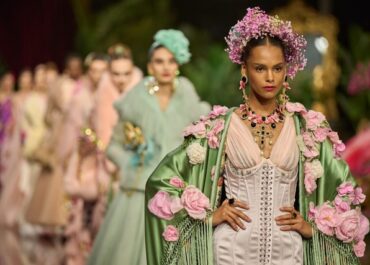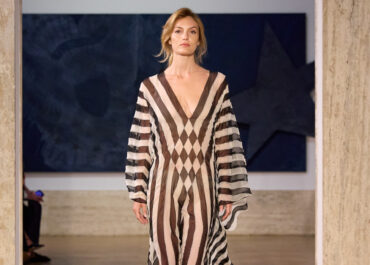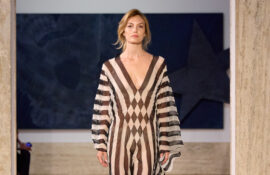

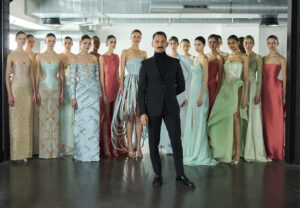
For his Spring/Summer 2026 Haute Couture collection “Fragments in Harmony,” Rami Al Ali looks beyond silhouette to something more abstract and instinctive. Inspired by a musical composition rooted in the 13th-century poetry of Rumi, the Dubai-based designer explores the idea of contrast as a unifying force, drawing parallels between harmony in sound and structure in dressmaking. The result is a collection shaped by tension and balance, where opposing elements are brought together through layering, texture and intricate surface work to create garments that feel both delicate and architectural.
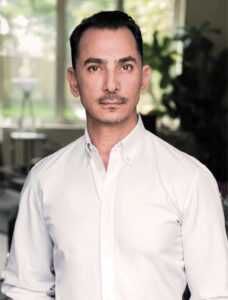
As his presence on the official Haute Couture Week calendar continues to grow, Al Ali reflects on modernising heritage, shifting global perceptions of Middle Eastern design, and how Dubai’s uniquely international audience continues to shape the evolution of his Maison.
Tell us about the SS26 Haute Couture collection, Fragments in Harmony. What was the inspiration behind it?
The idea for this collection began around a year and a half ago, when I first heard a beautiful piece of music by composer Shura Karimi called Duality. It was inspired by the poet Rumi, whose work I deeply admire and feel very connected to. We connected through conversations about music and the making of this piece, which sparked something creatively for me.
Much of Rumi’s poetry speaks about contrasts coming together in harmony to create unity. That same idea was evident in Shura’s composition and became the foundation of this collection. Sometimes, opposites coming together can create something far stronger than either element on its own.
This concept stayed with me. It is really the essence of fashion: threads and weaving, where very fragile, singular elements unite to create something structured and strong. It mirrors how something delicate, when organised and brought together with intention, can create a powerful and cohesive result. That is where the idea for Fragments in Harmony began. It all started from that musical piece and evolved into the collection you see today.
There were some very interesting silhouettes and material movements in this collection. Can you tell us more about the technical aspects you explored?
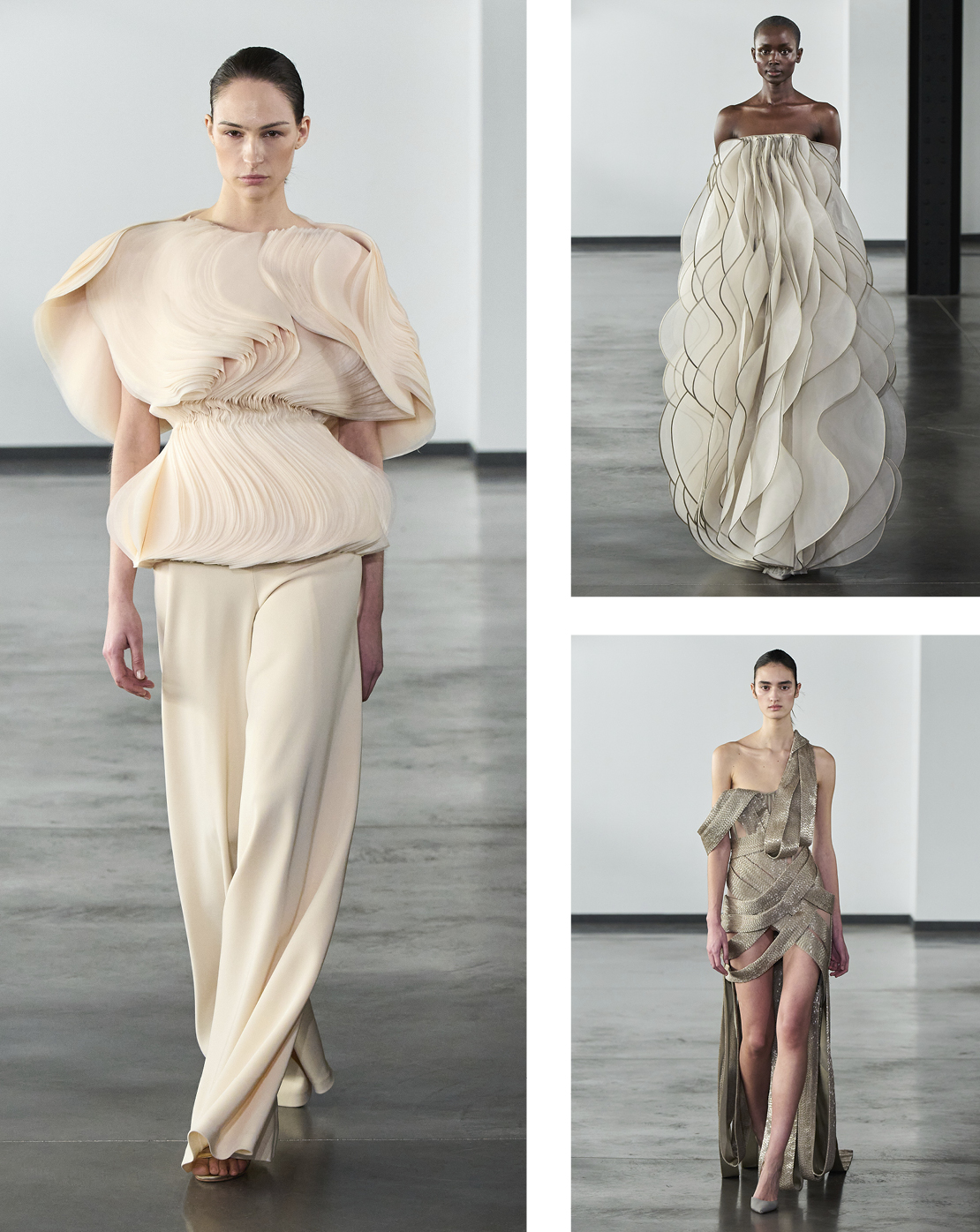
As with every collection, we began with techniques we’ve experimented with previously and pushed them further to achieve new results. Layering, and particularly multi-layering, became central to the principle of Fragments in Harmony. Individual, fragile elements come together to create movement and support, much as a society or community does.
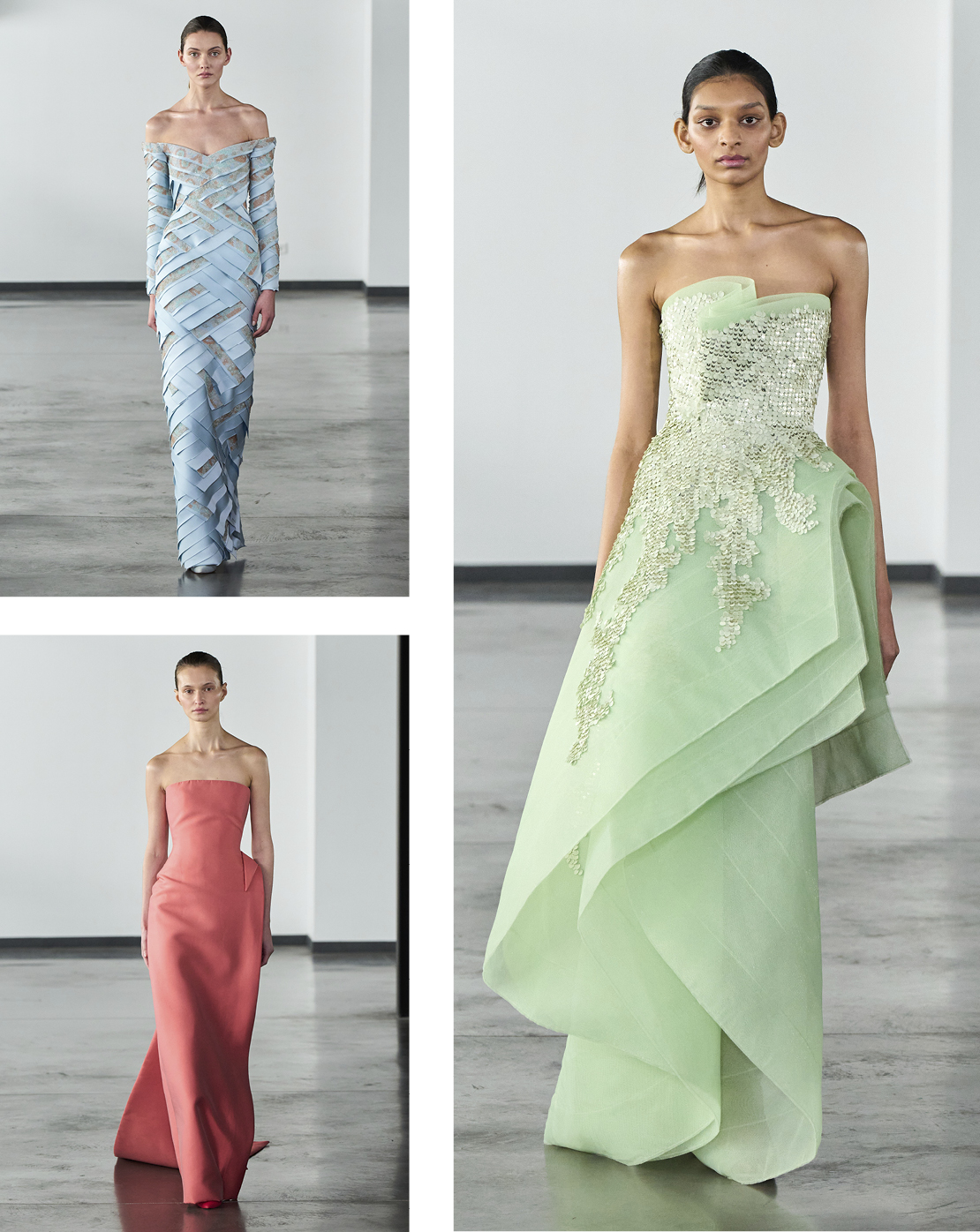
We explored this through different materials, from soft, fluid organza to more structured fabrics like satin, crepe, and Mikado. Each material responded differently, offering varied movement, volume, and structure, which, in turn, guided the design process. In some cases, the material dictated the silhouette, while in others, we began with the silhouette, knowing how the layers would behave.
We also introduced new techniques inspired by Persian carpets and their symmetrical patterns. Often, if you look at just one half of a carpet, it appears fragmented or disorganised, but together it creates perfect balance. In the embroidery, we developed a technique that appears pixelated, as though viewed through a magnifying glass. Laser-cut detailing reveals intricate Persian carpet motifs. From a distance, it reads as texture, but when viewed more closely, the pattern emerges. In some designs, it is very visible, while in others, it is hidden within the lining, creating an element of visual discovery for the viewer.”
What did you want people to take away from this collection emotionally?
One of the key ideas, which is becoming part of the brand’s DNA, is modernising heritage. The Middle East has an incredibly rich visual and craft history, but it is often viewed through nostalgia rather than in terms of its relevance to the present.
I wanted to reinterpret that heritage through modern silhouettes and a more minimal graphic approach. By integrating these traditional elements in a subtle way, the collection becomes more current and wearable. It reflects the Middle East’s journey not only through historical references such as the Silk Road, but also as a contemporary cultural perspective that is evolving and forward-looking.
Ultimately, I wanted people to see the region through a different lens, not only through its past but also through its present and future.
How do you feel perceptions around Middle Eastern designers are changing globally?
There are changes within our control and others that are happening naturally as the region evolves. Today, more people are visiting and experiencing the Middle East firsthand, which has significantly shifted perceptions compared to ten or fifteen years ago. A creative exchange is now taking place. We are no longer only importing ideas, but also exporting creativity, craftsmanship and storytelling. This has become more visible across different areas of the industry, from celebrity placements to a growing global clientele that believes in the region’s creative narrative.
However, we are not there yet. There is still work to be done on both sides. Middle Eastern designers are still underrepresented in museums and large-scale exhibitions, which are important for recognition and accreditation. Greater institutional acknowledgement is needed to fully reflect the region’s contribution to global design.”
You are now on the official Haute Couture Week calendar. What does that recognition mean to you?
In some ways, it makes the path easier by providing greater visibility, global exposure and accreditation from some of the most respected fashion institutions.
At the same time, it adds pressure. Every aspect of your work, from collaborations to communication, is now under scrutiny. It means there is no step backwards. Evolution must continue, even if it happens gradually. Being part of the official calendar comes with responsibility, and it requires consistency and ongoing development across every part of the Maison.
Dubai has long been your home. How has the city shaped both your aesthetic and the growth of the Maison?
Dubai has played a very positive role in the brand’s journey. It is a fertile environment for entrepreneurship and offers support to creatives, even those starting with limited resources.
The diversity of the community, in taste and background, allows you to think globally before you actually become global. You are constantly communicating with people from different cultures, mindsets and aesthetics.
The client here is highly exposed, well-travelled and discerning. She has seen a lot, experienced a lot, and she expects originality. It is not easy to impress her with something simple, which constantly challenges us to remain authentic and to renew our vision each season. That environment pushes you to elevate not only the aesthetic experience but also the overall brand experience.
Looking ahead, what are your priorities for 2026?
My main focus remains on fashion. We are working to stabilise our lines and expand into new markets. Bridal is a category with strong potential, particularly in the US, which aligns closely with our design DNA and aesthetic direction.
Entering new markets is an important step forward, especially those where our eveningwear and bridal offering can resonate with the local customer.
How do you balance the creative and business sides of running the Maison?
The key is finding the right team. Having people around you who share your vision allows you the time to focus on creativity while ensuring the business continues to move forward.
I am fortunate to have a team that executes each collection with precision. Their support enables me to develop new ideas, focus on upcoming collections and explore future projects. The credit truly goes to them for allowing that balance to exist.