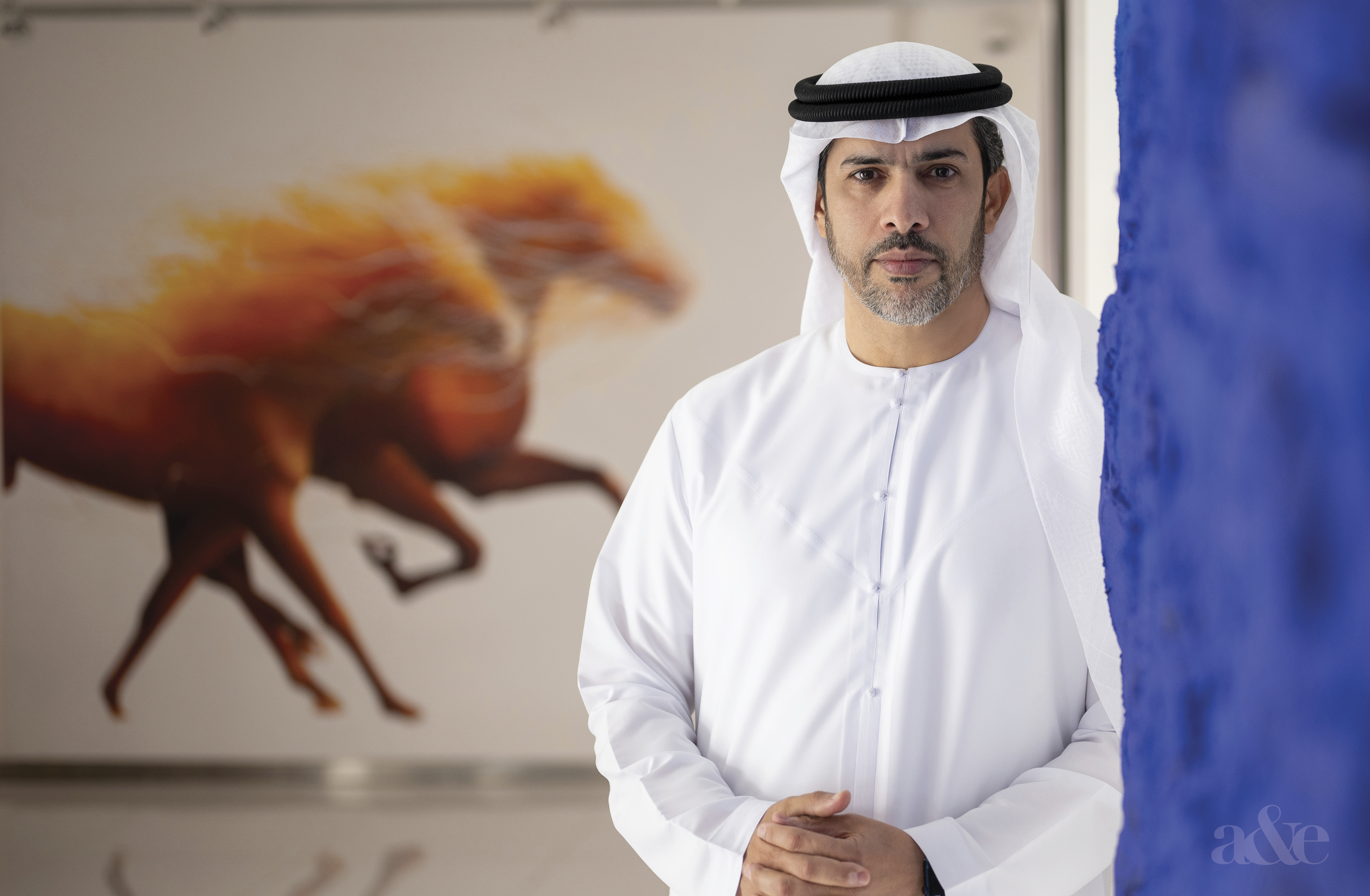
From monumental sculptures to the flowing Arabic calligraphy wrapping the Museum of the Future, Mattar Bin Lahej’s work has become an integral part of the UAE’s evolving cultural landscape. The Emirati painter, calligrapher, photographer, sculptor, and designer is known for blending tradition with contemporary expression, transforming Arabic script into bold visual statements that move beyond language into form, movement, and light. As the artist behind the Museum of the Future’s striking façade, often described as “the only building that speaks Arabic,” his work stands as a powerful symbol of both heritage and innovation.
Self-taught and multidisciplinary, Bin Lahej approaches art as a continuous exploration, moving fluidly between painting, sculpture, photography and design. His work draws inspiration from Emirati heritage, cultural memory and the rapid evolution of the UAE, resulting in pieces that feel both deeply personal and widely resonant. Through public installations and gallery works alike, he creates art that invites reflection, dialogue and emotional connection.
Here, Mattar Bin Lahej reflects on his creative journey, the evolution of Arabic calligraphy in contemporary art, and the ideas shaping his work today.
You are known for blending painting, sculpture, photography and design. How do these disciplines influence one another in your creative process?
For me, you cannot separate different art forms. Painting teaches sensitivity to colour and light, sculpture teaches patience and an understanding of mass, design opens the door to innovation, and photography is a third eye that sees what is otherwise unseen. When I work, these disciplines move together like an orchestra; each field complements the others, giving me broader freedom of expression.
Your work often incorporates Arabic calligraphy. What draws you to this art form and how do you reinterpret it for contemporary audiences?
Arabic calligraphy is not merely letters; it is a spirit. I am drawn to its capacity to transform; it can be a word, a form, or a movement. I present it today as contemporary art, not as a fixed heritage, but as a living energy that interacts with light, materials, and modern techniques.

Emirati heritage and cultural memory are central to your work. How do you translate these themes into visual art?
Emirati heritage is not old pictures to me, but a living memory. I translate it visually through symbols, materials, and the stories I grew up with. The sea, the desert, the majlis, human relationships, and the nation’s rapid development. I always aim to create work that dialogues with the past without repeating it and embraces the future without forgetting its roots.
You are a self-taught artist. How did your journey shape your distinctive artistic voice?
My journey was full of experimentation. I did not learn art only from books but from life, from mistakes, and from passion. That path shaped my artistic voice differently because it was not built on ready-made rules but on continuous searching and a desire for self-discovery.
Your public art installations have become part of the UAE’s visual landscape. Which project stands out as particularly meaningful to you?
Every public work holds a special place because it lives among people. Some projects remain especially close to my heart because they became part of a place’s identity. What moves me most is seeing people interact with the work, take photos, and pass by it daily, as if it has become part of their lives.
The Museum of the Future was a pivotal moment. To see Arabic script transform into architecture and for light to become part of the letter was an artistic dream realised. The project was more than a design; it was a responsibility to the nation and a symbol of the UAE’s vision for the future. I felt I was helping write a new page in the history of Arab art.
You have described your work as deeply personal and handcrafted. Why is this approach important to you?
The hand carries a truth that machines cannot replicate. Even when I use technology, the handmade touch remains the soul. I believe an artwork must bear the mark of the human; its pulse and its labour. That is what makes each piece unique.
Your Al-Duroor project in Al Shindagha explored an ancient astronomical device. What inspired this concept, and what message did you hope to convey?
I drew inspiration from humanity’s relationship with time and the cosmos. The “Duroor” was a simple yet ingenious device our ancestors used to understand the sun’s movement and the seasons. I wanted to revive that heritage in a contemporary way to show that ancient knowledge is not merely the past but a foundation we build upon.
You have created works both in the UAE and internationally. How do you approach creating art for different audiences while maintaining your identity?
Wherever I work, I carry my identity with me, while also listening to the place and its people. Art is a universal language, but its roots must remain firm. I balance my inner world with the particularities of each city or culture I engage with.
You have established your own gallery and museum space in Dubai. What was your vision behind creating this platform?
My aim was to create a space that resembles me: a place for dialogue, experimentation, and respectful presentation of work. I also wanted to provide a platform for young artists and contribute to Dubai’s vibrant art scene.
Preserving Arabic calligraphy is increasingly important in a digital world. Why do you believe this art form must continue to evolve?
Arabic calligraphy must evolve to stay alive. If it remains only within tradition, it will lose new audiences. Technology is not a threat but an opportunity; it can give calligraphy new life and open doors it could not reach before.
As one of the UAE’s most recognised contemporary artists, what advice would you give to emerging Emirati artists today?
I advise them to be honest. Seek your own voice rather than repeating what succeeds for others. Art is a long journey that requires patience, courage, and persistence. Above all, remain true to yourself.
Looking ahead, what projects or ideas are you currently working on?
I am currently working on a series that explores the relationship between light and script, and between movement and mass. I am also developing international projects that will be announced soon, offering a new vision for Arabic calligraphy in public space.
Who or what inspires you creatively, both within the UAE and internationally?
I draw first from the UAE: its energy, its transformations, and the stories of its people. Internationally, I am inspired by practices that break boundaries between disciplines and redefine beauty in unexpected ways.
What is your professional motto, and what continues to drive your creative journey?
Art is a responsibility before it is beauty. What drives me is the desire to create work that leaves a mark and adds something honest to the world.