
Founded in 2018 by architect and jewellery designer Lana Al Kamal, Lana Al Kamal Jewelry reflects a thoughtful approach to design rooted in craftsmanship, structure and emotional storytelling. Drawing on her background in architecture, Al Kamal approaches jewellery with a sculptural sensibility, creating pieces that balance proportion, movement and meaning. An elite member of the Dubai Chamber’s Jewelry Designers and Gold Business Group and supported by prestigious certifications from the Gemological Institute of America, she brings both technical expertise and creative vision to her work.
Since launching her brand, Al Kamal has developed collections inspired by nature, symbolism and the evolving role of jewellery in modern life. Her latest collaboration with Al Jalila Foundation, the Amal piece, further reflects her belief that jewellery can carry purpose as well as beauty, supporting women’s health and those facing cancer.
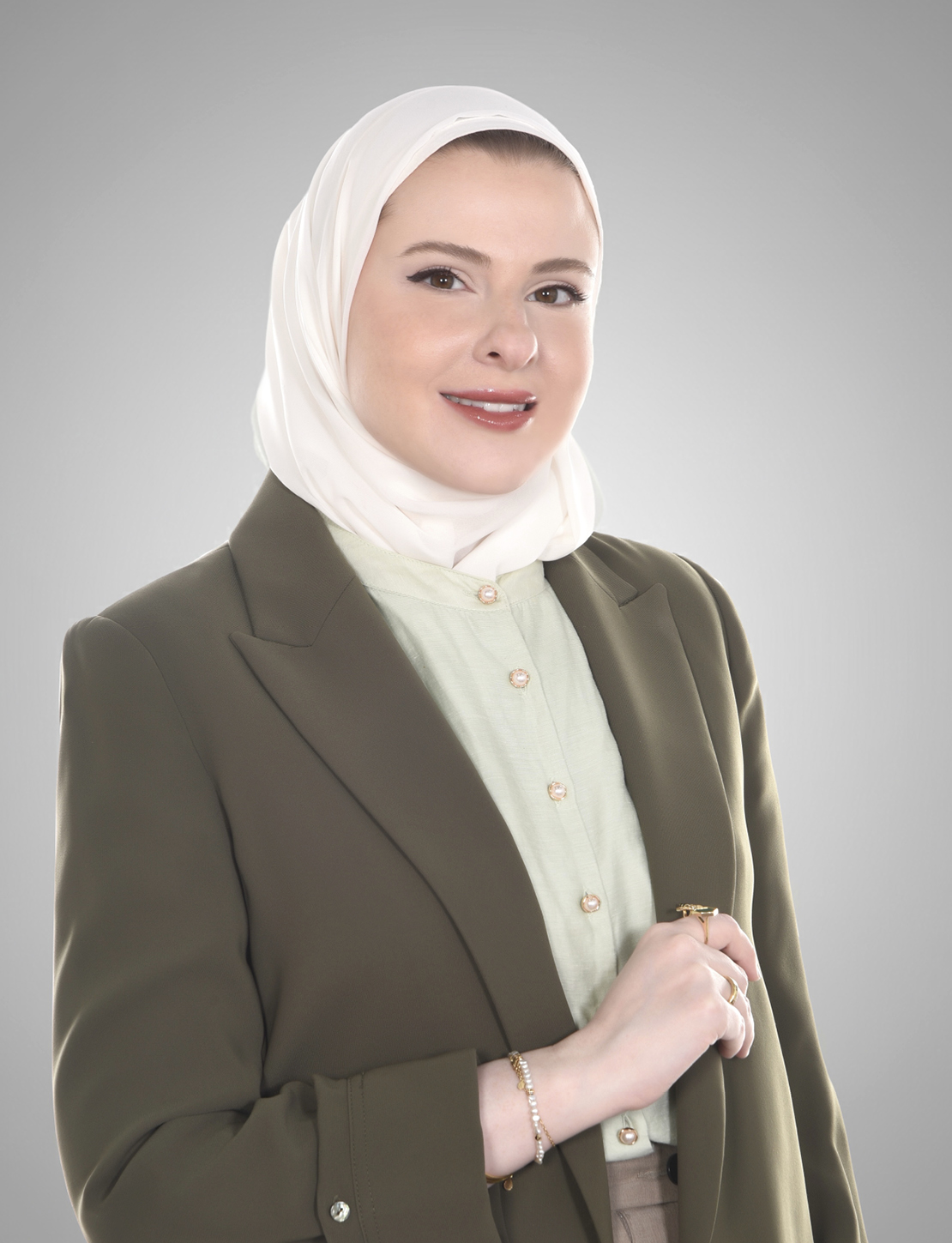
Here, Lana Al Kamal discusses her journey from architecture to jewellery design, the inspiration behind her sculptural aesthetic, the growing regional design scene and her vision for building a meaningful, globally recognised brand.
You began your career as an architect before founding your jewellery brand in 2018. What inspired the transition from architecture to fine jewellery, and how do the two disciplines intersect in your work today?
Architecture was the beginning of my relationship with design. When I studied architecture, I discovered that what truly excited me was not only buildings themselves, but the act of designing. I found myself fascinated by every form of design, interior spaces, exterior structures, objects and details. During that time, I began sketching jewellery purely for myself, almost as a personal creative exercise. Even while working as an architect, I felt a growing desire to explore design beyond architecture. Jewellery slowly became another passion. Eventually, I decided to study jewellery design and gemmology, and that was the moment when I realised I wanted to build something of my own. The transition was not sudden; it grew naturally from a deep love of design. Today, architecture still lives inside my work. I approach jewellery the same way an architect approaches a building, thinking about proportion, balance, structure and how a piece interacts with the body. Each design becomes a small architectural object with emotional meaning.
In what ways does your architectural training influence the way you approach form, balance and structure in jewellery design?
Architecture trains your eye to understand volume, balance and structure. That perspective naturally shapes how I design jewellery. I rarely see jewellery as something flat. I think about how the piece moves, how light touches different surfaces and how it sits on the body from different angles. Many of my designs include layers and depth because I approach them almost like small sculptures. This architectural mindset allows the pieces to feel dynamic and dimensional rather than purely decorative.
Your latest collaboration with Al Jalila Foundation introduces the Amal piece, created to support women’s health and those facing cancer. What inspired this initiative, and why was it important for you to use jewellery as a vehicle for social impact?
I strongly believe that every career should include a way of giving back to the community. As a brand founded by a woman, I have always supported women. I believe deeply in the idea of women supporting women. When I started thinking about how Lana Al Kamal Jewelry could contribute meaningfully, I wanted to create initiatives that could support women in real ways. Supporting women facing cancer felt especially meaningful, leading to a collaboration with the Al Jalila Foundation.
What makes the Amal initiative special to me is that it is not only the brand making a donation. With every Amal necklace purchased, 50% of the profits are donated to support women battling cancer. That means our clients also become part of the impact. In this way, the initiative becomes something shared, the brand, the clients and the wider community all participating together in spreading hope and support.
The name Amal, meaning hope, carries powerful symbolism. How did that concept shape the design of the piece itself?
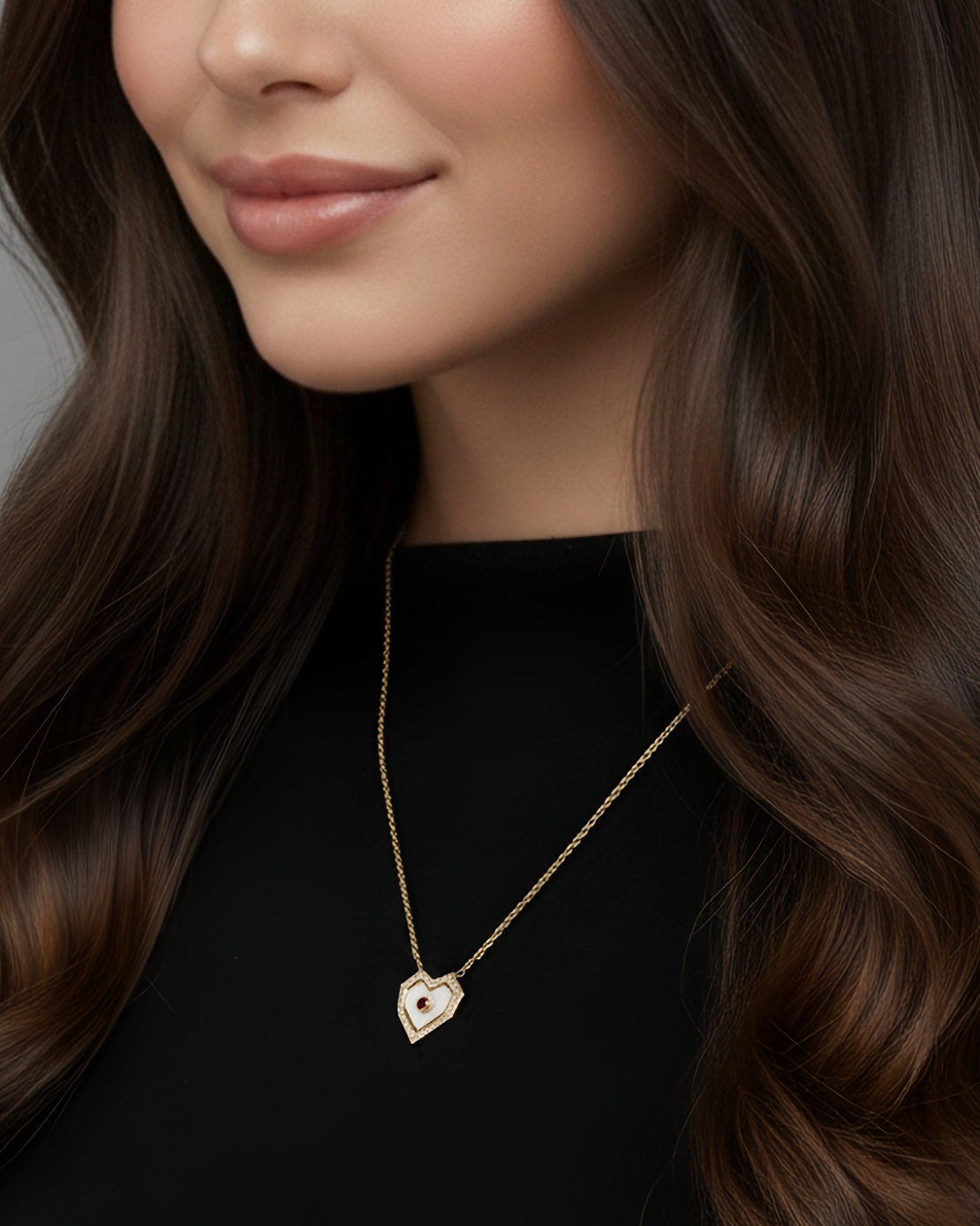
The entire design process began with the word itself, Amal, meaning “hope.” From that idea, we developed a mood board exploring emotions connected to hope, care and compassion. The heart shape became central to the design because it symbolises warmth, love and empathy.
The heart is framed with diamonds that form a circle around it, almost like a community standing together in support. At the centre, the heart is crafted from mother-of-pearl, chosen for its soft, calming presence and sense of serenity. Finally, a ruby sits at the centre, a stone associated with life, courage, strength and resilience. Each element carries meaning. Together, they create a piece that tells a story of hope, compassion, and collective support.
As a female-founded jewellery house, your brand celebrates strength and femininity in equal measure. How has your experience as a woman shaped the way you build and lead your business?
For many years, the fashion and jewellery industries were largely led by men. Today, it is inspiring to see more women stepping into leadership roles and shaping the direction of these industries. As a woman designing for women, I feel there is a different level of understanding. I can imagine how the piece will feel when worn, how it becomes part of someone’s daily life and what emotional meaning it might carry. That perspective naturally influences both my designs and how I lead my brand. Femininity brings sensitivity, intuition and attention to detail, qualities that are incredibly powerful in creative industries.
The Middle East is seeing a new wave of independent jewellery designers emerge. How do you see the regional jewellery industry evolving, and what makes this moment particularly exciting?
The Middle East is experiencing a very exciting evolution in jewellery design. In the UAE in particular, there is strong support for creativity and entrepreneurship. The environment encourages designers to start their own businesses and develop their artistic voices.
Over the past eight years, since founding my brand, I have watched the regional design scene grow rapidly. Today, many talented designers produce work that could easily compete internationally in terms of creativity, craftsmanship, and gemstone quality. This moment is exciting because the region is no longer only a consumer of luxury; it is becoming a creator of it.
Many of your collections explore themes found in nature. What draws you to these motifs, and how do they reflect the women who wear your designs?
Nature is one of the greatest sources of inspiration for me. If you look closely, nature offers endless ideas, plants, insects, waves, stars, colours and textures. It is an infinite design library. Personally, I feel very connected to nature, and that connection naturally appears in my jewellery.
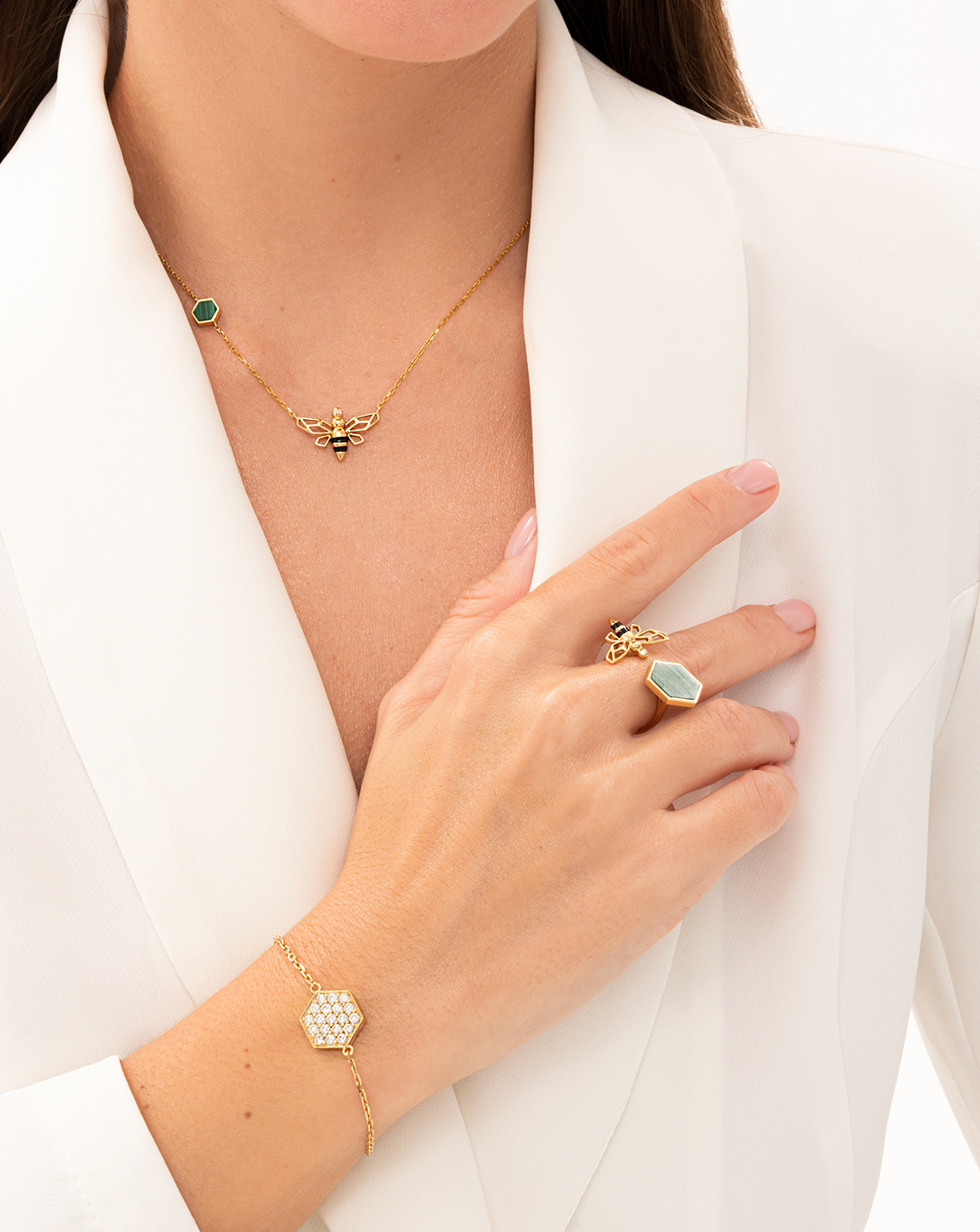
Many of my pieces also carry symbolic meaning inspired by nature. Butterflies represent transformation, flowers symbolise growth and bees reflect dedication and harmony. Through these symbols, the jewellery becomes more than decoration. It reflects the journeys and emotions of the women who wear it.
Your pieces are designed to move effortlessly between special occasions and everyday wear. Why was it important for you to create jewellery that accompanies women through all moments of life?
Jewellery should not only exist for rare occasions. The pieces we wear every day often become the most meaningful because they accompany us through our daily lives. I wanted to create designs that feel elegant yet comfortable enough to wear regularly. In modern life, women want jewellery that moves with them, from everyday moments to special celebrations. Designing pieces that adapt to both was very important to me.
Having studied gemmology and jewellery design at the Gemmological Institute of America, how important is technical mastery when it comes to creating pieces that feel both artistic and enduring?
Technical mastery is essential. Creativity alone is not enough to create fine jewellery. Understanding gemstones, metal behaviour, structural durability and craftsmanship is what allows a design to truly come to life. Studying gemmology and jewellery design gave me the technical foundation needed to translate ideas into pieces that are not only beautiful but also durable and enduring. In many ways, jewellery design is a balance between art and engineering.
Entrepreneurship often comes with challenges. Looking back at your journey since launching the brand, what have been some of the most defining or difficult moments?
One of the biggest realisations when starting a business is understanding that design is only one part of the journey. When I launched the brand, I quickly learned that running a company involves many other responsibilities, strategy, operations, communication and business decisions. That was one of the biggest challenges in the beginning. But over time, through experience, learning and persistence, you develop the skills needed to navigate these challenges. Every difficulty becomes part of the learning process.
For women who are considering a career change, as you once did when leaving architecture, what advice would you give them about taking that leap?
For me, the transition from architecture to jewellery did not happen overnight. It was a gradual process. I spent time exploring jewellery design while still working in architecture. I studied, practised and tested whether this passion could truly become a profession.
Only once I felt confident that it could become both creatively fulfilling and sustainable did I make the full transition. My advice would be not to rush such decisions. Think carefully, prepare yourself and build a strong foundation. Follow your passion, but also approach it with patience and clarity.
Finally, looking ahead, what would you still like to achieve with Lana Al Kamal Jewelry?
My goal is to continue growing Lana Al Kamal Jewelry into a globally recognised brand. I want the brand to be known not only for craftsmanship and design, but also for meaningful storytelling and emotional connection. Jewellery should carry beauty, but also purpose and memory. Ultimately, I hope that when people wear a Lana Al Kamal piece, they feel both elegance and meaning, something that becomes part of their own story.
By Lindsay Judge