

Exclusive Interview: Panerai’s CEO Angelo Bonati
While at the Classic Yachts Challenge that took place in Argentario, Italy, we spoke to Panerai CEO, Angelo Bonati, as he dishes about the passion in today’s industry, making mistakes, and the message he’s passing on to the new generation.

Where is the emotion and passion in today’s watchmaking industry and how hard it is to maintain?
Passion is something that you can’t buy! You either have it or you don’t! Passion is linked to a philosophy, it is how you work, how you approach people, and how you involve them in your projects and products.
To me passion is as important as marketing. For example, when you buy and wear a specific perfume and you are loyal to it, why is that? It is simply because it gives you a certain feeling, an emotion!
In our industry, people should feel that you are giving them something special and different. You should give them that emotion. Today we are in an era of social networks and multi-channels. The language is changing since the world is changing, but in the centre of all of the above, and in addition to e-commerce, we should never forget the core, which is the passion and emotion.

Do you work well with social media?
I enjoy checking it from time to time, but not to post. I am not a fan of sharing every move I make.
Today what are the best performing watches from Panerai?
The Americas Cup watches sold out immediately, and we have a large number of clients on the waiting list.
What’s a message you would pass on for your teams?
Be Spontaneous! I’ve been managing people for many years but I was never the typical manager. Sometimes I am sweet and sometimes I’m strong, I am just spontaneous!
But being spontaneous can sometimes results in making mistakes?
Mistakes are a part of life! I will try to translate a famous Latin quote which sums this up, ‘Making mistakes is human, but repeating the same is diabolical.’
Have you ever made mistakes that you regret?
No, and if I had to repeat my life, I will continue to live the same way. Mistakes motivate you to do better and be better, but you must be humble to recognise and admit it.
What scares you?
When people are not sincere.
Have you been failed by people?
Many times.
And how did you react?
Positively! I tried to be professional.
Describe Panerai in 3 words?
Unique, Authentic, Coherent.
How would you like the industry to remember you?
Oh God! I don’t want them to remember me.
Do you want to be recognised for what you have achieved?
I have spent 20 years of my life at Panerai, which in a way is my life! What will I expect from my successors? For sure they’ll try to say that I was wrong. It is the ‘Ego’ factor, but this is part of life!
How do you spend your free time if you are not sailing on your boat?
Reading, listening to music, and trying to relax.
What book are you reading now?
Currently I am not reading a book, as I need to be relaxed to read.
What type of music you listen to?
Music gives me a good mood. I love Classic, Jazz, Rock, and Italian music, it depends on my mood.
Going back to your boat, I know your passion is at the sea, tell me more?
When I’m on the boat it’s just like hearing a music I love, it is a rhythm, you float, and you enter a new dimension. Being at sea relaxes me after working a lot, it is the perfect reward.
What do you tell yourself every morning?
I try to organise my day, my thoughts, and be positive.

a&e Editor-In-Chief Lara Mansour Sawaya with Angelo Bonati
By Lara Mansour Sawaya
Exclusive Interview with Julien Marchenoir of Vacheron Constantin
Vacheron Constantin, the world’s oldest watch manufacture, has enjoyed uninterrupted activity since its founding in 1755. As a full-fledged watch Manufacture, it masters the complete creative process, ranging from research and development of movements, the aesthetic definition of each of its models, the full set of stages in designing and making the watch components, through to entirely hand-crafted finishing.

In celebration of a vibrant history of over 260 years, the Swiss watch brand recently restored the 18th century clock, ‘La Création du Monde’, in collaboration with the Musée de Louvre and Atelier Chronos.

Conceived as an educational journey revolving around the spirit of astronomy and horology, the unveiling of the restored clock, that dates from the same year as the foundation of the Vacheron Constantin Maison, is an exploration of the evolution of the measurement of time, of its crafts and of artistic influences, a trilogy that defines the history of Vacheron Constantin since its foundation. The exclusive trip is a travel back in time encompassing traditional tools and sciences leading through contemporary instruments to innovative developments in both astronomy and horology.
Located in the Musée de Louvre, the vintage clock shares a long and eventful history starting with its creation in mid-18th century at the expense and request of Joseph Francois Dupleix de Bacquencourt, the Governor of the French establishments in India. Originally intended to be a gift for the Nabab of the Deccan province, Salabetzingue, the clock was first presented in January 1754 at the court of King Louis XV of France in Versailles, from where it was taken aboard the ship La Diane headed for Pondicherry, accompanied by the horologist Jean-Pierre Dutertre. However, when Dupleix de Bacquencourt got dismissed from his post, the clock was summoned back, and arrived in France around six months later.

The voyage had left its mark on the clock. Having sustained substantial damage from the two year long maritime journey, a dynasty of Lepaute horologists were called to help restore the clock to its full working order. However, it wasn’t long before the revolutionary courts seized it, and came into the possession of Antide Janvier. He deliberately destroyed the clock, under the threat of having to sell it for its weight in metal, and handed it over to the national Assembly. The repair work, entrusted to Lepaute, lasted almost ten long years from 1801 to 1810 during which the clock also bore certain modifications. This included replacing the formerly silver planetarium with a medal-type colour and the addition of the equation of time. In 1823, Robin Junior came on board to perform a second set of very intensive repairs, with which he stated to have maintained a large number of the clock’s flaws. The clock was again repaired for a third time by Bécard and Batteux.

The Louvre Museum has played home to the clock since then. It was in 2016, when the restoration work was undertaken in accordance with the conservation and restoration policy of the directors of the Louvre Museum and in keeping with the brands determination to oversee ‘the best possible restoration work’. Today, Vacheron Constantin is finishing an almost year long restoration on the clock with an entirely reversible conservation-restoration technique. This technique allows each newly-made component to be removed and replaced by the one that had been previously damaged or degraded, or removed or was deemed missing. This included the rebuilt lunar cycle mechanism, the hours and equation of time hands which, according to Lepaute’s descriptions, were lost, the winding system of the earth’s rotation mechanism, amongst others.
Here, after learning about the extensive history of watchmaking, Marketing and Heritage Director Julien Marchenoir shares his views on the brands heritage, and about not only focussing on developmental and technical innovations, but also reflecting on the evolution of time, as well as trends and patterns in life.
How challenging is it to market the heritage of the brand while keeping it appealing to today’s generation?
Our heritage is our roots, but of course the tree continues growing. It is about reinterpreting our heritage it in a way where it is an inspiration for our creativity. It is part of who we are, but we are 260 years old and we are now looking forward to our next 260 years.

Tell us about the Celestial mechanics?
Astronomy and horology are closely bound together and represent the very foundations of time measurement. From the 19th century to the present day, the history of astronomical complications at Vacheron Constantin has been punctuated by a longstanding tradition of horological expertise. So, this year we launched horological landmarks in the field of astronomical accuracy. A one-of-a-kind piece with 23 mainly astronomical complications displays the civil time, the solar time, and the celestial time. It is one of the world’s most complicated wristwatches, a milestone for Vacheron Constantin and the source of inspiration for further astronomical timepieces such as a tourbillon with an equation of time, equipped with sunrise and sunset times for the city of Riyadh and for several expressions of astronomical features among which perpetual calendar and moon phase in the traditional collections.

Can you share with us what have been proud moments for Vacheron Constantin throughout its history?
This is hard to choose, but I would say that there have been 2 important factors that have been there since the beginning. Firstly, a commitment to pass on knowledge and skills from the watchmakers and artisans to the next generation, and secondly, we are never easily satisfied. This embodies the motto of the brand to do better wherever possible in a quest for excellence, always looking for ways to improve. At Vacheron Constantin, there has been a philosophy in place from an early age, to look beyond the watch as a functional object, and see it as an ornamental object which of course has a function, but tells something about who owns and wears it. Because of these requirements that we have set ourselves to achieve the highest means, we have gone on to have many pieces commissioned by some very important people.
What is the difference between watchmakers of earlier generation, and the watchmakers that we see today?
Back in the ‘70s when the cost prices were affected there were a gap of new talent in our workshops. This was a time when people weren’t entering the watchmaking sector as a career, as it was deemed unstable. However in the early ‘80s it began to grow and develop allowing us to recruit and train young people. So, when you visit our manufacturing you will find a younger generation of watchmakers instead of what you would traditionally expect. that there are more young people rather than what you think is the traditional watchmaker. What is interesting about the young watchmaker is that they are all aspiring to become high complication technicians, which helps us evolve and keep the brand relevant for today.

Les Cabinotiers Celestia Astronomical Grand Complication 3600
How would you describe the brand in 3 words?
It is a blend of excellence, heritage, and craftsmanship.
Does the brand still maintain passion today?
I think passion is a love affair and it needs to be nurtured, and in the future we need to make sure that the image is managed as we are an institution in the watch industry.
By Lara Mansour Sawaya
READ NEXT…
Our exclusive shoot with Vacheron Constantin’s Overseas Collection.
Time Share: September Photoshoot with A. Lange and Söhne
Bold, beautiful, and embodying the pinnacle of international fine watchmaking, timepieces that are perfect for both men and women.

Her: Saxonia Him: 1815 Annual Calendar All A. Lange & Söhne

LEFT IMAGE: A. Lange & Söhne Datograph Perpetual RIGHT IMAGE: Her: Saxonia Him: Lange Zeitwerk All A. Lange & Söhne

LEFT IMAGE: A. Lange & Söhne 1815 Annual Calendar RIGHT IMAGE: A. Lange & Söhne Saxonia

LEFT IMAGE: Her: Saxonia Automatic Him: Lange 1 Moon Phase All A. Lange & Söhne RIGHT IMAGE: A. Lange & Söhne Saxonia

Her: Saxonia Automatic Him: Lange 1 Moon Phase All A. Lange & Söhne
Fashion Director: Eliza Scarborough
Photographer: Francesco Scotti at MMG
Hair and Make-up: Bianca Hartkopf at MMG
Model: Angelika and Aydin at MMG
Women’s Clothing: By Symphony
Men’s Clothing: Dunhill
READ NEXT…
Our exclusive interview with A. Lange & Söhne CEO Wilhelm Schmid.
Floating Time: Interview with Jaeger-LeCoultre’s Marc Newson
Marc Newson innovator of the Atmos clock for Jaeger-LeCoultre.

Long fascinated with mantle clocks and a passionate fan of the Atmos, a mechanism that runs on temperature differential alone, Marc Newson was first approached by Swiss watch and clock manufacturer Jaeger-LeCoultre back in 2008 to collaborate on the new design of the Atmos. Fast forward almost a decade long partnership, and the third collaboration between Newson and Jaeger-LeCoultre, the Atmos 568, is all about lightness, transparency, and simplicity.
Invented in 1928 by the Swiss engineer Jean-Léon Reutter, the Art Deco pendulum clock is an elegant nod to a bygone era. It is now a sleek piece of modern design, thanks to Jaeger-LeCoultre’s bold approach to this collaboration.
Here we talk to the Australian designer about how he has reinterpreted the Atmos clock by reworking its classical style while preserving all its essential features, allowing an icon of watchmaking to become an icon of style.

Tell us about your new collaboration with Jaeger-LeCoultre, and how it came to life?
So, as I am sure you are aware, I have previously designed two of these Atmos clocks over the past ten years. Both pieces were limited edition and pretty much sold out immediately, so we understood that there was an interesting opportunity and demand to design another. We also decided that this time we would not limit the number, allowing it to be a piece that would be available moving into the future, which for me was important.
What makes it unique to the previous two versions?
The design is of course different, and technically it is a much more complex piece to make.
You have worked in design, from furniture to technicalities. What makes fine watchmaking different?
Working in this industry really appeals to my sense of craftsmanship. I trained as a silversmith and didn’t study design, so I have always had a strong interest in handcrafting, and skills that can only really be passed from person to person.
Do you remember the first thing you ever made?
When I was ten years old, my uncle gave me his watch and I immediately destroyed it, deciding to redesign the case, and put it back together. Of course this horrified my family, but for me it was the start of something, and I went on to try and make another watch myself afterwards.
Speaking from the design element, what do you think the watch-making industry is lacking?
Frankly speaking, there is a lot of repetition and I feel that the technicality of the industry dictates a lot of this repetition as there are unavoidable realties in the industry which is what leads people in certain dimensions. I also feel that there is a lack of modernity. Although the industry as a whole can be very modern from a technical perspective with many innovations, from a design perspective I feel there is a lot more available to people who are less interested in modernity. Therefore, our collaboration worked especially well in my eyes, because we took a 90-year-old object and gave it a modern twist, making it relevant to a new audience.

What is one thing you would still like to design?
I always had a strong interest in aerospace and spacecrafts, and although I have already designed within this realm, it would be amazing to design something that went into space. Personally, I have been very lucky and worked on many projects during my career, but the Atmos project has been a great opportunity for my love of art, as I don’t often work so closely with teams of accomplished craftsman, especially because this is a way of working that has become much less common.
Do you have any plans to promote and revive craftsmanship?
The most that I can do is to do more projects like this clock. I can be more effective by working with craftsman, trying to create some level of commercial success and justification at the back end, which will in turn benefit them and the industry.
How do you balance something that has commercial success, but also emotions?
It is very hard to understand before you do it. I think it is a methodical and organised process, but you just never know what is going to be a success. Products will always surprise you, getting a reaction from consumers that you can’t expect, whether it is better or worse that what you predicted.
What else would you like to achieve in your life?
I would like to work more on projects which really interest me. Throughout your career you inevitably find yourself pulled in different directions, working on some projects that for one reason or another you may prefer not to do. So I would now like to just work on the things I love and interest me on a personal level, regardless of money.
How would you describe yourself?
I am a perfectionist! I would rather not do something at all if I can’t do it to my best ability.
What does time mean to you?
I wish that time could be looked at, and that it was more philosophical. Time is now so binary and we talk in minutes and seconds.
What is your personal motto?
Don’t stress.
Tell us something no one knows about you?
That I am probably quite lazy!
What book are you reading?
I am reading a book that I gave to my daughter for Christmas which she doesn’t want to read. It is Jules Verne, 20’000 Leagues Under the Sea. I must say though that I very rarely read books anymore, as I just don’t have the time.
What are your thoughts on the digital world?
I don’t participate in social media at all, no Facebook, Twitter, or Instagram.
What do you love to do most when you have some time to yourself?
Nothing! My ideal is to think and drink tea.
What is your resolution for 2017?
To think carefully, and not to make any silly mistakes.
By Lara Mansour Sawaya
Interview with Lebanese Interior and Furniture Designer, Nada Debs
A Lebanese interior and furniture designer, brought up in Japan, who studied interior architecture in the Rohde Island School of Design. Nada Debs later moved to the United Kingdom for work before returning to her home country to launch her own company. Here the designer tells us more about the contemporary design world, culture and craftsmanship in the Middle East.
Tell us more about your background, and why did you choose furniture design?
I had studied interior architecture but took a course in furniture design. I didn’t realize I enjoyed so much researching materials and how to put them together to create a functional object.
What would you say are your main influences when conceiving a piece of work?
The craft technique inspires me as well as trying to have clean lines showing just the essence of what I’m trying to design- that must be the Japanese influence as my upbringing has definitely affected me.
What comes first – the materials or the design idea? Walk us through the process of any piece. And what part of the process excites you the most?
The first thing I do is to create a sample of a craft idea, which reflects the new concept that I am working on. For example, I wanted to take our traditional marquetry work that is in our typical backgammon games and apply a different colour and pattern to it. I create these samples and then see where I can incorporate it. I create then other samples until I am happy with the finish. Usually the pieces I make try to highlight the craft so in this case I applied the craft to create a frame for the furniture piece. Basically my products forms are based on showing our modern updated craft in as pure and straightforward form as possible.

Describe a day in the life of Nada Debs. What sparks a new project for you?
I am quite aware of trends worldwide I ask myself what are people looking at, their needs, and what are movies
highlighting? As for my day, I arrive at the studio and start immediately discussing my projects one by one with my designers. Usually they prepare the samples materials so that I can check on the quality and work on the next steps. In general I’m quite hands-on. We are also starting to focus on interior design. I often meet my clients in the studio in our sample room that has all types of materials to work with. Of course, Fifty my Golden Retriever makes sure she attends all meetings. The day goes by very fast. I use the end of the day for me-time and to answer emails and think of next steps. Ideas come to my mind after a whole day of being surrounded by design, materials and inspirational pieces that I collect.
What would you say are your values and ethics when it comes to designing?
I need to be true to the craft although sometimes it’s very difficult because machines take over. It’s also more costly but I believe that, because my mission is to preserve our craft and heritage by making it more relevant to our time and our style, I have to stick to our philosophy. I don’t mind that our products are not perfect- that’s part of the charm. I always say we strive to celebrate imperfection in a perfect way. I also aim to create as much as possible in Lebanon and the Arab world, this keeps the tradition and pride of the industry going.

What’s your take on craftsmanship, especially in the region? What do you think could be done to raise the level of skill amongst craftsmen in Lebanon?
It’s very hard to convince craftsmen to look the future. They are usually looking to the past and feel almost guilty to play around or do this differently from what they already know. But I give them a lot of attention and they welcome my input because I explained that the old products are not so popular anymore and we need to evolve to reach the young generation. And the fact that I insist that this remain to be made by hand, they agree with me. Now they get excited when I give them new ideas. We have beautiful craftsmanship and it is part of our culture. It is part of our identity. One can recognize a Middle-Eastern design. It just needs to be updated in a way where we still retain its essence.
Why do you think the Nada Debs brand has been so universally successful?
I guess because I simply highlighted the importance of our identity. My personal identity has always been a question that had remained troubling for me. My furniture and objects actually showed me who I am a modern Arab (mixed with Japanese aesthetics). I use terms such as ‘modern Arab identity’ promoting local production, celebrating eastern craftsmanship and the
East and East (the two Easts I come from). Although I was a silent introvert when I arrived to Beirut 17 years ago, I realized that if I want to promote all the above, I needed to talk about it. My team all live this philosophy and it spread when people are happy to hear it. My best compliment is when our clients all over the region tell me ‘ You make us proud’- It actually brings tears to my eyes when they say that.
What is/are your greatest threats?
I don’t have much except that we are losing quality craftsmen and need to keep this up.
Does Lebanon as a base play a factor in your work?
Definitely, this is the base of my work- I take pride in producing in Lebanon. It is also very inspiring because it is between East and West with a lot of soul.
Would say that your practices have changed to keep up with today’s new technologies?
Yes, I am going to have to incorporate technology within our craft because we cannot deny it. It’s actually my next challenge.

What’s your favourite piece from your archive?
Sometimes I get surprised when I look back at some of my work and realize that I’ve designed them. I like several pieces- my floating stool / Arabesque chair / Pebble table / Concrete table / Geometric trays / Mosharrabieh cabinet / Bling Bling Coffee bean / Concrete bowl land of the rising sun bar cabinet. But to be honest, most of the pieces are not about the piece as much as the craft involved in it.
Do you have an inspirational teacher or a muse you look up to?
I like women designers such as Patricia Urquiola and India Mahdavi- I owe my teacher Sylvia Acosta at the Rhode Island School of Design, because she really pushed me to go beyond my comfort zone. I am also inspired by fashion brands such as Paul Smith or Bottega Venetta, who use their identity and constantly create new objects with them.
What part of creating is more important for you: The idea, the process, or the outcome?
The idea first, then the process. I am not really into the end product- I feel what I sell is not a product it is a message!
What was last piece of home-ware you bought?
One of my own! I created a new prototype, a table using steel and Tatami rolls.
What is your favourite design shop in Lebanon or in any other country?
Any shop that buys products involving old and new craft techniques- I like Mint in London.
Do you have any advice for those hoping to break into the industry?
Persistence!
Any tips for someone who is looking to makeover a space or a room?
Make it personal.
What’s next for Nada Debs?
As a brand, a shop-in-shop concept and moving into a lifestyle concept store with more affordable small objects for the millennials… As a designer, my aim is to incorporate technology with craft.
By Dana Mortada
Sarah Beydoun of Sarah’s Bag Shines for Social Good
A social entrepreneur and designer, Sarah Beydoun is the founder and creative director of “Sarah’s Bag”, a world-known brand of handmade bags and accessories. You may have seen her fun accessories across various department stores and e-commerce websites likes of Matches Fashion and at Moda Operandi; but behind all of the intricately embroidered and festive bags, is that all the craftsmanship that goes into the handbags done by incarcerated and underprivileged women living in Beydoun’s home country.

Here we learn more about the designer’s vision, the impact of the brand and her social enterprise that empower both the women who make them and the women who purchase them.
How Sarah’s Bag Started…
The Lebanese-born unusual journey in fashion began during her last college years, when she was conducting her research at Dar Al Amal, an NGO that rehabilitates women at risk and female ex-prisoners. After completing her degree in Sociology, Beydoun then made a decision to set up a business that would train and engage the imprisoned women she’d met during her thesis. Soon the designer launched her own label Sarah’s Bag in the year 2000, in the city of Beirut. The brand merges Sarah’s love for fashion design with the conscious of empowering unfortunate women; all of which reflects her high-spirited personality while creating hip and playful handcrafted lavishing pieces.
The Signature of the Bags…
Sarah’s Bag aesthetic is all about being fun and colourful yet crafted with luxurious refined details. Each handbag collection includes new textures, fabrics and techniques of traditional crafts such as hand beading, embroidery, sequinning and crocheting. The brand has kept loyal to old techniques while reviving them with fresh materials and modern design techniques. To create such intricate statement bag, each masterpiece requires anywhere between 10 to 25 hours to be complete.
The Women Behind the Bags…
Seventeen years later, Sarah’s Bag works with over 200 women, whom are prisoners, ex-prisoners and underprivileged women in Lebanon. The brand is famous for its original crafted designs that showcase the artisan’s skills, and many of which in their own will are still with the company since it first launched to this very day. Sarah’s Bag is known also for having a positive ripple effect on the artisan’s families. After the female prisoners complete their sentences, it doesn’t stop there; the brand encourages them to still be part of the company and to become team leaders and trainees to other underprivileged women across their hometown. This does not only give them the advantage into becoming financially independent, but this opportunity also helps them to overcome the shame of being former prisoners, who turn into respected citizens amongst their communities.
After all this is the kind of brand and project that’s unfortunately very rare to find in fashion—while revolutionizing the production world, Sarah’s Bag gives the world a fabulous sensation at the same time.

10 Things you didn’t know about the Founder…
Best work experience…
Nothing beats seeing an idea come to life.
The most surprising thing that inspires your work…
Our archives.
Your favourite childhood memory…
The summers I spent with my sister in my grandparents’ beach house in the south of Lebanon.
Someone you currently admire…
My mom is the person I’ve always admired and looked up to.
The last place you traveled to…
Portugal- Lisbon
Pick one food item to bring to a deserted island…
Stuffed vine leaves!
Beirut is…
Despite everything else going on in the country, Beirut is great for its dynamism, its openness, the collective energy and resourcefulness of its people, the celebration of life, the good food, the music and the arts.
Best advice you ever gotten…
Change your thoughts and you’ll change the world.
The most important thing to maintain your success…
A positive attitude, perseverance and passion for what you do and an underlying purpose for why you are doing it in the first place.
Your life motto…
Believe you can and you are half way there.
By Dana Mortada
The Renewal of Zenith: Interview with New CEO Julien Tornare
Newly appointed CEO, Julien Tornare, takes the swiss watchmakers to the next level.

After spending 17 years at Vacheron Constantin, Julien Tornare, a real veteran of the watch industry, made the move over to LVMH, joining as the CEO of Zenith. The move followed an illustrious career in the world of watches for Tornare, who worked at Raymond Weil for 2 years before starting at Vacheron Constantin as the market head for Switzerland. The University of Geneva Economics Graduate went on to hold a variety of roles during his time at Vacheron Constantin, including being President of the North American market. From 2009 to 2011, Tornare headed Vacheron Constantin for international sales before helming the Asia-Pacific region as Managing Director for the last 7 years, ending his tenure at the world’s oldest continuously operating watchmaker in April 2017.
Here we speak to Tornare about how he plans to evolve the brand, and take it to the next level under his new leadership, together with the involvement of Jean-Claude Biver, Head of Watchmaking at LVMH, Chairman of Hublot, and CEO of TAG Heuer, who filled the role during an interim gap of 3 months.

What brought you to Zenith?
A will to change, to embrace a new challenge for a brand with great potential, and of course my encounter with Mr. Biver.
What surprised you most about Zenith when you joined the brand?
The fantastic heritage and the people that are working for that brand, some for many years. A huge attachment to the brand and a strong commitment to make it grow.
How have you found your transition to this role, and what has been your biggest challenge?
I like it when things go fast, so after coming from the markets where everything is happening live, especially in Asia, I need to be patient and take a step by step approach to implement our new strategy in the traditional world of Swiss Watchmaking.


How do you feel you will be able to make your imprint on the brand?
I will not do it alone but must have the right people around me and take the whole team with me, and of course with the strong input from Mr. Biver with whom I work very closely.
Can you share with us the key goals that you hope to achieve with taking Zenith to the next level?
At 152 years old, Zenith has a long history with many great achievements which contributed to the watchmaking industry a lot. People don’t always realise how innovation has been part of its Zenith history since its beginning, so the idea is to bring back this notion of innovation within our brand and move forward into the future, but always respecting the history. We don’t want to repeat the past, but re-interpret it to create timespieces for 21st century clients!
What will be the focuses with regards to innovation?
We are launching the new Defy 21 collection which is the perfect illustration of innovation inspired by our heritage with the first 1/100 of a second chronograph, functioning with a 50 herz frequency, which means 360’000 oscillations per hour. This is an amazing new milestone for the brand.

What is the key to balancing historical pieces with more contemporary designs?
The key is to benefit from our rich heritage and history to develop innovation and create new time pieces that 21st century clients are expecting from a brand like Zenith. We will always be inspired and start from our history, but not fall asleep into it by repeating what has already been done.
Which is your favourite timepiece?
My favourite watch is definitely the new Defy 21 which is an amazing piece of technology, but also includes a very contemporary design. It is very dynamic and a perfect fit with the El Primero 21 movement.
You plan to work closely with Mr. Biver, how do you both interact in the work environment?
We talk everyday but it can be about strategic points as well as minor things that we want to share. We have defined the brand strategy together and both agree on the right direction for Zenith.
Did you have a lot of contact with Mr. Biver before taking on your new role?
I obviously knew him better than he knew me, but we already had some interaction while I was in the US between 2004 and 2009. I was working on repositioning another brand on the market and Mr. Biver was promoting Hublot throughout the markets.
Following your work with other brands across many markets, which market do you feel has potential for the most growth?
Many markets are important and strategic. China is for sure a key market from a demographic and purchasing power point of view, but Zenith wants to grow globally. Today, being only strong with the Chinese is more of a weakness than a strength as the new generation of Chinese clients are becoming worldwide citizens and following global trends. A strong brand must be global and appeal to all clients, and that is why we will also focus on the USA and Japan, but without forgetting Europe and the Middle East.

How important is the Middle East to you in terms of sales?
The Middle East is a country of connoisseurs, with a great taste for high exclusive watchmaking. They have a great knowledge, and this is why they appreciate Zenith and its heritage. The Middle East is growing strongly for us, and not only in Dubai but across the region where we are entering new markets with great potential.
Do you have plans to evolve your sales channels, particularly with a move towards selling more online, either directly or via your retail partners?
A global brand today must have a clear distribution strategy and we have decided to work on an omni channel approach which will include e-commerce under different forms. Sales on the internet are everywhere and concerning all products so it would be wrong to try to avoid it. That said, today our brand is reinforcing its business partnership with our best retailers around the world and they also are integrating internet in their own business models.
What is key to finding the right equilibrium between online and boutiques?
To understand our clients, who they are and what they want. Some prefer to be in a fully branded environment, some enjoy being advised by multi brand retailers and some decide to buy online for convenience.
Where do you see the future with selling portals?
Everywhere! Many new portals or contact points will exist and we need to be ready.
Finally, can you share with us what sets Zenith apart?
Zenith is a unique brand as it has a long history but again doesn’t get stuck into it, and jailed by it. We want our past to serve our future and the future of Swiss watchmaking. This is why we are presenting world premieres this fall with our new Zenith oscillator followed by our Defy 21 worldwide launch which will make a real step forward for our industry. We also believe in the right product at the right price and our clients understand that very well.
By Lara Mansour Sawaya
Our September Shoot with Baume et Mercier
Timepieces in technicolour hues, bridging fearless fashion and function, on and off the course. Join the club and feast your eyes on our exclusive shoot with Baume et Mercier for our September issue, out now!

Her: Petite Promesse (22mm) Banka Leather Green Strap Him: Clifton Club Steel Case (42mm) All Baume & Mercier

LEFT IMAGE: Him: Clifton (43mm) Chronograph Complete Calendar Her: Promesse (34mm) Diamond-set steel Case RIGHT IMAGE: Him: My Classima (40mm)Steel Case Her: Classima (36.5mm) Diamond-set Steel Case All Baume & Mercier

LEFT IMAGE: Baume & Mercier Promesse (34mm) Two-Tone RIGHT IMAGE: Baume & Mercier Clifton Club (42mm) Steel Case

RIGHT IMAGE: Baume & Mercier My Classima (40mm) Steel Case LEFT IMAGE: Baume & Mercier Promesse (34mm) Diamond-set Steel Case

LEFT IMAGE: Him: Clifton Club Shelby® Cobra (44mm) 1964-piece Limited Edition Her: Petite Promesse (22mm) Banka Leather Red Strap RIGHT IMAGE: Baume & Mercier Petite Promesse (22mm) Banka Leather Blue Strap All Baume & Mercier
Photographer: Sam Rawadi
Styling and Direction: Dana Mortada
Hair Stylist: Ivan at Velvet Management
Models: Sia at Velvet and Charbel at Nidal’s Agency
Location: The Golf of Lebanon
All Clothing from ABC Department Store – Lebanon
Watch Baume et Mercier’s exclusive video below.
READ NEXT…
Check out our exclusive interview with Baume et Mercier’s CEO Alain Zimmermann.
Meet the Newly Appointed Christoph Grainger-Herr CEO of IWC
Newly appointed CEO Christoph Grainger-Herr, takes IWC forward to the next chapter.

After 15 years, Christoph Grainger-Herr took over the reign of Georges Kern, the former CEO of IWC.
At SIHH 2017, Chris or more formally Christoph IWC’S newly appointed CEO tells us more about the todays watch consumer and gives an honest analysis of the different ways he wishes to conquer the new market through E-commerce, together with the various prevailing themes that he will use to shape IWC’S ever growing significance to the current and future generations.
You began your career in Design and Marketing, what kind of emotions do feel about this drastic shift in your vocation?
It feels great! My final project at university was a watch and jewellery store in Geneva, and if you look at my original works that I did back then I believe it was all pointing towards this direction. I must say I am a brand and a storytelling person, and this whole idea of building dreams and telling stories is very much part of that, so for me to take a broader angle to just design the little elements of a brand seemed very natural. I think essentially it is the aesthetic image of a brand that guides the development of a luxury brand and builds its equity. So yes, it may seem like I am branching out into other fields, but it really does feel natural and I don’t think it is in any way a drastic change from the route that I have been taking from day one.
One of our favourite activities that IWC does is when they work with cinema. Will you continue to still use cinema to broadcast on a group level perhaps?
I think entertainment on a broader level is an absolute key element. You cannot think that the luxury consumer or company has a silo thinking, it is the context again, it is not only fashion but it is also cars, entertainment, music and theatre. Our customer lives in a context and when you see someone who is driving an Aston Martin and buying a beautiful watch it is all a context, as long as these elements don’t over shadow the fundamental values of the brand. Many brands have to adapt and they must keep up with the world, so yes there will be entertainment strategies. It is a must today for brands to build content, which they can own and reuse several times.
Do you think a watch with such a high price point can easily sell online?
Five years ago, everybody said forget it, you will never be able to sell luxury products, or jewellery or watches online. Again, our benchmark is the fashion industry, and today people are telling us that we will not be able to sell expensive pieces. I am positively convinced that it is an evolving process. The point is that you will never get rid of this tactile element of purchasing a luxury product, the customer who goes on an e-commerce site probably went to the wholesaler and touched the product, but for some reason didn’t have the chance to buy it immediately. There are multiple touch points before you buy the product, but you need to offer the customer this service, and e-commerce is a service where at anytime and any place in the world one can buy the product without seeing the wholesaler. Therefore, again I don’t believe that you will ever lose the tactile element of choosing a product with that value, but if you have touched it and know what it is, months later you can go online and buy it because you know the product very well. It is about convenience, and an additional offering to our clients.

What about the idea of creating products specifically for online?
I think it is a great idea!
In terms of online convenience, there are two ways people go about shopping. One is where you dedicate some time to shop, and the other is when you are in the middle of your day moving in and out and that is actually when you do the acquisition itself. In this situation, how much of this can be increased by emerging with entertainment?
Yes, I believe there is one option of when one is seeking an experience, and this is why for example we started to localise all our retail concepts everywhere to make sure that the client traveling to Rodeo Drive is not seeing exactly the same experience as someone who is traveling to Shanghai for instance. It is the interpretations of the same concept that give you a unique experience. I think that would be shopping category number one. And number two, is merging entertainment and content experience with a really simple excellent craft to purchase, because at the end of the day the people need to have the option from every touch point, whether you want to do that or not, we leave that option up to our clients. But the service and functionality has to be there, there is no question about it.
In the digital world, figures and great results are very important for watch brands. Do you think that values outside figures are compatible with good results?
Of course! Because building a luxury brand takes decades, and to build an image believe me everything takes time, especially if you want to be sustainable. When it comes to a luxury company everything relates to values, if transmitted in a modern way; now craftsmanship also can be translated in a very cool and attractive way but it is a key element. For me it is not the value per se that is questionable, but the way you explain it should change in my opinion.

Any ideas on this direction of change?
As I said, I think these manufacturers should play the card of digital communication. I always say our problem is not the digital watch, and when you look at the bigger picture and you look at all the companies launching these watches who try to reach a luxury feel and now it is a 180 degrees difference in change towards being a fitness striker, so it is all about sports which makes sense. The core definition of what luxury is will remain in the traditional watch-making, we are not worried about that aspect of the business, the point is we need to use digital to communicate, People today absorb information in different ways and want to consume everything with a thumb and all the experiences we made, for instance with Mr. Porter and Net-a-Porter showed us how successful this step can be and how people contextualise the product itself. This is a place where you have a product with a fashion context, it is not only the watch, but it is the reality of life that makes it extremely interesting. As an anecdote, the female percentage versus the male is hugely more important online than it is offline, which is why I think this can be a great learning experience for us.
While developing a new movement, when will we see the first item you are fully in charge of?
It is a fluid process, we have been working on some products for few months now and we have been discussing watches in development for the future. So, we have a compact creative team that is made up of key people who make key decisions all together. It is a changing and evolving environment, we take strategic decisions and we keep in mind the context of the market and our client preferences. This is a flexible process, and we don’t have a road map straight ahead that says we are going that way no matter what. We get up every morning, we feel the weather and the mood in the market, we have ideas and as a team we decide which way to go. We will always innovate ground-breaking ideas that will keep our brand both timeless and current.
By Lara Mansour Sawaya
Panerai Classic Yachts Challenge 2017
Long acknowledged as the leading international circuit for classic and vintage sailing yachts, the Panerai Classic Yachts Challenge celebrated its 13th outing in 2017. The circuit spans 10 of the world’s most fascinating and maritime tradition-rich regattas on a calendar that has become a reference point for lovers of the stunning beauty, glorious history, and absolute uniqueness of all classic craft.

“I can say with great pride that our commitment to safeguarding and fostering classic sailing is both unparalleled and unprecedented on an international level,” Angelo Bonati, Officine Panerai CEO.
As per tradition, the Panerai Classic Yachts Challenge rounds in France, Italy, and Spain to make up the Mediterranean Circuit. The yachts participating in each of the events on the Circuit build up points which go towards winning the overall Trophy. The Marblehead, Newport, Nantucket, and Bristol regattas allows participating boats to compete for the second Panerai Classic Yachts Challenge Trophy, which is presented to the winner of the North American Circuit, staged each August and September in the waters of New England.
Aside from the two overall Mediterranean and North American Trophies, the winners of the individual events, including the Antigua Classic Yacht Regatta and the Panerai British Classic Week, which for geographical reasons are not included in either Circuit. will receive a Panerai watch as their prize. Since it designed and produced the first watch for the Italian Royal Navy’s specialist diving corps in 1936, Panerai has been creating precision instruments that combine striking Italian design with leading-edge Swiss watchmaking technology, making them ideal for sea-lovers.
To mark this remarkably long-lived relationship, a series of watches have been designed for lovers of the sea, with a distinctive vintage appearance, yet they are absolutely contemporary in terms of the excellent technological solutions chosen. The two new Luminor 1950 PCYC 3 Days Chrono Flyback Automatic watches reveal their association with the world of classic yachting through a masterly combination of technology, design, and fascinating little details, such as the engraving of an elegant classic yacht on the back. But the powerful sporting identity is primarily demonstrated by the chronograph flyback function of the Manufacture P.9100 automatic calibre. The push-piece at 8 o’clock instantly zeroes the chronograph hands and immediately restarts them, without it first being necessary to stop them and return them to zero by pressing on the stop and reset button at 10 o’clock.
Distinctive features of the two chronographs are the dial design and the strap. To make reading the dial and its relative functions as clear and as simple as possible, the chronograph minute and seconds hands are of different colours and positioned centrally, while the hour counter is at 3 o’clock and the small seconds dial is at 9 o’clock, its hand being the same colour as the central chronograph seconds hand. Another element which expresses the link with the sea, while at the same time performing a useful additional function, is the tachymeter scale in knots printed on the flange, which enables the average speed of the yacht over a particular distance to be measured by the chronograph minute hand.
READ NEXT…
Interview with Wilhelm Schmid, CEO of A. Lange & Söhne
Wilhelm Schmid, CEO A. Lange & Söhne, talks industry projection, life lessons and remembering Walter Lange.

Steeped in a rich heritage, German manufacturer A. Lange & Söhne has long flown the flag for quality, craftsmanship and exclusivity. Here, we sit down with its CEO Wilhelm Schmid to go behind the brand.
What is the main message you are telling this year?
For us it is always the same. The message starts the moment you enter our booth. What you see is a gigantic watch, representing the most complicated watch of the year emphasising what is at the centre of our attention, and that is watches. It simply gives the story of who we are and what we want.
2016 was a challenging year, how do you see the industry projections for 2017?
True that 2016 was challenging, but I have no reason to complain. No company can always have the ‘best’ years.
What happened last year on a global level was all about crossroads and taking major decisions, and that created uncertainty. The Syria crisis that expanded, the UK pulling out of the EU community, and the US elections. This year, these questions have been answered, hence we don’t have this area or this uncertainty, so it’s not a question of having money or not, it is just being in the mood to spend. We are in a feel-good industry, and we buy when we are feeling good.

Where is the Middle East in A. Lange & Söhne’s world?
We are well represented in the region and I personally think that there is a huge appetite for what we offer. You have the travel hub, Dubai, where people visit from all over the world and that works completely differently from the rest of the Middle East since it depends also on who is coming and what purchasing power they come with, such indications that have nothing to do with the area, but more to do with the global economy. Our team is optimistic and we are also working on a few other countries, but it is too early to unveil.
Last year we also opened our boutique in Beirut. I travel the world extensively and there are cultures that you connect to instantly, and Lebanon was one of those places. For me it is always a goose bumps moment there.
What’s your take on social media, and how do you think it is serving your brand?
For me there are a couple of challenges that I’ll address. For example, we were live on Facebook yesterday and we will be again today, so we are obviously targeting a new audience, trying to reach out to the 25 – 30 year olds. Today they may not have the money, but we should explain what fine watchmaking means so they could become a part of our family in the future. We have worked for the past 20 years to create what we are harvesting today, and this is where I see the importance of social media. My duty is to think of what’s going to happen in the next 20 years.
Internet however is a different story! In the past, if you wanted to see a special watch, it was all about having the right connections. It was like a hunt, and you had to be after it to get it!
With Internet, everything looks available instantly, which is the opposite of what I think an exclusive product should be. It is creating the feeling of availability yet they don’t realise that the product has already gone, and that is a challenge that we must work with.
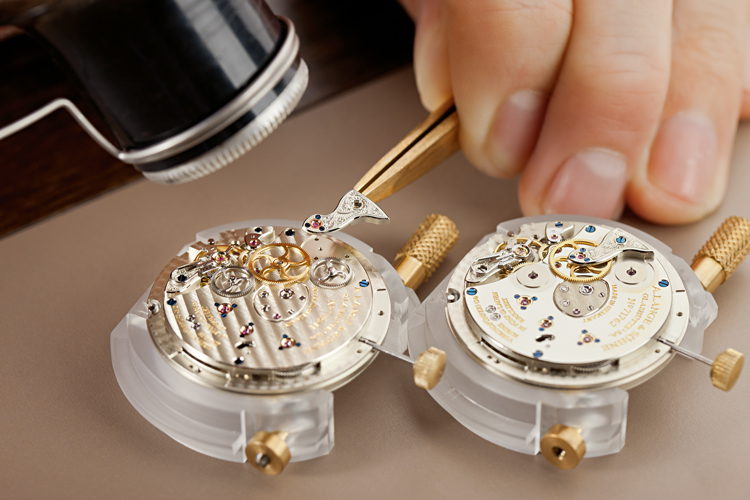
A very new phenomenon that is being discussed nowadays is ‘fake news’, where you will find someone offering a watch from A. Lange & Söhne that is not yet launched and out in the market.
Altogether, they are a tricky combination where you have people that trust the Internet until they are failed, and you have Social media that is not controlled like proper journalism. That is a challenge in today’s world for all of us!
Do you have a personal motto?
I don’t have a motto but I’ve realised that a day with no fun and love is a lost day! If you don’t have fun why do what you do!
What is one thing you hate most?
I hate unpunctuality, as it’s very disrespectful.
What book are you currently reading?
I love reading about cars and the history of cars because you can learn a lot on how brands developed overtime. However, when I am not in a serious mood, I love reading a soft easy book or a Thriller.
Tell us something no one knows about you?
If I told you then everyone will know, so I won’t tell you!
How do you want the industry to remember you?
If in a hundred years the history of A. Lange & Söhne is written, I’d like to have a chapter that started well and ended well. That’s all I want.
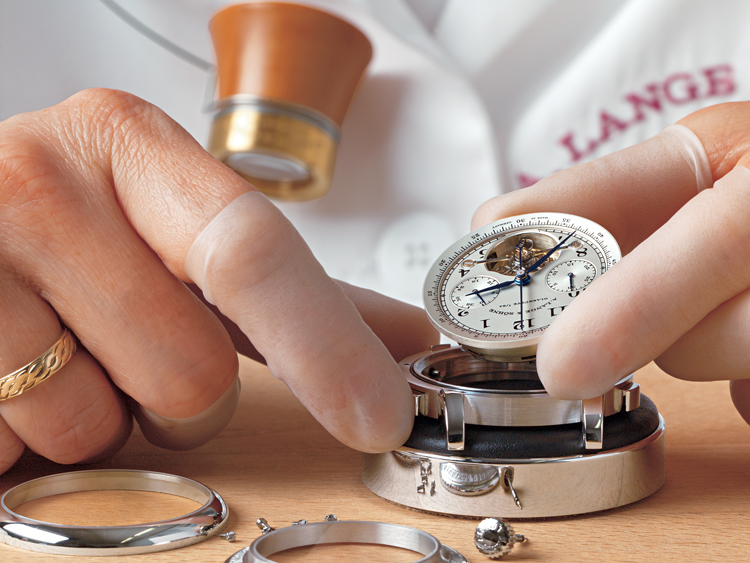
How would you describe the brand in one word?
Exclusive from A to Z. However, I think I will need two words, exclusive and passion.
What are wearing on your wrist today?
I am wearing the Zeitwerk Decimal Strike, it is a new launch of ours and it makes time audible in a new way, with a striking mechanism which sounds every ten minutes. Limited to an edition of 100 watches, the technical concept is paired with an innovative material.
How do you balance work, travel, and family?
Not well! I’m almost on the road for 180 days per year. Luckily my wife is used to it, but I always do my best for quality time together.
Do you have any life regrets?
No.
What’s a major life lesson you learned from your father?
Make your own mistakes, as you won’t grow without making mistakes.
What is your biggest fear?
Recently our dear Walter Lange passed away, leaving us suddenly. This made me realise that my biggest fear is losing the moment of saying goodbye.

What lessons did you learn from him?
‘Never stand still’ is one of the legacies that he will leave.
How do you remember him?
He was a tough man but he was always there. He was hard, disciplined, and not easy going, but he was a warm person. I will never forget him telling me once, ‘the company is in good hands.’
What do you still aim to achieve?
My task is to pass the flame to the next generation, together with keeping the passion and appreciation in high watchmaking. We must work on this objective as an industry, not only as individuals.
By Lara Mansour Sawaya
READ NEXT…
Check out our exclusive September editorial with A. Lange & Söhne.
An Interview with Van Cleef and Arpels Magician
While the rest of the industry looks at sales, Van Cleef & Arpels pushes for creativity and going beyond expectations.
Amid a slowdown in the luxury retail market, Van Cleef & Arpels remains focused on delivering extraordinary pieces that stand the test of time. Years of development and promotion are spent creating unique jewellery and watches that distinguish the brand from their many competitors. Behind this dream world is Nicolas Bos, Van Cleef & Arpels President and CEO, who faces the challenges of today’s luxury climate head on, and strives to keep the fascination with this world alive.

Born in December 1971 in Paris, Bos was an only child in a traditional French middle-class family. After business school, his strong interests in literature and culture lead him to an internship at Fondation Cartier pour l’Art Contemporain, where he spent eight years communicating with curators and artists, together with being involved in the numerous exhibitions they organised. In 2000, Bos was approached by Van Cleef & Arpels to join as Marketing Director, and 13 years later he became the CEO at only 42. Neither a jeweller nor a designer, his job is to initiate creative projects and ensure that they generate revenue and keep Van Cleef & Arpels on its own path.

Here we speak with Nicolas Bos, to find out exactly how you keep the balance of business and creativity.
Have you recently been finding it a challenging time for the watch industry?
We certainly have been impacted to some extent, but less than our colleagues since we are primarily a jewellery house and our watch collection is different to many others. Our watches are on the edge of jewellery, and the clientele considers a watch more as a piece of jewellery. We also have a different distribution setting, we are a retail house so we don’t benefit from the impact of wholesale distribution.
What is the main message for Van Cleef & Arpels this year?
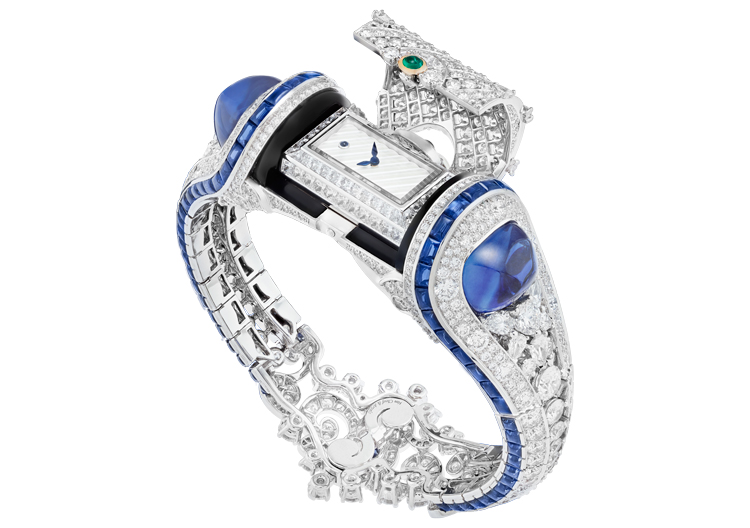
It’s a message of enchantment and creativity. This year we launched an extraordinary object, the Automate Fée Ondine, which is something that we have been working on for many years. It was a good symbol, as there has been a lot of discussion on the future of the industry and the production capacity, and there has also been a general negativity on luxury. The reveal was a reminder of why we do what we do, to create these magical pieces that are going to fascinate. We thought about the challenges of business but at the end of the day what is fascinating about that world of mechanical watches and jewellery is that nobody needs it, they can live without it, but it’s for the emotion and craftsmen challenging themselves.
What do you hope to achieve that you have not yet done at Van Cleef & Arpels?
We want to keep what we do relevant and exciting, we need to continue to build a level of understanding and fascination for this world. I would love to widen the audience to better know the type of universe that we are involved in. Therefore, we started a school in Paris and we work with museums and institutions to strengthen the interest for these activities.
When I started working in this company, one of my fears was that the interest in this world would disappear. However, we have come a long way and have exhibitions that drive wide audiences to look at pieces.

Luxury is an emotion, however where is luxury today?
I’m not sure there is a simple answer. We have aspirational luxury, where you aspire to a brand, not because they are different or unique, but because they represent a status, and then at the other end of the spectrum, there are unique pieces that people don’t care whether the brand is known. It’s a personal vision, between the object or the experience, and I feel it is a combination of the two, so we aim to fulfil both expectations.
What milestones will we see this year?
We had an exhibition in Kyoto which is a beautiful project which is a dialogue between the art of high jewellery with arts and crafts of Japan. It is one of countries where there is a mix of tradition and innovation, the museum wanted to create a parallel between Japanese ways of arts and crafts and western vision of high jewellery.
Can you share with us your personal motto?
Try not to compromise.
What are the three things you hate?
Craziness, opportunism, and violence.
What book are you reading?
Faulkner.
Can you describe your style?
Reserved.
How would you like to be remembered?
As a promoter of the arts.
What is your music taste?
It varies, from Schubert to Mettalica.
By Lara Mansour Sawaya
Dare to Be Rare: An Interview with Roger Dubuis’s Jean-Marc Pontroué
In the vast luxury market, Jean-Marc Pontroué, CEO of Roger Dubuis, takes risks in his pursuit of exclusivity and visibility.
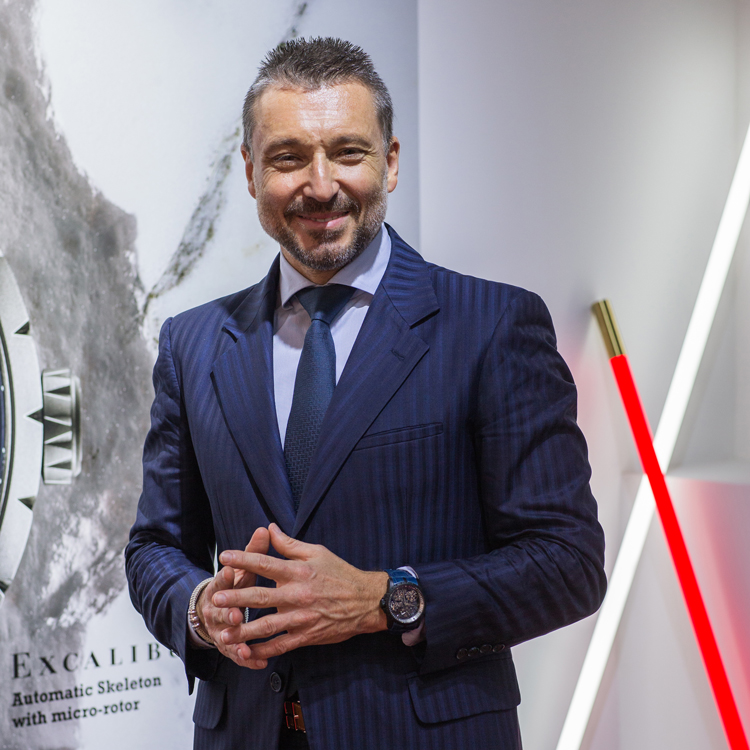
The balance between exclusivity and being known by a wider audience is a challenge that many brands face in the luxury market today. The aim to create an object of desire that is also acknowledged beyond high-end collectors is not an easy hill to climb, but that is exactly the hill Roger Dubuis wants to conquer.
The house has been praised for taking risks and looking at innovative ways of designing new products, but how well is it known? The task of visibility is something that plays a lot on Jean-Marc Pontroué’s mind, the CEO of Roger Dubuis since 2011. Strong product presentation, high-tech mechanics and a theatrical approach is something that Pontroué strives for in every project and partnership, and it is starting to work.
How challenging is it to sell premium watches?
We have a strong identity but it is not known enough. We have worked on it and the products are clear, but the issue is how to be more known among a certain number of the population and that’s why we have partnerships. I spend time travelling the world seeing customers who are very interested in the architecture of our Skeleton, as one of our best sellers is the Automatic Skeleton. The biggest problem is that I still have to explain who is Roger Dubuis, as 80% of our turn over today is created through new customers.

You like to push boundaries, does that become risky?
In this niche business, we over invest in research and development, yet we tend to fail in 9 out of 10 projects. When I came to the company, 100% of our best sellers were new products each year, and that is risky. Now we have about 30% in our innovations as bestsellers, but 70% of our business is core business.
You talk about visibility and exclusivity, does visibility kill exclusivity?
What we are missing today is brand recognition. I dream about having a billboard in Dubai Mall. We are here to create dreams which are not for everybody, and that is the beauty of our business. For now, we are very focused on our visibility, although the exclusivity will remain.

Tell us about your partnership with FFF Racing team?
As an official partner of the FFF Racing Team, it allows us to affirm a presence among spectators of this exciting sport, while offering its VIP and VVIP guests exactly the kind of immersive experiences that both brands favour. It offers opportunities for global exposure within a high-profile environment that is entirely in tune with our commitment to mechanical excellence and performance.
Why did you choose to focus on Excalibur?
We have had this model for 12 years and it has a 70% market share, so instead of making my life complicated, I said let’s concentrate all our energy on the brands icon. When you see the landscape of luxury in the world, there is no successful luxury brand without an iconic family, so if we want to become a relevant brand in the future we need an iconic family.
Can you tell us more about “Disruptive”?
We believe in coming up with a new story, and this year we launched an innovation for Excalibur, which needed a platform with a unique message. With this ‘Disruptive’ approach, we wanted to say that we are the first brand to come with a new world premiere, and we have the Cobalt which is all carbon.


What are the challenges of working with Cobalt?
It is complicated because the material is not something you can work. So, we have to break the alloy into powder and from that you build. It takes more time, its resistant to temperatures and was never used in the watch industry. We have consumers who are after this story telling, having a watch that is exceptional by its movement, but also by the material.
You have the same movement but in a different material, how did you combine the two?
We were depending 80% on gold but there have been new trends. We have had a hit with carbon and we need to put more focus on new material. Especially in the Middle East region where it’s hot and people want lightness. The more complicated it is the better because it is difficult to copy so if it looks like something that exists, we don’t do it. All the products that you see, there are very few where you can say someone has done it years ago. We are a brand of statement, but it is complicated.
Who is the Roger Dubuis consumer?
An entrepreneur, aged between 25-45, who doesn’t want to wear the watch of his grandfather. He has a new car, a Ferrari, or a Lamborghini.
By Lara Mansour Sawaya
READ NEXT…
Waste No Time: An exclusive editorial with Roger Dubuis out in our September’17 Issue.
Interview with Cartier’s Communications Director Arnaud Carrez
Cartier’s Marketing and Communications Director Arnaud Carrez talks about entering the new generation with the Re-launch of the Panthère.

The times have changed at how we perceive luxury with more high-end brands looking at ways to engage new customers, while remaining true to their ethos. Cartier, one of the most iconic names in jewellery and watches, understands the challenges of the millennial habits but never steps too far from what the great house is known for. With the re-release of the Panthère de Cartier women’s watch marks a step in a new direction while glancing back at what has made this a watch an icon of the 80’s.
First launched in 1983, it became the watch of the decade but was discontinued in 2004. However, it remained one of the highest sourced times-pieces on the vintage market so it was about time that Cartier answered the wishes of their fans.
The updated design comes in 14 styles, all specifically for women. You can choose from modern steel to classic warm yellow gold, as well as variety of finishes and two different sizes. That’s plenty of options given to the modern-day customer and we can see them styled with an evening gown as well as a classic white shirt and jeans.
To find out more, we sit down with Arnaud Carrez, to discuss how Cartier is stepping into the modern age, and yet remaining desirably classic.

What is new for Cartier?
We are coming back to our DNA at Cartier and showcasing our key signature model, Panthère de Cartier. We are being true to who we are and it will be the biggest launch ever. This watch was an icon of the generation in the 80s and captures the spirit of Cartier, and that’s what we want to translate to today.
What woman is it for?
It’s for all women, as we offer a diverse collection at various price points.
There is a balance between grabbing the attention of a millennial shopper and the loyal clientele. How hard is it to engage both?
We have always been very careful about putting the centre of gravity at the right place. We don’t want to be perceived as being obsessed with millennials, and we are committed to create objects of desire which are meant to enhance the style of the people wearing them. It’s not a focus on a generation, we are naturally catering to different clientele. It’s about finding the right message. In the Middle East, the women are digitally savvy, whatever the generation, it’s part of the culture and at the end of the day it’s building a relevant plan for each country. You can’t apply the same recipe everywhere.

Do you think digital, social media in particular, diluted the meaning of ‘luxury’?
Yes and no. It always comes back to the way you are doing it. If it’s too much, it lacks authenticity and there is no sense of exclusivity. We are all influencers today but if you have no message, people get bored. We’ve done collaborations that remain true to who we are and we’ve seen influencers that have authenticity. We need to engage with people that have something to say and who contribute to the world in different ways, and we are committed to collaborate with people who want to create something.

Do you create the product after the story, or the story after the product?
We never create a product if there is no story. We are creating objects which are eternal by sense. We can create without thinking of them in the longer term, but we always need to have a story around them or they fade.
Can you share with us three things that you hate?
Unfaithfulness, mediocrity, and an absence of courage.
How do you unwind?
Spending time with my family.
Can you describe your style?
Authentic.
What is your motto?
Nothing is impossible.
By Lara Mansour Sawaya
Guardian of Cartier
Pierre Rainero is someone who protects heritage, but also strives to make new history.
When you hear a job title like Director of Image and Heritage you can imagine that there is a lot of weight on the shoulders of person who is bestowed such a title. The responsibility to carry a name like Cartier can’t be easy, but Pierre Rainero takes it in his stride and is truly passionate about what the great house stands for and how it can push boundaries today.
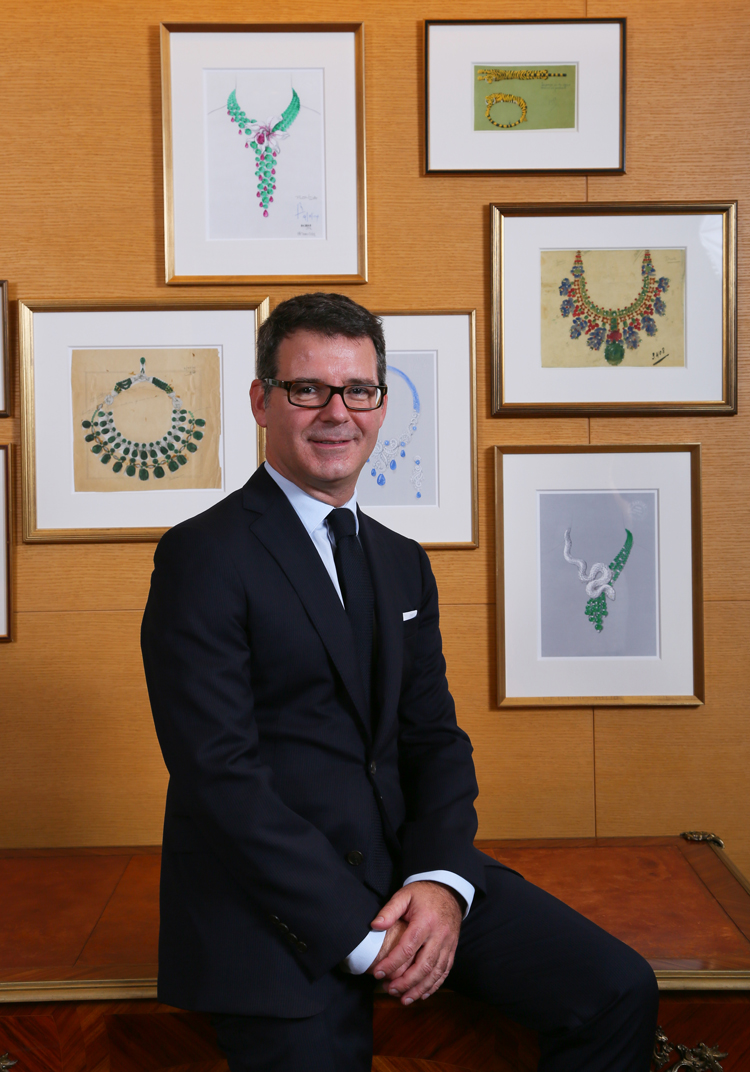
Pierre Rainero
He takes risks within reason, finds it difficult to say no, while also juggling many departments that rely on his vision and guidance. He is protective of Cartier’s image but looks forward to the challenges of engaging new audiences and how to introduce them to the world of fine watches and jewellery. Be it overseeing a gallery exhibition, flying all over the world, or spending hours overlooking design and precious stones, there seems to be not enough hours in the day to accomplish the task of keeping Cartier relevant and exciting.
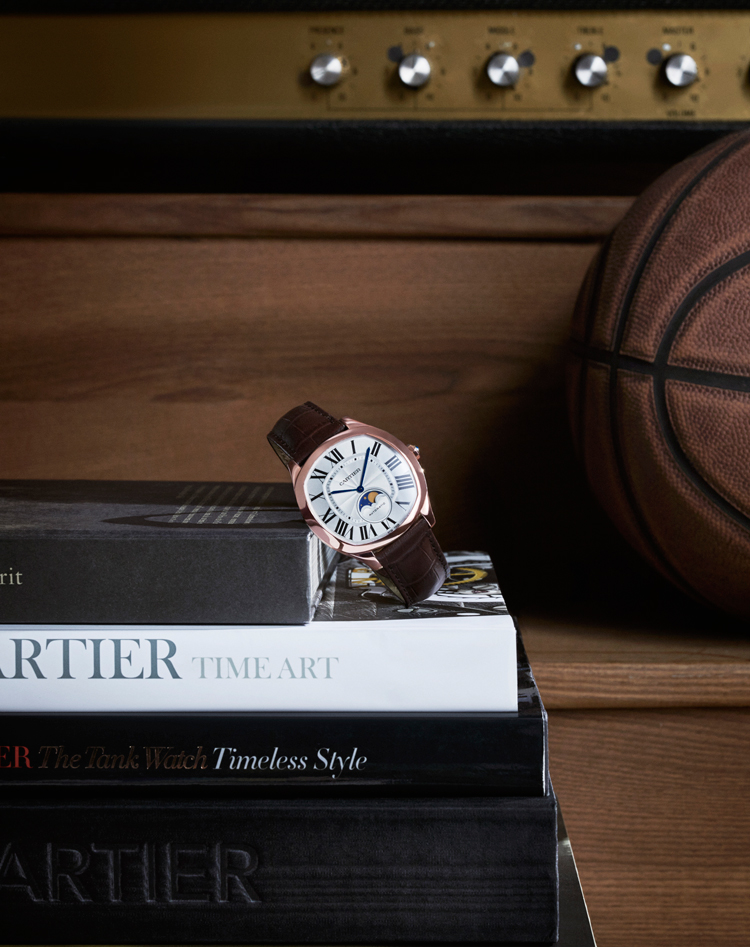
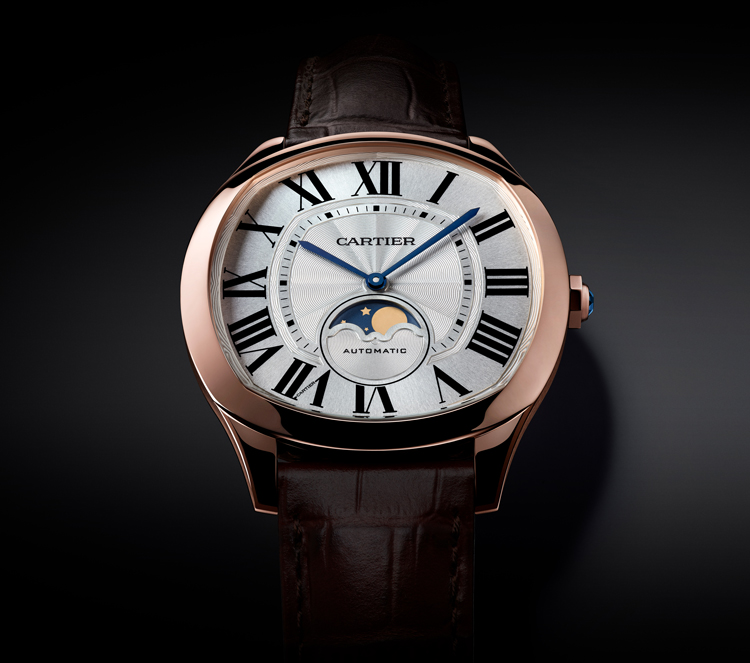
With one eye on us and another on his Drive de Cartier, we get to the bottom of how he manages it all and what the future holds for the house.
How did you start at Cartier?
I was working in an advertising agency and oversaw international accounts when Cartier asked me to join and look after international advertising. I didn’t know much about the heritage of Cartier but the thing I liked was that it was very cultural and it was facing different clients globally. That was in 1984.
What is a normal day for you?
Every day is very different. Part of my time is spent in Geneva, and I fly to other countries too. I’m also in charge of the expertise department and travel to see pieces as well as look after the antique collections for Cartier Tradición and many exhibitions. Every week we have a creation committee when I see heads of the studio and many of the designers one to one. I oversee all the special orders for clients, as well as look at all the new stones we might buy.
I’m also responsible for the image, and my department directly produces elements such as books, as every year we have a book on high jewellery. We also have a photography studio and capture all the pieces that we produce for all the departments.
What is the challenge that you face everyday?
There are two kind of challenges. Time to think about the future and to have new ideas and new focus. To find time to be active and not reactive and stimulate the people I work with. For that you need time and my challenge is not to be absorbed in day to day life.
The other challenge, which is professional and personal, is the capacity to say no. When you say no to some proposals there are disappointments but it takes strength to say no, and is for the sake of the company.
How can you ensure that you are doing a line that connects the path of the brand with the present and the future?
That’s the most difficult part, and is my central responsibility. Of course, what I don’t like is repetition. You shouldn’t repeat and pretend it’s new. It’s different when there is something strong which you think that even if it was created years ago, it’s still relevant and people might have a desire to have it, like the Panthère. It’s something that belongs to our history and even though it was created in 1983, we do think it’s a contemporary design and is relevant to today.
We like new ideas and going forward but we always think of different criteria. We have to imagine people living with this creation.
When we look at a project we ask, is it beautiful, is it Cartier, is it now and are we able to produce it at a price that is relevant for the creation? Because you might have a beautiful idea, but if it costs a fortune and will not match the lifestyle of the people then it will not succeed, and that is something we need to be sensitive to.
How does historical image and heritage of Cartier fit with the contemporary?
It’s a question of design. The lesson we learnt from our founders is that the design is strong thanks to its capacity to evolve and to contain variations for the future. The Panthère is a result of different Cartier creations from before.
Do you think it’s easier to pick a watch from the archives and recreate it, or to create a whole new one?
Both are challenging. Even a variation of an existing design is a huge responsibility and a whole new design is also very challenging. The key is to have in mind all the elements of our style, and for us, style is a living language that makes Cartier unique. So, we play with that vocabulary and the language evolves with time, creating a balance between the new and traditional worlds. We can express different things and be relevant for the people today.
How would you describe the image of Cartier in one word?
I am tempted to say ‘unique’ or ‘different’. There’s something distinctive because Cartier always went its own way.
After all this time at Cartier, can you imagine yourself at another brand?
I think many Maisons have their own personality, but I think Cartier is unique and it would be frustrating to be at another house. Cartier is so rich, history is long and design is incredible, and the fields of expression from watches to jewellery are unique. There’s nothing forbidden in terms of inspiration, there is a freedom to look at different inspirations, which would be difficult to find at another house.
What steps should people take when investing in a luxury timepiece or jewellery?
First of all, they should like it. We are talking about objects of art and the first preoccupation is ‘do I like it, is it me?’ Then you will never be disappointed in whether it grows in value or not. You should have an emotion, and only then you ask how much it is worth and if it’s part of my possibilities or not. But the first step should be to like it and not be concerned by the price or value. You raise that question after you’re sure you want the object.
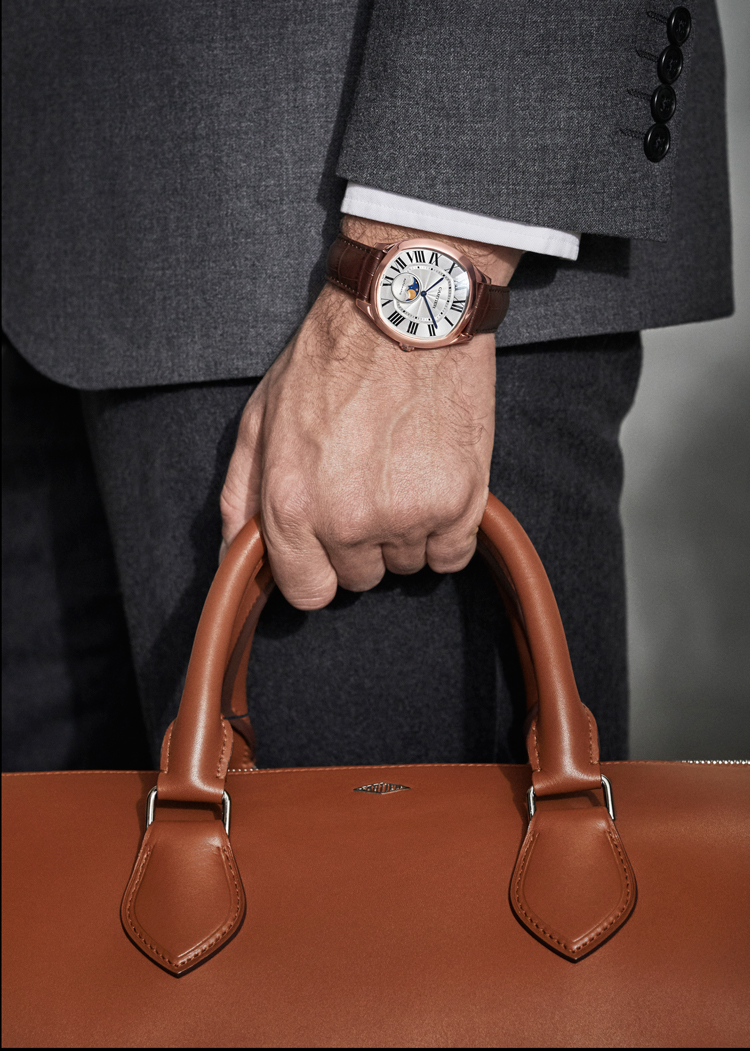
What watch are you wearing today?
Drive de Cartier, the automatic one from last year.
How many museums around the world can you find pieces from Cartier?
I haven’t counted, but many important museums have Cartier in their permanent collections like the Met in New York and the British Museum, Victoria & Albert and even the Kremlin. The Met has one historical piece which was a gift from the city of Paris to Tsar Nicolas II.
What is your definition of an historical watch?
There are different histories. You have a history of design and history in terms of age. History of design is on our side. Cartier is the creator of watch shapes. We made history when we created a watch that was designed to be specifically worn on the wrist in 1904. Before it was the pocket watches that adapted to your wrist.
And then history with a big H is different. Some watches are part of history because they belong to someone who made history. The Cartier Tank watch is part of history because of the people who lived with it. Like Michelle Obama or Lady Diana who wore the Tank watch and created a legend around it.
However, some of the watches, like the Tank, are both part of history of design and history in general.
What are the goals for the brand when it comes to history and heritage?
Every creation will be part of history because Cartier is part of something that might be in a museum one day.
Tell us a secret that no one knows about you?
I don’t have so many secrets. Although my favourite watch is a Tank, which many people won’t know.
By Charline Deek
The September issue of A&E is out now.
The Maxfactor, Creative Director Ian Griffiths shares his vision for the future at MaxMara
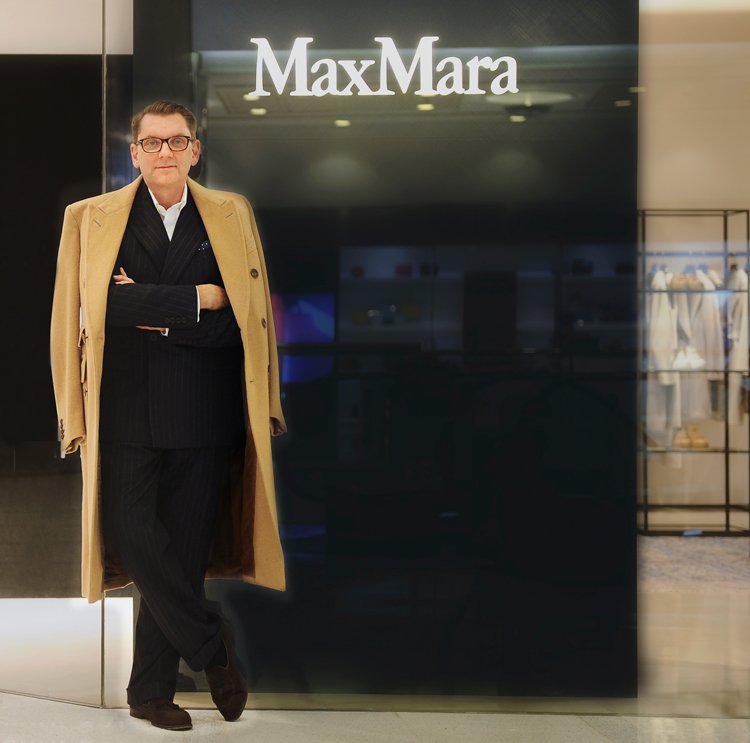
Few designers understand a woman’s needs quite like Ian Griffiths does. His clothes are beautifully constructed, well designed, luxurious, and unapologetically wearable. The ladylike silhouette is enhanced, creating versatile, forever pieces in a palette of all the shades of camel, that nobody will ever tire of.
This season his fall collection was no exception, it was complacently feminine just as much as it was pragmatic. It was honest, and most of all there were no styling tricks or diversions, just faultless outerwear, and classy separates. Opting for the Swedish concept of Slojdforeningen as inspiration, which is the idea that beauty in design is achieved by a simple, pared back approach, the first model to hit the catwalk was bombshell Natasha Poly, completely clad in vibrant red, with a voluminous statement coat. As the collection continued with floor length coats, flannel pencil skirts, sheer roll neck sweaters and other cosy winter attire, 19-year-old Muslim model Halima Aden took to the catwalk during her debut fashion week.

For Ian Griffiths, she fulfilled the Maxmara woman’s persona, ‘Halima has such a strong personality that it shines through on the runway. She comes across as an intelligent, confident, ambitious, courageous woman.’ Market considerations, he says, were also a factor. ‘If you walk down a top-end shopping street in any major city, you wouldn’t be surprised to see a Max Mara coat worn with a hijab, so why shouldn’t our runway reflect that too?’

Can you tell us about the Fall 2017 collection that we are looking at today?
If we had to describe what the collection represents with one word, it would be class. For a few seasons now, we have been talking about a woman struggling to emerge in what is essentially a man’s world, but now we are celebrating the fact that that she is nearly at the top. With a great sense of pride this woman is almost at the summit, and now with one last push she arrives at the top.
Who is the Maxmara woman?
She is a woman with a great sense of dignity, intelligence, ability, and culture. I imagine that she plays the violin, she reads music, she reads proustic French. She is better than everyone else.
What are the colours of the season?
The colours are vigorously from what we call the pantheon of Maxmara. We have red, tobacco, a triumph of camel, black and a touch of gold.
What is your vision and direction for the brand?
Upwards, upwards, and upwards. We have been dressing women for their careers since the 1980s, when power dressing first emerged as a concept, and we have followed our customer as she has risen through the ranks. Younger customers are coming into the world of Maxmara and we are continuing to grow with them as they achieve greater heights.
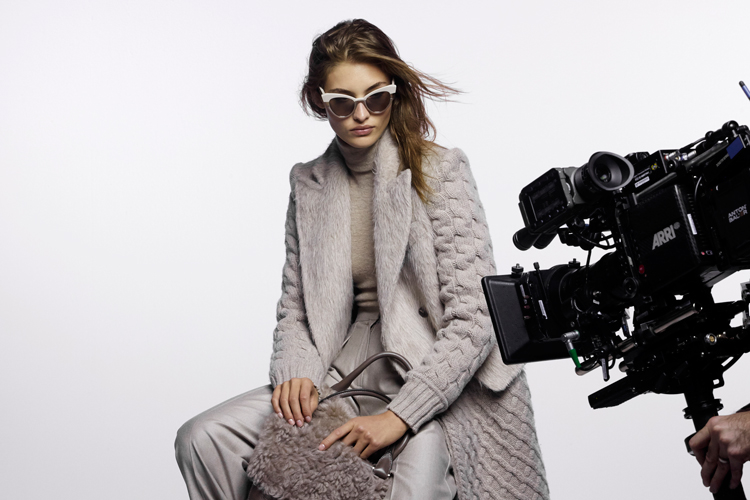
What motivates you?
Maxmara! The woman I have been dressing for the past thirty years, her success, identity, personality, and her struggles are what inspire me.
Speaking of struggles, what do you think are the obstacles that the fashion industry now faces?
I think that the world is flooded with clothes, so people are looking for pieces that have meaning as many don’t. Fortunately, Maxmara as a brand has a heritage and tradition, so all of our collections have a meaning. So, for us maybe it is not such a problem and works as an advantage, as women come to us because they find something that has history, meaning, and iconicity.
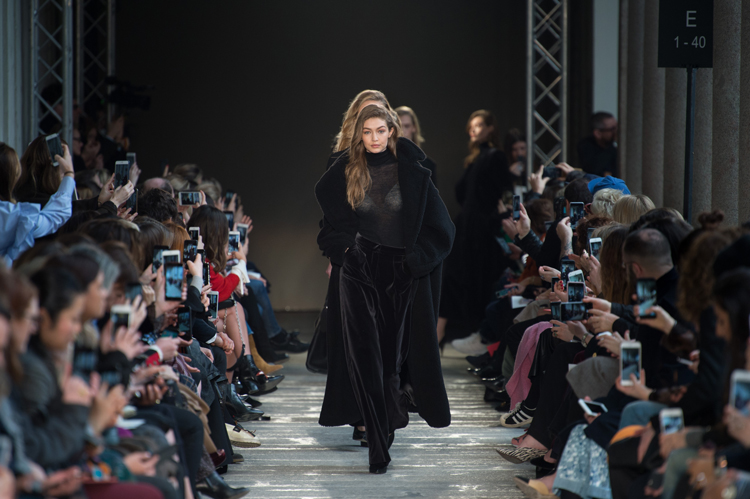
What would you like to tell the woman of the Middle East?
I would like to tell them that Maxmara dresses women from all geographical regions, and all backgrounds, philosophies, and religions. Maxmara is a brand that respects women wherever they come from.
Exclusive: Interview with Ralph and Russo
The duo couturiers to reinvent the Haute Couture world for the global consumer.

Founded by the dynamic duo, Tamara Ralph and Michael Russo in 2007, British haute couture fashion house Ralph & Russo has become renowned for its allure, romance, and timelessness.
Tamara Ralph is the creative mind behind the elegant and original handmade garments worn by the likes of Angelina Jolie and Beyoncé. Growing up in Sydney’s beach town of Cronulla, she came from three generations of couturiers, who furnished her with her initial training, and at just 10 years old she started creating her first couture pieces. Together with her fiancé Michael Russo, who is the CEO and brains behind the exclusive brand, they have joined the ranks of Chanel, Christian Dior, and Valentino as a member of the Chambre Syndicale de la Haute Couture in Paris, the highest accolade in Haute Couture.
In the ferociously competitive, exclusive world of high fashion, it can take brands decades to join the elite group of haute couturiers, with Ralph & Russo being the first British couture label in a century to gain admittance, and to get to that stage requires ticking a lot of boxes. For starters, you’ll need an atelier in Paris with 20 full-time members of staff, designing made to order, handmade pieces for private clients. You will also be expected to present 50 original designs to the public twice a year, something that the duo’s eponymous atelier does to the most exceptional standard, with a loyal following, making waves in the highest end of fashion.

But their unique business was born from just a chance encounter. After studying at the White House Institute of design in Sydney, Tamara visited London for a holiday, where she hoped to make a break in the world of fashion. Instead, she quite literally bumped into Russo, a banker from Carseldine in Queensland, who was sent to London for work. With both of them looking for something different, they noticed a gap in the London market for Haute Couture and decided to take a leap of faith and combine their skills, while taking advantage of the international clientele constantly coming through London. After two years, the pair set up the now globally successful company, with a sewing machine and an ironing board. Fast forward ten years later and the couple are expanding rapidly with an international clientele list, and following a successful move into leather goods, an upcoming Ready-to-Wear line too.
We spoke to the design duo entrepreneurs about the secrets to their working relationship, how they grew their brand and gained credibility, and what is driving their success.
You have dressed some of the most famous women in the world, what does the Ralph & Russo woman embody?
Tamara Ralph: The Ralph & Russo woman is the empowered woman of today. She is confident, feminine, elegant and a leader in her field.
How do you define luxury?
Michael Russo: As an inimitable service that combines quality and most importantly, experience.
What is the biggest luxury in your lives?
Russo: Free time!
What do you think is key to a successful working relationship? How do you balance work and home when you are running a company together?
Russo: It’s important to have a balance in any relationship. For us, we ensure that we are constantly communicating on both a personal and professional level. It’s also just about having a huge amount of respect for the other person and genuinely loving spending time with them.

What do you love most about what you do?
Ralph: I love being able to make my client’s dreams and my own creative visions come true.
What has been your biggest achievement?
Russo: Being invited to show at Paris Haute Couture week remains one of our biggest accolades to date, but ultimately, building the brand from our living room and transforming it into a luxury super brand is undeniably our greatest achievement.
Ralph: I was born into a creative family with four generations of couturiers, so couture has played a part in my life from a very young age. I began exploring my mother’s pattern archive, draping and creating pieces for myself whilst I was still at school. As I grew older, my girlfriends started wanting the pieces that I was wearing and before I knew it I was receiving orders from individuals that knew of me purely by word of mouth.
How difficult was it to launch a new couture business? Particularly based in London, rather than Paris?
Russo: With Paris being the home of couture, launching a rival business from London was naturally a challenge, but also a pursuit to fill a clear gap in the market. As a hub for international travel and exploration, our location in London allowed us to immediately establish a global network of clientele from the comfort of our own home.
Do you feel that by waiting to be personally invited by the Chambre Syndicale de la Haute Couture to show in Paris set you apart from other smaller brands who haven’t gone on to have such great success?
Russo: Being selected by the Chambre Syndicale was a huge honour for us and positioned the brand alongside the power houses of Chanel and Dior. Showing on the official schedule continues to enhance our global awareness, but ultimately it is the brand values and quality of design that have driven our success.
What has been key to gaining credibility in a segment of fashion that is so elite and surrounded by so much history?
Ralph: Exclusivity, quality, and individuality. Each of these elements are of the utmost importance to the brand and our clientele.
How do you guarantee exclusivity with your gowns?
Ralph: Our clientele are international women, so we’re very careful to ensure that not only one of each design is created per country, but also that one of each design is being worn per event.
As more luxury brands bolster their Couture strategies, what do you feel sets you apart?
Ralph: The level of personal interaction that we enjoy with our clients. Michael and I have developed such close relationships with them all that they truly are extended family for us.
Can you tell us about the couture process at Ralph and Russo?
Ralph: Each creation starts with an initial meeting and the selection of a single sketch. During our first meeting, we will introduce the client to our collections, discuss their colour preferences and what they are looking for, take their measurements, and talk them through a series of designs.

Once a design sketch has been finalised, it will be sent to our atelier to be created into a calico toile by our skilled toilistes. At this stage, we always look to have a fitting with the client so that we can assess the fit of the garment and make any changes to the overall design.
All materials are selected and passed onto a team of couturiers and embroiderers who delicately assemble each piece into the final creation. A final fitting is arranged with the client and any additional tweaks are made to assure that the gown is perfect and exactly as the client had imagined.
What do you feel makes it a particularly special experience?
Ralph: It’s very special in that every couture process is tailored to each client and is completely unique. It’s also a process in which the client is involved at every stage. From the sketches and production of the toile, to the placement of embroidery and draping of the skirt. The creation of every look is documented so that each client is not just buying a product, but are a part of making something beautiful.
Do you travel to meet your clients around the world too?
Ralph: Of course, our clients have very busy lifestyles and we respect that. We take the opportunity to travel not only just for fittings, but also to spend time with them. Our relationships with our clients are never left at the door of our Maison.
Will you be looking to open more standalone atelier’s around the world, in addition to your London and Paris Maison’s, to allow more retail destinations for the brand?
Russo: We are currently executing a retail roll out which will see Ralph & Russo boutiques landing in several global retail destinations. London and Paris will always be home to our atelier’s, but to facilitate the demand of all of our product categories we will of course need to look to expanding further.
As you diversify into leather goods, and now ready to wear, was this always the dream to become a more diversified luxury business when you originally started as a strictly couture brand?
Russo: Couture will always be at the heart of the brand, but from the inception of Ralph & Russo Tamara and I had shared the vision of creating a global luxury brand and curating the ultimate lifestyle for our clients. The level of craftsmanship, quality, and innovation of design prevalent throughout our couture are values that we are passionate about incorporating into all our product categories.
Has the addition of the leather accessories, and scarves been to make the brand accessible to customers at a lower price point?
Russo: Our goal throughout our category launches has been to provide the quality of product and design that we are so reputed for, both at a more accessible price point but within a range where exclusivity remains possible.
Have you found that you have gained a lot of interest in these, and is that why you have decided to branch out into Ready-to-Wear?
Russo: Our introduction of ready-to-wear has really surfaced from popular demand and a desire to fill our client’s needs. We’ve received thousands of enquiries requesting pieces that can be available immediately, are accessible in price point and unrivalled in quality. We hope that our ready-to-wear collections will now fulfil those needs.

How have you found the process of Ready-to-Wear designing? Does your heart always remain with the exclusivity and luxury of couture?
Ralph: As a designer, creative processes come naturally to me, so whether it be our accessories lines, couture, ready-to-wear or the interior of our boutiques, my heart lies within our brand pillars of design and innovation, craftsmanship and quality.
What has been the most memorable moment of a famous face wearing one of your designs?
Ralph: We’ve been lucky enough to dress some of the world’s most inspiring women and we cherish each moment with them, but one moment that both Michael and I deem unforgettable was Beyoncé commissioning bespoke Ralph & Russo pieces for her Mrs Carter tour.
When celebrities wear your designs, it certainly results in a lot of awareness of the brand, but how does it reflect in your sales?
Russo: Celebrity moments always remind me of the incredible power of social media. We receive so many enquiries and WhatsApp’s from clients following each wear, some of which look to buy a celebrity piece in its entirety, and others taking inspiration from their look.
As your business rapidly grows, in which geographical markets are you experiencing the strongest growth?
Russo: The Middle East continues to be a huge market for us, but following greater exposure and expansion plans in the Americas we’ve experienced particularly strong growth there.
Which markets do you feel will present the biggest opportunities in the coming years?
Russo: We’re looking to expand into all major emerging markets but feel that South America could present a lot of opportunity for us in the future. With the retail roll out strategy currently in place, we plan to integrate further into the European market and to expand our reach throughout Asia with a series of boutique openings.

What is next on the agenda when it comes to product lines for Ralph and Russo?
Russo: Our launch of ready-to-wear in September this year has been the next big project on our agenda for some time. We continue to have big plans for the brand, including cosmetics and fragrances in the years to come, but as to our next step, I’m afraid you’ll have to stay tuned!’
What do you expect to be the biggest challenge the brand will face in the coming years?
Russo: In today’s political and modern climate, I think the continued need to adapt is going to challenge luxury brands as a whole, including adapting to a consumer-centric strategy. In the contemporary world, there’s no longer any room for ‘arrogant luxury’.
By Eliza Scarborough
Exclusive Interview with the Turkish Fashion Designer Dilek Hanif
Dilek Hanif combines her natural creativity with hard work and productivity, to create a world-renowned brand. Meet the Turkish Fashion pioneer and learn more about her creative, brave, and visionary personality she has been able to translate her Anatolian cultural heritage into the international fashion scene.
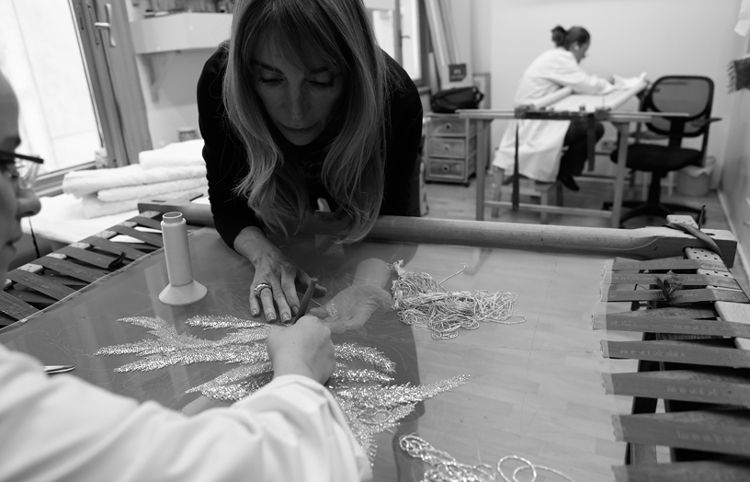
Hanif was born in Istanbul in 1962, with her interest in fashion beginning at a very young age when she started helping with her parent’s textile business. She established her first brand, the Dilek Hanif line, as early as 1990 and entered the international fashion world with her first Haute Couture fashion show in 2002 in the beautiful and historical setting of the Aya İrini Church in 2002. Then in 2004, again with a spring-summer collection, she became the first Turkish fashion designer to present a collection at the Paris Haute Couture Week, thus becoming a true pioneer. As the brand grows, so have Hanif’s collections, venturing into ready-to-wear which was launched in 2011.

Timelessness is a characteristic which runs inherently through Dilek’s creations. Inspired by both the rich cultural legacy of the Ottomans, together with modern and feminine dressing, she adds a new dimension to the Turkish woman fashion scene. Her designs, while emphasising and celebrating femininity, remain of a simple elegance, away from exaggeration and full of romanticism. The high-quality fabrics used, precise hand stitching, and her relentless pursuit of perfection in each design results in each piece being an artwork masterpiece.
With an emphasis on Turkish design, what are some trademark elements that shine through in your collections and are representative of Turkish culture?
The magnificent history of Turkey is one of the reference points that inspires me most. Our designs are a great representation of Turkey’s culture, where east meets west. We combine the orient and occident by using ottoman inspired embroidery work and update the design for the modern world, such as ottoman vests with our cultural beading techniques work interpreted for the modern fashion world. We try to reflect the culture of our handmade work that has been done for centuries in the palaces of Turkey. Our heritage is so rich and deeply rooted and it is a great source of inspiration for me. I like to mix different culture styles with a modern approach.

What is your impression on Middle Eastern fashion?
The Middle East is rapidly becoming popular for its fashion scene. Arabian fashion has received great interest from the other countries who try emulating their distinctive styles. Dubai is already a known fashion hub, where you can find a combination of international trends. KSA is also very fashion forward yet traditional, which is very pleasing to see how they can retain their customs yet be trendy. We have stores across the Middle East, as we design keeping in mind the Arabian woman, modern yet also traditional. There is a lot of potential for designers to grow their brands in both these markets and this is part of my brand’s future plans as well.
How do you feel your brand fits in Dubai?
Dubai is a melting pot of different ethnicities and cultures. Our collections tend to be universal and can be worn by women of all traditions and cultures. Some of our work is targeted towards the Middle Eastern women. For instance, I try not to expose too much orientalist touch on the dresses I design for the women in the Middle East. On the other hand, we also have many customers from Europe and the Far East. This is why my brand tends to have a global imprint and can be suitable for women that are completely different. Rather than cultural perception, I care about my customer’s demands, daily life and needs. My designs need to be aesthetically pleasing as well as practical.
What are some of the greatest challenges you face as a fashion designer today, and how has being from Turkey been an advantage or a challenge?
To present a couture collection in Paris as a Turkish designer was quite challenging, and it is still quite difficult, but over time the task has become easier. I am able to showcase the creative and artistic potential of Turkish people to the rest of the world, and the beautiful landscapes, scenic beauty, history and heritage of Turkey is so unique and inspiring that it has definitely helped with design creativity and distinction.
The challenges I face as a fashion designer are probably the same as many other designers from all over the world. Being successful both artistically and professionally is very hard work, it demands devotion, patience and resistance. We, as fashion designers, have to be artists and business people at the same time, able to catch up with everyday life and real people’s needs and expectations. Our work is our life. The most difficult goal to achieve is to be understood by people, to make them believe in you and appreciate what you create.
Can you tell us about how your interest in fashion began, and what inspired you to become a fashion designer?
Fashion was always a family business. I grew up close to fashion and fabrics, which fuelled my own passion for the industry. It was during school that I became passionate with drawings and fabrics. I used to draw all the time and imagine how to create new designs and new fabrics. Then, in the years after, I just followed my soul and instinct.
I began my professional journey in 1990 with the idea to translate Anatolian cultural heritage into the world fashion scene. The Dilek Hanif brand entered the international fashion world with its first Haute Couture fashion show in 2002 and broke barriers in 2004, by becoming the first Turkish fashion brand to present a collection at the Paris Haute Couture Week. I see myself as a visionary on a mission to harmonise the past and present through fashion, and this is reflective in my designs.
With both ready-to-wear and couture collections, which avenue do you enjoy working on more?
They are very different in procedures. Couture is limitless in the way you work with it and it has an artistic flair while in RTW, technology plays an important role. Regardless, I enjoy working on both, each helps me grow and develop the brand in different ways.

What do you look to for inspiration when you are designing, and do you have a muse?
There are many sources that inspire me. I find different cultures and ways of life very enlightening and I try to travel as often as I can. Exploring the world opens the mind and the great sights and wonders truly humble and inspire onlookers.
I am also very impressed by strong women in history. I admire the achievements they gained with the conditions of their time. I hold esteem for women that play many roles in their lives, being business women, mothers and partners. They not only inspire me, but I also draw strength from their courageous spirit.
Can you tell us about the inspiration behind this current couture collection?
For Fall 2017 I was inspired by the late 19th century Victorian Era and the unique style of Jackie Kennedy, who is a style icon of the 60s. The other influential reference point of my collection was the iconic English roses we can see in the works of Nick Knight, the legendary photographer and fashion film director.
What are your career highlights so far?
The journey that started 26 years ago in a small atelier brought me to some points that I could never imagine. For instance, in 2004 I was the first Turkish fashion designer to present a collection at Paris Haute Couture Week, and I was invited to Paris Fashion Week for the following ten years. This was a great honour for me and when I think about those days I still feel so excited. I keep trying to improve and develop myself in a profession that I always dreamt about. I see the brand Dilek Hanif having a rising performance abroad, even without doing many PR activities. As an example, we are now present in 27 selected points around the world, in countries such as United States and England. Sewing a Couture wedding dress for the Princess of Kuwait, dressing many celebrities such as Katherine Heigl, Iggy Azalea, Nicole Richie, or being selected as a ‘Woman to Watch’ in Turkey with my successful business story are all achievements that make me embrace my work even tighter and move my brand another a step forward.
Who have you been most excited to see wearing your clothes?
I have worked closely with several Hollywood celebrities over the years, and would love to dress anyone who appreciates the designs and collection. Dressing Cate Blanchett would be a dream. I can definitely see her effortlessly pulling off some of the pieces from our SS17 collection.
Tell us about how your brand has grown and transformed over the years?
I started my brand, Dilek Hanif, as early as 1990 to translate the Anatolian cultural heritage into the world fashion scene. In 2002, I entered my first Haute Couture fashion show and soon after, in 2004, Dilek Hanif was the first Turkish fashion brand to present a collection at Paris Haute Couture Week. The brand has gone from being a local Turkish brand to an international label with celebrities from all over the world wearing my creations, which has led to the establishment of stores across the globe and an online webstore that does international shipping.
Do you enjoy the freedom of running your own brand?
Yes, I do enjoy it. This brand became a part of my life, and it marks every single moment of it. We are like a single entity. I do not even see the borders between my work and my private life. They both feed each other. I really enjoy having no constraints, as it gives space to my creative side.
What drives you to continue creating new and inspired designs?
The continuous cycle of the business always gives me new energy and inspiration. After one collection has ended, we are immediately starting a new one and this gives me passion and new excitement to create new designs. On the other hand, I find inspiration from a variety of different sources. They may be books, movies, or important historical events. I find different cultures and ways of life very enlightening and I try to travel as often as I can. I am impressed by strong women in history. I admire the achievements they gained with the conditions of their time. I hold esteem for women that play many roles in their lives as business women, mothers, and partners. I am also inspired by the rich culture and heritage of Turkey.
Can you share with us the secret to your success?
There are not particular secrets to my success. I always do my job with love, passion and by feeling it, and of course with hard work and sacrifice. I think that in order to be successful in what you do or who you are you should always stand firm and never compromise your principles.
Finally, what can we look forward to and expect in the future from you?
I intend to strengthen my operations abroad. Dilek Hanif is available worldwide through the online store as well as multi-brand stores such as Bergdorf Goodman and Harvey Nichols. Becoming more prominent in London is next on the plans and we are already in the process of this. London is not just the capital of Great Britain but the fashion capital of the world and it is a long-awaited and much needed step for the brand in affirming its position in the international fashion scene. In the future, I hope to have the brand available and accessible in more countries, have more standalone stores and have Dilek Hanif be the symbol of the modern woman.
By Eliza Scarborough
DIOR: The Elegance of Bohemian Paris
Enchanting accessories evoke a sense of superstition
Studded ‘Lady Dior’ bags. All by Dior
LEFT IMAGE: ‘Dioraddict’ bag
RIGHT IMAGE: FROM L TO R:Minaudière engraved metal bag, ‘Le Coeur de Dior’ purse
All by Dior
LEFT IMAGE: Dioraddict’ box bag, ‘J’Adior’ strap
RIGHT IMAGE: FROM L TO R: Flap bag, ‘Dioraddict’ bag
All by Dior
LEFT IMAGE: ‘Dioraddict’ bag
RIGHT IMAGE: Leopard ‘C’est Dior’ bag
All by Dior
Fashion Director: Eliza Scarborough
Photographer: Tobi Jenkins
The Bulgari Hotel And Spa: Luxury In The Heart Of Milan
The first Bulgari hotel was opened in Milan, on May 18th, 2004. The opening marked the entry of the Bulgari Group, one of the major players in the luxury business, into hospitality. 10 years later, the hotel celebrated its anniversary with the unveiling of freshly renovated rooms and public spaces, a new spa collaboration, and culinary treats.

Location
In the heart of Milan, the Bulgari Hotel and Spa is renowned as a haven of relaxation and wellbeing. Set in a 4,800 square-yard leafy private garden in Brera, Milan’s artists’ quarter, the hotel enjoys a wonderfully tranquil location. Said garden is home to laurels, horse chestnuts, plane trees and wisteria. Nearby is the Pinacoteca di Brera, which houses an extensive collection of Italian paintings.

Style
Interiors are stylish and contemporary, with black marble and granite, bronze, teak and oak fittings, and Italian furniture. Floor-to-ceiling windows ensure plenty of light, and mirrored window-panes in the restaurant area look out over the garden, while images of celebrities from Bulgari’s archives decorate the lobby area. The heart of the original classical yet contemporary design by the renowned architects Antonio Citterio, Patricia Viel and Partners has been refreshed with cream coloured linen wallpaper, new furniture from Antonio Citterio’s Flexform Collection and Maxalto, drapes by Enzo degli Angiuoni, B&B module libraries, and plush carpets by Altai. Framed sketches of iconic Bulgari jewels have been added to all the rooms, while the suites feature a new collection of arts and design books.


Rooms
The hotel comprises of just 58 rooms and suites, most with garden views rooms. Black and earthy tones prevail throughout, with bleached oak marrying well with the pale hues of the fabrics and cream-coloured linen wallpaper. Bathrooms, equipped with Bulgari beauty goodies, feature black granite tubs, while suites have a selection of art and design books.

Food & Drink
Run by Neapolitan chef Roberto di Pinto, the restaurant serves Italian cuisine with an emphasis on fish dishes, with the likes of seabass carpaccio and langoustine risotto on the menu. Roberto finds the luxurious but informal environment of the restaurant an ideal stage for his work where the basic elements of superior quality, refined techniques, and creativity, coupled with the freshest and most seasonal produce, are the fundamental ingredients of his cuisine. Born and raised in Naples, Roberto’s intuitive cooking reflects the historical connections of his city with Mediterranean cuisine. His menu is the point of convergence between a strong, Neapolitan culinary identity and the desire to project family recipes and traditional flavours into the future.


Spa
The newly renovated Spa at the Bulgari Hotel has been conceived as an urban shelter for the mind and the soul. The new spaces include a private couple’s suite with mosaic steam shower, a marble steam room and Swedish sauna scented with eucalyptus essence, and an external Jacuzzi. There are three exclusive product lines, La Mer with its legendary Miracle Broth, 100% nature certified Amala, and the Sothy’s gentlemen’s studio. The renovation has enhanced the spa’s original elegant architecture to offer a unique setting that gently facilitates guests’ harmonious equilibrium. At the same time, its contemporary design creates a fascinating counterpoint to the ancient philosophies of wellbeing that underlies the modern treatments.

Beauty know-how: Your Cheat Sheet to a Flawless Face
You could be using the best foundation in the world, but without the right tools to put it on, it could still end up looking too cakey, too streaky, or just not flawless enough. That’s where makeup sponges come in, and how they have changed from what originated as a simple triangle of foam.

Washable, reusable, and perfect for use with all formulations of makeup including creams, liquids, powders, and minerals, they have now been reformulated to be more durable and prevent tearing. The latex-free material provides effortless, sheer, buildable coverage and faster application than with brushes or fingers. However, there is a plethora of choices, between plenty of different shapes and sizes, so we have put together an ultimate guide for which sponges to use when, and how.
Beautyblender Original
A favourite among makeup artists, the soft latex-free foam ball applies a seamless coat of liquid, gel, and cream formulas leaving skin flawless instead of clumpy and coated. Make sure to wet the sponge first, and then stipple the product on. Once wet, it doubles in size and the level of wetness can help you control the level of coverage. If just slightly damp, you’re able to build up medium to full coverage and if very wet, you can get a dewy, sheer finish.

Beautyblender Micro Mini
A scaled-down version of the Beautyblender Original, these mini sponges are perfect for camouflaging blemishes, dark spots, and redness in the most hard-to-reach areas, around your nose, along the brow bone and under the eyes. They are like a detailer for the small areas while creating a full coverage.

Hourglass
This innovative tool will effortlessly brighten and highlight areas of the face, thanks to its dual-ended shape, which has an angled side and a velvety, flocked base that softens and blends. It also has a small divot which can aid in more precise application. Holding from the round bottom provides a softer application, whereas by gripping from the ridge of the sponge, the application will be more intense.

Wander Beauty
It looks like someone took a slice out of the side of this latex-free sponge and that’s precisely what makes it such a multi-use tool. The broad rounded side of the sponge is great for basic application of foundation and bronzer, while the tapered end is for detailing, and the flat side is great for contouring with creamy products. If you’re someone who spends extra time polishing your complexion, this is a great all-in-one tool that helps you do just that.

Sephora
The dual tips on this sponge are ideal for precise concealing, blending in hard to reach areas, and removing makeup mistakes. The fine tip offers extra precision for getting into small corners, while the wide tip expertly smooths foundation over forehead, cheeks, and chin.

By Eliza Scarborough
Brides-To-Be: The Ulimate Guide To Your Big-Day Beauty Regime
The key is to start early, you won’t regret it!
You’ve made it through the fun, easy part of your engagement, a flawless manicure and those perfectly staged Instagram snaps of ‘The Ring’. But, now it’s time to get into the nitty gritty of looking fantastic on your big day, and there is nothing like a wedding date to keep you motivated. If you want a flawless complexion, shiny locks, a bright white smile, and envy-inducing arms, you need to put the work in. Here, we give you a year’s countdown in the world of health and beauty, to ensure you are photo ready on the big day, once you have put on your dress and look radiant you’ll forget about the pain and dedication it took you to get there.

One year before
Manage Stress
On the skin complexion front, many inflammatory conditions, including eczema, psoriasis, and acne, may be at least partially caused by stress, as stress weakens the immune system. Excess anxiety can also disrupt your sleep, which is prime time for your body and cells to rest and rebuild. So, so what you can to control anxiety, and try out some mindfulness apps, such as Headspace.
Skincare
Book an appointment with a dermatologist, as flawless skin should probably be one of the top priorities for your wedding day. By getting in there early your complexion’s current state can be assessed well in advance, and appropriate action can be planned. Especially because some treatments take up to several months to achieve results.
Dry Brushing
Add dry-brushing to your daily routine, as it yields major skin benefits, including exfoliation and increased blood circulation for a healthy glow. From an overall wellness standpoint, it also speeds up the flow of lymph, the all-important fluid that removes toxins from our systems, helping to rid the body of waste.

Longer Luscious Locks
Star working on strengthening and growing your hair by boosting your protein intake, and massaging your scalp. To a major extent, strong, glossy hair is an inside job, so by avoiding any vitamin and mineral deficiencies through eating lean proteins and taking a multi-mineral supplement laced with iodine and zinc, you will stimulate growth, creating more shine.
9 months before
Start Using Retinol
Derived from vitamin A, retinol is known for increasing cell turnover, unclogging pores, boosting collagen, and fading hyperpigmentation. However, it can generate redness and peeling at the outset, before all those benefits kick in, so best to start this far in advance.
Scrub Up
After chiselling your upper body to perfection, the last thing you want to do is ruin the effect with red bumps on the backs of your arms. The condition, called keratosis pilaris is caused by excess keratin, which blocks the hair follicle. While there’s no cure, you can treat the symptoms by exfoliating.
6 months before
Hair Colour
The general rule of thumb for big-day colour shifts, whether you’re going lighter or darker, is to stay within two shades of your own natural hue. So, for first-timers this is the time to consult with a handful of prospective colourists, to test the waters with a semi-permanent dye that easily washes out.

Brows
Unlike a haircut or colour, you can’t just snap your way into a new brow shape in the space of an hour. The eyebrow arch can take up to a half-year of regular appointments to change. So, start early to work towards your desired shape.

Work Out
Get serious about your back and upper body, as this will give you good posture. We look down at our phones all day and hunch over laptops, which tightens the chest muscles, so loosen them with stretches, and work your triceps with dips, cable pull-downs and pushups.
3 months before
LED treatments
Gently blasting your face with light emitting diodes, is one of the most effective ways to treat the ‘bad’ kind of rosy cheeks, something you should consider if you are prone to stress-induced redness.
Condition
Colour or no colour, this is the time to lavish extra TLC on your locks. You can head to the salon for a deep conditioning treatment, or mega hydrate at home with an intensive masque. An extra trick is to add a few drops of vitamin E oil to your conditioner, and then wrap your hair in a towel that’s piping-hot from the dryer.
Avoid Sugar
Removing sugar from your diet will both help you lose weight, and keep skin clear, plump and fresh-looking, two things you’re looking for when prepping for your big day. Limiting sugar intake can also help control stress levels and keep you more clear-minded.
1 month before
Suncare
Be wary of the sunshine, even on cloudy days, and wear an SPF on your face daily to protect your skin. Also, keep your shoulders covered in the sun if you’re wearing a strapless wedding dress, because strap marks are difficult to hide.
Brighten Your Smile
Ensure that your smile is camera-ready, and for a subtle upgrade, book in to your dentist for a professional cleaning to remove surface stains and plaque. To maintain the brightness, use over-the-counter whitening strips up until a day before the wedding.
Self-Tanning
Since you are avoiding the sun, try fake tan instead to achieve a golden complexion. Start experimenting with the right shade a few months before your wedding to adjust to seeing yourself with colour, working with the same product or professional spray tanner continuously, to avoid any surprises.
2 weeks before
Final Facial
Time your last facial so your skin has a chance to calm down. It will clear away any toxins, yet still leave enough time for your skin to settle. By this stage, your facialist will understand your skin, so any last-minute skin problems can be avoided.

Fine-Tune Your Colour
This is the time to perfect your colour, whether it’s a root touch-up or subtle highlights. This is a good stage to have it done, as it gives the dye a chance to settle while still looking fresh, but doesn’t leave enough time for your roots to start growing in.
1 week before
Practice Restraint
Try to avoid salty foods, excessive carbohydrates, and do not overdo your exercise in the week before your wedding, as all of these things cause your body to retain water and can result in a puffy face and eyes.
Three days before
Hair Removal
Time your waxing carefully to ensure your skin is smooth, but not irritated, and get waxed no later than 72 hours before the wedding day. Then, to reduce redness or swelling immediately following hair removal, smooth on a calming cream containing.
Tan
It is time to have your final fake tan, to allow enough time for it to bronze, yet still give you time to wash it thoroughly, so none transfers onto your dress. Exfoliate before each session, and then again every day afterwards afterward to avoid streaks and unevenness.
The Day before
Prep Your Hands and Feet
Your nails need to be looking picture perfect, so get these painted the day before, to avoid any chipping in the run up. It is also advisable to buy the exact shade of polish from your manicurist for touch ups, in case of any disasters on the morning of the wedding.

The Day of the Wedding

Glowing Skin
Prime Your Skin For a last-minute boost on the morning of your wedding, and apply a gentle exfoliating mask in the shower. Then, right before makeup, smooth a hydrating serum onto your face, neck and décolleté to enhance your glow before heading into hair and makeup.
Hair
Start on your hair three to four hours before the ceremony, and don’t forget to wear a robe or button-down shirt. Ask your stylist to prep and set your hair, and then work on the bridesmaids, as once your hair is setting, you’re halfway there, and you can relax.
Make-up
Once your hair has been prepped, get your make-up done. This should be smooth sailing since your skin is well prepared, and you have had previous practices with the artist. Once this is completed, your hair can be finished.
Get Dressed
The key is to not leave this until the last minute, it’s important that you start getting dressed an hour before leaving. If you are wearing a corset, it needs some time to warm up and mould to your body, and if not it is always good to have time to feel comfortable in your gown. Then you have an hour for touch ups, and to enjoy preparing for what you have spent up to a year planning.
By Eliza Scarborough
Wedding Day Style: The Groom’s Glossary
While the focus of a wedding remains traditionally, and quite rightly, on the bride, she’s not the only one under pressure to look their best on the big day.
The challenges faced by the groom are threefold, firstly he must set the tone of the dress code, doing so while still managing to stand out among his party, yet thirdly, and most importantly, he must not upstage the bride.
The dress code chosen for a wedding plays a crucial part in determining the level of formality, and, in turn, the general mood of the ceremony. So, here we have put together a definitive guide to wedding dress codes, to ensure you are looking dapper on your wedding day.

Morning Dress
This is the most formal Western dress code for daytime wear. You will be wearing a single-breasted, one-button wool morning coat in black, grey striped or hound’s-tooth check trousers, and a single-breasted linen or double-breasted wool waistcoat, depending on the season. There is no regulation on tie colour, but softer tones are preferable. There is no scope for experimentation here, follow the rules to the letter and employ a good tailor.

Black Tie
A common choice for formal weddings taking place in the late afternoon or early evening. This is a formal dress code, yet still offers some flexibility when compared to morning dress. Experiment with different cuts and fabrics of the dinner jacket, or try satin or silk lapels. Trousers should be matching trousers with braiding or a grosgrain trim on the outside leg. A hand tied bow tie is preferable, so if you need help mastering the art of tying it, head to YouTube for a video tutorial.

Lounge Suits
Otherwise known as ‘day suits’ or ‘semi-formal’, this popular dress code requires that male guests attend the ceremony in smart business suits. With less formal dress codes it becomes increasingly important to consider the setting and context. Roughly speaking, opt for modern in the city, and traditional in the country. However, remember that while a semi-formal dress code allows the groom the opportunity to experiment with colour, pattern, fabric and cut, this is not a privilege that necessarily extends to male guests.

Beach Formal
A dress code usually used at weddings taking place in warmer climes, beach formal implies a smart-casual dress code but with an emphasis on lightweight fabrics and neutral tones. Choose a linen suit or suit separates, a linen shirt, and loafers. Ties are optional, and there is something particularly romantic about this spontaneity, however it doesn’t mean scruffy.
And…. For the Guests
With such a well-dressed groom, it’s important that the guests follow suit, and here are our top rules to keep you on track.
Consider the Context
Style is a function of the outfit versus the situation. What works in a downtown registry office is unlikely to look ideal in the country, so dress appropriately.
Smarten Up
Pay the bride and groom the compliment of making an effort. Plan ahead to ensure that your suit is well pressed and spotlessly clean, your shirt is ironed and your shoes are polished.
Check the Weather
If you aim to look good at a summer wedding then some advance warning about the weather will be invaluable. Of course, you will be aware that an umbrella is useful in the rain, but you may also want to consider whether suede shoes will work well in the wet.
Conform with Codes
If the invitation asks that men wear a dinner jacket, then that is what you’re expected to wear, so don’t go off piste. The reason James Bond is a style icon is that he wears his tuxedo straight up and unadulterated.
Suit Up
We are advocates of wearing separates, rather than suits. However, separates are less formal than suits and unless the invitation contains the word casual, they’re inappropriate for a wedding.
Keep Cool
Fabric makes far more difference than colour when you are in the heat, so we suggest you wear a 100% linen suit, with a 100% linen shirt underneath. It may seem counterintuitive but you’ll be more comfortable wearing fine cotton socks than if you go sockless.
By Eliza Scarborough
Make a Splash: the best waterproof make-up
On your wedding day when tears may be flowing, together with a trip to the beach, it’s essential that your beauty products can withstand water.
The best waterproof makeup products have breathable textures and high-octane colour that is designed to withstand water, sweat and humidity, preventing your makeup from melting, sliding, or fading.

FROM LEFT TO RIGHT:
Shiseido UV Protective Compact Foundation
Tom Ford Waterproof Foundation and Concealer
Shiseido UV Protective Liquid Foundation
Dior Long-wear waterproof eyeliner pencil
Estee Lauder Double Wear Infinite waterproof eyeliner
Diorshow Black Out waterproof mascara
Benefit Bag Gal waterproof mascara
Benefit Ka Brow!
By: Eliza Scarborough
Photographer: Henry Pascual
Van Cleef & Arpels: The Language Of Flowers
Captured in all their grace, the flowers of Van Cleef & Arpels reflect the quest of movement. The pieces appear to come to life, thanks to their three-dimensional volume, the angle of their petals, or the asymmetry of their composition.
A trademark of the house, flowers in their blooming glory, from delicate petals, through to lavish and highly coloured bouquets, harness the nature of Van Cleef & Arpels, and their vitality and eternal freshness. These blooms are translated through diamond creations, light as a bejeweled breeze, that can be worn daily and for any occasion.

Here we look at the most exceptional of Van Cleef & Arpels’ exquisite creations, from the craftsmanship that is worked into pieces exclusive to the region, to timepieces with floral charms, and most recently the Frivole collection.
Alhambra
This special edition, created for Dubai Mall, is an exceptional lucky symbol. For the first time, yellow gold, gris de lin Sèvres porcelain and diamonds harmonise in a 20-motif necklace. An icon of Van Cleef & Arpels, the Alhambra collection has taken on an elegant range of interpretations since 1968, lending itself to a rich variety of materials and occasions. So, to celebrate the auspices of luck, the Special Edition Alhambra long necklace is adorned with gris de lin Sèvres porcelain for the first time. This gentle, feminine shade of mauve combines with the warm tones of yellow gold and the sparkle of diamonds to illuminate the neckline.

Rose de Noël
Van Cleef & Arpels pays homage to its Rose de Noël collection, created in 1970, with new creations in carnelian, onyx, and lapis lazuli. In 1970, it launched the Rose de Noël collection, named after a flower with the particularity of blooming in winter. First created in pink coral, yellow gold and diamonds, the pieces reflected the creative effervescence of the era with their prominent colours and broad palette of materials. Since then, the collection has taken on joyful variations that associate the sparkle of diamonds with the gleam of gray or white mother-of-pearl, coral, turquoise or chalcedony.


Perpetuating an emblematic Van Cleef & Arpels aesthetic, the Rose de Noël collection is today made up of clips, earrings, and pendants, which can also be worn as clips. The new models give pride of place to three materials, deep black onyx, orangey-red carnelian, and dazzling lapis lazuli of an intense blue. On each piece, six rounded petals spread out asymmetrically, in a play of varying sizes, angles, and heights. This three-dimensional approach enables the natural movement of flowers to be reproduced with precision and elegance. Pendants and earrings appear freshly bloomed against the skin, while the clips can be worn in a multitude of ways, to suit every mood and occasion. At the heart of the creations, six round diamonds rest on pistils of golden thread, while on the back an openwork gold plate molds itself to the contours of the petals, testimony to the Maison’s attention to hidden details along with visible ones.

Snowflake Fleurette
The Snowflake High Jewellery collection was created by the Maison in 1986. Then in 2016, two new watches extended the set. With a winter and nature inspiration, the snowflake collection renewed the Fleurette motif created by the Maison in 1925’s. This particular timepiece, is in platinum with a bezel set with round diamonds, featuring a diamond selection and setting, and is a figurative interpretation of Snowflake Collection with a feminine bracelet made of Fleurette motifs.

Cosmos
A new chapter is opening for the Cosmos collection, in an explosion of spring blossoms adorned with white mother-of-pearl and onyx. With their subtle blend of softness and brilliance, these jewellery creations offer fresh homage to nature and luck, two of the Maison’s most cherished sources of inspiration.
With the subtle angle of their four distinctive heart-shaped petals, Cosmos creations are inspired by an iconic Van Cleef & Arpels flower dating from the 1950s. Combining the ethereal quality of a four-leaf clover with the grace of a flower, the collection expresses a delightful femininity graced by luck. Emblematic of the Maison, these jewels now take on a new appearance thanks to onyx and white mother-of-pearl. Until now, Cosmos flowers have combined gold with the sparkle of diamonds. Today, they inspire new associations. The shimmer of mother-of-pearl complements the softness of pink gold in a tender hymn to nature. Onyx and white gold compose a refined and luminous duet, suffused with timeless elegance. This interplay of materials provides two new interpretations of the collection and breathes life into each piece. Like graceful talismans, their delicate corollas blossom against the neckline, the wrist, or the hand, the Cosmos Between the Finger Ring unfurls its graceful petals to illustrate all the creativity of Van Cleef & Arpels. In an ultimate touch of refinement, a diamond petal seems to glitter in the sun, adding a precious note of asymmetry.

Lotus
A symbol of beauty, purity and accomplishment, the lotus flower reflects the harmonious world of Van Cleef & Arpels. In the Lotus collection, it blooms in three dimensions on a trio of different-sized pendants.
Delicately superimposed, the petals are adorned with round diamonds to form a corolla of light. The various setting techniques, ‘perle de rosée’ grain setting, closed setting, and prong setting, along with openwork on the rear of the pieces, magnify the flow of light and accentuate the overall brilliance. Two of the three pendants are transformable and can also be worn as clips to suit their wearer’s mood.

Charms Extraordinaire Langage des Fleurs
First created in 2008, the Charms timepiece is among Van Cleef & Arpels’ emblematic watchmaking creations. Its clean lines, faithful to the delicate feminine aesthetic cherished by the Maison, are embellished with a lucky charm that spins with each movement of the wrist. This year, the collection is adorned with shimmering bouquets bearing messages of love, while the charm takes on a floral motif. The dials are decorated with buttercups, daffodils, crocuses, lilacs, wallflowers, and forget-me-nots.
The Charms Extraordinaire Langage des Fleurs collection is a numbered edition. It is composed of three models, of different sizes and in different coloured gold, each of which bears a message. The gradation of stones embellishing the bezel matches the colour of the watch. Two interchangeable shiny alligator straps adorn the timepiece to suit every mood. The emblematic flower of the watch is engraved on the back of the case, adding a final touch to the story related on the dial.

Left Image: Charms Extraordinaire Amour
On this 38mm watch in pink gold, wallflower, forget-me-not, and cyclamen symbolise memory, beauty, and lasting sentiments. The cyclamens appear to be in motion thanks to the enchanting sculpture on painted mother-of-pearl. Cabochonné enamel also bestows a sense of movement on the wallflowers. A pear-shaped pink sapphire represents a cyclamen bud. The flowers are framed by a gradation of pink sapphires, echoing the wallflower charm in pink sapphires and spessartite garnet.
Middle Image: Charms Extraordinaire Espérance
The smallest model in the collection is adorned with sunny colours, illuminating its 25mm case in yellow gold. The buttercup in cabochonné enamel symbolises beauty, the daffodil designates true love’s desire, while the chickweed represents the meeting, so pregnant with hopes. Embedded in the dial, the daffodil is sculpted in white mother-of-pearl for extra depth, then coloured yellow with miniature painting. The charm is a buttercup spinning round a row of shaded yellow sapphires and spessartite garnets. Its petals are also fashioned from yellow sapphires, while a spessartite garnet represents a pistil.
Right Image: Charms Extraordinaire Désir
Expressing all the desire of a new romance, the Charms Extraordinaire Désir watch is adorned with lilac, synonymous with young love, and crocuses blooming on the dial thanks to cabochonné enamel work. Three yellow gold threads delicately depict the pistil. The lilac, in pink sapphires and amethysts, grows against a background of sculpted miniature painted mother-of-pearl. A symbol of happiness, a crocus also spins around the dial as a charm.
Frivole
As spring approaches, Van Cleef & Arpels is revisiting its Frivole collection, a luminous ode to nature. Nine original creations enhance the Maison’s range in a bloom of graphic flowers, which seem to quiver beneath the wind’s caress. Ranging from single flowers to shimmering bouquets, the different models light up the skin with their precious brilliance.

The quest for movement lies at the heart of Van Cleef & Arpels’ creative process. For the Frivole collection, architectural forms and the orientation of the petals have been worked with care to reproduce the random quality of nature. Mirror polishing, a technique in use at the Maison since the 1920s, provides a way of highlighting the glitter of gold and creating particularly intense reflections, suffusing each piece with unique vitality. The search for brilliance can also be seen in the openwork, openings that the jeweller pierces in the gold structure to enable light to pass through the diamonds. All these jewellery techniques combine with rigorous attention to detail, enhancing the Frivole creations.


From the diamond clips of the 1920s to contemporary jewellery pieces, floral motifs have always been at the heart of Van Cleef & Arpels’ creativity. Enthralled by nature’s constant metamorphoses, the Maison transposes the vitality of its movement and its myriad nuances and forms. Christmas roses and Cosmos flowers, poppies and fuchsias, lily-of-the-valley, and cherry blossom, form a poetic garden, embellished by the craftsmen’s savoir-faire. The Frivole collection thus rejoins a continuous creative tradition, perpetuated by Van Cleef & Arpels in homage to beauty.
Style Equations: The Occasion Hat

Jane Taylor
The ultimate accessory for a wedding guest is a hat, and depending on the style of nuptials you can play around with the look you are going for. The key is to choose one that suits your face shape, so most importantly choose the right milliner and style for your proportions.

Stay in the know with this month’s Shopping Secrets
Read up on the latest happenings in the world of shopping; this month it’s light up accessories, the latest collaborations and shoes made for a good cause!
A Collector’s Item
Sometimes you see something on the runway that you just must have, regardless of its levels of outrageousness or impracticality. One of which is Dolce & Gabbana’s light-up box bags. Wear it or display it, win-win.

Remedies
Bobbi Brown has launched a new skincare collection to help come to the rescue of skin in need of a bit of love and attention. The collection of six treatments target specific complexion concerns to enhance skin’s overall health, instantly and over time.

Shoes and Philanthropy
Born out of a shared love of Russian embroidery, Malone Souliers has collaborated with model Natalia Vodianova to create a collection of modern and elegant shoes with a difference. Meticulous craftsmanship has been given a philanthropic twist, supporting Vodinanova’s Naked Heart Foundation.

The Cult Piece
Meet fashion’s new favourite hybrid, the sock boot. Skinny and stretchy, these pull on like a sock, have the appearance of a high-heeled boot and, in the case of this standout Fendi pair, also embrace the sporty flourishes of a sneaker.

Lady Gaga and Tiffany
Two months after releasing a must-see video, Tiffany & Co. have shared the campaign for their Tiffany HardWear collection, starring Lady Gaga. The new ads, a juxtaposition of black and white images against those with a Tiffany blue backdrop, feature the brand’s latest brand ambassador Lady Gaga.

Mini C De Cartier
One year after the launch of the Mini C De Cartier handbag, the French Maison has unveiled new colourways. They have not only injected new colours, but also a new savoir-faire in fine exotic skin craftsmanship.

The A-Z of Bridal Style: your ultimate guide to the big day
From planning the perfect wedding location, to choosing the right cake, and picking your dream gown, there are a plethora of things that you’ll need to consider in order to achieve the ultimate wedding day. So, to avoid any sartorial dilemmas, and ensure that you don’t miss out anything during the run up to your big day, follow our guide for all things stylish and on trend in the world of weddings.


By Eliza Scarborough
Suzanne Neville: The go-to bridal designer for fabulous figure-fixing corsetry
Hailed ‘the corset queen’, Suzanne Neville is one of Europe’s leading designers of bridal and evening wear. All her beautifully constructed wedding gowns are British made, with designing and hand-made production being undertaken in London.

It’s her impeccable eye for shape and detail that has made the award-winning designer such a popular choice with brides seeking to make the most of their figures on the most special day of their lives.
Suzanne started her business in 1991 after studying at the prestigious London College of Fashion, gaining recognition after Harrods took on her entire first collection, a break canny Suzanne, aged just 20 achieved after persuading family and friends to call the Harrods bridal department posing as potential customers, asking if the store stocked a new designer called Suzanne Neville.
Now with stores in Knightsbridge, Cheshire and Guilford, and numerous stockists in the UK and worldwide, the brand continues to grow. Suzanne, who is a very hands-on designer who takes pride on the fit of every dress, and aims to create the most flattering shape for every individual bride, shares with us her tricks for achieving the perfect gown.

Can you tell us about how you started and how much your brand has grown and matured over the years?
This year marks our 25-year anniversary in the industry, and when I designed my very first collection I never imagined how big the brand was going to become, which I am very grateful for. Ever since I can remember I wanted to be a fashion designer. I was lucky enough to study at The London College of Fashion, and during my degree I specialised in bridal as I felt I could go a little further with the dress designs. Once I started designing wedding dresses, and met the brides themselves, there was no going back, it’s a great honour to create any wedding dress.
What do you enjoy most about being a designer?
I love seeing all of my Knightsbridge, London clients for their Toile appointments, and being so hands on in production as well as with my girls in Knightsbridge. There is no better feeling than making a bride feel the best she has ever felt.
How would you describe your signature style?
A strong focus on the silhouette and the fit of each dress. The cut and corsetry is everything when it comes to wedding dresses. It’s all about enhancing the figure to the upmost and this can really only be done with a really well cut dress. Corsetry is not essential but it can support the bust and define the waist, so for many figures it’s the most flattering option.

Is this personal approach with the fittings for your brides something that will remain paramount as you continue growing your brand?
Yes, I love meeting all my clients, it is a chance to really get a feel for what brides are loving. My girls ask me every year if I am sure I want to carry on seeing every bride, but I would never be able to give it up, I just love it.
What makes your collections unique?
Seeing every bride in my Knightsbridge Showroom allows me to keep up to date with what brides want and is the reason I love it. From talking to my clients, to seeing what the current trends are, allows me to design the collections I do.
How has your style evolved over the years?
When designing a new collection, I like to include a range of styles and trends as I like to design something for everyone. I watch trends and keep up to date with the ever-changing bridal fashions.
From talking to my clients, to seeing what the current trends are, allows me to design the collections I do.
What is it about corsetry which makes it work for women of all different shapes and sizes?
The beauty of a made to measure corset is that you can really accentuate a woman’s figure. No matter what shape the bride may be, a corset will make her feel the best she has ever felt.
To you, what makes the perfect dress?
To me there is nothing better than a perfectly fitted bodice. I have always loved corsetry as it enables me to really show off a woman’s figure. Seeing the joy on my brides faces when they are in their wedding dress is my highlight and the reason I love what I do.
How do you find the pressure of designing what is one of the most important dresses in your client’s life?
It is a real honour and I still have to pitch myself at times when I really think about the responsibility we have to design and create a brides dream dress. But I have the best team, from the girls in my showrooms, to my very talented seamstresses in production, together we do it and I feel very lucky to have them.
What have been your biggest achievements to date?
When I was nineteen and Harrods agreed to stock the wedding dresses from my very first collection, getting the keys to my first shop, selling my gowns for the first time in New York, dressing a Spice Girl for the Olympics and so many others! I have been very lucky. However, the main thing that makes me proud every day is the brides all over the world are wearing my designs for the happiest day of their lives.
Who is your dream person to dress?
I have always wanted to dress Adele, I would love to design her something amazing,
Designing a bridal dress has many constraints. What inspires you, and how do you keep creating new and exciting designs with such a tight remit?
I’m often inspired to create a dress by the fabric itself. There are certain fabrics I know so well they are like old friends! Crepe is one of my favourites, so you’ll always see crepe dresses in every collection. I do spend months designing exquisite embroidery and searching for the right lace from the best mills in the world. I source only the very best fabrics.
Do you have a favourite gown in your current collection, and why?
One of my favourites is called Belle, it started life as a dress for television personality Holly Willoughby for the National Television Awards. Holly made the bespoke dress famous by wearing it on ITV’s is Morning the day after the night before, having not been to bed! We were inundated with calls asking where the dress could be purchased, so I added it to the new collection and now over thirty of our stockists have ordered the style.
Now that you are stocking your gowns in Dubai, have you created exclusive pieces for the region, which are relevant for the clientele?
Yes we have, our wonderful stockists Bride2Be do have quite a few dresses from the current collection, together with some dresses designed specifically for the our Middle Eastern clients. They are some of my favourite, as they are colourful, exquisite, and very luxurious.
You spend a lot of time with brides, what do you feel is most important when organising the perfect big day?
To remember to enjoy the experience, it can become stressful for many brides, but try to enjoy every moment.

What made your own wedding special?
I had a winter wedding in December at Highclere Castle, which is otherwise known as Downton Abbey. It was a magical day, surrounded by close friends and family, and we even had snow. I did design my own wedding dress, and it was a little stressful as it was made in the days leading up to the wedding! I decided to combine three of my favourite designs of all time, creating a fishtail gown in silk dupion, with pleating and lace detail. I had another dress for the evening reception in silver. To this day I still wouldn’t change a single thing, it was perfect.
What is the biggest mistake a bride can make while planning her day?
To forget what you and your partner want. The day is to celebrate the love the two of you share, it should be all about you.
Can you share with us your top tip for brides-to-be?
Just be yourself but a bridal version. There is a lot of choice out there but make sure you are true to yourself. You must try on a couple of each style and shape, as you never know what they will truly look like until you have tried them on. We provide a Made to Measure Couture service, where you are able to adapt or create your own design to enable you to truly have the dress of your dreams.
By Eliza Scarborough
Louis Vuitton Accessories: Signatures with a graphic twist
In the most recent accessories from Louis Vuitton, signatures have been twisted in a graphic and architectural way, for a strong fashionable statement.

LEFT IMAGE: Rope Monogram Reverse Petit Malle & City Steamer
TOP RIGHT IMAGE: Night Light Twist
TOP BOTTOM IMAGE: Column Monogram Petit Malle

LEFT IMAGE: Pokerface Python Boot
RIGHT IMAGE: Petit Malle iPhone Case & Braided Handle Twist
By: Eliza Scarborough
Photographer: Lezli and Rose
