

Stephen Jones: the master milliner on why hats are the ultimate fantasy garment
Stephen Jones might not need an introduction, but he certainly deserves one. Fashion’s favourite, and most prolific, milliner is known for both his eponymous line, together with an A-Z of designer collaborations, from Alaïa to Comme des Garçons, and Dior to Marc Jacobs.

Born in 1957, Jones graduated from Saint Martin’s School of Art in 1979, starting his millinery career by making hats for friends at a time when London was the centre for creativity and iconoclastic fashion ideas. He made hats for Boy George, Spandau Ballet, and Grace Jones, and by 1980 was sufficiently established to open his own shop. As his reputation and clientele steadily grew, he was invited to represent Britain in fashion shows in New York, Montreal, Helsinki, and Tokyo, making him known today as the first designer to bring millinery into the forefront of the modern fashion world, with some of his most celebrated millinery being for Christian Dior throughout the years.
The legendary milliner, whose designs have adorned the heads of celebrities and royals around the globe for nearly four decades, is known for his bold, imaginative approach to design. Here, the Cheshire-born designer talks to us about his most memorable designs, and the rules of etiquette for wearing a hat at a wedding.

How did you get into millinery?
I got into Millinery because I was a very bad fashion student, and when I was at college at Saint Martins, my tailoring tutor told me that unless I got extra help in my first year of college, I was going to fail the end of the first year. He owned a Couture house, where I went as a tailoring intern and then changed to Millinery.
Do you remember the first hat that you ever designed?
The first hat I ever designed was in black towelling with red tulle, but I never made it. The first I actually made was made with plastic roses and my sister’s old blouse.
What has been the craziest and most alternative hat that you have created?
I think the craziest hat I ever made was for design duo Basso and Brooke, when it had dry ice in it, so the steam came down the models face as she walked down the catwalk, but in fact last week I made a hat for British designer John Skelton in London for his Autumn Winter 2017 show, which had red melted candles.

What appeals to you about designing hats rather than clothing?
Because the head is the dot on the ‘I’ and the cherry on the cake, and it’s how we communicate.

Who is your muse when designing your hats, and what inspires you?
It is very difficult to have only one muse, because everything would be designed just to suit her or him, I like to design for a variety of muses even though they only exist in my head.
In your opinion, what is key to creating the perfect hat?
Confidence!
Do you feel a hat changes the identity of the wearer, or rather enforces their identity?
A hat can be interpreted in both ways, sometimes it’s really a reflection of their character, but often it’s a wonderful disguise too.
Can anyone where a hat, and at any time?
Anybody can wear a hat and at any time, whether they’re male or female. It’s just they have to know what the right hat is, and most people are not aware of the many different hats that can be worn. It often only doesn’t need to be something complicated, it can actually be something quite simple, which says just enough but not too much.
Do you feel more empowered when you are wearing a hat?
No, I feel that it’s part of my persona, and I love the accent that it brings to my silhouette and my personality.
What is your favourite style of hat to wear?
A beret, the t-shirts of hats.
Is it true that you have the perfect sample size head?
A long time ago when I had hair, my head was too big to try my hats on, now I don’t so it’s much easier.
How does it feel to be such a notable ambassador for millinery?
It’s an honour because Milliners around the world are very creative people, who very often struggle to be recognised, and I am very happy to use my power and position to show the world their fascinating work.
How important do you feel millinery is to completing a fashion collection?
For a fashion collection, it’s nice to have something that will coordinate with the rest of the look and will help emphasise the idea. For a fashion show it certainly turns up the volume on whatever you’re showing, and adds individuality and personality, not only to the collection itself but in comparison to other designer’s collections.
Tell us about how hats are making a comeback in the world of fashion.
Many designers around the world are seeing hats as a way to make their look more identifiable. In a world where so many fashion images are seen on a 10-centimetre phone screen, a hat is a very obvious way of creating a distinct look. A black on black print could never be seen on a cell phone.
What does a hat do that clothes can’t?
Make you taller, emotionally, and physically.
Tell us about the first designers you collaborated with on their fashion shows.
The first designers I collaborated with in England were Zandra Rhodes and Jasper Conran. I knew Zandra as a friend, and she asked me to create fantasy headgear to compliment her very thematic collections. For Jasper Conran, I made very chic restrained felt hats, reminiscent of the Pope’s. Of course, my life changed completely when I went to Paris, and started to work with designers such as Jean Paul Gaultier, Thierry Mugler and Comme des Garçons.
What have been your most memorable collaborations?
I worked for a very long time with the designer Claude Montana, both with his own collection and for Lanvin. Working with Marc Jacobs has also been extraordinary because of his encyclopaedic knowledge of fashion. But my most well-known, and the collaboration closest to my heart, has been with John Galliano, both with his own label, and also with Dior, which continues to this day with the ever-inventive Maria Grazia Chiuri.
Tell us about designing for Dior at such an iconic time for the House, as Maria Grazia Chiuri took the helm.
I am well versed in the language of Dior, and it has been fascinating for me to hear somebody interpreting it in a completely new way. The fact that she is a woman, is not so important to me, but I found her distinct point of view of fantasy and function extremely innovative within contemporary fashion.
Your first collaboration with Dior was over 20 years ago, with so much change at the house in-between, what is your wildest or proudest memory?
That I am still there! Every day when I walk in there, I am amazed because this is the centre of the world of fashion, there is nowhere else.

How important is the role of hats at weddings?
To decorate yourself or to make yourself more splendid is essential for weddings, whatever the religion is, and whether you are a guest at an evening western wedding in America wearing a fascinator, or a day time wedding in Britain wearing a wide-brimmed hat. Of course, at a wedding in the Middle East, the bride looks beyond spectacular, and especially through my work with Dior, we have created many bridal veils, for those beautiful women, but for me it is wonderful when the guests also do not, in my mind, forget to decorate their heads.
As a wedding guest, what is appropriate hat etiquette?
That it’s all about the bride, and not about you, but at the same time you should show that you enjoy life and enjoy dressing, so something which is high spirited, but not too showy. There is very much a difference between the hat appropriate for a wedding, versus the hat appropriate for a race meeting.
How do you choose between a hat or fascinator, and what do you prefer?
A fascinator is normally best with dresses or evening tailoring, and a hat is better with architectural dresses or day time tailoring.
Are hats just confined to the guests, or is this something that the bride can play with too?
Absolutely the bride can play with the idea of a hat, whether it’s a tiara, a garland, or flowers, around the world every bride’s head is decorated. We communicate through our heads, so it would seem strange if she went unadorned.
What is the most iconic hat of all time?
Queen Elizabeth’s Crown!
By Eliza Scarborough
SS17 accessories: The Iconic ‘It’ Bag
The ‘It’ bag, or an iconic, classic handbag has never gone out of style.
From Audrey Hepburn toting her Speedy en route to the airport or Grace Kelly and her namesake Hermes bag, women have always lusted about beautiful bags, elevated to star status by their famous owners.

LEFT TO RIGHT:
J’Adior Flap Bag with chain in off-white calfskin, Dior
J’Adior Flap Bag with chain in black calfskin, Dior

LEFT IMAGE: Peekaboo mini python shoulder bag, Fendi
RIGHT IMAGE: Gold Chanel’s Gabrielle bag in leather, Chanel

Pierce medium leather shoulder bag, J.W.Anderson at Net-a-Porter

LEFT IMAGE: Broche GG Supreme top handle bag, Gucci
RIGHT IMAGE: Slingback in black patent calfskin leather & J’Adior ribbon, Dior
By: Eliza Scarborough
Photographer: Henry Pascual
CHANEL: A Gilded Beauty
CHANEL Metiers d’Art 2017 – Paris Cosmopolite
A cosmopolitan elegance of sequins, sparkle, and even gold tipped feathers.

Coat in black cashmere with a satin collar, Boots in black grosgrain patchwork, Crown of black and white flowers in tulle and organza embellished with rhinestone, Strass buckle bracelets in ruthenium and dark grey. All Chanel

LEFT IMAGE: Jacket in off-white and black fantasy tweed, Wide weave veil, Earrings in golden metal and brown resin
RIGHT IMAGE: Sweater in off-white polyamide and alpaca embroidered with gold thread, Crown of white and black flowers in tulle, Multi-strand sautoir in golden metal embellished with faux pearls, Bracelet in golden metal embellished with faux pearls
All Chanel

Dress in off-white organza and grey tulle embellished with flowers in denim, silk chiffon, organza, and faux pearls, Belt in black leather embellished with faux pearls, Oxford shoes in white patent leather, Crown of pink flowers in tulle and organza embellished with rhinestone, Pink Chanel’s Gabrielle bag in tweed and leather. All Chanel

LEFT IMAGE: Jacket in black and off-white wool tweed with a leather collar, Pant-suit in black and gold jersey, Dark green Chanel’s Gabrielle bag in leather
RIGHT IMAGE: Dress in off-white organza and grey tulle embellished with flowers in denim, silk chiffon, organza, and faux pearls, Belt in black leather embellished with faux pearls, Crown of pink flowers in tulle and organza embellished with rhinestone
All Chanel

LEFT IMAGE: Off-white jacket in cashmere and silk embroidered with an Eiffel Tower in crystals and rhinestones, Dress in off-white viscose embellished with jewelled buttons, Multi-strand choker in golden metal embellished with faux pearls
RIGHT IMAGE: Jacket in black fantasy tweed, Trousers in black fantasy tweed, Oxford shoes in white patent leather, Crown of black and white flowers in tulle and organza embellished with rhinestone, Bronze Chanel’s Gabrielle bag in leather
All Chanel
Fashion Director : Eliza Scarborough
Photographer : Lezli & Rose
Hair and Make-up : Ian McIntosh at Carol Hayes
Model : Petra Palumbo at Next Management
MAKE-UP THROUGHOUT :
Complexion: Les Beiges Healthy Glow Luminous Color Light
Eyes: Les Beiges Healthy Glow Natural Eyeshadow Palette, Le Gel Sourcis N°360 Blond
Lips: Rouge Coco Stylo N°207 Sépia
Nails: Le Vernis N°558 Sargasso
All Chanel
Monique Lhuillier on creating a gown fit for a princess
No one dresses as many A-list actresses and Grammy Award winners, whether it’s on the red carpet or walking down the aisle, as Monique Lhuillier.
Known for flattering each and every body shape, with an attention to fit, and a large sprinkling of femininity, Lhuillier is an expert when it comes to choosing the perfect wedding gown.

When Monique Lhuillier launched her first collection of bridal dresses in 1996, it was out of necessity rather than fulfilling a lifelong ambition. Born in the Philippines, Lhuillier moved to Los Angeles to study fashion design at the Fashion Institute of Design and Manufacturing, but after getting engaged she soon realised there was a huge hole in the market, and promptly filled it with the most gorgeous confections. The designer’s creations quickly gained a cult following, and now after over 20 years in the industry, she’s branched out into everything, including shoes, handbags and fine jewellery, as well as evening gowns. From Michelle Obama to Gwyneth Paltrow, Taylor Swift to Cameron Diaz, women of all ages love her sumptuous, romantic designs.
Made of clouds of tulle, luxurious Chantilly lace, and floaty floral organza, Lhuillier’s bridal wear is wedding-dress heaven, and here we have had the opportunity to exclusively chat to the Los Angeles designer straight after her Spring Summer 2018 show, about her big day dos and don’ts, and why it’s always important to stay true to your style.
How did your journey in fashion begin?
Fashion has always been a part of my life, beginning with my glamorous mother. She loved to dress and entertain, and I grew up with a sense of her style. I knew I wanted to pursue my dream of becoming a fashion designer, so it was a natural choice when I graduated to choose to attend the Fashion Institute for Design and Merchandising in Los Angeles.
What made you decide to concentrate on bridalwear?
When I was searching for my own wedding gown I was surprised that I couldn’t find what I wanted, there weren’t enough options for brides and I saw a gap in the market. It was also when I fell in love with Bridal. I designed the looks for my entire bridal party except for myself, and a year after I was married I designed my first bridal collection. I am proud that from this beginning point, I have gone on to expand into ready-to-wear, accessories, home, tableware and more.

What do you find the most challenging part of having your own fashion line?
The most challenging part of having my own fashion line was that when my husband and I set out to create our company, we started from scratch. Neither one of us worked in fashion so we learned from our mistakes. We spent all our time laying that strong foundation to build our vision, which has now allowed us to expand into a true lifestyle brand. Now the challenge lies in maintaining the balance between work, and family life, considering all of the collections we put out a year.
Can you share with us a milestone moment in your career?
Opening my first store in LA was such a significant moment for me. Being able to offer customers the opportunity to experience my world in a controlled environment, that truly reflects my design aesthetic was an important goal. We now have a flagship store on Melrose Place, and a boutique on Madison Avenue in New York, and are rapidly growing our international business. Global expansion is a big focus for the company now, and we’ll be aligning with the Haute Couture fashion calendar to show the Spring Summer 2018 ready-to-wear collection in Paris this July.

What is your creative process like?
When it comes to designing my bridal collections, my focus is on a woman’s desire to feel confident, strong, and beautiful. I start with the inspiration and design the collection around it. I am always inspired by my travels and by art & architecture, which influences my selection of fabrics, prints and colour palette. My design aesthetic of elegance, glamour and luxury runs through all the categories of, ready-to-wear, shoes, and jewellery, as I want the collection to be cohesive. The key is to be constantly inspired and surrounded by an amazing team that understands your vision.
Do you have a signature fabric to create wedding dresses in?
In designing my bridal collections, I like to use signature elements like lace, delicate embroidery, and crystal detailing, because they are timeless and delicate, exquisite fabrics.
Can you tell us about your most recent Spring Summer 2018 collection?
My current collection is focused on a grand, traditional, timeless, bride.
What was different about this collection and seasons past?
This season I wanted to return to classic silhouettes and less sheer gowns. The Spring 2018 collection features traditional shapes, such as grand ballgowns with chandelier and tulle capelets to add extra glamour to the bride’s look.
Were there certain things that inspired you when you envisioned this collection?
I wanted to create an unforgettable collection that is both classic and regal.
Who are the most memorable brides that you have dressed?
Every bride’s style is very personal, so each woman’s look is always unique and special. For Reese Witherspoon, I designed a blush A-line Chantilly lace gown for her country-chic wedding at her Ojai, California ranch. I love that she chose to take a risk and she looked stunning in pink! I also loved designing for Carrie Underwood. Her dress was a drop waist, custom ball gown, complete with a corseted bodice made of Chantilly lace and covered in silk flowers and crystals. We cinched the dress with a blush pink sash and topped it off with a chapel-length circular veil encrusted with clear and pink crystals. I’ve also designed some truly over the top, intricate dresses that exude grandeur and fantasy for private couture clients.
Who would be your dream bride to dress?
I love having the opportunity to dress strong, confident women, especially on their wedding days. It is always special for me when a bride chooses to wear my design on an important day in her life.
How do you want women to feel when they put on one of your beautiful creations?
It’s most important for a bride to choose a style she is comfortable in, and that allows her to feel like herself. For me, my bridal gowns must emanate romance and fantasy. I want the bride to feel like she is floating down the aisle.

Can you share with us your recipe for instant glamour?
I find that a bright red lip is an instant mood changer. I always feel extra glamorous when I have it on.
What are your tips for ensuring a wedding dress reflects the wearers personality?
A bride should feel confident and beautiful on her wedding day, so she must be comfortable in her dress. I always tell brides to follow their instinct throughout the wedding dress experience, but I also encourage them to keep an open mind. If a bride’s timeline is flexible it is very helpful to begin shopping six to nine months before the wedding. Many brides do not realise that it takes about four months to produce a dress and another two months to complete the alterations.
Should you follow trends when buying a wedding dress or go for timeless styles?
It is not about the trend or silhouette of a dress, but all about how the bride feels in the dress. My bride is modern, chic, and elegant. She is looking for romance and fantasy, along with luxurious construction and attention to detail.
What are your favourite wedding dress styles?
I believe a wedding gown should have an element of fantasy. My aesthetic is elegant, feminine, and ethereal.
Flats or heels for a wedding?
A bride should wear a shoe that is comfortable and makes sense for the venue. A bride having a beach wedding will have very different footwear needs than a bride having a city wedding.
Hair up or down?
Hair (and makeup) makes such an impact on a bride’s confidence and ease. I always tell my brides not to try something new, and that it’s absolutely crucial to do a hair test the week before the wedding. She should choose a hairstyle and make-up that enhances her natural beauty.
Can you describe your own wedding gown?
I chose a very traditional dress. It was a silk white duchess satin dropped-waist gown, off the shoulders, with lace appliques and a bustled skirt. I also had a long cathedral veil to match. It was the third dress I tried on!
Is there anything looking back on it that you would change or do differently?
I had a beautiful wedding and there isn’t much I would change, but if I had to do anything differently I think it would have to be my hair. I’m very petite and had an up-do for my wedding. I think I’d try something more natural now.
It must be a challenge to constantly reinvent what is essentially a white dress, how do you do this?
Now more than ever, there is the opportunity to be creative and push the limits of traditional bridal fashion. A bride used to be limited to magazines for inspiration and was more confined to what was available in her local boutiques. With the internet and social media there are endless possibilities, and it challenges designers to create dresses for all different kinds of brides. Wedding attire now includes colourful gowns, short dresses, jumpsuits, and two-piece outfits. Brides today are walking down the aisle in more fashion forward silhouettes, and they aren’t afraid to take a risk, which is exciting for a designer.
Do you think a trouser suit or jumpsuit can be an elegant alternative to the wedding dress?
Yes, I’ve seen many different evolutions in bridal style, but I think one of the biggest changes has been the shift to more modern shapes and styles. A jumpsuit or trouser suit can still be bridal and elegant, but it’s also comfortable and brings edge to the bridal look.
Can you explain what getting a bespoke Monique Lhuillier wedding dress entails?
A couture dress is created with only the specific wearer in mind, a custom design, executed with the finest materials specifically sourced and cut for the bride. The full process of creating a couture bridal gown usually includes 6-8 fittings and generally takes a year from initial consultation to the finished dress. All couture gown consultations and fittings take place at our LA Flagship. There are usually 1-2 design consultations, 1 muslin fitting, and 3 final dress fittings throughout the year long process. Additionally, depending on the bride’s needs, our head tailor will accompany a bride on the day of her wedding, no matter where the location is, to properly prepare the dress and assist the bride on her wedding day
With online shopping becoming so popular, do you think this will change the way brides shop?
Now more than ever, brides have access to a wide range of styles and price points. A couture dress will still take 6-8 months to create, but dresses from my Ready-to-Wed collection can be purchased in the store, or shipped overnight to a bride. While the internet and social media have created more options that are immediately available to brides, it has also inspired brides to further customise their look by exposing how much is out there.
What do you think of the trend for brides to wear multiple dresses on their wedding day, from the bridal gown, to numerous different party dresses?
It’s all about preference. A bride may select an elaborate dress for the ceremony because she wants that element of fantasy, and then choose to change into something a little lighter for the party, perhaps easier to dance in.
What are the ultimate wedding accessories to complement a bridal look?
A bride’s complete look should reflect her personal aesthetic, but with special, luxurious elements. I also love a bit of sparkle. If a gown is simple, a crystal headpiece or some chic jewellery can enhance the overall look.
DAVID MORRIS: Sometimes the best sentiments are expressed without words
In the same way that stars illuminate the night sky, so David Morris has revitalised the traditional cuts of diamonds and modernised them for today’s woman. For over five decades, the esteemed British jewellery brand has hand crafted couture jewellery to the highest standards, using only the finest stones to ensure each unique piece is a work of art.

Fancy pink diamond palm ring with brilliant cut white diamond pear shapes set in 18ct white and rose gold.
Important D/IF pear shape diamond earrings with pink round brilliants in 18ct white and rose gold.
All David Morris

LEFT IMAGE:
Pear shape white diamond Le Jardin flower earrings with white diamond micro-set surround set in 18ct white gold.
White diamond butterfly motif Le Jardin necklace with round diamond micro-set surround set in 18ct white gold.
Pear shape, marquise and round brilliant cut white diamond Butterfly tiara set in 18ct white gold.
RIGHT IMAGE:
Kite shape white diamond fan necklace with round white diamonds set in 18ct white gold.
Kite shape white diamond chandelier earrings with round white diamond set in 18ct white gold.
Rose cut white diamond flexible bangle with round white diamond micro-set surround set in18ct white gold.
Rose cut white diamond full eternity ring with round white diamond micro set surround set in 18ct white gold.
All David Morris

LEFT IMAGE:
Fancy yellow pear shape diamond earrings with oval diamonds and micro set surrounds set in 18ct rose and white gold.
Three Row necklace with yellow pear shape diamonds with interspersed yellow round & oval white diamonds along the neckline, set 18ct rose & white gold.
RIGHT IMAGE:
Pear shape white diamond Le Jardin cluster earrings with white diamond and micro-set surround set in 18ct white gold.
Pear shape white diamond Le Jardin triple band flower ring with diamond set chain set in 18ct white gold.
All David Morris

LEFT IMAGE:
Bridal white diamond necklace with pear and heart shapes, set in 18ct white gold.
Kite shape diamond vine ring with a micro-set band set in 18ct white gold.
3 stone old mine brilliant cut vine ring with micro diamond set band in 18ct white gold.
RIGHT IMAGE:
Important graduated pear shape diamond necklace with 7.09ct central drop in 18ct white gold.
Palm ring bracelet with ring element and chain, set with white diamonds in 18ct white gold.
All David Morris

Three row Illusion style chandelier earrings with marquise and round white diamond set in 18ct white gold.
Five row Illusion necklace with marquise and round white diamonds set in 18ct white gold.
Three row Illusion ring with marquise and round white diamonds set in 18ct white gold.
All David Morris
Fashion Director: Eliza Scarborough
Photographer: Lezli and Rose
Hair and Make-up: Julie Read at Carol Hayes
Model: Chanel at Select
Bridalwear by Suzanne Neville and Bruce Oldfield
BURBERRY February 2017: Great Expectations
Inspired by Henry Moore, the Yorkshire artist and sculptor famous for his off-balance proportions and chunky, curving bronzes, this is Bailey’s most conceptual collection for Burberry, with an abstract take on the brand’s staples.

Cashmere Sweatshirt Dress, Cape, Mid-calf Boots with Sculpted Heel. All Burberry

LEFT IMAGE: Double-faced Military Cape, Mid-calf Boots with Sculpted Heel
RIGHT IMAGE: Macramé Lace Shift Dress, Cotton Shirt Dress , Cape.
All Burberry

White Long Tulle Dress, Cape. All Burberry

LEFT IMAGE: Ruffle Cotton Capelet, Cotton Shirt Dress, Embroidered Tulle Panel Dress, Mid-calf Boots with Sculpted Heel.
RIGHT IMAGE: Black Long Tulle Dress
All Burberry

LEFT IMAGE: Chambray Tunic Shirt Dress, Quilted Ramie Military Jacket, The DK88 Bowling Bag, Mid-calf Boots with Sculpted Heel
Unisex Sweatshirt with Rope Detail, Cotton Shirt Dress, Mid-calf Boots with Sculpted Heel
All Burberry
Fashion Director : Eliza Scarborough
Photographer : Lezli and Rose
Hair and Make-up : Britta at Carol Hayes
Model : Emma at Select
Location : Peak District
‘Knockout’: a Capsule Collection by Kojak Blurring Femininity and Recklessness
Egyptian apparel brand Kojak has launched a new capsule collection, ‘Knockout’, blurring the line between feminine and reckless.

The shoot, which took place on the streets of Beirut, focused on the typical urban exteriors in contrast with the feminine silhouettes of the collection. It featured dresses with an experimental edge, voluminous skirts, and different textures.


Kojak is not just a fashion brand, it relies on storytelling to send a message. The stories primarily rely on personal experiences and scenarios that are meant to push the norms and to have people question what they see. Mohanad Kojak, the designer behind his namesake label, is often considered an experimental designer, relying on unusual fabrics, such as upholstery material and tassels to create his pieces. Kojak participated in the first season of Project Runway Middle East, where he got closer to pinpointing his design aesthetic and diving more into his brand’s design identity. Throughout this journey, he also had more time to refine his skill as a designer and storyteller.


Art Direction: Ghina Maalouf
Photographer: Sam Rawadi
Make-up: Sharbel Hasbany
Hair: Hamza
Giorgio Armani: A Fashion Legacy
After over four decades of domination in the luxury industry, fashion legend Giorgio Armani continues to reign supreme.
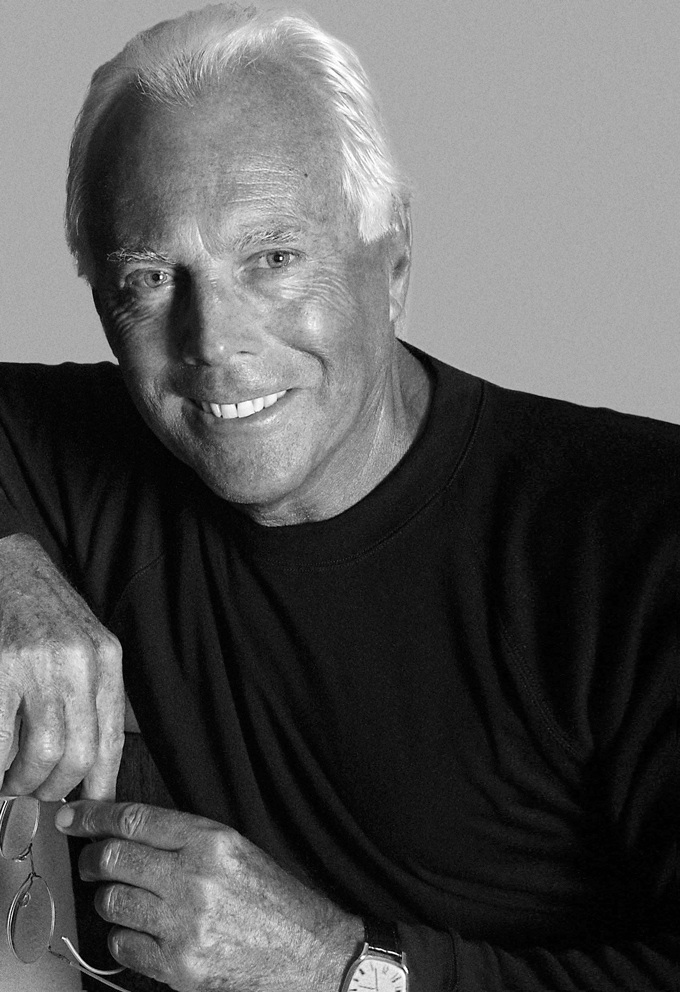
Christian Dior gave us the New Look, Yves Saint Laurent paved the way for ready-to-wear, while Coco Chanel liberated women from their corsets. Each of them is worthy of the monikers ‘legendary’ and ‘iconic’, but their fashion histories have already been written. Mr Armani, on the other hand is a living legend, and known for his precision, punctuality and unwavering strive for perfection, he is deservedly the most successful Italian designer of all time.
One part of Mr Armani’s sprawling portfolio of collections, is his Haute Couture offering, Armani Privé. Here we talk to the man behind the empire, about the optimism of orange, and the creative freedom of haute couture.
Is Haute Couture, with its rules and references to the past, still relevant today? What does it mean to you and what attracted you to this form of expression?
Haute Couture may appear anachronistic to some. Personally, I think that its high aesthetic and material value, being so precious, makes it always current. To me, Haute Couture represents the ideal uncharted territory that allows me to express the best of my creativity, translating into sartorial creations of timeless elegance. There are women who live special lives and need appropriate clothes, and in my work, I address their needs. Haute Couture is a dream that materialises into clothes produced with the highest artistry, where my style and aesthetic language are expressed in a subtler, more refined way.
Are you inspired by the creative freedom that Haute Couture allows?
It’s certainly liberating, though I’m a pragmatic designer who never forgets that Haute Couture means wonderful clothes made to be worn. Absolute freedom is expressed in the choice of materials, embroideries, and details. Reinterpreting the codes of Haute Couture in my style, I apply to my creations a precious language, different from prêt-à-porter, but identical to this in the expression of a refined elegance.

Why did you choose to present your Armani Privé collection in Paris? What does this city represent for Haute Couture?
Paris is the undisputed capital of Haute Couture. Here, Haute Couture is part of the rich cultural fabric and has a history preserved and valued over the years. Fashion shows in Paris are magical, the context and audience are essential to the spirit of Haute Couture.
In the last few years, Haute Couture has undergone something of a revival and attracted a new clientele. Do the new markets affect your creative choices in any way?
The new markets do not affect it directly, but certainly stimulate it and provide a wider audience. Personally, I place a lot of importance on my clients’ requests, because Haute Couture is about dialogue and service. I offer them precious clothes with a subtler, less conspicuous appearance. The Middle East and Far East are two markets where we have achieved our best results in Haute Couture recently. These are important markets, as they show today’s wide spectrum of Haute Couture clientele, which includes very young women too. In general, the performance of the Armani Privé collection is very positive, with orders growing when compared to last year, both in consolidated markets and in new countries, and my Milan studio is constantly busy.

How important is the relationship that develops with the client when you create her clothes?
Dialogue is essential, because through it we realise the uniqueness of the Haute Couture creation. There is a very lively flow of ideas. Regarding specific choices, it depends on the clients and their needs, standard considerations do not apply in Haute Couture. Couture is primarily a service, and I dress women for every event in their lives. My Far East clients are particularly interesting to watch, they are more daring and recently seem to be increasingly attracted by eveningwear.
Is Haute Couture a service or an offer?
Both. The catwalk is my offer for the season. The clothes created for my clients come from these creations.
Aesthetically, how has your idea of Haute Couture developed since the launch of Armani Privé?
Over the years, my work in Haute Couture has found a unique, unmistakable code. Today, fluidity is added to structural design, expressing a feminine, precious style. The process has evolved, but the basic inspiration remains unchanged, an ongoing quest for the purest form of elegance.

What is the process for the creation of a dress, and how does it evolve?
The first step is a drawing, followed by the realisation in the Atelier by expert ‘hands’, which take care of each and every tiny detail. Over time, new knowledge is added to each step. All Armani Privé styles are made entirely by hand, to order and tailored in the Armani Privé Milan Atelier.
In Haute Couture, do you prefer the process or the product?
I like the product, because it is unique thanks to the process behind it.
What inspired you for the latest collection?
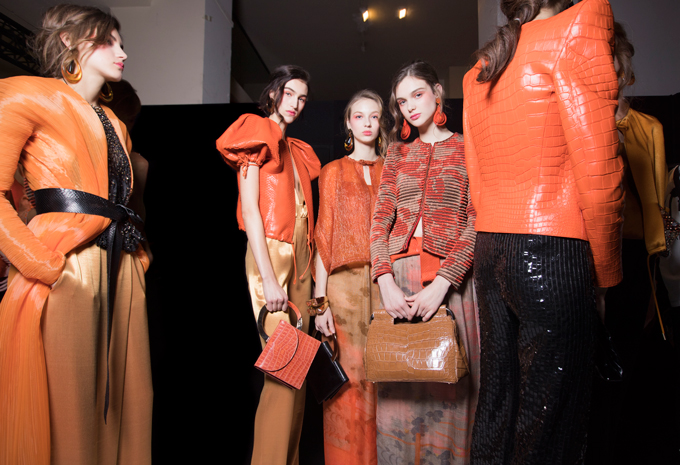
I wanted to centre my Spring/Summer 2017 Armani Privé collection around a major concept, which I then translated into different styles. My focus is often a particular shape or texture, however, for the new collection I decided to focus on the ‘vibration’ of a single colour, orange. It’s a dynamic shade of orange, used in a variety of tones. A happy, energetic colour that flatters all women, combined with black to enhance its intensity. The new Armani Privé collection embodies my idea of glamour and elegance. It is characterised by flowing, essential lines, enriched through the use of precious materials and carefully handcrafted details. Orange, set off by black, is used for small flecks as highlights, or for solid areas. It gives various looks an exotic accent. But this is filtered exoticism, reduced to a subtle suggestion, never overtly obvious. Haute Couture is an ancient art, which I want to root in the present. Undoubtedly, these are special clothes for special women, but they are most definitely made to be lived in and worn.
Travelling Light: Handbag-sized Beauty Essentials are not just for Holidays
Skincare, sun protection, cosmetics and haircare can add a hefty burden to your carry-on case. Avoid airport stress and unnecessary baggage by shrinking your beauty bag. There is no need to mess around with refillable cosmetic bottles, because all our favourite brands have done the hard work already.
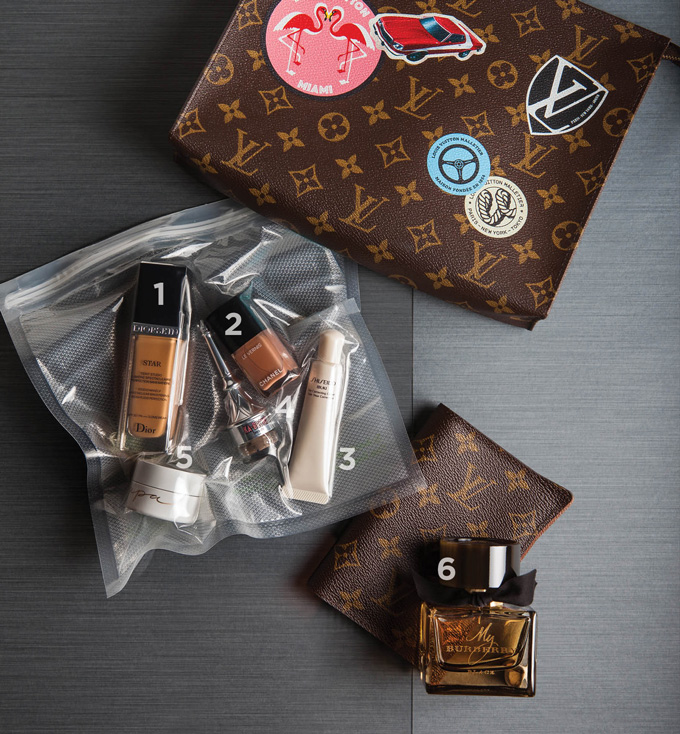
- Diorskin Star Studio Make-up Spectacular Brightening Weightless Perfection
- Chanel Le Vernis in Beige Beige
- Shiseido Ibuki Eye Correcting Cream
- Benefit Cosmetics Ka Brow!
- Apa Lip Loofah
- My Burberry Black Parfum
Additional Accessories, Louis Vuitton
Styling: Eliza Scarborough
Photographer: Henry Pascual
The Eight Reasons to Visit an Art Exhibition this Spring
From New York to Dubai, by way of London and Paris, there are numerous blockbuster art exhibitions opening which shouldn’t be missed. From retrospectives of the greatest artists of the past, to large-scale exhibitions by contemporary giants, there will be plenty that you will want to visit from our carefully edited selection below.
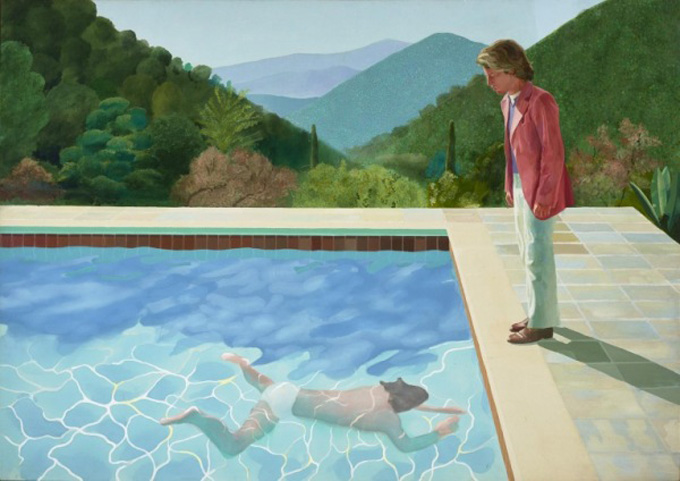
David Hockney
Mr David Hockney’s most comprehensive retrospective, held in celebration of his 80th birthday, reminds us that he was once a radical and something of an outsider. Since landing like an atom bomb on the art scene in the 1950s, his paintings of shimmering LA swimming pools, rolling Yorkshire dales, and more, have captured the imaginations of generations of people and shaped the way we see the world. Covering six decades there are more than 250 works on show, including his latest digital iPad experiments, collages, and even his work with fax machines.
9 February to 29 May
Tate Britain, London

William Eggleston – Los Alamos
The godfather of modern colour photography, Mr William Eggleston takes us on a nostalgic journey through the US between 1966 and 1974. The images on show were taken on various road trips and demonstrate Mr Eggleston’s talent for transforming the mundane into the sublime. His snapshots of diner condiments bathed in golden light, bright billboards and cars haunting car parks are a simple reminder that everything, the past included, is worth a second look.
17 March to 7 June
Foam, Amsterdam

Lala Rukh – Sagar
This exhibition marks the first solo Dubai debut for Lala Rukh, a feminist activist artist from Pakistan, and features a collection of her photographic images of the sea and coastlines. The focus falls on the serenity of the tides, punctured only by a diving seagull or the oars of a boat, as Rukh remains a voyeuristic observer. Whether it’s the breaking of day, or the coming of the night, the oceanic images provide a calming canvas for deep meditations.
13 March to 13 May
Grey Noise, Dubai

Paul Cézanne
The first exhibition devoted entirely to the portraits of Paul Cézanne, an artist hailed as ‘the father of us all’ by Matisse and Picasso, is to be staged in Paris, London, and Washington. Over 50 of Paul Cezanne’s portraits will be displayed together in this major show which will travel the world, and is likely to be one of the major exhibitions of the year. It will be a fantastic opportunity to gain a detailed understanding of part of the work of one of the 19th-century’s most significant artists, who influenced the art of Cubists, Fauvists, and successive generations of avant-garde artists.
13 June to 24 September
Musée d’Orsay, Paris

Khaled Ben Slimane – Ya Latif
Tunisian-born Khaled Ben Slimane presents a multi-disciplinary art exhibition that delves into the realm of spirituality. Inspired by the mythical practice of Sufism, the painter expresses a deep entrancement through repetitive graffiti-like calligraphy, that is rooted in the past yet exudes a contemporary aesthetic.
9 March to 8 April
Elmarsa, Dubai

Mark Chagall – Colour and Music
Despite poverty, two world wars, ethnic persecution, Russian-French artist Mr Marc Chagall’s fantastical paintings of flying fiddlers, fiery cityscapes, lovers, and village parties, captures the joys and many horrors of the 20th century. Featuring more than 300 pieces, which span the artist’s years in Russia, Paris and his exile in New York, the exhibition includes paintings, sculptures, and tapestries, as well as Mr Chagall’s costume designs and decor, lent by the Paris Opera, the New York City Ballet and the Metropolitan Opera.
28 January to 11 June
Montreal Museum of Fine Arts, Quebec

Samia Halaby – Illuminated Space
Showcasing her transition into abstract art, this exhibition features natural organic forms, such as flowers and trees, bathed in bright vivid colours that were inspired by the works of Mark Rothko and Ad Reinhardt. Expect soothing shades and hues, mixed with an invitation for personal interpretation.
9 March to 17 June
Ayyam Gallery, Dubai

Fahrelnissa Zeid
Part of the Tate’s ongoing shift towards showcasing artists from outside the well-trodden West, this is a retrospective of a Turkish artist who lived across 90 years of the twentieth century and travelled extensively in Europe, Asia, and America. Zeid’s dazzling, jewel-like paintings, were influenced by the art of the Islamic world, and Western avant-garde abstraction.
Tate Modern, London
7 June to 15 October
By Eliza Scarborough
Superstitious: Frédéric Malle partners with designer Alber Elbaz to create a new perfume
Designer Alber Elbaz, the former creative director of Lanvin who abruptly left the label over a year ago, has teamed up with French perfumer Frédéric Malle for a new fragrance creation.

Fashion designer and icon Alber Elbaz announced the collaboration during a special ceremony where he was officiated as an Officier in the Légion D’Honneur in Paris. The scent, Superstitious, is the 24th fragrance edition for Frédéric Malle, and also marks the second-ever fragrance Malle has created in collaboration with a fashion designer, previously he partnered with Dries Van Noten in 2013.
Frédéric Malle and Alber Elbaz worked with perfumer Dominique Ropion to create Superstitious. Mr Elbaz explained, ‘The word ‘Superstitious’ was the starting point of it all, something we agreed upon immediately. We are both superstitious.’


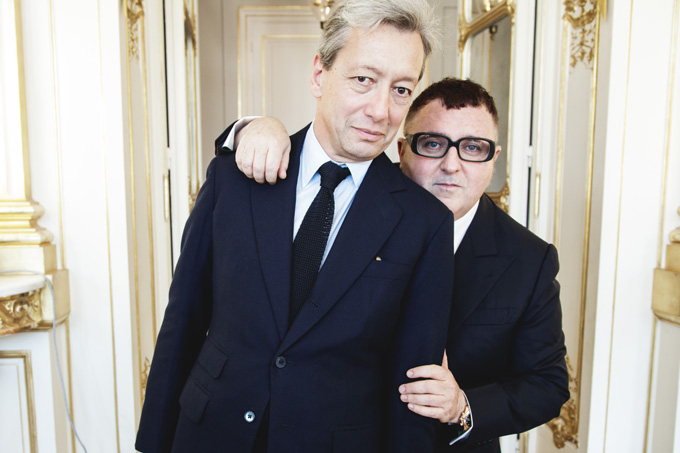
‘I have always admired Alber for making the women who wear his clothes appear even more beautiful. It is all about them and not about himself.’
Frédéric Malle
BEAU RIVAGE, GENEVA: A Charm, Elegance, and Spirit of a Private Home
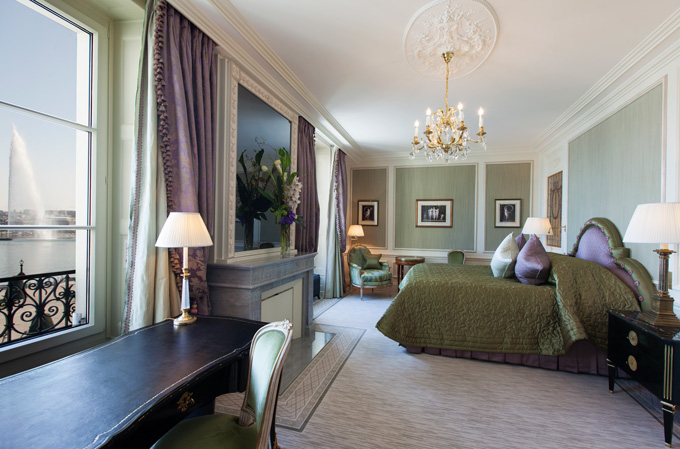
The Beau Rivage is a beautifully-maintained historical property owned by the same family for more than a century. This is a real gem of a hotel that is conveniently and scenically located by the lake in Geneva. It is ideally located on the lakefront, in front of the water jet, facing the Mont Blanc and the snowy mountains and the famous Jet d’Eau water fountain. The building has three facades, towards the lake, the Brunschwick garden and the city, with a total of 95 rooms.

History
Founded in 1865 by Jean-Jacques Mayer, Beau-Rivage has been under family ownership for more than five generations. Today, proprietors Jacques Mayer and Catherine Nickbarte-Mayer take pride in their family’s historical past, as the hotel is one of the rare luxury hotels in Switzerland currently managed by direct descendants of its founder. Alexandre Nickbarte-Mayer, Catherine’s son, was appointed General Manager of Beau-Rivage in 2016, and so the fifth generation of the family has taken up its post as the head of the hotel.

The Rooms
Following a renovation, Beau-Rivage now offers even more exclusive spaces. There are 15 suites, of which 6 are historic and 9 are brand new top-floor unique suites. The renovated include duplex apartments ranging from 100 to 150m2 and two apartments of 150 and 250m2. All with a private spa bathed in daylight, exceptional views, unique volumes, and an extremely comfortable bed from which you can admire the stars if you wish. Designed by the celebrated British interior architect Leila Corbett Elwes, every room has its own personality, expressing their differences with art and subtlety, down to the smallest detail.


Food & Drink
Whether it’s a Michelin-starred restaurant, a prestigious bar and lounge, or fine dining Thaï cuisine, you will be sure to be catered to in the most delicious and tasteful way possible. At the heart of Beau-Rivage, the restaurant The Chat-Botté promises to offer a unique and memorable culinary moment. The Chat-Botté charms its guests with its Mediterranean colours and atmosphere, and is skilfully orchestrated by the Chef Dominique Gauthier, Michelin star-awarded and 18/20 in Gault&Millau. In the kitchens, guests can enjoy a surprise menu created by the Chef and savour it the heart of the action at the Chef’s table. Alternatively, at Patara Fine Thaï Cuisine there is a gentle distillation of the exotic and flavours from far away, with courses following each other in a succession of captivating spices and senses. The Arab culture has also been catered for, with a halal menu available, and the terrace being the perfect place to savour it, overlooking the lake.

Alice Temperley: how art can inspire fashion and the challenges of a changing industry
Designing coveted bridal wear and ready-to-wear collections for her eponymous label, Alice Temperley MBE is a fashion force going from strength to strength.

Effortless glamour is one of the best ways of describing the printed and embroidered pieces at Temperley London, which fuse a bohemian aesthetic and artisan techniques with a contemporary attitude. Defined by a striking colour palette, mannish, relaxed tailoring breaks up the overtly feminine offering of wear forever pieces.
Somerset-born, London-based, Alice Temperley founded her eponymous label in 2000 and quickly established herself as the first port of call for exquisitely embellished eveningwear and dresses, peppered with her signature Victoriana, silver-screen influences. Marching to the beat of her own colourful and eclectic drum, the confidence of her modern-bohemian aesthetic has paid off, taking the fashion industry by storm, one market at a time. Well-known for her beautiful fabrics, vintage aesthetic, and hand-finishes, together with a squad of glamorous muses, including Caroline Issa, Laura Bailey, and Arizona Muse, Alice has garnered a loyal following, including the Royal family, for both her high-wattage eveningwear, and sharp tailoring.
We caught up with Alice in Paris to understand how art can inspire fashion, together with learning about the struggles she has faced as the fashion industry has changed through time.
When did you first discover fashion and glamour?
When I was a child we didn’t have a television until I was about 11, and so at that stage I discovered black and white movies, becoming obsessed with the romantic Fred and Ginger film noir style. I used to watch a lot of them, and no one could understand my fascination with black and white movies, but I could just sit and stare, pretending I was in them, looking into another world that I just found amazing. I guess that now I still design dresses for a fantasy world that you can export yourself into.
If you weren’t a designer what would you be?
A photographer, and a painter. They are still about creating image and escapism, but for the lifestyle I would be a painter, and I still expect to be a painter in the future.
As a fashion designer, do you have a style maxim?
Masculine, feminine. You should never be overdressed, you can always be underdressed, so I never like to have anything perfect and matching. You should never look too done.
How would you describe your own personal style?
I would describe it as quite classic, and timeless, yet still eclectic. I like ultra-feminine, but mixed with boyish touches.
When you aren’t wearing your own label, who is your go to designer?
I am just about to go and buy some McQueen show boots, that I just haven’t been able stop thinking about. On the whole I always wear my own brand, apart from vintage pieces and then dungarees for when I’m painting on the weekend, buying just accessories and shoes from friends who are designers. I don’t really wear anything else, as I feel that if I were to wear another designer then it seems like I am failing.
Whose effortless style do you admire and why?
I have a lot of muses who wear Temperley, such as Caroline Issa, who I have been working with this season, as she styled my show. I am inspired by the women around me, and a lot of the girls I dress such as Arizona Muse and Olga Kurylenko. Then of course I get further inspiration if I am dressing my team and my mother.
Who is the Temperley woman?
She is somebody who I guess doesn’t feel like she should fit in and wear items that are really trend related. The Temperley woman has her own sense of identity, and is looking for investment pieces that can transcend seasons. It is creating something that is our own language, and then whoever wears it makes it their own. I want the pieces to be forever pieces, as so much love, work and energy goes into each garment, so I would love them to be passed down through generations, and worn over and over.
How has fashion changed since you started in 2000?
I was so naïve when I started, and was doing it because I loved it and I liked making things. Now the business side of things and structure of the collections and deliveries becomes paramount. So much is about the logistics, production, and delivery, which makes up 80 percent of the business.
How has your brand evolved?
The brand is still very true to its original identity, with the spirit of the brand still exactly the same. The business and product however have become more polished. I have grown up with the business, as have my muses. At the beginning, it was an idea and a spirit, and the same energy and spirit is still there, but it takes many years to build a good team with the right people who have the same shared vision, which is what we have now achieved.

Do you find the speed of fashion challenging as demand increases for the number of collections and ranges a year?
What we were doing was four collections a year, and then my diffusion line, and then other consulting projects that I was personally doing, and this was understandably a huge work load. So now we have changed the focus to just the one collection, Temperley London, with no diffusion line. This has given us one label for the brand, together with the bridal department, allowing us to offer less in the collections, but more focus.
What are the hardest parts of this business that you have faced?
The pace of it, and the fact that there is never any downtime. Especially because you need to keep it up, as you are only as good as your last show.
How do you feel social media has impacted the fashion industry?
It is taking over. I think it is great to be able to reach people, and a fantastic way of being able to buy things. It can be terrifying, but it is an amazing way of telling a story. It is incredibly powerful, and I find this hard because of the amount of coverage you will get from a show straightaway, when you don’t yet have the product available to buy, which is a shame following the hype that can surround them.
What keeps you inspired and driven?
Beautiful things, pleasing my eye.
Can you share with us the secret to your success?
The energy of the people around me, and staying true to the brand, beating our own drum. We do things in a different way, but remain consistent with it. It has been having a sense of identity, so people understand the brand, knowing what it is about, and recognising it.
What is your ultimate luxury?
Time away with my family without gadgets. It is being remote and switching off.

Does art inspire your designs?
Yes, of course. I am a trained printer, studying at the Royal College of Art, and did seven years of printing, so this is very much a part of my designs. I don’t like a lot of contemporary art, but I really prefer pieces when you can appreciate the skill of the masters and the incredible techniques they had. I also really like deco and elements of different eras. I have always loved lithographs and prints rather than paintings, as the process of layering colours and the cleanliness of it really appeals to me, whereas I find watercolours too wishy washy and old fashioned.
Do you have a favourite piece of art, and what does it mean to you?
My personal collection is very eclectic, but it is mainly British artists. I have a lot of vintage advertising posters, like my Toulouse- Lautrec ‘Job’ print, which is so classic and makes me feel like I am in a French brasserie. You feel that you can step back in time with them. Then there is a painting by the sculptor Anish Kapoor, and I recently found a photo of him painting it with my son Fox, who was two at the time. Fox put a paintbrush in his mouth and Anish lent over to him and moved his head as my son painted. It was Fox’s first painting, but Anish signed it and made me promise to never, ever sell it.
Growing to now be a global brand, how has this affected the design process as you have to cater to different countries and cultures?
Funnily enough Japan is our number two bridal market, and we create some bespoke, key looks for them. Then we are successful in the Middle East, which I think is because we always tend to have a sleeve, which I find far more elegant on women, no matter what their age is. Going into the Asian market we are cutting shorter, mini lengths, and smaller proportions for them.
You have visited Dubai many times, what do you like about the city?
I love the desert and riding the horses out in Dubai. I also enjoy seeing the appetite that the women out there have for what they wear, and their passion for fashion.

How do you feel your brand fits in the region?
Because there is an occasion to wear it, and the colour, cut and weight of the fabrics used. We actually shot our summer campaign out in Dubai, with the kaftans fitting perfectly with the setting.
What has been a standout moment in your career?
Receiving my MBE from the Queen, and my first fashion show, when I was so naïve and new to the world of fashion.
Can you share with us the best piece of advice you have been given, and live by?
To listen to yourself, and your own intuition, and stick by it.
By Eliza Scarborough
Inside the World’s Most Luxurious Lounges: VIP areas to check out after you’ve checked in
Looking for the ultimate in pre-flight comfort? An hour or two in an airport lounge is the ideal way to relax and unwind before you jet off on holiday. Here, we look at some of the most luxurious airport lounges in the world, which look more like a city centre private members club than an airport facility, so you’ll soon be secretly wishing your flight is delayed when travelling.
Sydney
Qantas First Class Lounge
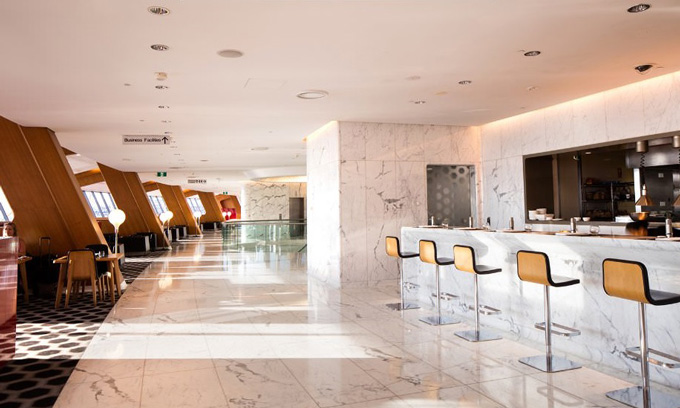
With 8,400 plants designed by tropical botanist Patrick Blanc, this lounge welcomes guests at the entrance by bringing a dose of nature indoors in a dramatic and sustainable way. The day before your flight, a member of staff will call to book you in for a 20-minute massage or facial in the jungle-like spa with living walls of plants. Mr Marc Newson-designed European oak sculptures segment the lounge distinguishing the dining area, relaxation space, business centre, library, and entertainment rooms. No corners are cut when it comes to furnishing, there are individual marble-lined shower suites with stereo volume and lighting controls, radiant heating to reduce condensation on the mirrors, exclusive furniture and luxurious finishes including leather lounge chairs, recliners, and sofas by Italy’s Poltrona Frau are just a few of the highlights.

Abu Dhabi
Etihad Lounge & Spa
Etihad’s First Class Lounge & Spa features 16 unique areas designed to ensure that guests can relax, re-energise, and be entertained in total luxury pre-flight. An à la carte restaurant, showcase bar, fitness room, cigar lounge, Six Senses Spa, Style & Shave barbers, nail bar, TV room, secluded relaxation room, and children’s play room ensure that all guests receive a highly-personalised experience.
Paris
Eurostar
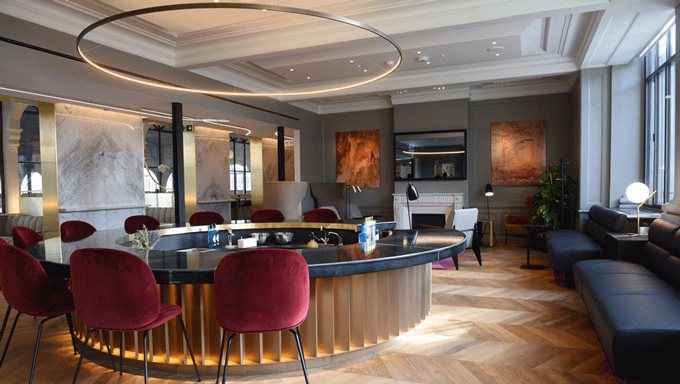
The food in this chic new Eurostar lounge has been overseen by Mr Raymond Blanc, so say ‘au revoir’ to sad bowls of peanuts. As of February, Business Premier passengers whizzing between London and Paris can graze on healthy salads and pesto chicken with quinoa. UK-based architect Softroom was assigned the task of transforming this high-ceilinged apartment-style space, with plush velvet and rotating artwork curated by London’s Hospital Club. There are white marble fireplaces, sleek co-working benches, and floor-to-ceiling windows, while the pièce de résistance is a circular bar where you can order bespoke drinks made by the London Cocktail Club.
London Heathrow
United Club Lounge
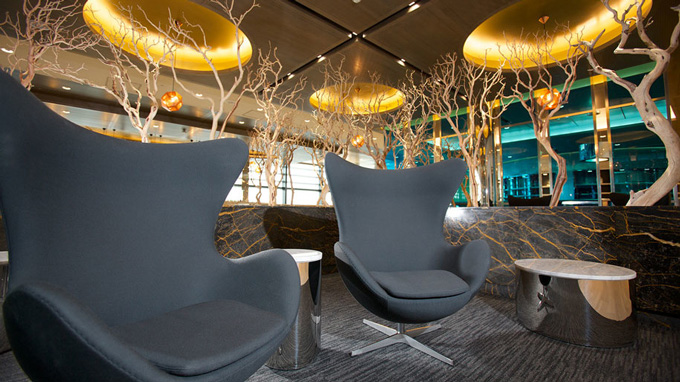
The United Club lounge in Heathrow’s new Terminal 2 is open to business-class passengers flying with the airline, as well as gold members of the Star Alliance group. Its gleaming marble bar is the longest in the airport, beneath the Tom Dixon pendant lamps. There is a vast buffet which has all-day hot and cold courses, and hotel-grade shower rooms stocked with Cowshed products. Once you have freshened up and refuelled, relax in one of the retro wing chairs, which are surrounded by an installation of blanched driftwood trees.
Los Angeles
Star Alliance Lounge
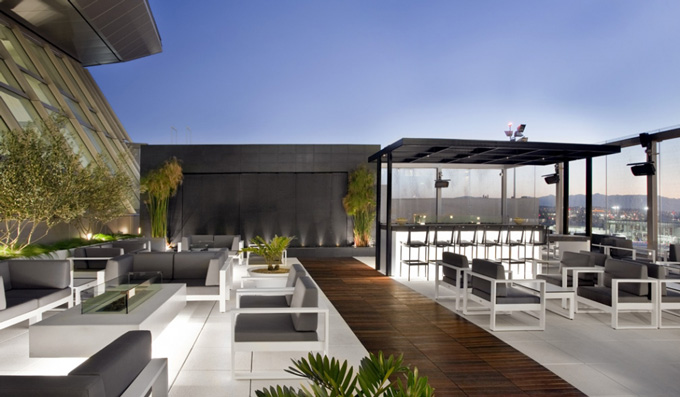
The Tom Bradley International Terminal has its fair share of celebrities and fashionistas passing through, and they will probably be heading to the business-class Star Alliance lounge, which is even bigger than the first-class section. The highlight is its huge al fresco terrace, which offers views of the runway and the Hollywood Hills beyond, and is illuminated by fire pits at night. Comfortable outdoor seats have built-in power sockets so you can charge your laptop while reclining, or otherwise inside you will find a screening room and monochrome prints of iconic LA sights. Self-serve fizz from the Napa Valley is free-flowing and, together with SoCal-friendly salad and noodle stations. Even if you’re not famous, you can expect the VIP treatment in here.
Frankfurt
Lufthansa Lounge
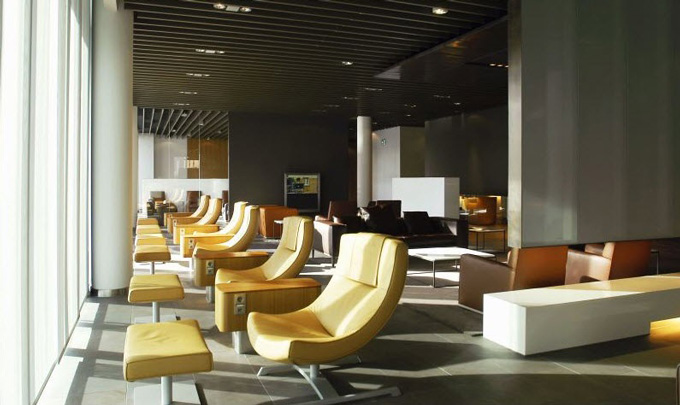
Not only does this lounge provide an area away from the rest of the airport, it has a terminal all to itself. Facilities include valet parking, a cigar lounge, two sleeping rooms and private bathrooms. And when the time comes to board, a limousine will take you directly to the plane.
Doha
Al Safwa Lounge
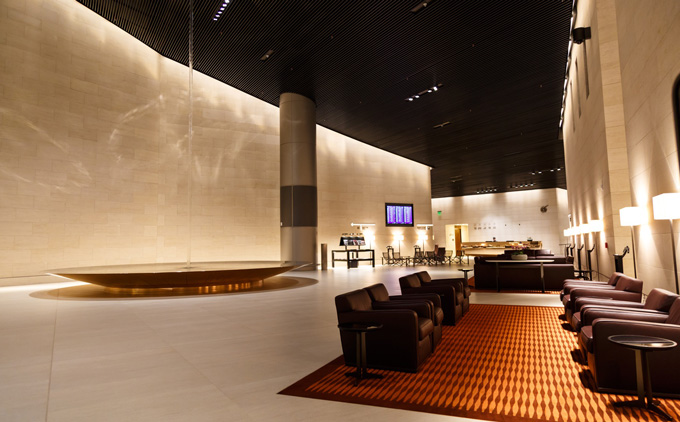
The Al Safwa first-class lounge at Doha Hamad International airport has a sci-fi feel, from the silver, lozenge-shaped reception desk, to a hall where you’re greeted by a decorative pool with a water feature that flows down from a triple-height ceiling. There are lines of private seating pods, and a further living zone located under the atrium of the main terminal, giving the feeling of being outside. You’ll never have to wait for a table at the Al Safwa restaurant, where staff rush to take your order of international and local dishes, including a sushi counter and a dessert room. And for the ultimate pre-flight refuge, head to the spa for a Jacuzzi and a nap in one of the sleep pods.
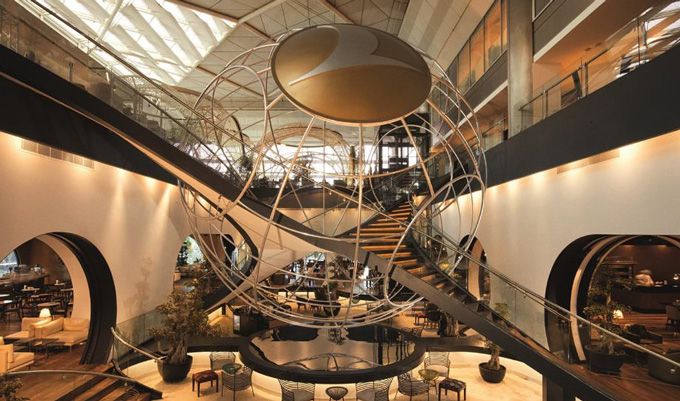
Istanbul
CIP Lounge
Described as a destination in itself, and capable of hosting more than 1,000 people at any one time, the two-storey CIP lounge at Istanbul Ataturk puts its focus on food and entertainment, with chefs whipping up traditional delicacies. The famous Austrian patisserie Demel has installed a counter for Viennese pastries. If you are travelling with friends, you can practise your swing in the golf simulator, watch a blockbuster in the cinema, play on the PlayStation 4, or rediscover your inner child on the Scalextric, otherwise you can just relax and listen to the grand piano.
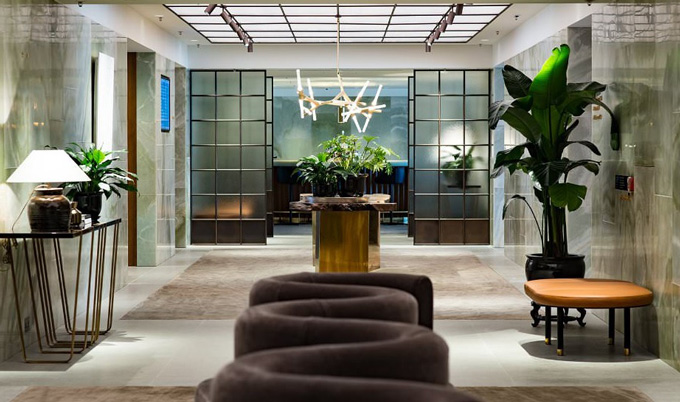
Hong Kong
Cathay Pacific
Voted as the World’s Best First Class Airline lounge in the 2016 global passenger survey, Cathay Airlines Pier Business Class Lounge in Hong Kong is by far one of the most luxurious airport lounges the world over. Passengers enter through the Tea House, a brand-new feature developed specifically as a sanctuary space for travellers to escape the hustle and bustle of the outside world, where a wellness area comes equipped with a wide selection of teas served up by a dedicated tea specialist. There are also five private cabanas complete with daybeds, showers, baths, and robes, to unwind in with a soothing drink after a shower pre- or post-flight.
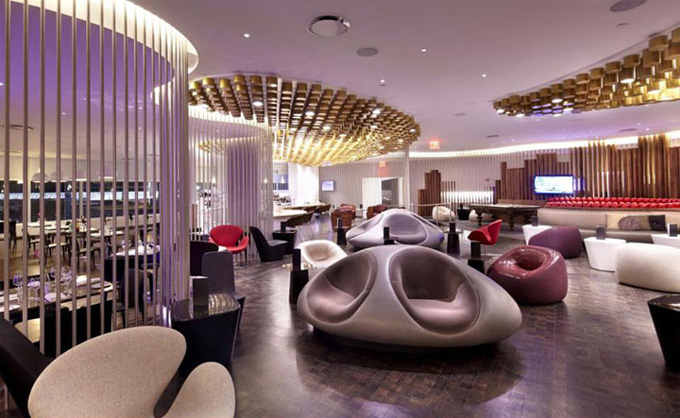
New York
Virgin Atlantic Clubhouse
An airport lounge with New York style, The Clubhouse has a staggering selection of amenities. If you are in need of a pre-trip blowdry, or post-holiday haircut, the lounge features a Bumble & Bumble hair salon. Otherwise if you want some ‘me-time’ you can take advantage of person-sized cavities that have been created in the walls and lined with wool.
By Eliza Scarborough
Spring Shopping Secrets: latest news to keep you in the know
Check out the hottest news for April from the world of accessories; from must-have new pieces to hot collaborations and brand launches.
The Artemis
One of the first women’s bags imagined by Christian Louboutin, the Artemis returns with renewed dynamism for the new season. Inspired by the Greek Goddess of the same name, the elegant and simple bag, draws the eye unexpectedly to the wearer’s shoulder through a bold flock of feathers or mixed spike embellishment.

Zayn and Gigi
Captured by Gigi Hadid on iPhones and digital cameras, Zayn Malik stars in an intimate set of images for the new Versus campaign. Shot throughout an evening hanging out in a suite at the legendary Chateau Marmont in Los Angeles, the images are a raw, honest and revealing study of relationships, friendships, and the passions of the Versus tribe.

Mehry Mu
Turkish designer Günes Mutlu’s vibrant discoveries in Istanbul’s Grand Bazaar inspired her to create this eclectic line of bags. Each style is handmade in Istanbul and designed to ‘make the user feel chic in an effortless way,’ she says.

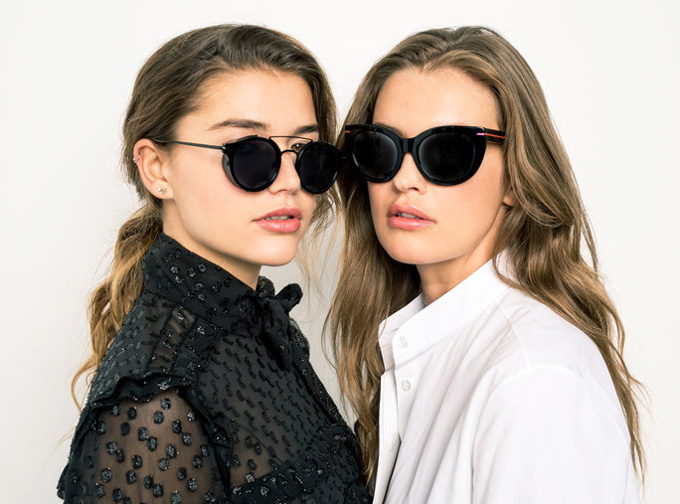
Hadid Eyewear
Another talented Hadid, Alana, half-sister of supermodels Gigi and Bella, is launching a line of sunglasses. Her designs, inspired by travel adventures with her family, focus on cool, off-duty style. She is also giving back at the same time, with five percent of each sale going to, The Vision of Children Foundation, a sight disorder charity.
The Cult Buy
Miuccia Prada has a knack for turning the unexpected into the ultra-desirable, such as these heart covered brogues. What really makes these work is the balance between the pastel pink and charming appliqués with the tough, smart shape of a brogue.

Prada Pendant
Supersized medallions from the 1970’s have made a return. Take a tip from the Prada Spring Summer catwalk and pile them up, clashing with your look beneath. Be brave, bigger and bolder are better.

Sweet Finish: how to pull off picture-perfect skin with a dusting of powder
Use a dusting of powder to set your make-up, and deliver a flawless look.
You’re already familiar with contouring and strobing, but baking is the new buzz word in the beauty world. The term refers to letting translucent powder sit on your face for five to ten minutes, which allows the heat from your face to set your base foundation and concealer, and then dusting it off your face, leaving you with a creaseless, flawless finish.
Here’s how you too can pull off picture-perfect skin, and brighten your eye area while you’re at it:
Hydrate your eye area
Apply eye cream around your eye area to hydrate your skin and plump it up, minimising the appearance of any fine lines, creases, or caking from all the products you are about to apply.
Apply a thick concealer under your eyes
While concealer usually contains oils, and tends to crease, it won’t if it’s set right. Apply it upwards from the apples of your cheeks, towards your temples all the way underneath your eye. Then, blend it in with a damp makeup sponge.
Reapply more concealer
Dab on another layer of concealer, this time a brighter, lighter one, and pat it in.
Dust on translucent powder
Using a fluffy eye shadow brush, apply translucent powder over the entire patch of concealer to set the base makeup.
Bake your makeup
Now that you’ve pre-concealed, you can bake. Dampen a make-up sponge, and dip it into the translucent powder, layering the loose powder generously over the area where you applied the concealer. Leave the powder on for anywhere between 5 to 10 minutes.
Dust it off
With a clean fluffy brush, dust away excess powder from under your eyes, blending any harsh edges.

CLOCKWISE FROM TOP LEFT:
Diorskin Forever & Ever Control Extreme Perfection & Matte Finish
Shiseido Future Solution LX Total Radiance Loose Powder
Burberry Nude Powder
Diorskin Nude Air Loose Powder
Sisley Paris Phyto Loose Face Powder
Guerlain Le Voilettes Translucent Loose Powder
Dior Diorskin Forever Perfect Cushion
Estee Lauder Perfecting Loose Powder
By: Eliza Scarborough
Photographer: Henry Pascual
The History of Art: a look at the most famous artists of all time
The history of painting reaches back in time to artifacts from pre-historic humans, and spans all cultures. It represents a continuous, though periodically disrupted, tradition from antiquity.
Across cultures, and spanning continents and millennia, the history of painting is an ongoing river of creativity, that continues into the 21st century. Until the early 20th century it relied primarily on representational, religious, and classical motifs, after which time more purely abstract and conceptual approaches gained favour.
It is a never-ending chain that began with the very first pictures ever made. Each style grows out of the styles that came before it, and every great artist adds to the accomplishments of earlier painters, influencing later painters.
Here we look at the most famous artists of all time, shining a light on their most notable pieces of work, and what made them revolutionary.
Andy Warhol
American Painter, Draftsman, Filmmaker, and Printmaker

Technically, Warhol didn’t invent Pop Art, but he did manage to take the style out of the art world, bringing it into the world of fashion and celebrity. Starting out as a commercial artist, he brought the ethos of advertising into fine art, even going so far as to say, ‘Making money is art.’ Such sentiments blew away the existential pretensions of Abstract Expressionism. Although he’s famous for subjects such as Campbell’s Soup, Marilyn Monroe and Elvis Presley, his greatest creation was himself.
Born: August 6, 1928 – Pittsburgh, Pennsylvania
Died: February 22, 1987 – New York, New York
Pablo Picasso
Spanish Draftsman, Painter, Printmaker, and Sculptor

Born in Málaga, Spain, Pablo Picasso is undoubtedly one of the most famous artists ever, with his name being virtually synonymous with modern art. He changed the course of art history with revolutionary innovations that include collage and, of course, Cubism, which broke the stranglehold of representational subject matter on art, and set the tempo for other 20th-century artists. He utterly transformed multiple mediums, making so many works that it’s hard to grasp his achievement.
Born: October 25, 1881 – Malaga, Spain
Died: April 8, 1973 – Mougins, France
Jackson Pollock
American Painter
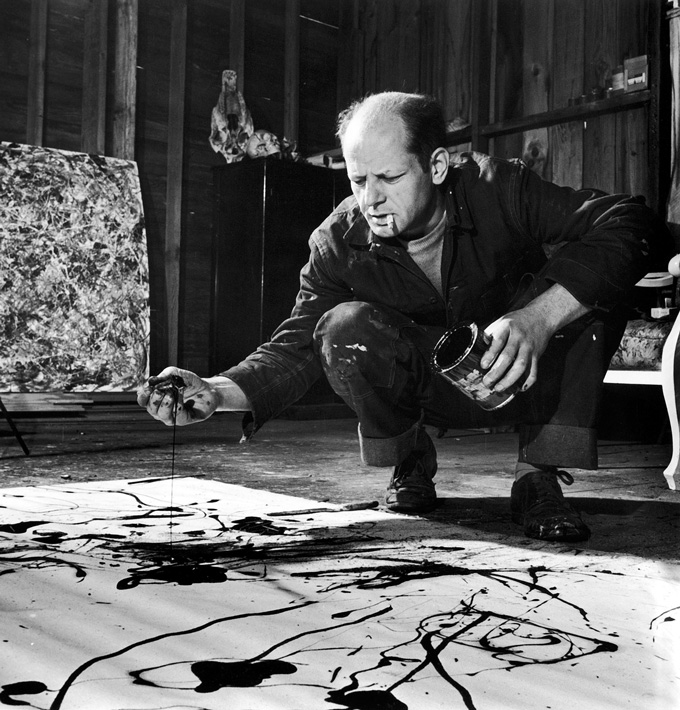
Hampered by self-doubt and clumsiness as a conventional painter, Pollock transcended his limitations in a brief but incandescent period between 1947 and 1950 when he produced the drip abstractions that cemented his renown. Eschewing the easel to lay his canvases on the floor, he used house paint straight from the can, flinging and dribbling thin skins of pigment that left behind a concrete record of his movements, a technique that would become known as action painting.
Born: January 28, 1912 – Cody, Wyoming
Died: August 11, 1956 – East Hampton, New York
Vincent van Gogh
Dutch Draftsman and Painter

Van Gogh is legendary for being mentally unstable, he did after all, cut off part of his ear after an argument with fellow painter Paul Gauguin, but his paintings are among the most famous and beloved of all time. The iconic tortured artist, strove to convey his emotional and spiritual state in each of his artworks, and although he sold only one painting during his lifetime, he is now one of the most popular artists of all time. Van Gogh’s technique of painting with flurries of thick brushstrokes made up of bright colours squeezed straight from the tube would inspire subsequent generations of artists.
Born: March 30, 1853 – Groot-Zundert, The Netherlands
Died: July 29, 1890 – Auvers-sur-Oise, France
Leonardo da Vinci
Italian Polymath

Painter, sculptor, architect, designer, theorist, engineer and scientist, Leonardo da Vinci created some of the most famous images in European art. Though many of his works were never finished, and even fewer have survived, he influenced generations of artists and he continues to be revered as a universal genius. The original Renaissance Man, Leonardo is renowned not only for masterpieces such as the Mona Lisa, The Last Supper, and The Lady with an Ermine, but also for his drawings of technologies that were five hundred years in the future.
Born: 15 April 1452, Anchiano
Died: 2 May 1519, Clos Lucé, Amboise, France
Claude Monet
French Painter

Perhaps the best know artist among the Impressionists, Monet captured the changeable effects of light on the landscape through prismatic shards of colour delivered as rapidly painted strokes. Moreover, his multiple studies of haystacks and other subjects anticipated the use of serial imagery in Pop Art and Minimalism.
Born: November 14, 1840 – Paris, France
Died: December 5, 1926 – Giverny, France
Salvador Dalí
Spanish Painter, Sculptor, Filmmaker, Printmaker, and Performance Artist

Dalí was effectively Warhol before there was a Warhol. Like Andy, Dalí courted celebrity almost as an adjunct to his work. With their melting watches and eerie blasted landscapes, Dalí’s paintings were the epitome of Surrealism, and he cultivated an equally outlandish appearance, wearing a long-waxed moustache that resembled cat whiskers.
Born: May 11, 1904 – Figueras, Catalonia, Spain
Died: January 23, 1989 – Figueras, Catalonia, Spain
Henri Matisse
French Collagist, Draftsman, and Painter

No artist is as closely tied to the sensual pleasures of colour as Henri Matisse. His work was all about sinuous curves rooted in the traditions of figurative art, and was always focused on the beguiling pleasures of pigment and hue. ‘I am not a revolutionary by principle,’ he once said. ‘What I dream of is an art of balance, of purity and serenity, devoid of troubling or depressing subject matter, a soothing, calming influence on the mind, something like a good armchair.’
Born: December 31, 1869 – Le Cateau-Cambresis, Picardy, France
Died: November 3, 1954 – Nice, France
By Eliza Scarborough
SS17 Hair How-To: Braidy Bunch
For Spring, the humble plait has made a comeback, from the topknot with a plaited twist at Dior, to the pretty and delicate up-do at Erdem.

DIOR
The ultimate off-duty hairstyle, the topknot, was embellished with plaits and showcased at Dior. Masterminded by super-stylist Guido, intricate French plaits contrasted against a sleek bun. To create the look, section your hair from the top of each ear to the crown of your head and divide the lower section into four equal parts. Tip your head upside down, and starting at the neck, plait each section upwards, securing the ends with elastic at the crown. Then smooth the upper section into a topknot, wrapping the hair round to cover the ends of the plaits.

ERDEM
If instead you are looking for the perfect hair to accompany your romantic and bohemian pieces, look no further than the twisted plait and bow at Erdem, which was created by Anthony Turner to look homemade. Start by blowdrying your hair using your fingers to add volume, and then spritz salt spray all over, to create texture. Next, separate your hair into two ponytails at the nape of your neck, braiding them in a more haphazard way. Cross the two finished braids over each other and pin them tightly together, close to your head, tucking in both ends. Finish the style with a black ribbon tied in a bow.
A Kit of Key Products to Create the Styles
GHD
The Aura Professional hairdryer is the quickest way to achieve more volume, and a super shiny finish.

Buly 1803
Use the pointed needle tail of this comb to create straight lines on the plaits in the Dior look.

Original & Mineral
This salt spray has added Australian sea salt for added texture.

David Mallett
Add structure, lift and reinforcement to every strand of hair with this weightless, volume powder.

Sephora
These mini, snag free elastics are perfect for securing the intricate plaits, and keeping the ends in.

Ouai Haircare
Whether you are creating the sleek topknot, or loose undone look, a spritz of spray will tame any flyaway hairs.

Sir Paul Smith: The Eccentric British Designer Who Revolutionised the Way British Men Dress
Sir Paul Smith’s great legacy is making high fashion amenable, injecting colour and pattern into the consumer’s monochrome wardrobe. He introduced suiting to those who didn’t wear suits and pleasing, streamlined casualwear to stuffier dressers.
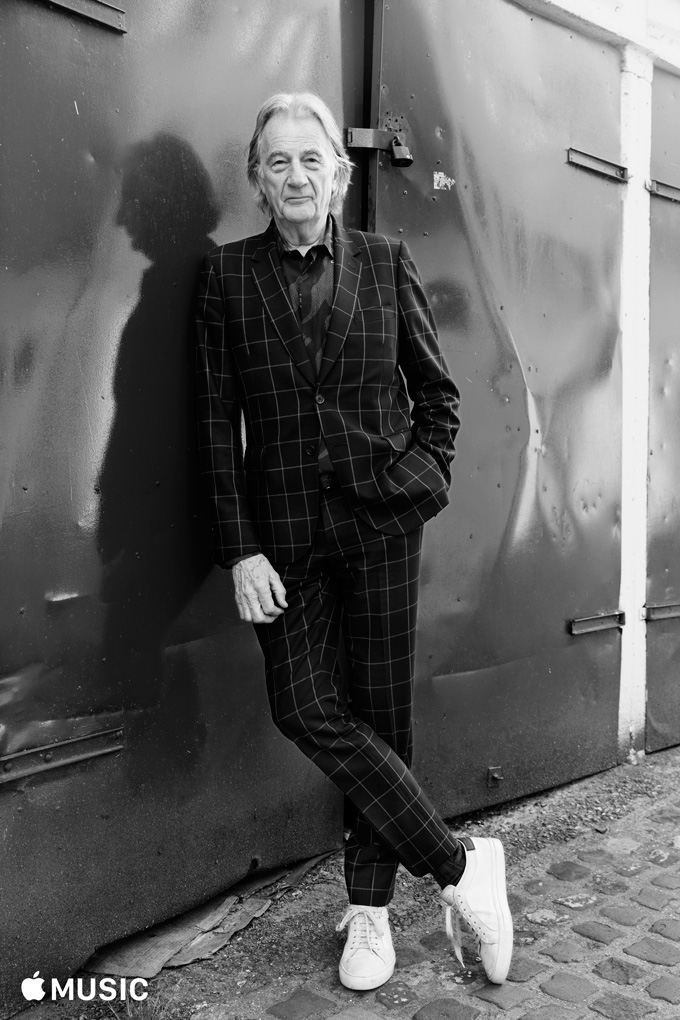
Born in Nottingham in 1946, Smith, the son of a draper left school at fifteen to work at a clothing warehouse, with a real ambition to become a professional racing cyclist. However, this was cut short, following a serious accident aged seventeen, which was followed with six months of recovery in hospital, during which time he made friends with people from the local art college who would introduce him to the world of art and fashion. This led Smith into taking evening classes in tailoring, and then with the help of his then-girlfriend (now wife), Pauline Denyer, he opened his first shop on 10 Byard Lane, Nottingham in 1970, named Paul Smith Vêtements pour Hommes.
In 1976 Smith showed his first eponymous menswear collection in Paris, and went on to gradually expand the retail business, opening his first London store in 1979, on Floral Street in Covent Garden, when he was 33. It wasn’t until 1993 when he branched out into womenswear, after Grace Coddington shot the same men’s shirt on female models in US Vogue for six consecutive issues. This led to the growth of a business based on numerous diffusion lines, offering a wide variety of products and price points which sat in line with the company’s wholesale channel. However, he recently streamlined the collections, merging his design teams, and collapsing the many lines into two collections, comprising both men’s and womenswear, with four drops a year.
Sir Paul is known for his idiosyncratic take on traditional British styling, having coined the term ‘classics with a twist,’ and here he shares with us the struggles he faces as customers’ needs change, and how he is making all of the right moves to stay at the forefront, especially with his cult classic, the suit.
Can you share with us your journey into fashion?
It all sort of happened by accident. Growing up in Nottingham, England, my dreams were of becoming a professional cyclist but I had a serious accident when I was a teenager that put an end to that. I made friends with some ‘creative’ people studying in the local art college and my life as a designer sort of grew naturally from there. Most of my early memories come from my now wife Pauline, who is trained in couture, teaching me how to pad-stitch and hand-make clothes.
Were the 1960s a particularly good time to start a creative business? How do you think growing up and launching a brand today differs?
It was certainly different to how it is today. The fishpond is a lot more crowded than it used to be. By that I mean that there’s a lot of brands and designers now trying to fish from the same pond of customers. As such the pace has changed a lot!
What has been a career highlight?
There isn’t one particular highlight. I’ve always prided myself on my continuity and consistency so the growth of Paul Smith has been pretty gradual, no sudden break-through!
Your approach to the business is very hands on, with an old-school gentleman approach. How do you feel this sets you apart from competitors, and in this climate with a more demanding consumer?
In the fashion industry, so often designers disappear into an ivory tower and lose touch with the customer that they’re really designing clothes for. I’ve always tried to design clothes that can be worn and not just clothes that look nice on a mannequin. I’m also involved in every aspect of the business, from finance meetings to shop design, to marketing, to of course designing the collections. But I also started out as a shop-keeper and so I never lose sight of who the consumer is. I love spending time in our shops and meeting the people who like our kit.
What are your views on the growing phenomenon of social media?
I’d be lying if I said it wasn’t difficult communicating our personality online through social media. What makes Paul Smith different is the individuality and the eclectic mix of high culture and low culture, rough and smooth. Communicating that on a computer screen is not easy, but we do our best, and we’re getting better and better at it.
Designing for men and women, do you tend to prefer one or the other, and which tends to be more successful for the Paul Smith brand?
We’re known for our menswear. Classic pieces such as tailoring, shirting, pieces that many people associate with menswear. Grace Coddington once shot one of my men’s white shirts on a female model in 4 or 5 consecutive issues of US Vogue. That was one of the reasons I started designing womenswear, because so many women were wearing my men’s clothes.

You recently restructured your business to unite your numerous lines under two single collections for both women and men. How has the consolidation helped you cater to the ever-shifting consumer and industry demand?
Of course, it’s been some time in the making. I’ve been working in the industry for a very long time and I’ve certainly never seen it as chaotic as it is right now. The speed with which everything is changing is very difficult to get your head around. The changes we’ve made to simplifying the collections’ structure is to give us more focus and clarity. It’s never been more important than now to have clarity for the customer.

As fashions change to having a more street vibe, does this make an impact on your suit sales?
Throughout my career, suits have changed enormously in how they’re worn, their popularity and how they’re perceived. Once upon a time they were a uniform that even people performing very labour–based jobs would wear. Now wearing suits as a uniform is contained to offices whilst other professions have altered their dress codes sometimes for functional reasons, sometimes not. I’ve always been famous for tailoring, whether that’s someone buying their first suit for their wedding, or a bespoke tuxedo for a film premiere. A good suit is essential to every man’s wardrobe!
What makes the perfect suit?
It depends on what you’re looking for, your body type, your tastes and so on. But my ‘Suit To Travel In’ is pretty definitive. I’m constantly travelling and often have to run straight from the plane to stand in front of an audience and give a talk or rush to an interview, so having a suit that can withstand all that movement and look fresh is important. I imagine that lots of other people are under the same pressure, and so I thought I’d try and make a suit that makes our lives easier! Lots of suits that are described as being ‘travel ready’ or ‘crease-resistant’ tend to have some manmade fibres in the cloth to give them elasticity, or they’re a wool and mohair mix which can be quite rough on the skin. What’s pretty unique about my ‘Suit To Travel In’ is that it’s 100% all natural wool fibres, which gives it this natural breathability.

You are known to collect art, do you have a favourite piece, or artist?
I find choosing favourites impossible as it depends on your mood and so on, but I’ve always loved the work of Alberto Giacometti and am lucky enough to own a couple of original drawings by him, so sometimes you might spot one of them. Matisse is someone else I’m a big fan of, particularly his amazing use of colour. Actually, my first ever shop was exactly the same size as his ‘Snail’ collage, so you can often see a print of the Snail in my art walls.
You are also an accomplished photographer, is this another way that you like to express yourself?
Absolutely. My father was an amateur photographer and so I’ve always taken lots of pictures, many of which influence various aspects of my designs. My iPhone is packed full of photos of all sorts of different things that inspire me. I also have my own Instagram page, @paul_smith, which sort of acts as a visual diary.
Cycling is another of your passions, together with swimming early in the morning, do you use this as a time to switch off and take time out from the fashion world?
For sure, first thing in the morning is my favourite time of the day. I get up very, very early. I swim at about 5am and normally I’m in the office before 6am. I get into my studio, listen to some music, and get to work before everyone else arrives.
Do you feel it is important to ensure you keep a sense of perspective in this fast moving, and ever changing fashion business?
Most definitely. My wife Pauline initially inspired me because she was trained as a designer at the Royal College of Art and had a very particular understanding of the construction of clothes which she passed onto me. Of course, I liked the way she looked physically but also the way that she dressed. She continues to inspire me because she’s always kept her feet on the ground, and she’s very calm.
Can you share with us your secret to success?
Since it all began I was determined to never let the job change me. I’m blessed with a sense of humour and the ability to keep my feet on the ground. Happiness to me is all about balance. I try to maintain balance in everything that I do. The balance between the creative and the commercial, the balance between your work life and your personal life and so on.
By Eliza Scarborough
Basil Soda Bridal: An Urban Dream
Basil Soda throws the bridal rule book and goes forth all clad in shades of white while creating a new modern bride.


Photographer : Sam Rawadi
Styling : Dana Mortada
Make-up Artist : Ivanna Bou Salameh at Velvet Management
Hair Stylist : Kuz Ivan at Velvet Management
Model : Inna K. at Velvet Management
Jewellery : All by Chaumet available at Cadrans Boutique
Shoot Location : Sodeco Gestion SAL
Dr. Zeina Nehme On How to Get Beautiful Skin
An expert in skincare, Botox, fillers, skin rejuvenation, skin diseases, hair and nail diseases, Dr. Zeina Nehme is one of the most sought after specialists in Lebanon, who is in private practice and has her own cosmetic center, Marina Clinic in downtown Beirut. Received her medical degree from The American University of Beirut (AUB) in 1998 and pursued her specialty degree in dermatology also from AUB in 2002.
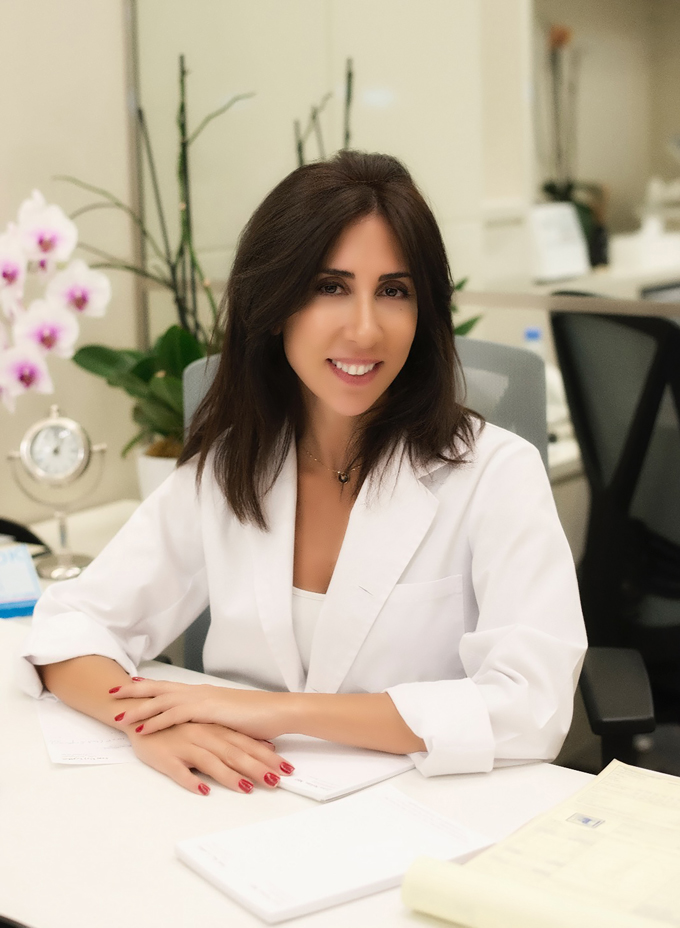
Her skin-care approach relies on working with products that properly stimulate the skin and the production of collagen, essentially to make the skin healthy-looking and beautiful. Below Dr. Nehme, dermatologist to an exclusive list of clientele reveals her secrets for healthy, glowing skin and how she gets her patients wedding-ready!
What’s the most common mistake women make with their skincare routine?
There many mistakes that women do during their daily skincare routine, but the two most common are- skipping the application of sunscreen in the morning, which is the most essential step for both women and men; and by applying sunscreen one will prevent rapid skin aging, the appearance of skin cancer, and skin pigmentation. The second mistake is to sleeping with your makeup on or not washing your face before going to bed at night. This mistake is vital, it is when pimples start to appear because all the pollutants and particles blocks the pores, which eventually leads to many facial skin problems such as acne and skin infections.
How important does diet really play as far as our skin is concerned, and what is the ideal diet for a radiant complexion?
A balanced diet is very important for everyone. As for the skin it loves Vitamin A, because it regulates the cells that develop the skin and it is the main ingredient that produces a smooth complexion. All antioxidants including Vitamin C and E act as anti-aging ingredients that helps in delaying the degeneration of the skin and the effect of pollution on the collagen fibers in the skin. Proteins are also a main source, because they are the building blocks of the entire body; and lastly in order to have a glowing and radiant skin it is extremely important to stay away from smoking.
Is the eight-glasses-of-water rule really is true? How do you define hydration and why is that important?
When it comes to the hydration rule it is very true, but if someone drinks lots of fluids, and eat fruits and vegetables the 8-glasses of water myth may not apply in particular. Again, water is very essential to keep a hydrated and more radiant skin, and it is also important for a good blood circulation, which helps the colour of the skin to look better and healthier. For instance, when someone is dehydrated the blood reaches less to the skin that’s why the skin starts to look pale and dry.
Which ingredient is the most important in skincare?
There isn’t just one specific ingredient, but if I must choose I will go with Vitamin A. Vitamin A is present in retinol containing creams, this has definitely been proven to be one of the most effective anti-aging when applied properly. I would also go with Vitamin C to be applied locally on the skin. Both ingredients are as important because they contain collagen synthesis, which helps repair the skin to be resilient yet flexible, reduces blemishes and it is likely to look more radiant. Plus, when you apply Vitamin C especially in the morning, it will give an antioxidant and a partial anti-ultraviolet effect.
With wedding season just around the corner, what are your secret ways to get the skin wedding-ready?
A lady must always be ready! The earlier we start taking precautions and applying conditioning creams and using face washes adapted to our skin type the better. Now, a bride who does not have a daily skin routine must start taking care at least two to three months before the wedding date; in order to note any allergic or irritation reactions to the applied products. If there is an acne problem we need a minimum of three months to treat it in order to maintain a more healthy-looking skin during and after the wedding. Again, I tell my patients to take care of their skin at an early age, because there isn’t one magic treatment that will remove pimples or freckles or solve major skin diseases. However, if the bride-to-be would like to undergo any interventions like Botox or Fillers, I would recommend it a month before the wedding date, because Botox needs around 10 to 14 days to settle in, and in a months’ time the bruising or the swelling from the fillers would have been gone and the bride will look flawless on her big day.
How far in advance should a bride-to-be get a facial? What type of facials do you recommend?
There are many facial treatments that are adapted for each skin type from patients who have red skin to black heads and white heads, you name it. If the bride-to-be has a dull, dry and flaky skin type she should ask from a hydrating facial, one that would apply more moisturizers, hyaluronic acid, and masks that are specifically calming and soothing. However, if a patient has a good-looking skin, she could come in for a skin-glow like a microdermabrasion treatment that removes all the dead cells, and then apply a vitamin mask a week before the wedding date.
Let’s say a bride-to-be is browsing the skincare aisle for products. What ingredients should she look out for?
We always take into consideration the patient’s age and the type of skin. Let’s say a young bride between the ages of 18-25, the most important products she should look out for are a facial cleanser and a moisturizer with an SPF factor for the morning. As for ages between 25- 30, I would recommend by adding Vitamin C in the morning before the moisturizer to keep a healthy-looking and glowing skin, plus adding an eye cream is a must at this age, look out for anti-aging creams containing retinoid and Vitamin E ingredients, which help delay the appearance of wrinkles around the eyes; and I also suggest adding a mild anti-aging night cream. However, if someone starts to experience pigmentation issues then we might have to add a bleaching cream to be used at night and a proper sunscreen for the morning, again it all depends on the patient’s skin type and age.
If brides-to-be could eat and drink only the most beautifying skin foods, what would their diet look like?
A diet full of vitamins, fruits and vegetables, eating a lot of berries from blue berries to raspberries all are a great source of antioxidants, plus to have the perfect-looking skin I suggest drinking at least one cup of green tea per day. Proper hydration is a must, and staying away from direct sunlight and smoking is vital. Also, try to stop consuming refined sugars, because desserts in high sugar will accelerate the degradation and the breakdown of the collagen fibers, which eventually leads to older-looking and aging skin.
Lastly, what’s the most popular treatment at your clinic?
I would say it is definitely Botox. As we mentioned in the case of a bride-to-be, she should come in for Botox at least two to three months before the wedding date. Especially if a patient has skin pigmentation problems, then we would need to apply pealing treatments or use masks to whiten the skin; therefore I aim to cure and solve all skin issues before my patient undergoes any skin intervention.
What’s the one skin care message you’d like to spread?
If you are a smoker quit smoking! Wear sunscreen daily. Keep a balanced diet enriched with fruits and vegetables; and lastly start taking good care of your skin at an early age and do not wait until it’s too late to act.
Marina Clinic Downtown Beirut, Lebanon- Tel: +961 1 999 292
By Dana Mortada
Hairstylist Georges El Mendelek Shares His Hair Secrets
The Lebanon-based, hairstylist is known for his creative talent seen on many TV shows, fashion stages and in magazine editorials. Georges El Mendelek first started to pursue a Marketing Degree at the Lebanese American University, and then decided to shift his career and to follow his father’s footsteps, Simon El Mendelek- a renowned Haute Coiffure. Mendelek pursued hairdressing at the famous Saks Academy in London, and after his return to Lebanon, he built a reputation for working with an impressive list of clientele, and his signature touch goes unnoticed all over TV shows starting from Mission Fashion, Project Runway, Arab Idol, Arabs Got Talent and Dancing with the Stars.

Today, the TRESemmé brand ambassador talks bridal hair tips and everything from working with celebrities to his favorite products and styling secrets; and here’s what he had to say.
Growing up, what inspired you to become a hairstylist?
Well, until I was 22 years old I never thought I wanted to be a hair dresser, I actually hated it. However, I think my love for women is what led me to eventually take this path. To tell you the truth, one day my previous girlfriend came up to me and asked if I can blow-dry her hair and that was my very first time I ever held a blow dryer; and honestly I enjoyed it. From that moment I decided to shift my career from marketing to becoming a hairstylist. When I approached my father, he was completely against it, because he wouldn’t believe that I can take the beauty industry seriously. I remember him giving me a pep talk about how it is a very tough industry to be a part of, which requires long hours, working during holidays and most importantly over the weekends. I believe after all these years I proved him wrong, because eventually I develop my skills under my great father’s coaching and became very passionate about my career that I wouldn’t want to be anyone else.
What is your main philosophy regarding hair?
I think all women are beautiful; you just need to see it and show it. Sometimes it’s a trait of character or a smile, or an imperfection. When it comes to being a hairstylist, you need to be a good judge of character, what I am trying to say is that a hair dresser must appreciate women’s femininity and try to create something beautiful he or she would want to see on others. The relationship between a hairdresser and client is very personal, if I must say it is all about chemistry.
What are the 5 ways to get the best hair for life?
Try not to dye your hair; and if you have to, then the least you do it the better.
After care is very important. I always tell my clients the care I give their hair in the salon is just as essential as it is to be taken care of at home.
Cut it every four months maximum, with at least a small trim to keep it healthy and clean.
Don’t leave your house without hair protection. Pollution is very harsh on the hair, even if one doesn’t dye or do any colouring; half of the damage that happens to hair is when the cuticle of hair is open and sand particles sit inside the cuticles, which leads to split ends and is the main reason why you won’t reflect colour. So, use a leave-in conditioner, in order to protect, close the hair cuticles and to help it look shinier. Plus, I highly stress on not leaving the house with completely wet hair, because this is when the cuticle is open and is prone to accept any dirt and particles to settle in.
Try not to let your hairstylist make you look like a clown or use you as an experiment to show off his/her skills.
What is your biggest “no no”? Do you follow any hair rules?
I try to avoid using a hair colour remover known as ‘effasor’, it is a product that removes the unnatural pigments from the hair and it is used when one wants to go shades lighter. The problem with this specific product, it is very harsh on the hair, because it opens the cuticles to strip the colours. In our case, as people from the Middle East we have a red undertone, which is why the majority have darker skin, therefore if they use effasor they will start to see red shades; that is why I highly suggest if you really want to achieve a lighter colour, I always tell my customers to wash it out more frequently and the hair will lighten gradually. I am really against drastic changes, for instance if someone has very dark hair and wants to go blonde, I wouldn’t do it all in one sitting, I’d prefer to go lighter step by step.
Bridal season is approaching, what are your top tips to keep in mind when choosing a bridal hairdo?
I usually go with simple looks. It is very important to know all the details about the wedding, the theme, the dress, and everything around it, in order to create the perfect hairdo. I always think how I am going to make the bride look better and have her stand out. An advice to all brides would be to go to an experienced hairdresser, someone who had worked on TV sets or editorial shoots, because they will know how to create a look that will last all night long and looks flawless in photographs.
Do you have tips for brides when it comes to conditioning and treating hair before the wedding day?
Just keep conditioning and protecting your hair as usual. However, I like to give it a trim before the wedding day, because sometimes when you want to curl the hair or do a small up-do the ends will look dry and split.
How long before the wedding day should brides have their hair coloured?
Ten days to a week before. Unless the bride is trying to go for a low-light build up we would have to start six to eight months before.
What are some of your must-have hair styling tools or products?
Dry shampoo, soft-hold spray, and an up-do brush; and my most favorite is the tail comb, I never leave my shop without it.

What’s your favourite bridal trend this season?
I don’t believe in bridal trends, I prefer putting a perfect hairdo to every face that brings out the character of the bride.
What do you prefer: head-piece/accessory, veil or both?
I love having either or, but not together! I am currently collaborating with a Lebanese designer, we are creating an adjustable head-piece that can get bigger or smaller, and can be used in many occasions from day to night. It will soon be released in Lebanon, hopefully in time for the upcoming wedding season.
You favor working with everyday clients or celebrities?
My favorite would be my everyday clients who come to my shop. My passion is to put a smile on the customer’s face, to make them feel confident and beautiful- it is a priceless feeling.
How about the celebrities you have worked with, is there anyone that stands out as your favorite from a hairstylist stand point?
As for celebrities, I would say I really enjoy styling the Lebanese singer Elissa and TV presenter Raya Abirachid; both come from different backgrounds and industries but they are very easy going and humble, which I seek for when I work with any celebrity or TV star. Someone who worked with recently and stood out was Lady Madonna; she was on the past season of “Dancing with the Stars” it was a great honor to meet such a glamorous woman and to style her hair on set.
Do you believe in DIY recipes?
Everything that has to do with coconut oil, avocado and egg whites hair mask recipes they do not work at all! It may give a nice effect on the spot, but I strictly believe that scientifically it doesn’t work on the long-term. In order to protect the hair the product must have a formula that closes the hair cuticle- meaning go for products that contain keratin proteins or else it is useless.
Then, what kind of treatments do you swear by?
The best way to treat the hair is with its own oil. I have seen this happen once, when I was studying hairdressing in London, we had a volunteer student who went 40 days without washing her hair, and the results were unbelievable. Yet again, I can never recommend that to my clients, but my advice for them would be not to shampoo the hair every single day, because it is aggressive on the scalp, which will weaken the bulb of the hair and that’s when it starts to fall out.
Any good hair tricks for when one is having a bad hair day?
Braid it if it is long, if it is short gel it back or add an accessory.
What would you classify as the Georges El Mendelek hair?
The best lesson I have learned was from my father, because all of what I have today comes from him truly. He told me to observe him, to learn the expertise from him but to never copy him; and the fact that my father pushed me and set me free allowed me to be who I am and to have my own uncommon signature touch. If I need to define the Georges El Mendelek hair I would say it is chic with a twist.
If you were to style someone’s hair, who would you pick?
I would love to style Queen Rania of Jordan and the Lebanese singer Majida El Roumi.
What’s the one hair message you’d like to spread?
Keep it healthy to look beautiful.
Simon El Mendelek Salon
Zalka- Amaret Chalhoub., Beirut, Lebanon Tel: +961 1 896 669
By Dana Mortada
Christian Abouhaidar’s 10 Step Wedding Beauty Routine
Hiring a makeup artist for your wedding day maybe is on top of your to-do list; and if it’s not, it should be to ensure you a bridal look that is everything you want it to be. So we asked bridal makeup expert Christian Abouhaidar, to share his most coveted beauty regimens and a step-by-step wedding beauty routine on how to create a long-lasting bridal look.
Simply say ‘I do’ to all the make-up tips and prepare to wow with a flawless look on your very special day and in photographs that you will cherish forever.
1. Prep your Skin
In the few weeks leading up to the big day, you’ll want to step up your skincare routine. Meaning, regular exfoliating as well as a twice-daily cleanse, tone and moisturize ritual. Invest in quality skincare to tackle trouble areas such as dry or oily skin and make an appointment with a facialist who will be able to recommend the right products for your skin type. On the day, make sure your skin is clean and free of flakes, using gentle formulas to prevent redness. Pixi Glow Tonic is a fantastic primer that offers gentle exfoliation and leaves your skin soft and smooth. Perfect for bridal beauty!

2. Apply a Mask
With the stress of getting ready, a face mask is the perfect excuse for a bit of chill time whilst also benefiting your skin. For your wedding day, you will want a mask that is nourishing with long-lasting effects and will keep your skin hydrated all throughout the day. Tulasara Wedding Masque by Aveda – is a luxury mask that tightens the skin, helps even the look of skin tone, and gives a wedding day glow with silky smooth touch.

3. Use a Quality Primer
Primer will be the extra ingredient that gives your makeup the staying power it needs to last throughout your big day, as well as provide a smooth basis for applying face products. A gel formula like Foundation Primer – Radiance by Laura Mercier, it creates a luminous complexion that gets you ready for your foundation. At this stage you can also apply a de-puffing eye serum or cream to help reduce any puffiness or redness that can happen after the sleepless nights of prepping and partying!

4. Cover Under Eye Circles
The perfect under eye concealer will make all the difference in your wedding pictures. You’ll want a light, non-drying formula that offers plenty of coverage, like one of my favorites Charlotte Tilbury The Retoucher – a great update and alternative to YSL’s famous Touche Éclat. Apply by creating inverted triangles that extend from underneath the eye to the base of the nose and blend well for an illuminated look.

5. Apply Foundation
Your foundation will need to look smooth and natural so make sure you get colour-matched in advance (especially if you intend to wear tanning products or spend time in the sun prior your wedding). Choose a matte, non-oily formula with buildable coverage and apply with a foundation brush, keep blending to a flawless finish. NARS Velvet Matte Skin Tint offers a wonderful coverage whilst the matte formula will reflect better in photographs than dewy ones.

6. Cover Blemishes
If you find yourself with odd blemishes that needs extra coverage, choose a long-lasting concealer, and blend it with a small brush to avoid any harsh lines. Estée Lauder Double Wear Concealer is just perfect for providing strong, durable coverage. Make sure this magical stick is always found in your bag for touch ups on the go.

7. Highlight your Complexion
Brides should embrace that glowing, youthful look that can easily be achieved with the right blusher-highlighter combination. I would generally avoid heavy contouring for your wedding day, as the look can be harsh and artificial; so focus on highlighting your features instead for more effective results. The right formula to use depends on your skin type – brides with dry skin will benefit from creamy textures as powder is for oily skin. Bobbi Brown Powder Blush is a long-lasting powder which comes in various shades that suits all skin tones, whilst Bobbi Brown Pot Rouge is a good cream alternative with huge staying power. The highlighter should focus on your cheekbones, the tip of your nose and forehead for a look that is subtle yet incredibly pretty. Illamasqua Beyond Powder is my top choice for highlighting, it gives that beautiful bridal glow and looks wonderful in photos.

8. Apply your Eye Makeup
A classic bridal beauty will involve subtle, natural eye colours that will create a timeless look, rather than being trend-based. A neutral cream base like MAC Paint Pot in Soft Ochre is the ideal colour to start with and will allow you to apply pretty much any colour after. I personally think nudes and brown tones in matte finishes are more effective for weddings, creating a more youthful look than shimmery or glitter formulas which can be ageing and distracting. The Urban Decay Naked 2 Palette has a range of lovely shades for creating your dream eye look for your big day. Keep your eyeliner to a minimum, focusing on a soft application around the lashline and make sure you choose a waterproof formula. If you’re going to wear false lashes (which I love for creating a fluttery, doe-eyed eye look for brides), choose mink lashes, such as the latest Christian Abouhaidar 3D Fiber Lashes which will make you look natural; or go for individual lashes rather than a full set, focusing on the outer corners. Apply waterproof mascara to your own lashes first, using MAC Extended Play Lash which has a non-drying, flake-free formula that will last you through all your happy tears!

9. Keep Lips Hydrated
Unless you’re going for a retro, red-lip look, you should opt for a more natural lip shade such as a nude or muted pink, which will instantly enhance your natural bridal beauty. Keep a lip conditioner close by, like MAC Lip Conditioner and apply as needed throughout the day. Liquid matte formulas are becoming more popular for brides nowadays, as they are non-drying and offer long-lasting colour, and for the best range of shades I’d recommend Jouer Cosmetics Long Wear Lip Crème Liquid Lipstick, a must-have lip product that is just perfect for your wedding day and any other day.

10. Set your Makeup
Setting your makeup is that crucial final step for helping your makeup to last all night long. Use a setting powder such as MAKE UP FOREVER High Definition Powder to keep your face makeup in place and I also highly recommend Urban Decay’s All Nighter Setting Spray to lock your whole look in. Applying setting products will limit the need for touchups and to make sure your makeup lasts and looks fresh the whole night.

Christian Abouhaidar Makeup Studio
I DAY SPA – AISHTI 5th floor, Downtown – Beirut, Lebanon
Tel: +961 3 487 242
By Dana Mortada
HIMO: Redefining Fine Jewellery
One of Lebanon’s best-known jewellery brands has gained international acclaim with their modern designs famous for being whimsical, feminine and timeless, and, above all, easy to wear.
Himo Jewellery is a brand that has redefined the meaning of fine jewellery by taking trends a step further, and inspired other jewellers to follow the same path with the exact Lady D, Infinity and Princess collections. The jewellery house is always on the move, doing what they do best, giving attention to detail, valuing the art of craftsmanship and using innovative manufacturing skills.

It’s breadth of jewellery and the presence it introduces today offers its customers something that no one else has, “Our collections reflect our modern approach to jewellery while remaining true to the established traditions in craftsmanship. They are classic, yet fashionable and trendy. It is our way to offer to every woman the style that most suits her image, and to every moment that special jewel that commemorates it”- Joseph Himo, CEO of HIMO Jewellery.
Himo’s delicate work is mostly recognized for its Classics collection, a timeless range that is perfect to be worn today, tomorrow and twenty years from now. Its identifiable high-quality design is inspired by pure elegance, and is suitable for various women with a distinctive style.
The brand counts on being up-to-date, and the Marquis collection processes all the delicate shapes to express a charming look. Its long and narrow sparkling design is a stunning choice for those who want something unique and interesting as well as symmetrical.
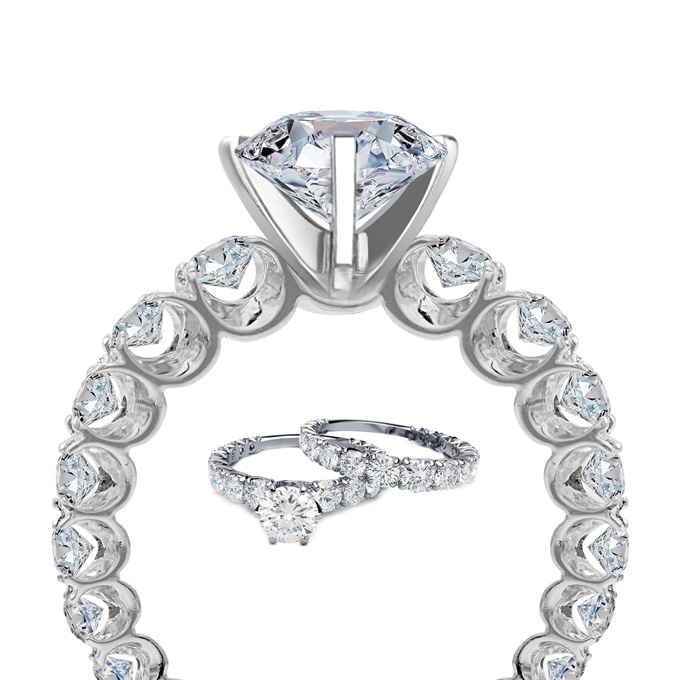
The Snake collection is as exotic as it is classic. The pieces in this collection are skillfully shaped into a snake, designed to emulate fluidity and movement.
Himo enters the world of scared symbols, illustrating a precious limited range called the Lucky Charm collection. This collection turns this classic symbol into a perfect gift of good fortune, which keeps you chic with a dose of luck.
The JOY collection is designed to symbolize love and happiness. This cheerful range, promises to hold the power to unlock every woman’s happiness and grant access to a dazzling future.
Himo doesn’t distract with irrelevant choices, instead it focuses on quality that matters- meaning what you see is what you get. Bringing in the Princess collection, it consists of a grading set of shiny diamonds aligned together for maximum impact. It is a divine range that adds the perfect finishing touch for the bride-to-be, and will always have a special meaning for one generation to pass down to the next.
The Palazzo collection turns your dreams into reality. The pieces in this collection are designed with intricate detail emphasizing on both quality and high-shine at once.
Calling all gold lovers, the Turbillon is a striking opulent collection. Combining roughness with fine beauty echoes the label’s elegant approach, made to compliment every woman’s contrasting style.
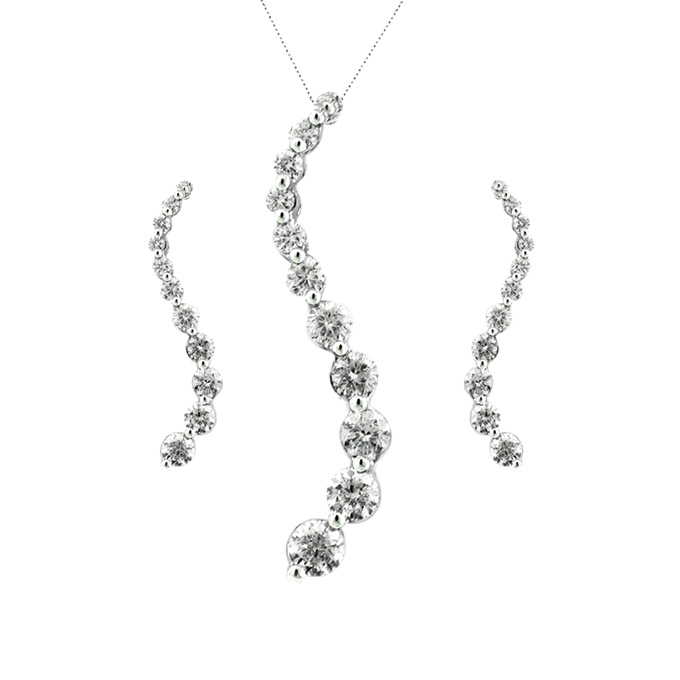
Himo is famous for setting the trend. The Wilderness collection is an exotic range, introducing innovative playful designs made to turn heads and add joy to your everyday style.
The Pied de Poule brings the fusion of two monochromatic hues- black and white, just like “when darkness meets light twin souls dancing in the moonlight.” This eccentric collection introduces sculptural pieces that tap straight into the season’s trend.
Straight from under-the-sea, the Perla collection displays the peak of aesthetic achievement and hand-craftsmanship. The lustrous collection signifies “purity, elegance, beauty and faithfulness” that will align with every bride-to-be expectations.
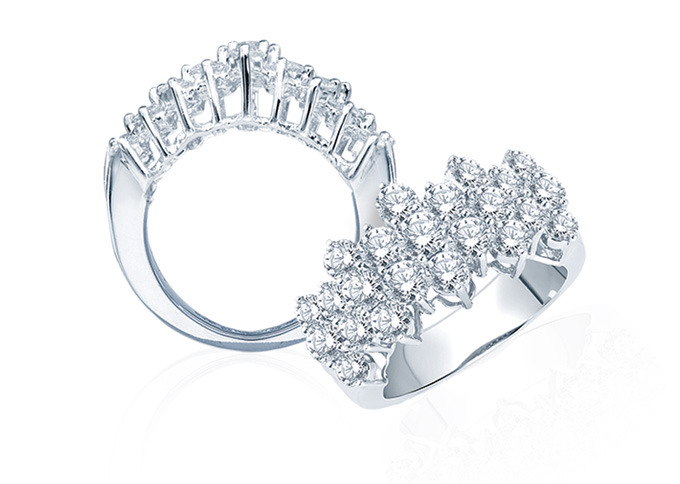
Complete Me embraces architectural designs with a hint of playfulness. This luxurious collection displays a mix of gold colours, which exemplifies the brand’s exquisite DNA. It features timeless pieces especially created to celebrate love and to cherish the special moments.
Himo is mostly recognized for the Infinity Collection, a collection that commemorates endless love. The brand reinvents the meaning of love with a simple infinity symbol design with a heart–shaped diamond; it’s a contemporary piece that speaks for itself.
Bringing in the Lady D collection inspired by “the endless elegance and beauty” of the late Princess Diana. The brand reinterprets the Princess’s famous engagement ring into a modern design revealing femininity and sensuality of powerful women. The Fabulous collection taps in pure luxury and sophistication. The range reinvents the classic wedding band with a source of brilliance, using the Solitaire diamond. It offers one or two or three solitaires, crafted with an exclusive touch, made easy for all brides-to-be to find the perfect ring that compliments any engagement band.
Himo Jewellery’s love for classic and contemporary designs ranging from fine to trend-looking collections became highly popular and gave all women and men of all ages, the more reason to invest in and turning every piece into a cherished heirloom.
Address: Mar Mitr Street, Himo Building, Ashrafieh, Beirut, Tel. 01 216 880
The Man Behind The Happy Childhood Foundation

The Happy Childhood Foundation has one simple aim, and that is to put a smile on the face of children in need all around the world. Founded in 2010 by Mr. Georges Hatem and developed under the guidance of a mother foundation incorporated in Geneva, Philippe Hatem Foundation for a Happy Childhood (PHF), is one of the various foundations part of HCFs that ensures proper implementation of the global initiatives, provides support to children in various areas. We sat with Mr. Hatem, President of HCF Lebanon and here’s how he adds “One Smile at a Time” to a child in need.

Can you share how The Happy Childhood Foundation’s (HCF) commitment to helping children within the various communities?
HCF is a foundation that helps all children from different nationalities, religion, and gender, race, with the focus on five main fields of health, basic needs, protection, recreation and education. The foundation is involved in three areas the Laetitia Hatem Rehabilitation Center (LHRC) – for handicaps it was established in 2012; built in Hotel-Dieu de France in Beirut with the help of the Rehabilitation Institute of Chicago (RIC) where my daughter Laetitia was treated after a rough accident. Our second initial focus is to help children through other foundations, for example Em El Nour Hospital where we fund programs for awareness against drugs strictly for children. Thirdly, we are currently working on a project in Tanzania; it is a village which includes an orphanage, rehabilitation center, a school, a museum and a social center. The plans are ready and we are working on a big fundraiser in order to move forward and hoping to build more over the years.

Two years ago, you introduced Philippe Hatem Foundation Art Collectors’ Auction event. What prompted you to start this charity event? And what was the audience reaction?
At the beginning we used to raise money through gala dinners, just like many other foundations out there, and as it was becoming more saturated, we decided to be different and tried to raise funds through other means, which is why were turned to art. Art is spreading into various sectors and nowadays there is more openness, and interest for art. Through our networks and with the support of Christie’s London we gained access to artists who have donated their works, and to a number of art collectors who positively supported our cause. Also, we currently partnered with leading galleries in Europe and the Middle East, namely White Cube Gallery in London, Agial gallery, Ayyam gallery and Janine Rubeiz gallery. Therefore, the combination of outsourcing works of art and knowing the potential bidders was a great match. As for our first auction event it was a great success, which encouraged us this year to plan a bigger second edition fundraising auction with more artists displaying 26 works of art at MIM Museum, Beirut. Another dimension we added this year was the advisory board of seven art collectors, who also helped us reach various international artists.
PHF and Laetitia Hatem Rehabilitation Center (LHRC) are both growing day by day. Is this how you had imagined they would grow? What is next?
It actually grew much faster than I imagined. Currently, we are in the process of building the expansion of the rehabilitation center and we have ongoing programs and yearly commitment plans with other foundations that we continually help. As for the village, we are working on a different funding channel based outside of Lebanon. Eventually, the dream is to be recognized and incorporated globally.
Do you see a change since you established the foundation? Especially, with the people’s mind-set, such as investors, collaborators or volunteers?
Definitely, there is more credibility when people see projects being realized and see the number of children we are helping each year increasing. Our network of people and number of supporters is growing and I must say from one year to another a lot of volunteers are joining and investing in our great cause.

Laeticia Hatem Rehabilitation Center at Hotel Dieu De France Hospital
Surely, over these 7 years there have been some happy and some bad moments. What keeps you inspired and motivated?
Of course, what triggered the dedication to the foundation were two sad moments- the loss of my son and my daughter Laetitia’s accident. After that, I must say it has only been happy moments because of the creation and realization of many successful projects helped us to be who we are today. However, the engine behind it all is a simple dream- to help and put a smile on a children’s face in the name of my dear son Philippe and through the Happy Childhood Foundation to make the less fortunate children happier, eager to live, and to help them mature into good people.
How does HCF provide a new model for giving and helping children?
It is worth mentioning that our foundation has so far followed a unique model, whereby we have been operating without any paid staff since the creation of the Foundation in 2010. All the work is done by the active members of our Board of Directors and the various committees we created for specific areas. Other volunteers and professional companies support us on a pro-bono basis.
What does the word “charity” mean to you?
I always tell the people who decide to join us on this journey, to not consider their support and generosity as an act of charity, but rather as the best investment that they will ever make, an investment for a better world.
8What is the biggest challenge you face today with HCF?
Fundraising! Because when we have the right funds we immediately have the means to get professionals to work on our plans and projects. Also, the main reason why it is a challenge is the competition; we have a lot of foundations in the region who are running after the same money. After all, we remain fully aware of the many challenges awaiting us on this road; however, we are convinced that with passion, hard work and of course the support of generous benefactors, we will continue to overcome these obstacles one after the other and reach our objectives – one smile at a time.
Finally, do you believe by giving back, one is more successful?
Maybe not successful in particular, but I do believe that once you give, you will get it back, because the satisfaction and happiness you feel after doing good is priceless.
By Dana Mortada
Krikor Jabotian: In The Mind of a Couturier
Meet Krikor Jabotian, a Lebanese couturier who entered the fashion scene at an early age, by starting a fruitful yet inspiring experience at the infamous Elie Saab fashion house. After seven months, Krikor, 23, stepped out to start his own independent brand, and joined Starch foundation- a non-profit organization founded by Maison Rabih Kayrouz, where he displayed his very first collection; and from that moment it marked the beginning of his career. The embroidery prince finally founded his own brand of an energetic workshop where his imagination and innovative designs flourish from day-to-day.
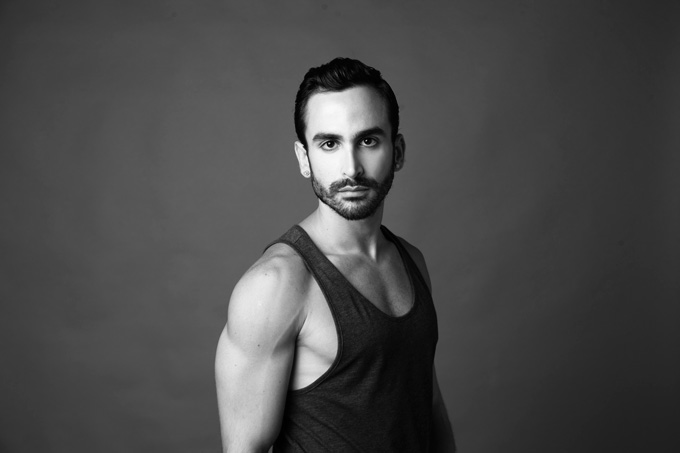
The young fashion designer talks about his embroidery technique, the challenges he faced and the women he designs for.
Tell us about your process and what environment you like to work in. What is your design philosophy?
My creative process is quite spontaneous, reflecting a big part of my personality. I start with one idea and evolves based on trial and error, many iterations and experiments. I like working in a peaceful environment, and to feel happy and inspired by those around me. The final collections are always the product of different people working hard together, to bring extraordinary ideas to life. My idea of a work environment is one that brings out the talents and the know-hows of the different team members in order to create amazing designs. My design philosophy is to make every woman look as beautiful as possible through couture.
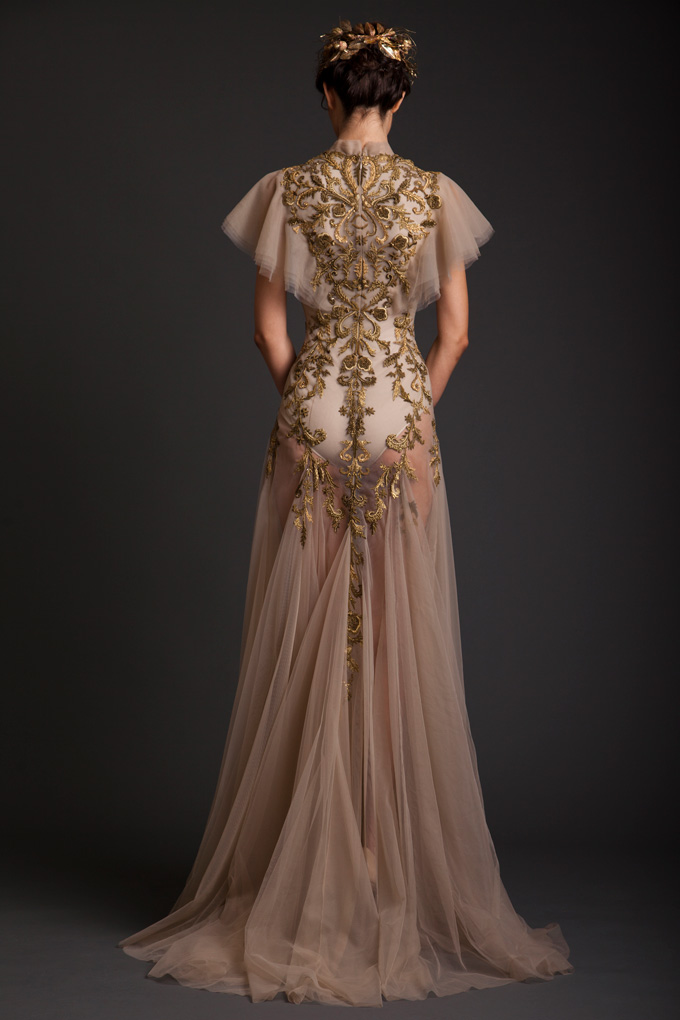
SS14 Akhtamar Collection

How did Krikor Jabotian evolve since it first started?
I started out as a fashion design student at ESMOD Beirut. After working with Elie Saab, I was eager to launch my own brand, integrating what I had learned from him in terms of technique and taste in embroidery. This is why I joined the Starch Foundation, where I began making sales and understanding the demand of my own designs. The brand was first independently based in a small showroom in Beirut. As our vision grew and our collections evolved, it turned into a family business, now based in a much more developed atelier. We’re evolving year after year, quite organically, and we’re happy with that kind of growth.
Fashion is ever-changing with endless trends. What are the steps in your creative process that would incorporate these trends in an upcoming collection?
I always say I’m inspired by both the beautiful and the ugly. This applies to all forms of inspiration, including fashion trends. My creative process is a combination of staying true to the Krikor Jabotian aesthetic which features signature embroideries, while innovating in the volumes and textures of the pieces.
What motivates and inspires you to always work towards new methods of design?
As a designer, you’re always as good as your collections. This is why I try to outdo myself every time I come up with a new collection, challenging myself to be innovative with every piece, and never repeating myself. It can be very tricky to stay true to your identity as a designer while evolving and surprising your clientele with something new. Exceeding my clients’ expectations while maintaining my signature style is what motivates me.


How did living in Beirut inspire your work?
Beirut is a very inspiring setting, especially for young designers. It is a beautiful and chaotic city that blends the eastern with western cultures. This often reflects in our art and design. The intricacy of traditional Lebanese designs inspires the details in my work and at the same time, growing up in an Armenian family has definitely influenced my designs and the stories I tell.
Now that the Wedding Season is just around the corner, what will the 2017 bride look like?
The 2017 bridal collection is dramatic and opulent. The Krikor Jabotian bride is always classic yet playful- her dress is contemporary and malleable enough to dance with her. There are no strict guidelines for what the 2017 bride will look like; the main focus of our bridal designs is practicality and functionality, in order for the bride to enjoy herself on her big day.
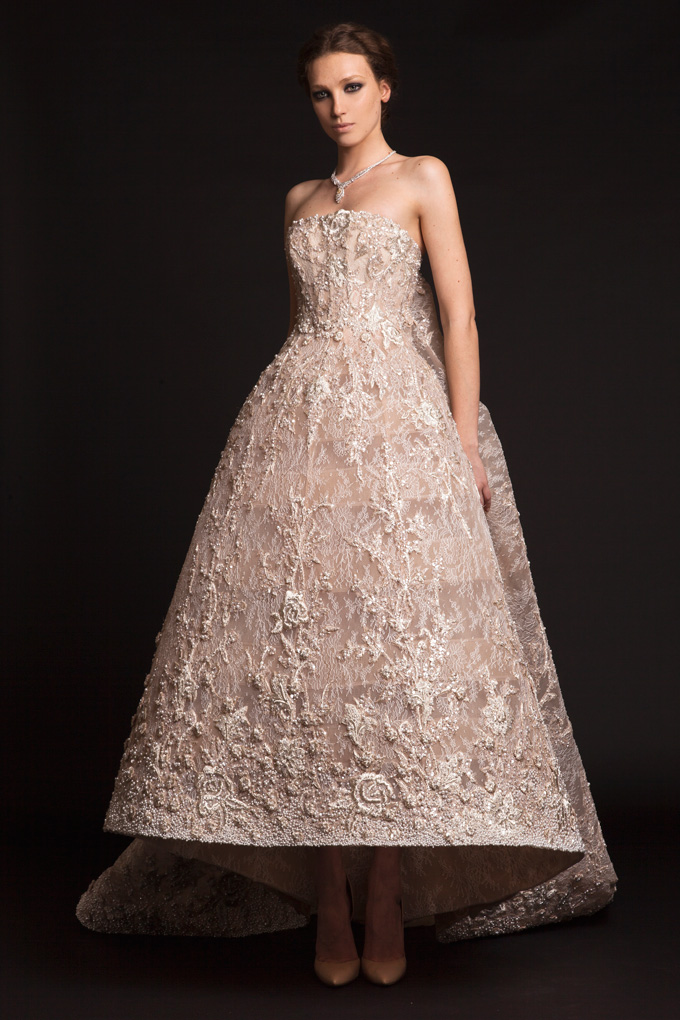
SS15 The Last Spring Collection
In the last few years, the fashion industry has become extremely competitive. What is some advice you would give to upcoming designers starting their own line?
My best advice would be to remain authentic- find your strengths and style, and develop them without feeling the need to conform to or replicate what others are doing.
What piece of tool could you not live without?
My phone!
What are your favourite fabrics to work with and why?
I love embroidering on tulle, creating an entire fabric out of the tulle itself. My signature style is this type of embroidered fabric which makes up most of my collections. Embroidered tulle is often a great way for me to showcase the intricacy of my designs.
Do you use a sketchbook?
Yes, sketching is a key element in my design process and I have been sketching since the day I learned how to hold a pen and paper. Every design starts with a sketch that often evolves once it becomes a piece after many fittings.
What was the greatest challenge you faced in creating Krikor Jabotian?
I opened my first showroom when I was just 23. And as you can imagine, it’s difficult to always make the right decisions and collaborate with the right people and manage a company at such a young age. I am also an auto-critique by nature, and therefore, finding my place within the competitive Lebanese designer scene, I was constantly challenging myself and competing with myself to make the brand what it is today.
What is the image of the woman you want to emphasize?
I design for ladies – elegant, sophisticated women who have an eye for details and who appreciate couture. My designs are for women who are looking to stand out, without being overstated.
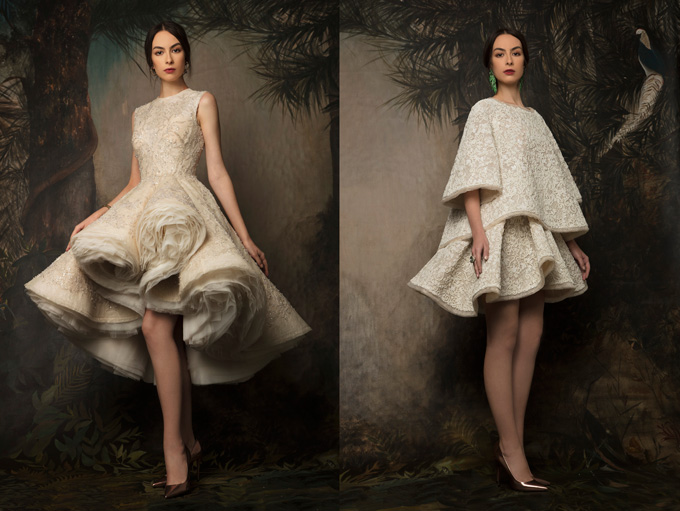
SS17 Reincarnation Capsule Collection
What would you say is the ultimate crime of taste?
The ultimate crime of taste is simply following a trend. People should always take into consideration whether the trend suits their personality, body type, ad tastes before adopting it.
What is your ultimate vision for the Krikor Jabotian brand?
My ultimate goal is to take the brand as far as it can go, and we definitely have a few ideas about what that might look like.
By Dana Mortada
READ MORE
When SS17 Accessories become a Work of Art
Theses accessories will not only give your outfit an instant update, they are also beautiful enough to warrant a spot pride of place on display.

FROM LEFT TO RIGHT:
Fendi Dotcom Click handbag, Fendi Micro Baguette with studs and rhinestones

LEFT IMAGE:
FROM LEFT TO RIGHT: Elena Ghisellini at Boutique 1 Pochette Fatal Clutch, Elena Ghisellini at Boutique 1 Felina Mignon Mini Bag
RIGHT IMAGE:
FROM TOP TO BOTTOM: Simone Rocha at Boutique 1 sandals, Stella McCartney Falabella Box Bird faux leather crossbody bag

LEFT IMAGE:
CLOCKWISE FROM TOP RIGHT: Loewe cat necklace, Christian Louboutin Piloutin bag, Jimmy Choo Romy pump with detachable charms
RIGHT IMAGE: FROM TOP TO BOTTOM: Boutique 1 clutch bag, Loewe cat necklace

LEFT IMAGE:
Bulgari Serpenti Forever in cloud topaz on python skin
RIGHT IMAGE:
FROM TOP TO BOTTOM: Chanel 2.55 Handbag, in aged calfskin with charms, Christian Louboutin Madame Menodo pumps
Fashion Director : Eliza Scarborough
Photographer : Henry Pascual
Laura Gulshani: When Fine Art and Fashion Collide
Laura Gulshani is a fashion and beauty illustrator who combines fine art inspirations with modern design trends to develop a unique expression of current fashion styles.

Living in Toronto, Canada, Laura’s work is marked by a vibrant use of colour, heavy brushstroke work and a focus on details. Her detailed illustrations executed with a painterly style capture the spirit behind the most beautiful fashion collections, either focussing on the most exquisite accessories and jewels, or the vibrant prints and hues that make up the look.
Here, Laura shares with us what inspires her artwork, which artist she looks up to, and how she can be seen in a far more understated work uniform in comparison with the intricacy of her paintings.
Tell us about your journey to becoming an artist?
I’ve always loved fine art and fashion, and loved mixing the two, but I never considered a serious career as a fashion illustrator since I didn’t think I had the chops for it, and I knew how competitive it was. But after some encouragement from my professor at university who helped me structure my thesis around fashion illustration, and through illustration opportunities at magazine internships, I realised that perhaps I had something different to offer, and that maybe such a creative career was possible in Toronto. I painted non-stop for a year, working on improving my skills and trying to find a style that spoke to me at this current point in my life. I made sure to promote myself as much as I could through Instagram, and tried to establish more contacts in the local and global fashion industry. Through this, my now-agent spotted me, and after a while jobs started trickling in. Through exposure on the social media platform, I have gained most of my commissions, which has changed my life. I’m still working hard at my craft everyday to create something unique, and carve a spot for myself in the market.
How would you describe your artistic creations?
I’m in love with anything Matisse, and the eras of Impressionism and Post-Impressionism. I love the imperfect, textured, outlined, suggestive, colourful visual impact artworks of that time had, and being messy and a lover of colour and texture myself, those periods always speak to me. I would like to say that my artworks are a mix of fine art (but not too fine!) and modern influences. I am passionate about fashion design, albeit I’m not much of a fashion designer, and so I am naturally drawn to those fine details and parts of a garment that took lots of time and effort to create, such as appliques, embroidery, and textile patterns. I absolutely love to blow up these parts and paint them on a large scale to really draw attention to this detail; it’s a joy to draw with that much focus on a beautiful creation. I also focus on brushstrokes, because the raw, dimensional effect one can achieve from a single stroke adds a uniqueness to the overall piece.

What inspires your work?
Any garment that is detailed, structured, colourful, or plays with transparencies, is something that immediately draws my attention. I loved that artists from the Impressionism & Post Impressionism periods often captured a fleeting moment between subjects, so that always inspires the compositions of my work.
What do you think and dream about when you are painting?
I think about every stroke and how it should be laid down. My mind also wanders and I completely forget where I am, and in that moment, I think about everything and anything in my life. I kind of lose track of time and I’m not really conscious of where I am. I don’t think that’s a bad thing? Maybe that’s how much I love to paint…
Who are your favourite artists?
First and foremost, Matisse. I also absolutely love fashion artists who put some sort of fine art spin on their work, such as Kelly Beeman, Tanya Ling, and Gill Button. I also love Jean-Phillipe Delhomme, Wayne Thiebaud, and Michal Pudelka for photography. There are so many artists I follow on Instagram who consistently inspire me.
Do you try to incorporate their styles into your own artwork?
Not really, aside from composition influences from photographers. I actually try not to look at other fashion illustrators’ works too much, so that I don’t subconsciously incorporate similar elements in my own pieces, and stay true to my own vision.
How do you feel art and fashion are intertwined?
Fashion is art. The art umbrella includes fashion. Painterly arts and textile arts inspire one another and always will; the runways of Spring 2014 were a testament to that.
What is it about fashion shows that inspires you?
I love the fantasy world that fashion houses create to showcase their collections, particularly Prada, Miu Miu, Marc Jacobs, Dior and Chanel. It conveys the inspiration behind the collection and helps me understand it as well. Seeing furry carpets, floral rotundas, mounds of gradient sand or whatever sort of elaborate setting was fashioned, sparks an image in my mind that I want to illustrate. Only at the show do you feel totally immersed in the designer’s vision and can truly appreciate the work that goes into each garment, an experience that you just don’t get from my perspective of sitting at home behind a computer.
How did you find yourself concentrating on painting fashion images?
From combining my love of the world of fashion and fine art. I paint things I wish I could wear in a world where sporting tweed knee-high Chanel trainers to the grocery store wouldn’t earn me a few judgemental glances.
Do you have a particular designer that you enjoy illustrating?
I have too many, Christopher Kane, Delpozo, Mary Katrantzou, Chanel, Dior, Miu Miu, and Rochas. Prada does hold a special spot in my heart because of Miuccia’s love for, and continuous support of the arts, and the artistic inspirations that are integrated in occasional collections.
What are your favourite colours to paint with?
I love to use any bright, bold colour, and especially favour applying an iridescent pink/blue hue as the background of my works. Somehow, that colour complements almost every garment I choose to paint.

How would you describe your own personal style?
I love to mix minimalist pieces with something embellished, and finish it off with a statement shoe. I’m really into metal earrings and structured tops right now. I’ve always favoured styles from the 90s, being a baby of that era myself, so slip dresses, exaggerated hoops, fiddler caps and lots of denim are included in my usual repertoire.
Is it a completely different look in and out of the studio?
Yes! Although sometimes, if I’m anxious to start painting, I’ll head straight to the canvas in my work clothes, but normally I throw on my pyjamas and get to it.
What is your ultimate dream or commission to achieve with your artistic work?
My dream would be to collaborate with big fashion brands, like Marcela Gutierrez has with Prada, on any sort of brand promotion, whether that’s on an in-store supplement, a lookbook, creating a textile, etc. But I try not to go about my work with those bigger dreams in mind; I just focus on enjoying what I’m doing now, and hopefully those things will come later.
Capturing the beauty and style seen on the catwalk, from Prada to Dior, and Delpozo to Fendi, Laura shares why she chose to paint each of these beautiful creations. She explains how she captured the spirit and essence of the collection in focus, to create a unique and detailed piece of art.

Chanel Haute Couture Spring 2017
This collection was perfection. I loved the glitter and retro-like look of these five particular pieces, and couldn’t choose which specific one to paint, so I had to paint them all! I feel that the image captures a moment, and I love the rhythm created through the combination of detail and colour. The set design perfectly complemented the collection, and the collection of metallics and candy pastels perfectly complemented the glamorous set. So, to encapsulate both, instead of creating a zoomed-in composition like I usually do, I created an overview look of a moment in the show.

Marco de Vincenzo Spring 2017
I really wanted to show off the beautiful textile of these Marco boots, and the adorable back bows, so I tried to conceive a composition that would do both, but in a captivating manner instead of a simple, still shot view of the shoes. To me, what makes the image is the contrast of light and dark colours, the feminine pinks and cool blues, and the movement in the skirts. I was inspired by the show’s backstage presentation, with its colourful walls and flooring, and so I incorporated those hues as the setting of this illustration. The collection displayed many bold colours and funky designs, so I tried to take the most memorable elements of that and compose them into one illustration.

Anya Hindmarch Spring 2017
I chose to paint this picture because I saw this imagine online and I loved the sharp contrast of element. A traditionally designed, flawlessly crafted coat backing a cheeky, furry accessory. What I like about this composition is the cool-warm tone colour balance, and the rendering of the different textures. It’s all about capturing those funky details that define every Anya Hindmarch collection!

Prada Spring 2017
When I saw this look from Prada’s Spring 2017 collection, I immediately thought, ‘that’s what Holly Golightly would wear to bed.’ I like the serenity of the colour combination, and capturing a still, quiet moment of a bubby, talkative character. I feel like the collection was about celebrating the modern woman, a boss lady with a strong personality who still retains her femininity, and that’s totally Audrey Hepburn/Holly Golightly.

Miu Miu Spring 2017
The patterns and textures of this Miu Miu collection captivated me, as did all the quirky swim caps, and images of chic ladies by the seaside popped into my mind. So, that’s what came out. There is a stillness to the scene, which I feel captures very fashionable ladies enjoying a relaxing moment beachside. The combination of warm colours and patterns adds a lot of energy to this painting of beachside babes wearing swim caps.

Delpozo Spring 2017
The details of the Delpozo collections are always the best part! The crystal earrings were the stand-out feature in this collection, and paired with the volume of the structural garments made for a fun image to paint. I really like the zoomed-in quality of this composition, allowing the viewer to enjoy the details and the raw brushstrokes. I made sure not to smoothen the strokes, which enhanced the dimension of the garment. The play of bold and pastel hues, and this sort of ethereal quality that the collection had, are what I tried to inject into this painting.

Chanel Resort 2017
The energy of Chanel’s Cuba show was infectious! I loved watching the models dance on the runway and their brief interactions reminded me of Renoir’s energetic paintings with groups of people sharing conversations at a party. Obviously, I’m no Renoir, but his busy compositions inspire me. The mix of colours and rough suggestion of faces, limbs, and clothes are what gives this image spirit. I had been dying to do something like this for a while, that was different from my usual work, through integrating more body movement. Capturing the models in action, dancing down the Paseo del Prado I think expressed the joyful sentiment of the Chanel cruise show.

Fendi Fall 2016 Couture
I honestly would have painted a head-to-toe version of this artwork that displayed the full Fendi garments, but being that I had little paper resources at the time, I had to settle for a cropped shot. This couture collection was a complete fairy tale, and I must have known it was inspired by illustrator Kay Nielsen, because I was immediately pulled to the decorative workmanship done in fur. Perhaps because all that detail took so long, since this piece is about 36 x 48”, I really favour the intricate patterns I managed to incorporate, and even though there were a lot of different colours used, they all still complement each other. There was a lot of bottom-heavy movement in this collection, from the elaborate hem designs and the whimsical boots, so although I wanted to paint a full-scale piece, I think cropping into this lower half did show off the best parts of the collection.

Simone Rocha Autumn 2016
I’m not sure why, but I’m automatically draw to looks that have a lot of top-heavy details, and so I end up painting a lot of portraits. This Simone Rocha collection was rich in collar and earring embellishment, and that contrasted against the sheer, delicate, frocks was so decadent to me. I’m always trying to use raw brushstrokes when rendering faces, but without creating an ugly or lumpy-textured result. I think this time it worked out quite nicely, and the brushstrokes in all colours complemented each other. This collection played a lot with contrast; contrast of transparencies and contrast of a luxe, yet dishevelled manner of styling, especially accented by the loose up-do. Leaving a build-up of paint in the floral pattern and the hair, and letting the brushstrokes fly free was my way of conveying this.

Dior Spring 2016
There was something poetic and artistic about Raf Simons’ final collection for Dior that made me want to draw it in a fine art-inspired way. I really don’t remember why I chose to put her on a sofa, but the red in this Dior garment reminded me of the red Matisse used a lot in his works, so the idea of combining prints as he so often did came to my mind. Not to toot my own horn, but I love the imperfect, illustrative style of this image. I also love the combination of patterns. I’m happy with how it turned out. There was something youthful, sweet, innocent about Raf Simons’ Dior girl, and I hope that’s conveyed by her unassuming posture on the sofa, the patterns, and the underlying pink tones of the colours.
By Eliza Scarborough
Pablo del Val: the International Director of Art Dubai
Pablo del Val, International Director at Art Dubai, is a man in the art world know. Previously artistic director of Mexico’s international contemporary art fair Zona Maco, before moving to Dubai at the end of 2015, Pablo has decades of experience as a cultural manager, curator, and director of contemporary art galleries around the world.

Looking at the dynamic Dubai art scene with fresh eyes, Pablo has given it an injection of talent, growing the galleries and collector programmes at the fair, all at a vital point as Art Dubai moves into its second decade. Now in its 11th year, Art Dubai, which is sandwiched between New York’s The Armory Show and Art Basel Hong Kong, is Dubai’s moment on the international art market stage, and here Pablo explains what makes Dubai such an energetic hub for the art world. Together with sharing the initiatives that Art Dubai has conceived to grow art in the region.
As Art Dubai enters its second decade, how do you feel it has matured?
Art Dubai is growing and becoming more internationally diverse each year. This year’s edition was our largest and most international to date, with 94 galleries attending from 43 different countries from all over the world. While developing into the most global of art fairs, Art Dubai has also carved out its place as the preeminent place to see art from the Middle East and North Africa, with our Modern section becoming a unique destination for lovers of Modern art from these regions.
Alongside the gallery halls, we are constantly expanding and adapting our year-round programming. A.I.R Dubai for example, will develop beyond being a residency programme in the coming year. The commissioned works will, for the first time, become permanent public pieces around Dubai, making a lasting imprint on the city.

Can you tell us about how art has grown in the region since the Art Dubai concept was conceived?
Art Dubai was and still is a catalyst for the cultural development in the region. The number of galleries in Dubai for example, has grown extensively since the first fair in 2007. In addition, our year-round community programme, including initiatives such as Campus Art Dubai, a school for UAE-based artists, curators, and writers, provides a platform for professionals in the cultural field, which didn’t exist before.
What makes Dubai such a dynamic region for both emerging and established artists, and also collectors?
Certainly the regions diversity and openness has put Dubai on the right track already. The city is home to over 200 nationalities, and has developed into one of the leading cosmopolitan hubs in the world. At the same time, the city offers increasing investment and job opportunities, as well as a liberal lifestyle, all of which are crucial for the development of a serious art scene and collector base.
Do you think Dubai is well positioned to compete with well-established art centres globally?
Rather than competing with more well-established art centres, Dubai offers an interesting alternative for both artists and collectors. Much of the success of Dubai’s cultural scene is due to the fact that the city is home to so many different diasporic communities, many of them coming to Dubai to seek the personal and artistic freedom that their home countries don’t offer. Often, artists’ work responds to political, economic, and social issues, and for many, Dubai provides a safe haven to create these pieces. I doubt you would find the same kind of energy in places like New York or London.
What are your goals to achieve with the art world in Dubai?
Credibility and trust.
In your eyes, what makes a beautiful piece of art?
Beauty is a very abstract concept. I find work beautiful when it shakes my brain or my soul. If they shake both then it is paradise.
By Eliza Scarborough
Yasmin Al Mulla: My Life, My Style
Classic is a word Yasmin uses often to describe her personal style and taste, from her 80 percent white wardrobe, to her favourite handbag brand, Chanel.

While Al Mulla always dreamed of being in the fashion industry, she studied international relations at university, although she feels that the two areas of politics and fashion complement each other, as whatever is going on around the world can affect the way you dress. After graduating, she steered herself in a different direction to gain the skills and experience needed to start a fashion brand and signed up for short courses from the London College of Fashion in Dubai. Then, after the sudden death of her father, Yasmin set up, and launched Y N M Dubai, with her sister, Nesreen, with the brand’s debut collection, in September 2014, selling out in just three days, after being posted online. Airy silhouettes sprinkled with dainty embellishments form Al Mulla’s trademark designs, with the young designer taking great care and pride in the smallest of details, a characteristic which is clearly reminiscent in all areas of her beautifully styled life.

By: Eliza Scarborough
Photographer: Henry Pascual
