

Georges Hobeika: Creating Art and Beauty in Fashion
Georges Hobeika is one of the most successful haute couture designers in the world. His couture art reflects creativity, femininity, glamour, detail richness and craftsmanship at its highest level. At every haute couture show, he unveils sophisticated, elegant and refined looks fit for a princess.

The Lebanese designer studied civil engineering at university in Beirut, with a focus on architecture, but upon his graduation joined his mother’s boutique atelier putting his sketching abilities to good use. In 1994, he spent a year in Paris, interning with several fashion houses, including Chanel, before returning to Beirut to start his own small atelier with the support of his mother and a few skilled seamstresses.
In 2001 Hobeika started presenting his collections in Paris, however this Spring 2017 couture season marked a very special milestone, as he was included on the calendar as an invited member rather than an invited guest. Establishing his atelier in Lebanon, Hobeika has achieved an impressive career, A-list celebrities have worn his couture gowns, and he has gone on to expand his house to encompass four fashion lines, including cocktail and daywear.
Building an international brand as a Middle Eastern designer is no easy feat, yet it is something that Hobeika has succeeded with. A master of beautiful embroidery and embellishments, the designer combines decadence with a refined elegance to create his exquisite gowns. Here he lets us into his world of design, sharing his thoughtful, artistic inspirations, and the proud moment that he was officially included on the Haute Couture calendar.


Can you tell us about how your interest in fashion began, and what inspired you to become a fashion designer?
My interest began when my mother, who had owned her own atelier in Beirut, requested my assistance in helping her manage the demand of her increasing clientele, during the time I was studying civil engineering at university. My interaction with those clients, from drawing to tailoring their dresses, inspired me to become a full-time fashion designer.
Many years ago, you left Beirut for Paris to pursue internships at prestigious fashion houses. Was your goal to become a local fashion designer in Beirut or to start an international career?
My goal had always been to pursue a fashion design career that would ultimately gain international acclaim and recognition.
You also did an internship at the prestigious Chanel ateliers. How did that equip you to start your own couturier?
My internship at Chanel provided me with exceptional knowledge of both the Parisian and international fashion industries, as well as priceless knowledge about how a successful fashion house is organised and managed.
Do you enjoy the freedom of running your own brand?
I enjoy the freedom so much, especially that I have decided to grow my brand slowly, rather than quickly. That decision has allowed me to expand organically while remaining the sole shareholder of Georges Hobeika.
Why have you chosen to keep your atelier in Lebanon?
I work best when I feel at home and when I am surrounded by my family and friends. I also have developed a team of people in my atelier who I trust and can rely on. I have everything I need to succeed, while still enjoying the luxury of living in the country I love.
One unique aspect of your atelier is that you produce all garments in it and do not use outside workshops or factories. Why is this important to you?
I have always been committed to authenticity, both in my profession and in my relationships. When clients buy my brand, I want them to know that they indeed are wearing ‘Georges Hobeika,’ and not the product of a mass production factory.
Haute couture is your passion, why have you always been so passionate about the highest class of fashion design?
At heart, I am an artist. I’m passionate about Haute Couture because it is a craft that combines numerous artistic disciplines, further enhanced by the fact that this art is displayed on living bodies.
How do you find the differences between designing ready to wear pieces with couture?
Though both collections are conceptualised and designed in the Georges Hobeika studio, the couture collection is prepared, tailored, and finished in the GH artisanal workshop. This collection’s craftsmanship is deemed the highest quality. Every Georges Hobeika Couture piece is designed with unique precision, and hundreds of hours of work. Our Ready-to-Wear collection is of exceptionally factory-crafted quality, and is produced in our private industrial workshop.
How involved do you get in the design process, beyond the sketching and concepts?
I’m involved in every facet of the process actually, including the embroidery design and creation, the core tailoring, and the quality control.
What do you look to for inspiration when you are designing, and do you have a muse?
I find most of my inspiration in nature and various artwork, and every woman is my preferred muse.
Tell us about how your brand has grown and transformed over the years?
It is quite difficult to summarise the growth and evolution of my brand in one paragraph, but I can say that after many years of dedication, starting from the 1st show I presented in Beirut in 1999, I was able to progressively expand my brand and make its first big move to Paris in 2001. Initially, this was the most significant advancement the brand made towards achieving international recognition. The opening of my showroom in Paris was then coupled with pursuing a presence on major international red carpets, while at the same time expanding my points of sale. The transformation of my brand was solidified when I became an official Guest Member of the Chambre de la Syndicale at the beginning of this year.

You must have felt an immense amount of pride when this Haute Couture season marked the first time that he was included on the calendar as an invited member. Can you tell us about how much this meant to you?
Of course! This had been my dream, since I designed my first collection. To be affirmed by the most revered fashion industry organisation in the world as a true Haute Couture designer is the highest professional accolade I could ever receive.
Has this milestone moment changed how you prepared for the show and created the collection?
No, it hasn’t. I have always conducted my work and business at the highest standard. The only difference now is that more of the world will see my creations.
How do you predict this achievement could change things for the brand?
Certainly, it will bring us more attention from major fashion press, which will result in more couture clientele, international points of sale and celebrity red carpet placements.
Can you tell us about the inspiration behind this current couture collection?
This collection is inspired by the creators of myths that colour both ancient and modern Asian civilisation. The dragon, the fan, and the flower each have a special place at the origin of the great Chinese dynasties. These mythical motifs also pay homage to nature’s beneficence, echoing a beautiful softness that evidences the feminine temperament.

What drives you to continue creating new and inspired designs?
My love for fashion design and for the female silhouette.
Finally, what can we look forward to and expect in the future from you?
The only thing that I know for sure is more expansion of the brand.
By Eliza Scarborough
Olivia Palermo and Piaget; a collaboration of creativity and elegance
With her innate sense of style, and pin-sharp business acumen, Olivia Palermo has become a fashion Tour de Force. Making her career out of her ability to put together one unforgettable outfit after another, she has now for the second consecutive year, collaborated with Piaget to unveil a collection full of vibrant colours.

The introduction of bright and bold Piaget colours to an iconic jewellery collection called for an equally vibrant and colourful collaboration with a woman who embodies the vitality of Possession, making Palermo the perfect choice. Piaget puts a spotlight on the many aspects of her life through film and photography, one vibrant colour at a time and through this campaign it is revealed how she balances many different talents, weaving her life into a colourful tapestry of achievements and adventures. A style icon with an eye for effortless elegance, Palermo is the heroine moving from one dynamic colour scene to another in the new film campaign, each representative of a different situation and mood, appearing in two of the scenes alongside her husband, photographer Johannes Huebl.
Beyond his appearance in two film vignettes, Johannes Huebl has also captured the effortless style of Olivia Palermo in a series of exclusive photographs. True to her effortless style that has earned her global fashion influencer status, she creatively pairs Possession sautoirs, bracelets, bangles, and rings with different looks themed around the new colours of the collection, showing off the versatility of a collection that is continuously evolving with new designs, colours and materials.
Palermo shares with us her thoughts on the campaign and colour, and how injecting bold hues into your wardrobe and life can instantly lift you and give you happiness. ‘Colour is very much something I enjoy in life. I love that it was incorporated in the new collection,’ explains the style icon.
What attracted you to work on as second campaign with Piaget for the Possession collection?
I loved the first collection with Piaget and working with the team. I think the new collection is so wonderful and very easy to wear. Especially incorporating colour into the new season is something I found very relatable, because colour is very much something I enjoy in life, and within getting ready. So, I thought it would be wonderful to continue to work together!

What is your favourite colour and stone from the new Possession pieces?
I really love the turquoise series. Turquoise is a colour that I’ve loved from a very young age. It reminds of the beach in Santa Fe.
How do you add colour to your life?
There is so much colour you can add to your life. You can add colour within interiors in an apartment, within the way that you dress, and the happiness you can have in life…
Tell us about the concept of this film?
This story plays a nice romantic and magical feel, thanks to various elements of the story. From working with Johannes, to working with two girls on set and even by myself, just having the colour in every story. I think each woman has their favourite colour so we tried to cater to everyone!
Do you have any anecdotes about making it?
I love that I was blowing out birthday candles but not on my birthday, that was fun!
Can you give us the first words that come to your mind for each colour?
Red: Valentino’s heels from the 60’s, Nails from my Olivia Palermo collection with Ciaté, Love.
Blue: My Husband, School uniform
Turquoise: Santa Fe, Ocean, Piaget
Green: English countryside, Military, Flowers
Gold: Favourite, Chic, Tasteful
Black: New Yorker, Classic, Needed

Where do you find the confidence and energy to always move forward and embody all your different roles as a woman?
I wear many different hats, but it’s wonderful how they can all go hand in hand. I think women in this day and age should be more supportive of each other than ever, and give each other a great platform and stability. Within the film, we show different ways a woman can wear the Possession collection, and you can really see how it can give confidence to the woman who wears it. That confidence can come from anything, it can be jewellery, hair, or nails… It’s all those little things, and little details in life that can give women an extra boost of confidence, and I think that’s really important.

What are your best tips on how to incorporate colour into your outfit?
Colour is nice to incorporate within getting dressed. Sometimes it can start from feeling an accessory and building your look from there. Of course, always keep in mind what’s appropriately dressed for your environment. But it’s fun, you should play with it, just being in front of the mirror, and you will be pleasantly surprised. Indeed, sometimes there might be colours you’re unsure of, but in the end it looks lovely together!
Art 101: your simple guide to the Forms of Art
Every piece of artwork is unique, and their meaning varies from one spectator to another, which lends artworks their unique attributes.
Here, we give you a better insight into different types of paintings, in order for you to acquaint yourself with the diverse styles of art, such as abstract, conceptual, and impression. The more accustomed you become with these art styles, the more easily you can differentiate among varying types of artworks, and of course make an informative decision about selecting artwork for yourself.
Abstract Art
Abstract art is art that does not attempt to represent an accurate depiction of a visual reality, but instead use shapes, colours, and forms to achieve its effect. Strictly speaking, the word abstract means to separate or withdraw something from something else, so this form of art is not representational, it can be based on a subject or may have no source at all in the external world.
Pioneers of ‘pure’ abstract painting were Kazimir Malevich and Piet Mondrian from about 1910–20, and since then abstract art has formed a central stream of modern art. In this form of artwork, an artist portrays his ideas and expresses his emotions by creating nonfigurative and intangible patterns in vibrant and bold hues.
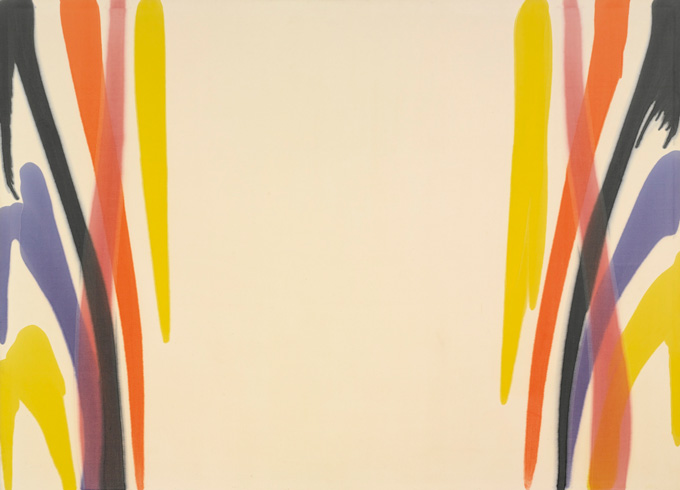
Morris Louis

Kazimir Malevich

Piet Mondrian
Surrealism Art
In this form of artwork, an artist portrays different scenes and scenarios using metaphors to give surprising effect to their creation. French poet André Breton launched this movement in Paris in 1924, with it becoming an international movement including British surrealism which formed in 1936.
Key artists involved in the movement were Salvador Dalí, René Magritte and Joan Miró, who all experimented with ways of unleashing the subconscious, with the aim being to reveal the unconscious and reconcile it with rational life.

Paul Nash

Salvador Dalí
Conceptual Art
While creating a piece of Conceptual Art, an artist concentrates more on the concept of his idea than its artwork, and is generally found in sculpture and installation. It emerged as an art movement in the 1960s, and can look like almost anything. This is because, unlike a painter or sculptor who will think about how best they can express their idea using paint or sculptural materials and techniques, a conceptual artist uses whatever materials, and whatever form, is most appropriate for putting their idea across, ranging from a performance to a written description.
Artists associated with the movement are John Baldessari, Marcel Broodthaers, and Piero Manzoni. The art forms they used were often intentionally those that do not produce a finished object such as a sculpture or painting. This meant that their work could not be easily bought and sold, and did not need to be viewed in a formal gallery situation.

Joseph Kosuth
Cubism Art
Cubism was one of the most influential styles of the twentieth century. It is generally agreed to have begun around 1907 with Picasso’s celebrated painting Demoiselles D’Avignon which included elements of cubist style. It aimed to bring different views of subjects, usually objects or figures, together in the same picture, resulting in paintings that appear fragmented and abstracted.
By breaking objects and figures down into distinct areas or planes, the artists aimed to show different viewpoints at the same time and within the same space and so suggest their three-dimensional form. In doing so they also emphasised the two-dimensional flatness of the canvas, instead of creating the illusion of depth.

Georges Braque

Juan Gris
Impressionism Art
The origin of this form can be traced back to Paris in the early 1860s, where a group of artists painted an impression of an object on their canvases, rather than an exact imitation. Impressionism developed in France in the nineteenth century and is based on the practice of painting out of doors and spontaneously ‘on the spot’ rather than in a studio from sketches.
Main impressionist subjects were landscapes and scenes of everyday life, and this form of art was developed by Claude Monet, and other Paris-based artists. Other core artists of impressionism were Camille Pissarro, and Auguste Renoir, with Edgar Degas and Edouard Manet also often associated with the movement.

John Constablein
Pop Art
Pop art describes the work of artists working in the 1950s and 1960s in Britain and America who drew inspiration from popular and commercial culture. It began as a revolt against the dominant approaches to art and culture and traditional views on what art should be. Young artists felt that what they were taught at art school and what they saw in museums did not have anything to do with their lives or the things they saw around them every day.
Key pop artists include Andy Warhol, Roy Lichtenstein, Richard Hamilton, Peter Blake, and David Hockney, who turned to sources such as Hollywood movies, advertising, product packaging, pop music and comic books for their imagery.

Andy Warhol
By Eliza Scarborough
Chabi Nouri: the new CEO of Piaget talks innovation and the evolving luxury consumer
Chabi Nouri joined the Piaget team in September 2014 as Director of Marketing, Communications and Heritage, and now at the start of April, she has taken on the new role of global CEO for the jewellery and watches brand.
Having spent a significant part of her career in the Richemont family at Cartier, Chabi adds a unique perspective to the Piaget brand, with a focus on deploying communications strategies around the Maison’s jewellery expertise and the 140-year heritage that defines Piaget.

Part Iranian, part Swiss, Chabi completed her Masters in Economics at the University of Fribourg, Switzerland, before joining Cartier in 1998 where she rose up the ranks, becoming completely immersed in the world of jewellery from 2004 to 2008, as International Jewellery Group Manager. Then, taking a hiatus from the world of jewellery and watchmaking, she acquired all the business acumen of working for a major international FMCG as Global Head of Brand for Vogue Cigarettes at BAT in London, before returning to the Richemont Group, with an in-depth knowledge of constantly evolving consumer tastes.
Here the recently appointed CEO, with an extensive knowledge of the luxury goods category, shares with us how being on the pulse is key to developing strategies that engage new-generation customers.
You’ve just been appointed as CEO of Piaget; how do you view these new responsibilities?
First of all, it’s very exciting and an amazing new experience for me. On the same note, I’ve been in the company for two years now, working on different aspects of our brand so it’s not a complete change for me. It’s a company and a D.N.A and a set of values that I know, and of course I have a good team around me.
Did you find that your break from working in jewellery and watches between 2008 and 2014 has allowed you to come back better equipped for your position at Piaget?
Yes, it has. I think I’m a very curious person; that’s why I love to experience different positions with different missions. I started out with the Richemont Group and I have been able to touch on very different areas within my career. I’ve worked on product development with Cartier, I’ve worked on the merchandising and I’ve worked on retail. So, I had an amazing experience there and I learned very different aspects of the business. That’s where I also fine-tuned all my financial knowledge, the trade environment, marketing, and had the chance to manage nice teams. So absolutely this will benefit me for my current positon, but also the last few years within the company has helped me quite a lot to prepare for the role.
How do you keep the balance between creative innovation and the values of tradition?
Innovation is key; we must always challenge ourselves to innovate while remaining in the framework of the values of Piaget. With Piaget, there is a motto which is ‘always be better than necessary,’ so the values of the family have always been to do something that has never been done before. We try to be pioneers in every aspect of what we create, and innovation is built into our brand values; we don’t see innovation as something that is opposite to tradition. For us, it is about referencing our tradition to be able to innovate even more. If we think about our watches for example, we have a record of innovation with new movement and thinner models while always putting design at the forefront. So, for Piaget it’s always about the innovation, design, elegance and creativity that goes into our pieces.
What’s key to keeping the brand at the forefront of the modern customer’s mind?
First of all, the product needs be desired, and so I think the creativity and beauty of the designs is one way of being kept in mind. But also, of course, there are ways to communicate with our clients and with the friends of the brand; this is a way to stay ahead and to stay at the forefront of people’s minds. Today, we have so many different mediums through which to communicate. We have social media, e-commerce and we have our boutiques, so everything works well together as a real 360 experience, and we have the opportunity to communicate even better with our clients.


How do you feel the historic market of watch making has changed with the introduction of social media?
It’s very exciting; it allows the rich heritage of the Maison of Piaget to really express itself through different mediums and to explain the artistic story. It’s a very key part of our communication strategy be able to work with social media and it’s good that our clients can communicate with each other too. It has definitely enriched our strategy and the way we talk to our audience.
So, do you plan to embrace social media more in the future?
Absolutely, it’s very key to us. We started a long time ago and were quite early in adopting social media into our plans. We will continue to emphasise social media and the entire digital world, including e-commerce which began back in 2012 in the USA. We feel it is a key part of the decision-making process of the clients. They decide if they want to purchase or experience a brand online or in the store and I don’t think the two compete with one another. For me, online is a retail environment and it’s also a source of information to better understand our products and our story. I think it is now part of the whole experience. It is not one or the other, they can complement each other and exist together. Today, it is almost mandatory; it is part of the way we inform ourselves and buy products.

Do you plan for the introduction of more ambassadors of the brand in line with this strategy?
Today, we already have two well-known, very talented and very prestigious brand ambassadors in Jessica Chastain and Ryan Reynolds. And then we have other faces too who are authentic fans of the brand across the world and across the different regions. We are very happy with the Piaget society we have today.
Feminism and the empowerment of women is at the forefront of society’s mind at the moment; what has been your experience as a successful woman in your industry?
First of all, I would say that I don’t think that luxury is very dominated by men. I have worked with a lot of different, talented women in this industry. I personally never felt any difference being a woman in this environment. I think on the leadership side of things; the profile of the individual makes a difference but not being a specific gender. I have always had the chance to evolve in an environment and an organisation that has really been advanced in its diversity, so I have been lucky to not really have felt any kind of difference.
How important is it to have the face of Piaget as an empowered woman?
It’s probably very close to the values of the brand in the sense that our clients are very charismatic and have their own personalities, and basically that represents the empowered woman. At the same time, I think empowerment isn’t really the sole criteria to define someone so it’s not necessarily about making the statement of empowerment alone. Jessica Chastain, an ambassador of the brand, really represents our values. She has a very positive energy and is radiant; she’s very much aligned with the Piaget brand. There is always a positive outlook that has driven the Maison from the beginning; it’s true that Piaget represents the sunny side of life, and that’s how we like to express ourselves.
What is your global vision and strategy for Piaget?
I think it is to have even more people knowing about Piaget. Knowing the rich heritage of course, but also the new creations; understanding its innovations and the amazing fusion between elegance and extravagance. It is my priority for people to feel the sunny side of life with Piaget; to ensure that this message is more well-known and experienced by our clients.
What challenges do you think you will face along the way?
The environment is very active and dynamic so there is a lot happening in our field. Therefore, the challenge is to find a way to elevate ourselves above the rest and above all of the activity, as everything moves so fast. Competition is fantastic as it pushes us even more and we must strive to be even better to create more and innovate more.
Is it a challenge changing the visual identity of such an iconic brand?
I wouldn’t say that it changes but more that the visual identity evolves. As long as we remain close to the values and the driving force of the brand and the Maison’s D.N.A, it is not a challenge. In fact, it’s a great evolution.

What’s not yet been achieved with the brand that you still aim to accomplish?
I think that when you know Piaget, you cannot help but love and desire the brand. So, our aim is to have more people understanding the brand and really raise awareness. It is such an amazing brand with a unique creativity so this is something I would love to accelerate.
What do you see as a standout piece that would be most popular to the customer?
I would say the new open bangle bracelets are standout pieces that will prove to be very popular. The pieces from the Possessions collection that we launched three years ago are a 25 year icon of the company, and now we are launching them in colour. We are launching the newer cuffs and the pendant with natural coloured stones. They are great for layering, so the fact you can stack them and mix and match becomes something that’s almost addictive; to collect them and keep them and love them. And I think in the region also, we love colour so it suits that passion perfectly.
Do you have any personal favourites from the collection?
Yes, absolutely! I have a favourite watch which is the Traditional watch. I absolutely love it because it embodies all that Piaget is about. There is the gold cuff and clip that is hand-engraved by our artisans line by line using small tools. Piaget is very well known for gold bracelets and for crafting and sculpting gold so this represents that very well. Also, it is a signature of Piaget to have hard stones so this is emphasised on our jewellery but we also have it on the watch setting too. That’s why this watch represents the brand for me; I love it because it has been made for almost 60 years and you cannot see the difference between what was created 60 years ago and this today.

We would love to learn more about you. Can you tell us what lessons you’ve learned and live by to remain empowered in this work environment?
I’ve always stayed very true to myself, to my own values and to my ethics. I’ve always tried to really stick to that. I believe in my teams and in myself and try to keep that confidence and have a very positive outlook of the future. I really believe in what I’m doing; I have a goal and just go for it.
How do you balance competitive work environment with your personal life?
I think it’s a matter of organisation. Everybody has a different view on what is for them and the things they want to prioritise. For me, I have found my balance between my family, my work, the professional experience and social life. Everything goes well together, and it’s a matter of organisation above all else.
Can you tell us about your own personal style?
I’m very feminine and I love wearing very high heels; that’s probably one of my signature elements to any outfit. I can do that more often as I’m not very tall! Also, I like to have a little bit of something audacious in my style.
Do you have any tips and advice you can share for women in business to make it to the top?
You need to believe in yourself. That is probably the key and most important thing; we need to believe in ourselves.
By Natalie Hanson
Highlights from Art Dubai 2017
As Art Dubai enters its second decade, the fair brought together 93 galleries from 44 countries to showcase the globally diverse works of more than 500 artists, acting as an important platform for discovering new artists. With diversity and nuance at the forefront, we have selected our highlights from the exhibition.

Abraaj Group Art Prize 2017
The Abraaj Group Art Prize invests in and has given resources to artists to develop their practice by realising a unique project, creating regional and global awareness. With a record number of applications from 61 countries, more than double the number received in 2016, the winner Rana Begum and the three shortlisted artists, Sarah Abu Abdallah, Doa Aly, and Raha Raissnia, were all women. The artists each had features at the exhibition, and also worked together to create a few specific pieces for the venue. Rana’s commission stems from a series of studies on MDF panels that focus on overlapping, transparent coloured planes which create a third layer of geometry and colour.

Interactive Installation by Meriem Bennani
Moroccan-born, Brooklyn based artist Meriem Bennani, created an interactive bar installation borrowing from playful strategies and designs that beauty salons, massage parlours or entertainment parks use to encourage social interaction amongst strangers. Titled ‘Ghariba/Stranger’, Bennani’s installation included viewing stations for videos showing video portraits of Moroccan women, encouraging visitors to interact and take part.

Art Dubai Modern Preview
For its 11th edition, and to complement the fair’s Modern hall, Art Dubai introduced the inaugural Art Dubai Modern Symposium, a series of talks and presentations focused on the life, work and cultural impact of 20th century masters from the Middle East, South Asia and Africa. Renowned curators, scholars and patrons led the sessions that delved into the styles, influences and practices of artists whose work contributes to the history of art produced in the 20th century.
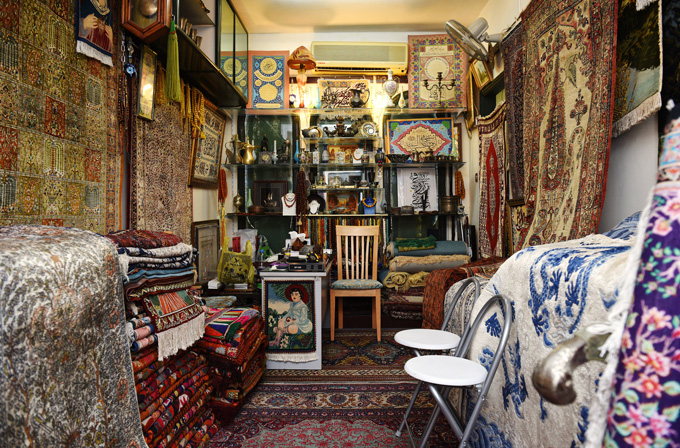
Global Art Forum
The theme for this year’s Global Art Forum was ‘Trading Places.’ The commissioner for the forum this year, Shumon Basar, talked about how we tend to think of trade as the exchange and movement of goods, but it is also the exchange of ideas. The theme came out of conversations about a secret painting and the history of trade between Sharjah and Iraq. The forum included interconnected topics about both art and trade, and was held at the Madinat Jumeirah’s For Island.

Cooking Liberty at The Room
Atfal Ahdath, an art collective of three progressive minds, which includes Vartan Avakian, Hatem Imam and Raed Yassin, created Cooking Liberty, which was hosted at The Room in Mina a’Salam. Seating 80 guests for two nights only, the performance-led dinner, taking its cue from Salvador Dali’s cookbook Les Diners de Gala, took guests on a journey with a surprisingly alternative drinks reception, followed by a grandiose twelve-courses banquet. The exhibit aimed to give visitors a surreal experience using exaggerated and repetitive video and audio, and the physical setup itself.

Gallery Hall Exhibits
Artwork was divided between two gallery halls, Art Dubai Contemporary and Art Dubai Modern. Art Dubai Contemporary featured 79 galleries from 41 countries, displaying the work of both emerging and established artists. Art Dubai Modern, now in its fourth edition, highlighted the work of influential artists from the MENASA region. According to International Director Pablo de Val, this year’s exhibits are more tightly curated and tailored, featuring solo exhibits and also overview collections by groups of artists.
A look at the exhibitions of The Fondation Louis Vuitton
In 2006, at the behest of Bernard Arnault, the LVMH group created the Fondation Louis Vuitton. Designed by the American architect Frank Gehry, it falls in line with the Groups’ efforts to promote art and culture over the last 20 years. A private cultural initiative, the Fondation Louis Vuitton’s aim is to promote and support contemporary artistic creation for a wide French and international audience.
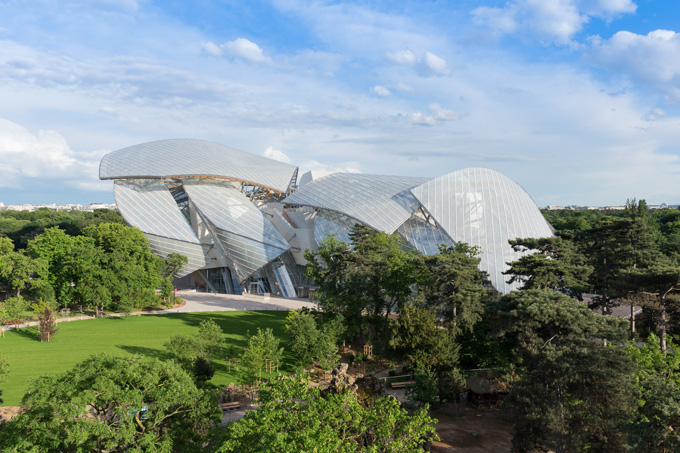
Frank Gehry’s building is in fact the first artistic statement by the Fondation, initiating an approach to artistic creativity. His daring and poetic architectural style offers an approach that differs from the conventional construction of various buildings.
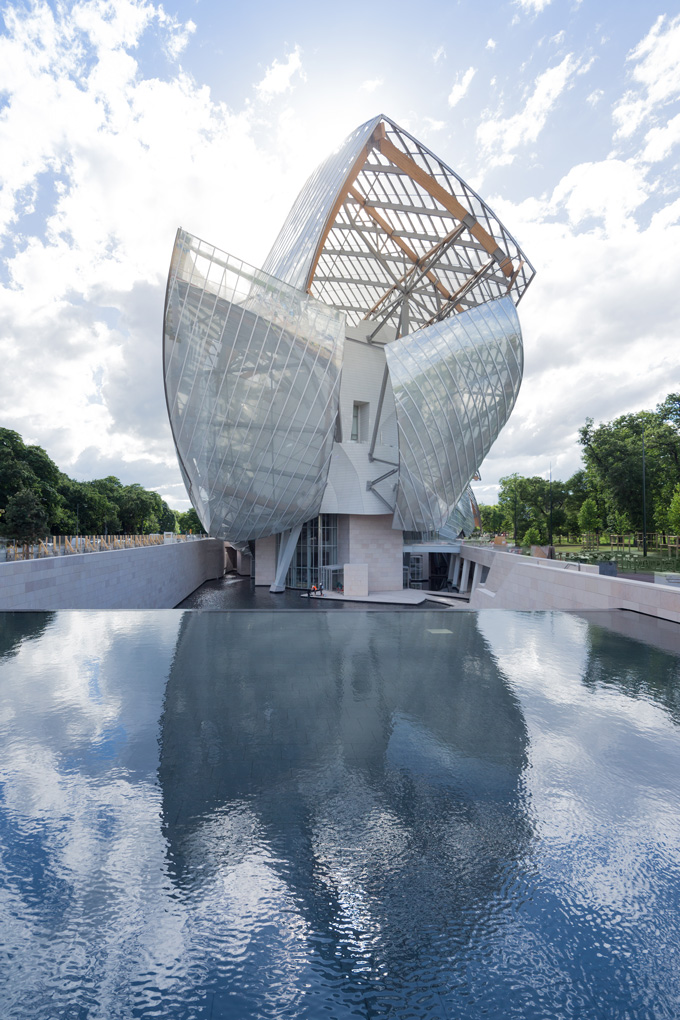
Powerful, it toys with gravity, using volumes that create cloud-like forms. Innovative, it provokes visual ruptures that reinterpret perspectives. Narrative, it invents a futurist design that inspires surprise and emotion.
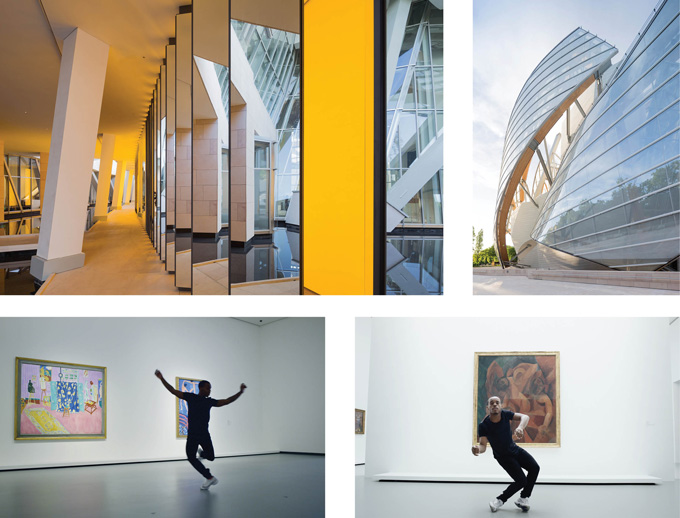
Since its inauguration, the Fondation has presented many successful exhibitions. Most recently there was Icons of Modern Art, The Shchukin Collection, featuring the collection of 250 paintings amassed by Russian collector Sergei Shchukin, who is recognised as one of the world’s greatest collections of modern art. With over 1.2 million visitors, the exhibition garnered a record-breaking number of visitors, being hailed as the most successful art show in France for 50 years.
Commissioned to celebrate the landmark exhibition, Icons of Modern Art: The Shchukin Collection, a film by Andrew Margetson is also presented called Lil Buck at Fondation Louis Vuitton. It captures the Memphis jooker’s first improv dance inside a museum, tracing his moves as he responds through dance to the iconic architecture of the Fondation, and the artworks of modern masters Picasso and Matisse.
Art/Afrique, Le Nouvel Atelier
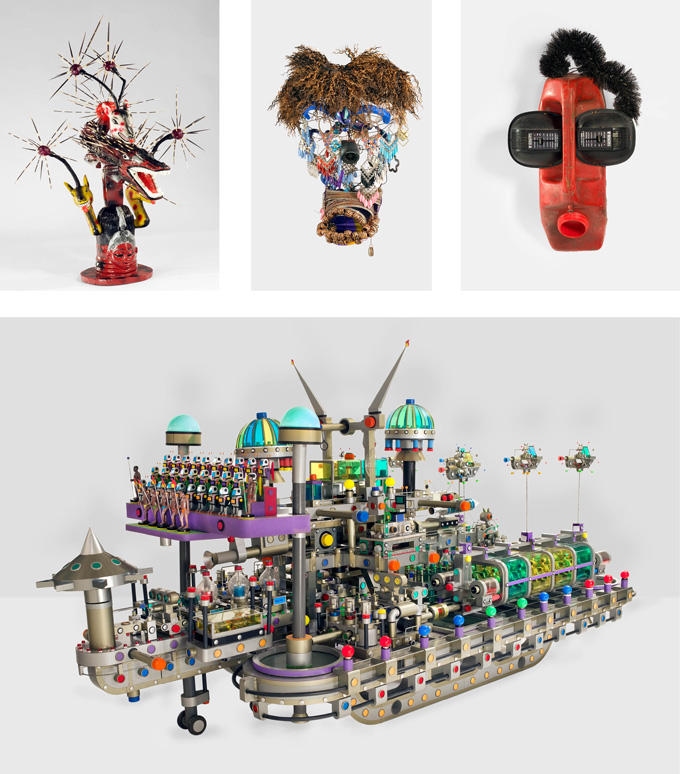
Fondation Louis Vuitton will present ‘Art/Afrique, Le Nouvel Atelier’ from April 26 to August 28, 2017. Alongside its monographic exhibitions, the Fondation Louis Vuitton regularly presents group exhibitions that focus on the latest developments from less known, or even entirely overlooked, art scenes. The exhibition will present recent works created by artists throughout the African continent, from sub-Saharan Africa to South Africa, and will be displayed across the Fondation’s galleries according to three sections:

The Insiders
This brings together a group of works by fifteen iconic artists from Jean Pigozzi’s collection of African art, presented in Paris for the first time. Businessman Jean Pigozzi began collecting contemporary African art in 1989, relying on advice imparted by André Magnin. A pioneer in the movement, he lived and travelled extensively throughout the African continent, visiting artists in French, English, and Portuguese speaking countries. At a time preceding the use of mobile phones, the internet, or social media, Pigozzi and Magnin visited the artists in person to build relationships with them and their works, enabling them to appreciate the originality of their approaches, a decisive element in the shaping of the collection. This determination and commitment guided Pigozzi and Magnin in assembling a unique collection of works that express strong political positions, representative of the diversity of the contemporary African scene between 1989 and 2009.
The artists included in the exhibition, each deeply influenced by the spiritual, scientific and craft traditions of their country of origin, develop unique worlds that manifest themselves through various forms of expressions and media. Boldly asserting its openness, eclecticism and freedom, the Pigozzi collection presents a representative range of each artist’s work across various media. It seeks to raise awareness of a relatively unknown art scene, increasing its international audience and impact.
Being There
As a complement to ‘The Insiders’, Fondation Louis Vuitton will present ‘Being There’, a collective exhibition of works by artists from South Africa, one of the most dynamic scenes of the African continent today.

It will include works by approximately fifteen artists, on the one hand, masters of South African art, such as Jane Alexander, David Goldblatt, William Kentridge, David Koloane and Sue Williamson who are internationally renowned and wield considerable influence on younger artists, owing to their socio-political engagement. Also presented are artists born during the 1970s, represented by key figures such as Nicholas Hlobo, Moshekwa Langa, Zanele Muholi and Moshekwa Langa. On the other hand, a selection of artists born in the 1980s, whose works examine South African identity struggles in the aftermath of apartheid, among them Jody Brand, Kudzanai Chiurai, Lawrence Lemaoana, Thenjiwe Niki Nkosi, Athi-Patra Ruga, Bogosi Sekhukuni, Dineo Seshee Bopape, Buhlebezwe, and Kemang Wa Lehulere.
These artists use a range of different media, such as installation, photography, painting, textile and video, to critically revisit their countries’ past, focusing in particular on the history of colonisation. They also firmly anchor their work in the present day by asserting an identity that defies race, colour and gender.

Africa in the Fondation Louis Vuitton Collection
A selection of works from the Fondation Louis Vuitton Collection will complement these two exhibitions by looking beyond the African continent to include African artists working outside their countries of origin, as well as Afro-American artists.
A set of multidisciplinary events revolving around music, poetry, literature and cinema has been organized in conjunction with the exhibition. As part of the event, Fondation Louis Vuitton is partnering with La Grande Halle de La Villette to offer a combined entry ticket for their exhibitions ‘Art/Afrique, le nouvel atelier’ and ‘Afrique Capitale’.
Discovering the Beauty of Brows with Benefit Cosmetics
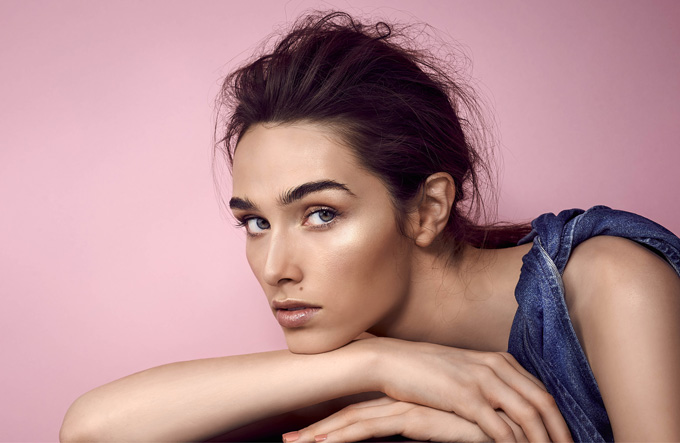
The Beauty of Brows: Gleaming skin, radiant highlights, and of course the perfect brow to frame your look.
Highlighted
Benefit Cosmetics, High Brow Glow
To emphasise your brows and give yourself more of an instant eye lift, highlight under the browbone. Complement this look by highlighting the high points of your face, these are the areas that the sun would naturally hit, giving immediate structure to you face.

LEFT IMAGE:
Bold
Benefit Cosmetics Gimme Brow, Benefit Cosmetics Ka-Brow!, Benefit Cosmetics They’re Real Double the Lip in Juicy Berry
Don’t be afraid to go all out with your make-up, balancing a bold brow with a bold lip can look beautiful. The important thing is to keep the skin glowing and fresh, to ensure the look remains youthful.
RIGHT IMAGE:
3D Brow
Benefit Cosmetics 3D Browtones , Benefit Cosmetics Goof Proof Brow Pencil
If you have naturally strong, dark brows, try using a brow product two shades lighter than your actual brow hair to create dimension. Apply a brow pencil into the sparse area of the brows and finish with a metallic based brow gel.

The Supermodel Brow
Benefit Cosmetics Ready, Set, Brow!, Benefit Cosmetics Gimme Brow
Adding drama to your make up look doesn’t have to be complicated. Brushing up your brows using a setting gel is a simple way to create a fashion forward look. Keep the rest of the make-up look simple, to ensure the brows remain centre stage.

LEFT IMAGE:
Wow Brow
Benefit Cosmetics They’re Real Double the Lip in Flame Game, Benefit Cosmetics They’re Real Double the Lip in Fuchsia Fever
Create a fuller looking lip to go with your full brow, by using two shades of lipstick that complement each other. An on-trend combination is orange with pink, and is best applied by keeping the lighter shade on the bottom lip, and the deeper shade on the top, to give you the perfect pout.
RIGHT IMAGE:
Feathered
Benefit Cosmetics Precisely, My Brow Eyebrow Pencil, Benefit Cosmetics Ready, Set, Brow!
To create a feathered effect, use this brow pencil to draw hair like strokes in the front section of the brow upwards, and continue through the brow to fill in any gaps. Then using the setting gel, brush the front section of the hair upwards. The great thing about this brow style is that it thins the look of the nose.
Fashion Director: Eliza Scarborough
Photographer: Lezli and Rose
Make-up: Lisa Potter-Dixon, Head Make-up Artist and Brow Expert for Benefit Cosmetics
Hair: Laurence Close at Carol Hayes
Model: Nicole at Select
All clothing, www.brownsfashion.com
Victoria-Jungfrau Grand Hotel and Spa; Member of the Leading Hotels of the World
Experience breath-taking views of the Jungfrau Massif and Interlaken, Switzerland’s local mountain, the Harder.

The Victoria Jungfrau Grand Hotel & Spa enjoys a privileged and picturesque location in Interlaken, between 2 beautiful lakes at the foot of the eternally snow-capped Jungfrau. With 224 rooms, including 102 Suites and Junior Suites, the Victoria-Jungfrau is an imposing establishment, large enough to be described as Grand, yet compact enough to retain a unique character and cachet developed over 150 years and more. It combines the luxuries of a five-star hotel, with the cosiness of a well-tended private home where the interior is never less than tasteful.

History
The Victoria-Jungfrau Grand Hotel & Spa we see today had humble beginnings when the businessman Eduard Ruchti opened the Pension Victoria in a former doctor’s surgery in 1856. Around this time, the Alps were being explored and conquered as European tourism started to emerge, with travellers from Great Britain playing a key role. In 1865, encouraged by his early success, Eduard Ruchti demolished the pension, and replaced it with a larger structure, the Hotel Victoria. In 1895 the dynamic entrepreneur acquired the Hotel Jungfrau, which had been built next to the Victoria in 1894. Two years later he added the lavishly decorated ballroom in the east wing of the Hotel Jungfrau, and the two buildings were finally joined by a striking domed structure in 1899. In the 1970s, the hotel was upgraded with extensive renovation work and the construction of indoor tennis courts. Another quantum leap took place in the early 1990s with the construction of the steel and glass ‘boulevard’ and, most notably, the opening of the famed spa.
The Rooms
All the rooms have a distinctive design and décor, ranging from classic to contemporary, impressively blending functional furnishings, with carefully chosen decorative elements, from the wallpaper and curtains to the pictures adorning the walls. Elegant interiors and spacious marble bathrooms complement the designs.

Food & Drink
There is a wide selection of restaurants and bars as far as regional influence and menus are concerned. La Terrasse, awarded 15 Gault Millau points, is an elegant restaurant renowned for its fine international cuisine. With its many palm trees, the interior is reminiscent of an orangery in France, which is also reflected through the French-inspired with an international perspective. At the Quaranta Uno, guests can enjoy Italian cuisine, where superior fish and classic meat dishes are served, and it is also possible to enjoy a plate of pasta in this down-to-earth eatery.

The Spa
The exclusive 5,500 m2 Victoria Jungfrau Spa is equipped with a pool, a sauna, and a steam room. It provides body and face treatments and features a Sensai Select Spa offering a holistic and long-established concept devoted to the theme of ‘better-aging’. To bring about a better quality of life in every sense, a full team of specialists, including osteopaths, fitness trainers, nutritionists, and medically qualified massage therapists, are on hand to support guests in whatever way they require. Those seeking to take up a healthy new lifestyle can make a confident start with the Nescens program, which was developed and validated under the direction of Professor Jacques Proust of the Centre for the Prevention of Aging at the Clinique de Genolier. Fitness, sports, and health coaching are also offered for a well-rounded health and well-being experience.
Additionally, there is a luxurious private spa for 2 and a cosy spa bar serving healthy spa cuisine. Swimmers can do lengths of the deep-blue pool while tennis players can make use of the hotel’s two indoor courts and three outdoor clay courts, while a riding stable and 18-hole golf course are located close to the hotel. In Interlaken, water sports enthusiasts, from canoeists to stand-up paddle boarders and sailors, have a choice of two lakes, both Lake Thun and Lake Brienz have wonderfully clear waters. Alpine and Nordic skiers alike have much to look forward to in winter.

Victoria-Jungfrau Grand Hotel and Spa is a member of The Leading Hotels of the World, a collection of authentic and uncommon luxury hotels. Rooted in the locations where they are found, the hotels embody the very essence of their destinations. Offering varied styles of architecture and design, and immersive cultural experiences delivered by passionate people, LHW’s collection is for the curious traveller looking for their next discovery. Established in 1928 by several influential and forward-thinking European hoteliers, Leading Hotels has an eight decade-long commitment to providing remarkable travel experiences.
Creating a bronzed glow: meet the must-have new-era bronzers
Forget the hit and miss gradual tans you’re used to, faux tan and creating a bronzed glow has evolved.
Deepen your skin colour with daily use of Shiseido’s moisturising emulsion which will deeply nourish your skin at the same time, or try Diorskin Nude Tan Prime & Bronze, which primes your skin while also subtly tinting, enhancing the complexion, creating the illusion of a natural healthy glow. If you are looking for something more immediate, then Guerlain Terracotta will naturally reproduce varying shades of the sun to give a good bronzed base, and when paired with Bobbi Brown highlighting powder, the skin will be given shimmering bronze highlights. If you are still looking for that extra bit of golden illumination, then Guerlain Météorites with their Stardust technology transform light invisible to the naked eye into a pure and endless glow on the skin, or try Tom Ford’s Shimmering Body Oil, which captures the sultry effect of sun-kissed summer skin with shimmers of gold and platinum leaf.

FROM LEFT:
Shiseido Daily Bronze
Diorskin Nude Tan Prime and Bronze
Bobbi Brown Highlighting Powder
Tom Ford Soleil Blanc Shimmering Body Oil
Guerlain Terracotta
Styling: Eliza Scarborough
Photographer: Henry Pascual
Roberto Cavalli Signature Scents for Him and Her

Roberto Cavalli Signature
Created by master perfumer Louise Turner, it is an exuberant and sunny fragrance whose top notes, lit by pink peppers, exude an infectious joie de vivre. Vibrant and sensual, the fragrance is exhilarating and mesmerising from the very first whiff. Its generous heart of orange blossom is a treasure of sensuality and its Tonka bean base notes leave a highly addictive imprint on the skin. The bottle’s soft curves pay a sensual homage to the woman’s body. Crowned by the Roberto Cavalli golden seal, it is adorned by a tiger necklace. A playful tribute to the brand’s famous signature patterns, it also reminds us that while elegant and refined, the Cavalli woman remains free, wild and willful.

Roberto Cavalli Uomo
The design of this masterpiece was entrusted to perfumer Christophe Raynaud. He composed an exclusive aromatic oriental woody fragrance, a combination of precious ingredients that create a perfect harmony between timeless Italian sophistication and dandy rock boldness. It opens with a distinctive note of black violet, Christophe Raynaud’s signature flower, contrasted with a very masculine counterpoint of hot and sexy saffron. An intense heart of honey facetted with lavender essence adds depth and volume to this catchy overture, building a riveting theme, while the hypnotic base note of cedarwood amplifies this fragrant melody. Laced with mesmerising oriental undertones of patchouli and tonka beans, its magnetic trail generates a seductive echo.

The Campaign:
Shot by the talented director Scott Cooper, the campaign was inspired by the Rolling Stones’ mythic sojourn in the Nellcôte villa in 1971. In the lavish surroundings of a majestic Italian villa, Esther Heesch, the new face for Roberto Cavalli’s Signature fragrance, perfectly captures the unique blend of spontaneity and sophistication that defines the Cavalli heroin. French male model Félix Guesnouin effortlessly captures the dandy-rock lifestyle of the Cavalli hero, his taste for elegance and refinement balanced by his audacity and unremitting love of freedom.
DOLCE & GABBANA SS17 Menswear collection: Ciao Bella!
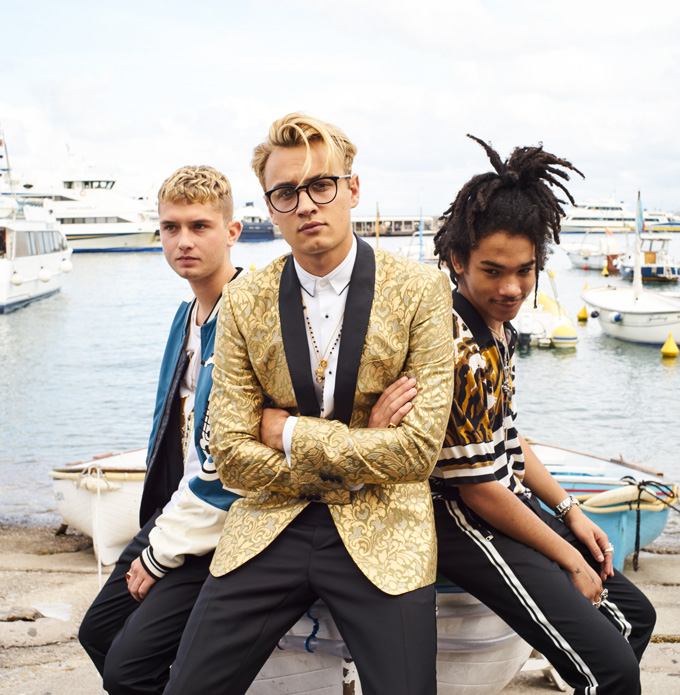
Inspired by music, and by the memories that music brings back to everyone’s minds, Mr. Dolce and Mr. Gabbana merged together jazz and swing, pop, dance, and rap to create a continuum of genres that knows no barriers of time. The contrasts continue with the clothes and the volumes, large pants, fitted shirts and long kaftans, short jackets, and classic suits, modelled by a group of the most renowned young gentleman of the so called ‘Millennial Generation’.
‘The mix and match of leopard, pineapples, musical instruments and dancing scenes prints are harmoniously mixed, in order to give a very personalised style to everyone as much as the music does.’ – Domenico Dolce and Stefano Gabbana
FROM LEFT TO RIGHT:
Calfskin leather jacket, Cotton shirt, Virgin wool and cotton trousers, Gold Embroidered silk jacket, Cotton smoking shirt, Virgin wool and cotton trousers, Cotton polo shirt,Cotton trousers. All Dolce&Gabbana
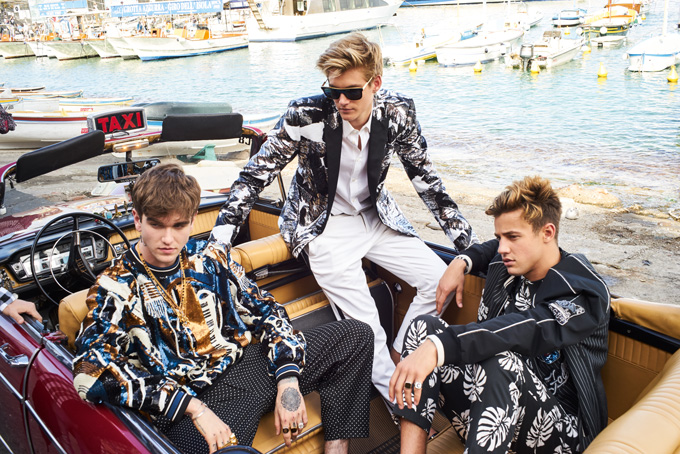
FROM LEFT TO RIGHT:
Embroidered cotton sweater, Cotton trousers, Embroidered silk jacket, Cotton shirt, Cotton trousers, Cotton and silk bomber jacket, Printed cotton shirt, Cotton trousers. All Dolce&Gabbana
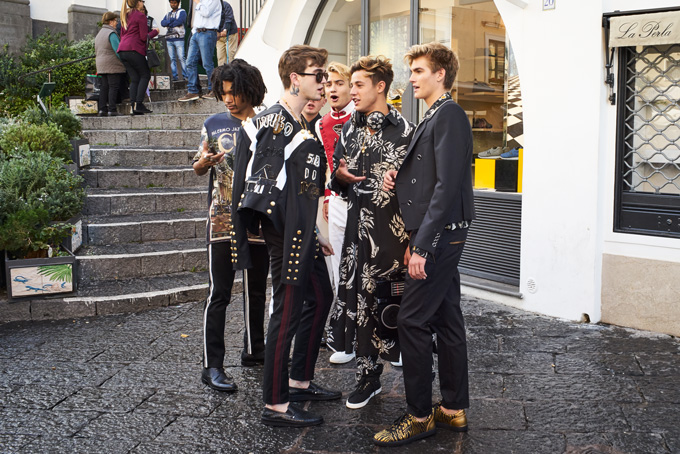
Printed Cotton t-shirt, Cotton trousers, Printed caftan in cotton, Cotton jackets . All Dolce&Gabbana
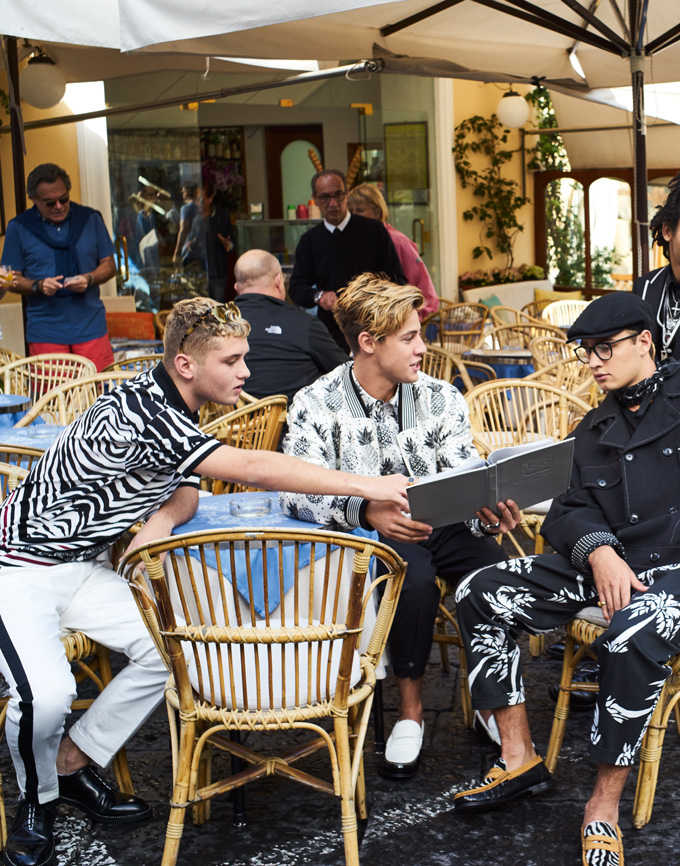
Printed cotton polo shirt, Cotton trousers. Printed silk and wool bomber jacket. All Dolce&Gabbana
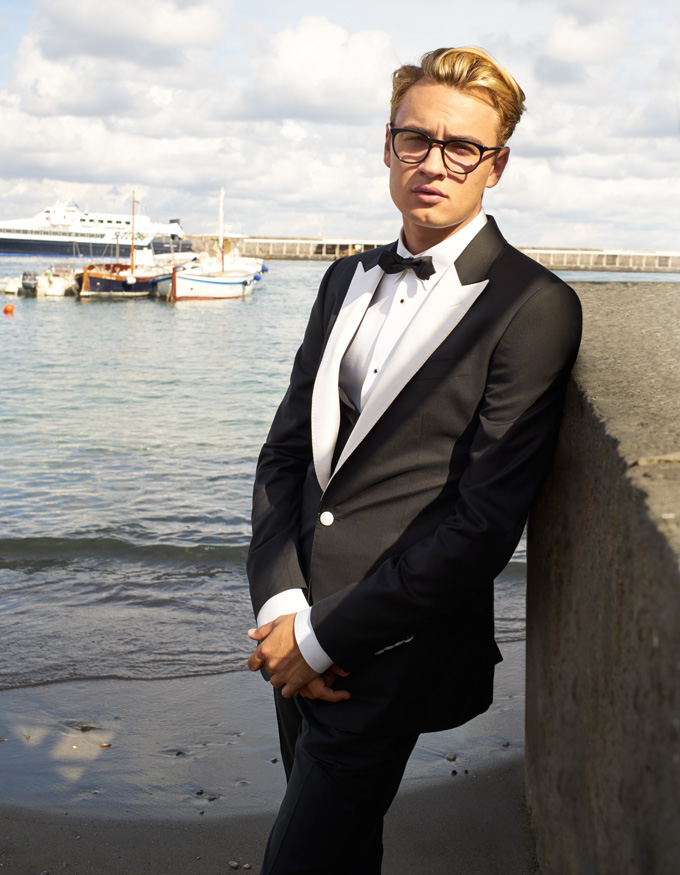
Black virgin wool and silk suit with white details, Cotton smoking shirt, Silk bowtie. All Dolce&Gabbana
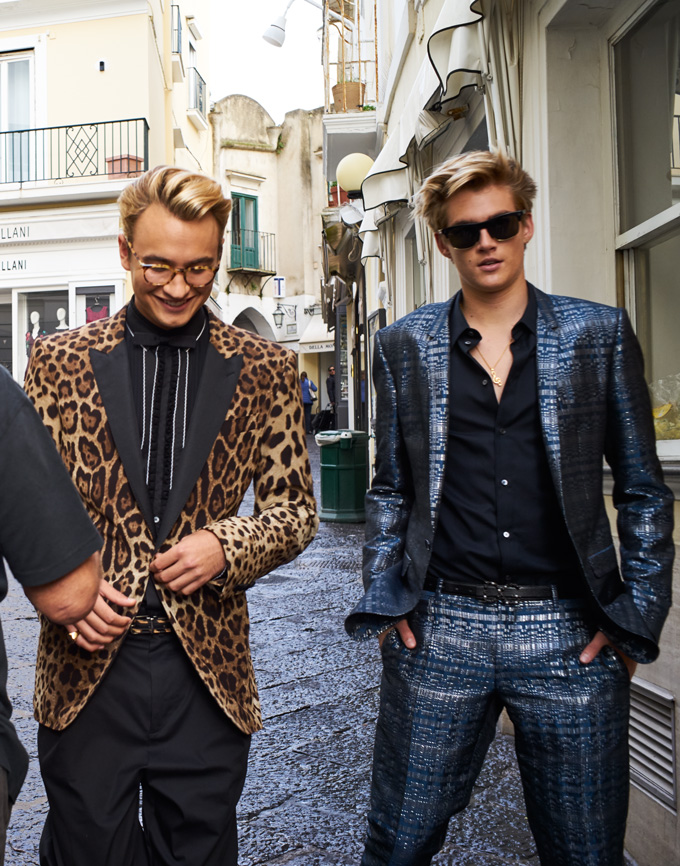
Printed leo silk jacket, Cotton trousers, Cotton shirt with mother of pearl buttons, Embroidered virgin wool and cotton suit, Cotton shirt with mother of pearl buttons. All Dolce&Gabbana
Photographer: Davide Gallizio
Céline Spring Summer 2017, A Reflection of Reality and Romance
Easy, fluid, fresh, but also surprisingly urban.
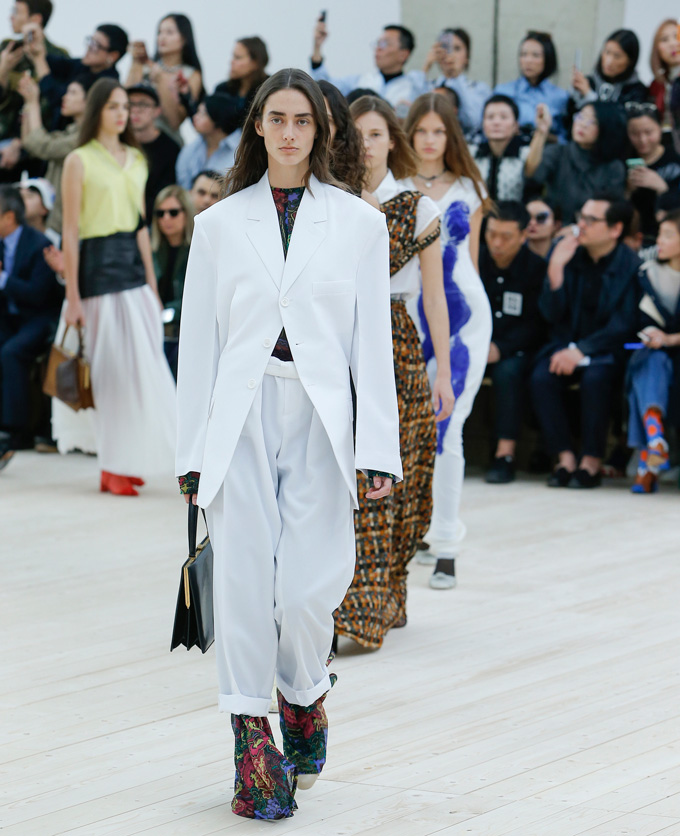
It seems Phoebe Philo has reached the point where she just wants her clothes to speak for themselves, because she didn’t want to say anything about them before or after her show, and as it transpired, they did speak for themselves, and for a relatable point of view on women’s lives.
The suiting jackets were oversized but fluid, the trousers were three-quarter-length, with printed chiffon inserts at the cuff. The palette was neutral with spots of sorbet, a raspberry dress in chiffon, a pale lemon yellow, or a cotton shell top in mint. Shoes were paired in different colours, with the heel height falling right into the current trend for kitten heels. Bags had a more understated edge, and one style, a classy, gimmick-free top-handled frame handbag, looked as if it might have come from the Céline archive.

The show itself was set in a pavilion designed be Dan Graham. The S-shaped, two-way glass structure, was reflective and transparent, and positioned in the middle of an open space through which the models walked. Phoebe Philo explained the show and set, ‘I wanted to see it cast through the kaleidoscope of Dan’s installation. The fact that people can see themselves and the clothes makes for more complex reflections.’
The need-to-know beauty buzzword of the moment: Draping
Contouring and strobing, step aside, there is a new beauty buzzword in town, and this type of makeup-based face chiselling is called draping.

It was legendary makeup artist Way Bandy who first used colour as a way of shaping the face in the 70s, although for years the effect took a backseat to contouring, and most recently strobing, but is now enjoying a revival. The technique relies on colours, rather than traditional contouring and highlighting shades, to enhance facial features.

Put simply, it is a wash of a single hue, blended over the contours of your face, and was a popular choice of make-up style at the Spring Summer 2017 shows. While the intensity and tone of the blush varied from show to show, in most cases, the cheek colour was the focal point of the entire face, with little else going on, as often the blush itself doubled as an eye shadow, extending past the temples and over the eyelids.

This is looking like a comeback that will stay, because draping succeeds where other techniques fail. While contouring can look harsh, and strobing can appear waxy, draping is subtler, adding nothing but a healthy, youthful flush.
By Eliza Scarborough
The Ultimate Guide to Spring Summer 2017
Welcome to our Spring Summer 2017 trend report, a season filled with escapism, activism, and storytelling. The sartorial spectrum ran from wearable to adventurous, making next season’s trends wonderfully diverse.
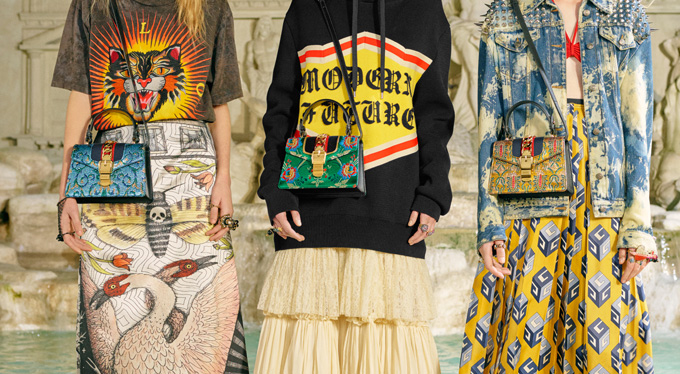
The offerings for the season ahead proposed a glimpse into the future of the fashion industry with see now buy now, as well as a glance back over our supersized shoulders at the bygone eighties era, in the expertly executed collections.


By Eliza Scarborough
Romantic and feminine Floral Fragrances
For an effortlessly romantic and feminine scent
For a touch of feminine charm, floral notes are probably one of the most popular fragrance categories. Striking notes of rose, lily and white blooms will lend a clean feel, likely freshly cut flowers, while hints of fruit and spices give a more intense scent. We’ve rounded up the very best, from light and airy to rich and warm, giving you the choice of the aroma of a mixed bouquet, or single scent, to inject a bit of summer sunshine into your day.

FROM LEFT:
Shiseido Ever Bloom, Prada La Femme , Miss Dior Blooming Bouquet, Chanel No5 L’Eau , Tom Ford Orchid Soleil, Jo Malone Peony and Blush Suede Cologne.
By Eliza Scarborough
Photographer: Henry Pascual
Dolce & Gabbana Beauty: Miss Sicily
In this ultimate tribute to Sicily, Dolce&Gabbana Beauty introduces its first colour and care lipstick, Miss Sicily.
The wide range of shades emulates the region’s shimmering postcard-perfect landscape, where the sun and the sea invite you to live to the fullest. Rosalia, Maria, Concetta, are only a few names, typical of Sicilian women, which inspire each of the 16 shades, which are grouped into five colour families, soft nudes, statement pinks, confident purples, sunny corals, and bold reds.
The ultra-light texture and vibrant hues sets on the lips, in a blend of unique polymers to give each Miss Sicily shade an inimitable radiance. An array of moisture-keepers prepares the lips to fuse with the colour, while a combination of emollient oils softens the skin, leaving an irresistible protective film. When applied, the lipsticks supple, lightweight, and non-sticky texture adheres to the lips and feels like a second skin.
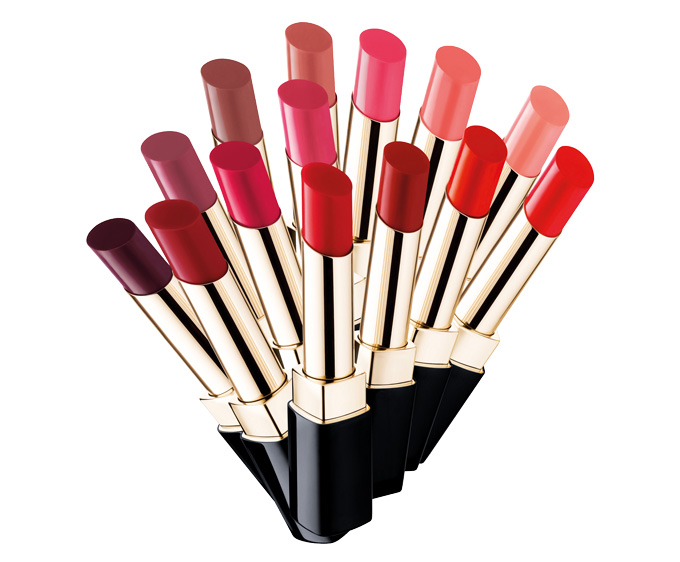
Here, Dolce & Gabbana Beauty International Makeup Artist shares his top tips for creating the perfect Dolce & Gabbana lips.
• Use the lipliner matching the chosen shade of Miss Sicily Lipstick.
• Apply the lipliner all over the lips and lip corners.
• Fill the lips within a freehand application with Miss Sicily Lipstick. One layer is enough for a shine and elegant effect.
• Apply a second time for more intensity and a glossy effect.
• Define the shape of the lips with the lipliner to make the look bolder.

Dolce & Gabbana Miss Sicily collection will be available in the region as of April 2017, at all Dolce&Gabbana Beauty counters.
Spring Style; Dressing for the New Season
What should a man wear when the weather is changing, not quite warm enough, but still sunny and warm? This, in a nutshell, is the eternal dilemma of dressing for spring, and one that we are setting out to solve. When it’s neither coat weather nor t-shirt weather, but something in between, it demands a flexible approach, focused on a smart combination of layers and colour palette.

Image: Gucci
Colour Code
Across the board, stone, the colour that hits between white and sandy beige, was the most popular shade shown by designers for Spring Summer 2017. The great news is that it’s not only a fantastic colour for a suit, but it’s also a sun-friendly alternative to stark white jeans, and will warm up all skin types. A close runner up for colour of the season was pink, in particular the warm, dusty rose seen in a big way at Gucci. So, for a quintessential spring look, lighten your colour palette, it will make you feel more spring like when the weather is cool too.
Cut Loose
Knitwear may seem more of a staple for the winter months, but it shouldn’t be overlooked for the milder weather of spring. Dressing seasonally is really all about choosing the right weight of fabric, so in a fine, or looser thickness, knitwear can still be present in your wardrobe. On the catwalk this was seen in abundance, particularly with ultra-long sleeves. From the shaggy sweaters at Louis Vuitton to the hand-hiding knits at Dries Van Noten, the shape of your jumper is looser and slouchier.
Lighten Up
A cropped, lightweight jacket comes into its own in spring. On the catwalk, this manifested itself through the rise in popularity of traditional hiking gear in even the most established fashion labels, and most notably with almost every big brand showing a technical parka or anorak cut from light waterproof fabric, often in an eye-catching colour or pattern. Expect a retro feel to jackets this season, with utilitarian, military-style flap pockets featuring heavily, all in a more subdued colour combination of army-green, charcoal-grey, and similarly muted shades.
Soft Touch
Suede, the supple napped leather that gets its name from Swedish-made gloves that were originally intended for the French market, ‘gants de suede’, is the perfect material for spring. Softer, more tactile, and just a little bit lighter than full-grain leather, it will instantly give that laid-back seventies vibe to your wardrobe. For spring, team with white jeans and a white t-shirt, to keep the look fresh and refined.


By Eliza Scarborough
My Life, My Style: Shahd Al Jumaily
Architect and entrepreneur, Shahd Al Jumaily’s journey in the fashion world started while she was pursuing a degree in Architecture at the American University in Dubai. This nurtured her creativity and design skills, teaching her to sketch, and laying down the foundations of perfection, until her search for all things unique driving her to start her own fashion label, Zanajeel, in 2012, and now her new wedding planning business, The ArchiTales.

Although Shahd cites her first fashion memory being back when she was aged six and looking in awe at her mother’s wardrobe, it was not until she was at university that she became influenced by the 50’s era for its classic ladylike silhouette. Describing her personal style as very diverse and dependent on both the mood and occasion, Shahd’s go to designers range from Dior and Saint Laurent, to the high street, where she picks up her wardrobe staples from Topshop, ripped jeans.
‘I love to accessorise my handbags with a scarf, and here I have used a favourite Fendi scarf to give my Dior bag a new look. The bag isn’t the most common colour, but by swapping the scarves it makes it instantly go with different outfits, and can dress up the look.’

‘Fabula is a local brand based in Abu Dhabi, and they custom made me this bracelet before my wedding with mine and my husband to be’s names. I love anything personalised, and the idea of this one is nice, as being in Arabic makes it not so noticeable. The bracelet with the little red heart is from Chopard, and was a Valentines gift. Both stack up well together with my other bracelets, which I tend to wear in the evening, whereas for day I usually accessorize with just my watch and wedding ring.’

‘One of my friends gave me this Chanel brooch for my birthday, and I love it, because it is one of those pieces that I feel will instantly make any outfit look classy. I tend to in it to the lapel of one of my blazers, to dress my look up from day to evening, as the pearls add that extra bit of glamour.’

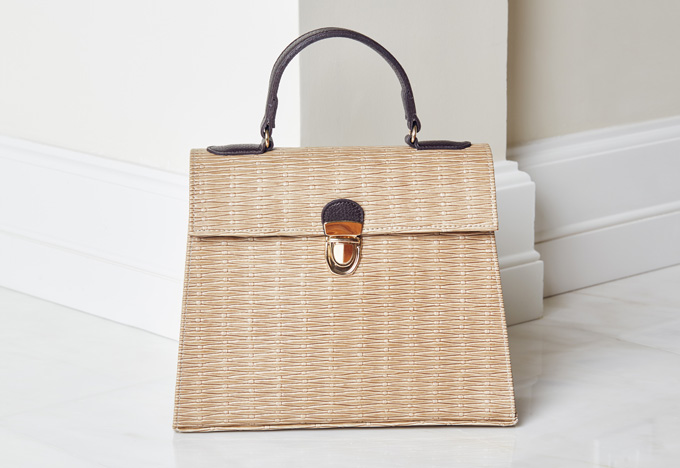
‘This bamboo tote bag is from Own the Looks, a company that my friend owns. Although it isn’t a fancy, luxury bag, it goes with everything, and is one of my go to accessories. It has a vintage, feminine feel, which works well with my style aesthetic.’
‘This Lancôme My Parisian Blush, is a beauty product that I can’t live without. Because it is easy to use, and the packaging is so pretty, I will always carry it around in my handbag. Before I got married, I acted as an ambassador for the brand, testing out their new product launches. During this period, I discovered a lot of great products which were focussed on a flawless base, that I have subsequently incorporated into my beauty regime.’

‘I have a signature look for my make-up routine, then when it is the evening I build up on what I have. For day, I use a normal eyeliner, and then in the evening I go over it with this NYX liquid liner, although if I have done it particularly well one day, then I will sleep in it so it is ready for the following day too! When it comes to lips, I am a big fan of a matt finish, so I particularly love this Armani lipstick, as it is a liquid matt, so nourishes my lips at the same time. Another product which I find super versatile is this Bobbi Brown bronzing powder, it can be used for a healthy glow, and then also for contouring and an eyeshadow.’

‘During the day, I tend to wear a simple flat sandal like these Hermes sliders, as they are both comfortable and stylish. I have this style in a few colours, as I feel they go with everything and give a nice finishing touch to any day outfit.’

‘When it comes to the evening, I will always dress up with a heel, and my go to shoe designers are Christian Louboutin and Gianvito Rossi. This particular pair are from Lodovico Zordanazzo, an Italian designer, and I find that they instantly transform an outfit. I tend to always keep a backup pair like this in my car, so that I am always prepared for anything at the last minute.’

BVLGARI: Italian Extravaganza
A collection that embodies the blues of the Mediterranean, the pinks of a Roman sunset, and the golds of an ancient age, as it captures the colours, light, and expressivity of a very Italian personality.

BVLGARI High Jewellery Diva Necklace, detachable in bracelet, in Pink Gold with Coral, and Diamonds (15.62ct)
BVLGARI High Jewellery Diva Earrings in Pink Gold with Coral and Diamonds (1.73ct)
Dress, Roland Mouret

LEFT IMAGE:
BVLGARI High Jewellery Necklace in Pink Gold with Spinels (27.94 ct), Peridots (310.40 ct), Amethysts (58.16 ct) and Diamonds (13.41 ct)
BVLGARI High Jewellery Earrings in Pink Gold with Spinels (7.12 ct), Amethysts, Peridots (60.20 ct) and Diamonds (1.64 ct)
Dress, Roland Mouret
RIGHT IMAGE:
BVLGARI High Jewellery Parentesi Necklace in Pink Gold with Diamonds (41.47 ct)
BVLGARI High Jewellery Parentesi Ring in Pink Gold with Diamonds (1.79 ct)
Top, Tibi at By Symphony

LEFT IMAGE:
BVLGARI High Jewellery DIVA Earrings in White Gold with Diamonds (4.90 ct)
BVLGARI High Jewellery DIVA Bracelet in White Gold with Emeralds (7.56 ct), Rubies (5.48 ct), Blue Sapphires (5.25 ct), Amethyst (4.64 ct), and Diamonds (15.62 ct)
Top, Roland Mouret
RIGHT IMAGE:
BVLGARI High Jewellery Colour Treasures Earrings in Pink Gold with Amethyst (6.45 ct), Citrine (6.58 ct), Peridot (7.49 ct), Pink Tourmaline (6.99 ct) and Diamonds (0.21 ct)
BVLGARI High Jewellery Colour Treasures Ring in Pink Gold set with Mother of Pearl elements with Peridot (16.32 ct) and Diamonds (1.12 ct)
Top, Tibi at By Symphony

BVLGARI High Jewellery Colour Treasures Necklace in Pink Gold with Akoya cultured Pearls, Amethysts (324.30 ct), Pink Tourmalines (29.35 ct) and Diamonds (5.04 ct)
BVLGARI High Jewellery Colour Treasures Earrings in Yellow and Pink Gold with Amethysts (38.36 ct), Rubellites (4.90 ct), Amethysts (19.21 ct) and Diamonds (1.38 ct)
Dress, Roland Mouret

LEFT IMAGE:
BVLGARI High Jewellery Giardini Italiani Ring in White Gold with Emeralds (2.86 ct) and Diamonds (1.8 ct)
BVLGARI High Jewellery Sautoir in White Gold with Akoya cultured Pearls, Emeralds (19.96 ct), and Diamonds (8.00 ct)
Top, Tibi at By Symphony
RIGHT IMAGE:
BVLGARI High Jewellery Serpenti Necklace in White Gold with Emeralds (1.34 ct), and Diamonds (15.30 ct)
BVLGARI High Jewellery Serpenti Earrings in White Gold with Emeralds (0.56 ct) and Diamonds (3.03 ct)
Top, Tibi at By Symphony
Photographer : Adam Balcerek
Fashion Director : Eliza Scarborough
Hair and Make-up : Hedi Kalmar
Model : Victoriya at MMG
Location : The Address Montgomerie Dubai
Van Cleef & Arpels: A Refined Association of Materials
An icon of Van Cleef & Arpels, the Alhambra collection has taken on an elegant range of interpretations since 1968, lending itself to a rich variety of materials and occasions. To celebrate the auspices of luck, the Special Edition Alhambra is adorned with lilac Sèvres porcelain for the first time. The gentle, feminine shade of lilac symbolises Spring’s purity and renewal, whilst complimented with class tones of yellow gold to bring a note of tenderness to this piece.

Vintage Alhambra 20-motif long necklace, Dubai Mall special edition, yellow gold, mauve Sèvres porcelain and diamonds, Vintage Alhambra 5-motif bracelet, yellow gold, diamonds joined with Vintage Alhambra 10-motif necklace, yellow gold, diamonds, Magic Alhambra earrings, yellow gold, diamonds, Vintage Alhambra ring, yellow gold, diamonds
• Dress, Lana Mueller

LEFT IMAGE:
Vintage Alhambra 10-motif necklace, yellow gold, diamonds, Magic Alhambra earrings, yellow gold, diamonds, Perlée ring, yellow gold, diamonds, 2 Perlée bracelets, yellow gold, diamonds
• Dress, Roland Mouret
RIGHT IMAGE:
Magic Alhambra earrings, yellow gold, diamonds, Perlée ring, yellow gold, diamonds, 2 Perlée bracelets, yellow gold, diamonds, Perlée clover bracelet, yellow gold, diamonds
• Dress, Lana Mueller

Vintage Alhambra 20-motif long necklace, Dubai Mall special edition, yellow gold, mauve Sèvres porcelain and diamonds, Vintage Alhambra 10-motif necklace, yellow gold, diamonds, Vintage Alhambra earrings, yellow gold, diamonds, Vintage Alhambra ring, yellow gold, diamonds
• Dress, Andrew GN at By Symphony

LEFT IMAGE:
Vintage Alhambra 5-motif bracelet, yellow gold, diamonds, Magic Alhambra earrings, yellow gold, diamonds, Vintage Alhambra ring, yellow gold, diamonds, Vintage Alhambra 20-motif long necklace, Dubai Mall special edition, yellow gold, mauve Sèvres porcelain and diamonds
• Dress, Roland Mouret
RIGHT IMAGE:
Magic Alhambra earrings, yellow gold, diamonds, Vintage Alhambra 10-motif necklace, yellow gold, diamonds, Perlée ring, yellow gold, diamonds
• Dress, Temperley London

LEFT IMAGE:
Perlée clover bracelet, yellow gold, diamonds, 2 Perlée Bracelet yellow gold, diamonds, Vintage Alhambra ring, yellow gold, diamonds, Perlée ring, yellow gold, diamonds, Vintage Alhambra 10-motif necklace, yellow gold, diamonds joined with Vintage Alhambra 5-motif bracelet, yellow gold, diamonds
• Dress, Rami al Ali
RIGHT IMAGE:
Vintage Alhambra earrings, yellow gold, diamonds, Perlée ring, yellow gold, diamonds, Vintage Alhambra 20-motif long necklace, Dubai Mall special edition, yellow gold, mauve, Sèvres porcelain and diamonds
• Top, Roland Mouret
Photographer : Adam Balcerek
Fashion Director : Eliza Scarborough
Hair : Adam Garland
Make-up : Hedi Kalmar
Model : Angelika at MMG
Location : Nikki Beach Resort & Spa
Dior Jewellery: Botanical Beauties
A tribute to Christian Dior’s passion for nature, and the garden where he would retreat.

‘Gourmande Pastel’ earrings and ring. All by Dior Fine Jewellery

LEFT IMAGE: ‘Angolia’ earrings and ring
RIGHT IMAGE: ‘Pre Catelan’ rings
All by Dior Fine Jewellery

‘Egratigna Angelique’ ring. By Dior Fine Jewellery

LEFT IMAGE: ‘Diorette’ ring
RIGHT IMAGE: ‘Bagatelle’ necklace and ring
All by Dior Fine Jewellery

LEFT IMAGE: ‘Epinosa’ rings
RIGHT IMAGE: ‘Egratigna Chipie’ earrings and ring
All by Dior Fine Jewellery
Photographer : Lezli and Rose
Fashion Director : Eliza Scarborough
Hair and Make-up : Ian McIntosh at Carol Hayes
Model : Camilla at Models 1
Location : Kew Gardens
All Clothing Dior
Roland Mouret; the man behind the magical art of drapery
London-based, Lourdes-born fashion designer Roland Mouret’s charming demeanour and striking looks have made him a magnet for the fashion elite, but it is his flattering and feminine designs that have put his name on the map. The dresses have become famous in their own right, some known simply by their first names, Galaxy, Moon, Pigalle and Titanium.

Mouret worked his way into the fashion industry, gradually making his way up the ranks as a student, a model for Jean Paul Gaultier, and a fashion stylist for French Glamour. He then decamped to London where he made a living from art directing pop videos, with Kylie Minogue and Bananarama being among his clients, before opening a café and gallery space in London’s Soho and launching a now-defunct streetwear brand called People Corporation.
Mouret, the son of a butcher, cites his father’s work apron as the first fabric he learnt to deal with, playing with the square of fabric to get it to fit the body. Although it wasn’t until 1997 when these skills were showcased, and he set up his own fashion label with 15 one-off, handmade pieces that he had created by pinning cloth directly on to a tailor’s dummy. Cue the Galaxy dress which was introduced in his Spring 2006 collection and first worn by Scarlett Johansson and Dita Von Teese, then by Cameron Diaz, Sienna Miller, Naomi Watts, Rachel Weisz and every other red-carpet starlet who fell in love with the frock’s old-fashioned glamour. However, the relationship with his backers came to a grinding halt and a split was announced, just 2 months after the frock with its superstar status was created, citing managerial differences. Unfortunately, Mouret had signed a deal that compromised his rights, and even the ownership of his name, yet as he was still contracted to the company he continued designing his iconic hits.
When he was eventually released from his contract in 2005, Mouret took a two-year hiatus, only returning when he found a new backer in Simon Fuller, the man behind the Spice Girls and the Pop Idol phenomenon, forming the company 19RM. The launch in 2007 was designed as a global interactive event and featured 21 ‘easy-chic’, geometric dresses which were available to purchase online the day after, making him a pioneer of the now popular ‘See Now, Buy Now’ trend.
Fast-forward to today and Mouret has bought back the rights to his own name and there are a host of new high-profile fans, including the future Queen of England, the Duchess of Cambridge. There are also shoes, bags and a bridal collection. Conjuring curves in all the right places, there is no denying the allure of the Frenchman’s frocks, so we chat to him about what inspires these skills and the tumultuous time he has had over the years.

When did you first realise that you wanted to be a fashion designer?
I was the son of a butcher, and I used to watch him fold his apron in ways to hide the blood. I learned my technique from watching him, and developed it into what I do today.
What is the secret to a successful label?
I think some of it has to do with listening to my customers, and taking her needs into consideration during the design process. The women who wear my pieces are the ones that take it from sexy to sophisticated and elegant. Being a designer, my tools are to elevate a woman’s confidence, she brings the pieces to life.
Who is the Roland Mouret woman?
She is constantly on the move, and requires a wardrobe to take her from place to place. The reason separates are so important in my collections are because it allows her to interpret and reinterpret her look, without compromising her style.
What drives you and keeps you inspired over the years?
Confidence inspires me, it is the foundation of all my work. I want the woman I design for to feel this, walk with confidence and have the reassurance that they are wearing something in tune with their lives.
Why do you choose to drape rather than sketch?
For me, draping directly onto the female form is the only way to fully understand the potential of the silhouette. When something is three-dimensional it has life, it has movement and that is the most important quality for me.
How has the fashion industry changed since you started?
Fashion, like life, is an evolutionary process. It goes onwards, and you can look to the past to better understand the future. The sands are shifting more and more, and where they settle, no one truly knows.
What are your career highlights so far?
Nothing will ever top the feeling of your first red carpet moment. It was with Scarlett Johansson and she wore a peachy coloured gown with an essence of Marilyn Monroe. It was to the 2005 Golden Globes.
Who have you been most excited to see wearing your clothes?
Every actress and woman who has worn my designs have given me so much pleasure. However, I will always cherish the Demi Moore moment, who was the first to wear the Galaxy dress in LA. She took the dress and made it her own, styling it with a long strand of pearls. It was at that moment when I realised what an ‘icon’ was.
How do you feel about the constant focus on your hero Galaxy dress?
The Galaxy dress is a dress for all women, which is how it should be. I designed it with the gift of confidence and it has stood the test of time, today I am happy to see it as my house’s icon.

Why set up your atelier in London as opposed to Paris?
London will always be my creative home. After all these years, I feel as though I am on the set of a movie, with the grandeur of architecture, and the rich history. It’s a melting pot of the best of the world’s cultures.
What is your secret to switching off and relaxing?
Aside from Roland Mouret the designer, I live a quiet and private life in the English countryside with my family, walking my dog, and pottering around in my garden.
How would you describe your own personal style?
Black shirts and khaki trousers take me from day to night.
If you could give one piece of style advice to a woman, what would it be?
It’s all in the attitude.
By Eliza Scarborough
Christian Dior Couture: Flowers
The labyrinth, irregular, almost impenetrable, like a secret garden, is the image that inspired Maria Grazia Chiuri’s first Haute Couture collection for the House of Dior. The result is evening dresses in changeant and powdery colours which evoke the passing of the seasons and of life itself, and whose layers of tulle trap exquisite flowers. This voyage is guided by a desire for beauty, where losing oneself is a necessary step to challenging oneself and evolving. And so, for the finale, Maria Grazia Chiuri imagined a splendid ball straight out of a fairy tale.

Sidera
Powder pink tulle draped dress over gem-embroidered jumpsuit.
Cecil Beaton coronet of ostrich spines.

Jardin Fleuri
Sage green tulle bustier dress with feather embroidery.
Herbacious fontange in silk flowers.

LEFT TO RIGHT:
New Junon
Pastel fan-pleated tulle dress. Angry black swallow.
Brise de Mémoires
Pleated tulle dress with herbal-inspired embroidery. Fête Champêtre garland.
Essence d’Herbier
Ecru fringe cocktail dress. Hedgerow headdress.
Souvenir d’Automne
Tulle ball gown embroidered with autumnal symbols. Hurricane of tulle leaves.

LEFT TO RIGHT:
Transformation Sublime
Black suit jacket with slit and pleated pant. Fly mask in crinoline.
Thésée
Satin architectural tailored topcoat and inverted-pleat pant. Dragonfly mask in crinoline.
Leonor
Black wool frock coat. Raven mask.

LEFT TO RIGHT:
Renaissance
Greige tulle dress embroidered with silver branches. Tiara in feathers.
Tyche
Almond green silk tulle dress with clover embroidery. Diorissimo bouquet in silk flowers.

Brise de Mémoires
Pleated tulle dress with herbal-inspired embroidery. Fête Champêtre garland.
Photographer: Tierney Gearon for Dior
SS17: The A-Z of Your New Season Style
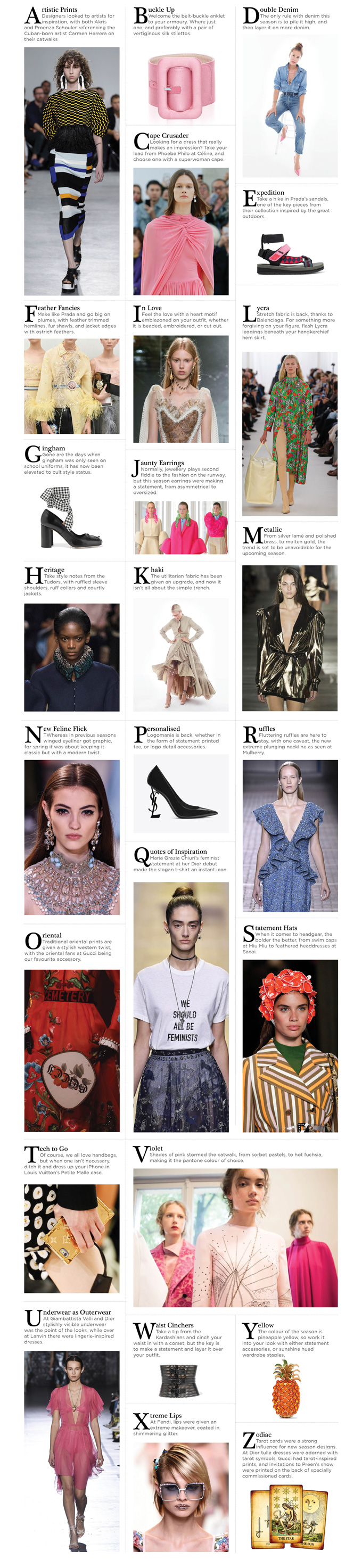
Follow our comprehensive guide to make sure you have your look down from A-Z for the upcoming season. From birds of a feather to tarot cards, this definitive list covers everything you need to know to keep on trend for Spring Summer 2017.

By Eliza Scarborough
How to Reboot Your Grooming Regime
It’s time to upgrade your daily routine and give your skin and hair a fresh start. Read on to find out how to reboot your grooming regime.

There is a myth, that a person can become immune to products with regular use, and although it isn’t technically possible, it can certainly feel as though you’ve built a tolerance over time. This may be partly psychological, but more to do with the ever-changing needs of your skin and hair. The solution to this is rotating your products every couple of months, to not only allow you to re-evaluate your existing regime, but also assist skin and hair renewal because different products trigger different cellular mechanisms. Here we break it down, to give you a comprehensive guide for how to re-jig your regime, and the best products to substitute your old favourites.

By Eliza Scarborough
Johnny Coca: Mulberry’s Creative Director on his vision for the future
British brand Mulberry’s Creative Director on his vision for the future, and what he loves most about designing for the iconic English label.

Coca made his debut for Mulberry in February 2016 with his AW16 collection to much positivity, and what a difference a year made. At the start of March 2015, the luxury British brand was without a CEO, had yet to appoint a creative director, and the most recent headlines were regarding its ill-fated price increase under former CEO Bruno Guillon, and its absence from the London Fashion Week schedule. Fast forward to 2017 and the house has the buzz about it that it did in the early 2010s, now that the Coca effect has started to take hold.
Over the years, Mulberry has become synonymous with British cool girls, from Alexa Chung, who collaborated with the brand on the famous ‘Alexa’ bag, to Kate Moss. With plenty of iconic styles, the Bayswater was one of the It-bags of the early 2000s, the label knows exactly how to deliver classic British heritage with a dose of fashion. And since Creative Director and Céline alumni Johnny Coca has taken over the helm, he is quietly but surely reinvigorating the house with a bold new flavour.
The Seville-born, Paris-London native, is instantly recognisable by his Elvis-style quiff, hoop earrings and extensive collection of kilts. If he is not wearing this Gaelic uniform, it’s a pinstripe suit and chunky white trainers. Given his exuberant dress sense, he could be seen as an unlikely character to helm one of Britain’s most traditional labels. However, Coca’s outlook and understanding of the industry could only come from someone who has been waiting in the wings for years. His pedigree can be proved through an education in art, architecture, and design at the École National des Beaux-Arts and École Boulle in Paris, before successful stints at Celine, which saw him create the most financially successful bags for years, as well as Bally and Louis Vuitton.
Johnny Coca has a vision to make Mulberry feel British again, whilst designing relevant, modern products, and here he talks to us about his Spring Summer 2017 collection, which was inspired by traditional school uniform stripes and Land Girl outfits spun into feminine dresses with bold ruffles. Together with this, he shares how the heritage of the brand is paramount, which is particularly clear in his choice to revive the Mulberry brand logo, through digging deep into the archives and reinstating an original font the brand used in the Seventies.
What is the inspiration behind your Spring Summer 2017 collection?
Everything comes from the idea of the school uniform with the plaza stripe, and what I like about the British structure. Uniforms are something very British, and when I first started working in London, I was struck by the beautifully dressed children, and not so well dressed students on their way to class. I also loved the way the older children kind of messed with the rules and played with the outfits to make them edgier, twisting something very traditional to make it look modern. I went to different suppliers in the UK to find the classic stripe blazer in strong colours for this first part of the show, and for the second part of the show I worked with paisley print. This was juxtaposed on very classic British colours of navy and white, with large oversized ruffles, and embroidered for an added sense of luxury. I also played with oversized shirts, a bit like different students from different schools swapping shirts at the end of the day, to mix them up for a cool look.
Did you have any specific muse in mind when designing the collection?
I don’t know if it is because I am Spanish, but I like the flamenco style, and big ruffles. I designed for a girl in Spain who loves this feminine volume, and these dresses are designed to give her comfort and freedom. The idea is to have something very British, but bring something personal from my culture.
Can you tell us about how you worked with the accessories for this collection?
For the new season I like the diversity of the shape, and I like to play with the construction and proportion, making it quite cool and unisex. The key style, the box bag is inspired by a child’s lunch box, the shape is modern and easy, and will bring something quite special to an outfit.

What do you feel women are looking for these days in fashion?
I think it is more a question of desire and uniqueness. The consumer is looking for special and unique pieces, that are also functional and easy to wear. They need to be classic to be relevant, as something that is too much is not easy to wear, and I like it when people can use a product for a long time.
When are you at your best when you are designing?
I think it is nice when you are outside seeing the world. I am designing for women, not for myself, so I like to sit on a terrace and see different girls walk by. By watching this I can appreciate that they are all different, helping me to project something that will work for different people.
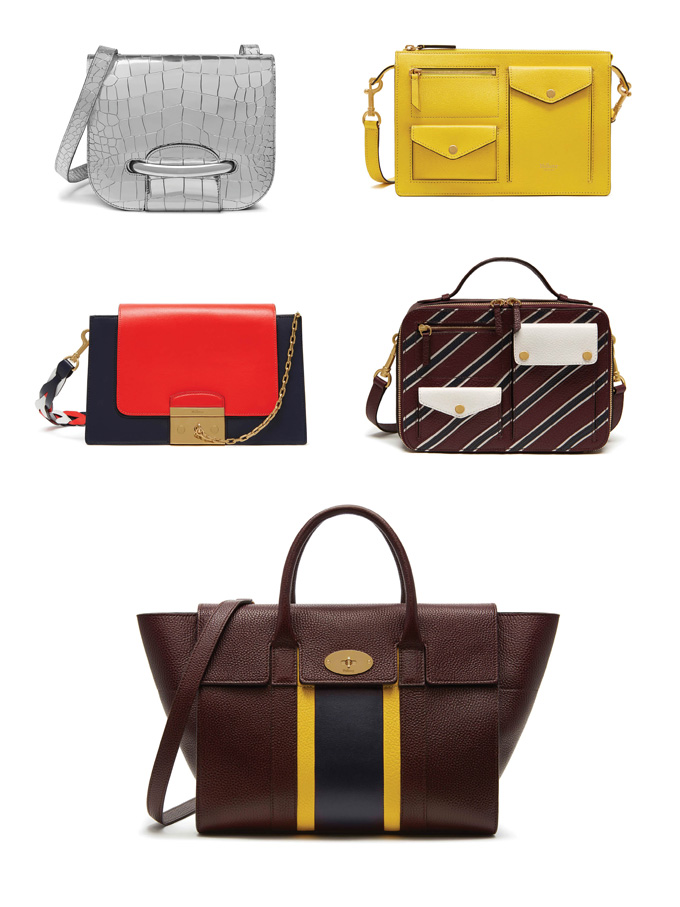
Can you describe to us your typical day?
I wake up and have my lemon juice, take a walk in the park, and then start to organise my meetings. I prefer not to follow a strict regime, and be relaxed, living in the moment. I think it is important to have fun and pleasure, following your instinct and listening to people, to be able to create something special, different, and unexpected.
As we meet here at Spring Summer fashion week, have you been following the other shows, and did any catch your attention in particular?
I think what is important to me, is when people bring a strong sense of attitude, and I love to see this, together with the novelties that each brand creates. This season I have enjoyed seeing what is happening at Dior, due to the current changes in creative leadership, and I particularly appreciated the white and embroidery in the collection, and how it kept the sense of something very feminine and sophisticated.
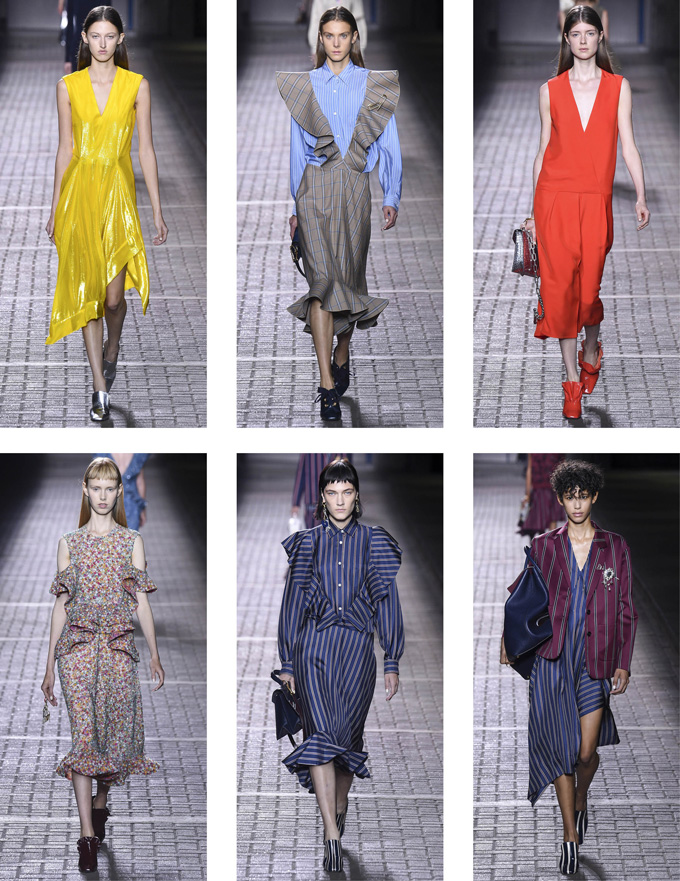
We are now seeing a lot of fashion shows combining men’s and womenswear, what are your thoughts of this new message?
I understand that for the press it certainly is a positive, as they are travelling a huge amount and perhaps this gives them more time. It also allows more consistency and a stronger message through the men and women combined, making them feel like a couple, therefore helping you to understand the connection when they are in the same show.
Do you follow Loewe, especially due to your shared Spanish heritage?
Yes, firstly because I am Spanish, and also because I really appreciate what Jonathan Anderson is doing for the brand, bringing together something quite modern and new, artistic, and crafty. Sometimes it may not be so easy to wear, but they have all the product to provoke interest, and bring something unique and unexpected in terms of communication and product. Another brand I appreciate is Bottega Veneta for their sophisticated, conservative approach, and care for heritage. I love how they work with the leather goods, and the crafts they have.
What are your views on the fashion world in the Middle East?
I am really pleased, because the women in the Middle East have really changed their mentality and the way they approach fashion, becoming more open. They understand what is modern and will take a lot of risks compared to other countries. They are very strong, sophisticated, and glamorous, and what I design I can imagine fitting well in the region.
What is your personal motto?
Make your days playful and fun.
How would you best sum up Mulberry?
Honest and British.
By Lara Mansour Sawaya
Angelina Jolie; Guerlain’s New Muse

You are a mother, a wife, an academy award-winning actress, a filmmaker, and Special Envoy for the United Nations High Commissioner for Refugees but, so far, you have never been the face of a fragrance brand. What drove the accomplished woman that you are to become the face of the new Guerlain fragrance?
I was very open to Guerlain because it was a brand my mother loved, and that I knew from my childhood. It spoke to her, as it does to me, of beauty, history, and quality, the oldest perfume house in the world, from France, a country I love and feel to connected to and spend time in. As I talked to Guerlain about the artistry they devote to the making of the perfume, and the way they work in communities, sourcing their ingredients, the pieces came together and I felt we were a match.
Can you tell us the story about your mother and the powder called Ladies in All Climates that she used?
My mother was a very natural woman. She never spoiled herself, never wore makeup, and wore modest jewellery, but she always had a few special items for when she wanted to feel like a lady. One of those special items, and I remember it because it seemed so elegant, was her Guerlain powder. I think it speaks of all women having those few special things that make them feel feminine, so when I was a little girl, I would associate Guerlain with that.

What did you like about Mon Guerlain?
I love the lavender and jasmine mixed with the sandalwood. I don’t like perfumes that are too strong or sweet. I like a fragrance that is earthy and sensual and can be worn at any time. I do remember that the day I met Laurent in Cambodia, I don’t think I had ever been more dirty or smelt more unappealing. We met while I was directing First They Killed My Father, after a day on set in the field, and I reeked of dirt and bug spray. We had a really good laugh trying to decipher the different scents and subtleties of the different notes within the perfume, all the while competing with my jungle-strength bug spray.
Throughout your career as an actress you have played many different types of women. How do you define femininity?
I think it is personal to every woman. So many women I know are so completely different from each other. My daughters are. There is no simple description. It is that mystery and diversity. But I suppose femininity is that softer side of ourselves, that we all like to indulge at times.
Why was it important to you to shoot the commercial in the South of France?
It felt natural. It is a region we love in my family and that we have a history with, and it is where Guerlain sources many of their ingredients, including the lavender in Mon Guerlain.
The very next day you gave a speech at the UN Peacekeeping Defence Ministerial in London and the day after you travelled with UNHCR to the Azraq refugee camp in Jordan. How do you deal with all your roles?
As it has been in my life for many years, one feeds the other. It is a joy to be an artist but it doesn’t mean very much unless that work is somehow useful in some way and contributes to others. I am very fortunate that I have the ability to be able to do creative work, that can in turn fund development programs and help other people, because just being creative or just making money adds up to a very empty life if it has no purpose.

Guerlain controls its raw material supply process as part of its commitment to sustainable development. Is this something that matters to you?
Yes of course, it matters to me very much. I discussed this with Guerlain at length and I did check on the company and their commitment to sustainable development before agreeing to work with them. I am impressed by their strong sense of responsibility towards the communities they work with and towards the environment.
You have donated your entire salary from the endorsement campaign to charity. Can you please tell us about the work of your foundation?
Its work is inspired by our children, and their connections to particular countries. We visit the projects together, and the foundation is growing with them. It is dedicated to education, health, and the environment. It began 13 years ago with a TB program in Cambodia, which grew into a program in Ethiopia treating and rehabilitating children and teens with TB. In Namibia, our major focus is on conservation and education, funding a wildlife sanctuary, animal rescue program, and healthcare and education for local communities. We are gradually expanding but our focus is very much on enabling local people to develop their own communities and future as well as on rights, particularly for women and children.
Accessories Edit: The best of spring-summer’s delectable bags and shoes
Embrace spring in the happiest and chicest way, with pretty pastels. There has been an abundance of accessories, from sorbet shades of lemon and lilac, to mint green and of course sugary sweet pink.

Bulgari Serpenti Forever Bag with Scaglie beads in Fire Opal & White Agate colour calf leather

LEFT IMAGE: Fendi By The Way with Strap You
RIGHT IMAGE: Christian Louboutin, So Kate Patent Petale

LEFT IMAGE: Anya Hindmarch Maxi Featherweight Ebury bag
RIGHT IMAGE: Fendi Micro Peekaboo bags
Fashion Director : Eliza Scarborough
Photographer : Henry Pascual
Le Royal Monceau Raffles Paris: Member of the Leading Hotels of the World
Parisian hotel transformed by Philippe Starck

On the avenue between the Arc de Triomphe and Parc Monceau, grand Royal Monceau was reborn after a Philippe Starck makeover as a self-proclaimed luxury art hotel. It all started with the desire to remodel the classic codes of luxury hotels and project them into a new dimension. But the project also derives from an affirmation of a slightly insane, infinitely poetic determination to break with custom, to steer clear of the apparently inevitable, to welcome the unusual, and to declare a tenderness for panache and impertinence, for fantasy and excess, while still cherishing rigour and perfection.
Style
The hotel is a combination of both decadence and modernity, with exposed brickwork, plush carpets and iron railings. It’s at its best downstairs in the public spaces, the lounge stretches endlessly mixing vistas and secluded corners, with illuminated Long Bar, and a cascade of chandeliers in the stairwell. The concept store, art gallery, bookshop and private cinema show how the hotel has branched out into an overall lifestyle concept.

Rooms
The 149 rooms and suites are far from designer minimalism, rather, a Starck-conceived artistic clutter of eclectic lamps and tables, mixing retro and contemporary touches, with a vast island bed, photos and artworks propped against the wall and a guitar for you to strum. There’s even a transportable recording studio if you wish. Bathrooms are lined with mirrors and crammed with Clarins miniatures.

Privé
Behind a discreet entrance on the chic avenue Hoche, next to Le Royal Monceau, is a collection of heavenly suites, including three spectacular 350sqm Presidential Suites. Each one is designed as an exclusive private residence, with levels of service worthy of a great private house. Set over five floors, these beautifully sophisticated, flexible suites offer their guests not only the services of the hotel, but also private and secure entry through 41 avenue Hoche, and direct access to the hotel’s idyllic spa. The largest suites also have a private hammam and gym, and a home cinema with next-generation technology.
Food & Drink
Cocktails and chic tapas at the Long Bar have become a hot Parisian destination, and there’s a members-only enclosed red Fumoir for cigar smokers. The two restaurants have each gained one Michelin star. It’s French cuisine from recent arrival Hans Zahner at La Cuisine with its mega lamps and painted ceiling, and Tuscan specialities from Roberto Rispoli at the shell-grotto style Il Carpaccio trattoria, with Sicilian baroque decor in a conservatory overlooking the garden.

Spa
The spa is home to the city’s biggest indoor pool, at 23m long, with mirrors covering one wall and a soothing shade of white everywhere else. The treatments are in Spa My Blend by Clarins, and offer a unique haven of peace and relaxation in the heart of Paris.

Le Royal Monceau Raffles Paris is a member of The Leading Hotels of the World, a collection of authentic and uncommon luxury hotels. Rooted in the locations where they are found, the hotels embody the very essence of their destinations. Offering varied styles of architecture and design, and immersive cultural experiences delivered by passionate people, LHW’s collection is for the curious traveller looking for their next discovery. Established in 1928 by several influential and forward-thinking European hoteliers, Leading Hotels has an eight decade-long commitment to providing remarkable travel experiences.
A. Lange & Söhne Tone on Tone: two new models of Saxonia Automatic
A. Lange & Söhne presents two new models of the Saxonia Automatic with terra-brown dials. They are the first members of the Saxonia family to feature this elegant hue, in both pink-gold and white-gold versions. The timeless earthen hue is flexibly combinable and always looks natural.

Both elegant self-winding models have 38.5-millimetre cases. Colour-coordinated, hand-stitched alligator leather straps in red brown and dark brown emphasise the graceful overall personality of these watches. The solid-gold hands and hour markers match the case colours and underscore their prominent design.
The Lange L086.1 self-winding calibre, merely 3.7 millimetres high, beats inside these models. It has a maximum power reserve of 72 hours and features brand-typical quality hallmarks such as the balance cock with free-hand decorative engraving. A central rotor suspended in ball bearings and a platinum centrifugal mass are among the assets of the manufactory-made movement. As all other Lange models, the Saxonia Automatic is assembled a second time, after the individual calibre components have been lavishly decorated and polished by hand. This makes each Saxonia Automatic a one-of-a-kind work of art.

