

A Guide to Group Holiday Destinations around the world
Looking for a family-friendly stay or a group party pad? We have handpicked a collection of retreats with to-die-for design and private-home perfection.
Villa Sungai – Bali
Sleeps 10, Bedrooms 5

Far from Bali’s bustling crowds sits Villa Sungai and its romantic little sister, Sungai Gold, two incredibly private and romantic residences that fuse a traditional village experience with five-star luxury to create a bespoke idyll. Combining the pampering service of a hotel with the privacy and freedom of your own home, luxurious Villa Sungai is the stylish way to do Bali. Set in a tranquil country village in the island’s south-west, there is the three-suite main Villa Sungai or its smaller sister the two-bedroom, couple-friendly Sungai Gold, either take just one or both if you are a larger group. Each villa has its own infinity pool, spacious communal areas, airy and elegant interiors with luxurious four-poster beds, and round-the-clock staff. The details are what count though, and Sungai does this in style with free bicycles, GHD hair straighteners, a sunglass-cleaning service, and a chauffeured car on call at all times. Rest, relaxation and a zen outlook are what is on the programme at Villa Sungai as they offer an extensive spa and yoga programme, with a dedicated two-room spa space for massages, body scrubs, and a range of beauty treatments. Further afield, staff can organise village tours, visits to markets, shopping for sarongs and fabrics in local town Kediri or a trip to an elephant park.

Hawksbill – Turks and Caicos
Sleeps 16, Bedrooms 8

Hawksbill is located in the coveted Grace Bay area of Turks and Caicos and is spread across a number of separate buildings and designed as a multigenerational retreat. The grounds feature a swimming pool, hot tub, a fire pit and an extensive stone terrace. There’s also a gym, basketball and a tennis court near the entrance to the property. The main house, which showcases a contemporary Caribbean design and high vaulted ceiling, accommodates an open plan living and dining area and the master suite, with plenty of natural light flooding in through the windows. On the opposite side of the pool is a stand alone suite for ultimate privacy, and behind the main house is an elevated two bedroom guest house with its own kitchen.

The Backstage Loft – Zermatt
Sleeps 10, Bedrooms 5

Gorgeous modern interiors are matched only by stunning mountain views at The Backstage Loft. Fusing the wooden beams of a 700-year-old chalet with the glass walls of a modern mountain lodge, this chalet is a masterful pairing of old and new filled with beautifully designed custom furnishings. There is heated ski and gear storage, an exercise room and private hammam, and even an indoor-outdoor hot tub with views of the Swiss Alps. For evening there is an ingenious dining table that can be lowered for a meal, then raised to make floor space for after-dinner drinks and dancing.

Peaceful Waters -Lake Tahoe
Sleeps 14, Bedrooms 6

Lake Tahoe is a natural wonderland between California and Nevada, and Peaceful Waters is situated right on the lake’s beachfront. Rich textures of wood populate every corner of the home, contributing to the quintessential log cabin feeling. With almost unlimited activity options for any season, you can enjoy water sports and winter sports, bike trails and nightlife. Slip into the outdoor hot tub for a relaxing soak after an energetic day on the mountain, followed by a barbeque around the fire pit. The private boat ramp gives you the option to bring along your boat and explore the lake at your own pace.

Napili Cove – Maui
Sleeps 16, Bedrooms 9

Luxury villa Casa Duquesa is set in 150 acres of elegantly manicured grounds, guaranteeing the utmost privacy. The fully staffed 17th-century Spanish villa in the countryside also has its own private chapel. Aside from sprawling grounds, there’s a lavish pool area set away from the main villa, with an outdoor kitchen, bathroom, lounging terrace and dining area. The villa has been restored to its former opulence, and is equipped with all the modern accoutrements you could possibly need, including space to land a helicopter. Casa Duquesa has generously sized rooms with an array of communal spaces to choose from for socialising and sundowners, meaning you can have some private time away from the group as well.

Per Aquum Desert Palm – Dubai
Sleeps 6, Bedrooms 3

Celebrating everything horse-related, this is a hotel, riding school and polo venue rolled into one. Located on a 160-acre estate, a 30-minute drive from Dubai, it offers guests an opportunity to escape the metropolis without having to venture into the desert. The style of the main retreat is Spanish hacienda meets country club, with a giant statue of a horse’s head in the outer courtyard and an infinity pool. The villa itself is surrounded by a walled garden and is centred around an open-air courtyard with a swimming pool, while the rooftop terrace overlooks the main polo field. There is also a barbecue with a private chef available on request, and in the bathrooms, you’ll find Ren and Eminence Organic toiletries, together with a menu of bath salts.

Tagomago Private Island – Tagomago Island, Ibiza
Sleeps 10, Bedrooms 5

Enjoy both the nightlife and scenery of Ibiza at Tagomago Private Island. Just a short boat ride from the famed beaches and clubs, the island is a private paradise with beautiful rolling hills and panoramic sea views. Fold-back glass doors hung with gauzy white drapes give the open-plan living areas a breezy, relaxed feel, not to mention beautiful sea views. The contemporary five-bedroom villa is ideal for basking in the sun on the terrace and paddling in the saltwater pool during the day, to al fresco barbecues and star gazing in the evening.

Lions and tigers takeover Gucci’s Spring Summer 2017 campaign

Over a year and a half in and eleven collections down, Alessandro Michele is well and truly in his stride at Gucci. We now know what to expect from the designer, enough colour, print and texture to overload the senses, a combination of references to different time periods, cultures and subcultures, and eccentricity.

This season, the advertising campaign, shot by Glen Luchford, travels to Gucci’s homeland where a collective of artists, intellectuals, creatives, and outsider characters collide in the streets of Rome, celebrating the eccentric, the surreal and the bizarre. Alongside the model line-up that includes new faces Daisy Cvitkovic, Dwight Hoogendijk and the heavily-inked Lorens Miklasevics, wild cats nonchalantly roam the romantic city, a giraffe is fed grapes as they dine al fresco, and lions and tigers are welcomed into their home as they watch TV.

Inspired by generations of intellectuals and artists that considered Rome to be their home town, some by birth, others through cultural adoption, this campaign is a true homage to personalities like Cy Twombly, Mario Schifano and Laura Betti. The result is a series of compelling compositions that champion the unconventional individuals found in the historic city.
Maria Grazia Chiuri Makes a Feminist Statement at Dior Spring Summer 2017
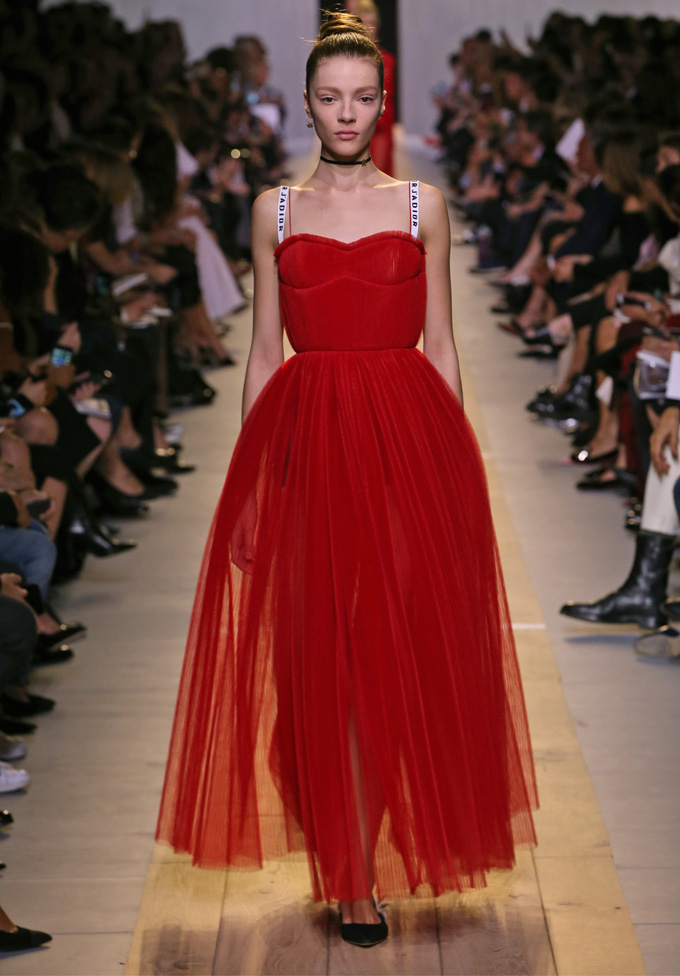
‘We should all be feminists’ read the phrase emblazoned on a T-shirt from the Dior ready-to-wear spring-summer 2017 collection, as Maria Grazia Chiuri made her debut for Christian Dior, the first woman ever to take charge as creative director of this storied house. With the boldness of a manifesto, this inscription is drawn from the title of an essay published in 2014 by Chimamanda Adichie, a writer whose convictions Maria Grazia Chiuri shares.
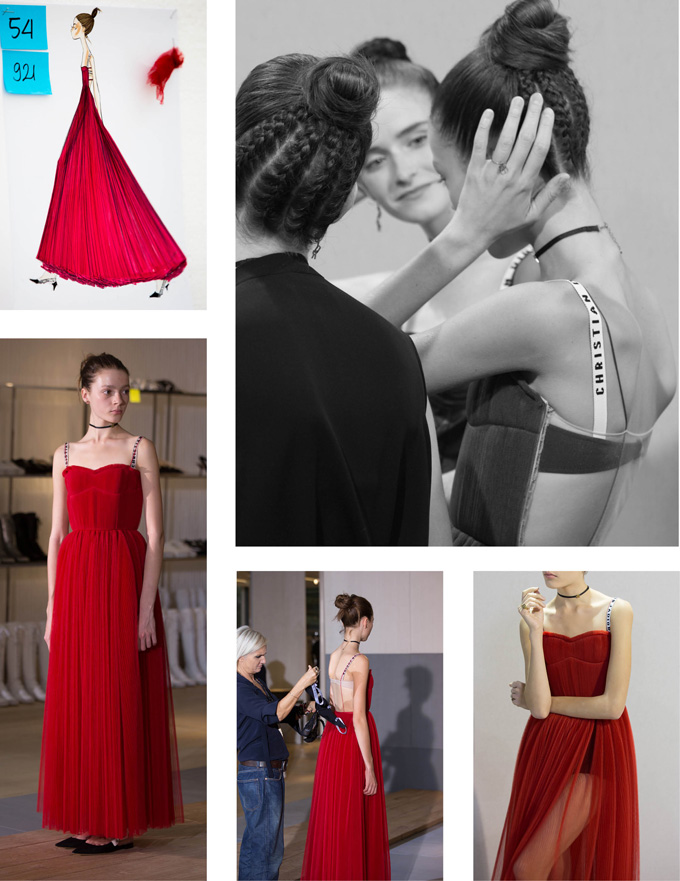
The opening look, worn by shaven-headed Ruth Bell in a white fencing jacket and knickerbockers, was a jolt to anyone who expected Chiuri to start on a romantic note. But as the designer sees it, the art of fencing ‘involves mind and heart at the same time, which women always need if they are to realise themselves.’ Quilted, optic white fencing kits with buckled-on halters moved through the show, worn with a new line of sneakers and knee-length boots decorated with embroidered bees. The bee symbol holds the key to another aspect of Chiuri’s approach, as Hedi Slimane used the bee as a motif while he was at Dior Homme. In the future, Chiuri plans to draw from the work of designers who’ve designed for Dior over the years. ‘Monsieur Dior only lives 10 years. It can’t only be about him!’ she said. ‘In some ways, I see myself as a curator of the house.’

But there were plenty of things, which were pure Maria Grazia in this collection, when she staged the show in the Musée Rodin, trading the floral sets favoured by Raf Simons for a simple one of unstained wooden benches and a wooden runway. Through the line-up, the net dresses, scattered with flowers, leaves, and tiny insects, tulle dresses, delicate lace blouses, and Chiuri’s sumptuously innocent full-length dresses embroidered with tarot card imagery, were reminiscent of the work she did at Valentino.

However, she also remained reverent to Monsieur Dior, working his love of tarot cards with a sprinkling of some of his lucky talismans, such as the number 8, clovers, and hearts, throughout. Highly superstitious and a regular visitor to clairvoyants, the house founder was said to have had his cards read before each show, which explains Chiuri’s finale of ethereal evening dresses with intricate tarot motifs. Together with this she still offered plenty of options for the modern women, and young girls in love with the idea of Dior, with her revival of Dior’s ‘J’adore Dior’ catchphrase, here transformed on heels, straps and chokers straps as, ‘J’adior’.
Raha Moharrak, The story of the first Saudi woman to stand on top of the world

On May 18, 2013, Raha Moharrak made history by becoming the first Saudi and youngest Arab woman to summit Mount Everest, beginning her journey of success, while breaking the norm, challenging herself, her society and culture.
Born in Jeddah, the Dubai-based art director graduated with a Bachelor’s degree in Visual Communications from the American University of Sharjah, before starting a career at a leading advertising agency. From there Raha took a different turn in her career, as her challenges and accomplishments began, and the mountains grew higher, until she achieved the ultimate goal, climbing the world’s biggest mountain.
Raha’s name is synonymous with adventure, as she continuously challenges herself, and consequently her culture. When not climbing mountains on two legs, it’s a challenge on two wheels instead, when last year, Raha learned how to ride a bicycle in order to join Team Shirzanan on a 7-day, 462-mile ride across Iowa, promoting female sports participation as a fundamental right, leading to greater independence and gender equality. The raven-haired mountaineer has also become the face for numerous fashion and beauty projects, recently starring in Burberry’s exclusive Middle East Art of the Trench campaign, together with using her artistic skills to design a limited-edition range of Coca Cola bottles.
Although climbing 8,848 metres may have been the start of the story for this trailblazing woman, her journey of success didn’t stop as she stood at the top of the world, instead the adventurer has strived and succeeded in empowering the next generation of Arab women to follow and achieve their own dreams.
How many mountains have you climbed?
I have completed 14 expeditions. Not all have been summits, with some being hikes and climbs instead.
What inspired you to climb Mount Everest?
I would say that it was not an inspiration, but more of a calling. It was a case of the right thing coming at the right time. I never grew up saying that it was a dream of mine and something that I want to achieve, however I came to discover mountaineering, and loved it. At that point in my life my parents were pushing me towards settling down and finding a husband, however I don’t believe in stopping your life to wait and get married, it should be integrated as part of your life. This was the catalyst for me to decide to do something which would change my families’ mentalities and my own belief in myself. Then one day I heard someone mention Kilimanjaro, and that was when the journey began.
Surely it has all been very physically demanding, did you ever feel like giving up?
No, that is just not a part of the way I am made up, I would never give up. Of course, I sometimes questioned why I was doing it! I would wake up exhausted and hungry, with every part of my body, down to my lashes hurting, smelling like a six-month-old boot. I wouldn’t be able to recognise my own reflection, or who I was, so sometimes I questioned my sanity, but I never felt like giving up. It was my life and I had to continue, and would never want to give up because of something inside. The other factor that drove me was that I was doing something that many people would only be able to dream of.
How did you feel when you reached the summit?
My emotions were like Pandora’s box, I had so many feelings and reactions, but at the top of the list it was disbelief that I felt. I just couldn’t believe that I had achieved this, and so I was there standing on top of the world nearly pinching myself, feeling like I was in a movie. The time I spent at the summit was just short, and for those fourteen minutes or so I was overwhelmed with sheer emotion. That sense of being both very small and very big at that point in time was a daunting realisation. I will always carry that feeling and remind myself of it whenever I doubt myself.
Was it a reflective moment for everything you had achieved in the run up to this ultimate goal?
Yes, but also it set the bar for everything else I wanted to achieve, because now nothing is impossible and I believe that anything is possible. So it wasn’t a time of looking back and being reflective, it made me look forward about what I could achieve next.
How would you define success?
Being happy. There are people who are billionaires and miserable, and others without who are happy, so to be happy with how you live your life, to me is success. I don’t take anything for granted, especially as it is not every day that you can be heard for what you do, which I am very proud of. Although as human beings, I don’t think we ever feel that we have done enough, we always plan and dream ahead, striving to be better.
As the first Saudi woman to climb Mount Everest, a lot of women in the Arab world look up to you. What message do you have for these women?
If a Saudi woman can touch the sky, what makes any of your dreams too far to reach. If I can exist achieving these goals, then I can guarantee to you that others can exist like this too. So, I want others to hear my story and then look at their own dreams and say why not, and understand that anything is possible.

Was it always your goal to give power and strength to the Arab woman and become an icon for female empowerment when you embarked on your first climb up Kilimanjaro?
No, I never thought that I would be an icon in this way. I did feel that we had a void in the market for someone like me, but I never imagined that it could actually be me. The moment I realised that I was this accidental role model was when young girls started to come up to me for advice about their own aspirations and dreams. This happened a few months after I came back from Everest, and the amazing response that I received was overwhelming. However, I also receive negativity about what I have put myself out there doing, including the initial response from my family, but that is also a sign of you being a pioneer. The reality of the situation is that if you don’t have enemies, then you are not making an impact. When the only response you receive is positive, you may be doing something great, but not revolutionary.
How do you compare Kilimanjaro and Everest in terms of hardship and expedition?
The best analogy that I can give, is that it is like the first time you drive a car, and the first time you drive a car in a race. Both are cars, but in one you are inexperienced, whereas in the other you are experienced but it is difficult terrain. Kilimanjaro was my first and a new experience, yet when I came to Everest it was my ninth climb, so although I was experienced, it was still a very difficult mountain to climb.
What have you learned?
I am extremely stubborn, although I would never have admitted it prior to this! I also came to understand that time is only as relative as you make it. If you focus on the negative things then time is slow, whereas feeling positive will make time pass faster. I found this out when I was on the mountain, as ten minutes of laughter is different from ten minutes of tears, so time is what you make of it.
What has been the hardest part of your climbing experiences?
Being away from my comfort zone and family for such a long period of time took its toll. Also, I felt the burden of my family as they had found it hard to let me go, and they were worried about me, which was hard to carry around. Physically it had to be the cold, as growing up in the desert does not make you well equipped for the low temperature.
What has been the most inspiring part?
Seeing all the amazing people who have shared their stories with me.
You recently learnt to ride a bicycle, was this an empowering experience due to the restrictions surrounding it in Saudi Arabia?
In 2013 they lifted the law but it is still not a widely-accepted activity. However, when the opportunity arose for a cycling marathon with a team of Muslim athletes I signed up, naively thinking that I would be able to ride a bike. Prior to the marathon, I spent twenty minutes learning the skill, which meant that although I ended up completing the adventure, the first day took twelve hours, and I spent the whole time clinging onto the handlebars as I couldn’t yet master the balance of the bike. It was an empowering experience for me, as I proved that however old you are, you can always learn something new, and you are not what a stereotype dictates you to be.
Have you always been greeted with positive feedback to all your successful achievements?
No, it has been a hard journey to achieve. Can you imagine any fathers’ reaction when his youngest, unmarried daughter asked to climb the highest mountain in the world, and then consider that he is Saudi. It was a big shock to him. At the start, my family didn’t understand why I wanted to do this, but then they saw my passion, and accepted it.
You have collaborated on fashion and beauty campaigns, this is quite a departure from your climbing, how have your found it?
To be honest, I don’t understand why they chose me, but I am proud to have been included in these collaborations! If you see my social media, I will spend one day in high fashion, and the next day I am in boots and mud, which is a great example of being true to who you are, and not having to choose one side or the other. You can be a combination of athletic, brave, and feminine, which is what I try to embody.
How would you describe your own personal style?
Sometimes I am more fashion over function, yet other times it is the other way around. My rule of thumb would be, if I am above 2000 metres than it is function over fashion, and below that it is all about fashion. I am a chameleon, and adapt depending on my circumstances.
Does your creative side from your graphic design background link with your interest in fashion?
Of course, I have an eye for colour, style, cuts, and patterns. My background in design lends itself to everything, to have a keen eye and be organised. This is key to my climbing, as I always must be extremely organised and well prepared.

Do you feel that fashion is another positive tool for women to convey their personality and independence?
Extremely, as it is very powerful, but it shouldn’t be the sole tool. You shouldn’t define yourself by how you look and dress, as it isn’t the only thing that makes you who you are.
You are currently in the process of writing your memoirs, can you tell us about the book?
It is my story, and is a thank you to my parents for what they have done, as I really feel that they deserve a page in history. Without them I wouldn’t have become who I am and achieved what I have. In essence, it is a story of a Saudi girl who believed she could touch the sky. It goes through the notions of how I started, together with all the backwards and forwards with my family. Yet, it is currently on hold as I want to include a climb that I am planning to accomplish this June, which nearly killed me when I attempted it before.
Was this always something you had aspired to do?
It certainly wasn’t, as I am severely dyslexic, and also very private, so it is nothing I could have imagined I would do. But my father sat me down one day and explained that I should write it down for others to read, as I had changed his mind, and through telling my story I may change other people’s minds.
What is next on your checklist of ambitions?
I have always wanted to go to space. It was my first dream as a child as I love the stars, so I always say that if anyone knows Richard Branson, then please send my CV, as I would go in a heartbeat!
How do you feel the future is looking?
The future is bright, so long as there are people like my mother and father who are aspirational, and the media to keep sharing these stories.
By Eliza Scarborough
Photographer: Vivienne Balla
Hair and Make-up: Marisol Steward
Location: Palazzo Versace
Clothing: By Symphony
When in Rome, Fashion meets Art

Last week I had the pleasure to celebrate with Fendi, “MATRICE”, Fendi’s first exhibition of contemporary art by the legendary Italian artist Giuseppe Penone, which was held at Palazzo della Civilta Italiana, Fendi’s Headquarters.
The exhibition is named after one of Giuseppe Penone’s most spectacular works, Matrice (2015), a 30-metre-long sculpture in which the trunk of a fir tree has been carved out following one of its growth rings, thus bringing to the surface the past of the tree and its transformation in time. A bronze mould has been cast in wood, apparently freezing nature’s flow of life. Like many of Penone’s artworks, Matrice reveals the artist’s interest in the relationship between time and nature, and metaphorically between nature, humankind, and transience.
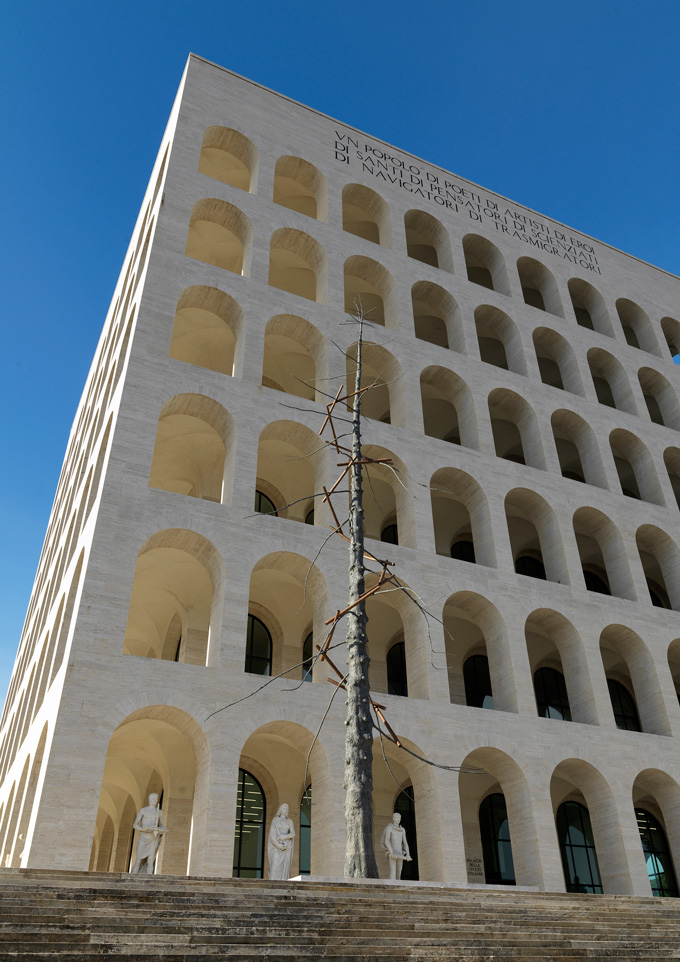
During this occasion, I met Pietro Beccari, Fendi CEO, and had a chat about this collaboration.
How did this collaboration come to life, and why did you choose the artist Giuseppe Penone?
The whole concept originated from the idea that Fendi would donate a major piece of art to the city of Rome, which would be installed in front of our store. In order to ensure that the city would accept this idea, there was a commission that Fendi participated in, together with the Minister of Culture, and the Mayor of Rome, to choose which artist would be the chosen one. We gave a list of artists’ names, with Giuseppe Penone being preferred, but we had to let the independent jury choose. They came to the decision of Penone, who is an artist I have loved and respected forever, so I believe the city is receiving a fantastic gift. Subsequently, we decided to have an exhibition in anticipation of the May installation of the piece of art. In preparation, I went to meet with Penone at his home, and it turned out that we both came from the same small village in Italy, so we spoke the same language in a way, and have a similar sensibility.
Is this collaboration part of your social responsibility?
Yes definitely, and we have done a lot for the city of Rome. Right now, we are sitting in Palazzo della Civilta Italiana, a building which was forgotten and abandoned for 72 years, until Fendi took it over and restored it, turning it into offices, whilst also allowing the ground floor of the building to be left open to the public to house exhibitions celebrating Italian craftsmanship. We restored the Trevi fountains last year, and also Palazzo Fendi, whose ultra-modern design includes details like a cylindrical glass elevator, undulating travertine, and has the opening of the Japanese izakaya-style restaurant Zuma on the rooftop. So, this piece of art is further proof of our dedication to social responsibility and the city, and we hope to associate our name with the city of Rome for years to come.
As the luxury market has become massified, how do you maintain desirability of the brand?
In terms of retail, we have opened our stores in exclusive locations, and we ensure that the product is not massified, so there is a sense of luxury given in the type of artisanal content in the product. Our message is that Fendi is not for everyone, it is for a sophisticated cliental, and we try to achieve this image through the stores, the product, and the operational communications which are beyond the simple pushing of products. Our customer wants to hear nice stories, to share a certain set of values with the brand, and I believe that this will give an appeal to the whole brand, which will have a shadow effect on the products.
What are the challenges that you face today as a luxury brand?
The challenges are the market which is not growing in the way that it was in the past, together with the competition being much fiercer. The lucky ones are the customers, as there is more choice, and more creativity than years before. The product is evolving, and is far more appealing and diverse, giving the customer more choice and better prices. So, our challenge is to be up to speed, as what is good today may not be good tomorrow, and to ride the wave you must always be on the edge of innovations.

What are your near and far objectives for Fendi?
We are very happy with what we have done in the past with Fendi, and in the last five years we came to become one of the most desirable brands in the luxury industry. I believe that Fendi can be more attractive and even bigger in terms of size, so my dream is to keep the market share for competition, and the sophisticated image for the sophisticated customer, ultra-luxury is the way we want to go.
Speaking of desirability, today what is the recipe to create an object of desire?
Luxury for me is a matter of passion and emotion that you can give in a product to a customer. We provide items that people don’t need to live, as you can live without luxury, but they are items that will allow the customer to live better, and will give a sense of satisfaction and an emotion. Luxury today is when you touch a fur, or a product that is handmade and crafted, with an emotion behind it.
What are the projections for Fendi in 2017, and what is in the pipeline for the brand?
Globally we opened in new countries last year, such as Australia, Canada, and Austria, and this year we have big openings in the US, starting with Dallas, then San Francisco, and Soho. Together with these openings, we have also been innovating our stores, and have plans for the store in Dubai Mall. We also just renovated the store in Jeddah, as although the market has slowed in Saudi Arabia, we still see the desirability and demand in the region. The Middle East is a key market for us, so although it may be slowing, we need to think of the long-term plan and the importance of the market to us, which is why we opened the Fendi childrenswear mono-brand store which has recently opened and is a new concept from our architect.
As couture week has just taken place, did you have a chance to see the collections?
Unfortunately I was very limited with time because of this launch. However, I of course saw the Chanel show and talked with Karl Lagerfeld to congratulate him, who was very happy and proud.
Can you describe your personal relationship with social media?
I am watching this phenomenon through my three daughters, but I am not a consumer myself. I have an anonymous Instagram account so that I can follow my daughters and other brands, and I check this every day, so I try to observe more than being a fanatic user myself. My daughters are teaching me new things all the time, as I don’t think my mind is quite formatted in this way of thinking!
What is your personal motto?
I tell myself that if I have everything under control, it is because I am not going fast enough, and I must accelerate.
Can you describe your personal style?
I am very authentic, and as you see me today is how I dress every day.
What is a fact that people don’t know about you?
I was a football player in the second division when I was younger.
What are your hobbies?
I am a good skier and I love trekking, so I can walk with my family for ten or fifteen hours at a time.
If there is one thing you could change within yourself, what would it be?
I would love to live more in the moment, and enjoy what I have done, rather than escaping to the future being afraid of keeping up.
Do you have any regrets?
Yes, probably that I didn’t become a football player!
How would you like this industry to remember you?
Someone with a vision, who brought to reality his ideas.
How would you sum up Fendi?
Unique, because it is combination between sublime craft, and a lot of fun, which makes us very special, as very few people are good at doing both.
As all roads lead to Rome, how would you describe the city?
Rome is a surprise every day, it has the most beautiful light in the world, and is an open-air museum.
By Lara Mansour Sawaya
Get Connected

The digital world is now on your wrist, so what is out there and best for you? We link you up with the smartest watches.

By Eliza Scarborough
New Season Scents
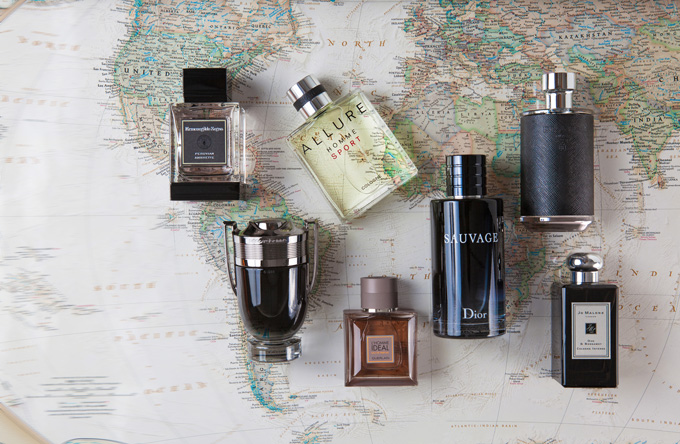
Freshen up your fragrance game, whether it’s a special-edition spin-off, or a designer classic.
LEFT TO RIGHT:
Ermenegildo Zegna Peruvian Ambrette
Paco Rabanne Invictus
Chanel Allure Homme Sport Cologne
Guerlain L’Homme Idéal Eau de Parfum
Christian Dior Sauvage
Prada L’Homme
Jo Malone Oud & Bergamot Cologne Intense
Styling: Eliza Scarborough
Photographer: Henry Pascual
A Guide to Gentlemen’s accessories
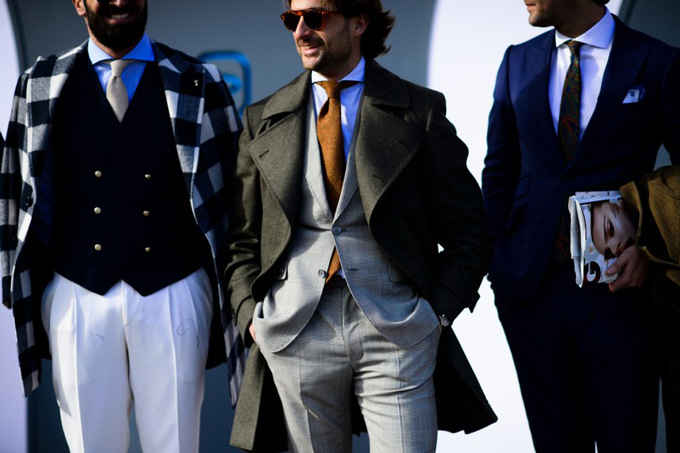
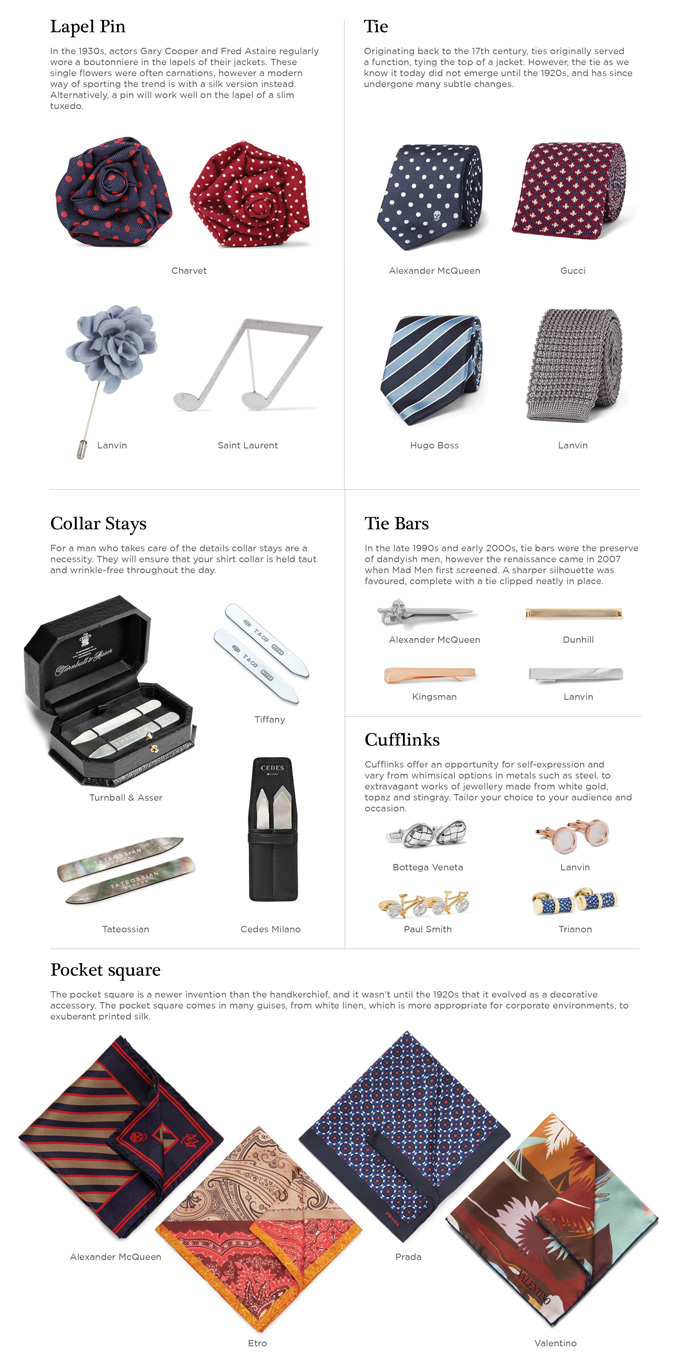
Raise your suit game with the addition of a well-chosen accessory, as it’s all in the details. A suit on its own can be quite an unindividual uniform, so add a sprinkling of your personality and take the opportunity for personal expression with an adornment.
By Eliza Scarborough
BOY BAGS

When it comes to menswear, the key accessory is the man bag. From Backpacks to totes there are plenty of choices to update your look, whatever the occasion.

By Eliza Scarborough
Growing Old Gracefully
As every year passes, the quest for youthful skin heightens. Of course, the recipe for looking after your skin hasn’t changed, but on top of that, skincare science has also grown up over the years, and here we share our latest discoveries to age proof your skin.

1 Lancôme L’Extrait Ultimate Elixir
This regenerating ultimate elixir contains up to 2 million Lancôme rose cells. These cells have been extracted through a state of the art process, and cultivated via an exclusive biotechnological growth process, allowing the unique properties of the cells to be preserved.
2 Dior Capture Totale Dreamskin Perfect Skin Creator
Dreamskin is the key to beautiful skintone and texture, instantly and over time. The universal formula is both a global age-defying treatment and a perfect skin creator, producing youthful-looking skin while increasing radiance and firmness.
3 Chanel Sublimage L’Extrait
In a single drop, this serum concentrates all the power of Vanilla Planifolia essence. It is an intensive treatment with a precious oil texture to immediately repair and ensure recovery for your skin. Day after day, skin is protected, revitalised, firmer, and more toned.
4 YSL Or Rouge Serum
More concentrated than ever, the fine texture of this serum defies the appearance of the signs of ageing with a powerful action on the look of skintone uniformity. Immediately skin appears tightened and radiant, the density improves and wrinkles appear reduced.
5 Estee Lauder Revitalizing Supreme Global Anti-Aging Crème
Responding to your skin’s changing needs, this is the first cream with IntuiGen Technology, which helps activate skin’s own revitalisation. This high-performance, multi-action moisturiser dramatically reduces the look of multiple signs of aging, specifically addressing your unique anti-aging needs all at once.
6 Shiseido Vital-Perfection Wrinklelift Cream
Pure Retinol, the highly-effective constituent of vitamin A, is notoriously unstable, making it difficult to incorporate into a product, but the scientists at Shiseido have solved this by encapsulating the Pure Retinol in miniscule soft gel capsules. When applied, they pop open to give skin a smooth veil as the Pure Retinol fits into creases and lines caused by frequent smiling.
7 Dior Capture Totale Dreamskin Perfect Skin Cushion
This complexion perfector features the correcting power of Dreamskin in the form of a cushioned foundation. To create this revolutionary formula, Dior Science combined two powerful, active ingredients from the Dior Gardens, longoza and opilia. These potently natural active ingredients combat lines, dark spots, redness, and a lack of glow.
By Eliza Scarborough
Photographer: Henry Pascual
Cake Design: Rubab Suri
Beauty Sleep

We’ve all seen the studies about why sleep is so important, a full eight hours keeps our bodies and brains fitter, happier and more focused. The results of these wonder hours are also just as effective on our skin, leaving you with a healthier glow after a night’s rest.
While we are sleeping, our cells go into overdrive to help repair the damage incurred during the day, for example from environmental pollutants and UV radiation. During this time our blood vessels dilate, allowing an increased flow of nutrients and oxygen to the skin, which helps stimulate the removal of toxic cellular products. Using this cell regeneration to your advantage, it is most effective to feed them with products to optimise healing, hydrate for improved barrier function, and regulate oil production.
To get the full eight hours of rest needed to give your skin a boost, you need to start winding down several hours in advance. Follow our 5 essential tips to perfect your bed time routine, and ensure your skin and body is revitalised in the morning.
Cleanse
Cleansing your skin before bed is a step to never skip. An evening cleanse allows you to take off your makeup and wash away any grime and oil that your skin has accumulated throughout the day. Twice a week elevate this to a scrub with an exfoliator, to buff away dead and dull skin cells.
Hydrate
From serum, to anti-aging products or luxe night creams, this is your time to get the most action from them. Apply just before bed and you will boost the effects. Eye cream is one not to skip as this area of skin is more fragile, more prone to dryness, and quicker to show age and fatigue.
Disconnect
Bright lights such as those on your computer or TV screen activate the brain, keeping your mind alert before bed. Studies suggest electronic devices right before bedtime can interfere with the quality of your sleep, so switch everything off and relax before bed to help you sleep.
Position
Avoid sleeping on your face as it creates a lack of circulation to the skin, which is squashed into the pillow. This can lead to wrinkles, fine lines and creases. If breaking the habit is too hard, try sleeping on a silk or satin pillowcase, which won’t compress the skin as much.


By Eliza Scarborough
Jo Malone: Myrrh & Tonka Cologne Intense
Celine Roux
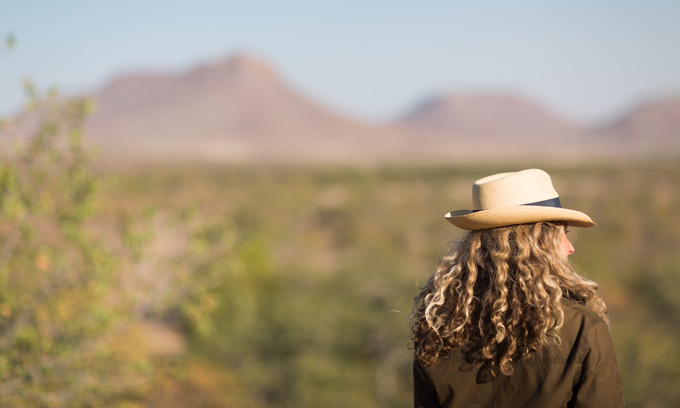
Jo Malone London’s new launch, Myrrh & Tonka, is a unisex fragrance in the Cologne Intense Collection. This addictive scent uses the potent sap of the Namibian myrrh tree and blends it with a little dose of warm almond and lush vanilla from the tonka bean. It was developed by perfumer Mathilde Bijaoui, who explains, ‘There is an atmosphere of addiction and carnal richness to this fragrance which appeals to both men and women. It’s captivating and mesmerising.’
We chat with perfumer Mathilde Bijaoui and Jo Malone’s fragrance director, Céline Roux, to understand the inspirations and individual notes used to create the scent.

What was the inspiration behind creating this fragrance?
Celine Roux: The idea of Namibia, with its sand dunes and warm desert colours, conjured up the romance and emotion of faraway lands. Myrrh felt like the perfect note to use for a new and innovative Cologne Intense. Once enriched with the note of tonka, the fragrance gives a real sense of richness, travel and escape.
Mathilde Bijaoui: I was obsessed with the colours and landscapes of the desert and dunes. The sandy ochre and reddish brown palette, paired with dark shadows and sweeping scenery, it’s so remote and evocative. This association with colour was really important to me during the creative process. The tonka bean is naturally black, and the myrrh crystals are slightly reddish, slightly golden and ochre, it all felt so natural and the perfect combination for a fragrance.
The Cologne Intense collection works with rare, ritualistic ingredients. What makes Myrrh & Tonka an ideal addition to this collection?
Celine Roux: Both the myrrh and the tonka have a decadent and addictive quality that chimes with the Cologne Intense concept of rarity and opulence. I felt that the collection was missing a fully warm, sensual and rounded Oriental feel. We do already have a resinous incense note elsewhere in the collection, in Incense and Cedrat, but it’s cut through with a citrus that amplifies the fresh nature of the Incense. However, for Myrrh & Tonka, we headed in the opposite direction and reinforced the richness of the resin rather than trying to contrast it. Even though the final fragrance is deep, it stays true to our philosophy of simplicity and clarity.
How would you describe Myrrh & Tonka as it warms and develops on the skin?
Mathilde Bijaoui: Right at the top there is a hint of lavender and a little floral to make the opening effect comforting and voluptuous. The big, rich heart and base note of myrrh is sensual and balsamic, with hints of amber and liquorice. And the tonka brings generosity. There is also a touch of vanilla, cypriol and gaiac wood, which together deliver a smoky tobacco note to the perfume. It’s a fragrance that’s quite linear, meaning that from the top to the bottom it more or less stays the same. It’s very stable in its evolution, and that’s something quite rare in perfumery. It’s sensual and addictive, captivating and mesmerising.

Myrrh & Tonka in hands
How was the Myrrh harvested?
Celine Roux: We wanted to go to the source of the myrrh and I had the privilege of travelling to Namibia to be part of the harvesting process. It’s a long, long journey and, once there, it feels like a very distant land. Once we landed in the country, it was another eight hours travelling into the mountains to get to our destination. The trees they collect the myrrh from are called Omumbiri trees, they seem almost dead when you look at them as they grow in the dryness of the desert. But a few times a year the trees produce a sap that comes out like a resin; it’s a mechanism that the tree harnesses to fight potential bacteria, and the myrrh has a wonderful purity to it because of the altitude and climate. Accumulating the resin is a ritualistic process in itself. The sap is very gluey so traditionally they would cut the tree trunks to get it. But in this region, to preserve the tree, they don’t touch it at all, they wait until it’s become dry and either scrape it from the tree or they wait until it falls off. With their method, there’s no waste, the trees aren’t damaged and the whole experience is very simple and clean. And because of the nature of the crystals you can keep them for a week or two, unlike flowers that you have to work with immediately as they’re so fragile. I’ve never seen something so beautifully uncomplicated.
What was your first impression of this particular Myrrh note?
Mathilde Bijaoui: In this perfume, we have two different extractions of the myrrh. One is the essential oil, which is made from a distillation. And the other is the exclusive resinoid from Namibia made by Serge Majoullier, which is an extract with solvent. The essential oil has a more uplifting scent than other myrrhs from Africa. It’s more immediate, more bracing and a bit spicier. The resinoid meanwhile is very complex and has so many facets that it’s almost a perfume on its own. It has a resinous effect like incense, but it’s a bit warmer and woodier. It reminds me of caramelised sugar, maple syrup and sun-baked tree sap.
How is this particular Myrrh’s aroma different to other varieties?
Celine Roux: Myrrh can be fresh and lemony but the Namibian variety has a unique warm quality. We worked with the perfumer Serge Majoullier at MANE who transformed the essence into a resinoid exclusive to Jo Malone London. Through our unique extraction process, we pushed certain notes to make the myrrh even warmer, with a hint of sensuality and liquorice.

Ingredients
What does Tonka Bean bring to the fragrance and why was this chosen?
Celine Roux: Myrhh has an addictive quality and we felt it was a shame to cut it. We did originally try to do that game of contrasts, which is a very signature concept for Jo Malone London, but it really didn’t work for this. We tried a citrus, a dried wood, a dried fruit note, but they were clashing rather than complementary. So, we thought about tonka. It really worked, delivering a beautifully sensual mood to the fragrance.
Mathilde Bijaoui: Tonka is one of my favourite ingredients, not just for perfumery but for cooking too. It’s an edible, addictive and gourmande note without being sickly-sweet. It helps to give a natural balsamic ‘oriental’ note to the myrrh, and a feeling of sophistication and strength to the fragrance, which is so important for the Cologne Intense collection. That feeling of addiction and carnal richness is very much down to the tonka. And I love that it’s not too feminine. In fact most masculine ‘fougere’ fragrances include tonka, so overall this definitely appeals to both men and women.
Within the Cologne Intense collection, what family does Myrrh & Tonka sit amongst?
Celine Roux: We don’t have an ‘Oriental’ category as such, so I would place this in the spicy-woody family. And this rich, slightly smoky, sophisticated scent suits both men and women beautifully.
The Modern Man’s Guide to Beards

There is no correct way to have a beard, but chances are that you are going to need a little sculpting here and there. Lay down these ground rules, and get the best from your beard.

Going Beard Free?
There’s a right way and a wrong way of going from a full beard to beard-free. Shave the whole thing off in one go and you risk things like ingrown hairs and skin irritation. With that in mind, here is the ultimate guide for how to shave your beard off the right way.

The Hairstyle of the Season
Each season, male models have their hair styled over and over, from catwalk to catwalk. It’s testament to the creativity of the backstage hair styling teams that they can be so inventive. However, it is also down to a versatile base hairstyle, so step forward Finnlay Davis, who is a mainstay at all the top shows, dominating the style scene.
Finnlay’s haircut is a ‘modern shag’ which is a mixture of references from the Seventies shag, Eighties wedge and the Sixties mod cut, long on top with softer, longer outer edges. In terms of maintenance and styling, it can be worn in a variety of ways, as shown in our favourite looks from his appearances at the SS17 shows.

By Eliza Scarborough
He Said, She Said: Didier and Sophie Guillon
Husband and wife duo at the helm of Swiss luxury cosmetics brand Valmont
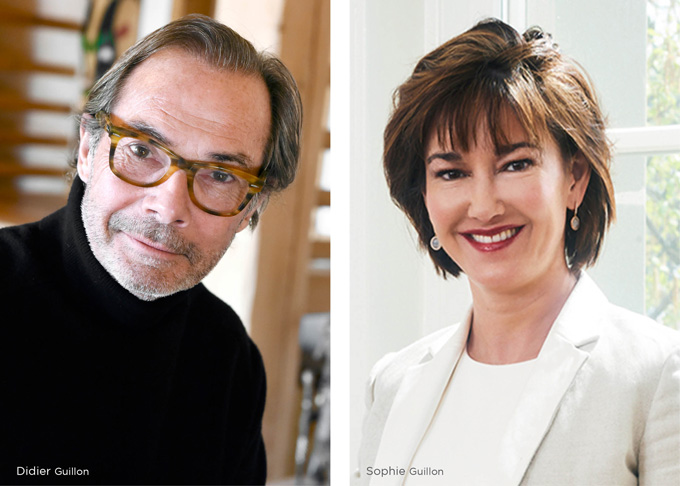
It’s not often that couples manage to mix business with pleasure successfully, however Didier and Sophie Guillon are an exception to the rule. A husband and wife team, whose individual talents have helped an iconic Swiss beauty brand succeed in the industry. The dynamic duo are not just a powerful combination in the business world, they are also proud parents of three, Capucine, Maxence and Valentine. Didier is the third generation of Guillon’s who took over the family business, as Chairman of Valmont, and Sophie, his wife, is the scientific brains behind the mastermind products. Their pioneering products have included the first use of glacial spring water in cosmetic care and they have had DNA and RNA advances with their products, making them an innovative force in their field.
What is the history of Valmont?
Didier: In 1905 Valmont clinic was the first to open in Switzerland. It welcomed film stars, including Charlie Chaplin and Ingrid Bowman, and people in politics. Clients came to rejuvenate and recover from their busy lifestyles. Eventually, it was our clients who asked us to create cosmetics. By 1985 we did just that and in 2000 Sophie joined me in the company.
Sophie: I always wanted to work with cosmetics and mix business with science. Previously, I worked at Balmain and Oscar de la Renta perfumes, and Yves Saint Laurent. I started as an export manager, selling products that others were developing. That is what I did for 15 years. Now when I develop a product I think about the customer first. At Valmont, I am Director of Operations. I look after the creation of concepts and product development. When Didier took over the company there were 30 products and now we have 115 formulas. I love developing scientific products, I’m addicted to innovation.
Tell us about yourselves and how you met.
Didier: I was born in Paris, and I met Sophie in Paris.
Sophie: I grew up in Paris and studied there. I am French, but bloodwise I’m Vietnamese. I never lived in Vietnam though and I’m someone that has no roots to one place, I’m an international person. I live everywhere and I feel comfortable anywhere. I was brought to Paris when I was five and, when I married, I moved to Switzerland to raise a family and take care of Valmont.
How would you describe each other in three words?
Didier: I believe she is passionate person, a real leader and represents excellence.
Sophie: I think Didier is visionary, artfully accurate and intellectually brilliant, all at the same time.
What do you admire most about each other?
Didier: Sophie’s ability to be everywhere at the same time, her strong dedication to everything she does and her high precision to deliver perfection.
Sophie: What I admire most about Didier is his visionary sense and his artistic ability.
Tell us the secret to your success?
Didier: To be very honest, I believe there are no real secrets to success, you need to combine persistence, determination, innovation, and hard work, together with learning from your mistakes. Multitasking is also a major part of success.
Sophie: There are definitely three fundamental factors at the same time, passion, vision, and hard work.
How is it working together and being married?
Sophie: It’s our life, we don’t know any other way. It’s probably boring for the children but they enjoy it and the oldest wants to join the company.
Didier: Normally you need to force children to join a family business, but our eldest, Capacine, really wants to join us. The youngest even said she would join. They would be the fourth generation to stay in the family business if they did. Today, getting a good job at a nice company is difficult, and there’s no guarantee you are going to keep your job. Having a family company is a chance for our children to succeed. We hope our daughter will work in the new store in London, which will open in Knightsbridge next year.
Are there compromises you must make to enable a good work harmony?
Didier: Well, Valmont is a family owned-business. Everyone is different and everyone has different ideas obviously. Each idea is a piece of puzzle. You just have to know how to put them all together because they are all fundamental to the final great result. Working with family is a beautiful adventure and is part of your actual family duties.
Sophie: It is all about accepting different point of views, not everyone is the same, but together you create great outputs.
What makes your brand special compared to others?
Sophie: People will pay for something luxurious that gives instant results. Many are skeptical that cosmetics don’t really work and won’t change anything. However, our customers are loyal to our brand because they see the instant positive benefits on their skin.
Didier: If today we are cosmetic leaders in the industry it’s because we have proved our products really work. Worldwide our products are sold in stores and spas where the customer will have the best beauty advise from a qualified, trained therapist.
What can’t you live without?
Didier: My family.
Sophie: Joy, passion, and friendship.
Where is your happy place?
Didier: I would say, in artistic galleries where I get to dive into my favourite world.
Sophie: On an island near Bordeaux where I don’t wear make-up.
Nights out or relaxed evenings in?
Didier: Personally, between both I would choose to have a relaxed evening with my entire family.
Sophie: My choice would be a relaxed evening watching a good movie.
Where is the next place on your wish list to visit?
Didier: Costa Rica, it is a childhood dream.
Sophie: Nordic fjords.
What talent do you yearn for?
Didier: Sometimes I would like to have my youngest daughters’ artistic talent, with her compilations of videos and her short creation of small movies. It may look easy but it actually requires talent.
Sophie: No hesitation, music.
What is the best lesson you have been taught in life?
Didier: Great organisation as well as good communication can lead to incredible results. These are some fundamental things that you need in order to build an empire, and accomplish what originally seemed quite impossible.
Sophie: If there is one lesson that life has taught me, it is to always trust yourself. You always know more than you think you do.
What are your hopes for the future?
Didier: I would like to stay with my wife for a very long time and to keep making beautiful products in this beautiful environment. I’d like to continue to do everything with passion and emotion and to please our customers.
Sophie: I would like our products to continue to be innovative and to help women grow old with grace.
If you could be remembered for one thing, what would it be?
Didier: My artistic world and perception of things.
Sophie: I would say my way of seeing the bright side of life.
By Hershey Pascual
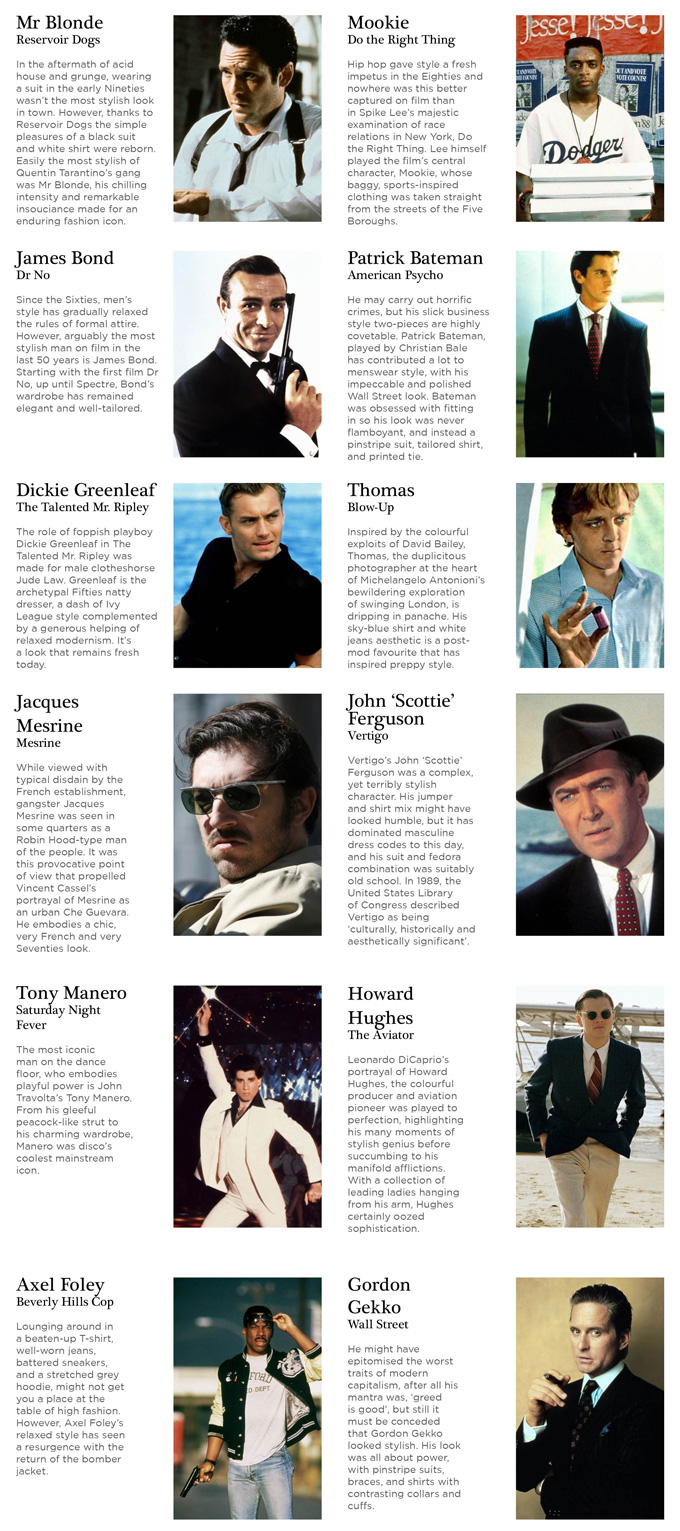
How these male film icons have inspired fashion
The leading man has sparked many fashion trends and become a style icon in his own right. Here we consider how these cinematic icons have made an impact on the fashion of today.
By Eliza Scarborough
Franca Sozzani At the helm of Vogue Italia

Franca Sozzani, the editor-in-chief of Italian Vogue, passed away on 22nd December 2016 after a year-long illness. While she might not have been a global household name like her US counterpart and friend Anna Wintour, she was undoubtedly a giant of Italian fashion.
Born in Mantua, her father, a classic Italian patriarch, was an industrial engineer who did not approve his daughter’s early ambitions to study physics. She studied literature and philosophy at university in Milan instead, and married soon after, although she knew, as she later admitted, that the marriage was doomed before she walked into the church. Franca would later confess that romantic relationships were the one weak link in her formidable arsenal of triumphs. The couple divorced three months later, and the free-spirited Franca went to India to find herself, followed by time in London, to nurture her creative spirit.
Franca was especially close to her only child, Francesco, whom she raised more or less alone. Like her, he studied philosophy, but spent recent years directing and producing a documentary about his mother. The result, Franca: Chaos and Creation, which had its premiere at the Venice Film Festival in September 2016, and will be released in early 2017. Francesco payed tribute to his mother, telling The New York Times, ‘My mother sacrificed herself for me and for her work.’
Franca’s illustrious career began with Vogue Bambini in 1976 with an assistant role, followed in 1980 with the editorship of Lei, aimed at young women, with Per Lui, its male counterpart, following in 1982. She transformed both these titles into displays for the most dynamic trends in international fashion and lifestyle image-making.
When Oliviero Toscani, her key photographer, moved on from her magazines, she began nurturing a dazzling talent roster of emerging photographers including Mario Testino, Paolo Roversi, Herb Ritts, Peter Lindbergh, Bruce Weber, and Steven Meisel, all of whom were attracted by the unprecedented editorial freedom that she gave them, and her passion for photography.
Allowing them to communicate through powerful imagery, she earned their unswerving loyalty and willingness to work with her magazines’ negligible budgets.
In 1988, Franca was appointed Editor in Chief of Italian Vogue, immediately shaking up the formulaic title with dynamic covers and content, creating a magazine that, in her words, would be, ‘extravagant, experimental, and innovative.’ Then by 1994, she was made Editor in Chief of Italian Condé Nast.
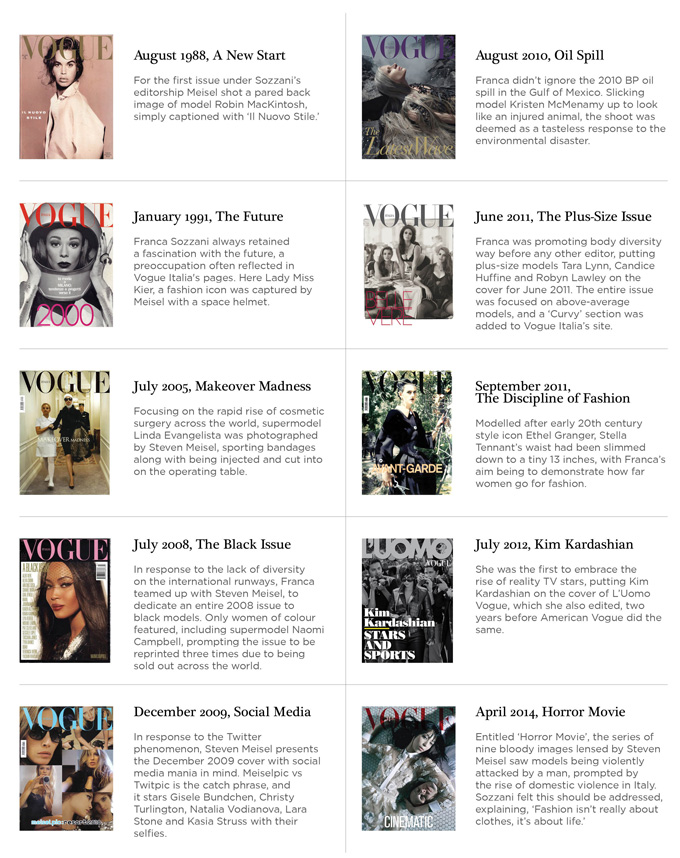
Franca Sozzani’s maverick spirit transformed Italian Vogue into a magazine that not only celebrated the power of the image, but also used fashion stories as a platform to discuss broader issues, and the obsessions of the fashionable world. Her fearless willingness to tackle provocative and controversial social and cultural issues through the medium of fashion shoots immediately began as she made a statement with her first issue, for August 1988, with the single cover line ‘Il Nuovo Stile,’ meaning, ‘The New Style’. Coupled with a sepia-washed black-and-white image by Meisel of model Robin MacKintosh, wearing a plain white Ferré blouse, this message signalled that she was not going to be playing by anyone else’s rules.
Not only a magazine editor, Franca also took an active role in social issues beyond the pages of her magazines. She was the creative director of Convivio, the AIDS initiative that Gianni Versace launched in 1992, and founded Child Priority with Jonathan Newhouse, to provide work opportunities for underprivileged children. Franca was also appointed global ambassador against hunger for the United Nations World Food Programme, with a focus on the empowerment and education of women and girls, and as their goodwill ambassador for Fashion 4 Development, she worked in areas including poverty and gender equality, through the medium of fashion-based initiatives. In this capacity, she travelled extensively through Africa, subsequently raising global awareness, and funds, to support the projects.
During Sozzani’s almost three decades at the helm of Italian Vogue, the magazine was transformed from one simply about clothes into one that championed its photographers, regularly broke boundaries, and never shied away from important issues. Here we look back at the most controversial covers under her editorship.
Olga Kurylenko announces Abdullah Hassan Ahmed as the fifth IWC Schaffhausen filmmaker award winner
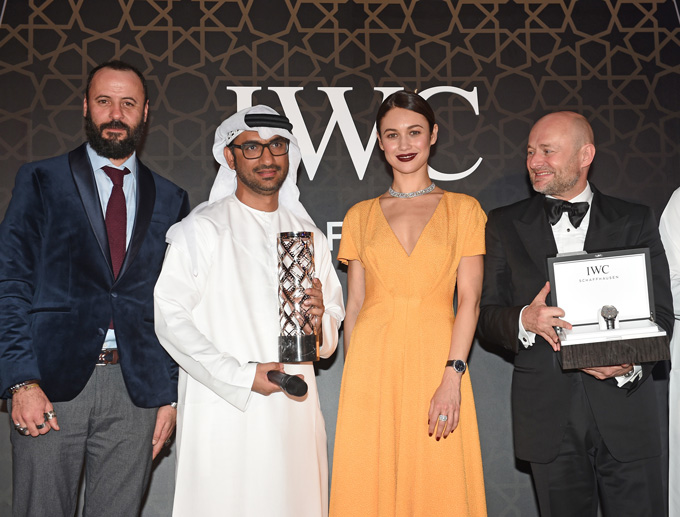
Ali Suliman, Actor, Abdullah Hassan Ahmed, Director, Olga Kurylenko, Actress and model, Georges Kern CEO IWC Schaffhausen
During this year’s Dubai International Film Festival, actress Olga Kurylenko presented the fifth IWC Schaffhausen Filmmaker Award to Abdullah Hassan Ahmed from the United Arab Emirates for his project ‘Sunrise’ during the ‘For the Love of Cinema’ gala event at the One & Only Royal Mirage in Dubai. The winner also received a grant of USD 100,000 for his project and an exclusive Portugieser Automatic from the Swiss luxury watch manufacturer at the 13th edition of DIFF.
‘Every year, we receive a diversity of excellent submissions for the IWC Filmmaker Award, and this year was no different. As always, it is our pleasure to support and encourage talented filmmakers from the region, in order for them to unleash their creativity and skill with their projects,’
comments Georges Kern,
CEO of IWC Schaffhausen.


This year, the film ventures were evaluated by a jury headed by American actor Ali Suliman. Other jury members included Georges Kern, DIFF Chairman Abdul Hamid Juma, and DIFF Artistic Director Masoud Amralla Al Ali. While the event’s master of ceremonies were IWC brand ambassador and television personality Raya Abirached, together with TV presenter Bassel Alzaro.

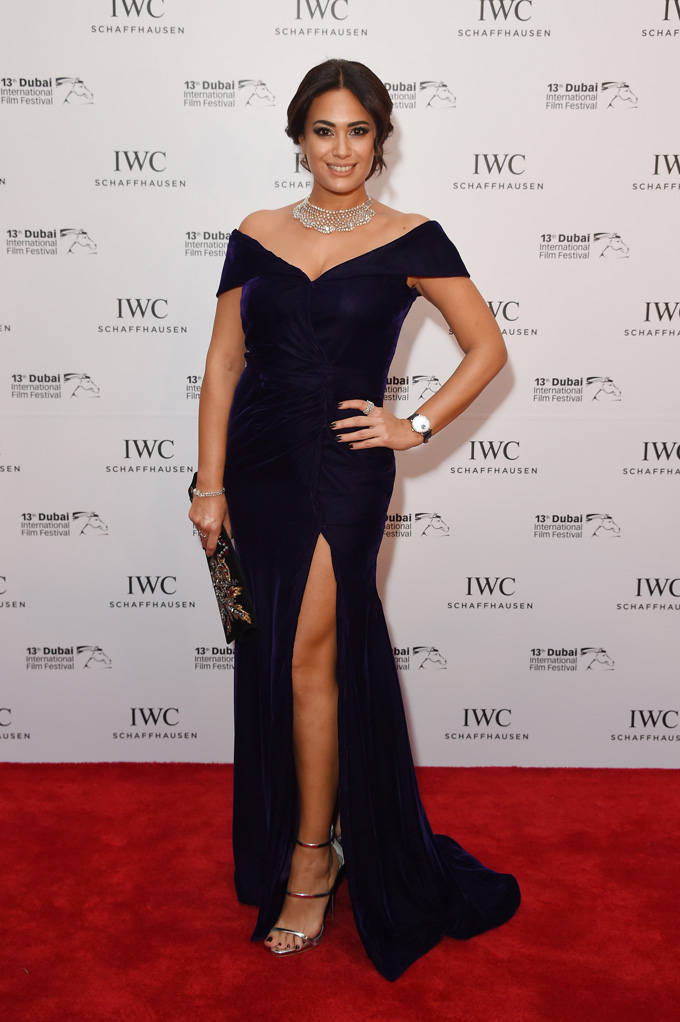
Hend Sabry, actress and IWC brand ambassador
The winner, ‘Sunrise’ tells the story of a worried father who receives tragic news about his son, who is fighting in a distant war. With a pregnant wife to take care of, he is unsure how to deliver the news without causing too much anguish. The two other projects shortlisted for the award were. ‘Salem’ by Arabic director Nujoom Alghanem, and ‘The Search for the Star Pearl’ by Qatari director Hafiz Ali Ali.
The Regions Top Restaurant Haunts Of 2017
Discover our unique selection of where to eat and be seen in Dubai, with these new openings and quirky hotspots.

Indie
An uber-cool import from Beirut
There’s something about Indie, the new venture from the team behind Dubai’s Iris and White. It could be the discreet location, hidden away in the upper levels of Gaucho in DIFC, though you wouldn’t know it exists, for there is no signage in sight, or the darkened interior punctuated by flashes of bright colour from the green and purple upholstery.
The space has a distinctly rustic charm, an eclectic collection of retro ornaments, think suitcases, old television sets and typewriters, shelved away amongst a beautifully crafted decor. Seating is a mixture of high bar style and more formal dining tables. There are also striking light fittings with exposed filaments surrounded by bulbous glass jars, like burst fireworks, momentarily suspended in mid-air, before cascading to the ground.

In an area renowned for pretentious dining and expensive prices, Indie is making waves bucking the trend, providing a breath of fresh air into an area where most venues are offering the exact same thing. The vibrant area injects a huge boost of personality into Dubai’s financial district and this is evident in the eclectic mix of cocktails served in everything from re-cycled light bulbs to tin cans.
The urban menu includes a selection of tapas, taking on an experimental nature. The food may be downplayed as you will be focused on the overall atmosphere and experience offered by the restaurant. However, the food here is an excellent blend of international flavours and cooking techniques, and although it may not be as high end as neighbouring establishments, the quality is exceptional, from the starters all the way through to the grills, grains and mains.
Indie is a busy place, one that is bursting with energy. A neon sign that adorns the entranceway says it all, ‘If you don’t belong, don’t be long.’
—

Alfies
A refined spot offering British favourites in a gentlemen’s club atmosphere
Alfie’s is a British restaurant in Dubai with a sophisticated playground for the more discerning gentleman. Situated in the Boulevard alongside the Dunhill store, Alfie’s Dubai is the third venue in the Alfred Dunhill restaurant portfolio, joining Alfie’s Shanghai and Alfie’s Hong Kong.

For a restaurant that takes its name from the icon of British luxury, Alfred Dunhill, it’s unsurprising that Alfie’s wears its Britishness on its sleeve. The cigar lounge immediately on entry is lifted straight from a London gentleman’s club, all brown leather, dark wood, and bookshelves crammed with artefacts. However, the main dining area takes a more modern approach. The leather is still very much in evidence, but lighter tones and white marble table tops give an airy feel, while arty black and white prints on the walls pay homage to the Dunhill company’s fashion exploits over the last 120 plus years.
The considered menu has been designed with a fresh interpretation of British fare in mind, with a strong seafood accent, though meats, poultry and vegetarian options are represented too. An emphasis is made on the finest quality ingredients and provenance, making this dining at its stateliest.
—

The Artisan
By Enoteca Pinchiorri
Bringing La Dolce Vita to the heart
of Dubai
The Artisan, by Enoteca Pinchiorri, is a concept derived from Italy, and is known for offering a feast for the senses. L’Enoteca Pinchiorri is home to one of the best chefs in the world, and the 3 Michelin Stars main restaurant in Florence has been highly acclaimed since the 1970’s. The Artisan is yet another chapter in a rich culinary history, it’s got a pedigree background while being slightly more casual than its Italian counterpart.

The interior speaks of grande dining rooms, with details reflecting the attention to detail and passion present in the artisanal craftsmanship of the food. A broad nod to the long established Italian institution is evident, but with a modern twist to suit its new Dubai context. There is an abundance of stunning marble, together with suspended handcrafted Murano glass irises, the space plays a game of contrasts between old and new.
The menu is compact but varied, with small starters, antipasti, pasta dishes and mains. The cuisine is best described as mainly Tuscan, with exceptions including burrata from Puglia and tomatoes from Vesuvius near Naples. Although the menu is smallish, it has enough variety to excite, but not too much as to overwhelm.
—

Em Sherif
A prestigious fine dining experience based around authentic Lebanese cuisine
Em Sherif is Lebanese chef Mireille Hayek’s first restaurant in Dubai, a licensed concept imported from Beirut. Conveniently nestled at the foot of The Address Downtown Dubai and facing Burj Khalifa.
As you step inside the restaurant you will instantly feel transported to Beirut. From the décor, to the atmosphere and waiters. The restaurant is mesmerising and plush space, yet still with a shabby chic aesthetic. Blue walls are wallpapered with Ottoman-style mirrors and oriental porcelain plates, pale blue translucent drapes adorn plush fuchsia banquettes, and a huge metallic firewood oven surrounds large black tables and chairs.

The restaurant has no a la carte menu. For a set price, the only option is a fixed menu of 32 dishes, changing depending on seasonal ingredients, starting with a freshly baked and well-seasoned thyme man’ousheh as you sit down. This continues to traditional salads and a cold mezze. Warm mezze dishes follow, then the meats and finally an assortment of desserts.
—

The Act
A theatre-style venue that pushes the boundaries of entertainment in Dubai
Dubai’s most theatrical venue offers vaudeville-style entertainment, great quality Latin food and a stop and stare atmosphere that can’t be matched anywhere else. The variety performance includes well-choreographed dance routines, circus-style acts, music and comedy.

Stepping out of the lift on the 42nd floor of the Shangri-La, and through another door, you’re in another world, all dark and Victorian burlesque, think boudoir, sexy cabaret and Moulin Rouge. It is a Simon Hammerstein Las Vegas theatre club concept, offering Peruvian cuisine, and is apparently the highest theatre in the world.
The menu which is divided into several starter options from ceviches and tiraditos, to enrollados and salads, mains and accompaniments, follows the sharing concept and is created by two chefs straight out of Lima.
—

Comptoir 102
A café and concept store
Launched in 2012 by two Parisian girls, Emmanuelle Sawko and Alexandra de Montaudouin, Comptoir 102 merges food with fashion. Acclaimed by international travel guides and fashion magazines, the space has been conceived as a home, with its kitchen, lounge, garden and terrace- combining fashion, homeware and organic café.

The philosophy behind the café is to offer a more conscious and healthy lifestyle by offering sustainable and nutritious food. Ingredients are sourced from local organic farms, meaning the menu changes daily according to the harvest. Age old techniques such as pre-soaking, fermenting, cooking at low temperature, steaming and dehydrating are used, and vegan choices are offered, together with a menu which is sugar-free and dairy-free, with raw and gluten free options.
Ermenegildo Zegna & Alessandro Sartori MAKE THE PERFECT FIT

As Alessandro Sartori returned to Milan with his new position as artistic director of the Ermenegildo Zegna Group, it was more sentimental homecoming than first day on the job. His connection with the company goes back a long way, and the reunion will no doubt continue far into the future.
Sartori was born in Trivero, where Ermenegildo built the family’s first mill in 1910. He then joined the company out of design school in 1989, left, came back to spend eight years as designer of Z Zegna until 2011, when he moved to Paris for Berluti. However, with his return comes a new title of artistic director, which suggests a far broader remit of creative administration than designer. He sums this up as, ‘combining my previous design job with the idea of co-ordinating and putting together the work of a beautiful team.’ This is a huge step for the Zegna Group, as it is the first time so much power has been handed over to one person, amalgamating under one title responsibilities that were covered by a handful of people before.
We travelled to the Ermenegildo Zegna Global Store opening in London, which was not only an occasion to unveil the first project of Alessandro Sartori since his appointment, a unique bespoke shoe collection, but also a look inside the newly renovated flagship boutique on New Bond Street. The store was first opened in 1987, and now after a 20-month renovation project, the reinvented and expanded store reimagines what a luxury boutique should be in the 21st century. The finished store is the result of a fruitful partnership between Zegna and architect Peter Marino, whose design for the 600m2 space echoes the brand’s use of quality materials, integrity, and modern style. Rich colours, materials and fabrics are used throughout the store to immerse the visitor in the true world of Zegna and its history. In keeping with Zegna’s approach to fabric and tailoring, each design detail is considered and realised to the highest quality.
Here, Alessandro shared with us about how the company is being moved towards a more one to one approach. However, with a new updated spin, as he explains, ‘I think that more than made to measure, personalisation is the future. This store is the first milestone into this new level of personalisation. Today is more than just tailoring, we have sports jackets which can be personalised and that part of the business is booming, and we have to keep increasing the number of people in the atelier to keep up with the demand for this.’ Of course, he understands that the DNA and heritage of the brand remain paramount, and it is about combining this with design to maintain a modern approach. ‘I don’t pretend to know the recipe, but I think that there is a way of keeping the craft if you respect the construction of the pieces, together with pairing with a modern silhouette. You can meet at a good point with the two components, the craft with modernity, the design with the artisanal expertise.’ This brand identity is designed for an international man who doesn’t have a specific age. Alessandro sees the Zegna man running over four of five generations, not just two like a father and son. ‘They may not have the same identity and personality, but some common points, such as a strong sense of style, authentic values, and Italian taste.’
Inspired by nine of his friends, Alessandro’s bespoke shoe collection, which is debuted at the store opening, has been handcrafted by the English shoemakers Gaziano & Girling. He explains how these bespoke shoes are completely hand made from scratch, with a shoe last made from raw wood, before the shoe is moulded and stitched entirely by hand. From the laced casual to the biker boot, the collection is a complete range designed for the modern man. The shoes can only be purchased from the new flagship store and each one will be made for the wearer in this entirely handmade process. Alessandro finds the approach for designing shoes very similar to that with fashion materials, however it is when he gets to the technical stage that the two differ, with footwear being far more complex, made in different steps with different layers. Here Alessandro Sartori introduces the nine characters who inspired the shoes, and each tell a unique story of an authentic and style conscious man.


Spring Summer 2017 Menswear TREND REPORT

Gucci SS17, Courtesy of Gucci by Kevin Tachman
Summer 2017 will be a season of contrasts. On one side of the style divide there are the polished luxury heavyweights with talented new creative directors at the helm, while on the other are the anti-establishment bright young designers. The result is our compilation of 12 hot trends not to be missed.


By Eliza Scarborough
DIOR TIMEPIECES: Crystal Gems
Precious refinement with the spirit of Dior timekeeping

La De D Dior Satine watches By Dior Timepieces

LEFT IMAGE:
Dior VIII watch By Dior Timepieces
RIGHT IMAGE:
Dior VIII Montaigne watch By Dior Timepieces

LEFT IMAGE:
Dior VIII Montaigne watch By Dior Timepieces
RIGHT IMAGE:
Dior VIII Grand Ball watches By Dior Timepieces

LEFT IMAGE:
La De D Dior Satine watch By Dior Timepieces
RIGHT IMAGE:
Dior VIII Montaigne watch By Dior Timepieces
Photographer : Tobi Jenkins
Fashion Director : Eliza Scarborough
Rami Al Ali, My Life My Style

A master of faultless drapery, Middle Eastern designer Rami Al Ali, who grew up in Deir ez-Zor, a small city in Syria, combines decadence with streamlined geometry and romanticism to create his exquisite gowns. Describing his personal style as classic with a twist, Rami cites his earliest memory of fashion as when his mother was preparing herself for an event. She pulled out a timeless turquoise silk dress which magically transformed her into a princess. He found it mesmerising, and this was the spark that made him intrigued by fashion. It was then that Al Ali saw fashion as more than just a dress, and instead as a communication tool. We stopped by his atelier in Jumeirah to get an exclusive look inside his personal wardrobe, and of course get up close with his exquisitely created gowns.

This Rolex Submariner was the first luxury item that I bought with my own money. I chose Rolex as it is always the first brand to buy into when you start collecting watches. At the time, they had this unique limited edition green style and I like the idea that it wasn’t available to purchase off the shelf, you had to order the timepiece and wait, a process which I found very interesting. It’s a sporty, energetic piece, and for the summer I updated it with the canvas strap.

I follow a strict routine when it comes to skincare, as I believe that we have become a very vigil world, making a young and healthy appearance imperative. Therefore, I take great care of my body, skin, the way I eat, and my lifestyle. The more you are committed to good products the better, so I choose to use the Shiseido Men full range of products. I trust everything Japanese and it’s a brand that from the start was dedicated to cosmetics, so I can be assured that it is authentic and credible.

These Chanel patent leather tuxedo shoes are my dancing shoes. I found them in Paris at the Rue Cambon store, which I always pass by when I am in the city as it is the only store that sells the men’s line. The sales team know me and had kept this special pair aside, because with their simple and discreet logo and beautiful design they match perfectly with my style.

It is always hard to pick a favourite dress as it isn’t fair to choose just one from the collection. However, this dress from the Autumn Winter 16 couture collection really symbolises the classical silhouette of the 40s and 50s that I love. The pixilation and layering create a 3D effect which makes it more interesting, as I like to create something in layers so areas are hidden for people to discover.

I’m not a leather person in general, I prefer soft fabrics and I don’t tend to dress very casually. But when I saw this jacket and tried it with fabric trousers, I loved the contrast. It ties in with my character, the old and new, the East and West.

The bangle here is Bil Arabi and features my first initial in Arabic. Nadine Kanso launched this line for men a couple of years ago, and when I saw it I loved both the simplicity and discreet nature. The Bulgari ring is something from the days of showing my collections in Rome. I love the story and heritage of the jewellery house, so when I was there for my last show in the city I bought this ring to say goodbye, as a memory of leaving Rome.

I am a big fan of Fendi leather accessories and especially love their new modern designs. However, most are too funky or oversized to suit my character, until I saw this classic design in a muted colour tone which is something I could wear every day, throughout the year. I always carry a bag with all my belongings, as I hate to put anything in my pockets.

I prefer to have one fragrance that you are known for and becomes your signature. Right now, for me it is the Aqua Universalis by Maison Francis Kurkdjian. I found out about the parfumier Francis Kurkdjian by accident, as his store was next to Le Meurice where I usually show in Paris, and I came across it and its beautiful smell when I was taking a walk one day. He is French Armenian, and all of his perfumes are based on fresh lush white flowers, which is very much what I like.
A Fine Romance, François-Henry Bennahmias, AUDEMARS PIGUET CEO

François-Henry Bennahmias was born in Paris, beginning his career as a golfer. As an avid player, he was even ranked 25th in France. But his professional sporting days soon came to an end when he decided to pursue the world of luxury fashion and timepieces. Bennahmias first worked in the fashion industry for brands like Giorgio Armani, Gianfranco Ferré, Les Copains and Vilebrequin, before later moving to a career in Haute Horlogerie.
In 1994 he arrived at Audemars Piguet, the Swiss watchmaker, and after three years was promoted to lead the brand’s operations in Singapore together with taking on the added responsibility for Audemars Piguet in France, Germany, Italy, Spain, Switzerland, Brunei, Australia and Malaysia. In 1999, he assumed the role of President & CEO of Audemars Piguet (North America), Inc. while he also advised the Audemars Piguet Group on the development of the South American market, including Mexico and the Caribbean.
Now at 52 years old, he is CEO of the 141 year old family-owned company, which is still based in its ancestral home in the Vallée de Joux, a remote spot in the Jura mountains, regarded as the cradle of Swiss watchmaking.
Do you think the luxury watchmaking market is changing?
A few weeks ago, in Switzerland, a journalist mentioned that the watch industry is too expensive and we should reduce prices. I said it was the biggest joke I’ve heard during the 23 years that I have been at Audemars Piguet. When you talk about luxury, price doesn’t matter, it is only an issue if something is missing from the product and the emotion isn’t there. If you are capable of creating and delivering emotions within the product, then price should be the last thought. However, some brands may have gone too far with their volumes, and are chasing revenue by increasing volumes, which removes the luxury element. Whereas, we announced that we would make 40,000 watches and we would stick to that limited number for a minimum of five years. This gained respect from our customer who felt that the brand is staying true to its value, whilst keeping the desire and rarity of the product.
You’ve been with the brand since 1994, what are you yet to achieve?
I want the brand to be the best brand ever and we are not there yet, but we are on our way. There are so many things to do, but we are on a good path. 2022 is the 50th anniversary of Royal Oak, and 2025 is the 150th Anniversary of the company. We are planning to introduce a new classical line, together with a lot of new inventions and innovations coming up.
What can we expect at SIHH 2017?
The beast has awakened! We have something great coming up. For many years, for whatever reason, all our designers were very stuck with ideas, and so we decided to look back at what we have created over the past 10 years, and this has inspired new designs.
Are women’s watches important to the brand, and what is your strategy for growth in this sector?
It is becoming increasingly important every day. The watches are small, innovative, and emotional products. The Frosted Gold is a good example, we teamed up with Florentine jeweller Carolina Bucci to create four watches with a frosted gold finish. Creating for women by a woman is the perfect pairing, and by adding the jewellery aspect we mix both worlds together, which couldn’t be more authentic for someone who loves Audemars Piguet and jewellery.


What are the challenges in the market today?
The biggest challenge is to make sure we keep ourselves spread equally across the globe. The Middle East has been increasing like crazy over the past three years, and the success of the brand has been fantastic, however scary at the same time because we don’t know where it will stop. This year has been particularly positive, many other brands in competition are not performing, but we are skyrocketing.
Do you aim to focus on one market or spread across them all?
We never focus on one market and try to spread ourselves across all. A lot of brands have been focusing on China for almost 10 years, but that wasn’t our only focus. We look at all the markets, the Japanese are coming back strong, and Switzerland has never been stronger. So, when we look at the geography of ourselves we are happy with where we are right now, yet we need to ensure that in years to come we are not tempted to slide.
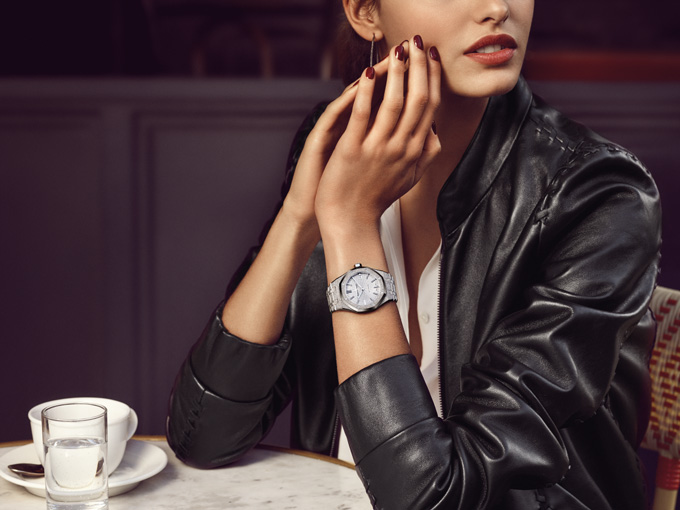

Can you tell us about your personal style?
My style depends on my weight. If I am slimmer I can enjoy more clothes, but if I’m bigger it is a strain on my wardrobe. In my closet, you will tend to find a collection of basics. I have six blazers, up to forty pairs of shoes, which are mostly one brand, lots of polo shirts and turtle necks.
What is your key to unwinding and switching off?
When I come home in the evening and I want to relax, I like watching a TV series to help my brain unwind, rather than reading a book. I am currently watching an American series called Ballers with Dwayne Johnson. I’ve always loved sports and this series is about the world of professional American football, which I very much enjoy.
What is your relationship with music?
Music is my life, and I like all types of music. If I didn’t work with watches I could have been a producer, or something in that domain.
What is a life lesson that you can share with us?
Never take no for an answer, and the more you tell me it is impossible, the more I do to prove it is possible.
Do you have any regrets in life?
Not yet, but one day I’m sure I will say not spending enough time with my kids.
By Lara Mansour Sawaya
A luxurious journey with Jean-Christophe Babin, Bulgari CEO
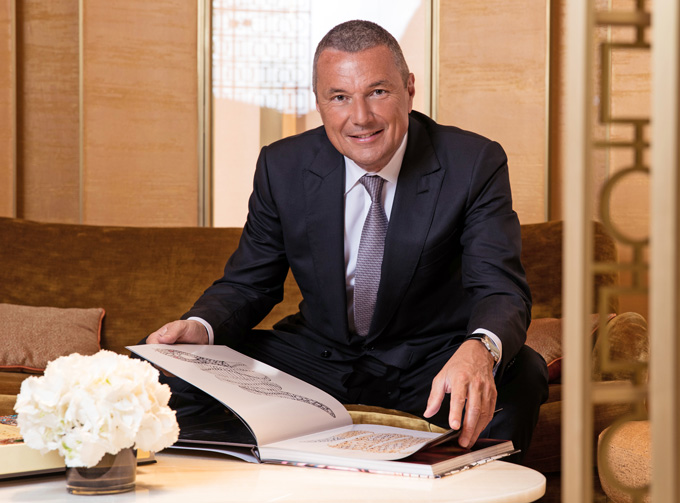
Bulgari CEO, talks about the challenges he faces, things he would change and how luxury is evolving.
Jean-Christophe Babin joined Bulgari, the 130-year-old Italian company, in 2013. Prior to that, he was CEO of TAG Heuer for 12 years. Born in France in 1959, both his parents were lawyers and from a young age he was interested in entrepreneurship, doing business and interacting with clients. To make this dream come true, he attended business school at HEC Paris (Hautes Études Commerciales) and was the youngest MBA graduating in his class.
When it comes to jewellery and watches he believes that it is essential to know your clientele. Transitioning from a world of watches (from TAG Heuer) to high jewellery was fairly smooth. He learned about the business of the luxurious Italian company, which was jewellery, accessories, perfumes and hotels. Although jewellery was a new industry for Babin he was quick to embrace its history, values and culture – not to mention the technical aspects of its craft.
What challenges you are facing in the industry?
Credibility is the ultimate challenge. Basically gold is gold, sapphire is sapphire and diamonds are diamonds, but what makes a difference is the way you combine them – that makes the real difference. There are great brands that have very good craftsmanship, but the main difference will always be the design.
We need to express ourselves very boldly and also have consistency in what people believe Bulgari is. Bulgari is Roman history; we are inspired by architecture and Italian art. You can create something innovative and bold, but it has got to fit with the expectation of our history. When I joined Bulgari, I began to study the company’s Roman origins, its history, its expertise, and see how that expertise translates into design. That is how I discovered its incredible competitive advantage.
What can we expect in 2017?
We will present on the same week as SIHH. There will be 17 collections; we will announce important news about men’s watches, also some news for ladies. During Basel in March, the focus will be for ladies but we will have news for men too.
There will be more of what exists already today. With Lucea, for instance, we will be enhancing the line to help shape and design what we already have. Even though we take inspiration from antique times, they are very new designs. The current Serpenti watches, that we have on the market, have been relaunched in 2010. It’s our youngest Swiss watch even though we have been making snake-style watches since the late ‘60s. Our emblematic and iconic watches were only born a few years ago. Compared to other watch brands, 80 per cent are relying on icons that were made more than 25 years ago. Also, Bulgari Bulgari is still very popular.
What is your vision for the brand?
The vision is ambitious – we want to be the most desired luxury brand in the world. I want it to be irresistible. It’s a combination of getting the aesthetics right and consistent with our DNA. For ladies, the Serpenti bag and Serpenti necklace has to go well with the watch. Our craftsmanship and design makes it an irresistible brand.
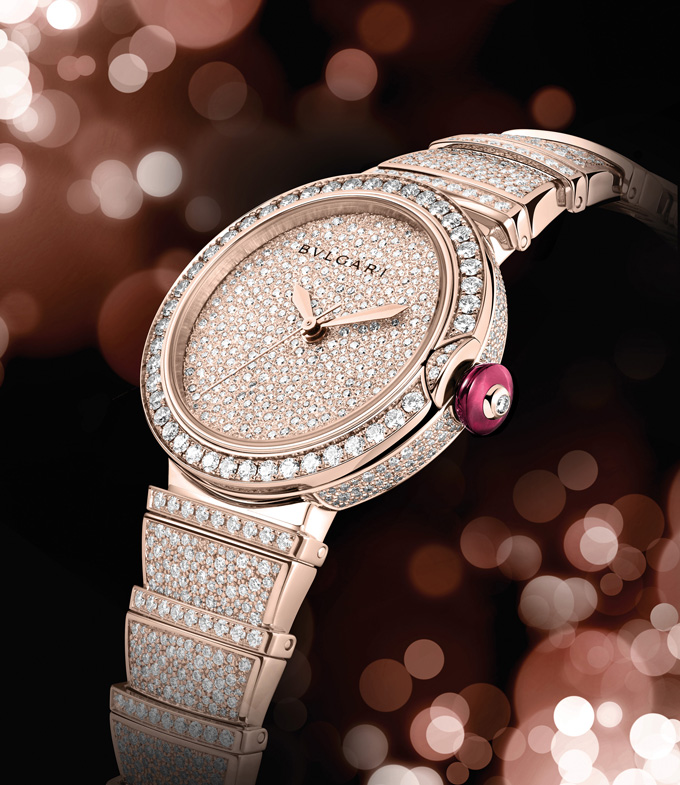
LVCEA Haute Joaillerie
Did you expect the Serpenti to be a massive success?
I think no one expected such success. The challenge now is to take it to the next level. Why keep it still very exclusive? We need to multiply the creativity around the Serpenti without losing the initial idea behind it, which is what we have been doing this year with the jewellery. Serpenti is the new interpretation of the snake; it is not full bodied anymore, instead we focus on the head and the eyes of the snake, and this later translated into watches. The challenge is to reinvent, but keep the initial concept. If we do this, we have a lot of potential to increase our desirability.

Serpenti Joaillerie

Serpenti Spiga

Serpenti Tubogas

Serpenti
Where do you think luxury is going?
Luxury is broadening its scope, it is broadening itself from extraordinary objects, which are very much like art. A necklace is art and a one of a kind piece. Mankind has existed as long as jewellery has. The idea of the serpentine dates back 3000 years ago. Jewellery and mankind are ultimately bonded. However, luxury is not just about objects. People will spend money not only on a watch or a piece of jewellery, but also on a beautiful vacation. They will pay for an experience and travel can be an indulgence.
With technology, people won’t be as loyal as they use to be in the past. They receive more images and messages on a daily basis. People are far more open-minded. The possibility to travel the world and discover things are more accessible. As a brand, you need to be more clever than ever. One of the challenges is to raise the level of surprise and be more experiential with luxury. Jewellery is a multisensory experience. The point is to create emotions that you will remember forever.
A holiday can be a memorable experience that you will never forget. You remember it because you had the best time in your life. Both jewellery and a travel experiences are expressions of modern luxury.
What are you wearing on your wrist?
I wearing the Octo Skeleton. I love the look – it has a matte alligator strap and it is a modern design. I love the weight too, because I don’t feel it on my wrist and it’s very discrete and light.
Do you like to travel?
As a CEO, one of your most valuable assets is to be open-minded and to seize new ideas by being receptive to the outside world. Traveling has opened my mind to different cultures, to the arts and to different ways of life. I went backpacking around the world before rushing into my first job. When you travel, you learn to respect and accept differences. It helps you to be compassionate and understanding.
What’s your morning routine before work?
I have coffee, reset my mind and listen to music. I love music.
What music do you listen to?
I love music from the ’70s such as King Crimson and Pink Floyd, but classical music speaks to my heart – Mozart, Beethoven, Bach and Chopin.
How do you define your style?
I am very casual and informal. I like mixing and matching items. I don’t think about my style; I’m quite spontaneous and I don’t plan in advance.
Three things you hate?
I’m not sure I have three, but losing time is the first thing. I don’t like to be in places where I feel I am wasting time, so I don’t want to be surrounded by people that don’t add value to my life in some way. I’d rather be alone. Finally, we are all human beings and I don’t like those who distinguish themselves by their title or power; I like to think we are all equal.
Favourite city that you love?
I feel good each time I go to Hong Kong. Ever since I first went, at 18 years old, I loved the lifestyle and the energy. I love Asia in general for its culture and dynamic energy.
What book are you reading at the moment?
A book on humankind that is written recently. Sapiens: A Brief History of Humankind by Yuval Noah Harari. It’s amazing because he writes the history of mankind with a lot of different perspectives. He’s a historian and anthropologist. He also writes from a political angle – it’s very interesting.
How do you want the world to remember you?
As a simple person full of joy.
Are you a happy person?
Yes, deep inside I am, very much. Everyone has regrets in life and if I were to die tomorrow there are a few things I’d say on my death bed.
If you could correct something you have done in your life what would it be?
I’d gift myself (as a child) to have learned a musical instrument that I would appreciate now. It frustrates me that I cannot play an instrument well.
What’s your personal motto?
‘Carpe diem.’ I do not stress about much. I think sooner or later there will be a solution to everything.
What really upsets you?
I am a really easygoing person, it would take a lot to get me angry. I suppose, if I was betrayed by a friend that would upset me.
What do you think of the Middle East?
I love the Middle East. I feel like it is part of Asia because of its energy, spirit and creativity. The contrast of the sand dunes with skyscrapers; it’s a world full of colour and contrast. It’s a magical part of the world.
If you could be granted three wishes by a genie, what would you wish for?
To ensure my kids will be happy forever; to always have good health because that is 50 per cent of your happiness, and to find a solution to the save the planet.
Describe yourself in three words?
Energetic, joyous and determined. The lessons I learned from my parents were precious. They taught me to be ambitious, demanding of myself and that in life I could only count on myself.
By Lara Mansour Sawaya
Michel Bernardaud, Keeping the family proud
Michel Bernardaud tells his tale of family history and being the number one porcelain manufacturer and exporter in France.

Michel Bernardaud comes from a long line of Bernardaud’s who have run the family business that manufactures Limoges porcelain for 153 years. He is the fifth generation who has taken over the family business. Born in Limoges in 1957, he was educated at the Lycée Gay-Lussac and he earned admittance to the prestigious school of management École des Hautes Études Commerciales in Paris, where he graduated in 1979. Later that year he joined the family business. By 1986, Michel became CEO of the company; he was appointed, by the board of directors of the company, to take over as the head of the firm because his father, Pierre Bernardaud, tragically died in a plane crash in Vietnam.
Over the generations, the brand’s name has become synonymous with Limoges porcelain and Bernardaud (the brand) has grown into a major player in the French luxury and international decorative arts scene. He is a refined man, calm in nature and confident with the success of the business. What makes the 59 year old a good leader is his openness and awareness to innovation, new concepts and ideas. He also has his predecessors to thank for his ability to run the company so well. Michel Bernardaud is a world traveller who values local identity and heritage associated with the family business. He sees to it that the company plays a socially responsible role in his home town, so he set up The Bernardaud Foundation to promote ceramics as an artistic medium and showcase the cultural aspects of the historic factory site.
On one of his many trips to Dubai, we met the man himself at the Bernardaud boutique launch at the Dubai Mall.
What’s your connection with the Middle East and how important is the region for you?
For me, this region has a special place in my heart. When I joined the business in 1979 my first business trip here was in 1980, and since then I have come here many times. The Middle East is doing very well for us. It is a very important market and we have a long history of being here. The Middle East customer shares our values, they like family life, they place a big importance in their homes, and they like to entertain with big parties. The dining table is something that is very important to them, so although it is a different culture their values are very similar.
How has the industry changed since you joined?
The world has changed, everything has changed, nothing stays the same. The industry has evolved and I guess this was the case for my predecessors. There were a lot of changes and they had to go through rocky times and I will never forget those moments. I have a responsibility to my predecessors who have given me this role. Bernardaud was already a company that was well established when I joined. I am the fifth generation, so it’s easier than starting from scratch.
How has the company evolved in the last 5-10 years?
We’ve always maintained and followed the principles and DNA of Bernardaud, never compromise with quality, always try to make the best product and be as creative as possible. We try to have a close relationship with the creative world, working with different artists and designers. We are also very open to new technology. When you follow the principles and the DNA it is very easy. The company evolves with what is current.

What have been your favourite key collaborations?
We have had so many collaborations in the history of the company. I think now it is easy for me to meet people and to work on new projects. It was harder for my great-great grandfather because he had to take a boat to go to New York, for instance. I can just take a plane and go and have a meeting with Jeff Koons (for example), the American artist known for working with popular culture subjects.
Any new collaborations coming up that you are excited about?
We are always excited and there are many coming up. We try to be open-minded and work with people who bring us fresh new ideas. We work with people who are very well known and others who are not. We like to work with those who will bring something new to the wide collection that already exists.
How has the popularity of porcelain changed in time?
Porcelain has conquered new territories, thanks to the combined talents of prominent artists and artisans with a passion for their craft. In addition to tableware for use at home or at the restaurants of great chefs, porcelain is now used to make furniture, lighting fixtures and jewellery.
Do you have any favourite pieces?
That is like asking a parent who is their favourite child.
Other than the Middle East what other regions are key for Bernardaud?
From the start, we have sold all over the world so we don’t have all our eggs in one basket. Yes, the US is important, but so is Asia, South America and Europe.

Who are your typical customers?
Sophisticated customers that recognise quality, of course. They enjoy dinnerware and want products that they are proud of. Our customers aren’t uniformed, some are very contemporary and some are very traditional. We keep this in mind when we create new collections twice a year. We try and cater for all styles.
What inspires your work?
I look at what is happening in the world, the trends, where we see something that we may add value to that is missing in the market, or something that can make us more creative. It is a maturing process and I listen to people who are working in the company who also have the same spirit and way of thinking. Every year we like to reinvent Bernardaud.


Do you have a mentor or any role models?
My mentors are my predecessors. I’m always thinking about what they would have done.
What is your greatest achievement?
I’m always trying to be positive. Life is ahead of me and my greatest achievement it yet to come!
Do you have a motto?
When you want something, you can get it.
By Hershey Pascual
The Ritz Hotel, London
With faultless service, a superb location, an atmosphere that borders on the theatrical and one of the loveliest dining rooms in Europe, a stay here makes for a truly exceptional experience.
Member of The Leading Hotels of the World
The Ritz London opened its doors on 24th May 1906 on the Piccadilly site of the Walsingham House Hotel, and has changed very little since. Conceived by renowned hotelier César Ritz, The Ritz owes its architectural design to the successful partnership formed in 1900 between Frenchman Charles Mewés and Englishman Arthur Davis. Together they had designed the Hotel Ritz in Paris and the Carlton Hotel in London’s Haymarket, beginning The Ritz in London in 1904. César Ritz’s innovations for the hotel were, at that time, quite unique with bathrooms for every guestroom, double glazing, a sophisticated ventilation system, and brass, rather than wooden, beds. The first steel framed building of any significance in London, The Ritz was praised for its brilliant refinement of detail and articulation. Large copper lions stand proudly at each corner of the roof while ranks of soaring chimneys and projecting dormers cleverly break the skyline. With its French chateau style architecture and Louis XVI furnishings, the hotel was, according to César Ritz, ‘a small house to which I am proud to see my name attached’.
Style and Character
The Ritz is a place where everyone has always gravitated for a celebration, as witnessed by its wildly popular afternoon teas. Integrity and tradition remain, jacket and tie in the restaurant, long-serving staff, including head concierge Michael de Cozar who has held the job for 35 years, and traditional uniforms. These are combined to give a timelessly elegant, yet constantly busy feel.


Rooms
Architects Mewés and Davis were appointed to design both the layout and interior decorations for the hotel’s guestrooms and suites. During recent renovations, the Louis XVI style décor has been retained, while the antique guestroom furniture, decorative gold leaf mouldings, original light fittings and chandeliers have been meticulously restored. These traditional features have been skilfully combined with contemporary technological facilities. The 136 guest rooms are large and comfortable with immaculate detailing, high ceilings, classical proportions and spacious bathrooms, while each of the 24 magnificent suites offer the ultimate in luxury, privacy and comfort. Four principal colour schemes are used for the bedrooms, salmon pink, rose pink, yellow and blue. The curtains in each room are handsomely swagged and draped with both Jacquard and damask silks.
Food and Drink
Executive Chef John Williams joined The Ritz in 2004 and in October 2016 gained a Michelin Star for the first time, although the quality of his food has long reached that standard. ‘What makes me particularly proud’ he says ‘is that the other grande dame London hotels that have stars for their restaurants are because of named, entrepreneurial chefs brought in to run them, they aren’t employees of the hotel, but I am, pure and simple, and proud to be’. His distinctive classical British dishes match their beautiful surrounding.
Four Seasons Beirut
Synonymous with luxury, the 26-storey landmark offers an exquisite art collection and decadent fine dining in the heart Beirut.

Location
Situated in the heart of Beirut City, the hotel soars above Beirut at the edge of the sea, and offers stunning 360 degree views of the city and mountains over the Mediterranean. Rich in sophistication, and being the only International Luxury brand in Lebanon, the hotel is placed in a prime location.
Style and Character
Substantially owned by Prince Al-Waleed bin Talal bin Abdul Aziz Al Saud, co-owner of Four Seasons and a grandson of the first prime minister of Lebanon after its independence, it’s been designed by Paris-based Pierre-Yves Rochon, creator of the interiors in many of the prince’s other properties, the George V in Paris, the Hôtel des Bergues in Geneva and the Savoy in London among them. But rather than dwell on the Frenchness of Beirut’s cosmopolitan culture, Rochon has sought to emphasise Lebanon’s Arabic heritage, hence the panels of golden calligraphy in the Grill Room restaurant, the moucharabieh (fretwork screens) in the bar, along with panels of arabesque mosaic and chandeliers hung with tassels.

Rooms
The spacious rooms are supremely comfortable and have expansive wraparound balconies with panoramic views over the marina to the mountains.


Food and Drink
Excluding warmth and style, The Grill Restaurant is an ideal spot to enjoy the best breakfast experience in Beirut, or alternatively light meals with a Mediterranean inspiration throughout the day. Around-the-clock Asian Tapas and Sushi can be enjoyed in The Lounge, and then capping the top of the building is The Roof. The alluring outdoor lounge bar offers guests a perch to take in the city’s energy and soaring views of Beirut, the mountains and the Mediterranean Sea. The exclusive pool oasis is one of the most coveted destinations in a city, comes alive in the evenings with its unique ambiance.

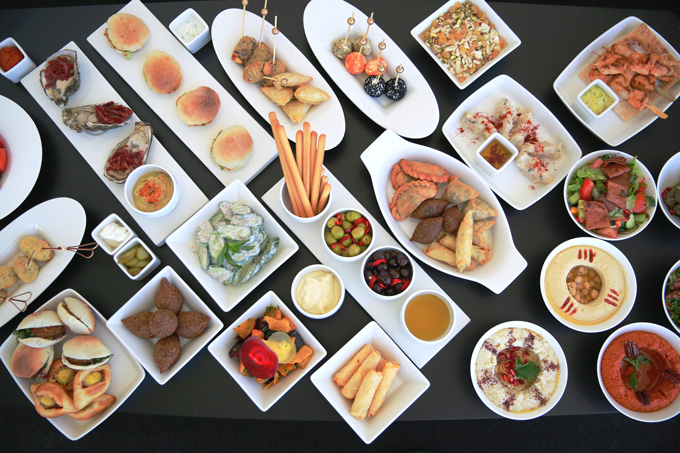
Spa
A destination for total relaxation and well-being, indulge in five-star treatments at the spa. With a comprehensive list of treatments, including massages, therapies and yoga lessons, you can enjoy a top-to-toe treatment program.

About Time WITH Georges Kern, CEO IWC Schaffhausen
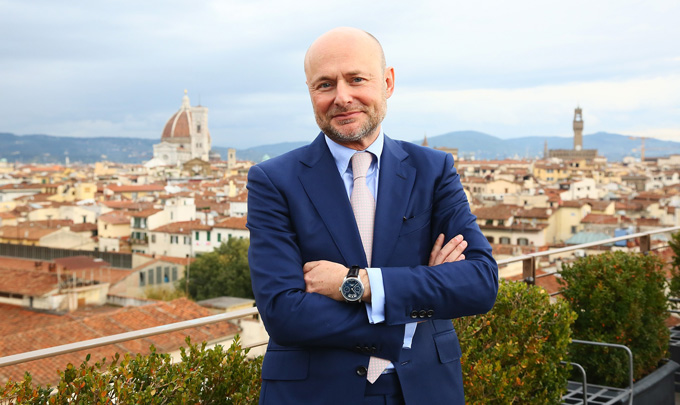
As CEO of internationally renowned watch brand IWC Schaffhausen, a role which he took back in 2002, Georges Kern is a smart and forward thinking force in the world of exclusive luxury brands. He is also committed to charitable causes, as evidenced by his role on the Board of Trustees of the Laureus Foundation, and as a patron of the Fondation Antoine de Saint-Exupéry, supporting disadvantaged youths in their quest to build a better life. These are both areas of corporate social responsibility that the German has blended with watchmaking to create partnerships that have strengthened the brand by supporting others. IWC Schaffhausen has also leapt into e-commerce with Kern at the helm, exclusively launching on MR PORTER and NET-A-PORTER, the only pure play e-tailers to carry the high-end timepieces. This is a huge move for Richemont’s luxury watch division, and certainly a smart reaction to the movement towards e-commerce. So, although the high-end watch business may be suffering and facing challenges, Kern has plenty of ideas to tackle this and propel the brand forward into the new year.
Tell us about how the brand has evolved during your time with IWC Schaffhausen?
Very positively. Sometimes I look back at catalogues of the products from ten to fifteen years ago, and compared to where we are today, the difference is striking. The visibility of the brand has hugely improved, making us one of the biggest brands in the world today. I personally felt the breakthrough when we opened our boutique on Rodeo Drive some time ago, alongside other luxury brands at the top of their game. Profits aside, this was when we could see how far we had come in the past fifteen years.
How has your introduction of women’s watches revolutionised the brand?
Two or three years ago, we launched the first midsize watch aimed primarily at women, due to our understanding that 60 percent of the current watch market is female, and because we knew we were ready. We are strong and competent in our core of men’s watches, making it the time to extend smartly whilst staying true to the values and DNA of the brand. The Portofino was launched with a campaign shot by Peter Lindbergh, featuring women in tuxedos, which is quite a departure from the girlie approach that many other brands adopt. This upheld our vision of strong, established women, and was subsequently a huge success.
Will more of a focus be made on the women’s timepieces, and can we expect more product lines?
We are continuing to extend our offering for women, with our newest being Da Vinci, a slightly more formal line than Portofino which is a leisure style. It complements our current roster quite nicely, made up of the sporty midsize Pilot’s Watch and the Portofino. Later, there will be a fourth product line, thereby completing the women’s midsize collection, and allowing us to have an even greater impact. It is important to IWC that we cover all lifestyles, with an assortment of options from formal to everyday.
Can you tell us about the latest novelties at SIHH?
Da Vinci will be the focus. Not only the female midsize, but also many more technical products, particularly with the new perpetual calendar on a new base movement. This movement was the first breakthrough for the brand many years ago, and something that we are renowned for, so of course in the Da Vinci these same technical aspects will be ever-present, as they are so crucial to the DNA of the brand.
Is there a favourite piece in your eyes?
I love all my babies!
Is there more of a pressure to remain modern, with the interest and popularity in smart watches increasing?
I don’t think that today smart watches are a problem for the classic high-end watch industry. Firstly, smart watches are trying to find their way and are not selling as well as was expected, and secondly, they are better oriented towards sports and fitness tracking, rather than emotions and a way of life. For this reason, they haven’t had a negative impact on us. Instead, the issue which we must concentrate on is remaining relevant with a product that is 250 years old and hasn’t technically changed much, a goal that we are achieving through digital communication. How you talk and sell to the consumer digitally is a revolution, and is an area where we need to focus on to not miss out. To achieve this, we have been investing heavily in social media, as it is in constant flux and fuels our image and perception as a modern company.
Tell us about the IWC Connect that you have been working on, and can we expect more elements of wearable technology?
We have been postponing the launch of the IWC Connect as we were not happy about the standard of the piece in a world where technology changes every day. I personally believe in these wearables, which are different to smart watches, and how they can facilitate your lives, so know that it is something that we will endeavour to produce. The technology will continue to evolve, and as it does we can work on incorporating it into our wearables to ensure that it has the same level of perfection as our analogue watches.
What was the catalyst for stocking your watches on Net-a-Porter and Mr Porter?
Net-a-Porter has been part of our Group and we are still a major shareholder. Therefore we know them very well; in my view, they are the best e-commerce sites on the planet with an unmatched wealth of experience. The brilliance of the teams at NET-A-PORTER and MR PORTER is that they frame the product within a greater fashion context. They place the watch alongside other different yet relevant products, suggesting a sort of virtual wardrobe, which is something we can’t offer as an individual brand, telling a story through style guides as well. The impact of combining our timepieces with fashion has surpassed our expectations, by giving the customer the confidence in how the product can be introduced in all aspects of their life.

Is this a strategic shift to introduce a younger clientele?
Certainly, because purchase behaviour has totally changed. I didn’t have a smartphone when I was younger, but our children and the younger generation have been raised in a different way, and if we miss this movement then our products will be dead. It is not just about the products, it’s the spirit, environment, and the way we talk to our clients which we need to review. Our benchmark is not the watch industry, but instead what is out there in the fashion industry, ensuring that we keep up with the way the consumer is looking to purchase.
How do you foresee the future of e-commerce?
If I look at the last ten years, everything changed, as the market became transparent in terms of pricing and offerings, through the web. The market and clients are mobile, and we need to follow them. As the market becomes digital, behaviours are changing and you need an immense amount of intellectual flexibility to adjust in what is a very slow-paced, traditional industry by definition.
Currently due to shipping restrictions they can’t be delivered to the UAE, what is the reason for this and will it change?
This is just because of logistical regulations which we will be sorting out.

As we are here at DIFF, can I ask what is your favourite film?
In general terms, I prefer the older movies, and I like the big films of the 80s and 90s, such as, ‘Once Upon a Time in America’, and ‘Apocalypse Now’.
Is your own personal interest in the movie and film business what drives the collaborations you have with film festivals?
I hope not as you shouldn’t put your own personal interests too much into work. But I do truly believe that story telling is the common element between IWC Schaffhausen and the film industry. The interlinking characteristics between timepieces and film are that we both create beautiful stories and reactions, ours through the names of our products and the emotions they conjure.
You have recently celebrated the tenth edition of an IWC Laureus watch, why is this foundation such an important focus for the brand?
It was one of our first engagements in corporate social responsibilities many years back, which demonstrates that sport has the power to unify the world. For instance, think of the World Cup final is on: everyone stands still, beyond race, age, and sex. I feel that sports, alongside music, is one of the only common denominators in the world, making it very powerful. So, helping young people through sports is incredibly powerful, as it allows the young people to engage and really get involved in something that speaks to them.
Do you feel that it is very important to dedicate your resources and time to addressing social challenges through sports?
We are not here to save the word, but if you can associate doing good with doing well, then we should try to do that. This is what we are aiming to achieve with all our partnerships that we support to the fullest.
As luxury becomes massified, how do you see the direction of luxury watch making?
I think we are in a changing environment, as everything is transparent and mobile. Following the years of growth that we experienced over the past ten years, we need to make sure that we continue fulfilling the luxury aspect, by only manufacturing limited numbers of pieces, whatever the demand, as luxury goods must remain rare. By keeping this feeling of unavailability of our products, we can continue growing at a manageable rate, focusing more on building long-term brand equity.
What are your New Year resolutions for both your personal and professional life?
Probably to balance my personal and professional lives well, which requires discipline.
By Eliza Scarborough
Park Hyatt Dubai
A fusion of Arabic and Mediterranean design

Park Hyatt Dubai combines elegance and drama in architecture, combining modern trends and regional trademarks in both the interior and exterior design. The architecture of the hotel draws on the essence of Arabic and Mediterranean heritage with blue domes and white buildings.
Location
Located in Dubai Creek Golf & Yacht club on the banks of the majestic Dubai Creek, Park Hyatt Dubai provides an idyllic setting for a luxury getaway. It is nestled in the heart of city, ten minutes from Dubai International Airport, Gold Souk, Dubai Museum and Burj Khalifa.
Style and Character
The chic city resort consists of 223 luxury rooms including 34 suites, all of which offer stunning views overlooking the Dubai Creek and marina. On the outside, the hotel mixes Mediterranean and Arabian influences, and on the inside, the plush rooms are in shades of cream, ivory and pearl, with subtle features, such as patterned carpets and screens, tipping a hat to Dubai’s history. The balconies with creek views are our favourites, while the swimming pool is a serene haven surrounded by shady palms.

Food and Drink
Park Hyatt Dubai brings to stage world class cuisines, stylish decor and spectacular views with its award-winning restaurants and bars, offering the finest in Western, Eastern and Middle Eastern cuisines. With floor-to-ceiling windows, wood-fired ovens and theatre kitchens, the hotel brings excitement and style to dining, both indoor and al fresco. Traiteur, Park Hyatt Dubai’s signature French restaurant presents casual dining within a Creek front setting offering panoramic views of the marina. The back-to-basics menu incorporates elements of classic French cooking, accompanied by seasonal surprises delivered to your table by Chef Dennis and his crew of sociable chefs. Reminiscent of the hustle and bustle of downtown Bangkok, The Thai Kitchen presents authentic Thai dishes prepared by native chefs.
This award-winning restaurant offers three live kitchens, one each for wok, grill and noodles, as well as an additional kitchen devoted to the preparation of traditional Thai desserts. Over at Café Arabesque, culinary delights are presented from the Levant region, influenced by the flavours of Jordan, Lebanon and Syria. Featuring cold and hot mezze sections along with delectable main course options served from the charcoal grill, the freshest of ingredients are infused with traditional culinary heritage. If you are looking for an area to unwind and enjoy the sunset over the water, the Terrace is a perfect venue with its canopy-covered terrace and outdoor boardwalk, all set amidst abundant palm trees. Here there is a standalone seafood raw bar, offering a selection of caviar, oysters and Baltic salmon.
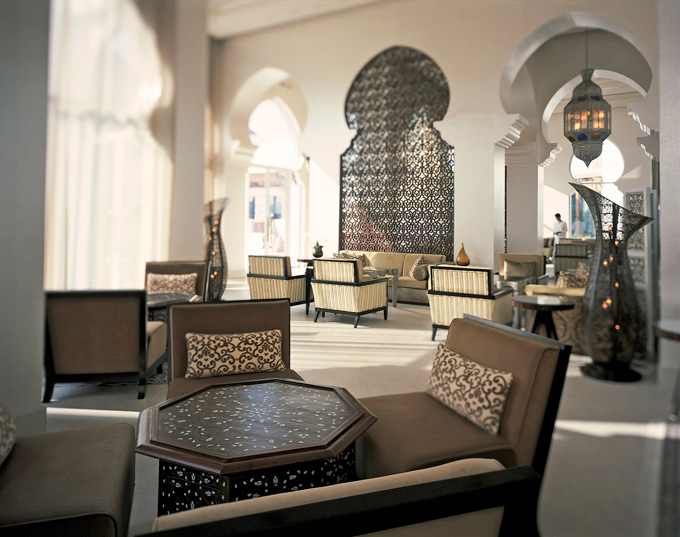

Spa
The Amara Spa features eight private treatment rooms, and the spa concierge will customise your experience using ancient healing philosophies to ensure that your individual needs and preferences are met. Combined with the finest products, Arabian teas, and authentic delicacies, your trip to the spa will be an unforgettable and personalised experience.
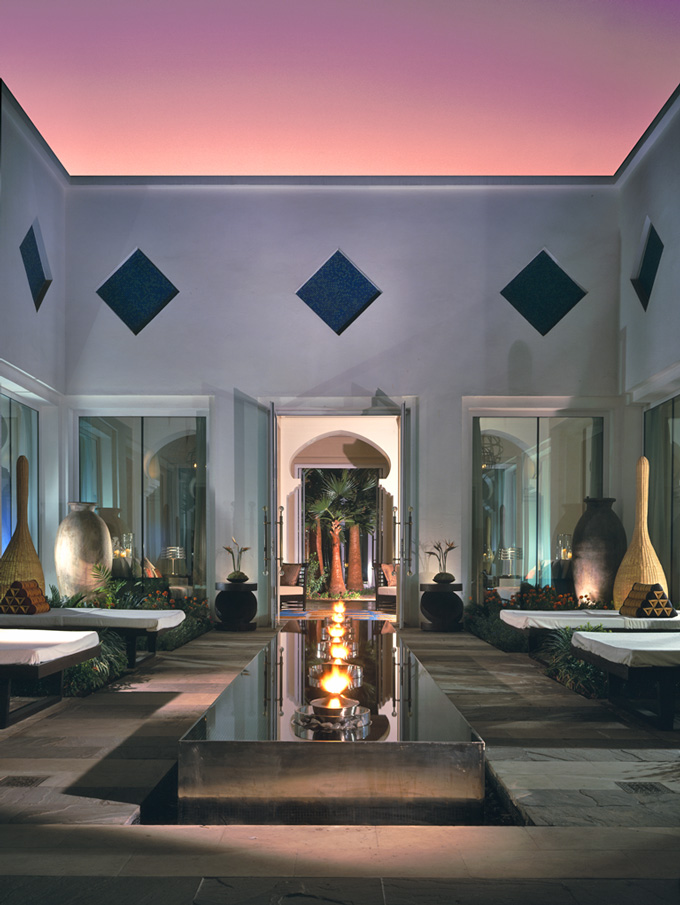
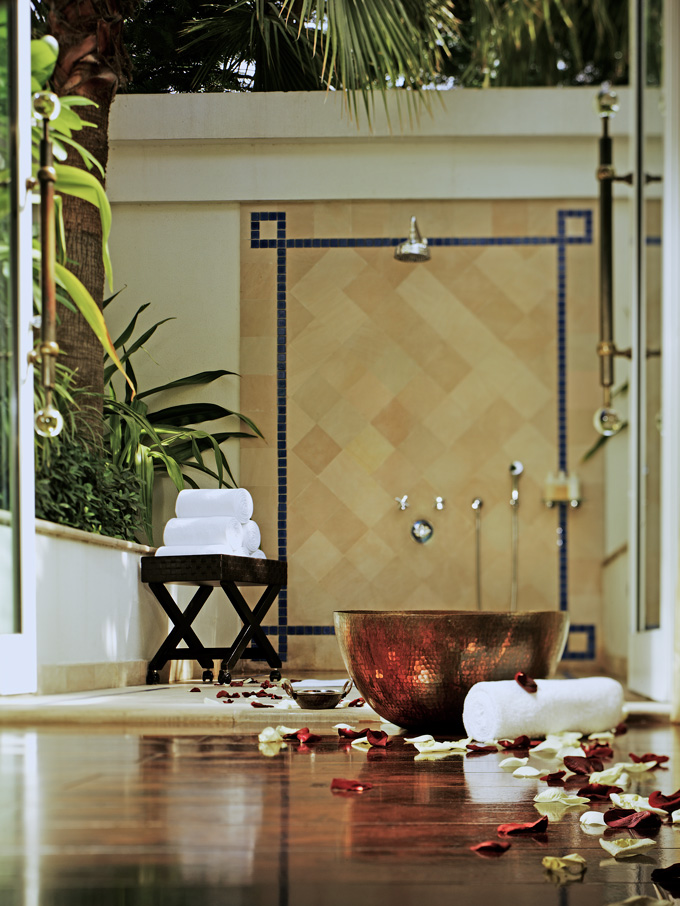
La Réserve Hotel and Spa, Geneva
Between the alps and the Jura mountains, are dazzling African interiors, an ice rink and a swimming pool overlooking Lake Geneva.
Member of The Leading Hotels of the World

Location
Within a beautiful 10-acre park, the cleverly concealed reserve is just two miles from the airport and three miles from the city centre, which is easily reached in ten minutes by road or by the hotel’s own very chic motoscafo which whisks you across Lake Geneva.
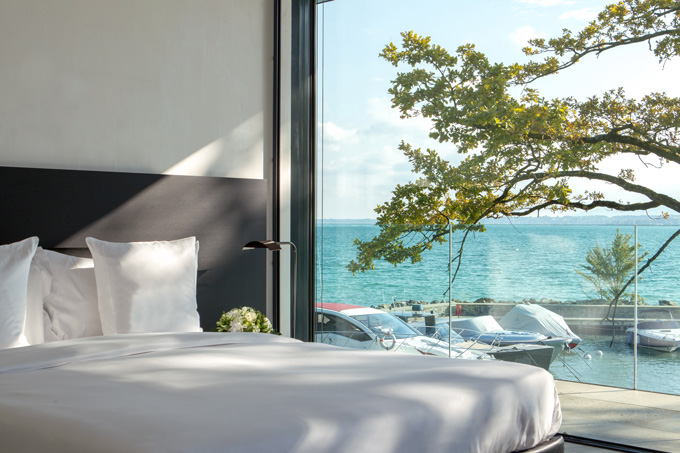
Style and Character
Playing on the name of the hotel, designer Jacques Garcia has re-imagined an African game reserve with striking décor from oversized prints of lions, sculpted elephant heads and spotted rugs, to a line of jellyfish lights lining the indoor swimming pool in the spa. It is fun, warm and very stylish.

Rooms
Michel Reybier’s inspired vision took shape with the help of Parisian interior designer Jacques Garcia. The 81 rooms and 21 suites interpret the refined style of African lodges with luxurious linens and a particularly delicious range of La Réserve toiletries in the elegant black granite and marble bathrooms. The spacious rooms open wide onto the exterior, and some even have a patio with direct access to pool and park. Providing delightful views over the sparkling waters of Lake Geneva from their balcony or terrace, the Lake suites offer huge round baths equipped with balneotherapy jets.
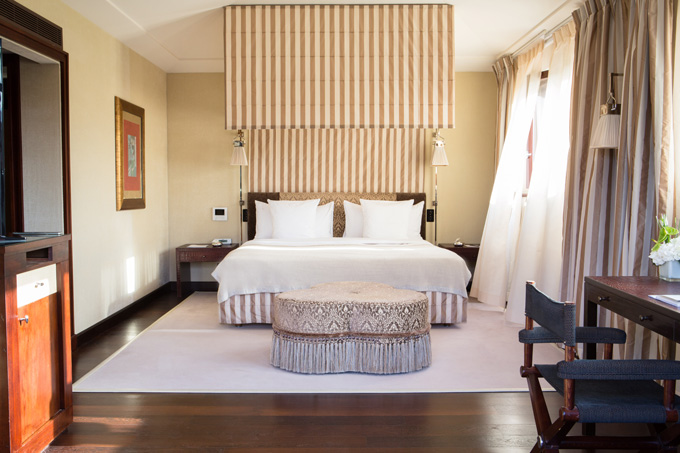
Food and Drink
A wide choice awaits, from the fat-free, raw and healthy dishes in the spa’s Café Lauren, to the memorable Peking duck at the glittering Tsé Fung which transports you to a Shanghai of the 1930s. The Loti Restaurant, popular for Sunday brunch, offers classical delicacies such as Sole Meunière, while over at The Summer Lodge in the gardens, you will find prawn and lobster tanks, fresh oysters and sushi.

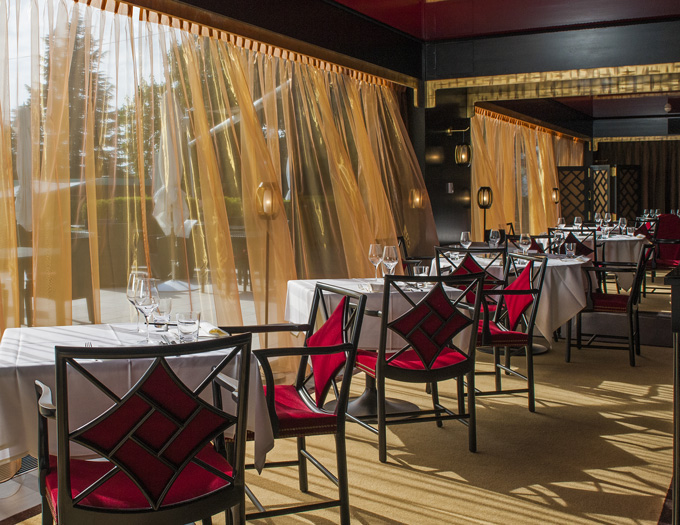
Spa
The spa is one of the best in Europe with indoor and outdoor pools, a sauna and hamman, tennis courts and a fitness centre. Encompassing cutting-edge medical treatments drawn from the expertise of the Nescens brand and the Centre for Ageing at the country’s Clinique de Genolier, you can expect results here, from figure shaping through Zeltiq CoolSculpting, to lipo massage, facial tissue regeneration, or help in radically changing your lifestyle for continued results. Beauty products come courtesy of La Prairie and their firming caviar treatments.

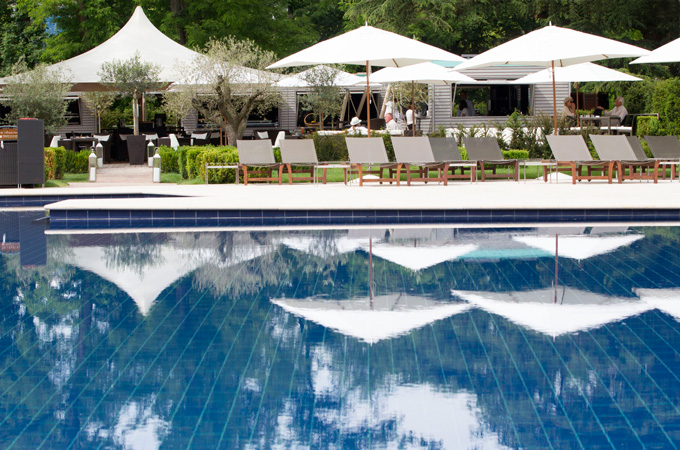
La Réserve is a member of The Leading Hotels of the World, a collection of authentic and uncommon luxury hotels. Rooted in the locations where they are found, the hotels embody the very essence of their destinations. Offering varied styles of architecture and design, and immersive cultural experiences delivered by passionate people, LHW’s collection is for the curious traveller looking for their next discovery. Established in 1928 by several influential and forward-thinking European hoteliers, Leading Hotels has an eight decade-long commitment to providing remarkable travel experiences.
