

Cross THE LINE
Embrace your inner garçonne with these sleek takes on boyfriend staples

Tuxedo shirt at By Symphony, Chanel Cruise necklace, Roksanda trousers at By Symphony

LEFT IMAGE:
Aigner dress and jacket, Stuart Weitzman boots
RIGHT IMAGE:
Dior Cruise jacket and trousers

LEFT IMAGE:
Carven jacket and skirt at By Symphony, Maison Michel hat at By Symphony, Chalayan shirt at By Symphony, Gucci scarf at Net-a-Porter
RIGHT IMAGE:
Zadig and Voltaire sweater, Delpozo skirt at By Symphony, Chanel Cruise clutch bag and loafers

Maxmara coat, trousers and body

LEFT IMAGE:
Victoria Beckham top and trousers at Boutique 1, Mulberry bag, Gucci loafers
RIGHT IMAGE:
Lanvin hat at Net-a-Porter, Victoria Beckham dress at Boutique 1
Fashion Director : Eliza Scarborough
Photographer : Stephanie Galea
Hair and Make-up : Marisol Steward
Model : Sylwia at MMG
A Pioneer in The World of Wellness

Founder and President of Technogym, Nerio Alessandri talks about his dream that turned into a reality.
Nerio Alessandri was born in Cesena, Italy on April 8th, 1961. As a six year old boy he would build monuments from Lego. He was no ordinary boy though, turning his Lego of dreams into a reality, by building fitness machines found in hospitals, universities, clubs, homes, hotels, offices, and gyms around the world. This helped shape the formation of an innovative fitness village in Italy, the first of its kind, which focuses on wellness as an overall theme. Many would soon be replicated across the globe.
Alessandri studied as an industrial designer. In 1983, at just 22 years old, he founded Technogym, which started in his home garage. Although, his life could have easily taken a different turn if he had continued his interest as a fashion designer. Alessandri had planned to work for Giorgio Armani at 21 years old, but instead, he chose a life of health and wellness rather than fashion.
Today he has a world leading company offering products and services for wellness and rehabilitation. His company has equipped 65,000 wellness centres and over 100,000 homes around the world. It is estimated that approximately 35 million people use Technogym products every day. He’s employed 2,200 people in 14 branches across Europe, US, Asia, the Middle East, Australia and South America. To add to this, his credentials include, The Knight of the Order of Merit for Labour, Vice President of the Leonardo Committee – an entity which sustains and promotes Italian products throughout the world, ‘World Heart Champion’ by the World Heart Federation and the Guido Carli Award in the category for ‘Corporate Social Responsibility.’ With these achievements under his belt, his sole purpose is to make the world a better, healthier, and happier place.
Even in the early ‘90s, Alessandri defined the wellness concept as a lifestyle which aimed at improving quality of life thanks to regular physical activity, a healthy diet and a positive mental attitude. He is a compassionate innovator, caring for people and society. He said: ‘I was a young boy with a dream. The dream was to realise something, to build something and to leave a mark. The most important thing is to leave a legacy and to create something for the next generation. For me, it’s important to design not just an object but a culture. I want to help people, people with illnesses like depression, muscular pains, and cancer. Exercise is medicine.’
How did this all begin?
I started over 30 years ago in a small garage. The first piece of equipment I produced was a pectoral machine, and my wife (then girlfriend) was the first model for the company. She helped advertise Technogym in the small garage, in 1984.
I am both an industrial and wellness designer. My vision was always to design not only the product, in terms of technology or functionality, but to design an environment and create a lifestyle. Wellness is a lifestyle and the evolution of the physical being. The physical is about looking good, and wellness is about feeling good. I wrote a book ‘Born to Move,’ which is about the journey from having a gym in the garage, to developing a wellness economy, in terms of evolution from a green economy to a wellness economy. The green economy is put in the centre of the environment and the wellness economy is put in the centre of a person. Thanks to this vision, and thanks to my obsession and passion, I continue to design and innovate.
What exactly is the Technogym Village?
In September 2012, we created the first wellness ecosystem in the world, The Technogym Village. We wanted to transform a bad lifestyle into a wellness lifestyle. I’m convinced that the new frontier is about wellness. There is a wellness centre, wellness restaurant, wellness university, wellness work place and wellness doctors, among many other things. Everything is based around wellness because our mission is to improve people’s lives. Our vision is to deliver a wellness solution, and our strategy is to provide a wellness experience on the go, every day and everywhere.
Antonio Citterio, Patricia Viel and Partners, one of Italy’s most internationally renowned architecture studios, designed 60,000 m2 of covered space to spread across the 150,000 m2 site. This represents the first wellness campus in the world, a cultural centre, a laboratory for innovation and a production centre where staff, customers, suppliers, and guests from across the globe can visit and enjoy a wellness experience. The project is fully integrated into the ‘Romagna-Wellness Valley’, an initiative which aims to create Europe’s first wellness district in Romagna. The design is inspired by the concepts of eco-sustainability and bio-architecture.

Tell us about your campaign ‘Let’s Move Towards a Better World’.
At the launch of the village we invited 2000 people. The theme was ‘Born to Move’. We wanted to focus not only on the movement of the body but also the movement of the mind. Technogym is a solution to societies’ problems. Health is wealth! Good health benefits everyone, the government to reduce the health cost, people’s improvement of everyday life and companies to increase productivity and creativity. And wellness is the balance between the body, mind, and spirit.
In 2016 there were great improvements, visits increased by an average of 29 per cent, new memberships increased by 16 per cent, and over three quarters of participants saw an increase in the engagement and motivation of existing members. In 2017 we are promoting a global ‘Let’s Move for A Better World’ campaign. The campaign will take place for the fourth year running, with a social goal to reduce obesity and sedentariness. Thanks to Technogym’s ecosystem platform, from the 13th to the 31st March 2017, gym members in fitness clubs all over the world will join forces to promote wellness and healthy living in their local community, and beyond. The more active the club members are, the bigger the donation will be to the communities.

Nerio Alessandri infront of the Technogym Village in Cesena Italy- the best wellness centres in the world.
What has brought you to Dubai today?
I’m visiting from Italy for the World Economic Forum, which I am a member of in Switzerland. We will talk about improving health, wellness, and the community.
How do you see health and wellness in the Middle East?
Diabetes is a big problem here in the region. In Qatar, 23 per cent of people suffer from it. In Abu Dhabi and Dubai there are many locals who have type 2 diabetes. Thanks to wellness and good nutrition, it is possible to improve this situation. This is the evolution of wellness.


Do you think the concept of wellness will evolve in the future from what it is today?
I am very convinced that the future of the patient is wellness. The priority is the quality of life. I think that is the starting point for family life, work, relationships, friends, and a good lifestyle. For this reason, we have invested a lot of money on research, development, and education. We plan to spread wellness around the world by making sure people have good food, experience regular physical activities, and have a positive mental approach to living.
What does the future hold for Technogym?
We have a vision that we want to spread throughout the world. During the next World Economic Forum in Davos-Klosters, Switzerland, we will discuss the launch of wellness cities, in terms of universities, hotels, residential gyms and corporate offices. It’s about spreading wellness cities around the world. We have created a company dedicated to consulting. It’s called ‘Wellness Partner’ and its aim is to help the government and developers, to support investors, to create a wellness environment.
Do you have any role models?
I have many. Adriano Olivetti was an Italian engineer, politician, and industrialist whose entrepreneurial activity thrived on the idea that profit should be reinvested for the benefits of the whole society. He was a pioneer in the world of corporate social responsibility. Then there is Steve Jobs, who was instrumental when it comes to connectivity. Also, Giorgio Armani is my role model in fashion design.
By Hershey Pascual
DIOR HOMME: A Synthesis of Generations
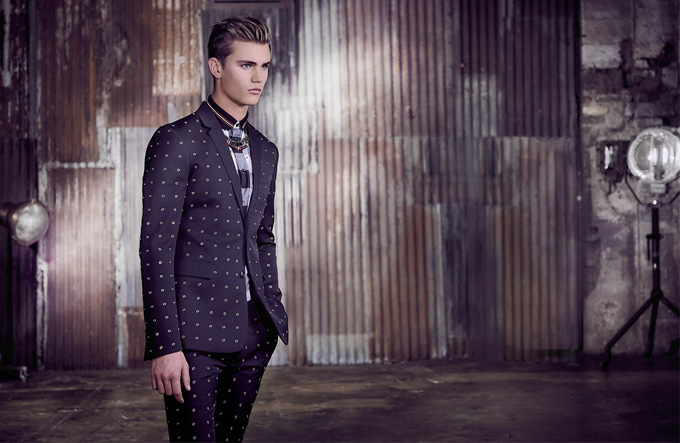
Embroidered jacket and pants, Shirt, Necklace All by Dior Homme
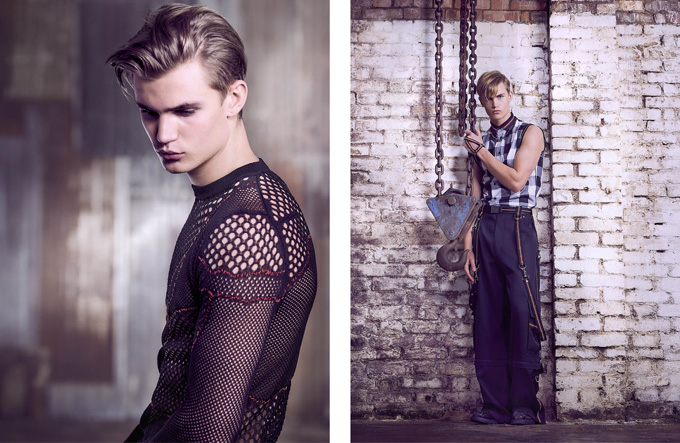
LEFT IMAGE:
Knit top By Dior Homme
RIGHT IMAGE:
Shirt, Oversized pants, Necklace, Cuff. All by Dior Homme
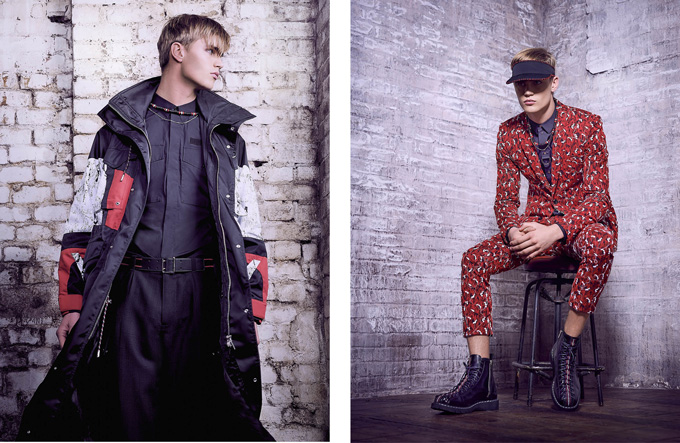
LEFT IMAGE:
Coat, Shirt, Oversized pants, Necklace, Belt. All by Dior Homme
RIGHT IMAGE:
Embroidered jacket and pants, Shirt, Necklace, Cap, Boots. All by Dior Homme
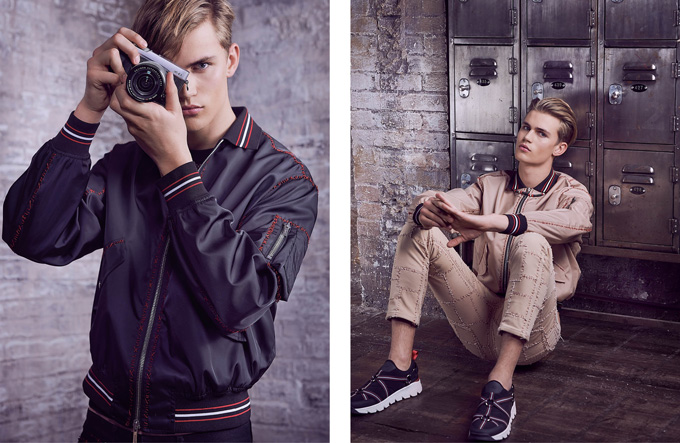
LEFT IMAGE:
Bomber jacket, Knit top. All by Dior Homme
RIGHT IMAGE:
Nude denim jeans, Bomber jacket, Sneakers, Necklace. All by Dior Homme
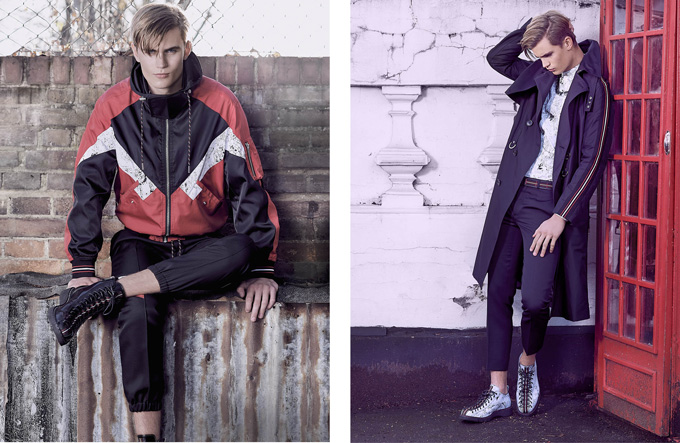
LEFT IMAGE:
Bomber jacket, Pants, Boots. All by Dior Homme
RIGHT IMAGE:
Trench coat, Shirt, Pants, Boots, Belt, Necklace. All by Dior Homme
Fashion Director : Eliza Scarborough
Photographer : Lezli and Rose
Model : Sam Harwood at Models 1
Grooming : Vassilis Theotokis
PRADA: The Urban Traveller

Rip stop raincoat, Tela check colour jacket. All Prada

LEFT IMAGE:
Flat denim jacket and pants, Technical fabric backpack, Flat denim navy hat, Cotton tec headband. All Prada
RIGHT IMAGE:
Tela check colour jacket, Elastico colour belt, Wool rasato tec knitwear, Saffiano prints wallet. All Prada

LEFT IMAGE:
Light wool jacket and pants, Wool moulinè tec gilet, Cotton fabric headband, Rip stop vela lifestyle, Metal and nastro nylon bracelets, Gabardine nylon hat. All Prada
RIGHT IMAGE:
Wool quadretto vichy jacket, Tela check bicolor pants, Madras cotton shirt, Moulinè cotton socks, Nastro nylon sandals. All Prada

LEFT IMAGE:
Wool tela quadretto overcoat, Madras cotton shirt, Cotton headband zig zag print, Fabric printed hat, Technical fabric and nylon patch bag, Nastro nylon belt, Moulinè cotton socks, Rubber sandals, Saffiano bracelets. All Prada
RIGHT IMAGE:
Tela madras colour gilet, Wool rasato tec knitwear, Cotton headband in zig zag print, Wool quadretto colour pants, Moulinè cotton socks, Rubber sandals, Saffiano bracelets. All Prada

BOTH IMAGES:
Cablè patch wool gilet, Nylon piuma shirt, Rip stop vela pants, Fabric printed hat, Nastro nylon belt, Technical fabric backpack, Cotton jacquard headband, Saffiano eyeglasses holder, Nastro nylon sandals. All Prada
Fashion Director : Eliza Scarborough
Photographer : Lezli and Rose
Grooming : Laurence Close
Model : George Admiraal at Models 1
Jeremy Hackett’s Secret to Success
Chairman of British designer menswear company Hackett London

Jeremy Hackett is a man who knows style, and after spending the seventies working in a Savile Row tailors, he founded his eponymous shop, which grew from a second-hand outfitter to the classic British brand we know today. For some people, Jeremy Hackett is the Ralph Lauren of the UK, but the story of his brand Hackett runs far deeper than their mutual appreciation of classic style.
In the early eighties, Jeremy Hackett went on a trip to Paris where he met a dealer at the Clignancourt flea market selling quintessential British second hand clothing such as Aquascutum, Burberry, Savile Row suits, and tweed jackets. The dealer travelled to London on a weekly basis to scout for products, and since he was tired of his flea market journeys, he asked Jeremy Hackett to do this work for him. After about a year of indirectly providing the Parisian with used high quality clothing, he decided to do the same thing in London under his own name. As such, he partnered with Ashley Lloyd-Jennings in 1983 to open the very first Hackett second hand store on London’s Kings Road. Lloyd Jennings left Hackett in 1999 to work at Dunhill, leaving Jeremy growing the brand. From here there were collaborations with Rugby and Polo players, rowing teams and Aston Martin, a strong following including the future King of England, Prince William, and even the Mr Classic blog to keep in touch with customers through modern means.
We chat to the founder and chairman about how despite launching the label more than 30 years ago he understands the importance of the modern shoppers needs, together with learning his top style secrets.
From where do you tend to draw inspiration for your collections?
Inspiration comes from many sources. As a British brand, we are always keen to highlight the British lifestyle, especially because in Britain we are fortunate to have many social occasions to dress for. We partner with several iconic British brands, such as Aston Martin, British Army Polo, British Polo Day, London Rowing Club and William’s motor racing, so are never short of ideas to refresh the ongoing collections.
What inspires you outside of fashion?
I am inspired by photography for which I have a passion. This can range from art and architecture, in both a contemporary or classical form. Movies are another source of inspiration, with ‘North by Northwest’ being a favourite of mine.
Who is your ideal Hackett customer?
Anyone who has made the decision to walk through our doors is a valued customer.
Which individual, past or present, would you most like to dress?
From the past, the movie stars Cary Grant and Steve McQueen, and in the present it would be the actor Bill Nighy.
Who in fashion do you most admire and why?
I have always been drawn to the Japanese brand Comme des Garçons. Whilst some of their creations are a bit too much for me, within their collections are many pieces that have a fresh take on the classics, and I like the fact that they have fun with their clothes.
How have you found the changes over the past decades in the fast-moving world of fashion?
It may be that I am getting older, but the pace of fashion appears to be increasingly faster. However, it is almost always the case that you can predict that what was extremely fashionable for one decade, will be the complete opposite the following decade. So, in that respect very little changes.
Do you appreciate the changes that technology has made in fashion?
On the whole, technology has been good for fashion as it has made people across the globe much more aware, but the adverse effect is that people’s attention spans have become much shorter. Seeing catwalk shows as soon as they have appeared can mean they lose their lustre almost immediately, making it increasingly stressful for designers to create new lines to feed an increasingly hungry Internet market.
Are you a keen user of social media?
The only social media I use is Instagram, purely because I like to take photographs. I am always intrigued and sometimes surprised about what people like. My dogs are a favourite.
What has been the best-selling product you have worked on?
It’s probably the Hackett polo shirt that I introduced in 1986 and is still hugely popular today.
What has been your proudest achievement?
Creating a brand from scratch, I can barely believe it.

What advice would you give to other young people with the same aspirations that you had 30 years ago?
When I started Hackett I believed in what I was doing and maintained a strong point of view. Both factors are important, but also good financial management is necessary for long term success.
What do you consider your best attribute?
Understanding the customer.
What is your most prized possession?
Well, I would not call them possessions, but my Sussex Spaniels Muffin and Harry.
What are your style essentials?
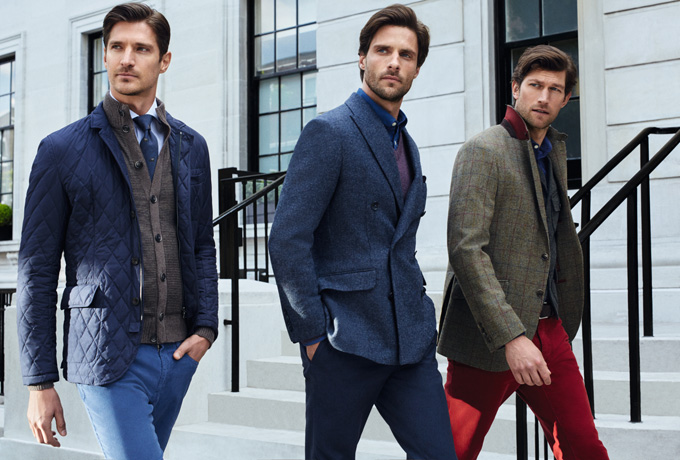
Pretty much anything in navy-blue and good shoes.
What is something every modern-day man should possess?
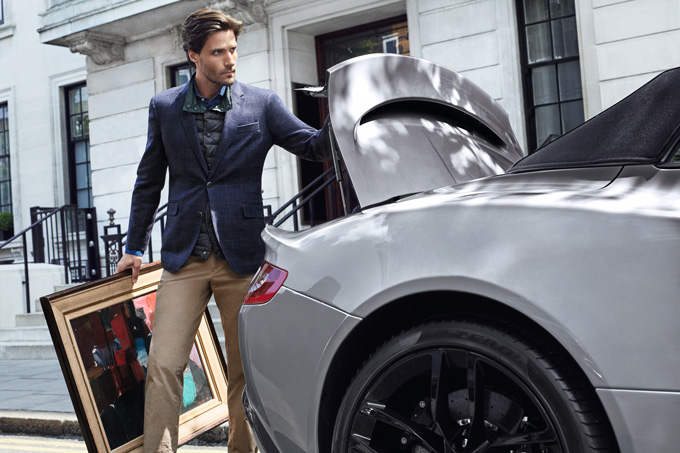
Modern day or otherwise, every man should own a navy-blue blazer of some description.
If you could give one piece of sartorial advice to gentlemen everywhere, what would it be?
Keep it simple.
By Eliza Scarborough
Welcome to the World of Schiaparelli
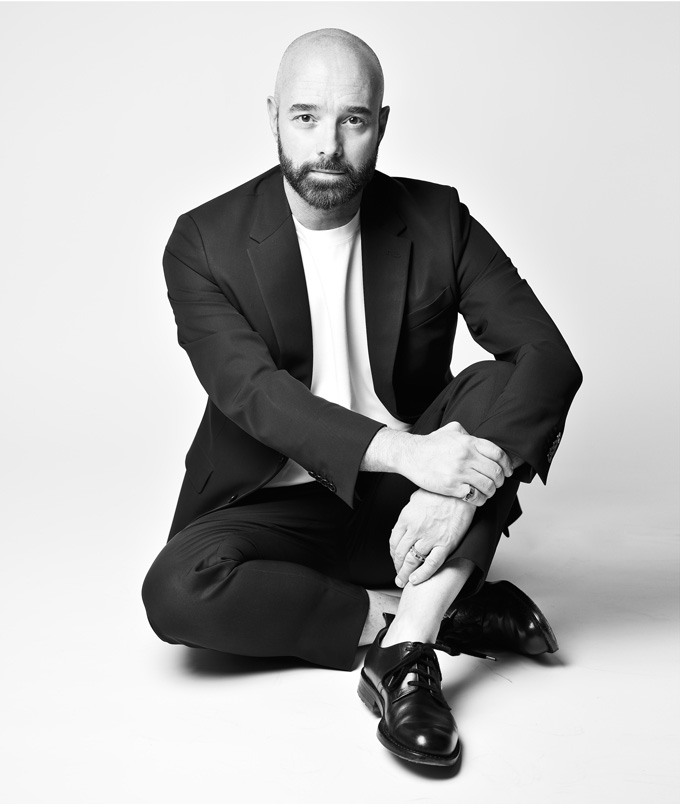
In 2015 Bertrand Guyon was named as Marco Zanini’s replacement at the helm of Schiaparelli, as design director across both haute couture and ready-to-wear. The storied house is steeped in history, with an exceptional legacy of quirkiness and creativity, influenced by founder Elsa Schiaparelli. Guyon, an École de la Chambre Syndicale de la Couture Parisienne graduate and seasoned couture designer, was previously at Valentino, Givenchy and Christian Lacroix. He may be the opposite of what many think of when the name Schiaparelli is invoked. Elsa was shocking, as in her favourite colour shocking pink, and her memoir was aptly named, ‘Shocking Life’. However, the more understated Bertrand, has not only respected the brands heritage and tradition, but has also given it a contemporary and modern take. Silhouettes have remained relatively simple and classic, occasionally incorporating sculptural elements, while colours and prints have been more adventurous. Cheeky appliqués and motifs may have employed skills learned at Valentino, but have been executed in a way that is very Schiaparelli.
You have been with Schiaparelli for just a few seasons. How have you found the position?
I feel like I have been here for years, although it is only my third collection, time goes so fast, but I feel very settled now. I know Elsa Schiaparelli’s body of work better, from the sketches of her collections we have in the archives, to pieces I have seen in museums. I guess it was a necessary period to get to know each other, the house, its spirit, the teams and myself. But, I must say that I immediately felt quite at home in the sense that it was immediately pleasant and welcoming. There is something here that makes you particularly at ease. It might be her spirit that is surrounding us, since we work in the very place where she used to work.
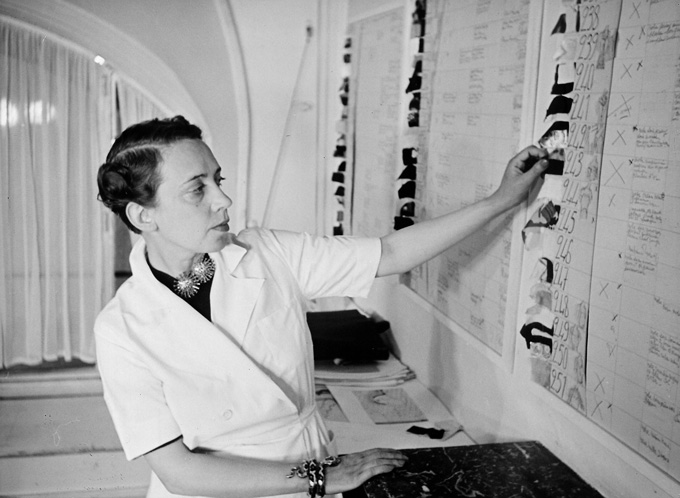
Elsa Schiaparelli
How do you find the pressure of reviving such an iconic French house?
It is something that I probably was not fully aware of when joining Schiaparelli, but that makes the challenge! It is about finding the right equation between respecting such an iconic house and its amazing legacy and history, together with the fact that few people outside the fashion world really know about Schiaparelli, whilst being contemporary and creating something for today’s women. The mission is to extract the spirit of Schiaparelli to re-invent its fashion.
How far do you feel you can push the collections towards your own vision, whilst still referencing Elsa?
This is what I am trying to reach with each new collection, but I start from scratch each season. Each time it is a new beginning. Doing, making, re-doing, re-making is the only way to hopefully find its own path, it is a complex process that only time will allow to fine-tune.
How would you describe your signature design style?
This is something that you might be able to answer better than me! I guess you need to be on the outside to answer that one. What I can say is that I have a natural taste for craftsmanship, femininity, precious elements and refinement. I love embroidery and embellishment, which is completely in sync with Schiaparelli. I also love working with all the artisans, and these collaborations are part of what Haute Couture and Prêt-à-Couture, our own version of ready-to-wear, are about. This is a real asset compared with other brands and high diffusion fashion. It is a tradition of excellence in terms of fabrics, materials, and embroideries. It is also some sort of resilience in a world where everything is done so quickly, the ‘humanity’ that goes into everything we do makes it truly unique.
Do you have a muse or someone’s style that you admire?
I do not have a muse per se, and do not sketch with a specific woman in mind. However, there are always many women who are references on the moodboards I do for each collection. They are not always the same, but some may come back. They can be a model like Guinevere van Seenus, Linda Evangelista, and Carolyn Murphy, or otherwise famous women like Loulou de la Falaise, Tina Chow, and Lee Miller. They embody a mix of aristocracy, culture and taste, which make them real personalities. It goes beyond their beauty.

What is your work philosophy?
My work has always been a vocation. I spend hours and hours at work, and love coming early in the morning. Something that is part of me is to constantly question myself and what has been done.
What was your first job in fashion?
The job that I feel wass my first real one is Givenchy, because I had always wanted to work there for as far as I can remember as a child. I also had the chance to work there with Hubert de Givenchy, John Galliano and Alexander McQueen. It was an incredible experience.
Do you feel your training at other prestigious design houses has enabled you to hone your skills and bring a wider variety to your current collections?
Of course, they have naturally blended and nurtured who I am today. However, none of them are specifically or consciously present in my mind when creating today.

What was the turning point in your career?
The first one was when Hubert de Givenchy retired, allowing me to work with John Galliano and then Lee McQueen. I enjoyed what I wanted to experience, in the same way a ballet dancer who has been trained for years at the Opera with all the subsequent classical techniques going on to dancing for a contemporary dance company. Suddenly, I was exposed to another world of fashion, creation, influences, and references. The second was with Valentino. To get to know and work for that great Italian couture house with all its professionalism and its tradition of amazing ateliers, was something I had not experienced before. It helped me develop a new take on my job. Haute Couture is French and I am French, but working at Valentino, which is an Italian company, allowed me to experience and learn a lot.
What do you prefer working on, couture or ready to wear, and why?
My DNA is Haute Couture, especially because I love working with the atelier. The notion of time is also fundamentally different, which is quite crucial nowadays. At Schiaparelli, the fact that we take the time to nurture our collections might be the added value that women appreciate. We do not produce 20 collections a year, which may make each one quite ‘banal’ for the clients. Haute Couture also refers to a different culture, a craft that is exclusive.
What drives and inspires you on a day to day basis?

Anything inspires me on a daily basis, from a book, a magazine, a film, or music. For instance, I can get completely obsessed with a certain kind of music, an artist, or songs, and will listen to it from morning to evening for days. It will put me in a certain mood that will certainly influence what I am working on. Then, after a while, I will not listen to it for a long time because I would have switched to another one. Each season is marked by a small number of musical influences. I travel in my head more than physically.
How have you found the recent movements of Creative Directors across other design houses? Does this give a feeling of unease or do you think it injects new passion and ideas?
According to me, it is not really healthy. A designer needs a bit of time to develop and fine-tune a vision. Some may manage to do it from the first season, but most human being needs time to properly digest and find the right balance between creativity and commerce. The right equation between the designer, the manager and the brand is a formula without a unique recipe, however it does take time. What is fundamental is the dialogue between the various parties in order to avoid misunderstandings and create a clear vision. All these changes can be quite destabilising for the teams, but also for the clients who see the style change from season to season, making it difficult for them to identify themselves with the brand through the years of change.
How have you reacted to the rise in social media and e-commerce in the fashion industry?
There is something there that makes it somehow quite exhausting. That global quest for new pictures every 2 seconds and for commenting on everything seems non-stop. I am not sure it helps anyone think about the world we live in, or simply try to understand it, making people become judgmental rather than analytical. At the same time, it is quite stimulating to watch such a variety of pictures. I guess it is a question of balance.
Do you feel that this will keep changing the future of fashion?
I would not be able to tell as it keeps on changing and evolving at a very quick pace.
By Eliza Scarborough
Giuseppe Santoni, A man of fine details

The CEO of Santoni discusses the family business and his attention to details
Santoni shoes are one of the world’s finest purveyors of luxury footwear. Much of its success was because of Giuseppe’s father, Andrea, who founded the company in 1975 and passed the legacy on to his son. Giuseppe Santoni came from a modest family who worked hard to create their vision, a vision that came from technical skill, passion, dedication and respect for people and quality. Quality is a key word here, in terms of ethics, for Santoni as a brand. It will be hard to find someone that pays more attention to shoes than its CEO. At 48 years old, Giuseppe Santoni has a lot to say about the early days and the success of the company 40 years on.
We met Giuseppe during our visit to the Santoni headquarters in Corridonia, Italy and we had the following chat.
It’s been 40 years. How is Santoni today and what are you aiming to achieve?
I joined the company at a very young age, and was 21 when I became CEO. At the beginning the company was very small, with my father Andrea starting it at the garage of our house. We lived up-stairs and so I basically grew up in the factory. My passion for his work started at a young age, and I was always interested in this world, aiming to become what I am today. I never thought about becoming anything else, like a policeman or a fireman. Together, with the family, we created Santoni, although the hardest part was to develop the company from an excellent manufacturer to the luxury brand that it is today.
Family businesses have pros and cons. What are these for you?
My father started the business from nothing and was able to create a successful company in a few years. To him, it’s impossible to make a good business without knowing the craft behind it. People have different skills. My father is very technical, whereas I am very much market and brand orientated. My father gave me the power to make decisions when I was 21 as the new CEO, however I always asked him for his opinions. I am the son who always listened to his parents, but I grew up with my own ideas. Sometimes I made decisions where my parents didn’t agree, but they trusted me.
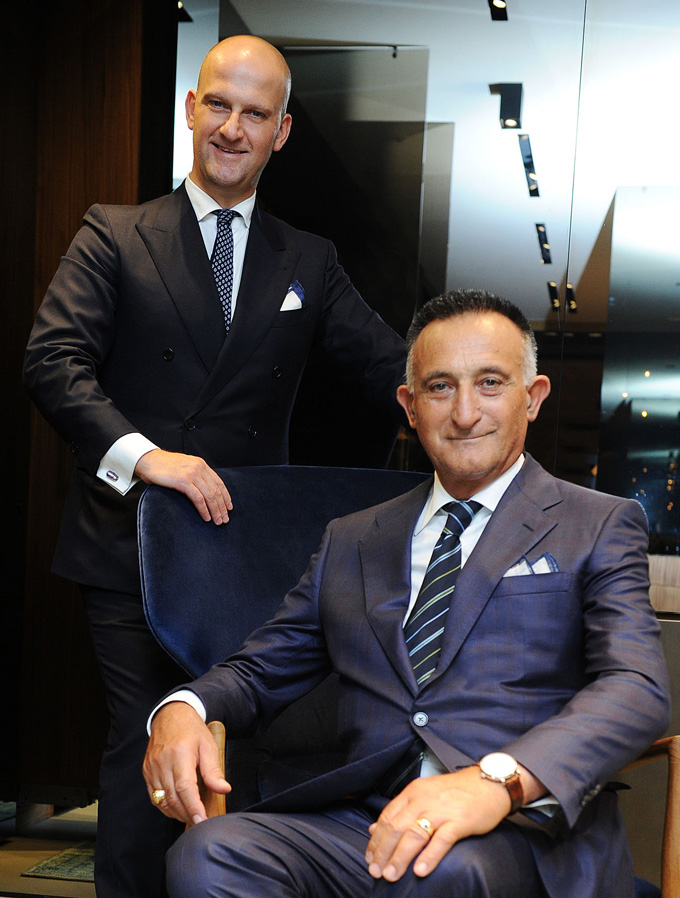
Andrea and Giuseppe Santoni
My father is a real entrepreneur with a bright vision, he was not just a man who could make shoes. When I was 17 my father didn’t speak English and he told me he wanted to go to New York for a fashion show, asking me to join him. He felt that if we both went then something could happen. I spoke twenty per cent English at that time, but I learned immediately, together with understanding the technicalities of the business. Now, I can control the company from a technical aspect. In this kind of company, you can’t just be a CEO that came from an Ivy League school, you need to know the products because quality is involved.
How involved are you with designing?
I’m not the designer and I can’t draw, but I approve every shoe you see. First I give directions, I say what I like and what I want. I tell people my vision, my direction, where I want to go, what I want to achieve and they create it. Like a tailor making a suit. I create Santoni’s vision around our DNA. I have a passion for details, quality, luxury and beauty, and I pride the company on these things. I tell my team, we don’t make shoes, we make objects of desire which create an emotion for each customer. You need to think of something desirable, not necessary. You don’t need luxury to survive but you need luxury to live.
We live in a world where everything is fast paced and digital. How hard is it to maintain tradition?
Keeping quality is part of our insurance policy, and without it I don’t know how we can survive. We are not a fashion brand, but we are a quality brand. When you are a fashion brand you can sell a name and people buy a name, however, in our case, people buy the product not just the name. Ladies tend to throw fashion away, but you don’t throw quality shoes away, you keep them. They are timeless.
Tell us about your Spring Summer 2017 collection.
The direction was ethnic, going for African and Moroccan styles. It’s a sophisticated style that is also elegant. They are light colours and there’s a lot of material work with special designs. There are different elements of Moroccan culture, such as a basket that we replicated as a pattern to put on our shoes.

Tell us about the Santoni man and woman?
Both are very independent, they are not fashion forward but they are trendsetters. They have their own style, and they come from families where luxury, beauty and quality are part of their DNA. They have passion for quality and details.


You have your own training school, tell us about that.
We were forced to create this because the quality of work that we have at our workshops is not common like any other company. The only way to create the best workers are to train them. We have to give them a training period where they are familiar with the Santoni quality, atmosphere, philosophy and techniques. People that work for Santoni are special, they are not just workers, but rather artists. This training is imperative to the outcome of the product, as during the manufacturing process a pair of shoes is being touched by 100 people, so if you don’t do your job correctly you can ruin the work of 99 other people.
How involved are you with your commitment to society and the environment?
Santoni’s HQ, in Corridonia, is a small, quiet, modern town on the east coast of Italy about 250km north east of Rome. Next door to the futuristic boardroom is the factory where both men’s and women’s shoes are made using machines running on solar power. When we built the factory, I was attracted to the fact that I had a responsibility for the future. Quality is not only what you do, but how you think, with quality of life being an important element. To create something that is a vision for the future, I consider it a sign of responsibility.
Tell us about your collaboration with IWC Schaffhausen watches and Mercedes-AMG.
I have a passion for cars, and I met Mercedes-AMG people at a time when they wanted to develop themselves as a lifestyle brand. We created shoes to build a relationship between the two brands. Now it’s more developed and we are creating shoes for racing, we have shoes that are FIA approved, so they can be used on the race track.
I met Johann Rupert through a common friend. Every year they have a Richemont global summit where CEOs are invited. Usually they invite 20 people and some VIPs. In 2007, Mr Rupert asked me to talk at the summit about quality. I was honoured to be invited to speak to people at Richemont about quality. Bearing in mind this was 10 years ago, I was younger and a bit nervous. He was so pleasant and introduced me to everyone in a lovely way. He said, he had a friend who brought him a pair of shoes, and usually he goes to London to buy his shoes and spends up to £5,000 on a pair; it takes him up to two months until they stop hurting and they get comfortable. However, his friend bought him a pair of shoes and as soon as he put them on he was instantly comfortable, and they were even more beautiful than the shoes he usually wears. He explained that he didn’t understand how they were so beautiful and comfortable and so he wanted to meet me. We are friends now and he introduced me to all the CEOs at Richemont. I became friends with Bernard Fornas from Cartier, JérômeLambert who was CEO at Jaeger-LeCoultre and is now at Montblanc, and Georges Kern, among others.
Georges and I met in St. Moritz because we have a house in St. Moritz. He said he liked my style, so I thought it would be a great idea to collaborate and make straps, matching belts and matching shoes – all with the same leather. After six months Georges came to me and said he liked the idea. We started with a small number in a small selection of colours. The IWC dealers loved the straps and we began with Portofino, but the biggest number was made with the Portugieser watch. It was a huge success; people said it has a good selling point. Everyone was super excited about the quality and the colours. They launched the collection with the Pilot’s watch too, and for the ladies there are so many colours; we are now also making new colours, which are unbelievable.
Tell us about your personal style.
I am very classic, but not boring. I like quality and details, using tailors for made-to-measure suits. The beauty of tailors is that they are creators but not designers, allowing you to choose the details and be the designer yourself.
Do you have a motto?
Every morning I raise the bar. Usually I achieve what I want not because I am very good but because I work hard.
What do you dislike about yourself?
That I am not patient. I want everything immediately and I cannot wait. I would like to be more patient, although as I am getting older things are changing.


Do you have any regrets?
To be honest I don’t have any. I consider myself lucky.
How do you spend your free time?
I don’t have much free time. Before I could not afford to take time off for a vacation, however now I am 48, I realise life is like a marathon. It you want to reach the end of the marathon you can’t sprint too hard or you will never finish, you must pace yourself. Health is important to me and everyday I go to the gym in the morning, taking two hours off to workout.
How would you like people to remember you?
I am a serious person, but I am absolutely fair. I have nothing to hide. If I am happy you can see it, if I am not happy you can also see it. I am not a liar and I cannot hide my feelings. But in life it’s not always easy to be this way because life is full of compromises.
We are celebrating 10 years of A&E. Do you remember when you celebrated your first decade?
We didn’t really celebrate a decade. However, last year we turned 40 years old and I hope I will continue to have the patience, power and spirit to keep on going as I did in the past.
By Lara Mansour Sawaya
Patrick Chalhoub, Co-CEO, Chalhoub Group

Taking steps forward into concept stores and capturing a growing online market.
Patrick Chalhoub is the co-CEO of Chalhoub Group, the luxury retail and distribution company started by his parents in 1955 for the Middle East. Since its founding, with the opening of the first Christofle boutique in Damascus, Syria, Chalhoub Group has emerged as a powerhouse in luxury retail in the Middle East and has paved the way for Dubai-based distribution. 1965 marked the move of the Chalhoub family and activities to Beirut because of the economic uncertainty, and then in 1975, due to the civil war in Lebanon the group had to move its activities to Kuwait. The invasion of Kuwait triggered the move of the group’s activities to Dubai in 1990, where the successful and growing group has been based since. With a growing workforce of more than 12,000 employees, implemented in 14 countries, and a network of over 650 retail stores, the group has flourished from its humble beginnings in Damascus, and as their business has grown, so has their portfolio of brands. Today the family’s name has become permanently linked to that of its partners Dior, Louis Vuitton, Christofle, Baccarat, Puig and many more.
Spread across fourteen countries, the company’s stores are a mixture of franchises, joint ventures, and Chalhoub Group’s own concept locations, such as the Level Shoes at Dubai Mall, a shoe metropolis spread across 97,000 square feet. The curated space is divided into 40 designer boutiques, and four multi-brand areas. The group also operates Tanagra, a lifestyle gift chain with nine stores, Wojooh, a beauty shop offering fragrances, make-up and skin care, and their recently launched Level Kids. Spanning over three floors of retail space with over 200 brands, the children devoted store offers specialised services, including a spa, photo studio, birthday room, interactive classroom, and of course a Very Important Children (VIC) room.
Patrick is a man in the know, being privy to priceless information about what makes the market tick, making him a force to be reckoned with at the helm of this internationally renowned, luxury group. Here, he exclusively shares his time and insights with us.

Tanagra

Level Shoes
What would you say are the invaluable factors needed to uphold the groups luxury edge?
I think that today we are living in a world where things are changing so quickly and drastically, so what you say today is perhaps irrelevant tomorrow. For that reason, we have to be creative and innovative, especially with a company the size of ours, which is far more complicated compared to if you were working on a small start-up company. With 12,000 employees, it is more difficult to run and move, and you need to be very agile to stay ahead. An entrepreneurial spirit instilled in everyone is also imperative, so if we want to stay at the edge we need to empower all members of staff, to ensure we keep the company fresh and forward thinking.
Has your creation of concept stores been a reflection of the region entering a new phase of luxury development?
As a group, we have always tried to be very understanding of how the market and consumer is evolving, and we have seen a big shift as our consumers mature and become more self-aware. There was a time when consumers only related to head to toe single designer outfits, which is perhaps a little over now, as the consumer becomes more assertive, wanting more choice, allowing us to enter a new era. The customer today is shifting and expects more, so our group felt it was important to capture this evolution, with our concept stores. The other perspective is that it is impossible to open a store in every mall, so the concept store allows brands to have a presence in many places, but tailored in a different way for different places. So, we have mixed the ambition of brands, together with the evolution of the customer.
Was childrenswear always a sector you were looking to branch into? Has it been a successful move?
We know that in the Middle East, customers give a lot of attention to their children, possibly spoiling them with beautiful garments, so we are aware that this is an important area to represent. We originally had a few freestanding stores, which were successful, and this gave us the impetus to create a store that offers an incredible experience, like a wonderland. The key was to encompass all children’s age ranges, and offer every brand, from high end designer to contemporary. We achieved this with Level Kids, a visually and interactive concept store, which really captures the customer. The goal is to create more traffic, as because the location isn’t in a mall it doesn’t naturally have such a high footfall. However, through feedback, we can understand that Level Kids has become a must have landmark for tourists to visit in Dubai, due to its unique concept in a unique destination, which can’t be replicated elsewhere.

Level Kids
Tell us about your fragrance concept, Ghawali?
Ghawali for us is perhaps a different perspective that we have taken. As a group, we have been very strong, and leaders in the western market, but did not have a presence in the oriental market. So, four years ago, we realised that we could not be absent from what makes up almost 50% of the fragrance market, and because of this we decided to make a store with these, although from this we decided to create our own product, something that we haven’t done before. The whole idea was to give a contemporary look to an oriental fragrance. We have launched seven scents, and within these are oils and moisturisers, with the hair oil surprisingly being the strongest seller.

Ghawali
You have started with Aubaine in Food & Beverage, are there any further plans to expand in this domain?
As a group, we remain extremely focused on fashion, beauty, and gifts. Entering F&B is more to complement what we currently offer, as our customer always wants somewhere which is both inviting and welcoming, and F&B is naturally part of this experience. Our aim is not to just enter the sector for the sake of it, but to see if we can add value. For that reason, we are very excited about a new signing that we have just acquired, Dylan’s Candy Bar, a chain of pop-art inspired stores with the flagship being in New York City. The fun concept was pioneered by Ralph Lauren’s daughter Dylan, and also sells related lifestyle products and personalised gifts, making it the perfect fit for our group. It is both luxury, but also playful and joyful. These are the collaborations that excite and interest me, as it is something different to bring to the region, rather than just replicating a restaurant.
Do you feel the constant demand to self-improve?
Today, yes as you don’t have a choice. You must always move forward to continue creating a journey, as if you are not relevant and meaningful to your customers, with a quality of knowledge, then they don’t need you. So, a lot of our investment goes into training our staff, and creating a shopping experience with a point of difference.
Tell us about the Chalhoub retail academy?
We started about 10 years ago, and have opened four academies’ in the different cities of the Gulf. For us it has really been a way of making sure we have a minimum level of expertise, as our staff come from all over the world with many different levels of experience and education. The initial stage of learning is to ensure we offer a consistent service, and this can then be followed up with higher levels. The academy is a key element to what makes our retail successful.

Wojooh

Tryano
What do you feel are the necessary tools to help your employees grow and remain motivated?
Today we need to give our employees the capacity to prove themselves to themselves, giving them empowerment so they can express their own competence. Many of our new colleagues are highly motivated, and we need to make sure we give them enough space and opportunities to grow and achieve, whilst still ensuring that we don’t lose our own DNA. This allows us to benefit from their desire to prove themselves.
How important do you feel a flawless retail experience is to the Chalhoub brand?
When we speak about luxury we speak about fulfilling a dream and aspiration. So, you must put it in context through visual merchandising, the team, and the spirit. We aren’t just looking for a cashier, we need a sales person who can interact. As customers become more knowledgeable, they look for assistance from someone who understands more than just the brand, someone who knows the whole sector and trends. This broader knowledge is what sets us apart and satisfies the customer.
As customers have an increased knowledge, does this put more pressure on you?
As the customer knows more, they are looking to be able to experiment mixing and matching. This is where a retailer like us can share all our knowledge and expertise. Which is very captivating, although it can be more challenging.
The original buzz around Dubai and its luxury growth has slightly died down. Do you still see abundant growth opportunities in the region?
I see huge opportunities in the region. The trouble was that prices became too high, which harmed retail and slowed down the movement of sales. But I would say that this is getting rectified, as hotel room rates are going down, and the price of luxury goods today are becoming more competitive than before. Other things that didn’t help Dubai, was that it was lacking an individuality, however with the creation of our concept stores and the new City Walk, this differentiation is being made. What also makes me optimistic is that Dubai is a young population, and increasingly a population at work who want to prove themselves, and this positive energy will be reflected. Together with this, the infrastructure in Dubai is growing, creating more experiences, and consequently sustaining the region as a luxury retail platform.
Is there more demand for an innovative approach to keep Dubai as a retail hub?
Absolutely, it is not only the concept, it is our approach to marketing, and with the customer, and how we portray it which must be increasingly different and more innovative.
Has the evolution of digital made an impact on you? How do you balance online with offline effectively so that they complement each other?
There is a combination of elements. Firstly, the internet became very important as a way of communicating, as people became more interested in social media and becoming digitally connected, which we must capitalise on. However, when it comes to e-commerce it is true that some customers have resisted, wanting to continue experiencing the feeling and touch before buying, especially with luxury items. Online has also allowed the customer to compare price differences, which of course keeps competition with other retailers healthy. However, because of how we have evolved, it is very hard to focus on just one aspect, and in our eyes both online and offline should live and work together. At our group, we are still at the beginning of this digital transformation, and I’m sure we will face barriers, especially concerning how we can give the same customer service online as we do offline in our stores, however I know that we will learn from both aspects.
What is the biggest challenge you see facing the Chalhoub Group in the coming years?
It is to assemble this online and offline experience, and make it work seamlessly in harmony.
By Eliza Scarboroug
Vacheron Constantin redefines the boundaries of Fine Watchmaking
A shining new addition to the watchmaking galaxy with Les Cabinotiers Celestia Astronomical Grand Complication 3600.

Celestia Astronomical Grand Complication 3600 combines astronomy and watchmaking in a celestial white gold composition. Twenty-three essentially astronomical complications appear on the front and back dials of the watch, providing a reading of time in three modes, civil, solar, and sidereal, each driven by its own gear train. Embodying the height of technical sophistication, its new fully integrated 514 part caliber measures a mere 8.7 mm thick, while six barrels guarantee three full weeks of autonomy.
Featuring an all-new construction and equipped with 57 complications, this mechanical masterpiece follows in the eminent wake of a unique creation representing a milestone in the history of mechanical horology and laying a veritable cornerstone for new watchmaking feats by Vacheron Constantin.
Five years of development starting from a blank page, a dedicated master-watchmaker, along with two years of design, have given life to the one-of-a-kind Les Cabinotiers Celestia Astronomical Grand Complication 3600, displaying 23 complications on its twin dials. This Haute Horlogerie ‘heavenly phenomenon’ is one of the most complex ever made and heir to a proud lineage of astronomical timepieces.
Astronomy, the study of celestial objects, is closely bound up with horology. The former seeks to explain the origins, evolution, and properties of heavenly bodies. The latter strives to capture and mechanically express the course of time and its perpetual dance with the stars, a challenge successfully met in this watch providing a combined display of civil, solar, and sidereal times by means of three separate gear trains.
A remarkable feat of miniaturisation and engineering, the new timepiece, controls more than 20 functions and has a three-week power reserve. It is yet another vivid demonstration of the technical expertise cultivated by the Maison in the field of astronomical complications. This expertise dates back to the late 19th century, with pocket-watches featuring a perpetual calendar, moon phases and sidereal time, and later, in 1914, equipped with a running equation of time display.

A Waltz in Triple Time
Epitomising the peak of horological mastery, this unique timepiece equipped with a wealth of astronomical complications united within an incredibly small area, represents an impressive sum of knowledge, calculations, and fine adjustments. Its captivating functions notably feature the triple-time, civil, solar, and sidereal displays powered by three distinct gear trains.
Swept over by a pair of white gold open-tipped hands, civil (or standard) time is read in the traditional manner on the front dial. True solar time is on the other hand based on the visible trajectory of the Sun during the day, expressed through its hour angle measured at a given place and time. Depending on the day of the year, the difference between solar time and mean time ranges from +14 to -16 minutes, with the two exactly coinciding only four times a year. Thirdly, sidereal time is read off on the back of the watch. Technically regarded as an astronomical time scale based on the Earth’s rate of rotation measured with respect to the apparent motion of the ‘fixed’ stars as observed from a local meridian, sidereal time differs from mean time by approximately four minutes per day.

Running Equation of Time
To measure and display the difference between civil and solar time, this timepiece is equipped with a complex and refined equation of time mechanism. Moreover, the latter is also a ‘running’ equation of time, a kind rarely seen in wristwatches and indicating solar time by means of an additional coaxial pink gold minute hand adorned with a cut-out sun. The running equation of time is far more complex to create and enables instant readings of solar and civil times, so to ensure exactitude and precision, Vacheron Constantin has adjusted it to a tropical gear train simulating the tropical year, meaning the time the Earth takes to make a full turn around the Sun.
Time and Tides
This unique creation features a doubled-sided display of 23 complications. On the front, the slate grey dial reveals 15 artfully arranged complications. As well as readings of civil and solar time by three coaxial hands, it also has a perpetual calendar with a precision moon phase as well as a remarkable mareoscope composed of a tide level indicator and a 3D depiction of the Earth-Moon-Sun alignment.
Tides are governed by physical laws and depend on the gravitational attraction and centrifugal forces of these three heavenly bodies. Representing a ‘memory’ of time yet to come, a perpetual calendar is able to keep track of the irregularities of the Gregorian calendar with no need for any intervention other than a date change every 400 years. It displays the day of the week, the month and the leap-year cycle through apertures, while pointing to the date with a serpentine hand.

Stellar Transparency
On the back of the watch, a second dial is also brimming with worthwhile astronomical functions. Composed of two superimposed sapphire discs, it is distinguished by its limpid, airy design as well as the originality of its translucent celestial chart for which a patent has been filed. In the foreground, this display depicts the constellation viewed from the Northern Hemisphere, ringed by an anthracite inner bezel ring showing the months of the year as well as a gauge-type power-reserve indicator. On this same transparent disc, two ellipses, one red and the other white, respectively correspond to the projections of the ecliptic and the celestial equator. Positioned beneath the constellation, a second disc rimmed by a graduated scale displays sidereal time and the four cardinal points, while an anthracite-coloured sphere reveals a see-through view of the celestial map.

A Feat of Technical Sophistication and Miniaturisation
The extremely complex and exclusive Caliber 3600 powering this exceptional watch called for five years of development, from the start of its fully integrated conceptualisation through to the finishing touches on its refined exterior. This mechanical manual winding movement not only achieves the feat of combining more than 20 horological complications, but also has an extraordinary three-week power reserve ensured by six barrels, coupled by three. It naturally takes considerable energy to ensure that such an impressive number of astronomical indications operate with all due precision.


To achieve this, the manufacture worked simultaneously on two fronts, by seeking to save energy on the one hand, and by increasing the size of its power supply. So, to optimise the energy stored as well as its transmission, the barrel springs are made from a sturdy and ductile Bioflex® alloy, while the involute gears mesh in an ideal manner. Finally, the six barrels guarantee a substantial storage volume, while keeping the calibre as slim as possible. The resulting ensemble is a true feat of miniaturisation, comprising 514-part finely adjusted and meticulously decorated parts and measuring just 8.7 mm thick. This unique mechanism, equipped with a tourbillon featuring a large balance wheel for enhanced precision and regularity, fits neatly inside an elegant 45 mm diameter white gold case.


Reaching for the Stars
Presented in the collection Les Cabinotier, made of exclusive timepieces, this astronomical super complication model exemplifies the tradition of Geneva’s 18th century ‘cabinotiers’. These highly specialised watchmaking artisans in their attic workshops created authentic bespoke masterpieces intended for prestigious clients around the world. Fired by the same spirit of blending horological prowess with exclusive service and extreme personalisation, Vacheron Constantin perpetuates this same philosophy of excellence. The quintessentially rare Celestia Astronomical Grand Complication 3600 is issued in a limited edition of one. Fitted with an alligator leather strap secured by a white gold pin buckle, it comes in a luxurious presentation box adorned with wood marquetry.
Over the Beirut Rooftops

Juan-Carlos Torres, Vacheron Constantin CEO, talks about the challenges he faces, things he would change and how luxury is evolving.
Recently, Vacheron Constantin selected Lebanon for the launch of their first ‘Mediterranean’ boutique, an embassy for their collector customers to meet, share and communicate about the extraordinary Vacheron Constantin masterpieces. During his stay in the capital, Beirut, we had the opportunity to chat with brand CEO, Juan-Carlos Torres, on the breezy rooftops of the bustling city.
Juan-Carlos Torres, or Charlie Torres as he likes to be known in the industry, started work in Vacheron Constantin in 1981, initially in an accounting role before rising to become Finance Director in 1987, Finance and Manufacturing Director in 2000, and then Deputy Chief Executive in 2002. In 2005, he succeeded Claude-Daniel Proellochs as CEO, and has been at the helm ever since. A strong leader, with a candid approach to our interview, we get an insight into the choice of destination for the new boutique, and how the Middle East customer is paramount.
How would you assess your presence as a brand in Beirut and the Middle East?
Our presence in Lebanon is for us, one of the most important for the evolution of the brand. This is because Vacheron has always been linked to this part of the world. Also, because we are the watch for collectors, we are dedicated to providing exemplary pieces for extraordinary collectors, and the Lebanese are connoisseurs in the world of watches, making them the most important people in terms of collectors. They know about timepieces, technique, and the real value of each watch, so to have this boutique here, it provides an embassy where all those in high watchmaking can meet, speak and share. We wanted to create a space which would allow customers and collectors to express their specialist knowledge about watchmaking. Lebanon for me is a very Mediterranean region, making this our first Mediterranean boutique as we don’t have anything in Italy or Spain, which is quite a landmark.
How is the brand performing in the Gulf, and what strategy are you maintaining to have a good market share in the Middle East?
The competition is strong and all the brands are fighting and pushing for customers, although the retail situation is bad, with limited customers. However, now people are discovering the Arabic customer and the needs that they desire, and for us this means differentiating our product for this market. Firstly, we need to make sure that we have right product for the market and this isn’t something small and delicate. The customer wants strong pieces, and they want to be different, so we are branching out with bigger watches and ladies’ pieces too. Therefore, through the product first and foremost, we are aiming to develop the brand in this market. Secondly, it is important to be close to the customer, and although we may not be throwing big events regularly, we have instead chosen to have selective, small gatherings, using the boutiques as embassies to come and exchange, talk and have a one to one service.
A lot of brands are directing their focus towards women’s watches. How are you going to approach women with a brand that has such strong links to men?
Surprisingly 25% of our sales are to women, and that indicates that we have a good, strong clientele. Currently, the Overseas range is a favoured product for our female customers, with the different elements and colours, that help satisfy their taste. However, we are also working on a special dedicated ladies collection, which will remain as a permanent line. As you know, this is a new position for Vacheron, and we must work on all the elements to make this a successful launch and collection. We must be focused and ready to present a ladies line, in a ladies context, which can’t be done with the current advertising that we have. I can’t launch an elegant, refined women’s watch with an old fashioned concept and advertising. It is about the product and the visibility, and we are not in a hurry, we have a strong legacy so there is no need to rush. It will come in the next 2 to 3 years.

Mr. Paul Kupelian, Mr. Raymond Abou Adal, Mr. Juan-Carlos Torres and Mr. Alexander Schmiedt at the Beirut boutique opening.
What sets Vacheron Constantin apart as a brand?
A dear friend, Franco Cologni, wrote a lot of books for Vacheron Constantin and one day he told me, ‘Each time I write about Vacheron Constantin, I get nervous because I’m facing history I’m not creating marketing. I feel something that I don’t get with other watches.’
He continues saying, ‘These products have a soul. In Latin they call it anima. There is something spiritual with Vacheron Constantin from the way the product is developed to the way the watch is made; every step has its own soul. Each time you see the watch you see the real DNA. It is the human values inside.’

What is one thing you would change in your strategy?
With this brand, you enter the big house through many doors or windows, there are so many things to explain and loads of stories to tell. The mistake I did was that I tried to explain too much too quick, I was so passionate; I guess that’s my Spanish side.
What worries you in today’s industry?
Don’t let marketing take care of the brand, if this happens the brand is dead.
Let creative people make products, and let marketing people sell the products. Make the product first and create stories after.

Mr. Raymond Abou Adal, H.E. Francois Barras & Mr. Juan Carlos Torres
What are we expecting at SIHH?
This year we will present a lot of products around astronomy and will release one of the most complicated watches around astronomy. We will also launch something exceptional which is the “Grand Sonnerie”.
Are you a patient person?
I can be passionate, but not patient.
What’s your personal motto?
That is something difficult for a man of 60 years old, but I can tell you, it is one quality, BE HUMBLE!
What’s your style inspiration?
Be yourself! Don’t be different, be the same both within your job and outside of it, during the day and during the night.
What do you promise yourself?
I am 60 years old now, and hopefully I have 30 years remaining and that is the same sum of years I spent working for the brand, so now it is looking for the future.
What’s your ideal ‘me time’?
Good times with friends. But sometimes I need my time alone to free my mind.
We know that you love music and classical cars? What kind of music you listen to?
For sure classical music, I also like modern and rock music. I collect classical cars and I just bought a Bentley Derby 1934.
How did you celebrate your 60th Birthday?
I spent my anniversary at a garage in Moscow eating pizza and drinking Coca Cola. I was taking part in a rally from Beijing to Paris, and all was organised for a big party in Moscow, but I never reached the city on time, so I spent it at the garage.

Mr. Juan Carlos Torres, Lara Mansour Sawaya and Mr. Alexander Schmiedt
Last words?
Make the maximum to be happy!
By Lara Mansour Sawaya
A. Lange And Söhne SIHH New Releases
Today at Salon International de la Haute Horlogerie (SIHH) in Geneva, A. Lange & Söhne is presenting a collection of new products.
This year’s highlight is the Tourbograph Perpetual “Pour le Mérite”, which brings together five traditional mechanisms in one watch, fusée-and-chain transmission, tourbillon, chronograph, rattrapante function and perpetual calendar. The product family of this highly complex classic also features the new 1815 Annual Calendar with a manually wound movement and analogue date, weekday and month, as well as a moon-phase display.


TOURBOGRAPH PERPETUAL “Pour le Mérite”
With a chiming movement that acoustically signals the time in ten-minute intervals, the Zeitwerk Decimal Strike makes time audible in a new way. Its case is made of honey gold, used exclusively by Lange.
At the beginning of December 2016, A. Lange & Söhne also presented the new Lange 1 Moon Phase with a day/night indication. With the Little Lange 1 Moon Phase, it has been provided with an elegant companion in pink gold featuring a guilloched, argenté-coloured dial.

LANGE 1 MOON PHASE

LITTLE LANGE 1 MOON PHASE
The Saxonia family is also growing, with the addition of two new models with a mother-of-pearl dial. This product family is also complemented by a Lange 31 version in white gold with a grey dial, which has a power reserve of 31 days and a patented constant-force escapement that provides uninterrupted operation.

SAXONIA
IWC Schaffhausen Opens New Boutique in the Middle East
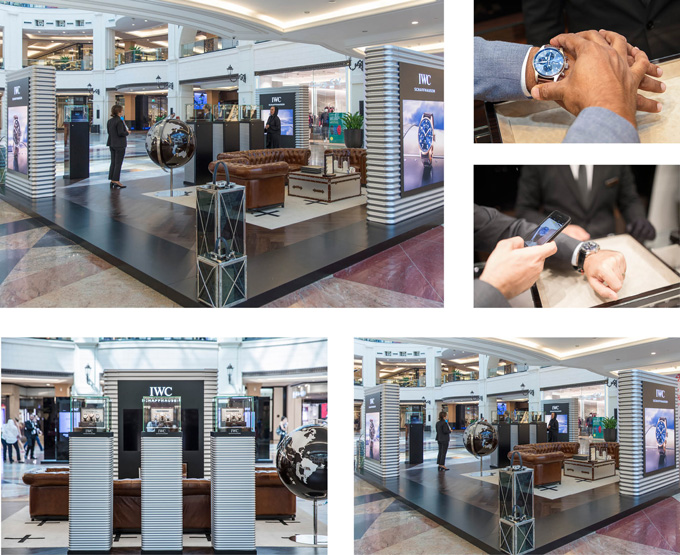
IWC Schaffhausen and retail partner Ahmed Seddiqi & Sons opened their newest boutique in the Middle East, located at the iconic Mall of the Emirates in Dubai. To celebrate the new opening, a special Pilot’s Watch exhibition was on display in the boutique, introducing watch lovers to the world of IWC’s Pilot’s Watches.
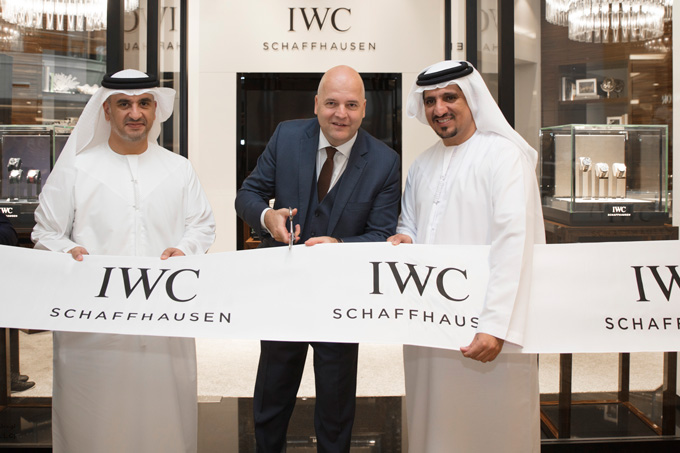
“Mohammad Abulmagied Seddiqi, IWC Regional Brand Director Luc Rochereau and Osama Seddiqi” attend IWC Schaffhausen Boutique Dubai
Luxurious flooring and an alluring entrance draw visitors into the world of IWC, while clean lines and warm colours highlight the brand’s six different product families. ‘The opening is in line with our expansion plans for the Middle East and has only been possible thanks to the strong alliance with our retail partner in Dubai, Ahmed Seddiqi & Sons. It is the first boutique in the region to showcase our new international boutique concept and offers watch connoisseurs a luxurious shopping experience’, explains Luc Rochereau, Regional Brand Director of IWC Schaffhausen.
Ingie Chalhoub Celebrates the official opening of the first Ingie Paris store in Riyadh
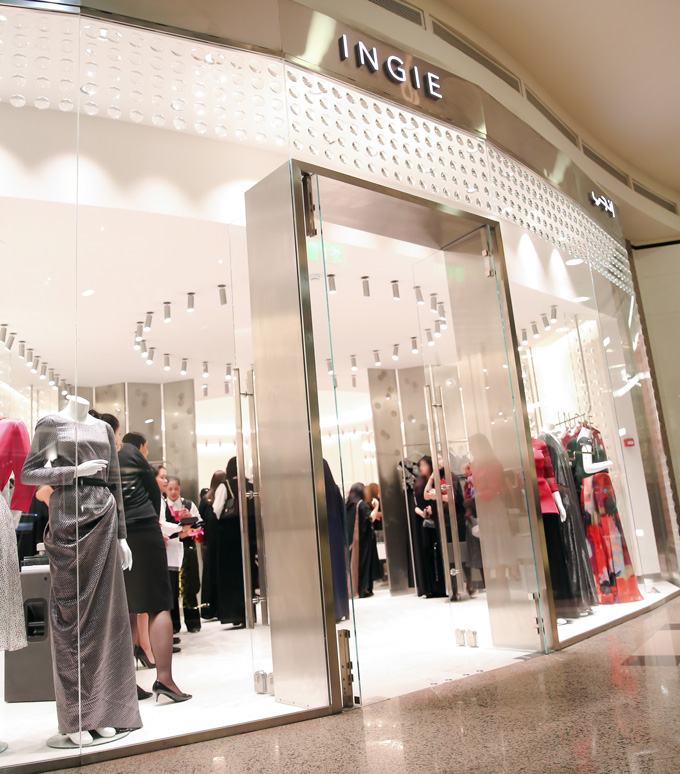
To celebrate the official opening of its first INGIE Paris store in Riyadh, Ingie Chalhoub, Creative Director of the French fashion label, hosted an event in the newest INGIE Paris boutique located in Kingdom Centre, Riyadh.
The 130 m2 store designed by the French design studio ‘Architecture et Associés’ led by Jean Christophe Poggioli and Pierre Beucler, reflects the architectural concept of the brand and works in line with that of the Kingdom Centre Mall.
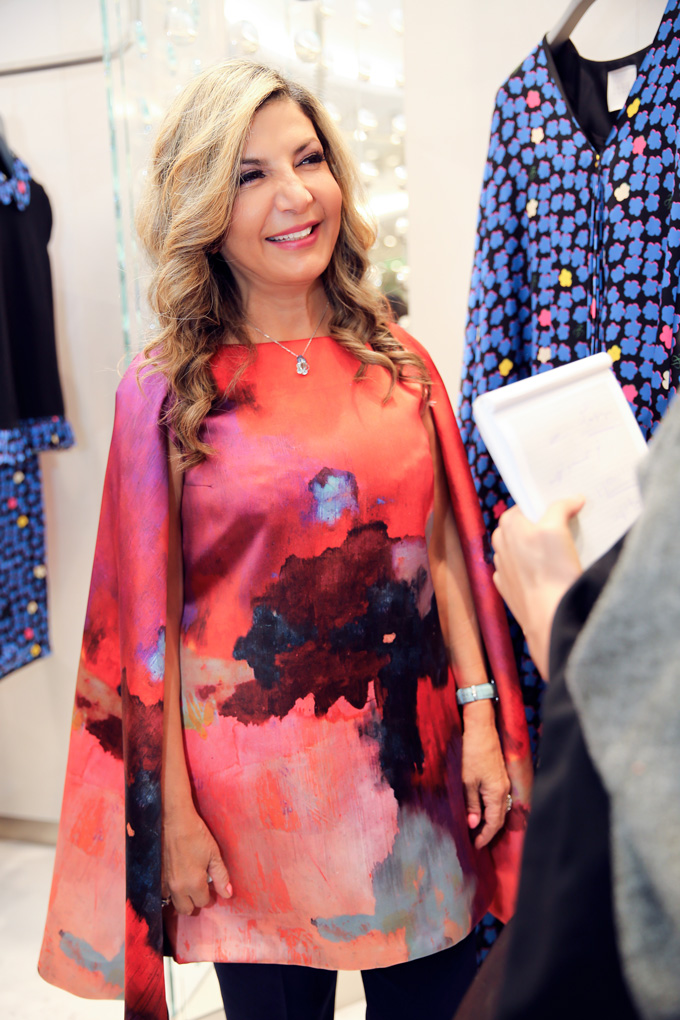
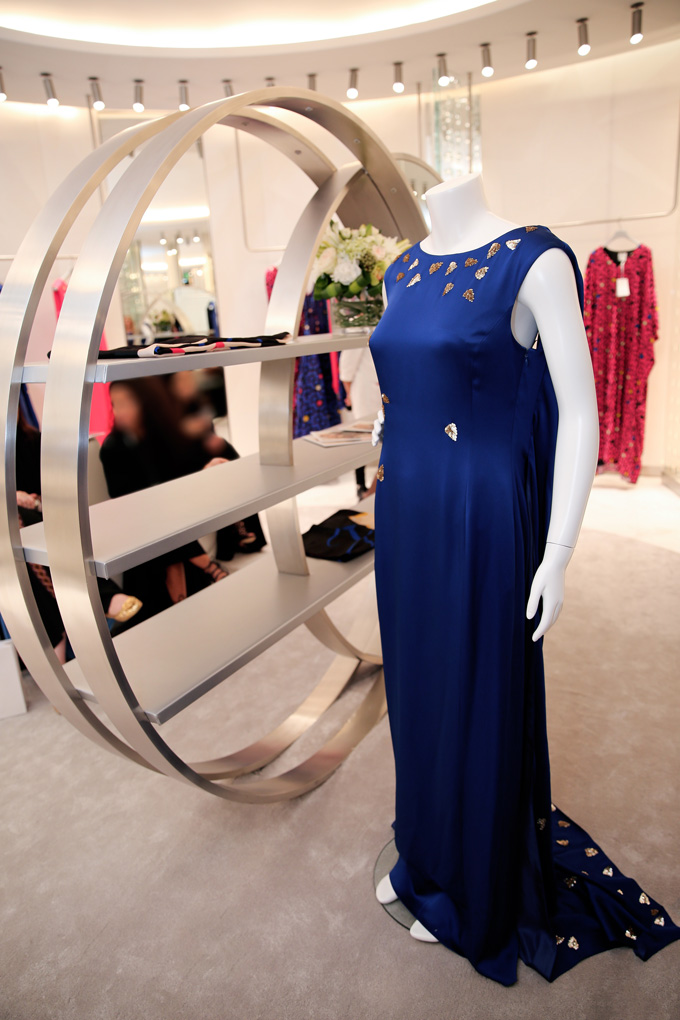
Key socialites, fashion bloggers and press attended the show to discover a preview of the INGIE Paris Fall Winter 2016 collection straight from Paris. A bright and inviting space welcomed visitors into the elegant and feminine world of INGIE Paris.
Hermès at Mall of the Emirates
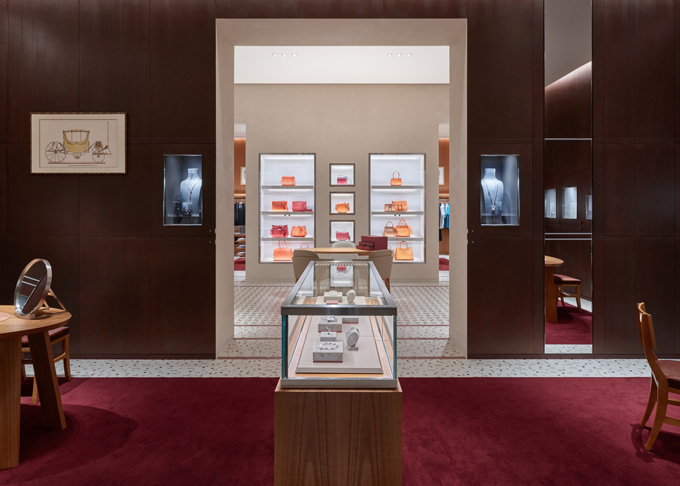
Beneath the 38-metre high arched glass dome of the Mall of the Emirates, Hermès has opened its third store in the Emirate. The design of the 276 square metre retail space was entrusted to RDAI, the Parisian architecture agency under the direction of Denis Montel. Its double aspect facade spans 40 metres and features a unique architectural treatment that enables visitors to glimpse through the exterior into the interior yet at the same time allowing privacy to shoppers inside.
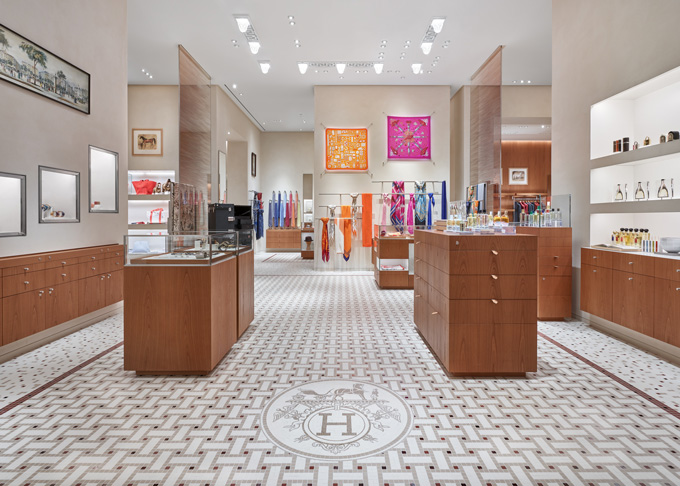
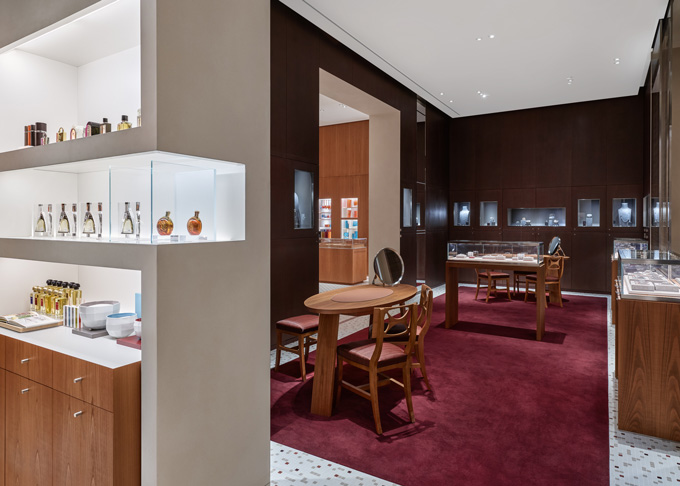

This facade, constructed in three separate layers, is created through first capturing delicate horizontal lines in a dark brown colour between two sheets of glass, creating vibrations and combining this with solid sections with the extremities finished in champagne coloured enamel.
By bringing these elements together, RDAI introduces a pleasing rhythm of opacity and transparency. On the corner sits the larger of two showcases, at around 23.5 cubic metres, this is much more than a mere window. It recalls the celebrated corner of the Hermès store at the 24 Faubourg Saint-Honoré in Paris and is framed with the same grecque pattern and emblematic architectural house code.
A Unique Perspective
Emirati entrepreneur, Anas Bukhash introduces the Vacheron Constantin Overseas.

Anas Bukhash, one of the leading entrepreneurs in the UAE, introduces the Vacheron Constantin Overseas, a reinvention of their iconic collection. Created in a spirit of casual elegance and practicality, the model embodies the new generation of self-winding timepieces inspired by the spirit of travel. Bearing the Hallmark of Geneva, the timepiece is fitted with easily interchangeable bracelets, making it transformable and easy to wear.
Anas, the co-founder of Ahdaaf Sports Club and the founder of Bukhash Brothers, possesses strong qualities for entrepreneurship and business leadership. Here, the world traveller himself, shares his motivational moto’s.

‘It’s important that your value remains in this world, even after you’re gone.’

‘We all have the same 24 hours each day, the difference is how each of us utilises them.’

‘If success was easy, everyone would be successful.’
Photographer : Vivienne Balla
Fashion Director : Eliza Scarborough
Grooming : Marisol Steward
Location : Park Hyatt, Dubai
Perfect presents for every personality on your gift list

‘I have the simplest tastes. I am always satisfied with the best.’ – Oscar Wilde


By Eliza Scarborough
The Zegna Holiday Collection
Exquisite gifts for distinctive men

Ermenegildo Zegna presents a rich selection of sophisticated gifts inspired by the elegance of the holiday season, adding a touch of luxury to all magic holiday moments, from cocktails to the New Year’s countdown.

Featuring the Italian style and craftsmanship that have been part of Zegna’s heritage since its foundation, the collection combines exclusive materials such as silk, cashmere and leather, in a colour palette of black, white and deep burgundy.
Master evening events in style with wardrobe essentials such as the pure wool tuxedo with satin reveres, and the iconic Couture Triple Stitch sneaker in velvet. Completing the look with luxurious accessories, including silver cufflinks, satin and velvet bow ties, and tuxedo gloves in suede.
The evening elegance inspiration is also embodied in traditional gift ideas, with their signature fragrance, the Essence Gold Collection, being one of our favourites.

Find your Watch Type
Are you a man who travels the world, flying between time zones, or a gentleman of elegance and understated style? A man’s wrist says a lot about him, and is an instant portal to his personality.

Maximal Minimalist
Clean, understated and elegant, these only appeal to those really in the know. This isn’t a watch that shouts from the rooftops, but instead just whispers impeccable taste.

George Clooney

Technology Smart
You thrive in fast-paced environments and may need to send and receive notifications immediately, never missing a text or social media notification the second it comes in.

Kanye West

Traveller
Those who travel throughout the world have to frequently re-adjust their watch for the ever changing time zones. Wearing a watch with a world-time function means that you can surf through the world’s time zones instantly.

David Beckham

Sportsman
Whether you’re running mountain trails or riding waves, you need a high-performance watch that makes your life easier. From the ultimate in water resistance, to rugged durable, movements, these timepieces tick all the boxes.

Jenson Button

Connoisseur
Interested in the complications that only the finest watchmakers can achieve. This watch wearer chooses to sport a timepiece of engineering excellence.

Eddie Redmayne

By Eliza Scarborough
Dress your way to a Promotion
Whatever your profession, make an impression with you work wardrobe. What you wear and how you wear it can be key determining factors when you are working your way up the career ladder.

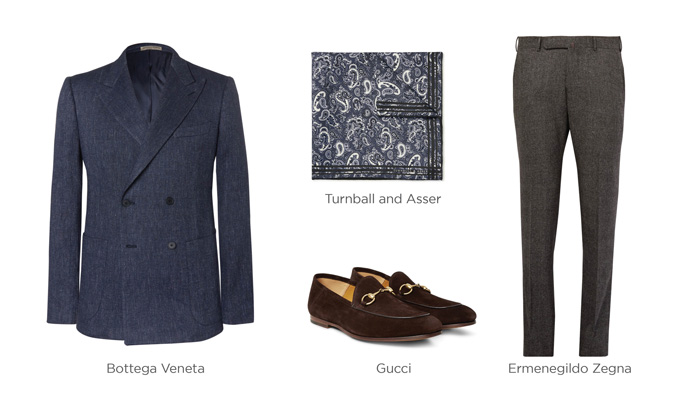
Media Executive
Many of us are not expected to wear formal tailoring to work, but still want to dress neatly without looking out of place by overdoing it. Tradition but with a 21st century update, this blazer combines a bold colour with a luxe texture. Smarter than jeans, these chinos have a slim fit and coordinate with the leather rucksack and tassel loafers.

Accountant
If you work in a conservative corporate environment such as an accountancy firm, the secret is to change up the default uniform, but to do so in an almost imperceptible way. A pair of double strap monk shoes will set you apart from your colleagues, together with some tortoiseshell glasses from cult brand Cutler and Gross.

Hedge Fund Manager
Many offices now have an open-neck shirt and no-tie dress code. To elevate this, wear good quality tailored separates and a shirt with a stiff-enough collar that will stand up without the support of a tie knot, together with buttoned cuffs to easily accommodate a statement watch.
Account Manager
If you want to stand out, especially when everyone else is trying to fit in, pattern is the answer. However, there are a few prescriptive rules, such as making sure the patterns are contrasting in scale, and don’t have too many different colours into the mix. It is often easier to pair entirely different kinds of pattern, such as stripes with a check, or polka dots with stripes.
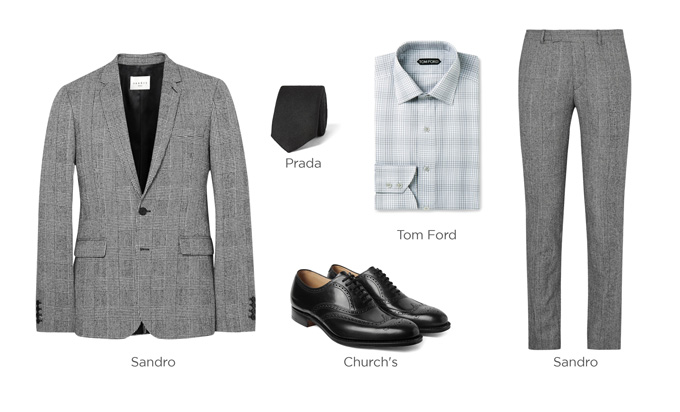
Lawyer
No matter how hard we try not to, we all make immediate assumptions based on appearance. So with a high powered defence job in law you may have more sway with the judge and jury if you are dressed to impress. A tailored look from an on trend designer is ideal for this formal setting.

By Eliza Scarborough
Statement Sunglasses

Dolce & Gabbana
From the aviator silhouette which complements your cheekbones and slims the jawline, to the cat eye which will balance out a sharp jawline, picking the right style frame will accentuate your face shape.

A Contemporary Elegance
Introducing the new Santoni collections, for him and for her.

The women’s fall collection takes the unique know how of the maison and taste for authentic and precious craftsmanship to heights of unrestrained virtuosity. Inspired by the unforgettable figure of Marlene Dietrich, a diva able to charm men as well as women, this collection outlines the image of an assertive femme who uses fashion as a way of telling her story, beyond time and trends.
High stiletto heels alternate with flat styles. Shapes are round or open-toe. Opulent pumps are filled with maxi-sequins imitating crocodile’s scales, and geometric indentations feature shoes of rigorous taste. The rigor of design seals several elements in an expression of quivering balance, completed by a faded palette of blacks, black & whites and antiques burgundies. From Santoni’s patina calfskin to crocodile leathers, the material selection is unmistakable.
For men, the new collection outlines a powerful ellipsis that binds tradition and innovation in an idea of style that is classic, rough, futuristic and modernist at the same time. It is a multifaceted elegance, conceived to travel in space and time. The aesthetic research sprung from a synthetic thought on basic technologies is a whole with the expression of a progressive craftsmanship. It’s a real and tangible manual skill interpreted with a neat twist.
Shapes are classic, archetypes of men’s repertoire, from lace-up Oxford shoes to double buckle ankle boots and the sneakers. The vintage appearance of luxury materials and futuristic compositions combines in new proportions that are the result of innovative techniques. The reductionist allure continues throughout the bags, matte python backpacks and professional briefcases of bare design. Chromatic tones, deep and timeless with an unmistakable Santoni imprinting range from burned brown, burgundy and tones of blue and grey. Materials are solid and precious, brushed calfskin, crocodile, Santoni patina, ostrich, matte python.

Shopping Secrets

Novelty Accessories
British luxury and accessories brand, Charlotte Olympia, has presented a capsule collection of shoes and clutch bags in collaboration with Barbie. Founder and Creative Director, Charlotte Olympia Dellal says, ‘This was a childhood dream come true to collaborate with Barbie!’

Shoppable App
Mr Porter has launched an app for Apple TV app, which will allow customers to browse and shop from the e-tailer’s weekly digital magazine, The Journal. The app will also have short videos and films from each issue, together with how-to videos and tutorials.

Fendi Roma
Celebrating 90 years of Fendi, a new book, Fendi Roma, is an exploration of the label’s daring creativity, its cinematic inspiration, its innovative techniques, its timeless Italian craftsmanship, and in particular, its profound links to the city of Rome.

Bobbi’s Birthday
Bobbi Brown looks to her favourite cities for her new anniversary collection. The limited edition eye, lip and cheek palettes feature sketches by fashion illustrator Richard Haines, inspired by London, Paris and New York.

Fashion and Technology
Inspired by Instagram and designed with the Michael Kors Scout handbag in mind, the Michael Kors x Fujifilm Instax Mini 70 camera comes in seven-strong colourways.

Tom Hiddleston for Gucci
The British actor is the newest face of the Italian fashion house’s Cruise 2017 tailoring campaign. Photographed in an ornate mansion owned by late American artist Tony Duquette, Hiddleston poses in a variety of Gucci suits alongside three Afghan hounds.
The Universe of Python : One to One with Amanda Navai
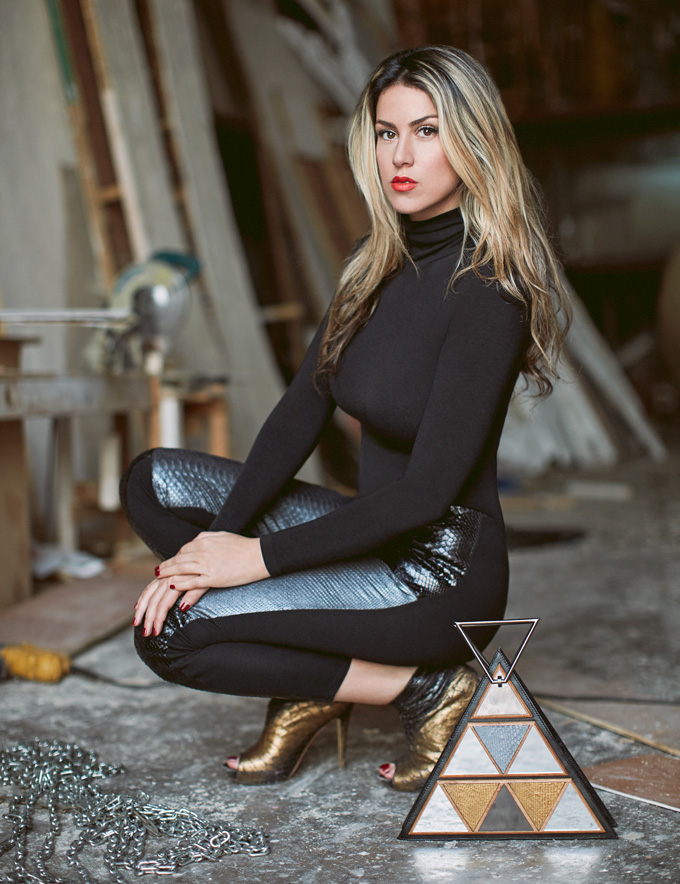
Beirut-based accessories designer Amanda Navaian founded Amanda Navai, an exclusive brand of handbags that are aimed at the multitasking, fashion-forward woman. The designs are dedicated to the independently strong and unique women who inspire her each season. Made with the utmost precision and care, every bag is handmade and transformed under the same roof to ensure quality control, creating a niche brand which is focused on uniqueness and exclusivity for its customers. Only 10 bags are produced in the same style and colour, all with semi-precious 22k gold-plated brass metal, juxtaposed against pieces of exotic leather skin and marked with a lion insignia that represents strength, a brand symbol that transcends into every collection.
What made you decide to launch Amanda Navai?
I always wanted to be an entrepreneur. I attended a conference with the motivational speaker, Sahar Hashemi, who really had an impact on me and gave me the courage to make the move. I decided to work with what I loved, handbags in exotic skin. I had also done my research and had found a niche in the market that there was a gap in, which was handbags in colourful exotic leather at more reasonable prices. I think it’s important to make sure that there is a market need before you launch something.
Was this always the career path you had planned to take?
No not at all, I never imagined that I would be in this industry and do what I do!
How much do you feel the brand has evolved over the past 6 years?
It has really evolved so much, especially in terms of quality. The main focus over the past 6 years has been to make the quality on a par with the best international luxury brands. Good quality is the key to long term survival and so we focus hard on this point, making major progress from where we started. The designs are also now far more coherent, creating a strong brand identity that has been developed over the years, especially in the last two seasons. When you start you know what you want and the styles you like, however as you start evolving it becomes clear that there are certain styles which you keep coming back to, and your identity in terms of style becomes stronger and stronger.
What advice would you give to other young entrepreneurs?
I would advise them to really focus on a solid business plan, to stick to the numbers and to have an accountant from the start to keep them on track. A good product is a given and a must, thereafter what will determine the success or the demise of your brand is the finances and if your company is profitable or not. This is the bottom line to survival and continuation.
How would you sum up the brand?
Versatile, Smart, Luxurious.

What has been your career highlight?
There have been so many things and I feel so grateful for them all. A few things that were really special was when Amanda Navai was solely merchandised in the main Saks Fifth Avenue window, it is such a huge and iconic store. Another key moment was when an Amanda Navai handbag was chosen to be the feature accessory in the Tryano launch ad campaign, the visual was on major banners all over the region. A very recent highlight was in fact at the Emirates Woman awards, I was a guest at the Tryano table as one of their important partners and I was sitting at the dinner table with Anthony Chalhoub, CEO of the Chalhoub Group. I used to work in the group many years ago, and I had previously worked with Anthony when launching the brands I managed in Kuwait, however this time we were sitting together in such a different context, and it was a highlight of where I was and where I am today. It really goes to testify how open minded and visionary the group is. They really support regional brands and give everyone a fair chance, and I am very grateful to all the support I have received from the Chalhoub Group and for all the great memories they have been the facilitator of.
You are known to name your bags after strong women in your life. Who are the women who inspire you?
I’m inspired by women who want to be a part of making a difference. I’m inspired by women that instil hope in other women, helping to empower them.
What are your bestseller bags?
The Rosemin bag, named and designed alongside Rosemin Manji is one of our best sellers. The Monir bag is also extremely successful, together with the Ramona bag. Ramona, is a special bag that we launched in 2013, the main focus is triangles and it’s so much fun to mix and match the colours of the triangles. It was from that point that the brand developed a strong love for triangles, which are also the base of the Monir bag and the Layla K bag.
If someone was going to invest in just one bag, which style would you suggest?
OK, there are two categories of women! One that really loves to stand out, and I would suggest for her to choose the Monir bag. It’s a statement piece and has a major timeless wow factor, so if she wants to impress I would recommend this. Then there is the other type of woman who would like to be a bit more discreet, and for her I would suggest one of our more classic styles such as Alice in Tehran, it has a very classic timeless shape, that is always in style, but not loud.
Do you prefer to carry a compact clutch or a roomy tote?
That’s a very tough question to answer! During the day it would be a roomy tote and in the evening a compact clutch!
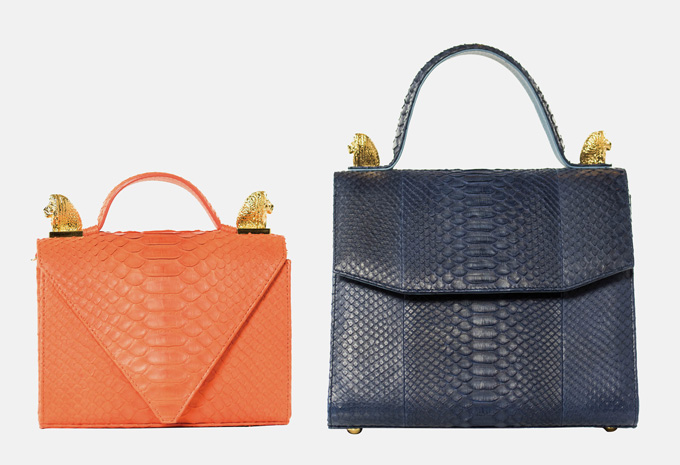
What essentials do you keep in your bag?
Lipstick, phone, keys, and a credit card holder.
What do you think is the other ultimate accessory that every woman needs, aside from the handbag?
A pair of amazing knee high boots or heels. Good shoes are a must!
by Eliza Scarborough
LOUIS VUITTON’S GRAPHIC LINES
Paying tribute to Nicolas Ghesquière’s first Louis Vuitton show, this fashion collection reinterprets the iconic V signature.

Essential V Crew Necklace, Essential V Bracelet.
All Louis Vuitton
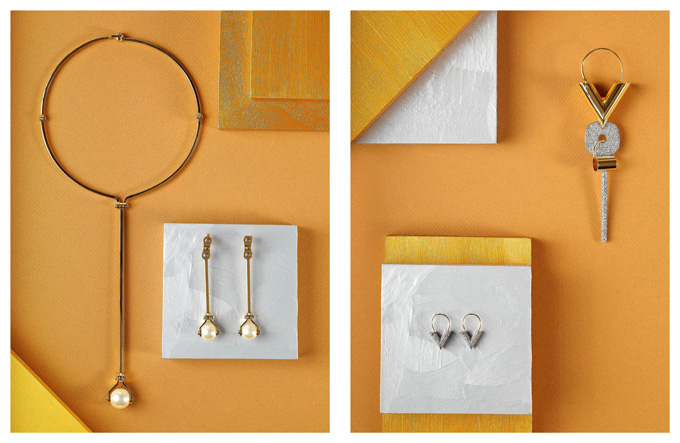
LEFT IMAGE: LV Speedy Pearl Pendent Necklace, LV Speedy Pear Pendent Earrings.
RIGHT IMAGE: Essential V Single Earring Strass, Essential V Strass Hoop Earrings.
All Louis Vuitton
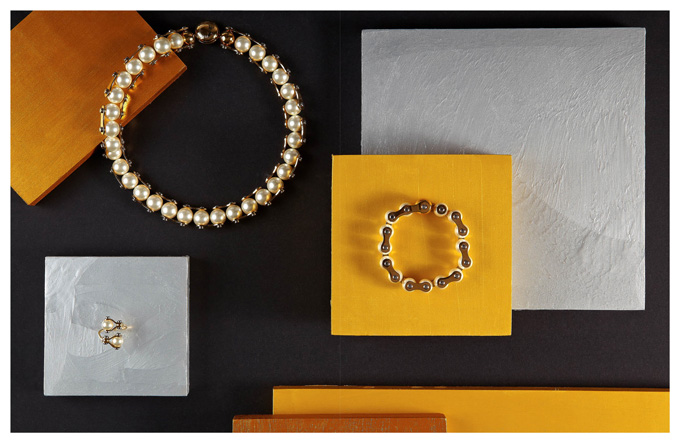
LV Speedy Pearl Necklace, LV Speedy Pearls Ring, LV Speedy Pearls One-Rank Bracelet.
All Louis Vuitton
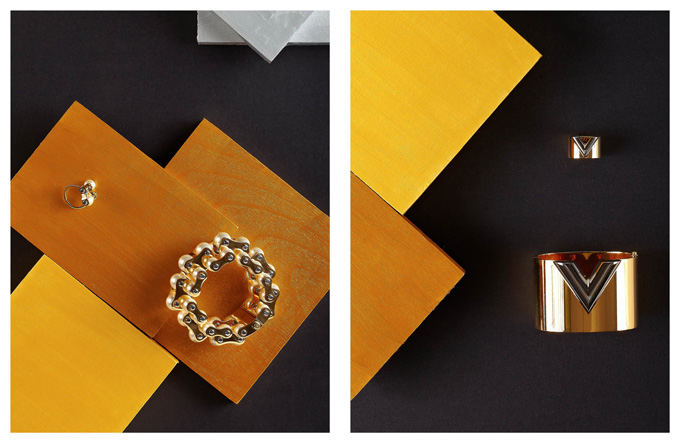
LEFT IMAGE: LV Speedy Pearls 3 Rank Bracelet, LV Speedy Pearl Ring.
RIGHT IMAGE: Essential V Ring, Essential V Cuff.
All Louis Vuitton
Fashion Director : Eliza Scarborough
Photographer : Henry Pascual
BLOCK COLOUR DIOR TIMEPIECES

Clockwise from top left:
La D De Dior watch, La D De Dior watch, La D De Dior Satine watches, Dior VIII Grand Bal Coquette watch, La D De Dior Precieuse watch
All by Dior Timepieces

LEFT IMAGE:
Clockwise from top left: Dior VIII Montaigne Ligne Corolle watch, La D De Dior, La D De Dior, La D De Dior
RIGHT IMAGE:
Clockwise from top left: La D De Dior, La D De Dior Precieuse watch, La D De Dior Precieuse watch, Dior VIII Grand Bal Plisse Ruban watch
All by Dior Timepieces

Clockwise from top left:
Dior VIII Montaigne watch, Dior VIII Montaigne watch, Dior VIII Montaigne watch, La D De Dior Satine watch
All by Dior Timepieces
Fashion Director : Eliza Scarborough
Photographer : Henry Pascual
Stone Roses
Dolce & Gabbana’s latest jewellery showcases an array of sparkling colours.
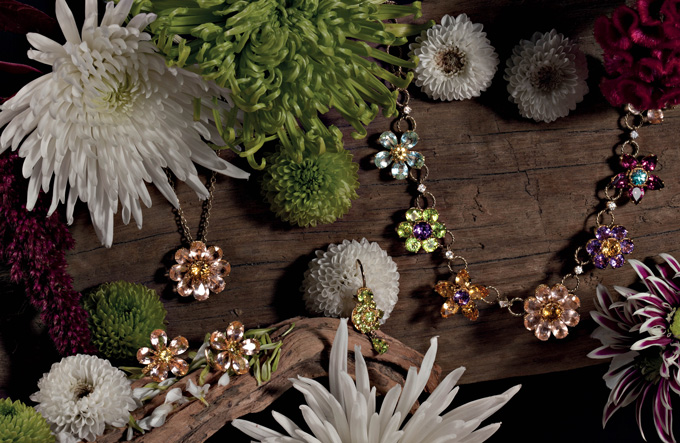
Clockwise from top left:
Red gold pendant with morganite, citrine, fresh water pearl, in a daisy setting.
Necklace in yellow and red gold with daisy settings, set with morganite, aquamarine, citrine, amethyst, peridot, red rhodolite, light blue zircon, colourless sapphire and south sea pearl.
Filigree earring in 18ct yellow gold, set with green peridots.
Clip on earrings in red gold with morganite, citrine, in a daisy setting.
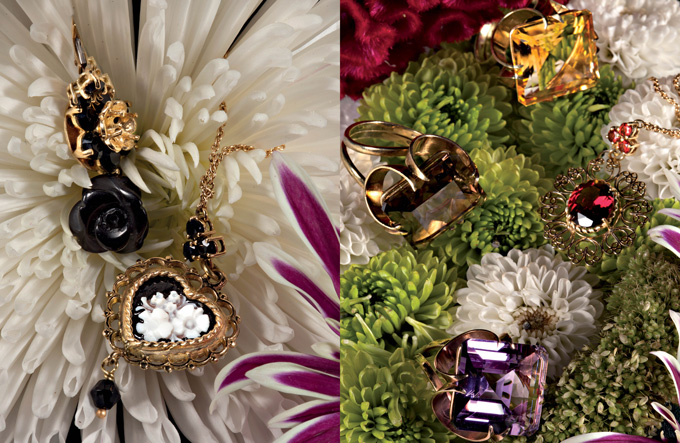
LEFT IMAGE:
Left to right:
18ct yellow gold pendant earrings with black jade.
18ct yellow gold necklace with black sapphire, black agate and black jade heart cameo.
Clip on earrings in red gold with morganite, citrine, in a daisy setting.
RIGHT IMAGE:
Clockwise from top middle:
18ct yellow gold ring with citrine quartz.
18ct yellow gold filigree necklace with red garnets.
18ct yellow gold ring with amethyst.
18ct yellow gold ring with fume quartz.
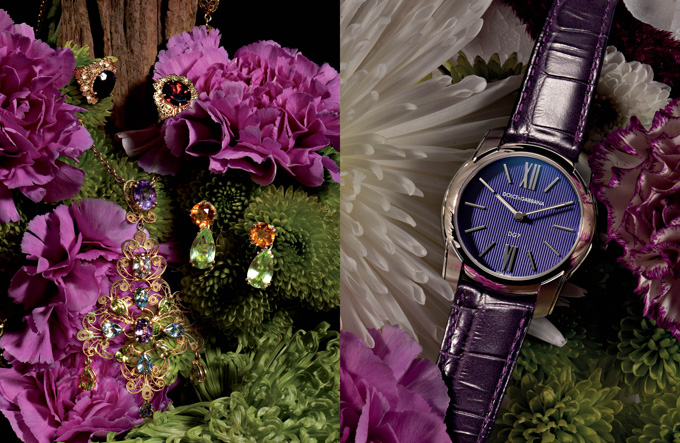
LEFT IMAGE:
Clockwise from top left:
18ct yellow gold ring with black and colourless sapphires.
18ct yellow gold ring with red garnet and colourless sapphires.
Earrings in 18ct yellow gold earrings with yellow quartz and peridots.
18ct yellow gold filigree necklace with a mix of semiprecious gemstones.
RIGHT IMAGE:
DG7 watch with natural ruby on the crown and an alligator leather strap.
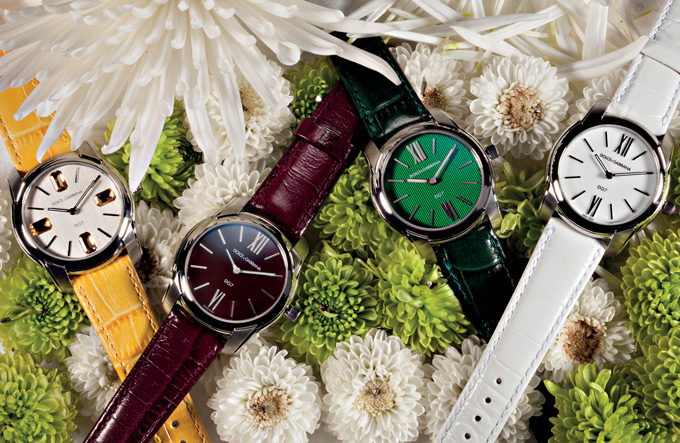
From left:
Watch with four citrines and an alligator leather strap.
DG7 watch with an alligator leather strap, in three colours.
Photographer: Matteo Weber
Bulgari’s sparkling scent in the eyes of Valeria Manini, Bulgari Fragrance Business Managing Director
A luxury scent where gemstones are the muse. Valeria Manini, Bulgari Fragrance Business Managing Director tells us about the latest addition.
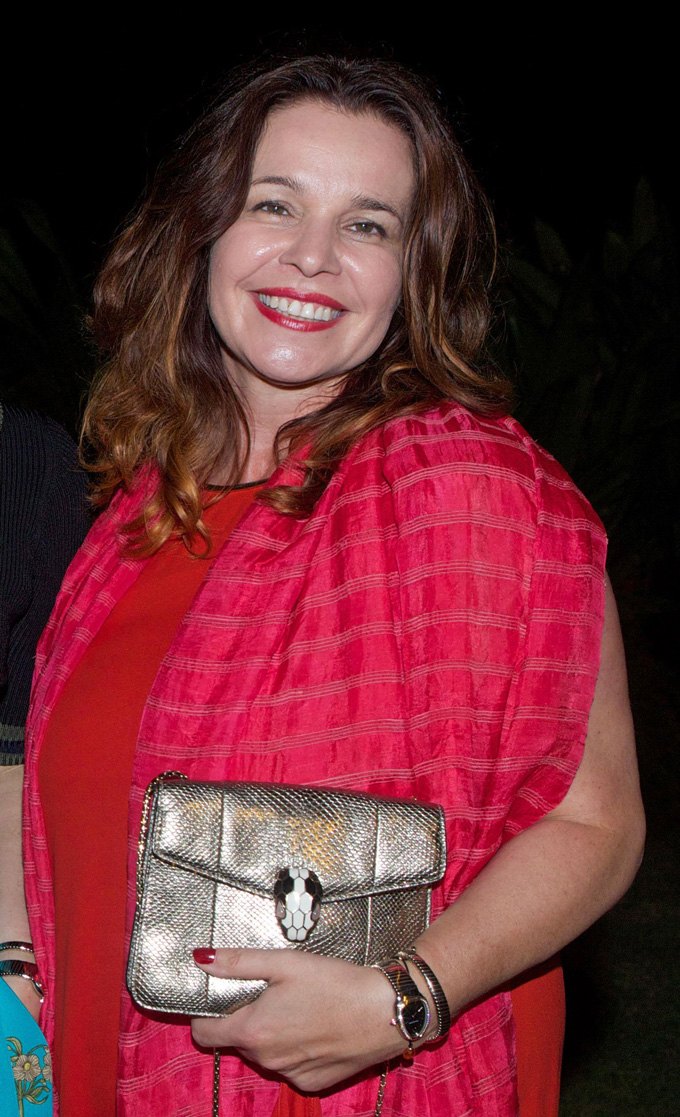
Gorgeous, glittering gemstones, playing on the senses. However, it is not high jewellery we are talking about, but elegant luxurious fragrances. Bulgari’s latest offering of precious fragrances, this time for men, are inspired by gemstones. Echoing the first Le Gemme collection for women, this new perfumery collection revisits an entire aspect of ancient history following the precious stones and perfume roads that the great conquerors and luxury nomads of Antiquity discovered during their travels and conquests. Meaning it was only fitting that we were introduced to this journey through a trip on the Orient Express from Prague to Venice, snaking through the countryside and the Alps.
Valeria Manini, who has 25 years of professional experience in the luxury industry tells us about this new creation for the Bulgari Maison, and about how it shakes up the codes of luxury perfumes for men. The Business Managing Director, who has also been key to the launch of previous pillar fragrances for the brand, explains how in the same way as stone cutters reveal the beauty of gemstones with their skill, Jacques Cavallier has worked exceptional raw materials to the limits of the possible so as to exalt their richness and reveal them in a new, unexpected way.
What was the incentive behind creating a high perfumery collection for men?
The men were the incentive. There was nothing for them, so the objective was to cover a segment that didn’t exist.
How long did it take for the collection to be conceived and produced?
It took two years, but it benefitted from the previous research that had been made for the Le Gemme for women. It was a bit quicker for us as we already had all of the milestones for the product defined.
Why did you choose Jacques Cavallier to create the scent?
He is the master. Right now he really is the best person for the job.
What similarities and differences do you see between the male and female ranges?
Similarities are that every man and every women needs to express their own personality with luxury and not have something generic. The differences are that women are emotional and more intuitive in capturing the link between the gems and the scent, whereas men tend to be more analytic and want to understand how and why the concept and scent has been conceived.
How do you feel the colours and types of stones associate with smell?
We try to capture the vibe and colour of the gemstone with the fragrance, and recreate the similarity. For example a citrus scent. For women this would be paired with a citrine stone and for men the tiger eye, evoking the sun, the brightness, the energy. Colour is very important as it guides you in the research of the ingredients.
What are you favourite memories that are sparked by notable scents?
For me it is incense as it is the church and my childhood. I smell incense when I go to Asia and visit the temples, and also when I visit the Middle East. It is a scent that I can enjoy all over the world and it makes me feel very connected and brings me peace. It makes me feel comforted and reassured.
Which scent represents you best?
The iris flower, as I feel connected the vibe of the violet and the amythest colour of the flower.
What particular gemstones inspire you?
The amethyst, for its spirituality and wisdom.
Which do you see as the hero of the collection, particularly in the Middle East?
It will be a tough battle between the blue sapphire and the oud.
How challenging is it to make a collection of fragrances that is appreciated by consumers in different regions of the world?
The regions of the world aren’t the challenging part, because it is actually about the different masculine personalities. Wherever someone is living or has been brought up, the common trait is their feeling and personality. Whether someone is from China, Europe of the Middle East, if they are feminine, or nostalgic, or strong willed, they will share the same taste, wherever they are from.
Where do you see stepping into haute parfumerie for men leading to in the future for Bulgari?
I don’t have the answer just yet. For us it was already a big challenge, as to make men trust in a product is a big project in itself. So now we need to wait for the response to this collection, and then see what direction to take it in next.
By Eliza Scarborough
An athletic journey for Giorgio Armani
Understanding the relationship with sport for one of the world’s most critically and financially successful designers.

During Milan Fashion Week, iconic designer Giorgio Armani opened an energetic new photography exhibition in Milan at Armani/Silos titled ‘Emotions of the Athletic Body.’ Joined by a host of Italian Olympians, Giorgio Armani presented a first glimpse of his carefully curated exhibition. Immediately upon entry, the exhibition space is deeply immersive. A running track floor signals the beginning of an athletic journey. Much of the photography captures movement perfectly, but video projections quite literally place you in the action. The photography is a display of triumph, pride, unity and struggle. It captures sports people’s athletic achievement, alongside their natural aesthetic beauty which Giorgio Armani so admires. The sculpture on display at the entrance resembles an ancient statue of an idyllic Greek God and introduces visitors to his vision.
After Athlete and Facce da Sport this is your third exhibition focusing on sports. What is it that fascinates you about sports?
I have always been a sports fan, ever since I was a boy. Initially I suppose it was the excitement and spectacle that attracted me, but over the years I have come to understand that there is something more profound at play here. Sport is a way to bring people together, it is a social activity. It is also something that promotes the idea of dedication and expertise. It shows what human beings are capable of when they work hard to perfect a particular skill and talent. And then, speaking as a fashion designer, there is the simple fact that sportsmen and women are extraordinary from a physical point of view. Their bodies are at the peak of their development and prowess, and this is fascinating for someone who works with the human form.
Why did you decide to showcase this new exhibition at Armani/Silos? Is it dedicated to someone in particular? Why now?
The plan for the Silos has always been that it should be a home for temporary exhibitions as well as for my permanent collection of work. It is also a centre for learning, and as part of its mission to educate it should host work that inspires and enlightens people. Emotions of the Athletic Body is the first of what I hope will be many exhibitions where we give over our space to great work by creative people. The timing of this show coincides with the Olympic Games and Paralympic Games in Rio, for which I have once more designed the official outfits of the Italian national teams.

What is your relationship with sport?
It’s a deep relationship that has followed me throughout my life in various ways. I take exercise to keep fit, which means not only taking care of the body but also the mind. I’ve always loved sport because it represents the human ability to endure and work hard, commitment, tenacity, and willpower, all at the highest level. Active sport affirms the value of the individual and the courage of teamwork. These are all qualities I believe in and that apply both on the field and, especially, off it too.
You have always had a very strong bond with the world of sports. What do you find stimulating about dressing athletes on and off the field? What fascinates you about their shape?
It’s true, sport is a genuine passion of mine. I like it because it encourages the qualities that, in my opinion, help improve a person, commitment, sacrifice, tenacity and willpower. It’s good for the body and the soul because it shows that without commitment there is no success. This is why I always gladly collaborate with athletes. Of course, the muscular build of athletes is always a challenge for a designer, but my clothing’s softness and comfort, which are central aspects of my stylistic vision, allow it to effortlessly adapt to various physical builds.
How do you think the Special Olympics has changed people’s perceptions of those with intellectual disabilities?
The Special Olympics is a very important movement as it shows that everybody can achieve amazing things, and though it focusses on sporting excellence, it serves a much greater symbolic purpose. These athletes are really incredible human beings, and their achievements remind all of us what we are capable of if we apply ourselves and have self-belief. In showing people with intellectual disabilities competing at the highest level, we are invited to admire them in exactly the same way we admire all athletes. In this way, the Special Olympics has genuinely changed attitudes in a remarkable and positive manner.
What are the future plans for the Silos? Do you still want it to be a research centre dedicated to younger generations?
Armani/Silos was conceived, established and organised to encourage young people to undertake creative research, providing them with a world of unique knowledge. My hope is that Armani/Silos represents a starting point and an inspiration for them. With Armani/Silos, I propose a different point of view, and that’s why I conceived it as a sort of research centre that revolves around fashion and design, with an associated exploration of fashion’s relationship with photography and cinema, both art forms that are integral to my vision of style and fit well into the idea of a lively exhibition space.
La Réserve Paris, Member of The Leading Hotels of the World
Located directly across from the Eiffel Tower, La Réserve Paris stays true to its name through interior architect Remi Tessier’s refined take on discreet opulence.
Location
In the smartest part of town overlooking the roofs of the Pantheon and, in the near distance, the Grand Palais and the Eiffel Tower is the discreet front door to the exquisitely decorated hotel which has both an airy grandeur and a rarefied kind of intimacy.
Style and character
The hotel was originally built for the Duc de Morny, Napoleon III’s half-brother, so spaces are airy and grand, although not over-bearingly palatial. This is a space that feels more like the bourgeois home of a Parisian millionaire, such as its last owner, the fashion designer Pierre Cardin, than a hotel. Nothing other than the grand fireplaces remain of the old homes, though. The rest has been re-imagined by the theatrical maestro of hotel design, Jacques Garcia, using a dramatic palette of black, white and gold, with flourishes of peacock green and ruby in the public spaces, and pale champagnes and greys in the bedrooms. While the intimate bar and living room are open to the public, the library, lined with leather-bound books and furnished in peacock green velvet and silk, the candlelit spa with its 16m pool, and its cosy smoking lounge are restricted to guests only.
Rooms
Because this hotel has been built from scratch, the owner has been able to make every part of the 26 suites and 14 rooms as fine and polished as can be. Particular favourites are those on the fifth floor, in the mansard roof, with far-reaching views, and the third-floor suites with balconies furnished with wrought-iron tables and chairs. Walls are lined with silk damask, and window curtains in heavy silk and fine white voile which can be easily drawn back to reveal views through double-glazed floor-to-ceiling French doors. Wardrobes are built from heavy oak, with elegant hangers and a big umbrella for Paris showers. Mattresses have feather toppings, pillows are filled with fine goose-down, and beds are swathed in crisp white Quagliotti linen. Bathrooms are lined in white and grey Carerra marble, with spacious walk-in Roselli rainshowers, capacious silver-sided bathtubs and own-brand La Reserve toiletries, super-thick bathmats, as well as soft slippers and cotton and towelling robes. When it comes to technology it is all high tech, with televisions disguised in mirrors, high-quality speakers that connect wirelessly to devices, temperature-controlled kettles and high-tech touch-screen phones and tablets.
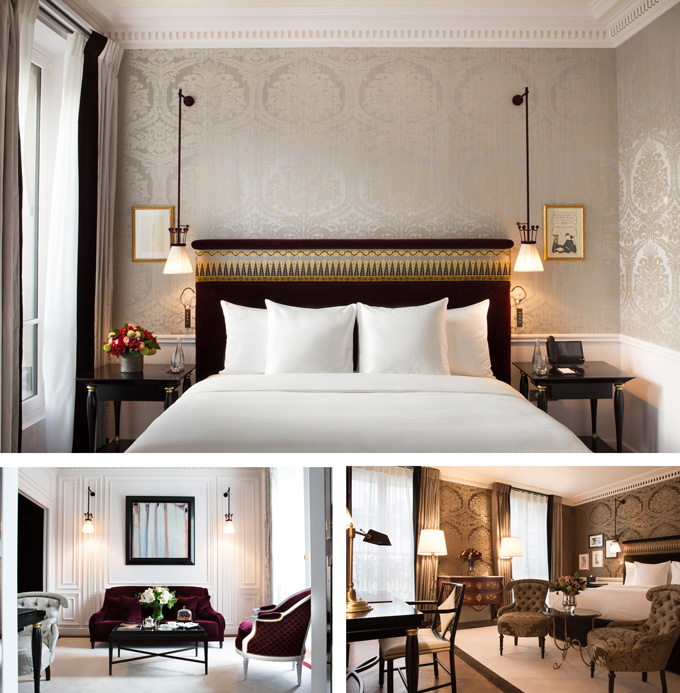
Food and drink
The restaurant offers gourmet-style fine French dining, but of a light and inventive kind, rather than traditional and rich. The chef, Jérôme Banctel, delivers dishes from tender milk-fed lamb to marshmallow-light pepper-filled ravioli, and red-mullet with asparagus to wild-strawberry tiramisu, all of which can be enjoyed in the decadently dark dining room, all woods, Chinese-style black furnishings, mirrors and gilt that give it a romantic, Parisian feel.
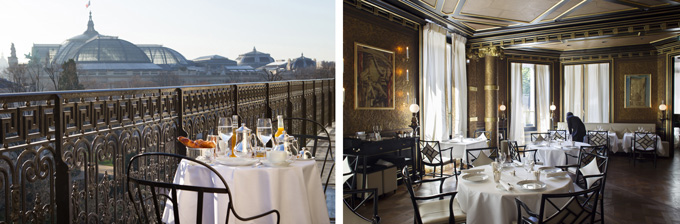
Spa
Set around the 16-meter indoor pool are just three treatment rooms, a fitness area with a sports coach and a steam room, creating a peaceful atmosphere where one is finally relieved of pressure and can succumb to a complete disconnect from the daily grind. men are not forgotten, with a range of services indispensable to the modern-day gentlemen.
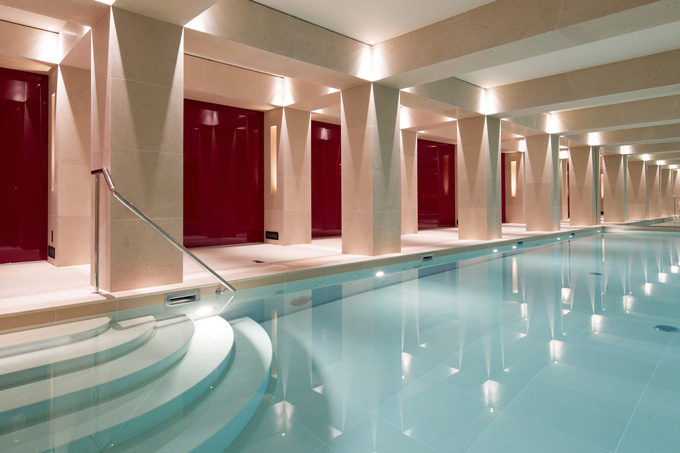
La Réserve is a member of The Leading Hotels of the World, a collection of authentic and uncommon luxury hotels. Rooted in the locations where they are found, the hotels embody the very essence of their destinations. Offering varied styles of architecture and design, and immersive cultural experiences delivered by passionate people, LHW’s collection is for the curious traveller looking for their next discovery. Established in 1928 by several influential and forward-thinking European hoteliers, Leading Hotels has an eight decade-long commitment to providing remarkable travel experiences.
The story behind Bobbi Brown
The makeup magnate on how she created her global beauty empire, and what she defines as beautiful.
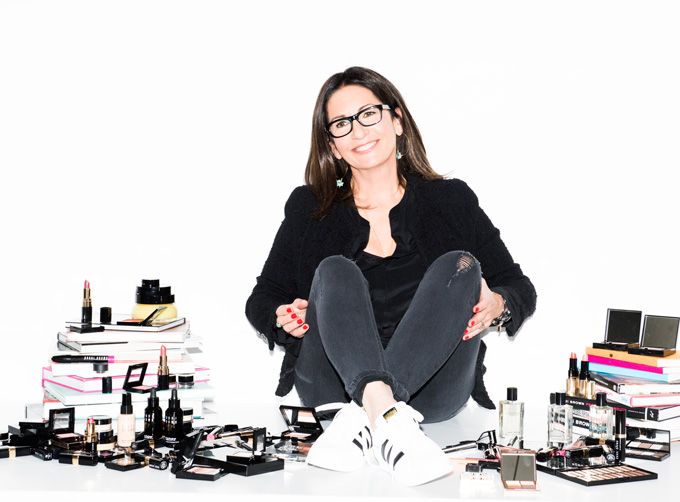
Before Brown’s line was available worldwide, worth over a billion dollars and had changed the beauty landscape to define simple, modern glamour, she began her career as a makeup artist. After gaining a degree in theatrical makeup from Emerson College in Boston, Bobbi had enough money for six months of rent, courtesy of a graduation gift from her father, and decided that would be enough time to test the waters in New York. In a short time, she made her way up the ladder to work with photographers including Bruce Weber and Arthur Elgort, who responded to her now signature modern-but-natural look.
The brand started with an edited collection of 10 lipsticks, 25 years ago. From salmon to beige and brown, the flattering shades stood out from the bright, garish lipsticks that were the trend of the 80s and the response was incredible. Four years later, in 1995, Estée Lauder stepped in, and with every product launch thereafter, it has been Bobbi’s mission to deliver a range of makeup colours and products that work for all skin tones, as well as meeting the needs of women around the world.
Bobbi Brown (the person) is as refreshingly real as her brand. She is an advocate for her easy to use eponymous brand, applying her own makeup in five minutes during the car trip to work. Once at Bobbi Brown HQ, where the kitchens are stocked with fresh fruit, there is an on-site manicurist, and employees can bring their dogs to work.
Bobbi is launching the Be Who You Are campaign, celebrating the individuality of women. Anchored in self-confidence, she celebrates the brand’s empowering philosophy, with the right makeup, tools and knowledge, a woman can look like herself, only prettier and more confident.
What is your motto?
My mantra is: ‘Be who you are.’ My goal when I started my company was to empower women with the right makeup and knowledge to look and feel their best, most confident self. Rather than trying to change or distort a woman’s features, I use makeup to enhance the features that make her unique. While makeup shouldn’t be considered a one-step prescription for self-confidence, I believe that with the right tools and knowledge, makeup can help all women achieve that little ‘boost’ for looking and feeling our best. And more than makeup, beauty is really something that comes from within, it’s about having self-confidence. My mission is to empower women to feel good about themselves.
How do you define beauty?
Beauty is something that comes from within, it’s about having self-confidence and embracing who you are. I really believe that a woman is most beautiful when she looks like herself. Beauty comes in many faces, colours, and shapes. I don’t think that there is one single definition of beauty, so our line is designed to give women of all ages and ethnicities options that work for her individual look.
Who are your beauty icons?
My mother was a huge role model. She was the most beautiful woman I knew. I grew up watching my mother carefully apply her makeup in the mornings and before parties. My early memories of watching my mother apply her white eye shadow and false eyelashes in her blue gilded bathroom are still with me. I always hoped that I could look half as glamorous and fresh-looking as she was. She taught me that confidence is the compelling aspect of real beauty.
When do you feel most beautiful?
I look and feel my best when I’m mindful about how I’m treating body. To me, that means eating healthy, drinking plenty of water and exercising on a regular basis.
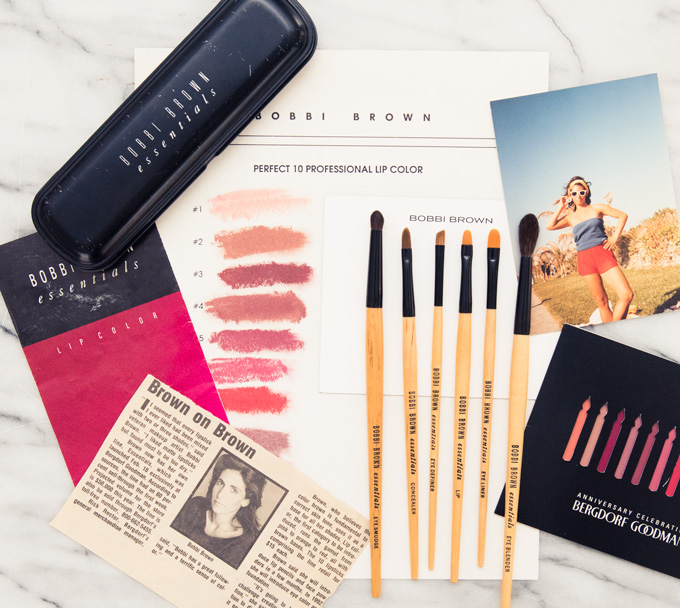
What is your morning and night skincare routine?
In the morning, I wash my face with Soothing Cleansing Oil and sometimes I mix Buffing Grains with Extra Balm Rinse if I want to exfoliate. I moisturise with Extra Repair Moisturising Balm and will sometimes layer the Extra Repair Serum on top, especially during the winter months when my skin tends to be dry. I recommend layering moisturisers to plump the skin and create the perfect canvas for makeup application. Also, eye cream is a must, every day, all year round. I alternate between Extra Eye Repair Cream and Hydrating Eye Cream. At night, I repeat my morning routine and add Hydrating Intense Night Cream.

‘It all started with a simple idea, natural looking makeup and a lipstick that looked like lips.’
Do you wear a lot of makeup?
I like to apply a few of my staple products every morning, before work (usually in the car), but I’m not afraid of going bare-faced, especially on the weekend. I keep my beauty routine really simple – it takes less than 5 minutes. Most of the time I will use my customised face touch up palette which has empty pans that I filled with my shades of corrector, concealer, foundation stick, pot rouge and lip balm. For an evening look, it’s all about black Long-Wear Gel Eyeliner and layering different mascara formulas, it’s a quick and easy way to get the look of false lashes.
How do you maintain your passion and enthusiasm for the industry?
I am fortunate to be passionate about what I do. Makeup, colour, and everything visual have always been what makes me happy. Thanks to my parents, who understood the importance of pursuing my passion, I made makeup my major in college, a first at my school. I knew that I would eventually turn my fascination with makeup, and how it can transform women inside and out, into a career.
This also fuels my other passion, helping women. My goal when I started my company was to empower women with the right makeup and knowledge to look and feel their best, most confident self. My mission has always been to empower women to feel good about themselves, that’s what energises me and keeps me going every day. And that’s also why I’m focused on giving women the right tools, products and knowledge to become their own makeup artist.
As a working makeup artist, who was the first celebrity you worked with?
Glenn Close and the rest of the cast from the movie, The Big Chill, for their press tour.

How has the beauty industry evolved since you started out?
Today, women want the same thing – simple and effective products that will help them look and feel their very best. They crave the knowledge of how to use them. Women have become so much more knowledgeable about products and application techniques. When they go to a makeup counter, they have a higher degree of confidence about what they want, which is great. The way women feel about ageing is also beginning to change. Ageing is starting to be seen as process through which a woman can gain more vitality, strength, wisdom, and a new sense of her beauty. As a result, the beauty industry has become more about options and less about rules and young girls and women have more role models today. We’ve definitely moved away from the idea that there’s only one definition of beauty. We’re starting to realise that we should all strive for is a very personal definition of our own beauty.
What is your favourite beauty look?
I’ve always preferred a natural or nude makeup look, it’s flattering and timeless. It compliments everyone and is pretty much mistake-proof. Natural or nude makeup means choosing the most flattering shades and textures for your face. However, natural makeup doesn’t mean completely bare-faced. The secret is to choose shades that are similar in tone to your complexion, for example, eye shadows that mimic the natural colouring of your eyelids and lipsticks that look like your lips. If a nude shade looks ashy, it’s too light for you. If it looks muddy, the shade is too dark.
But I’m also an artist and I love colour and I find ways to integrate bolder and brighter trends into my collections, all while making them more wearable for everyday. Sometimes I create beauty looks that are more runway than everyday for Fashion Week, Editorial shoots, etc, but I love showing women how they can translate these looks to fit their personal style, as well as enhance their features.
What’s your most important makeup tool?
While brushes are a fool proof way to apply makeup, never underestimate the power of your hands. The warmth of your hands can make blending easier, and the tips of your fingers can soften a shadow in a nanosecond. For my own everyday application, I like to use my hands/fingers to apply makeup because I don’t carry a lot of tools with me. If I had to choose my favourite brush, I’d say a Face Blender Brush because it’s ideal for travelling. It can be used to apply multiple products, including bronzer, blush, or a Shimmer Brick.
Has your beauty philosophy changed over the years?
Since the beginning, I’ve used makeup to enhance natural features and I’ve always used flattering, natural-looking products and shades. To this day, my philosophy hasn’t changed but it’s evolved and our products have definitely expanded to cater to the needs of modern day women around the globe. While today, it’s still about easy makeup that enhances and compliments a woman’s unique and natural features, that’ll always be my mantra, it’s also about being stylish without falling victim to trends. As far as foundation, concealer and powder are concerned, I still believe in skin tone correct shades. They look the most natural, the most perfect on a woman’s skin. That will never change, either.
Do you follow catwalk makeup trends?
I don’t believe in following every trend. What might work for one person, might not suit the next. It’s really about what makes a women feel her prettiest. For some women, that means natural, subtle colours, and for others, it means a more vibrant look. When it comes down to it, makeup is about options.
What has been your most memorable experience with Fashion Week?
One of my favourite moments working backstage at Fashion Week was with Michael Kors. Michael had Cindy Crawford, Christy Turlington, Naomi Campbell, Linda Evangelista and many others in his show before they were supermodels. The beauty look was always bronzed, healthy, tanned-looking faces, makeup I loved.
If you could define the Bobbi Brown women, who would she be?
The Bobbi Brown woman is someone who is confident and comfortable in her skin. She’s classic but edgy, cool but sophisticated, worldly but grounded. She is true to herself.
Bobbi’s beauty tips

What is the best way to create radiant, fresh and beautiful skin?
Before applying makeup, always begin by applying a hydrating face cream, moisture is the key to healthy looking and feeling skin. It replenishes the skin with a boost of hydration and helps even out and soften the skin, ensuring a flawless makeup application.
How do you pick the perfect foundation shade?
In natural light, swatch the foundation from your cheek to your jaw line, and gently blend it into your skin. Now do the same with another foundation that’s one shade lighter and another that’s one shade darker. The shade that’s imperceptible should be your pick, but double-check it against your forehead, since some women tend to be darker there. If it works in both areas, you’ve picked a winner.
Can you use the same foundation year-round?
I recommend having two foundations on hand, one for the winter months, when your skin is naturally paler, and one for the summer months, when your skin is slightly darker. For those in-between months, blend the two to develop your own custom shade.
Can you share tips on the best makeup for photos?
It’s important to adjust your makeup depending on the light. If you’re outdoors in natural light, then keep your makeup soft and natural. On the other hand, fluorescent and incandescent indoor lighting washes out the colour of your skin and reduces the definition of your features so you can apply more makeup than you normally use.
