

LANVIN, Stable Guard
Photographer : Urivaldo Lopes
Stylist : Sleiman Dayaa
Hair & Make-up : Laure Dansou
Model : Visnija Vjetrovic

Moka draped gabardine dress, block heel suede boots, Red Silk and crystal necklace, embroidered cap

Fleurs fils coupes lame dress in terracotta, Pony coat in brown, red crystal silk and crystal necklace, embroidered cap

Python and shearling coat, Satin Mosaic dress in Dark blue, Brown suede block heel boots

Fleurs fils coupes lame dress in Mint, Feuillage fils coupes pants in aubergine. Black silk and crystal necklace, embroidered cap

Flanelle gazar black coat

Black wool cape, double gabardine pants

Fleurs fils coupes lame dress in terracotta. Black silk and crystal necklace, red silk and crystal necklace.

Fleurs fils coupes lame dress in terracotta

LANVIN Sugar Bag in Cherry Lambskin, black silk and crystal necklace
Berluti, A Heritage of Bootmaking

History
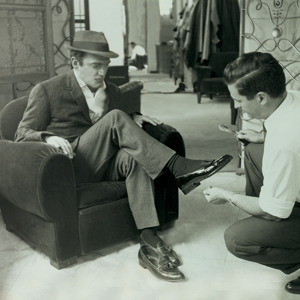
Alessandro Berluti, The Founder
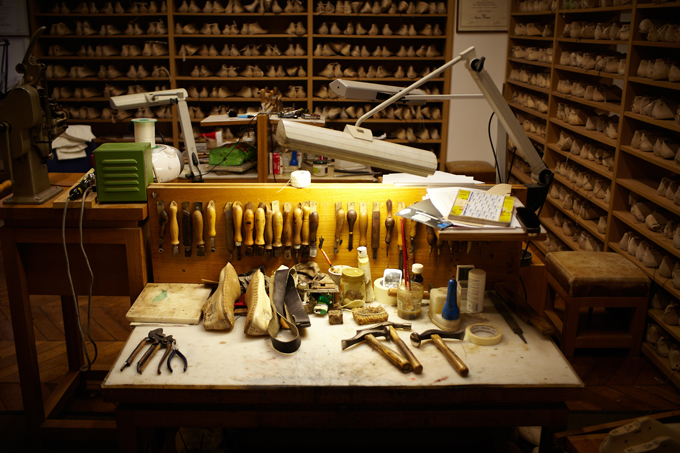
Alessandro Berluti was born in Senigallia, a tiny Italian port town in in Le Marche on the Adriatic coast, on October 20th, 1865. It was here that he began carving out his future as an apprentice, constructing carriages from wood, seats and reins in leather. During these years of hard work he made friends with the old master shoemaker of his village and discovered with him the shoemaker’s craft and its severe demands : skilled wood carving to ensure the upmost accuracy of the last, due attention to the leather to ensure the quality of the shoe, and the necessity of perfection to please the client. In 1882, with his skills now honed, he was ready to discover the world and took to the road. A few years of journeying and adventure led him to Paris, the city of light and joie de vivre.
Gaieté Parisienne
A hard-working perfectionist, Alessandro rapidly found work with orders from a number of fellow-countrymen, experienced shoemakers with their own establishments. Everywhere between the Opéra and the Tuileries the newly established grand hotels of Paris welcomed an international clientele in search of novelty and Parisian elegance. And here Alessandro set up his own bootmaking workshop, to craft shoes for these wealthy men who were not only connoisseurs but also extremely exacting clients.

Birth of a Style, The Dandies
In the effervescence of change that marked the turn of the century, with scientific progress advancing at great pace, artists were exploring unusual and diverse paths. The Symbolists invented a poetic language strongly influenced by mythology and dreams, while the swirling curves of Art Nouveau challenged the rigid and regular patterns of architecture. A generation of artists were challenging the codes of high society elegance and the smart gentlemen of the age dressed in exclusive and refined tailoring, immortalized in portraits by Boldini, Helleu and Sargent and in literature by authors from Proust to Loti.
During this search for a poetic aesthetic, Alessandro was fine-tuning his own style, and in 1895 he created an extraordinary lace-up shoe for men, the Alessandro, in an unusual design using a single piece of leather with no visible stitching, smooth and supple as a leather glove. Defying both time and fashion, this iconic shoe, the first under the Berluti name, became the foundation of the House style. In that same year Torello was born, the fifth and last child of Alessandro and Zénaïde Berluti.
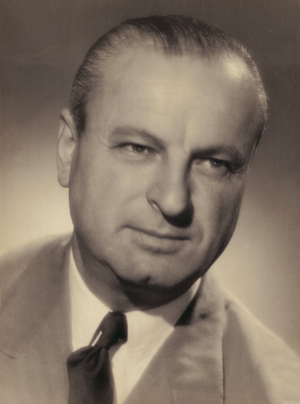
Torello Berluti, The Entrepreneus
Torello, motivated by the same passions and desires as his father, followed an almost identical path. He had inherited his father’s greatest gift: hands to express his creativity and intelligence.
An Ideal Son
The young Torello could turn his hand to almost anything, but what he liked best were the noble materials – wood, leather and cloth – from which he could craft accoutrements for the elegant living of the day. A carpenter, cabinet maker, his greatest pleasure lay in creating and shaping beautiful things, bringing a touch of the exquisite to daily life.
La Forza Del Destino
By 1922, with the Roaring Twenties were gathering speed, Torello plunged himself enthusiastically into the bootmaker’s craft that his father had taught him to love. His approach was very advanced from the start: he thought in terms of volume while others were still thinking simply in sizes. He was particularly focussed on the beauty of the finished shoe. Echoing the Art Deco style of the period he preferred simple, clean lines, introducing the “Richelieu à plastron” (lace-panel Oxfords) and comfortable “Sans Gêne” elasticated boots. In 1928, to satisfy the flood of orders and receive his clients in comfort and style, Torello bought the lease of a shop at 9 rue du Mont Thabor. From there his fame spread, to such a point that wealthy international clients from the nearby grand hotels had their names put down on his waiting list for the privilege of wearing shoes made by Berluti.
Success Story
Torello and his family were now living on rue Saint Honoré. Early in the 1940’s the shop on rue du Mont Thabor had become too small to receive a clientele accustomed to luxury and comfort, so he acquired larger premises at 26 rue Marbeuf. Here, a stone’s throw from the Champs-Elysées, he was able to give shape to his passion for creation. With his characteristic meticulous detailing, he designed the refined interior of his new premises himself. Attentive and hard-working, he attracted intelligentsia and film stars to his shop and country house outside Paris.
Gaston and Claude Gallimard, Jean Cocteau, Marcel Achard or Jules Roy, but also Marcel l’Herbier, Yul Brynner, Charles Vanel or Pierre Mondy, these personalities and many others became ambassadors for Berluti’s excellence. Torello and his wife Assunta had one child, a son called Talbinio.
Talbinio Berluti, The Innovator
Brought up in his father’s world of creative discipline and elegance, Talbinio imagined a future tailored to his own ambitions: the international renown of a Maison entirely dedicated to masculine elegance. He was nurtured by a family that had successfully established its social standing, nevertheless he chose to learn the bootmaker’s craft under the benevolent authority of his father Torello.
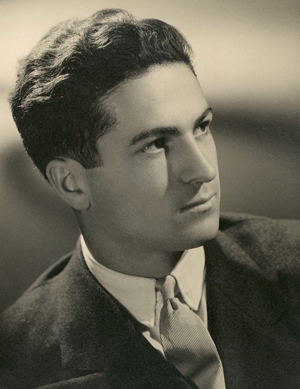
The Personal Road
Talbinio cultivated his design talents, sketching elegant masculine silhouettes clothed from head to toe, shod in Berluti’s new creations, such as the emblematic lace-up loafers. For him, a young man born into the dynamic post-War period, the time had come to change, innovate and give Berluti an international dimension.
With typical visionary enthusiasm and audacity, Talbinio introduced ready-to-wear de luxe shoes in 1959, a selection of entirely hand-made models in the great bootmaking tradition, but immediately available. This idea, at the dawn of a new era, opened the door to a very specific and younger clientele.
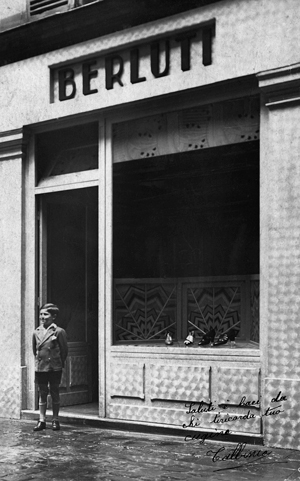
For the boutique, he designed a modern, functional decor, where new customers could mingle with established clients to discover both ready-to-wear and made-to-measure shoes. Even fervent advocates of bespoke footwear, such as Edie Constantine, Truffaut, Godard, or Chabrol found immediate satisfaction in the new ready-to-wear models offered at rue Marbeuf.
Cultivated, charming and attractive, by introducing remarkable changes, Talbinio had written, with grace and some success, a new page in the history of the House. Subsequently, Talbinio was joined by his young cousin Olga, who injected yet another burst of creative energy into the family business.
Olga Berluti, The Artist
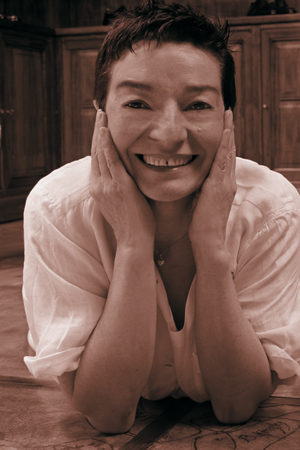
When she arrived at rue Marbeuf in 1959, straight from the Italian village in Emilia-Romagna where she was born, Olga, Talbinio’s cousin, discovered a world whose manners and
values were foreign to her, yet her lively and cheerful disposition rapidly won her the hearts and minds of Berluti’s clients. Little by little, she developed a long-lasting creative affinity with her cousin Talbinio, who was by now the head of the firm. Her youthful vitality worked its magic on all who came, turning their purchasing decisions into a charming game.
Colours
Talbinio’s imagination paired with Olga’s boldness worked wonders. Olga transformed the shop into a drawing room where clients could enjoy conversation in good company. Jacques Lacan would chance upon Roman Polanski and Yves Saint Laurent, Pierre Bergé or Karl Lagerfeld. In 1962, Olga’s perception of the young artist, both rebel and client, Andy Wharol led her to create an exceptional pair of loafers. The shoes’ clean, unconventional lines gave them an unmistakable stamp of modernity, and the artist immediately recognized their unique character, their avant-garde originality echoing his own artistic endeavors. He took possession on them enthusiastically, and they carried his name ever after, with the model becoming one of the classics of the House.
It was a light-hearted period, the future looked promising, and bold colours made their entry into this now venerable institution. Olga brought a touch of spice to luxury, perfecting Berluti’s Venezia leather and introducing a hand-finished patina in a palette of exclusive shades. The House’s very individual shoes and the soul Olga discovered for them made the magic that to this day remains the romantic signature of Berluti.
The Signature
Lasts, The Foundation of Bootmaking Know-How
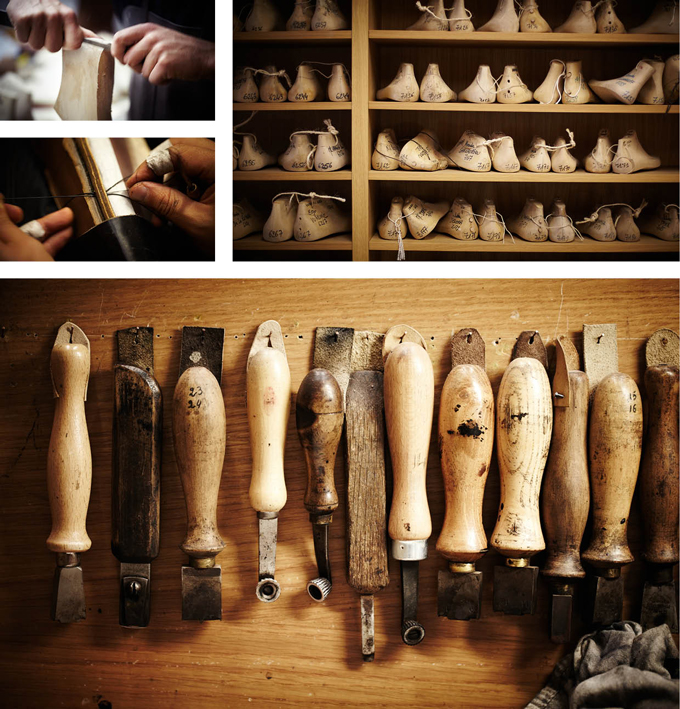
Since 1895 each successive Berluti generation has cultivated an exceptional mastery of last-making and a deep understanding of fine footwear. The consistent result has been shoes of incomparable comfort and elegance, expressed in the House saying : “you cannot be elegant if you are not comfortable and well shod”. These techniques and this expertise, initially developed for bespoke footwear, were also brought into service for the ready-to-wear collections.
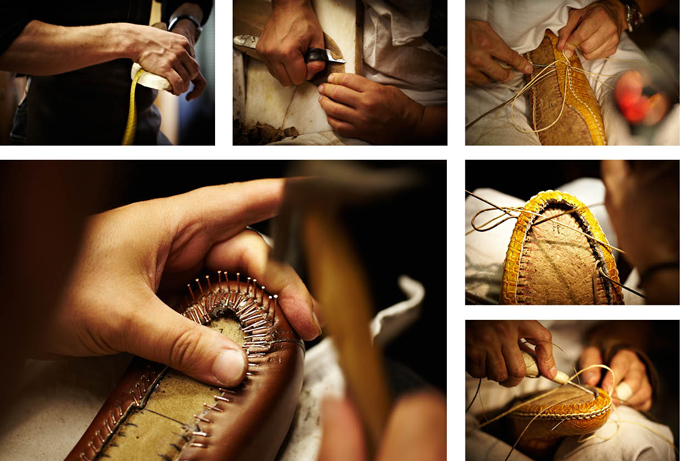
Customers begin their bespoke experience by having their feet expertly measured. A last is then constructed in wood to perfectly match their feet. Next, a pattern of the selected model is cut and a prototype made of one upper stitched to a sole. Only once the customer returns to try the prototype and it has been modified can the construction of the definitive pair of shoes begin.
Berluti’s artisans produce shoes using four distinct specialist techniques, each one of which helps form the personality of the shoe. Hand-stitched Blake construction, where the outer sole is stitched directly to the insole, is ideally suited to lightweight, flexible shoes. Goodyear welting, where the upper and sole are first stitched to the welt, is perfect for both comfort, durability and future repair, which Berluti can provide. Norwegian assembly has the welt flush to both the upper and the sole, and gives a durable shoe with a very waterproof finish. Berluti also produces softer and suppler shoes with a non-welted tubular construction, such as driving shoes or slippers, which have a hand- sewn vamp.
Leather
Venezia Leather and its Patina
The Venezia leather used by Berluti was developed after years of research exclusively by and for the House. Immediately recognisable, it owes its unique flexibility to its initial vegetable tanning and its durability to a secondary tanning process with mineral salts. This expert and jealously guarded knowhow gives the unvarnished leather an exquisite texture when it is patinated, a process that imparts to the finished leather its totally unique and special character.
Perfected during the 1980’s, the famous Berluti patinas revolutionized the world of male footwear by introducing colour at a time when the majority of men’s shoes were either black or brown. These patinas overlay the Venezia leather with colours that are both transparent and exceptionally deep, bringing individual life to each pair of shoes, for each patina is the unique result of hand-finishing by Berluti’s expert colourists.
Emblematic Colours
Tobacco Brown: since its creation in 1895, the Alessandro lace-up was a warm amber. This characteristic shade brings a touch of nature’s wild side to the sober classicism of brown. The suggestion of tobacco fragrances harmoniously blending with the scent of leather carries the client into a world of sense perceptions.
Saint-Emilion Red: a deep, brilliant red that brings the nobility of a great terroir wine to the shoes it glosses. This association of grands crus with great leathers captures the client’s imagination and draws him into a sophisticated world, where the touch of skilled hands brings nature’s sublime generosity to the peak of perfection.
A House with Character
Three Characteristics
Berluti is the story of a long-lived passion ripening over time. Men have always been attracted to the classicism and rigour of the House heritage. Proudly impervious to time, Berluti rises above and beyond mere ephemeral fashion.
Installed in the heart of Paris, between the Tuileries and the Place Vendôme, Berluti’s founders absorbed the fertile influence of the royal architecture around them, whose pure lines gave them a taste for proportion, balance and perfection.
Each and every day in Berluti’s workshops, with much patience and virtuosity, highly skilled cutters and tailors turn leather and cloth into both bespoke and ready-to-wear collections. Attention to detail, respect for skill and technique, perfection in cutting and assembling, matched with imagination and a taste for elegance -these are the cornerstones of Berluti’s culture, foundation and history.
The House cultivates an art de vivre that rejects the boredom of banality, so self-deprecation, joie de vivre, lightness and humour also have a place. With a touch of fantasy in its soul, Berluti occasionally enjoys transgressions and digressions from established codes. A three-piece suit worn with boots, a soft-collared shirt worn with a bow tie, or jeans cut in flannel – these details add an irreverent flourish.
The Club
From the beginning, Berluti clients belong to a world apart, one reserved exclusively for those whose taste for the rare and appreciation of perfection means they belong to a community of men who are hedonists. These experts in the high art of true luxury are both collectors and connoisseurs.
They share a certain taste for enjoyment and refinement which they find at Berluti. The expertise embodied in the products of the House, such as a shoe cut from a single piece of leather, an overcoat lined with sable and cashmere, or exclusive experiences – the bootmaker who calls to take measurements, a tasting at Château d’Yquem, an invitation to take part in a car race – all bring a touch of magic to the lives of men who love daring and adventure.
The private universe of Berluti is a club whose members make light of established codes, avoiding the commonplace, inventing a savoir-vivre that is distinctively off the beaten track of convention. They are collectors of rare experiences which mingle surprise with the pleasures of discovery. In their quest, the legendary history of Berluti is their shared roadmap, weaving, between connoisseurs, the subtle links of complicity.
Giorgio Armani Cruise 2016
The Giorgio Armani Cruise 2016 collection features clean and sophisticated lines. Simple designs combined with structured yet light silhouettes bring out the effects created by playful stripes and intertwined patterns. The collection has a sensual, spontaneous allure: fluid shapes emphasise the sensuality of the body. There are enveloping pea-coats and little jackets, slim blazers, wide-cut, calf-length trousers and figure-hugging overcoats. The knot is a common motif that runs through the collection as a functional device – a belt around the waist – or a decoration – a necklace or a detail on a clutch bag. Colours are bold and strong: shades of red, including geranium, are enhanced by graphic contrasts with white, black and blue. Fresh and soft tones of greige and pale blue punctuate the collection.
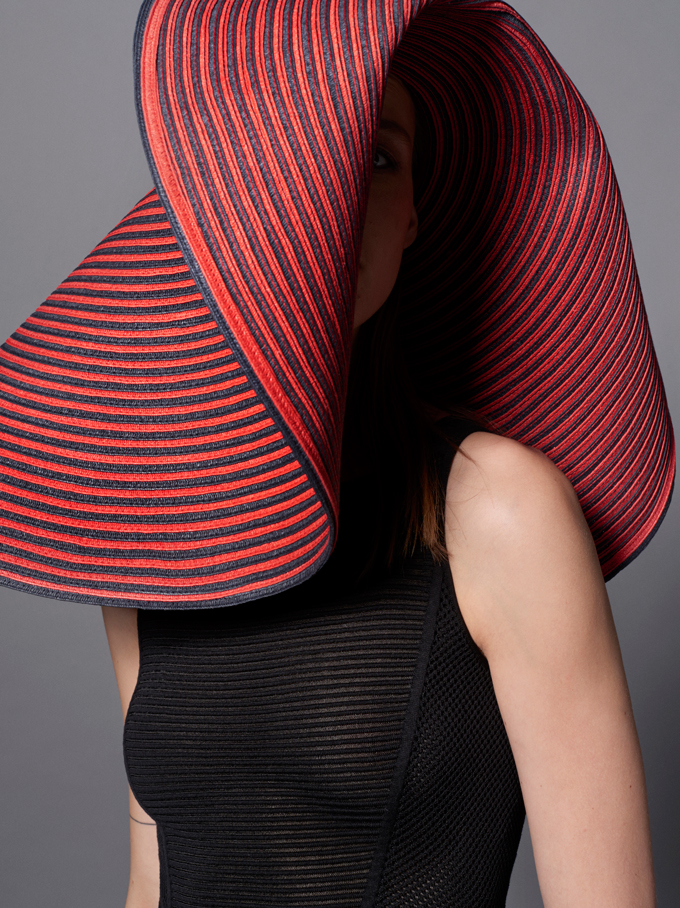
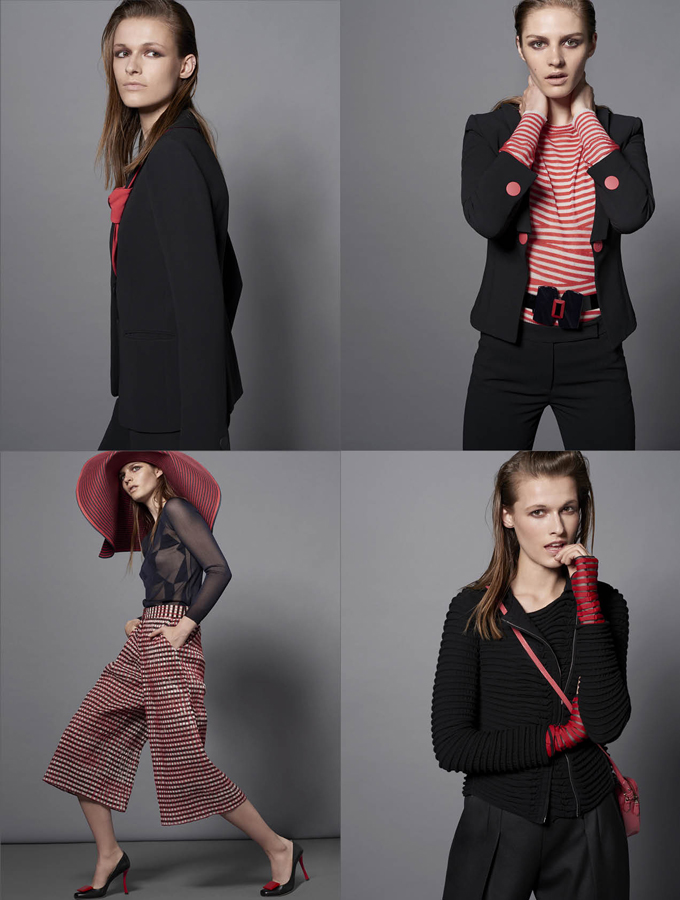
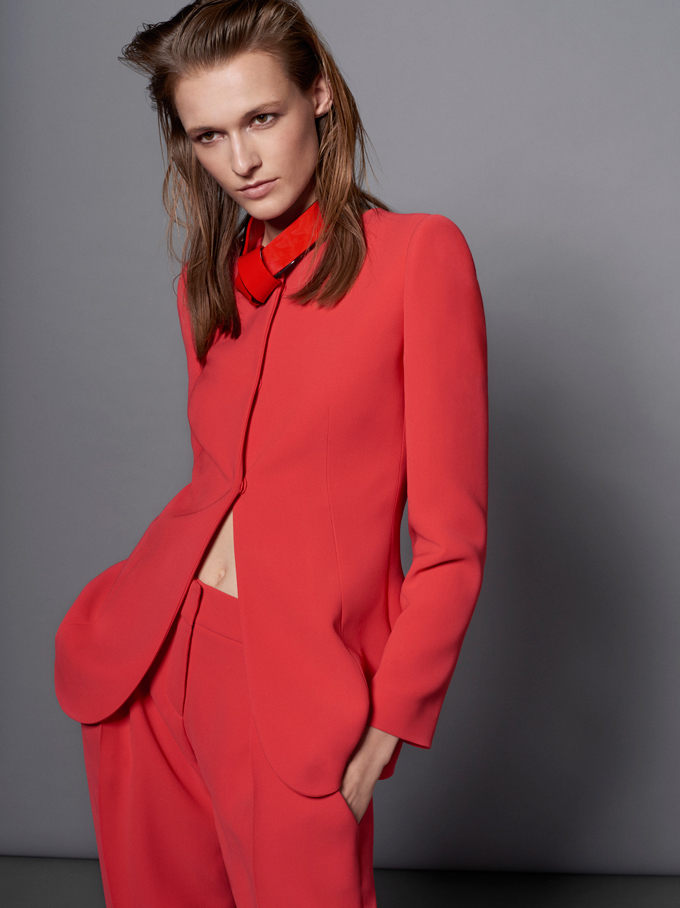
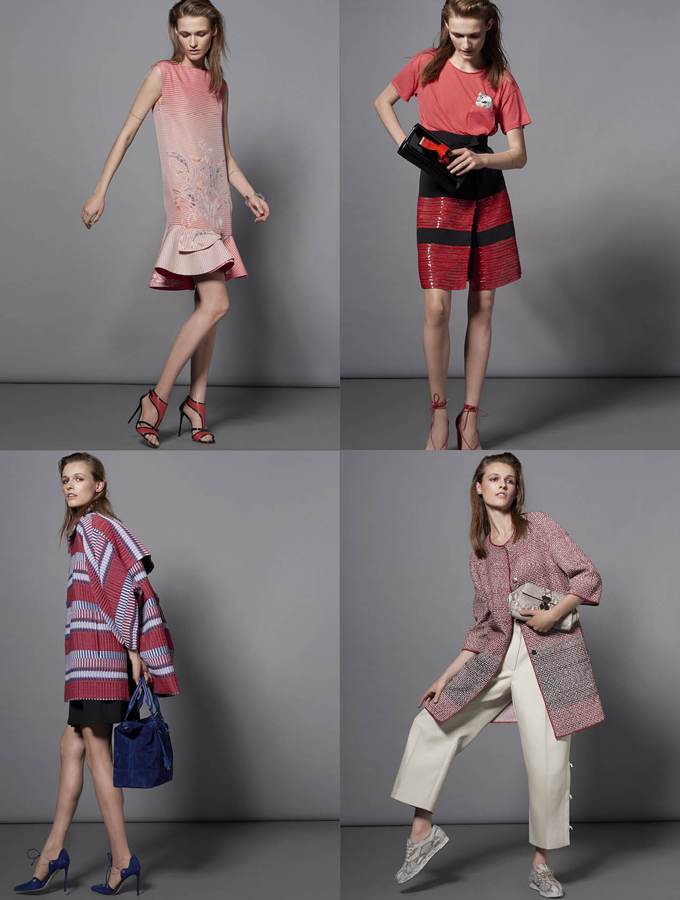
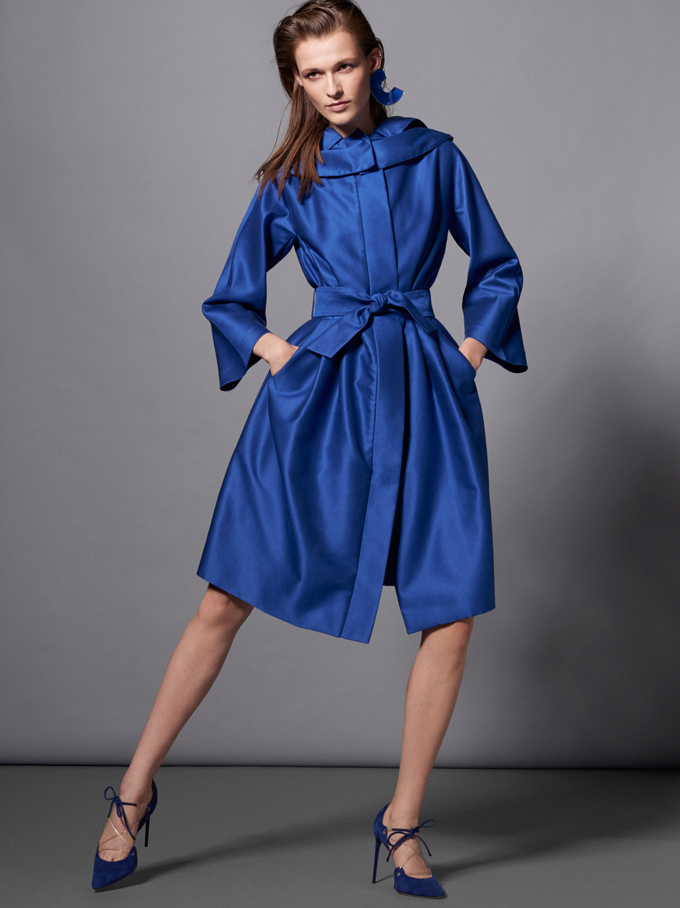
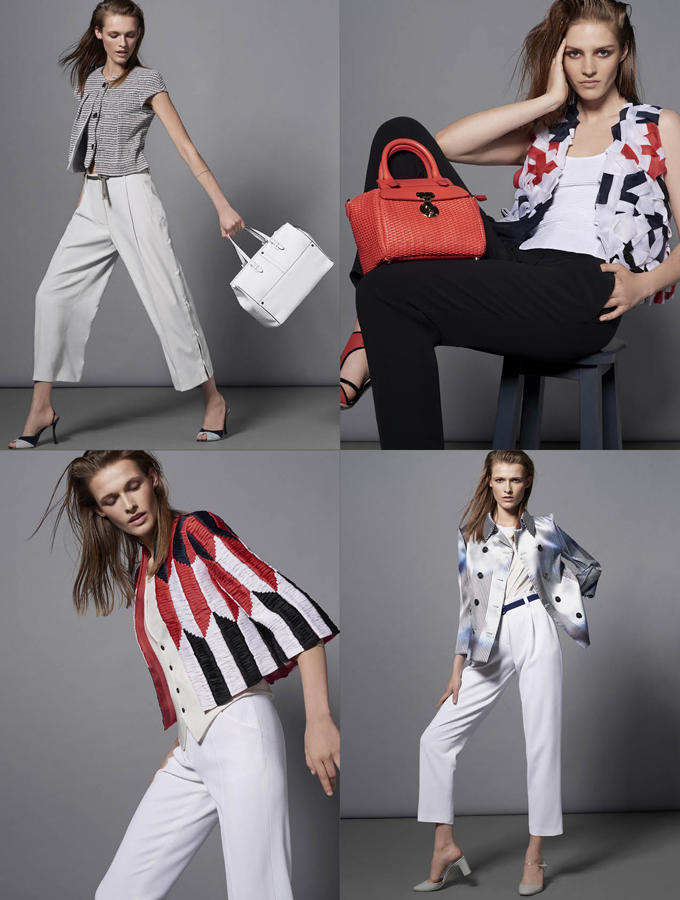
Giorgio Armani is available at Mall of the Emirates (Dubai), The Dubai Mall (Dubai) and The Avenues (Kuwait)
ERMENEGILDO ZEGNA, When heritage and avant-garde technology come to life
Photographer : Claudio Braccini
Stylist : Gioele Panedda
Grooming : Astor Hoxha @ Closeup Milano
Model : Pedro @ tomorrowmodel srl
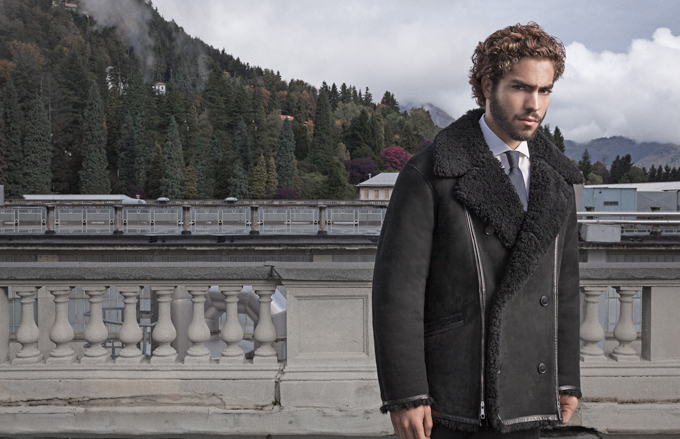
Black double breasted peacoat in curly shearling with leather binding and front zip openings , worn with single pleat trousers with elastic stirrup detail at hem in back wool sablé. Four pocket shirt with two button collar in white pure cotton poplin, loop detail.
(Ermenegildo Zegna Couture)
Dark blue silk tie
(Ermenegildo Zegna)
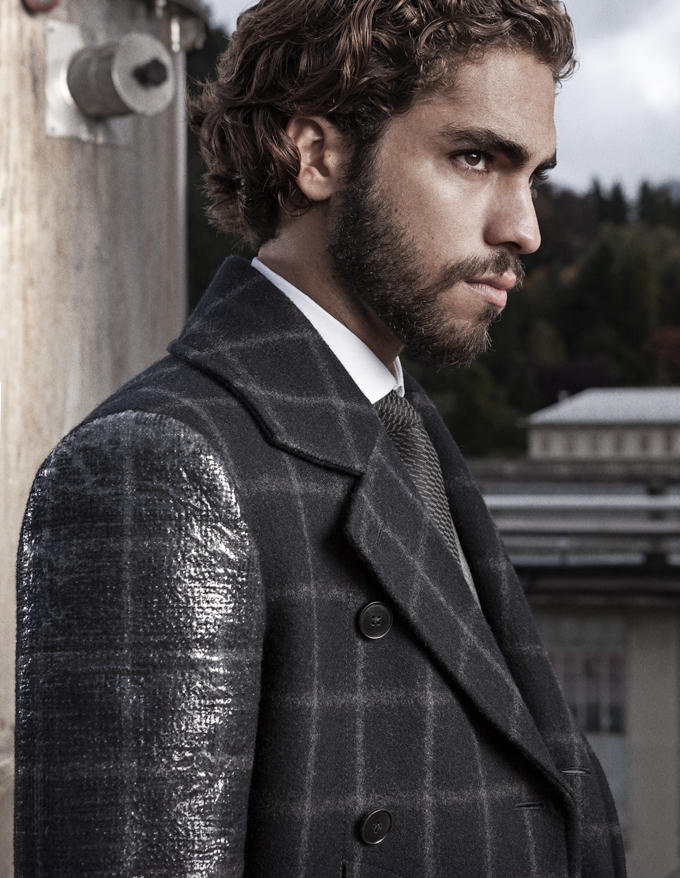
Compact Japanese heavyweight double breasted wool coat in dark blue windowpane check with two side pockets and sleeve zip detail.
Four pocket shirt with two button collar in white pure cotton poplin, loop detail.
Oxford without laces in French calf, high frequency wing tip, additional rubber sole with leather strap.
(Ermenegildo Zegna Couture)

Micro-check cashmere overcoat with unlined construction
(Ermenegildo Zegna)
Bordeaux premium cashmere
V-neck sweater
(Ermenegildo Zegna)
Single pleat trousers in black wool sablé with elastic stirrup detail at hem. Shirt with two button collar in white pure cotton poplin, loop detail. Wool cashmere jacquard tie 6cm
(Ermenegildo Zegna Couture)
Luxurious and functional reporter bag in black soft lamb nappa with cut details on handle, mesh effect padded leather on the back and double gussets. Equipped by express pockets padded for technological devices and personalized with the hand-stitched triple X COUTURE signature.
(Ermenegildo Zegna Couture)
Chelsea boot in French calf, high frequency wing tip, additional rubber sole with leather strap.
(Ermenegildo Zegna Couture)

Compact Japanese heavyweight double breasted wool coat in dark blue windowpane check with two side pockets and sleeve zip detail.
Four pocket shirt with two button collar in white pure cotton poplin, loop detail.
Oxford without laces in French calf, high frequency wing tip, additional rubber sole with leather strap.
Light grey wool suit.
(Ermenegildo Zegna Couture)

Dark navy compact felted wool cashmere coat with guru collar and military inspired pocketing and detailing, extra long waisted belt, half quilted lining.
Single pleat trousers in dark blue sablé with elastic stirrup detail at hem.
Four pocket shirt with two button collar in white pure cotton poplin.
Wool cashmere jacquard tie 6cm
(Ermenegildo Zegna Couture)

Evening coat in felted regenerated wool combined with Harris Tweed with exclusive needle punch finish, double zip detail trimmed in leather and double entry pockets, worn with single pleat trousers with elastic stirrup detail at hem in back wool sablé.
Four pocket shirt with two button collar in white pure cotton poplin, loop detail. Wool cashmere jacquard tie 6cm .
(Ermenegildo Zegna Couture)
Suit in light grey wool
(Ermenegildo Zegna)
Dark navy compact felted wool cashmere coat with guru collar and military inspired pocketing and detailing, extra long waisted belt, half quilted lining.
Single pleat trousers in dark blue sablé with elastic stirrup detail at hem.
Four pocket shirt with two button collar in white pure cotton poplin.
Wool cashmere jacquard tie 6cm
(Ermenegildo Zegna Couture)
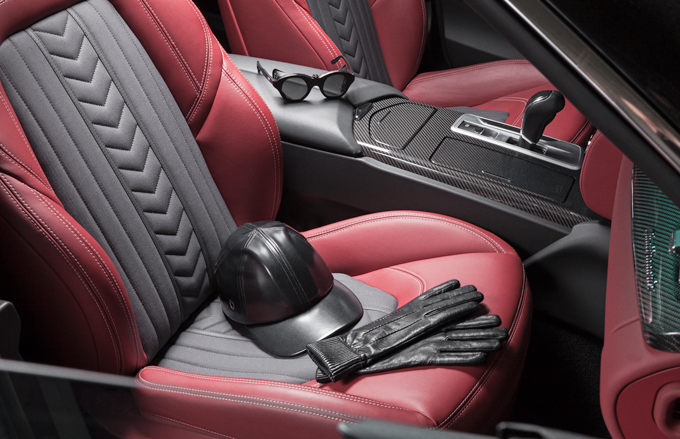
Black shiny rubberized technical workmen inspired safety baseball cap.
(Ermenegildo Zegna Couture)
Gloves realized in goat nappa; detailing of 3 parallel ribs on the front part and the elasticated nappa wrist with discretely logo embossing; 100% cashmere lining.
(Ermenegildo Zegna)
Sunglasses with perforated side shields and hand crafted in acetate.
(Ermenegildo Zegna Couture)
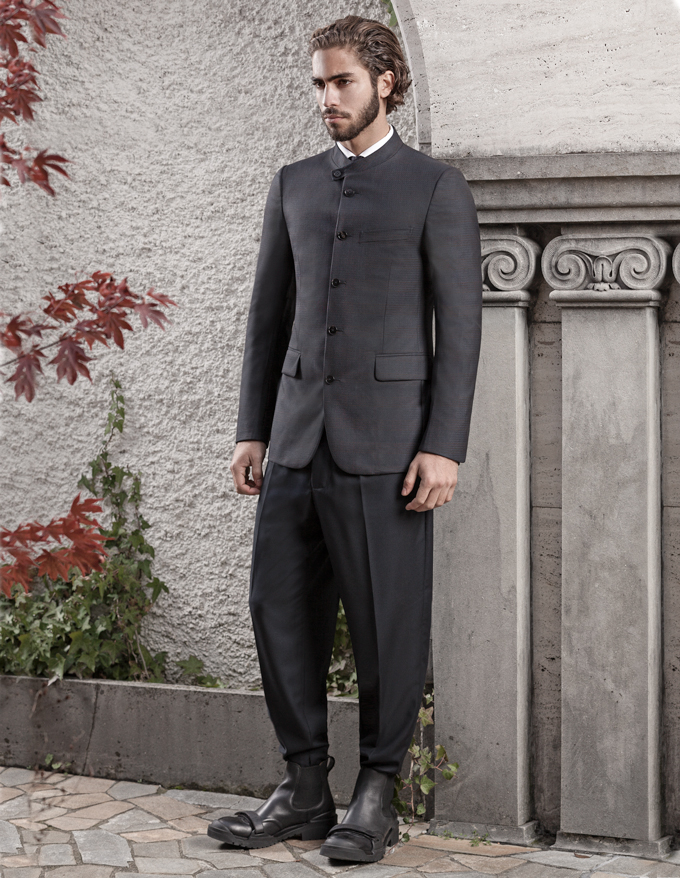
Broken suit in pure wool from Lanificio Zegna, single breasted jacket with guru collar in checked pattern on structured ground, worn with single pleat trousers with elastic stirrup detail at hem in microstructed wool. Four pocket shirt with two button collar in white pure cotton poplin. Wool cashmere jacquard tie 6cm . Chelsea boot in French calf, high frequency wing tip, additional rubber sole with leather strap.
(Ermenegildo Zegna Couture)
PIAGET Secrets & Lights – High Jewellery Collection
Photographer : Sandra Chidiac
Assistant photographer : Rachel Barakat Stephane, from Rouchon
Stylist : Amine Jreissati
Hair Stylist : Tomoko Ohama, from @Callisté
Make up : Grigoris, from @Callisté
Model : Estelle, from Marilyn agency, Paris
Location : Studio Rouchon, Paris
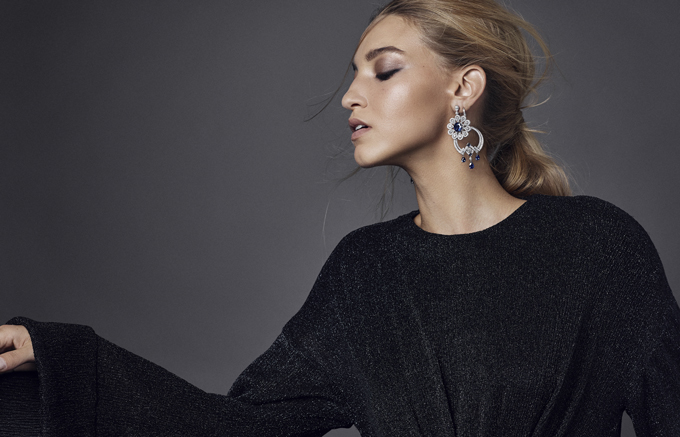
RICCAMO NOTTURNO EARRINGS (G38M2700) Earrings in 18K white gold, set with 2 cushion-cut blue sapphires (11.53 ct), pear-shaped diamonds (2.60ct) and brilliant-cut diamonds (2.95ct).MASEGNI EARRINGS (G38M4300) Earrings in 18K white gold, set with pear-shaped blue sapphires (4.25ct), blue sapphire sugarloaves (4.12ct) and brilliant-cut diamonds (4.25ct).
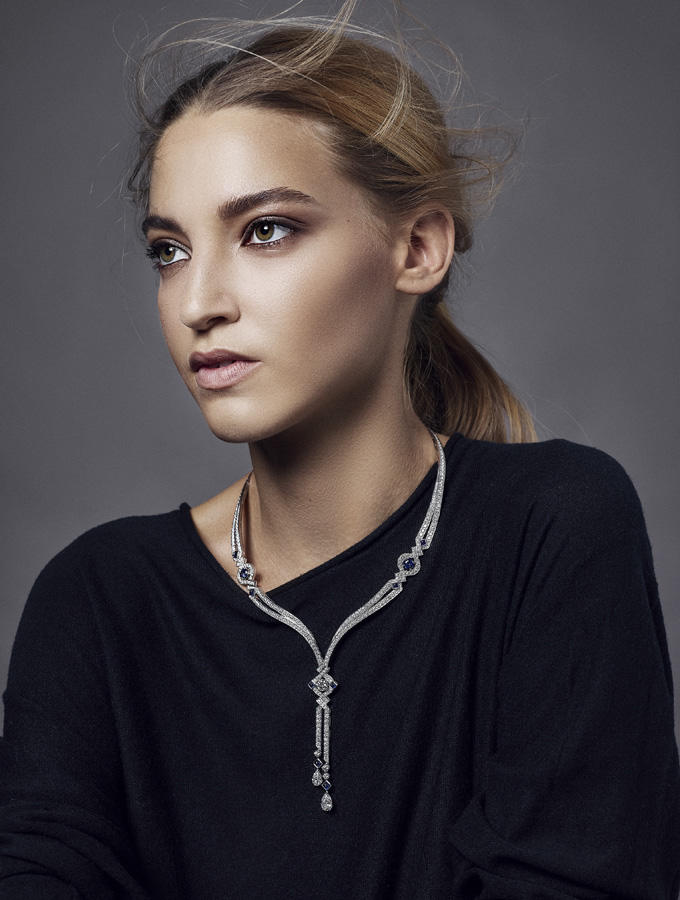
MASEGNI NECKLACE (G37M5300) Necklace in 18K white gold, set with pear-shaped diamonds (2.83 ct), blue sapphire sugarloaves (3.90ct), round blue sapphires (2.00ct) and brilliant-cut diamonds (13.14ct).
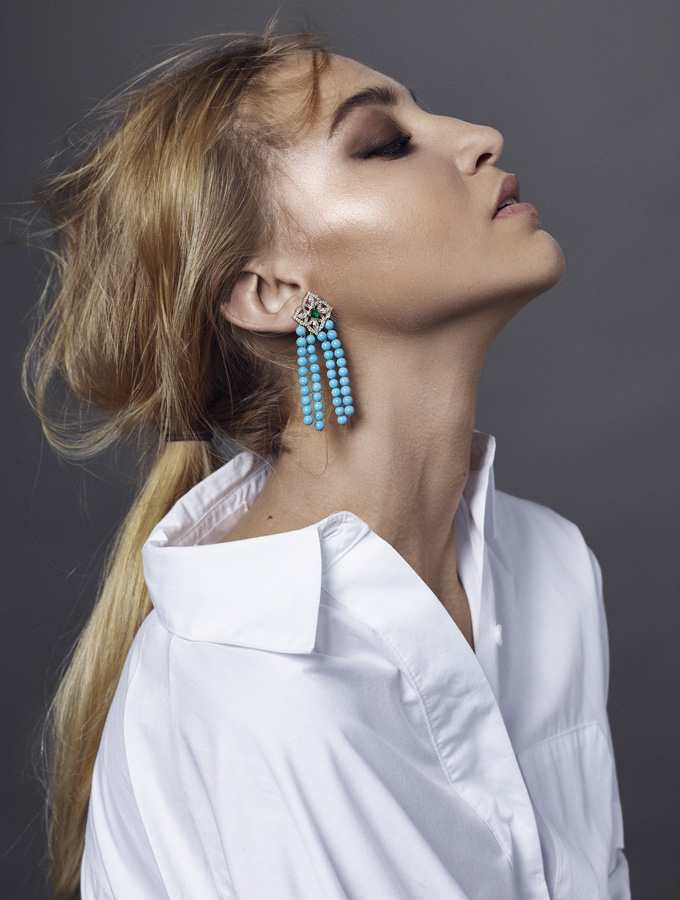
TILLA KARI EARRINGS (G38M6600) Earrings in 18K pink gold, set with 2 cushion-cut emeralds (1.28 ct),marquise-cut diamonds (1.28ct), turquoise pearls and brilliant-cut diamonds (1.02ct).
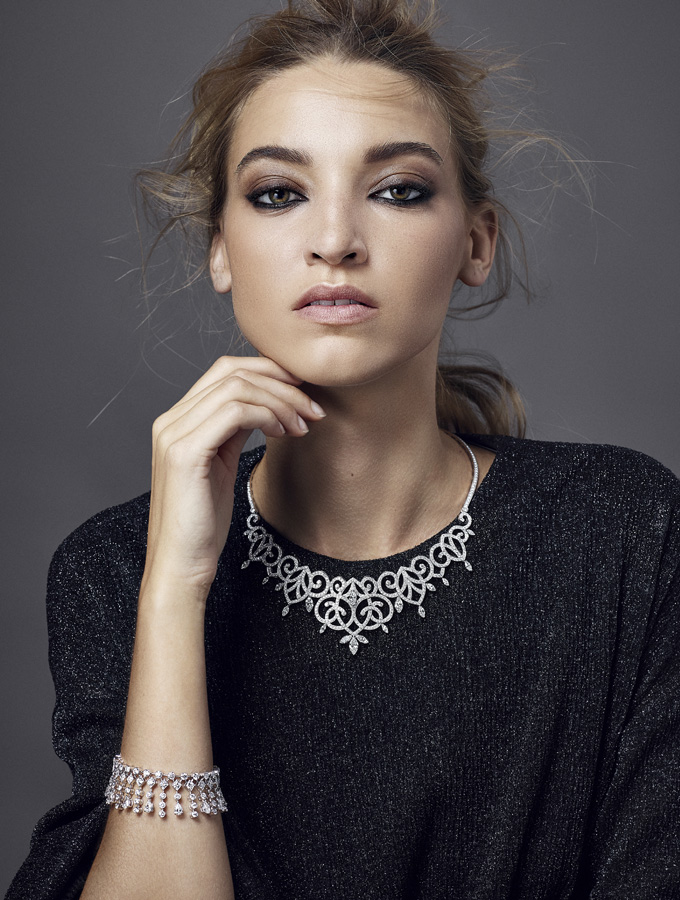
ARABYSKA NECKLACE (G37M6200) Necklace in 18K white gold, set with marquise-cut diamonds (4.81ct) and brilliant-cut diamonds (11.17ct).
PICCOLO CANALE BRACELET (G36M1216) Bracelet in 18K white gold set with 10 pear-shaped diamonds (4.20 ct) and 102 brilliant-cut diamonds (13.09ct).
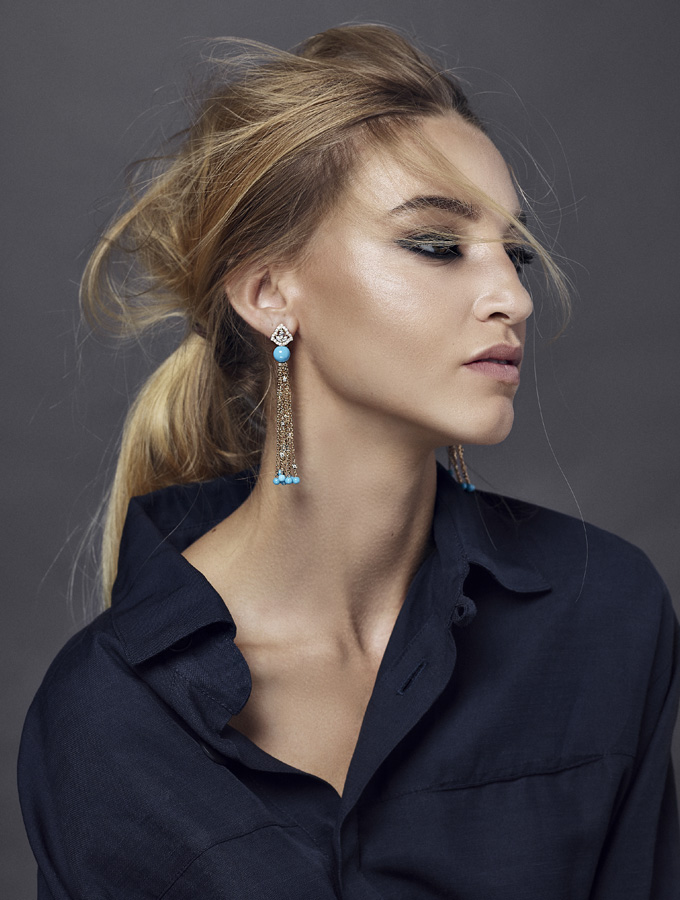
SAMITE TURQUOISE EARRINGS (G38M6500) Earrings in 18K pink gold, set with marquise-cut diamonds (0.68ct), turquoise pearls and brilliant-cut diamonds (2.37ct).
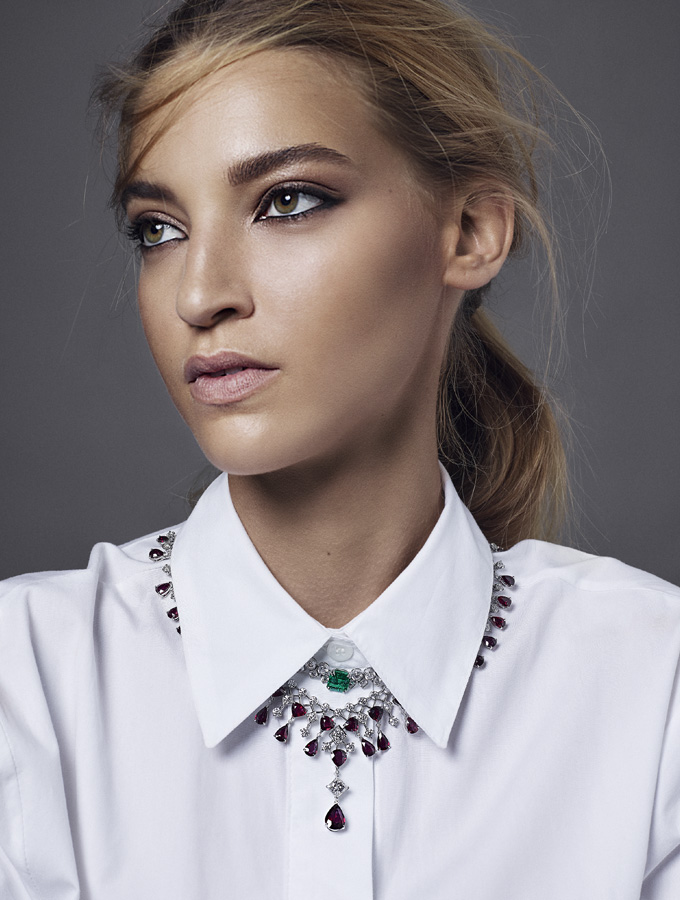
PASSEGIATA NECKLACE (G37M5140) Necklace in 18K white gold set with 1 pear-shaped ruby (approx. 4.41 cts), 45 pear-shaped rubies (approx. 48.90 cts), 1 princess-cut diamond (approx. 1.77 cts) and 158 brilliant-cut diamonds (approx. 23.89 cts).
PICCOLO CANALE NECKLACE (G37M5238) Necklace in 18K white gold set with 1 octagonal-cut emerald (4.87 ct) and 116 brilliant-cut diamonds (25.14 ct)
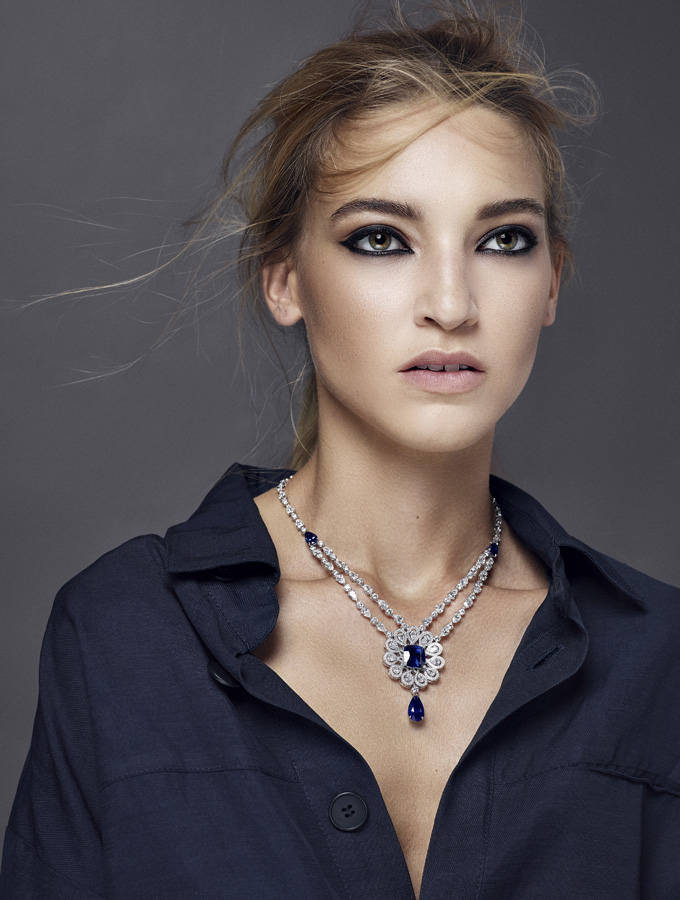
RICCAMO NOTTURNO NECKLACE (G37M3540) Necklace in 18K white gold, set with 1 cushion-cut blue sapphire (10.57 ct), pear-shaped blue sapphires (7.20ct), pear-shaped diamonds (15.41ct) and brilliant-cut diamonds (10.56ct).
BULGARI A Colorful Perspective
Photographer : Tina Patni
Stylist : Stuart Robertson
Hair & Make-up : Billy Orr @ Bareface
Model : Justyna @ MMG Eventz
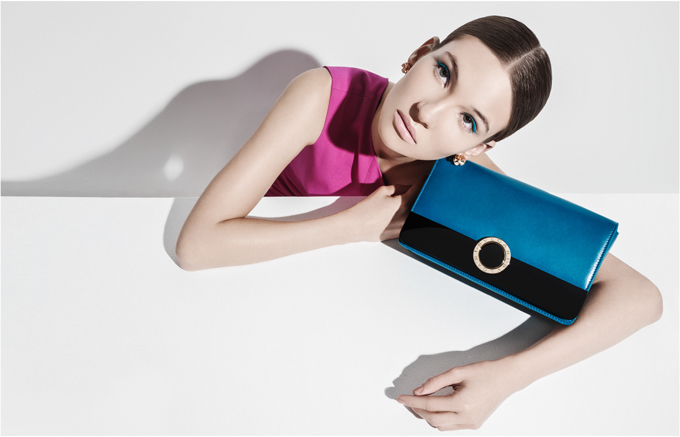
BVLGARI Diva Earrings & BVLGARI-BVLGARI Bag
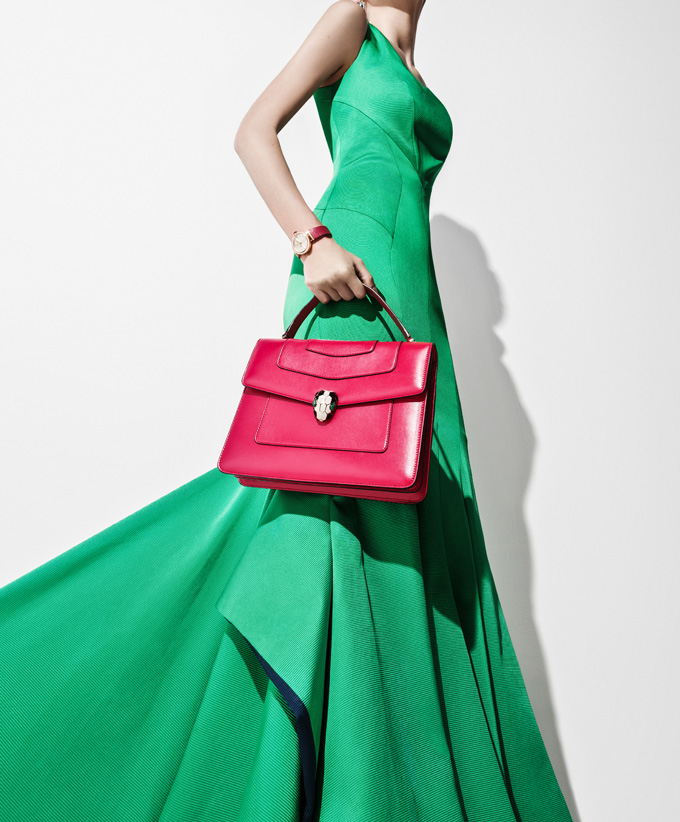
BVLGARI MVSA Earrings, BVLGARI Lvcea watch & BVLGARI Serpenti Handbag
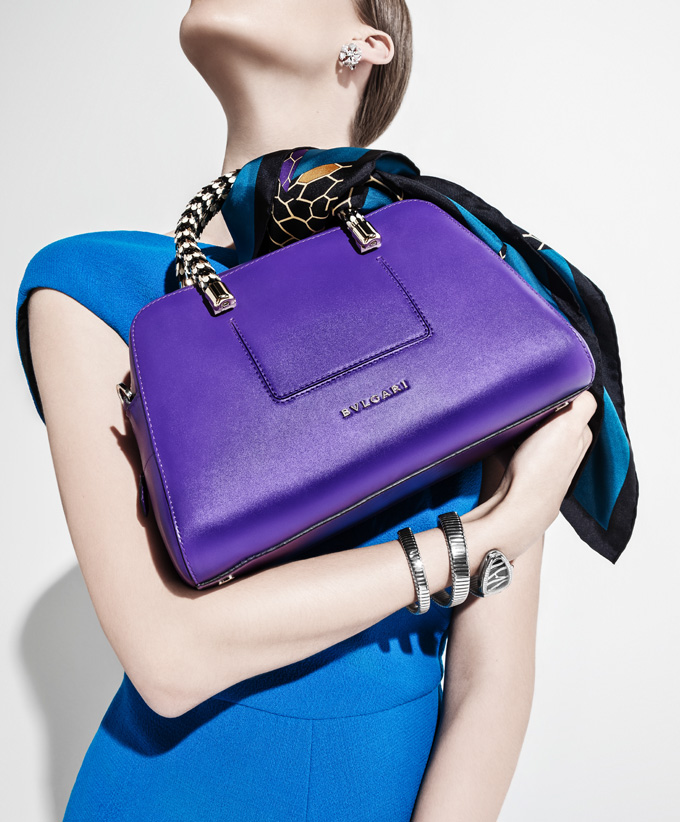
BVLGARI Diva Earrings, BVLGARI Serpenti Scaglie Handbag, BVLGARI Serpenti Tubogas Watch & BVLGARI Serpenti Scarf
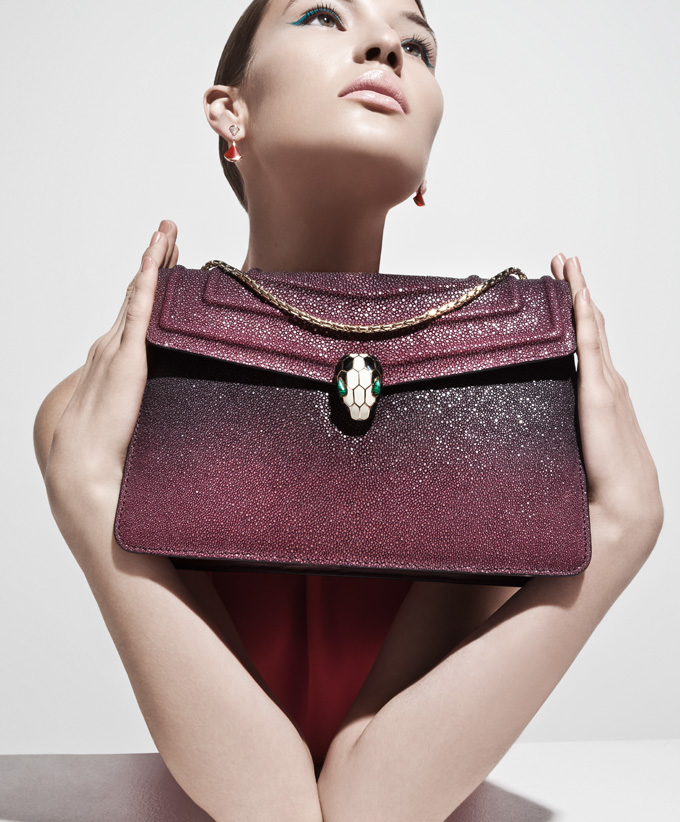
BVLGARI Diva Earrings & BVLGARI Serpenti Forever Bag
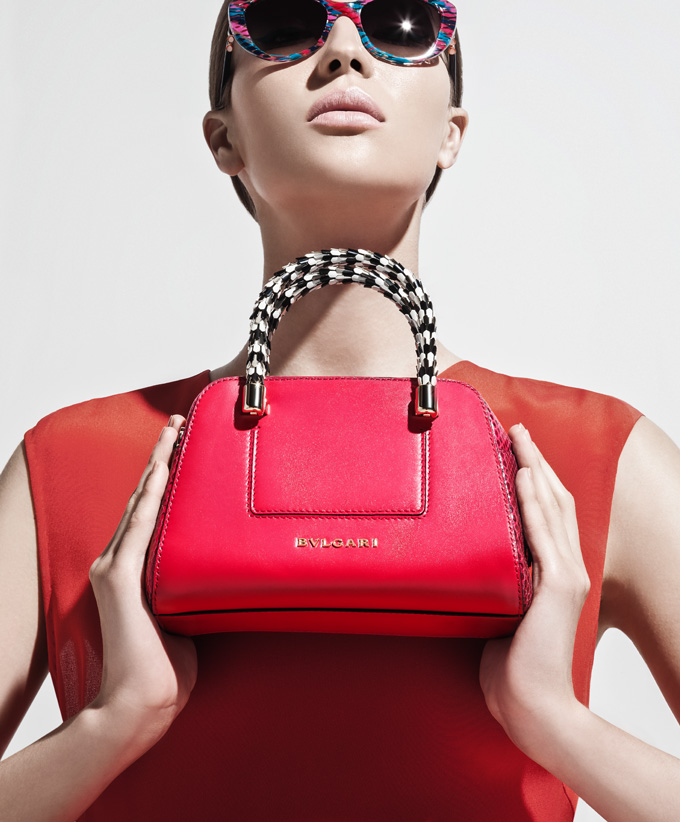
BVLGARI Serpenti Sunglasses & BVLGARI Serpenti Scaglie Clutch
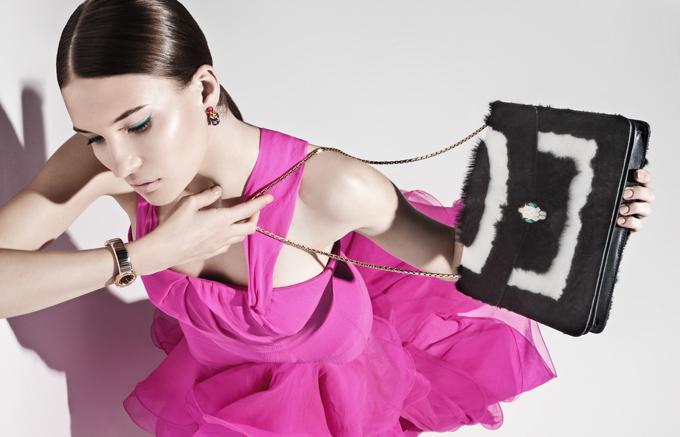
BVLGARI MVSA Earrings, BVLGARI-BVLGARI Watch & BVLGARI Serpenti Mink Bag
One to One with Domenico Dolce & Stefano Gabbana On Fashion, Family & La Mama Collection
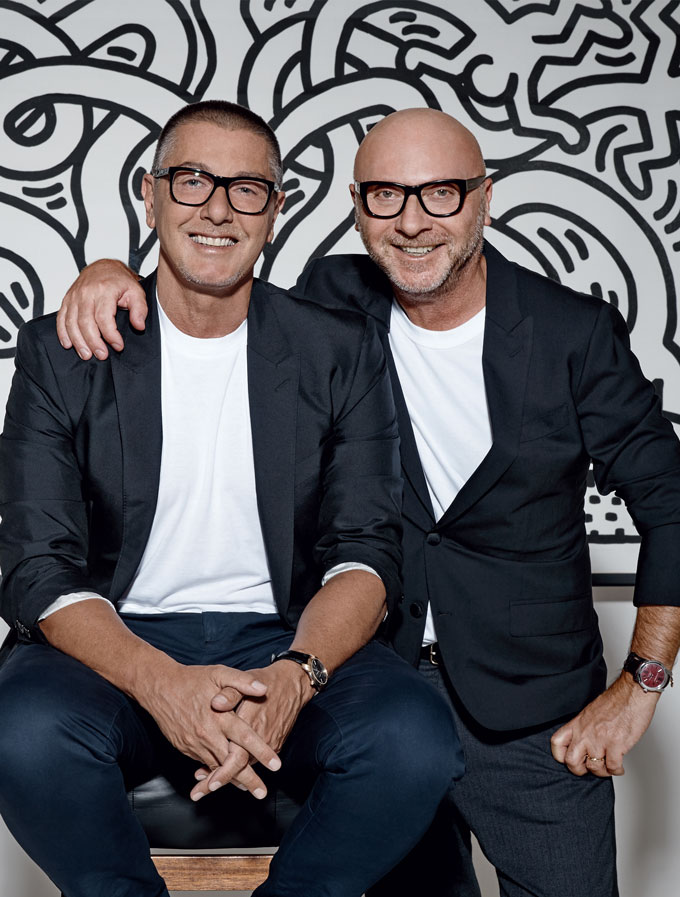
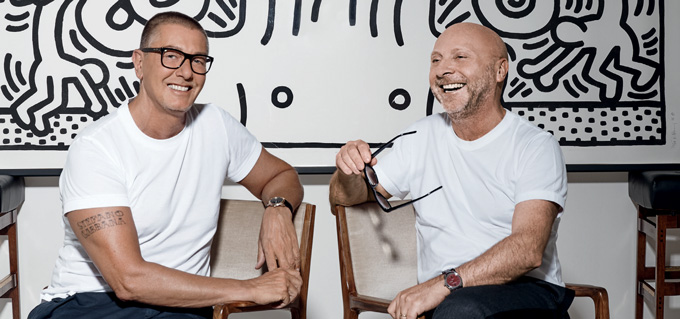
Professional partners since almost 35 years, what can you tell us about the recipe of this successful relation and how is it working as a team?
Domenico Dolce : the secret is being different but complementary. Stefano and I have very different approaches when we start working on a collection. I focus on lines and shapes, he wants colours everywhere!
Stefano Gabbana : He is right. Ultimately though we always manage to find a way to keep each other happy and our collections represent a balance between our two different creative approaches that merge together. The vision is the same; it is the way to get there that is sometimes different. Mine definitely has more patterns and colours!!
Your first debut collection was in 1985, if you look back at that time till today, how do you see fashion changing since then.
DD: Fashion has become faster. If I think how they used to make clothes in the Botteghe! There was a direct contact with the clients, most of the times the tailor would get to know his customers in a very personal way. He would nearly become an advisor in his client’s life. It is important not to lose sight of the love and, to always send positive messages, to be real.
Your fourth collection that was inspired by Sicily was the one that made a significant impact on the market. Today, Sicily is still present in all your collections. Tell us more about the brand DNA and how / why Sicily inspires you.
DD: I am from Sicily, I grew up there before moving to Milan, in the north of Italy. My father had a little ‘Sartoria’ and I spent many afternoons there watching him choosing fabrics, making beautiful clothes, talking with clients. I think I owe to this my love to creating clothes. In my memory, I cannot divide the love for my family, for the art of tailoring and for my land.
SG: I love Sicily! It is such an inspirational place. It’s full of traditions yet it has been a land historically influenced by many different cultures and historical moments. The Greeks, The Arabs, the Monarchy all added to the charm of this magical island which maintain its DNA despite the passing of time. This is also how we see our collections: a continuous evolution of ideas without forgetting the roots and our DNA.
With collections always inspired by Italy, how do you think this appeals to the global taste?
DD: I think Italy is a code known and loved all around the world. Everybody knows and love something Italian be that food, art, fashion, cinema, language etc Can you tell about the various stages of the design process of a collection since the idea comes to mind and till it is runway ready.
SG: It starts with an idea, an inspiration. It can be a book we are reading, a movie, a place, anything! Then we start collecting images related to the inspiration. We research, we play with all the information and the images we have. We then think of shapes; silhouettes come naturally while we experiment with colors and patterns. Once we have the first prototype I usually play with embroideries. I place them spontaneously on the dresses until it all makes sense to me. Domenico is usually the more meticulous one: he focuses on lines, cuts and sewings.
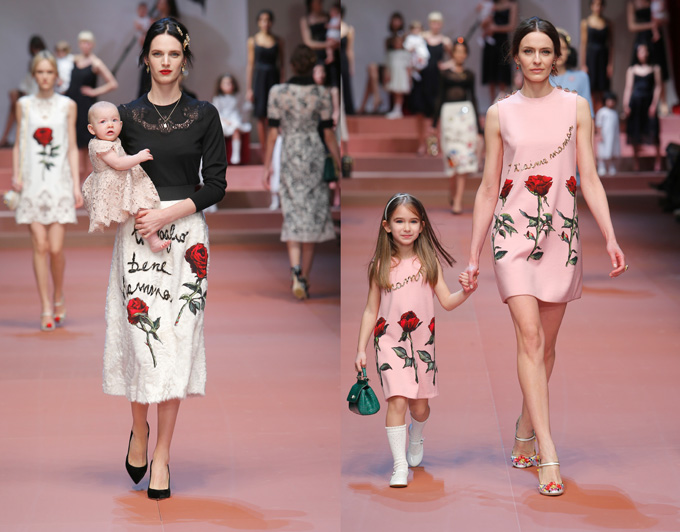
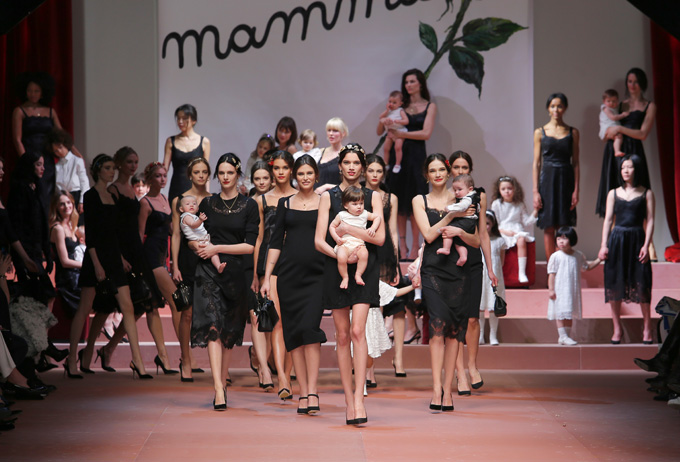
The fall / winter RTW collection “I love you Mamma” was a massive success all around the world, tell us more about this collection and inspiration and what does family mean to you.
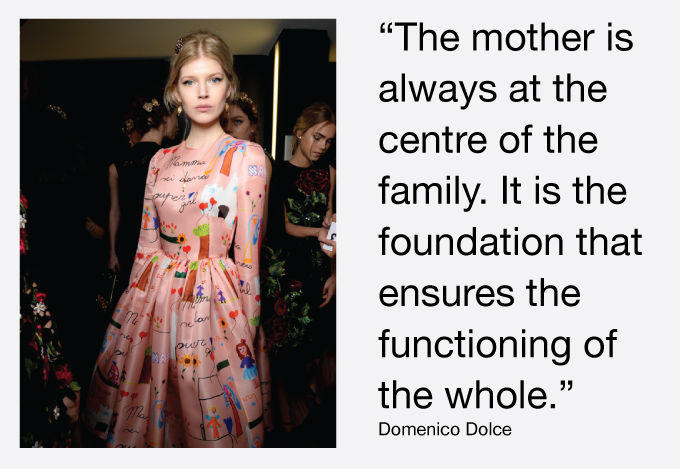
DD: Having chosen “LA FAMIGLIA” for the men’s collection, we thought that, in the end, it is the mother who has the lead in the house. The mother is always at the centre of the family. It is the foundation that ensures the functioning of the whole.
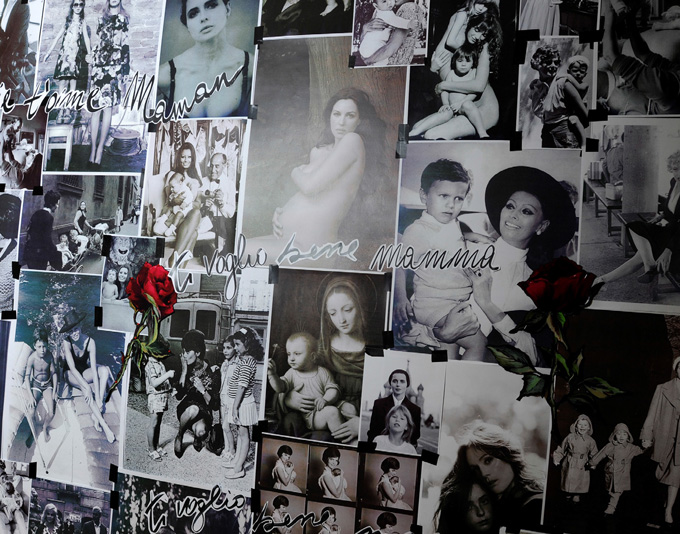
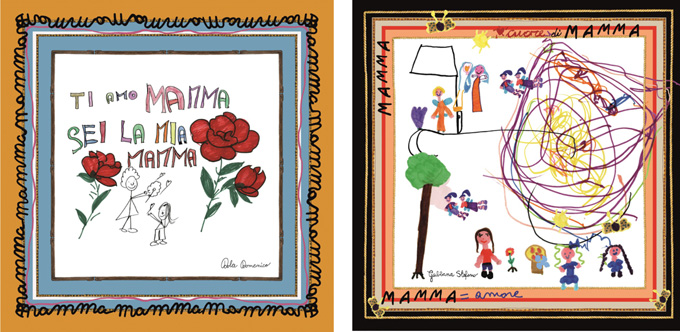
SG: We combined imagination and memories to outline a draft of what a MOTHER is for us. Every mother is different, even at a “geographical” level, but we were interested in studying her wardrobe in all its facets; from lingerie to coats, always maintaining the image that defines her in all cultures: “a sweet and delicate mother “. The entire wardrobe follows softer shapes, lines are more delicate and less rigid than the past. Dresses are longer, chalice shaped dresses, pushing us to experiment with different concepts for the accessories. The same goes for the decorations which are the result of a new work that ranges from prints on dresses and scarves, taken from drawings of kindergarten children, and then the collage, used as a new type of embroidery of letters, flowers, such as red roses: the first flower that a child gifts to his mother.
Who is the Dolce&Gabbana woman?
SG: she is feminine, confident. She is a mother, a wife, a working woman. Any woman who is proud of being one.
At a time where everything is being commercial, how challenging is it for designers to create collections that can still touch emotions?
DD: This goes back to what I previously said. For us this is extremely important. In doing what we do, we should absolutely still be able to touch emotions, to communicate through our collections and create an emotional link with our clients.
SG: We can’ t live without emotions. We create our designs following precisely those feelings and those emotions we experience in life; our collections could not come alive without carrying pieces of them. It is too important. Otherwise, you slowly become detached from the world, from the people, and ultimately from your clients.

Talking about challenges, what do you think are the difficulties that the luxury sector is facing today?
DD: I think these days it is hard for clients to be offered something that is truly luxury. Luxury goes beyond the 5 stars services. It is also about adding the personal touch to it. I think for the luxury sector it might be challenging to truly offer a luxury experience.
SG: It is also about remaining relevant in an era where the term luxury means nothing at all. There are so many brands, companies, offering ‘luxury’ goods and services but, it is then hard to define what real luxury is to the specific individual.
Stefano, you are active on social media, how do you think it is shaping the fashion world today?
SG: I find the world of social media to be an amusing one. It gets you closer to other human beings with no barrier of space and time regardless the obvious obstacle of a telephone or computer screen. It is a powerful mean of learning, often a source of inspiration. It’s entertaining. It’ s definitely addictive!!
Tell us more about your hobbies?
SG: I love to travel! It is a passion I have always had and it is a very important element in our daily work where I get most of my inspirations. By travelling, I acquire a better understanding of the market tendency, and of the tastes of the different cultures. When I am in Milan, I love my family time.
DD: I really enjoy going to the movies, watching old fashioned movies and reading books. Naturally, I love spending time with my nephews and the people dearest to me. Time is the real luxury today!
There’s a massive wave of emerging talents as designers, what would you advise those aspiring people to make it?
DD: Place passion and emotions in everything you do. Love is fundamental.
SG: Don’t lose sight of who you are. Don’t forget your roots and always be consistent throughout time.
What’s next for Dolce & Gabbana?
SG & DD: We have a lot of projects and a lot of ideas. We are really loving the #DGwomenlovemakeup project that we have launched during the summer. It has been a huge success and we love flicking through the beautiful images thousands of women are still posting. We are also focusing a lot on the kids lines. We will be launching a line of evening dresses for little girls so that they can finally match their mothers outfit like all little girls dream of! The collection will be exclusive to a selection of cities only. We also have more surprises coming for the Middle East at the beginning of 2016. I can’t say more at this stage but it is a project we are very proud of.
Interviewed by Lara Mansour Sawaya
PRADA The Legend of this Fall
Photographer : Jeremy Zaessinger
Stylist : Amine Jreissati
Model : Arina @ Ford
Make-up : Grigoris @ Callisté
Hair : Tomoko Ohama @ Callisté
Location : Villeroy & Boch Saareck Castle, Mettlach-Germany
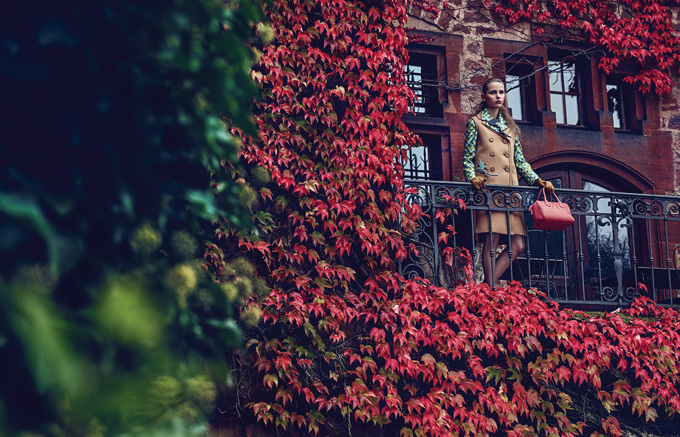
Double jersey gilet, Printed cirè jacket, Plex pins with crystals, Soft Calf Prada , Inside Bag & Handmade nappa leather gloves

Shaven mohair knitwear, Twill silk shirt, Plex pin with crystals, & Handmade nappa leather gloves
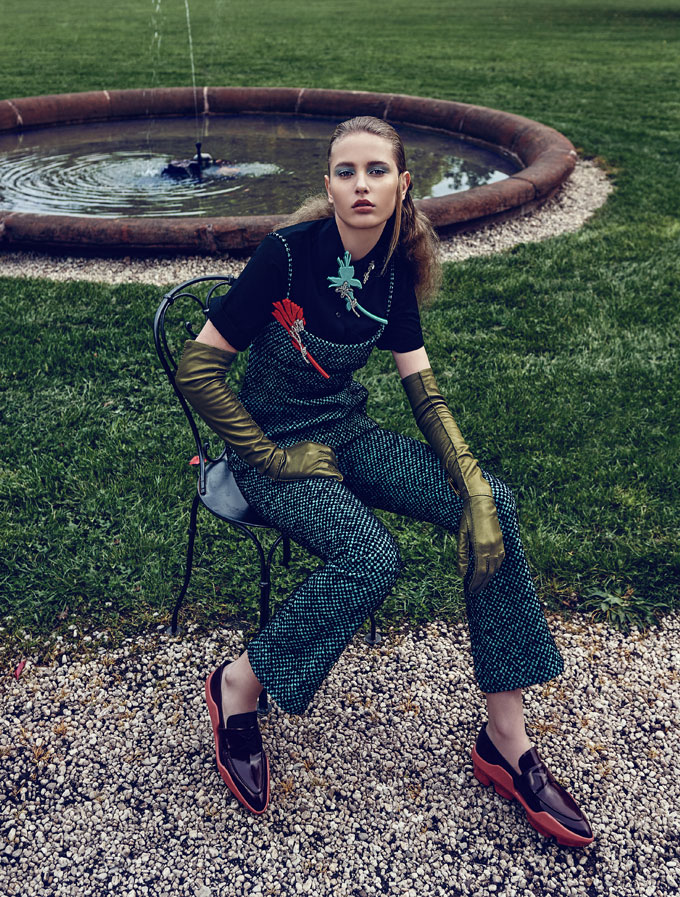
Knickerbocker tweed top, Popeline shirt, Knickerbocker tweed pants, Plex pins with crystals, Nappa leather handmade gloves, Brushed calfskin loafers with polished rubber shell sole
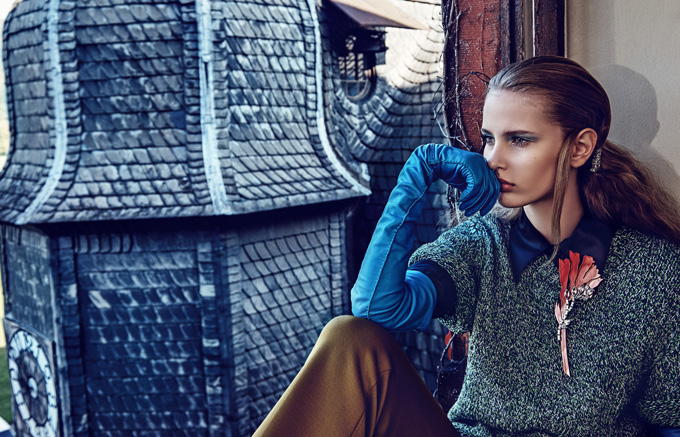
Multicolor moulinè pullover, Twill silk shirt , Jersey double pants, Handmade nappa leather gloves, Plex pin with crystals & Hair pin with crystals
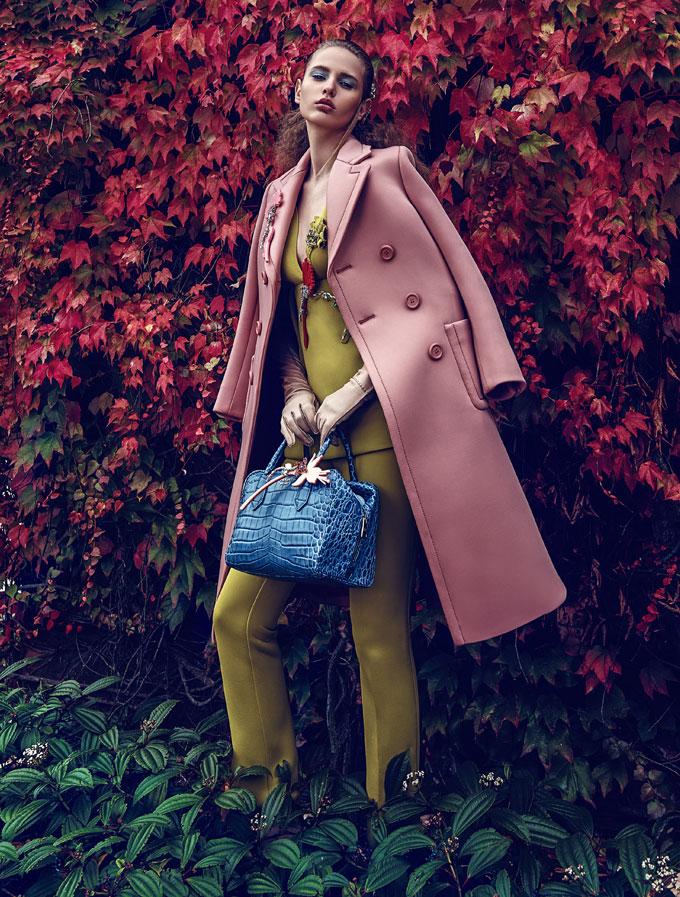
Double jersey coat, Gazarre jersey stitched top with plexiglas and crystals brooches, Gazarre jersey pants Handmade nappa leather gloves, Crocodile Prada Inside Bag, Plex pin with crystals & Hair pin with crystals
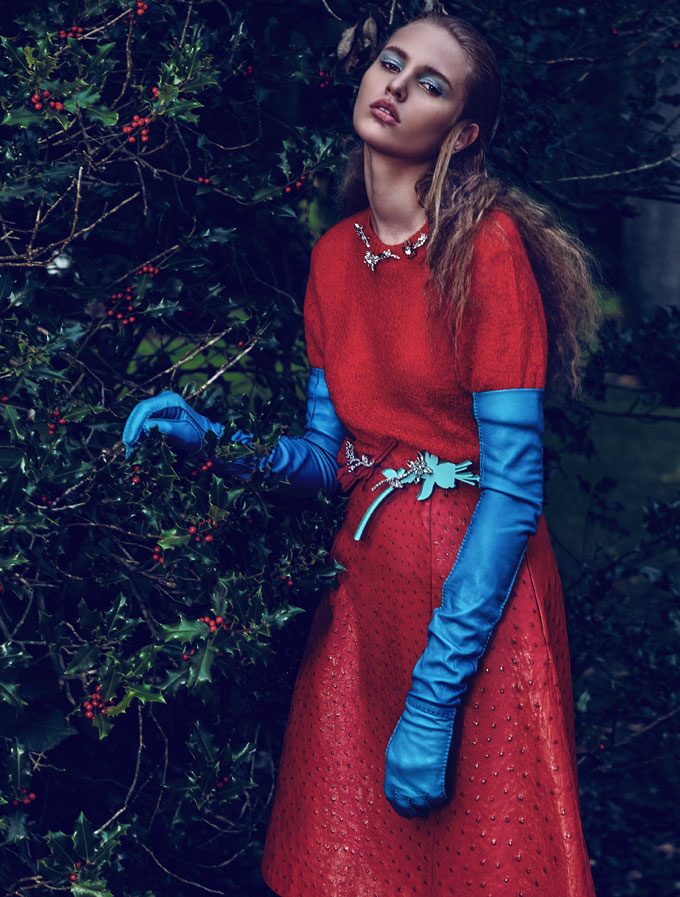
Shaven mohair knitwear, Ostrich skirt, Handmade nappa leather gloves, Plex pins with crystals & Pins with crystals
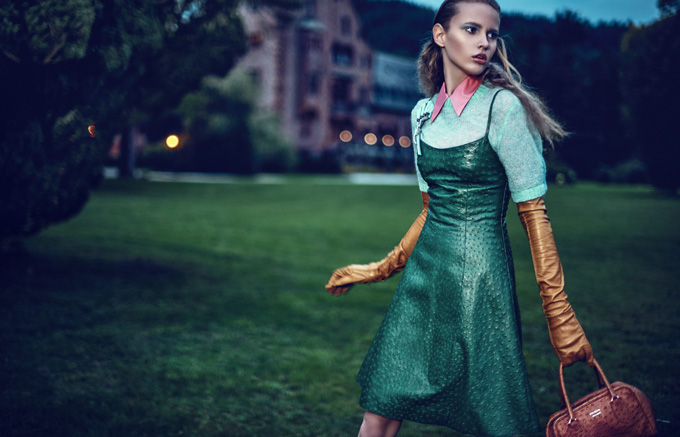
Ostrich dress, Plex pin with crystals, Twill silk shirt, Shaven mohair pullover, Handmade nappa leather gloves & Ostrich Prada Inside Bag
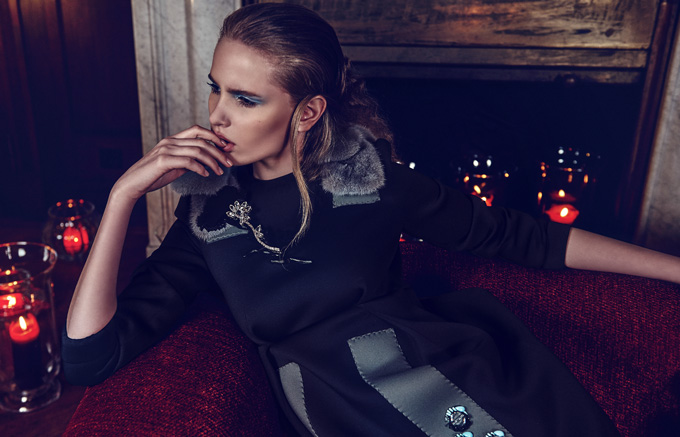
Embroidered double jersey, dress with mink bows & Pin with crystals
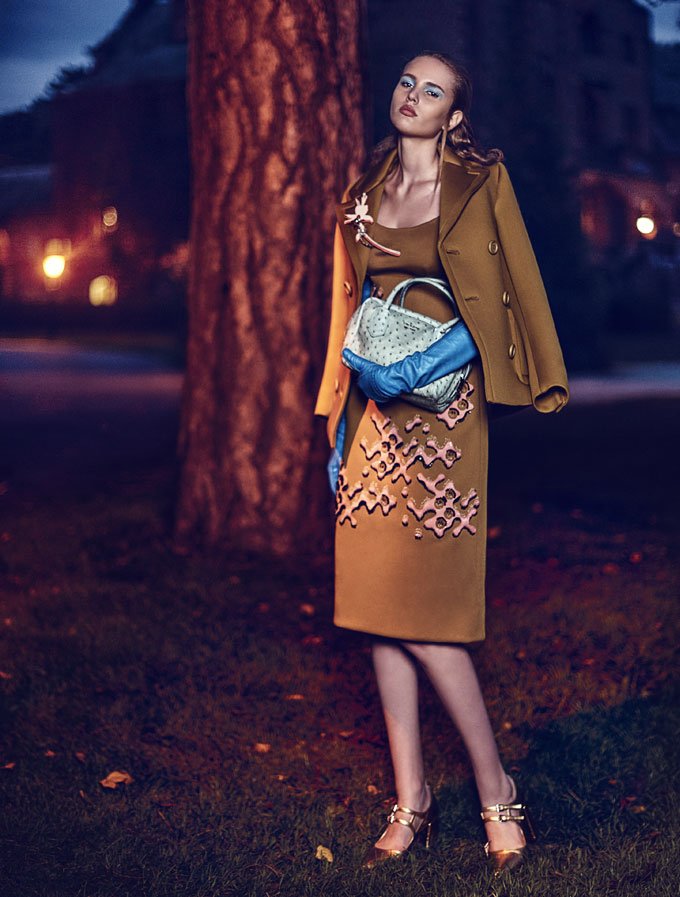
Embroidered double jersey dress, Double jersey jacket, Handmade nappa leather gloves, Ostrich Prada Inside Bag, Plex pin with crystals & Lamè nappa leather mary jane
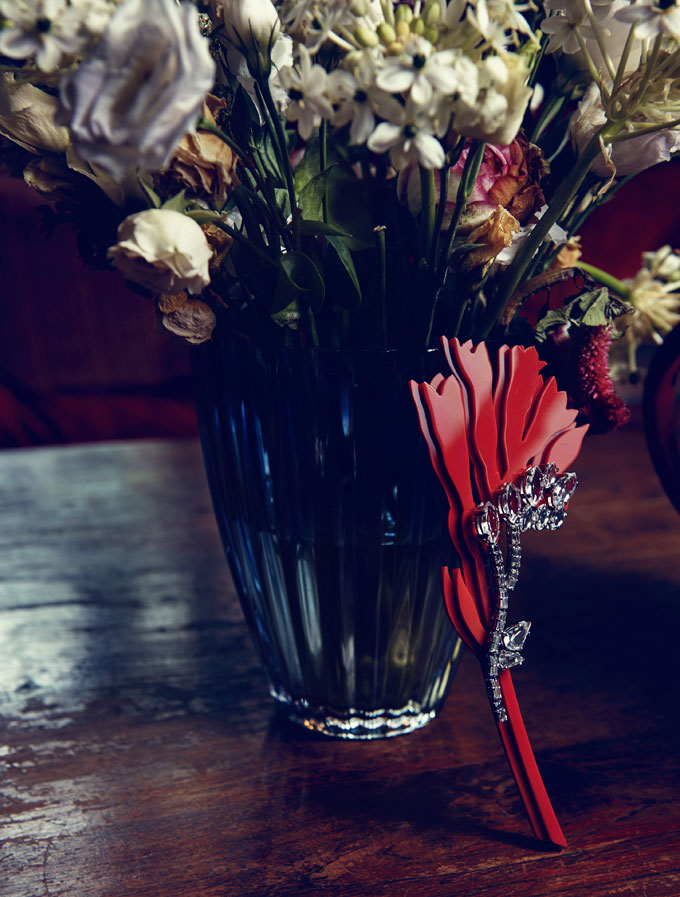
Plex pin with crystals
One to One with Maria Grazia Chiuri & Pierpaolo Piccioli Creative Directors Valentino

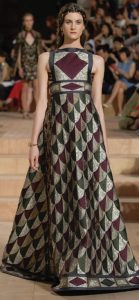
I’ve seen Rome through your designs in your latest couture collection, tell us how it inspires you and how challenging is it to keep Rome eternal in your designs yet avoid repetition?
“Rome is such a wonderful city, so full of life. It is an important part of Valentino history and so it is impossible to not be inspired by it. Some of the romance and details found in our work can be attributed to the essence of the city and its vibrant diversity. Rome is the city where we work and get inspired everyday by its many hidden corners full of beauty and history. But Rome is also a city in constant transformation, which is experiencing a wave of creativity. We are happy to live surrounded by such inspiring diversity. Rome is and will always be a fundamental part of Valentino, because Valentino is Rome.”
Almost 7 years since you’ve held the creative direction at Maison Valentino and we are obviously seeing the re-invention of couture. What does couture mean to you and how do you see couture today at a time where most claimed “couturiers” are commercially driven only?
“Haute Couture is a private luxury experience, a unique emotion, timeless but contemporary at the same time. It is like a dream nourished and filled with new ideas, constant experimentations, intense research and individual passion. Couture is not only the expression of the high craftsmanship and tailoring which make “Made in Italy” alive, but it’s the pure essence of our Maison and we do the best to protect this special universe.
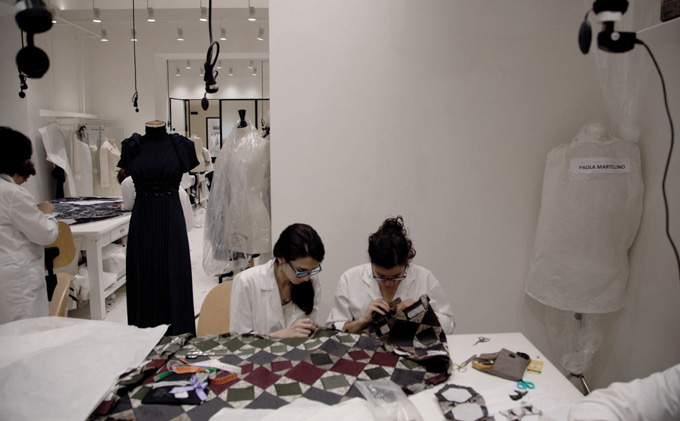
We know that most of the employees at your atelier are young dynamic talents, to what extent you think Couture requires fresh eyes at a time where at some ateliers you find employees that are there since 30 years?
We strongly believe in teamwork and working towards common goals. We have the support of a great team, some have been working for the Maison for over 30 years with an incredible experience and some have joined the atelier only a few years ago. The premieres and the seamstresses working in Valentino hold an immense wealth, which we want to transfer to the new generations. Preserve the sartorial knowledge is a long process that requires passion and time. Valentino school of Couture, recently opened in our Roman atelier, has the aim to pass down the Maison savoir faire to the youngsters, preserve its memory and the high standard of craftsmanship that Valentino is globally known for, yet convey the freshness and the energy that only new generations can bring.
Elegance, Grace and Modern Femininity are three pillars we always see in your designs, can you tell us what each one means to you?
We believe that beauty and elegance have always been essential elements of the Valentino vision. Our aim, as Creative Directors, is to use the codes of the Maison in a more contemporary way, more effortless. In this sense, elegance becomes more personal and with our clothes we want to express the subtle nuances of grace and femininity, being able to talk to different type of woman.
While watching your designs sway on models on catwalks, have you ever said, Oh I wish I did more on this or less on that?
“We both are two perfectionists and we oversee each detail of a collection until the last minute. Nothing is left behind. Our idea is clear since the start of the creative process and our effort is to achieve a natural balance among emotions and technical perfection.
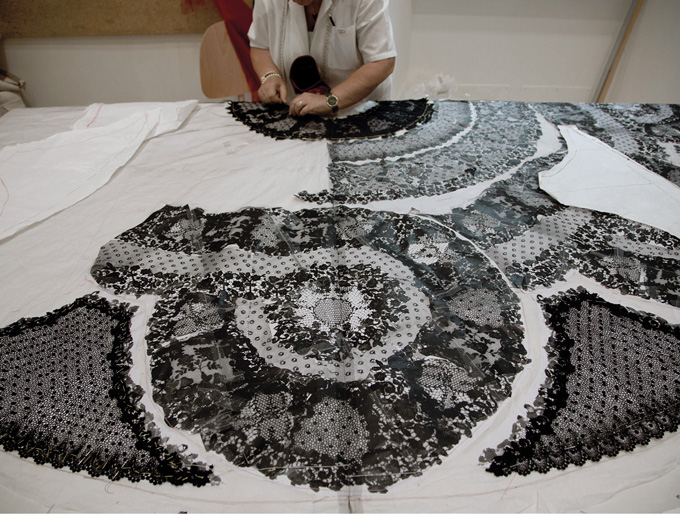
Can we tell our readers about the design process of a Valentino look, the stages from the inspiration, to sketching to the show?
“It all starts from an initial idea. The inspiration can be a book, a photograph, a piece of art, a fabric or a colour. Each element is an essential part to unfold the final story we want to describe and the emotions we want to convey through the dress. It’s like assembly piece of a movie”
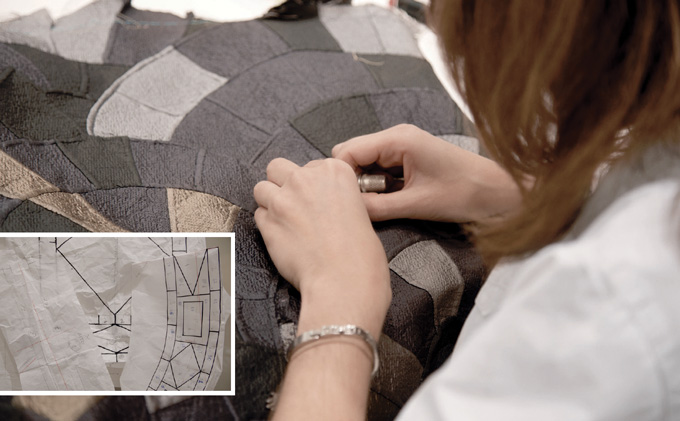
You are a team, how does that serve you in your work and the outcome?
“Our work is always the result of a great team effort. Our aim is to establish a positive synergy among the team, making sure everyone takes part in the creative and development process of every project. Each individual with his own specific characteristics and talent is taken into great consideration. Thanks to this diversity our work is always stimulating and personally and professionally inspiring”
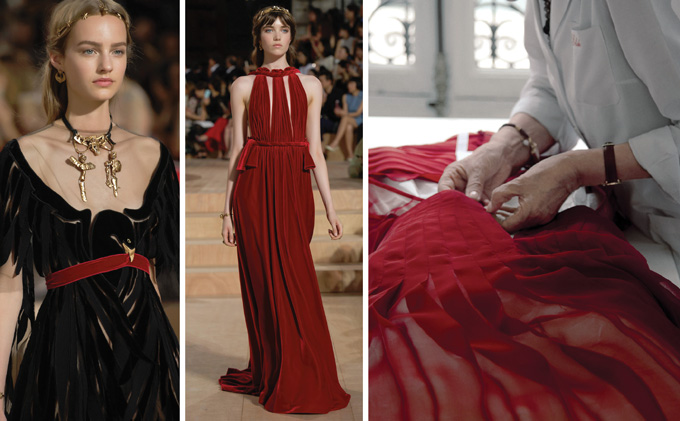
Two Romans that love fashion, art, photography and film. Answer the following what fashion era you love most, what kind of art attracts and inspires you, what kind of movies you like and again what era?
There are so many pieces of art and eras in history that inspire us for its emotional impact on society and unsurpassed creativity. It’s hard to mention only one. In our collections there are always different elements which inspire us and took us to an emotional journey through art, poetry, culture and historic eras.
In our last SS 16 collection, for example, we took a journey to the beginning of time, through a primitive beauty full of emotions and spirituality.
The earthy tones of Africa, the ethic embroideries, the leather cutout garments of the Roman gladiators; all have been equally inspiring to unfold the story we had in mind.
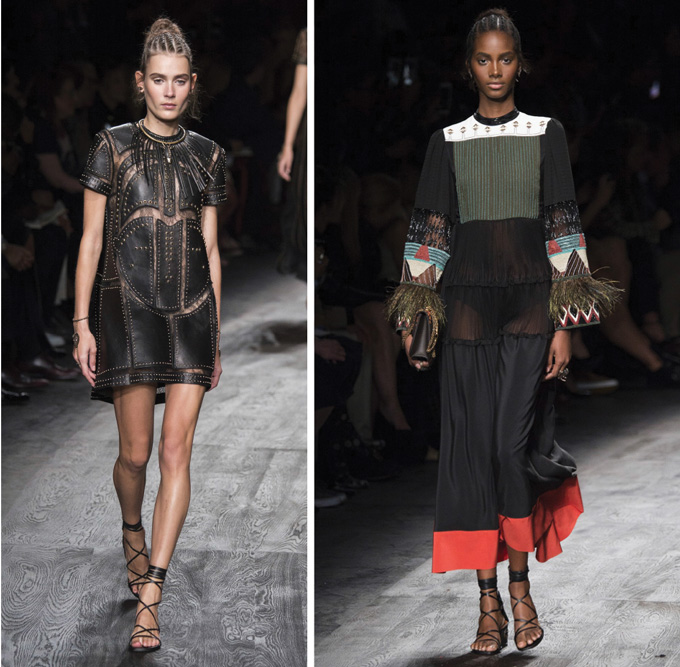
What do you feel when you look back on when you did your first couture show in 2009?
It was an unforgettable experience. Haute Couture represents the essence of Valentino’s DNA and for us it was a honour to express the values of the Maison with our vision. Being able to express our constant research and experimentation, yet protecting the Maison’s heritage, tradition and the craftsmanship was, and still is, an overwhelming feeling.
What are the couture and RTW codes that redefine Valentino today?
The essence and the core values of the Maison are firmly rooted in our language but today our aim is to reinterpret it in a more contemporary way, like telling a classic tale in a modern language. Our style is feminine with an edgy feel. We like unexpected contrasts.
How do you think the Internet and social media have changed the faces of fashion?
Social media changed the perception of fashion. As soon as a runway show is over, thousands of Images are available on the Internet to people all over the world. The drastic change in communication instantaneously allows people to participate, follow and discuss any trend and fashion news. A form of modern democracy based on the emotional response, that lets everyone be part of something that was initially exclusive to an elite. Of course this has a greatly influenced the face of fashion, but we believe it is important to stay true to our roots and identity at all times.
Some designers are infusing technology with couture, to what extent you believe couture is emotional and do you think deviating from traditional craftsmanship leaves the piece with no soul? “We are truly interested in technological innovation and we love exploring new ways of expressing ourselves. Technology is constantly changing our job and our designs. The fabrics, the textures and the techniques used in the collection underline the surprising liaisons between natural and technological weaving in a continuous interplay of materials. This evolution perfectly matches our vision. We like to mix classic beauty with the unexpected.
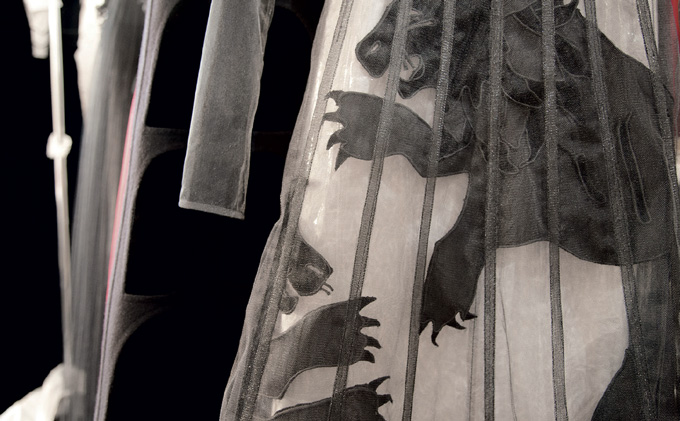
How hard is it managing work and family for both of you?
Our private lives are extremely important to us. It is crucial to balance the two things. We believe that the quality of our work also depends a great deal on the quality of our life. We are both very lucky because our companions and families support us in every moment. Behind every choice we made in our careers, our families have always encouraged and supported.
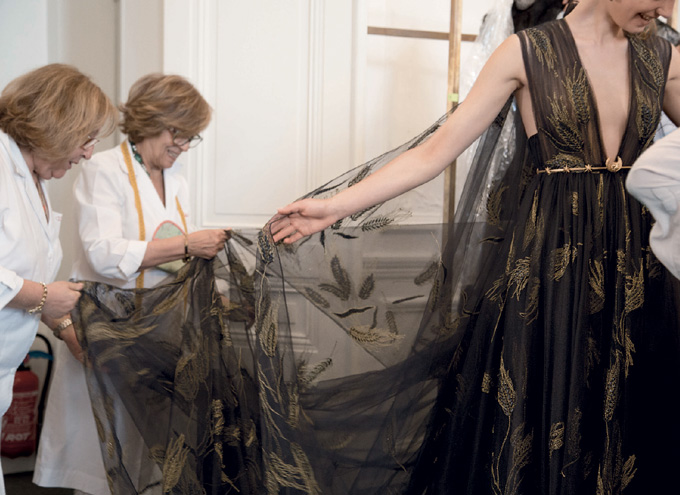
How do you want the world to remember you?
We are constantly developing our personal vision of Valentino, by staying closely attuned to the world around us. Music, movies and books are a great source of inspirations as well as the people we encounter. Nevertheless our goal is to maintain the Maison couture codes and develop them, implement them, expand them in all our creations. We would like to transmit this open-mindedness to the brand and being remembered to take the Maison historic concept of beauty into the future.”
Interviewed by Lara Mansour Sawaya
DIOR CRUISE The art of knowing
Photographer : Greg Adamski
Styling and concept: Houry Seukunian
Hair & Make-up : Katie Cousins
Model : Marta @ MMG Modelz
Location: Hotel Dubai Marina & Lounge at the Address

- Printed leather dress, Boots, “Dior Shades” & earrings. All by Dior
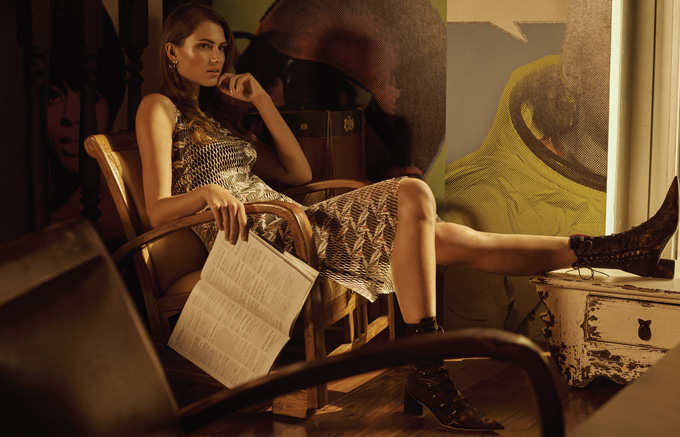
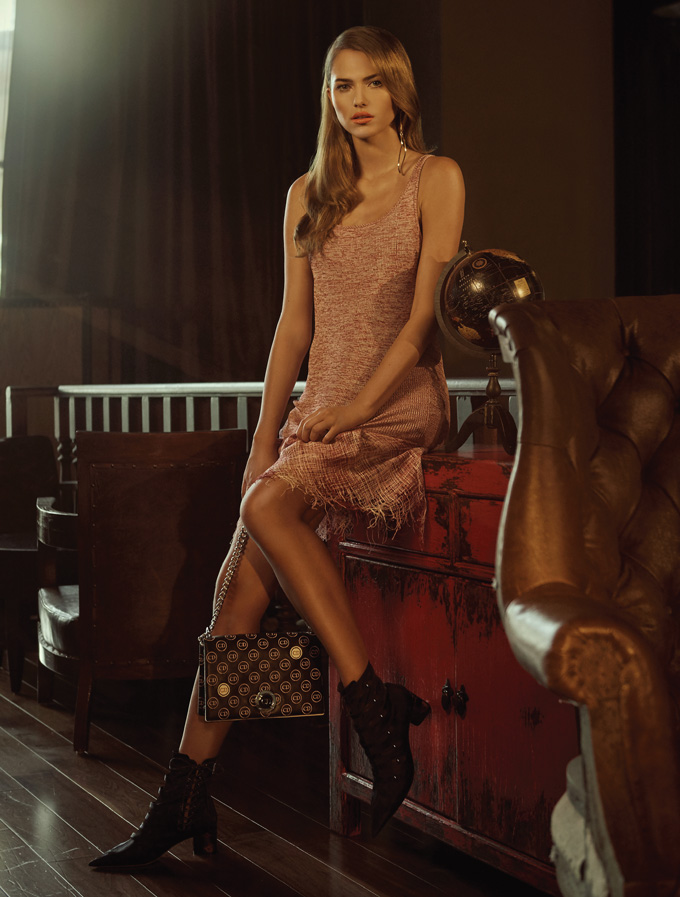
Knitted tweed dress, “Dior Shades” earrings, Boots & “Diorama” bag. All by Dior
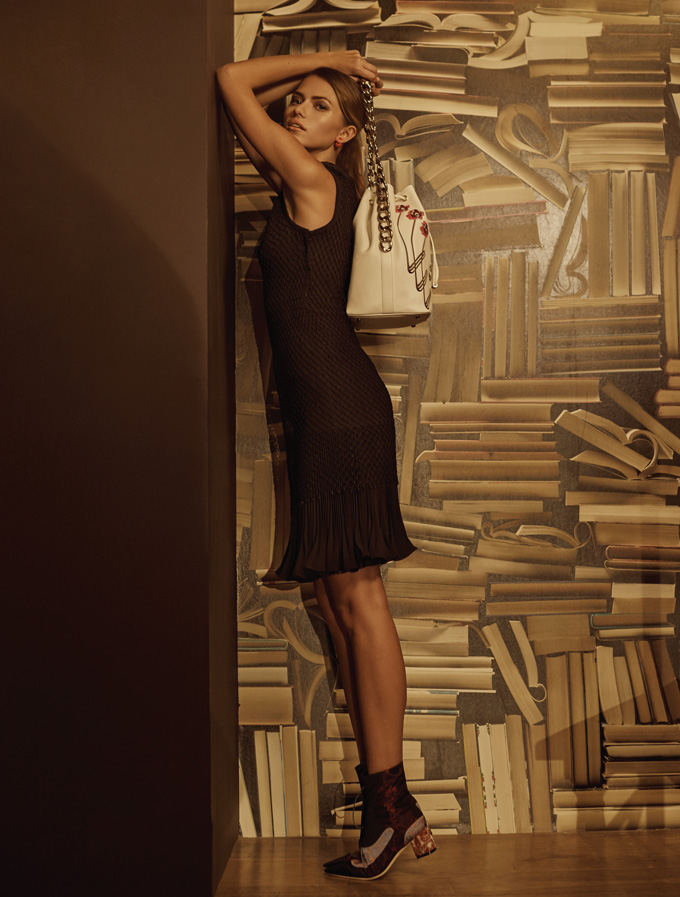
Knitted dress, Tribal earrings, Boots & “Dior Bubble” bag. All by Dior

Knitted dress, “Diorama” bag, Boots. All by Dior
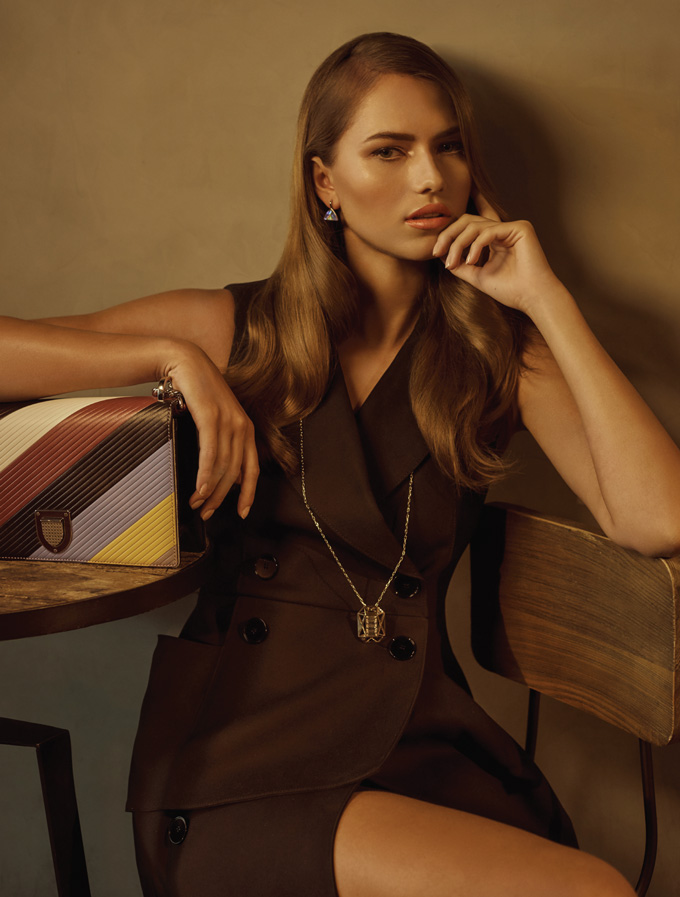
Coat dress, “Diorama” bag, “Dior Set” earrings, & Necklace. All by Dior

Dress & Tribal earrings. All by Dior
Dior Homme opens a new store October in Paris at 24 Rue Francois 1ER
The house codes are displayed across two floors, melding modernity and elegance, tradition and innovation, in colors, vowmes and materials- Dior gray, white,black leather and wood, polvmirror stainless steel, gray quartz resin, natural wool.
Light is reflected by the translucent white resin structures, blurring the divide between interior and exterior, creating a singular setting for the dior homme universe. The new space encompasses all the collections designed by Kris Van Assche, Dior Homme Creative Director. On the ground floor: accessories and footwear. On the first floor: ready-to-wear. This is also the location for custom orders and personalization. A home-visit service is available, along with the exclusive made-to-measure experience offered by the Dior Tailoring Atelier.
A new address for the new luxury Dior Homme defines.
Ferrari Owners Club UAE and Premier Motors Rev Up at Yas Marina 488 GTB debuts on the Yas track

Ferrari Owner’s Club UAE and Premier Motors, the official dealer for Ferrari in Abu Dhabi, hosted a thrilling weekend driving experience at the Yas Marina Circuit, Abu Dhabi.
Ferrari’s latest mid-rear-engined V8 Berlinetta, the 488 GTB, made its debut on the Yas Marina Circuit. Other models from the Prancing Horse marque’s current range such as the F12berlinetta as well as the California T were also part of the exciting driving action on the day.
About 25 members from the Ferrari Owners Club and special guests of Premier Motors numbering about 70 in total, participated in the event. The Ferraristi thoroughly enjoyed driving their cars on track under the expert guidance of Ferrari driving instructors especially flown in for the event.
The current range of Ferrari cars including the 488 GTB, F12berlinetta, California T and FF can be viewed and are available for test drives at the Premier Motors showroom in Khalidiya, Abu Dhabi.

Jennifer Lopez wore Le Vian and Pasquale Bruni to the UN Foundation’s Gender Equality Discussion

Jennifer Lopez wore a Le Vian white diamond and chocolate diamond ring and a Pasquale Bruni white gold diamond flower ring while attending the UN Foundation’s Gender Equality Discussion at The Four Seasons Restaurant on September 25, 2015 in New York City.

Le Vian:

Considered one of the oldest jewelers in the world today, Le Vian’s glittered archive tells the story of a family’s steadfast integrity and love of gemstones and quality. Capturing the eyes of ancient royalty and the most famous celebrities on today’s red carpet, Le Vian’s® designs are regarded as works of art. Artisans craft rare natural fancy color diamonds including Pink Orchid Diamonds™, Sunny Yellow Diamonds™, Blackberry Diamonds™, Vanilla Diamonds™ and Chocolate Diamonds® into innovative designs, combining colors of gems and flavors of gold with intricate detailing and a passion from days gone by. Master gem cutters then utilize Le Vian®’s proprietary and innovative cuts to brilliantly reveal the exceptional beauty of each gem. For more information, please visit www.levian.com
Pasquale Bruni:

After being drawn into the allure of jewelry as a young boy through workshops in Valenza, Itally, Pasquale Bruni has stood for high quality since creating his namesake jewelry collection in 1976. With a keen eye for detail, Pasquale Bruni has created fine Italian-made jewelry under a brand name that has become synonymous around the world with passion and unmistakable Italian taste, style, and creativity. With his vision and tradition now proudly carried forward by his children Eugenia Bruni, the Creative Director of the brand, and Daniele Bruni the company’s gemologist, each new collection continues to display a distinctive style that is both unconventional and harmonious. For more information please visit www.pasqualebruni.com
FEEL THE BRIDAL SEASON WITH CHAUMET

THE MAISON CHAUMET
Chaumet, Parisian jeweller since 1780, is the master of sentimental jewellery.
For more than two centuries, since crowning the destiny of Emperor Napoleon the First and the Empress Joséphine, Chaumet has been creating exceptional tiaras and jewellery sets… at the heart of the place Vendôme.
From High Jewellery to every day Fine Jewellery, the Maison reinvents the engagement ring as the symbol of a unique encounter and the promise of eternal love.
12, PLACE VENDÔME
Chaumet’s founder was the first of the Parisian jewelers to settle on the place Vendôme.
The private mansion and its 18th century salon, situated at number 12 of the illustrious square, now host the Maison’s creative studio and High Jewellery workshop where tomorrow’s sentimental jewels are imagined and crafted with bold creativity. The collections express the soul of the Maison in an alliance of jewellery excellence and Parisian elegance.
CHAUMET’S SAVOIR-FAIRE
For 230 years, High Jewellery excellence is passed on from one workshop master to another.
It all starts with a drawing, for which the Chaumet gemologists will carefully select the stones – they must be elegant, rare and have the capacity to evoke emotion. Diamonds and precious stones, chosen for their exceptional purity and sparkle, are then sculpted into a number of shapes; round, cushion, oval, emerald, or the Maison’s signature cut, the pear-shaped. Then, the jewellers, stone setters, polishers and engravers give life to the jewel. The art of stone setting enhances the precious gems with refinement and lightness, transforming the pieces into unique creations.
THE COLLECTIONS
Liens, Frisson, Bee my Love, Plume, Joséphine, Torsade, Fidélité… represent the colours of emotion.
With artistry, Chaumet chooses from a palette of subtle and rare stone colours for its creations: from dazzling whites to captivating jonquille yellows for diamonds, from ruby reds and emerald greens to fascinating shades of sapphires and tourmalines…
Each collection has its own unique and timeless style, creativity and architecture.
Joséphine
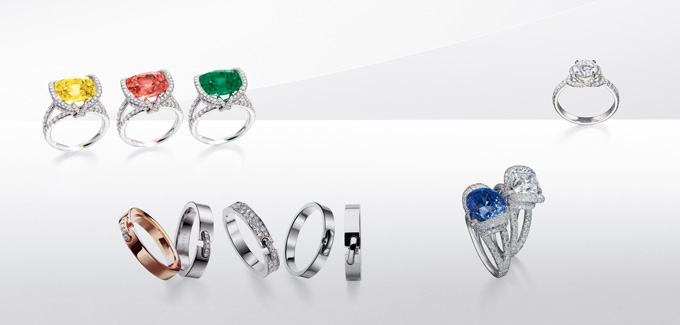
The collection pays homage to the Maison’s first muse, Joséphine, and to the power of love. The tiara transforms into a ring, crowning the finger with the majestic beauty of a pear shaped diamond.

Liens
Whether tied, crossed-over or interlaced, the iconic and architectural lien motif is adorned with diamonds to become an exquisite symbol of enduring emotion.
Bee my Love
The diamond bee and the honeycomb motif celebrate an imperial pledge of love with these precious wedding bands.

Frisson
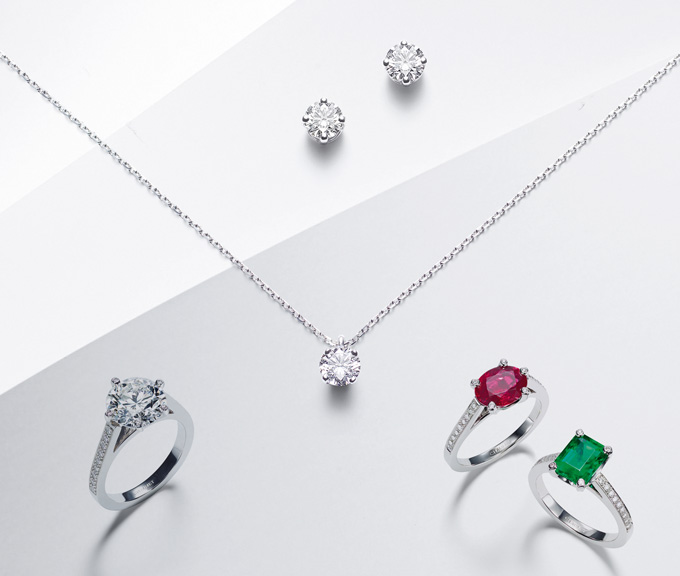
A shiver of diamonds enhances these pure, asymmetrical lines and reinvents the classic solitaire ring.
Plume
What better than the lightness of a feather to express the most delicate feelings?

Torsade
This architectural reference to the Vendôme column pays tribute of the 12 Vendôme address.

Fidélité
The purity of the diamond, the beauty of emotion.

THE 4Cs ACCORDING TO CHAUMET
The Maison selects its diamonds according to the universal certification system developed by the GIA (Gemological Institute of America). Thus, Chaumet sets its creations with the rarest diamonds, chosen according to the criteria known as the 4Cs: carat, cut, colour and clarity. Each diamond weighing 0.30 carats or more comes with its own GIA certificate. All of the Maison’s diamonds are engraved with a miniature certificate number, invisible to the naked eye, which guarantees the authenticity of the Chaumet diamond. The ultimate criterion is unique to the Maison; in the perfect light and using a magnifying glass, the expert gemologists select each diamond for its singular elegance and capacity to spark emotion. Finally, all the gemstones and precious metals used by the Maison originate from socially and environmentally responsible sources, in accordance with the RJC (Responsible Jewellery Council) certification and the Kimberley process.
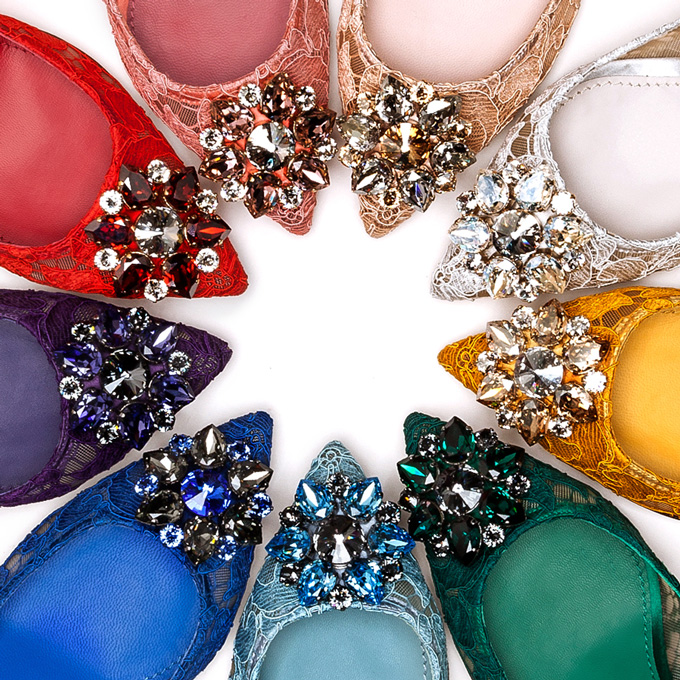
Dolce&Gabbana new Rainbow collection
Dolce&Gabbana presents the new Rainbow capsule, an elegant footwear collection created entirely in lace which comes in a wide array of shades that resemble the colors of the rainbow. Floral motif lace meets a chromatic explosion of precious crystals brooches in a multitude of shapes and hues.
Chic, Parisian and Cool a&e visits the iconic Le Royal Monceau Raffles Paris

Le Royal Monceau Raffles Paris – Facade ©Philippe Garcia
On my flight to Paris in the Emirates A380’s business class, I watched around 4 movies whilst in the comfort of “my zone.” One of those was a completely relevant choice, as I was on my way to the City of Lights to live through the real-life experience of the film. The Hundred-Foot Journey, produced by Oprah Winfrey’s production house and starring Dame Helen Mirren who plays the role of Madame Mallory, a chef who manages a popular and classic Michelin starred restaurant. She goes to war with a newly settled Indian family who decides to introduce Indian cuisine to French fine diners, and throughout the plot her adamant connection with her country’s culinary traditions and recipes, becomes the main reason for conflict. In one scene, young sous-chef Marguerite, played by the soft spoken Charlotte Le Bon, reveals how important the Michelin stars are to a chef in France which is why Madame Mallory works so hard to maintain the standards of her restaurant and wipe out the competition. The French chef Paul Bocuse, one of the pioneers of nouvelle cuisine in the 1960s, once considered the Michelin to be the only “guide that counts,” sparking a media frenzy compared to that of the annual Academy Awards for films. During my visit to Le Royal Monceau by Raffles in Paris, I explored this concept in more depth, watched a movie screening in the Katara cinema (the 99 seat in-house screening room), indulged in an anti-jet lag treatment at the award winning Spa My Blend by Clarins, and consumed a lifetime of chocolate and macaroons by the one and only, Pierre Hermé who creates all his pastries exclusive from and for the Palace.
History and design
From a cloister for monks, to a palace, then a hotel
During our tour of the hotel, we learned many things about Le Royal Monceau, which we would not have known if it weren’t for the knowledgeable staff and their passion for the iconic palace. It has been one of the 7 historical palaces of Paris since the beginning of the 20th century, which of course eventually became a luxury hotel. In the 1990s, it started to lose its fame amongst visitors, because it desperately needed to be refurbished. In 2008, the owners asked famed French designer Philippe Starck to redesign the hotel entirely, and it was reopened in October 2010. Philippe Starck kept the classical Parisian façade and destroyed everything else. He also kept the bricked staircase wall dating back to the 1860s, and added a mosaic element, reminiscent of church design, since it was formerly a cloister for monks. Its comeback as a palace placed an emphasis on the arts and presented itself as a familial space.
This illustrious Palace hotel, an icon in the City of Light since 1928, began a new era in its history, reliving the unique Parisian spirit of the 1930’s filled with glamour, effervescence and creativity. Philippe Starck’s vision was the main contribution, and his spirit was reflected in the smallest of details. Everything was handpicked; hence it’s unsurprising that guests develop an attachment to the pieces in their room which they can purchase and take back home with them. The designer’s aim was to create a “cool and cozy” atmosphere, and he even commissioned his own daughter to design the carpets in the hotel. He stitched a pair of eyes and the word yeux, the French word for “eyes”, on the desk chair to signify that even if you were always travelling, there should always been someone to greet you. Kitsch pieces of framed art hang on the walls, emphasizing the homey atmosphere. Even Philippe Starck has such random, out-of-places memorabilia in his home which he displays as art. Large framed paintings and photographs rest on the ground implying that he “hasn’t finished decorating” yet. Bedside lamps have shades scribbled with personal notes, reminding himself to “look at the moon and stars at midnight,” to “sing a song today” and go on a rendez-vous at the “Jardin des Tuileries a 16:00.” He even wrote real phone numbers on the shades, but when guests started dialing those numbers, the hotel had to remove them!
At Le Royal Monceau – Raffles Paris, art is omnipresent, with an exclusive service of Art Concierge, an Art Bookstore, a private Art Gallery, a 99-seat cinema theatre and an impressive private art collection. We had the pleasure of meeting the lovely art concierge Julie who handles the in-house art gallery, and was proudly boasting about the private museum visits she recently planned for a powerful Hollywood couple. She also curates exclusive exhibitions and puts together weekly schedules for the best classical, opera, jazz and other prestigious artistic performances and shows in the city, which are hung up in every room for guests to refer to during their stay. You can also refer to the concierge team who will tell you everything you need to know about Paris, give you recommendations and even make special bookings for you and ensure you received special treatment as a Le Royal Monceau guest. The hotel is just minutes from the Arc-de-Triomphe and the Champs-Elysées in Paris’ 8th arrondissement, so you are guaranteed to have plenty of activities to do, museums to visit, and parks to stroll in, including the elegant Parc Monceau nearby.
The hotel has 149 luxurious rooms and suites including the special “Ray Charles” Lifestyle Suite, in which ‘The Genius’ resided for quite some time. A perfect option for music lovers or for a romantic getaway, this package offers a private jazz concert with a pianist on the suite’s grand Pleyel piano. Since the reopening of the hotel in 2010, it has been a favourite with celebrities in the music and entertainment industry. The Hollywood power couple we mentioned, or didn’t mention, stayed at the hotel for two months, in the adjacent building that was recently bought by the Le Royal Monceau. The Privé at 41 Avenue Hoche, has Five floors of luxurious new suites, each one a superb expression of that Parisian character. The spacious suites adjoin the acclaimed Le Royal Monceau, Raffles Paris, giving guests the privacy of an exclusive residence, underpinned by the services of the most exciting hotel in Paris. Every suite has a kitchen where the chefs create the menu of your choice. There are individual gyms and direct access to the hotel’s idyllic Spa My Blend by Clarins and the city’s longest pool. In this building, you will also find the Presidential Suite 341, a sumptuous suite encompassing the entire third floor, with a private gym and home cinema, making a spacious and luxurious residence.
Food and drink are an art form here too – from the buzz of the Long Bar on the ground floor, to the two Michelin-star restaurants, ‘La Cuisine’ for gourmet French food and ‘Il Carpaccio’ for the best Italian in Paris. Not to be missed are the delicious pastries, macarons and chocolates by Pierre Hermé, considered by Vogue magazine as the ‘Picasso of pastry’.
The hotel is now under the leadership of Serge Ethuin, the newly appointed General Manager who is one of Europe’s best-known hoteliers, spent around 20 years in the hospitality and the past 6 at the Rome Cavalieri. He was named Best General Manager of the Year by Waldorf Astoria Hotels & Resorts receiving many international accolades. With titles such as “Best Hotel in the World”, “Best restaurant in Italy” and “Best Spa in Europe” under his belt, the pressure to prove himself with such an iconic Palace, has begun. The Saturday Brunch at La Cuisine, is usually fully booked two months in advance since it has been named the best brunch in town serving the “best croissant” in Paris. Il Carpaccio, is also the only Michelin starred Italian restaurant in Paris and retaining such a reputation will be Serge’s ultimate challenge

Le Royal Monceau Raffles Paris Suite

Polisski reindeers on the 1st floor

Presidential Suite soft feminine colours inspired by Maison Dior
The Michelin stars
La Cuisine and Il Carpaccio
Two years after its reopening, Le Royal Monceau, Raffles Paris was awarded its first two Michelin stars: one for French restaurant La Cuisine, the other for Italian restaurant, Il Carpaccio.
La Cuisine, offers a contemporary take on traditional French cuisine and is usually buzzing with families on Saturdays. Guests are able to watch Gabriel Grapin’s open kitchen, as light and flavourful notes are incorporated into sophisticated, generous cuisine, using seasonal and regional products. The Michelin Guide comments that La Cuisine “explores a classic repertoire of French cooking with superb taste, produce and skill from the chefs. Each dish is a well-balanced blend of flavors, with a lightness of touch which lets guests rediscover the pleasures of Oeuf Mollet, Sole Meunière or Rum Baba.” The way it looks is also a reference to a cathedral, with the kitchen as the temple, since gastronomy is the dominant religion in France!
Il Carpaccio, on the other hand, has a design primarily inspired by the sea, with doors, walls and chandeliers covered in corals and shells in different sizes. Those were encrusted by hand, one by one, and the result is stunning. Il Carpaccio gives its guests a very personal interpretation of Italian cuisine, taking constant inspiration from traditional family recipes which have been created by generations across Italy. Ironically enough, the restaurant does not serve any seafood! It celebrated its 30th anniversary last year, and is famous for welcoming very high caliber guests in its private dining room which looks out at the courtyard. Of course dessert plays just as big a role in French dining, and Lasse Hallström, the film director of The Hundred Foot Journey, had made audiences drool once before with Chocolat.
The film starring Juliette Binoche as a travelling chocolate maker in France and Johnny Depp as a gypsy who falls in love with her, depicted the raw ingredient as almost having a magical and spiritual influence on people’s taste buds. Once the townspeople had wholeheartedly indulged in the chocolat created by this woman, an exaggerated concept they had otherwise ridiculed, they found their spirits enlightened, their lives transformed, and their hearts filled with passion and love.

Restaurant Il Carpaccio
“A Michelin star is the pinnacle of any chef’s career, and it will be an essential ingredient of our continuing creativity in the kitchen.” – Chef Laurent Andre
Pierre Hermé food and the chocolate bar
It is no surprise then that the “Picasso of pastry” would have his own “laboratoire” in Le Royal Monceau and oversee all the patisserie at the Palace on avenue Hoche. The ex-Fauchon chef left in 1996 to start Pierre Hermé but he is most popular in Japan where he had 7 sales outlets by 2009, compared to the 6 in Paris. He launched his original concepts from Pierre Hermé in Tokyo in 2005, a “luxury convenience store” and a “chocolate bar” both located in the Omotesando district, where the biggest fashion brands and companies operating in Japan have stores. With his original approach to the profession of pastry chef, he revolutionizes even the most firmly entrenched traditions. For example, he prefers discreet pastry decors and “uses sugar like salt, in other words, as a seasoning to heighten other shades of flavor.” During the festive season, he set up a “chocolate bar” in the hotel where guest would enjoy one of the four steaming cups of hot chocolate he created, including the Originel which goes back to the origins with the flavors of pepper, grains and corn foam. Another one of his famous creations is the Plenitude Millefeuilles, created from caramelized puff pastry, Grand Cru Araguani chocolate mascarpone cream, salted butter caramel and dark chocolate slivers with fleur de sel. I would personally however recommend the Chocolate Trilogy which is an assortment of three desserts in glass cups including the Inca, which consists of Grand Cru Caraibe hot chocolate ganache, avocado and bananas compote, being my favourite.
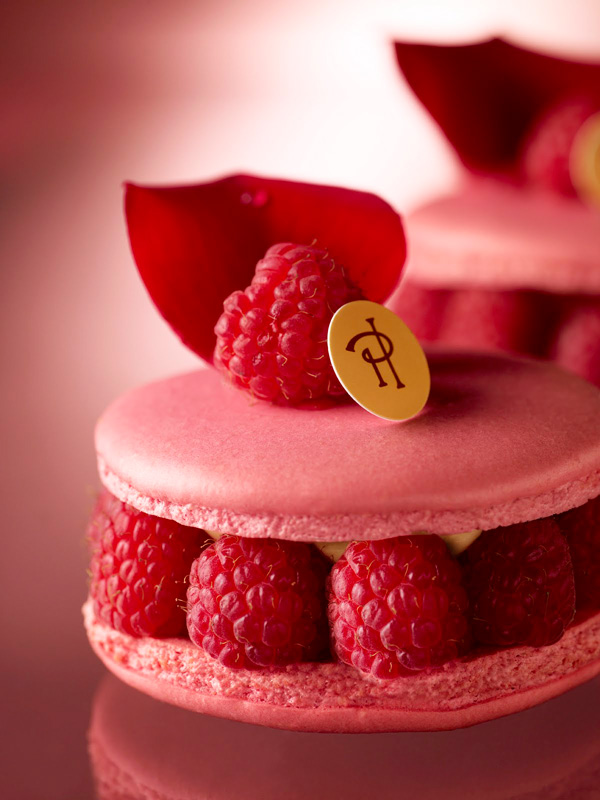
The Ispahan dessert by Pierre Hermé Paris

La Cuisine
“I like the idea of sharing my world, where cocoa is the king.” Pierre Hermé
VIP Shopping at Le Printemps Haussman
Le Royal Monceau – Raffles Paris and Le Printemps Haussmann have collaborated to offer a unique shopping experience with a multi-lingual Personal Shopper, who can expertly guide clients through the exclusive department store of 45,000 sqm dedicated to Fashion, Luxury and Beauty. Guests of Le Royal Monceau are invited to their private lounge and given access to luxury and limited edition items. This luxurious package includes complimentary access to Premium services including a VIP welcome, VIP card with special offer, hands-free shopping, priority tax refund, international shipping and a VIP gift. Le Printemps Haussmann welcomes Middle Eastern clients with a special gift with participating brands such as Dior, Elie Saab and Omega, whilst the hands-free shopping and priority tax refund make this a wonderful opportunity to engage in some retail therapy. Georges-Eugène Haussmann was an architect who was commissioned by the Emperor Napoleon III to reconstruct the centre of Paris which was the largest of such public works project ever undertaken in Europe in the 1850s. His main instruction was to bring “air and light to the center of the city” and unify the different neighborhoods with “boulevards” and today there is a Boulevard named after Haussman himself parallel to the Champs Elyzées.
Le Printemps Haussman was founded in 1865 and noted for its branding innovations, handing out bouquets of violets on the first day of each Spring and championing the new Art Nouveau style, with its nature inspired motifs. When I paid a visit, a collaboration with Burberry inspired by the Christmas holiday season was creating a buzz amongst tourists at the main Atrium, and the iconic rooftop restaurant on the 6th floor was fully packed with a lineup of guests waiting to be seated. This area is highly frequented as it is an iconic location steeped in history. In 1939, to avoid the risk that the carefully encrusted Dome above the Tearoom would be destroyed in bombing attacks, it was dismantled and stored at Clichy near the town of Montmartre, and restored in 1973 by the grandson of its original designer.
Diabetes in The U.A.E. goes head to head with a dominating disease
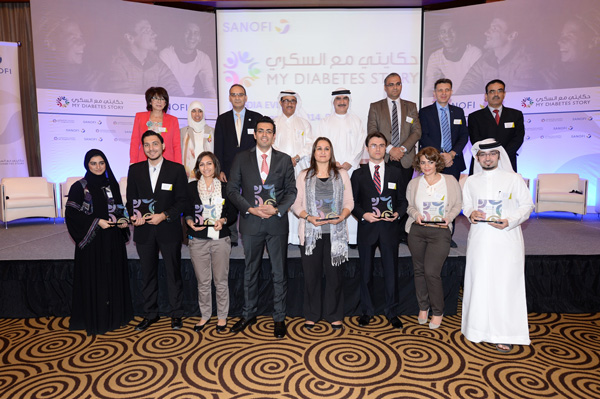
Diabetes patient ambassadors and regional heads of diabetes associations at the launch event of My Diabetes Story online community supported by Sanofi
My Diabetes Story
A new online community supporting people with Diabetes.
Recent figures by the International Diabetes Federation (IDF) estimate that the incidence of diabetes is expected to rise from 34.6 million in 2013 to 67.9 million by 2030 in the Middle East, which equates to a 96 percent increase in the MENA region according to the Diabetes Atlas, at the International Diabetes Federation. In the U.A.E. alone, 18.9 percent of the population, live with the disease. Answering the need for increased patient-to-patient communication, an online patient community was launched during the 2014 Diabetes World Awareness month, endorsed by leading diabetes associations and Sanofi. Sanofi is a global healthcare leader that is dedicated to discovering, developing and distributing therapeutic solutions focused on patients’ needs, with core strengths that include diabetes solutions, human vaccines and consumer healthcare.
Led by diabetics, My Diabetes Story, is a community that offers a platform where patients will be able to discuss the issues that matter the most to them and share tips and recommendations on how to manage their condition. My Diabetes Story ambassadors are diabetic patients that have been nominated by diabetes associations from across the Middle East. They are inspirational patients, successfully managing their condition and are keen to spread awareness and support other people living with diabetes.
“The increasing numbers of diabetics in the region unfortunately echo the global trend of the disease,” says Dr. Pius Hornstein, Sanofi Vice President, Turkey & Middle East. “With the prevalence of diabetes in the adult MENA population at approximately 11% and 14.9% in Turkey. At Sanofi, we recognize the need to go beyond medication and therapies. A vital component of managing diabetes is providing access to information to people with diabetes, particularly having independent access to patient-to-patient communication which is still an unmet need. By launching My Diabetes Story online community we are facilitating for patients to share their experiences, stories and concerns in a likeminded community so they would feel part of a bigger, supportive and secure environment.” He added.
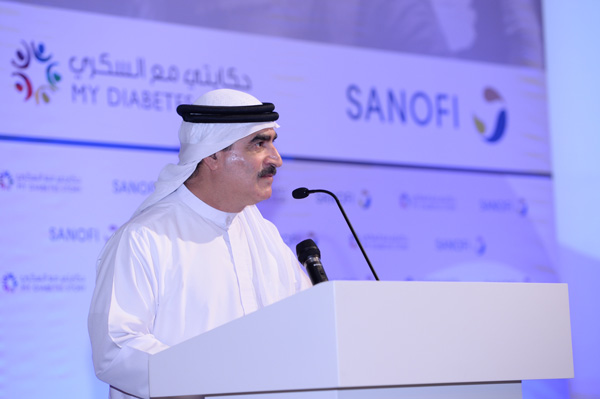
Dr. Abdulrazzaq Al Madani President of the Emirates Diabetes Society at the launch of My Diabetes Story
Diabetes can lead to blindness
Doctors from the Burjeel Hospital in Abu Dhabi explore the effects of the disease on vision
One of the biggest effects of diabetes is on the eyes causing mild visual loss to severe visual loss or even blindness. Diabetes can affect the human lens causing premature cataract or clouding of the eyes or causes an increase in fluid pressure inside the eye or glaucoma. “The most common diabetic eye condition is called Diabetic retinopathy, which is the leading cause of blindness,” said Dr. Madhav Rao, Consultant Ophthalmologist / Vitreo-Retinal Surgeon at Abu Dhabi’s tertiary healthcare provider, Burjeel Hospital. “Diabetic retinopathy is caused by damage to the narrow blood vessels called capillaries in the retina of the eye causing leakage of fluid, blood, proteins into the retinal layers resulting in retinal swelling or an edema. If the edema occurs in the center of the retina, vision might be affected.”
“The second most important change caused by diabetic retinopathy is the formation of abnormal new blood vessels on the surface of the retina and these grow towards the center of the eye,” he continued. “These large new blood vessels are fragile and can be raptured easily on physical exertion causing bleeding into the vitreous cavity (fluid in the middle of the eye) or can pull the retina separating from the outer walls.” Eye disease caused by diabetes is particularly dangerous because it does not display any symptoms in the early stages. Over time, patients will suffer from blurring of vision, distortion of images, blockage in the central vision, and sudden appearance of a cloud in the field of vision. “Once diabetic retinopathy has progressed to the later stages, the patient will have to undergo a recommended laser surgery that shrinks the abnormally formed blood vessels,” Dr. Rao said. “This surgery is most effective when the vessels are newly formed and haven’t started bleeding. It can be done even if the vessels have started bleeding but this can have complications.” Prevention damage to your eyes is the best way forward once you have been diagnosed with diabetes. Control of blood sugar, blood pressure and cholesterol along with a suitable diet and regular exercise will keep these alarming conditions away.


Periodontitis & Systemic Diseases
a&e consults Dr Hubert de Grully CAD/CAM specialist, Implantologist and Cosmetic Dentist at the

Dr. Hubert de Grully from Dr.Roze & Associates Dental Clinic
Dr. Roze & Associates Dental Clinic
Dr. Hubert comes from France where he studied dentistry at the Medicine and Dentistry University of Monpellier. We spoke to him about periodontal diseases since the clinic he represents is an advocate for oral health and raising awareness on its correlation with Diabetes. The Clinic organizes a weekly training session along the beach and invites patients and friends to join for The Million Smile Foundation a charity it is currently in the process of setting up at Dr. Roze & Associates Dental Clinic.
What is the main correlation between Diabetes and periodontal health?
Diabetes is a chronic disease that occurs when the pancreas is no longer able to make enough insulin or when the body cannot make good use of the insulin. This hormone allows the glucose from our digested food to pass from the blood stream into the cells of the body and produce energy.
Periodontal disease is thus linked to the control of Diabetes and blood sugar and is thought to be the 6th Complication in diabetic patients. People with poor blood sugar control, or a high blood sugar concentration, are more prone to gum disease and teeth loss. The high concentration of glucose in the blood causes blood vessels to thicken, which slows the flow of nutrients (oxygen and nourishment) and the removal of harmful wastes. This process can weaken the resistance of gums and bone tissue to infection. High levels of glucose in saliva can feed bacteria and set the stage for periodontal disease. Good oral hygiene and thorough regular dental check-ups with a Dentist as well as regular appointments with a Dental Hygienist, are essential to the prevention of periodontal disease for Diabetics.
Another correlation between Diabetes and periodontal health is the use of tobacco. It is common knowledge that smoking is dangerous for health, especially to oral tissues. Smokers are five times more likely than non-smokers to have periodontal disease. This statistic drastically increases for smokers with Diabetes, whereby Diabetic smokers over 45 years are 20 times more likely to be infected with severe periodontal disease. It is thus very important for anyone who is diagnosed with Diabetes to quit smoking immediately.
What are some other types of diseases or infections related to oral health, to which patients with Diabetes may be more prone?
Diabetes reduces the body’s defenses and increases the oral bacteria content which can also induce gum and alveolar bone inflammation. When the gums become red and swollen and bleed during tooth brushing or flossing, this is gingivitis, the first stage of periodontal disease.
Insufficient brushing and flossing allows dental plaque (a sticky film containing over 25000 species of bacteria) to build up on the teeth. Gingivitis can usually be reversed with the correct daily brushing and flossing technique, and regular cleanings by the dentist or the hygienist. If it is not treated, gingivitis can lead to a more serious type of gum disease or periodontitis. Periodontitis can affect the supporting tissues of the teeth, gums, as well as the alveolar bone which make the teeth mobile and possibly lead to tooth loss.
Other oral problems that can occur include:
Thrush – an infection caused by a fungus that grows in the mouth. People with Diabetes are at higher risk for thrush because the fungus thrives on high glucose levels in saliva. Smoking and wearing dentures can also lead to fungal infection. Good Diabetic control, no smoking, and removing and cleaning dentures daily can help prevent thrush. Medication is available to treat this infection.
Dry Mouth – is often a symptom of undetected Diabetes and can cause more than just an uncomfortable feeling in your mouth. Dry mouth can cause soreness, ulcers, infections, and tooth decay. The dryness means that you have deficient saliva levels which acts as the mouth’s natural protective fluid. Saliva helps control the growth of germs that cause tooth decay and other oral infections. It washes away sticky foods that can form plaque and strengthens teeth with minerals. Good blood glucose control can help prevent or relieve dry mouth caused by Diabetes.
Do mouthwashes have any effect?
It is important to differentiate mouthwashes with chlorhexidine and the others.
Chlorhexidine is a disinfectant and is active against germs. It is very useful for reducing periodontal disease, however, it must be prescribed by your general dentist. The treatment is short (between 5 days to 2 weeks) and not recommended for a daily use. Studies have proven chlorhexidine is very effective for a short term use, but not good for long term use as it may cause teeth discolourations and/or candidiasis (thrush).
Most of the mouthwashes found in supermarkets are for daily use and do not contain the active ingredients of chlorhexidine. They usually contain fluoride, which is a good complement to the correct tooth brushing and flossing, or interdental cleaning especially in areas where fluoride is difficult to access.


What are everyday maintenance strategies Diabetics should adopt in order to better care for their gums?
Here are some suggestions:
• Floss teeth at least once per day
• Be careful to gently slide the floss against the gums and remove it from one side of the tooth gap, or use another interdental oral hygiene aid such as interdental brushes, or the airflosser. Brushing alone will only clean 60% of the tooth surface.
• Gently brush teeth twice a day with a fluoride toothpaste, first thing in the morning and last thing at night using a soft nylon brush with rounded ends on the bristles. Avoid hard back-and-forth scrubbing. Use red to white motions (from gums to the teeth). An electric toothbrush can be highly beneficial if instructed by a dental professional, and used in the correct way as an alternative to a manual toothbrush.
• Gently brush your tongue, which can trap germs.
• Use fluoride toothpaste to protect teeth from decay and avoid rinsing out with water after.
Jaeger-LeCoultre Yearbook Eight a Tribute to rare handcrafts (“Métiers Rares®”)

The human hand is the first and foremost instrument behind beautiful objects. In the eighth edition of its Yearbook – a photographic anthem to creativity and the artisanal skills that have played such a powerful role in the history and the life of the Manufacture – Jaeger-LeCoultre turn the spotlight on these rare handcrafts (“Métiers Rares®”) and the creative hands that both master and serve these crafts. Ten articles in pictures take us around the world, wherever works of art bear the signature of the human hand.

Every year, the publication of its Yearbook presents an opportunity for Jaeger-LeCoultre to highlight and strengthen its connection with the world of photography. Guided by a desire to preserve artistic know-how and achievements to better transfer them, the Grande Maison takes part in the dissemination of the work of talented photographers.
Yearbook 8 highlights emblematic artisanal professions featuring the peerless, irreplaceable contribution of hand-crafted operations. Invited to focus on the human being behind each object, the reader is thus taken on a journey around the world through the pages of this exclusive publication offering a wide-angle immersion into the very palm of these creative talents.

Métiers Rares
The hand of the enameller, the engraver, the watchmaker and the setter have for centuries successively joined forces in adorning watches endowed with horological complications. The first part of the book focuses on historic watchmaking creations which pay tribute to the rare handcrafts (“Métiers Rares®”) deeply cherished by Jaeger-LeCoultre.
In Praise of Clay
The inherently sensual, soothing age-old art of the potter is the supreme example of a craft involving the hand, since only the latter can assemble a sophisticated Fine Watchmaking mechanism, and it alone can perfectly finish a clay vase. A rejuvenating clay bath.
Sacred Art
The craftsmen of the Marinelli bell foundry at Agnone in Italy appear to be fired by sacred inspiration. Evoking angelic voices, the results of their art can tolerate nothing short of perfection. The human hand draws, models, decorates, moulds, pours, glazes and paints. Everything comes from the mind, itself guided by the heart.
Leather Deep
Slowness and patience: two watchwords for Jaeger-LeCoultre watchmakers that are also dear to the hearts of the artisans at the Casa Fagliano in Buenos Aires, Argentina, who finely craft leather to produce custom-made polo boots that enjoy an international reputation. Recently, Fagliano has combined its unique know-how with that of the Manufacture to produce bracelets made of Cordovan leather for a re-edition of the legendary Reverso 1931 watch.
Hybris Artistica
In the form of a poster placed at the centre of the Yearbook, Jaeger-LeCoultre highlights its Hybris Artistica collection of 12 models majestically marrying watchmaking techniques with artistic creativity. Each of them testifies to the meticulous work of the artists and above all to the irreplaceable intuition guiding their every move, since this alone can enable them to perfectly position a diamond or to perform such complex skeleton-work.
Hybris Mechanica 11
An elegant treasure on the wrist, Jaeger-LeCoultre’s Master Ultra Thin Minute Repeater Flying Tourbillon is one of the world’s thinnest minute repeaters. Through a lengthy process of trial and error, the Manufacture’s craftsmen succeeded in developing an ingenious system that eliminates the usual pause between the hours and minutes when the watch does not chime the quarter hour. A whole new way of setting the beat.
Carriers of Light
The arm stretches out to enable light to pass through the piece of glass and reveal the subtle nuances of its colours. A familiar move for the stained glass window makers at the Loire workshop in Chartres (France), who cultivate the medieval technique of stained glass window making. This meticulous art transforms light over time.

Precious Hours
Radiance and daintiness meet and mingle on the ladies’ watches delicately adorned by the Jaeger-LeCoultre artisans. Like a soft caress on the page, the creations are enhanced by the light and by the satin-soft atmosphere radiating from these photographs.
Virtuoso hands
Releasing the inner voice of an instrument, attaining virtual auditory perfection in a violin. The stringed instrument-makers from Cremona (Italy) hand down their know-how and secrets from century to century, giving a second timeless life to the wood of their instruments. An additional touch of soulfulness that makes the very air vibrate with peerlessly beautiful sound.

Of colours and other places
To conclude the Yearbook, American photographer, Steve McCurry provides striking shots of “Holi” the Hindu Celebration of Light. To celebrate the coming of spring, the population, especially in northern India, descends into the streets with their bodies covered in coloured pigments. A vibrantly joyful tribute to life’s simple pleasures.
The Yearbook 8 is on sale in Jaeger-LeCoultre boutiques all over the world.
Hermès -wool and cashmere
Double-breasted coats, shawl collars, trench coats and blousons with ribbing and gusset pockets, perforated and embroidered sweatshirts. Crewneck and turtleneck pullovers, cardigans with contrasted stripes detail. Trousers were straight and narrow with contrasted stripe, wide displaced or zipped cut-outs trousers, jogging pants, evening trousers with tuxedo belt also made a hit. In terms of fabrics, there was a lot of cashmere on the runway with technical double cashmere, supple cashmere flannel, and herringbone cashmere. Wool was also a dominant fabric with Prince of Wales wool, Scottish plaid madras wool, technical wool and wool and silk ottoman.
Dior Homme – HOMME FLEUR
The elegant and eccentric is celebrated in Dior Homme’s Winter collection with the figure of the ‘Homme Fleur’. This fundamentally contemporary figure is both romantic and realistic; as likely to embrace formal wear as much as work wear, the sartorial and the technical, with the decorative and practical.
“This man has a real life,” says Kris Van Assche. “He moves, he has that energy and the technical aspect of the collection gives him that freedom. He does not look back – He is really confident in the future.”
A version of Koudlam’s ‘The Landsc Apes’ undertaken on traditional orchestral instruments, transferred from the electronic medium and made into a live musical event – a metaphor for the making of the collection.
Gucci
BOWS AND BERETS
Silk chiffon blouses with a hanging bow, tortoise-shell spectacles, patterns from the 70s, and berets. He is an artist sketching in his leather rimmed sketch book on the side of the river or under a tree in the Italian country side…and he is being filmed by a movie crew while doing so. Mink-lined slippers and the Gucci logo in a gold belt buckle, still remind one of the brand’s luxury presence and namesake while playful elements such as pajama-like pants, knit caps and deliberately shortened sleeves make for a poetic collection.
Top10 Best-selling wedding Books

Vera Wang On Weddings by Vera Wang
In this superbly produced volume by Callaway Editions, Ltd.; the world′s most successful bridal gown designer shares her thoughts and vision on weddings. Culled from years of experience in the wedding business, Vera Wang offers ideas on every aspect of the wedding day from invitations to flowers, from cakes to attendants.
Of course, a wedding book by Vera Wang wouldn′t be complete without detail on the bride′s gown. She explains how to select the right neckline, construction, length, bodice, and waistline for each bride′s figure; what fabrics are appropriate for certain times of day; how to choose a headpiece, and much more.
Emily Post’s Wedding Etiquette, 6e by Anna Post, Lizzie Post
Emily Post’s Classic, Indispensable, and Comprehensive Guide to Your Wedding
Now Completely Updated and Expanded in a New Edition
Today’s weddings are a beautiful blend of traditions, reflecting what matters most to each couple. They are also more complicated than ever, with new customs replacing the old, new technologies to help plan and communicate, and new relationships to consider as families grow more complex. But while weddings evolve, one thing has remained constant: A wedding is one of the most special days in a person’s life. Surrounded by friends and family, it is a day for everyone to celebrate.
The Emily Post Institute has been answering etiquette questions for more than ninety years, and Emily Post’s Wedding Etiquette, 6th Edition, written by Emily Post’s great-great-granddaughters, Anna Post and Lizzie Post, will provide you with everything you need to know from past traditions to modern updates so you can approach your wedding with grace and ease. After all, etiquette is about treating people with consideration, respect, and honesty-attitudes that will help you to set the tone for the perfect day.

Emily Post’s Wedding Planner for Moms by Peggy Post
Countless mothers of brides and grooms have asked Peggy Post for a wedding planner just for them. Here it is! Whether you’re helping a little or a lot, or-like most moms-are serving as combination coach, diplomat, and troubleshooter, this planner is packed with useful ideas, including:
Planning lists especially for moms
Questions to ask before hiring wedding professionals
Times when a mother’s tactful advice is most helpful
A Resources section with worksheets for keeping track of guests, gifts, budget, and more
An Address Book you’ll refer to again and again
Peggy Post will help you navigate finances, guest list, ceremony, and reception details; interact with your daughter’s or son’s future in-laws; and plan your role (including your outfit!) while making memories to last a lifetime.

A Wedding Like No Other, Inspiration for Creating a Unique, Personal, and Unforgettable Celebration by Peggy Post, Peter Post
Destination weddings planned in exotic locales, intimate weddings organized on a shoestring budget, full-scale galas with guests from all over the globe. . . . In A Wedding Like No Other, read the stories of some of the most incredible, romantic ceremonies and receptions collected by the wedding etiquette experts at the Emily Post Institute. As different as they all are, the stories featured here are examples of how a wedding can be heartwarming and unique-even if everything doesn’t go exactly as planned. In each one, the bride and groom make a determined effort for their wedding day to be an expression of their tastes and personalities, often in the face of unexpected obstacles. And in every case, the end result is a wonderful and memorable experience for the couple and for everyone else involved. Let these stories help inspire your own big day. The creative vows, cakes, toasts, and more described in these pages will spark your own ideas and help you personalize every detail of your wedding. Also, each story is followed by a short advice section, offering insights and general wisdom on a large variety of topics from picking the venue to selecting the menu. Go beyond the standard, the expected, and make your big day a cherished, uplifting, unforgettable experience. You already have a love like no other, so celebrate it with a wedding like no other.

Words for Your Wedding by David Glusker, Peter Misner
In the excitement of planning a wedding in all its detail, the beauty and meaning of the words exchanged can sometimes be overlooked. To help you find and create the perfect ceremony, ministers David Glusker and Peter Misner have compiled this do-it-yourself guide that walks you through the entire wedding ceremony, offering both contemporary and traditional readings and prayers. From the gathering words to the final blessing, this collection of wedding traditions lets you design a ceremony that is right for you-whether it is an established service, a combination of elements from various traditions, or a newly created celebration of your own.
This practical resource for couples and ministers alike also includes special sections featuring:
The civil ceremony
The Roman Catholic and ecumenical wedding
The Jewish wedding
Tips for how to write your own service
Guidelines for renewing your wedding vows

Do I Have To Wear White? Emily Post Answers America’s Top Wedding Questions by Anna Post
“I can’t choose between my two best friends. Can I have two maids of honour?”
“My fiancé and I are considering a destination wedding. Are we obligated to cover our attendants’ travel expenses?”
“Do we have to invite our guests’ children to our wedding?”
“I’m still close to my ex-husband’s parents. Would it be okay to invite them to my wedding?”
“How do my partner and I go about planning our commitment ceremony?”
“My parents are divorced and each has remarried. Where do they sit in church?”
“Do I have to wear white?”
Do I Have to Wear White? draws on the Posts’ extensive database of wedding questions received through their Web site, as well as popular topics addressed in their columns. For busy engaged couples and their families, attendants, and guests, this book provides at-a-glance answers to everything from essential bridal basics to the knotty logistical questions that spring up around this joyous yet often complex event.

The Wedding Bees, A Novel of Honey, Love, and Manners by Sarah-Kate Lynch
Sugar Wallace did not believe in love at first sight, but her bees did. . . .
Every spring Sugar Wallace coaxes her sleepy honeybee queen-presently the sixth in a long line of Queen Elizabeths-out of the hive and lets her crawl around a treasured old map. Wherever the queen stops is their next destination, and this year it’s New York City.
Sugar sets up her honeybees on the balcony of an East Village walk-up and then-as she’s done everywhere since leaving South Carolina-she gets to know her neighbors. She is, after all, a former debutante who believes that manners make the world a better place even if they seem currently lacking in the big city.
Plus, she has a knack for helping people. There’s Ruby with her scrapbook of wedding announcements; single mom Lola; reclusive chef Nate; and George, a courtly ex-doorman. They may not know what to make of her bees and her politeness, but they can’t deny the magic in her honey.
And then there’s Theo, a delightfully kind Scotsman who crosses Sugar’s path as soon as she gets into town and is quickly besotted. But love is not on the menu for Sugar. She likes the strong independent woman she’s become since leaving the South and there’s nothing a charmer like Theo can do to change her mind . . . only her bees can do that.
The Wedding Bees is a novel about finding sweetness where you least expect it and learning to love your way home.

Once Upon a Wedding Night by Sophie Jordan
An Innocent Deception . . .
Lady Meredith Brookshire has every right to Oak Run. Now that she’s suddenly husbandless and penniless, where else would she, her addled father, and spinster aunt reside? Yet who should appear but Nicholas Caulfield, the new Brookshire heir, claiming the estate is rightfully his by law. The brute is as arrogant as he is handsome-besides, he’s supposed to be dead. And the only plan resourceful Meredith can devise to save her family from homelessness is a desperate scheme that may lead her to salvation or ruin . . . and the bed of the man she has vowed to hate. A reluctant aristocrat, Nick does not trust this fiery, infuriating chit whom he suspects of subterfuge-yet who bewitches him with her innocent green eyes. The sooner he can get this tempting beauty married off to some stodgy old blueblood-and off his hands for good-the better. There is one slight problem, however: Nick can’t bear the thought of her wedding any man but him.

On the Way to the Wedding by Julia Quinn
A funny thing happened…
Unlike most men of his acquaintance, Gregory Bridgerton believes in true love. And he is convinced that when he finds the woman of his dreams, he will know in an instant that she is the one. And that is exactly what happened. Except…
She wasn’t the one. In fact, the ravishing Miss Hermione Watson is in love with another. But her best friend, the ever-practical Lady Lucinda Abernathy, wants to save Hermione from a disastrous alliance, so she offers to help Gregory win her over. But in the process, Lucy falls in love. With Gregory! Except…
Lucy is engaged. And her uncle is not inclined to let her back out of the betrothal, even once Gregory comes to his senses and realizes that it is Lucy, with her sharp wit and sunny smile, who makes his heart sing. And now, on the way to the wedding, Gregory must risk everything to ensure that when it comes time to kiss the bride, he is the only man standing at the altar…

A Girl Walks Into a Wedding,Your Fantasy, Your Rules by Helena S. Paige
Wedding fever creates plenty of opportunity for heat in Helena S. Paige’s sexy and funny A Girl Walks Into a Wedding-the interactive erotic novel in which YOU, the reader, make all the rules . . .
Your best friend is getting married, and she’s asked you to be her bridesmaid. So many decisions: for starters, do you ask the gorgeous but mysterious man you met online to come as your date? Or do you go solo, giving yourself ample opportunity to kick up your heels and scope out the talent?
Once the wedding weekend gets underway in a romantic country setting, all kinds of adventures on offer. Will you ditch your date? Duet with the hot DJ? Dodge the disreputable best man? Or perhaps the rugged pilot you meet in the bar will open up unexpected erotic opportunities – and who knew the maid of (dis)honour had such a sultry streak?
All this while steering your way through the bachelorette party, the bride’s wedding jitters, the Dress From Hell, and more. Perhaps the most tempting option is to flee the entire affair with a tall, dark stranger … or maybe an old friend surprises you with a sizzling encounter. YOU make the decisions-fulfillment guaranteed. It’s your fantasy. Your rules. The choice is yours …
Courtesy of HarperCollins Publishers – www.harpercollins.com
Think Like a Freak

The Authors of Freakonomics Offer to Retrain Your Brain By Steven D. Levitt, Stephen J. Dubner
The New York Times bestselling Freakonomics changed the way we see the world, exposing the hidden side of just about everything. Then came SuperFreakonomics, a documentary film, an award-winning podcast, and more. Now, with Think Like a Freak, Steven D. Levitt and Stephen J. Dubner have written their most revolutionary book yet. With their trademark blend of captivating storytelling and unconventional analysis, they take us inside their thought process and teach us all to think a bit more productively, more creatively, more rationally-to think, that is, like a Freak. Levitt and Dubner offer a blueprint for an entirely new way to solve problems, whether your interest lies in minor lifehacks or major global reforms. As always, no topic is off-limits. They range from business to philanthropy to sports to politics, all with the goal of retraining your brain. Along the way, you’ll learn the secrets of a Japanese hot-dog-eating champion, the reason an Australian doctor swallowed a batch of dangerous bacteria, and why Nigerian e-mail scammers make a point of saying they’re from Nigeria.
Some of the steps toward thinking like a Freak:
First, put away your moral compass-because it’s hard to see a problem clearly if you’ve already decided what to do about it. Learn to say “I don’t know-for until you can admit what you don’t yet know, it’s virtually impossible to learn what you need to. Think like a child-because you’ll come up with better ideas and ask better questions. Take a master class in incentives-because for better or worse, incentives rule our world. Learn to persuade people who don’t want to be persuaded-because being right is rarely enough to carry the day. Learn to appreciate the upside of quitting-because you can’t solve tomorrow’s problem if you aren’t willing to abandon today’s dud. Levitt and Dubner plainly see the world like no one else. Now you can too. Never before have such iconoclastic thinkers been so revealing-and so much fun to read.
Courtesy of HarperCollins Publishers – www.harpercollins.com
One to One with Nada Ghazal Founder of Nada G jewellery

Nada, how did you come to know about your passion for jewellery designing?
My fondest memory is sitting by the fireplace watching my grandmother’s delicate fingers weave pieces of art using string and her trusted crochet needle. I could sit for hours on end and never tire. I was fascinated with the intricate details of the pieces she created. I clearly recall the euphoric feeling I had the first time she held my hand and gently pressed my finger against that needle as she carefully guided me to tie my first knot. I knew back then and at the early age of 6 that I wanted to be an artist and an artisan.
Later as a teenager I aspired to emotionally connect with women around the world through my fine jewellery collections.
How do you define the style of your designs, I:e , the design DNA?
Nada G designs are contemporary timeless jewellery with an edge that has a soul, story and glamorous feel.
Who is the Nada G client?
When I work, I think of the powerful global woman, but I would rather not select the women, but let them select Nada G.
What are the sources of your inspiration?
My designs are a true reflection of my emotional sense, of my immediate surroundings and what invariably moves me. I am touched by everything I see and everyone I meet. It could be as simple as the icicles that were hanging down from the window of my parent’s house in the mountains to a sparkle in a child’s eye, so talking to myself, and digging deep into my soul is what kick-starts my ideas. I suppose that’s where my hard disc is
Having said so I think visiting and living in many countries have played a role in how I think about design, and one thing I claim is that Nada G jewellery has a global feel.
Can you take through the design process after your first sketching?
It is very challenging to create something unseen and unexpected, and that’s why I always aspire to explore my ideas.
Coming from an advertising background, I do not start by creating a piece, but instead I start by creating the concept of the collection which derives from certain feelings or experiences which I am going through, then I start sketching different items under the collection. Relevant items are then chosen based on different criteria. Prototypes are later produced, and accordingly a final selection is made.
What in your opinion sets the Nada G designs from others?
Going against established norms, the pieces exhibit fragility in their coarseness, docility in their textures, and vibrancy in their candid statements. Each piece of jewellery echoes a different sense of emotion, mirroring not only an adornment of the senses, but more so celebrating what they evoke to be a woman.
Every collection carries its own identity and is derived from my emotions; they all belong to one spirit, the Nada G spirit, so each one defines Nada G in its own way.
Having said that, I believe every piece we create has a soul.

What “Maison” of Jewellery do you admire and why?
I appreciate different work presented by different designers such as Cindy Chao, Lydia Courteille, Sevan Bicakci and many others…
Who would you like to see wearing your creations?
My biggest satisfaction is when the women appreciate and admire Nada G jewellery, no matter who she is.
Today Nada G boutique is located in Beirut Souks, can you tell us more about your expansion plans and the e-boutique project.
Besides our flagship boutique in Beirut Souks, Lebanon; Nada G is available in USA, London and now at Sauce Rocks Dubai.
Our plan is to grow our business in USA by expanding our presence.
As for e-boutique, at the moment we are already working with one and have plans to add more in 2016.
Being a mother, how do you manage between family and work?
I am an early riser, so I would say my day starts around 6am with my husband and three children.
By the time our little ones are all set, and on their way to daycare and school, I am already on my way for an hour at the gym. Then I rush to work to make sure I am there by 9am. In some cases even earlier.
I spend my day partly with the communication team, the financial team and myself at the office; with the sales team and the customers at the boutique; and with the production team and the stone setters at the workshop – the part that adds more glitter to my eyes!
I make sure to pass by the house to spend 30 minutes with the kids while they have their lunch, or share with them an activity, so I sort of learnt how to run in high heels rather than walk.
I also make sure I am at home early evening, but I am prone to going back to work, or working at night from home if need be.
I am the kind of person that needs to finish her to do list before going to bed.
You always say that your work is the true labor of love, can you tell us what is your personal motto and what do you still aim to achieve.
Being true to myself, creating with passion and transmitting feelings through my pieces is what I believe gives my pieces a soul. So I would say my motto is putting love in everything I do, and hoping to connect with the rest of the world through my timeless jewellery.
Gucci dinner in honor of Alessandro Michele following the Gucci Spring Summer 16 Fashion Show
WHO: François-Henri Pinault, Kering Chairman and CEO, and Alessandro Michele, Gucci Creative Director.
Guests included Gucci President and CEO Marco Bizzarri and Salma Hayek Pinault as well as Fabien Baron, Carlo Capasa, Charlotte Casiraghi, Alexa Chung, Gia Coppola, John Currin, Jeanne Damas, Bianca Brandolini D’Adda, Karen Elson, Rachel Feinstein, Virginia Galateri di Genola, Matteo Garrone, Nan Goldin, Valeria Golino, Katie Grand, Luca Guadagnino, Jefferson Hack, Adrian Joffe, Dakota Johnson, Miriam Leone, Nathalie Love, Carlotta Loverini Botta, Glen Luchford, Steve Mackey, Federico Marchetti, Albertina Marzotto, Martina Mondadori, Flo Morissey, Margherita Puri Negri, Emanuele and Laura Rimini, Anna dello Russo, Patrizia Sandretto Re Rebaudengo, Franca Sozzani, Carla Sozzani, Stefano Tonchi, Anna Wintour, Unskilledworker, Hikari Yokoyama, Olivier Zahm and more.
WHAT: Following the Gucci Spring Summer 2016 fashion show in Milan, François-Henri Pinault hosted a dinner in honor of Alessandro Michele. Three Michelin star chef Massimo Bottura created a special menu for the evening.

Marco Bizzarri, Salma Hayek-Pinault and Francois Henri Pinault
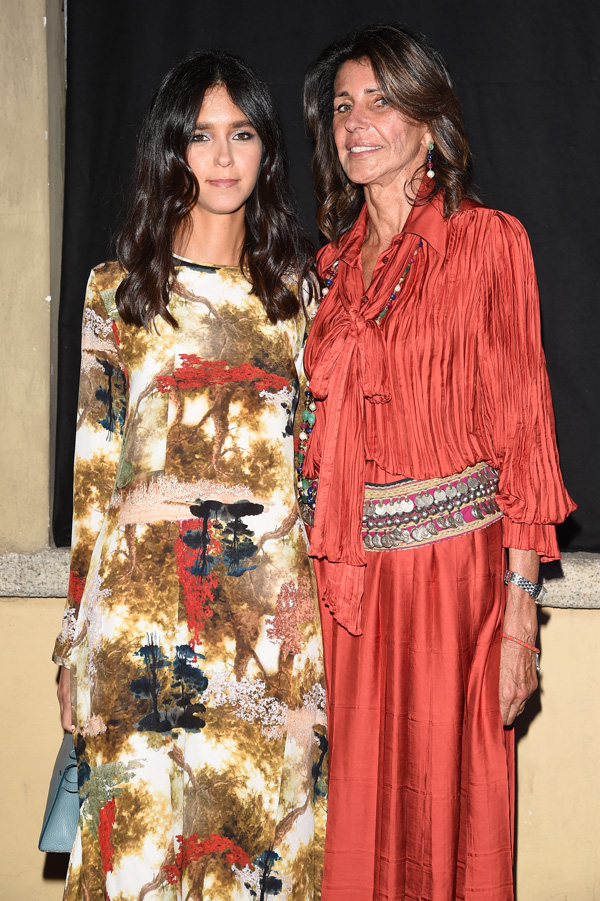
Albertina Marzotto & guest
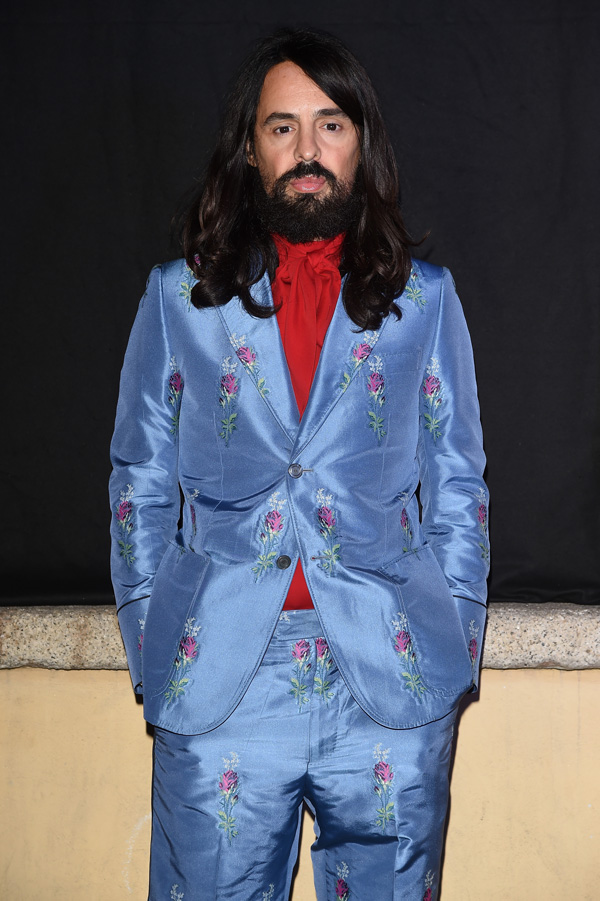
Alessandro Michele
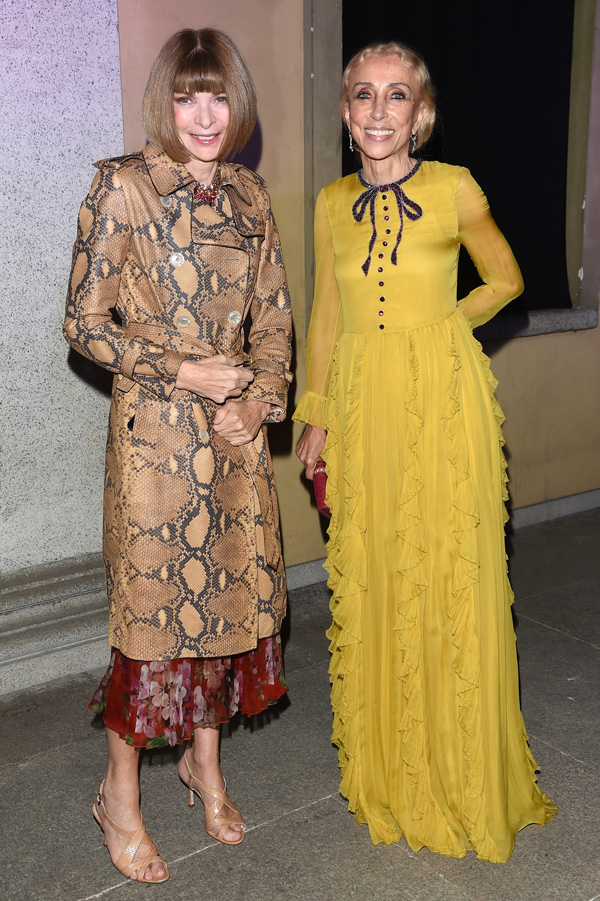
Anna Wintour & Franca-Sozzani
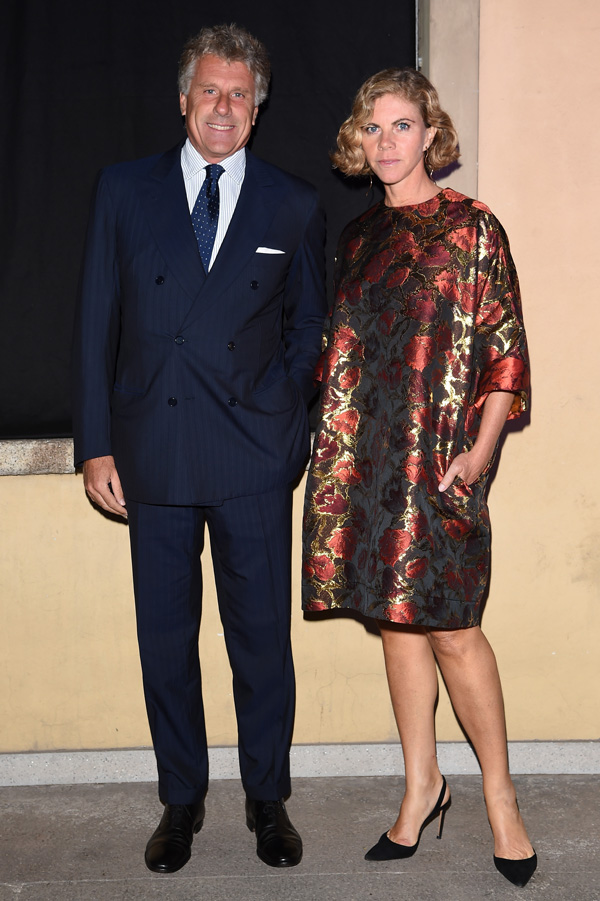
Emanuele & Laura Rimini

Federico Marchetti & Kerry Olsen
Villeroy & Boch- A journey through 3 centuries of innovation

Being an avid collector and a fan of Villeroy & Boch as a brand, the thought of visiting the splendid Baroque building of the “Old Abbey“ in Mettlach that houses the “Keravision“ exhibition where 266 years of Villeroy & Boch’s corporate history are displayed, always seem like a great plan to discover the latest novelties and re-live the success stories with a brand of such rich heritage and deep roots in the European culture.
During my visit I had the pleasure of meeting Nicholas Luc Villeroy, board member and CEO of the brand’s tableware division, where we had the following chat over dinner at the historic Schloss Saareck.

How would you describe Villeroy and Boch as a brand?
Not easy to sum up a 266 year old legacy but the story of Villeroy & Boch is very much linked to the European story.
If I look back in time, we have had an influence on the “eat and drink culture” since many years. We are a French- German company, and now German with roots in those 2 countries.
In the beginning, both families Villeroy & Boch where French. Boch moved to Luxembourg and afterwards to Mettlach where we have the headquarters today.
Villeroy started in France, they were both in competition. It was during the Napoleon era, the time of the continental blockade, goods produced in the United Kingdom where not allowed to be sold on the continent. In 1814 when Napoleon lost, the English goods started selling on the continent again.
In 1836, Villeroy & Boch merged together. Six years later, in 1842, my great aunt Octavie Villeroy married Eugine Boch. It was a consolidation from patrimonial union to matrimonial union. It was the base of deep roots. Those roots survived three French- German wars. They always had in mind the future of the company through hard times. This was the best example where the people can achieve when they start thinking in another direction. The French and the German today are the motor of Europe, and for Villeroy & Boch, it was always the case. We were the starters!
Two years ago they gave the peace Noble price to Europe. I was driving and heard it on the radio. I had tears in my eyes, and when people asked why I got so emotional when Europe imposes many laws, I said: I have another vision. In Europe, we have the biggest freedom period since the Romans! At a time where in many places around the world you have conflicts and wars, we have safety and stability!!

Tell us about the expansion of Villeroy & Boch?
I’m absolutely convinced that history and tradition are ways to breakthrough the future. If I look back in our history I can define three pillars that have been always there.
1) Tradition being a main pillar.
2) Diversification. We started with products for tableware and moved later toward sanitary ware and tiles.
3) Innovation. We always tried to innovate either in the design or the production process, since we wanted to make our products very high quality and affordable.
4) Internationalization. We started with two families: German and French with a base in Luxembourg, at a time where borders have always moved.
So we always had to adapt to new markets and seek new markets. Our mindset was always directed to export, from being present at the international fairs, to serving the Russian Tsar and Royalty around the world.
In the last period we decided to move abroad, one way with partners or agents or the other by moving directly with our regional offices.
We are in America, Australia, and Japan, moving to Asia where we have good sales in Korea, we are starting in Beijing and Shanghai in China, and we are opening in India.
Last but not least, we are present in the Middle East with more than 40 points of sales where a big part is with our distributor, Sara Trading.
We have the same type of movement for our bath and wellness division with one difference, which is the size, weight, and volume of the product. We can serve the world from our central warehouse in Mertzig for Tableware, but for bathroom and wellness we have additional factories, one in Mexico to cater for the USA, and one in Thailand to cater for Asia.
What are Villeory & Boch’s largest markets on the global level?
For the tableware division and on a global point of view, it is definitely Germany. Second comes France, followed by the USA.
If we want to measure it group- wise, Germany takes the lead, second comes the Nordic countries followed by France.
After Europe, we have many markets that are very big for us such as Japan, the Middle East and, Russia.
What is the customer looking for nowadays at Villeroy & Boch?
We are a brand that works with lifestyles. The essence of the brand is very much linked to where we come from, and to our tradition.
If you look outside you will see woods and fields and you will see a very old classical building. These inspire our two pillars of our lifestyles and offering: “The Country and The Classic”.
If we are at the modern cities, we evolve our design to meet the metropolitan lifestyle.
If we segment markets by taste: Europe is a market that has a high demand on both, the Country and Classic collections, while in the USA, the demand is on Country. The Middle East used to be very classic and now moving to contemporary.
Tell us about the design process at Villeroy & Boch and how you decide on what product you are going to offer the market?
There are basically two labels. The first is the classical product management where you analyze the product assortment you have and you identify the needs from the feedback that you get from the market. This is what I call the structured part of product development.
The second is where we have the design DNA and whether we should move more to Classic, Country, or Metropolitan.
How does it feel to be the heir of such an empire, and what are the 3 main messages you want transmit for generations to come?
I would probably tell them who we are, where we are coming from, and what are for me the 4 pillars we have at Villeroy & Boch. Tradition, Innovation, Diversification and Internationalization. Those pillars that were present over the centuries and should continue to be there.
There is one point that I may add and that would be Passion, which is considered the roof of this home. Since if you are not passionate about what you do, the burden will be too heavy. You have to face the responsibility of driving a business, the responsibility for your workers and your co-workers.
After 266 years the family is bigger, the shareholders are above 250 and the one big point that is very important is the need to be proud of the product your putting in the market, and that of course, is additional pressure when you run a family business.
You need to see yourself as a bridge between generations.
Besides having the passion, the main target that I would highlight will be: “you are becoming a heritage of the last 9 generations in a certain shape, your job is to transfer it into the coming generations in a better shape”.

What is an objective that you would still like to achieve?
I think we are always speaking about internationalization and being present globally. We are not global, yet are moving towards achieving it. This is part of the objective.
What is a personal favorite among the Villeroy & Boch collections?
To be honest I can’t name one. Since am in this business I always told the same story. Usually you can’t have breakfast, lunch, afternoon tea or dinner with the same person or with the same clothes, or at the same place. Why should you only stick to one set of porcelain?
I have many favourites for different occasions: French garden, New Wave, Old Luxembourg, Black Pearl, Indian Summer, My Wave from Paloma Picasso, Old Strasbourg and many more but never a complete set. I have a bit of everything.
What set you recommend for outdoors?
The next one will be released in February. We are bringing a new Anmut collection.
Is there any new collaboration with a designer after Paloma Picasso?
We have one in place now and that is with Isabelle de Borchgrave, the famous Belgian artist who used to work with Villeroy & Boch long time ago on tiles.
She worked on a project we had trying to mix the two faces of the brand.
The task was creating a pattern for our Artesano shape. And that was when she created the Artesano Provensal.
I have to say that this is not the usual way we work, since our philosophy is “Villeroy& Boch first” and sometimes when u work with external designers you need so much to market the designers more than the brand, so it’s a bit tricky.
Through our history you will always find collaboration with designers but not in a systematical way to develop products or concepts as some others do.

Tell us about brand’s social commitment. What are giving Europe?
We are really fighting for our environment.
I think that this is something that has always been part of our DNA at Villeroy & Boch.
We are the first producers moving from the wood-fire ovens to coal-fire ovens.
We have obliged ourselves to have our factory EMAS certified, which is the strongest environmental certification you can achieve for both of the ceramic factories. It obliges you to work with water consumption and what type of water you use .We are doing the same towards energy and we are having our factory ISO 50001 certified.
Our engagement is much more towards the planet. Why? Even if we are producing in the 21st century, we are producing with the help of the 4 elements. Fire, earth, water, air and we have to preserve them. This is part of our philosophy.


What is your insight on the post crisis economic situation and how do you forecast market recovery in Europe?
We have a diversified answer, since at this stage many markets in Europe still suffer and some are in good shape.
Germany currently is in good shape, the United Kingdom is evolving well, the Nordic countries are doing well, but in the South of Europe there are many countries that are still suffering with some evolution.
Spain hit the bottom but is rising up again, Italy as well. Portugal, Greece and France are still having big difficulties.
If I see the light at the end of the tunnel, it’s going to be quiet some more time. So it’s a mixed picture!
The difficulties will be trying to find a common goal and denominator in order not to segregate one country from another. Europe will only survive if there is unity.
Any plans of adding new product lines to the brand’s offering after Tableware and Bath & Wellness?
For the time being we don’t plan to add a third part of business. We still believe that there is a big potential in developing what we currently have. And what can we still achieve.
What is in the pipeline for the brand?
We are working on a lot of giftware concepts and in the direction of new place settings in tableware and glassware.
RIZZOLI PUBLISHES “BOTTEGA VENETA: ART OF COLLABORATION”
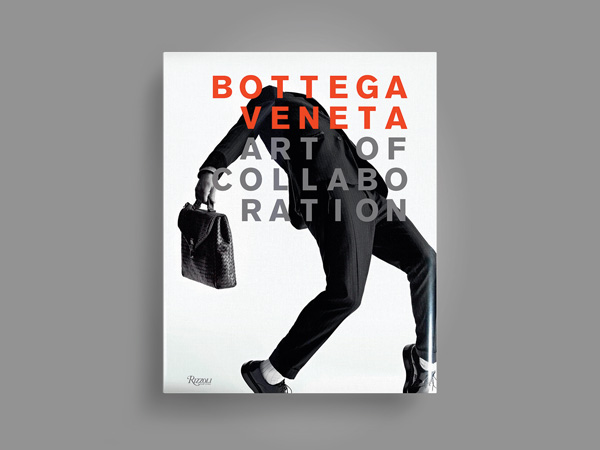
TO CELEBRATE TOMAS MAIER’S CREATIVE PARTNERSHIPS WITH RENOWNED ARTISTS
In 2002, Tomas Maier, Bottega Veneta’s Creative Director, launched the Art of Collaboration—a project that invites a world-renowned photographer or contemporary artist to collaborate on the Italian brand’s campaign for each season. With more than 1000 photographs, this book chronicles the comprehensive series of creative partnerships since the beginning.
Divided by each seasonal campaign from 2002 to 2016 Bottega Veneta: Art of Collaboration documents the collaborations between Tomas Maier and all the artists who have contributed to the creation of Bottega Veneta’s advertising portfolio including Lord Snowdon, Annie Leibovitz, Peter Lindbergh, Steven Meisel, Robert Longo, Nan Goldin, Nick Knight, Philip-Lorca diCorcia, and others.
These creative individuals translate Bottega Veneta’s timeless and refined elegance into beautifully cinematic campaigns season after season. Tomas Maier, whose résumé includes positions at Sonia Rykiel and Hermès, joined Bottega Veneta in 2001 as Creative Director and re-established the original identity of the brand founded in Vicenza in 1966, focusing on its values and original motto, “When your own initials are enough.” Since joining, Maier guided the company with his distinctive vision of functional design and holistic creativity built around the dynamism of the collaborative process. Collaboration at Bottega Veneta is not only a meaningful alliance between the creative vision of its designer and the innovative techniques of the Italian master craftspeople, but extends to the way Bottega Veneta partners with talents on its advertising portfolio, and other initiatives.
Featuring some of today’s brightest visionaries working in photography, often from outside the world of fashion, Bottega Veneta: Art of Collaboration illustrates how they have each interpreted the house’s modernist aesthetic and material elegance, resulting in a book that will be an essential volume for photography aficionados.
About the Author and Contributors: Tomas Maier has been the Creative Director of Bottega Veneta since 2001, and he also designs his own label, Tomas Maier. Daphne Merkin is a novelist, essayist, and literary critic. Tim Blanks is an award-winning fashion journalist.
Credit for the book must read: © BOTTEGA VENETA: Art of Collaboration by Tomas Maier, Rizzoli New York, 2015. Photographs, which may not be reproduced in any way without written permission from the publisher, are available to accompany your coverage, and are to be credited on a case-by-case basis.
BOTTEGA VENETA: Art of Collaboration
By Tomas Maier
Foreword by Tim Blanks and Essays by Daphne Merkin
Soie Dior, The Inspiration, the Story

Soie Dior (Dior Silk in French): the most couture of fabrics, the silk of a taffeta, a pongé, organza or satin; the sumptuous colours of the silk of evening gowns. Sois Dior (Be Dior in French): be sensual and fanciful. In her latest collection of high jewellery, Victoire de Castellane delights in word play as much as the stones and symbols themselves. Here, the silk comes in the form of a ribbon, a tie that binds couture with the world of jewellery. She delights in curling her ribbons this way and that, into pleats, scrolls and twists… then, all of a sudden, she sets it. Silk settles, like a dress on a mannequin, like a precious moment frozen in time. At that moment, a jewel is born: a ribbon of gold amid a construction in gemstones. “When you play with a ribbon, it’s instinctive, ephemeral, and I wanted to keep that notion of freedom,”explains de Castellane.
Each piece in the collection spontaneously captures that fraction of a second between one motion and the next. The one when a pleat captures a pink sapphire between two waves in gold pavé. The instant when a ribbon, which appears to have been untied just a moment earlier, holds a pear-cut diamond suspended between two undulating tails. Or the next second, when a gesture has already altered the ribbon’s pleats and the shape of a necklace.


a touch of newyork at the ME Milan Il Duca

ME Milan Il Duca is the ideal choice for both business and leisure travellers, with amenities designed to exceed guest expectations, such as private terraces, high quality linens, rain shower heads and other such luxuries. The hotel offers 132 rooms modern in design, including 34 suites, 32 of which are Chic suites, plus the Personality Suite, Presidential Suite, which can be combined to form the Suite ME.
ME Milan Il Duca is located in the centre of Milan, in one of the largest Italian squares named Piazza della Repubblica, which was built in 1865 to house Milano’s central railway station.
In 1931 the railway station was closed and the square was expanded to accommodate residential buildings, which were built facing the station known as the “Tower Turati,” the “Breda Tower” and the monument to Giuseppe Mazzini. Today Piazza della Repubblica is minutes from the fashion district and the new vibrant Porta Garibaldi area, which boasts the hottest nightclubs, innovative concept stores and design showrooms. The hotel is also close to Porta Venezia, the oldest Milanese park dating back to 1780, which is the location for the Natural History Museum and Planetarium. ME Milan Il Duca is close to the main metro lines, tram lines, a railway station and the central line.
ME Milan Il Duca is situated in the former building of Hotel Duca di Milan, which was redesigned and extended between 1988 and 1991 by globally renowned late architect Aldo Rossi, creating a masterpiece of modern Italian architecture. Aldo Rossi was able to renovate the hotel, whilst it remained operational. It was the only hotel in Milan, during this period, to sell suites from 8 million pounds per night. The new facade unveiled a striking red brick and stone Lombard exterior, with four large Carrara marble columns and linear windows framing the entrance in a “simple and cultured” design.
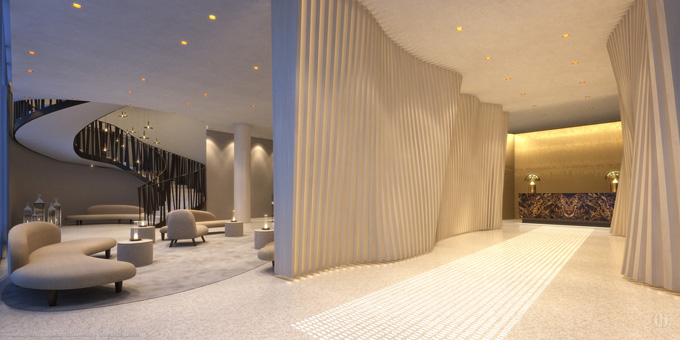
Design & Interior Design
ME Milan Il Duca combines elegance with ME by Meliá’s four experience concepts to create a stimulating atmosphere and stay. The hotel is a fusion of traditional and contemporary Italian design with seductive furniture, neutral colours and urbane textures.
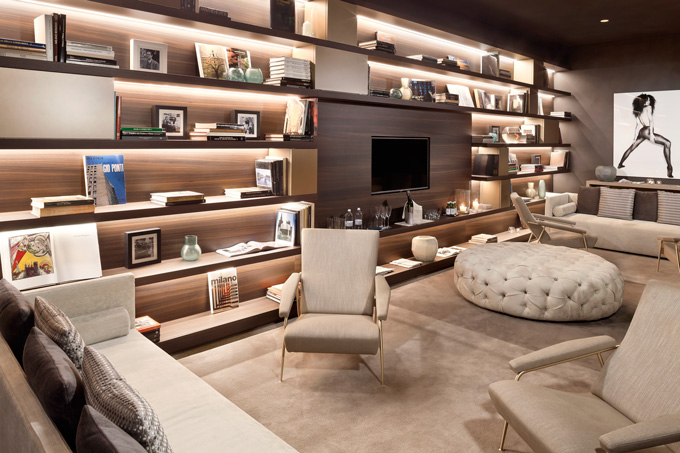
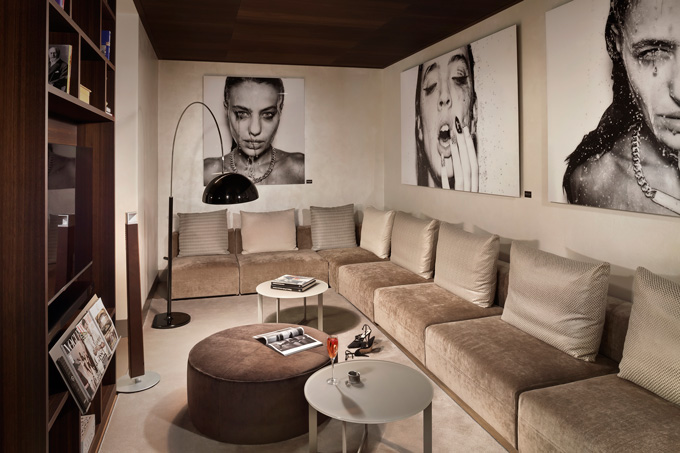
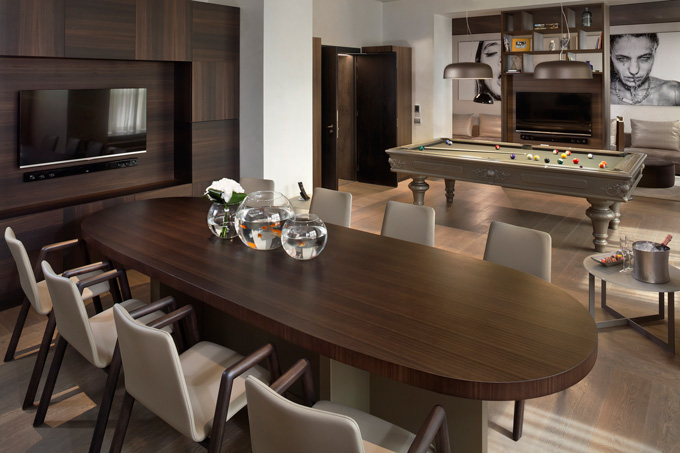
The building ME Milan Il Duca was originally designed by late architect, Aldo Rossi, born in 1931, who gained international recognition as the first Italian to win the Pritzker prize in 1990. Aldo Rossi was defined as “a poet who became an architect”, Rossi always believed that architecture was key to a city and has given this building a balanced and simple design, which stands out today as one of the most promiment buildings in the square. ME Milan Il Duca interiors have been redesigned by Mortini’s Studio to become a cosmopolitan hub with modern interiors.
The Studio Arassociati provided architectural guidance during the renovation of ME Milan Il Duca. The practice, established in 1997 by architects Marco Brandolisio, Giovanni da Pozzo, Massimo Scheurer and Michele Tadini, collaborated with Aldo Rossi throughout his career. The Studio Arassociati has an extensive portfolio of national private and public sector buildings. All projects, including ME Milan Il Duca, have been designed using the principles of rational construction where a sense of continuity between the building and the surrounding area is established and maintained. The Studio recieved the International Award for Architecture Theatre for the reconstruction of the Teatro La Fenice in Venice, and have been named in two publications: A monograph on the implementation of Tiscali (2008) and Arassociati Architectures (2013).
ME Milan Il Duca has undergone a radical interior renovation, to reflect and bring to life the prestigious brand ME by Meliá in Italy’s fashion capital, Milan. The hotel has retained the Rossi designed facade, while the interior has been totally reconstructed in a contempory way from the rooms and suites to the public areas. This led to the creation of the panoramic Roof terrace, Radio Rooftop Bar, with spectacular views that sweep over Piazza della Republicca, the new Garibaldi Business District with its futuristic towers, as well as the historical city beyond.
The hotel is a fusion of traditional and contemporary Italian design with seductive furniture, neutral colours and urbane textures. ME Milan Il Duca showcases furniture designed by the late architects, Gio Ponti and Luca Meda, who worked in collaboration with Aldo Rossi. Renowned industrial designer, Achille Castiglioni, also created the floor lamps throughout the hotel, with imagery by Madrid-based fashion photographer, Alberto Van Stokkum. His work focuses on icons from the world of music and fashion and will be permanently and exclusively exhibited throughout ME Milan Il Duca.
Bespoke artworks by Milanese artisans are also showcased in the hotel. The hotel is furnished with iconic pieces by leading designers inlcuding Luca Meda in the ground floor library, furniture by Vico Belgioioso and the hotel lobby is reminisent of Gio Ponti.
Emirates Airlines, the brand, the powerhouse!

Sheikh Majid Al Mualla The Divisional Senior Vice President (DSVP) of the Commercial Operations Centre at Emirates Airlines, introduces a&e to the powerful world of Emirates Airlines.w
Emirates Airlines is a brand and powerhouse to be reckoned with. It not only operates one of the youngest fleets in the world, but also the world’s largest fleet of Airbus A380s. Equipped with industry-leading comforts in the air, Emirates even offers private suites and Shower Spas in its First Class cabin. This is nothing short of an airborne hotel. Spread over two levels, the whole of the upper deck is dedicated to Premium Class passengers. Towards the front, 14 flat-bed, massage-equipped Private Suites. Remote controlled doors, a work desk, an electrically controlled mini-bar and the most advanced in-flight entertainment system available to travellers are all part of this luxury sanctuary eight miles up. But the First Class feature that is the talk of the travel industry, the media and travellers around the world is the On Board Shower Spa, brought to you by the airline’s premium spa brand, Timeless Spa. Emirates promised some special surprises with its A380 and this is one of them – a real sprinkling of home comforts above the clouds. You may expect Economy to be forgotten inside this superjumbo. Nothing could be further from the truth. More generous seats, wider aisles, Gourmet chef-prepared meals and the Emirates’ personal touch mean passengers could be mistaken for thinking they’ve settled in the wrong cabin class. For such a colossal aircraft, there’s another surprise – the quietness. Its GP7200 engines, manufactured by the Engine Alliance, are as quiet as engines get. More help to passengers wanting a good night’s sleep and a great deal more peaceful for those on the ground. a&e had the chance to talk to the DSVP of the Emirates Airlines Commercial Operations Center about their positioning, novelties and his role in one of the biggest players of the aviation industry.

How did you find yourself working with one of the best airlines in the world?
In my role, I oversee the commercial development and long term strategies of Emirates’ business across the Gulf, Middle East, Iran, as well as West Asia to ensure continuous growth, geographical expansion of the airline’s operations, new business and profitability. Over the course of my career, I have worked in senior managerial positions covering the UAE, West Asia and Indian Ocean. I also held country management positions in key markets for Emirates, such as Lebanon, Bangladesh and district management positions in the Kingdom of Saudi Arabia and the UK. I joined Emirates as a management trainee in 1996 after graduation from Embry-Riddle Aeronautical University in the United States. With hard work and dedication, I have been able to rise up to a leadership position in one of the world’s most loved airline brands.
What is your leadership style and how do you encourage the best in your staff?
Emirates competes on a global stage, and we know if we become complacent we will fall behind the pack. This is why we never take our foot off the gas pedal when it comes to investing in new products, technologies, training and looking after our people. When leading others, I take this into consideration and try to get the best out of my team. It’s not just about the bottom line, but also about the top line results and it starts with our people.
I have a hands-on style and I like working in collaboration with my team. Taking this approach allows us to maximize our resources and achieve the results that are expected of us. I like to think that I lead by example and creating an environment in which all staff can flourish is really important to me.
During the holiday rush of crowds, you had more than 4000 staff working between the Dubai International airport and Al Maktoum International. Along with Dnata airport services, you ensured that everything was being handled properly from flights to passenger luggage. That’s a lot of pressure. Tell us how you effectively deal with pressure in your line of work?
There is one guiding principle shared by all at Emirates: never do anything to compromise the quality of the customer experience. We focus on comfort, innovation and getting the details right. Operational efficiency will also be key to our success. Emirates has a well thought out strategic plan for the future, and we invest in training our staff to reflect this.
What are some details an airline has to pay attention to most when it comes to the upkeep of the plane from the inside?
Emirates’ on-board product in all classes is constantly reviewed, and our product is updated and refreshed based on customer feedback, research and industry analysis. In addition to the regular product life-cycle, we ensure all onboard services and products is always kept up-to-date and competitive. Experience and comfort are essential elements of the on-board experience and many airlines are now starting to realize this. Emirates has always been driven by a passion to be unique and we have a deep understanding of our customer and can anticipate what’s next. Customer expectations continue to rise. Customers expect the very best each and every time they fly. They are looking for consistency and it is our aim to ensure they get this. We know that in the age of social media there is no room for lacklustre service. Customers expect more from the airline that they choose to spend their money with and we have invested millions to ensure the experience meets and exceeds their expectations, whether it’s through free Wi-Fi on most of our aircraft, our award winning ice entertainment system, global crew or international cuisine offerings.
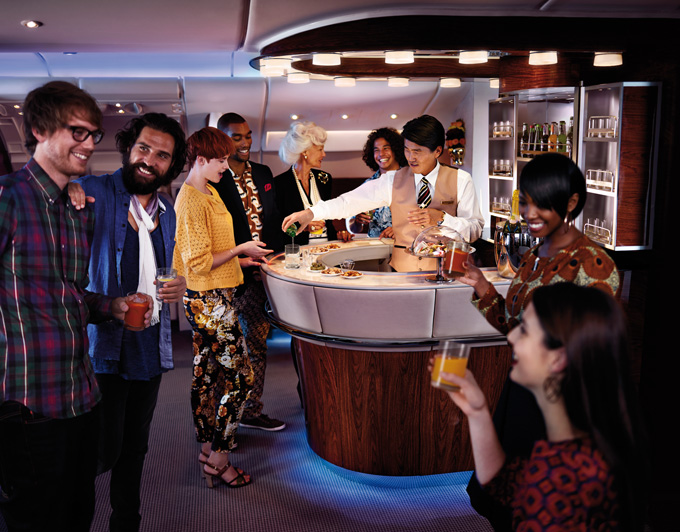
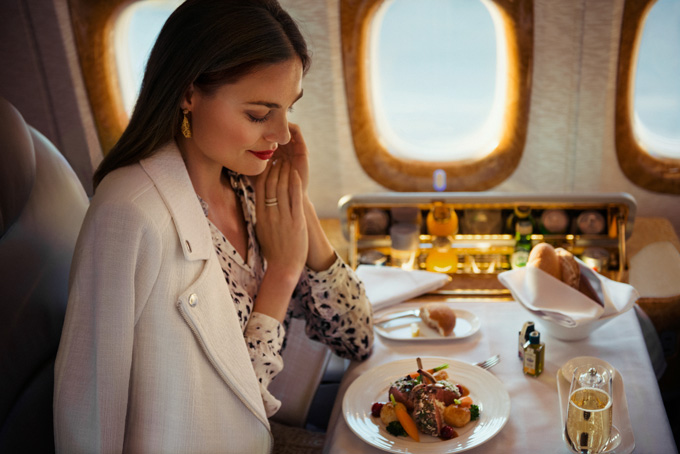
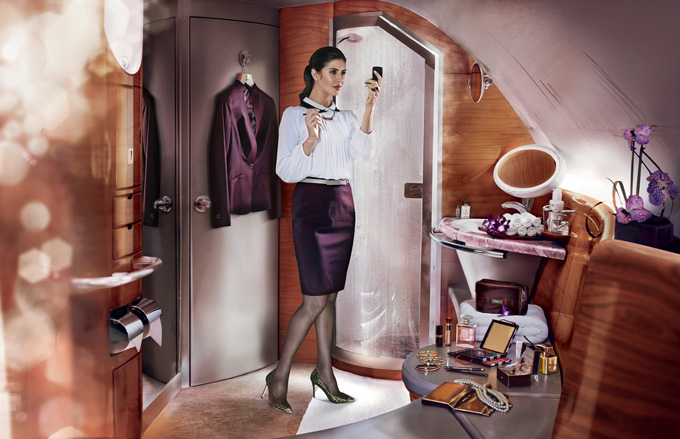
Based on passenger feedback, the Emirates Cabin Crew has a strong reputation in the industry for being well-trained and always one step ahead. What makes the Emirates Airlines Cabin Crew exceptional and what distinguishes them from others? Do you have a special training process that places you at the top of your game?
Emirates has Cabin Crew from over 130 countries and speaking more than 55 languages, and is proud of the service delivered by its cabin crew. In total, Emirates employs over 20,000 cabin crew members today who have all trained at the Emirates Aviation College Cabin Crew Training. Crew is trained in the highest standards of safety and service delivery for over seven weeks, with regular ongoing training after they are in service. The training includes a combination of both theoretical and practical components, with the latter taking place in full motion simulators of all aircraft types.
You have an On Board Shower Spa. What can you tell us about such luxury features and about luxury travel as a whole in this day and age?
Over six years ago we were the first airline to put showers onboard our A380 aircraft and it is immensely popular with our passengers today. The idea behind it was to provide a refreshing spa experience at 43,000 feet for our First Class customers, and help them refresh before they land. Today, over 80% of our first class passengers have used the shower spa. Emirates has been a leader in innovation and redefined the First Class experience, led the design of the first private suites in commercial aviation, and was first to introduce it into service. Now suites and showers are becoming “the standard”. It’s never a standstill – our product is being constantly fine-tuned, upgraded and continually evolves.
Interviewed by Houry Seukunian
