

Shamsa Alabbar On Creating Unusual Jewellery Pieces For Unique Women
Shamsa Alabbar, Founder of her namesake jewellery brand, was inspired by jewellery from a young age, particularly by the pieces her mother wore.
As the daughter of Emirati businessman and retail mogul Mohamed Alabbar, she saw first-hand the opportunities in the UAE for the retail and fashion world and has developed her own successful business in the jewellery industry. While she was at university, her love of jewellery became something more than just a passion when she designed her first piece as a gift for a friend. After she received great feedback, she slowly began developing it into a business and created her own jewellery brand; Shamsa Alabbar. Initially, the line was focused on using Arabic typography to create unusual designs that were modern and geometric in shape. Her signature style quickly became popular with women in the UAE. As the brand developed, Shamsa began to work with stones and different lines and shapes to create pieces that are contemporary and unique. As her journey continues, we discover more about the brand.
How did your brand come to life and when did you know you had this passion for jewellery?
I’ve always loved jewellery, but I think my mother is the main reason why I am so into it. Her choices in jewellery are always the best. As a career, my first jewellery piece was a birthday gift for my best friend Alia. I decided to sketch her name in a very abstract style of Arabic letters, and I turned it into a pendant. Once I had it made, I posted a picture on my personal Instagram and a lot of people began asking where it was from and how they could get one. So, I started creating more of the pendants. I realised it was a great business, and I went ahead with it. The brand began with very basic branding and packaging, and it developed gradually into what it is today.

What challenges did you face along the way in taking it from an initial organic brand to what it is today and what are the challenges you are still facing?
I graduated as a graphic designer, so jewellery design was something totally new to me. Designing and coming up with the creative ideas is the fun part, but the technical part is always done by the production team who turn my vision into reality. I was lucky that I started the brand at a time when Instagram was just getting popular and I was very active on the platform.
What is a stone or design feature that you like to see in your collections?
When I first started, I used only gold and diamonds. After a while, I began adding in coloured stones such as malachite, opal, and onyx. I was more comfortable with just gold and diamonds but experimenting with colours and different stones alleviated the brand and gave it a fresh new look.
Our region has traditionally been a market that believes in branded jewellery, but now we are in a phase where young, unique jewellery brands are growing in popularity – what is your take on this?
I think in the region we love the idea of branded jewellery – Cartier, Piaget, all those Maisons. But I think now women want to stand out and they are looking for pieces that tell a story. They want to be the first to wear something and to be seen in something unusual. Emirati women are being more experimental and that is what my brand is about. I design for women who appreciate art and design, who are not afraid of change, and most importantly who take pride in their culture and tradition because it represents them and their values as an integral part of who they are.

What are your thoughts on supporting Arab talent?
I love supporting Arab talent, especially women. It is something very close to my heart. All my sisters are in the fashion and business industry, and we all work hard. I am grateful when I feel supported by others, it makes me want to give back and support other women out there, because I appreciate the hard work they do. I appreciate all women in the UAE that are working on their own vision and I especially love to support Emirati brands.
What does Emirati Women’s Day mean to you and what is a message you would give to the Emirati ladies who are also on a journey to success?
I would say that we are all here for each other, and that I’m proud of all Emirati women. I would tell them to follow their dreams and take risks. I think it’s a day of celebrating our achievements and celebrating ourselves as women. It’s very empowering and it makes us want to work harder and put more into what we do.

What is your professional motto?
Pressure creates diamonds. This is a sentence I really love and I have it on my office wall. I feel that when I’m put under pressure, I am able to really shine and give it my all.
Who is a role model you look up to and what would you tell this person?
It would be my mother, especially now that I’m a mother myself. I know how it feels to take care of young children and put everything on hold to raise them. I always appreciate her and the time she dedicates to us. She also inspired me to do what I do today, and she is my number one supporter. Whenever I receive a sample of each new jewellery piece, I show it to her for her approval and recommendations, as she has the most exquisite taste in fine jewellery, which I have always looked up to. People think that Emirati Women’s Day is to celebrate the achievements of working women, but it’s also about celebrating Emirati mothers because that’s the biggest achievement of all.
As a mother of two, how do you juggle a work/life balance?
I have to be honest, it’s not easy. I dedicate most of my time to my kids, and they are my number one priority. I am privileged to be a business owner, and work from the comfort of wherever I am. I connect with my team on a daily basis, and we meet once a week to discuss our weekly progress. However, my work starts in the evenings when the kids are asleep. I’ve always been more creative at night. I thought that when I had kids, I would put the business on hold and spend all my time with them, but the fact that I can do both makes me even prouder, although it stresses me out sometimes. I want my kids to see me as more than just their mum.
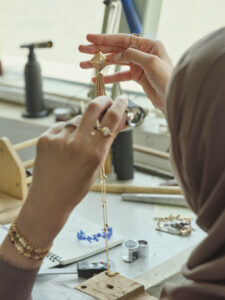
What are you currently working on?
We are working on a new collection. We have just launched the new Kufi-inspired letters and we are working on some icons and motifs for our new collection, inspired by the beauty of the region.
What is the first piece of jewellery you remember growing up?
The first piece of jewellery I remember owning was a Cartier Love bracelet with an engraving of my name that was gift from my parents. I was about 11 years old when I received it and wore it throughout my high school and university years. I now have it polished and stored to pass on to my little girl. It is the most iconic piece of jewellery I own because of its sentimental value.
How would you describe yourself in three words?
Ambitious, experimental and creative.

This past year has been very difficult for all – is there a lesson you have learnt or something you have changed in your life after the pandemic?
It was a wakeup call to start working even harder. I didn’t panic, I always believed like there was a light at the end of the tunnel. I think the lesson was to keep the faith, be grateful and never give up.
Where is the first destination you would like to travel to right now?
The United States! We have spent every summer there since I was a kid and I have a lot of happy memories there. I feel like this year out of all the years, I am missing it the most.

What does it mean to you to have Expo 2020 in Dubai?
It’s such a big achievement for Dubai and the UAE, and I’m proud of it. It’s a great opportunity for Dubai to be the first city to host the World Expo in the Middle East and North Africa and to inspire and empower positive change in the region.
What are your thoughts about sustainability in the jewellery industry?
The jewellery business is kind of sustainable because gold lasts forever and jewellery pieces can be passed on through the generations as I have done with my own pieces. It is also important as a business owner to think of sustainability as part of your business model.
How would you describe your brand in one word?
Can I use two words?! Unusually beautiful. This experimental brand has been designed for art lovers! People who appreciate beauty in the most unusual things.
This year the UAE celebrates 50 years – what is a message you would like to share as the country reaches this milestone?
I am very lucky to be from the generation that witnessed the UAE develop through its first 50 years which was a huge inspiration. Under the guidance of our rulers, we have always felt empowered to do more and grow with our country. For the next 50 years, I wish even more success and happiness to the UAE and its people.
EXCLUSIVE: H.E Shamsa Saleh, CEO of Dubai Women Establishment Discusses Women’s Empowerment, Gender Balance and Inspiring Global Nations to Follow the Lead of the UAE
H.E. Shamsa Saleh has held the role of Chief Executive Officer of Dubai Women Establishment since 2008.
Working directly with Her Highness Sheikha Manal bint Mohammed bin Rashid Al Maktoum – President of the UAE Gender Balance Council, and President of Dubai Women Establishment, and wife of His Highness Sheikh Mansour bin Zayed Al Nahyan, UAE Deputy Prime Minister and Minister of Presidential Affairs, Saleh has been working to support gender balance and the empowerment of women in Dubai. Since joining the Establishment in 2008 her focus has been supporting women in the UAE, pushing the boundaries and rewriting the rules and stereotypes connected to women in the workplace. Under her leadership, Dubai Women Establishment has launched several key projects and initiatives which support the Establishment’s mission to enhance the crucial role of Emirati women as equal contributors to their society. The Establishment’s efforts have given more opportunities and offered greater support to Emirati women, allowing them to excel in the workplace and at the same time continue with having a family.
As a mother herself, Saleh fully understands the struggles many women face when balancing looking after their children while excelling in a career, and it was that experience that drove many of the Establishment’s initiatives over the last few years. H.E. was instrumental in the organisation of the first Women’s Forum for the Economy & Society in the MENA region, Arab Women Leadership Forum, Women on Boards Initiative, Women Leadership Exchange Program, Emirates Leaders Gathering and the National Child Care Centers Project, amongst many others.

Aside from her work at Dubai Women Establishment, Saleh holds the position of Secretary-General of the UAE Gender Balance Council which was established in 2015. The Council was devised to support the UAE’s vision of becoming a regional and international leader in gender equality, taking women’s empowerment to the next level and giving equal opportunities to both genders.
Here we discuss with H.E. Shamsa Saleh the role of these key organisations in empowering women and offering equal opportunities to all, as well as the importance of Emirati Women’s Day and her vision for the future.
Tell us about Dubai Women Establishment – the role, the objective and the vision?
Dubai Women Establishment started in 2006 when the Government of Dubai began working on the Dubai Plan 2015. In that strategy, there was a clear pillar focused on women’s empowerment, but back then there was no entity in place to achieve this vision. His Highness Sheikh Mohammed bin Rashid Al Maktoum announced the formation of Dubai Women Establishment in 2006 and the Establishment launched officially in 2008 with the objective of increasing women’s participation in the economy. We focused on women in business, supporting working women, entrepreneurs and businesswomen.
We conducted an initial survey on a focus group of 7,000 women to find out what barriers and challenges they were facing in the workplace and we began recommending policies that would empower women in Dubai. Most of the challenges women faced were related to achieving a work-life balance. Women asked for childcare centres, a longer maternity leave, flexible working hours etc. We then started to create the Work-Life Balance Initiative to empower women. We also established the National Childcare Centre Project, which dictated that, by law, any government entity that employs more than 50 women, has to have a childcare centre. We started approaching government entities – most of them were happy to have a childcare centre but they didn’t have the know-how nor technicalities to put this in place. We developed a guide on how to establish a childcare centre in a corporate workplace. The first pilot project started with Dubai Customs where we opened a nursery in 2009 for around 60 women. After a year, we did an assessment to determine the impact of the nursery and we found it had increased the productivity of women, decreased the resignation of female workers, increased the happiness of women at work and increased the number of Emirati women joining the workforce. Furthermore, women who were in technical fields, such as port engineers, gained more motivation to go to work. The level of female recruitment increased because of these childcare facilities. This project also helped the children during early childhood thanks to the interaction and socialisation with other children. We had specialists working at the nurseries and, in some cases, they were able to identify learning difficulties in some of the children at a very early stage. It served many different purposes aside from women’s empowerment. It was a national project which really helped us achieve more than one objective.
In 2010, DEWA opened its first nursery as a pilot project. After they observed the progress they opened three additional childcare centres in different branches. Today, we have 53 nurseries, serving more than 1,000 women. It’s a great initiative and such practices have previously only been seen in the Nordic countries. We are proud of what we have done, and we have highlighted it on a global level. All of the Emirates are now implementing these childcare centres and following the same standards. Aside from the children enrolled in these centres, they are also creating job opportunities for women who have majored in early childhood education. The majority of staff in these centres are locals and Arabs. The effect on mothers and the convenience it offers leads to a better society, so much so that I am recommending to the Minister of Labour to also implement in the private sector.
Next, we proposed to the government that maternity leave needed to be increased – 45 days or 60 days were not enough. At that time the International Health Organisation advised us that the minimum maternity leave according to global standards and best practices was 90 days. So, we were able to amend the maternity leave period in the UAE and extend it from 60 to 90 days. We also took mothers with special cases – such as mothers of twins or women who have suffered from miscarriages – into consideration. This is something that has never been considered before in the UAE and it has helped a lot of women. We also advocated for flexible working hours, and this was implemented for working mothers in Dubai.
On the Gender Balance Council level, we worked on more than 20 reforms, which included a paternity policy for fathers, as well as protection for women who are pregnant in the workplace. So now, by law, an employer cannot dismiss a woman who is pregnant. We also added a clause that stipulates that workplaces cannot discriminate against women as well as dictating equality in the wages of both men and women. We observed a problem at senior levels as there was a large pay gap between men and women in similar positions, so we effectively closed that gap with this new law. We also removed a law stipulating that women do not have the right to leave the home for work unless they have the permission of their husband because, in practice, this was not realistic. We introduced a law that ensures no discrimination against women when they are applying for loans. All of these reforms have encouraged women to participate in the workforce, and to take on leadership positions. A few months ago, we implemented the Women on Board policy, which states that all publicly listed companies in financial markets must include at least one woman on their boards of directors. In two months, we had around 20 women appointed onto boards. As more companies restructure their boards, I think this number will further increase. In 2008, women accounted for 1.2% of board members, by 2015 it was 5 per cent, and I think by the end of this year we will reach 20 per cent, which is the global average. But the expectation is that we will get to more than 30 per cent and I hope to achieve that. In the past, there was a widespread misconception that women were not qualified to be in boardrooms and that they didn’t have the experience. At DWE, we are helping to provide training and experience and we are encouraging women to apply for opportunities. We also implemented a law in 2019 to increase female participation in parliament by 50 per cent and this is now effective with many women in parliament in the UAE.
All of these laws helped enhance women’s empowerment. The UAE’s progress and efforts have reflected globally, as the UAE has become a global example to others. We are beyond empowerment, and we are competing globally. For our 2030 Agenda, we will continue competing globally as we aim to be in the top 5 or top 10 in the world in all of these categories. Because we have already achieved women’s empowerment, in our new strategy we are looking at gender mainstreaming across all sectors.
We now have women involved in the space sector, for example. 40 per cent of the people accepted in Sheikh Mohammed Bin Rashid’s space programme were women. Another important agenda is food security, which is being led by a female minister. We have many other women in leading positions. For example, HE Reem Al Hashimi the Minister of State for Foreign Affairs and International Cooperation, while simultaneously leading Expo 2020, for example.

What kind of challenges do you face in your role and in working towards your goal?
As a woman, I still face challenges with achieving work-life balance because of my position. I have to travel and there are often long working hours. Being a mother myself, it is difficult when it comes to these commitments, but again it is also about the way each individual handles these things. You can manage your own time and make it part of your lifestyle.
Between 2008 to 2012 I had my children and I did struggle with this. Now, however, they are growing up and I have supporting facilities like a nursery at my workplace which my kids attended until they were four. I have flexible working hours as well so I can manage my time. When I travel I have the option of having my husband travel with me. There are many support systems in place on a corporate level – even some men are jealous of the initiatives we have implemented! I would say around 50 per cent of the issues related to work-life balance are now resolved thanks to the initiatives we have put in place.
Awareness and changing mindsets was a challenge and we have overcome this by highlighting the impact of what we do and why we are doing it. If you want to convince people you have to explain that this is not only in favour of women but it is in favour of society. We also have support from men and this is very important. Many of the UAE Gender Balance Council members are men, and they are great supporters and advocates of our agendas and initiatives. They are advocating for these things because they are seeing the overall benefits.
Moving forward, what is your vision on achieving this balance?
My overall vision in five or ten years from now is not to be thinking in terms of men and women. Without any discrimination, hiring should be done according to performance and eligibility and should not be gender-based. This is something that needs to start from the upbringing of the younger generation to remove stereotypes. Young women today are pushing boundaries, they want to prove themselves and this is built within education and early childhood. Gender equality has never been a local agenda, it is a global issue, and we need to take all the best practices from around the world and transfer this knowledge to the UAE while simultaneously supporting other countries. It’s a whole chain. In 2017 we created a Gender Balance Guide for the UAE and now the whole world is using it. The guide informs organisations how to be “gender-friendly”. Now we are working on a Gender Balance Toolkit which includes gender equality practices from A-Z. From basic needs to leadership empowerment. We are developing this toolkit in the UAE, and it can be used by any country anywhere in the world. It will feature case studies and tangible practices. We have worked with experts from around the world to bring this agenda to life and we will be launching it during Expo 2020. The platform that Expo will provide us with will give us the chance to have a global impact and it’s a project I am very proud of.

What are you most proud of from what you have achieved so far?
My background was in strategic planning. I wasn’t thinking about doing this kind of work, back then I had a mindset that 45 days for women to stay at home after having a baby was too long. I was not married at that point. When I moved to Dubai Women Establishment, I hit two birds with one stone – I got married and had my children, and at the same time I was working on the agenda to introduce initiatives to help working mothers. My first baby was premature, and he had to stay in the hospital for two months. At that point, I was only allowed to take two months of maternity leave. This is where I really noticed the importance of the work-life balance initiatives and the need for flexibility for women. When you experience it, you really understand. I am proud that I am helping women through the job I do. I see the Establishment’s initiatives in practice and this for me is a great achievement. When I see women getting longer maternity leave or being able to take their children to the childcare facilities I know that I am helping the community and I can see the impact. So yes it is my job, but I can see the results in practice and that makes me proud.
What is one thing you haven’t done yet that you still aim to achieve?
To be perfectly honest – I would like to do a PhD. It has been my dream for five years, but my work takes all of my time. I know I am capable, but time is the main constraint. Plus it requires me to travel. Currently, my youngest child is three years old. So maybe when they are a bit older.
What is the personal motto you live by?
In my world, everything is results-centred. No matter how much effort is invested, I don’t mind as long as the outcome is what we were aiming for. Results are always the indicators of success. Our decision-makers are very supportive as long as we present valid arguments and highlight the impact on society.
How do you access the progress of women in the UAE so far?
HH Fatima bint Mubarak Al Ketbi is a major role model. She worked on the National Strategy with the late Sheikh Zayed bin Sultan Al Nahyan. She was the one who founded the General Women’s Union and the United Arab Emirates University. Since that time, all the majors that were for men, have also been accessible to women, but it was Sheikha Fatima in 1976 that led the way and established these roots. Then, in the 80s, a Federal Women’s Council and a Business Woman Council were established in every Emirate.
Today, the enrolment of women at high schools and universities is above 90 per cent. We are competing on a regional level. Today we have transcended mere women’s empowerment, and are rather embedding an overall culture of gender balance and equality.
Why is Emirati Women’s Day an important day for you?
I believe there is a motivational element to it. It allows women to feel proud of their and contributions and makes them want to achieve more. It is a celebration of pride, showcasing the achievements of women – much like International Women’s Day. I want to showcase and support women and this day sends out a very strong message.
This will also be a year where the UAE celebrates 50 years since its founding. 50 years is a very small time period, but Emirati women have achieved great results in such a short time. We have eliminated illiteracy and now the UAE is invited to be part of the G20 to speak and share our progress. Looking forward to the next 50 years to 2071, there will be a national strategy where cohesion and women’s participation is key and we will continue to be leading on an international level in terms of gender equality. For the next 50 years, we have a solid foundation and system to build on.
Who is your role model and what is a message you would dedicate to them?
It would definitely be His Highness Sheikh Mohammed bin Rashid Al Maktoum, Vice President and Prime Minister of the UAE and Ruler of Dubai. He took the UAE to a prestigious level amongst the international community. He has always been a motivational figure. Since before was appointed as the Prime Minister, he was always motivational, what he’s doing now is not only for the country, but he is also played a major role in making Dubai recognised around the world. If you go anywhere in the world today and you tell them you’re from Dubai it is as if you are a brand. I believe that we are all living the privilege that was set by our leader. In Arabic we have a saying: “You are the well where we source our water from.” This is how we see His Highness Sheikh Mohammed Bin Rashid Al Maktoum. We learn a lot from him, from his skills and his talks. Even in the most challenging of times he always makes sure to motivate. Despite the pandemic that we passed through – all the work on Expo continued. Everything in Dubai progresses and as a person, I always feel I’m in safe hands. This is his spirit; he has no fear. He has the spirit of challenge and because of this we as Emiratis are always ready for challenges that life may put us through.
We are a country driven by role models and when His Highness Sheikh Mohammed bin Rashid Al Maktoum makes any decision, we will follow. He is known for his support of women. Each time he makes a speech he makes sure to mention women. The first voting system that ever took place in the UAE was in 2006 and he said “I encourage women to go for elections.” Now half of the parliament is women. He is always on top of things, and he is a leader that is involved in everything and every detail. Even his daughter, Her Highness Sheikha Manal bint Mohammed bin Rashid Al Maktoum, has a great level of involvement in all that surrounds women’s welfare.
We are noticing members of the Royal families from different Emirates making more public appearances and engaging more with the community on different projects, and that wasn’t something very common before. How important do you think is that?
I believe it’s important for us to have role models. At one time it wasn’t very common to see parents accepting their children to go out in public and speak, but when they see our leaders allowing their daughters and sons to speak, this is when they become role models to people in our country. People feel that if members of the Royal family can do it, then they can do it too. I recently had a discussion with my brother about this and I told him times have changed.
For example, look at what Her Highness Sheikha Latifa Bint Mohammed bin Rashid Al Maktoum has achieved so far and what she has contributed to the arts and culture of the country. Since she took the reins of the cultural authority – look at the progress of achievements. She is very involved, and she continued to be active, even throughout the pandemic. The truth is when you’re the son or the daughter of a Royal family member you don’t really have to work, but when you choose to, it makes you the perfect role model or leading example to others in society. So, when the daughters of the Sheikhs are working there is no excuse for the rest of us to not be proactive.
Hind Alowais, Vice President of International Participants Department at Expo 2020 Dubai Discusses the Women’s Pavilion in collaboration with Cartier
As Expo 2020 Dubai prepares to take place later this year, we discover the pavilion specially dedicated to women with Hind Alowais, Vice President of International Participants Department at Expo 2020 Dubai.
Expo 2020 Dubai recently announced The Women’s Pavilion in collaboration with Cartier. An exciting project that will reaffirm a shared commitment to closing the gender gap and promoting gender equality both regionally and globally. The collaboration will see the inauguration of a dedicated Women’s Pavilion at Expo 2020 that will celebrate female changemakers from around the globe. Under an exhibition titled “New Perspectives”, the Women’s Pavilion which is in partnership with Cartier, will invite visitors to recognise the central role that women have played throughout history. Celebrating the significant – and often forgotten – contributions of women, the pavilion will demonstrate an important principle: when women thrive, humanity thrives. It will highlight important contributions women have made in advancing societies, as well as the challenges they still face, especially as the world navigates through the COVID-19 pandemic and works toward a more sustainable future. Breaking stereotypes and deconstructing misconceptions on women’s roles, the pavilion will raise awareness by showcasing both female and male contributors to women’s empowerment and gender equality, inspiring visitors of all ages to become change-makers within their own communities and beyond. Through a series of discussions and events over the six-month period of Expo 2020, The Women’s Pavilion in collaboration with Cartier will address regional and global issues that women face and offer a fresh outlook on the future.

Hind Alowais, at the unveiling of The Women’s Pavilion in collaboration with Cartier
One of the leaders behind the development of the Women’s Pavilion is Hind Alowais, Vice President of International Participants Department at Expo 2020 Dubai. In her role, Hind oversees the participation of international and intergovernmental organisations, as well as a wide range of stakeholders such as non-governmental organisations, academic institutions, philanthropic foundations, and global initiatives. Within her leading role at the Expo 2020 Women’s Pavilion in collaboration with Cartier Hind aims to create a space that will address global challenges by building a platform for multi-stakeholder partnerships to advance the global development agenda through innovative and impact-driven initiatives. Having previously worked with the UAE Ministry of Foreign Affairs for almost 15 years she focused on multilateral diplomacy and supporting the UAE’s agenda. She served as a Special Assistant to the UAE Minister of Foreign Affairs, HH Sheikh Abdullah bin Zayed Al Nahyan, where she advised on key policy issues, and she also played a central role in bringing the International Renewable Energy Agency to Abu Dhabi. Hind was the first Emirati national to hold a senior position in the United Nations system, advising the leadership of the United Nations Entity for Gender Equality and Women’s Empowerment (UN Women) on key strategic issues. As a Senior Advisor for Intergovernmental Support and Strategic Partnerships at UN Women, she oversaw the launch of the UN Women Liaison Office in Abu Dhabi and was responsible for looking into the role of religion in advancing gender equality and women’s empowerment at UN Women headquarters. Hind brings her experience and interest in continuing the journey of gender equality in the UAE to her role at Expo 2020 and more specifically to the development of the Women’s Pavilion. Here we learn more about the project, as well as the advancement of women’s empowerment and gender equality, not just in the UAE but across the world.
Tell us about The Women’s Pavilion in collaboration with Cartier at Expo 2020. How did it come to life and what is the message you are trying to send through?
I think it was important to have the Women’s Pavilion, firstly, because of the values that have been instilled in us in the UAE by the founding father His Highness Sheikh Zayed bin Sultan Al Nahyan. There is a quote from him that says: “nothing makes me happier than seeing women take their exceptional role in society, and nothing must obstruct their advancement.” So, the founding of this country was very much focused on the idea of women and men working side by side, having equal opportunities and having an equal seat at the table in the building process of this nation. So, when you have that in the background and you recognise the UAE’s long-standing commitment to gender equality and women’s empowerment, not only from the values that it has instilled, but to think about how the UAE in such a short time, has surpassed so many other countries and become recognised as the leader when it comes to closing the gender gap in the Middle East. When you think about all these achievements, we can’t have an event like Expo 2020 which brings the world together and not have the issue of gender equality and women’s empowerment at the core of what we’re doing.

Expo 2020 Thematic District
So this is one aspect of it but there are two sides. One is that we do it very thoughtfully and in a very meaningful way and secondly, we are modelling it on the 2030 Agenda for Sustainable Development. When the world was negotiating this agenda there was a huge discussion on whether gender should be a cross-cutting theme, or it should be an entity by itself. And we were one of the countries that advocated that it should be both. I was part of the negotiating team at that time, and we supported UN women and like-minded countries to make sure that gender was not seen in a silo but was seen as something that deserves its own place, and was also integrated across all the other sectors, and this is exactly what we’re doing at Expo 2020 Dubai.
The Women’s Pavilion in collaboration with Cartier represents the standalone concept of women’s equality and then we have gender equality and women’s empowerment which has become a cross-cutting issue in everything that we’re doing. Every issue that is being tackled at Expo 2020 will have a gender angle. I think this is even more important to highlight than to ask, ‘why do you have a Women’s Pavilion?’ Because not only do we have a Women’s Pavilion, but we are tackling the issue of gender equality and women’s empowerment across everything that we do. And we’re telling the world, that gender issues, women’s rights, women’s issues, women’s advancement, gender balance, that whole agenda, is not just a women’s rights agenda. It’s not just something that concerns only women, it is something that concerns everybody in the world. Women’s issues are everybody’s issues and all issues are related to women, and that’s a very important step forward to take in our thinking. We can’t continue to have 50% of our population, not have equal opportunities, not have an equal space, or equal footing. It’s impossible to create a prosperous, sustainable, stable, and peaceful world without the full and equal participation of women. And so, we are hoping that through our work, we are delivering these messages.
Finally, we also want to create an opportunity to build collaborations. Expo 2020 is a platform for innovation that brings the world together and creates a multi-stakeholder approach with 200 participants, global countries, international organisations, and foundations, all coming together, for six months, and we have an amazing opportunity to enhance the conversation, and to keep it going for a substantial period. We hope to have 25 million visits, and if half of those walk out with the conviction that women’s issues are everybody’s issues, and everybody’s issues are women’s issues, and that when women thrive, humanity thrives, then we’ve done our part. This is an amazing opportunity for us, and I feel especially honoured and lucky to be able to work on a project that I feel so passionately about. We are driven by the vision of Her Excellency Reem Al Hashimi and it is an honour for me to be able to deliver that vision, which I also believe in 100%, and to say that we’re doing this not only for the UAE, but for women worldwide.

Sustainability Pavilion
Tell us a little about why you decided to partner with Cartier on this project and what are the common codes or values that you found with such a brand?
It’s been a real pleasure to be able to partner with Cartier and to be able to learn so much about them and to understand how we can come from different vantage points or different walks of life but have a common vision for the future. A vision that is based on, empowering women and this idea of femininity being strong. And the idea that equality does not remove femininity, on the contrary, it is creating an equal space. This is I think, what we have done in the UAE that is so brilliant. We as women from this country have never compromised on our values or our culture, but within all of that, we have also been strong. And so, what people need to recognise is that the misconceptions of women from this region are so far from the truth. And just because we are proud of who we are, and where we come from, does not mean that we have fewer rights or less equality. On the contrary, we are demonstrating that within all of that, we own it, we own our equality, we are always constantly driving forward, we are making progress every year. It makes me very proud.
But to answer your question more directly, when Cartier approached us, we were already under the direction of HE Reem Al Hashimi to create a woman’s pavilion. So, we went back to that principle of Expo, and we thought, it might be interesting to work with a brand like Cartier who has demonstrated its commitment to gender equality and women’s empowerment through various initiatives. Whether it’s through their philanthropy, or the Cartier Women’s Initiatives Award, or their amazing CEO Cyrille Vigneron, who speaks so highly of women.
There was great synergy and a connection of minds between the teams and going back to this idea of creating a new perspective, which is the title of our exhibition, I think we must recognise that we are women of the world, who are facing universal challenges, no matter where we come from. But we must all be one at the end of the day and coming together with Cartier was such a unique and special experience.

Mission Possible – The Opportunity Pavilion
Emirati women Day is coming up, what does this day mean to you first as a person, and how important is it to have a day that acknowledges the achievements of Emirati women?
We owe a lot, not only to our founding father, His Highness Sheikh Zayed bin Sultan Al Nahyan, but also to Her Highness Sheikha Fatima bint Mubarak. She created Emirati Women’s Day, and she was spearheading all efforts to secure women’s rights and continues to do so through the General Women’s Union. We have leadership initiatives that were born from this, like the Gender Balance Council, and there has been a common vision by our leadership to propel women forward. So, Emirati Women’s Day for me is a moment of pride, but it’s also it is a moment of gratefulness. Because not everybody has the support, or the opportunities or the leadership vision like Emirati women have. Even when society culturally was not there, the leadership was ahead of us, and society and our values and the culture followed. It’s something so beautiful that we have legislative advancements being made and the cultural values are hand in hand moving forward. That’s thanks to our leadership, who instilled these values in us and who made things possible. I can’t say enough about it because it’s such a unique situation and we are very, very, lucky to be Emirati women.
Speaking of progress, what is something that you still aim to achieve?
So many things! I think we’re all striving for the same thing, to create a better world, and to make sure that we are existing in this life and this world, and spreading not just good values, but that we are a positive existence. On a more professional level, I feel very passionately about the work I do, and I am very proud to have had this opportunity to be part of Expo 2020 and the Women’s Pavilion will remain a legacy and I can’t wait to leave something behind that will be meaningful and will enable us to continue this conversation after Expo 2020 closes its doors.
What is a motto you live by?
“Nothing is impossible” is one that inspires me. When we think of the obstacles and the challenges, and what we thought was impossible for us to achieve, especially as women, and then when you see what women have done so far you realise that they have moved mountains, they have overcome things that we thought were impossible.

Al Wasl Dome
Is there anything you can share with us about what to expect from the Women’s Pavilion?
We are employing different avenues to tell the story that we want to tell, which is focused on new perspectives and how when women thrive, humanity thrives. So a collaboration with artists is one avenue that will allow us to tell the story. We are going back in history and looking at profiles of women who have achieved the impossible and looking at how women today are working to provide solutions to make the world better. The Pavilion represents women’s stories – whether it’s through their profiles, or through their own voices. It is a space where we honour and celebrate the women of the past and women of today who are working to make our world a better place.
We will also host a series of discussions that will try to tackle issues from a different perspective. One golden thread we have in all our discussions is women’s leadership. And by leadership, I mean, women’s seats at the table, women’s voices being heard. I give the example of space exploration, or climate change, or biodiversity, or health – what does it mean for us to think about these issues from the gender perspective? What does it mean to ask if women had a seat at the table, or were in leadership positions, what would happen? So demonstrating how women bring a different perspective to the table and the value of this.
We have some amazing people that we’re bringing to the women’s pavilion who will share their vision of what a gender-equal future looks like. They will share their journeys of how they have overcome inequality and discrimination, but also tackle issues in a newer way. We also have a series of discussions that will look at changing the misconceptions around women. Women have always been contributing, but the lights were never on, so now it’s time to bring it to the forefront and that’s what the Women’s Pavilion will do.
This year the UAE celebrates 50 years, what does this mean to you and what message you would send to your country on this occasion?
Onwards and forwards! If there was a wish I could have for this country and for the next 50 years, it is that we remain a loving nation and we continue to be people who love each other, who are inclusive, and tolerant. I hope we continue to be exemplary in everything we do, and that we do it with excellence like we have always done, and never lose the values of love and respect. I think that is something so special that the UAE and our people possess, that you don’t find anywhere else, and I hope that we never have to compromise our values and our culture for advancement.

Who is your role model and what would you tell him or her?
I have so many from the UAE. His Highness Sheikh Mohamed bin Zayed Al Nahyan is somebody I look up to very much. I’m in awe of him and how brilliant he is and what a great statesman and politician he is. I’m constantly amazed and impressed by how this country moves and establishes itself as a leader in the world and the wisdom and kindness that it is done with.
The other person is His Highness Sheikh Mohammed bin Rashid Al Maktoum who has built Dubai to compete with cities like New York. He had this amazing vision and the fact that he was able to bring it to life and position it on the world stage, the way that other cities are, is amazing. I truly think that Dubai competes with cities like New York, and I used to live in New York. It’s very similar in terms of the pace of life, accessibility, the intelligence of the people around you. We have built a truly cosmopolitan city that is forward-thinking, futuristic, and just amazing.
I would also have to mention HE Reem Al Hashimy because she inspires me every day with her work ethic, her commitment to excellence and her attention to detail. As Minister of State for International Cooperation, and the Director-General of Expo she is just amazing, but what I think is the most special thing about her is how she maintains a level of kindness, understanding and humanity. She is a kind person, and when she looks at the world, she sees people and that’s something very special. Her vision is based on this idea of people coming together and getting to know one another and at the end of the day we are all human beings, and we should all recognise that in one another and come together.
What would you like to tell our readers about Expo 2020?
It’s going to be amazing, it’s going to be a show of human brilliance, innovation, arts, music, food. You’ll be able to travel the world in one space. It’s all these things and it’s a fun, educational space, and it’s a space to raise awareness. Everything in one spot, and how lucky are we that we have this one spot here in Dubai?
Tried & Tested: Armani Hotel Dubai
Armani Hotel Dubai combines contemporary design with the elegance of the Italian fashion house.
As Giorgio Armani said; “to create something exceptional, your mindset must be relentlessly focused on the smallest details.” And it is with this philosophy that he created the Armani Hotel Dubai. An icon in hospitality around the world, situated across ten floors inside the Burj Khalifa from, Armani Hotel is the ultimate in luxury. From the second they enter the lobby, guests will instantly recognise the Armani elegance. Sleek furnishings, elegant design, modern graphic lines, the design fully reflects that of the legendary designer’s style and embraces the Armani lifestyle, something that can be clearly seen throughout the property.
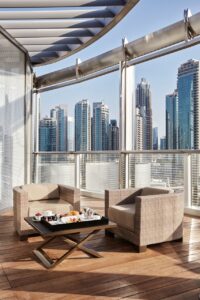
Personalisation is key to the property, from customised spa treatments to touches that are unique to each guest. Based on the philosophy that travel is as much an emotional journey as a physical one, Armani Hotel Dubai assigns each hotel guest a personal Lifestyle Manager who will serve as a personal contact and host from the moment they make a reservation to the time they check out and even beyond. Perfect for a weekend getaway or a business trip Armani Hotel Dubai combines refined luxury, innovation and contemporary style for a one-of-a-kind experience.
Rooms & Suites
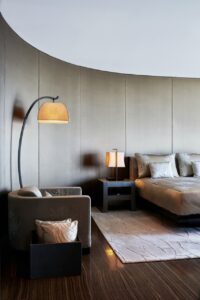
The hotel’s 160 guestrooms and suites provide a welcome retreat from the busy world outside, with stunning views across the city from the world’s tallest building.

The restful living spaces are a stylish aesthetic interpretation of the Armani signature style, using custom-created fabrics and bespoke furniture, many of which are shipped directly from Italy, to provide the perfect finishing touch. Whether you are looking for a place for quiet relaxation or a beautifully designed environment to work or play in, the rooms blend modern architecture and natural light to create an atmosphere of calm serenity.
Dining
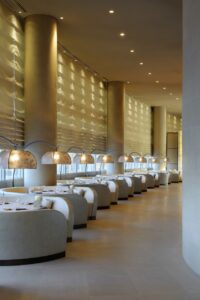
Much like the rest of the property, when it comes to dining, attention to detail is key at the hotel’s restaurants and lounges. The hotel’s restaurants are also very popular with outside guests so be sure to book when you arrive. Inviting guests on a culinary journey around the world Armani Hotel Dubai has a cosmopolitan offering of dining destinations that blend Armani style with a novel approach to world cuisine.
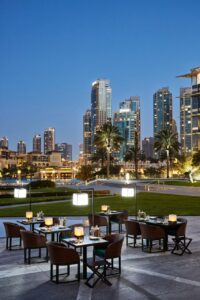
Starting with Armani/Ristorante where you’ll find the finest Italian flavours. With a true taste of the Italian way of dining, the guests will get to experience Italian flavours with a contemporary twist. From an Aperitivo to the degustation style menu there is a personalised touch at all points. The impressive outside terrace is a must-see as diners can enjoy their meal whilst overlooking the iconic Dubai Fountain. The finest ingredients are used in the restaurant’s dishes, to capture the true spirit of Italy. Just make sure you save room for dessert!
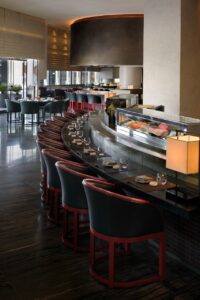
Elsewhere in the hotel, you’ll find modern regional Indian cuisine at Armani/Amal, Mediterranean favourites at Armani/Mediterraneo, fashionably different Japanese dining at Armani/Hashi and European accents at Armani/Deli – there’s something for every taste! Of course, the interiors of each dining destination reflect the spirit of the hotel. Elegant furnishings and understated elegance are present throughout.
Spa & Wellness
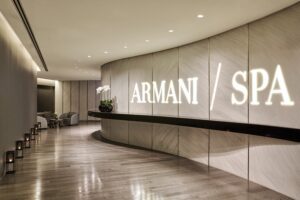
If you have time during your stay a visit to Armani/Spa is a must. A 12,000 square foot space offers tailor-made treatments and sensory therapies that cater to the needs of each individual guests. An oasis of peace and tranquillity, the spa encompasses a number of spaces and facilities with including thermal bathing, personal fitness, creative spa cuisine and calming relaxation areas. The treatment menu includes a trio of therapeutic themes to choose from. Mu quenches a desire for relaxation and stillness; Libertà encourages freedom of movement and the release of physical pain; and Fluidità enhances vitality, restoring internal balance.
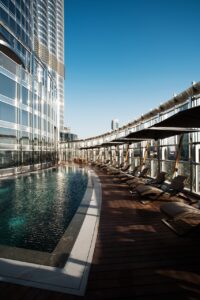
We highly recommend the signature collection of treatments, with each experience being tailored to your own personal request. When you’re done with your spa experience, take a break in the relaxation pool which offers panoramic views of the city, or unwind in the saunas, steam baths, and ice waterfall. Finally, choose from a wide range of hot teas, cold infusions, and fresh fruits to finish your experience and give you an energy boost for the rest of the day. The fitness centre is open 24 hours a day for those who want to work out during their stay.
The Armani Touch
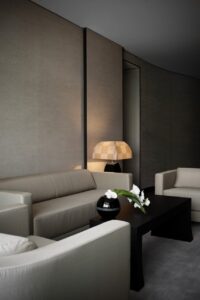
Also popular among guests are the three exclusive retail outlets within the hotel, completely the Armani lifestyle experience. Armani/Galleria is the first and only place in Dubai where the Giorgio Armani/Privé Haute Couture collection is showcased. Browse the latest pieces created by the Maestro himself. Armani/ Dolci is a luxurious confectionary store offering a selection of Armani chocolates, and more; and Armani/Fiori, is a floral boutique selling exquisite fresh flower arrangements and exclusively vases designed by Giorgio Armani.
Christoph Grainger-Herr, CEO at IWC Schaffhausen Presents the Latest Editions to the Iconic Pilot’s Line
This year, IWC Schaffhausen celebrates 85 years of its iconic Pilot’s watch. A watch that first debuted in 1936 when the Special Pilot’s Watch became the first wristwatch developed by IWC, specifically for use in an aircraft.
Since then, innovation and technology have allowed for generation after generation of Pilot’s watches through to the 21st century. This year as it celebrates this milestone anniversary IWC Schaffhausen is reigniting the Pilot’s watch with a series of new novelties throughout the tear surrounding this line. The first of four waves of new products debuted this April at the latest edition of Watches & Wonders. Presenting the watches to the world is CEO Christoph Grainger-Herr. Having worked at IWC Schaffhausen for over a decade before becoming CEO of the brand in 2017, Grainger- Herr fully understands the importance of the Pilot’s watch and its place in the brand’s heritage. As the first wave of new launches debuts across the world we discuss the latest innovations and the outlook for the future of the watchmaker.
Tell us about the latest novelties launching as part of Watches & Wonders?
We have been working on a full upgrade for our main Pilot’s line this year, bringing the latest om movement innovations and case innovations into the line, complemented by some ground-breaking efforts that we’ve been making over the last eight years now and I’m very happy to present that this year. This year we have four waves of novelties and the first is about updating the Pilot’s classic pieces.
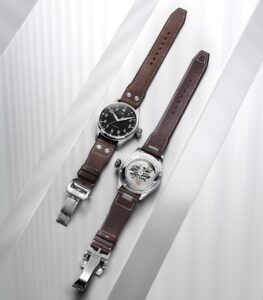
Big Pilot’s Watch 43
We are presenting the Big Pilot 43 and the Chronograph at Watches & Wonders and then we will have three more waves later on in the year. This first wave is all about making an upgrade from utilitarian, vintage-orientated timepieces that are aviation inspired to fully versatile, modern sports watches. One of the key pieces for this update to the Big Pilot. and we’re very happy to introduce the Big Pilot 43 which combines the wearability of the Big Pilot with true expression in the dial. We have completely changed the case size and height so we have much better wearability on smaller wrists, as well as an upgrade with the sapphire glass caseback. It has 100-metre waterproofing which makes it a more versatile sports watch and then we have the new EasX-CHANGE system which offers the capability to upgrade the strap within seconds at the simple touch of a button. There is of course a whole range of different colours that we can offer including the typical IWC Pilot’s blue, as well as a stainless-steel bracelet which is very comfortable and of very high quality.
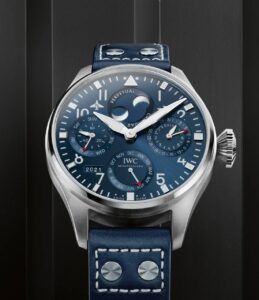
IWC Big Pilot’s Perpetual Calendar
Then we have the Big Pilot’s Watch Perpetual Calendar with a 46.2mm dial. So we are presenting this watch with a blue dial and stainless steel case in the standard collection. It’s a great entry point to the Perpetual Calendar range.
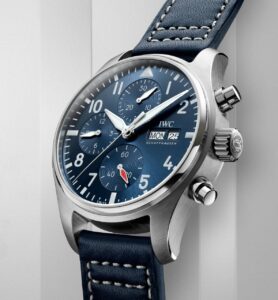
Then we have the Pilot’s Watch Chronograph that is our most popular sports watch today. This has been redesigned with a 41mm case which is really wearable. It’s a fully upgraded case featuring a highly comfortable bracelet with all of the adjustment features and the EasX-CHANGE system. For the first time, this watch comes with the 69 calibre in-house chronograph movement. You can also fit this system to other IWC Pilot’s watches, whether you want a sporty look or a classic look. So we have a very versatile setup with the Pilot’s Chronographs which are also great for first-time buyers of Pilot’s watches.
There is a strong focus on your Pilot watches this year –why is it important for the brand to continue its legacy of Pilot watches?
We’re hoping for a huge Top Gun wave to kick off with the release of the film, which as you know has been pushed again to November 19th, but really when we start talking about Top Gun this is all based on our collaboration pieces. The first one to be directly the US navy was the Top Gun Mojave Desert Chronograph that launched two years ago and we’re now adding two more models to this line. We have the Pilot’s Watch Perpetual Calendar TOP GUN Edition “Mojave Desert” and the Big Pilot’s Watch TOP GUN Edition “Mojave Desert”. These will be limited edition pieces.
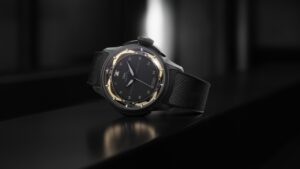
IWC Big Pilot’s Watch Shock Absorber
We also have a big technical launch. Eight years ago we set up a new department at IWC that studies all of the effects on our watches, looking at the shock-absorption element of mechanical watch protection and this year we present the first watch from our experimental edition; the Big Pilot’s Watch Shock Absorber XPL. It holds a world record in d-force protection, protecting the mechanical watch movement against g-forces up to 30,000g. The watch uses our patented spring-protect system which has been finely calculated to reduce the impact of forces that affect the watch movement by over 80 per cent and to evenly anticipate the forces around the entire surface of the watch movement. It also features a lightweight version of our calibre 32 in-house automatic movement. It uses aerospace aluminium as a base plate to make the movement lighter and to make sure that when the shock hits the spring as little movement as possible is generated. And the third element which is truly unique is the clutch system that we have in the crown. So when the crown is locked in, it partially disconnects the crown transmission from the movement. When you unlock this mechanism and pull the crown out, the clutch reinserts making sure that the collection is solid and you can then change the time and wind the watch movement. This flexible transmission allows the movement to move inside the case in every direction up to a millimetre, without breaking the physical connection to the crown. The watch is also made from our in-house titanium which is a ceramic-infused titanium alloy that is exclusively created for us in Pittsburgh. So after 85 years of the Pilots watch; we present a legacy packaged into the next level of engineering which should be a good technical piece for this year.
This is the second year that you participate in the digital format of Watches & Wonders – how is it serving you and how are you remaining close to your clients during these times?
I think we have to look at the two main elements. The first in terms of the benefit for many clients and our partners is clearly that we can reach a much broader audience a lot quicker with a virtual format. We have reached more people than we could ever have reached by travelling around the globe as there are just not enough hours in the day. So that’s the efficiency element of it. On the other hand, I think as an industry we are missing the energy and the atmosphere of actually coming together with journalists and retailers in a physical format and actually feeling the state of the industry. That’s a lot more difficult when you’re speaking to an empty camera lens and getting no feedback from the audience. You have to go onto Instagram to find out whether people liked it or not! That’s weird and the same emotional connection is not there through the screen. But I hope in the end we can find a balance of both going forward because it is great that we can meet a lot more people virtually including on a one-to-one basis with the efficiency of our studio, but at the same time I think for inspiration it’s a killer!
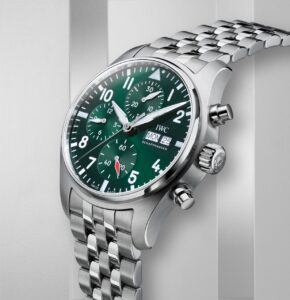
IWC Chronograph 41
What do you think are the challenges that the industry is facing now?
I believe that we are in a very good position considering all the hardships and difficulties that COVID-19 has brought about for many people. It has been a moment of reckoning where we really started to think about what is important to us, and what we connect with, who’s supporting us and what we are missing and not missing. I think people have looked at what they consume, how they buy, the impact on the environment and also this whole question of global Vs. local. There has been this idea of process and emotion during the pandemic and there has been a sort of stripping away.
And as a brand, we have a very good message in that context because we create things from start to finish here in the heart of Europe that have not been shipped all around the earth already before they get to the end consumer and it’s a product that creates value, creativity, jobs and content and is designed to last forever. So in terms of creating a product that is not bound by all of the problems we associate with consumption today, it’s really interesting as an approach and I think that’s given people a renewed sense of importance of the idea of self-creation. At the same time, I think we could see even in the middle of the pandemic when there was a lot of uncertainty, there was an element of hope, dreaming and escapism that’s beautifully captured by things like watches and jewellery. Especially mechanical watches that are rich in heritage and history. It’s something I noticed myself, during a time like that you go back to the things you genuinely care about to give you a bit of escapism. I think this element of humanity that goes beyond the functional and beyond purely survival instinct is now more important than ever and people have come to realise that again. So I do hope going forward that gives us a very strong base to develop as a brand.
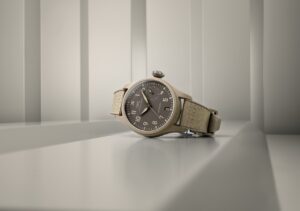
IWC Watch Top Gun Mojave
What can you tell us about sustainability at IWC Schaffhausen currently and what can you tell us about your projection and plans for this topic?
We are constantly working on our simple mission to make the most responsibly manufactured watches in the business today. We have showcased initiatives highlighting that we are on the bus of sustainability, but I want to make sure that we are actually changing ourselves for the better. A few years ago we launched a very open communication around every element of our subscription to the sustainable development goals that everything we are doing is bound by. The drive behind this is always to step by step both make the process a more responsible one, reduce the impact on the environment, but also be very open with our consumers in terms of how we do things. That’s already been recognised during the WWF study on gold-sourcing from a couple of years ago where IWC was one of the very few in the industry that actually openly communicated on where our materials are from and now taking our involvement with the Responsible Jewellery Council from the code of practices to the chain of custody, takes us a whole level further because that means that fifty years down the line I can use my case number and actually trace precisely where the gold in my watch originally came from. This is a guarantee that goes much further than anything that was ever possible previously. Then, it’s about working on every element of the supply chain to really make sure that the entire impact created by the product on the environment is minimal and at the same time, we maintain what the product is for. First and foremost it is still a luxury product and it needs to continue to be that, so it’s not just innovation for innovation’s sake, it’s actually about trying to make a better, beautiful product that also has a lesser impact on the environment.
We have had a complete overhaul of our packaging concept where not only are we reducing the waste from packaging by making modular packaging that can be used as a travel pouch or a collectors box further down the line, it has a very low plastic content and is highly recyclable. Then we have gone for new local sourcing on our packaging. Meaning for example that all of the packaging we are using in China is now produced in China and the watches are coming from Switzerland without packaging to our Chinese distribution centre where we then package them and the same happens in Europe and around the rest of the world. By sourcing much more locally to the final destination we ensure that we don’t have to ship everything. This goes through to every element of the business and we are making sure that step-by-step we are getting better at every element towards making the most responsibly manufactured watches in the industry.
What is in the pipeline for IWC for this year?
Watches, services, accessories, campaigns! As I said we have the four major waves that are coming throughout this year. The first was the Pilot’s classic, then we will enter the world of Top Gun which we have already begun to do a little and then we will take it from there!
What is one thing that you haven’t achieved yet that you still aim to achieve?
I have many plans for the next few years. What is key to remember is that in this business at the end of the day, it’s a very emotional product. It’s all about curiosity, creativity and maintaining energy and fun and I think as long as we as a team have this much fun doing what we’re doing, hopefully, our clients will continue enjoying our products. Let’s see what guides us, I’m not making distinct six-year plans because we know from everything that’s been going on in the last ten, fifteen years that this is a nice planning exercise but hardly every materialises exactly in the way you expect, but I think it’s all about staying creative, keeping curious and just building it stage by stage, level by level and as long as we are having this much fun then we will carry on.
2020 has been a learning curve for many of us both on a personal and professional level – what is a key challenge that you have faced and a lesson you will take with you from this year?
The key lesson was not to think that the end of 2020 would suddenly change the situation. We found on the 1st January 2021 that things looked quite similar to 2020! And I think what I’m taking away from it is that the fact that none of us can control the environment. All you can do is have a good feeling for what’s going on and be very agile and respond with a great amount of innovation to every situation you face. Long-term planning is a thing of the past and the environment is changing rapidly all the time and I think we’ve become quite good and are getting better at responding to this and then innovating to adapt and this is what we have to keep on doing. What I’ve taken with me is definitely to ignore that idea that suddenly everything is going to normalise.
What’s the message that you would send to your clients and friends in the Middle East?
First of all, I would love to see you all again at some point! I very much look forward to engaging with everyone again in the region. We’ve got a huge upgrade to our flagship boutique concept in Dubai Mall later in the year which I’m very excited about. It will bring a new level of immersive storytelling and a connection to the manufacturer and our product design process and it also happens to be the biggest boutique in the world, so I’m very much looking forward to seeing that and getting in touch again with everybody.
Wilhelm Schmid, CEO of A. Lange & Söhne Presents the Newest Novelties and Looks to the Future
This year, Wilhelm Schmid CEO of A. Lange & Söhne marks ten years at the helm of the brand. Known for its authenticity and its ability to stay true to its roots A. Lange & Söhne has remained true to its DNA since the beginning over 175 years ago.
By continuing to keep its headquarters in its founding city of Glashütte in Germany, A. Lange & Söhne has remained true to its identity for two centuries. Something that Schmid credits to be one of the biggest strengths of the brand. A brand that is positioned with the finest of watchmakers A. Lange & Söhne prides itself on its connection and relationship with its niche customer base. So when COVID-19 hit last year and the whole world saw one-to-one interactions stop overnight, a huge challenge came for the brand that prides itself on personal interactions with clients. After quickly finding ways to adapt and realign its strategy A. Lange & Söhne has continued to launch new watches over the past year, most recently through the 2021 Watches & Wonders digital event. Three key new novelties were launched via the digital platform. To find out more and to reflect on a decade in his role, we talk to CEO Wilhelm Schmid.
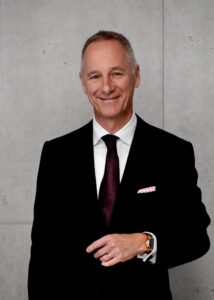
Wilhelm Schmid
Tell us about the A. Lange & Söhne novelties for 2021?
As part of Watches & Wonders 2021 we presented three new watches. The first was the Lange 1 Perpetual Calendar. The Lange 1 epitomises what we stand for and I think if you want to take it to the next level, this watch does that because the Perpetual Calendar is the only of its kind. There is no other with a display on the peripheral ring. I have to say, I’ve been wearing it now for three days and I don’t think I will take it off for a while!
Then we have the triple-split in its second chapter. The first one in white gold with a grey dial of course sold out a long time ago, but it takes us at the company about three years to produce 100 watches if they are as complicated as the triple-split is. Watchmakers do not change very often so once they are trained on that specific movement, we want them to continue working for as long as possible without any interruption. So that’s why now, after three years, we are launching the next hundred pieces of the triple-split with completely different aesthetics to keep the watchmakers up and running. They will continue working for another three years to produce the next hundred pieces of this beautiful and still very unique watch.
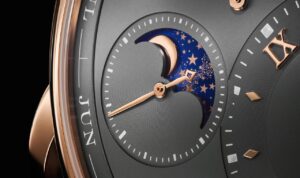
Lange 1 Perpetual Calendar
This is the second year that you participate in Watches & Wonders in a digital format – what can you tell us about the experience and how is it serving you?
Mankind has hugely adapted and I think at A. Lange & Söhne we have shown throughout history that we adapt to whatever is necessary. The only way to launch watches nowadays is to do so digitally. For the last Watches & Wonders, we had about four weeks to prepare but we had a lot more time this year and I think you can clearly see the results. The last time I was actually in quarantine because my son had COVID-19, so I had to work from home with no technicians and do whatever I could myself. Now I’m sitting here in a fully-fledged studio with perfect lighting and all the tools on hand to make it a much nicer experience. But we have continued launching watches throughout the past year and it was all done digitally, so by now we know how to do it and we also see that our clients have changed. I don’t think they would have enjoyed it two years ago, but now everyone is hungry for novelties and if digitally is the best way you can get them, then that’s what you accept.
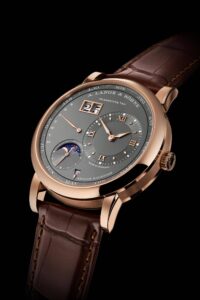
Lange 1 Perpetual Calendar
What is your take on this and what is happening at A. Lange & Söhne in terms of digitalisation?
We did not change the way we design and produce watches and that will never change because it’s our DNA. But if you want to stay true to your values and the factory, then you also have to comply with the changes that are happening around us. Had you asked me 15 months ago if our clients were prepared to do Zoom meetings with me instead of meeting in person I would have said no because that’s not what they expect from us. But not only have we changed, but our clients have also changed, and they accept that for the time being, this is the best we can do. And if it’s done in a very personal way as we are doing it, you can build a relationship even though the digital world as long as it is authentic, clean and in line with what is expected. We have to stay hugely flexible. We are doing remote over the telephone and soon through e-commerce on our website. This is where you have to accommodate and comply with the changes in the world that are restricting people from what we like the most; mingling with others.
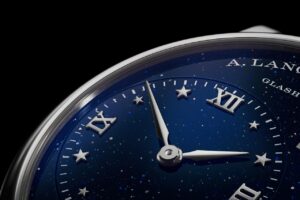
Little Lange 1 Moon Phase
What is the strategy of A. Lange & Söhne to remain agile in such times?
We have the slogan “never stand still” which helps us to remain quite agile. But we are not agile to the extent of being hectic, more in the way that we maintain certain sets of values that we believe are important, but we also allow changes when we think it’s necessary. And again it’s in our history. We came back and revived the small town of Glashütte to make it the watchmaking hub of Germany. So, we know what our responsibility is, and we have great people on board that will transfer that from generation to generation. I think we have always had that ‘never stand still’ gene in us which helps us specifically in situations that you could not anticipate and where you have to navigate your way through times that you have never experienced before. I’m not worried about the future; I think the future of our company is even better than the past. Whatever comes up, we are prepared to deal with it.

Little Lange1 Moon Phase
What are you doing at A. Lange & Söhne to stay close to your clients?
I can’t even count the number of Zoom meetings I’ve had in the last twelve months. I know that I’m not alone, gladly the company’s weight is on many shoulders and we are very close to the customers.
As we speak, I know that we are working on digital events and boutique events. We’ve invited people to the Lange experience app for clients where they can not only see us and our novelties but more of the Watches & Wonders novelties on a broader scale. So, whatever is doable in a typical A. Lange & Söhne way, without meeting in person which at the moment is in most countries impossible, we do. But again, I believe that it is important that you stay authentic along the way. We will not involve celebrities and red carpets for example, because that’s not something we have ever done. So, whatever you get from us is authentic, be it digital or physical. That’s what’s important for us to maintain.
This is your tenth year as CEO at A. Lange & Söhne – how does it feel and what is a major milestone that you can share with us that you are proud of?
First of all, I come to work with a smile on my face every day. I’m not tired and I’m not bored after ten years. Every day is a new day and a great journey, and I love the brand and the people that work here. I will do it until I can’t do it anymore and it’s what makes me want to wake up in the morning and go to bed a little happier at night. A. Lange & Söhne is about the team it’s not about one person. So there is no secret that I did, it’s a lot of people that are involved and it’s about what we do together. But there were three things that I’m pretty sure are real milestones that I would highlight. The first would be the Grand Complication launch in 2013 because it answered the question of what we can do. And we can do everything we want. We have all the capacity and knowledge. For sure, the inauguration of the factory in 2015 was a key moment. With all the sustainable energy sourcing, the clean energy methods that we built in, the controlled environment, the beautiful view of the mountains. All that is there to stay. And the third highlight was launching the ODYSSEUS watch family in 2019. I believe the team did such a great job in coming up with something so unusual but also staying true to our DNA. So I’m pretty sure if I had to bring it down to three things, it would be these.
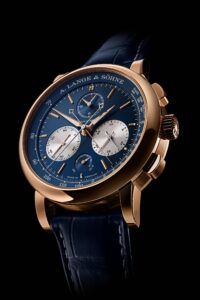
Triple Split
What is a major challenge you’ve faced during your ten years and how did you overcome it?
There is a company challenge that not only was there and is there, but I also believe will always be with us. 90 per cent of our people work in Glashütte and 100 per cent of our customers are not there. So how to connect the people that are working for us in Glashütte and connect the world with Glashütte remains the biggest challenge. We are by far the most successful, the most prominent and the biggest company in Glashütte and so my people don’t feel the breath in their neck from competition because it’s not there, it’s somewhere else. And we all know what happens to companies that become complacent. So that’s a challenge that will continue to be there and we need to ensure that we don’t become so self-centred that we don’t understand that the world is changing. And there is so much beauty in bringing the world to Glashütte, but also so much beauty in bringing Glashütte to the world, so that’s an ongoing challenge.
In times of uncertainty like now, what advice would you give to entrepreneurs and leaders who are in uncertain times?
Don’t be worried about mistakes, but be sure that you identify those mistakes. If you don’t change you will not make mistakes, but you will fail. If you do change you will make mistakes, but just make sure you identify them to avoid repetition of the same things. Other than that, just go for it. The world is waiting, and a decision can look great one day, stupid the next and then great again the next day, so don’t be afraid. Mistakes happen, it’s the way we deal with them that makes the difference.
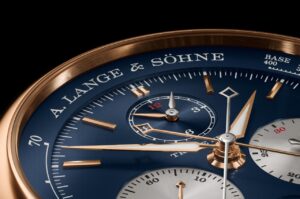
Triple Split
What is it that you still aim to achieve that you haven’t done yet at A. Lange & Söhne?
There are many things! My ultimate aim is to make the company so sustainable that all the young watchmakers that we take on board every August as apprentices have plenty of work for the rest of their careers. A watchmaker can only make watches, so it’s my duty to ensure that the brand is so strong and resilient and in demand that there is always enough work for these people.
How would you assess the watchmaking industry today?
It’s always a difficult question for me because I’m just a small player. We produce 5-6 thousand watches a year and that’s it. I’m only at the top of the iceberg, so I’m probably the wrong person to ask about the watch industry. But what I realised last year, is that in days when everything is about bad news, people love good news and for a watch collector, the launch of a new watch is good news, and it brings joy to their lives. I think that’s right today, it will be right tomorrow and it was right yesterday. We are about making watches. That’s our duty and gladly there are enough people in the world that enjoy the hobby of fine watchmaking and it’s our duty to continue to come up with them. So, I see the business that we are responsible for at least, in good health. I’m not worried about the future, I’m rather optimistic.
What can you tell us about A. Lange & Söhne in the Middle East?
I was so happy that I was there to open the renovated boutique at Dubai Mall just before COVID-19 and I can’t wait to get back there. We have opened a boutique at Mall of the Emirates which I haven’t seen yet, and I can’t wait to get there! From what I see, the brand is well-positioned in the region. We also opened a boutique in Riyadh which I haven’t been to see yet. It looks like the awareness of what we do and the standing of what we do is rising in the Middle East, quite significantly. We can see this from the number of requests and customers that we get from that part of the world. I think the Middle East has always been a sophisticated market and maybe we were a little unknown, but we see slight changes in this. We never want to be known by everybody, that’s not our aim, but we want to be known to people that like fine watchmaking and understand it and I see we are on a good way to that.
What is a message you would send to fans of the brand and your clients in the Middle East?
It’s the message that I give to everybody at the moment to be appreciative of subtle difference. I always take the Perpetual Calendar as an example. I know not many of us are awake at midnight to see all of the indications instantaneously jumping, but to know it works like this is understanding A. Lange & Söhne. It’s all about the details and the love and the passion for small little things.
Flying High: Dr. Eng. Suaad Al Shamsi, the UAE’s First Aircraft Engineer on Defying the Odds to Achieve Her Dreams
Dr. Eng. Suaad Al Shamsi defied all her critics by becoming the UAE’s first female aircraft engineer.
Choosing a career that had previously only been undertaken by men was never going to be easy, but UAE-born Al Shamsi rose to the challenge. After being given a once in a lifetime opportunity by His Highness Sheikh Mohammed Bin Rashid Al Maktoum, she travelled to London to study aeronautical engineering and returned to the UAE to pursue a career in this field. She became the first woman in the UAE to work as an aircraft engineer when she secured a job at Emirates Airlines, and today she works as a senior manager and technical advisor for one of the biggest aviation projects in the UAE, the Midfield Terminal Project, in Abu Dhabi, with Etihad airways.
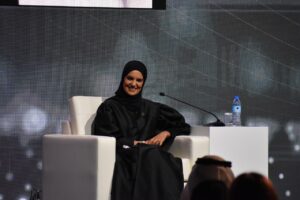
Women in Aviation
Al Shamsi has inspired many other women to follow in her footsteps and the gender gap in this industry is slowly closing. But there is still much to be done and Al Shamsi has made it her mission to inspire and educate other women to choose a similar career path. She is a member of the Emirates Association in the UK and the Institute of Electrical and Electronics Engineers, and one of the founders of the Women in Aviation organisation in the Middle East. She is also the CEO of L2L (Learn to Live), a consultation company that inspires other women to achieve their dreams and help them along the way. While her work is of utmost importance, Al Shamsi also puts her family at the forefront. As a mother of two young boys, she strives to make them proud of her through what she does. She has received many awards and high-level recognitions for her work and has been acknowledged by Her Highness Sheikha Fatima bint Khalid Al Qasimi for her work. We discover more about the journey that led her to where she is today and how she hopes to continue to inspire future generations.
What led you to this industry and where did you find your passion for aeronautical engineering?
I think it first began when I used to steal toy cars from my brother when we were kids and I always loved them. As a young girl, at that time, there was an expectation that you should study social studies, business administration, management, or medical studies – but I didn’t want to have that imposed on me, I wanted to choose my own path and I wanted people to change the way they see Arab women. In 1990 I travelled by plane for the first time, and I loved it. When I got back home, I started to think maybe there was a way I could study something related to aircrafts. I started to research I realised I wanted to do something in the aviation industry, but I wasn’t sure what. But at that time, no one believed I could do it. My teacher told me I was dreaming and that it wasn’t a suitable career for a girl! So, I said ‘who are you to tell me this?’ and they suspended me from school for three days! I was fighting for it because I didn’t see why I should have to do the same as everyone else. My sister went to medical school, and it was expected I would do that as well, but by then, I knew I wanted to be an aeronautical engineer. At that time, I was overweight and was bullied a lot, even the teachers told me I was dreaming. When I graduated from school, I contacted a lot of companies and universities and they all told me this was a major only for men. I hated this idea that men could do whatever they want but women couldn’t, and I kept asking why. I was determined and I knew I would succeed, even if everyone doubted me.
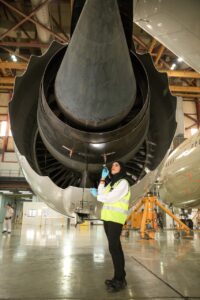
Later, I joined Al Ain University and I did not like it at all, then I joined the American University in Dubai, but it was not for me. I would run away to the garages in Al Quoz to fix cars as I knew that the mechanics of a car and the ones of a plane are similar and it would help me get closer to the career I dreamt about. One day, a man saw me there and he asked what I was doing. I told him my story and he said, “give me one reason why I should help you”. So I told him: “I want to show the world that as an Arab and Emirati woman, I can be whatever I want to be”. And so, he said he would help me. He led me to His Highness Sheikh Mohammed bin Rashid Al Maktoum, and he told me this was the only chance I would have to talk to him, and he put him on the phone! I knew this was the only opportunity I would ever get in life. I took the phone and told him my dream and he asked me why and I said it was because I wanted to open the door for ladies to enter this field. He said: “OK no problem” and he put the phone down. I thought that was it, but I continued fighting. A week later I received a phone call from a leadership programme of His Highness, and they asked me to meet them. I arrived with my sister, and they told me that I’ve been accepted on the programme, and they had found a college for me in the UK. They told me I would be leaving in ten days and that everything would be organised for me, including a salary. When I told my mother, she was shocked! She told me she would never stop me from going overseas to study, but if I go, I must return with a degree. She said I should travel alone, which was frightening but I understand now why she made me do it, because she wanted me to be stronger and to face everything on my own. This was over twenty years ago, and now when I look back and I see how I’ve inspired other girls to go into this field, I feel so proud. I have helped and encouraged a lot of the universities in the UAE to run this degree here and there are a lot of scholarships happening. We even started a non-profit organisation called Women in Aviation. The mentality has changed and that is what I wanted to achieve.
What are the challenges you faced when leaving the UAE as a young Arab woman to study in the United Kingdom?
The challenges are not only as an Arab or a woman, but to be in another country in an environment that you haven’t been to before, and to be there on your own – you must be strong. Whatever you face you must keep reminding yourself of the reason you are there.
When I first landed at Heathrow airport my bags didn’t arrive. The next day was a Sunday, no shops were open, and I had no clothes. It was January so it was freezing cold, and the heater was not working at my accommodation. My mother called me, but I knew I had to be strong, so I didn’t tell her what happened, I just got on with it and I think it made me stronger. Looking back, I would say to anyone who is thinking of studying abroad if you have your family and everything you need in your country, don’t travel unless you can’t do your desired course in your home country. You will have to do everything for yourself, and it is not easy.
For me, the main challenge has always been that working in the field of aviation as a woman, you must accept that you are never going to be seen in the same way as a man. I was in a class with only men, even the teachers didn’t believe in me. I remember one day I had been working so hard on my project and it was Eid, but I had to go to class and when I got there the teacher threw my project on the floor! I told him: “One day, I will be something and you will be nothing”. It is these moments that make you stronger and no matter how many times people say you will never be accepted as an engineer, you keep going. It’s still hard today, only 13 per cent of aircraft engineers across the world are women, but it’s much better than it was.
When you graduated and came back to the UAE what acknowledgement and support did you receive?
My family were huge supporters. It wasn’t just me that faced these challenges, my family faced them too. A lot of people were judgmental, and they would make fun of my brothers for what I was doing. Some of my mother’s friends and relatives would tell her that I will never graduate. They would judge me because I was there alone. My mother would keep reminding me that I was coming back with a degree, and it wasn’t just for me, it was for the whole family. So, in my life now I am trying to make them prouder and prouder and to silence the people who judge me and see it as a negative. I have passion and that is everything and this is what I try to teach my students now because it is the passion that will drive you.
What do you consider a major achievement so far and what do you still aim to achieve?
First of all, to still be working in this field as a woman is a huge achievement. But to continue showing that I can also be a wife, a mother, a daughter and keep doing what I love, that’s what makes me the proudest. People are judgemental and they think that because of my career I shouldn’t have kids or get married. I see many women who choose between their personal life and their career, but I always want to show them that you can have both.
How do you balance both your career and your personal life?
The support I get from everyone surrounding me makes me what I am today. When I show people what I love and they love it too, that makes me love them even more. So I educate them on what I do. My kids know everything about aircraft, they know what I’m doing each day. My husband and my mother are the same. I engage them in my universe because when you do that, you get the support you need. The praise I get from them keeps me shining. When I retire, I want to see this passion in the new generation and the only way you can keep the passion is by finding a balance in life. I have a schedule that I put up on my wall each week because that’s the only way I can manage my time.
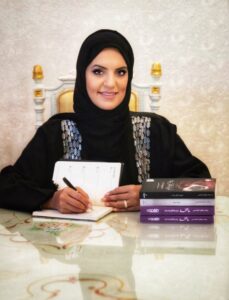
We know you have also written many books – tell us a little about them?
I have written five novels so far. They are all true stories and I try to highlight the real-life experiences that people don’t like to talk about. My novel “How To Kill Your Man With No Evidence” has sold 28,000 copies in Arabic and it is now being translated into English. It’s a true story about 12 ladies who are fed up with their husbands! Another was focused on how social media is tracking the new generation and taking them on different paths. It addresses sexual abuse, and the ways women experience it, and their family can have no idea. Another was a true story about a man who in front of his family, looks as though he has a great life, but inside he is empty. I am addressing a lot of issues; I love to write about real people, and I think a lot of people can relate. I have two new books coming out this November so stay tuned!
What is a motto you live by?
There are two: “if you can dream it, you can do it, you can achieve it” and “dream high, achieve high”.
What do you say no to?
I cannot accept when people try to impose decisions on you and try to monitor your life. I have always been told what I can and can’t do and I will always say no. Everyone has their own way, and I don’t like it when people judge others when they don’t know them.
Emirati Women’s Day is coming up, what does this day mean to you and how important is it to have this day each year celebrated by the whole nation?
When Her Highness Sheikha Fatma Bint Mubarak announced this day we all felt happy. A lot of Emirati women were already doing great things long before Emirati Women’s Day began, but to have a special day for us and to recognise our achievements not only in our careers but in our personal lives too, is fantastic. This year, because we are in the 50th year of the UAE, I think there is even more for women to celebrate. For other countries, 50 years is a short interval, but what we in the UAE have achieved in that time and the equality we have found, means we can do anything. I think we have achieved more in 50 years than a lot of countries have even in 100 years, and this is just the beginning for Emirati women.
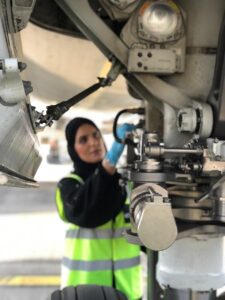
What is a message you would give to your country to mark this 50-year milestone?
I wish that not only Emirati women, but any woman who is living here will continue to make the UAE even better and globally recognised. Our country means everything to us, and I hope we get more respect globally and we take the country even higher.
Do you have a role model or someone that inspires you?
In my life, I have two role models. The first is His Highness Sheikh Mohammed bin Rashid Al Maktoum because he believed in me and all women in this country. We as Emiratis, feel that we are a family, and he is our father. We see what he has done for this country, and he is truly a role model. The second role model is my mother. She was a mother and a father to us because my father passed away when I was just ten months old when she was just 26, with four children. She showed me how life should be. She taught me when I should act like a woman and when I should act like a man. When I should be tough when I should be soft. She taught me everything and I am still learning from her. She educated me and my siblings in a way that made us achieve amazing things and now she is teaching our children. She taught me to never stop helping and inspiring others and to be a role model for them. She is the best role model I could have.
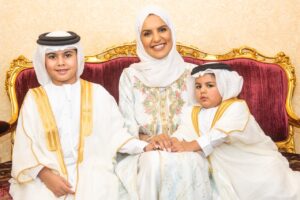
We know you have a passion for watches where did this come from?
I move by minutes and Watches give me time to understand my day. I know what I must do every minute of the day and time is very important to me. Life moves so fast, and I have to wear a watch to keep track. But I don’t wear just any watch. When I am working in the construction area, I need something light that won’t hurt my wrist. I need to be able to wear it with my uniform and with my evening clothes.
Which are the top brands you like to wear?
I have a Breitling Aviator which is my favourite, I own two of them and they are very dear to my heart because of the link to aviation. And Rolex is always there as one of my favourites. I think every woman needs to own a Rolex!
Where is your favourite place to travel?
London is my favourite place to travel because I have an emotional connection to it and it is the place where I learnt so much and became the person I am today. The second place would be Amsterdam. I like to go there when I’m trying to finish a book. It is a place of paradise. Every country I go to I become attached to in a different way.
What is a message you would give to your younger self?
I would tell her “I am proud of you”. And I would tell her to be patient because she still has a lot to give!
Tried & Tested: Waldorf Astoria Ras Al Khaimah
We discover Ras Al Khaimah’s luxury resort that will take you away from the city and into relaxation mode.
Waldorf Astoria Ras Al Khaimah is the perfect out-of-city getaway for all the family. Just a short drive from Dubai, the luxury resort is ideal for those looking for an escape but don’t want to travel for hours. The beachfront resort is surrounded by desert, sea and mountains so you can experience the best of what the UAE has to offer while secluded in a private haven on the Arabian coastline. Needing a well-earned break from the city I decided to take my family for a short trip to paradise and we made the one hour journey from Dubai.

Rooms & Suites

The resort features an impressive 346 rooms and suites that offer ultimate luxury. Waldorf Astoria’s impeccable standards can be seen throughout from the spacious rooms to the personal concierge services and the state-of-the-art technology systems.

For families, deluxe family rooms or two-bedroom suites are perfect for you and the kids. We stayed in the two-bedroom family suite which offers sea views and two bedrooms. The suite was spacious and featured a separate dressing room, large bathroom and plenty of space for the kids to play while I unwind and enjoy some “me time”. For the ultimate in luxury, spoil yourself with a stay in this King Royal Suite and enjoy views of either the golf course or the sea. This spacious suite stands exclusively on its own floor with a VIP elevator and direct private spa access. Each of the 2 bedrooms comes equipped with a king or 2 double beds, and an ensuite bathroom.

A separate living area features a 62-inch HDTV and stays connected to WiFi access. Suitable for 4 adults and 2 children with existing beds.
Food & Dining

Lexington Grill
The resort has a number of dining destination for a range of tastes. The resort’s steakhouse Lexington Grill is known throughout the area for its showcase dishes. Inspired by New York’s steak houses the restaurant offers perfectly cooked grills and fresh seafood. Led by Chef Lendl Pereira don’t visit without trying his special air-dried beef cuts that can’t be found anywhere else in the region. The Art Deco design takes you all the way back to the 1920s, while the private dining rooms are perfect for groups looking for a more private dining experience.

Waldorf Astoria Ras Al Khaimah UMI dining area
If Asian food tickles your tastebuds UMI is a trend Japanese restaurant with bold and captivating interiors. The restaurant’s centrepiece is a Teppanyaki grill where master chefs show off their skills. The sushi corner invites guests to see live creations by the resident Sushi and Sashimi chef. Perfect for families who can’t decide what to eat, Qasr al Bahar offers dishes prepared in open kitchens, featuring Arabic classics, Indian tandoori, European-Mediterranean and Asian cuisine.
Spa & Leisure

Whether you want some relaxing “me time” or you’re more of a thrill-seeker the resort has something for everyone. The large spa has 12 treatment rooms, as well as one VIP couples’ suite, a floatation bed for females and a hydrobath. The spa facilities also include male and female steam rooms and Waldorf Astoria’s signature herbal sauna. Designed with an under the sea theme, Waldorf Astoria Spa features calming blue silk walls, floor to ceiling one-way windows and artful light pieces throughout. An interior design to fall in love with, the spa’s central details take guests to a serene place of peace beneath the sea, accompanied by True Waldorf Service. The spa offers a selection of signature and bespoke treatments designed for restoration, relaxation and harmony.

For those looking to get outside. The nearby Al Hamra Golf Club is a great experience to guests who get exclusive access to the 18-hold course. Guests of all ages and skill levels can enjoy the facilities and services of the club. There are also a number of leisure activities both on and off-site. From a desert safari to a waterpark visit to a mountain experience. The hotel staff are on hand and happy to meet the needs of each of the guests.
Fun For All the Family

Waldorf Astoria Ras Al Khaimah is the perfect destination for kids. The Pearl Kids Club will keep the little ones busy all day so you have more time for yourself. The Club offers which is open to kids aged between 4 and 12 offers recreational, educational, cultural and focused activities including cookie and pizza making, sand art, falcon show, Archery, shell collecting, shell photo frame-making and Petanque. And for those with young children, babysitting services are also available. So make sure you enjoy and indulge a little too on this luxury escape.
For bookings click Here
Watch: Lunch With Palestinian Film Director Farah Nabulsi
Oscar-Nominated Film Director of “The Present” Farah Nabulsi has had quite the journey.
After winning a BAFTA for Best Short Film for her film “The Present” Farah jetted off to Los Angeles for the Academy Awards last month.
Before the Oscars, we met Farah for a chat over lunch to discuss her film, her nominations and the message she is trying to spread.
Watch the video here….
Read more of Farah’s interview here.
Driving For Change: Meet Hanan Mazouzi Sobati, Founder of Arabian Gazelles
Hanan Mazouzi Sobati, Founder of Arabian Gazelles shares her passion for cars and how she is empowering women in the region through driving
Hanan Mazouzi Sobati’s passion for fast cars was something that had been with her since she was a child, but it was left dormant as she pursued a corporate career and worked for the family business. A mother of two teenagers, Hanan has been living in Dubai for 25 years and it was this city that allowed her to ignite her passion and take it one step further into a business. In 2016 Hanan founded Arabian Gazelles; an all-female supercar club that invited like-minded women who share a passion for fast cars to come together and essentially fulfil their need for speed. Over the last five years, the club has grown into somewhat of a movement that is defying the stereotypes of women. With regular meetups, events and drives, with global recognition from luxury car manufacturers, these women not only drive together but have formed a community that is promoting change in an industry that has traditionally been dominated by men.
Originally from Algeria, Hanan always knew her passion for cars was there, but turning it into a business was only a dream. Living in Dubai allowed her to bring that dream into a reality and she is now inspiring other women to take a leap of faith and follow their passions. Hanan was chosen by Giorgio Armani as part of a new brand initiative, Crossroads. Crossroads highlights 14 inspiring women from around the world to promote female strength and to give a voice to modern women to celebrate their personalities, femininity and capabilities. As part of the project, Hanan was chosen for her passion and fierce spirit that defies the odds of what is expected today. Here we find out more about her journey and the message she is spreading with Arabian Gazelles.
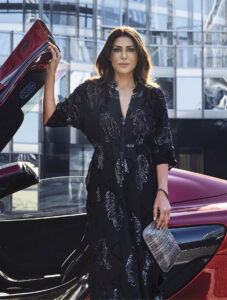
You were born Algeria, and you lived in the UK and in Qatar before settling in Dubai. How much has this variety of places made you the person you are now?
For anyone, living abroad definitely helps to shape their character. The experience, the people they meet along the way, will enrich their lives. And it’s true, living in Algeria, the United Kingdom, Qatar and then Dubai has definitely helped me become the woman you see now.
How important is the energy of Dubai, and the sense of living in a dynamic, ever-changing, global city, to you?
Of course, Dubai has made it so easy for me to pursue the passion that I always had. So yes, Dubai means the world to me, it’s home, it’s where my family is, where my business is and I don’t see myself living anywhere else.
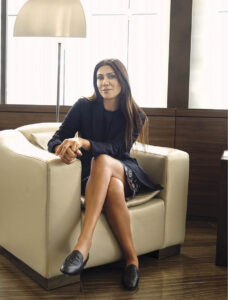
If you had to pick the most important decision you made in your life, what would it be? What options did you have, and what did you ultimately choose to do?
Setting up Arabian Gazelles was one of the most difficult decisions I’ve ever made, simply because I didn’t have a role model, I couldn’t find anyone whose steps I could follow. So, I had to come up with my own concept and just go for it. I was working in the corporate world and we have a family business as well, but all of that did not give me that drive for life. I had to decide to stop doing what I was doing for other people. It was difficult because the family business always needs you, but I had to step back and find myself, before again being able to give back. It was a decision I took alone, but thankfully I had all the support I needed to make it happen.
Setting up Arabian Gazelles was a sheer product of my passion for cars. I believe when I share my passion, I double my happiness. It’s a selfish thing actually! So, I wanted to find women who have the same passion so we can all grow together.
Do you ever have regrets for past decisions? If so, what would be one specific regret you’d want to share with us?
No, I don’t have regrets. In life there are no regrets, there are only experiences. This is how I like to see it. Nobody goes through life without the experiences that in my opinion, are paramount to the growth of the person. I feel that sometimes things might not have gone as I wished, but definitely, I came out of it as a more experienced person, moving closer to the goals that I set myself.
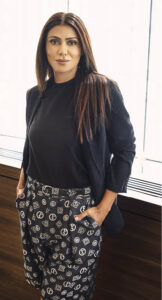
How do you manage to balance your work life with your private life?
There is no science to having a work/life balance. What I do is periodically review the situation and adapt. Having two teenagers demands different amounts of attention at different times. You cannot be too involved in their lives and you cannot be completely out of their lives. So, when they need me, I’m there, I review how much they need me and I go with the flow. What is consistent for me is having ‘me time” which I get through my passions. This is the only way for me to keep that balance and keep my sanity as well!
In 2016 you founded Arabian Gazelles, the first supercar club for women in the Emirates. You said you were not inspired, but rather frustrated to start this, because of a world that you felt kept you out. When and how did you decide it was time to change things?
When I decided to set up Arabian Gazelles in 2016, I knew that I was going to face challenges because I was entering a male-dominated industry. The more challenging the situation was, the more rewarding it was for me to keep ongoing. So really my passion was fuelling this drive. There were of course people who were not happy seeing us enter this world. Honestly, they didn’t know what to expect, so I don’t blame them as it was something that has not been done before. But thankfully, we have proved that we have the same passion as men do when it comes to cars, and we are not competing with anyone, we are just creating a world for women to live out this passion beautifully and bond together around these beautiful cars.
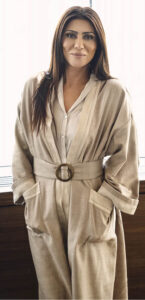
When was your love for fast cars born?
My love and passion for cars has always been with me ever since I can remember. I used to play with my brother’s cars and put Barbies on them! For a kid, my favourite show on TV was Formula One. But the passion really took shape when I moved to Dubai where I could really live it and find like-minded women who could join me on the journey.
Your family and your husband helped you and supported you, but you received a lot of resistance in a traditionally male-centered world like that of car racing. Did you ever feel like giving up, and why didn’t you?
I indeed received all the support I needed from my husband, my family and my friends, but obviously, when you do something for the first time you are bound to face objections and resistance. But the funny thing is, that the more I was faced with people questioning my passion and the existence of the club, the more I was happy to convert them, and this is exactly what happened. People come to me and they want to understand. Sometimes they come across really curious about the concept and sometimes they are a flat ‘no’. They say it’s just a club of rich women, you hear a lot of things. But of course, once I get the chance to prove them wrong or to explain what we are all about, they become our biggest fans and supporters. I love finding people who still don’t understand the concept because it’s a chance for me to explain to them what it is we’re doing and where this passion comes from.
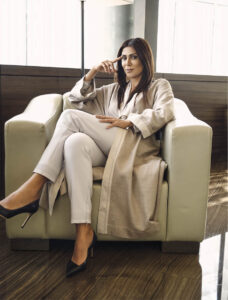
A great moment: the first women-only track day at Dubai Autodrome. Tell us about it.
The first ever event that we organised was a track day. It was the first time that women took over the Dubai Autodrome. I wanted to put women who didn’t even know they had this passion behind the wheel of a supercar, and this is where most of them realised that they could develop this passion. Because sometimes you might not have a passion because you were not given an opportunity to try it. These women had never drive fast cars before, they had been told it was dangerous etc. and this experience gave them the confidence they needed to drive. This was the first women’s-only track day with supercars, and it was an experience that I still remember. From that experience, a lot of women decided to join the club and go and buy their own cars. The cars that they’ve always been told they can’t drive and that they are better off in ‘safe’ options. So we gave them the choice to try and if they liked it they could continue to grow this passion even further.
What started as your passion became a movement. Did you ever expect Arabian Gazelles would bring so many women to feel more empowered?
Empowering women became a bi-product of Arabian Gazelles. I didn’t decide to create something that empowers women, actually for me, women don’t need anybody to empower them, but the fact that creating this platform allows them to network with like-minded women and live this passion fully empowers them somehow. Some people say it’s a movement, I say it’s a platform. We are just creating this, not only for the women in the area but ultimately throughout the world. Women who have this same passion and will drive for change. We are not only about cars. What started as a car club has become a platform or movement for change. We are changing mindsets and looking for better ways to serve the community and to do charity drives. So, we cannot say it is just a car club anymore. It has grown from that to being a platform for change.
Today carmakers are inviting you to share ideas and opinions on their new models. Are things changing in the car world too?
I have been lucky to have been to test drive different cars around the world and yes, I gladly see the shift in the mindset coming from car manufacturers who now understand that there is this group of women who can afford their cars and yet, they have not been spoken too by the industry. So, what they are doing now which is lovely to see, is inviting Arabian Gazelles for round table discussions. We have the first look at concept cars, we finally have a voice, and we are being heard. Previously, the only women you would see at automotive events were hostesses ushering people around, no drivers, no women being taken seriously. So now, they see us they know we want to drive, and we are here not to be ignored anymore. We still have some way to go, but we are already happy to see this change happening in the industry.

How would you describe yourself in one word?
Daring.
For women who would like to be part of Arabian Gazelles what is the criteria?
To be part of Arabian Gazelles, first of all, you have to be a woman! And you need to own a supercar. We sit with the members and vet them personally because we want these members to bring something to the club. No matter how many cars you have or what you can afford, at the end of the day it’s a club of like-minded women. It’s an exclusive association where the members can meet and exchange ideas and really work on changing this industry, so we want to make sure that the women joining the club have the same mindset.
How would you describe Arabian Gazelles in one word?
It’s a voice and a choice – it’s two words!
Editor In Chief: Lara Mansour Sawaya
Fashion Director: Lindsay Judge
Photography: Ziga Mihelcic
Hair and makeup: Sophie Leach
Location: Armani Hotel, Dubai
All clothing by Giorgio Armani, Spring/Summer 2021 collection.
From Palestine To The World: Oscar-Nominated Film Director of “The Present” Farah Nabulsi Discusses Her Oscar Nomination
Oscar-Nominated Film Director of “The Present” Farah Nabulsi talks exclusively to a&e on winning international awards, following her passion and representing Arab women on a global scale.
Elegant, poised and ready for anything, Palestinian Film Director Farah Nabulsi arrived on set to our shoot in Dubai like a breath of fresh air. You would never know this in-demand woman has spent her recent evenings on Zoom calls with national TV channels in the United States and interviews with top journalists in the United Kingdom and the rest of the world. One of the most talked-about women in film right now, Nabulsi is one of the few female Arab directors to be nominated for both a BAFTA and Oscar and she’s taking it all in her stride. With barely any sleep, she is running on adrenaline after an incredible few months of award nominations and global recognition for her short film; “The Present”, before she jets off to Los Angeles for the 2021 Academy Awards ceremony later this month. It’s every Film Maker’s dream to win (or be nominated for) an Academy Award, but as an Arab woman and for her first-ever film as a director, this is an even more significant milestone for Farah Nabulsi.
Farah wears : BVLGARI FIOREVER Earrings in White Gold, set with round brilliant-cut Diamonds and pavé Diamonds. BVLGARI FIOREVER Necklace in White Gold set with round brilliant-cut Diamonds and pavé Diamonds. BVLGARI FIOREVER Necklace in White Gold with Diamonds and Diamonds pave BVLGARI FIOREVER Rings in White Gold with Diamonds, and Diamonds pave. Blazer and blouse, Giorgio Armani
WATCH MORE HERE…
But when Nabulsi has her red carpet moment at the Oscars this April, it will only be the beginning of her journey. After first debuting at the Clermont-Ferrand International Short Film Festival in January of this year, “The Present” won the Audience Award for Best Film and subsequently went on to win awards around the globe. The big moment came earlier this month when “The Present” won Best Short Film at the BAFTAs as well as a nomination for Best Short Film at The 2021 Academy Awards. But while many Film Directors may strive to win awards, for Nabulsi the rewards run much deeper than that.
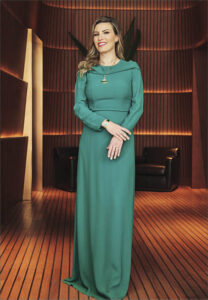
BVLGARI DIVAS’ DREAM EARRINGS in rose gold set with Malachite and round brilliant-cut Diamonds.
BVLGARI Divas’ Dream Necklace in Rose Gold set with Malachite, Diamonds, and pavé Diamonds. Special edition exclusive to Middle East.
BVLGARI DIVAS’ DREAM Watch in Rose Gold set with brilliant-cut Diamonds, Malachite dial, Diamond indexes and green Alligator strap
BVLGARI DIVAS’ DREAM Ring in Rose Gold set with Malachite and pavé Diamonds.
Dress, Dolce&Gabbana
Born to Palestinian parents in London, Nabulsi trained as a banker before working in finance and then going on to run her own company for ten years. But it wasn’t until a trip back to her home country in 2013 that the trajectory of her life took a dramatic change. When visiting Palestine, Nabulsi was faced with the challenges and struggles Palestinians face on a daily basis. She discovered how the basic right of freedom to move is heavily restricted by Israeli checkpoints in the West Bank and how many Palestinians face a daily battle doing tasks as simple as going to the shops or getting to work. When she discovered the way many Palestinians are living in the home country, Nabulsi felt compelled to share the stories of the people she met. She began to put pen to paper and describe some of the stories she had discovered through her words. Nabulsi was so deeply affected by the stories that she felt the need to do something more. Having always been interested in film, she began to teach herself firstly how to produce films and then subsequently to direct. In 2016, she founded Native Liberty Productions, a not-for-profit media production company, that aims to re-humanise the people of Palestine and draw attention to the injustices they face. “The Present” is her first film as a director but is the one that is most dear to her heart as it shares such a simple but crucial story that Farah believes the world needs to understand on a deeper level. As “The Present” continues to attract global attention Farah is already thinking of her next move as she works on her first feature film. Here we talk exclusively to Farah during a recent trip to Dubai as she shares some of the challenges, achievements and opportunities she has found on her journey so far.
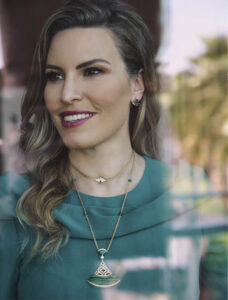
BVLGARI DIVAS’ DREAM EARRINGS in rose gold set with Malachite and round brilliant-cut Diamonds.
BVLGARI Divas’ Dream Necklace in Rose Gold set with Malachite, Diamonds, and pavé Diamonds. Special edition exclusive to Middle East.
BVLGARI DIVAS’ DREAM Watch in Rose Gold set with brilliant-cut Diamonds, Malachite dial, Diamond indexes and green Alligator strap
BVLGARI DIVAS’ DREAM Ring in Rose Gold set with Malachite and pavé Diamonds.
Dress, Dolce&Gabbana
Talk us through how you felt when you found out you were nominated for a 2021 academy award?
Honestly, I felt and still feel extremely grateful and absolutely thrilled, but at the same time, very overwhelmed. With this has come a lot of interest and attention, but also responsibility because of the different hats I wear as an individual and because of what the film is about. As an Arab, female, British, filmmaker who’s made a film about a very under-represented group of people, based on a cruel reality, there’s a lot of responsibility.
You chose to share your story in the format of a short film – what was the thought process behind this?
I think for me it was really that simple. It didn’t need to be longer than that. Of course, when it comes to the injustice and the suffering and the different parts of control systems in Palestine, there is so much more to share, but, I was zooming in on one aspect; the checkpoint and zooming in on one family. I certainly wanted to humanise the story and I think by using one father and his daughter I was able to do this. I took a really simple action or experience that anyone in the world has to do; going to the shops – could it be more simple? And I placed it into a complex, messed up, absurd landscape. So the story didn’t need to be complicated as everything else lent itself to explain the bigger picture. I think everything that happens to this man and his daughter can happen to anyone of us: it can start to rain, your kid could need the bathroom, you could suffer from a migraine or back pain etc, these are all universal situations that happen on a normal day out with your children, and you deal with them because in the normal landscape: you would hail a taxi or buy some painkillers. There are always solutions. But this story shows what many Palestinians have to go through, even for something as simple as a shopping trip. It depends where they live and on their proximity to these checkpoints, but even a simple action like this can be so traumatic, humiliating and exhausting. And that’s on a good day! What about on a bad day? What can happen then? That’s aside from some of the things that take place at these checkpoints. People have died at them, given birth, been unable to get to school, to university, to their hospital appointments. There is so much more that could have been included, but this simple story of going and coming manages to explain the whole situation in a very simple way. In its essence, it’s about freedom of movement. The freedom to go and come as you please like pretty much everyone else in the world. The most basic of human rights.
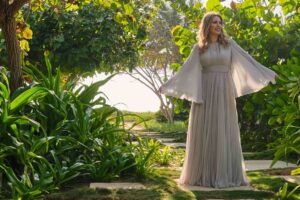
Farah wears: BVLGARI SERPENTI Earrings in Pink Gold, set with pavé diamonds.
BVLGARI SERPENTI Necklace in Pink Gold set with pavé Diamonds
Dress, Dolce&Gabbana
What is the message that you aim to share through this film?
It’s something that’s already happening and it has been for the past year as the film has been shown at festivals all around the world and I have been doing a lot of interviews with the media. In some ways, I could be called a purpose-driven filmmaker because I like to make films that have depth and meaning and raise the global social conscience around them. Yes it’s fiction but it’s based on reality and I certainly want people to consider that reality very deeply and to contemplate such a life, and I would like them to want to learn and understand more about that reality and how it affects hundreds of thousands if not millions of Palestinians every day. I’m here to have those conversations beyond the film. So ultimately what I want people to do is truly ask themselves if they would accept it for themselves and if not, then why should others? That’s really the bottom line. I want people to talk about it, learn more about it and if they feel compelled, to take action.
What was a challenge you faced while you were making the film and how did you overcome it?
When you make a film, there are so many challenges. Forget the topic of my film and where we filmed it, making films are overwhelming and exhausting! You find yourself troubleshooting the whole time and racing against time and budget and literally chasing the light! So that in itself is overwhelming and there are so many issues to deal with. Then there’s the fact that I chose to make a film in essentially occupied territory.
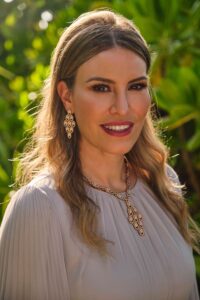
Farah wears: BVLGARI SERPENTI Earrings in Pink Gold, set with pavé diamonds.
BVLGARI SERPENTI Necklace in Pink Gold set with pavé Diamonds
Dress, Dolce&Gabbana
I wanted the film to be extremely authentic and I knew it would be possible to film in Palestine as I was directing it myself. Fortunately, the right introductions were made for me to have the right people on the ground to work with, so I chose to make the film in what is essentially occupied military territory. We were going into an unknown and it’s important to be wise about where you’re shooting and how you’re shooting. There are three zones in the West Bank; A, B and C, and in areas B and C it’s a lot harder to shoot as there are more checkpoints and more military presence. So we ended up choosing to be mostly in area A. We had to contend with things like our casting crew having different identifications and permits so some had to go through checkpoints and others didn’t. There was the problem of selecting locations. A lot of the places I wanted to film was in areas B and C which was very frustrating because those were the quieter rural areas that actually I wanted for the film. On-screen it appears that everything is quiet but behind the scenes, we were stopping traffic and dealing with noise which was very frustrating. In fact, the entire time that we were shooting in the main checkpoint, up on a hill close by was a settlement where they were doing construction and there was constant drilling. The sound on a film is really important for continuity and it was very frustrating! So this is why in the scene where the actor is in the cage, I decided to sound engineer the drilling sound that was actually existing. You can hear music and then there is this build-up of sound in the scene. That’s the real sound of the drilling and then we layered it. But it turned out to almost be representative of the character’s stress and depression. So there were all these frustrating elements because of this landscape and this dynamic. We shot scene two at a real checkpoint. It’s an infamous checkpoint called checkpoint 300 in Bethlehem where hundreds of thousands of Palestinians pass through to go to work every day. The only fiction in that scene is our actor Saleh Bakri who plays Yusef. It was a scene I felt very strongly about and I wanted it to be authentic and I don’t think I could have replicated that. We went in documentary-style and I think in some ways you could say that was quite risky, but we got incredible footage and it was really rewarding, so I’m really happy we did it. I personally put myself through that checkpoint to experience it with the masses and it’s horrendous. I think to myself to do this every day, just to earn a living – how do you come home and be with your family after that? It steals hours from your life and not pleasant hours. You are not even in the luxury of a vehicle, you are literally being herded like cattle for hours.
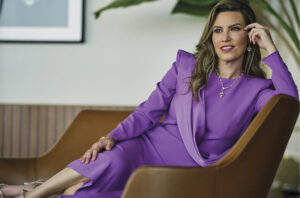
Farah wears: BVLGARI DIVA’S DREAM Necklace in Rose Gold with Rubellite, Amethyste, Diamonds, and Diamonds pave
BVLGARI DIVA’S DREAM Earrings in Rose Gold with Rubellite, Amethyste, Diamonds, and Diamonds pave
BVLGARI SERPENTI VIPER Bracelet in Rose Gold with Diamonds and Diamonds pave
Dress, Alex Perry at Bloomingdale’s Dubai
Let alone being with a child. Tell us about the beautiful girl who plays Yasmine in the film.
Yasmine is played by Mariam Kanj. She was eight years old when I met her and she is such an emotionally intelligent girl. She’s absolutely gorgeous with her huge expressive eyes and she has this confidence with adults and strangers. She’s been on sets before but she had never acted in any major roles before this. By complete coincidence, her father was the production designer on the film but I didn’t know that when she was brought to my attention by a friend. I knew that I needed to find an eight-year-old girl who was preferably living in Palestine who can act, speak really good Arabic and who ideally looked like Saleh for authenticity in the film. Anyway, I was sharing these details with a friend and she said “what about my niece?” And her niece happened to be Mariam. My jaw literally dropped because she really looks like Saleh! And so I met her at her home in Palestine and completely fell in love with her. My instincts told me she was the one but I wanted to be sure so I auditioned a few other girls but nothing compared. She was the one and it was perfect. She is so emotionally intelligent that I could talk her through who her character was and what she was going through and she just got it. I’m not saying it was completely easy of course, she was eight years old, so there were moments when she lost concentration. I brought a puppy on set for her to keep her busy! So it wasn’t always easy but she is amazing and I truly love her.
I can feel your passion and genuine approach and how you want to share such an agonising story with the world. With that passion driving you, what brought you to this industry?
My background is not in film, I didn’t go to film school. My background is actually very much in business and finance. That’s what I studied and ended up working in and then I ran a business for around ten years and honestly, the very short version of why I changed the trajectory of my life and chose to become a filmmaker is that I went home. I am Palestinian by heritage and I was born and raised in London. I had visited Palestine as a child a number of times and then for around 25 years, I didn’t go. And then I went back around eight years ago for the first time as an adult, and I can say that that initial experience and the trips that followed, had a very profound impact on me. What I thought I had understood of the situation of military occupation that exists in Palestine was no substitute for seeing it with my own eyes. So I started to write therapeutically about what I had seen and felt and a couple of years later I felt this deep desire to tell these human stories that are so unheard and have been silenced. This was paired with a deep desire to express myself creatively. I’ve always loved film and I’ve always been a storyteller from a very young age. I also feel that Palestinians have been severely dehumanised, and art is the most powerful way of rehumanising them and touching people’s hearts and telling human stories in a way that can resonate. So, I adapted my first few writings and produced them as short films and then I decided to direct my first film.
I had been asked throughout my journey ‘why aren’t you directing?’ And it was because I didn’t have a formal education in it, but it was something I would love to do, I just didn’t know the technical side at that point. I was learning on set while producing and I had always been very involved in the creative side of the films that we had been making, but I was certainly not the director. But when it came to “The Present” I could really see the whole image of the film and I knew if I was going to have my debut as a director, this would be the moment. And that’s how it happened! I learnt a lot, read a lot of books, talked to a lot of people about it, researched, watched interviews with directors, and just trusted myself to do it. Because I’m so emotionally connected to the story and feel so strongly about the message I’m trying to share, I think it was naturally conveyed through my work onto the screen. Of course, I had a wonderful team around me and as a director, you work with everyone in that team on every detail but as the director, you are leading the ship and I felt so passionately about that and the story I was telling.
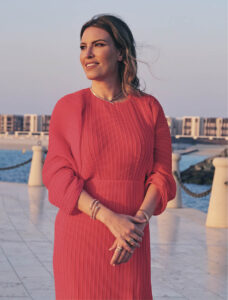
Farah wears: BVLGARI Serpenti Viper Necklace in Rose Gold set with semi-pavé Diamonds
BVLGARI Serpenti Viper Bracelet, two-coil, in Rose Gold set with pavé Diamonds
BVLGARI Serpenti Viper Bracelet, in Rose Gold set with semi-pavé Diamonds
BVLGARI Serpenti Viper Ring, two-coil, in Rose Gold set with pavé Diamonds
Dress, SOLACE London at Bloomingdale’s Dubai
This is such a huge milestone in your career, what is it that you still aim to achieve?
Honestly, awards and accolades are great of course and it’s wonderful to have your work acknowledged, rewarded and recognised. But my ultimate goal is always for the actual film to be seen. The fact that it is streaming on Netflix worldwide for example for me is a huge accomplishment. I never set out to win a BAFTA or an Oscar. What I have always been aiming for is to develop my first feature film and that’s something that I’m working on at the moment. I feel even more passionately about this film and telling the story than any of the past films I’ve made, and I want to make it with every bone and drop of blood in my body.
What are the challenges you face as a woman in the film industry?
For me, it was never about feeling challenges specifically as a woman. There are issues in the industry that I can see very clearly. I come from an investment banking background working in the City in London in a very male-dominated industry. So I learnt to have a very thick skin and to stand my ground and demand my respect and my place. So I think I brought a lot of that to filmmaking and to being a woman in film, but I certainly know that women in filmmaking experience a lot of difficulties. This can be from accessing budgets and finance to having respect and being taken seriously by what is a very white male-dominated industry. But from my experience, I can’t complain.
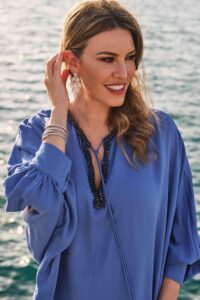
Farah wears: BVLGARI Serpenti Earrings in White Gold, set with pavé Diamonds.
BVLGARI Serpenti bracelet Viper, one-coil, in White Gold set with full pavé Diamonds.
BVLGARI Serpenti Viper Bracelet, two-coil, White Gold set with pavé Diamonds
BVLGARI Serpenti Viper Ring, two-coil, White Gold set with pavé Diamonds
BVLGARI Serpenti Tubogas Watch single spiral with rose Gold bezel, set with brilliant cut Diamonds, black Opaline dial, Rose Gold
BVLGARI Serpenti White Gold Ring set with a blue Sapphire on the head, Emerald eyes and pavé Diamonds
Kaftan, Max Mara
Tell us a little about Farah Nabulsi as a person.
My mother was born in Palestine and she moved to the UK where she met my father who was there doing his PhD at the time. I was born there and we were raised in what I consider a wonderful, privileged happy home and life in London. And we are blessed in that sense. My parents never let me forget my heritage. I consider myself to be a compassionate and sympathetic person and someone who is ethical. But as I’ve gotten older and I have the chance to reflect on all the blessings and skills I have learnt, the word responsibility has taken a whole new meaning for me. This word responsibility if you break it up means having the ability to respond and I came to a place where after my trips to Palestine, I felt I had a responsibility and the ability to respond, as a Palestinian who has had a blessed upbringing with freedom and education. I think I’ve gone through a big turning point in my life related to what I want to use my life for and the kind of work I want to be doing. So I can actually say that I’ve changed and matured in so many ways in these past ten years. In terms of what’s important to me, it would be my work and my family. I love to laugh and I am a very outgoing person but I wouldn’t say I’m a particularly social person in terms of being out and about. I have key friends in my life that I don’t have to see so often to know that they are there for me and I’m there for them. I’m quite selective in terms of who I spend quality time with. I love sports! I’ve always been a very sporty person. I care about my health and I love to laugh.
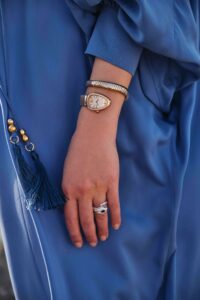
Farah wears: BVLGARI Serpenti Tubogas Watch single spiral with rose Gold bezel, set with brilliant cut Diamonds, black Opaline dial, Rose Gold
BVLGARI Serpenti White Gold Ring set with a blue Sapphire on the head, Emerald eyes and pavé Diamonds
Kaftan, Max Mara
What do you do to disconnect?
Well, I’ve always loved film and the greatest part of my job is that when I am watching films and series, I can now say I’m working which is wonderful! That has always and still is my chill-out time but now it doubles up as work! Of course, I now watch everything with a filmmaker’s eye which I never used to do and that certainly changes the way you perceive and enjoy films, it’s a very different experience, but I still love doing it and I still do it to disconnect. I love to read and doing sports is also a big disconnection for me. Actually, I have some of my best moments of inspiration while I am exercising, and it is something really important that allows me to disconnect from the stresses of my work and the stresses of the subject of my work.
What inspires you?
I think a lot of my inspiration comes from the resilience of others. When I see people rise above, injustice or indignities and somehow find their space and speak their voice, that’s what inspires me. People who against the odds can rise above and strive and be steadfast. That is hugely inspirational to me and it’s certainly what drives me and my passion for what I do.
What would be your advice to creatives in the Arab region?
My advice to the creatives in the region is to be bold, unapologetic and be themselves. We have so many stories to share and when you offer the universe something, the universe opens up to you.
What is the motto you live by?
One thing I refer to again and again is the title of a book by Susan Jeffers: “Feel The Fear And Do it Anyway”. I love and believe that. It’s OK, to feel fear, but go ahead and do what your instincts and gut push you to do.
A second quote that resonates with me is by Charles Bukowski. “If something burns your soul with purpose and desire, it is your duty to be reduced to ashes by it.” I love that.
A Tribute to Alber Elbaz
“Without Passion there is Nothing”
As we learn of the tragic passing of fashion designer Alber Elbaz, we pay tribute to his legacy and revisit his last interview where he discussed, happiness, passion and the future
French-Moroccan fashion designer Alber Elbaz sadly passed away in Paris on 25th April 2021 after a battle with COVID-19. Throughout his career, the designer has become an icon in the industry and his mission to make all women feel beautiful, happy and confident through his designs is something that will touch women around the world forever as his legacy continues to live on.
Most widely known for his revival of French fashion House Lanvin, Elbaz took the brand from a relatively known fashion house to a global fashion giant in his reign as Creative Director. Born in Morocco Elbaz began his career in fashion after moving to New York in the 1980s but he had long been sketching fashion designs, drawing dresses from the age of seven in his own iconic style. In New York, Elbaz worked alongside American designer Geoffrey Beene for seven years as his senior assistant, before moving to Paris to work for French fashion house Guy Laroche. His first big break came when he was appointed Creative Director of Yves Saint Laurent in 1998 where he worked for three seasons until he began designing for Lanvin in 2001.
Over a 14-year period, Elbaz became synonymous with the elegance and femininity he put into his designs, and off the catwalk, he was known for his infectious personality and desire to make every woman feel beautiful. In October 2015, Elbaz announced that he had been let go from Lanvin after an internal disagreement. It was a major blow for the designer and the industry but there was one guarantee – Alber would be back bigger and better than ever. His first return to fashion was through a collaboration with Italian luxury brand Tod’s. Alber worked on a limited-edition collaboration of bags and loafers for the House in 2019.
Later that year it was announced that Alber would join forces with Richemont group to launch a new fashion house that would change the way women purchase and understand fashion. It was just this year that Alber returned to our screens as he presented the first collection for AZ Factory in February. Set to be one of the most game-changing projects the industry has seen, Elbaz wanted to create a new way of purchasing and a brand that catered to the needs of all women, no matter their shape or size, combining technology fashion and entertainment in one concept.
Alber Elbaz walks down the runway at the Spring 2004 Lanvin show in Paris.
While Alber may be gone, his legacy will live on in the hearts of all that knew him and many who didn’t. From his family and friends to those in the fashion industry, to all the women around the world that were touched by his magic and made to feel beautiful in his designs.
After his return to the industry, Alber has only given a few interviews and A&E was pleased to talk to the designer on happiness, the future and his passion for design as he launched his collaboration collection with Tod’s.
We revisit the beautiful interview below as his memory continues to live on through his words that will never be forgotten.
Tell us how this project came to life and what are the common codes that you share with a brand like Tod’s?
I actually turned down working with them for two years. I was taking time out and I wasn’t sure I could do it, as it’s not my comfort zone. I’m not a shoe designer. So I asked: ‘why me? There are so many better people than me.’ But Diego Della Valle (Chairman of Tod’s group) insisted and so I did it.
At first, I thought to myself ‘I have no idea what I’m going to do’, and then there’s a moment where you become very humble because you are almost lost in the forest and there and you don’t know which route to take. This is the moment when God helps you. All of a sudden you start asking questions and talking to people and you realise what you should be doing. In Paris and all over the world, so many roads are becoming pedestrianized, you see more and more people are walking and you see how shoes are becoming the new cars – everyone is using their feet again.
So I started working on the collection. First, I took the sneaker that is the most important and fashionable of styles because it is a very pragmatic piece in the wardrobe. It has almost become more vital than the ‘It’ bag. Comfort is so important to women and in a moment when women are also fighting for equal rights and freedom it is even more crucial. When I was at Lanvin, we were the first ones to introduce ballerina shoes many years ago and we were the first ones to introduce sneakers because I have always believed in comfort. I think also as an oversized designer, comfort is something that I’m very aware of. Because I’m larger, I try to wear and design pieces that are very light because it creates a fantasy. If you see a designer that loses weight, they go from chiffon to heavy fabrics!
Personally, I don’t work with focus groups or marketing people, I work with what I love and I have a great team. There was one girl helping me in the factory – she ordered the fabrics, she helped me to choose the colours, she was there the whole time and I don’t want people like that to be forgotten. So I invited her here for the launch in Paris.
Once I do a collection I don’t like to look at it because all I see is mistakes. And that’s a good thing because once you don’t like it anymore you know that you are ready to go to another project. If you like it too much then you’re stuck. I think mistakes are beautiful – I like people who make mistakes and have opinions.
You have spoken of how we are all seeking happiness – can you elaborate on this?
I meet a lot of people and they tell me that things are so hard – and I question – ‘how are we, an industry that has to make everyone happy not happy?’ That kind of gave me the idea for this collection that was called “ HappY moments”.
What makes you happy?
Moments and people.
What state of mind are you in when you are designing?
You know sometimes when you wake up in the morning and you just have this feeling! My process starts with having an idea that is one-dimensional, making it three-dimensional and then adjusting it to real life. Then you have to look at it with your eyes, in a mirror and in a photo and ask yourself what is more important – that it’s going to look good in a photo or on the body? There are some things that look great on a woman’s body but in a photo, they don’t look good. A corset can look good – but try to move in that, try to sit on 50 metres of tulle. Imagine when women wear gowns to the Oscars – they have to come in buses because they can’t fit in cars and they cannot sit! So you have to know what you are designing for.
The media have always loved you for your honesty – what is your relationship with them now and your take on what is happening in the industry?
When it comes to the media I don’t work on commission and I’m not selling anything. I believe that we have this kind of triumph of marketing and communication. Everything is everywhere all the time so as a journalist, you are being bombarded by everyone and it’s too much. A lot of journalists are women who are sensitive but also smart. So they know who is a key success and who pushes them and I think they are sensitive to that, so that’s what I’m doing. I’m not reading articles about what I do – unless it’s a bad review. Because I don’t want to believe in it, so I don’t want to see. I only read the bad ones!
It’s almost like you want to learn from what didn’t sell. You ask yourself why? Sometimes it can depress you because you think ‘maybe I haven’t done a good job’. We’re living in a time of followers where people want to see what they know, almost like a DJ can design a collection today – he just has to express himself and say ‘this is me’. But sometimes, we have to have new ideas. We have to come up with innovations and statements and really change something and for me, this is the difference between a DJ and a composer. A composer has to start from scratch and come up with something completely new and different. This is the part that’s very difficult and that takes all the energy.
What is next for you?
It’s a good question! I think that fashion today is moving very fast but the system is not very fast. So everything is new every season – six times a year now – but the system is not new. There are so many clothes and collections that women cannot digest it. Before you arrive at the store it’s already on sale and there’s already the next collection. I think women are confused because there is so much.
Also, you’re not going to go in December to try a bikini. But all the bikinis are there. If you go in summer to buy a summer dress, they’re all on sale. Why would you want to buy a summer dress in January? How can people not see this? I am starting to see changes. The department stores are living a hard moment, digital is affecting stores and also print magazines. So I see that there are changes and I’m very optimistic about it.
That brings me to myself and to my future. For me, I have to really fall in love with the people in order to say ‘I do’. I cannot fake a relationship – if I don’t like the people I cannot work with them. This can be a problem because I don’t know how to separate work from my emotions. I like to be very involved and I’m very much a people person. I met with some people recently that I used to work with at Lanvin – they are all working at different brands in high positions and I asked them how they are and they all said ‘we’re OK but it’s not the same’.
I think that what I bring, because of my personality, is that people first like me, then they hate me, then they don’t like me, then they love me forever! Because at first, I’m nice and easy-going so they like me, then they see that I’m to the point and I like perfection in work so it is tough, but then they see that I’m direct and will never do anything behind anyone’s back. If I have something to say I will say it to you, and this is something that I bring to a company. I bring energy. This is what the people at Tod’s have said to me – that I bring great energy and it makes them feel really happy. I’m happy that I make other people happy.
Is there anything in life you would have done differently or still want to achieve?
There are two things. Firstly, I want to be happy with myself. I think it took me some time to find myself again. I took some time to miss fashion; I was burned by fashion so I didn’t want to touch it for a while. I have a scar inside and I believed I didn’t want to come back. But when I recovered, I remembered that I love fashion people, I love the industry and I love women. I am a Gemini so I’m always about contradiction. On one hand, I love to make beautiful clothes, really exquisite clothes – not for a photo but for women to really wear, for their bodies and for their needs but not like a couturier – I want to make them dream because what I sell is a dream, but I don’t want to do it too many times a year because then you lose the joy.
Secondly, I always wanted to do some kind of project with technology because that’s what is changing the world. I think that if you take a piano you have just a piano, but when you bring a pianist with emotion and know-how then you can create music. I have been offered many jobs and I have said no. Some jobs I wanted and they didn’t offer them to me, but many were very hard to say no to, but I did. Because as Nelson Mandela said ‘winners are dreamers that don’t give up’. I have my dream and I want to be able to help women with solutions. That’s my project and where the technology will come in, but it’s very hard for me to find people that understand what I’m doing because people only want to do what they’ve done.
I’m meeting so many people around the world and I want to pioneer something that will be different for women but it’s very hard to find people who understand my vision. I think the biggest problem of fashion today is the lack of taking risks. People do not want to take risks. That is probably why I took on this project with Tod’s as it was not like I had to answer to a board of directors – I asked Diego if he liked it, he said yes, I said ‘okay, we can do it’. I didn’t have to meet a board and a marketing team and a focus group. I respect people, I always have. When I went to Saint Laurent they loved me because I didn’t destroy what had been done for forty years, I did the same at Lanvin. I am a very respectful person to what has already been created.
How important is passion in what you do?
For me, without passion there is nothing. Without passion, there is no relationship, no innovation, no project, no fashion. Passion is a very important thing. Sometimes over-passion can kill something but you need to know how to find the middle ground.
Caroline Scheufele Co-President and Artistic Director at Chopard Presents The New Happy Sport Campaign Starring Julia Roberts
Chopard begins a new chapter of its Happy Sport collection as Co-President and Artistic Director, Caroline Scheufele partners with Hollywood icon Julia Roberts to mark the occasion
In 1993, Chopard’s Co-President and Artistic Director, Caroline Scheufele created a watch that would become an icon. The Happy Diamonds Sport which innovatively combined steel and diamonds was first coined by Caroline Scheufele’s mother, who exclaimed upon seeing them: “These diamonds are happier when they are free” as she witnessed the dancing diamonds around this watch. Created with happiness in mind, this watch has survived almost three decades, preserving its modernity and becoming an icon in its own right. This year, Happy Sport returns in the form of Happy Sport the First: two 1,993 and 788-piece limited-edition re-releases of the very first watch presented when the collection was launched, as well as the new Happy Sport 33mm which for the first time features a 33mm case, inspired by the ‘golden ration’ principles of aesthetic harmony.
The re-release pieces pay faithful homage to the icon thanks to its legendary diamonds and its “pebble-link” bracelet while adding major innovations: a new case in Lucent Steel A223 redesigned in a 33 mm diameter inspired by the principles of the golden ratio, as well as the Manufacture Chopard 09.01-C movement with automatic winding. In 1993 this modern watch was designed to accompany women in all their day-to-day activities from sports, to work to leisure and the decision to re-release it is perfectly aligned with the busy and multi-functional lives of women today.
Alongside the re-release pieces, the 33mm Happy Sport starts a new chapter of this icon. This watch is available in seven new references in a variety of models: four two-tone featuring a Lucent Steel A223 case embellished with ethical 18-carat rose gold, and three entirely crafted from ethical 18-carat rose gold, available on a leather strap or metal bracelet. An eighth version in ethical 18-carat white gold is entirely set with diamonds.
Feminine and playful, technical and precious, timeless and modern, the Happy Sport collection embodies the values of successful women today. And a collection such as this needs a successful woman to represent it. Caroline Scheufele chose Hollywood actress Julia Roberts to front the campaign for the collection. A contemporary icon whose powerful life force inspires her to respond to the world with her inimitable and never-failing smile, Roberts embodies the vision and values of this collection. We find out more about the campaign and the latest collection with Co-President and Artistic Director, Caroline Scheufele.
Why did you choose to work with Julia Roberts for the new Happy Sport campaign?
As we are celebrating happiness, my team said it would be nice to have an ambassador with a beautiful smile and immediately Julia Roberts popped into my mind because when you think of all the movies she has made and she always has this beautiful smile. I first met her in Cannes when she was wearing Chopard and she’s not just a happy face, she’s also a very positive and happy person from the inside. Everyone thought I was crazy because Julia never does anything for any brand, so we approached her and she loved the idea of having the diamonds dancing around and the whole concept, and here we are!
This watch is truly an icon…
Indeed, If you don’t reach for the stars you don’t get them!
Tell us about the new campaign and what you had in mind when putting it together.
Well, we have an icon (Julia Roberts) for an iconic watch. It’s something that has been around for 30 years but is as modern today as it was then. When I first designed the watch there were a lot of questions about how we could put diamonds into a steel case – it was something that you don’t do – but it has outlived generations and is attractive to all age groups. And this is why it can be called an icon. This is also why we chose Julia because she is someone that is known to all generations. Everyone has seen at least some of her movies. I think what makes something iconic is when something lasts and becomes special over time. It’s like the Coca-Cola bottle for example – you can take the sticker off and you still know it’s a Coca-Cola bottle – that’s a timeless and iconic design that no one would ever change. It’s is the same idea that we have with this watch.
What is the message you want people to get out of this campaign?
Well, we have Julia and a lot of other friends of the house who are involved. We held back for a year with this campaign because even though everything was ready to go, somehow it didn’t feel right to launch in the middle of a pandemic because it was not the time to put out a message that says “be happy”. But I think now is a moment where we are coming out of the tunnel, and it’s a time when people really want to enjoy life again. We are all trying to turn a page and be positive. Not forgetting to be careful and respectful of the rules. So I think now it is OK to send happy messages and that’s why we decided to launch now.
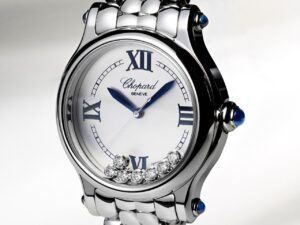
The Red Carpet high jewellery collection is something we look forward to every year – what can we expect to see from that collection this year?
Even in 2020 when we were in the middle of the pandemic, we launched the Red Carpet collection. Despite not having the pleasure of being in Cannes to share it personally with the world, we did it because it’s also important for the ateliers to have a goal. They are creative artists and they need to be creating, not working at home on a computer. So out of responsibility to the brand and my team and the artisans in the high jewellery department, we have to continue creating. So, for this year, I had the idea to create the collection under the theme of “paradise”. Last year we had the theme of nature and paradise is very close to this but when you think of paradise it can be a lot of different things. Everyone has their own paradise.
It’s amazing how your stories are so intertwined and interconnected each year and we know you have a love of nature, tell us a little about that.
Last year we worked on the theme of nature which is something so important to humans and we are realising that a lot of things have happened because we as humans are not respecting nature. So that nature collection was very much in the works before anybody was talking about COVID. I love to stay close to nature and I love it even more now because I’ve been able to finally enjoy my home, my dogs, and be in nature a lot more. I have been noticing things I haven’t seen before because I was always so busy going from one place to the next. I was always on the move. So for once, although I do miss the travelling, the last year has allowed me to have more time to see my parents and my family and to be even more inspired. I hope people will remember this time and think twice before taking actions in the future. Many positive things have come from this time and we are enjoying the little things so much more. So when I approached the team and told them about the idea for this year’s red carpet collection we realised that everyone has their own image of paradise, it’s much more than just the planet, it’s the universe, it’s about fairy-tales, it’s a poem, it’s a lot of things. So yes you can expect some very nice pieces.
What is a big challenge you have faced throughout this year and what do you have in mind on how to overcome it?
Of course, a lot of markets have been completely shut for most of the past year. But thankfully some markets are doing very well including the Middle East as well as China. Others like Europe are suffering because the shops have been shut for so long and no tourists have been coming. But we have implemented a lot of changes in the way we work. We have done a lot more sales online, we have more platforms to talk to clients over digital means, be it Zoom or WhatsApp. It’s completely different and we are using a lot of new technology which we have never had to use before because watch and jewellery making are very conservative compared to perhaps fashion which has already gone down that road. It is an emotional industry but there are ways that we can guide clients over digital means and then we send them the pieces and while they have it in their hands, someone else in another country in the boutique can explain in more details. So we’ve done a lot of crazy things actually that we would not have thought possible. If you had asked me two years ago if we would do these kinds of things I would have said it was insane, but I think human beings can adapt a lot. In situations like the pandemic often when things are over, you come out stronger. It depends a lot on mindset, but I think it’s also a time to sit back and think and have a new vision. You also realise what is important and what really matters and what is irrelevant. We know now that health is number one because if you’re not healthy, you can’t do anything, and I think we have had a bit of a wake-up call where the whole world has sort of stopped. Nobody was excluded from this situation, whether they are Royal or rich, this virus affected everyone, everywhere and nobody saw it coming. I hope when life goes on and starts again that people will be more human, listen to their surroundings and if they are in a fortunate position, help the less unfortunate than them
What is in the pipeline for Chopard in the Middle East?
Well apart from launching Happy Sport! It’s a very much-loved collection in the Middle East so there will be some unique pieces coming along with that. Then we have just had Watches & Wonders where we showed our latest novelties. The L.U.C collection for men is celebrating 25 years this year, so in autumn we’ll have a lot of buzz about the men’s mechanical world, and of course, we are going to paradise!
What is a message that you would like to send to your friends and clients in the Middle East?
First of all, I would like to thank them for always being very supportive of the brand and of course of myself. I will hopefully be able to astonish all of our fans and clients for the next decade to come and the real message is: be happy and stay safe. When I say happy it means to be happy with yourself, be nice to yourself, appreciate your family and your loved ones because that’s what really matters.
By Lara Mansour Sawaya
Stuart Vevers, Creative Director at Coach on His Future Vision For the Brand
Stuart Vevers Creative Director at Coach on why he’s creating sustainable and forever-lasting products that will become the vintage luxuries of a new generation.
Stuart Vevers is one of the most experienced designers in the fashion industry. His first job was at Calvin Klein, followed by positions in the design teams of Bottega Veneta, Givenchy and Louis Vuitton, where he worked alongside Marc Jacob. He then went on to join Mulberry as Creative Director in 2005 and he became Creative Director of Loewe in 2007. His vast experience led him to join Coach as Creative Director in 2013 and bring his vision to the American brand. Since joining Vevers has worked to transform the brand, introducing ready-to-wear collections and opening a whole new chapter for the house. He has masterminded iconic collaborations with Selena Gomez and most recently, Jennifer Lopez, allowing the brand to expanded on an even greater scale.
Coach’s strong roots in leather craftsmanship mean that Vevers was welcomed by a decades-long archive to delve into as he pleases and his approach is to combine the rich history of the brand with today’s trends and the needs of the modern woman. His latest collection Coach Forever does just that. Looking at the past, present and future the Spring/Summer collection focuses on long-lasting designs as well as putting sustainability in the forefront. We discover more about the latest collection as well as Vevers’ plans for the future of the House
We have seen a more youthful approach to the brand over the last few years – what can you tell us about your vision and how you have put that into practice so far?
My vision since I joined Coach has always been to reimagine the house’s heritage through the lens of now, juxtaposing our legacy in craft with pop culture and personal expression. I think a lot about what luxury and fashion mean to younger generations because it is often their collective mindset that is shaping the world. Today, what I think is important is more about an attitude and less about perfection –– a distinct attitude that enables a sense of belonging as well as individual expression.
Since I joined Coach, I’ve changed a lot of things to put my vision into practice, like introducing ready-to-wear collections and runway shows, working with Juergen Teller and Renell Medrano on our campaigns, reimagining our stores and introducing our house mascot, Rexy. I have also rethought the way we create, focusing on responsible approaches and sustainability, introduced vintage and upcycling, and built a unique community through our Coach family and friends. All of these things are about creating a world and a head-to-toe look that is grounded in the authentic attitude of New York. It combines the codes of American sportswear with a sense of individuality through special pieces that feel like one-off magical finds. There’s also a feeling of ease, joy and nostalgia which is optimistic and youthful.
This global pandemic has been a learning curve for many – what has come out of the crisis for you?
Like most people, the times we are living in forced deep reflection about what matters most to me. Our responsibility to people and the planet, the lifecycle of fashion, our communities — this time has become an opportunity to accelerate these things. I thought, “If not now, when?” It was very instinctive. We faced many new challenges when creating our collections, presentations and campaigns: the realities of working from home, of not being able to collaborate together in the same space, of dealing with continuous change. We had to rethink everything, and that actually became liberating.
What can you tell us about the spring/summer 21 collection “Coach Forever”?
The early inspiration for the collection was actually quite specific, grounded in New York’s Upper East Side. But as early 2020 evolved, many things we were working on just felt (if I’m really honest) irrelevant, and small. We naturally started to pivot, to think differently. It was very instinctive, but at a certain point some things didn’t feel right, and we had to dig deeper. The result of this is a collection that rethinks seasonality and is grounded in responsibility, renewal and reduction. It features new techniques like vegetable-tanned, naturally-dyed leather, recycled materials that give a second life to plastic bottles, thoughtfully upcycled pieces, vintage and archival designs.
How important is it to preserve traditional leatherwork and craftsmanship at the brand?
Before I came to Coach, I worked at traditional European luxury houses, where I learned everything about craftsmanship and creation. Craftsmanship will always be important to me when I design, as it’s something I love and have deep respect for. Coach has a legacy built on its leather craftsmanship, but at the same time, the house has an un-precious approach which I find modern, fresh and inspiring.
Are there any periods in the archive of Coach that you are particularly inspired by?
It would have to be the Bonnie Cashin era of the 60s and 70s. Bonnie was Coach’s first lead designer, and it was her vision of clever functionality, colour, simplicity —and also, her sense of humour — that defined the house. Over the years, I’ve remade and reissued many of her bags: the Shopping Tote, the Dinky, the Duffle, the Saddle Bag and the Barrel. They continue to have appeal and relevance today as much as they did fifty or sixty years ago. In the spring collection, I also recreated archival pieces originally designed by Bonnie, from her days beyond Coach. I wanted to pay tribute to Bonnie’s legacy more broadly. This year marks the 80th anniversary of Coach, and so it felt like the right moment to recognise Bonnie and the huge impact she made, not just at Coach, but more broadly in fashion.
How did you find the process of creating this collection throughout unprecedented times and did it have any influence on the collection and your creativity?
The challenges my teams faced were the challenges that many have faced during this time — the realities of working from home, and not being able to collaborate together in the same space and dealing with continuous change. And rethinking everything. Personally, I find change energising because it’s an opportunity to be creative, and to solve problems creatively. I have been genuinely amazed by, and grateful for, the tenacity and creativity of my teams as we’ve discovered new ways of working together and doing things.
Of course, responsible fashion is a key topic today – what can you tell us about yours and the brand’s approach to producing responsible luxury goods?
As part of my vision for Spring, I wanted to explore and introduce more responsible materials; our original natural leather, up-woven bags, and bags made of recycled materials. More broadly, though, our position on sustainability at Coach is grounded in the idea that everything we make is crafted to last and intended to be worn and loved for generations, and then passed down. This refers to the craftsmanship of our bags, the materials and quality standards that ensure they will last. I like to think of our products as “future vintage,” pieces that will have relevance many years from now, as we’ve seen with the bags from our archives. With every collection, my team and I are exploring new ways of designing more responsibly. It’s an iterative process grounded in designing, exploring, and learning.
What is your professional motto?
One of my favourite mottos is from a print by the artist Anthony Burrill: “Work hard and be nice to people.”
What is something you would like to achieve this year?
Like many of us, I’m looking forward to being able to see in person many of the people I love. Last year, I became a father to twins, and so one of the things I’m looking forward to is introducing my parents to their grandchildren as soon as it is safe to do so.
Why do you feel it’s important to highlight the history of the brand and how do you go about balancing the past but still keeping it relevant for today’s customer?
One thing I really love about designing for a house with a legacy like Coach’s is that there’s a story — and an existing emotional connection — that I can explore. Coach has an authority in leathercraft, but more than that, it has a rich history of marking moments in people’s lives. Ever since the beginning, Coach bags have been designed to last, which means they are often thought of as keepsakes, the kind of pieces our clients will wear for years, and then pass to the next generation. So, while it is always important for me to evolve the house and reach new audiences, it has been equally important to honour the stories that have made the house what it is over the years. It’s a narrative that comes with a lot of emotion and feeling and inspires my designs.
What is something you would like to see taken further when it comes to sustainability in the manufacturing of luxury goods and what is your next step at Coach when it comes to ethically producing products?
Often when we talk about sustainability in our industry, what we are talking about is doing minimum damage in the way we source materials for, and craft our products. The next step that I’m eager to explore is regeneration — processes that actually heal the planet as we create things, instead of depleting it. An example of this is the Original Responsible Leather my team developed for Fall 2021. Locally sourced from the farms where the cows were raised to the ingredients used in the dyes and finishes, it was made in partnership with a family-run tannery that supports responsible farming practices that prioritise soil health. Soil health is vital to life on earth and sustaining it. It is where nutrients are cultivated. Healthy soil also captures carbon from the atmosphere. It’s materials and practices like this I want to pursue more in the future.
What is the biggest challenge you currently face?
The challenges I am currently facing are the challenges that many of us are facing, such as not being able to see loved ones in person, and living with a degree of uncertainty. In the challenges, though, I’ve been able to find a kind of optimism, hope that these times will inspire meaningful and positive change. I remain hopeful for a better future and believe that these times have encouraged dialogues about our responsibility to one another that have needed to happen for a long time.
Sheikha Amal Al Maktoum Founder of Azzalia on Her Passion For Design
Sheikha Amal Al Maktoum’s passion and love for what she does is her greatest asset. She is a businesswoman by heart who could and in many ways has, tried her hand at anything.
After graduating from college with a degree in business, Al Maktoum began working for her university in Dubai, helping graduates to start their careers. With no professional design training, she used her experience and knowledge of starting a business combined with her passion for fashion to start her own brand. Azzalia incorporates three lines, named after Al Maktoum’s daughters; Daisy by Azzalia is the casual, affordable line, Lily by Azzalia is mid-market, and Iris by Azzalia is her couture line.
In 2017 Al Maktoum was invited to present her Iris line at London Fashion Week after winning a competition in Dubai. The designer had just two months to complete a collection before it was shared with the world. After the success of her show, Azzalia has continued to become more and more popular in the region, with designs on offer to meet the needs of any woman. Fusing traditional silhouettes with a contemporary twist, Al Maktoum designs with women of all walks of life in mind. As we meet with the designer in Dubai her passion is immediately infectious and we discuss in depth her upbringing, her desire for design, her love for business and her wish to help others in the future.
How did your upbringing in the UAE shape your passion for fashion design?
I was privileged that my parents gave me the space to exercise passions and work and develop my personality to become the person I am today. I graduated from college in 1995 and at that time when we had to choose what and where to study there weren’t many options, so it was a challenge. At that time people were not so open to their daughters travelling abroad to study but to be honest I don’t regret studying here in the UAE at all. We had an excellent education system that was designed to prepare women for work and gave them confidence. At that time, you could not graduate if you had not done an internship so it was required for everyone to go out into the workplace. My internship was special because I did it in something I was interested in at Emirates Environmental Group. When I went to do this, I really started to see my personality shaping up. I always had the support of my parents. I was the only girl so my father would always support me. For my bachelor’s degree, I was required to do an extra year of working to prepare us for life. At first, I started to work at my father’s company but when I went back to the college to enrol, they wouldn’t accept this because I was working for the family company! So, I had to find somewhere else to work. I went to the Dean and she gave me an idea to work at the careers centre at the college. So, I started working from 8am to 5pm for a whole year. It was such an experience. I was involved in career counselling and guidance so we would prep women to go into the workplace and we would help them to find internship opportunities. It was my ultimate happiness; it gave me the satisfaction that no other job could. This shaped my personality and I thank my parents for that because they let me work in a field that gave me confidence and empowerment.
Eventually, I got promoted to professor level in the faculty and worked there for five years before I moved to Sharjah Women’s College to take on a role that involved working with students directly and empowering them through creating sports teams, councils, events etc. The age gap between myself and the students was very small, so I had some great experiences. I wanted to establish and find myself. I also served six years as the Vice-Chairman of the Sharjah Businesswomen’s Council. Then I got married and left and soon got pregnant with my first daughter and at that point, I decided to open a fashion brand.
What brought you to fashion?
I always had an interest in fashion. My dad was very cool and stylish, and he inspired me! He always liked to be unique, and he has a character that was very inspiring. Even though I have always loved fashion I never thought it would become a business. I always thought it would be such a responsibility and very challenging. But I do think when you study business it prepares you for any industry. I created my first brand with a partner which ran for eight years. Then I decided I wanted to do my own thing – I wanted to have my own DNA. So I started Azzalia. It took me two years to establish. The brand is split into three lines Iris, Lily and Daisy. I believe that any woman who enters the Azzalia world will find something she needs within these three lines and their different price points and levels. Everything is of high quality, but the lines differ. From a business point of view, couture does not pay the bills, that’s why it’s important to have an offering of different price points. It’s a lot of hard work but I’m all about challenges.
What were the major challenges that you faced at the beginning and how did you overcome them?
I think I was quite lucky. I think the diversity in my experience prepped me for anything. I saw how businesses are developed and I was there to support them, so the exposure and experience I had, enabled me to prepare myself for my own business. I wanted to launch my brand as three lines and that offered diversity. I made sure that the brand, as much as it is stylish and trendy, it is also timeless. If you look through the pieces in all of the collections, you will see that they are timeless and transformable.
What in your opinion makes a timeless design?
Firstly, quality is key. And you have to study the silhouette. There are pieces that can be both trendy and timeless. Pieces that I could wear but I could also give to my grandmother. They will always come back around. Whenever I am looking at inspiration for any collection, as much as the trend aspect is important, timelessness is key.

How does the design process begin and how are you inspired?
I travel twice a year to Premiere Vision. I look at the trends, at all the new suppliers, new fabrics, I do my full research, I buy all the trend reports and then I go back to Dubai and I gather everything. I am obsessed with fabrics. I don’t let anyone do this job for me. I travel by myself and discover all of the beautiful fabrics. While I’m doing this, often I get the inspiration for the collection – it could be something as simple as a button or a picture. I like to be involved in everything – I paint, I do photography, I write press releases – all of this would not be possible without the support that I had from my parents and now of my husband. My husband and my kids support me through everything.
I don’t want to be completely out of the trends, but still, not everything that’s “on trend” is wearable. So for me, Azzalia should be practical. It should make the woman who is wearing it feel attractive, feminine and she will want to keep the piece forever. I often get asked if I make Abayas and I tell people; “no I go beyond that”. There is a stereotype that any local designer only makes Abayas. Yes, I do Abayas, but there is always something new or special with each of my designs.
Describe a day in your life.
To be honest, I am not a morning person because I feel my creativity starts at night. That’s when all my ideas come. My energy starts in the afternoon and by midnight; that’s the time when I should create and design. I wake up with the kids, currently, they are doing their studying online. Then I will go to the office or to meetings and then we have lunch all together as a family. This is a must. Then I go back to my office or to more meetings in the afternoon. At the moment we are breathing each other’s air the whole day because of the pandemic. Sometimes I bring them with me to work and I like to involve them in all aspects of the business. I encourage them because it’s very important that they do something that they want to do and something that they love. The past year has not been easy with the pandemic because it interrupts their flow.
Speaking of this year what have been the changes in your life and are there any lessons you have learnt?
Actually, I think this experience made me more adaptive. I have had to think fast, think smart, and adapt my strategies. I think the fashion industry is one of those that has really struggled. Even online, purchasing is not as much because we are not going out or having a social life to wear clothes. So immediately when the pandemic began, we started to create a whole new permanent collection that comes out of the Daisy line and is available all year round. It is made with one very soft, light and stretchy fabric and is designed to serve different purposes for women. We created pieces such as jumpsuits, kaftans, tops, and pants. It is affordable and it is what women need now. It has been doing extremely well since we launched and we keep adding new colours and silhouettes, but we keep the same DNA. Instead of doing huge collections, we are doing smaller more easy-to-wear collections. We had to expand the Daisy line and minimise the couture line because there were fewer occasions to wear couture. We also added a Pret-a-Couture collection which is simple but embellished and can be worn every day. So from a business point of view, I had to shuffle my strategy, but I think it was an amazing exercise because it tested me and we survived. I am the type of person that always asks myself “how can I do this better? How can I do this with passion?”
Tell us about your experience at London Fashion Week.
It was a competition organised by the Dubai Fashion Council. I applied to take part and they pushed us hard – I had two weeks to develop a whole collection! We had to present our concept to the board, and I was very nervous. My brand was only one year old at the time and it was the first competition I had entered. The presentation was at the beginning of December and we had to produce the full collection by February. When I showcased the collection to the board, I remember Reem Acra was one of the judges and she told me “don’t worry you’re there.” I didn’t even get a chance to tell them all of the details and they told me I had won! It was such an emotional moment. We went to London and we had four days to do the model casting, to alter everything, do the full styling, the hair, the makeup – we did everything there. There were so many details, everything was considered, and I was involved at every moment.
What are you currently working on?
We are now working on a new strategy and we are going to launch our revamped website. We are also developing an app for Azzalia to make it easier for customers. As you know we have three lines, so it is quite a range for the customer to understand and browse through. We are also developing our online presence on different online platforms, choosing the right ones that fit the brand and this is where the flexibility of Azzalia comes in. Because I have multiple lines certain platforms will take some lines and others will take other lines. So although everyone told me not to do three lines – this is where it works! If I had only one line in this pandemic, I would have struggled.
Tell us about the Aurora collection.
Every collection that I create is inspired by something specifically. I saw these beautiful pictures of the Aurora and the colours gave me this incredible feeling. So I started to research what it was and it was so inspiring. The combination of the colours gave me warmth and I really wanted to look into the phenomenon and see what I could do to incorporate it into my collection. I started researching and began to match my inspiration with the trends. It cannot be just the trend itself; it has to be what I feel. I don’t believe that you should follow trends, there has to be a personal touch. When you see the collection you understand why it is called Aurora because every colour represents the colours of the sky. When we created this collection, I started to separate myself from the seasons and create something that overlaps seasons as I don’t believe the concept of seasons works anymore. Whenever you choose to wear it, you wear it. When I designed Aurora, I had in my mind not only Middle Eastern women but women from all nationalities of all body types and of all styles. When we create, we create modest looks, sexy looks. We create for everyone. We wanted our garments to be one size fits all and they need to be effortlessly chic. There are many ways to wear each piece. We introduced a lot of mix and match pieces in this collection so women can style them in the ways they suit them. When I’m designing, I put myself in the shoes of the woman that will wear my collection and think about what she wants. We create pieces that fit different occasions and can be worn in many different ways and that is what makes our pieces timeless. I don’t want to create pieces that are a burden in your wardrobe, I create pieces that you will always find a way to wear. This is embedded in my mind whenever I create a collection.
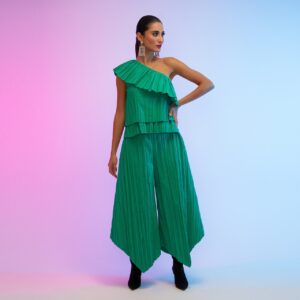
What is something you say no to?
When somebody shows disrespect. That is my ultimate turn off. I come from an upbringing where I was taught that you have to respect, to be respected. The second thing is when somebody judges you when they don’t know you. We are in one of the most challenging times facing our generation, so you try to survive, and if someone judges me when I am doing this, it really affects me. Otherwise, nobody breaks me. I believe life is all about giving, passion and respect. These are the fundamentals.
If you were to describe yourself in one word, what would it be?
Passionate. I am passionate about everything and I am lucky that my parents embedded this in me.
What is the motto you live by?
Staying positive and passionate is what keeps me going.
What would you still like to achieve that you haven’t done yet?
I think my work experience dealing with students showed me another side of myself that I didn’t know existed. When I was much younger, I was very shy and I used to get nervous. But this is why I thank our government for the amazing education system because it really makes you flourish and builds up your confidence. As a local person who studied in the system and had to go through a lot to become what I am now, without that education system I would not have reached where I am. So, through this, I discovered that I love public speaking. I feel like I have a lot to give, and I think this could be something that will come gradually. I can talk about anything at any given moment. I can go on and on! So, I would like to develop this in the future but currently, I am voicing it through my fashion.
In your spare time, what are your hobbies?
I love painting. I used to paint for a long time but now I put all of my creative talent into design. I like to meet young people who are starting their careers or businesses. I feel like I went through a lot and I have a lot to share, and I think I can add value to these people.
What advice would you give to aspiring designers?
They need to be original. Look at their inner passion and inner style and don’t do it just for the sake of imitating or copying. Try to think out of the box and always keep your original style and have your own flavour. The minute you imitate or copy you will fail. Analyse your interests and what you want to do in life and then make your decisions. If you follow your passion, that’s when you will succeed.
What message would you send to women to invite them to discover Azzalia?
Azzalia is always creating new things and is always innovative with something new to offer. Women can always find something that talks to them at Azzalia.
Zenith CEO Julien Tornare on the Latest Novelties and an Exciting Year Ahead
It is no secret that the watch industry, like many, has been deeply affected by the COVID-19 pandemic.
Early in 2020, thousands of stores were forced to close across the world and brands have found it difficult to provide the same experience with clients as they have done for many years. With many events still being cancelled globally and the travel industry far from recovering, key players in the industry are finding dynamic ways to share their latest novelties with prospective clients. This January saw the second edition of LVMH Watch Week taking on a digital format with brands including Zenith, Hublot and Bvlgari showcasing their latest novelties. After the success of the first event in Dubai in January 2020, this presentation had a whole new look as attendees saw watches through their screens without being about to touch and feel. But the excitement was still there.
Zenith unveiled its biggest launch of the year; the Chronomaster Sport. This revival watch is a remake of a model from the past and is inspired by several watches in Zenith’s archive. For CEO Julien Tornare this is a landmark launch and something he has been working on for a long time. When he joined the brand three years ago, Tornare was challenged with bringing it into the 21st century while not forgetting its heritage; a task he has been striving to achieve. Now, for the first time, the brand’s portfolio is coming together in the image he imagined and it starts the beginning of an exciting new chapter for Zenith. We discover more.
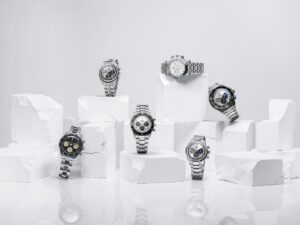
Zenith Chronomaster heritage pieces inspiration
LVMH Watch Week had its first edition last year in Dubai and the second this January with a digital format – how do you rate this new concept after the first two editions and is it as effective as you anticipated?
I believe it is very effective but it is difficult to compare with what we did in the past because the concept is so different. With the coronavirus situation and the digital presentation, it’s very difficult for us to determine whether it was as successful as it would have been if we’d had physical shows. But I think it has made us evolve and I do think that things will change moving forward and continue to be a mix of digital and physical. This situation has pushed us all to move much faster than expected. At the Dubai show last year we wanted to get as many people as possible here – we didn’t talk to anyone via Zoom, but I’m sure in the future with such shows, we will have a “Zoom Room” for those who cannot physically come. So I do believe moving forward it will be a combination of both digital and physical. Having said that, had we not been limited by the COVID-19 situation, I’m sure we would have had a few more physical shows around the world already. We would have gone to China and probably Miami for the Americas, but instead this January we were 100 per cent digital.
When it comes to clients are you following this same pattern connecting with them digitally?
Yes but this year has created a lot of limitation in all areas; whether it’s press, retailers or clients. When you are behind a screen, how much of the experience can you really give to the other person? It’s very limited and that’s why I’m so happy to be here in Dubai because I haven’t been out to the markets since the situation began. The minute I knew I could visit Dubai safely I decided to come because you will never beat face-to-face interaction. At large events, there is always a formal part but there is also an informal experience and that crucial part is the part you lose with digital events.
In my ideal world, when the COVID-19 situation is over, my perfect scenario would be to have one institutional trade show. I would love to have everyone within the watch industry come together to create one big show. The upcoming Watches & Wonders event is a good start as we are expecting to be 50 brands to participate, which is a very good sign and I’m happy to be part of it. So yes, I think we should have one big event and then brand by brand or group by group, individual things can happen around the world to promote the brands in the markets.
Chronomaster Sport
Tell us about the new Chronomaster Sport that is receiving great echoes so far.
This watch is a very important timepiece for us – not only because we just launched it or because it’s been a great success, but because we have been working on it for three years. In 2017 when I joined the brand, we launched the DEFY collection which had a very contemporary approach and some people were eager to see something that looked to the history of the brand. I have been reassuring them that I wasn’t forgetting what was done in the past, but I believed that we needed a good balance between the two. But this takes time. So, the DEFY line allowed me to increase the success of the business for a few years while working behind the scenes with my team on what Chronomaster is all about and the design and roots of the watch and ask ourselves ‘how can we come back to this particular watch collection?’ That’s why in 2019 we celebrated the 50th anniversary of the El Primero, and I started to introduce the revival pieces. In the footsteps of these revival launches, we were supposed to present the big comeback of Chronomaster in 2020. Obviously, COVID-19 happened so I decided to keep the Chronomaster Sport on hold, as well as the Chronomaster Classic, which will be released during the upcoming Watches & Wonders. So it’s very clear that now we have revival, sports and classic watches within the Zenith range. And finally, we have two key pillars: DEFY which talks about today and the future and Chronomaster, which is about yesterday and today. Plus of course, we have our Pilot watches and some new concepts that are going to be happening in 2021. I knew Chronomaster Sport would be something special, but never to the extent that it has been received so far.
What’s in the pipeline for Zenith in the Middle East?
Aside from the UAE, we are looking very closely at Saudi Arabia, which is a very important market that we haven’t really tapped into yet. And of course, the two other main strategic countries are Kuwait and Qatar. So these four countries are our focus right now.

ZENITH CHRONOMASTER SPORT LIFESTYLE
What can you tell us about women at Zenith in 2021?
We will have the continuation of the “Dream Hers” programme in which we had women offering their testimonies of how they reached their star or achieved their dream. The only problem was that we had planned to bring all of these women together on one stage somewhere in the world, but of course, that couldn’t happen this year so instead, we had virtual talks and Instagram Lives etc., which worked well, but again we had the limitations of digital. The aim this year is to reinforce the “Dream Hers” programme, as well as the DEFY Midnight watch, which has been a great success.
But more than anything I want to change the codes of communication with our watches in terms of men and women. In other words, at Zenith we will never talk again about men’s watches or women’s watches. I believe that this is something in the past and sometimes watch brands look too much at what has happened previously. I think we need to make beautiful watches that can be worn by both men and women. As simple as that! Who are we as a watch brand to determine which designs are for men and which are for women? The customer should be deciding on what he or she wants to buy. I think it is similar with cars – I remember when I was young and people would say “this is a men’s car” or “this is a women’s car” – today that doesn’t make any sense. The Chronomaster Sport for example is very wearable by both genders. One thing we haven’t done yet, but we will do, is create a visual with women for the Chronomaster Sport. We have already sold quite a few of these watches to women and it is a unisex watch, so this is something we will rebalance. But overall I think we will be one of the first brands to stop completely talking in this way.
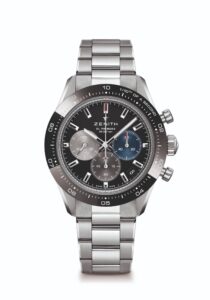
What do you think will be the biggest challenges for Zenith this year and what is the strategy you have to overcome it?
We have been working really hard for three and a half years and the main challenge for us today is the environment and external factors. We have everything ready at Zenith, what we need is more wind pushing us from behind rather than in our face! That’s what we have had over the last year and a half, beginning with the second part of 2019, which was not so good because of what happened in Hong Kong, and then, of course, we had COVID-19, which has led the entire industry to be at minus 25-35%. It’s not that bad if you consider the situation and the fact that there were times when everything was closed but we need to move forward. Overall the resistance to the situation has been quite good but now we just need better days. For me, as a brand, that’s the main challenge. We have been working on brand awareness and desirability and it’s starting to take off. The launch of the Chronomaster Sport in the middle of a situation that is still problematic shows us the huge potential that we have.
What is the master message you are spreading at Zenith this year?
“Time to reach your star” continues as well as the comeback of Chronomaster, which for me is the biggest highlight of the year. It’s the biggest because it’s creating a link between DEFY and Chronomaster as the two main pillars and connecting what the brand is all about. I think this year, for the first time we can see a completely new brand. Wait until we launch our new boutique at The Dubai Mall. It’s a boutique that people love wherever we put it. I think it’s a year where Zenith enters a new league.

ZENITH CHRONOMASTER SPORT
What is the message you would send to your clients in the Middle East?
I would like to tell them that Zenith is a brand that needs to be understood in the right way. It is a brand that has a long history of 156 years and in the watch industry, brands that have a long history tend to turn to the past, whereas new brands do all kinds of creative things that can be quite dynamic. But today, customers are much more attracted by authenticity than you can imagine. The world is moving at a rapid pace because communication is so fast and customers want to be linked to something true and authentic. We are one of the last four or five brands in the watch industry that can say that 100 per cent of our watches have an in-house movement. So in summary we have history, heritage and authenticity but we are very dynamic and creative.
Tell us about the Zenith Icons.
Last November we launched a programme called Zenith Icons. It was born at the beginning of the confinement period and it’s a programme in which we acquire back iconic watches from the past and restore them inside. We don’t touch the outside as we want to keep the traces of the past but inside we restore them to their original state. And then we resell them with a certificate of authenticity and a booklet with the entire history of the watch. Everything has been guaranteed, certified and restored by the Zenith HQ. These watches are on sale only in our boutiques. When we produce a Zenith watch it’s for forever – so when you buy an Icon watch it could be a timepiece that has already had 5, 10, 12 lives and someone young today will wear it because of its history. It’s a neverending, sustainable watch that will never be thrown away. I’m very pleased to be able to link the past and future in this way.
Emirati CrossFit Athlete Shaikha Al Qassemi on Her Passion For Fitness And Her Journey To Success
Growing up in the UAE, Sharjah born Shaikha Al Qassemi always knew she wanted to take her passion for fitness further than just being a hobby.
In 2012 her life changed when she became involved with the local CrossFit community. She began training and started to realize that women of all shapes and sizes could take part in the sport and succeed. Al Qassemi became a regular on the country’s fitness scene, opening her own fitness destination; Platform Fitness Gym in Nadd Al Hamar. Al Qassemi was determined to help empower Arab women to follow their dreams and pursue their fitness goals. The ladies-only gym offered a safe, friendly environment for those new to CrossFit, as well as women looking to improve their general fitness. But it was her dream to compete internationally in the sport that she loves.
Growing up, Al Qassemi’s passion for fitness went against social norms in the UAE; traditionally an environment where women don’t practice competitive sports. But the fitness enthusiast wanted more than to just train, it was her dream to compete in the CrossFit Games, an annual fitness competition that unites hundreds of thousands of athletes around the world to compete in the world’s largest participatory sporting event. It wasn’t until a move to Spain last year, that Al Qassemi could take things to the next level. After making the life-changing decision to leave the UAE, she is now living out her passion to pursue her long-held ambition of competing in the CrossFit Games. Here we discover more about her journey and her goals for the future.

Image by Adnan Karimjee
This past year has been an adaption for all – what has been your experience and what is a lesson you have learnt?
It has been a hard but extremely rewarding year. I have learnt to be grateful for every single day that I wake up living my dream. It has been a rollercoaster of healing internally, physically, mentally and emotionally. Having to move to Spain just a few months before lockdown was really lonely. I was grateful for my friends and family keeping me company on the phone, but human interaction is something that brings me so much joy and it was tough for the first few months.
What first inspired you to follow a path in fitness?
I have always been an active person. From swimming to dancing, to kickboxing, there was always something that kept me going. When I found CrossFit I was in awe of the spectrum of women of different shapes and sizes embracing what their bodies can do instead of how they look. That was something that I struggled with growing up, having a more athletic body in comparison to my friends and I always wanted to look smaller. Once I found CrossFit, I embraced my broad shoulders and big legs and found that my strength and what my body can do was far more rewarding than looking good in jeans!

Image by Adnan Karimjee
What is it about CrossFit that you love and what do you enjoy most about competing?
I love that CrossFit has incorporated varied movements in one sport. There’s always something to work on and improve, so the motivation is there to get that 1% better every day. Competing ignites this fire in me that I haven’t felt in anything else that I do, it gives me purpose and excitement regardless of the outcome.
CrossFit has become a global community – how does it feel to be part of that?
It feels incredible. I am constantly humbled by the women who inspire me and that have become my friends, and by the women I have inspired as well along the way.

Image by Lululemon ME
When you are entering a competition what motivates you?
I can’t describe the feeling of being on the field. You can’t even think for a second, once they call your name, you walk out and soak it all in. The energy is high and electrifying and that is another thing that ignites that fire and motivation in me when I compete.
Tell us a little about your training programme – do you have days off?
Yes, the volume and intensity of training depends on where we are in the season. And since I’m currently coming out of injury, my goals have slowed down to build a better foundation to take on the volume my body was able to take before the injury. I am currently training five times a week, two days off, but every day of the week I walk at least 12,000 steps or cycle. I am pretty active regardless.
We know you now live in Spain and this must have been a big decision for you to leave the UAE – what pushed you to make the move?
It was a big decision, but I truly felt it was time for me to move on from the things that didn’t bring me joy or happiness. To fulfil my dream of competing at a high level, there are so many things that I will need to give up moving forward. There are specific things that are out of my control when I am back home, so I needed to create an environment that better serves my current purpose. It was also a decision I had to make to be closer to my coach and train with likeminded people and learn from them first hand since they have a better experience with competing at a higher level.

Image by Adnan Karimjee
Growing up in the UAE with such a strong interest in fitness – did you face any challenges in choosing this path and what were some of the setbacks along the way?
Yes, with anything a person pursues out of passion there can be questions, especially being a woman in the Middle East who is expected to uphold a more traditional lifestyle. My family never imposed or enforced anything on me. We made choices that aligned with respecting ourselves and our family. But being a woman that lifts weights and competes in the same environment as men, wasn’t something that was acceptable and it’s still the case today. So, it was still a struggle for me to constantly question my actions, but I grew out of that and always went back to what my intention is.
How were you supported by those around you?
Those who weren’t supportive in my journey didn’t last long in my circle. I kept those who supported my purpose, cause and dreams close to me and they have been there since the beginning.
How do you hope to inspire other women with your journey?
I hope to inspire women to chase their dreams regardless of the limiting beliefs we hold onto. Our thoughts are not real unless you make them real by constantly telling yourself that you can’t. Correcting these beliefs will give you liberating freedom from fear and scarcity.

Image by Adnan Karimjee
This issue talks about women’s empowerment – what makes you feel empowered?
I feel empowered when I am completely being myself.
What are the biggest challenges you face in what you do?
There are many. In the beginning, the Arab community gave me a mix of good and bad feedback. I was constantly getting messages from people that I don’t know expressing that what I am doing is not feminine or acceptable, but for the most part, I received messages from women that I didn’t know telling me that I have inspired them, not only to move more and eat more healthily but also to love themselves more. In the aspect of training, every day is a challenge, you need to separate your ego from yourself and listen to what your body is telling you. As the amount of training increases, so does calorie intake and the amount of time I need to put in to improve my sleep, lower stress and recover.
What would you say is your biggest achievement so far?
Being honest with myself, and taking the leap of faith to move to Spain.

Image by Adnan Karimjee
What would you still like to achieve that you haven’t done yet?
I would like to compete at a higher level than I have in previous competitive years.
How do you deal with criticism?
It used to kill me internally. But now I understand people’s opinions are only their own and if it does not fit or align in my world then it doesn’t matter.
What would be your alternative career path?
I am currently a Nutrition Coach and I focus on working with women. I launched my online coaching business earlier this month and I’ve been working with clients since last year. I also launched a Healthy Habits Group Program that helps women to create healthier habits every week to improve their sleep, digestion, energy levels and overall health.
What do you think are some of the biggest issues in the UAE related to women’s fitness today and would you like to see happen to change them?
The biggest issue in my opinion is the idea that if women lift weights, they get bulky and undesirable. This is slowly changing in my opinion and women are slowly warming up to the idea that getting stronger is better for their hormones and health.
What is something all women should be doing even if they don’t enjoy exercise?
Walk 10,000 steps a day, see as much nature and get as much sunshine as possible to revitalise yourself on a daily basis.
Talk us through your morning routine.
I wake up, check the time, pet and cuddle my dog Coco and play some music. Once I’m ready to get moving. I drink about 750ml-1ltr of water which is extremely important because you lose the majority of your body’s water by breathing, which is something you do all night when sleeping, so I hydrate myself and make a coffee while the music is playing. Some mornings if I have dreams, thoughts or I just want to be grateful for the day, I would write in my journal then go for a 30-45 min walk with my dog by the sea and around the park. Once I am back home then I prepare my breakfast and another coffee.
The most important things that never change in my routine are:
1- Re-hydrating my body upon waking.
2- Playing uplifting music and being grateful for the day.
3- Getting fresh air and walking in nature.
What is the motto that you live by?
Courage over comfort.
Discover the Accessories Brand That’s Based on Craftsmanship
Shoe designer Serena Uziyel discusses her passion for craftsmanship and why her designs fit perfectly with Middle Eastern style
Designed for the on-the-go woman who has a true appreciation of fine craftsmanship and handmade designs, Turkish luxury accessories brand Serena Uziyel offers pieces that you can truly treasure for generations. Based on Founder Serena’s love for handmade pieces that have meaning, the brand combines modern styles with old-age labour-intensive craft techniques, making every piece truly unique. The attention to detail and careful choice of materials in each of the pieces can be clearly seen through the unique designs that have a precious sense of history about them. Hours are devoted to each tiny detail and unusual materials such as metal yearn, raffia, and hammered copper are carefully twisted, braided or woven together to create a unique appeal. A single shoe or bag can take up to 50 hours to weave and execute.
Founder Serena Uziyel has always had a passion for craftsmanship. After training at Parsons School of Design in New York, Serena had the opportunity to work with global luxury brands including Moschino, Calvin Klein and Donna Karen. While honing her shoemaking and design skills in Milan and Florence Serena met Grandmaster Giuseppe Joseph Amolo, who helped her learn the technical and theoretical skills of shoe-crafting. In 2019, Serna decided to launch her own brand that would bring together everything she had learnt as well as highlighting her true passion for craftsmanship. Here we discover more about the brand and why it resonates so well with women in the Middle East.

Who is the woman that you design your collections for?
The Serena Uziyel woman is confident, she has a strong purpose, and she has an appreciation of art, discovery and craftsmanship. She is unique.
What can you tell us about the latest collection?
We will showcase our Spring/Summer 2021 Collection for the first time at our new store at the Mandarin Oriental in Bodrum, Turkey. I truly love Bodrum as a destination. I have such fond memories of being there over the years, as it’s one of my favourite summer destinations on Turkey’s Aegean coast. I have often drawn inspiration from the mesmerising nature and coastline around Bodrum, and I feel that there is no better place for customers to discover the Serena Uziyel collection than in this historic city. Situated on a beautiful shoreline, the Mandarin Oriental Bodrum hosts prominent guests from around the world, as well as in the residences on the compound – offering my brand the opportunity to connect with a global customer. The Serena Uziyel Resort collection reflects my idea of serene summer days, crafted with intricate braiding and raffia combined with colourful stones – elements that I feel will fit perfectly in the Bodrum setting.

Can you tell us about some of the craftsmanship techniques that are used in your designs?
The Serena Uziyel Collection is entirely made in Tuscany, Italy, and many of the embroideries are crafted by local artisans in Turkey as well as in India. We source from around the globe to ensure each piece we create is made from the highest quality materials. Some pieces can take up to 200 hours to make, as the process is executed with rigorous precision, intricate weaving, and sewing. The Serena Uziyel Collection balances ornate detailing with sleek and architectural silhouettes. The techniques passed down from generation to generation date back to Mughal times, and find new purpose and flair adorning the collection. The Almeria Sandal sees the raffia dyed and then separated by hand to disentangle each strand, with the crowns on each of the disks twisted together out of a silky viscose thread and carefully closed with hand stitches. The Iris Sandal uses 1,000 metres of copper/aluminium alloy thread and the Bul technique gives tension to the thread, which is then locked in with approximately 200 hand stitches. Such refinement and quality require a unique dedication and mindset.
What can you tell us about your choices of materials – we know this is something very important to you?
It’s curiosity, love and the pursuit of beauty that motivates and informs my process. It’s a method and a passion that thrills me every time: Every piece that comprises the shoe has to be in a harmony with the whole; the heel, sole, outsoles, insoles and embellishments — this process amazes me every time. I think what distinguishes the Serena Uziyel brand is a dedication to the traditions of handcraft. Preferring to begin the design process by investigating materials means all creations are endowed with a luxe, tactile quality. Hours upon hours are devoted to the perfection of details. Metal yarns, raffia, hammered copper, twisting, braiding and wrapping are just some of the materials and techniques I employ which give and an artisanal touch of heritage that enhances our sleek modern designs.

What inspires your design?
One of the most precious values to me is heritage. Heritage to me is found in traditions and rituals. I was raised in a family where women are powerful, inspiring and courageous. Their integrity and moral values are exhilarating and promising. My grand-aunts were millinery makers in the late Ottoman Empire/beginning years of the Turkish Republic. They owned a small millinery shop behind the ancient streets of Beyoglu; they were twin daughters of a wealthy ambassador and they never married. After the loss of their father at a young age, they became entrepreneurs to support themselves and began crafting hats catered to the elite society of Istanbul. These stories from my roots have always been uplifting and inspiring to me. I actually display antique millinery moulds from my aunts’ boutique in our Kurucesme Boutique. At the same time, I find my inspirations everywhere. I am inspired by what life has brought me to this day; mainly through history, my roots and the women in my family. I think all these elements create beauty for Serena Uziyel ‘s timeless yet modern pieces.
Do you have a favourite piece from the latest collection?
Both my mother and my grandmother are collectors of art, jewellery and antiques. Through the generations, they have tremendously honoured the family traditions and kept these collections that have appreciated enormously. Nowadays these collections are part of our family heritage. My grandmother has a precious jewellery box that I played with every time I visited her. There would be always new unique pieces that I would discover and I loved to play with her them and mimic her elongated hands with perfectly polished red nails holding a cigarette. So I created a vanity bag inspired by that small box with three compartments and a mirror inside.
One of my other favourite elements throughout the collection is our signature ‘Catena’ chain detail. I especially love it in the high-heel mules. Each chain in the new Serena Uziyel Catena collection is hand-embroidered with four antique golden silk threads, which are woven together to give each accessory’s chain a three-dimensional effect. With the appearance of no beginning and no end, the golden chains of the Serena Uziyel handcrafted Catena clutches and sandals are classically refined, sustainably sourced and designed for timeless elegance while simultaneously protecting the earth’s natural resources.

You learned from some of the best – what is the biggest lesson you have learnt throughout your career?
I do believe that every major brand has a secret maestro behind them. Giuseppe Joseph Amolo who passed away two years ago was a grandmaster shoe crafter in Tuscany. Meeting with Giuseppe was an important milestone in my life. I had a huge opportunity to learn a lot about how to perfectly construct a shoe. Structuring the shoe step-by-step while combining each component such as the insole, the outsole and the heel within harmony and most importantly, to be able to do that with an architectural approach, are the key tools that I took away from my experience with him. This experience played a major role in my desire to launch my own brand and to bring my designs to life. Through my training with Giuseppe, I was given the opportunity to experiment with every phase of the shoemaking process. Giuseppe always said “a shoe is to be put on your feet and not under your arm,” meaning that a shoe should be aesthetically appealing but it must also be comfortable. He taught me the importance of combining aesthetics with comfort. He had a serious personality but he also knew how to relish in the joyful moments of life as well. One of the most important things that I learned from Giuseppe is that shoe design and shoemaking is much harder than it looks, you need to give the most of yourself to build a unique shoe. Even though he was tough, he took me under his wing and taught me every aspect of shoemaking. I am forever grateful for his guidance and kindness. I remember the day I crafted my first shoe and showed it to him, it was an intimidating moment for me, and I could not initially understand from his facial expressions if he liked it or not. He turned the shoes over and over, and then asked me to try them on and walk; only then did he nod and say “Bravo” in Italian. Thankfully he liked them, which was a great relief.
What are the biggest challenges you face today having your own brand?
Travelling with restrictions is the biggest challenge currently, but we are connected thanks to our long-lasting relationships via great technology. Adapting to the new norms of working has been a process, but I have learnt that I can solve issues with practicality. There have been many surprises during this time, it is not always very easy to predict the future but there have been some great surprises as well! I believe that the pandemic has made people take a step back and slow down. Women are seeking one-of-a-kind, timeless pieces for their wardrobe that they can keep for generations. I think that as the world opens up again, accessories will play a major role in how women make statements through dressing – especially with heritage pieces that have meaning. Perhaps surprisingly, one of our best sellers at the moment (which has sold out and even has a waitlist) is the Catena Ankle-High Sandal, which is an embellished heel that can be worn day to night. I feel like women are wearing Serena Uziyel shoes and handbags as their jewellery, and I love this connection. I think this trend will grow once we have more freedom to go out and socialise again.

What would you like to achieve with the brand that you haven’t done yet?
I feel very motivated and empowered every time someone from a different part of the world discovers the Serena Uziyel collection and appreciates the inspiration and the craftsmanship that goes into making every piece. My dream is for Serena Uziyel to become a staple in each new customers wardrobe each season. Hopefully, over the next five years, we can expand the Serena Uziyel footprint by opening brand boutiques in key markets, to reach as many inspiring women around the world as possible.
Why do you think your designs resonate with women in the Middle East?
Statement pieces with ancient glamour are one of the aspects that Middle Eastern customers seek the most. They value the brightness of the colours, handcrafted pieces, combinations of several shades of silver and gold and the positive energy of the shine. The ancient special wrapping technique is used for Catena Notte chains with three shades of gold and three different shades of silver threads. The intricate process of making and creating took almost 35 hours to create one full pair of chains which inspires the Middle Eastern customers as well as inspires me a lot because a unique and unidentical pair of shoes are created. High-quality materials and craftsmanship with particular details are what we offer for all of our customers.
What is the professional motto that you live by?
Do my best possible to pursue my dreams. My design philosophy is “Be true to yourself, do it with a purpose”.

What is a message you would like to send to your fans in the Middle East?
The Middle Eastern accessory market is innovative, rich in design, and extremely inspiring to me. As a designer, and lover of travel, I am always focused on the culture of a country or region, and I have found that the Middle East has a deep appreciation of couture, luxury, and creative expression. I am so happy to share that we have great partnerships in the Middle East such as 51 East and Sole Avenue in Doha and Level Shoes in Dubai and our collection will be sold very soon at Ounass as well. We launched Serene Uziyel Collection on Net-A-Porter in December 2020 and our launch has seen really strong results thus especially with great feedback from our customers in the Middle East. Net-A-porter has already placed replenishment orders on the best sellers – which is a really great sign! We have more newness for the next seasons for our Middle Eastern customers and we are always open to different opportunities in the region.
David Tedeschi, Hublot Regional Director on the Future of the Brand
David Tedeschi, Hublot Regional Director, Latin America and Caribbean, Middle East and Africa discusses the new novelties and the plan for Hublot in the region
This January, Hublot presented its latest novelties as part of LVMH Watch Week. While the watches were presented digitally this year, boutiques in the region are welcoming clients to discover the latest designs and innovation stories at the brand. While this past year has been a difficult one, in the region things are looking positive with many targets being met in terms of watch sales. While tourism to the region continues to be lower than usual, on the flip side residents are turning to local boutiques to make purchases, as well as the new Hublot e-commerce platform. The impressive new watch models come at a time when the brand is focused on sharing the story and the capabilities of its Manufacture with the world. Inviting clients and prospective clients to discover more of what is behind the brand and its fascination with innovation. As the latest watches begin to arrive in the Middle East we talk to David Tedeschi, Regional Director, Latin America and Caribbean, Middle East and Africa.

Big Bang Integral Ceramic Grey
Tell us about the new Big Bang Integral timepieces.
This year we are launching four different models in this category. There are three particular models that we are highlighting because they feature a new ceramic and the fourth model is the Black Magic, which is the continuation of the old black version that we launched in Dubai last year. We have three new models; white ceramic, blue ceramic and of course the new grey ceramic that we have never used before in the collection. Throughout the year and in the future we will be using this colour of ceramic more and more. When we launched the first collection last year in Dubai we wanted to see how it would work in the market and how it would perform and we were quite surprised by the results. It was the first time that we were doing a full-integrated bracelet on the Big Bang collection, which took us a lot of time to develop, and since last year the reaction has been crazy – we aren’t producing enough watches that meet the demand!
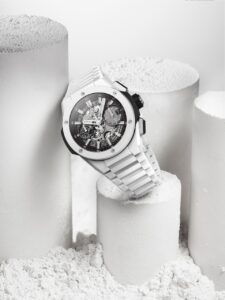
Big Bang Integral Ceramic White
Is there anything that will change post-COVID in your strategy at Hublot or will you continue with your DNA of being inclusive as you have in the past?
Our main focus in the strategy now is to communicate better on our manufacture because we believe that this is the most important thing for us. Digitalisation is also key at the moment. It’s important for us to have an online selling platform, but also to share new content through digital channels. Each major watch we launch now comes with full video content and we believe this is important. In terms of our partnerships, we are almost everywhere, but we have decided to do things a little differently. For example, we chose not to renew our partnership with Ferrari. It was an amazing partnership that has been ongoing for nine years. It was a great 360 collaboration and we have some amazing watches that will remain in the Hublot DNA forever. But our philosophy has changed to develop and concentrate on our manufacture and that is the focus moving forward. Our other main pillar is football, which currently is very challenging as we still don’t know if events will happen this year, so it’s quite difficult, but still, football continues to be part of our DNA moving forward and we will be the official timekeeper of the 2022 World Cup. But we are also starting to be involved in other sports that are new for us. We have partnerships with top golfers for example and we are also breaking into the tennis segment with a few new ambassadors. There is no limit to what we can do and in my opinion, we need to touch people and bring them into our world through these partnerships in various segments.
What’s happening on a regional level in the Middle East?
In December 2020 we opened our fifth boutique in Saudi Arabia and this is a huge and important market for us that we have been developing over the last five years. Five years ago we didn’t have any presence there, so five boutiques in five years is quite an achievement. We have four other boutiques due to open in the region this year, including in Abu Dhabi, Qatar and Bahrain. We have hugely developed our Qatari market as previously people would come and shop in Dubai so that did offer up an opportunity for us, but It’s good for Qatar to be reintegrated into the GCC countries and it’s good for local tourism in the region. We are focused on teaching our clients to buy locally. In Dubai around 75 per cent of our business comes from tourists – so having no tourists this year and not knowing when they will come back to the country means we are expecting a big drop in our turnover in the UAE. However, thanks to our approach of developing the sales by going to the customer instead of the customer coming to the point of sale, we were able to develop a new sales strategy and teach local clients to purchase in their own country and it makes a huge difference. In Q4 starting from October last year, we had a better sell-out compared to what we had in 2019 and up until today that continues. January 2021 was a record month for Hublot in the UAE and particularly at our Dubai Mall boutique. We sold 166 watches and the previous record was December 2019 with 156 watches. So it’s quite encouraging!

Big Bang Integral Ceramic Blue
What is a lesson that you’ve learnt from 2020?
The ability to change our way of thinking and putting this into practice. We had to completely change ourselves and Hublot not only innovates in terms of watches but also in the day-to-day business because we had to completely adapt everything. Launching the Big Bang ER – the smartwatch in our collection, by bringing this new e-commerce platform on our website was a must I believe. It’s not that these were things that we weren’t expecting but now they are really picking up. I’m not part of the generation that buys luxury products online, but the young generation are purchasing much more online, so of course, we are targeting the younger generation with this method of sale. For me though retail will never disappear.

Tell us a little about the Big Bang Tourbillon Automatic Orange Sapphire.
The orange sapphire is a world first and it’s a brand new material. It’s a limited edition of fifty watches and has a complete new manufacture movement and marks the first time we have an automatic tourbillon movement in our collection. It’s very fresh and new and the idea behind a product such as this is to keep it exclusive and that’s why we have only 50 pieces. We have internalised the fabrication of our ceramics in house, but also the sapphire production, which is a huge, plus that allows us to innovate in this segment and play with different materials and colours.

Big Bang Tourbillon Automatic Orange Sapphire
What can you tell us about the new partnership with Japanese artist Takashi Murakami?
This is the first time we have partnered with this particular artist. The construction of the case is new; there is a rotor inside the case that is permanently moving whenever you’re moving your wrist. It’s a limited edition of only two hundred watches and it is the watch everyone is fighting to get at the moment!
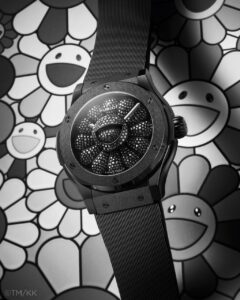
Classic Fusion Takashi Murakami All Black
What is a message you would like to send to your clients and friends in the Middle East?
It’s good to be back. Of course, stay tuned because there are a lot of new special edition things happening for the market this year.
The Great Reset: Key Themes and Messages From The Davos Agenda 2021
The Annual World Economic Forum meeting which is traditionally in Davos took on a part physical, part digital approach this January and saw world leaders come together to address some of the most important topics and issues in the world today.
Held with the theme “The Great Reset” the event was perhaps one of the most important in history and captured the mood of the world today with many governmental and business leaders sharing their thoughts through a forward-looking dialogue. Coming together to define the post-COVID world through special addresses and open discussions the Forum looked at topics such as the economic crisis, sustainability, health and technology. We discover some of the highlights from global leaders who shared their thoughts and interesting insights into the future.
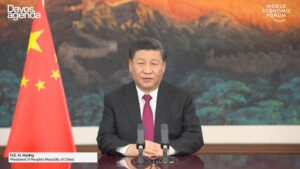
Xi Jinping President of China
Klaus Schwab, Founder and Executive Chairman of the World Economic Forum opened day one of the event by declaring “We need a mindset change to move away from a society where business and government have separate tasks to one in which they, together with civil society, work hand in hand,” This was echoed by Xi Jinping President of China who was the first national leader to speak. He called for greater global efforts in the fight against an unprecedented public health crisis and offered a renewed commitment to multilateral cooperation.

António Guterres, Secretary-General of the United Nations
António Guterres, Secretary-General of the United Nations, set out his priorities for an inclusive and sustainable recovery from the pandemic. In a wide-ranging address, he asserted that vaccines – “people’s vaccines” – should be regarded as a public good, pressed developed nations to offer their poorer counterparts debt relief because “no country should be forced to choose between basic services and serving debt”, and called for increased fairness in the world of work. He made a call for a “truly global coalition for carbon neutrality” and suggested the need for adaptation, renewed confidence and a need to drastically change policy. He pressed business to operate “in line with the Paris Agreement”, called on asset managers to “decarbonize their portfolios” and asked all businesses to “align with the UN Global Compact”. In addition, Guterres announced the need for a new social contract, one “between governments, peoples, civil society, businesses and more, integrating employment, sustainable development, social protection, and based on equal rights and opportunities for all”.
Anthony Fauci, Director at National Institute of Allergy and Infectious Diseases (NIAID), followed in a discussion on how to respond to the COVID-19 pandemic and future such outbreaks. Fauci reflected on how divisiveness had hobbled the US approach to the disease, saying: “When public health issues become politically charged – like wearing a mask or not becomes a political statement – you can’t imagine how destructive that is to any unified public health message.”
He called on China to provide the World Health Organization (WHO) with information about the origin of COVID-19, arguing that without it, scientists and doctors faced a “big black box”. He also registered the US’s renewed support for the WHO and said that with reform, it will become the multilateral organization that deals with disease preparedness. His overall message, however, was one of the need for greater global health security, transparency, collaboration and solidarity, without which he announced: “it becomes extremely problematic to address an outbreak”.
In other sessions during day one, President of the European Central Bank Christine Lagarde said economic recovery in 2021 will progress in two phases. In the first, there will be a high level of uncertainty as vaccines are produced and rolled out, and lockdown measures may become more stringent because of the emerging COVID-19 variants. She described it as “crossing the bridge to recovery, but the journey is delayed, not derailed”.
The second phase is where the economy is reopening, something that will bring its own challenges and positive developments. As part of the recovery, Lagarde underlined the need to bring more women to the table to help the recovery, saying: “Progress can be made and women can do the job just as well as men.”
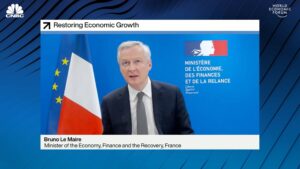
Bruno Le Maire, Minister of the Economy, Finance and the Recovery of France
Bruno Le Maire, Minister of the Economy, Finance and the Recovery of France, argued that while pursuing a policy of fiscal support during the pandemic, nations should also consider the future. “We have to think about the kind of economy we want to build; we want to build a sustainable economy and reduce the inequalities,” he said. Le Maire also called on states to learn lessons from each other during the crisis. As he pointed out, for the first time in its history, the member states of the Eurozone have all taken the same measures. Underlining the day’s theme – Designing cohesive, sustainable and resilient economic systems – the meeting saw the launch of the Partnering for Racial Justice in Business initiative, which sees a coalition of almost 50 organizations committed to improving racial and ethnic justice in the workplace. The Forum released a report revealing that upskilling has the potential to boost GDP by $6.5 trillion by 2030. Also covered during the day were topics ranging from gender parity and restoring economic growth to addressing mental health in the workplace, building crisis-resistant healthcare systems and creating a new social contract.
Day two saw world leaders call for greater collaboration and issued warnings of the perils awaiting if we do not. Ursula von der Leyen, President of the European Commission, called for a “Paris-style agreement for biodiversity”, laying out in stark terms the economic and social risks of failing to protect a high-functioning biodiverse ecosystem. She warned that issues – ranging from climate change and the pandemic to the lack of social media governance – pose a challenge to democracy, showing the “limitations of the old ways of working”. According to von der Leyen, the global push to create a vaccine – something that was achieved in 10 months rather than over several years – reveals what happens with “pooled resources, shared expertise, manufacturers working together and government finance”. The European Commission president urged greater collaboration, arguing that we need to understand that “it is not weakness to reach and help each other, but strength.”

Ursula von der Leyen, President of the European Commission
Angela Merkel, Federal Chancellor of Germany, reflected on how the “pandemic has left deep imprints on economies and our societies,” and will “determine how we live and do business in the next few years.” She focused on multilateralism and collaboration, arguing that the pandemic has shown “how much we are interlinked, how globally interdependent,” warning that “trying to isolate yourself fails.” Reflecting this, the German chancellor announced that “this is the hour of multilateralism,” which for her means greater transparency in global relations, as well as better supporting developing nations. Merkel declared that “development cooperation is in our national interest.”
Angela Merkel, Federal Chancellor of Germany
Like a number of the speakers, Emmanuel Macron, President of France, used the word “vulnerable” to describe the human condition. He argued that the pandemic has shown that the “capitalist model can no longer work” and suggested that “we can’t build anything without reaping the benefits and learning the lessons of COVID-19.” Macron placed humans at the centre of this, saying: “You cannot think ‘economy’ without thinking about human beings,” adding that it will only be possible to address the pandemic with an economy that fights inequality. Considering the economy of tomorrow, the French president said that in addition to considering innovation and humanity, it would have to build competitiveness while also fighting climate change and reducing CO2 emissions. He urged companies to play a role in fighting inequality in society and to take responsibility for mitigating the effects of climate change and stressed how French businesses are already working hard to establish clear ESG metrics.
Emmanuel Macron, President of France
Cyril M. Ramaphosa, President of South Africa, set the tone for the day, describing how the economic challenges presented by COVID-19 had sped up the process of restructuring his nation’s economy. “The issue of collaboration, of working cohesively, has underpinned the plan,” he said. He argued that people rather than COVID-19 have created the challenges now faced, perhaps exemplified in the over- ordering of vaccines by wealthier nations leaving poorer countries and their populations facing shortages. He was, however, positive about future collaboration among African countries, describing the African Continental Free Trade Area (AfCFTA) as “a revolutionary, sea change initiative … possibly the most important initiative the African continent has undertaken.” Ramaphosa used his address to call on countries that have bought up large supplies of vaccines for COVID-19 to release the excess. He said that a vaccine acquisition task force had been created, but that its work had so far only been marginally successful. Speaking in a related session, John Nkengasong, Director of the Africa Centres for Disease Control and Prevention (Africa CDC), warned of a second aggressive wave of COVID-19 in the region and, underlining the South African president’s comments, said: “We as a continent must recognize that vaccines will not be here when we want them so we must focus on the public health measures that we know work while we’re waiting.”
Cyril M. Ramaphosa, President of South Africa,
War was on the agenda during the third day of The Davos Agenda in the form of action on climate change and the threat of conflict as a result of the pandemic. John Kerry, Special Presidential Envoy for Climate, National Security Council (NSC) said “we are in a decisive decade for action.” He focused on the race to make wholesale change and the fact that the Biden administration has placed addressing climate change at the heart of its policy and “is totally committed to this fight”. He apologized for the US absence from the climate change agenda in the past four years, saying: “We rejoin the international climate effort with humility and ambition. Humility because we know we’ve wasted four years in which we were inexcusably absent; humility because we know no country and no continent is getting the job done.”

Moon Jae-in, President of the Republic of Korea
Moon Jae-in, President of the Republic of Korea, spoke about his nation’s impressive response to COVID-19, with its focus on ensuring that everyone – particularly the vulnerable – had been given support and medical access. He also reaffirmed his country’s commitment to combating climate change through its Green New Deal and 2050 carbon-neutral pledge. In the face of challenges, the president’s tone was positive: “Even now as we are living through the pandemic, humanity is overcoming hunger, disease and war and practising the shared values of freedom, democracy, humanitarianism and multilateralism, taking one step forward at a time.”

Vladimir Putin, President of the Russian Federation
Vladimir Putin, President of the Russian Federation, gave several stark warnings about the possibility of conflict because of modern- day challenges. He said: “All of this cannot but impact on international relations, making them less stable and less predictable. International institutions are weakening, regional conflicts are multiplying, global security systems are degrading.” He suggested this made a “heated conflict” like the Second World War “not possible, I hope, in principle” because this would lead to “the end of our civilization”. The Russian president also cautioned that “the situation might develop unpredictably and uncontrollably if we sit on our hands doing nothing to avoid it.” He argued for the need to “restore global, national economies affected by the pandemic, ensure this restoration is sustainable in the long term and has a quality structure”.
Mark Carney, United Nations Special Envoy for Climate Action and Finance, switched the focus to policy. He highlighted the advantages of a voluntary carbon offset market, which he argued would achieve four things: being complementary to a company’s efforts to reduce absolute emissions; catalytic for projects in emerging and developing economies; cross-border, thereby attracting companies looking for high-quality offsets in these types of economies; and with the potential – if properly structured – for “enormous co-benefits for biodiversity, co-benefits for other SDGs.”
Two ministers also spoke about climate-change policy. Grant Shapps, Secretary of State for Transport of the United Kingdom, said: “Our plan is to build back better. Fundamental to that plan is to decarbonize”, with a zero-emission aviation sector expected well before 2050. Huang Runqiu, Minister of Ecology and Environment of the People’s Republic of China, assured participants that China is doing all it can. He said: “There will be a road map and actions, which will be rolled out. We will strengthen our efforts to push coal consumption to reach the peak as early as possible. All this will be done to achieve the strategic objective to achieve carbon neutrality in 2060.”
And finally, was the issue of racism as the Forum launched a coalition of organisations committed to improving racial and ethnic justice in the workplace. 48 organisations representing 13 industries, with more than 5.5 million employees worldwide and with headquarters in three continents have committed to building more equitable and just workplaces. The Partnering for Racial Justice in Business initiative, which will see a coalition of organizations commit to building equitable and just workplaces for professionals with under-represented racial and ethnic identities. The initiative has been designed to operationalize and coordinate commitments to eradicate racism in the workplace and set new global standards for racial equity in business. It also provides a platform for businesses to collectively advocate for inclusive policy change.
“With just 1% of Fortune 500 companies led by Black chief executives, the need to tackle racial under-representation in business is urgent and obvious. To design racially and ethnically just workplaces, companies must confront racism at a systemic level, addressing not just the structural and social mechanics of their own organizations, but also the role they play in their communities and the economy at large. The Partnering for Racial Justice in Business initiative provides an effective platform for businesses to take individual and collective action towards racially and ethnically just workplaces,” said Saadia Zahidi, Managing Director at the World Economic Forum.
Au Départ CEO Gianfranco Maccarrone On The Rebirth Of The Centuries-Old Luxury Luggage Brand
In 1834, when the Industrial Revolution brought about advancements in transportation, brothers Paul and Ernest Bertin had the idea to address the travel needs of this changing society by selling various types of travel trunks and accessories needed for fishing and hunting trips. In 1847 they purchased a shop on Boulevard De Denain in Paris, just across from the newly constructed Gare du Nord train station, which would soon see thousands of travellers pass through its doors every day.
The brothers began to re-sell travel items as well as customising elegant trunks that benefited from recently patented trunk-making processes. No matter what the request, Au Départ met the needs of any customer, however impossible it seemed. In the 1920s Au Départ became one of the most stylish brands in trunk-making and it soon became one of the leaders in this field. The designs were distinguished by a 3D-effect box monogram which was created by Paul’s son Francois Bertin. Francois was an early adopter of marketing and invented the brand’s motto “a beautiful voyage begins Au Départ”, which was seen on posters over the city and in many French magazines.
In 1965, Au Départ merged with fellow luggage company Moynat under the leadership of Francois’ son Alain Bertin. The joint company was named Moynat Au Départ and the brand continued to produce trunks and other leather goods until 1976 when it ceased production. Then in 2019, more then 40 years later, Au Départ was reborn to create a new chapter in the history of the brand. It was relaunched during Milan Design Week, showcasing its history and its new life by reinterpreting the trunks as interior design pieces with a much more contemporary approach.
Today at Au Départ anything is possible. Under the guidance of CEO Gianfranco Maccarrone, who brings a long career in luxury to the brand, Au Départ is continuing to honour its history and heritage, but also moving forward into the future with its unique use of technology and innovation that will allow the brand to speak to a whole new audience. As was the case in the past, no request is too big at Au Départ. From traditional luggage trunks to luxury bags, to technology accessories and bespoke gifts, the brand will make any dream a reality.
When he joined as CEO Gianfranco Maccarrone had the vision to bring Au Départ into the 21st century and in line with life and the needs of customer’s today. While they are diversifying into other areas, the core of the business remains the same – to provide bespoke trunks to luxury clients. To find out more about the future of the business and its plans in the Middle East, we talk to Gianfranco Maccarrone.

Image: Au Départ
Can you tell us about the story of Au Départ and its comeback?
I feel lucky to have the chance to relaunch Au Départ. It was one of the pioneers of trunk-making when it began in the 1800s. The first store was at the departure lounge of Le Gare De Nord and so that’s how the name came about. At that point, we weren’t specifically a trunk- maker. We used to be re-sellers of items including fishing objects, travel products, hunting products etc. At that time these things were seen as luxurious. People would go shopping and pack everything inside their trunk and attach it to the top of their car or on to their horses and continue with their journey. During the twenties after the first World War, the brand moved primarily into the business of trunkmaking. At that time several other companies were starting to make trunks. Each brand would take their materials from the same place, but to make their designs look different, each would create their own pattern. So that’s why we created our beautiful three- dimensional monogram pattern. In the 1930s, we created our first advertising campaign and this featured the same font that we are using today. When we looked back through the history of the brand we found there were 29 different logos all using different fonts. So we brought them all together and we decided that actually, they did a great job with the one in the 30s – so we took that! Around the 1950s the brand was struggling, so we merged with Moynat and the company became Au Départ Moynat and then in the seventies, this company closed down.
In 2017, we came up with the idea of restarting where everything began. Instead of creating a new world, we continued where we left off with our beautiful trunks. We decided to start from what we already knew and present the brand through that, creating a new chapter of the story. So we hired a team of very creative interior designers and architects in Milan and I invited them to come to my office and showed them the entire archive collection. I asked them to choose five trunks of their choice and reinterpret them in any way they wanted. So with the inspiration of different arts, they created five different elements linked to water, sound, video etc. and we created an exhibition in a beautiful demolished theatre. It was fantastic. The exhibition presented inspiration from the past and then we introduced our new collection that was a mix of heritage, innovation and technology. Yes we began in 1834, but we don’t want to look old, we want to talk to the young community and that is the goal today. Today we see it as the start of the “Au Départ movement”. Before the pandemic, we were all constantly moving non-stop and that’s not travelling, you don’t get really to experience your journey, it’s simply movement. So we decided that we are going to be the brand that represents the movement of today. Movement can mean anything and Au Départ can mean everything so it is the perfect scenario.

Image: Au Départ
How are you communicating with your clients now both old and new?
Our goal is to communicate both offline and online. We want to create offline events to generate online interest. Online is the channel that we can exclusively use currently, as of course travel and physical events are difficult, but before COVID-19, we started to create connections within the world of fashion and art through events. We invited potential customers and people were very interested in exploring the brand and to see our connections with the world of art and design. We had a beautiful space in Paris where we showcased collectable design pieces from the 50s, 60s and 70s and we invited customers to come and visit us in more of a home environment than a store environment. Our method of communication is about making sure that people can see the difference in the approach of the brand in presenting the collections as well as using the online channels to enhance this. We don’t use influencers as that is not who we are as a brand. To sum up, our manner of communication is probably “non-communication”. We want to create a desire and an interest by giving little information to our potential customers around the world and there is a sense of mysteriousness.

Image: Au Départ
How do you think the ideas of exclusivity and luxury are changing?
The meaning of luxury today is completely different from what it was in the past. As a brand, we don’t want to be for everyone, we leave it to other brands to be inclusive. We want to be extremely exclusive, but not because we want to be unaffordable, but more because we don’t want to be everywhere. In the case of Au Départ we know that
our bespoke pieces are not for everyone. So we also have smaller pieces that we consider as gifts and these can give accessibility to the brand to a wider customer base, but still keeping it small. I want to make sure that everyone who wants can experience Au Départ in some way. So luxury for me today is making sure that the quality of your product is outstanding and that the price is correct.
I also want to mention sustainability, as this is very important today when it comes to luxury products. It’s not just about producing products with no plastic, for me, it is about having exclusive long-lasting products. If something is done well, it will last forever and that makes it sustainable. I want to make sure our products can be kept with the owner for their entire life. And if we create this incredible quality, our products will never be destroyed. I have a collection of beautiful trunks from the 1870s that are still in my office today and I hope that we can create something that will still be used in 150 years.
What is in the pipeline for Au Départ both globally and in the Middle East?
Au Départ is a very sophisticated brand and we do have long- time clients, but at the same time, we want to talk to the younger generation, especially with our Reflective Jacquard design. This is completely new, but our design team were extremely respectful of the original design from the 1900s and used some of the original techniques in a different way but introducing new technology. This allowed us to add a reflective aspect to the designs with a new three- dimensional material.
So we want to talk to millennials and Generation Z customers as well as our high-end customers. Those young generations especially in regions like the Middle East are key to us. We absolutely want to have a presence there. We are already selling bespoke pieces to private customers in The Middle East. One of the special things that we sold to some customers in Saudi Arabia was a beautiful desert theatre creation which comes in a foldable trunk and inside is a video projector with a sound system and a large foldable screen, that can be opened in the middle of the desert, so you can watch a movie for up to two hours. I believe we are the only ones who have created something like this. This is what defines luxury. Time is luxury and we need to make sure that we can be with our customers when they have time to enjoy life. So we create items that include technology like this that can support then in their beautiful journey.
What do you think customers are looking for today from luxury products?
I wish I had the perfect answer so I could meet all of the customer needs! But let’s say for sure, in a world where everyone can access almost everything, especially with luxury brands having many more affordable options, we want to have a sense of mystery. We want to be mysterious enough to leave people wondering and we want to make sure that our customer can find the perfect partner for their new journey and the new movements I mentioned earlier. Our goal is to try and be with our customers not only when they are connected, but also when they are mentally disconnected from the world around them and create moments or objects that can be part of each person’s journey.

Image: Au Départ
What can you tell us about the upcoming collections launching soon?
We are not a seasonal brand but this year we will introduce two new colourways. Then we are going to create new objects related to being outside. That will be our next project and the timing is great because everyone has been locked down inside lately, and now we all want to be outside with nature.
How do you find the balance of respecting and keeping the history of the brand yet remaining modern and appealing and relevant to today?
It is about respecting the brand and reproducing historical pieces with new innovative materials and technologies. So respecting the past and evolving for the future.

PS4 Video Game Trunk
What would you still like to achieve at Au Départ that hasn’t been done yet?
I would like to continue to treat our trunks like they were treated at the beginning of our story. At the end of the day, the trunks were simple boxes but they allow people to dream when they open them. At Au Départ, we can do everything that our potential customer wants within that trunk and that is what I hope will continue.
What are the biggest challenges you face currently?
The challenge of the pandemic has actually been a strength for us. Before it happened, everyone was moving too fast and spending so much money. Thanks to the pandemic the world pushed the reset button and gave us all time to realign. And I would say this critical moment actually turned out to be an advantage for us because we are now living in a new environment.
What is a lesson you have learned from 2020 and what is the motto you live by?
2020 for me is just the end of an era. The era of how we used to live and the beginning of how we will live moving forward. Our brand motto “a beautiful voyage begins” is still very relevant. In 2021 we are at the departure of our new era and this is the motto that we are living by today.
What is a message you would like to share with your clients and friends in the Middle East?
It would be the same! “A beautiful voyage begins Au Départ.” I wish that the new journey we are going to live would be a fantastic one. So pack your luggage and get ready!

Image: Au Départ
How would you describe Au Départ in one word?
Mysterious.
What do you think sets Au Départ apart from the rest?
It is the perfect combination of heritage, romanticism and sophistication, but it can include the ultimate technology.
Exclusive: Film Director and Producer Ali Mostafa Sheds Light on The Sequel to His Film “City of Life”
Ali Mostafa discusses the UAE’s film industry, his ambitions for the future and the upcoming sequel to his award-winning film city of life
Charismatic, charming and effortless, Ali Mostafa is everything you would expect from a successful creative and filmmaker. The Emirati-British film director, writer and producer had his first great success with the release of his 2009 movie and the first international Emirati made feature film, “City of Life”. The movie gave an honest insight into the reality of living in Dubai and the unexpected ways that lives collide in this cosmopolitan city. While the initial response from some was that the film was quite controversial, perhaps because of its honesty and openness, it went on to have great success in the region and elevated Mostafa from an unknown young filmmaker to a household name.
After the release of “City of Life,” Mostafa was recognised for his creativity and seen as a pioneer in the industry for his innovative and honest approach to filmmaking and the way he addressed issues that were still seen as a taboo in the region at the time. Mostafa was awarded “Best Emirati Filmmaker” at the Dubai International Film Festival (DIFF), and he won the ‘Young Filmmaker of the Year’ award at the Digital Studio Awards in 2010. Now, a decade later, Mostafa is returning with the sequel to this iconic film.
Ali Mostafa has been fascinated by film from a young age. Growing up in the UAE, when other children were interested in the latest toys, Mostafa would spend hours creating his own home videos and mock TV adverts. His upbringing was unique in that his father was Emirati and his mother British, so Mostafa’s outlook on the world is perhaps influenced by the coming together of these two cultures. His mother and father were both creatives so Mostafa had been immersed in these industries his whole life and it was destined he too would opt for a more creative field. While at high school, Mostafa decided to launch a segment of his mother’s business which would see him create set designs for weddings. In 2003, Mostafa decided he wanted to expand on his passion for film, so he enrolled a course in Practical Training For Film at The London Film School. Upon completion, Mostafa returned to Dubai to set up his own production company AFM Films, which has produced short films and TV commercials in various areas of production.

Photography by Marco Falcetta
Throughout his career, Mostafa’s focus and true passion has always remained on directing feature films. After the success of “City of Life” in 2009, his second feature “From A to B” opened the Abu Dhabi Film Festival in 2014, a first for an Emirati film, challenging stereotypical perceptions of Middle Eastern culture through a story of three best friends who take a road trip from Abu Dhabi to Beirut. His most recent feature film “The Worthy” which premiered at the BFA London Film Festival in October 2016 was a collaboration between Image Nation and Hollywood Producers Peter Safran and Steven Schneider. The story is set in the dystopian future where water is scarce and tells the story of one man’s quest for survival. With all of his films, Mostafa has pushed boundaries and gone against the norm, helping to set a new standard of filmmaking in the UAE.
As he embarks on a new journey to create what will likely be his most ambitious project to date, we sit down with Ali in Dubai to discuss his upcoming movie, as well as the film industry in the UAE and what it really means to him to be in this creative world.
You knew you wanted to be a filmmaker from a young age, what encouragement and support did you receive from your family and those around you to take this creative path?
Both my parents were creatives – my father was an architect and my mother was into design. But seeing me who from the age of nine years old, only doing this [filming], I think it was inevitable that it was something I would have a career in. When I reached a certain age, the gifts they would buy me would be the latest camera that had come out because they knew it was what I was most passionate about. As I grew older, I started to develop this passion even more and eventually, it became a career. Prior to film school, however, I did have another creative path that involved designing stages for weddings. I started my own division at Blooms, my mother’s company, called Bloom’s Interiors when I was still at high school. I had a lot of friends who were ten years older than me and they were all working and making money and I wanted to make my own money. So I found a way to do it. I felt this was something I could do without having to have a major background in it because I grew up on construction sites with my father, so I understood design and construction and building those sets came as second nature to me. When I applied to film school it was for a Master’s degree but I didn’t have a Bachelor’s as I had set up the business throughout school. But designing wedding stages is pretty much production design, which is of course closely linked to filmmaking. So because of my experience, I already had a portfolio and that’s how I got to do my Masters in Film.

Ali wears: Jacket and shirt by Giorgio Armani Men’s ss21 Collection
What were the challenges you faced going into the film industry?
It was more about getting my foot through the door. Because in the UAE there wasn’t a real film industry to begin with, so everything was quite fresh. I thought I was one of the only Emiratis who was interested in this field, until in 2003 I discovered a film competition in Abu Dhabi that had 300 submissions. These were amateur films but the passion was still there. When I think about it, I wonder where all those filmmakers are today. I wonder if they continued or if it was just a passion for them. This wasn’t just a hobby for me, this was what I was setting up to do as a career. So that was the biggest challenge – the fact that there wasn’t really a film industry, so I had to get into the commercial industry. I had started a family at a very young age and it was about supporting them as well, so I had to get into the commercial world to do that and to get into that I had to work my way up. It wasn’t easy to keep myself motivated because I was assisting people most of the time. But eventually, I did get there, and I appreciated the experience a lot.
You were quoted saying that to you films are a method of escapism – can you tell us more?
Films allow the audience to escape. As a filmmaker, I create a world that they escape to for that period. That’s what I love about it. Creating something that allows people to step away from their lives and live in the moment that I have created. That’s why I also feel film is so important because it offers the audience a time to disconnect. When I’m making the film, the only escapism for me, is that I’m in the zone. I have to be switched on. As a director, I will get asked hundreds of questions a day and I have to have the right answer every time. The director is the captain of the ship so you can’t have the wrong answer – whether it’s the wardrobe department, makeup, design – people are always asking you questions and you can’t escape there. For me as a filmmaker, the escapism part is that I’m in the zone and I feel most alive when I’m on set.
You have worked on all aspects of films from writing to directing – tell us about the difference in working on each of these areas.
When filming commercials you will get given a brief, and as a director, you have to create the treatment for it and bring to life your vision or your take on that brief. So it’s a creative process with your touch on it. But when you’ve written the piece, it’s your baby and you make the changes. Then when I directed someone else’s script for a feature film, that was also a very good experience. It was like the commercial idea, but on a much larger scale. So it was my vision on someone else’s script. You take their characters and interpret them how you see them and you bring them to life.

Ali wears: Jumper and trousers by Giorgio Armani Men’s SS21 Collection
Shoes by Tod’s
Tell us a little about the film industry in the UAE today.
The film industry in the UAE is non-existent. To have a film industry we need to have something that is like a machine. It’s sustainable – you make films, people go to the cinema to watch them, the films make a profit and you invest in more films. It’s a cycle, an industry. We have a commercial industry which is thriving, it’s one of the biggest in the Arab world. If you look at Egypt for example, there is a film industry. We don’t have this yet in the UAE. First of all, because we don’t have the number of cinemas that could help us actually make money. Our films don’t actually make any money. But that’s going to change.
What do you think should be done to change this?
To be honest, had my first film (City of Life) been of the budget that I can make films today, it would have made money. But it was way over budget because I did it at a time when there was no infrastructure for filming. Everything was expensive and we were shooting at commercial rates which doesn’t happen nowadays. I think this film also catered to everyone who lives in Dubai and that’s why it was popular. That film catapulted me and helped me with my career, but as a filmmaker, I have always wanted to do justice to it. I’m proud of it because of what it achieved for the future industry. The fact is, it opened people’s minds and it also helped with the censorship of getting things done, because of what I had to go through to get the film made. As controversial as people may think “City of Life” was, it took me a year to get script approval – and I actually never got script approval – I had to shoot the film first and after I would be told if it could air. And we are talking about a multimillion-dollar film! I never really got the approval until it reached the highest authority because there was no benchmark at that point.
We hear you are working on the sequel – what can you tell us about this?
In my view, it is more real than the first. For this film, I got the approval in three days! I explained that I wanted to do a sequel and what I wanted to talk about and that some things may be sensitive – but we need to talk about these things in society. I think opinions have changed because of the first film. At the end of the day as people, we tend to censor ourselves because it is our culture and I’m not going to say anything that’s not real, but I also don’t want to push it to a point that’s unnecessary. There’s a level that you can talk about and showcase because society needs to have these discussions at home. Because if they don’t happen, how will anything ever change? For example, initially, when I was thinking of ideas for the film there a global Opioid crisis happening with children in school. If this is not discussed, parents won’t be aware of what’s happening and they won’t have the discussions at home with their kids. So I feel like certain subjects need to be spoken about. And it needs to be showcased as the harsh reality and not glamourized. People can die – this is what happens and it depends on the path you choose.

Ali wears: Shirt by Giorgio Armani Men’s SS21 Collection
How proud are you of your achievements so far?
Of course, I’m very blessed and lucky to have done what I have done, but I feel like I could have done so much more. But now, things are going to change. I’m a lot more driven.
What can we expect to see from you this year?
First of all, I want to make the second movie. I was supposed to do it last year but of course, COVID-19 happened. But that turned out to be a blessing because I wanted to do it in line with Expo 2020 and now that Expo has also moved we are going to try to time it to debut at the same time. We are expecting a lot of people to come to Dubai for this event and I want them to see the film to understand Dubai as they did with the first film. Expats used to buy “City of Life” and send it home to their families to help them understand the place they lived in. So because people are coming I want there to be a film in the cinema that they can go and see that will show them a lot more of Dubai. It will be a standalone film so they don’t have to have seen the first one to understand what’s going on. There will be different characters, but because of the first film, I have a couple of returning characters that are in supporting roles. This just gives a nostalgic element to the first one, but otherwise, it is standalone.
If you were to describe the second movie in one word how would you describe it?
Current. It is very current, it is Dubai today.
How do you source funding for movies today?
Nowadays it’s a lot easier. The number one rule is to never pay from your own pocket. Unless perhaps it is a short film with a small budget or you’re super-rich and you can! But I’ve seen families collapse from people trying to invest in their own films and it’s not a good idea. There are people that are willing to do this for you, so don’t throw your savings into a passion project.
What advice would you give to aspiring filmmakers in the UAE on what to do and what not to do?
In terms of funding, luckily we do now have companies such as VOX, MBC, Netflix and ImageNation who are all ready to fund films in the UAE, depending on the project. But then again, some of the best ways to get investment for films and something that I learnt very early on, is product placement. I raised about two and a half million dollars on my first film on my own, when no one knew who I was, just from product placement. Especially if you’re shooting a film in Dubai – you can’t turn left or right without seeing billboards with branding, so it’s easier than if you are doing a contained film. There are a lot of institutes and people who are ready to invest.

Ali wears: shirt by Giorgio Armani Men’s SS21 Collection
Shoes by Tod’s
What is something that would you still like to achieve that you haven’t done yet?
To create my dream film. This is something that if I did it, I wouldn’t ever need to do a film again. It’s the story of the late Sheikh Zayed bin Sultan Al Nahyan. That’s my ultimate goal. It’s something I’ve wanted and have been trying to do for the past ten years. But it is a film that needs to be right and done at the right time. If someone from the US was directing it, it might be able to fly now, but because an Emirati filmmaker is doing it, I think it needs a bit more time. So that’s my ultimate dream.
I feel he is clearly a great inspiration to you – what are some lessons or mottos that you have learnt from Sheikh Zayed bin Sultan Al Nahyan?
It’s the unbelievable vision and wisdom that he had. It’s something that reflects on his sons one of whom I am very close to and I see it in him every day. They are a family of born leaders. You could go to them with the biggest problem and you will hear advice that you never would have thought of. They think out of the box. As much as you live to experience life or however well-travelled you may be, you do not get any advice as you do from them, it’s amazing. What an inspiration of a man. One of the most amazing things you could watch on YouTube is “Farewell Arabia”, where Sheikh Zayed drives around and you see his vision of turning, not only Abu Dhabi into what it is, but the coming together and creation of the United Arab Emirates. It’s phenomenal. Some of the decisions he’s made politically and the impact that he had – what an inspirational man.
It would be an unbelievable honour of mine to be able to portray him. Of course, second to that, I would also like to get a gold statue [OSCAR] for our country!
What is the motto that you live by?
Nothing is impossible. I have had way too many people tell me something is impossible and we have managed to achieve it – so I know that nothing is impossible, however impossible you think it is. And secondly to not be too proud. Be proud of certain things, but don’t have an ego in that pride. My father always says that pride kills a man and I think it’s important to stay grounded and not let anything get to your head.
What scares you?
This year taught me a lot about myself. I had to reassess myself and I feel like I was able to go deep inside and look at how I see life today as opposed to how I used to see it. The only fear I have today is of God and that of being a father and that something happens to my kids. Other than that, I have no fear at all.
What is in the pipeline for you on a professional level?
Well in the pipeline is the sequel to “City of Life” – this will be the major thing. There are a couple of campaigns that UAE national brands have asked me to try and help revive so that will be interesting. But I want to put full focus on the film because it takes a lot out of you to make a film.
If you were to enhance or change something about yourself in 2021 what would it be?
On a personal level I want to maintain this person that I think I’ve become because I like this version of myself. There was a period where I felt a little bit lost and I didn’t really understand me. This year – I spent almost two and a half months with my kids in the house during lockdown – I got so much closer to them, it’s a different bond and I just want to maintain this and enhance it as much as I can. I always want to make myself a better person.
Is there something that you will make sure you won’t do in 2021?
What I don’t want to do this year is not make this film! Because sometimes you can procrastinate and I do not want to slack this year, it’s important that I stick to it.
What do you think will change after COVID-19?
I love the barriers in restaurants, I think they should keep those! But in the industry, nothing has changed.
What do you dream of?
As I’ve always said: “The bigger the dream, the more work you have to put in to achieve it.”
Ricardo Guadalupe, CEO Of Hublot On Celebrating The 40th Anniversary Of The Brand
This year Swiss watchmaker Hublot has been celebrating its 40th anniversary.
Still a relatively new brand in the world of watchmaking, Hublot has achieved so much in its four decades thanks to its disruptive, innovative approach to watchmaking, while not forgetting the true art of creation. To celebrate the milestone anniversary Hublot has been taking a look back at its journey and its daring personality and DNA. Hublot was the first watch brand to dare to combine rubber and gold on a watch, something that was completely unheard of at the time, it created a niche for itself in the form of ultra-luxury sports watches that break barriers and has continued to produce cutting-edge designs for the forward-thinking customer. The Art of Fusion concept coined by the brand highlights this audacious approach to watchmaking through innovation and partnerships, and the 40th anniversary celebrates this unique concept. Fusing together the past and present to create futuristic designs was the thought process behind the new 40-Year Anniversary Watch. Based on the Classic Original of 1980, the Classic Fusion 40 Years Anniversary 2020 Watch takes inspiration from the original ground-breaking design of 1980 but gives it a modern twist that brings it into 2020.
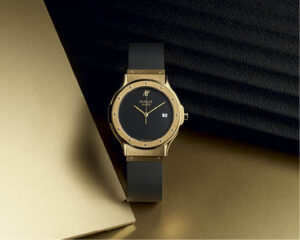
Classic Fusion 1980
To support the celebration Hublot has created a 40-year exhibition at the Hublot H2 Manufacture in Nyon, Switzerland. Designed by Samuel Ross the exhibition which celebrates some of the brand’s key achievements through an immersive 3D experience, highlights four themes to showcase Hublot’s story: The Art of Fusion, the men and women who embody it, the products and the world of communication. Visitors can take a 360 journey into the world of Hublot The exhibition which will be available to access remotely thanks to a virtual platform will also welcome talks from the brand’s ambassadors and friends.
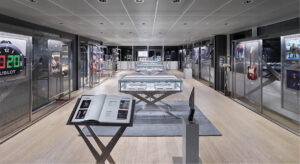
Hublot 40-year exhibition designed by Samuel Ross
CEO Ricardo Guadalupe has been a key force in driving the celebration of this anniversary. Having worked at the brand for over 15 of its 40 years Guadalupe is truly part of the family. He joined in 2005 working alongside the great Jean-Claude Biver who was CEO at the time, before taking over the role in 2012. He has seen the brand grow and reinvent itself to become the leader in the luxury watch sector that we know it as today. It’s expansion into partnering with key artists, designers, sports and more have been part of Guadalupe’s dream to expand the world of watchmaking into an art and allow the consumer to discover the true beauty of luxury watchmaking. Here to share more about the 40th-anniversary celebrations and what we can expect to see in the near future we talk to Ricardo Guadalupe.
Hublot Manufactures H1 and H2
This year Hublot is celebrating its 40th anniversary, what re the key milestones achieved during those years?
I believe there are two key important periods in the history of Hublot. The first was the creation of the brand in 1980 and the revolution that Hublot created at that time by having the first 18-carat yellow gold watch with a rubber strap. That was the first Fusion watch, but at that time, the “Art of Fusion” concept hadn’t even been invented. For 24 years Mr Crocco the founder of the brand and CEO at that time, had amazing success with Hublot, especially in Spain where the King of Spain wore this Fusion watch and inspired everyone to have a Hublot timepiece. But the brand always remained private, not global and very high profile in its customer base. Then in 2004, Mr Jean-Claude Biver came on board as CEO and this is when he invited me to join. He created what we know as today as the DNA and philosophy of the brand: The “Art of Fusion” in watchmaking, and this has created a new revolution for Hublot. The Big Bang watch was a result of that Art of Fusion concept which involves connecting tradition and innovation and connecting the past with the future and from 2005 when it was launched we had immense success and that has continued for 15 years.
When it came to celebrating the 40-year anniversary exhibition it was difficult to explain the years chronologically, so we decided to create four themes with 40 chapters. We have ten personalities and ten iconic products, and we explain what the Art of Fusion is through materials and movements.
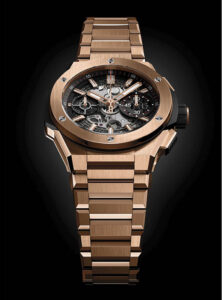
Big Bang Integral
Of course with success come a lot of challenges, could you identify some of the challenges you have faced along the way and how did you overcome them?
The first challenge was to reposition the brand to be in the very high-end segment of watchmaking by introducing a chronograph with a mechanical movement. At that time a lot of our watches were still powered by Quartz movements so the challenge was to reposition Hublot and compete with some of the important brands in the industry in this high-end segment.
At that point, we were quite a small company and we had the challenge of becoming an influential brand. So we had to create our own Manufacture and that was a huge challenge to build and to find the right people to create and produce our own movements and materials. We have always had a lot of challenges but Hublot has had incredible success. There is a lot of substance to our brand much of which is linked to the manufacture.
Last time we spoke there was a lot of development happening at the manufacture, what has happened since and how has this challenging year affected the progress?
This year has, of course, provided unprecedented times and our industry and our company have been impacted. We had to close the factory in March for two months and we had to reinvent ourselves. There are over 450 people now working at the Manufacture and we have done everything to protect our people and their jobs. Of course, our sales will be reduced this year because of the pandemic, but we have kept all of our staff, which is very important.
We opened a second building on the site in 2015 and the idea was and is to verticalize our production with our own movements and materials. We have a third building in the pipeline and the purpose of that is to allow us to increase what we can manufacture in-house, not in terms of the quantities of the watches but in terms of the movements and materials.

Big Bang e
In terms of strategy and staying close to your clients what has been the strategy of Hublot this year and is there anything you have changed in terms of communication moving forward?
Of course we have had to reinvent our relationship with our customers. Digital was already important before the crisis but it has become key to use digital tools to allow us to be closer to our customers. Firstly we created an ecommerce site, which launched in June. But we didn’t just want to have an online site; we wanted to bring an experience to the customers through a digital approach. So we introduced our what “digital boutique” which complements the physical experience. We try to get in contact with the customer before he or she comes to the store through our digital boutique by offering customers online appointments so we can prepare them ahead of their experience of buying the watch. This is a new tool that we have implemented alongside the digital launches of all our products every couple of months. There are no watch fairs, so now we launch digitally. We are trying to have a digital approach at every dimension.
What can you tell us about the recent novelties and what is in the pipeline?
An important product for us was of course the Classic Fusion 40 Years Anniversary 2020 watch, which launched in September. The original watch from 1980 inspired it, but instead of being a replica we created a mechanical movement with a rubber strap and we used yellow gold for the first time. We used ceramic because it has become a reference material for us and we used titanium instead of steel. There are three designs in a very limited quantity of 500 pieces.
Before that, we launched our Big Bang e, which is a connected version of our Big Bang Watch. Connected watches are a popular theme globally and we believe that Hublot is a brand that is very open to innovation and that there is a niche for a luxury connected watch with a limited production that allows us to express the storytelling of our partnerships, specifically our partnership with football, and we have had great success with this watch so far.
And we also have a new world of lifestyle partnerships. We launched a watch in partnership with Japanese designer Yohji Yamamoto and we also recently partnered with fashion house Berluti on a watch that used leather on the strap and dial. Of course we will have the LVMH Watch Days event at the end of January where we will be launching a few new novelties but I will keep this to myself until next year!

Big Bang Unico Berluti Cold Brown
You’ve been in the industry for many years, what is something that you would still like to achieve that you haven’t seen done in the industry yet?
For me, the most important part is the product. At the end of the day, we are selling a product that must meet the dreams of the consumer. In the watch industry, we aren’t creating watches to tell the time anymore, so we must reinvent our industry to create works of art. Watchmaking itself is an art, but I think we need more and we need to really emphasise through the mechanics and the movements the beauty of watchmaking. It’s not just about producing a watch that shows the time, it is so much more than that and my biggest challenge is to try to reinvent the industry in this way. At Hublot, we are already doing this through our partnerships with artists but my dream is to be able to reinvent the famous complications of our industry and our history and create a new way of making watches.
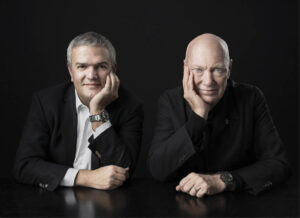
Ricardo Guadalupe and Jean-Claude Biver
You’ve worked alongside Jean-Claude Biver who is truly an icon in the industry – tell us a little about your experience of working together and what is a lesson you learned from him?
Jean-Claude Biver is someone who is very important in my career and also in my life in general. It has been 26 years since we met and I still remember our first meeting in 1994 at Baselworld. He was already a big influence in the industry at that time, and I talked with him for just a few minutes and he told me “you shall work for me” and he offered me a job on the spot at Blancpain and that’s how it started! At that time Blancpain was a leader in the watch industry and so for me, it was very important to work for this kind of brand. In the beginning, Jean-Claude Biver was my boss and through the years we became friends and after I left Blancpain in 2004 he asked me to join Hublot. At that point, our relationship went from an employee to being more like partners and with time we became close friends and today I can say we are friends for life. He is of course my mentor and what I have learned from him is that you have to always be innovative and disruptive in everything you do. You have to be a leader by creating and anticipating the trends not following them.
What is coming for Hublot in the Middle East?
The Middle East is of course a very important market for us and it represents quite an important share of our business. Our partnership with the Seddiqi family is crucial to us and we have been working with them for almost 40 years. They have done an incredible job for us in the region. Having great flagship stores is also a great achievement. The Dubai Mall boutique is our number one boutique in the world. Even this year it has been performing very well. We recently opened a boutique at the Mall of the Emirates and we are looking to relocate our boutique in Abu Dhabi. In Saudi Arabia, we are performing very well and the local consumers there are very active in their buying. And we have the boutiques in Kuwait, Qatar and Bahrain. So yes, the Middle East is really key for us and we try to be very present in the region and to keep our position as one of the top brands in the high-end segment.
Hublot The Dubai Mall Boutique
Hublot is a leader in a specific market segment, especially when it comes to the sports technical watches, what in your opinion are consumers looking for nowadays from watches?
As I said, I think they are looking for objects that are pieces of art. I think the new trend that we are really exploring is to be inspired by other worlds and industries and partnering with other sectors. At Hublot, we have a number of partnerships including one with tattoo artist Maxime Plescia-Büchi, and artist Yohji Yamamoto, and I think to bring something different while keeping the art of watchmaking in mind but trying to reinvent is key. I also believe that it’s really important to show the mechanics of the watches as consumers what to know what the watches represent and the message they are representing through what they are wearing.
This month we are celebrating the UAE National Day where the UAE celebrates its 49 years, what is a message you would like to send to your friends and clients in the Middle East?
Happy National Day to the UAE. We are very proud to be present and liked by many people in the country. I know we have a lot of fans of the brand and we will try to keep you excited in the future with the creations of our new watches.
EXCLUSIVE: Federico Marchetti, Chairman and CEO of YOOX NET-A-PORTER Presents The Modern Artisan Project in Collaboration with HRH Prince of Wales
As YOOX NET-A-PORTER launches a ground-breaking collaboration with HRH The Prince of Wales and The Prince’s Trust, we talk exclusively to Federico Marchetti, CEO and President of the Group on the future of luxury
Federico Marchetti, Chairman and CEO of YOOX NET-A-PORTER Group has always been one step ahead when it comes to planning for the future. Whether it’s supporting sustainable brands, encouraging the use of traditional artisanal techniques, reducing the carbon footprint of the Group, empowering women or working towards being a 100 per cent renewable energy company, Marchetti’s dedication to building a better future can be seen throughout all of the Group’s platforms. In recent years there have been many projects that highlight this dedication to the cause, but this November YOOX NET-A-PORTER Group unveils one of the most exciting collaborations yet.
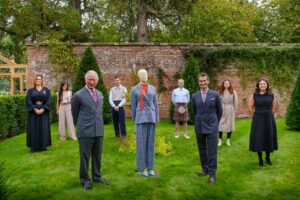
HRH The Prince of Wales & YOOX NET-A-PORTER Group Chairman & CEO with six of the Modern Artisans at the final collection review at Dumfries House
The Group has partnered with The Prince’s Foundation on a unique project that brings to light some of these key topics and the shared values of both organisations. Founded by HRH The Prince of Wales, The Prince’s Foundation was set up to create harmonious communities and encourage education with a particular focus on traditional and heritage skills. The Prince’s Foundation’s Future Textiles initiative aims to breathe new life into the UK’s fashion and textile industry to help preserve traditional craft skills such as sewing, weaving, knitting and hand embroidery. The values and goals of The Prince’s Trust and HRH Prince of Wales are perfectly aligned with Federico Marchetti’s vision for the world of luxury. With a mission to preserve tradition artisanal techniques and realign the luxury industry to ensure it is kinder and most preserving of the environment and craftsmanship, as well as putting technology at the forefront of the business the two organisations came together to work on The Modern Artisan project.
YOOX NET-A-PORTER Group has partnered with The Prince’s trust to create a capsule collection of menswear and womenswear designed in Italy and crafted in The United Kingdom by modern artisan trainees. An evolution of the relationship between HRH The Prince of Wales, President of The Prince’s Foundation, and Federico Marchetti, Chairman and CEO of YOOX NET-A-PORTER GROUP, the collection celebrates both the rich heritage and future of British and Italian textile craftsmanship. The Modern Artisan project guides trainee artisans through the process of bringing a luxury collection to market, marrying training in data insights with sustainable practices and traditional production skills to equip the students for their future careers as truly modern artisans.
HRH The Prince of Wales & YOOX NET-A-PORTER Group Chairman and CEO Federico Marchetti at final collection review at Dumfries House in Sep 2020 – Mike Wilkinson
The project fuses together traditional craftsmanship with digital tools to create a new form of luxury with sustainability at its heart. This unique collaboration also allows from a new generation of talented individuals to prepare for a future that brings together innovation and technology. During the manufacturing process, the artisans learnt advanced technical production skills such as industrial sewing, pattern drafting and quality control, while also developing the expertise to handle wool, cashmere and silk fabrics to ensure garment finishes meet the requirements of the luxury market. The knitwear was designed by the Italian artisans and manufactured at Johnstons of Elgin’s knitwear mill in Hawick, Scotland, where all of the artisans learnt about the British knitwear development process. Throughout the project, the British and Italian artisans collaborated across borders to share knowledge, cultures and experiences to enrich the collection.
Sustainability is at the very heart of the collection, reflecting the shared values of The Prince’s Foundation whose President, HRH The Prince of Wales, has championed action for a sustainable future for more than four decades, and Federico Marchetti, Chairman and CEO of YOOX NET-A-PORTER. The Group has been dedicated to driving sustainability in luxury fashion since 2009. A conscious selection of suppliers and high-quality materials were fundamental to ensure the collection stands the test of time and can be passed down through generations. Natural and organic materials were prioritised, as was end-of-roll, and no synthetic fabrics were used in the collection. Each style is equipped with a digital ID, providing the story behind the product, its materials, the artisans who designed and made it, as well as care and repair recommendations to enable customers to treasure these pieces for years to come.
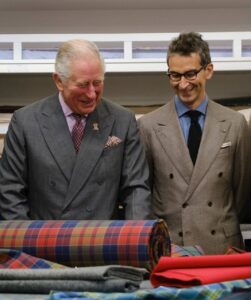
HRH The Prince of Wales with Federico Marchetti at Dumfries House – Mike Wilkinson
To ensure the success of the project, the artisans were granted exclusive access to five years’ worth of YOOX NET-A-PORTER data on long-term preferences of the Group’s 4.3 million customers, to create a timeless collection they knew would resonate in the luxury customer’s wardrobe. They learnt how to process image data and use AI visual recognition to inform the styles and silhouettes of their designs. In the womenswear collection, details from the wide legs and midi lengths to the cinched-in waists and pussy bows were design choices informed by customer preferences. Similarly, data-informed the choice of colours in the menswear, from the camel coat to the navy trousers, and influenced defining features such as the drawstring detail at the waist of the casual trousers.
The YOOX NET-A-PORTER for The Prince’s Foundation label launches this month across all four of the companies luxury e-commerce sites: YOOX, NET-A-PORTER, MR PORTER and THE OUTNET and will be part of the Group’s 20th-anniversary celebrations. This is a first for the group and allows the artisans a unique opportunity to debut their world to 4.3 million customers. The collection design, carried out during the 500th anniversary year of the death of Leonardo da Vinci, took inspiration from da Vinci’s work and features 18 pieces for men and women. To find out more about this exciting project A&E talks exclusively to the man behind it all, Federico Marchetti, Chairman and CEO of YOOX NET-A-PORTER Group.
Federico_Marchetti, Chairman and CEO of YOOX NET-A-PORTER GROUP, Ph. David Needleman
What does it mean to you to be launching this project with The Prince’s Foundation and how are your values as a company aligned with those of HRH Prince of Wales?
The concept for The Modern Artisan was born from a passion that His Royal Highness The Prince of Wales and I share, for educating and investing in the next generation of talent, particularly, in my case, when it comes to harnessing the convergence of technology and luxury fashion.
When HRH The Prince of Wales invited me to Dumfries House in Scotland for the first time I discovered The Prince’s Foundation’s motto, ‘Respecting the past, building the future.’ These are principles that I felt a strong connection to – similar in many ways to those that have driven my work over the last twenty years building YOOX NET-A-PORTER GROUP. They also formed the inspiration for The Modern Artisan project. Our aim was to empower the artisans of tomorrow by marrying the ancient profession of craftsmanship with contemporary technology and data-driven insights. We guided students through the process of what it actually means to design, manufacture and bring a luxury sustainable collection to market and support them to do this work themselves.
They experienced first-hand our shared vision for the future of the fashion industry, one where artisanal skills are nurtured, sustainability is key and collaboration, skills-sharing and the intelligent use of technology and data are combined to make a positive impact on the world we live in.
Modern Artisans Graeme and Francesca with YNAP Chairman and CEO Federico Marchetti in Textile Training Centre – Mike Wilkinson
Can you tell us a little about the experience of working with HRH The Prince of Wales and the process behind choosing the young designers?
It’s a real pleasure to collaborate with HRH The Prince of Wales on this long-term project. I’ve admired his work for a long time. He has been a champion of sustainability for over fifty years. He was already talking about the effects of plastic in 1969, the year I was born! He also has a great interest in our world of fashion, craftsmanship and innovation so throughout the project we found much common ground, from the moment we first met during his visit to our newly opened London Tech Hub, to my proposal for a partnership on this project and the rewarding Modern Artisan journey we’ve all been on since.
We worked closely with the Politecnico di Milano and The Prince’s Foundation to select the artisans. Each of them has their own unique story, with many coming from unusual career paths – for example, Graeme worked in the construction industry for ten years before swapping building for sewing and Nicole was a dancer! Many of our Italian students have already found jobs in great brands following their involvement in the project, Andrea Parolini is now working at Zegna for example, and Andrea De Matteis is working at Max Mara. They are all enormously talented and I expect that we will be hearing much about them in the years to come!
Italian Artisan working on prototypes in Milan – copyright G-A-Mocchetti
What is the importance of raising awareness of sustainability in the luxury industry with the younger generation today and how do you think this will help us in the future?
I believe we cannot talk about the future without talking about sustainability. The project’s commitment to sustainability is reflective of a common thread running through our work at both YOOX NET-A-PORTER GROUP and The Prince’s Foundation. I believe it is our responsibility to create a sustainable future for fashion and it is absolutely achievable if we remain focused and determined. This belief has driven my efforts in this area for the last 10 years. YOOX NET-A-PORTER has pioneered countless sustainability initiatives, including launching our own sustainable fashion platforms YOOXYGEN at YOOX in 2009 and, more recently, NET SUSTAIN at NET-A-PORTER, as well as creating the first-ever sustainable packaging in fashion; the ECOBOX, eleven years ago. These are just some of our flagship endeavours. As exemplified by The Modern Artisan project, we lead a huge amount of young talent programmes to create a sustainable pipeline of future talent but also to ensure that sustainability, creativity and digital skills are front of mind for the next generation. It feeds into our belief that considerations for people and the planet go hand in hand for a sustainable future – and teaching the next generation the importance of this is essential.
With this project we have created a unique opportunity to train our emerging artisans on the importance of mindful production practices, ensuring that they are briefed on how the use of data and tech in design can enhance sustainability and how to handle high quality, organic materials, so they are already ahead of the sustainability curve when they launch into their career paths. This has been one of the most exciting and rewarding parts of the project and I feel very proud when I hear our artisans say they want to find jobs in businesses and brands that put sustainability at the heart of what they do.
YNAP Chairman and CEO Federico Marchetti with Italian Modern Artisans in Milan – copyright GA Mochetti
The project brings together British and Italian craftsmanship – What is the importance of sustaining traditional crafts in luxury design and what is the recipe for balancing that with innovation and technology?
The fashion industry can only be successful in the future if we nurture the elements that make it so exciting, creative and impactful. The artisan producers and makers that have long supported our luxury fashion houses with skills perfected over lifetimes are gradually retiring and risk not being replaced by the next generation. So we must learn from tried and tested skills crucial to our industry’s heritage, but also that we understand the importance of sustainability, embracing the power of technology, and are adapting to the changing priorities of the customer. This is only more important today. At YOOX NET-A-PORTER we operate at a unique intersection between human and machine – customer and e-commerce, craftsmanship and digital – and we wanted to bring this symbiotic relationship and understanding to this project and these students, so they are equipped with all the tools they need to succeed in today’s fast-paced digital world.
Spinning at Johnstons of Elgin Mill – copyright Mike Wilkinson
This partnership also marks the 20th anniversary of YOOX Net-A-Porter – what can you tell us about this landmark anniversary, your biggest achievement so far and what is your vision for the next 20 years?
When I founded the world’s first fashion e-commerce destination in 2000, my vision was to create the shop of my dreams. I wanted to show the world that a luxury fashion experience could exist online. While that is commonly accepted now, twenty years ago it was unheard of.
When I look back over the last twenty years, there have been so many ‘firsts’ for us. When we launched, the first iPhone was still seven years away and it would be a decade before Instagram was founded, that is hard to imagine now. We pioneered the ability for customers to shop straight from the catwalk and in 2006, we launched our first Online Flagship Store with Marni. From there, we have continued to bring our leading technical expertise to the most prestigious luxury fashion brands around the world. I’m incredibly proud of these brand partnerships and the special collaborations we’ve created over the years for our customers. Another big part of our culture is to scout and foster new talent – something that I have personally driven forward over the years.
Naturally, I am also immensely proud of the efforts we have made to advance sustainability in the sector, something we have pioneered since before sustainability was a buzzword! Whether through our sustainable fashion platforms, our packaging, or our young talent programmes, we have pushed the boundaries of sustainability in luxury fashion. In many ways, The Modern Artisan project is a synthesis of the work I have carried forward through the last twenty years.
Menswear lineup – copyright G-A-Mocchetti
The collection is inspired by the work of Leonardo Da Vinci – how do you think his works reflect the message of the project?
The period during which the collection was designed fell during the 500th anniversary year of the death of Leonardo da Vinci, who was not only an artistic genius but also an accomplished and ground-breaking scientist. The Modern Artisan project took inspiration from the way that this polymath brought together the worlds of art and science to achieve greatness, something which resonates deeply with the project’s founding principle to empower the artisans of tomorrow by uniting traditional artisanship and heritage skills with tech know-how, data-driven insight and commercial science.
Da Vinci’s work also reflects the notion of cross-border collaboration that is at the heart of the project. In the Codex Atlanticus in Milan, Da Vinci predicted the future invention of a means that would allow mankind to connect and communicate across boundaries with a lingua franca – which I have always imagined to be the internet! In The Modern Artisan project, it has been wonderful to see two groups of people from different countries (many of whom hadn’t visited Scotland or Italy before) come together to share their knowledge and unite in a common goal and passion.
Cashmere Yarn at Johnstons Of Elgin Mill, local supplier for the collection – copyright Mike Wilkinson
How do you value the importance of timeless pieces in the future of luxury?
I believe we have entered a new age. One that is technological, connected, interactive, but also one that has had to reorder its value hierarchy and rediscover the importance of community and a respect for the environment and nature.
I see a future with fewer collections, less production, less waste, more creativity and more sensitivity. There has of course been a demand for this already, but I hope we will see an acceleration of this. More mindful purchasing; buying quality products that last. Pieces that can be cherished for a lifetime and beyond. To me, that is true luxury.
The Modern Artisan pieces are just that. The design of each piece was informed by data insights from across our Group on long-term customer trends to ensure that they could be worn and loved for many years to come and even passed to the next generation. This data-driven design expertise was then partnered with high-end sustainable manufacturing, using natural single-fibre materials that would stand the test of time. We’ve also used technology to empower our customers to ensure these pieces last – each piece is equipped with a digital ID giving customers transparent information on the product but also detailed recommendations for care and repair.
What is important to me is ensuring that delicate balance of human touch and technology – luxury is about emotion, creativity and beauty while machines are about precision, detail and power – both are fundamental to the future and we have to make conscious choices to find the perfect equilibrium. This is what we taught our Modern Artisans, along with the importance of ensuring that the collection is made to last, in the spirit of our purpose – connecting people with the joy of luxury and fashion that lasts a lifetime and beyond.

Blending process at Johnstons of Elgin Mill – copyright Mike Wilkinson
This is the first time you have launched a collection across all of the Group’s platforms – how do you think YOOX Net-A-Porter’s platforms can raise awareness of important issues on the future of the industry moving forward?
There is a shared belief that the fashion system must change. We are seeing an acceleration of attitudes towards sustainability and conscious consumerism and we are constantly working to evolve our business accordingly. As innovators, we have designed projects and championed designers that share our mission to invent new solutions that can truly advance the cause. To provide customers with more transparency over the sustainable practises of their favourite brands, we have invested in key initiatives such as YOOXYGEN, MODERN ARTISAN and NET SUSTAIN. As an entrepreneur, I also wholeheartedly believe in holding a hand out to our future talent, be that in technology, design, craftsmanship or sustainability. Whether it is a place for further developing their skills, or showcasing their work, we endeavour to use the YOOX NET-A-PORTER platform to support the next generation as they enter the industry.
What is the key message that you would like readers to take away from this partnership?
I very much hope that the first collection ignites interest amongst today’s fashion and textile students, and encourages them to seek out new skills and to better understand how data technology can play a pivotal role in the design and manufacture of more sustainable collections.
I also hope that the collaboration between the students throughout the project illustrates the importance of sharing skills and working together internationally. It has never been more important to establish friendships and working relationships that go beyond borders, which allow us to broaden our minds to new cultures, experiences and learnings. The collection is a wonderful showcase of Italian design and British craftsmanship.
Modern Artisan Campaign
There are a lot of speculations and uncertainty around how the industry is moving forward especially after this year – in your opinion what is the future of retail?
There is no doubt in my mind that over the next 20 years the industry will be more digital, more personal and more global.
Technology and the pursuit of sustainability will be the driving forces behind much of this change. The intelligent use of technology has the potential to transform how we operate. Robots can be more precise, AI can learn and adapt production to be more targeted, reduce waste and cut-out inefficiencies. If it is implemented in the right way, technology can free up mankind to focus on what really matters, to be more creative, forward-thinking, ambitious, and to support the next generation of inventors, artists, designers and dreamers who will define our future. It is important to recognise that being more digital does not eclipse the value of human connection, personal service and creativity – the Modern Artisan demonstrates how technology can be used to power human endeavour.
What’s a strategy that has proved successful in allowing you to navigate through this challenging year?
The pandemic forced the world to embrace e-commerce more than ever before. As a global business, we saw how the virus was impacting each country. We learnt from our brands and operating teams in different locations – it was as if we had our own, mini-United Nations to guide us through. This meant we could stay one step ahead and apply consistent actions, whilst accounting for particular local differences or demands. Our priority was always to protect our colleagues and community, whilst designing new ways to serve and connect with our customers. We were quick to speak directly to our customers and keep them informed every step of the way. Over the last twenty years, we have built a very strong community; I wrote personally to customers throughout the year, and I have never received so many letters of support.
We had an advantage going into this period. As a tech company, everything was ready. We already had smart working in place across our business, which meant we could shift to this 100% even before global lockdown came in. When this was done, we focused on how we could offer support. We repurposed our vehicles to deliver essentials and medicines to vulnerable communities, we provided laptops and online digital education classes for homeschoolers, and we donated PPE and care packages to the heroes of this crisis; the medical teams. These were just some of the many community initiatives our teams invented and actioned this year. I am incredibly proud of all that we have done to date, and everyone involved at YOOX NET-A-PORTER.
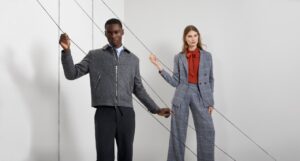
Modern Artisan Campaign
What can you tell us about YOOX NET-A-PORTER in the Middle East?
As one of the fastest-growing global centres for luxury retail, the Middle East is hugely important to YOOX NET-A-PORTER. In a globalised world, personalisation and localisation are key – you have to understand your customers and what they want. Our approach is to partner with the best to unlock this local knowledge, which is why in the Middle East we are delighted to have partnered with Mohamed Alabbar, the Middle East’s undisputed leader for online luxury retail, since 2016. His organisation Symphony Investments has an unmatched knowledge of luxury consumer trends and an extensive network in the region. Our combined strengths give shoppers in the region access to a fantastic luxury assortment with our unparalleled service and content.
Together, we established a local office in Dubai with dedicated sales and marketing, customer care and personal shopping teams to provide Middle Eastern customers with a highly tailored offering, setting a new standard of customer service in the region. We also opened a new Distribution Centre in Dubai powered by our omni-stock techno-logistics platform to guarantee the highest level of service, including premier same-day delivery; and developed a localised offering ranging from Arabic-language customer care and content, as well as local currency and payment methods.
We continue to be very excited about the growth potential of the Middle East and are constantly innovating to ensure we can deliver the best possible experience for our customers in the region.
Modern Artisan Campaign
What is a challenge you have faced this year that others can learn from and how did you overcome it?
The key piece of advice I can give is to stay true to your values – act consciously, ethically and in a human way. We acted quickly and decisively to keep our colleagues and community safe and I believe people remember and appreciate how you act in difficult times.
My other guiding principle is to seek hope. When I wrote to our customers in March, I likened this period to a sailing analogy; as an avid sailor myself, like with all storms, after the wildest part, when all the elements seem to fight each other, the wind drops, the sea calms and you can see the horizon once again. This is when new ideas emerge and new opportunities are possible. It can be difficult in the centre of a storm but as a leader, you have to keep your eyes on the horizon and guide your ship through.
I established a task force on the first day of lockdown to start working on solutions to the main challenges we anticipated. As a global business, virtual collaboration is nothing new for us, so we were able to move quickly. As well as the physical safeguards we put in place, including social distancing, temperature checks and PPE to name a few, we designed and launched new technology solutions. Through our Stay Safe App – developed in house – colleagues now receive up-to-the-minute safety updates and information directly to their mobile devices. The App connects to Safety HUB, a new ecosystem of content and tools to keep colleagues safe, informed and connected throughout the pandemic.
What is a message that you would share to entrepreneurs at the beginning of their journey?
Twenty years ago I brought together two separate worlds: luxury and technology. I wasn’t a techie nor was I a fashion insider, but I saw a fantastic opportunity that no-one else had yet visualised. As an entrepreneur, I’ve been pretty good at guessing what the near-future will bring. I’ve tended to do this by seeing the convergence of unrelated trends before others did, as I spend a lot of time dreaming about the future. Of course, everyone has dreams – what I believe sets entrepreneurs apart is that they don’t just stop with the dream.
For me, when I founded YOOX, I created it as the Shop of my Dreams, with me as customer #1 and I believe after 20 years it is still very contemporary – because I have never stopped dreaming and chasing the future! For instance, I became obsessed with the mobile phone a long time ago: back in the early 90s, I was the first at my university to have one of those giant mobile phones that would barely fit in a backpack. My obsession turned into action when I set up a mobile task force at YOOX in 2006, a year before the first iPhone was launched. Today, our most valuable customers do all their shopping on their phones and we sell well over $1 billion each year via smartphones. I would encourage all entrepreneurs at the beginning of their journey to approach life with this “dreamer” mentality – and turn those dreams into reality by acting decisively.
What is a lesson you will take with you from this year?
I have always been interested in how seemingly opposite worlds can be united to achieve something special – be it cross-border collaboration in Italy and the UK, or working across different sectors, such as luxury fashion and technology, as we do at our Group. The project has shown us what is possible when you unite the ancient profession of the artisan – one of the world’s oldest – with cutting edge technology, creating truly modern artisans ready for our changing world. This is a way of thinking that I will take forward for years to come, not just in how we evolve the business but how I continue to invest time and energy in the next generation entering the industry.
The Modern Artisan collection is available across all YOOX NET-A-PORTER platforms from 12th November 2020.
Simone Gibertoni, CEO, Clinique La Prairie on Taking Greater Care of our Health and Wellbeing
Clinique La Prairie is a pioneer in wellbeing and longevity. The Swiss wellness clinic has successfully been providing proven solutions to some of the most critical problems we face today since 1931 through tried and tested medical programmes.
Their holistic approach to medical wellbeing uses a combination of progressive medical expertise and traditional and alternative philosophies. In-house programmes are created to enhance life to its fullest potential, fulfilling every physical, psychological and emotional need. Clinique La Prairie has worked on some of the most extensive and innovative stem cell research in the world, providing solutions for its clients that they cannot receive anywhere else. Clinique La Prairie doesn’t need to plan for the future because it’s already writing it with its unique, ground-breaking therapies and treatments. To find out more about the latest treatments, programmes and technologies, we talk to CEO Simone Gibertoni.
How would you sum up your vision for the future of Clinique La Prairie?
With a long family-owned history, Clinique La Prairie is driven by a very personal commitment to look after all guests as if they were family members, with expert and advanced care and a welcoming and intimate environment. Our mission: to accompany each of them in a personalised way and to “help and inspire them to live a longer, healthier and better life”. Founded in 1931 by Professor Niehans, a pioneer in the development of cell therapy, Clinique La Prairie has continued to evolve and expand, thanks to continuous innovations that have enabled us to stay at the forefront of health and exceptional guest service. This is possible thanks to the very unique combination of Clinique La Prairie: a state-of-the-art medical centre with 50 specialists, award-winning wellness and luxury hospitality.
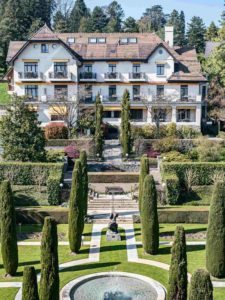
This year has been an unusual one for all, how has this period affected the operations of the company?
Clinique La Prairie welcomes clients from all around the world, so the pandemic, restricting most of the international travels, has had an impact. Outside Europe, in Asia, The USA, the Middle East and Russia there are still travel bans and government restrictions that are serious obstacles for clients. Operationally speaking, we have, of course, implemented strict security measures. With our very own facilities’; a combination of a medical centre, hotel and wellness centre, there are several procedures and protocols in place for the guest services, medical and spa and room services, so that all of our guests – and employees can feel safe.
In this context, our mission has been to preserve the highest level of service and care. The philosophy of Clinique La Prairie has always meant high-end luxury for our guests, with a “feel at home, away from home” experience to the highest standards possible while undergoing treatments. This had to be preserved, despite social distancing and the many safety measures, to continue Clinique La Prairie to be a haven of health with an exceptional level of care. For our staff, from doctors and therapists to hospitality members and management, the process has two dimensions: firstly, ensuring our employees stay safe at work with relevant measures. And secondly, accompanying them in the return to a work environment in which many changes would affect their daily routines. Discuss, explain, help and sustain is crucial.
What makes Clinique La Prairie unique in its approach to wellbeing?
There are many things. Firstly, our 90-year legacy offers serious wellness to those in search of a profound change in their health and wellbeing thanks to a medical-led 4-pillar approach (medical, nutrition, wellbeing, movement). Our unique clinic-Medispa concept is a combination of spa, hospital and hotel in one location, with the widest range of experts, and pioneering and innovative treatments. Our Scientific approach of health and wellness, and scientifically verifiable expertise in rejuvenation, wellbeing and longevity instils cutting-edge science and technology in all of our programmes. Our Innovative mindset, spanning from advanced genetics, regenerative stem cells, nutrigenomics and many aspects of leading-edge medicine.
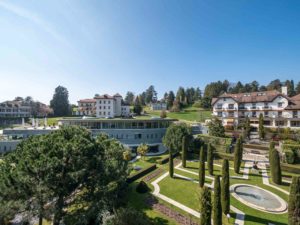
How can it help guests build a better future for their lives?
We believe that health is not only the absence of illness but also the balance of the mind, body and spirit. Our guests are accompanied and advised by leading specialists. Experts and staff members work closely with one another, with a commitment to bespoke and personal service. A real synergy that is none other than Clinique La Prairie’s trademark and the key to its success.
At Clinique La Prairie, guests find this unique combination of cutting-edge diagnostics, highly personalised care, science-driven treatments and long-term support that leads to genuine transformation in our client’s health and lives. This is possible because medical consultations and testing lay the foundations for each guest’s personalised objectives: their wants and needs. Many common medical conditions, such as cardiovascular disease, obesity, food intolerances and certain auto-immune diseases are influenced by both genetic factors and lifestyle; that is why our experts use a genetics and epigenetics approach through targeted interventions, medical technologies and on nutritional, wellness and movement dimensions to influence long-term behaviour.
Ultimately, this expert approach allows guests to stay healthy, live longer and live life to its fullest, thanks to programmes that fulfil every physical, psychological, and emotional need.
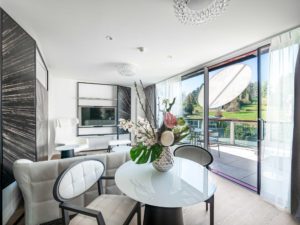
Clinique La Prairie is a pioneer in its field, how do you continue to keep the innovation going?
The clinic has continuously evolved since 1931 to become a multidisciplinary, expert-led medical facility that specialises in providing world-class preventative medicine, based on cutting-edge science. Life and Longevity Sciences have been part and parcel of Clinique La Prairie since its inception, and it has continued by collaborating with renowned researchers in the field of biosciences, and by the creation of a life science division that looks into the next generation of health technologies. In 2018, we were the first wellness clinic to integrate DNA testing into health programs. Since then, genetics have taken an even stronger front seat, with DNA tests forming part of the Revitalisation, Master Detox and Weight Loss programs and driving the highest level of personalisation for programs. Because a key part of disease-prevention is diet, the emphasis has recently shifted towards nutritional science. Since 2019, the Revitalisation, Master Detox and Beauty programs have had nutrigenomics elements added. This year, we have launched the new Master Detox program with a genomic-based method using nutritional science. And more will come in this area soon.
How is new technology aiding the development of the company?
For the last four years, we’ve integrated some of the most sophisticated genetic tests into our longevity and detox programmes. A precise analysis of a client’s genetic profile means that we can develop a highly personalised plan for each individual, customised according to the objectives and the needs of the client. If you speak about tech-enabled wellness, this has undeniably grown in this period, and it has opened up new and interesting dimensions.
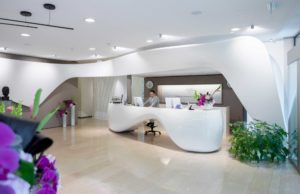
At Clinique La Prairie, we’re testing a few projects to meaningfully integrate tech into the programmes, or to offer a high-quality engagement into their health journey. The important point for us is to do it with a genuine purpose that will amplify health and wellbeing benefits for our guests while keeping the highest level of human connection and customisation, for example, enhancing the follow-up period after a programme at the clinic or to give personal access to an unprecedented service of health coaching. In our mission of profound and long-time change, tech is one of the enablers. As innovation is rapidly moving and scientists are researching how AI can impact many health areas, including diagnosis, it is going to be an amazing resource to act as supplemental care.
Can you share with us any of the latest developments?
The newly launched 7 days MASTER DETOX focuses on a Cellular Genomic detoxification protocol working on nutrigenomics, i.e. the study of the relationship between nutrition, health, and the human genome. The cure comprises four 100% nutraceutical supplements to stimulate the body’s own antioxidant and detoxifying defences, taken for a week during the programme and recommended for four weeks following the stay.
In the regenerative medicine field, we have taken a cutting-edge approach to rejuvenation with stem cells medical technology. Beauty Stem Cells and Cell Boost facelift surgery treatments offer the ultimate in anti-ageing. The patient’s own stem cells are re-injected, revitalising the face using the body’s own natural resources to regenerate its skin and slow down ageing, restoring a more youthful appearance.
The immune-boosting and anti-ageing Revitalisation programme continues to reinforce our status, but in the past decade, the clinic’s offering has been developed with pioneering technologies and programmes answering many health and wellness needs, resulting from the stresses and strains of modern life (sleep, detox, mind-body balance, weight issues). The approach of Clinique La Prairie is always about a leading-edge and ultra-personalised approach towards “longevity”.
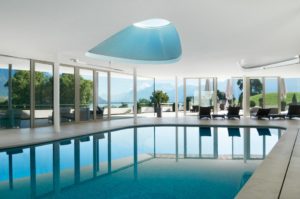
In this issue, we are talking about the future – what is your vision for the future of wellbeing?
These are some specific trends I see for the industry:
– Demand for ultra-personalised treatments: this was already growing and will be in very strong demand in the near future.
– Genetic and epigenetic: wellness will be more customised to individual needs and epigenetic expressions. Wellness institutions will create and offer innovative therapies, and guidance will be even stronger in the future of our wellness industry.
– Technology and data: How can we use data and AI in a meaningful way and use technology to stay connected with our clients?
When it comes to Clinique La Prairie’s future, our vision is always looking at pioneering longevity. We are taking a particular interest in research on microbiota, senescent cells and their markers, stress and sleep, circadian rhythms among other aspects of life science and biology, to determine how they can be used to promote holistic longevity. Also, and this is essential, we are the dedicated partner of our clients in health and well-being throughout their lives. That is why our idea is to go even further. We want to develop our concept in cities where our guests live, like in Bangkok or Madrid this year, and in Asia, the Middle East and America in the future. Our clientele will benefit from our expertise in Clinique La Prairie establishments offering our unique concepts combining medical, nutrition, aesthetic, well-being and leading-edge health technologies.
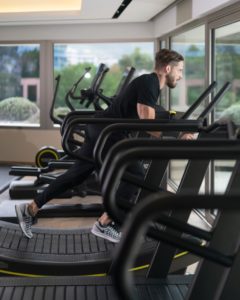
Can you share with us any new treatments that you have introduced to the portfolio?
We have introduced two new programs that will be exclusively available in winter 2020 and spring 2021.
Immunity Boost: 5 Days Medical Offering: Immunity is at the front of mind more than ever before with the world’s focus on health amid the global pandemic. With the guidance of Clinique La Prairie’s qualified health practitioners, this exclusive short-stay programme aims to regain vitality and strengthen the body, boosting the immune system. Thanks to the advice of the health and well-being experts, the programme is the perfect option to replenish energy and immunity levels and learn more about how to re-activate a healthy lifestyle, while enjoying the benefits of the microclimate in the Montreux region.
Energising Wellness: New Wellness Offering For 2020: The balance between mind and body is crucial for long term health benefits. With this in mind, Clinique La Prairie’s leading team of holistic consultants has introduced this new pure wellness offering for guests to relax, recharge and look and feel younger. Guests will enjoy exclusive treatments in the world-renowned spa and will be given an IV drip and vitamin complex as precious allies to sustain their wellbeing. Supervised by trusted medical specialists who care for what guests’ body’s need, the blends will contain a carefully selected combination of essential vitamins, minerals and antioxidants to target individual needs, while promoting anti-ageing and whole-body health.
And as a first in Clinique La Prairie’s experiences: Chef Sara Bussetti will be teaching a unique gourmet cooking class, in a personal session, during which the guest will learn the secret of the clinic’s healthy recipes in the most exclusive way.
After leaving the clinic how can guests ensure a better lifestyle going forward once they are home?
The stay at Clinique La Prairie very often has a very strong impact on the guest’s way of thinking about longevity and lifestyle. We often hear from returning clients that the information they received here was life-changing or life-saving! Concretely, during the interactions with physicians and dieticians and based on results taken from medical analysis and DNA testing, guest receive tailored guidance (with personal documents and material to take home) about what – and how – to eat, how to tackle their own stress levels, how to work out to reach the agreed goals, the next advised step if any specific medical situation has been identified, etc. In signature programmes, there is a follow up remote conversation after several weeks or months to do a personal “check-in”. Of course, there is an essential involvement from the guest to take the lead on implementing the modified routine once back home. If we did well, if we responded to our customer’s need for reassurance while moving them out of their comfort zones, thus delivering a real transformation for their lifestyle, they will surely take this life-changing lead!
How important is nutrition and diet to overall wellbeing?
Nutrition is key to preventive medicine and a healthy life and is one way to counteract cellular ageing and to delay or prevent the onset of age-related diseases. It plays a major part in every programme at Clinique La Prairie, where we combine the science of genetics and the culinary skill of top chefs to deliciously kick-start your health journey.
At Clinique La Prairie, we believe that an anti-inflammatory diet, one of the most powerful strategies to increase longevity, should be the basis to all lifestyle changes. Clinique La Prairie’s evidence-based approach to nutrition provides comprehensive diet changes that decrease the inflammatory processes by reducing oxidative stress (part of the ageing process in which an imbalance of free radicals and antioxidants in the body causes cell and tissue damage), improving metabolic function and restoring a healthy gut microbiota.
This is achieved by unique signature processes, which protect cells by reducing seno-inflammation; something that’s fundamental in anti-ageing and whole-body preventative health. Using a range of ingredients with antioxidant and anti-inflammatory qualities allows for a powerful preventive approach against disease development. Led by expert nutritionists, this approach means that we can tailor bespoke nutritional interventions which target specific needs, while promoting neuroprotection, increased energy and, importantly, the enjoyment of healthy eating. Our nutritional philosophy can be broken down into four objectives: improving gut microbiota, reducing oxidative cellular damage, improving metabolic flexibility and supporting a healthy immune system.
The restaurant is also a key aspect of the Clinique La Prairie stay, with dieticians on hand to provide individual advice to guests; we have ensured that it can still be enjoyed despite social distancing and no-paper procedures. Our answer has been to go for a bespoke experience led by the chef herself. Instead of choosing from a written menu, the guest gives his/her preferences to the chef and she drives the kitchen crew to create, at every meal, a personalised gourmet menu adapted to the tastes, demands and dietary constraints of the guest.
Can you tell us a little about the importance of sleep?
Sleep deprivation leads to decreased concentration and memory capacities, so disturbed mood, even up to depression, are possible consequences. Irritability is also a frequent consequence. Sleep is a very complex phenomenon, it can be restful and an energy provider when all the different ingredients are presented and dosed in the right quantities. Our holistic approach involves consultations with medical experts to make sure to identify and treat sleep issues such as insomnia or sleep apnea, in tandem with any underlying problems. These may be linked to many aspects of body functions or with the mind-body connection. We have assembled and concentrated these necessary specialists at Clinique La Prairie and so we can assess the problems in an extremely short time frame, which allows us to start the first tailor-made treatments after only a few days.
Moving forward how can we shift a greater focus onto wellbeing, and do you think it’s something that is becoming more at the forefront of everyone’s minds given what has happened this year?
With immunity being on everyone’s mind, we’re seeing more demand on that level, especially because our signature Revitalisation programme is recognized as a holistic programme with major benefits of boosting the immune system and generally upgrading mind and body. In response to COVID-19, we have introduced new elements, including immuno-fortifying ingredients, enhanced nutrition coaching and wellness solutions to help activate the immune function. In its one-week approach, Revitalisation helps to combat stress and infections and to improve health-related setbacks. The Revitalisation has been carried out exclusively at Clinique La Prairie for nearly nine decades and does include the CLP Extract, containing biologically active substances, given in conjunction with bio-stimulants.
Our experts follow a mind-body medical approach. Sleep disorders and stress being some of the main challenges of contemporary health, psychotherapeutic evaluation, sessions of therapeutic hypnosis, breathing or relaxation techniques are planned in the targeted programs or prescribed whenever needed if the holistic consultation with the doctor points out to special needs in these areas. We also think that with today’s lifestyle, detox programs are key and thus we have just launched an all-new MASTER DETOX programme. Overall, in a context of higher demand for preventative and longevity-based wellness, our mission is to respond to the need for reassurance while moving people out of their comfort zones, thus delivering a profound and long-time change in their health and wellbeing.
How do you think we should be educating the younger generations on wellbeing moving forward?
Younger people are usually more aware of the different technologies and the need for a holistic approach. While people in their 20s are normally in good health, we would recommend the Medical Check-up programme and provide a clinical and laboratory examination to ensure the patient is in good health. We recommend preventive treatments and nutrition advice to ensure a healthy lifestyle and fitness advice. Additionally, we instruct on the potential risks that come with the daily use of modern devices and recommend paying attention to radio waves, eye fatigue and hearing problems.
What is the biggest challenge you face in what you do?
The most important lesson is that after winter there is always spring and then finally summer. Sometimes winter is a bit longer, but it has always an end. So, knowing this, we have to be able to separate what we do for the short term (even if for some companies now short term means survival) but at the same time always keep the bigger picture of our long-term strategy in mind. This needs to continue to be our compass. This period is also an opportunity to apply what is called “zero-based thinking.” The key question here is, “if we were building the company today from scratch, what would we do differently? And once we get beyond this crisis, knowing what we know, where would we want to be and what resources would be required to get us there?” For me a wonderful definition of leadership is “bringing people where they may not be able to go alone, and teach them how to do,” and this is even more true in these difficult periods. Set the objectives and then coach, help, and sustain.
What is something we can all do every day to improve our wellbeing?
Eat healthily and do twenty minutes of meditation twice a day, every day, no matter what happens!
Dr Fanny Douvere, Coordinator of UNESCO’s World Heritage Marine Programme Discusses the Future of the World’s Oceans
As the Coordinator of the Marine Programme at UNESCO’s World Heritage Centre in Paris, Dr Fanny Douvere is continuing the mission to conserve and sustainably manage UNESCO’s Marine World Heritage sites.
These 50 sites are some of the most crucial, but also some of the most endangered marine sites in the world. Crucial for the future of our planet, they include key coral reefs as well as much of the ocean’s wildlife that’s in danger of becoming extinct. Over the past decade, great progress has been made in succeeding to protect these sites from environmental impacts of the world and move towards a more sustainable environment for the world’s oceans. However, this year has thrown up big challenges for the project, which relies predominately on tourism for its funding. Of course, with travel and tourism still ground to a halt this throws up big problems for the continuation of the projects and many sites could be at risk. But it’s not all bad. 2020 has seen the world shift towards creating a cleaner, more sustainable planet and it is this that fills Douvere with the hope of fulfilling her mission. We discover more about the latest developments in the project and why there is still so much hope for our planet.

© Olivier Borde – Monaco Explorations
When we last spoke you were hoping to take the Belize Barrier Reef Reserve System off the endangered list how has this developed and what are the current areas of focus?
We succeeded in taking this site off the endangered list and it was a major achievement for us. The really good thing is that it managed to happen due to changes in legislation, mainly from the government introducing a legal commitment to no longer drill for oil. These kinds of changes don’t happen often so it was a really big moment for us. There are a lot of fancy things in the press about UNESCO, which does increase the awareness of what we do, but what really matters is when governments take action to change things and allow us to complete the work that we are doing on the ground. In Belize, we worked together with the NGOs and the government and as a company; we were a big factor in bringing everyone together to set the priorities for the project so everyone could move forward together. We have had other successes in the past in similar ways but this was really a big accomplishment.

Dr Fanny Douvere © HorstWagner.eu
If we look across the board we have several challenges right now. The critical challenge is of course climate change. We have 50 marine sites in the oceans in 37 countries and 29 of those are coral reef systems. Those coral reefs are suffering more and more every year. The Great Barrier Reef in Australia or example, bleached three times in the last four years and what’s happening is that when a reef bleaches it doesn’t necessarily die, it can come back to life and we do see that in places that are well protected, but if it bleaches all the time it has no time to recover and that is what we are seeing. We published an analysis two years ago in which we laid out the future of the coral reefs on UNESCO’s World Heritage List and we saw that we tend to lose them between now and the end of the century if we don’t take action. That is huge because it’s not just about the beauty of the coral reefs; there are hundreds of millions of people who are dependent on those reefs for their livelihoods and survival. There is also a tremendous economy connected to the reefs in terms of local communities. All life in the oceans is reflected in the coral reef systems, so if we lose that, we lose a great proportion of the ocean’s wildlife. That’s the very sad reality and we unfortunately, see that happening as we speak. So we have looked at future scenarios based on different increases in temperature between now and the end of the century.
Indeed, COVID-19 has highlighted the critical importance of humans living in harmony with nature. I don’t think there is anything that could have shown it better than this type of global pandemic. There are positives and negatives to this. The negative part is that we are seeing budgets being significantly cut as a large proportion of funds are reliant on tourism. Over the last decade, we have had a real positive transition to seeing local communities and industries moving away from techniques that harm the ocean and changing them into a positive income such as eco-tourism and activities that are bringing people to the sites in a positive way. There has been huge investment in that and now of course, with tourism revenues collapsing globally entirely, we see our sites no longer having the budgets to manage their parks and we see that many of them no longer able to operate in the same way. But the positive angle of the global situation and this is where I have hope, is when you look at the attention that the environment is getting right now and especially the attention that climate change is getting. A lot of hope however lies in financial investments. With the pandemic, what is critical is that we’re losing out on a moment when we should be investing to make transitions.

© Tet Lara – Oceanographic Institute, Albert Ist Foundation, Prince of Monaco
Throughout COVID-19 we have seen several institutions around the world investing positively to give back to their communities through funding, what is a message you would send to these organisations to explain why now is the moment to act?
I think the big misconception is that an organisation like UNESCO works on the basis of government financing. That is absolutely not the case. We do have some government funding, but we are dependent on voluntary contributions. This can be from governments of course. The government of Monaco for example is a key partner of ours, but the biggest majority of our financial support comes from private donations. The entire work we did in Belize, for example, was financed by a private individual who had read about our projects in an article. He called us up and told us that he liked what we were proposing to do and he stepped up to help. But if that hadn’t happened we would not have been able to invest in the project. The investment that we want to make is in research, understanding the politics, what the socio-economics of each country are and pulling all that together and helping the government to put in place the right kind of legislation on the ground. Those are the kinds of things nobody thinks about financing, but it’s critical and it’s what makes changes happen.
Another initiative we are seeing become hugely successful is our Climate Adaptation Initiative. This is a nine million dollar investment that we used to build climate adaptation strategies in four initial coral reef sites. This is also financed by a private foundation. It’s really important and it’s changing the way we are doing business. In ten years from now, these are the kinds of things that are really going to make a change in the world. Yes, we’re doing a lot of projects in the ocean and when you look at it in certain areas there is a lot of money that’s flowing into ocean conservation, but the sum of all of this is not adding up to the kind of change we need. So the Climate Adaptation Initiative is allowing us to hire Chief Resilience Officers who are locally recruited. That person is responsible for overseeing all of the investment being made into the site and understanding what local communities need to thrive in ten or fifteen years from now. He or she is working together with UNESCO, with external experts and the government in order to be able to outline the decisions that need to be made today to build for a better future. Surprisingly, there are very little investments in this kind of work. In terms of a call out to companies, what we need is to step on that train of positive change and for that, we need to work with private investors. The bottom line is really to make commitments that are real and will really make changes on the ground.
© Olivier Borde – Monaco Explorations
What can you tell us about the work you have been doing and have planned with Monaco in relation to sustainable development?
We have had a partnership with Monaco since 2017 where the Principality of Monaco supports the programme financially. For a number of years Albert II, Prince of Monaco has been organising explorations to see the World Heritage sites himself, as well as financially supporting local scientists that are using innovation to better understand and better protect the sites. He went to one of our sites in Columbia and helped to finance local scientists that are doing shark tagging, so we can get a better idea of how the sharks are moving in and out of the sites and where they are moving to. So we’re not just protecting within the site but also the surroundings. He also went to Tubbataha Reef in the Philippines and he worked there together with the manager to understand the ecosystem, and there are more explorations to come. From this, we developed an exhibition together with the Principality of Monaco to shed light on the extraordinary work that’s being done. On 1st of January 2021, we will launch the United Nations Decade for Ocean Science, which is a decade of focusing on science for the oceans and we felt it was important to inspire other organisations to invest in the local scientific work that is being done. Women are actually doing a lot of it and they are at the forefront of truly innovative science, which is working with DNA so it’s quite exceptional work.

© Olivier Borde – Monaco Explorations
Speaking of women, what kinds of challenges do you face in your role as a woman today?
To some extent, I face the same challenges that everyone does in their jobs. When you’re working in a job related to the environment, you are not doing it for the money, you are doing it because you want to make the world a better place, so my day can start at 6 am and end at midnight. It is frustrating at times because progress can be slow, although again I do really feel that we are on a curve of change at the moment, which gives inspiration and courage, but at the same time we work with a lot of different partners from different cultures and it’s often challenging to reach agreements. Luckily I do work in an organisation that takes gender equality seriously and the head of our organisation is a woman, so that’s definitely also helping. I do see challenges for women now though, especially with COVID-19 and working from home, women are taking on a lot when schools are closed and children are home. Equality is something I feel very strongly about and UNESCO is an organisation that takes it very seriously.

© Olivier Borde – Monaco Explorations
We spoke about the importance of education and the role of each individual; in your role to what extent do you think education to the future generations is crucial?
If I was ever to change my career I would work in education because I really believe that it is everything. I might be biased because I am a living example that education is everything or at least it was in my life, but I believe it is so important in every single thing we do. I believe in traditional education; getting a university degree, but there are a lot of things that we do not learn at university and I think these things are key today. One of the things we need to learn is about our spending behaviour, as this is truly what everything comes down to. We’re not taught how to make decisions on where our spending should be and that’s fundamental to the environment. Why is there so much plastic in the ocean? It’s because of the things we buy. Why is there so much pollution? Why is climate change such a big problem? Because we are not taught to make the right decisions in our spending. Everyone is a consumer so it comes down to behaviour and where we put out money. This is where education really needs to evolve and I’m starting to see this happen.
If you could wish for something right now what would it be?
The first wish I would have is for humans to change their behaviour and go for greener solutions. Make their voices heard on all platforms; educate themselves on what’s going to make the planet a better place to live. My equally important wish is for a programme like ours to actually live up to the expectations of what we are capable of. We can do a lot more than we are doing today, but the problem lies not in expertise but in the investment that we need. So my wish is to attract investments more quickly and more easily.
What is a life lesson you would take away from 2020?
Live consciously, spend consciously, and think about where you are spending your time and your revenues. Really think about it and make your own choices. This is what is going to determine the way the planet is moving forward.

© Magali Boussion – Monaco Explorations
What is a message you would send to people in The Middle East?
I would like to tell everyone that the planet is on a crossroads. We have fifty unique ocean sites across the world on UNESCO’s World Heritage List. Nearly all of them have lost their revenues. I call every human being that can, to step up and join us to protect the most precious places on Earth. Help us and join us at UNESCO, we are here to make the world a better world.
For more information on how to support click Here
Jean-Marc Mansvelt CEO of Chaumet on Finding Positivity in Even the Darkest Moments
As a Maison that is known for its great legacy, joy and optimism, French jeweller Chaumet will surely have found it difficult to embrace the difficult times the world has experienced throughout this year.
But with CEO Jean-Marc Mansvelt at the helm, there is always positivity to be seen. Mansvelt has made it his motto, particularly this year, to see the brighter side of situations. He has always been optimistic in the way he works, and it’s that optimism that has been driving the House through this unusual year. Since joining Chaumet in 2015, Mansvelt has continued to raise the profile of the brand, particularly on an international scale. While building for the future, he has been sure to remember the 240-year legacy that this historical brand has behind it and continue that story into the future.
Chaumet has long been recognised for its understated, timeless and elegant DNA. Since its founding in 1970, the House has served as a jeweller to some of the world’s most iconic women. One of its most pivotal moments came in 1802 when it became the official jeweller for Napoleon. The French leader would gift pieces to his wife Joséphine Bonaparte and their love story has continued to be at the heart of the House. Today, as we look to the future after COVID-19, a new chapter of Chaumet begins and it is one of optimism and positivity. We discuss the latest collections and upcoming projects for the brand particularly in the Middle East, with CEO Jean-Marc Mansvelt.
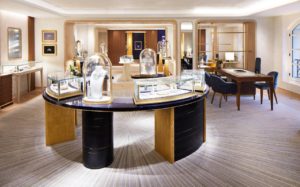
We have been through a very challenging year how has Chaumet managed to stay close to its clients through these difficult times and have you changed anything about the way you are communicating the brand?
We have experienced two different periods, during the full lockdown we had to change a lot, all of our teams were forced to work differently and invent new ways to communicate with the clients. We did this through live screenings, videos etc. We had to be pragmatic and I think that has been one of the learning curves of this period and it’s something that has been positive. Since the complete lockdown, we have reopened our stores in most countries and what we are seeing is a mixture of physical and digital experiences. Physical remains very important but today it does depend on the wish of the client as still some clients don’t want to come to the stores. Human contact is still super important, maybe even more important in a way, but to maintain the continuity with our clients there is more of a digital connection than there was in the past.
Tell us about the latest high jewellery collection and the elements of freedom and movement that were celebrated in it?
It was interesting because it was both fantastic to show this collection and express that life continues, but it was also frustrating as we were not able to present the full offering. When you prepare such a collection you articulate the different chapters and angles and the value really comes when you have everything together because then you understand the richness of each piece and how you create a synergy between them. Secondly, I personally still believe that jewellery in general and high jewellery particular is about seeing, touching, and trying on. These aspects are essential because the pieces are things that really have to connect to your skin and to your emotions. So it was frustrating because even though we could communicate things digitally and in alternative ways, it did not replace the physical and emotional experience of seeing the pieces.
But the positive side was that we were able to remind our clients that life continues and despite everything, we can still talk about creativity and things that can surpass difficult moments. This is actually what I think is the purpose of jewellery. It is, of course, a beautiful collection. It took three years of work and I was happy to show such an interesting theme and to offer once again something that is not only about being a beautiful piece but to open up a way of seeing things and create those links and parallels between architecture and jewellery design. Despite the difference in size, there are many parallels between the two in terms of construction, equilibrium, light, movement etc. and I like this approach very much. I believe in crosslinking everything to open up the understanding of the vision and creativity.
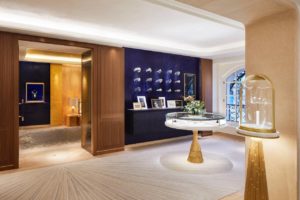
In this issue we are talking about the future, in the case of Chaumet how do you keep the balance between guarding the legacy of the Maison and being relevant for the future?
I don’t have a secret recipe and I don’t think it’s something based on science. I think the most important thing is to first be aware of the question that you asked and keep it in the back of your mind. I strongly believe that whatever you are facing, what is important is to be aware of the subject. Meaning that you are always asking yourself ‘how do I continue?’ ‘How do I enrich the past?’ ‘How do I stay true to authenticity?’ Secondly, you must be aware that no one is interested in you because of the history, but rather because it means something for the people of today.
On a personal level, before I joined Chaumet I had a very simple formula that I continue to do. That is to write down a certain number of rules that I follow. Amongst my rules, I addressed exactly the point of this question. I know it sounds silly but sometimes very simple things like this work as more efficient guidelines for me, rather than any sort of big concept. I regularly come back to this paper and refocus my attention in order not to lose my way. I think the key is to be immersed in what you do and not forget what is important.
How would you sum up what you have done since joining Chaumet and what was the strategy that you adopted to stand out as you have done for the last few years and appeal to the younger generation?
Firstly what was most important was to be clear as a team on who we are and what we want to do and say. Because how can you be perceived and understood by others if you don’t understand what you want to be yourself? Consequently, this had a certain number of implications in terms of choices, because it is not possible to tackle too many things at once. So we made choices together as a team. The number one element was to be clear on what we wanted to do and say and be clear on our position. Once you have this, it clarifies a lot of things. Then when it comes to the point where you have options on the table in terms of investment, communication, creation and possible actions, you have a guideline to know whether it’s part of your plan or not. Of course, nothing is black and white, but at least if you have a framework it helps. Secondly, what was crucial was to have fantastic people within Chaumet and around us. People who are passionate about the brand and have a lot of creativity, energy and who want to contribute. To emerge and create desire you need to have a great team. You might need someone to guide the team but once that has been done you need the people and their energy and creativity and this is how you convey the message and the joy of the brand. They are the ambassadors of the Maison and it’s not possible without them, so it’s essential to encourage them.
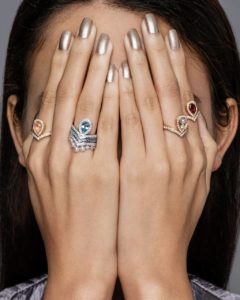
Chaumet Josephine collection
In your opinion what identifies an object of desire today?
I would say it is probably a combination of surprise and authenticity. Authenticity is something that I think is fundamental. To have an object of desire you first need to define exactly whom you are as we mentioned earlier. Once you have this, then you can convey what is true to that. I think people today can see the difference between something that is authentic and something that isn’t so we have to be genuine.
We love the simplicity of the Bee My Love collection – how will it evolve and to what do you tribute its success?
I think its success is because it is so simple! From a business and marketing point of view; the simplicity is the magical part of Bee My Love and it’s also the extraordinary complexity of it. Of course, you can expand the link because more people are interested and as more people see it being worn by beautiful people this creates a certain desire. But of course, sometimes you want to accelerate the momentum, which is not always the best way, but that’s exactly the paradox behind Bee My Love. I think people, particularly young people are interested because there is something slick and simple about it, but the more you look at it and dig into the details and different meanings, you discover its multiple facets. You suddenly see that when it moves, the way it plays with light is incredibly interesting. Then you discover that there are many references to history, symbols etc. So you realise it’s not that simple, but at the same time, it is simple.
What are we expecting to see from Chaumet going forward into the near future?
We have many projects despite the unclear situation that we are all experiencing. One that I can talk about is that next year in Paris, in spring, we hope to have at our Maison, an exhibition dedicated to Napoleon and Josephine and their love story. Napoleon and Josephine have set everything at Chaumet in terms of theme, style and the use of symbols; so we want to pay tribute to them. Next year is the 200th anniversary of Napoleon’s death so it will be a big celebration in France with many museums and institutions celebrating and gathering for this. So from our side, we will tell the extraordinary love story. We will look at the different moments, the ups and downs and the way the story is in one way extraordinary because it’s about power and a political journey, but at the same time, behind the scenes, things were very normal. The letters he wrote to her are unbelievable and there are many moments to express that we will try to explain to the public through Chaumet’s pieces. We will have around 150 treasures coming from major museums and very important private owners. It will be about jewellery of course, but also about intimate objects. It will be physical and digital and many of the objects that we are going to share have never been seen by the public before. It should be interesting and it will also celebrate the fact that this story is, in fact, a story of eternity and it is also relevant. Chaumet was contributing to this story in a powerful way, but also in the intimate moments and many of the symbols of this story are still part of Chaumet today, but in a more contemporary way.
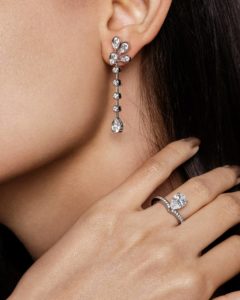
Chaumet Josephine collection
What can you tell us about what is in the pipeline for Chaumet in the Middle East?
During my first years at Chaumet the brand was slowly emerging in the Middle East, but now there is definitely acceleration in the region and it’s a really exciting time. The way people in the region talk about Chaumet and the way it corresponds more towards what Middle Eastern clients expect in terms of authenticity, femininity, grace is much more present. With that acceleration, we start to raise our presence. We have reopened our stores in Dubai and Abu Dhabi and we will soon open a second store in Saudi Arabia. We plan to open a store in Kuwait too. So in terms of physical presence, we want to accelerate. And of course, we still have in mind; to one day bring the best of Chaumet through an exhibition in the region. That is something we are still thinking about, but of course, the current period has changed a lot of things. We are not forgetting these plans, but for now, we are expanding our stores in the region.
What is a message you want to give to your friends of Chaumet and clients in the Middle East?
I have two messages. The first is that I hope everyone is safe and I want to bring optimism and joy because I think this is very important and Chaumet is all about joy, fun and colour. The second message is to thank all of our friends in the region. Because the more I see Chaumet in the Middle East, the more I feel the love for the Maison from the people there and I think it’s only the start. In the coming months, we will be even more visible so we will reach more and more people and the story between the region and Chaumet will go on to the next level.
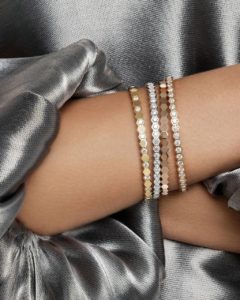
Chaumet Bee my Love collection
What is a lesson that you are going to take from 2020?
At this particular moment, I think the motto I am living by is to think with positivity and keep the optimism. I think this is fundamental because when you listen to too many people or read too much information in the media you feel the pressure to look at things that are sad and negative. But there is no hope if you don’t fight against this. That’s not to say that these things are important, but if you look only at the dark side of something, you will feel dark. This is something that I focus a lot of my efforts on within the organisation today. Always look at the positive side.
Exclusive: Patrick Chalhoub on the Future of Retail
Patrick Chalhoub CEO of the Chalhoub Group on the future of retail, the challenges faced, and transforming the business to meet the needs of today’s and tomorrow’s consumer.
In 1979 Patrick Chalhoub followed in his father’s footsteps in shaping up the future of retail in the Middle East when he took over the family business alongside his brother Anthony. By trying to meet the aspirations of luxury in the region in a more consistent and deeper way, the Chalhoub Group has built multi-brand networks of retailers, distributors and now e-commerce that has allowed luxury in the region to become more unified, more readily available and more engaging with consumers. In 1979 the company employed around 100 people, today that number has grown to over 12,000 and the company’s market share has exploded to over 30 per cent. Today, the Chalhoub Group is the largest retail operator in the Middle East and it has played a crucial role in developing the luxury sector in the region.
But what makes the Chalhoub Group so unique is actually Patrick himself. His passion and flair for luxury and retail are what drives the company and his entrepreneurial mindset and desire to always be moving and keeping ahead of the times has allowed the Group to be a leader in its field for the last 40 years. This year, when the global pandemic hit, the Chalhoub Group was already well prepared. Under Patrick’s guidance, the Group had already outlined a plan for the future that would see it progress into the digital, technological and data-driven era and be able to lead in the industry moving forward. Of course, the Group has faced difficulties this year, like any of the world’s corporations, but with a new mindset already instilled into its employees, partners and consumers, the Group is weathering the storm and continuing to plan for the future. To find out more about building for a better future and being leaders in their field in the region, we talked to the CEO of the Chalhoub Group, Patrick Chalhoub.
What can you tell us about the way the Chalhoub Group has been and is continuing to restructure the company and build for the future?
Every time we say we are putting something in place that will take us to the next phase, things change and we have to adapt, so it has been quite an interesting ride. Around three years ago we decided that we needed to transform our organisation. Even if we have been an ambassador of luxury for years in the Middle East, we have remained quite a traditional retailer. We felt that things were changing; the environment, the consumers etc. and we needed to transform and move towards the different vision of being a hybrid retailer that brings luxury to the fingertips of our customers anywhere and everywhere. I am very happy that we started this movement three years ago, since if we hadn’t, the situation with the global pandemic would have been really difficult. We set ourselves a period of 900 days, which came to an end in June this year, but that was just beginning. We have put in place a transformation structure called “shift” and now we have to shift the whole organisation and make sure the structure is in motion. Thankfully the idea of re-organising ourselves happened before the pandemic as it was obvious that we needed to move forward.
Moving onto the global pandemic, unfortunately, we are living through this period of craziness which is not over yet. We immediately realised that we needed to react very quickly. Firstly, we had to take care of the health and the welfare of our people. Secondly, we had to make sure we were connected to our customers and that they were safe. This was the reactive part. After this, we started to think about that point when we are going to return to business, and we wanted to make sure that we do that most efficiently and adapt to the reality of what we are living, and this is how we have been working over the past few months. In parallel to this, we are also keeping in mind what will happen after the pandemic. Life will eventually continue but the world will be different. So we had to question how we are going to reinvent ourselves as a Group after the pandemic and understand how we can be the most relevant to future needs.
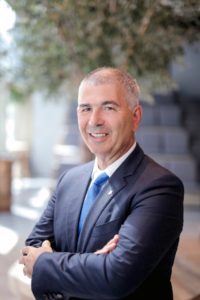
We need to make sure that our Group’s activity remains relevant to the customer. The customer is changing so we as a Group need to constantly adapt to be relevant to them. The pandemic has purely accelerated this movement for us. We had already started to move into digital for example, then when our stores were closed this accelerated and now it has become part of our company. We aimed to reach 12-15 per cent of our total revenue from digital sales. Before the pandemic, we were at 3 per cent and it increased to 20 per cent during the pandemic, so the acceleration was there. Taking all this into consideration we need to, more than ever, put a structure in place within the organisation which will create this relevancy.
The other thing that we need to involve is innovation and creativity in everything we do. This is not only in the products we sell but also in the type of experience we offer, we really have to make sure that we have this creativity and innovation in our mindset. We must also be agile in whatever we do, and we will achieve this by making sure we have people within the organisation who are empowered and can move ahead.
The last point that has nothing to do with the pandemic is that I am blessed to have around me a team that has accompanied me for 20 or 30 years. As a family business, one of the most important elements is knowing how we can make sure there is a transition between people who are loyal and knowledgeable to welcoming a new generation who will perhaps know different and new things but also can absorb everything we have worked on. This is the final element that has prompted us to make sure we become this hybrid retailer and continue our movement and transformation. We have had a shift in our leadership team, which meant a shift in the way we are seeing the business. We split our business into two and saw it from a holistic point of view. And finally, we are looking at becoming more data-driven. We are very blessed to have a lot of data on our customers collected over many years, but honestly, we have never really used it because we didn’t know how to use it well and analyse it to help us be relevant. So we are working hard to analyse this and use it to help us move forward.
What are the current challenges you are facing today?
There are different types of challenges. The biggest challenge today, which hopefully will disappear in time, is that people are feeling insecure. This is happening because we don’t know how the pandemic will affect our families and us. So everyone, from customers to employees is worried about security. As a company, to address this immediate challenge of security we need to do two things. One is to try to secure people, but the second is to have honesty and transparency. The worst thing I believe is to give false hope to people. So you need to be transparent and tell the truth, even if it’s not 100 per cent securing people, but this will ensure they will believe you and trust you and there will be no surprises.
The second challenge is to ensure that we can absorb this change of mindset. From an employee point of view, we are not changing our values or beliefs, but the way we are doing business and behaving has to adapt. We still want to have good people who are delivering what we want, but we are adapting to the mindset of working in different ways. Changing behaviours, without changing our values or beliefs but changing the way we process business is important.
You have launched the “Greenhouse” platform a few years ago that works with SME businesses and individuals – tell us a little about this initiative and why it was something you wanted to do?
The Greenhouse is something that I feel we should be very proud of as a Group. With the Greenhouse, we had three objectives. The first was to help the change of mindset within the organisation and make sure that we go back to an entrepreneurial mindset. The second was to nurture talent. We had a lot of people within the company who had plenty of ideas but could not pursue them, so we created a place where they could initiate their idea, have the job security and if it works, develop it and if it doesn’t, go back to their job. The third objective was that we needed to make sure that start-up companies all over the world became aligned with us. For a long time, companies of our size or bigger have been afraid of start-ups and we wanted to stop this and use the best of them.
Three years after having launched the initiative we feel that people are feeling that they are offered more opportunities. We have at least three ideas who are on a very good path to success, which has made the whole Group extremely happy. We have brought companies from all over the world who have now established their businesses here in the UAE and also added value to our business. So we really feel that this is moving in the right direction. Now we want to scale it up and allow it to include all aspects of our business. We want to take it to Saudi Arabia where there is a movement of entrepreneurship. In the new chapter of the organisation, the Greenhouse will be a key part of our innovation moving forward.
What can you tell us about the work and development you are doing in Saudi Arabia?
Saudi Arabia has always been our most important market by far. Not only our most important market but in our activities of luxury fashion and beauty, we are among, if not the leading company in the country. With the new environment of business, the growing economy, women’s empowerment and all of these things happening in The Kingdom, things are moving extremely fast and as an organisation, we should be able to not only lead the movement but also make sure we are the ones who are shaping the future. That is our ambition.
How are we going to do it? It will start with people – making sure we have the right people based there. This is something we started three of four years ago when we opened our retail academy in Jeddah. This will build a foundation that enables us to attract retail clients and develop these people. Bridging this with people who are talented and want to use their initiative; young designers, for example, people who we want to offer the opportunity to develop. We have a much deeper understanding of the market and we have been visiting areas in Saudi that we have never been too. I was taken to some of the new districts out of the city centre and I found such interesting ideas, I saw concept stores, met people with great ideas. There is a feeling of it being underground and no one knows about this exciting industry and it was honestly fantastic. I visited one particular concept store that was absolutely amazing. It had been there for five years. I found things that I would have never imagined I could find. There was also a nice mix between things that were produced locally and pieces from some of the leading designers. I told them “I am happy that you are here, and you don’t have to pay the rent in the mall”. But it turned out that their rent was actually higher than the rent in any of the malls in which we are renting. They know all of their clientele by name, they engage with them and they have a great business. All of this has been happening in the background in Saudi Arabia but now it’s moving to be at the forefront. So as a group and an organisation, it is our mission is to make sure that we cater to this new generation of people and align with them to help us shape and move in the right direction. I think we can bring a lot to them, but they can also bring a lot to us as a company. The opportunity is huge. Despite the pandemic, we have still been moving forward with our work there and building the bridge in all aspects of the business. Now we need to make sure we are a part of the ecosystem, but also driving the ecosystem.
How do you see the future of retail in the Middle East and globally in the near future?
For me retail, if we are talking about hybrid retailers whether digital, physical or any form of 360 retail, is still an activity that will without a doubt, continue to grow. There is no denying that luxury retail has been damaged as a result of the pandemic. 2020 will be remembered as the year where luxury retail saw a loss of around 25 per cent in the Middle East specifically. This is a lot better than some parts of the world and China is doing much better than us as they rebounded much quicker. So on average, we believe that the recovery will happen between 2022 and 2023, which will get us back to 2019 figures. The bigger picture is if we project ourselves in 2025, and this is again only a projection, but if we project for five years time, we reach the same figures as what we would have projected in 2019, despite the pandemic. So the future of luxury, be it in our region or the world, is absolutely, totally there. Yet, it will not be the same motivation of purchases or the same category of product that is leading, in fact, it will be totally different.
Of course, the classic question has been about physical vs. digital. Before the pandemic we were originally forecasting that probably by 2025, 20 per cent of luxury retail would be digital. Today after the pandemic, we are saying that it might be 23-30 per cent. But honestly what I care about is what my customer wants and what is convenient for him or her. What I need to do is to be a good hybrid retailer. Are shoppers looking for an experience online? No, they are looking for convenience but there is no human touch. When it comes to convenience we have to do that in the best possible way – making sure there is the ease of use, providing all the necessary details and offering good delivery. But the digital experience will need to continue being improved with augmented reality, with artificial intelligence, and there are a lot of things that we can do, some of which we don’t even know yet.
Then we move onto the physical experience. Is the current experience satisfactory? No. Today, customers go to the store for an experience otherwise they buy digitally. If they visit the store it’s because they want to be inspired and have a human connection and a service. All of this considered; retail, be it physical or digital, will continue but we need to transform these experiences and move forward. If customers are in a store they don’t want to wait. They want to pay in the most efficient way. If I am offering a discount I must make it a good discount. If I am offering an experience, a service, a connection, a discovery, I need to give it to the customer and make it a great experience. Execution is more difficult than talking about it. It’s complicated and it requires investment in many places. But in terms of intellectually, I have never seen a more interesting period across my entire career. We are questioning ourselves about how to do things moving forward. I honestly think we are discovering a new retail, which requires us to really delight our customer. Even in a digital world human touch will be so much more important than ever before.
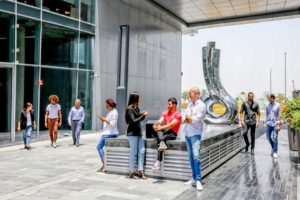
What would be your advice on what makes a successful business model today and what would you advise entrepreneurs?
It’s a difficult question but having said that it all starts with an idea and a vision. You must have a real conviction that your idea is meaningful. Once you start with this idea you need to conceptualise it and make sure that it has traction and that’s when it will become a business. At the part between the idea and the conceptualisation, a lot of people will abandon their idea because they are afraid, or they don’t have the means etc. You must have the courage to take this idea to conceptualisation. Then when you get to this point, you need to be persistent and make sure that you make the necessary movements to make this idea happen and have this proof of concept to do it. Here again, some people would lose patience and not take it any further. For me, these are still the easy steps. The third step is asking how you are going to scale up your business and does it have the traction to do this? This for me is probably the most crucial part.
A lot of effort is being made today to create this eco-system of start-up ideas, but there is not enough focus on once it has been conceptualised, how you do you scale it up and move it from idea to what it could become? This is the part that requires a lot of belief in yourself, a lot of patience, persistence, fight and conviction. This is probably the most difficult step to making it happen and become successful. This is actually where I as a person would like to help support businesses. To help them scale up their concepts and make them a big success. My advice here is patience and persistence – and then you will fly!
What is something that you still aim to achieve that you haven’t done yet?
I was blessed to have inherited this Group from my parents and with my brother we developed it, unfortunately, he passed away and I continued to develop it with mistakes and successes. Now it’s time that we make this transmission to a younger generation including my son. When I speak about family and family values and the team transmission, this is probably the most difficult step because you think you can lead and grow, but there comes a point when you have to understand that you need to let go and put in place some building blocks for the future. So this is definitely what I want to succeed in.
Secondly, I think the community has given me a lot and we do try to give back, but something I would like to do more of is to find more meaningful ways to give back to the community. Be it through the scaling up I was talking about, or education, mentoring, humanitarian projects, looking at the sustainability of our planet and our people. I think there is a lot to give and I have a lot to learn on how to be able to do it.
What is a lesson that you will carry with you from 2020?
Apart from how to remain agile, one lesson I have learnt is that you have to keep your eyes on both the short term and the long term. During the pandemic, humankind has mostly been quite genius and reacted to the best of their ability. Often what we have lacked is to continue to think about what happens after. So we need to be able to continue having an outlook on the longer term as well as the shorter term. It is easier said than done.
A second lesson is that this movement of solidarity and collaboration, which we have seen everywhere, is incredible and it’s incredible that we are not about to have this same level of cooperation and understanding during normal times. We don’t need to have a pandemic to make this happen. Together we can collaborate and contribute and not only to face adversity, we can collaborate for the good as well.
What is a message you would like to send to your clients in the Middle East?
I believe that beauty is in humankind and as a Group, family and business, we love and care for all of our customers, we believe in them and we are sure that they believe in themselves. So together, we can be much stronger, and we can co-operate to make this world a better place.
Tima Deryan The First Lebanese Woman to Climb Everest on Achieving Her Goals and Helping Others
Tima Deryan made headlines when she became the youngest Arab and first Lebanese woman to climb Mount Everest when she was just 26 years old.
This ambitious young woman gave up her corporate career when she realised her passion for mountain climbing and made it her mission to conquer some of the world’s highest peaks. Since creating her social media platform “Mountain Gipsy” she has developed a community of over 10,000 people who follow her journey around the world. As she travelled from country to country, Tima realised there was something else she was passionate about: inspiring and empowering women to achieve their dreams. She has since started to work as a motivational speaker and works with organisations around the world and particularly in the Middle East to create awareness and positive change across various topics such as leadership, team building, environment, and youth and women empowerment.
When the explosion in Beirut happened in August Tima couldn’t just stand back and watch the events unfold. She was on the first flight to Lebanon, not just to check on her family but also to help those in need. And she’s been there ever since. Working with local organisations to support women and children who have been badly affected by the blast. In a year when her schedule mountain summits have all been cancelled, Tima has found a new way to find success; throughout helping others. We find out more about her current work and the path of her journey so far.
This year has been a strange year for all – how have you spend your time during the lockdown?
I had the lockdown of a lifetime! When the UAE went into lockdown, I was spending some time in Ras Al Khaimah training for my next expedition. After realising that it would no longer happen, I decided to continue training as if it was still going ahead. During the first two months, I was very active, I tried to follow a schedule, which included getting certified as a Professional Life Coach, training, cooking, researching, reading, and practising yoga. Just like everyone else, I had my highs and lows while following the schedule during the tough times. I managed to stick to it through most of the lockdown! After two months I decided to fly to Beirut to visit family. I spent around 6 weeks in Beirut, making sure I still followed the routine I set myself. I flew back to the UAE when airlines resumed operations. Two weeks later, the Beirut blast happened, and I flew back to Lebanon to volunteer as part of the on-ground relief services.
Could you tell us a little about the work you have been doing to help support those affected by the explosion in Beirut?
I joined Borderless NGO, an organisation that supports the same causes I do: empowering women, inspiring youth, and safeguarding children. I joined their relief efforts and supported in rebuilding family homes and working on psycho-social support with children.
After spending a week on the ground, I realized how much this meant to me; being there and making an impact. So, I decided to stay and continue supporting through Borderless NGO. Today, I’m managing the project at the Karantina site. I oversee the children’s wellbeing circle in the morning, the women upskilling circle at noon, and I lead one-on-one life coaching sessions with women in the afternoon.

How has the tragic situation in Beirut affected you personally and what would you like to do moving forward to help those affected?
On a personal level, I felt anxious when I first saw the explosion on social media. It was very hard to articulate what happened, given that the country and the people have been going through a lot of challenges for a long time. From the protests back in October 2019 to the currency crash and drastic inflation, the explosion left me and every other Lebanese person in anger and disbelief. It was tough to see the tragic destruction after the explosion and I immediately wanted to be on the ground, supporting those affected. A week after the explosion, I managed to fly back to Beirut and have been volunteering ever since. I have decided to stay until the end of the year as the explosion has uncovered so many other issues faced that need to be addressed.
We love some of the work that you have been doing to inspire other women to climb – what is your motivation behind this?
Through my journey, I have learned so much from climbing mountains, travelling the world, connecting with people, breaking cultural barriers, and refusing to conform to social norms. Offering an example to other women and specifically Arab women, of what can be achieved is what motivates me to inspire them to set goals and to “climb” anything in life including career ladders, personal challenges, family restrictions, societal limitations, and anything that requires rising up! What motivates me, even more, is the daily progress I witness through my life coaching work with women who get inspired by my journey and take on obstacles to achieve their goals. We all have a shared responsibility encourage others and I take that responsibility to heart.
Take us back to the beginning of your career – what inspired you to become a mountain climber?
I have always been into sports and I have been attracted to anything that felt extreme to me. It started with fitness and bungee jumping to getting my licenses in scuba-diving and skydiving. Each sport offered something that I enjoyed, but it wasn’t until I climbed my first mountain that something inside of me ignited: “this is it” – it is what I want to do for as long as I live. Since then, I’ve climbed 19 high mountains around the world and became an outdoor enthusiast and an adventurer.

What were some of the challenges you faced at the beginning and how did you overcome them?
At the beginning of my mountaineering journey, I was working with an international company, so leaving work frequently to climb mountains was not an option. I had to decide between the mountains that made me sparkle vs. my career and financial stability. It came down to what really makes me happy, and mountains contributed to my overall wellbeing compared to work. I decided to quit my job and start my own venture; Mountain Gipsy, to have the flexibility I needed.
Another challenge was explaining to my family that I would be gone for long periods, in a remote area, in a different part of the world, to climb a high mountain. It sounded very alien to them, and they had a lot of fears knowing that I can be disconnected and unreachable. After a few mountains, it became natural to them seeing me take off for a month to climb a mountain.
As for society, I had to deal with a lot of doubters and sceptic questions such as: “are you sure of what you are doing?”, “do you think you are taking your life seriously?”, “do you believe you can sustain such a life?”, “will you be able to build a family in the future?” and the list goes on. To this day I do not entertain these questions unless I believe my answer will bring an actual change or a new perspective to the other person.
What goes through your mind when you are about to reach a summit?
“Just a few more steps” is literally the only thing that goes through my mind before reaching any summit. The summit is one of the most dangerous zones on a mountain and you need to be fully present in the moment and maintain your absolute focus.
What message would you share with women who are afraid to achieve their dreams?
To every woman struggling with achieving her dream or to anyone afraid to set a dream, my advice is to put yourself first: “moving forward, what kind of a future do I see for myself?”. Once there a vision and a little clarity of the aspired future, she can then start focusing on setting short-term goals to achieve her dream. While building on her inherent talents and strengths, she needs to block out all the noise and negativity around her, which may include family’s fears, friends’ opinions, and society’s expectations. By doing that she’ll be able to create her own world, her own thoughts, her own standards and most importantly, she will know what’s truly the right thing for her to do. If she manages to create that space of her own, every obstacle and challenge along the journey to her dream will become much easier to deal with.
Tell us a little about your fitness and training regime.
Being fit is the core of my mountain climbing passion. I have done a lot of tests and errors to understand how my body functions in a different environment. When I do not have an expedition planned, I focus on training at a low intensity for longer hours to keep a strong base and improve endurance gradually. Before a planned expedition, I increase the intensity of my training so that my body can perform sustainably. This balance between low and high-intensity training based on heart rate helps me to go longer, faster and with less effort, and ultimately helps me in the mountains. Sometimes, I take a break and chill because that is healthy too!

Tell us about a moment when you faced a challenge or setback and how did you overcome it?
While climbing Everest, after my 2nd rotation, which is more than halfway into the expedition, I fell very ill and started developing bronchitis. I felt weak, anxious and constrained, especially after the basecamp doctor told me there was a chance my expedition would have to be cancelled. I had to start a course of antibiotics and for such medication to be effective; I needed to be at a lower altitude. I left basecamp 5,360m and went to a village called Pheriche at 4,300m. I stayed at a mountain hut with two elderly Nepalese couples for ten days. During the first three days, I was feeling sick, lonely, and nervous. I’d wake up every day to the same routine, to silence with only the Buddhist chants in the background and mules’ bells ringing outside and I would tell myself that I will feel better, I will rise above this, it might not all be in my control, but I can still do small things to contain it and change it. I committed to being very consistent with my medication, have the right amount of food my body needed to heal faster, and I stayed away from all the stress of big avalanches, peak news, and basecamp rumours. Ten days later, I was feeling strong and decided to head back to basecamp, it took me about 8 hours through sun, rain, wind and snow! That day tested my patience and proved how bad I wanted to continue my journey. My main takeaway from this setback was the power of mindset and consistency. Having a growth mindset in any situation and committing to a consistent routine for ten days got me back on my feet.
How would you define success?
To me, success is being the best version of yourself. Living your best life. Being free. Giving back and achieving your dreams.
What is your biggest success so far and what would you still like to achieve?
My biggest success so far is myself. Today, I am not who I was yesterday as each event we go through shapes the peaks and valleys of our lives. Always moving forward through good times and tough times is a great measure of success and the results are reflected through my personality, perception, thoughts, and actions. I still have so much to achieve in terms of self-growth, passion, community, and exploration. The list of desired achievements is endless. However, the ultimate achievement would be creating a meaningful impact in the world and inspire people to be the best version of themselves and live their best lives.
What’s the best piece of advice you’ve ever been given?
If I have to pick one, I would choose what my dear grandfather tells me all the time: “Do not look back because you will lose yourself in the past, only look forward and you will find the best version of yourself”
When are you at your happiest?
On a mountain, when I am feeling strong, halfway through an expedition, appreciating how far I have climbed, and excited about what is yet to come. Also in the community, when I’m giving back and creating meaningful impacts on the life of others.
Where is your favourite place to travel to?
I love travelling to South America, the energy of this continent is vibrant, deep and full of life. It brings out the best colours in me!
What is the life motto you live by?
Nothing is permanent! Be present and truly live the moment.
What is the next challenge you are going to set yourself?
There are a lot of adventures that are calling me but my top three currently are: Completing the last of my 7 summits: Mount Vinson – Antarctica’s highest mountain. Skiing both the North and the South poles. Climbing as much as I can of the 14 mountains that are higher than 8000 metres. (known as the 14-8000’ers)
Noora Hefzi Talks Style, Passion and Finding Self-Love
Noora Hefzi considers her own personal style as her biggest inspiration.
The Saudi Arabian-born fashion lover starting designing collections when she couldn’t find anything she liked to wear. So she took matters into her own hands and began creating collections that inspired her to dress up in the morning. But it is Noora’s spiritual side that has been driving her passion over this past year. The designer has learned more new skills than ever, from playing the violin to learning how to help others appreciate themselves and find self-love. As she prepares to launch her fall/winter 2020-21 collection we talk to Noora Hefzi on why this year has been so special to her and the changes she would love to see in the fashion industry moving forward.
This year has been a strange one for all – what is something you have learnt from this period?
It was a strange year but to be honest, I feel like this has been the best year for me as I was able to use the downtime to create my Spring Summer 2021 collection. I’m working on a collection of shoes and accessories collection for the first time as well. I’m investing most of my time into learning, by reading all the books I have always wanted to read and completing courses. I’m also focusing on improving my violin skills. I feel like I went back to being a student but studied subjects that will help me to grow mentally and spiritually.
Take us back to the beginning of your journey before you launched your fashion brand – what was your goal and how did you set about achieving it?
I wanted to create my own clothes so I designed a wardrobe for myself as I felt what I was looking for wasn’t available in the market. I wanted interesting clothes with luxurious fabrics, cool cuts, with great attention to detail and excellent finishing.
What is your first memory of fashion growing up?
Playing dress up in my mother’s closet with my sister and deciding who gets to keep what when we grow older. Making Barbie dresses with spare fabrics my grandmother had from her sewing projects, and watching one of my favourite style icons Sherihan on TV.
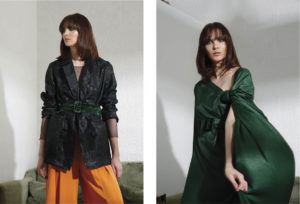
What are the values that are important to you as a woman and as a brand?
In a nutshell, “better fewer things” has been my motto in life. We need to re-evaluate our consumerism habits and see how we can invest in more long-lasting quality items rather than fast fashion or disposable things in order to reduce our footprint on our planet. We need to find sustainable solutions, but it can start with the way we live our lives at home, by upcycling rather than throwing away or recycling. I wish more people would understand this and be mindful when purchasing anything. I know as a designer that I have to do my best to be a sustainable brand and to do this I produce by order only. There needs to be an effort to reduce the absurd amount of waste that fashion brands produce and destroy each year.
What would you still like to achieve that you haven’t done yet?
With the knowledge I have acquired I would like to open a wellness centre for people who are interested in healing, self-discovery, development and releasing trapped emotions from their minds that are limiting them in their life, and changing or limiting their beliefs. I would also like to create a platform to teach kids how to deal with their emotions from the daily pressures of life by using EFT or Psych-K or creative visualization and teaching them that they are the creators of their reality. I would like to create a cookbook with all my wholesome healthy homemade recipes as well as create a Barbie clothesline with the fabrics I use for my designs and create dolls, dressing them with clothes I make. I would love to dress Queen Rania of Jordan and finally on a more personal note, I would like to travel to see the Northern Lights.
How do you think your heritage and upbringing has influenced your designs?
My upbringing definitely influenced my designs as I considered my mother the most stylish and elegant lady there is and she still is to this day. She dresses for herself every day, even if she’s not seeing anyone or going out, and I love that about her. She inspired me to dress the way I do and be creative with my outfits.
How would you define success?
Success is being able to do what you love, enjoy it and get paid for it. All whilst giving back to your community and making a positive impact within the world.
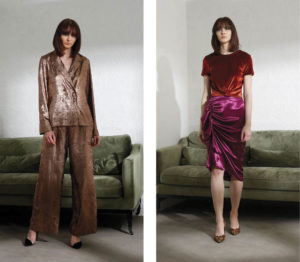
What can you tell us about your fall/winter collection?
The Fall/Winter 2020-2021 is a nostalgic ode to the decade I was born. Dreaming of yesteryear and my first real introduction to fashion through my mother’s wardrobe. As a child, I immersed myself and visualises the possibilities of what I would be able to wear as an adult and this collection is a reflection of that. I would envision myself looking glamorous in rich colours and bold cuts while running errands, or while lounging, much like the women in my life when I was young. The colour palette is a combination of deep jewel tones and evokes a sense of lavish glamour and mystery. With shades of emerald, persimmon, magenta, chartreuse green, oxblood and teal, the collection forms a complete wardrobe that can be layered and transitioned from evening wear to formal wear. It has the perfect balance between fluid and structured designs with shimmery iridescent velvet, fluid crepe and voluminous taffetas.
When are you at your most creative state of mind?
Definitely it is very early in the morning and while out with nature by myself, listening to classical Cello or violin music.
Who is the woman you design for?
I actually design for myself; that’s how I started my brand and I still keep that in mind every time I make something. When designing a new collection, I start by asking myself ‘what would I want to be wearing next season?’ So I’m creating a new wardrobe for myself each time. I imagine the woman who wears my pieces is someone comfortable in her own skin, elegant, timeless, confident and adventurous with her style.
What are some of the styles you love to create the most and what colours and fabrics do you like to work with?
I love velvet and organza even though it’s not easy to work with and they are seasonal materials, but they are just so beautiful to touch and so pleasing to the eye. I also love draped styles as well as asymmetrical cuts.
Where does sustainability fit into your brand?
We make our pieces to order for each customer; so don’t keep stock of any of our pieces. Customers today, have got too used to having what they want instantly, but in my opinion, good things take a little more time; just like good food takes time to be cooked, good clothes take time to make. Having to wait for your clothes to be made makes it exciting and you know that each piece is made especially for you. I think that is a nice feeling.
What is a challenge you have faced throughout your journey and how did you overcome it?
I think my biggest challenge was overcoming my fears. So I was the challenge! I wasn’t sure I could grow or expand or design more, or always be able to be creative or be good enough. But I have I learned that my business is not really about the sales, profits, media coverage or any of that. But rather who it made me become as a person and how it allowed me to evolve and change through the years to whom I am today. It made me work on being the best version of myself each day and to face my fears and do something out of my comfort zone each day.
If you could look back, what is something that you would tell your younger self?
Surrender and go with the flow. Take everything that comes your way not as an obstacle or problem but rather as an opportunity of growth in some form. I learned to ask myself ‘what’s the opportunity here?’ when facing a challenge. In the end, everything will work out in the best possible way for you, and if it doesn’t then it’s not the end yet. Trust God’s plans for you, even if it’s not what you planned for, everything is always connected back to your purpose in life.
What is something you would like to see happen in the fashion industry?
Season-less fashion! I hate the pressure of creating 3-4 collections a year collections that have a shelf life of maximum 6 months then “expire” or go on sale. I’ve been considering shifting my brand to a season-less one. I know some of the biggest brands have been doing that because of the pandemic, which I think is great since no one really needs a new wardrobe each season. I believe season-less fashion will save the planet. It would be a radical shift of a cycle that has been spinning and overproducing for decades and we need to rethink how we as producers and consumers can make a positive change.
I believe fashion should be classic, timeless, exciting and unique. Quite literally like wearable art. Something that will look good and appealing to buy today and ten years from now. Not because it’s in style or on-trend, but because it can be worn multiple times in many ways and will never go out of style.
What would you say to anyone at the beginning of his / her business journey?
Creativity requires courage. There is always a beginning, so gather the courage to start something you are passionate about. It’s that passion that will keep you going. Take one step towards your goal each day. Small continuous acts gather momentum that creates bigger things. Divide big goals into smaller chunks to make them easier to accomplish and to make them less intimidating. I truly believe that inspiration comes from God and is everywhere in the universe. Take action on the inspiration you get and implement the ideas before someone else does because someone else always will when you don’t. I learned this from the book “Big Magic” by Elizabeth Gilbert.
What is the life motto you live by?
“Forgiveness is like setting a prisoner free then discovering that prisoner was you.”
