

Jacob & Co. Launches an Exclusive Collection of NFTs
Jacob & Co. has revealed the first-ever luxury watch NFT collection. Inspired by the watch Maison’s iconic timepieces the Astronomia Metaverso collection of digital artworks come hand in hand with a new collection of five limited edition watches.
The collection is exclusively in partnership with UNXD, the leading NFT marketplace for iconic luxury and culture.
The Astronomia Metaverso collection features 8 unique watch NFTs that are works of art in their own right. Each NFT captures a unique Astronomia Metaverso design inspired by an imagined metaversal version of each planet in our solar system.
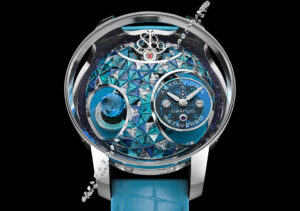
The watches from the five closest planets (Mercury, Venus, Earth, Mars, Jupiter) will come with the physical watch, while 3 most distant planets (Saturn, Uranus, Neptune) will be sold as digital-only NFTs with different stylistic variants.
Drawn from the metaverse, each NFT returns with a special set of powers. Each NFT is not only a beautiful work of art, but also a membership pass to join exclusive Jacob & Co. digital and physical activations.
This eight-watch collection has been personally designed by Jacob Arabo, Founder & Chairman of Jacob & Co. The lore behind the collection draws inspiration from the crypto community’s comic and collectable culture.
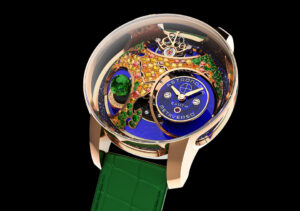
Astronomia Metaverso asks watch enthusiasts and crypto-collectors alike to indulge their imagination while enjoying the finest craftsmanship in watchmaking and unlocking new experiences with the Jacob & Co. brand.
Benjamin Arabov, CEO of Jacob & Co., said “This is a long-term commitment for us, and the first in a series of launches. As a company, we’ve always been on the bleeding edge of art and technology — forging our own path instead of following the crowd. We’re putting all our creative energy into this and can’t wait to show the world what we’re making.”
Jacob & Co.’s Astronomia Metaverso collection will be released exclusively on UNXD.
Reserve your spot now at unxd.com.
Dior Unveils an Eco-Friendly Capsule Collection For Men
Dior has revealed a colourful new beachwear capsule collection for men that embodies the House’s desire to become more eco-friendly.
Designed for the summer, the new collection. Features a ground-breaking collaboration between Dior and Parley for the Oceans; an environmentally conscious organisation and collaborative network that addresses major ocean threats with a strategy called Parley Air: Avoid, Intercept, Redesign.

For the debut collection of this collaboration Dior introduces a selection of environmentally conscious pieces that embody the house’s desire to move towards a more eco-innovative, sustainable future in the luxury fashion industry.

The collection is now available at Dior stores across the region.
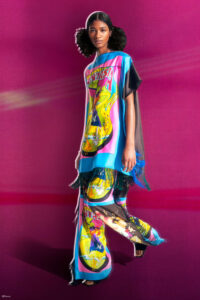
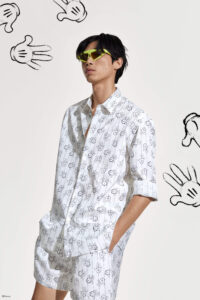
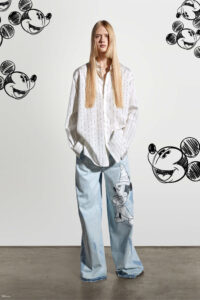
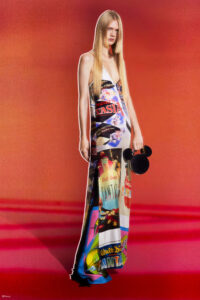
See Stella McCartney’s Disney Inspired Collection
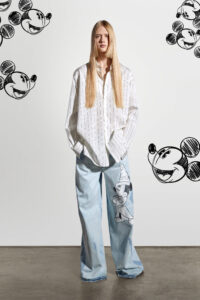
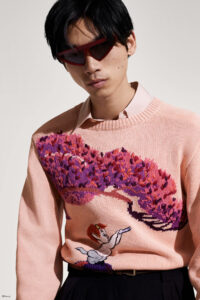
Stella McCartney was inspired by the timeless characters of Disney for her Disney Fantasia collection. The playful offering features some of the classic Walt Disney characters on recycled fabrics and organic cotton pieces for men and women. See more of the collection below:
Louis Vuitton’s New Collection Has us in the Mood For a Summer Holiday
Louis Vuitton presents ‘Spring in the City’ a summer capsule that celebrates travel and springtime with everything you need for the coming months.
Capturing the energy of springtime in California, the latest collection features clothing and accessories in bright colours and bold prints.
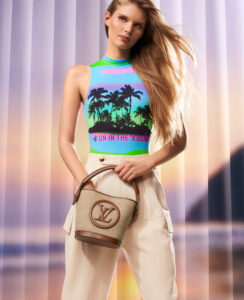
Adopting a colour gradient inspired by the vibrant palette of a spring sunrise, the new pieces feature Monogram-printed silk and Damier Graphite-printed denim.
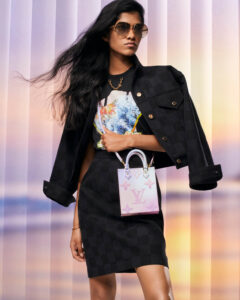
Iconic pieces such as the Papillon, Petit Sac Plat and Onthego bags dazzle in the collection, updated with a glossy 3D effect.
Now available at Louis Vuitton stores across the globe.
Miu Miu Presents a Special Collection Dedicated to the Month of Ramadan
Miu Miu has revealed an exclusive collection of ready-to-wear bags and accessories, dedicated to Ramadan and Eid.
Gam-miu-rous perfectly blends elegance and simplicity with an offering of pieces that will take you from day to night throughout the holy month.
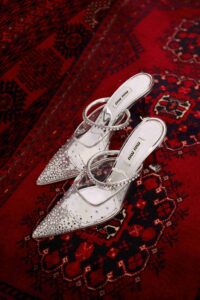
The joyful collection comprises feminine silhouettes with sophisticated details in a colour palette of bold and bright hues.
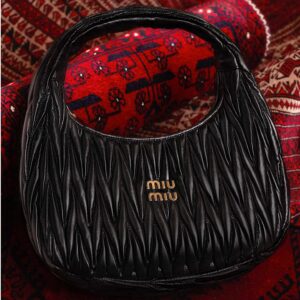
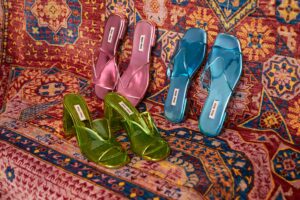
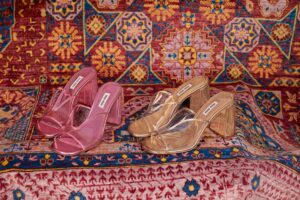
In accessories, the new Miu Wander bag juxtaposes contemporary design with the house’s iconic and discreetly luxurious matelassé́ leather. Sandals and slides are illuminated by crystal embellishments while moccasins in patent leather have pointed toes.
The collection was shot in an exclusive set of imagery featuring Dubai-based talent Dima Al Sheikhly.
Whether you are looking for a glamourous ensemble for the upcoming Eid celebrations or a sophisticated look for your next suhoor, this collection is the perfect accompaniment to all your celebratory events.
Discover the full collection across the Miu Miu stores in the GCC and online at www.miumiu.com/ae/
Photography Credits:
Location: Courtesy of Fatima Bint Mohamed Bin Zayed Initiative.
Photographer: Daniel Asater
Creative Direction: Jeff Aoun
Celebrity Style at Coachella 2022

Harry Styles

Sara Sampaio

Doja Cat

Paris Hilton

Kim Kardashian

Vanessa Hudgens

Olivia Culpo

Alessandra Ambrosio

Christina Milian
Carolina Herrera Introduces a Regional Exclusive Fragrance
Carolina Herrera is proud to launch the first regional Herrera Confidential campaign inspired by the unique world of oriental perfumes in the Middle East.
Carolina Herrera celebrates the latest fragrance from its Confidential line: True Oud. This newest addition encompasses the traditional Oud scent of the Middle East and is brought to life through its cultural campaign, shot on location in Riyadh, Saudi Arabia.
The fragrance explores the feeling of identity and belonging that the distinguishable scent of Oud embodies in the Middle East. Carolina fell in love with the scent on the many memorable trips she made with her mother to the Gulf, she would visit markets and immerse herself in the unique world of oriental perfumes.

Amal Alharbi stars in the True Oud Campaign
“The idea is that, whether you’re a man or a woman, the fragrance is present at important times with your loved ones and creates a powerful sillage that will follow you wherever you go and speak about who you are and where you’re from.” Said Carolina A. Herrera.
Carolina envisioned a celebration of Saudi culture for this campaign and the feeling of women empowerment that is growing within Saudi society.
Alongside the regional campaign video, Carolina Herrera commissioned Amal Alharbi to create a poem inspired by this sense of identity and belonging that inspired the woody-floral formula of the eau de Parfum.
Amal Alharbi, is a regional pioneer across her various mediums of expression, bringing visibility and understanding to topics such as mental health, addiction and their validity in society.
Find Herrera Confidential True Oud at all major retailers across the region now.
Dolce&Gabbana Opens Its First Home Boutiques in Milan
Home at last: Dolce&Gabbana announces a double opening of its first two DG Casa boutiques, dedicated to the universe of furniture and furnishings.
If you’re planning a trip to Europe in the coming months, a stop at the new Dolce&Gabbana Casa boutiques is an absolute must. The two stores can be found in the city of Milan, on Corso Venezia 7 and Via Durini 23.
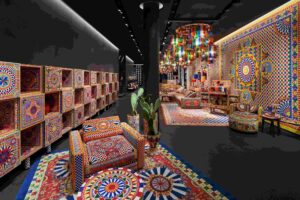
Each of the boutiques clearly reflects the exquisite patterns and designs that the brand is famous for and brings the themes of their clothing line to life on luxury furniture, table accessories, fabrics and decorative objects.
Blu Mediterraneo, Leopardo, Carretto Siciliano and Zebra are the four themes of the collection that evoke the Italian brand’s lifestyle, each respecting the tradition and innovation that have always been part of the brand’s DNA.
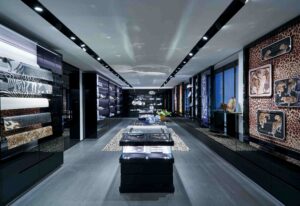
The first of the two, Corso Venezia 7 Boutique, stands out for its basalt decorations, linear, harmonious and a strong character. This boutique hosts DG Casa’s furnishings. Twill and Duchesse cushions, printed quilts, mouth-blown Murano glasses and Sicilian ceramic plates. This collection celebrates the best of Italian craftsmanship and highlights the art of home living.
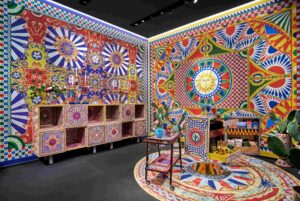
Aesthetically coherent with the boutique on Corso Venezia 7, large fabric sofas, lacquered oak tables and accessorized bar cabinets find their place in the second boutique on Via Durini 23. The two floors of the boutique are visually connected and enriched by the presence of mirrors reflecting the magnificent collections of furniture on display.
Get Summer Ready With Chanel’s Saint-Tropez Boutique
La Mistralée villa is a home away from home, presenting the brand’s various collections throughout the summer season, this elegant destination will be open from April 8th through to the end of September 2022.
Throughout the villa, the beige tones of the Roman opus travertine floor highlight the pinky-beige walls and the touches of black and white. Elegantly furnished, the different rooms of the boutique evoke the private sphere of Gabrielle Chanel.

In the double salon, a large fawn velvet banquette, inspired by Gabrielle Chanel’s own sofa in her apartment at 31 rue Cambon, further reinforces this welcoming atmosphere. All around, alcoves built into the walls present a selection of silhouettes and accessories from the Spring-Summer 2022 Ready-to-Wear collection.
A large zellīj table is an invitation to discover the season’s bags, while watches and jewellery, including the COCO CRUSH and N°5 collections, and the latest J12, Première and BOY-Friend watch creations, are arranged in sleek consoles.

The garden – a veritable oasis of calm – flourishes with large white bougainvillaea, black metal lanterns, sunbeds and wrought iron furniture. Near the swimming pool, on the wooden terrace, a salon in white linen echoes the aesthetic so characteristic of Mediterranean villas. Here, clients can try on the shoes displayed in the pool house, decorated in the same spirit as the villa.
Start shopping now through to the end of September 2022.
Van Cleef & Arpels Celebrates Ramadan With a Special Artwork
Van Cleef & Arpels has partnered with master calligraphist Majid Alyousef to share a message of harmony this Ramadan.
The Saudi Artist has created a creative expression of artwork representing his creation Harmony in Bloom. The artwork is inspired by values that are important to the Masion and values that are particularly important during the Holy Month.
This marks the third year in a row that the Maison’s essence of life, along with the spirit of the season, is reflected into the traditional art form of contemporary calligraphy.

Majid Alyousef
Majid’s artwork highlights his sophisticated style through a creative artwork that offers a harmonious take on the Frivole flower. The calligraphy brush strokes are so vivid as to make the viewer feel as if the heart-shaped Frivole petals are blossoming before them.
Since its foundation, flowers have been a historic source of inspiration to Van Cleef & Arpels, fascinated by its metamorphoses and constant renewal. The Frivole collection, which has inspired Majid’s master artwork, is a luminous ode to flowers where the pieces have been crafted with precious materials thanks to expert savoir-faire.
Where To Travel For The 2022 Eid Holiday
With Eid al-Fitr approaching, it’s the perfect time to plan ahead for a luxury escape during the long weekend. As the UAE has now removed many of its COVID restrictions, it is the perfect moment to travel, reflect and spend time with your loved ones. Many countries around the world are beginning to open their borders to travel to, and the joy of travel is finally returning. From serene deserts, chic cities and beachside hideaways we round up some of the destinations to visit now.
AlUla Saudi Arabia

The picturesque destination of AlUla in Saudi Arabia has been high on the priority list for many UAE travellers this year and we can see why. Nestled within the Saudi Arabian desert, AlUla is the ideal setting for tranquillity and mindfulness. The spectacular sunsets across the World Heritage Site are picture-perfect, and its rich history is not to be missed. Spend the days exploring the surreal rock outcroppings that mark the landscape, travelling on foot, bicycle, 4×4, or even an Arabian horse. In the evenings, coexist seamlessly with the natural wonders around by spending the night in the villas at Caravan by Habitas. These villas combine traditional design influenced by the Bedouin people, with a modern and luxurious feel encompassing you within the culture.
All travel restrictions to Saudi Arabia have been lifted, visitors no longer require a vaccination certificate or COVID test to travel from the UAE.
Singapore

If you are looking for somewhere further afield with the hustle and bustle of a modern city, then Singapore has just recently opened its borders for travellers coming from the UAE. One of the ultimate highlights of this destination is Gardens by the Bay. An impressive 101 hectares of land converted into waterfront gardens, it is home to Marina Bay Sands, Singapore’s most iconic and luxurious hotel. Streets are filled with artworks and sculptures, and at night the city comes alive with the lights of the super trees. Alternatively, for a haven of natural beauty, visit the national orchid garden or the botanical gardens, which has been listed as Singapore’s first UNESCO World Heritage site.
Singapore has introduced a Vaccinated Travel Lane scheme. This means it is open to vaccinated tourists but they must apply for a safe travel pass before they fly, download the TraceTogether Covid-19 tracking app and present a negative PCR test result before departure.
South Africa

After last year’s COVID-spike, South Africa is returning to normal and cases dramatically dropped and many restrictions have been lifted. Tourists are flocking back to experience the best outdoor activities the country has to offer. By flying into Gqeberha, previously known as Port Elizabeth, you can visit the old mosaic lighthouse for the perfect picture opportunity or take a boat tour to spot whales and penguins. After the delights of this city, a scenic 8-hour road trip adventure to Cape Town awaits. Cape Town is a must, famous for its Table Mountain hike and breath-taking vineyards, there is also a chance to spot the ‘Big 5’on a thrilling safari at Madikwe Private Game Reserve.
Visitors must present a valid, recognised negative PCR test certificate, taken within 72 hours of departure. The COVID Alert South Africa app should also be installed, and a traveller health questionnaire should be completed and presented at check-in.
Maldives

The Maldives has been one of the most luxurious destinations to visit for many years now and it continues to be a top getaway for UAE travellers during the Eid holidays. It boasts idyllic resorts with underwater hotels and overwater bungalows, and the turquoise water that surrounds them is second to none. The Maldives is renowned for having some of the world’s best beaches and the beneath the sea lies pristine coral reefs with an abundance of tropical marine life. Whether it’s a romantic escape or a cherished family holiday, the Maldives has everything you need to relax and take time out from hectic daily life.
Passengers are no longer required to have a COVID19 vaccination certificate or a PCR test result to enter the country but must complete the online immigration and health self-declaration form within 48 hours of departure.
Croatia

If Europe is where your heart lies, then Croatia offers sophisticated hotels, elegant restaurants and private yachts. The coastline is also adorned with remote villas for privacy and that extra level of luxury. It’s also worth taking a few day trips to explore the different sights, Croatia is famous for its beautiful lavender fields, vineyards and historic towns, or you can take a private sunset boat tour across the Zadar shoreline.
Fully vaccinated visitors from the United Arab Emirates can enter Croatia without restrictions and unvaccinated visitors from the United Arab Emirates can enter Croatia with a negative COVID-19 test result.
Oman

If you have not yet had the opportunity to visit our neighbouring country Oman, then Eid is the perfect holiday for this visit. Feel comfort in your own car as you cross the border on the 5-hour road trip journey, or alternatively take the short 1-hour flight, you can surely mix luxury with adventure on this trip. Stay at the W hotel in the heart of Muscat with Sultan Qaboos Mosque just 15 minutes around the corner, a beautiful sight to see at sunset. For daytime exploration, take a trip to see the Emerald Water at Wadi Shab or hire a private boat to see dolphins leaping from the sea in their natural habitat.
Tourists who are fully vaccinated with any of the approved vaccines can be accepted for travel to Oman without presenting pre-departure COVID-19 PCR testing results.
Opinion: Reverse, Release and Recalibrate This Ramadan
John Sanei: Why you should take time to reflect and unpack your wisdom this Ramadan.
Ramadan is a time for reflection and I think it is a wonderful opportunity to unpack wisdom. This process stems from the idea that you can have memories with no triggers and you can move from unconscious memories to conscious memories, meaning that you stop blaming your past and on the contrary, start thanking your past. An interesting quote is “the knowledgeable man has to learn something new every day, but the wise man has to unlearn something new every day.”
Letting go of old identities and old trauma are the most important parts of reflection, and in order for us to have a brighter future with more opportunities, the most essential thing for us to do is let go of old expectations. Within our brains, we have developed certain belief systems, from growing up, from our culture, from our families etc. and we continue our lives looking for reasons to prove our belief systems right. So for example, if you had a bad experience with a partner when you were young, you will meet other partners with similar traits, and this will allow you to confirm to yourself that all partners are the same. Which is not the case. But this will be a continuous pattern throughout our lives, reconfirming the belief systems that we believe to be true.
So if you are taking some time out to reflect on your life over Ramadan, I would advise you to take on a practice that will allow you to reverse, release and recalibrate. What I mean by this is to firstly reverse back to where the trauma sits in your mind. Seek help to try to identify these patterns within yourself and find ways to release them, so that you can come out of Ramadan, not only cleansed spiritually and physically but emotionally as well. We are made up of three different bodies – mental, emotional and physical – and healing needs to happen on all of these levels. Memories sit in our emotional bodies and we need to be able to deal with these emotional traumatic hooks in a very specific way. Prayer and being connected to God is an amazing technique, but actually taking on the tools to heal our memories, is a different scenario – it doesn’t make you less or more religious – it just allows you to use different tools to deal with these traumatic memories and to go through the process.
Wisdom is ultimately this idea of letting go of the past, and if we want to prepare for the future in the most exciting and optimistic way, we have to clean our past and release and recalibrate parts of our memories that have kept us stuck in the past. The truth is that all of our memories are just subjective stories that we are holding on to. None of our memories are real, they are simply our interpretation of something that has happened. We must take on the task of reverse, release and recalibrate to allow us to start fresh post-Ramadan.
The first step is to become aware that your memories can be changed. Many of us don’t realise this and many of us don’t even want our memories to change because we feel as though they give us identity. So once we have that awareness, the second point is to seek help. There’s a fantastic modality called “Family Constellations” that can help you see your family lineage objectively playing out in front of you and this is a really interesting tool to help address issues from your childhood. It uses an incredible concept called quantum mysticism which is something really powerful that happens when you go through this, and it allows you to break patterns that your family might be carrying.
We also need to realise that our emotional bodies require the same attention that our physical bodies do. When it comes to our physical bodies we worry about eating the right foods, working out etc. but we don’t pay the same attention to our emotional bodies. And when you can manage your emotions, you don’t even need to go to the gym because your physical body will reflect what is happening emotionally within you! So what does that take? It takes constant engagement with professionals. So if you are seeing an emotional coach or life coach, the key is to make sure it is something that you do regularly, not just once in a while.
There are three ways to seek out help. The first is related to how you think. There is a great author called Adam Grant who has a new book which is about thinking about how you think. Ask yourself if you are putting enough effort into thinking about how you think? And can you change how you think? And I can tell you the answer is absolutely yes, you can. The second way of healing yourself is through dealing with your emotional state and family constellations is a wonderful way of doing this. And the third way is physical. Because our physical cellular structure is holding on to these memories. Your body becomes your mind and it starts to make decisions on your behalf as a habit that you have no control over. So we have to heal our bodies as well. You can try techniques such as reiki, body talk Kinesiology – all of these tap into the emotional intelligence that is around your body, which we often tend to ignore.
So in summary, I think it’s wonderful that Ramadan comes round once a year as it gives us time to reflect, but I think if we can go a little bit deeper and engage with professionals to understand the tools that we need to actually create more wisdom within ourselves, it could be an even more powerful Ramadan for you.
Nadine Kanso Collaborates With Bespoke Carpet Maker Iwan Maktabi
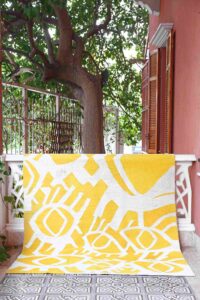
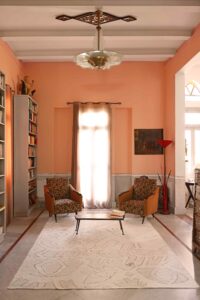
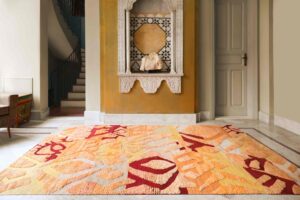
Nadine Kanso collaborates with bespoke carpet maker Iwan Maktabi on a special collection inspired by the Evil Eye.
Artist and jewellery designer Nadine Kanso has always been inspired by Arabic culture, calligraphy and symbols. Her jewellery line Bil Arabi features creations that incorporate Arabic symbols and letters combining heritage and modernity. In 2018, Kanso collaborated with Beirut-founded Bespoke carpet creator Iwan Maktabi on a luxury carpet inspired by His Highness Sheikh Zayed.
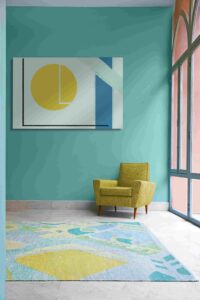
Now the partnership returns with the new “All Eyes” collection of carpets that combine Iwan Maktabi’s heritage with Nadine Kanso’s love of calligraphy and symbols. Here we meet with Nadine and Mona Maktabi, Managing Director of Iwan Maktabi in Dubai to discover more about the collection as well as the continuing partnership between the two brands.
Tell us about this collection and how the partnership came to life?
Mona: Myself and Nadine are old friends and we are very close so it’s something that was bound to happen. It took some time to get it right but here we are.
Nadine: When Iwan Maktabi first approached me in 2018 we created our first carpet; the Sheikh Zayed inspired carpet which was a beautiful handmade wall hanging carpet in silk. After that, we saw that we could actually work together in a number of ways and that we had great synergy so everything has gone very smoothly. When you have a collaboration like this it’s always a big job.
Mona: We started with the carpet that featured a raised heritage technique, then we put the effect of the evil eye on top in silk. So it is a combination of modern and old. In terms of colours, we chose an electric orange which was very daring but looked very nice, and we paired it with greys and blues as well as introducing rainbow colours.
Nadine: We decided to incorporate the Evil Eye into our designs as we saw a lot of demand for that kind of style and we know that people like to have the Evil Eye symbol in their homes.

Tell us why you decided to use the Evil Eye symbol in the designs?
Nadine: The Evil Eye is a cultural symbol that many people can resonate with. I use it in my jewellery designs, and I actually hand draw it myself. I decided to use the design in the carpets in this collection as it is both cool and practical.
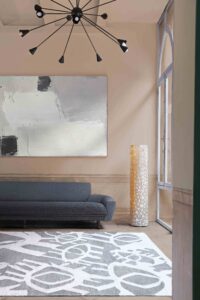
Mona: Yes, and these are not your regular carpets, they are perfect for summer, they can be in chalets, you can even place them outdoors so they are perfect for this time of year. We first created a “Keleem” carpet which is a flat weave, and then we added mohair or precious yarn on top to create a three-dimensional texture.
Nadine: We have also created a specific “All Eyes” jewellery collection for Bil Arabi that is inspired by the carpets and it is exclusively available in THAT Concept store in Mall of the Emirates. I decided to bring back the old Arabic font that I used from the beginning of the brand and I added stones and incorporated the evil eye so you can actually have the eye inside the letter.
Mona: One more point on the Keleem is that we stitched the words “Ya Ein” which means “wow” in Arabic on every carpet. The words are in Nadine’s handwriting.
Tell us about the creative process and how you worked together on this project?
Nadine: For the Sheikh Zayed carpet I did the design and sat with Mona and the team and went through all the colour options. For this one, I did the design and then I handed it over to the brand and they took it to their manufacturer to apply it.
Who is your target customer for this collection?
Mona: The Keleem is affordable so anyone can have one in their home even in the small size. And then as you go bigger they increase in price but they are still very accessible. People like them because the Evil Eye is something that’s nice to see every day in the home and it’s very decorative. The colours that have been most successful so far are yellow and white and the natural tones.
Iwan Maktabi as a brand has a long family history, how did you express the DNA of the brand through this collaboration?
Mona: When we saw the production of the Sheikh Zayed carpet that Nadine designed we thought that the eye resembles the new generation and it combines both contemporary and traditional style. It goes well whether you are in a living room, family room or a formal setting and it goes well with tribal designs as well.
Bil Arabi has always incorporated Arabic Calligraphy into its designs, what inspires you to use letters and symbols in your creations?
My brand name “Bil Arabi” means “in Arabic” so this was always the identity. Being from the Middle East I always thought that we needed to have a voice when it comes to our language and culture and this is why I started to play with Arabic letters. I started with the letter “N” for Nadine and since then it’s always been about making a statement that has to translate to everything I do. I like to incorporate an element of culture or calligraphy and its beauty in all that I do.
What is something you would still like to do that you haven’t done yet?
Nadine: The sky is the limit and we’re still young so we will see!
Mona: We keep trying to be creative because the carpet industry has become very essential, not just for the home but also in galleries that want to display the carpets as art. If you go to a luxury store they will always have carpet, so it’s not just about the home and this is something we are really proud of.
Throughout the pandemic people have been spending a lot more time at home, have you seen a greater demand for carpets throughout this time?
Mona: Yes this is something we noticed. We were very busy throughout the pandemic especially in the UAE because people weren’t travelling, they were spending more time at home and they wanted to find new ways to customise their homes. People were looking for something different so the customising element became very popular. We created a lot of bespoke pieces through this period.
How does the design process work when customers come to you?
Mona: Often an architect or interior designer will visit our studio in Dubai and they will have their own image of what they are looking for. We try to guide them and adapt the design to match their space. Sometimes we are asked for very unusual things, like a child’s painting as a carpet or something that uses special colours that you wouldn’t expect, so our design studio team will work hard to accommodate all of these requests. One of the most important aspects is finding the right materials that are of the best quality because the world of carpets has so many directions, you can have something very basic made from wool then you can add cashmere, viscose and make it whatever you want it to be.
Where do you source your materials?
Mona: We tend to source them from all around the world, trying to take the best materials from the best locations. Wool from New Zealand for example is always of the best quality, Indian wool is good, also Chinese wool and silk is great.
Do you think this partnership between Nadine Kanso and Iwan Maktabi will continue?
Mona: We still have so much to do so just be patient!
What does Ramadan mean to you and how do you usually spend it?
Nadine: Ramadan is a time for family and a time to slow down and gather over mealtimes every day. It’s a good time to think of other people and spend time with friends.
Mona: For me, the days are slower and it’s a time for gathering and spending time with family.
Boucheron Gets Colourful With Its Latest Collection
This Spring Boucheron adds colourful new additions to its Vendôme Liseré collection.
Bordered by an iconic black lacquer, pastel-coloured Tourmaline, Morganite and Aquamarine stones offer a fresh joyful look for this season.

This deep black lacquer has become an iconic symbol for this collection but this is the first time coloured gemstones have joined the offering which previously consisted of mostly white diamonds.

The new collection is accompanied by the Spring Colors campaign which celebrates optimism and renewal. The Maison has designed buzzers in the same colours as the stones as a playful way of celebrating these new pieces.
The collection is now available at Boucheron boutiques.
Louis Vuitton Reveals the Location For Its Cruise 2023 Collection
Louis Vuitton has revealed it will present the Cruise 2023 collection on May 12, 2022, at the Salk Institute in La Jolla, San Diego County, California.
This iconic location features remarkable brutalist architecture and sweeping views over the Pacific Ocean. Designed by Estonian-born American architect Louis Kahn, in collaboration with founder Dr Jonas Salk, The Salk Institute is considered one of the most significant architectural sites in the United States.
It is an independent non-profit research institute where internationally renowned scientists make life-changing discoveries in the fields of ageing, cancer, neuroscience, immunology, climate change and other areas to benefit global health and wellbeing.
Its impressive architecture merges bold lines with impressive views and modern design.
“Having spent a lot of time in California, I was drawn to the idea of showing there again. The Salk Institute has been a place of wonder for me over the years and Louis Kahn’s stunning Brutalist architecture against this extraordinary setting of the Pacific Ocean and the California sunset provides me with endless inspiration. It also celebrates intelligence, knowledge and the belief in the power of science,” Said Nicolas Ghesquière, Artistic Director of Women’s collections at Louis Vuitton.
Louis Vuitton’s Cruise shows across the years have been presented at some of the world’s most remarkable architectural structures and settings, each of which reflects genuine sources of inspiration for Nicolas Ghesquière, the Artistic Director of Women’s Collections.
The Louis Vuitton Cruise 2023 show will take place on May 12, 2022.
Damas Reinvents Its Iconic Collection
Sixteen years after it first debuted, Damas has reinvented its iconic Farfasha collection for Ramadan.
Comprising delicate butterfly designs with light floral creations these light and feminine pieces are perfect for spring.

Beyond the dreamy aesthetics and refreshed delicate designs, this collection also holds a nostalgic and sentimental value to many as it reminds them of the first Farfasha jewellery piece they ever wore.
Farfasha has always accompanied, women throughout their life journey enabling them to find the ideal piece to wear or gift their loved ones.

The latest collection features elegant designs inspired by nature with floral and butterfly motifs, brought to life by coloured gemstones including Tourmaline and Turquoise. The 18k gold collection features necklaces, earrings, bracelets, rings, bangles and long necklaces.
Now available at Damas Jewellery stores across the GCC and online. To view the full collection, visit www.damasjewellery.com
Meet Amy Smilovic, Founder & Creative Director of Tibi
Amy Smilovic, Founder & Creative Director of Tibi discusses the expansion of her brand, being a female entrepreneur and Tibi in the Middle East
Amy Smilovic founded her brand Tibi in 1997 after moving to Hong Kong with her husband. Unable to continue her own job in the country she wanted to find a way to express her love for fashion and her entrepreneurial mindset. Creating Tibi fulfilled this passion and set her on a journey of success. After moving back to the United States Smilovic established a base for Tibi in New York City from where she has gradually grown the business in her own way, remaining the sole owner of her company until this day. Tibi caters to women who are confident in their own style and understand fashion, her cult designs have become a favourite of celebrities and industry insiders and her classic style allow women to be creative in the way they wear her pieces. On a recent visit to Dubai, we caught up with Smilovic to discuss the latest collection and her plans for the brand in the Middle East.

In your own words, how would you describe the universe of Tibi today and the woman that wears the collections?
In the past, I would think to describe our Tibi customer as a demographic. Maybe by where they lived, their career, etc. But now I have so much more insight and we know that the Tibi person is a mindset. It is someone who really cares to express who they are visually. They have an attitude that is at ease, open-minded, and very curious about the world around them. They either have confidence within themselves, or it is something that they hope to have for themselves. The more their outside reflects their inside, the more their confidence grows.
What can you tell us about the Spring 2022 collection – the inspiration, the silhouette, the colour palette etc.?
The collection was about expressing who we are and showing more of the craft of the art. Handmade details, crochet elements, and visible seaming are ways to show the handwork in a more visible way. The collection manages a lightness that I feel is more important now than ever. However, it still does it in a way that is refined and very modern. That’s a delicate balance to achieving that ease whilst still having structure.

Tell us about the creative process for this collection.
I always start with how I want to feel. I write out the adjectives I want, it is important for me to have a lightness in attitude that is still grounded. I want to show respect for the past and heritage but not heavily anchored to it. I want colour and happiness but I want it tempered. The world is in a crazy place and I want to reflect an acknowledgement of that. It is joyful but still cognizant of what is happening around us. When we know how we want to feel, we can start to build the colour story and the fabrics that will reflect that. From that, we start to understand the shapes of the styles that will communicate that mood.
Can you share a little on the Creative Pragmatism concept you have been discussing over the past year?
Creative Pragmatism is about striking that balance between creativity and functionality. Many people have been trained that fashion is about choosing a “team” to be on. Team “Modernist”, team “Ladylike”, team “Sexy”. Creative Pragmatism eliminates the notion that you have to be one thing or another, or that to be both is to be confused. It gives a “term” to those who’ve had trouble expressing their style for fear that it is confusing. One day they dress very creatively, the next day more tailored and classic. Formulating the idea of Creative Pragmatism is about saying yes, you can visually look very creative, but it can also be functional and quite refined at the same time. You are a Creative Pragmatist if you strike this balance.

As a founder and creative director of the brand, how do you prioritise and separate your duties?
I hire people that I trust to do their jobs. Many have been with me for a long time – we know how to move together. I get my hands in everything, always. It’s what keeps me on top of the business. However, my team is confident enough to tell me when to back away or question me when I’m jumping in too deep into their area. I can’t help myself so it’s important I always have people around me who are confident pushing back.
Looking back can you tell us a little about how Tibi came to life?
I had always known that I would be an entrepreneur one day and I think subconsciously maybe I was always working towards that goal. Working first in adverting and then in marketing and sales at Ogilvy and then American Express. I moved to Hong Kong in 1997 with my husband; I couldn’t work for American Express there, and pragmatically speaking, it was an opportunity for me to do something on my own and fashion made sense. I was an art minor in college; I knew a lot about business and I was always obsessed with fashion. Hong Kong was just emerging as a place to make a luxury product so it was perfect timing.

What in your opinion is the secret to success?
I think one of the biggest secrets is that I am not a perfectionist. Perfectionism in my world of creativity is very dangerous. Because there is no set definition of a creatively perfect creative piece. I see many designers striving for this and it puts them in a holding pattern where they cannot move forward. Constantly moving forward is the key – if you spin too hard you just dig a hole for yourself and that’s not good.
What do you think sets Tibi apart from other brands?
Independence at our size. There is simply no, or extremely few, other brands that are our size and have managed to stay independent of outside investors. This means is we are free from being constrained by external voices of direction. We can make our own decisions, every day. And because we are a small team of 40 people, we are all highly informed on the business. Our ideas are not created in a “vacuum” and we are small enough to vet them out with each other and nimble enough to take quick action because we do not have layers of management. It is very freeing creatively, and to be free creatively is to be authentic. To be authentic is to mean something to someone. We do not have “authenticity” as a marketing objective, it just is what we are. Other companies are either too big to be authentic or they are too small to balance authenticity with the ability to actually produce and execute. We are in a sweet spot where we can do both.
Who is someone that has been a mentor or inspiration to you throughout your journey?
I take inspiration from everyone around me, whether it is my family, my husband, my talented team at the office, or podcasters that offer very balanced viewpoints (Honestly by Bari Weiss). I’m a voracious reader of business-related books and older books that are still relevant today (Ogilvy on Advertising). Anyone who takes risks I’m always a big admirer of (Richard Branson, etc).

What can you tell us about Tibi in the Middle East and can we expect to see more of you moving forward?
This trip was amazing and we will do so much more here. I had no idea the range of the individuals that I would meet and that 7,000 miles away I would meet so many people who shared the same mindset. There is a very passionate open-minded creative customer out here and I can’t wait to do more.
The past two years have been challenging to say the least – what is a lesson you have learnt from the global pandemic and have you changed anything about the business?
The lesson that I have learned is that really terrible things happen and you have to press forward. I am lucky in that my husband has been through so much in that respect. Having fled a country to arrive as a hopeful immigrant into the USA, he has seen terrible events unfold and he knows that you press on. Growing up on a small island, off the coast of Georgia in the United States, I always had a very loving family. We were not rich, but we had each other and life was stable. You knew what to expect. Now I know, I have to just expect that we will be constantly surrounded by the unexpected. We have to protect the core of what we have and press forward. Always moving forward.
What is the biggest challenge you face in what you do?
There is much out of our control – production, raw goods materials, and the state of the world. So the biggest challenge is to focus on what we can control, make sure that we are financially stable whilst still taking the right amount of risk to grow. We have employees at Tibi who have been with us for over 15 years and that’s a lot of pressure knowing that we are all supporting each other in so many ways. If one of us fails, everyone feels it. That’s a bit stressful, every employee contributes to such a level that they cannot fly under the radar. Traci, our head of design, she doesn’t just feel accountable to me, she feels accountable to Courtney in Public Relations, or to Sandra who runs our warehouse. That’s stressful and rewarding at the same time.
What is something you would still like to achieve?
I want to achieve a business level where more of our team can be rewarded and feel more financially independent for themselves. If that happens, we all really win. We are not there yet but I know I see the light at the end of that tunnel, so to speak.
What is the professional motto that you live by?
“Leap and the net will appear.” Julia Cameron, The Artists Way
How would you describe your own personal style?
Chill, modern and a bit classic.
What is a message that you would send to your fans and customers in the Middle East?
I can’t wait to see and meet more of you!
Tibi is available at THAT Concept Store in Mall of the Emirates, and online at thatconceptstore.com
See Net-A-Porter’s Exclusive Ramadan Edit
This year, Net-A-Porter has announced its most expansive curation of Middle Eastern brands to date, in honour of the month of Ramadan.
The carefully curated offering was the result of data insights that highlighted the demand for local talent, inclusive sizing, tailoring, fine jewellery and lifestyle products. Regional ready-to-wear brands including Reem Acra and Taller Marmo are joined by homeware brands such as Nimerology and fine jewellery brands such as Ananya. The edit features exclusive pieces from designers such as Elie Saab, Galvan, Oscar de la Renta, Marchesa Notte and more.
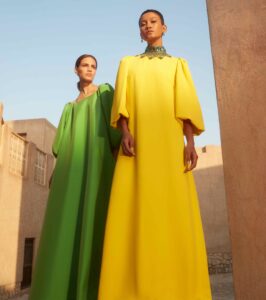
For its latest Ramadan campaign, Net-A-Porter took to the winding alleyways of Al Fahidi Historical District, known as Al Bastakiya in Dubai to shoot a series of images that pay homage to Ramadan festivities and nostalgia through vivid hues, dramatic silhouettes and Arabesque features.
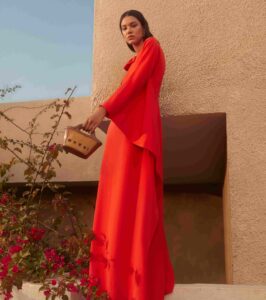
“Two years into the journey of NET-A-PORTER Arabi, we’re finally heading towards our north star. This Ramadan campaign offers a message of inclusivity, optimism and kindness. All of which represent the sustainable values of the Holy Month. The exclusive product offering this year is bigger and more colourful than ever to truly capture the spirit of the occasion” Said Nisreen Shocair, CEO YOOX NET-A-PORTER, Middle East.
The collection is now available to shop online at www.netaporter.com
Why This is One of Dubai’s Most Exclusive Pool Destinations
SAL at Dubai’s exclusive Burj Al Arab Hotel is of the most exclusive pool day locations in the UAE.
Situated behind the world’s only seven-star hotel this impressive hot spot combines the best of Arabian hospitality with Mediterranean style and flair. It offers the perfect destination to chill out and catch the sun’s golden rays, as well as offering fine European cuisine in the seaside dining destination.
Pool Side Luxury
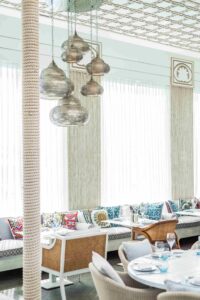
If pool days are your style this has to be one of the UAE’s most impressive destinations. With a 100-metre infinity pool looking over the azure blue ocean, views don’t get much better than this. From morning until sunset SAL offers the perfect location to lay back, relax and take in the sweet sea air. As the sun sets, lay back on your bed with one of the resort’s exclusive drinks, and watch the bright blue sky turn into a rainbow of pink and orange.
With various pool packages available, guests can choose their level of luxury, ranging from the pool-side loungers (complete with a manmade beach setting) to the fully air-conditioned cabanas. Guests will be treated with seven-star hospitality by the friendly staff who are on hand to cater to every need, their attention to detail is truly exceptional.
Fine Dining

Whether it’s for lunch or a laid back dinner once the sun sets, SAL’s impressive mirrored restaurant is a breathtaking dining venue. With a bold exterior that won’t go unnoticed, this has become one of the most in-demand destinations in Dubai. The restaurant serves the finest in Mediterranean cuisine, with a touch of elevated elegance.
On the menu is a range of seafood and Mediterranean inspired mouth-watering dishes. Must-try options range from the Homemade Trenette Pasta & King Crab (our favourite) to the Sea Salt Crusted Seabass (a seafood lover’s dream). If you prefer a meat option, the Grilled Beef Tagliata is a modern take on a traditional beef dish. Then to finish, a selection of sweet dishes including Sal & Sun, a mango and passionfruit based dish or Tonkakao, a rich Tonka bean dish.
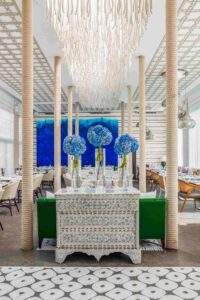
When you’ve finished your lunch, head back to the pool to indulge in handcrafted mocktails as you watch the sunset over the bright blue sea.
For more information and to book a table, guests can visit jumeirah.com/SAL or contact reservations at restaurants@jumeirah.com or 04-4323232.
Meet The Family Behind One Of Italy’s Most Iconic Jewellery Brands
As Buccellati opens its first store in the UAE, we meet Maria Cristina and Luca Buccellati to discuss the Italian jeweller’s future in the region.
With a long history of over 100 years, Buccellati is one of the most historical jewellers in Italy. Its unique style produces exquisite jewellery pieces that are made completely by hand and embrace the finest Italian craftsmanship techniques. A Buccellati piece is instantly recognisable thanks to its iconic style and design which is different from anything else out there and it is this that continues to set them apart and push forward while still staying true to the heritage of the brand.
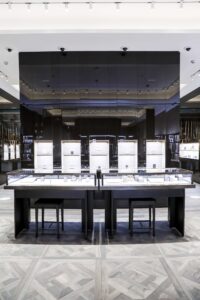
Founded by Mario Buccellati in Milan in 1919 Buccellati has always had a special relationship with its clients. As the company grew it was passed on through the generations of the Buccellati family who have continued to keep the vision of its founder alive. It is one of the only brands today that sees the original family still at the forefront of the brand. In 2019, the Richemont group announced that it had acquired the brand with a long-term plan to expand further globally but continue to keep the family spirit that has defined the brand for over a century. Part of the expansion saw the recent opening of Buccellati’s first store in the UAE. Situated in The Dubai Mall it will allow a new customer base to experience the true beauty of this “Made In Italy” design. As the new boutique opens we talk to Maria Cristina Buccellati, Global Communications and Marketing Director, and her brother Luca, Special Sales/VIP Client Director, to discover what this moment means for the brand in the Middle East.
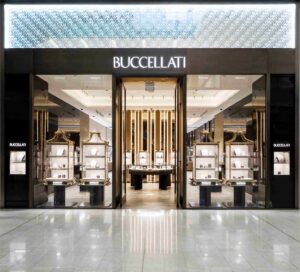
First of all welcome to Dubai and congratulations on this beautiful store – tell us about why you decided to open now and what this step means for Buccellati in the Middle East?
Luca: Opening a store here in Dubai has been a dream of ours for many years. Now we are part of the Richemont Group, which made that dream become a reality. At first, it was difficult for us to find a location for the boutique but once we found it, we immediately started working on it and we opened within a few months which was very fast. We have a great location amongst the other jewellery brands and it is in an area where a lot of people walk around. We had the soft opening on February 15th and the real opening is actually today, so you are one of the first to visit! As you know, we have a very different style of jewellery from any other brands and we have been doing this for 100 years so have a long story and heritage of making and selling jewellery that we want to share with the region.
What can you tell us about the new high jewellery collection?
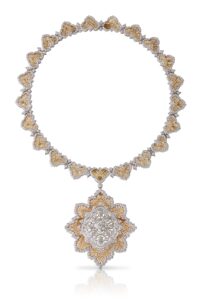
Maria Cristina: The collection was created last year for the Haute Couture season in Paris and it was originally composed of 15 pieces, but we have actually continued producing pieces because we had such great success with it. This year’s collection was inspired by Monet’s paintings. You can see this from the colours of the stones that have been used. We decided to call it the Il Giardino by Buccellati collection, meaning “garden” and the idea is inspired by flowers. We have blue sapphires, and green tourmaline – all of the colours are inspired by the artist’s paintings.
There is something very important in many of the pieces called “enchainment”, each small piece is enchained to the other, everything is handmade and this allows for complete flexibility of the pieces on the skin as if they are painted on. Every element is a one-of-a-kind piece and that is something quite important at Buccellati and something I think is quite important for our customers in this market.
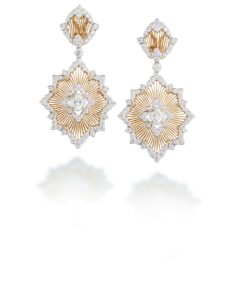
Luca: If you look at the pieces they are so light, it is as if they are floating on the skin and this is something that is integral to Buccellati. They are also versatile for day and night as some pieces are interchangeable and that’s something people love in this country.
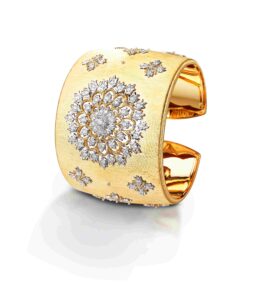
Maria Cristina: Looking forward to next year we are already preparing an amazing collection, we cannot say the name but it specifically recalls the engraving that we are known for. As you can see we have many different styles, but all of them are immediately identifiable as Buccellati. Engraving in the first element, then we have lace and flexibility, and then we have the honeycomb workmanship which is fantastic.
The incredible craftsmanship in your jewels is a key element of the brand can you share a little about that and the importance of preserving these traditional techniques?
Luca: It is so difficult to keep those people working for us but we try to do it as well as find new people to join the company. We created the Buccellati Academy and we are trying to recruit young people who are interested in learning crafts such as gold smithery and engraving, we are recruiting experts in gemstones, etc. and we are bringing them together and teaching them how to work in the Buccellati way and then many of them will join us as craftsmen or women.
Are you seeing any interest coming back to these craftsmanship skills from the younger generations?
Luca: Yes a little bit, but it’s still not as much as we would like. I think it is because in these times working with your hands is not always considered an intellectual skill. But these people are artists, they are like painters. They are not just using their hands they are also using their brains and it requires great skills. With all of these methods, you can’t afford to make any mistakes, or you would have to start the piece all over again, so the skills required are so special. Then you have the concentration required. These people can only work for around three hours at a time because the concentration required to do these intricate tasks is so much. One special thing about Buccellati jewellery pieces is that you can always see right through them. And this is why they are so light and easy to wear. It’s something beautiful that is exclusive to us and it’s in our DNA.
What do you think sets Buccellati apart from other jewellers?
Luca: It is our craftsmanship of course. A piece of Buccellati jewellery is instantly recognisable and different from anything else. We are crazy about detail, and we work in a unique way that no other brand does. One necklace can take over a year to make and our customers will wait that long because they know it is worth the wait. That is something incredible and it sets us apart from others.
Now you have the store here in Dubai what is the next step for the brand in the region and can we expect to see more of you moving forward?
Maria Cristina: We already have boutiques in the Middle East in Doha and Kuwait and we will be opening stores in Jeddah and Riyadh by the end of the year, and then eventually we will look at opening something more in the UAE, perhaps in Abu Dhabi. That’s not confirmed or in the plans yet but obviously the idea is to expand. The only thing that we must be careful of is that as all our pieces are handmade, we cannot open too many shops as we will not have the products to fill them! So there must be a good balance and we must not lose our exclusivity.
What are some of the collections you are going to be sharing in the region and highlights readers should look out for?
Maria Cristina: Firstly we have the Il Giardino high jewellery collection of which some of the pieces will remain in the store while others will continue to tour the world. Then we have the iconic collection; Macri. Then we have Rombi, Hawaii, and Ramage, all of which are all our DNA products. And then there is Opera which is a lower price point collection, and finally, the Blossom collection which is probably one of our best-selling collections today. The Blossom collection comes in silver and it was created by the next generation of our family. Lucrezia Buccellati my brother Andrea’s daughter was very young and could not wear the high jewellery pieces so we said, ‘why don’t you make something more affordable?’. So with my daughter and my other brother’s daughter, they created this silver collection. Lucrezia has remained in the company as a designer, so we are passing through the generations. The Blossom collection is of a lower price point, and we made it in silver with either diamonds or stones and it opens us up to a new audience. It’s really very interesting. Originally we made it for young girls, but even women like me wear it because it is versatile and can be worn from day to night.
Luca: It’s something new at Buccellati because years ago our collections were starting at 8,000 Euros upwards, now, you can buy something for 800 Euros.
What can you share about your clientele here in the region – what are they looking for from a jewellery brand?
Maria Cristina: We know we have a lot of clients here in the region because they visit us at our stores around the world. What they are usually looking for is something unique. But now that is what we are going to discover while we are here in Dubai. And we will also get to meet customers from all around the world as they pass through The Dubai Mall, so it is very exciting.
Luca: We know the awareness of the brand is there but to be here now and to see what happens and the type of customers that come to our store is very exciting.
Can you share a little on the concept of the store and how it reflects the brand’s DNA?
Maria Cristina: Yes all of our stores around the world have the same concept. There is a combination of ancient and modern elements. We have panels and display boxes that have been preserved from an old shop in Place Vendôme from the 1700s. We bought them from an antique dealer and I thought they had the perfect look for this store. Also, the jewellery cases were designed by my grandfather, but we also have modern cases and there is a nice mix of modernity and tradition, much like the brand.
As a family business, how do you balance work and family life?
Maria Cristina: Each one of us in the family has a different role in the company. Luca is in charge of private clients, I’m in charge of communications, and my brother Andrea is in charge of design.
Luca: We love it and we have fun together, we make decisions together when we are laughing and relaxing and everything is easier.
Tell us about some of your memories of Buccellati throughout the years?
Luca: There is one piece that will always stay in my mind. It was a flamingo that was commissioned in full gold by a customer from San Diego. He wanted a life-size flamingo for his garden. I told him it would be around one million Euros to make and he said “OK! Do it!” So we made it and shipped it to San Diego. I went there to ensure it arrived safely and he was amazed. It was a very memorable experience! He has passed away now but his son sent me a picture of the garden and the flamingo is still there! Some of the stories we have of people buying strange things are amazing.
Maria Cristina: I remember when we were young someone commissioned a headboard for their bed. It was a Mexican lady and she wanted the headboard made in full silver. My father made it and I remember thinking it was so huge, but I was very young at the time. Now they’ve sold it on auction and when I saw it again it was really tiny! When I was young it felt huge! So yes, we get very unusual requests from time to time.
Luca: And we can truly make anything because everything is handmade. I had a customer who was a fan of golden retrievers and her dog passed away. She wanted a full-size retriever made completely in silver. It was 75kg of silver and it took one and a half years to make!
What is a final message you would send to your clients in the region?
Luca: Buccellati is a family. We have beautiful jewellery and it’s probably the only brand left where you can visit one of our stores and shake hands with one of the family members. We are so proud to meet our customers. And once you buy a Buccellati piece once, you will never leave.
Valérie Messika Celebrates Ramadan
Messika Jewellery is celebrating the Holy Month of Ramadan with a unique gathering. In a new campaign, Valérie Messika is joined by friends to honour exclusive pieces from the brand’s collections.
“I feel a special connection to this region, which comes straight from the heart. I love the combination of gentleness and strength that emanates from Middle Eastern women. For me, it’s a perfect balance and their different facets, like a diamond, are sources of inspiration.” Said Valérie Messika.
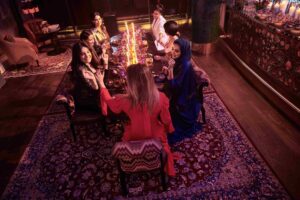
The regional campaign features successful women from the region including singer Almas, designer Alftoon Al Janahi, Chef, Sama Jaad, and actress Mila Al Zahrani.
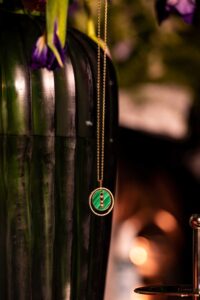
Each of the ladies is wearing their chosen pieces from the brand’s collections as they celebrate the spirit of this month. Shop the collections now online and at Messika stores around the region.
Taking Care of Your Skin Throughout Ramadan
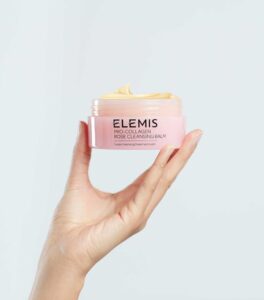
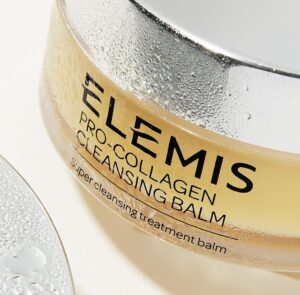
When fasting during Ramadan our skin can become dry and dehydrated, much like our bodies. As the weather also begins to heat up in the region it’s incredibly important to be using the right products in the right way in order to sustain a glowing complexion and to look and feel our best. With that in mind, we talk to Elemis brand trainer Ieva Onaityte to discover the latest tips, tricks and trends that will help to preserve our skin’s natural beauty throughout the Holy Month and beyond.
What are some tips you can offer for taking care of your skin during the month of Ramadan?
The skin will be more dehydrated than normal for those who are fasting so it’s crucial to use products with hydrating ingredients to keep your skin looking plumped and glowing.

How should we adapt our skincare regime throughout the Holy Month?
I advise my clients to use enzymatic exfoliators which will nibble away at dry and dead skin cells followed by overnight face and eye masks for increased hydration while they are sleeping.
Are there any things we can do aside from using the correct products to help our skin during this time?
It’s crucial to drink plenty of water and consume superfoods such as blueberries, avocados, goji berries and other antioxidant-rich fruits and vegetables which will maintain a natural healthy glow throughout the Holy Month.

What are some of the products you would recommend for dehydrated skin that many people might experience during this month?
My 3 all-time favourite products are:
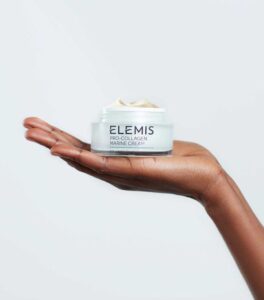
- Pro-Collagen Marine Cream – clinically proven to increase hydration by 248% in just one hour. It is extremely lightweight with rose and mimosa aromatics.
- Rehydrating Ginseng toner – this infuses the skin with a boost of hydration while also balancing the pH level of your skin.
- Ultra Smart Pro-Collagen Aqua Infusion Mask – contains aqua shuttle technology and encapsulated seaweed ingredients that will continuously drip feed the skin for more than eight hours.
Are there any in-salon treatments you would recommend?
ELEMIS facials, supercharged with BIOTEC technologies. It’s a 5 in 1 machine that offers in-depth and longer-lasting results. From anti-ageing to deep cleaning, to hydration to oxygen infusion, this treatment will cover all of the concerns you may have throughout Ramadan.
The weather is starting to heat up in Dubai – how can we protect our skin from the heat starting now?
It is important to keep your skin hydrated all day and night as even when you are indoors a lot more, the air conditioning tends to dry our skin out. I also advise drinking plenty of water.
What are some of the latest skincare trends that particularly interest you?
I continue to be interested in clinically proven skincare. With our fast-paced life, clients want to see results yesterday and to only use good quality ingredients is no longer enough, it’s also about how they are penetrated into the skin to ensure its full potential. Elemis continues to be a pioneer in the skincare industry, providing multi-award-winning clinically proven products.
In terms of ingredients would you recommend natural or manmade or a combination of both?
I recommend natural ingredients, however, manmade ingredients do need to come into play from time to time. For example, when it comes to SPF, the only natural option we have currently is titanium dioxide which is white in colour and isn’t compatible with make-up users. This is when micronised sunscreen which is widely used in the industry, comes into play.
What are some of the ingredients we should look for in products throughout the month of Ramadan?
Hyaluronic acid. It is 1,000 times more hydrating than water itself and when applied to the skin, will hold moisture content like a sponge, helping to reduce dehydration.
How often should we be using overnight masks and are there any you would recommend?
We should all be using an overnight mask 1-2 times per week or when our skin needs an additional boost while sleeping. My favourite one is ELEMIS Pro-Collagen Marine Mask which can be used during the day or at night, over your night cream. It will ensure you wake up with radiant and glowing skin.
What is the biggest mistake you see people do when it comes to their skincare regime?
Using the same products for more than five or ten years. Our lifestyle and skin change continuously, therefore our skincare products should reflect that. Adding or changing our facial oil or serum will challenge the skin in a new way.

What are the latest products from Elemis that we should add to our beauty cupboard today?
One of the latest and my favourite launches is Superfood Midnight Facial. It’s an overnight sleeping night cream that will leave dry, thirsty skin feeling silky soft, radiant and replenished with moisture upon wakening.
All Your Need To Know About This Year’s Homo Faber in Venice
Alberto Cavalli General Director of Homo Faber discusses this year’s event and how it celebrates the beauty of craftsmanship.
This year, Homo Faber, a cultural event dedicated to the beauty of contemporary craftsmanship returns for its second edition in Venice and it’s set to be the most exciting one yet. This year’s event which is organised by the Michelangelo Foundation for Creativity and Craftsmanship is titled “living treasures of Europe and Japan” and is dedicated to handmade crafts from these two destinations. Taking place at Venice’s iconic Fondazione Giorgio Cini, it will be home to 15 exhibition spaces, each dedicated to different aspects of craftsmanship. Here we discover more with the General Director of Homo Faber, Alberto Cavalli.

Alberto Cavalli Executive Director Laila Pozzo ©Michelangelo Foundation
Tell us a little about this year’s edition of Homo Faber exhibition, what can we expect and what are some of the highlights to look out for this year?
Homo Faber will be an event that celebrates the master of craftsmanship with a special focus on what we call the “living treasures”. It will be focused on European fine craftsmanship, but this year, our curators scoured the world for exceptional artisans and it drew them to Japan. In Japan, both seasoned masters and rising stars express and manifest a very contemporary vision and the idea of the role and the value crafts in our contemporary life. And this is why Japan is the guest of honour of this edition.
Since 1950 in Japan a group of gifted human beings who are holders of intangible know-how of Japanese traditional crafts were named “National Living Treasures.” And we liked the idea of celebrating human beings as treasures. Treasures are normally hidden and not easy to find, but they are very precious. They give value to the territory and to whoever encounters them. We have worked with some Japanese curators to have a selection of these Japanese national living treasures. In particular, we have worked with Naoto Fukasawa who is an architect and designer who has conceived the most beautiful set-up in one of the rooms where Homo Faber will be staged to celebrate twelve objects crafted by twelve living treasures.
The magnificent location of the event is already a discovery in itself. I think it’s the most photographed place on earth, but not a lot of people know what’s going on inside, so we are opening the whole foundation including spaces that are normally not accessible to the public, to create this kaleidoscope of exhibitions, each of which has been imagined and developed by a curator with an architect or designer. We have a team of curators over five continents and they have all brought great value to the project because they have allowed us to multiply the points of view. We believe that in contemporary times, to arrive at such an event offering a monolithic vision would be of no interest to anyone. While the fact of having all of these visions, perceptions, inspirations and points of view, all the different facets that the craft takes on contemporary life, Homo Faber will be a celebration of all of this and hopefully we will not only inspire new vocations but also surprise our visitors in a positive way by showcasing and demonstrating that there are and will always be something that human hands can do better than any machine.
At a time when technology is leading the way what in your opinion is the importance of sustaining traditional crafts in art and culture and how do you promote that to the younger generations?
We believe that technology is a very powerful and important instrument for artisans. Think about all the opportunities that digital communication can offer to master craftsmen who are very often tucked away in their own territories and not so visible to the rest of the world. Digital communication is of huge help. So if you look at the digital revolution from this perspective, it can only bring good to the master artisans. We believe that the true enemy is not technology, it’s ignorance and not acknowledging the fact that what humans do and their talent makes a difference in the world.
We believe on the contrary that the young generations are particularly interested in this. Unlike my generation, they have grown up knowing that the future is not necessarily a promise, but very often a threat. And they know that they have to take care of this to treasure the resources and to enjoy a new way of creating, producing, selling and exchanging. So there is already an interest that we will certainly try to channel into Homo Faber and on top of this, there is the idea that the more digital our lives become, the more analogue our dreams are. If you look at some of the world’s biggest tycoons, they live in the digital world, yes, but they wear an analogue watch. So there is always a part of us that needs to dream through something made for us with a purpose and Homo Faber will be showcasing this.
We are working with the new generations and we are offering visibility to young and upcoming designers who will be present as exhibitors, but also we are targeting an even younger audience. We have partnerships with schools and colleges around the world and we are ready to welcome an exchange with the younger generation and many of our exhibitions will be very immersive for them to enjoy.
We have 100 young ambassadors from across Europe. They are all school leavers from some of the best schools in arts and crafts and they will come to Venice to be the ones who show guests around, describing all the objects and installations to visitors. There is value in forming a community these days and this is a community of the makers of the future.
How do you think the event can resonate with people in the Middle East and is there any potential to bring the event to the region in the future?
I think it can resonate in a number of ways. The first and most obvious is that in the Middle East there are a lot of commissioners. By that, I mean people with good taste who are extremely interested in the work of the master artisans throughout the world. So there are a lot of opportunities. A master artisan can make his or her job viable if they have commissions. So it’s extremely important to work on this and to inspire people with the offering of having something special made for them in a certain way. With all the beautiful and impressive architectural development in the Middle East, it is becoming the new cradle of the commissioners of tomorrow. Because there is nowhere else in the world, that I know of, where there is this bustling activity of creating not only homes but meaningful and beautiful buildings whose interiors have to reflect personalities, dreams and hopes. So on top of the land of making is the land of dreams, and dreams will become projects.
Aside from this though we have the Homo Faber Guide which is our online tool that will soon be open to non-European countries. I’m quite positive about the fact that the United Arab Emirates will soon join. We will have a little taster of this coming up soon but I can’t tell you anything more yet!
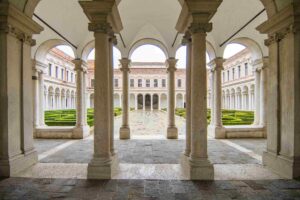
Fondazione Giorgio Cini Simone Padovani ©Michelangelo Foundation
Can you tell us a little more about the Homo Faber Guide?
Imagine you are a third-generation silversmith in a little village in Kazakhstan. All of your friends are moving out of the village to open their own businesses but you stay there and you are regarded as someone who is not going anywhere. But all of a sudden you are featured in the Homo Faber Guide which is an internationally acknowledged instrument of discovery of the living treasures and suddenly you are the embodiment of a success story from that small village that will attract interest, attention and value to your country.
On top of what we do and the artisans that we feature, there is a constellation of other artisans that might look at what we do and find comfort in knowing that they are seen, heard and taken care of. Many of the artisans that we feature don’t normally even have a website or social media, so the Homo Faber Guide is their way of being present around the world. If what we do can help these people to reaffirm that the choices they made were the right ones, then we have done our job.
Venice itself is a living museum, what does this beautiful city mean to you and why is it important to hold this event there?
Venice is a handmade city. It’s floating and it’s a city without walls. If you think about it, the most beautiful facades of Venice open onto the lagoon so it has no way of defending itself apart from with its beauty and its meaning. These are the only weapons it has to survive. It has always been the place where anyone who has something beautiful, meaningful or new could come. It’s the city of art and commerce, of merchants, of exchange. It’s an international city and it’s a city where the culture of contemporary art and architecture has been developed thanks to the precious job of the Art Biennale. So there is a splendour of the past and there is very vital craftsmanship still going on and reaching the city, there is an international allure, there is a dialogue about contemporary art always going on and it’s a place where everyone wants to go! So you don’t really have to persuade someone to come to Venice! It’s a very unique city and this is why we believe it is the only place to host the exhibition.
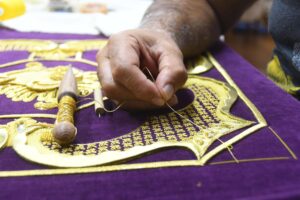
Francisco Carrera Iglesias Artisan ©JavierComas
Since the global pandemic what has changed around the event and are there any new messages you are sharing or new strategies in place?
You cannot deny the fact that today we live in a different world. As General Curator of the event, I really felt that we needed to convey new messages and new values. So in fact postponing the event due to COVID allowed us to focus on our purpose. We want to champion fine craftsmanship, bridge it safely into the future, allow the artisans to make their jobs viable and sell their goods, but also to be seen, and be celebrated. We wanted to underline the importance of crafts in our everyday life and we worked on the new edition of Homo Faber to make sure this emerges clearly. We as humans are the only creatures that can consciously transform the creation around us. Craft is central to our lives and it is becoming more and more central in terms of sustainability and choices. Every day we can each choose if we want to live surrounded by objects that we know very little of, or if we want to invest in something that reflects a long story because it is coming from the hands of an artisan. This is what we are looking at with the new edition of Homo Faber. We are offering the best we can in order to invite people to join forces with us and to understand it.
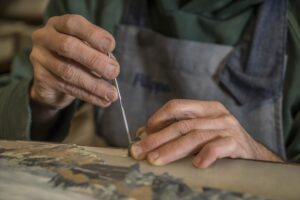
Mosaic making Scarpelli ©Guido Cozzi
Can you tell us about the work of the Michelangelo Foundation for Creativity and Craftsmanship?
I am the Executive Director of the Michelangelo Foundation for Creativity and Craftsmanship which is a not-for-profit institution created in Geneva in 2016 by Johannes Johann Rupert and by Franco Cologni. The two have known each other for many years as they both have senior positions in the luxury industry. Mr Cologni already had a foundation in Italy that was dedicated to promoting fine craftsmanship that I have been directing since 2008. Then when the two decided to join forces in 2016 and to scale up the message, I was invited to join them as Executive Director. We are a small institution and this is why we have to be original and develop our own projects. We have the Homo Faber event and the Homo Faber Guide which is our signature project. We organise summer schools offering young artisans the opportunity to learn and discover something new and special. And we have created an international network of like-minded institutions throughout Europe that share our values. We realised that sometimes you can say the same things but mean something different. The concept of “craft” in the United Kingdom could be very different from “craft” in Italy. So we have tried to put together a common language to understand each other when we talk about crafts and to bring some projects from around the world to an international level.
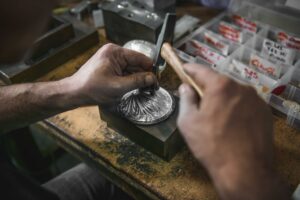
Artisan from Buccellati ©Buccellati
What is a message to send to our readers on the event and why they should visit this year’s edition of Homo Faber?
When guests left the first edition of Homo Faber I saw a sparkle of happiness in their eyes and that was really special. The event enabled them to acknowledge that as humans we are still capable of producing beauty and enjoying it. So why should someone come this year? Because fine craftsmanship, creativity and this vision of it, is a way to embrace our true self. You can love technology but inside of yourself, you have, in my opinion, to know that the creative transformation of materials with a meaning, is what constitutes our humanity. So come to see all the incredible beautiful objects that the artisans are still able to do to express themselves in a contemporary way. The fact it is happening at the same time as the Art Biennale sets another important dialogue with contemporary art. So do come to discover and rediscover.
Homo Faber will run from 10th April to 1st May 2022. For more information visit homofaber.com
Saudi Arabia Announces TROJENA, an Extraordinary New Innovative Destination in NEOM
Saudi Arabia’s Crown Prince Mohammed bin Salman has unveiled a mega project for mountain tourism in The Kingdom. Title “TROJENA” the new development will be a year-round destination reportedly adding a new dimension to tourism in the country which is home to some of the world’s most picturesque mountainous landscapes.
Once complete, TROJENA, which will be located in the mountains of NEOM, will be a world-class mountain destination that blends natural and developed landscapes, offering guests a 360 experience of skiing, adventure sports, wellness, culture and more. It will be home to six distinctive development districts centred around tailored experiences that blend real-life experiences with virtual architectural and engineering innovations. Highlights will include a manmade freshwater lake, 1,400 Square KM of mountain ranges and a number of luxury hotel destinations.

The project will be separated into four yearly seasons beginning with the winter season from December to March which will see TROJENA transform into a world-class ski destination. Then from March to May Adventure season will see triathlons, high-altitude training, mountain biking, climbing and more taking place in the destination. From May to September TROJENA will host Lake Season which will feature music festivals, art fairs, cultural activities, a yoga retreat and more. Then to close off the year between September and November the Wellness Season will play host to a wellness summit, discovery week, alternative medicine experiences and artist residency.
“TROJENA will redefine mountain tourism for the world by creating a place based on the principles of ecotourism, highlighting our efforts to preserve nature and enhance the community’s quality of life, which is aligned with the goals of the Kingdom’s Vision 2030. It also confirms our commitment to be part of the global effort to protect the environment. TROJENA will be an important addition to tourism in the region, a unique example of how Saudi Arabia is creating destinations based on its geographical and environmental diversity. This forward-looking vision will ensure that mountain tourism will be another revenue stream to support the Kingdom’s economic diversification while still preserving its natural resources for future generations.” Said His Highness Mohammed bin Salman, Crown Prince and Chairman of the NEOM Company Board of Directors.

TROJENA is part of NEOM’s regional plan and the Saudi Arabia Government’s Vision 2030 and is scheduled for completion in 2026. Located 50km from the Gulf of Aqaba the destination will capitalise on the ranging climate in the area which sees temperatures drop below zero degrees Celsius in the winter. It will follow the same ethos and principles of NEOM in regards to sustainability, technology and innovation and will provide incredible opportunities for residents and visitors.
Omani designer Buthaina Al Zadjali Talks of Her Dreams to Take Her Fashion Brand Global
Omani designer Buthaina Al Zadjali first started designing kaftans in 2010 after fining the demand for traditional pieces with modern influences. She launched her brand Bthaina in response to the positive feedback she received from friends and family for her stylish designs.
Her designs take inspiration from Eastern and Western elements, using traditional Omani craftsmanship techniques and luxurious, feminine fabrics to create pieces that are both functional and stylish. Buthaina opened her first boutique in 2011 before expanding from Oman to the UAE in 2016. Buthaina’s dream is to take her brand to the next step, expanding outside of the Middle East and sharing her designs with the world. Here we find out more about her latest collection and the inspiration for her designs.

Tell us about your latest collection – the inspiration, styles, colour palette etc.?
This season I was inspired by the concept of “turning over a new leaf”. We’ve all been through so much over the past couple of years due to the pandemic so I’m hopeful 2022 will be a fresh start and this is what I have tried to portray through this collection. It features vibrant shades of green with flowy silhouettes and intricate embellishments.
Are there any particular pieces or styles that you love?
I love them all! But if I was to pick a favourite I would say look two, it’s a new silhouette for me with beautiful sheer details.
Tell us about the materials you work with and how you select them?
I work with lightweight and natural fabrics. It’s important for me to use fabrics that have movement and will keep the wearer cool during the hot summer months.

Do you have anything special happening for Ramadan this year that you can share with us?
I have created “mini-me” pieces so that mothers and their daughters can wear matching outfits during the Holy Month. It’s a special way for mothers to bond with their daughters.
Tell us about how your brand has expanded over the past decade and where would you like to take it in the future?
I first started designing kaftans and abayas for my friends and select customers in 2010, and after such a positive response I opened my first boutique in Muscat in 2011. In 2016 I decided I wanted to expand my brand internationally so I started working with a fashion consultancy in Dubai to rebrand and help take me to the next step. My collections are now available at my boutique in Muscat along with Ounass.ae, Threads Styling and Harvey Nichols Saudi Arabia. In the future, I want to add value to the fashion industry and to be known as a brand that enhances a woman’s beauty and brings out her confidence. I also want my brand to transcend borders and reach customers all over the world.

Who or what inspires you the most?
I find inspiration in my daily life, from my family, friends and my surroundings. I also draw inspiration from my home country Oman and from my travels overseas.
You are a well-established brand in the region now – how have you seen the landscape of the industry change over the last two decades?
It has come such a long way in the past 20 years. When I first started there weren’t many brands from the region, now there are so many talented designers making the fashion scene really diverse.

How do you look to traditional Omani techniques to inspire your designs and can you share a little on the techniques that particularly inspire you?
There are so many techniques that are unique to Oman, it’s a constant source of inspiration! In each collection, I always incorporate Omani threadwork techniques.
What would you still like to see in terms of Arab designers being recognised on a global scale?
I would like the world to see that Arab designers are creative and have so much to offer. The attention to detail is second to none and we love to make women feel their best and be the most confident versions of themselves.

The past couple of years have been challenging, is there anything you have changed about the business since the beginning of the pandemic?
I introduced the ‘Roots’ collection which includes more casual styles in natural fabrics, that are more suitable to wear around the home. The way we dress has changed due to the pandemic so I created this collection to meet my customer’s needs.
Are there any brands or designers that you look up to?
I really admire Elie Saab.

What can we expect to see from you for the rest of the year?
I’m currently working on expanding my regional and international stockists while working on some exciting collaborations!
What is the professional motto that you live by?
It always seems impossible until it’s done.
What is something you would still like to do that you haven’t done yet?
I would love for my brand to be available at a world-renowned retailer such as Harrods or Bergdorf Goodman. It would bring me such pride to walk into one of these stores and see my collections hanging there. It’s a goal I’m working towards.
Hublot Creates Two NFT Digital Artworks
Hublot and Takashi Murakami have unveiled two NFT digital works, inspired by the Hublot Classic Fusion Takashi Murakami watches.
This new phase in the artistic collaboration with the Japanese artists comes in the form of two static NFTs featuring the smiling flower, the iconic theme of Murakami’s work and his Superflat artistic movement.
The first NFT based on the All Black version, is a limited edition of 216, while the second, which will recreate the colours of the highly exclusive Sapphire Rainbow version, will be a limited edition of 108.
Our collaboration with Takashi Murakami has led us to digital art, a field of expression in which Hublot has become a pioneer on the watchmaking planet. From now on, NFTs will be an integral part of our ‘Hublot loves art’ artistic world.” Said Ricardo Guadalupe, Hublot CEO.
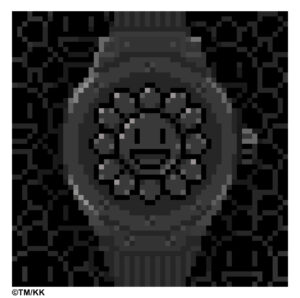
These NFT digital works are mainly intended for the current owners of these two limited-edition watches, to whom they will be offered under certain conditions The current owners of these watches shall actively claim the NFT from 1st April 2022 and no later than 25th April 2022. If they claim and wish, these watch owners may then receive their free NFT in their eWallet. In May, Hublot will then open a page on a decentralised non-fungible token marketplace, where owners may exchange their NFTs.
A limited number of the NFTs will also be available to the public in May 2022. Find out more at hublot.com.
See Elie Saab’s New Bridal Collection
Say yes to the dress with Elie Saab’s new Spring 2023 bridal collection.
Inspired by the beauty of nature and light this ethereal offering is light and dreamy. Incorporating elegant details and flowing silhouettes the gowns are each a work of art.
Delicate organza blooms, lavish necklines, fragile shoulder straps and layers of tulle. Sequin embroideries, plunging necklines, and open backs will offer a touch of glamour to any bride to be. Light sleeves cascade down from regal pearls and sequins into endless skirts of tulle mist. Elaborate organic motifs of silk thread delicately weave through overflowing ruffles, while Chantilly lace and guipure softly embrace natural contours.

Complementing veils, detailed headpieces and the symbolic Elie Saab slim belt at the waist, add a final breath of radiance.
See more of the collection below:


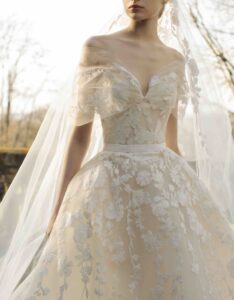
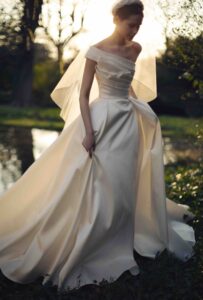
Prada Introduces an Exclusive Ramadan Collection
Prada’s capsule collection “Parallel Harmonies” is a special offering of ready-to-wear and accessories dedicated to Ramadan and Eid-Al-Fitr 2022.
The collection celebrates people and the community and is supported by photographic imagery shot in the UAE, featuring inspiring figures from the region. Mountaineer Raha Moharrak, designer Hessa Al Suwaidi and actor Rakan Bin Abdel Wahid are depicted in simple, profile shots that represent the deeper meaning of community.
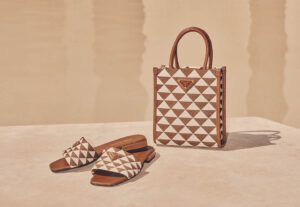
Prada Symbole jacquard fabric micro bag
Embroidered fabric slides
The collection features silk dresses and elegant ensembles for women that showcase the brand’s DNA through modest, understated styles. For men, a selection of garments in nude shades and linen materials are perfect for the warmer months.

Prada Re-Edition 1995 brushed-leather mini handbag
In accessories, we see new takes on iconic bags including Prada Galleria and Prada Re-Edition 1995 which are given a sparkling update with embellishments and new materials.

Satin sling-back pumps with crystals
Shoes including the Nappa sandals and sling-back pumps are giving a metallic upgrade for women while for men, loafers and sandals made of iconic Saffiano leather can be perfectly paired with the ready-to-wear designs.
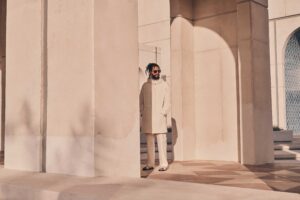
Cotton raincoat and pants
Prada Eyewear Collection sunglasses
Saffiano leather sandals
Now available in Prada boutiques in the GCC countries and online at prada.com.
Meet the Female Scientist Helping to Preserve Saudi Arabia’s Coral Reefs
Dr Eva Aylagas Martinez, Senior Coral Science Manager at The Red Sea Development Company discusses Saudi Arabia’s most ambitious tourist project and the importance of preserving the Red Sea’s coral reefs.
Saudi Arabia’s Red Sea Development project is an ambitious multi-million dollar project designed to transform the country’s coastline into a unique luxury tourist destination, celebrating the natural beauty of the area. With some of the world’s most beautiful, untouched areas including some of the largest coral reefs on the planet, the nation has an incredible amount of potential to explore. While many of the world’s areas of natural beauty have already been destroyed due to both human and natural factors, the Red Sea coral reef has mostly remained untouched, preserving its original beauty. The destination is rich in culture and tradition and visitors will have a wealth of opportunities to explore the history of the region and its modern beauty. This is a key factor being considered by the Red Sea Development Company whose mission is to develop this area of beauty but in a sustainable way that’s kinder to the planet. From island getaways to resort holiday mountain retreats and desert adventures, Saudi’s Red Sea Coast has something for everyone.
With sustainability at the heart of the project, the expertise of some of the world’s most advanced researchers and experts has been employed to ensure the area is developed in the best way possible. A special emphasis has been put on environmental sustainability to ensure that the natural landscape will remain in its beauty for generations to come. Dr Eva Aylagas Martinez, Senior Coral Science Manager has been researching the science behind the world’s coral reefs for several years during the completion of her PhD in Spain and she finally has the opportunity to put her knowledge into practice. Her work resulted in the development of biotic indices for marine monitoring using a new technique based on DNA called metabarcoding. The development of these DNA-based biotic indices has helped managers and scientists to quantify changes in the environment due to anthropogenic pressures in a cost-effective way. Dr Eva moved to Saudi Arabia in 2017 where she continued the investigation of the response of marine organisms (with a focus on microbial communities) to anthropogenic impacts, such as aquaculture activities, oil and gas extraction or coastal development. In 2021 she joined The Red Sea Development Company. Here she focuses on the monitoring of coral reefs and associated communities using novel methodologies to detect potential changes in the marine environment in a timely manner. A key goal of her role is to generate scientific-based information that allows for earlier detection of trends and to more effectively support management decisions. Here we find out more about the project as well as the specific work she is doing to bring new life to this unique area of beauty.

Can you tell us a little about the Red Sea destination and the work that’s happening in Saudi Arabia around this?
It is no secret that Saudi Arabia is a nation being reborn. Since I arrived in the country five years ago, I have witnessed first-hand a spirit of ambition, resilience, and confidence like never before as the Kingdom diversifies its economy away from oil to gain prominence on the global stage as one of the world’s leading, most-visited, destinations. One hundred million local and international visitors are expected to arrive annually by 2030 and raise the industry’s revenue from the current three per cent of the GDP to 10 per cent. Mega-developments like The Red Sea will welcome the world in experiencing the treasures this transforming nation has to offer.
The destination is ushering in a new era of never-seen-before, breath-taking regenerative luxury and the world’s highest standards of sustainability and nature-preservation. Fascinating nature, culture and adventure sites have been cultivated in The Red Sea’s area, which spans 28,000 km2 along the country’s pristine west coast and includes an archipelago of over 90 islands, one of the few thriving coral reefs in the world, and 50 dormant volcanic cones.
What can you tell us about the project on a wider scale and why should our readers visit this resort once it is complete?
The Red Sea is ambitious in every regard. It has an extraordinary vision to deliver new levels of service excellence, world-class innovations, seamless smart technology, and regenerative tourism development. Visitors will have access to undiscovered coastlines, islands, lagoons, mountain ranges, and thriving wildlife. The destination will also attract diving enthusiasts with its underwater reefs of 314 species of coral and 280 species of fish. Historical and archaeological sites will celebrate the rich cultural heritage of Saudi Arabia’s Red Sea coast.

Can you share with us details on some of the sustainable practices being put in place?
Our principles for sustainability enable us to set a new precedent in international luxury tourism and lead the industry’s transformation into a regenerative model. We have committed to consistently using 100 per cent renewable energy, which has never been achieved on a project of this scale. The destination will not have any connection to the national grid and instead rely on the world’s largest battery storage facility. We aim to deliver a net positive conservation benefit of up to 30 per cent by 2040, with 75 per cent of the destination’s islands being left untouched. This means that nine islands have already been designated as special conservation zones and only less than one per cent of the site is being developed, which is something that has never been done by any documented coastal development plan in the world. There will be zero waste to landfill even during the construction phase, and annual visitors will be restricted to one million by 2030. Our sustainability practices are aligned with the Saudi Vision 2030 and support national commitments towards achieving net-zero emissions by 2060. They also take into account all 17 United Nations Sustainable Development Goals and the circular carbon economy (CCE) targets to reduce carbon emissions to almost 280 million tons. I believe this will be a defining chapter in Saudi Arabia’s historic transformation, and I am excited to play my part.
Why is it so important to preserve the world’s coral reefs and what are some of the major issues in the world related to this and how are they being overcome?
Coral reefs have unquestionable ecological and socio-economic roles. They are one of the most diverse ecosystems on earth and support critical services to humans such as shore protection, fisheries, tourism, and recreation. Many fisheries depend on coral reefs and related habitats. For example, in the United States, the commercial value of fisheries from coral reefs is over $100 million. Unfortunately, during the past few decades, coral reefs have been severely threatened by pollution, disease, habitat destruction and greenhouse gas emissions (resulting in ocean warming). At the same time, the awareness of the importance of preserving the integrity of coral reefs is rising, and several environmental monitoring programs have been established in different projects around the world to follow the trends of coral reefs. Also, a measure that is aimed at protecting coral reefs and other marine ecosystems is the establishment of Marine Protected Areas; these are designated marine areas where certain activities are limited or prohibited.

What is so special about the Red Sea coral reefs in particular?
The Red Sea itself is very special because it is one of the saltiest and warmest seas in the world. The Red Sea hosts some of the most productive and richest coral reef ecosystems with more than 350 species reported – 23 of them being endemic, meaning they are exclusively found in this area. Red Sea coral reefs are also subjected to the effect of increasing sea surface temperature. Warmer temperatures cause corals to bleach, meaning that they expel the microscopic algae that live in their tissues and turn white. Long bleaching events can cause the mortality of the corals. This effect usually occurs when temperatures rise above 1 or 2 °C in summer. Yet, it has been observed that corals in the northern Red Sea can tolerate temperatures above 5 °C before they bleach. This behaviour hasn’t been observed in any other region in the world. Understanding why the Northern Red Sea harbours are so resilient and temperature-resistant may help to protect reefs elsewhere.
The Red Sea coral reefs are an untouched area compared with many coral reefs in the world, what can be done differently here to other reefs that have already been impacted by global issues?
The Saudi Red Sea coast is a clear example of species-rich marine tropical ecosystems that have been historically subjected to low human pressure but are currently under increasing demands due to economic development. If tourism and economic development are not managed properly, reefs can be degraded, representing important socio-economic losses. There is a unique opportunity to make things different through sustainable marine ecosystem management. This means creating a framework to balance human needs and the preservation of the marine environment through adaptive management, for which collaboration between different stakeholders is crucial. We need to also differentiate between global and local stressors to protect the environment efficiently. An example of a global stressor is global warming (several models have predicted that sea surface temperatures will rise by 2-3° C by the end of the century), which represents a major threat to the integrity of coral reefs. There is little we can do at a local level to avoid global warming. However, local stressors such as coastal development, pollution, and fishing can be controlled and reduced to preserve the integrity of coral reefs. This will have a significant role to play in helping corals to recover.
How do you balance the safe preservation of these reefs and optimising the area as a tourist destination?
One of the main goals of the project is not only to avoid impacts (preserve the reefs and other marine ecosystems) but to improve the environment. To achieve this, we are creating a new environmental regulatory system that goes beyond typical global practices designed to minimise impacts and will be science-informed, adaptive and ecosystem-based. By the sustained collaboration of different stakeholders following this new regulatory system, we can find the balance between preserving the reefs whilst also meeting the goals of the destination.

What can you tell us about your research into coral reefs and how your findings have helped in your current role?
My research focuses on understanding the changes in coral reefs as a response to natural and human-induced environmental changes. Coral reefs support a number of co-existing species that maintain the structure and function of these complex ecosystems. If the composition of these species changes due to a negative effect of activity, the balance of the ecosystem may be disturbed and triggers the degradation of the reef. For this reason, understanding how the different species inhabiting coral reefs respond to environmental alternations is key to preserving the integrity of coral reefs.
In my work, we apply a variety of advanced monitoring tools to capture the structure and composition of the coral reef as a whole. For example, we use a combination of high-resolution imagery and machine learning tools to detect changes over time in corals but also other benthic organisms that live in the reef, such as sponges, macroalgae, giant clams or calcified algae. Additional technologies based on DNA (molecular tools) are helping us to detect changes in other organisms (such as bacteria or invertebrates) that otherwise are very difficult to survey. The combination of these techniques can give a very rapid indication of changes to the environment before effects become too severe, helping to better protect organisms and their habitats.
How does the project support local communities?
The Red Sea will benefit the communities bordering it, so we see a lot of positivity towards it. The project is expected to create up to 70,000 new jobs and to contribute as much as 22 billion Saudi riyals (USD 5.3 billion) to the nation’s GDP. There is a dedicated community outreach strategy to bridge the gap between the community needs, and the destination’s objective, to benefit, involve and uplift the local population and provide them with alternative livelihoods. The Red Sea is committed to developing socioeconomic opportunities in the local community by focusing on three main aspects: Building partnerships, building capabilities and enhancing livelihoods. We work collaboratively with internal and external stakeholders to document key aspects of the local culture and strive to shed light on it and celebrate it as an integral part of our destination’s DNA.
What first inspired you to get into this line of work?
I always wanted to apply my research in the real world and The Red Sea Development Company has provided me with this opportunity to finally make it happen. A few years ago, whilst I was still a university researcher, I expressed my wish to see my research being used by government agencies and industries through the establishment of permanent marine monitoring programs. The ultimate goal of this hope was to help managers and policy-makers to support adaptive environmental management practices.
What is the biggest challenge you face in what you do and what is something you would still like to do that you haven’t done yet?
It is not very common to sit at the same table with environmental scientists and project delivery staff members to discuss best environmental practices. I am honoured to be part of a project that gives importance to science-based decisions. My biggest challenge in what I do is to balance what I do as an environmental scientist to preserve the environment and coordinate it with the deadlines that need to be met to deliver the industry products. Something I am looking forward to seeing in the future is that the science-based programs we are currently implementing continue to evolve.

What is something you would like everyone to be aware of and keep in mind to help protect the world’s oceans?
As humans, we take care of something when it matters to us. We can be aware of the importance of the oceans for our economies but if we don’t love the ocean, we will forget about it. I’d love to see people spending more time near the sea, whilst connecting to it. We don’t need to dive to observe the beauty of the sea but just connect with it when going for a walk or feeling the sea breeze.
Off-White™ Celebrates the Vision of Virgil Abloh In Qatar
Off-White™ the brand founded by the late Virgil Abloh recently celebrated the vision and values of the designer with a new exhibition in Doha, Qatar.
For the first time in the Middle East, the “Imaginary Experience”, was showcased to VIP guests. The exhibition is a world within a world that is simultaneously a map and a form of transportation: a spaceship, a theatre, and a portal to another world—one devoted entirely to the imagination.
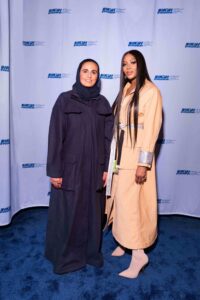
HE Sheikha Al Mayassa and Naomi Campbell
The experience included a Trunk Show of Virgil Abloh’s “High Fashion” collection, showcasing the designer’s iconic designs to VIP guests. This was followed by an exclusive dinner, inviting guests to immerse themselves in Virgil’s world.

To complete the experience, Qatar Creates, which is led by HE Sheikha Al Mayassa, held its closing tour of “Figures of Speech” at Doha Fire Station. It is the first museum exhibition in the Middle East dedicated to the late acclaimed designer and creative Virgil Abloh showcasing more than 55 of his artworks.
The events were part of a profusion of interdisciplinary expressions in the city concreting “Imaginary,” an Off-White™ platform desired by Virgil Abloh and dedicated to cultural reinterpretation, disruption, and transformation as a means of instigating a new dialogue and format of the future.

Rooted in Abloh’s stated desire to define a universal language that transcends cultural parameters and opens the conversation to all, it affirms that the label’s next chapter remains grounded in its founder and creative director’s guiding philosophy: “Question everything.”
This signature exchange between past and future, cultural and subcultural to articulate and progress the present is debuted through the “High Fashion” collection, all designed, envisioned, and finalized by Virgil Abloh.
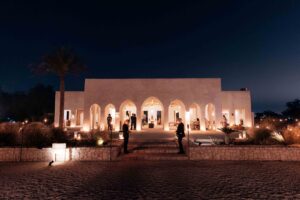
The event was attended by regional and international guests and hosted by HE Sheikha Al Mayassa, alongside supermodel Naomi Campbell.
