
A relationship built over civilizations
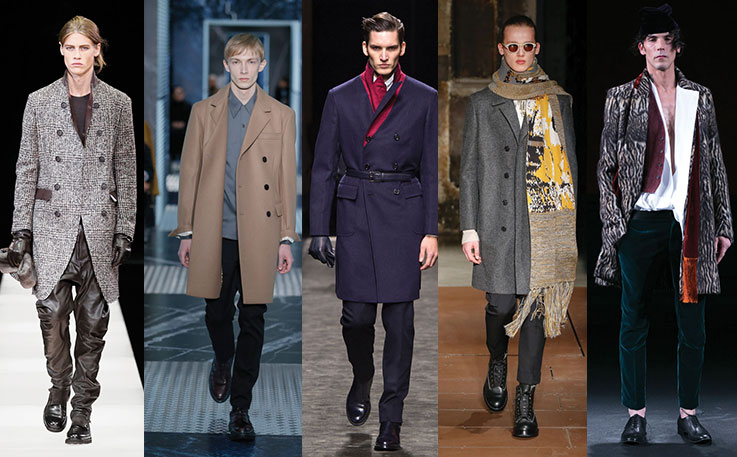
One of the most evident trends in menswear fall/winter collections, is the coat: Slim fit, double breasted…different shapes for different personalities. The origin of the inspiration? History.
The classics are called Ulster and Paletot. The most popular models look up to them: double-breasted coats with a trim shape, patch pockets with flap, bellows on the back, elegant martingale and central vent with buttons.
In the cold half of the year the gentleman finds himself in brush and in some cases to exhume the coat closet.
When the world modifies, habits and lifestyles shift and, therefore, the way you dress changes too. The overcoat was born as part of a dual historical and social-economic revolution: on the one hand the affirmation, in particular in the British Empire, of a new working class; on the other hand, in France, the rise to power of the Third Estate. In this context, the men’s coat is an amount of shapes and functions: those of the eighteenth century tail coat and those of the greatcoat in rough cloth of the Grand Army of Napoleon. Summarizing, the nature of the apparel occurs in stretching the tailcoat and transposition in civil dress of the potential of a garment from the war, in primarily the ability to protect from the cold and bad weather.
The coat’s coming-out has the flavor of an exploit. The protagonists are the “incroyables” – as the leaders of a movement characterized by an extreme flaunted luxury and extravagance in dress and in the conduct of life were called – that in the years of the Revolution and the Directory consider to be “fashion” without being estranged from the change, a duty. There is a strong will of exasperation: extremely tightened waists, slopes that reach the ground, exaggerated lapels leaving in plain view the shirt collar raised and stopped by kilometric ties.
A few decades later the Restoration reaches the coat too. Decorum and discipline are an essential diktat. The overcoat now is good enough for Prince von Metternich, the bankers of London, the ministers of the Tsar. The recently born apparel joins the experience of formal clothing of the industrial age. Without ever losing neither role nor prestige, even when advanced societies become post-industrial and globalization breaks down all boundaries. Measured substantially in shape, the coat is converted in all types of wool, from the most valuable – cashmere, vicuna, mohair, camel, alpaca – to the cloth and felt, more accessible, or the tweed, casual and sporty, mediated by the Anglo-Saxon “gentry’s” customs. The velvet joins – winning the first place for the evening models.
The sobriety of the color palette is imperative. Dense and intense color, reassuring and virile, are of pragmatic importance. As it happens with the dress, the overcoat’s surfaces are full of all-male fantasies alternative to plain color. The only factor that gets away from the severity is the neck, if not the entire lining, made out of fur: not for concession to extravagance, rather manifestation of affluence. With the Roaring Twenties, the requirement of formal moderation diminishes. The overcoat gets volume, lengthens, the lapels return to be important. With some micro-variation, this configuration resists until the second postwar period. Only with the rise of the “Mad Men Style”, the coat gets closer to the body, loses centimeters in length and width, and then retrieves them in the eighties, as a sign of hedonism.
The present of the coat is the present of men’s fashion: there are no longer prescriptive trends which change from season to season, rather plurality of proposals to choose from, according to tastes or need. And also: attenuation of barriers between formal and casual, approach to other kinds of “outerwear”, technological optimization in material’s performance and wearability.
Prepared by Antonio Nieto