Dubai-based artist Rabab Tantawy has become one of the most resonant artistic voices shaping the UAE’s evolving cultural landscape. Her practice, rooted in the human form and enriched by Nubian visual heritage, has developed into a powerful language of connection that speaks to memory, belonging, and the shared rhythms that bind communities together. Over the past decade, her work has expanded from intimate canvases to monumental public commissions, from Yas Island murals to her historic Formula 1 livery collaboration, each project revealing a deeper exploration of movement, identity, and collective resilience.
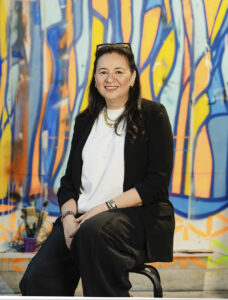
Yet Tantawy’s impact extends beyond the work itself. As the founder of Studio Thirteen, she has created one of Dubai’s most vital creative hubs, a space built on access, openness, and community. At a moment when the region is defining its own cultural identity, she stands at the intersection of artistic experimentation and community-building, nurturing emerging talent while continuing to push the boundaries of her own practice.
As she embarks on her latest projects, she reflects on the evolution of her visual language, the power of public art, the realities of creating opportunity where none existed, and the role artists will play in shaping the UAE’s next cultural chapter.
Your work often weaves together themes of kinship, resilience, and collective identity. How did these themes first begin to take shape in your artistic language, and how have they evolved over the years?
When I first started painting Nubian figures, I wasn’t consciously thinking about community or connection; I was trying to understand belonging and trace my own roots. Over time, almost instinctively, the work revealed what I was searching for: connection, memory, and the spaces we hold for one another. Now the work feels less like representation and more like a conversation between people. I would like to think that those themes continue to evolve as I explore scale, new materials, and ways of experiencing the work beyond the canvas.
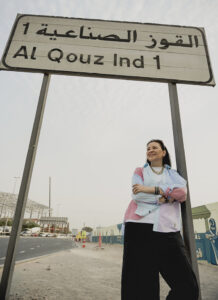
You’ve created some of the UAE’s most recognisable murals. How do you approach large-scale public work differently from studio pieces?
Public work requires a different mindset. A mural belongs to the public, the city, and those who live or move through that space. You must think about it in a cultural and spatial context. Studio work, on the other hand, is intimate. It’s slower, more experimental, more personal. Both are instinctive, but murals demand clarity and intention, while studio work allows for more experimentation and uncertainty.
What did it mean to you to become the first artist to design a Formula 1 livery? How did you navigate bringing your visual identity into that high-performance world?
It was surreal and completely unexpected. There was no reference point, no example to look back on, which meant excitement and fear showed up at the same time. Being the first came with a huge sense of responsibility. But it also became a moment of validation: that my visual language could exist on something moving at 300 km/h on one of the biggest global stages. Professionally, it opened my eyes to what happens when art enters a world that isn’t built for it. I stayed true to the lines, the figures, the rhythm of my work, but shaped it to fit a sport driven by precision, speed, and engineering. That contrast is what made it memorable.
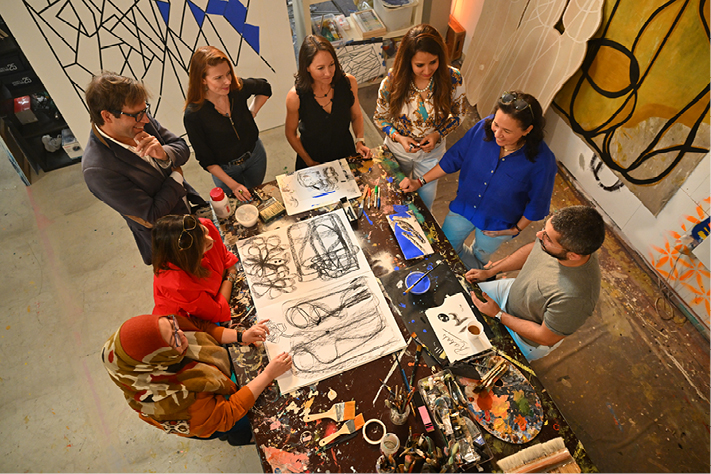
Studio Thirteen
Studio Thirteen has quickly become an important creative hub in Dubai. What sparked your vision for the space, and what gap in the local art ecosystem were you hoping to fill?
Studio Thirteen was built out of necessity. When opportunities weren’t available, I opted to create them, not just for myself, but for others who were also overlooked. I wanted a space for artists who didn’t fit the traditional institutional model, who needed room to experiment, connect, and build their practice on their own terms. The gap was never just a lack of space; it was a lack of access, community, and momentum.
Aramtec, Voices of AlQuoz
Community-building is at the heart of Studio Thirteen’s mission. How do you cultivate an environment where emerging and established artists can grow alongside one another?
We keep it real, supportive, and unpretentious. No hierarchy, no gatekeeping. We share everything: resources, successes, failures, contacts, and knowledge. Artists learn by doing, observing, and collaborating. The mix of experience levels creates a natural mentorship ecosystem, a community of individuals helping each other navigate the creative world. At Studio Thirteen, it’s always been collaboration over competition, which can be challenging because ideas feel personal and precious. But with trust and time, we learn that sharing doesn’t diminish us, it expands what’s possible.
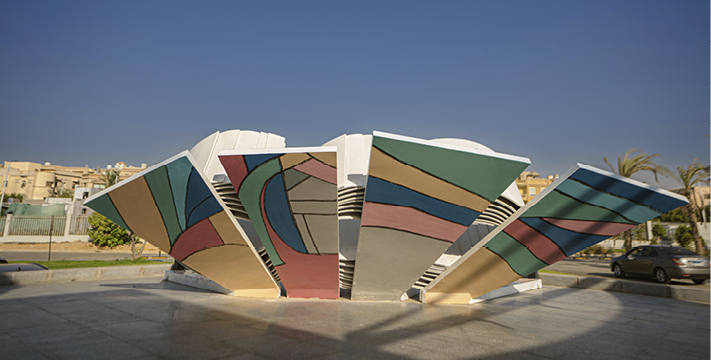
CDD
Dubai’s creative scene is expanding rapidly. From your perspective, what makes this moment particularly significant for artists working in the region?
We’re at the beginning of something important, building cultural legacy rather than importing it. There’s space for experimentation, risk-taking, and defining what art from this region is rather than responding to what the global art world expects. Institutions, collectors, and the city itself are now looking inward, and that shift is powerful.
Many young artists struggle to find their voice and build confidence. What advice do you share with the emerging talents who join Studio Thirteen?
Start. Make work. Make mistakes. Stop waiting to feel ready; readiness comes after doing, not before. Opportunities rarely show up fully formed, so build your own momentum. And don’t rush the process. Give your work the time it needs to become what it’s meant to be.
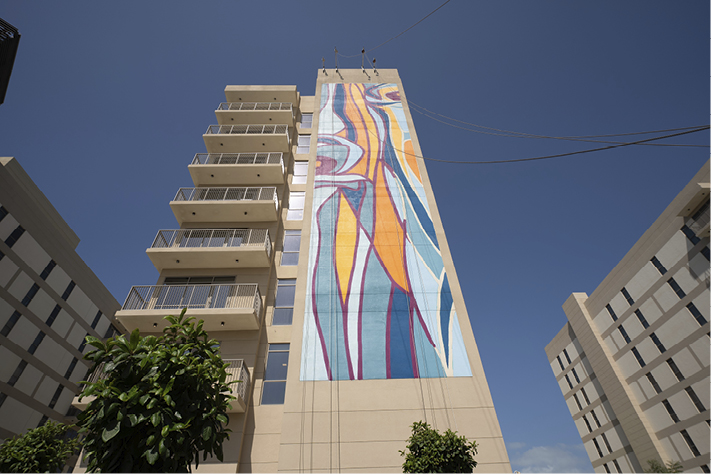
Mural – YAS 2024
You have spoken about instinct and experimentation guiding your process. How do you maintain that sense of freedom while balancing major commissions and community responsibility?
It’s intentional. I’ve seen what freedom can create, so I’m always looking for new ways to experiment. I also understand that my work won’t speak to everyone, and that’s fine. If I only focused on commissions, I’d lose the part of my practice that keeps me curious and alive creatively. So, I protect experimentation, even if it means making bad work along the way. That freedom doesn’t happen by accident; you really must claim it.
As an artist deeply connected to the region, how do you see art shaping cultural identity and social dialogue in the UAE over the next decade?
The UAE has built a cultural landscape in record time, and the momentum now is undeniable. There’s already a solid foundation; institutions, public art programs, galleries, collectors, and our government that genuinely prioritises creativity. In the next decade, I see art continuing to shape how we see ourselves and how the world sees us, not by mirroring western narratives, but by expressing the complexity, diversity, and confidence of this region. Artists here aren’t filling gaps; we’re contributing to a cultural legacy that’s already taking shape. The future feels exciting because there’s room to experiment, challenge, archive, and imagine and that combination is rare.
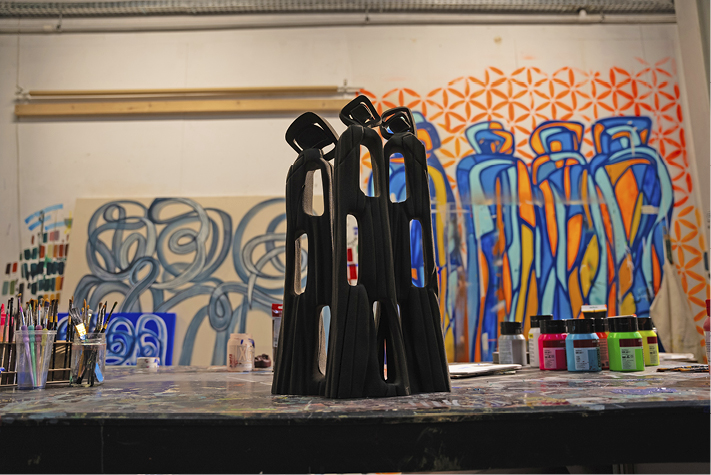
The Guardians
What are you currently exploring in your practice, and what ideas or projects are exciting you most as you look ahead?
Right now, I’m drawn to process, movement, and mark-making that feels instinctive rather than controlled. I’m interested in performance, repetition, erasure, and the line as both gesture and record. I’m excited about large-scale sculptures, new materials, and work that blurs the boundary between drawing, installation, and experience. The direction feels less about producing objects and more about creating moments.
By Lindsay Judge