
At the heart of the Pays de Fayence, not far from Grasse, Christian Dior lived out his final dream. The Château de La Colle Noire was to be his last haven of peace. The imposing house, set against a stunning Provençal backdrop, had the nature-loving couturier utterly spellbound.
Lovingly restored, the castle became a place dedicated to the arts and to good taste, attracting his artist friends and housing his creative passion.
In addition, the garden became a veritable Eden, crafted by his own hand, and designed to reawaken childhood memories of “Les Rhumbs”, the family home in Granville. Planted with thousands of trees, May Roses. Jasmine Grandiflorum and other fragrance flowers cultivated on Grasse terroir, these scented green hectares embodied an ideal for the avenue Montaigne couturier-perfumer. It was the garden of a visionary genius, who dreamed of flower-women and created fragrances that have endured throughout the ages.
Today, Dior Maison de Parfums has chosen to restore this renowned place and to redecorate it in keeping with what Christian Dior wished. May Roses bloom again in the garden, and the castle’s prestige has been restored, as has its magnificent décor.
Once again a place filled with life and creativity, the Château de La Colle Noire relives, under the sunny skies of Provence.
Christian Dior’s dream has been fulfilled.
“The avenue Montaigne seems far away” – Christian Dior, Dior by Dior, 1956
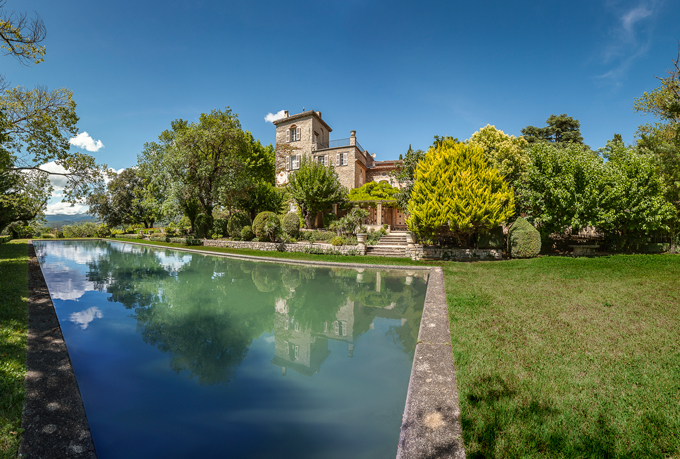
Ornamental pond designed and built by Christian Dior © Philippe Schlienger
Chapter 01:
The Long History of the Château de La Colle Noire
From its beginnings to Dior Maison de Parfums
1 – From seigniorial fief to the
“Château de La Colle Noire” in the 19th century.
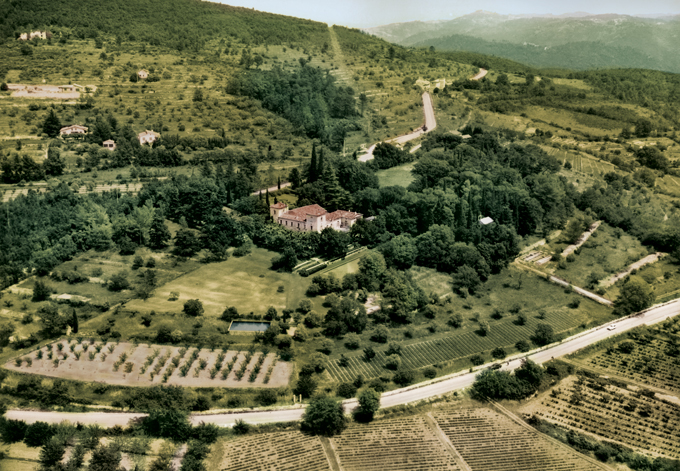
Lying at the entrance to the Pays de Fayence, forty kilometres from Cannes and eighteen kilometres from Grasse, the Château de La Colle Noire overlooks the Montauroux plain.
It was there, in 1951, on the border of the Maritime Alps and the Var region, that Christian Dior acquired this Provençal country house, surrounded by grounds in which sat the Saint Anne Chapel, dating back to the 19th century.
In 1858, at the age of 66, Henri Emmanuel Poulle, a lawyer and deputy of the Var region, chose to build a large house here. The construction was to go on for three years. On this same site, Maître Poulle had a chapel built, dedicating it to Saint Anne, in reference to his daughter Anne-Victoire, and services were conducted here by the parish priest.
Upon the death of Maître Poulle in 1877, the property was inherited by his daughter Anne-Victoire (1827-1894), and then his son Paul-Félix Honoré Reibaud, who showed little interest in the family domain in his native Var. The neglected Château de La Colle Noire would be sold to an industrialist named Fayolle, whose widow would in turn relinquish the property to Pierre Gosselin in 1921. The latter remained its owner until 1950.
2 – 1951, Christian Dior buys and restores the Château de La Colle Noire.
It was in 1951 that the property was bought by Christian Dior, who had lived close by in Callian with his sister Catherine and their father during the Second World War.
Although vast, the place was much neglected. But the plot of land, bathed in the light of Montauroux, named for Mons Auros (windswept or golden Mountain), caught the couturier’s imagination.
One of Christian Dior’s most symbolic acts was to undertake a two-year restoration of the chapel, before donating it, in 1953, to the village of Montauroux, on condition that the villagers maintain it. The locals were in the habit of attending mass at the chapel, and Christian Dior perpetuated this tradition. By restoring and donating the chapel to the village, Christian Dior ensured that it would endure, as though to ward off the ephemeral ghosts whose triumph he oversaw season after season.
Having admired André Svetchine’s spectacular, 1949 transformation of the Auberge de la Colombe d’Or, Christian Dior decided to turn to him to renovate the house. A veritable master of neo-Provençal architecture, André Svetchine reinstated the fundamentals of the Southern French aesthetic, transforming what amounted to little more than wine cellars and barns, into salons and suites. The house was once again restored, but the renovations would continue, and the work would not be completed before Christian Dior’s demise.
Although Christian Dior carried out colossal renovations at the Château de La Colle Noire, he was nevertheless respected, as he remained discreet and was careful to honour the traditions of this village of less than 900 inhabitants, whose summers were punctuated by games of boules, and Sunday lunch served with traditional aioli sauce. Every summer, Christian Dior would participate in a solemn, Saint Barthélemy’s Day mass, led by the Pays de Fayence bravadiers.
To this day, the villagers still attend a mass held in honour of Christian Dior every year on August 24th, and every October 23rd, they celebrate the anniversary of his death in 1957.
More than just a summer residence, the Château de La Colle Noire was a large agricultural domain on which the couturier cultivated fragrant roses, vines and jasmine, which were then delivered by his sister Catherine. At the time, the house was set on a veritable domain of more than 50 hectares.
“I have spent the day among my vines, inspecting the future wine harvest.” – Christian Dior, 1956
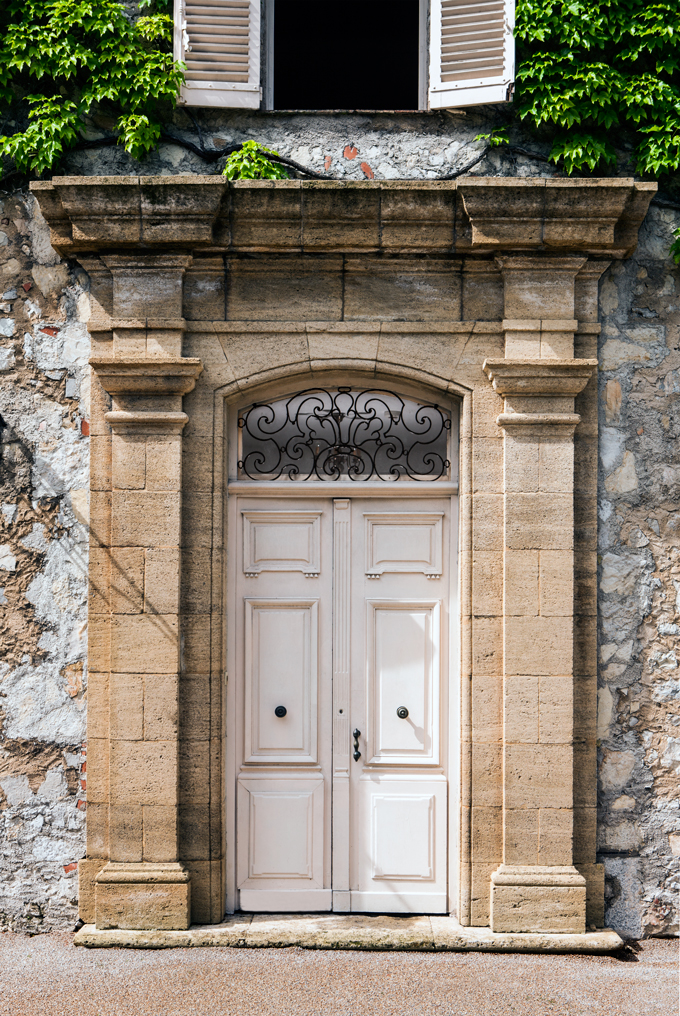
Main front door of the Château de La Colle Noire © Philippe Schlienger
3 – In 2013, the Château de La Colle Noire finally becomes a Dior property again.
Christian Dior left his domain to Catherine Dior and Raymonde Zehnacker, one of his closest colleagues. Then in 1968, “The Dior Château” was sold to the Laroches. But, situated inland in the Var region, far from the splendour of the French Riviera, it was once again neglected and pillaged. In 1976, it was re-sold, and was used to host functions and holidaymakers. In 1999, the group Oasis recorded their fourth album, Standing on the Shoulder of Giants, there.
Finally, in 2013, Christian Dior Parfums acquired the Château de La Colle Noire, and began major renovation works aimed at preserving and enriching this element of Dior’s heritage, which is deeply rooted in the culture of Grasse flowers and perfume.
Chapter 02:
Grasse, Christian Dior’s favourite place
Reminiscence and terroir
1 – From Granville to Grasse: the journey of a man in search of memories.
“I am in fact at Montauroux as I write these last lines: fate has brought me into the calm and peace of the Provençal countryside to put the finish to my work. Night is falling and, with it, infinite peace.” Christian Dior, Dior by Dior, 1956.
When Christian Dior acquired the Château de La Colle Noire in 1951, his designs were championing a look that was “soft yet not flowing, simple yet not dull.” His collections had taken a step towards a more natural look, with slender but not cinched waists, “measured” fullness and embroidery that revealed a bucolic influence, as the inventor of the New Look continued to cultivate his poetic garden. This transition marked a return to the child he had never ceased to be, whose flower-women expressed an ideal, for which the South of France would now provide a beautifully lit setting.
“I think of this house now as my real home, the home to which, God willing, I shall one day retire, the home where perhaps I will one day forget Christian Dior, Couturier, and become the neglected private individual again.”- Christian Dior
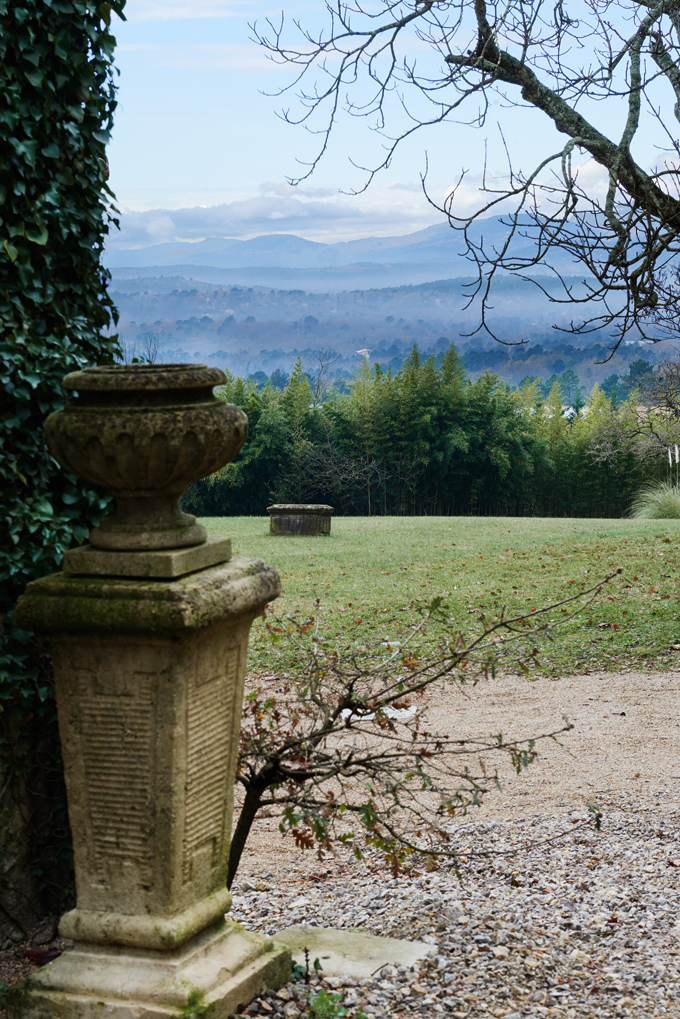
The gardens of the Château de La Colle Noire facing on the Village of Montauroux and the hills of Provence ©francoislacour.com
2 – The perfume of a rediscovered childhood
When the couturier decided to make the Château de La Colle Noire his Provençal retreat, he was celebrating the family soul in the South of France. The perfume of the Rosa Centifolia flowers recalled the rose garden at “Les Rhumbs” villa in Granville where he had spent his childhood. But far from the rainy skies of Normandy, everything was light, wonder and a source of inspiration, for it was at the Château de La Colle Noire that the couturier dropped his mask, sketching to the sound of the cicadas’ concert, among pathways of white jasmine. Although Svetchine conducted the principal renovations, Christian Dior himself entirely redesigned and created the entrance to the house. He chose to take up the symbolic motif of the compass rose from his childhood home, and to create a “mirror of water,” a large ornamental pond more than forty metres long.
3 – Christian Dior and Provence: a love story.
From the “cool room” to the “guest rooms,” Christian Dior’s Château de La Colle Noire reflected an epicurean lifestyle that basked in the sunshine of friendship. Provence went hand-in-hand with trips in his Austin Princess that took him from Comps to Oustau de Baumanière in Les Baux de Provence, where he enjoyed the generous Provençal cuisine. And then there were excursions in a “pointu,” or Provençal fishing boat, to Porquerolles and Saint Tropez, where Christian Dior absolutely adored Senequier’s candied tangerines.
For Christian Dior, Provence remained a favourite place where he took refuge, for it was here, during the Second World War, that he had spent much of his time at the Nayssées’ house, purchased by his father before the war.
“As I finish this book, I am in the process of finishing the decoration of my house in Provence, at Montauroux, near Callian. I cannot describe this new house fully, since it is still not completed. It is simple, ancient, and dignified: I hope its dignity conveys the period of life which I am entering.” – Christian Dior, 1956
Chapter 03:
The Château De La Colle Noire, and a passion for art
Christian Dior, an aesthete in Provence.
1 – Christian Dior at the Château de La Colle Noire: his other self.
Why did Christian Dior choose the South? Well, it is worth noting that among the artists represented by Christian Dior in his days as a gallery owner from 1929 and 1934, were painters from the “Grasse Group,” who, like him, had fled the occupied zone. Jean Arp and Sophie Taueber were two such artists.
But it was probably also because, just like the artists to whom he was so close, Christian Dior was captivated by the Mediterranean light. In a very real counterpoint to the grey-blue clouds of Granville, the azure Provençal skies made an ideal shine through.
Christian Dior would not live to see the renovations completed at the Château de La Colle Noire, but it was here that he would write his autobiography, “Dior by Dior.”
“In the large house where I am alone, it is almost cold. The heating has not yet been put in and it is taking a long time for the electricity to be connected. Only two rooms are habitable, including the one I am in. Wood is burning in the fireplace and the glimmer of the candle I have lit disturbs the dancing shadows on the ceiling.”- Christian Dior
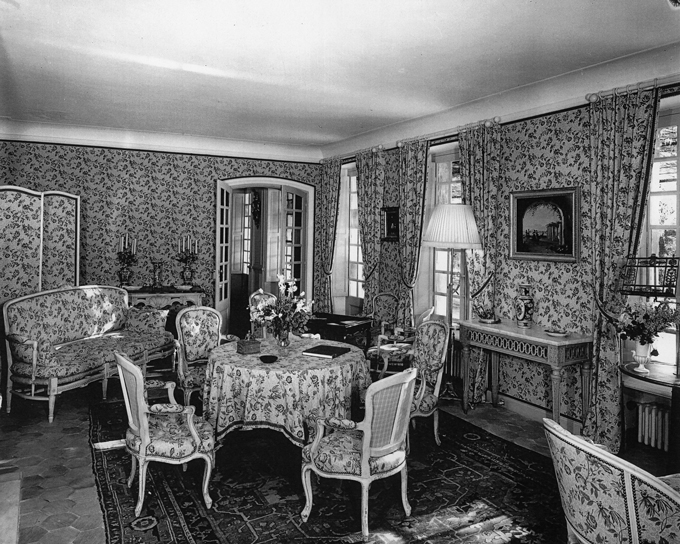
Summer living room on ground floor papered with red on white flower cretonne, the same fabric is used for covering the 18th style furniture André Svetchine / Collection Luc Svetchine
2 – From Chagall to Marie Laure de Noailles, the Château de La Colle Noire Visitors’ Book.
In the Château de La Colle Noire visitors’ book, from August 6th 1956 to August 28th 1957, fifteen pages were filled with numerous autographs and drawings by Christian Dior’s guests, who were a combination of artists, prominent women and close colleagues, first and foremost Raymonde Zehnacker, who really ran the place.
Among the guests were artists such as Maurice Van Moppès and Bernard Buffet – who acquired the Château l’Arc near Aix en Provence in 1956 – Marc Chagall, who had lived in Vence since 1949, and also Aimé Maeght’s wife, Marguerite Maeght.
The Château de La Colle Noire regularly received “neighbourly” visits from Christian Dior’s friends, starting with Marie Laure de Noailles, the queen of the Félibrige cultural association, whose cubist villa near Hyères had been built by Robert Mallet-Stevens.
Under the pergola that hummed with the cicadas’ tune, lazy lunches were held with Marie Blanche de Polignac (Jeanne Lanvin’s daughter), Paul Louis Weiler, a financier and patron of the arts, and Elisabeth Chavchavadze.
The Provençal countryside provided Christian Dior with material for a dream he shared with Jean Cocteau, the “frivolous prince” of the Côte d’Azur:
“I go out little, alas, and leave that to my legendary double who goes out and about instead of me. I can speak only of a shore where the mythical fragrance of the Mediterranean produces an admirable blend of idleness and work.” (Jean Cocteau)
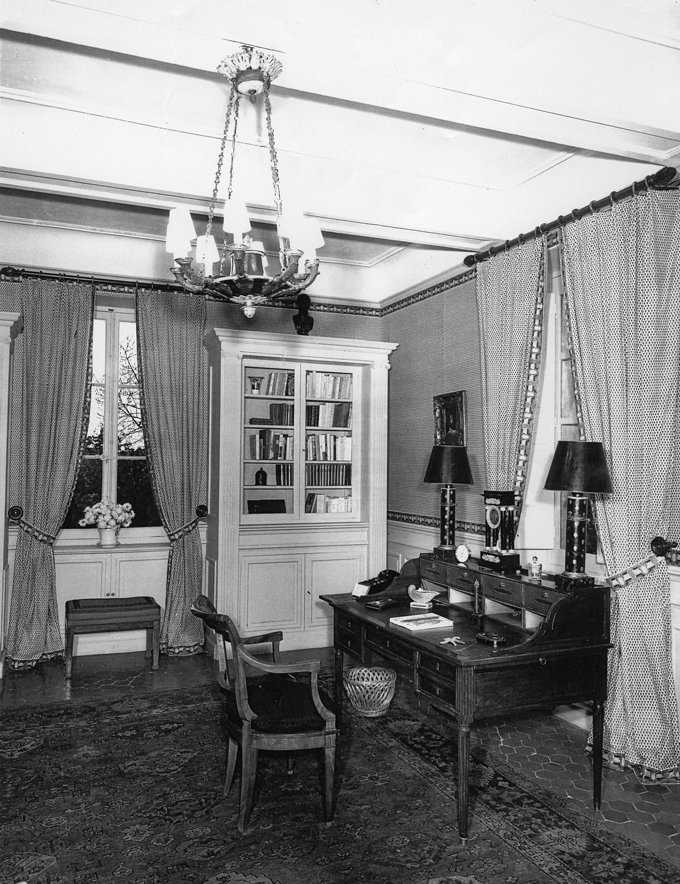
Christian Dior office at the ground floor of the Château de La Colle Noire, Empire style with 16th century desk and decorated with 19th century paintings and a Charles X barometer, 1956 André Svetchine / Collection Luc Svetchine
3 – Decorating the Château de La Colle Noire in triumphant neo-Provençal style.
From gondola bergère chairs to the earthenware flowerpots in Wedgwood style, the spirit of the Château de La Colle Noire was that of a neo-Provençal house.
Here, Christian Dior revealed eclectic tastes, ranging from the 18th century to romantic interiors augmented with occasional furniture and jardinières.
Christian Dior’s Grand Salon was a concentration of the neo-Louis XVI style already seen at avenue Montaigne in Victor Grandpierre’s “Pompadour grey,” and the 1950s neo-classical style worthy of Christian Bérard’s watercolours.
Moreover, the kentias, ferns and rose-filled vases in every bedroom were another indication of Christian Dior’s sense of hospitality.
4 – A gentleman’s table, Christian Dior receives friends at the Château de La Colle Noire,
The pantry at the Château de La Colle Noire housed oyster forks, crystal preserve jars and coffee cups and saucers decorated with a fleur-de-lys motif, as well as golden finger bowls and Christian Dior monogrammed silver menu-holders, which sat alongside champagne flutes, cognac glasses and eighteenth century Burgundy wine glasses.
Monsieur Dior’s spirit can be seen in his approach – at once sophisticated and rustic – which plays on a blend of eclecticism. He had a certain art de vivre that combined nineteenth century English style, French tradition and the modern elements of a neo-Provençal house.
“The first stars have come out, and are reflected in the pool opposite my window.” Christian Dior, 1956
South-west facade of the Château de La Colle Noire © Benjamin Decoin / Visula Press Agency
Chapter 04:
2016, In the footsteps of Christian Dior’s dream
Reviving the Château de La Colle Noire.
1 – Christian Dior Parfums undertakes restoration works (2013-2016).
A house of Dior property since 2013, the Château de La Colle Noire was the object of a major restoration project that began in 2015.
From the grounds to the ornamental pond, and from the guest rooms to the reception rooms, the Château de La Colle Noire once again came to life, basking in the sunlight of rediscovered memories.
The Provençal salon, the entrance hall and Monsieur Dior’s office, as well as the Egyptian room, were all returned to their original state, while the newly created Chagall, Bernard, Picasso and Dali suites were designed by the decorator Yves de Marseille, in a spirit of eclectic affinities and in the style appreciated by these artists.
The bishop’s room, which Christian Dior had not had time to decorate, became a reception room, designed in keeping with his wishes: “I would like a pair of Louis Seize console tables with gilded mirrors,” he had said.
The grand staircase was entirely rebuilt. In addition, a perfume atelier has been added to the castle, in an extension of eighteenth century Provençal style.
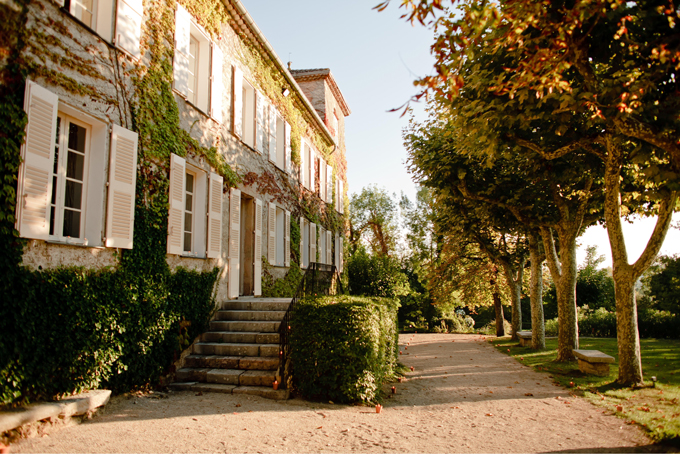
South-west facade of the Château de La Colle Noire © Benjamin Decoin / Visula Press Agency
2 – The Château de La Colle Noire, the legacy of a garden
Interview with Philippe Deliau, landscape architect.
Philippe Deliau is the owner of ALEP (Atelier Lieux et Paysage), which he created in 2002. He graduated from the École Nationale des Ingénieurs des Techniques Horticoles et du Paysage (ENITHP).
He has worked on various natural and historical sites.
The Château de La Colle Noire was his second project for LVMH, following the restoration of the Jardin d’Acclimatation, by the Louis Vuitton Foundation, with Frank Gehry.
How would you define Christian Dior’s garden at the Château de La Colle Noire?
Originally it was an agricultural garden. Through the Provençal, festive, fragrant and invigorating character of the garden, Christian Dior had always wanted to express how attached he was to the very origins of the place, and to transform it into an Eden where he would feel happy and at one with nature and Provence. Christian Dior was present, like a father, working with the gardeners as he worked with his seamstresses at avenue Montaigne. At the Château de La Colle Noire, having inherited this eminently agricultural and rustic land, he put in an ornamental pond of eighteenth century inspiration bordered with box trees. He planted rose bushes, lilies, violets and jasmine. Everything he did was related to light and shadow, plants and minerals (he sketched a stone fountain decorated with nymphs), to heighten the feeling of charm and relaxation, without ever rejecting the origins of the site. This garden was a genuine manifesto for both its horticultural heritage and its agricultural legacy.
How did you manage to give such a site a future?
In the beginning we worked very carefully. We identified everything that had accumulated over forty years in order to recreate the original plans. I didn’t attempt to reconstitute everything. The trees had really grown, starting with the cypress trees which are now more than fifteen metres high. It was more an attempt to recompose the landscape – on the one hand I wanted to free the tree bases to open up the view, and on the other hand I wanted to reconstitute a setting of olive tree, in order to filter the background views. We replanted the elements which seemed important and right to us, such as ten thousand May Rose bushes, vines, olive trees and Monsieur Dior’s cherished almond trees. In addition there is a pathway through the oak wood, a flower garden, and a beautiful terrace below the chapel to open up the views again.
What, in your opinion, is this rediscovered ideal?
This is not a ceremonial garden. It is an ideal nourished by elements of surprise, and by a radiant and high-quality art de vivre. You can feel it in the very creative way that Monsieur Dior had of combining flowers, vines and olive trees, and in his desire that nothing should be still. The movement of life and the idea that nature is first a promise, then movement, reflects the collections of a couturier who carefully gave women a new silhouette every season, in order to make them look more beautiful.
Chapter 05:
Christian Dior Parfums and the Grasse terroir
Reviving fragrance flowers
“Miss Dior was born of those Provençal evenings, alive with fireflies, where young jasmine plays a descant to the melody of the night and the land.”- Christian Dior, 1954
1 – Grasse, an aromatic city with a
signature terroir.
May Rose, Jasminum Grandiflorum, mimosa, tuberose and bitter orange: in Grasse, certain names create bouquets of sensations. In this ancient Roman station, the water and exceptional flowers form the site’s memory, and its history. For more than three hundred years, its roots have sunk deep down between the Alps and the Mediterranean, beneath the western Provençal sun. Although the tannery industry was developed in Grasse in the fourteenth century, the fragrance plant culture took off in the seventeenth century, with the fashion for perfumed gloves, then grew more intense in the following century.
Lulled by the winds, this land blessed by the Gods enables the flowers to develop the best of their fragrant qualities. The calcareous-clay soil and the local microclimate, which sees mild winters alternate with hot humid summers, partly explains this superiority. But the mystery of these haute couture plants remains, as the plots of land described as “extreme zones” are limited to a few hundred hectares, at the borders of which the flowers will no longer bloom.
Although Grasse used to produce 5000 tonnes of flowers every year until the 1940s, annual production since 2000 has been limited to a few hundred tonnes. However, thanks to passionate growers who endeavour to keep their generations-old family secrets alive, and to the great perfume houses such as Dior, this terroir, the only one of its kind in the world, continues to shine.
“Grasse Jasmine and the May Rose provide exceptional olfactory results. In terms of power and subtlety, no other flower can surpass them.”
François Demachy
2 – Dior, and reviving the fragrance flowers
of Grasse:
The “Domaine de Manon” and the “Clos de Callian,” Dior’s exclusive domains.
Beneath an azure sky, the undulating hills seem to overlap. Their slopes are edged by silver-leaved olive trees, cacti and palm trees. In the distance, the sea is a blue line. It is here that the “Domaine de Manon” and the “Clos de Callian,” the house of Dior’s exclusive partners, demonstrate their vital expertise in their flower fields.
For Carole Biancalana, who manages the family business (4th generation) at the “Domaine du Manon,” the art of flower cultivation is subject to strict standards, from rotating the flowers, enabling the land to lie organically fallow for two years, to hand picking the harvest.
In 2006, a meeting with François Demachy completely revitalized this tradition, which the house of Dior endeavours to champion both in terms of culture and spirit.
“I chose to cultivate exceptional flowers for I wanted to be in control of what we are doing,” confirms Armelle Janody from the “Clos de Callian.” This inspired ecologist is devoted to a project to plant 20,000 May Rose bushes. The flower is extremely fragile, because if it is not picked on the day it blooms, it is unusable.
Armelle Janody chose to plant clover in order to fertilise the soil during the cold season. She is currently testing hemp and jute mats to protect the rose bushes and preserve the micro-organisms and insects that contribute to biodiversity. Plans for fields of tuberoses are also in the works. Both the “Domaine de Manon” and the “Clos de Calian” reserve their harvests of Rosa Centifolia (in May) and Jasminum Grandiflorum (from July to October) for the house of Dior. The hand-picked flowers are immediately sent off to be transformed into Absolutes and then Concretes.
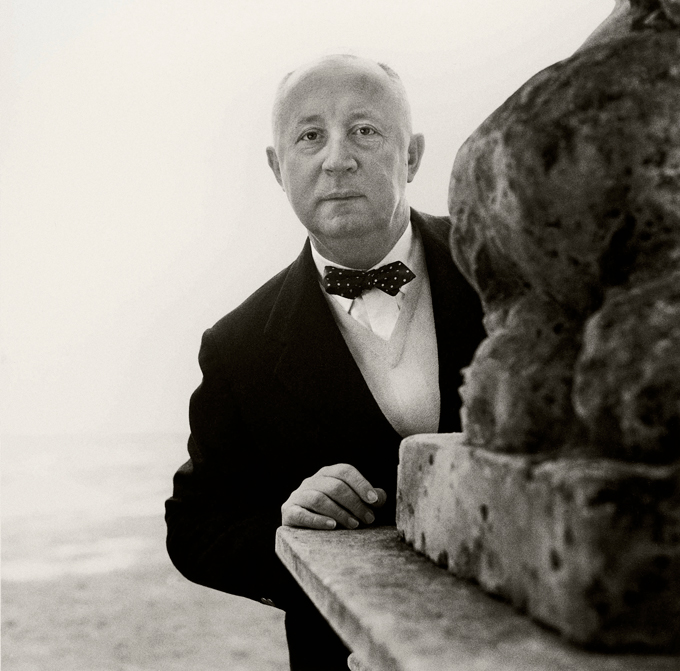
Photograph by Lord Snowdon of Christian Dior near one of his two stone lions bordering the courtyard of the main entrance, 1957 © Lord Snowdon / Camera Press / GAMMA
3 – The Fontaines Parfumées
The new site for Dior perfume creation
in Grasse
Dior fragrances will now be created exclusively at the Domaine des Fontaines Parfumées, a site nestled in the heart of Grasse.
François Demachy, Dior Perfumer-Creator and native Grassois, has set up his laboratory in the city centre, going back to his roots in this terroir of exceptional flowers.
A protected place of memories, the Fontaines Parfumées domain holds an important position in the collective memory of Grasse. Aware more than ever before of the heritage value of this lush domain situated in the city centre, Christian Dior Parfums decided to set up their creative laboratory here.
Inspired by the most beautiful flowers, Dior perfumes will henceforth be created in the heart of Grasse.
“Christian Dior had made this property look wonderful! But what he wanted more than anything was fragrance flowers.”
“The property was blossoming; we were happy to have Christian Dior because he was kind […] he really liked the land, and he liked people.” – Lucienne Rostagno, an employee at the Château de La Colle Noire gardens in Christian Dior’s time.
KEY FIGURES
- 8,000 to 10,000 blossoms make one kilo of jasmine flowers.
- 2006: François Demachy named as the house of Dior nose.
- 700 kilos of jasmine flowers are required to make one litre of absolute.
- 10 to 20 kilos: the daily rose harvest of one flower-picker, who must ensure that the flower is picked below the calyx.
- 350 m2: the size of the new perfume laboratory created by LVMH at the Fontaines Parfumées site in Grasse.
- 50 to 100 absolutes are contained in a Dior perfume.
- 30 years: the life expectancy of a jasmine plant.
- 15 years: the life expectancy of a rose bush.
- 300,000: the number of roses required to make one kilo of Absolute.
“I am in fact at Montauroux as I write these last lines: fate has brought me into the calm and peace of the Provençal countryside to put the finish to my work. Night is falling and, with it, infinite peace.” – Christian Dior, 1956