

A&E Fashion And Beauty Guide: February 2018
Stay up to date with our latest guide for all things fashion and beauty…

Bloomie’s Loves UAE
It’s no secret that Calvin Klein designer Raf Simons has a soft spot for Andy Warhol, first referencing the artist in his SS18 collection. And in an unprecedented move, The Andy Warhol Foundation for the Visual Arts will give the house access to a sizeable back catalogue of Warhol’s work.

Accessory Update
Statement earrings are still the easiest way to make a daytime impact and Leigh Miller’s molten creations are topping fashion-forward wish lists right now. After a decade in New York spent designing ready-to-wear pieces for powerhouses including Calvin Klein and J.Crew, Miller made the transition to LA and into jewellery, using lost-wax casting and hand-hammering techniques.

Alpine Chic
Net-a-Porter believes you should be putting as much attention into getting dressed for the mountains as you do for city life, and their Ski Shop ensures you hit the slopes in style whether you’re there for the activity or the après. Hero brands include Fendi and Perfect Moment, teamed with retro favourite Moon Boots for head-to-toe vintage cool.

Name to Know
If you haven’t heard of Broochini yet, the short story is chic swimwear and après surf. The minimal silhouettes are the kind of swimwear you spot on the beach and wish you were wearing, but what sets this label apart are that the pieces are handmade in Bali, where an ‘antioxidant dew’ is added, infusing the fabrics with nourishing vitamin E and healing aloe vera.
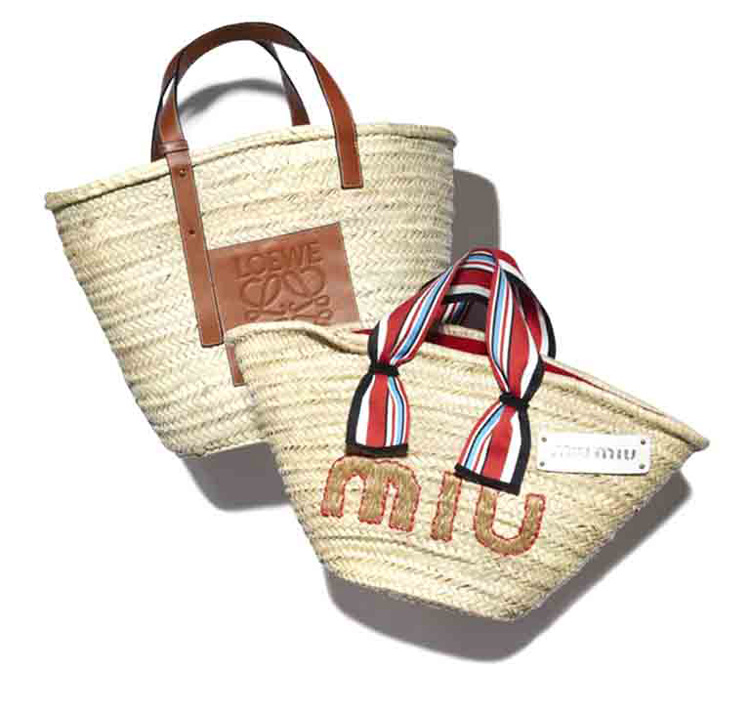
Branded Baskets
This season’s must-have accessory sees two of the biggest trends right now, bohemia and logomania, combine in the form of the branded basket bag. From Loewe to Miu Miu, your favourite big brands are championing this ’90s spin on the quintessential vacation holdall. But while raffia might be synonymous with jet-set style, these aren’t just meant for the beach.

Magic Wands
Pushed for time? These pocket-sized skin perfecters are the answer. Their formulas include skincare-worthy ingredients, so flawless coverage also equals healthy skin. Combining coverage, hydration and radiance enhancing pigments, give your complexion an instant uplift with one swipe.

A&E Ultimate Fashion Week City Guide
Be Fashion Week ready with A&E ultimate city guide showcasing the best places to eat, sleep and shop in each of the fashion capitals.
NEW YORK

THE WALKER HOTEL

LE COUCOU

TOM FORD
EAT
Dishes at Le Coucou match the superbly opulent and lush interior, think pink quenelles with lobster sauce and foie gras.
DRINK
The Rose Bar serves as the perfect escape for the fashion set in search of a cocktail. The intimate setting features high, wood ceilings, plush, velvet seating and bold artwork.
SLEEP
One of Greenwich Village’s finest, the Walker Hotel is as authentic and old-style as your New York experience can be. The key here is that bohemian is the new minimal, and clean lines have been supplanted by eclectic vibes.
THE BOUTIQUE
Love, Adorned is one of the coolest stores, from the Guatemalan textiles to the crystal chandeliers hanging from the ceilings. This store is your one-stop shop for jewellery, accessories, and home décor.
THE SHOW
As many designers moved to show in Paris, one very important American designer, Tom Ford, did just the opposite, returning to New York making a grand entrance, and this season his show will undoubtedly cause a similar stir.
THE LABEL
Everyone was obsessed over the Mansur Gavriel bucket bag, with it going on to gain cult status, and now the CFDA-winner designer is moving into clothes.
MILAN

CARLO E CAMILLA

BAR LUCE

ATTICO
EAT
Carlo e Camilla is a defunct 1930s sawmill which has been transformed into an industrial-style restaurant designed for communal dining by Michelin-starred chef Carlo Cracco and art director Tanja Solci.
DRINK
The pastel-heavy colour palette of Bar Luce will make you feel like you’re in a Wes Anderson film, which is not surprising since he designed it.
SLEEP
A short hop from the Duomo, with a coveted entrance onto the Via dell Spiga, the five-star Baglioni in the perfect fashion week base.
THE BOUTIQUE
Founded by Carla Sozzani, sister of the late, great Franca, 10 Corso Como remains Italy’s hippest store, offering up refined fashion, literature, and art.
THE SHOW
Held at their hub, nothing is more eccentric than Gucci, where Alessandro Michele visits different, disparate fashion eras to create a psychedelic parade of glitter, haberdashery, and influences.
THE LABEL
Dreamt up in the back of a cab by two street style aficionados, Attico focuses on classic robes and slip dresses made in sumptuous materials and richly embroidered to create feminine, decadent pieces.
LONDON

CASA CRUZ

HALPERN

SKETCH
EAT
Casa Cruz’s prettily presented ceviche and steak are as Instagram-worthy as the oh-so-trendy copper walls of the dining room and model-like waiters.
DRINK
Having hosted everyone from Kate Moss to Kendall Jenner in powder pink inimitable style by David Shrigley, Sketch has seen over a decade’s worth of fashion weeks, and is the perfect pitstop.
SLEEP
The most indulgent of them all, Claridge’s. One of London’s most glamorous and longest-established hotels and a home-from-home for visiting royalty, heads of state and celebrities, offering excellent hospitality and luxurious bedrooms.
THE BOUTIQUE
Comme des Garçons’ Dover Street Market is the Tate Modern in boutique form, with directional labels from Alaïa to Céline.
THE SHOW
The widespread nature of the instant positive reaction to Michael Halpern’s first glittering ’70s disco-inspired collection last season can only indicate what a hot ticket this show will be during fashion week.
THE LABEL
Reawaken your slumbering inner princess, and take her raving in Molly Goddard’s neon tulle confections.
PARIS

HÔTEL COSTES

MERCI

LEMAIRE
EAT
Not only is Ferdi an old-school glamorous brasserie next to the Jardin des Tuileries, it serves Paris’s best cheese-burgers making it the perfect post Chanel meal.
DRINK
It’s hard not to love Hôtel Costes. Come for the people watching in the courtyard and stay drinking into the night, it’s not unlikely that you will run into Rihanna or Kendall Jenner.
SLEEP
Opulent doesn’t begin to describe the Shangri-La Paris, housed in a fairy-tale building once owned by Napoleon Bonaparte’s great nephew.
THE BOUTIQUE
No trip to Paris is complete without a visit to Merci on the edge of the Marais where they change the installations in the store by season. Enter via a courtyard and wander around this three-storey warehouse space.
THE SHOW
The self-taught Simon Porte of Jacquemus has meteorically risen thanks to his achingly cool style, and his front row will be filled with all our favourite French girls.
THE LABEL
For those who love the understated elegance of Hermès, Lemaire does insouciant slip dresses like no other. French designer Christophe Lemaire brings his luxurious touch to wardrobe staples.
READ MORE
It’s All About Scandi Style
Style Hacks From Paris Haute Couture Fashion Week SS18
A&E Interviews Corneliani’s Stefano Gaudioso

Corneliani is something of a rarity in the fashion industry, in that it is set up in such a way that it does not have a conventional creative director, and instead has the visionary Stefano Gaudioso at the helm as General Merchandising Manager and Style Director. As such, Stefano increasingly finds himself in a supervisory role overseeing the company’s operations and creative direction from top to bottom, facilitating the work of others.
Born in Milan in 1973, Stefano is a man who grew up around the kind of sartorial elegance Corneliani is famous for. From an early age, he cultivated a passion for the fashion industry largely down to his grandparents’ fur atelier in the centre of the city, where he spent many a long afternoon after school, observing the craftsmanship of the tailors, getting inspiration from the designers and, without knowing it at the time, gaining a head-start on the development of his future career.
Then, at the age of 22 he joined the Ermenegildo Zegna Group, handling different roles, from sales to brand management during his 15-year tenure, before finally taking the lead of product development and merchandising. In this last role, he struck the right balance between his creative skills and business acumen, before being appointed at Corneliani in September of 2016.
Rich in heritage, Corneliani was set up in Mantua in the 1930s by Alfredo Corneliani, a pioneer in the Italian menswear sector, making raincoats and overcoats. Production was halted due to the start of the second World War, until Alfredo’s sons Claudio and Carlalberto went on to reintroduce the company in 1958, growing it to become the brand it is today. Here, we talk to Stefano about the growth of global fashion, balancing the values of tradition and quality with current trends, and his future strategy.

When did you first realise that you wanted to have a career in fashion?
I was born in Milan in the 70’s and part of my family was already active in the fashion industry.
I don’t think I realised by then that this would have been my path, but it certainly influenced my choices. I started working properly in fashion by the time I was 20 years old and I immediately had the feeling of being in my natural environment. I love the fact that my job is never boring, and there is both a creative side and an analytical side.
What brought you to Corneliani?
The brand has a fantastic heritage and an elegance which has been built over the past 60 years. Investcorp asked us to build the future of Corneliani and we are touching on every single element, with a new digital platform, new store concept, new corporate ID, and of course a new energy in the product development.
Who is the Corneliani man?
He is both refined, sophisticated, and cultured, he knows what’s going on. He has a sensitivity for beauty and authenticity, he’s connected, and he’s spending money to live an experience, not just to own a product.

How do you set yourself apart from other leading brands in the market?
We don’t want to just sell a product, instead wanting to sell an experience. Every single aspect of the brand has a purpose, we aim to become the curators of Italian sophistication.
Tell us about your role, and what it entails?
My role and how it is designed is not so common for our industry. I’m the Style Director but at the same time I’m also the General Merchandising Manager. This means that I have ownership of the creative aspects of the job, but on the other side I need to be very analytical and aware of the competition. I have a great team supporting me with both roles, Style and Merchandising. We analyse everything, and we do a quantitative briefing containing all the numbers, complexity, target price and positioning. At the same time, we are creating, designing, and developing all projects. It is really exhausting but very rewarding at the same time.
How balanced are the creative and business sides of your role, and which area do you prefer?
It is really a 50/50 balance, in terms of time and in terms of preference.
Do you feel that all your experience has prepared you for your current role?
Absolutely, my 24 years’ worth of experience in the industry has given me a very broad vision of this world.
Tell us about how you introduced new logos, new packaging, and a new e-commerce site, what was the catalyst for this?
Everything has a unique purpose. We aim to shift our brand perception to an experiential one and less product driven.
Do you feel the rebranding has allowed you to introduce a new cliental?
Absolutely, we have created it in a way that it is open to new clientele as well as allowing us to keep our loyal existing ones.
Tell us more about how you ensure that you continue satisfying your loyal client base, while encouraging new customers?
Staying true to our roots whilst always striving for advancements of our product, through conducting the right research and striving for innovation.
Tell us how you balance the heritage of the brand with modernity?
We always try to put all our sartorial knowhow into every category. Hybridisation between sartorial and sportswear, together with new technology on formal fabric and new constructions on sportswear. Mixing all elements is the name of the game.

To you, what is key to the design process at Corneliani to ensure the best outcome?
A good collection plan and a good selection of the colour cards is already 50% of the job, so the starting point is maybe the most important part of the process.
Does the sudden expansion of global markets mean that the brand’s style is being driven in a certain direction?
I would say no, we are an Italian brand with a great history and we will continue to promote our Italian style and the elegance and sophistication that we have in our DNA.
Which region do you think is the most stylish?
Japan and Korea are certainly two of the most elegant and sophisticated countries.
Do you enjoy travelling, and where in the world do you feel most inspired?
New York remains one of my favourite cities. The energy and the people are amazing!
To you, what is elegance and luxury, do they work hand in hand together?
Yes, they do work hand in hand, but I must clarify that elegance is something you cannot buy, it is innate. As for time, it is the ultimate luxury.
Tell us about your personal style?
Very simple and clean. Less is more for myself.

Who is your style icon?
Gianni Agnelli, the most successful and elegant Italian entrepreneur.
What is your biggest luxury?
My biggest luxury is having the time to do things that I like to do, without any obligations, which is really rare nowadays.
Although you have already introduced many changes to the brand, what else can we look forward to seeing next?
Until recently we have been working on many new projects, and the market will see the result of this work in the next 12 months. Following from here, the objective is to continue to train our team in order to become an experiential brand in terms of shopping experience, communication, and digital approach.
By Eliza Scarborough
Become A Global Citizen With Bulgari
Silvio Ursini is not just an eagle-eyed creator of Bulgari’s leading hotels and resorts, but on a quest to seamlessly blend the aesthetics of the jewellery house with bespoke hospitality.

Silvio Ursini is Bulgari Group Executive Vice President, and oversees Bulgari Hotel & Resorts, recently introducing another jewel in the Maison’s crown with Bulgari Resort and Residences Dubai. Working with the brand for 25 years, Ursini understands the heart and soul of the house and since 2002 he has been instrumental in delivering their vision, from jewellery to luxury hospitality across the world, including London, Bali and now Dubai. With every property reflecting the personality of the country and exquisite attention to detail, they offer an at-home high-end environment which you will immediately fall in love with and find very difficult to leave.
Here, we examine the unique Bulgari approach to the hospitality market, why Dubai had to be part of the family, and Silvio’s personal passion for exploring and bee keeping.
Why Dubai?
As a brand we have been present in Dubai for over 20 years with jewellery, so we have seen how much has changed. It has evolved from a small regional market to one of the most interesting cities in the world. The government has a clear vision which has been executed in a spectacular way, and it’s a worldwide destination. What fascinates me is the combination between the local community, the expat community, and the tourist, so you have different layers which makes it an interesting place.

In Dubai’s luxury hotel market, what value does Bulgari Resort add?
We have the vision to be different to so called normal luxury hotels, and we believe that our product is not in Dubai today. Even in markets where they are extraordinary luxury hotels, when we go with our own approach we bring something different.
What does luxury mean to you?
We take a different approach to hotels because we are not a hotel company, we are a jeweller. In a normal hotel you have a mix, the architect, designer, and decorations, with it focusing more on service, with the rest being less curated. We come from design and in a way we have changed the way hotels are designed, we design a hotel like a private house with one architect per hotel, residential furniture and Murano crystal glass. No one does that.
How important is the wellness part of the hotel?
Wellness is very important. When we started in Milan, because the building was so small the spa is small, but we have the garden. Bali is a different thing, but what really changed the approach for us was London where we had the opportunity to create a large spa with a 25m long pool and workshop gymnasium which worked wonderfully, so that confirmed to us that the investment was a success. We are a lifestyle brand, and although we don’t want to go into medical, we want to push into wellbeing as far as we can.
What is the profile of your guests?
They are very mixed, but they are all well-travelled. Very rarely do we see people who are new to luxury, these people know and have experienced the best, so they expect the best.
What sets each of your hotels apart?
You will see similarities as it’s one brand, one designer, and one approach, but we infuse every property with a distinctive character. Milano is understated, particularly the rooms. In London we use mahogany and silver, Beijing is very different from Shanghai as it’s on the bottom while in Shanghai it’s at the top with a view. When we do city hotels, it’s different from a resort. When we do a resort with give it a stronger sense of self so when you go to Bali the villas are traditional Balinese, the construction techniques are also Balinese, but it is interpreted in a very Bulgari way. We interpret culture in a modern way, and in Dubai we believe we chose a Middle Eastern approach to shading without it being a replica or an imitation.
If you were not staying in Bulgari, where would you stay?
In general, I prefer to go to small independent hotels than chains. This is where you see the passion and attention to detail that a true owner can give.
What advise would you give to travellers?
Be curious. I read a lot and study and find things people don’t know. I go somewhere like Dubai and ask, ‘do you know where you can buy an antique Persian vase?’ and they don’t know, and they’ve lived there for 20 years. The world, because of the globalisation, has become a little bit the same. That’s the difference between being a tourist and a traveller. Tourists will go and see the normal, take pictures and go home. A traveller tries to learn and live the experience. I read crime books because they show the truth of a place and you find amazing stories.
What is your favourite travel destination?
It’s hard to say. The place I go back to in countryside in Italy, Southern Tuscany, where I can find a combination of art, culture, nature, and food. It’s an unspoilt area, and that’s where we have our farm. When I travel there are so many places rich in culture like Bali. The way they nurture their religion every day is very organic which makes their lives wonderful.
What are you reading now?
I don’t like using Kindle, so I travel with books and right now I’m reading a book about this lady in England who has had a black bird in the house for many years, and the story is about how important the relationship with this bird has been for her. ‘Meditation and The Art of Bee Keeping’ is another one because my wife and I have started bee keeping on our farm.
After over 25 years at Bulgari, what are the most important lessons that you’ve learnt?
Maybe that you can be brave. Luxury and jewellery, in a way, is a traditional business and very often people are scared to be brave, but you need that to a degree to do something crazy.

What do you tell yourself every morning?
Generally, I try to remind myself of how lucky I am because I have a beautiful family. I try to stay healthy, I have a wonderful job and despite so many horrible things going on around the world, there is still so much good. In this region, and my Dubai experience, there are positive stories about the Middle East and beautiful people doing things with art and culture.
What is the key to success?
I always try to tell my children that to be successful ideally you don’t want to be successful. You need to understand yourself and your talent and push it to the maximum level. Many people do things because they want to make money, or have power and eventually they become unhappy because instead there is something inside them that wanted to be a musician or something else. They forgot their soul.
What are the 3 things you hate?
I hate violence, vulgarity and most of all ignorance.
On a professional and personal level, what are your objectives for the new year?
The year past has been memorable, after so many years of work we have opened Beijing, Dubai, and Shanghai so the beginning of 2018 is a combination of so much work. Going forward I need to work on new projects and change, an evolution of design. Now that all these properties are open I really want to make a special effort to ensure the consistency. On a personal level we have started working with bees and so next year we will have the first harvest.
By Charline Deek
Meet One Of The Artists Who Reinvented Dior Lady Bag

© MARK PECKMEZIAN FOR DIOR
Dior are reinventing the Dior Lady bag again, and this time the selection of artists is as exciting as it is diverse. Here we chat to French-born Betty Mariani, who marries modernism with traditionalism, creating art, and a unique lady Dior, that is inspired by street art, abstract expressionism, and classical techniques.
Born in 1993, Betty Mariani has already come into her own as an artist, focusing largely on the texture and ‘movement’ of her drawings and paintings. For Dior, the young Frenchwoman has combined modernism and traditionalism, employing compelling colour-splatter techniques and a complex, multi-layered texturing that makes her bag appear to ‘have lived in some way’. The idea, she says, is that it looks as though people on the street have been constantly adding to it. As once a graffiti artist and an abstract expressionist, Mariani is constantly innovating, embracing an aesthetic that is impossible to pin down.
What do you make of your frequent comparison to the street artist Banksy?
Banksy is an artist who was the starting point of my passion and my interest in street art. He’s totally fascinating. I admire him immensely. But my work is still different. I think that, generally speaking, when we talk about street art, we talk about Banksy. Maybe these comparisons speak more to the people making the comparisons.
Can you walk us through your typical design process?
After I visualise my painting, I try to represent it with different sketches. Then I choose a range of dominant colours with which I create the background. Spontaneity and emotion provide the rhythm and movement of the painting. There are a lot of layers of paint and materials on my canvases. I am constantly searching for reliefs, irregularities to the touch. Then, if I have decided to add people or characters, I will create collages or drawings.
What do you consider your central theme?
It may be cliché, but life. Anything that touches me from near or far. The characters, the staging, the stories told. Likewise, people I have met, events that I wish to share.
Are you self-taught?
Yes, and in a certain way I’ve always been very proud of that. As a child I already had more ease in drawing than other children. From drawing to painting I learned everything by myself. Later, I learned tags and graffiti, too.

© MARK PECKMEZIAN FOR DIOR
Is art learnable in the same way that Spanish or algebra is learnable?
For me, the key to learning is passion. Passion can make you learn, overcome, discover, or love a lot of things. Whether it’s playing a musical instrument, making a film, writing a book, or learning a language.
To what extent is your work defined by spontaneity and instinct?
Despite my colour range, I never know how my flows, spots, or reliefs will appear. It provides a unique aspect for each canvas. The idea of not being able to reproduce the same painting twice is very interesting. To let emotion, instinct, and gestures take over is really good. The non-calculated dimension is fascinating!
How did your childhood affect your artistic outlook?
I live in the suburbs of Paris so when I was a kid I used to go to museums all the time. The Louvre made a big impression on me. There I discovered art history. Then there were more modern museums like the Centre Pompidou and the Musée Picasso, which both taught me a lot. These visits, and my passion for art have made it possible that today I can be inspired just as much by a fourteenth-century Madonna as by a Picasso painting or a sculpture by Damien Hirst. Having been able to discover several artists, currents, and epochs very early on, I was not stuck on a particular movement. I was able to be attentive to other art forms and to broaden my areas of inspiration.
When did you know art was your path?
I am fortunate to have always been supported by my family, friends, and even teachers. Everyone kept telling me that I was going to end up in this direction, but I didn’t want to believe it. It always seemed like more of a dream than reality. Despite everything I continued to draw and paint for years on the side. Then, in March 2016, my first exhibition took place, and I sold my first paintings. At that moment I thought to myself, ‘go throw yourself into art, or you’ll regret it. If you have the opportunity to follow your passion, don’t hesitate a second!’ From then on, my future was set.

How does your youth affect your artwork?
The advantage of being a young artist is that I can only progress when it comes to the development of my technique and ideas. My motivation has been reinforced by a few successful projects, which have given me confidence in myself and my work.
Do you think of yourself as a part of any school or style?
Oh no, not yet. I don’t want to be classified in a category for now. That will come as late as possible, I hope. I have the feeling that if I’m a part of any style or school, as you say, I won’t be able to move. I don’t know. Maybe in the next few years my paintings will be completely different. So, wait and see.
Who are the writers, artists, and philosophers, to whom you look up to?
I admire the longevity of the French street artists Blek le Rat and Miss. Tic. I love Jean-Michel Basquiat, I envy his creativity. He had such an intense and rich but short life. It is very impressive that he left behind more than two thousand works by twenty-seven, when he died. There are so many other artists that I appreciate too, from Jackson Pollock to the sculptor Niki de Saint Phalle, even Sandro Botticelli and Henri Matisse.
Although influenced by street art, you also revel in abstract expressionism, what’s the result of this combination?
I have always been attracted by abstract expressionism. It is an artistic movement which has, for me, something enigmatic and fascinating. While experimenting, I have found a balance between these two movements, which has been important to me in finding a personal style. The backgrounds of my paintings are inspired by abstract expressionism, in order to emphasise the materials and the colours, which are fundamental. I give a lot of importance in textures, to the volume of the paint and the movement of the artwork. Gestures have also been an integral part of abstract expressionism, just like in graffiti art. The gestures of an artist give a rhythm or a drive, a music to the created work, which is what one finds both in graffiti as well as in an abstract painting.
What drew you to collaborating with Dior?
When I was invited to participate I didn’t believe it at first! It’s such an incredible project, but it has also been a real challenge for me. I am very proud to associate my work with this mythical house. It’s a great proof of confidence that Dior has offered this opportunity to me, especially at my young age. Dior has done a great job and the savoir-faire of the house is just undeniable.

What was behind the idea to create a bag that is at once chaotic and traditional?
I wanted something that would contrast with the elegance and sobriety of the Lady Dior that we know so well. I wanted to give the bag a dose of youth and freedom. I love the idea that tags, stains, drippings, and not very clear designs might be found on a couture bag while keeping the emblematic codes of the Lady Dior, like its cannage pattern. The mix of the two offers a unique vision. I love it!
How did you use the textures of your re-imagined Lady Dior to tell a story?
The textures were very interesting to work on. The goal was not to have a smooth, flat surface. I wanted irregularity to touch, a relief, in order to give a certain depth to the visual aspect of the bag. The idea was that the bag has lived in some way, like a canvas with several layers of paintings or a wall in the street to which, over time, there might be added collages, drawings, tags, etc.
Were there any surprises in the process of turning your artistic vision into a bag?
I was pleasantly surprised by the freedom Dior’s team gave to the artists when it came to the construction of the bag. We had carte blanche to really create the bag that we wanted and that corresponded to us.
Were there any technical challenges when creating your bag?
The only challenge was, perhaps, finding the balance between classic and modern style, which was very important to me.
Is there a certain emotion or idea you’re trying to convey with your bag?
The image of the woman represented on my Lady Dior is, for me, the depiction of a strong, independent, and creative woman. My wish is that all women who carry my bag will feel these different emotions. Moreover, the artistic direction of Dior is directed by a woman currently, and I think that, subconsciously, that influenced the emotions I wanted to transmit with my Lady Dior. Like a little wink!
What’s next for you?
To continue practicing, experimenting, exploring, exhibiting, and collaborating. The art world is full of surprises. I hope to be able to discover them!
A&E Editorials: Ermenegildo Zegna SS18
Alessandro Sartori explores a tailor-made future, in a bold and ath-luxe direction. Enjoy our exclusive Secret Lands editorial story for Zegna’s Spring 2018 collection out now in our January issue.

Shirt with knit kimono collar and seamless canneté cuffs and hem in papyrus white pure habotai silk. Jogging trousers with hidden drawstring and seamless canneté cuff detail in walnut brown cotton linen gabardine. Low-top sneakers in natural canvas with elastic lacing.

Crewneck short sleeve sweater in geranium pink graphic jacquard and hand embroidery. Scoop neck vest in lotus pink with triple X logo, double pleat trousers in lotus pink silk. Red XXX strap and cream braided leather charm, papyrus white perforated calfskin backpack with vicuna trims, slip on boots with leather mesh cut detail in white calf leather.

LEFT IMAGE: Bi-colour chunky short sleeve knit sweater with overlapping pyjama collar in vicuna and white cotton. Double pleat trousers in vicuna coloured silk. Sneakers in bleached aqua with black Pelle Tessuta stripe accent. RIGHT IMAGE: Single breasted knitted jacket with patch pockets in dark brown and vicuna cotton net. Scoop neck vest with red and white stripe in brown cotton pique, jogging trousers with hidden drawstring and seamless canneté cuff detail in vicuna colour cotton and linen gabardine. Cap in papyrus red Pelle Tessuta, slip on boots with leather mesh cut detail in dark brown leather.
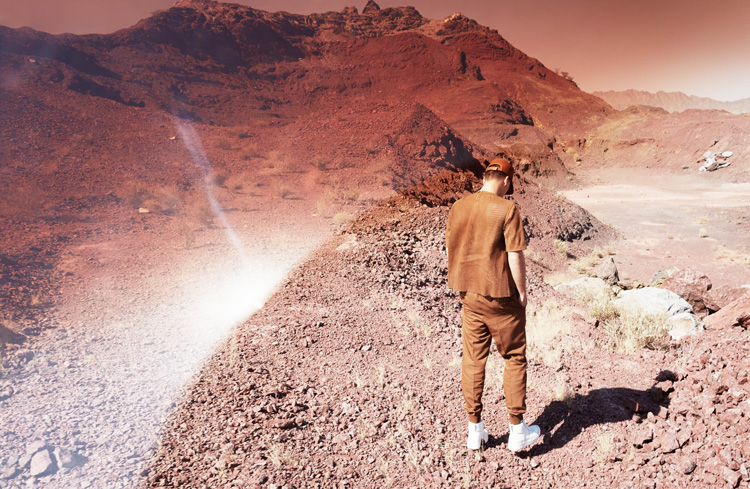
Short sleeve crewneck T-shirt in vicuna colour mesh cut calfskin leather, jogging trousers with hidden drawstring and seamless canneté cuff detail in vicuna cotton linen gabardine. Cap in vicuna colour leather, printed bandana, high-top sneakers in white calf leather with elastic lacing.

LEFT IMAGE: Two pockets Blosuon in white technical cotton gabardine, jogging trousers with hidden drawstring and seamless canneté cuff detail in white cotton linen gabardine, low top sneakers in natural canvas with elastic lacing. RIGHT IMAGE: Single breasted suit in green mohair suiting. Double layer scoop neck vest in white and black with XXX maxi logo in cotton and silk. Aqua and vicuna sandals with XXX logo.

Light grey nubuck blouson jacket with knitted collar, cuffs and hem; short sleeve round neck mesh t-shirt with XXX logo detail on collar in walnut and opera red cotton and linen, jogging trousers with hidden drawstring and seamless canneté cuff detail in typewriter green cotton linen gabardine. Low top sneakers in natural canvas with elastic lacing.
Styling and Direction: Dana Mortada
Photographer: Alan Gelati
Grooming: Lorna Butler
Model: Tony Marshall
Location: Emirate of Fujairah, UAE
Enjoy the our exclusive fashion film for Ermenegildo Zegna below:
READ MORE
A&E Editorials: Dior Homme SS18
Celebrating a decade at the helm of Dior Homme, Kris Van Assche reinvents the DNA of Dior. Explore the SS18 menswear collection in our exclusive editorial below.

SHIRT, NARROW SCARF, TAILORED SCARF, PANTS, NECKLACE. ALL BY DIOR HOMME

LEFT IMAGE: SHIRT, NARROW SCARF, TAILORED SCARF, PANTS, NECKLACE RIGHT IMAGE: SHIRT, PANTS, BOOTS, BACKPACK, NECKLACE, BRACELETS ALL BY DIOR HOMME
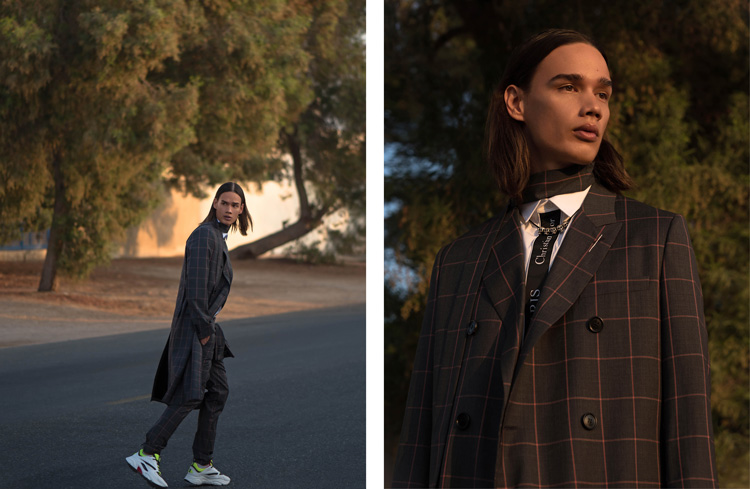
LEFT IMAGE: JACKET, NARROW SCARF, SHIRT, PANTS, SNEAKERS RIGHT IMAGE: JACKET, SHIRT, NARROW SCARF, NECKLACE ALL BY DIOR HOMME
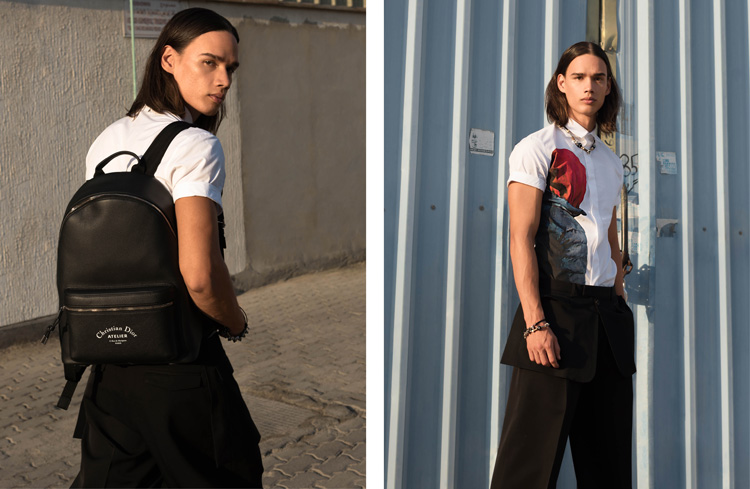
LEFT IMAGE: “CHRISTIAN DIOR ATELIER” BACKPACK RIGHT IMAGE: SHIRT, PANTS, NECKLACE, BRACELETS ALL BY DIOR HOMME
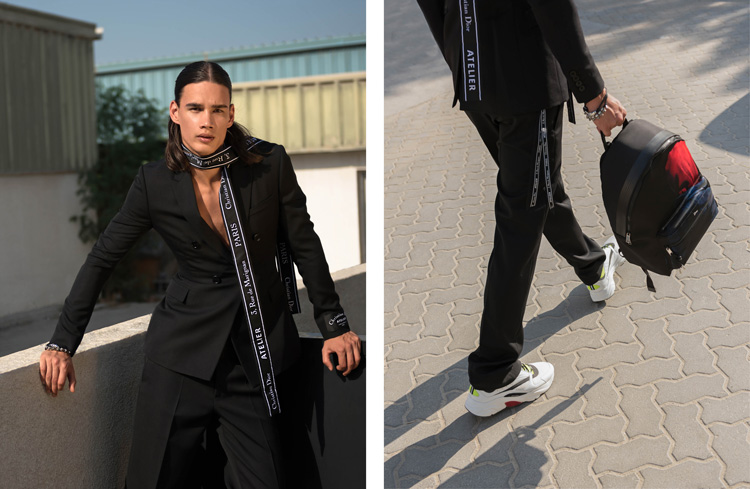
LEFT IMAGE: JACKET, PANTS, NARROW SCARF, BRACELETS RIGHT IMAGE: “FRANÇOIS BARD” BACKPACK ALL BY DIOR HOMME

LEFT IMAGE: SNEAKERS RIGHT IMAGE: SHIRT, VEST, PANTS, NECKLACE, BRACELETS, BROOCH ALL BY DIOR HOMME
Styling and Direction: Dana Mortada
Photographer: Fouad Tadros
Grooming: Emma at MMG
Model: Paul at MMG
Location: Light House Studio
Enjoy our exclusive fashion film for Dior Homme here:
READ MORE
Dior Cruise 2018: California Dreaming

COAT, DRESS, CHOKER, BRACELETS, RINGS ALL BY DIOR

LEFT IMAGE: COAT, CHOKER, NECKLACE, EARRINGS RIGHT IMAGE: DRESS, CHOKER, BRACELETS, RINGS ALL BY DIOR

LEFT IMAGE: DRESS, CHOKER, EARRINGS, BRACELETS, RINGS RIGHT IMAGE: “J’ADIOR” BAG ALL BY DIOR

LEFT IMAGE: DRESS, HAT, NECKLACE, BRACELETS, RINGS RIGHT IMAGE: DRESS, “J’ADIOR” BAG, HAT, EARRINGS, BRACELETS, RINGS ALL BY DIOR

LEFT IMAGE: DRESS, CHOKER, BRACELETS, RINGS RIGHT IMAGE: “DIO(R)EVOLUTION” BAG ALL BY DIOR
Photographer: Chloé le Drezen for Dior
READ MORE
Sheikh Majed Al-Sabah: Finding Fragrances
Sheikh Majed Al-Sabah embodies style, knowledge, and passion. An entrepreneur in his twenties, he defied the odds from a young age to reach success in the worlds of fashion and perfumery, and is now known as one of the most successful young entrepreneurs who has revolutionised the luxury fashion industry across the Middle East.
Born on November 12, 1968 in Kuwait, his love of fashion started from a young age, and he dreamt of gathering all the giant brands into one place. Founding Villa Moda, one of the region’s most iconic department stores while he was in his twenties, the entrepreneur is reputed for bringing brands like Gucci to the Middle East. After collaborating with Tom Ford to launch Arabian Wood, a fragrance which went on to become a worldwide best-seller, Al-Sabah decided to go one step further, creating The Fragrance Kitchen in 2012, turning his passion for high-end fragrances into an international business.

TFK AT GALERIES LAFAYETTE
Here, we chat to the man behind the prestigious fragrance brand, as his explains his venture’s philosophy, most memorable scents, and the power of social media.
What inspired you to be part of the fragrance industry and launch The Fragrance Kitchen?
Back when I was a teenager, my grandmother taught me how to mix essential oils and raw ingredients. Later, when I was in the fashion business and attended the International Collections, I was always recognised as the best smelling man at fashion week, with friends always asking what I was wearing. Then one day when I was having lunch with Tom Ford, and he expressed his interest in the expansion of his ready-to-wear business in the Middle East. I advised him that his men’s collection would not be the best investment, and that he should instead launch a fragrance collection. I created Arabian Wood for his Private Collection and it became a best seller. This experience and outcome gave me the confidence to start The Fragrance Kitchen.
What message are you trying to convey with The Fragrance Kitchen?
I want to create fragrances that marry Middle Eastern tradition with Western expertise.
Tell us what you think makes a successful fragrance?
A refined fragrance can be totally unique, it can lead you to a memory or a place that you love.

What is your favourite scent?
Arab Spring and The Finest, they are completely different from any other fragrance in the market.
Do you have a favourite top, middle and base note?
Bergamot, Oud, and Rose, although depending on the fragrance it can always be different.
Can you talk us through the ingredients in your fragrances?
The majority of the ingredients are natural, such as Taif Rose and Oud, and my favourite is Patchouli, as this is my grandmother’s favourite.
Do you feel that all the notes are meant for different personalities?
Musky scents can be for the mysterious and curious, while floral scents can be for the happy and free type of personality. Fresh scents are for the vibrant and charming. The magic is how to blend these notes together to create an amazing fragrance.
Are there some scents which are more suited to certain times of the day?
I would recommend wearing a fresh fragrance like Arab Spring in day or night, or The Finest for the evening.
Can you share with us your thoughts in mixing fragrances?
Blending fragrances is in the DNA of the Middle Eastern people. They always like to smell unique and different. It’s like a great Michelin-star chef who keeps his own recipe.
What was the catalyst behind your decision to create unisex fragrances?
This is because I always believe that there is no men and women fragrances, as long as the fragrance smells amazing.

What’s the biggest challenge in crafting scents for the public?
This depends on the country, as sometimes one country has a different taste to another, therefore I have to find ideas about the notes they like, and then finally know what the palate is.
Can you share with us your inspirations?
I always find my inspiration when travelling, especially to the broken and old places.
Could you define what luxury is for you?
Simplicity
What is your goal?
It is to stay simple, and comfortable, with an edge.
What are your views on the rise of social media, do you think it is advantageous to the world of fashion and fragrance?
Social media platforms are a great way to showcase activities, news events or cultural aspects of your travels whether work or play. Snapchat and Instagram are very effective in communicating your brand message as long as your content is meaningful to your fan base. You have to know your audience. Social media can only impact your personal life if you allow it to happen. You need to take breaks and set personal boundaries for yourself if privacy is important to you.
By Eliza Scarborough
READ MORE
Haute Couture SS18: Jean Paul Gaultier
Building upon his love for individuality, Jean Paul Gaultier’s show was a definite call for visual recognition, as enormous monochrome swirls covered the walls of the runway on rue Saint Martin.
The show paid homage to avant-garde French couturier Pierre Cardin and was heavily inspired by 1960s design, which was materialised gradually, in glamorous ladylike tailoring sliced and twisted in panels for 3D effects.
Keeping true to his signature look, Gaultier cinched waists and shoulders were exaggerated. What could best be described as futuristic plissé appeared in leather trousers, and on closer inspection, tuxedo jackets were actually capes. There were thigh-high boots created out of tulle and trench coats fashioned into bustiers.
Towards the close of the show, Gaultier’s muse Coco Rocha emerged, and seconds later she had twisted herself out of a spiral dress to reveal her two-year-old daughter Ioni Conran hiding inside in a matching dress.
READ MORE
Haute Couture SS18: Giambattista Valli
Haute Couture SS18: Zuhair Murad
This season, Lebanese couturier Zuhair Murad was heavily influenced by Indigenous cultures heading deep into native America, from the tepee-like structures down the runway, to the finale soundtrack of traditional flutes.
The fashion took this one step further, and featured no shortage of fringing, feathers, and chevron embellishments, taking inspiration from the glorious civilisation of the red Indians. Waists were cinched with traditional style belts, and hair was decorated with an array of feathers.
The pièce de résistance was of course the finale wedding dress. Capturing an innate elegance, the heavily beaded masterpiece featured a chevron pattern, jewelled headpiece, and cascading feather earrings.
READ MORE
Haute Couture SS18: Ralph & Russo
The aesthetic of Ralph & Russo, the only British haute couture house, can be summed up as dresses in which to marry a prince. So, while Kylie Minogue sat front row between the supermodels Arizona Muse and Natalia Vodianova, and despite the actors Lupita Nyong’o, Tracee Ellis Ross and Allison Williams wearing the label on the red carpet at the Screen Actors Guild on Sunday evening, the most significant name currently linked with the brand belonged to a certain Meghan Markle, who chose the brand for her official engagement photo, and no doubt saw the show’s finale, an off-white duchess satin gown with a draped bodice, long train encrusted with leaves of Swarovski crystals and lace veil embroidered with silk petals.
Aside from the extravagant bridal showstopper, the show dreamy fantasies in frothy mint organza, blush pink silk gazar and ice blue Chantilly lace, and bombshell gowns in black velvet and metallic satin. Sleeves were largely absent, unless made from fine-spun silk fringing, and the few coats to be found were fashioned from ostrich feathers, or sheer tulle.
READ MORE
Haute Couture SS18: Valentino
For many years, Pierpaolo Piccioli has produced some of fashion’s most extraordinary work, first in partnership with Maria Grazia Chiuri and now, on his own. This season, Piccioli’s spring collection was elevated to out-of-this world magnificent, as he transferred knowledge and values through time.
Behind each haute couture gown there are personalities and not just ‘small hands’, something which was the focus of this collection. Piccioli made a point of naming each look after its maker, honouring the craftsmanship behind the creation.
Volume was key, with oversized balloons of fabric in vibrant yellows, blues and purples opening the show. Belted with tight ribbons and draping bows, sophisticated jackets with partially pleated hems set a luxurious tone from the off. Oversized ruffles were paired with paper-bag trousers surrounding the models with excess fabric, yet tailored to emphasise the female form, with some looks styled with avant-garde feathered headpieces designed by Philip Treacy.
Pierpaolo Piccioli’s choice in emphasising simplicity is obvious, as the choices of colour-blocking garments demands focus to shift to the masterfully draped garment cuts. A sharp influx of minimal garments rapidly changed direction to over-the-top ruffles and scallop hemlines, which reflected the regal environment. There was extravagant tulle in tones to match the model’s skin, and with volume still the focus, floor length gowns captured the sense and magic of haute couture.
READ MORE
Haute Couture SS18: Elie Saab
Channelling the style and attitude of the modern woman, the Elie Saab SS18 haute couture collection presents elegant gowns created in homage to the independent and liberated ‘Parisienne’. Influences delved back to the 1920’s, with modern-day versions of Art Deco dressing. These bold geometric prints were amplified further with heavily encrusted embellishment and lavish adornments, expressing jewellery-like opulence.
Created with freedom of movement in mind, the pieces in this collection show off long, impossibly refined, and graceful lines. Soft and airy silk, satin, tulle, and lace in pastel hues drape effortlessly whilst still framing the feminine silhouette, enhanced by the fluttering of feathers. Whether bare or decorated in embroidery, shoulders were accentuated, while necklines plunged, all further accentuating the feminine form.
Accessories were just as spectacular, from cloche hats adorning perfectly coiffed heads, to bold yet refined headpieces, earrings, belts, necklaces, and cuffs. Clutches were equally statement, either covered in perfectly linear patterns of diamond-like studs and baguettes, wrapped in a coat of slim, champagne gold and silver chains, or jewel studded with the Elie Saab monogram design.
READ MORE
Haute Couture SS18: Giambattista Valli
Those who prefer their couture extravagant and their ballgowns fit for a princess were not left disappointed by Giambattista Valli’s latest showcase, with a runway filled with fairytale creations.
Held in the Musée des Beaux-Arts in the Petit Palais, the Italian designer, whose name has become synonymous with frothy confections, presented a series of maximalist, multi-layered dressing options for evening, each more opulent than the last. From airy draped silk chiffon lavished with crystal bows to mille-feuille tiered embroidered tulle, these were gowns designed for the red carpet, which is why Valli has long been a go-to among the A-list’s most daring red carpet regulars, calling upon his skills as a couturier to secure their spot on the top of best dressed lists.
READ MORE
The St. Regis Dubai: Celebrating European Elegance on Arabian Grounds
Location
Situated in the heart of Dubai, The St. Regis Dubai has earned its reputation offering flawless luxurious experiences to its discerning guests. Boasting a diverse portfolio of dining outlets, state-of –the art event and leisure facilities, including a world-class spa, The St. Regis Dubai has developed a loyal client base with guests from all over the world frequenting the property.

Style
Celebrating class, sophistication and elegance, and continuing a legacy that started at the brand’s original hotel, The St. Regis New York in 1904; today the regal property is winning the hearts of both tourists and residents alike, the property remains top of its league. With the extravagant 800-square-meter Astor ballroom, seven sophisticated meeting rooms and a glorious landscaped garden; the St. Regis Dubai continues the legacy of hosting the most exclusive events for special occasions, luxurious weddings and executive round table meetings.
Rooms
The St. Regis Dubai, incorporating its very own private helipad, features 234 guestrooms, including 52 suites, each offering a bright, airy ambience with impeccable design details, impressive chandeliers, marble bathrooms and a signature St. Regis bed. All hotel residents are promised the hallmarks of the St. Regis brand, including the signature St. Regis Butler Service, anticipating guests’ needs as well as the option of customization of stays in accordance to specific tastes and preferences. Taking luxurious accommodation to a new level, The St. Regis Dubai is also home to some of the city’s most exquisite hotel suites, including the impressive Sir Winston Churchill Suite and the custom-made Bentley Suite, the first of its kind in the Middle East.

Food & Drink
The St. Regis Dubai extends culinary excellence across its dining destinations creating a distinctive gastronomic journey for all who dine at the property. BQ – French Kitchen & Bar is a modern interpretation of a traditional brasserie serving redefined favorites from the cuisine. J&G Steakhouse offers a sophisticated selection of steakhouse classics, featuring the finest cuts of premium meat, a global selection of fresh seafood and a refined selection of beverages. Le Patio is a chic open air setting located within the central courtyard. Serving traditional Arabic cuisine, Le Patio caters to the modern palate with a delicious range of authentic Middle Eastern dishes, influenced by global flavours.
Guests are offered the opportunity to partake in the St. Regis’s authentic rituals, including Champagne Sabering at the Champagne Lounge, which celebrates the onset of an eventful evening, as well as the time-honored Bloody Mary ritual at The St. Regis Bar. Sidra, the lobby lounge of The St. Regis Dubai hosts the renowned tea ritual of the St. Regis brand, enhanced by bespoke tea blends and unique afternoon treats. Set against lush greenery, The Roof Gardens is a charming outdoor venue offering in-house guests an intimate setting within stylish cabanas.

Spa
The Iridium Spa at The St. Regis Dubai has become a spa haven in the heart of the bustling city. Showcasing six luxuriously designed treatment rooms, Dubai’s exclusive Iridium Spa has been carefully designed to reflect the energy of its surroundings and create a sense of harmony from within. With designated male and female sections, each area features its own dedicated wellness area, highlighted by two hammam rooms, a steam room, sauna, hot tub and a relaxing area known as The Iridium Room where guests can satisfy all of their wellness needs, all in one serene location.

READ MORE
Haute Couture SS18: Schiaparelli
Bertrand Guyon presents a trailblazing tribute at Schiaparelli to kick off couture week in Paris, with a collection which sought to deliver innovative designs.
The Frenchman, who was charged with breathing new life into the revived label in 2015, was keen to ensure founder Elsa Schiaparelli’s reputation as a trailblazer was kept firmly intact as he unveiled cobweb lace gowns and beetle embroidered tailoring in homage to the late designer’s 1938 pagan collection. Unusual fabrics, such as shredded plastic shopping bags interwoven with silk, showcased the house’s affection for celebrating the more avant-garde side of couture.
Guyon also sent out a love letter to her signature shade of shocking pink in the form of one show-stopping tulle gown which featured a heart shaped bodice. But while much of the collection was devoted to the house’s heritage, Guyon also collaborated with interior designer Lucie de la Falaise to present the Selene, Soteria and Selkie bags.
Fusing their background and influences of haute couture savoir-faire, natural and raw materials, precious craftsmanship, bohemian spirit, effortless allure, the Schiaparelli symbols, a nod to Bloomsbury and a pagan mythology, the accessory becomes the key piece of the season.
This ultimate couture tote braids raffia and strips of plastic bags embellished with wood and mother of pearl in three versions. The Selena shows a black sun, the Soteria a drift wood handle nailed with mother-of-pearl, and the Selkie an allegoric mask.
READ MORE
Haute Couture SS18: Dior
Health Wonderland: Clinique La Prairie In Montreux
What if your health was your true wealth? That’s the question the Simone Gibertoni, CEO of world famous Clinique La Prairie, wants you to ask yourself before you decide in which direction to take your personal wellbeing. With a background in consulting for luxury business and cosmetics, Gibertoni knows the level of service that his guests expect but he doesn’t just want to deliver the medical side, he is keen to educate the visitors to the Clinique about various levels of true health.
“The four pillars of Clinique La Prairie are medical, spa which relates to the mind, nutrition for longevity and then movement. Knowledge is fundamental and the application of that knowledge, that’s why we have psychologists.’ He adds, ‘We want to create value for the customer. Health is the real true wealth. For some holistic concept it’s hard to understand, but it’s important they understand it for the whole quality of life. We want more people to come from the Middle East and teach them our principle.”

Founded in 1931 by Professor Niehans, a pioneer in the development of cell therapy, Clinique La Prairie has over the years established an international reputation as a world-renowned medical clinic and wellness destination and has hosted everyone from Churchill, Marilyn Monroe, Pablo Picasso, a number of oligarchs and several rock stars. Thanks to ongoing scientific research, Clinique La Prairie is regarded as a leading light in preventative medicine due to its unique Revitalisation programme, designed to promote vitality, enhance the immune system, and slow down the ageing process.

As the clinic evolved, it also anticipated the needs of its global clientele adding specialised consultations, an operating theatre and a medical spa. A medical team of some 50 leading specialists, all under one roof, assure exceptional diagnostic precision and subsequent treatment. Equipped with the latest technology, Clinique La Prairie now offers a holistic approach to healthcare and wellbeing in a tranquil and sophisticated environment.

No other spa offers such a wide range of expertise, although Switzerland’s Bad Ragaz and, in Germany, the new medi-spa in Baden Baden, Villa Stephanie, are snapping at La Prairie’s heel.
‘I don’t consider La Prairie absolute, in our niche of business we are number one but the only thing that can happen to being first is being second so our challenge is to reinvent ourselves,’ says Gibertoni. ‘Innovation is waking up in the morning and saying, ‘what can I do better today’. The challenge is to push the people in the company to do something better than the previous day.’
One of the most popular treatments is the 7-Day Master Detox Program that involves personalised nutrition programs, beauty and spa sessions and is ideal for flushing out toxins, leaving you feeling re-energised in a peaceful environment.
Offering a balanced environment of both a luxury retreat with medical professionalism, how can visitors continue to apply what they learnt once they leave the picturesque setting? It has become a key focus for Gibertoni to have the philosophy of the clinic easily available, something like an app on your phone perhaps?

“One of our projects is to make something that is more than a simple app,’ he says. ‘We need more time but everything needs to be together so it works.”
Clinique La Prairie is not only a leader in delivering ground breaking health solutions, it helps create a state of mind in every customer installing the right frame of mind and a deeper understanding of what wellbeing means. We are all different, but one thing we have in common is our aim to live a long and healthy life and if there is one place that can improve our bodies and mind, it is located in Montreux on the shores of Lake Leman.
By Diana Bell-Heather
READ MORE
The World Of Marc Jacobs: A Quarter Century Of Style
The atmosphere was buzzing as Marc Jacobs presented his Spring Summer 2018 show in Park Avenue Armory, an event also marking 25 years since the beginning of his solo career. Digging deep in the archives to celebrate a quarter century which first began with his Spring Summer 1993 collection, past seasons were reworked, and momentous moments referenced. From sixties dresses to flower power prints, straight boas from the 80s, retro overalls, futuristic flip flops and turbans to mirror Kate Moss’ iconic look at the 2009 Met Gala, it was a saturated collection making Marc Jacobs the king of creative opulence.
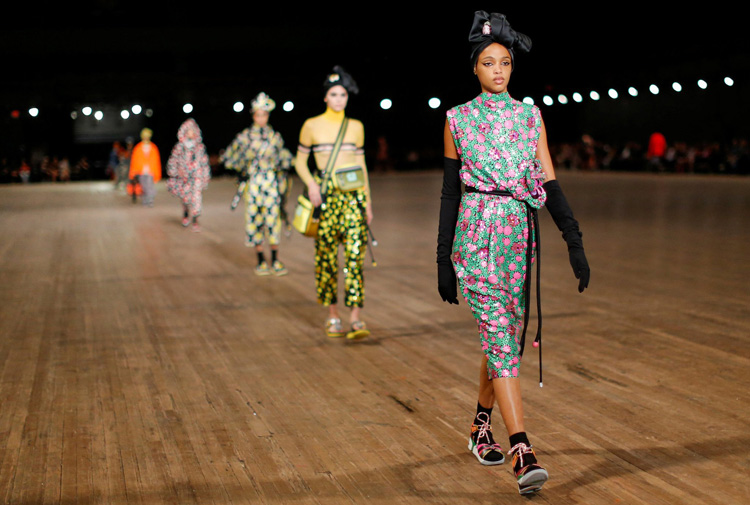
In the last 25 years, Jacobs first shaped the style in the 90’s, starting with his ‘grunge collection’, before presenting creations that would reflect his own vision about society, with his ability to predict trends and stage high-concept catwalk shows impressing the fashion industry. But his infectious sense of fun and daring style, kilts, skirts and even dresses have all featured in his wardrobe, has also endeared a legion of followers.
Born in New York City on April 9, 1963, Jacobs’ first foray into fashion was being taught to knit by his grandmother in her Manhattan apartment. He progressed to working at hip boutique Charivari where he first met Perry Ellis, the designer who encouraged him to enrol at Parsons the New School for Design and later take him on as creative director of his label. When Jacobs graduated in 1984, as Design Student of the Year, no less, he caught the eye of business executive Robert Duffy, beginning a business partnership that would last into the present day. However, his stellar trajectory hasn’t been without the odd hiccup. Jacobs’ contract with Perry Ellis was terminated in 1993, after management were disgruntled by his grunge-inspired collection, a show that is today credited with recasting the mood of fashion for that decade. The hurt was promptly assuaged, however, when he was awarded Womenswear Designer of the Year by the Council of Fashion Designers of America the same year, an honour he has received five times throughout his career, together with many other accolades.
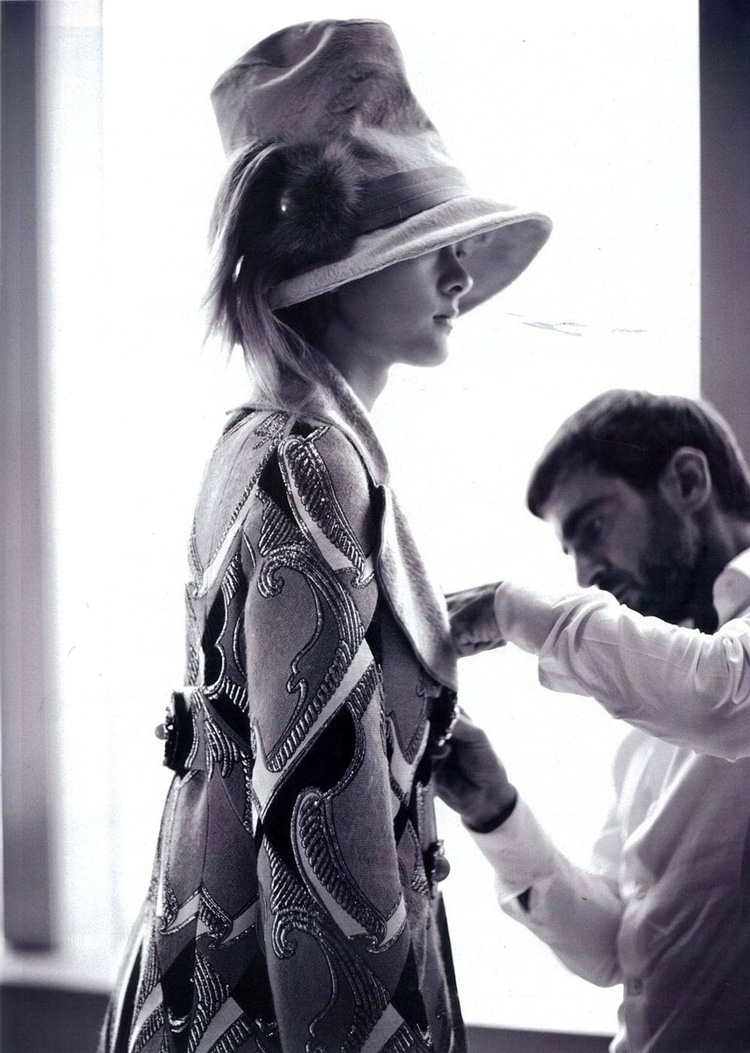
“ONE THING THAT IS EXCITING ABOUT FASHION IS THE SURPRISE ELEMENT. PEOPLE DON’T KNOW WHAT THEY WANT. THEY JUST KNOW WHEN THEY SEE IT.”- Marc Jacobs
Joining Louis Vuitton in 1997, at the beginning of a period of rapid growth in the luxury sector, Jacobs was responsible for introducing Vuitton’s ready-to-wear line, turning the brand into a global powerhouse. Prior to his tenure, the label was known only for its leather goods and luggage line. He also launched the first of the fashion house’s art collaborations, working with artists such as Stephen Sprouse, Richard Prince, Takashi Murakami, and Yayoi Kusama.
His tenure at Vuitton became one of the most successful revivals of a historic French house, and the longest-running, apart from Karl Lagerfeld at Chanel and Fendi, spawning what has become a standard business model to place contemporary designers at fashion labels. While Vuitton’s ready-to-wear has become a substantial business, its accessories have been the most important money makers for LVMH. Remember the Stephen Sprouse Louis Vuitton graffiti bags from 2001? The smiley-cherry Vuitton bags designed with Takashi Murakami in 2003? Or the Sprouse animal-print scarf phenomenon? Those intentionally defaced handbags were both a metaphor for Jacobs’s irreverent approach to stuffy French fashion, and also among the most successful in the history of the company. Although a risky move, they re-established the label as a luxury powerhouse and lead to an international craze for Louis Vuitton bags.

Closing his chapter at the French Maison and beginning a new journey with his eponymous brand, Jacobs presented his final Louis Vuitton show for Spring Summer 2014, a celebration of his greatest hits, created entirely in black, as was his first show for the label. The staging of the show re-created many of the sets from his sixteen-year tenure, the elevators, the escalators, the carousel, the fountain, the previous season’s hotel corridors, they were all there, a reminder of the designer’s extraordinary showmanship, only rendered this time in shades of black.
Marc Jacobs is a powerful fashion force, but he is known for being down-to-earth and speaking his mind, no matter what is on it. His achievements speak for themselves. His directional Marc Jacobs catwalk collection, launched in 1994, with bags in 2000, remains a kooky-cool high point of New York fashion week, while the newly expanded Marc Jacobs brand now combines the original diffusion lines for clarity. The spin-off perfumes are bestsellers, together with a recently launched make-up collection, and his work for Louis Vuitton, where he joined as the wilfully controversial creative director in 1997, is also consistently era-defining.
By Eliza Scarborough
READ MORE
A&E Interviews: Alaa Najd
Young, ambitious and already among the rising designers of the region, Alaa Najd winner of the debut season of Project Runway Middle East, started his professional career in the business sector. After realising his deep appreciation for design and architecture, he pursued a fashion design degree at ESMOD Beirut, and ultimately joined the world of fashion where he is currently thriving.
The Lebanese designer sat with A&E as he shared his stressful, yet memorable, Project Runway journey, his well-deserved win; and his goals of pioneering in the fashion industry with his eponymous brand.
Tell us, why did you decide to take part in the fashion industry?
Actually, I started out as a business student, and I worked in the business world for a few years before realising at the age of 27 that I was not happy anymore; it wasn’t what I wanted to do. So, I decided to make a drastic change and enter the fashion world. I studied at ESMOD Beirut and here I am!
What triggered your passion for design?
Well I’ve always had this passion; I’ve always loved fashion and had a talent for drawing. But fashion back then was not as serious as it is today. My mother also took fashion and sewing classes back in the day, so I was never a stranger to the field. At one point I worked as a marketing assistant with a designer, and I think that was what triggered my decision; I did not want to be in the corporate side, I wanted to enter the creative world of fashion.
Congratulations! How did it feel to be the winner of the first Project Runway Middle East?
Honestly, it was an indescribable and amazing feeling that I had never felt before. I did win prizes at ESMOD, but this was completely different, and having Elie Saab, member of the jury and one of the top designers worldwide, compliment my work and my style was truly overwhelming. Being the winner of the first season ever of Project Runway in the Middle East was wonderful and surely left a memorable mark on me for life.

How would you sum up your Project Runway experience?
It was a stressful and crazy journey, and the best part of it was that stress brought out the best in me; a creative side I never knew I had. The program also gave me a lot of exposure to which I am very grateful for.
Who did you think was your biggest competition throughout the season?
It was Luma, definitely! Luma and I were together at ESMOD, and since day one, we were always competing to be number one. We both have very strong characters, which I found out during this fierce competition for Project Runway. I was actually sad to see her leave, knowing that she is a great designer.
Out of all the collections you created during the show, which one were you worried about the most?
It was definitely the avant-garde collection. The challenge wasn’t for me; I am someone who loves wearable and practical designs, and the avant-garde collection was far from my usual style. While everyone went for extravagant designs and volumes, I went for body-fitting and more feminine style and forms. I was worried about that, but it surprisingly played to my advantage; they liked my dress and I won that challenge!

How did you stay so calm throughout? What have you learned from this whole experience?
To tell you the truth, I did not stay calm at all. At some point I did feel like I was going to break down. For example, the day of the Red Carpet challenge was as stressful as it was emotional; we only had 10 hours and the dresses had to be ready before our trip to Cannes. Another example would be the first episode of the show, it was all new and I was shocked since I wasn’t realising what was happening, but then you get used to it. Deep inside, I was so happy and grateful for the experience. As for what I learned, it was mainly how to be fast and efficient-especially for someone like me who likes to take his time. I also learned that sometimes, you will inevitably miss out on small finishing details and that’s alright.
Tell us a bit more about your latest collection.
I am currently working on it and it will be launched this November. It’s a collection of 12 outfits that are all white with touches of silver. My main inspiration for the collection is related to Greek patterns and structures. I was inspired by the small family hotel I stayed in this summer in Bodrum, Turkey; where the theme was all blue and white, with marbles and Greek stones. The idea started there, and then it developed further with my research and drawings. I haven’t named my collection yet; I actually create the concept first, I draw, and then I think about the name.
What are the three pillars you would like to build your eponymous brand on?
First, I must say simplicity and minimalism; the elegant attitude, and finally the quality of the material and the craftsmanship.
Who is the Alaa Najd woman?
The Alaa Najd woman is very independent, modern, and contemporary. She doesn’t want anything that other people are wearing; she wants modernity with a classic and elegant touch.
Any chance you’ll collaborate with any of the contestants in the future?
Yes, I wouldn’t mind. If I had to choose, it would be Luma Saleh, for sure! I would love to work with her since we have opposite styles; I think the collaboration would create something very original. I would also like to work with Maroun Issa, who has strength in the detailing and technical work, and I liked Mohanad Kojak’s vintage Victorian style, which I believe would merge very well with my style as well.
Any advice you’d like to share with the new participants of the next season of Project Runway Middle East, or with young designers trying to break through the industry today?
Don’t complicate things and don’t overthink it! It’s basically a simple idea with a twist. Also, never look around and compare your work to other contestants: believe in your own work and creativity.
What was your favourite look from the SS18 runways?
I am personally not into trends; I prefer to do my research, go with the general trend and from there work on the character of the person I want to dress.

What is your biggest fashion no-no?
This is an easy one for me: animal prints; I don’t think I could ever work with them or use them in any of my pieces.
If you weren’t a designer today, what would you wish to be?
I love architecture and interior design, furniture is also very interesting for me. Knowing that my designs have strong structuring and a touch of masculine but elegant detailing, it’s easy to see how I am inspired by architecture. I believe that if I wasn’t born in this generation, I would have loved to be part of the ‘60s era of modernity, geometric, and minimal shapes.
What is Beirut to you?
Beirut is home. As cliché as this may sound, you could travel all around the world, but never find what we have here in Lebanon anywhere else. It’s a unique country with its cultural diversity, different mentalities, and lifestyles. The more I travel, the more this is confirmed to me.

So, what’s next for you? Can you share with us a message you would like to end the year 2017 with?
What’s next is definitely my new collection. As for 2017, I believe it was a very successful year. Project Runway was a dream for me, my first step into the market, but I have so much more to accomplish and thrive for. I am a perfectionist, and no matter what I accomplish, I always want to push further.
Your life motto…
I have a quote that I live by, whether in my daily life or when I am designing: “Simplicity is the ultimate sophistication.”
By Dana Mortada
READ MORE
A&E Editorials: Dior Timepieces
Speak the language of couture, at these delicate styles translate creativity into a timepieces. Enjoy our ‘Time is Precious’ editorial exclusively for Dior out in our January 2018 issue.

LA D DE DIOR SATINE WATCH BY DIOR TIMEPIECES

LEFT IMAGE: DIOR VIII MONTAIGNE WATCH RIGHT IMAGE: DIOR VIII GRAND BAL PLISSÉ RUBAN WATCH BY DIOR TIMEPIECES

LEFT IMAGE: LA MINI D DE DIOR SATINE WATCHES RIGHT IMAGE: LA D DE DIOR SATINE WATCH BY DIOR TIMEPIECES

LEFT IMAGE: DIOR VIII MONTAIGNE WATCH RIGHT IMAGE: DIOR VIII MONTAIGNE WATCH BY DIOR TIMEPIECES
Fashion Director: Eliza Scarborough
Photographer: Jenny Brough
Hair & Make-up: Scarlett Burton
Model: Rebekka at Premier
Location: Dandelyan, London
All Clothing: Dior Cruise 2018
READ MORE
A&E Talks To Dior’s Laurence Nicolas On Watches Women Want
New Season Men Accessories
Welcoming casual Styles Reinvented with a Modern, Minimalist Appeal.
An increasing interest in men’s accessories is seeing a surge of growth in the sector with a stronger presence in previously apparel-heavy fashion ranges accessories market increase. So, from London and Milan to Paris and New York we have identified the key accessories from the most directional designers and influential shows, giving you the best possible basis for your decision making.

By Eliza Scarborough
READ MORE
A&E Guide: World’s Best Relaxing Retreats
Work-life balance. Three little words that are so easy to say, yet so hard to achieve. So, there’s no time like the present to take yourself away from the fast pace of life, albeit temporarily, to relax, recharge and give yourself some well-deserved me-time. We have done the hard work for you, so read on for a selection of retreats where you can completely escape.
CHENA HUTS, SRI LANKA


Perfectly situated on the edge of Sri Lanka’s famous and historic, Yala National Park, Chena Huts, really does have it all. Boasting only 20 luxurious lodge retreats, set metres away from the beach, you can enjoy the perfect combination of adventure and relaxation. Each thatched lodge evokes a rustic and colonial feel, yet still providing a modern and luxurious touch, and you can either relax in your own private plunge pool or at the hotel’s main pool, located next to the intimate jungle spa. For every night you choose to stay at Chena Huts, a complimentary game drive is included, with these game drives taking place early morning or in the afternoon, accompanied by highly experienced and professional guides who will make sure you get up close and personal with the resident wildlife, such as elephants, leopards and even sloth bears. After your game drive, why not unwind in the spa, where you can choose from a variety of holistic treatments and massages. For those looking for a chic, safari escape that ticks all the boxes, we certainly recommend this remote, jungle haven.
AMANPURI, PHUKET


The original of the Aman hotels needs no introduction. From the moment, you enter this property you experience the wow factor, from the perfectly manicured gardens along the drive way to the stunning open plan lobby in the style of a Thai palace. Once you get past the impressive swimming pool all you can see are towering palm trees and one of the best and only private beaches in Phuket. Pamper yourself at the hidden away spa, where treatment rooms are housed in individually enclosed pavilions, boasting divine views of the bay, and dine in luxury, choosing between authentic Japanese, South American or Thai cuisine in one of the ocean front restaurants. So, if you are looking for isolation, a stunning setting and pure luxury, then Amanpuri should be at the top of your list!
THE BRANDO, FRENCH POLYNESIA


Thirty miles north of Tahiti is an enchanting necklace of 12 beach fringed islets that was once the private atoll of Hollywood legend Marlon Brando. Now it’s home to a very exclusive escape which you can only reach by the resort’s own plane. The mood here is luxury unplugged, with 35 majestic, thatched-roof, beachfront villas, each with an outdoor bath, plunge pool, rocking chair for two, and a pair of chic vintage-style bicycles for freewheeling through the coconut palms. Everything here is included in your booking, from dreamy Polynesian spa treatments, lagoon cruises, and delicious French cuisine created by two Michelin star chef Guy Martin. This idyllic spot is best known for its castaway feel, whether you are snorkelling in the crystal clear South Pacific waters or eating fresh fruit whilst lounging on the white sands.
NORTH ISLAND, SEYCHELLES


North Island Lodge is a colonial chic sanctuary for both wildlife and guests. The 11 handcrafted villas, which are all bare wood and billowing cotton, have a quintessential rustic Robinson Crusoe feel, and being raised off the ground they catch the cooling Indian Ocean breezes. After a day soaking up the sun, take in the Island’s scenery as you walk over to the Sunset Beach Bar for cocktails. Although, keep an eye out for Brutus, the island’s 160-year-old tortoise. To add to the feeling of desert island life, you won’t be finding a menu at meal times, the chef prepares seasonal fresh food to your taste with a plentiful supply of fish caught offshore.
CHEVAL BLANC, SAINT BARTHS


With sugary sand leading down to the clear blue sea, Cheval Blanc St-Barth Isle de France has won many loyal fans since its recent makeover by LVMH. The luxury goods conglomerate added this jewel of a destination to its new travel portfolio, and has preserved everything that was already perfect, so it remains serene yet chic. But the lightest touch of additional luxury has been sprinkles over the venue, from pink fluffy towels, subtle French lines, supremely stylish bathrooms, along with a very good Guerlain spa.
READ MORE
A&E Interviews: Zaid Farouki
Emerging Arab American atelier designer Zaid Farouki always wanted to design, but when it came to the idea of applying to universities and picking a major he was told that as long as he got a degree in business, he could do whatever he wanted afterwards. So, that is exactly what he did, moving to Washington DC to attend American University, where he majored in Business Administration with Marketing. During this time Zaid’s artistic side felt starved, so he started art classes and completed a studio art minor, which included painting, sculpting, and multimedia. From here a fashion design degree followed at Istituto Marangoni, Milan, together with specialised courses in couture techniques, embroidery, and hand-painting at Central Saint Martins, before launching his first atelier collection in 2016 in Dubai.
Farouki is from a global background, finding inspiration in the fusion of cultures, and imagining a woman adorned by European clean cuts, true American liberties, and the ever-existing Arab dramatisation. His designs are individually and specially painted by him, which makes his pieces extraordinary, combining couture techniques, embroidery, and unique artwork.

Tell us about how your interest in fashion began, and what inspired you to become a fashion designer?
I always wanted to become a fashion designer, so when it came to the idea of applying to universities and picking my major I was told that as long as I got a degree in Business I could do whatever I wanted afterwards. So that is exactly what I did, I moved to Washington DC and attended American University and majored in Business Administration with a Marketing concentration, but I always felt that I wasn’t feeding my artistic side, and consequently enrolled myself in art classes adding a Studio Art minor, which included painting, sculpting, and multimedia. I also started my own fashion blog zaiddor.com where I shared my views, ideas, and anything that inspired me. During my final year in DC, I applied to Istituto Marangoni, Milan and was accepted, and at that point I knew that’s where I was meant to be and what I was meant to do. After receiving my degree in Fashion Design, I moved to London and attended Central Saint Martins, taking specialised courses in couture techniques and embroidery, as well as hand painting.
Can you share with us the brand DNA, and who the Zaid Farouki woman is?
With such a global background being an Arab American as well as being educated in Italian fashion techniques, I found inspiration in the fusion of cultures. Imagining a woman adorned by European clean cuts, true American liberties, and the ever-existent Arab dramatisation has helped me to create the global hybrid woman, a representative of a new globalised world and the woman whom I yearn to design for. A woman who is confident and unafraid to express herself. My pieces are all handmade and abide by couture techniques, embroidery, and finishing. Furthermore, all my prints are hand painted onto the fabric, making the wearer a walking piece of art.

What was the catalyst behind starting your own label?
I had to realise my alternate reality, so there wasn’t any other option than to start creating right away.
Tell us about your breakthrough into fashion, and how you have found the journey?
I got to learn about Dubai Design District in its beginning phases while I was still living in Milan, and I knew that I wanted to be part of the community. I have an Arab name, features, and identity, so if I had gone back to the US or stayed in Europe I would be called ‘The Arab American designer’, so I believed that moving back to my region and being part of the creative community was the best journey.

Why did you choose to create a fashion line based around art?
When I was at university and gave up on the finance side, I walked over to the art school and registered myself, studying sculpture, photography, painting, & drawing. Therefore, upon graduating and when I moved to fashion school, I felt my background in art needed to speak for itself, and by allowing the wearer to impose a point of view to the viewer, each piece had to have a purpose.
How do you combine both fashion with art?
My creations are wearable sculptures, light installations, and wearable paintings.
One unique aspect of your designs is that you hand produce all the artworks exclusively for one of a kind garments, why is the uniqueness important to you?
When I paint or sculpt a piece it is impossible to exactly duplicate it again, no matter how hard I try. Taking that concept into mind, and also understanding how much exclusivity means to my clients, uniqueness is key for my designs.
Do you always paint the artwork on a mannequin? Tell us why, and how you learnt this process?
Not necessarily, as each piece is painted in a different technique to achieve the desired look of how the paint falls and its reaction with that specific fabric. Most of our work is based on research and development, and therefore developing the piece takes the longest time to achieve the best technique and quality.

Have you always been passionate about Haute Couture and the highest class of fashion design?
I am obsessed with details, and one-off creations allow you to focus on the details, especially because you don’t have budget and retail price targets like Ready-to-Wear.
Would you look to branch out into Ready-to-Wear, or will you always look to continue with Haute Couture?
We actually just launched a menswear Ready-to-Wear collaboration with MINI Cooper last October. Moving on we will always have our creative one-of pieces as well as the Ready-to-Wear pieces.

Tell us about the global hybrid woman, and how all the cultures combine?
Having been exposed to so many cultures throughout my life has allowed me to imagine a hybrid human, a person that rises from combining different factors of their ancestral roots leading to this globalised jet setting powerful individual with nothing holding back their ambition and power.
Has your global background helped inspire your work heavily?
I am inspired by Arabs and the way they dress, the way they interact, and our culture as a whole. Moreover, I am inspired by the fashion brands and heritage that the Europeans managed to create. Lastly, there is this laissez-faire style that rises out of the US and the individuality and subgroups that are formed in the country.
Where does your core inspiration come from?
My life and experiences.
Do you have a muse?
To create a collection there is always a person that I imagine wearing the collection. I Imagine my creations with every breath and living moment, I envisage my woman in her surroundings moving to the sound of her own drums. Then one day my eyes encounter a beautiful subject across a pond, allowing me to forget the past and move forward wondering and studying her art of seduction, it’s features, and its ever-growing beauty in my eyes, and therefore a new muse and theme arise.
Is there anyone in particular who you would love to see wearing your designs?
No there isn’t anyone in specific, I love dressing any powerful Arab woman proud of her identity and heritage.
Tell us more about your current couture collection?
My latest creative collection is called ‘Revival’, and I imagined a woman walking through the hallways of a 16th century château with nothing other than candles lighting her path. As a descendant of the residents she explores the estate through the night discovering her heritage and identity. Throughout the night, candle wax drips onto her clothes as it is the only form of illumination, with her later emerging as a different woman, knowing her true stature and heritage. She is a great grandchild of an Arab queen that rose against her people, and as the social struggles of centuries come to a complete halt she realises that only she can uproot social norms and free herself from the shackles of male imposed measures. She despises her gender’s definition as receptors of male hand-me-downs, and as the night gets darker, resentment grows stronger. She declares herself free of male-imposed constraints and vows to pave a way for her own people, so as morning rises, she declares victory by stripping her former commanders of their powers by feminising their clothing and making them as daring as ever.
Can you share with us which piece is particularly special or memorable?
It’s very difficult to choose, as it’s like picking which child is your favourite. However, the pieces that I really enjoyed creating were a dress fully hand embroidered with green silk threads and inspired by candle drippings. To further emphasise the candles’ drops, the dress was fully hand painted with seven different colours in the back. It was then hand embellished with 1200 peacock feathers. I also enjoyed making the wedding veil which is like no other. This was made from a single golden thread which was turned into a rope and attached by hand to create a fishing net. Then 9000 Swarovski crystal pearls were hand embroidered onto the veil. Finally, a wearable sculpture adorned with a headpiece inspired by the falcon is memorable. There is a metal cage corset inspired by Arabic geometry and mathematics worn over a black leotard. First, she is spray painted by me and then as the lights turn on she turns into a light installation due to the shadows that the cage reflects on her clothing.

Do you enjoy the freedom of running your own brand?
I think this is an entrepreneurial dream that we feed to people. Creatively and decision wise you have the freedom of deciding on whatever you want and in which direction you see your business going, but at the end of the day launching your own company has no freedom, and on the contrary you must ensure that all bills and salaries are paid, you need to be present and set an example to your team, and put in the most effort as if it is your child. Yes, you have certain flexibilities concerning where you wish to invest your time, but when your name is on the door freedom as a business owner is barely present.
What drives you to continue creating new and inspired designs?
It’s a feeling which drives me, when I can’t design or create it is like a piece of me is being chipped away little by little.
Do you feel that your business education has helped with starting your business from scratch?
Yes of course, I wouldn’t have been able to manage without it!
After living in many different countries, why have you chosen to have your atelier in Dubai?
I am Arab, and my family relates to 5 different Arab countries. Dubai gave me the opportunity to move back to our region and launch from there, allowing me to build my brand and become part of the growing regional talent pool making this city a destination for design and fashion.

What are your feelings on how the fashion industry is growing in Dubai?
The industry in the region is growing as a whole. People are getting more into purchasing and endorsing regional talent, with designs and products that cannot be found anywhere else in the world.
What can we look forward to and expect in the future from you?
Creating more, being out there more, and opening the doors to be as creative as we can.

Finally, what is your ultimate goal to achieve in the next 5 years?
Not to only be recognised regionally but also showing signs of our global presence and maybe opening a second atelier in a different city.
By Eliza Scarborough
READ MORE
A&E Interviews: Antonia Citterio and Patricia Viel Unveil A New Jewel To Bulgari’s Crown
Antonio Citterio and Patricia Viel are the founders of Antonio Citterio Patricia Viel, a multi-interdisciplinary studio that works across the fields of architecture, interior and product design. Working internationally, developing complex projects of varying scales, from hotels and offices, to commercial complexes and showrooms, their most recent venture has been growing the Bulgari hotel chain, with the breath-taking Bulgari Resort & Residences Dubai, a true ‘urban oasis’.
How did your passion for architecture begin?
ANTONIO: In principle, for me it was a natural choice because I grew up with my father creating furniture, and I started working with my father before going to the school of art near my family village, and things went from there.

Do you remember your first job?
ANTONIO: Yes, it was when I was 15 years old and a furniture supplier came to me with a lot of small pieces of offcut material asking me to do something with them, I made a pouffe.
PATRICIA: I was very much interested in imagining spaces from a young age, and my first project was a house for a puppet made from paper boxes.
How would you describe your design approach?
PATRICIA: We have been educated to be very much inclusive in our process. It is not only about architecture, but also landscape, social needs, aesthetics, and taste. So, it is important for us to understand the context, and we go very deeply into the needs and demands.
How challenging is it to work together?
ANTONIO: We started to work together when Patricia came into my office in 1984, so we have had a long relationship. It was also a strategy to grow the company and I needed a partner to help me with this. We have worked together for many years, following the same path, although we have a different approach.
How would you describe each other?
ANTONIO: The Boss.
PATRICIA: A Master

Looking back in history, do you have an idol in the design world?
PATRICIA: I do not think that an architect can be an idol for anyone. However, all my favourite artists are dead, but I think that there is some thinking that is very interesting, but I don’t believe that this is the time for great masters.
Talking about the Bulgari Dubai project specifically, how long did it take to execute?
PATRICIA: 4 years of design and 2 and a half years to build.
How would you describe it?
ANTONIO: It is an urban oasis.
How has the Dubai culture inspired and influenced this project?
PATRICIA: We are doing the Bulgari hotels in locations that are attractive to the Bulgari tribe. So, we must somehow be respectful of the culture, but also must understand that now there is an overall global way of life, and we need the finished product to be appealing for everyone. With this property in Dubai, sun is an important aspect. The country is blessed with a lot of sun and we have played with it so that the project really connects with the place.
Which of your projects are you proudest of?
PATRICIA: For me, it is the Ermenegildo Zegna group headquarters in Milan, because it is exactly what I mean by doing something very bright, it is something we did for the brand but also for the city.
ANTONIO: It is the Technogym Village in Cesena, Italy.

Do you have a personal motto?
PATRICIA: I wouldn’t say it is a motto, but every morning I tell myself to try and come home early!
What things do you hate the most?
ANTONIO: Extravagance, and people wanting to show off.
Is there a book you are reading right now?
PATRICIA: I’m trying to read books in English, so I can learn more words.
Do you enjoy music?
PATRICIA: Yes, I am always using Shazam to find the names of the music I hear around me, and I am currently a big fan of Ed Sheeran.
What is something that you will promise yourself to do in 2018?
ANTONIO: To do less!
PATRICIA: I am the opposite and think that I should do more!
If you weren’t who you were today, what would you be?
ANTONIO: I would have a job without responsibility.
PATRICIA: I think I would be a writer.

Where do you see the design direction going in 2018?
ANTONIO: I think that people increasingly understand that their apartment is a private space, and they will think more about their real life rather than something for show.
What is your response to social media?
ANTONIO: None.
PATRICIA: We have no relationship with social media!
How would you describe Dubai?
ANTONIO: Normal, but with a high perception of quality.
What can we expect in 2018 from you?
PATRICIA: Many other exciting projects, but mostly high rise.
By Lara Mansour Sawaya
READ MORE
Bulgari Unveils New Dubai Resort In Style
Beauty Oil: The Ultimate Skin Saviour
Whether you suffer from dry or oily skin, adding a beauty oil into your routine could be just what your complexion is screaming out for. Many people worry that using a face oil will leave them with a greasy, shiny complexion, but in fact using an oil-based product can actually be a good way to regulate your skin’s oil production. Alongside the obvious hydration benefits, face oils can completely transform your overall skin tone, giving you luminous, dewy, and radiant skin which will look healthy all year round.
CLEANSING
Oils are also transforming our cleansing regimes. It’s strange to imagine that the same ingredient that seals in moisture can also clean, but it’s true. The skin’s protective barrier is made up of sebum or oil, so because oil absorbs oil using an oil cleanser will purify your skin without stripping it. They work because the molecules in oil specifically react with makeup and your own natural oil, meaning they dissolve makeup, sunscreen and impurities while nourishing the barrier.
APPLICATION
The way in which you sequence your products matters. Oils deliver nutrients and create a protective seal that stops moisture escaping, but they won’t pull water into the skin to moisturise it the way a humectant, such as hyaluronic acid, does. For maximum hydration, you should start with a serum, followed by an oil and then your moisturiser. When applying, avoid rubbing the product into skin, rather warming it slightly between your fingertips and patting into skin to allow for full absorption.
MULTIPURPOSE
In addition to moisturisation, face oil can be super effective for a makeup touch-up, so instead of adding more makeup, pat some oil on to revive the makeup you’ve already got on, avoiding the T-zone. Pop it in your handbag, and it can act as an all in one product to fight frizz, hydrate cuticles, moisturise under eyes and give shine to lips.
REPAIR
You really need an oil if you use retinols or other drying anti-aging or anti-acne treatments. Treatments like Retin-A, AHA peels or creams, or breakout fighters from astringent toners all the way to prescription medication can really help your skin, but they can also seriously dry it out. Face oils return moisture and elasticity to your skin, smoothing wrinkles, and soothing irritation in the process.
OILY SKIN
Sufferers of oily skin often turn to harsh toning, oil-stripping products to combat shine and breakouts, but this can actually cause your skin to over-compensate and produce more oil, leading to pore congestion. When finding the best face oils for oily skin, look out for vitamins, amino acids, and anti-oxidant ingredients to help. Using essential oils such as tea tree and eucalyptus that have anti-bacterial properties can also help combat breakouts and adult acne.

By Eliza Scarborough
READ MORE
A&E Guide: To Help You Beat Jet-Lag
Crossing time zones can wreak havoc on your body for days after your return flight. So, from what to eat and when to sleep, we reveal the most effective ways to prevent and overcome jet-lag.

Body Clock
Your body secretes hormones at certain times of day, and your brain expects different hormones to be at work at certain times. For example, cortisol, a stress hormone, rises in the morning when you’re about to start your day and face the world, while the growth hormone is produced at night. This is all controlled by the endocrine system, and the timing of these hormones helps your brain know whether it’s day or night, based on the previous day and night. However, when you travel this of course gets set to the wrong pattern, as your behaviour is out of sync with your body’s hormones and the endocrine system. In order to avoid this, and prepare your body, in the days leading up to your flight, adjust your bedtime by an hour a day to get more sunlight in the morning if you are flying east, or in the evening if you are heading west. Book flights that land in the daylight when possible and change your watch and phone to the destination time before boarding.
Skin Saviours
Skin gets very little oxygen during flight time as you are enclosed in an encapsulated environment without fresh air, and depending on recycled air. This immediately results in dehydration, sensitivity, and tired dull skin, as it does not get cleansed thoroughly, so it’s important to travel with clean skin, avoiding makeup. It is also key to stay hydrated, aiming to drink a litre of water before taking off, and at least ½ a litre for every hour on board. On arrival, to revive tired skin, massage your moisturiser in, focusing on the key pressure points, including the temples, in between the brows, the tops of the cheekbones and along your jawbone. This will help to boost your circulation and give you a healthy glow.
Eat Clean
Pick up some healthy snacks, such as chia seeds, unsalted nuts, apples, and coconut bites, for the flight, as in-flight meals tend to contain salt which will dehydrate you further. These are also effective energy boosts, as flying at high altitudes seriously dehydrates your body together with affecting your energy levels. When you arrive try to stick to your destinations meal times, so if it’s breakfast time when you arrive, eat something appropriate even if you don’t fancy it, as we have a food-related body clock.

READ MORE
A&E Interviews: Melissa Losada and Marcele Velez of M2Malletier
While studying at Parsons School of Design, Colombians Melissa Losada and Marcela Velez discovered a shared interest in translating old-world luggage into everyday chic, after meeting late one night at the now-defunct Bungalow 8. A partnership was formed through their friendship and mutual desire to create something the industry had not seen before, and in 2012 the brand was launched.
Recognisable for their hexagonal shapes, and synonymous with chic minimalism, clean lines, and cool, timeless design, the elegantly crafted styles come in a range of shades, from traditional tones to the more daring plum, mustard yellow, and exotic skin. But the key, head-turning signature is the handle. In either gunmetal or polished plated gold, this is a handle unlike any other, and which Losada and Velez spent some two years developing with engineers in Spain.
Here, we take the opportunity to speak to the ladies behind the highly coveted minimalist handbags to discuss the inception of their brand, their greatest inspirations and influences, and the future of moving into making accessories and footwear.
What made you want to want to become handbag designers?
We had not purchased new bags for a while, and were tired of the ‘It’ bags. That’s how M2Malletier was created. We wanted a product that did not have its brand everywhere, something more discreet and timeless.

Tell us about how you conceived the idea for M2Malletier?
Our brand’s philosophy is reminiscent of the works from French interior designer Jean-Michele Frank and Catalan architect Richardo Bofill and is interpreted as the unification of two fundamental cultural movements, minimalism and surrealism. M2Malletier combines influences from the world of architecture with the world of history, refreshing medieval Armor and thought-provoking tools relevant to the time period. The brand pays homage to iconic pioneering women such as one of the 20th century’s most daring and influential patrons of the arts, Vicomtesse Marie-Laure De Noailles, with its unexpected and trend-setting designs.
How did you come up with the brand name?
Well, ‘M2’ comes from our names, Marcela and Melissa, and ‘malletier’ is an old French word related to luggage and bag manufacturers.
Who is the M2Malletier woman?
A woman distinguished for her eternal style and sober taste, the M2Malletier woman is a trendsetter in her own distinct way.
How did you carve out the brand’s signature aesthetic?
We wanted something different, something that would stand out from the rest. Medieval medical instruments inspired us to develop this signature handle.
Tell us more about the design for your signature top handle?
Our bags are a result of progressive design and an aesthetic that is rooted in an old-world sensibility. The inimitable linear handle is inspired by medieval tools and armour. It is a hallmark of M2Malletier which perfectly articulates the unforgettable glamour and spontaneity evident in the brand’s avant-garde designs.

What sets you apart from other luxury bag designers?
Foremost, our hardware and then comes the hexagonal shapes and versatility of the handbags. Next is our exotic leathers in unique and exclusive colours such as our calf skin, laser cut calf for fur-like texture, and exotic skins alligator and python, crocodile, and cashmere suede
What does luxury mean for you today?
For us, luxury is craftsmanship and great quality with the best materials.
Do your Colombian roots influence the way you design and conceptualise the brand?
We love to use natural rich colours, but still allow ourselves to play with textures and other bright vibrant colours in each collection. We also love experimenting with new fabrics and materials, which is very influenced by our heritage due to the various natural textures found in Colombia.
Which design elements help you balance timelessness while also being on-trend?
The design of our bags is very sober and clean, our shapes are very geometrical, and we innovate with different leather finishes to give them the ‘seasonal’ touch.
Tell us about your studio and how it inspires your designs?
The studio that we were offered in a revamped 1973 cement factory in Barcelona by Ricardo Bofill was definitely an encouraging factor to relocate to Barcelona. Needless to say, the rich history and opulent architecture that is found in Barcelona also serves as our brand’s philosophy, unification of two fundamental movements, minimalism and surrealism.

What part of the design process do you enjoy the most, and do you split responsibilities?
Yes, we split a lot of the responsibilities so that we can be more efficient, and each task is focused and done perfectly. We love finding inspiration and of course selling the collection afterwards. There is nothing more rewarding than seeing your creations on the shelves of the leading department stores worldwide and multi-brand stores.
If you could design a bag for anyone, past or present, who would it be?
Anna Ewers.
If you had to choose a favourite bag from any of your collections, what would it be, and why?
At the moment one of our favourites is La Fleur du Mal Botanical Embroidery. It really combines the timelessness of our brand but has this very rich and feminine touch with the embroidery. It is extremely delicate and beautiful, and makes you want to dress for Spring already!

What essentials do you keep in your bag?
Credit Card, lip balm, sunglasses, and phone.
You have been extremely successful in a short space of time, how are you ensuring longevity for the brand?
We are not ‘trendy’, and we steer away from having the brand’s logo monogrammed on any of the bags. We aim to always have our designs looking discreet, clean, and of course timeless.
Tell us about when you felt you hit the turning point from being on the rise to making it?
When Cate Blanchett and Nicole Kidman wore our bags.
What do you feel has been key to the growth and success of your brand?
Consistency is definitely key in maintaining the momentum of the brand, while ensuring the brand is always ‘top-of-mind’ to our customer is one of the sole reasons for growth. Needless to say, there is the importance of having our curated group of women always carrying our latest designs and our classics.

What has been the most valuable business advice that you have received?
To always be loyal to our design aesthetic and not to create what is being trendy just to sell.
Can you share with us what is next on the horizon, will we be able to look forward to shoes and other accessories?
We are definitely looking into venturing in the direction of accessories and footwear.
By Eliza Scarborough
READ MORE
A&E Guide: Modern Man’s Beards
For years, the clean-cut man-boy ruled the runway. Parted hair, waifish silhouette, and peachy smooth skin, before a grittier look rolled into view, and changed the game. With it the beard invasion began, becoming the most on-trend accessory of the season. However, a beard needs maintenance, nothing too manicured or man-scaped, nothing too wild and overgrown, so we break it down, meaning you can avoid the need for daily trips to the barber.
SHAPING
Chances are you’re going to need a little sculpting here and there, a little on the cheeks, a little on the neck depending on the kind of look you’re going for. Shaping a beard takes time and effort, so the evening is the best time as you’re not in a rush and are more relaxed. When picking the shape, always try to define a natural line that your beard has already, and on your cheeks look for a line from where your moustache meets your cheeks then up to your side burns. If you’re shaping your beard on your neck try and stay just above the Adam’s Apple, tilt your head back and place the line in a downwards semi-circle. When you look straight on it will straighten up.
TAMING
From combing to hydrating, your beard hair is the same as what is on your head, it needs taming. A quick comb through may seem strange, but flattening down any runaway bristles makes you look a lot smarter and give the face better definition. After combing, it is key to add beard oil too. Just a pea size drop will do the trick, moisturising both the facial hair and the skin beneath, together with helping soften and tame hairs, acting as a styling agent too. Also, regular trims will help even it out. Your beard hair can grow in stages, getting thicker the longer you leave it, which is because some hair can take a bit longer to grow through. So, regular cutting will help even this out to give a more groomed and thicker look.
SKINCARE
As the seasons turn, temperatures change, and together with the constant air conditioning, you may be prone to dry, flaky skin. As part of a complete grooming regime you should be using an exfoliating cleanser to regularly remove the dead skin from beneath the beard. In addition to this, an electronic facial cleansing brush will not only cleanse and exfoliate your skin but also simultaneously soften stubble. It is important to remember to keep the skin beneath your beard hydrated. Beard balm is the product you need, as it will give you the hold of a wax coupled with the conditioning agents of an oil. You should also continue to apply your normal lightweight daily moisturiser directly to the skin beneath your beard, leaving as little residue behind as possible.

What Style of Beard Will Suit Me?
Of course, you could oversimplify things and simply let your beard grow uncontrollably. However, beards can help define your cheek bones and jaw line, so to complement your face best we suggest you follow our guide to find the best style of beard suited to your face. There’s a lot of variety out there, but the guiding principle is that your beard and your jaw should work together to achieve a nice, evenly-graduated oval shape.
SQUARE
Avoid thicker, fuller styles and opt to grow your beard downwards on the bottom, to give your face a longer silhouette.
OBLONG
You’ll want a bit more length on the sides and less below the chin, or otherwise just an all-round coverage of stubble. This will give the illusion of a fuller face, preventing your face from looking too long.
ROUND
As with a square face shape, you should grow your beard longer on the bottom to elongate the face. A fuller beard is only going to accentuate the width of your face, so at the very least, you should trim the sides and emphasise your beard’s length.
TRIANGLE
If your jaw is thicker than your brows, it’s best not to go grow too much facial hair, as it’ll only accentuate the difference further. Keep things neat and clean with minimal growth.
By Eliza Scarborough
READ MORE
Spring Summer 2018 Catwalk Trends
Next spring’s fashion forecast is for winds of change, with blasts from the past being blown into the future. There was an abundance of exuberant Hawaiian prints and a number of short shorts, leaving the understated behind in favour of something with a jolt of personality. In an antidote to stuffy style, an urban influence sees sportswear soar, branded aggressively with logos, with even the normcore-est trend of them all, dad denim, getting a punchy revival courtesy of Balenciaga and Vetements.


By Eliza Scarborough
READ MORE
Pitti Uomo Fall 18: Best Men’s Street Style
