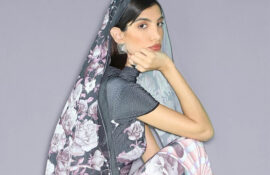

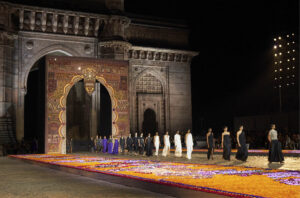
Earlier this year, Dior travelled to India to Mumbai’s extraordinary Gateway of India, a location that represents cross-cultural influences, heritage, and tradition, to present its Fall 23 collection, designed by Creative Director of Womenswear Maria Grazia Chiuri.
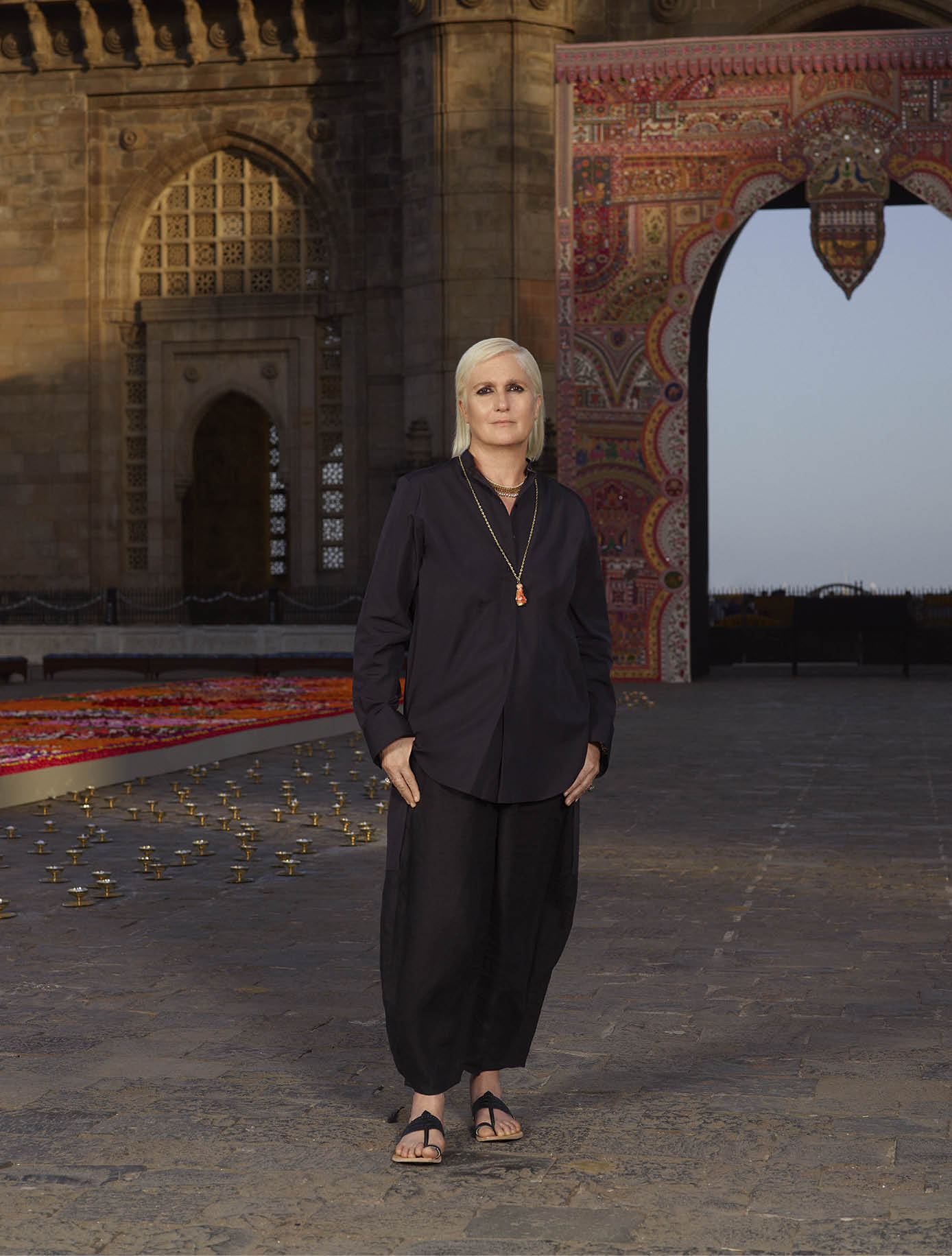
This collection was more than just an offering of garments, much like all of the Italian designer’s collections since joining the House of Dior in 2016. This was a celebration of crafts, and Chiuri wanted to shine a light on the incredible craftsmanship and traditions of India, a country that has been so dear to her throughout her career, as well as having an intertwined place in the Maison’s history.
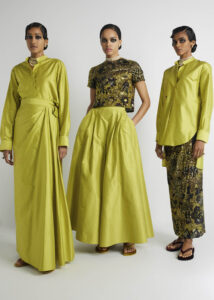
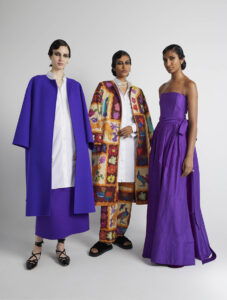
For this collection, Chiuri collaborated with the Chanakya School of Craft in Mumbai, a school that has for many years contributed to the House’s designs. This was the first time, however, that they would be put at the forefront, with the School’s Director, Karishma Swali, taking the lead. Working closely with Dior’s Creative Director this school explored traditional Indian crafts, reinterpreting them in the Dior way and highlighting the visionary spirit of the founding Couturier. The result was an extraordinarily colourful and detailed collection, which could not be fully appreciated at first glance. Intricate embroideries, prints and needlework were combined with innovation to create something truly magical.
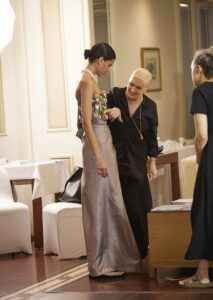
Championing talented artisans and exceptionally gifted women in the worlds of design arts and crafts has been a clear mission of Chiuri’s since she joined the House. Travelling to some of the far corners of the world, she has worked with and given the spotlight to some of the most diverse artisans and craftspeople. As this collection launches in stores around the region, we find out more about the story behind the show and the Creative Director’s mission to fulfil the vision of the House’s founding Couturier but make it relevant for today.
Let’s start by discussing the Fall 23 collection; tell us how it came together.
This collection is the result of a long creative process. One which began long before this actual project of showing in Mumbai. So, in a way, it was not the result of a few months, but it most surely reflects years of creative dialogue. The Chanakya School of Craft worked on the show installations, and over the last few years, it has been an opportunity for the students to collaborate with great female artists, such as Judy Chicago or, more recently, Mickalene Thomas. For this collection, we approached things a little differently: the students conceived a “toran,” a symbolic arch made of textiles and needlework which represents a sense of gathering, of welcoming. And this time, they were entirely the authors of their work, an opportunity to acknowledge their growth as artists as much as artisans.
The colours, the shapes and the embroideries in this collection are beautiful – what can you tell us about the attention to detail in the pieces?
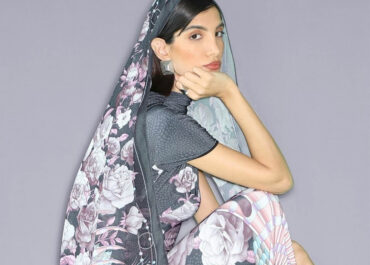
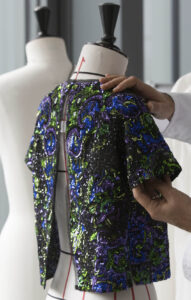
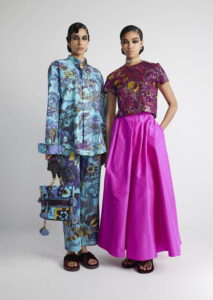
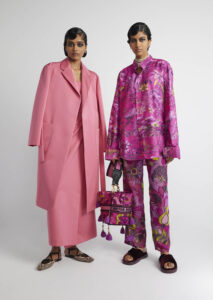
I wanted a great variety of techniques to be represented in the collection to suggest the wealth of textile cultures pertaining to India. We included different embroidery techniques, such as zardozi, appliqué and mirrorwork. But beyond the needlework, we also conceived a design of block-printing on silk and collaborated with artisans in the South of India to produce a series of woven silks such as those used for saris. It was a humble way of mapping part of the diversity of gestures and traditions forming the Indian culture.
In the history of the House of Dior, there is an iconic French fabric, the ‘toile de Jouy’, which was used notably to decorate the first Dior store in the 1940s. The history of this fabric is fascinating because it was actually a French answer to the popular Indian printed cotton back in the 18th century. Drawing from this important reference for the House of Dior, we revisited this print, and, instead of the flowers and forests of France, we placed the fauna and flora of India, with elements such as lotus flowers, peacocks, or tigers. I felt it was a meaningful way of reflecting on mutual influences and the way patterns and textiles travel between cultures.

Can you share a little on the partnership with Chanakya ateliers and their connection with the House?
The Chanakya School of Craft is a space for education and the transmission of artisanal needlework. The students are taught the techniques, but also to reflect on the value of craft: in this context, it felt very relevant to connect with the art world, and especially with female artists who have demonstrated, over the last decades, that through textiles and embroideries, you could create art pieces with the same symbolic and aesthetic value as a painting or a sculpture.
This was the starting point of our collaborations around the Dior couture shows, where I have commissioned women artists to create installations to which the Chanakya School of Craft students contribute. I am profoundly proud and touched that the many conversations I have had over the years with Karishma Swali have inspired her to create this incredible project. It’s both an honour and a great pride to be able to have accompanied the realisation of such a vision and to continue to do so across many projects together.
What impresses you about the skills and craftsmanship you can find in India?
I started by discovering the embroideries of India – indeed, in the 1990s. I was amazed by the wealth of techniques and materials that this tradition has kept alive. But it was not a heritage looking only towards the past. As soon as I started collaborating with Indian artisans, I understood that I had found partners who would allow me to constantly push the limits of craft and reinvent it for the future.
I think it’s difficult to define the fashion culture of India in general precisely because it is so rich and vast. Each region has its own specificities when it comes to dress and textiles, and this is what is so fascinating. I will never be done exploring the numerous techniques and stories that they carry.
The show for this collection was truly breathtaking – what was your initial vision, and how did it come together?
This show is the result of collaborative work, on so many levels. And it’s possibly what make it that much more powerful. I really felt I shared its success, first and foremost, with the many artisans that have helped me make it come alive. This was one of the most emotional experiences for me as a Creative Director because the show was not just about a creative performance or the display of visual art in all its shapes and medium. It was truly a collective gathering and one meant to express gratitude. I hope that this energy could be felt and that it was demonstrated to the audience as well as the beauty that comes from working together.
Since you joined Dior and over the last few seasons, it has felt as though your collections are more than just a creative idea; there is a meaning, a partnership, or a message in everything you do – why do you think it is important to convey this through your designs?
I have approached this as an opportunity to redefine the notion of femininity, which the House of Dior was built on, as something less normative and more empowering for all women. It has been crucial for me to look back at the legacy of the Couturier and to explore with my ‘female gaze’ his sometimes-misrepresented idea of womanhood. In other words, I have sought to connect Dior with women in a different way – past, present and future.
I truly believe in collaborative projects; this is an integral part of my creative process. Establishing dialogues with other creatives from different fields and practices is an extremely challenging and enriching adventure. I have cherished these moments and relationships for what they have taught me. I feel it’s only natural to acknowledge the fruitful collaborations that I have initiated as it’s so intrinsically connected to my work. These are values that guide me no matter how successful they may be. I am committed to these ideas and will stay consistent in my project to bring them to the forefront.
We have seen collections presented in so many beautiful corners of the world, but where do you go when you truly want to be inspired and how do you get into your most creative state of mind?
India has been an important country for me throughout my career as a designer. It’s a place where I have met wonderful collaborators who have introduced me to the unique Indian culture of craft. It’s a place where I have really come to understand my own creative process and the central role that craft plays in it.
How do you balance using traditional crafts at Dior with new technology and innovation?
I think it’s very important to balance heritage and innovation. In any case, when you work for a brand like Dior with a long, rich history, you have to maintain the heritage and value of the brand, but at the same time, to move into the future. For instance, the RTW 22-23 collection was called The Next Era – title of Mariella Bettineschi’s artwork at the heart of the show’s scenography – because this collection was a new design challenge geared towards inventing a series of garments that combine fashion with textile innovation. This ambition is the essence of the collaboration between Dior and the Italian start-up D-Air lab*, which has given rise to a new era of clothing – performance is increased tenfold thanks to new technologies. Technical elements are integrated into outfits that symbolise a dialogue with fashion, embodying the synthesis of these two languages. It represents a post-humanity conceptually unfolding through the forms that have defined the legendary destiny of the House of Dior.
*D-Air lab is an Italian start-up founded in 2015 by Lino Dainese. Architect Silvia Dainese Gris has led this special project for Dior.
Looking to the future – what is your vision for the House of Dior?
The Dior fashion house has succeeded in staying relevant over a long period, peppered with revolution and social and cultural transformations that have sometimes been drastic by reinventing itself and constantly building its identity around femininity and its complexities. This is mainly because the codes have remained at the core of the Dior project, constantly brought up to date and reinterpreted in light of the times and fashion trends. It is important to respect the past because you can only imagine the future if you know what came before it.
What is a key piece every woman should own this summer?
I see many girls with vintage bags, but they have added a new strap, and I think it’s cool. It’s about freedom and personal style, so I really like this idea. This is not to make someone else happy. This is to make yourself happy. Women today are full of freedom; they wear whatever they want and be whoever they want to be.
What is the current motto that you’re living by?
While you should feel confident of your accomplishments of the knowledge you have acquired through training, remember that you never stop learning.