
Founded in Meda in 1948 and still led by the family that created it, Italian furniture house Minotti has evolved across three generations while maintaining a recognisable design language.

Susanna Minotti, who joined the company in 2013 and now heads its Interior Decoration Department, plays a key role in translating that identity across interiors, retail and exhibition spaces around the world. For her, design is as much about how a space is experienced as how it looks. Here, she discusses growing up inside the family business, designing for different cultures, the Middle East’s relationship with space and privacy, and why the idea of ‘timeless’ design deserves a little more scrutiny.
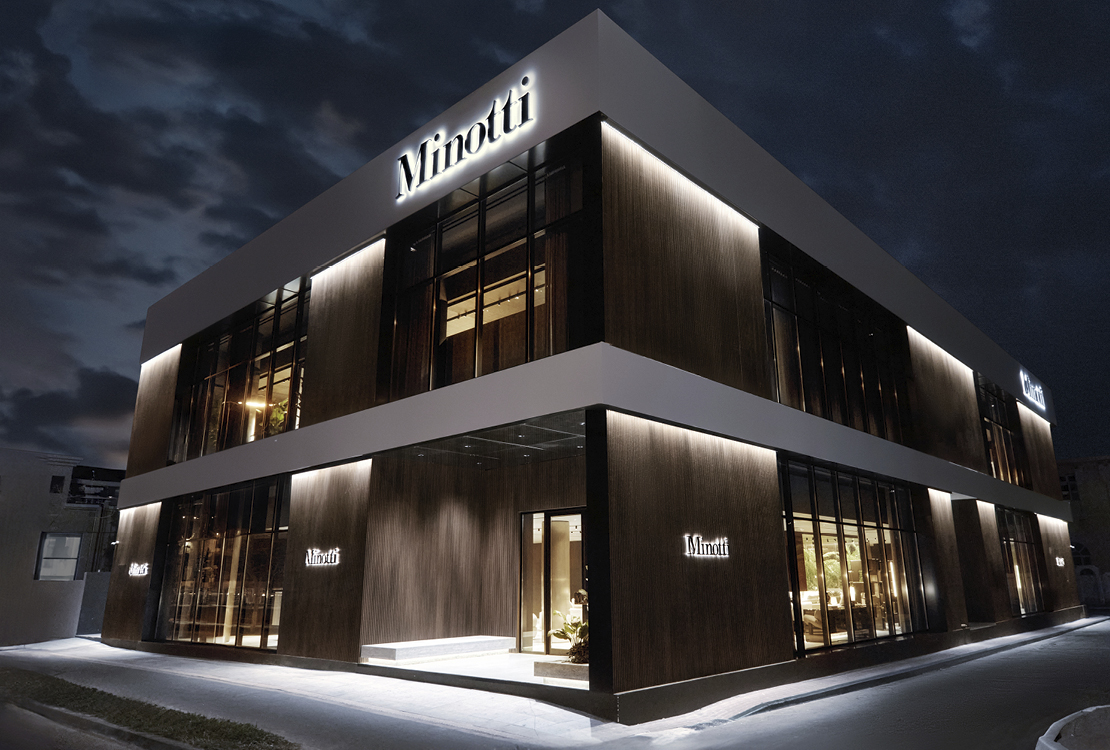
Starring: Minotti Dubai flagship store. Photo courtesy of Minotti
As a third-generation member of the Minotti family, how has growing up around the business shaped your understanding of design and your own creative point of view?
I don’t remember a moment when design entered my life. It was simply part of my family’s language. We talked about objects, spaces, proportions, and aesthetics, so of course this educated my eye, though I think a certain sensitivity and passion for beauty were also instinctive.
At the same time, I grew up seeing the less visible side of design: making things, taking risks, solving problems, and constantly trying to improve. What I inherited is perhaps this combination of sensitivity and pragmatism, together with a strong sense of reliability. Vision matters, but so does the ability to stand behind what you create.
Minotti has been family-led since 1948. What have three generations taught you about creating interiors and furniture that feel relevant without becoming defined by a particular moment or trend?
Today, the second and third generations work side by side, with the second generation still leading the company: my father Roberto and my uncle Renato (both co-CEOs). My grandfather had the courage to start and build the company. The second generation took Minotti into a new phase, internationalising it and developing a clear design vision. The decision to work with architects and designers has always been strategic: choosing different creative voices for what they can bring to Minotti’s evolution, while maintaining a strong overall direction. This has been fundamental in developing the design culture, craftsmanship and aesthetic language for which the company is recognised today. When I joined, other members of my generation were already part of the company, and I was fortunate to learn from people with different backgrounds, skills and attitudes from my own.
Each generation has added something without starting again from zero. Our responsibility is to continue that evolution, reading and sometimes anticipating how society and ways of living are changing, while continuing to evolve the craftsmanship, sophistication and Minotti lifestyle built over time.
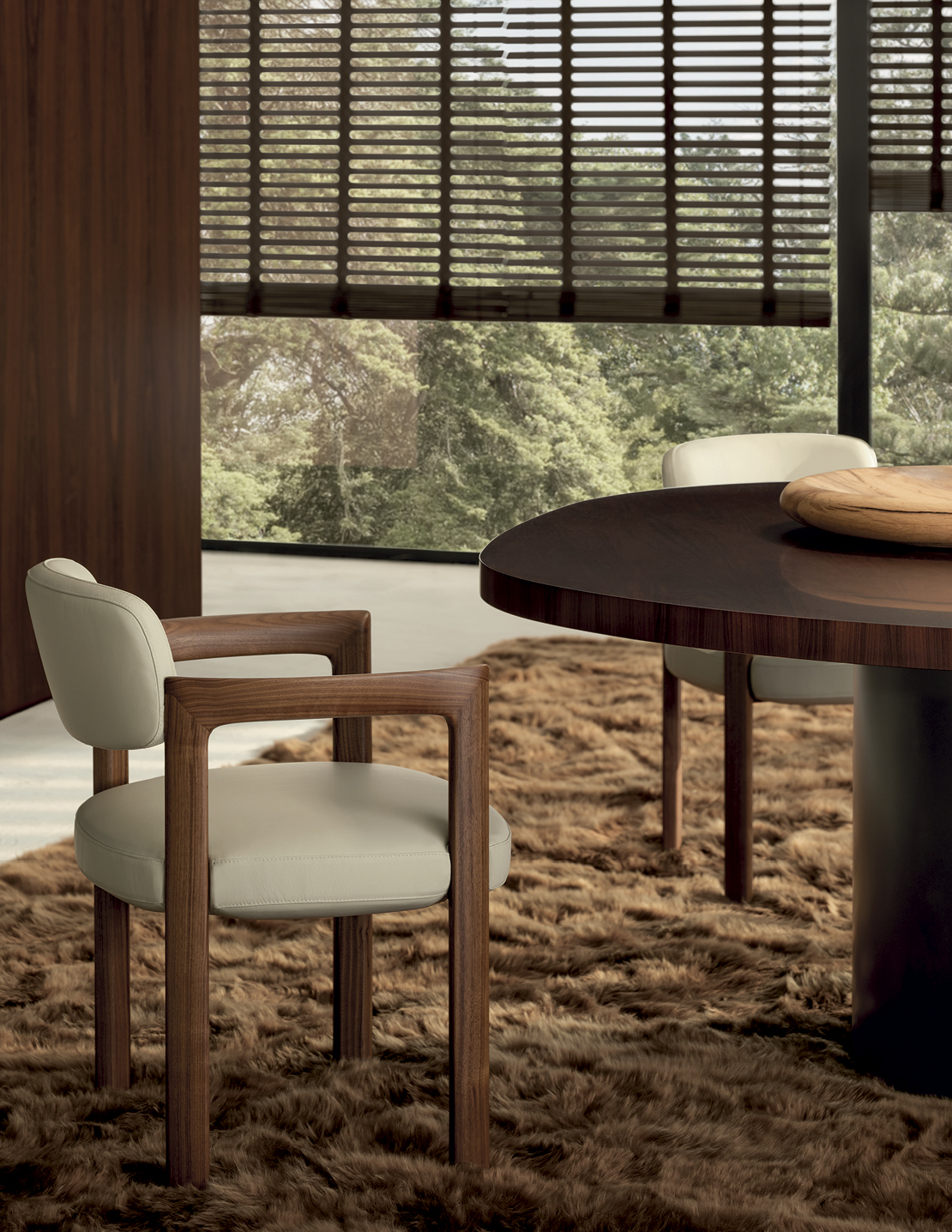
Starring: Giulietta dining chair by Inoda+Sveje for Minotti. Photo courtesy of Minotti
How has your role evolved, and what do you feel you have personally brought to Minotti’s visual identity?
Since joining Minotti in 2013, I have had the opportunity to grow within a strong design culture built over decades, gradually developing my own contribution through different projects and responsibilities. Today, I am particularly involved in how that identity translates into spaces and is experienced internationally, across interiors, decoration, retail, and exhibition design.
When I approach a project, I often imagine it almost as a film. It has a sequence of scenes, a rhythm, and a point of view. I think about what you encounter first, where your eye is drawn, what you discover later and what remains in your memory.
This has an aesthetic and architectural dimension, but also an experiential and strategic one. For me, sensitivity and strategy are two parts of the same project.
Art, objects, lighting and materials all play an important role in Minotti spaces. What elements can transform a well-designed room into one that feels truly complete?
I am less interested in completeness than in resonance, in the moment when architecture, furniture, art, light and objects begin to affect one another.
Sometimes an unexpected object, a work of art, or even a certain emptiness gives meaning to everything around it. A room becomes interesting when you stop seeing the individual choices and start feeling their relationships.
Art has become an increasingly important part of this dialogue. Through collaborations with artists and galleries, it can become more than a layer within an interior. It introduces another cultural voice into the space and creates a dialogue between different forms of creativity.
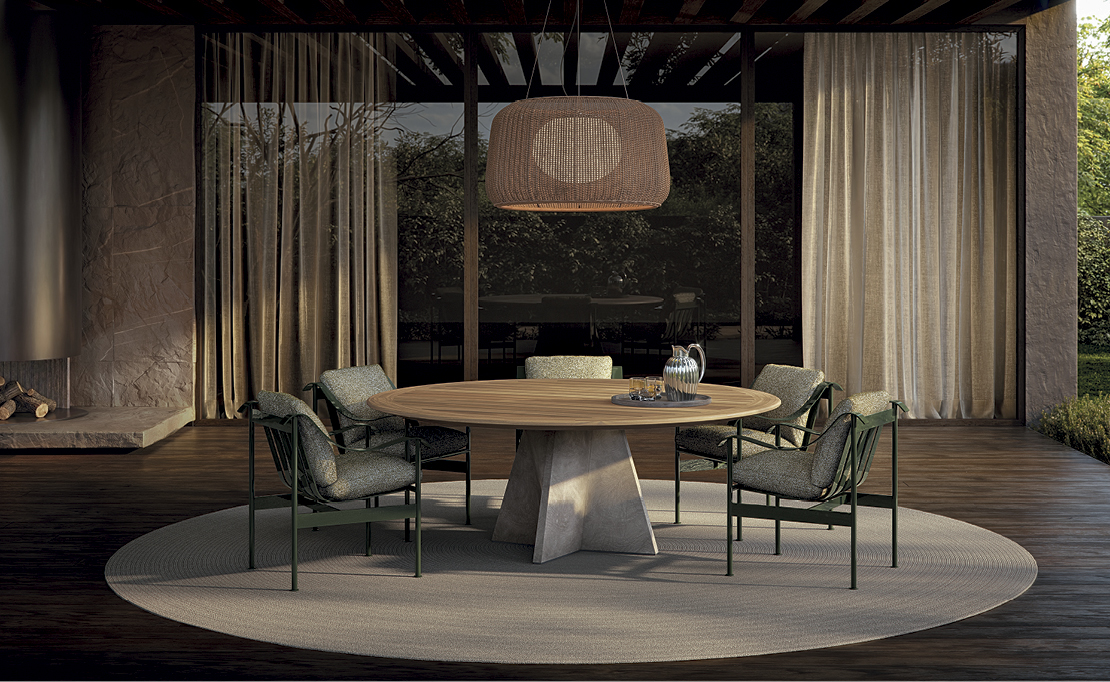
Starring: Brutalist Outdoor table by Giampiero Tagliaferri and Sandy dining chairs for Minotti. Photo courtesy of Minotti
How do you balance consistency across Minotti’s international stores with the need for each location to respond to its architecture, culture and surroundings?
I strongly believe that our showrooms should not all look the same. For instance, Tokyo, São Paulo, Dubai, Florence or Los Angeles each offer a completely different reality to respond to, from architecture and light to history, culture and ways of living.
Recognition should not depend on repetition. What connects these spaces is a design culture and a language that Minotti has built and refined over decades, rather than a fixed aesthetic formula.
I like the idea that each project can absorb something from its context and still remain unmistakably Minotti. Every place asks a different question of the same identity.
The Middle East has become an increasingly important market for Minotti. What are you seeing from clients in the region today?
I have always been fascinated by the culture of space in the Middle East, particularly the relationship between hospitality and privacy, openness and protection, collective and more intimate life.
In many ways, these principles are not as distant from our own cultural origins as we sometimes imagine. Looking further back, even to the Roman domus and the Mediterranean house, we find recurring ideas of centrality, thresholds, courtyards, filtered views and different degrees of privacy.
I find these deeper connections between cultures much more interesting than stylistic similarities. They allow us to learn from one another without reducing a place to an aesthetic reference.
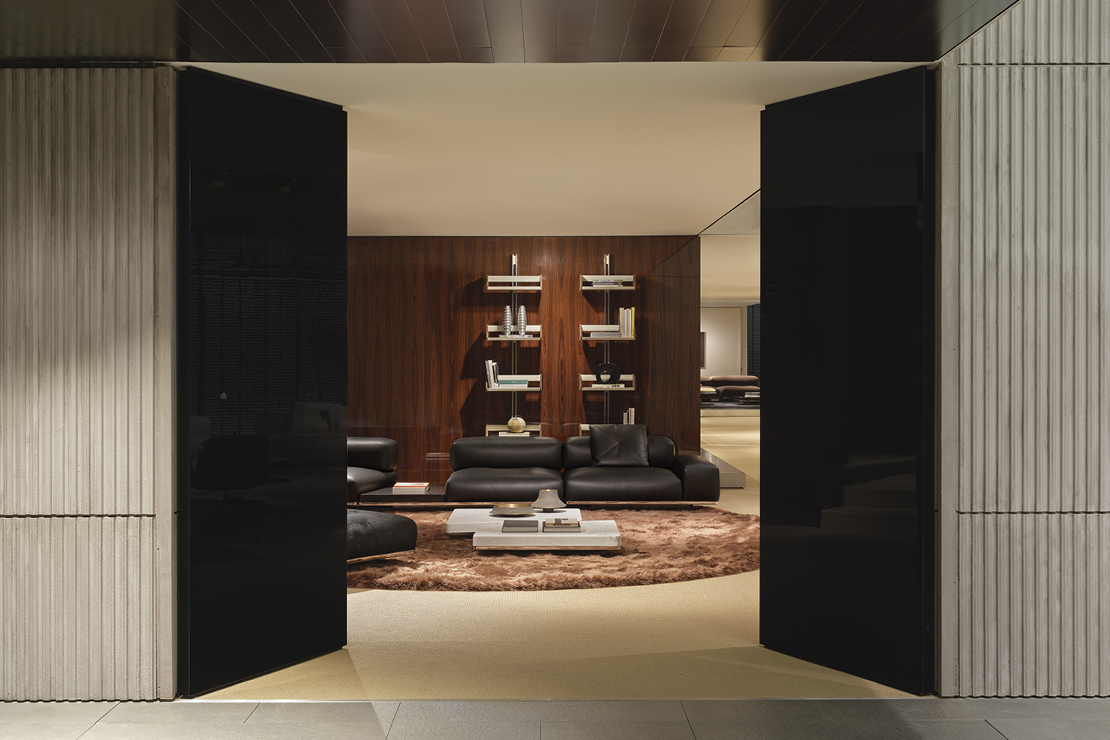
Starring: Orion modular sofa and Doheny bookcase, both by Giampiero Tagliaferri for
Minotti. Photo courtesy of Minotti
Are there particular qualities in Minotti’s approach to design that resonate especially strongly with Middle Eastern homes and lifestyles?
Perhaps this is why designing in the region feels very natural to me. Some of the principles I encounter there, such as conviviality, different levels of privacy, thresholds, filtered views and the gradual discovery of a space, have long been part of my own design language as well.
The question is never how to make Minotti look “local”. It’s more interesting to search for a common language that both sides can understand without falling into cliché.
I have learned this through designing internationally. The most meaningful dialogue between cultures begins with principles, not symbols.
How have changing lifestyles influenced the way you think about contemporary interiors?
I think contemporary homes increasingly reflect the complexity of our lives. Different moments, places, memories and ways of living accumulate over time. Objects travel with us, sometimes changing function or meaning, and different cultural references begin to coexist.
I find this idea of layering very interesting. A home should evolve with the person who inhabits it rather than remain a perfectly fixed composition.
The challenge for design is to give space to that complexity without making the result feel complicated. When complexity finds harmony, it becomes richness.
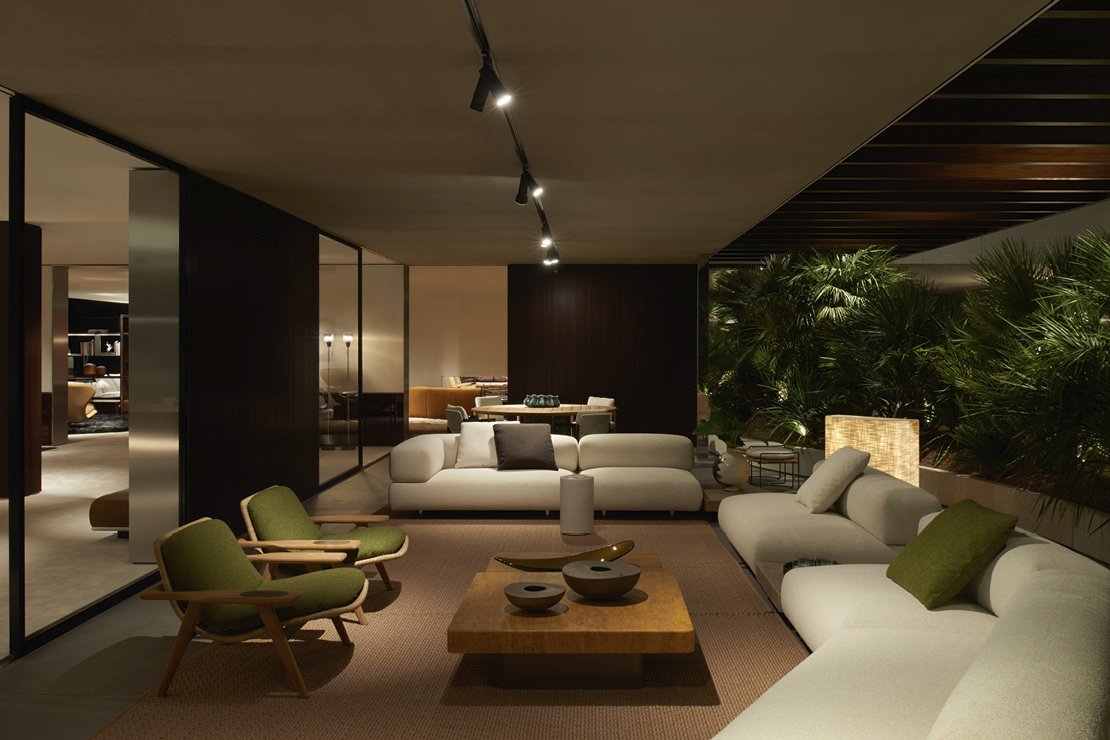
Starring: Orion Outdoor modular sofa by Giampiero Tagliaferri and Elas Cord Outdoor armchairs by Marcio Kogan / Studio MK27 for Minotti. Photo courtesy of Minotti
In a culture increasingly driven by fast-moving trends, what does “timeless” design mean to you today?
I am slightly suspicious of the word “timeless”. Everything meaningful belongs to its time.
A chair, a building or a work of art carries something of the technologies, desires and ways of living of the moment that produced it. The interesting question is why some continue to speak to us decades later.
I don’t think it is because they avoided their time, but because they expressed it with unusual clarity. Perhaps timelessness is not the absence of time, but the ability to remain meaningful through it.
Minotti speaks about design as a lifestyle rather than simply individual pieces of furniture. What does the idea of the “Minotti lifestyle” mean to you personally?
What we call the Minotti lifestyle today did not appear all at once. It has been built over decades, through different generations, and through the contributions of designers, architects, people within the company, and an extraordinary network of specialised skills.
I like this expression: “It takes a forest.” Nobody creates from zero. What we can do today rests on knowledge accumulated by generations before us, by people inside and outside the company, and by an entire territory that has developed exceptional expertise in furniture.
Individual talents matter, but the ecosystem allows them to grow. This is why Brianza matters so much to us. To me, Made in Italy is not a signature placed on an object. It is the intelligence embedded within it.
You have spoken about curiosity as the starting point for creativity. What are you most curious about in design right now, and where do you see that curiosity taking Minotti next?
I am increasingly interested in the scale at which we think about design. Ernesto Nathan Rogers famously expressed the idea of design moving “from the spoon to the city”, a culture of design capable of operating across radically different scales.
I find this very relevant to what we do. A piece of furniture is part of a much larger system: how it enters a room, how that room creates an experience, how our showrooms express a way of living, how that language travels through different markets and, ultimately, how a company builds a culture around what it creates.
I am curious about these relationships between scales, disciplines and cultures. The object is never really isolated. It is part of a much larger world of relationships.
What is in the pipeline for Minotti in the Middle East for the rest of 2026 and into 2027?
The Middle East has been an important part of Minotti’s international story for many years, and Dubai is a particularly meaningful example. Our long-standing partnership with Al Tayer Insignia brings together two family businesses with a shared belief in long-term relationships, quality and the importance of building for the future. I think this common perspective has been an important part of the strength of our relationship over the years.
Today we remain very active across the Middle East together with our partners. What interests us is how the Minotti lifestyle can continue to evolve in the region, through our collections, the experience we create around them and in response to a part of the world that is itself evolving very quickly. It is an extraordinarily international environment, where different cultures, expectations and ways of living coexist, and I think this makes the dialogue particularly stimulating.
Our spaces are part of this evolution too. They should remain clearly Minotti while being open and responsive to the context in which they exist.
Looking further ahead, I hope Minotti will be remembered not only for the pieces it created, but for having contributed to the evolution of how we live, creating a design language and an aesthetic that can be recognised as part of our time.