

Boucheron CEO Hélène Poulit-Duquesne Discusses the Future of the High Jewellery House
As Boucheron celebrates its 160th anniversary, we talk to chairwoman and CEO Hélène Poulit-Duquesne on the future of the high jewellery house and why she has embraced the free spirit of the Maison.

This January, Boucheron unveiled a complete re-design of its historic boutique at 26 Place Vendôme in Paris. The project was managed by Hélène Poulit-Duquesne, Chairwoman and CEO of Boucheron.
Built in 1717, this historic building – The Hôtel de Nocé – became much more than just a store to the Boucheron brand that celebrated its 160th-anniversary last year. The aim was to revive the original spirit of the iconic building through a renovation respecting its history and heritage.
Michel Goutal, Chief Architect of Historic Monuments, was commissioned to reconquer this unique place, to strip back 300 years of history and restore its former glory. To accomplish this, he surrounded himself with the finest French craftsmen, proud representatives of specialist métiers across art and architecture.
The décor of 26 Place Vendôme was entrusted to Pierre-Yves Rochon, the internationally renowned French interior designer. Inspired by the spirit of freedom, he set out to challenge the codes of traditional jewellery stores in order to give this historic address the character of a modern family home.
The décor of each room is a carefully curated blend of contemporary design, works of art and vintage finds, as if each generation had left its own imprint on the house.

The 26 Place Vendôme, Paris
No one feels more at home at the store than Hélène Poulit-Duquesne. She joined Boucheron as CEO in 2015 and set out to pursue the growth of Boucheron international and preserve its long-lasting legacy, strengthening its position in the high jewellery market, as well as finding a fitting way to celebrate the landmark anniversary last year.
Poulit-Duquesne has a background in international development as well as extensive knowledge of the watchmaking and jewellery industries.
Here we talk to Hélène about the latest collections, the renovation of the store and preserving the legacy of this iconic brand.
What is your vision and direction for Boucheron?
I think you will see in what we have been doing that it is not classic in the sense that we don’t have a pure retail vision. We have been doing things differently and I think this is something that’s very strong at Boucheron. All of this comes from our DNA and how the clients are buying. It took time for me to put a word on what this was but I think it’s free spirit, in the way that creativity or strategies are coming from inside. Meaning that we have never followed trends, we’re just doing what we feel are the right things to do and we stick to it.
Frédéric Boucheron used to say “I do not impose, I propose”. He never followed the trends and was always very innovative, pushing the boundaries of jewellery and it’s still the same in the way we are envisioning the brand today.
For me, it’s totally different from other brands because there is always a twist. We’re not doing it differently because we want to be different, but because we think that it has to be like this.
I also notice this in the way that our clients behave. We have a lot of creativity, so they have a wide band of designs to choose from. It’s typical of our creativity to have a large offering but we do not impose what you have to wear. I think jewellery helps to reveal part of your personality so it is very personal and needs to be a personal choice.

Interior view, The 26 Place Vendôme, Paris
How hard was it for Boucheron to embrace the new generation and extend the offering while keeping the existing clientele?
I think we have such an offering that it’s not that difficult. I think we are very creative compared to other brands in the high jewellery segment, so we can fit the needs of many different types of clients. Today we see them coming from many different nationalities and ages and each one finds something moving for her.
So I think in high jewellery it’s not that difficult for us. We don’t have a specific strategy towards the younger generation because in our portfolio a lot of our jewellery is sold to millionaires. And it’s linked to the fact that the young generation comes to understand jewellery when they get married. So basically when you’re a jeweller you have a large amount of your turnover with people between 20 and 30 when they get married. Then they come to understand the brand and you follow them.
Claire Choisne loves to work with diamonds and she loves to design rings. But for this brief, I said to her ‘Claire I will not allow you to design a ring or use any diamonds.’ I wanted jewellery in full gold and it’s very difficult to do. When you design something you put diamonds everywhere and it’s always beautiful because of the diamonds, but if you tackle that, the success is much more difficult.
So she went back to the office and she came back with the Jack de Boucheron collection, which was a total surprise because it’s so playful and totally new. I think because it’s new in the market that it is going to appeal to the younger generation. Surprisingly the brief was not specifically that she had to design jewellery for young people. And this relates to what I was saying before – we don’t do things because we want to follow trends, we do things because we believe we have to do that, and then it happens.
What are the challenges you face today as a high jeweller?
In the high jewellery segment, it is becoming more and more difficult to find stones. I am passionate about stones so I love finding them. I think another difficulty we have is to be at the right level of value for money.
For me, this is really important because when you buy high jewellery you have two goals – one is to bring emotion, but it’s also an investment. The piece you buy is something that you will give to your daughter and she will give to her daughter etc. So we have to consider both creativity and value for money for client.
What is an objective that you haven’t yet achieved at Boucheron that you would like to achieve?
International development is not done yet, it takes years. When I joined the company the first objective I had was this, and for some areas it was quite easy but we are still weak in other areas of the world. So I said the first focus is Asia, and I think we have room to grow there.
For the time being I think we have the right image in the Middle East, and that has been because of historical reasons. It’s probably one of the only regions in the world where I feel clients today understand who we really are. And they very much understand jewellery and we have the right positioning. So a challenge is to upgrade the image so Japanese people for example, understand the brand.
In three words what do you think sets Boucheron apart from the rest of the jewellery Maisons?
1. Free spirit. 2. Innovation. 3. Generosity.
What is a professional challenge that you’ve had at Boucheron and you managed to overcome?
I think the first challenge is to be sure that everyone in the company understands your vision and where you’re going and that they want to follow.
What is in the pipeline for Boucheron this year?
You will have a very nice story in high jewellery. I think we’ve been doing plenty of things in 2018 as part of the celebration of our 160 year anniversary and what I’m going to tell my team in a few days is that now we have to go back to normal. Because we did so much in one year with the anniversary, now that we have all the seeds, it’s time to get the fruits.

Where do you stand on the debate of e-commerce vs retail?
What I believe is that the more you explore e-commerce the stronger you must be in retail. Before, there was a physical space, and you had to just sell products in this space, but today as you can have pretty much everything on digital.
When people come to the boutique their expectations are triple of what they were ten years ago. And that’s why I think they need to live experiences and emotions and that’s why I created this so people have a place where they can dream.
What inspires you professionally?
The traditions of Boucheron. Boucheron has existed for 160 years and I feel that it will still exist in 160 years but I will not be here! I’m very conscious of that, so I’m working hard to maintain and pass on the legacy and make it grow for the best. It’s something that’s linked to my personality and I have a sense of responsibility.
That’s why I took the Vendôme project directly because this building belongs to my family and it’s a legacy of four generations of Boucheron and because of that I wanted to be totally dedicated to the project.
And personally?
The first source of inspiration for me is nature. I don’t know if it empowers me or if I take all my energy from it, but there is something linking me to nature that is very strong. There is something about that energy that I want to focus on and keep.
What makes you happy?
I’m happy pretty much every day and in pretty much everything I do. It’s very surprising but I am a very positive person and I have the chance to work in something that I’m very passionate about and have been doing so since I was 14 years old. I would have been an artist but I couldn’t because my family wanted me to go to school etc. But then I decided to work in a business where I could combine my passion and business. That’s why I never feel any pain in working and I’m working pretty much every day. I’m happy when I go to work.
Recently my son had to decide what he wants to do in school and he was totally lost so I told him this and he said ‘mummy you’re not an example because you’re not working you’re having fun!’ And it is so true! I told him to find something that he loves and he will never fail.
What is a challenge you faced as a person and how did you overcome it?
I think the most difficult part personally was to be a mother and to have a job. Because sometimes you feel guilty and I hate guilt. I will never know if I did the right thing – my kids will tell me in 20 years I’m sure.
But one thing I know is that if I’m not happy they can’t be happy. And if I’m not passionate about what I’m doing I will not be happy. So I think my work probably helps me to be a better mother. One of my principles is when you are with your kids, be totally there – it’s about quality not quantity.
What piece of advice would you give your younger self?
Don’t take so much time in trusting your instincts.
What is a motto that you live by?
Never give up.
What is a book you read recently that inspired you?
A very funny book about how you have to learn from cats in the way you’re living. I love cats – I have three. This book tells you to learn about a cat’s behaviour and I read this at night when I go to bed and laugh because it’s so true.

What is your morning routine?
Coffee! I cannot wake up until I have coffee.
How would you like the world to remember you?
Every one of my friends will say that I am very loyal and trustworthy.
You mentioned that you would have loved to have been an artist – what is it that fascinates you in that world?
I used to draw a lot. I used to write books as well. I began writing when I was twelve. When I was 14 I spent hours drawing and sketching fashion designs.
What do you promise yourself in 2019?
Go back to serenity.
In one word how would you describe Boucheron?
Free-spirit.
Chanel’s In House Perfume Creator, Olivier Polge, Chats to A&E About Keeping Alive Gabrielle Chanel’s Legacy Through His Scents
A&E talks exclusively to Olivier Polge, Chanel’s In House Perfume Creator, on how the legacy of Gabrielle Chanel resonates in his latest fragrance, 1957.
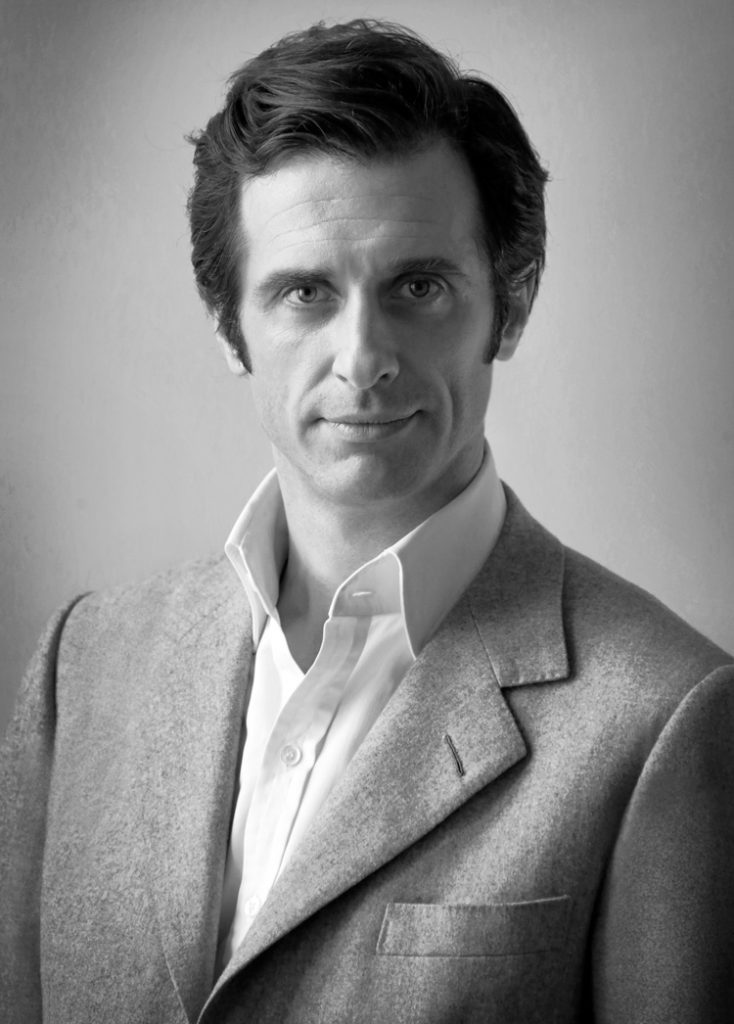
As Chanel’s In House Perfumer Creator, Olivier Polge is tasked with preserving and developing the legacy of the iconic brand as a perfume house. A house that is centered around creating beauty and using timeless formulas to celebrate the legacy of its heritage and its founder Gabrielle Chanel.
For Polge this comes easily. He was just four years old when his father Jacques took over the role he now holds today, so fragrance has been in his life since he was a young boy growing up in the South of France.
But Polge had not originally planned to follow in his father’s footsteps. While studying art history he dreamt of creating with his hands. He was passionate about classical music and played the piano every day.
Polge decided to enrol on a course in creative arts, but during the summer before, he took on a placement at the Chanel Laboratory. Here he began assisting the teams behind Chanel’s iconic fragrances, weighing ingredients and studying the molecules that composed the formulas. He became fascinated by the ingredients and began to wonder if this was what he really wanted to do.
Soon after, Polge began training at Charabot in Grasse. He spent two years at the factory learning the basics of fragrance composition before he moved to New York with the International Flavors & Fragrances. He started to create his first fragrances and experienced great success.
Soon, Olivier decided it was time to go back to Paris where he was approached by Chanel who wanted to bring him back to the laboratories where it all began. Of course, he knew the house inside out and had the passion to try new formulas and compositions that hadn’t been done before. It was from here the journey began.
Olivier Polge is the nose behind some of Chanel’s most recent iconic fragrances, including Gabrielle Chanel which launched in 2017, Boy Chanel, Les Exclusifs De Chanel, No.5 L’Eau, and Misia – Les Exclusifs De Chanel Chance Eau Vive.
As we meet in Paris at the beginning of this year, Polge is preparing for the launch of his latest creation; 1957, a scent that represents the relationship between Gabrielle Chanel and America. It was a relationship that began with fashion in 1912 when a young Gabrielle Chanel’s hats were first distributed in New York department stores.
The relationship soon began to incorporate fragrance when Chanel No.5 launched in 1921, followed by the first make-up collection. “Americans buy all things luxurious, and the greatest luxury is fragrance,” said Gabrielle Chanel.
But why 1957? This was the year Gabrielle Chanel was hailed as the most influential designer of the 20th century. This was the year when America embraced her new designs when Paris did not. One magazine said: “At 71, Gabrielle Chanel is creating more than fashion: a revolution”.
The scent 1957 is the third of the Les Exclusifs De Chanel creations. It is designed to illustrate the mystery of simple Chanel style with a balance between creamy softness, enveloping comfort and light perfused with discreet power. “For each fragrance in Les Exclusifs collection we explore a path that has never been taken” explains Polge. This fragrance is composed from white musk and is, therefore, more unique than other scents to each individual’s skin.
This is perhaps why, when we meet Olivier Polge, he is so keen for me to try the fragrance on my skin before we begin to talk. “I like to show people the fragrance directly on the skin because it’s it differs from one skin to another and on top of that it is mostly made of musk and I think there is a very important interaction between this ingredient and the skin,” he says. So with 1957 filling the air of the room, we begin our interview to find out the true meaning and thought behind this new fragrance.

How were you able to interpret the story in a fragrance?
For me it had to be understood in a broad way. It started off with the interaction between Gabrielle Chanel and America. I think what caught my attention was an interesting link in America between cleanness and sensuality. There is a special taste for clean scents which for them is a sign of sensuality. This is a special point of view that really interests me. Today musks are very important in fragrance. They are often just one facet among others, and this was something that we didn’t have in our portfolio of exclusive fragrances already.
How do you set this fragrance apart from others?
The key notes are exclusively musks, which is different from all of our exclusive fragrances.
What is one ingredient that you love to work with?
There are many! I always say that I like iris. It is a beautiful ingredient. In perfume we use the root of iris which doesn’t smell when you bring it out of the soil, it has to dry for three years and it develops a very interesting scent which is floral, slightly woody and somehow powdery as well – it’s beautiful.
What do you think as a perfumer is your biggest challenge today?
I think there are many different challenges. The most important is to create beautiful scents. We are in the world of always thinking about something beautiful and different, as well as thinking about the environment.

What is your favourite scent?
One of my favourite scents is Chanel N˚19 – which is made from iris mostly.
What in your opinion, is the formula to creating a fragrance that has universal appeal?
I don’t know if there is such a thing as a universal scent. I like to think that there are different types of tastes. You can find Chanel everywhere in the world, but we always see that there are certain scents that have a better audiences in different regions.
How do you think the legacy of Gabrielle Chanel is translated through the fragrances today?
The legacy is huge. She is the person who brought together this world of perfume and fashion more than anyone else. Before her it was two very separate worlds and today we cannot differentiate them. I think that she is the one that understood that both worlds could participate from the same principal. The way you dress, the way you arrange yourself – fragrance is part of it and that’s because of her.
What does Chanel mean to you?
I think that there is no better perfumer than Chanel. I think it’s the best place to be in the world of perfume because we own our material completely.
What inspires you when you are developing a scent and the story that goes with it?
Perfume speaks directly to emotions and it creates emotion. What I like is that with a fragrance everyone can tell herself or himself a story. My sources of inspiration are of course the legacy of Chanel. Sometimes there are stories that evoke certain scents. Working for Chanel I think I will always have to think about flowers.
What makes a fragrance timeless?
A timeless fragrance has to be a fragrance that you never completely understand and in which you always find something new.
Is there an ingredient that you haven’t worked with yet or would love to explore more?
There are certain ingredients from which we have never been able to extract. Like Lily of the Valley, Gardenia, Freesia, and I think it’s a pity because they have incredible scents.
In one word how would you describe the fragrance 1957?
One word is not much! I would say enveloping. Or maybe soft – there is something soft about it that I like. I think this is a very intimate type of scent due to the musk, but also the other notes. There are contrasting spices that are dry and counter balance the more enveloping and soft part of the musk. Going with it are the woody notes.
What is a scent that you still aim to develop?
I like to work with leathery scents, they are interesting to build.
Tell me about your childhood with fragrance.
It was somehow always part of my home as my father was a perfumer. I think there were scents that I remember like the scent of my holiday when I went to South of France where my family was from. Those dry nature scents, I like very much.
What do you think of layering fragrances?
It’s such a debate. It’s a huge tradition but I don’t think I can advise as you never know how a scent will be worn. There are certain fragrances that are easier to layer than others, but there are some that are not meant to be layered at all as they are so complex on their own.
Where do you go when you want to clear your mind and get inspired?
I like cities. I like cultural things like art galleries, museums and concerts.
What are the most important things or the prerequisites when telling the story of this fragrance?
In this case I didn’t have many prerequisites. Chanel was renovating its main store in New York on 57th Street. This was a very important store to us and we had a fashion show there and I was asked to develop a fragrance.
How did the city of New York inspire you?
I was more inspired by this taste for clean scents of the Americans rather than the city itself.
What do you say ‘no’ to?
I say no to short term things and things that will not fit Chanel. I would say no to repeating myself all the time, I think that we should always do something new.
What do you think is your greatest achievement so far?
For me, the most important thing is to be able to continue my job and be passionate about it.
What was the last book you read?
I like music very much and I’m reading the biography of a French pianist.
What piece of advice would you give your younger self?
Take your time. I started working very early and I think that you shouldn’t rush too much.
How does travel inspire you?
Very much so. You have to enrich yourself and see other beauties to help you realise the chance you have to be you are.
Do you have a motto that you live by?
Be happy!
Describe Chanel in one word.
Creativity.
How would you like the world to remember you?
With a good scent!
By Lara Mansour Sawaya
Brad Pitt On Honesty, Vulnerability And Success
a&e talks to Brad Pitt about honesty, vulnerability and what it takes to achieve success.
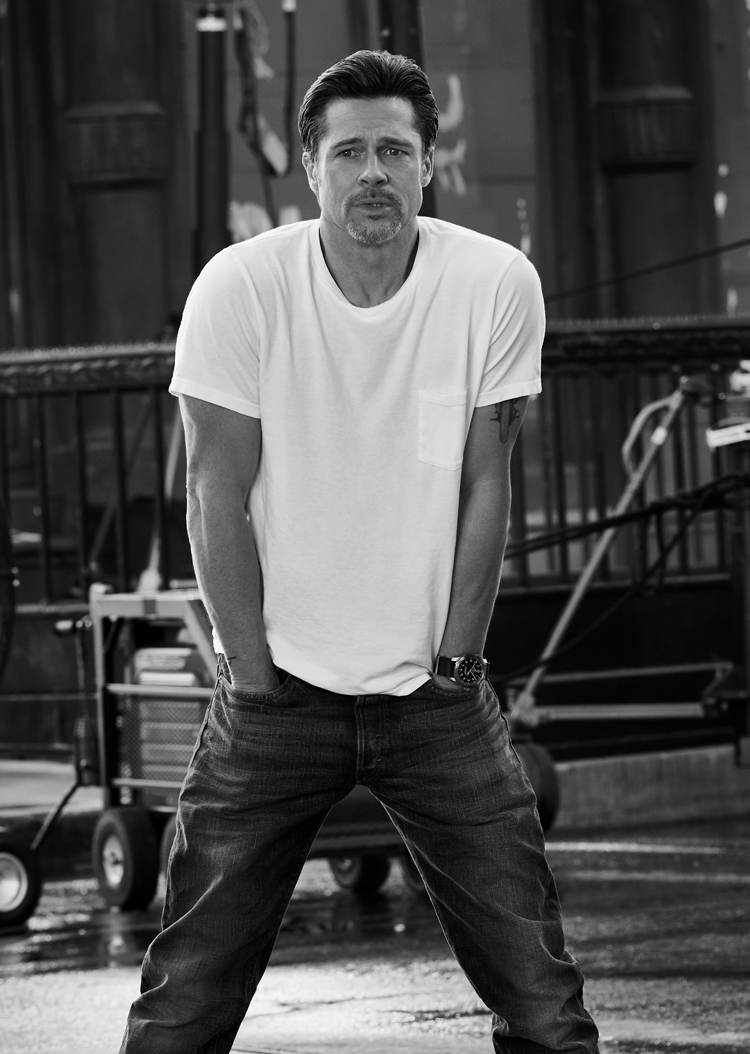
Brad Pitt needs no introduction, but we will give him one anyway. He is one of the most recognised men on the planet and is a hugely successful actor, film producer father of six and humanitarian. Pitt is Hollywood’s heartthrob and one of the most famous actors in the world.
Known for being the leading man, Pitt has received countless awards throughout his thirty-year acting career as well as Academy Awards for Best Picture as a producer for “Moonlight”, “The Departed” and “12 Years a Slave” which were produced under his own company Plan B Entertainment. Plan B has made films including “World War Z”, “The Big Short”, “Eat, Pray, Love” and dozens more. The company is owned by Pitt and his friends Dede Gardner who is President, and co-president Jeremy Kleiner.

His first noticeable recognition as an actor was in 1991 when he starred as a cowboy hitchhiker in the movie “Thelma and Louise” and he then went on to become one of Hollywood’s most sought after actors. Pitt’s countless movie credentials include “Fight Club”, the “Ocean’s” series, “Troy”, “Mr & Mrs Smith”, “The Curious Case of Benjamin Button”, the list goes on…
His most recent project is the filming of “Once Upon a Time in Hollywood”, a movie in which he will star alongside Leonardo DiCaprio and Margot Robbie. Directed by Quentin Tarantino, the film is set in 1969 in Los Angeles, around the Charles Manson murders and will debut in cinemas in 2019.
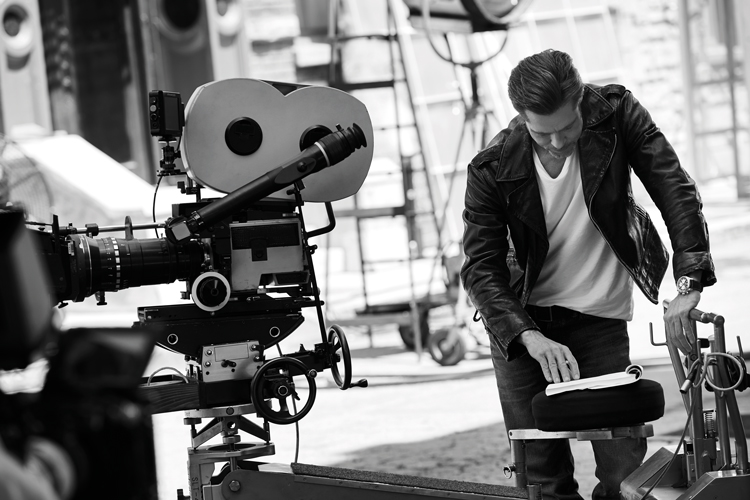
Brad Pitt on the set of the Breitling Cinema Squad campaign shoot
Pitt has been described as one of the most generous stars and he has donated millions to charitable causes. He supports the ONE Campaign, an organisation aimed at combating AIDS and poverty in the developing world and he is one of the founders of Not on Our Watch an organisation that focuses global attention on stopping “mass atrocities”.
In 2006, he founded the Make It Right Foundation, organising housing professionals in New Orleans to finance and construct 150 sustainable, affordable new houses in New Orleans’s Ninth Ward following the devastation caused by Hurricane Katrina. He also founded the Jolie-Pitt Foundation, with his then wife Angelina Jolie. The charity was created to aid humanitarian causes around the world.
Despite being one of the most recognisable men in the in the world, Pitt is surprisingly humble and incredibly charming. A&E was lucky enough to meet the man himself on a recent visit to China. He was there as part of a celebration of Breitling’s entry into market. Taking a break from being the leading man, Pitt was named as one of the four members of Breitling’s Cinema Squad earlier this year. He stars alongside Charlize Theron, Daniel Wu and Adam Driver in the latest campaign, shot by Peter Lindbergh. A&E sat down for an exclusive chat with the actor discussing why he was so drawn to Breitling as a brand and what it is he believes it takes to be a successful man.
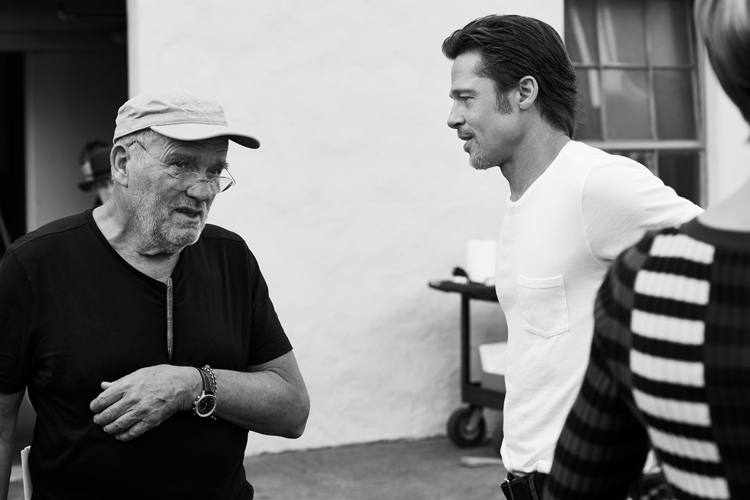
Brad Pitt and Peter Lindbergh on the set of the Breitling Cinema Squad campaign shoot
What are the common codes that you see between you and a brand like Breitling?
Quality is very important to me. Precision – which I’m always striving for. Elegance that I also strive for, and purpose. I think these are the things that I’m certainly drawn to and that speak to me. The brand is undergoing a transformation while also incorporating its history into the designs and I’m enjoying being part of it.
“THERE’S CREATIVE SUCCESS AND THERE’S PERSONAL SUCCESS THAT I HOLD IN MORE ESTEEM. THE BEST WORDS ARE INTEGRITY AND HONESTY AND TO BE TRUE TO ONESELF. I’M MORE DRAWN TO SINCERITY THAN I AM TO MACHOISM”. – Brad Pitt
Why did you decide to be part of the Breitling Cinema Squad?
To be a part of The Breitling Squad is exciting. Breitling has been around for over a century and is now rebranding itself, looking towards the future and redefining itself. It’s an exciting thing to be a part of it. The brand is a living example of incredible longevity. Of course working with Peter [Lindbergh] is great, we first met twenty years ago.
What is it that you love about watches?
I really like watches. They are the only option a man has to express himself with an accessory. And watches aren’t just for decoration – I also love their precision, their purpose.
How important is a mechanical watch and what does it mean to you?
Despite the fact that I look at my smartphone a lot for practical reasons, I wear a watch almost every day. It is a statement of masculine taste, and with its mechanical movement and rich history – an expression of real elegance.
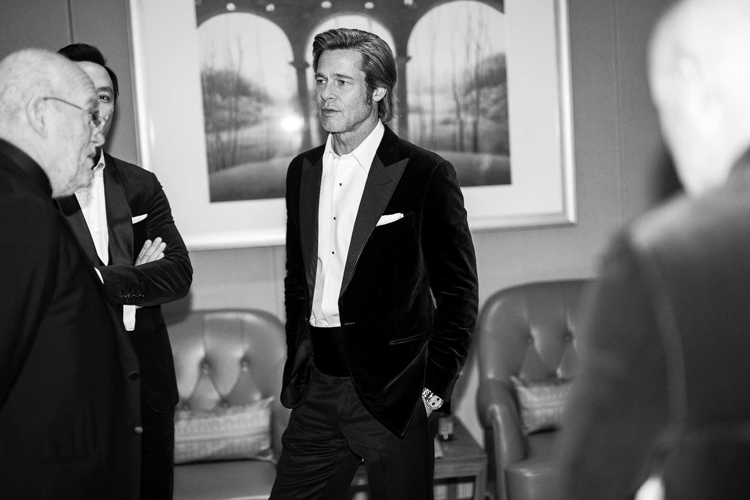
Peter Lindbergh, Daniel Wu and Brad Pitt. Image by Sever Zolak.
What attracts you to buy a watch?
The most important things for me are the aesthetics and what it feels like to wear. Not every watch feels the same on your arm. Finely-made watches just like these [gestures to the Premier B01 Chronograph on his wrist] have a certain gravitas, a weight… That’s something that I like to feel on my wrist.
When did you first own a Breitling watch?
I got into them first actually when I was travelling and I bought an Emergency watch. It’s not like I would every really be in danger but the idea was exciting. So I think I first invested then. And also being that the history of Breitling links to aviation, I got my pilot’s licence about twelve years ago so that took me to Breitling for the Pilot watch.
What qualities do you think a successful man must have?
Of course there’s creative success and there’s personal success that I hold in more esteem. The best words are integrity and honesty and to be true to oneself. I’m more drawn to sincerity than I am to machoism. I think vulnerability in a male is actually very strong. I think that the only responsibility I have is towards myself, my family, the people I love and the people I work with. I want to be authentic and honest.
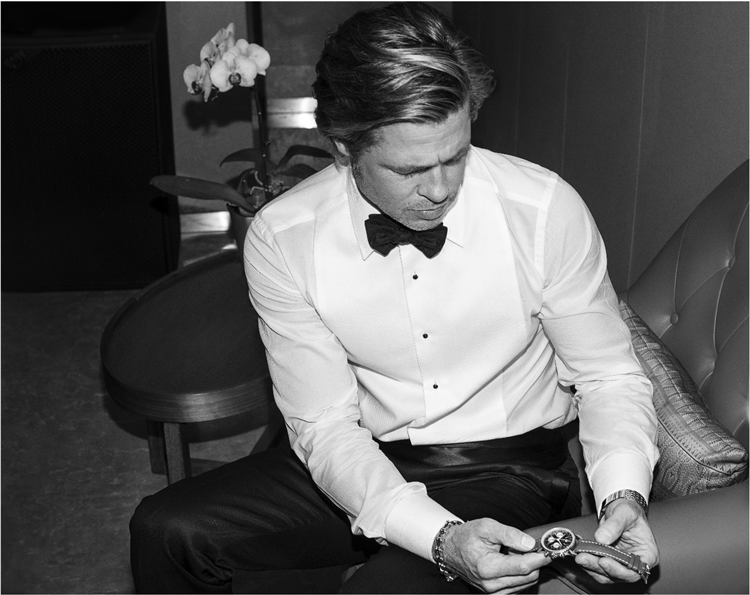
Brand Pitt at the Breitling summit in Beijing. Image by Sever Zolak.
Since you’ve started producing movies, you have gained three Oscar nominations. Are you doing something differently to the others?
Two friends and I started Plan B as a little garage band. Small movies were being made and big tent pole movies were being made, and in between, there were a lot of talented directors, writers and storytellers that were having a difficult time. We wanted to encourage and promote these people that we believed in. That’s how we got started.
What we found ourselves really being drawn to was “complicated” material. I call it “complicated” to describe the degree of difficulty to get the story made to completion. Projects like these need so much more support to go from idea to film. In a way, we still have the same enthusiasm of a garage band. I always think: “If we find this idea interesting, then other people will too.” The question is how many people? But that isn’t my game. I’m just interested in the stories. It’s a quest for quality storytelling. Being a producer became much more fruitful and is much more fun than I ever imagined.
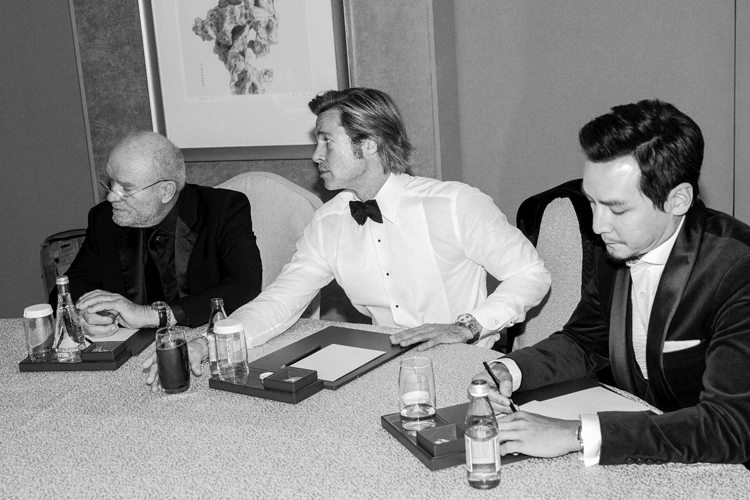
Peter Lindbergh, Brad Pitt and Daniel Wu. Image by Sever Zolak.
Many of your films deal with challenging issues and stories…
Firstly we wanted to support friends who were having a tough time in the industry – talented directors and writers. We wanted to encourage and promote the people that we believed in. We then realised that we wanted to take on projects that dealt with more difficult subjects. But there’s something else that’s more important to me: We all have things in our lives that inspire us. If we all just cared a little bit more about the people around us, then the world would be a much better place. We need to start taking care of each other more.
What about your approach to acting roles, what can you share with us about that?
Usually, I take on a role, I study the lines, I live and breathe the different characters, and I can be very focused on it for three or even six months. When it’s done, when the clap falls for the last time, everything starts to blur and I concentrate on something new, to make room for the next project.
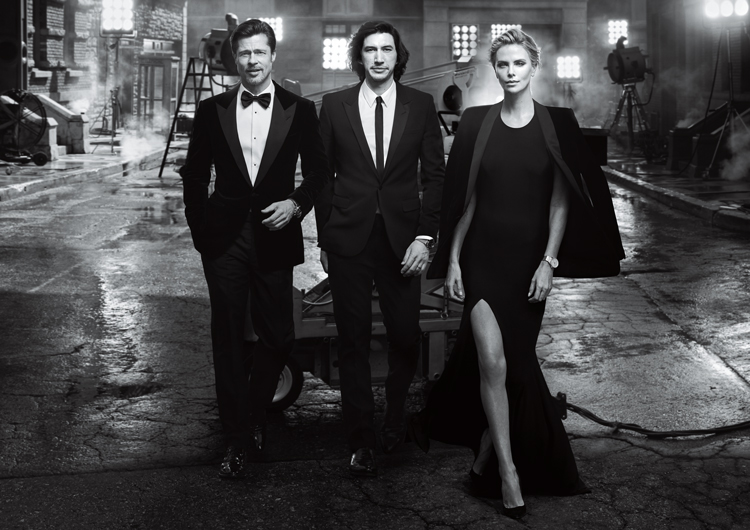
Breitling Cinema Squad campaign
What can you tell us about your relationship with Quentin Tarantino?
My relationship with Quentin Tarantino started when we both were emerging around the same time, in the early Nineties. I worked on “True Romance” that was based on one of his “spec scripts” and then, “Inglorious Basterds”. He has an original voice, when you say “a Tarantino movie” everybody knows what it means. It’s part of the vernacular.
You also have an interest in architecture?
Somebody said that architecture is my real passion… Actually, I consider myself only a tourist in the architecture space. To me it’s not just architecture, but the art, the creativity. A building is a sculpture. It says a lot about how we live today, how we interact with others. Its function defines how we live our day. Buildings in Beijing like CCTV house and Bird’s Nest attract me a lot.
Timeless Quality With Loro Piana
LORO PIANA CEO FABIO D’ANGELANTONIO TAKES US ON A SENSORY EXPERIENCE OF THE BRAND AS HE EXPLAINS WHY IT’S SO IMPORTANT TO TOUCH THE PRODUCTS.
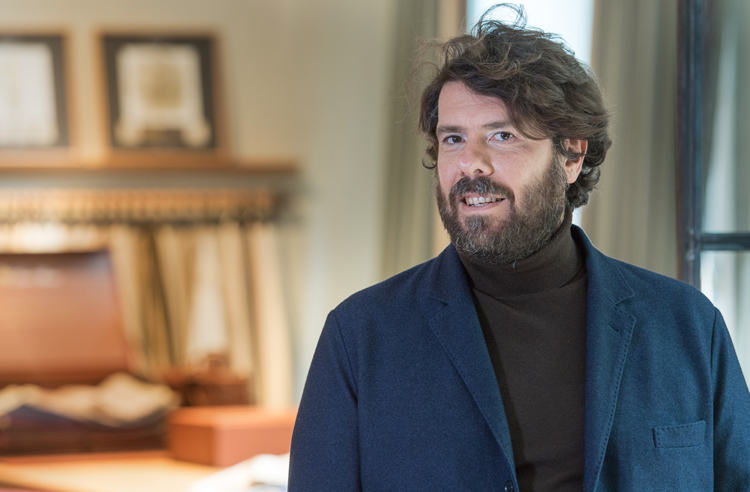
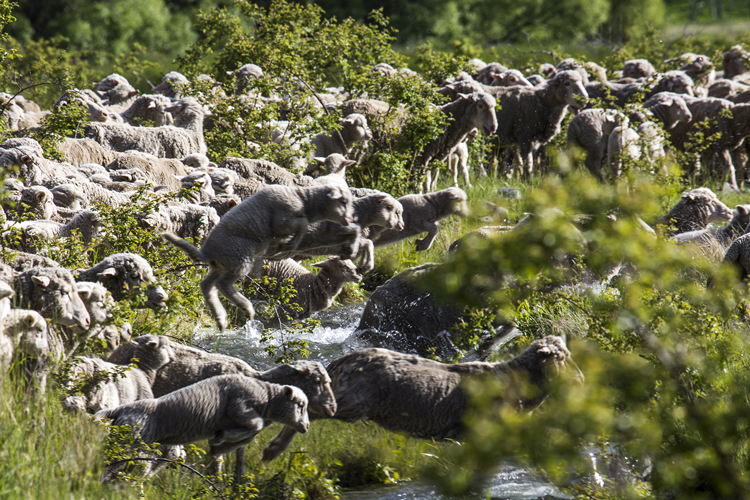
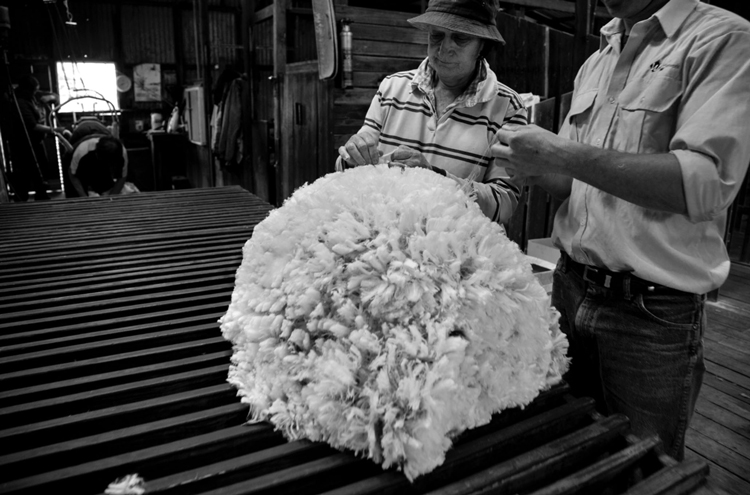
Last month Loro Piana made a spectacular debut into the UAE with its Gift of Kings installation. The presentation was designed to send customers on a sensory experience of the world’s finest wool; the same wool that is used to create Loro Piana’s luxury products. Once the installation was over, focus shifted to the brand’s first store in the region, which opened inside the Dubai Mall Fashion Avenue extension.
Loro Piana is known for its absolute luxury, using the finest materials to create pieces for the elite customer. Part of the project was to allow new customers to touch and feel the wool used in creating the products and subsequently explain the story and the heritage of the brand.
These were two of the talking points when we sat down for an in-depth chat with CEO Fabio D’Angelantonio. With a background in sales and marketing, Roman born D’Angelantonio was appointed CEO of Loro Piana in 2016, after being nominated by the LVMH group (who had recently acquired the brand). D’Angelantonio openly admits to being a dedicated customer of Loro Piana well before taking on the role so he has a unique take on the brand and its future. Here we talk to him about the decision to open a store in Dubai and why we can expect to see a lot more of Loro Piana in the coming years.
Why did you wait until now to debut in the Middle East?
There are a lot of reasons. One is that we were waiting to be prepared to do it in the right way. It’s a new market so we wanted to be right in terms of location and to ensure it was somewhere that was right for the brand. We also had to make sure as a company we were well equipped to manage it properly. So it took some time for us to find the space but we are very happy about it. We also dedicated a lot of time to hiring the right team for the brand. We are very different from other brands in a normal luxury environment, and I think for us it’s very important for us to have the right ambassadors in our store.
What sets you apart from other brands?
First of all the kind of product we offer. We are proud to say that we offer a beautiful product that is exquisite and is done with the rarest natural fibre in the world. And I think that this makes our products special. I also think that our customer is quite different from others. Sometimes they overlap with other brands but I think that our customer is quite special. The more we talk with them we discover that they are seekers of quality and they really go searching for things and the story behind the products. They are very cosmopolitan, very demanding and very intelligent.
What can you tell us about the recent Gift of Kings event in Dubai?
We wanted to tell the story of our natural fibres from a different angle. We wanted it to be special and for people to go home having touched something they would not expect to touch. Touch is a much more long-lasting feeling than seeing and we wanted people to discover our product and our heritage. The hope is that based on that experience, people will want to pass by our store and find out what it’s all about.
And what makes your stores unique?
Sometimes our stores are defined as an oasis of calm and education. Our customers come to our stores and they often stay for a long time. I think we are the only business in the world where if I add an armchair, I add business for the company! Because they love to come and stay for a long time. There is a real sense of politeness and service that we are trying to represent.
To what extent is the retail experience still important?
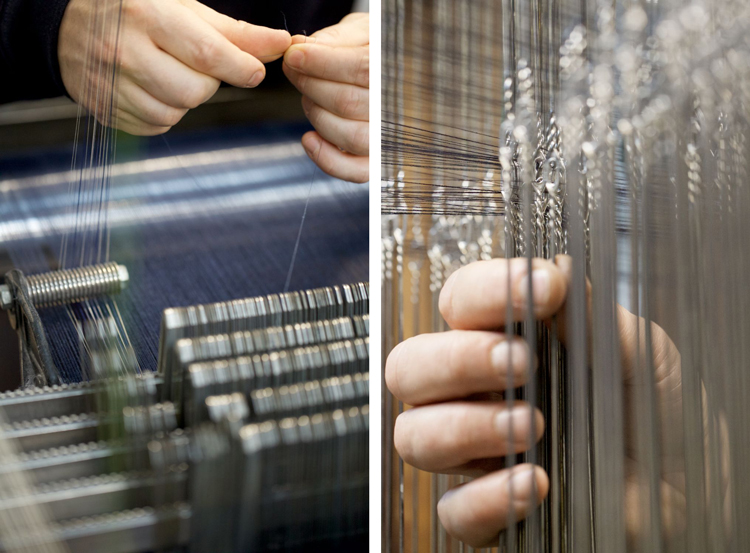
Retail is very important. Customers are searching for products and in our case, touching it makes all the difference. When you see a customer come into a store, if he is a real Loro Piana customer you will see him touching everything. You need to have this sensual experience. I personally believe that the service and experience you offer is important. On the other hand I don’t think you need to open stores for the sake of opening. You have to open in places where you have either the right concentration of your customer, or somewhere where the customer will be surprised.
When it comes to luxury brands to what extent do you think storytelling is still relevant?
The reason the entire world of luxury is going in the direction it is, is because there are brands that are an alternative to the mainstream and I think we are one of them. Customers are very interested in understanding the product and the values they are buying in to and what is behind the products in terms of material, authenticity and the story the product can tell. I think when these kinds of customers learn about us, they develop a special relationship with the brand and products and it can sometimes be close to an addiction! Our customers love to touch and that is what we are all about. If you asked a Loro Piana customer if they would prefer to touch without seeing or see without touching, they would always prefer to touch. To have this sensory feeling and the story to explain why this product is so special is really rare and for us this is really our answer when it comes to storytelling. You need time to develop a good product that is the best quality and you need time to develop a real story.
Loro Piana targets men and women, tell us about the balance between the offering for the two.
I think today’s offering is very balanced. I think it applies to all different categories. I would say probably the women’s business is a little more driven by each collection and season, while the men’s business has a more solid mass of products that we preserve year after year. I think we are one of the few luxury cashmere brands that has mostly ready-to-wear, and we offer somewhere where men and women can shop together and be happy in the environment. We often have couples that come to our shop and they both find their happiness in each department.
To what extent do you think fashion shows are relevant today and why has Loro Piana never showed in a runway format?
We are happy to talk about style but I don’t think we belong to a fashion category. We don’t feel the obsession of the fashion cycle. When you buy something from Loro Piana you buy something that is long-lasting and designed and developed to gratify your experience for a lot more than one year. So when we think about the new collection, we certainly look to develop something new, but with the idea that the pieces that you buy today, can be worn with the other pieces you already have. It is an idea of dynamic but long-lasting elements that are timeless. I think the goal of the runway is essentially to present a new collection, but also at the same time to make sure that the past collection becomes old forever, which is not at all the goal of Loro Piana. We want to be something different – of course we do ready-to-wear but we have very different beliefs and goals in mind. Our deeper goal is being able to ensure that we find the most unique natural fibres and preserve this whatever the cost or difficulty. And I think if you do this with integrity, the product will find its customer.
What has been achieved since you joined Loro Piana and what is an objective you still aim to achieve?
I arrived in a very delicate moment. Five years ago the family that ran the company sold the majority to LVMH group. Then after that there was a moment of limbo in which the integration happened. Six months after the closing of the deal one of the two brothers of the family passed away, so there was a big emotional transition.
I think my biggest achievement from my perspective has been really regaining the energy, ambition and talent in the company and looking to the future with the right energy. I think it is also something that’s easier when you are being supported by a bigger platform such as LVMH.
Looking at the future there are a couple of areas in which we are working really hard. We have had fantastic success in the last two years with shoes, and that is a big area for us, as well as making sure that leather goods become an important part of our business. We are working very hard to develop a new offering of fibres such as silk, linen and cotton. Which most people don’t know us for. So we want to focus on that.
What are you doing to ensure the sustainability of your products?
My take on sustainability is that we aren’t just sustainable now that it is in fashion to be. This company is sustainable by definition and it’s in our roots. One thing we have to think about at Loro Piana is the sustainability of the offers we put to our breeders, so we have to ensure their sons and sons of sons will sustain the wool after many years because this is not a quick process. We don’t just buy any wool or cashmere it is always the best. When we buy it we buy a lot and we have to make sure we create the right conditions to go back and buy it again next year. So one of our goals is paying the right price to communities in order to make future generations become part of the same business. We are working with the children of the people that harvested our wool twenty years ago. We have to make it interesting for the next generation and for us this is sustainable because we don’t think only of the present generation of customers but we want to ensure that the next generation can experience the same wool as the customers today.
This applies to our relationship, to nature, animals and our very respectful relationship with the communities that we work with. We ensure a complete respect to nature and the people that supply us with the wool. Whatever the price we pay, if we are always going for the best, there will be a customer that recognises what we do and that it really is the best.
What challenges do you face now in the industry?
I think we are very peculiar as a brand. We have a positive outlook on how we are developing the brand. If you look at ten years from now, as a brand that sells products to fit comfortably that are also warm, then potentially global warming could one day be a challenge for us, but it is also true that for many areas of the world where it is warm you use air conditioning. So probably one of my biggest challenges when I joined the brand was looking at these aspects and how to resolve these problems.
A potential concern is that we have a lot of loyal customers that in many areas of the world are not young. But then again we have an entire new generation of customers so that makes it not so much an issue.
We are proving that our brand is extremely relevant in a world where consumption is faster and more superficial than ever. Our consumer still has a desire for quality and they a ensuring this.
What is your professional motto?
Dreams and teams.
How do you interpret luxury?
I think luxury is a very deep emotional experience. It can be related to a product or not. The more knowhow and culture you have the more you will appreciate this experience.
What book are you currently reading?
It’s a book by an Italian writer about the relevance of good education and being polite in a world that apparently everyday gives less relevance to politeness.
Where do you see Loro Piana in five years’ time?
In terms of positioning I see Loro Piana exactly as it is today. Probably if we have succeeded the brand will be equally loved and even more desired. I hope that we have will be able to offer the brand through more categories than today, in order to be able to create a real lifestyle universe.
Such as?
First of all the entire universe of home interiors. I think we have incredible beautiful fabrics for interiors that can allow us to become even more of a player in the world of home living. We have the potential to build a lifestyle around the brand, and I think there are a group of customers that will buy into this lifestyle.
How would you describe Loro Piana in one word?
“Touch” with a capital T.
CEO Of Van Cleef & Arpels Talks Us Through The Latest Novelties
AS VAN CLEEF & ARPELS PRESENTS ITS LATEST NOVELTIES IN THE UAE, PRESIDENT AND CEO NICOLAS BOS TALKS TO A&E ON WHY THESE PIECES ARE SO DIFFERENT FROM ANYTHING ELSE IN THE INDUSTRY.

For 2018 Van Cleef & Arpels dreamed of living in time with the cosmos: capturing the movement of the planets, tracing the constellations and reaping the stars. That dream became reality with the Poetry of Time collection. These rare creations illuminate the twelve constellations of the Zodiac, track the movement of the planets and bring all the magic of the universe to life on the wrist.
Van Cleef & Arpels draws from its history with these magical timepieces inspired by the stars and the universe. The face; a starry sky, tracks the journey of the sun and moon as well as other planets, and the time is told by watching the planets move around the face of the watch. The greatest care has been taken by the watchmakers, jewellers and craftsmen to create something completely unique.
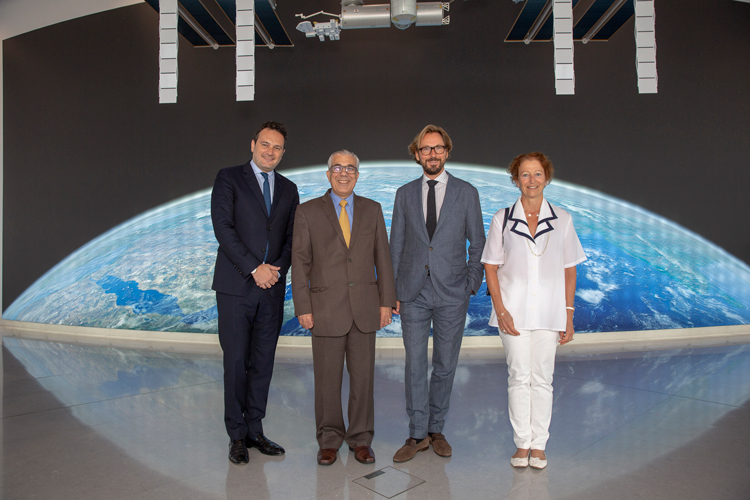
To celebrate the worldwide launch of the Poetry of Time pieces Van Cleef & Arpels hosted an exclusive event in the UAE. Held at the very fitting location of the Sharjah Center for Astronomy & Space Sciences, the presentation was in the presence of Van Cleef & Arpels President and CEO Nicolas Bos. Bos, who has worked in the industry for many years first joined Van Cleef & Arpels as the High Jewellery Maison’s Creative and Marketing Director and has been in his current position since 2013; overseeing all new launches since then. During the global launch A&E sat down with Bos to find out what it is that makes these pieces so unique.
Why did you choose the UAE as the setting for such a beautiful launch?
I visited the universities in Sharjah some time ago and saw the planetarium which we thought was absolutely outstanding. So we said we should definitely do something here at some point. The Middle East in general has become a major market for us and we have a major presence here now. It is as important as Europe, Japan or America.
What’s so special about the collection?
The starting point was asking “what’s fascinating when we look at the skies?” Of course it is the movements, colours and the light – so we asked ourselves how we could integrate that into a watch and still have an element of surprise and playfulness. The whole collection is a tribute to the poetic vision of astronomy and astronomic watches. What we do in the worlds of jewellery and watchmaking is try to be part of a tradition and at the same time explore beyond the boundaries of that tradition. So while astronomic watches are classic, we wanted to see how, while remaining part of that tradition, we could somehow visit it with our codes and a slightly different vision.
From there we chose animations and stories that we could interpret. A lot of them based on history. What’s interesting is that there is a scientific component as well as the idea of precision and accuracy that is associated with watchmaking, but it is always connected with the idea of beauty.
We found the planets quite fascinating and it was very challenging to see how we could bring all this emotion and vision into the limited size of the watch whilst trying to innovate. The pieces are something quite personal as well as playful. The stars that light up on the watches can actually be set to be the stars that are the prominent stars in your own personal zodiac.
Who is your client for this collection?
The offerings are unusual because of the link to astronomy. We have some clients that are watch collectors who are quite intrigued and interested by them. And we have some clients that come from the world of jewellery and creative arts who really look at the pieces for their aesthetics and the jewellery component. We also have clients that are looking for a specific piece but aren’t coming from either of these worlds. So there isn’t one specific profile.
What can you tell us about how Poetry of Time fits with the high jewellery collections?
The Le Secrets collection was not too far from these watches. Using the technique of something that’s hidden to create an element of surprise. There is always an idea in our products to evoke an emotion or create a different way of wearing the pieces. But the technique should never be visible so the Le Secret collection was exactly that – each and every piece had a secret. This could be hidden message, a secret mechanism, a compartment. Something that is always associated with a story.
What is the secret to success at Van Cleef & Arpels?
We try to do things that make sense for us. I believe in stories and inspirations. At the end of the day we are creating pieces that are not necessities in life so you have to have a good reason for the customer to buy them. You need to create an element of surprise and desire. You cannot sell a piece of jewellery or a watch simply on a marketing campaign, you have to create a story and emotion, as well as having the most beautiful pieces you can. Of course if you have a key story which we do, then yes you know that a certain set of clients will be interested.
Do you think the global industry of watchmaking is changing its shape and how are platforms such as SIHH being affected by this?
The industry is evolving for sure. We are not present in SIHH for a very specific reason because we are a retail only company, we don’t have any wholesale. But I am a great supporter of the event and its great quality and I think it is evolving. But it is true that years ago when these fairs were created they were trade fairs for manufacturers or wholesale companies who were meeting with their clients once a year. Then they became platforms of expression and evolved to what they are today. But yes I think it is true that more watch brands have developed their own international footprints and retail teams so it’s a different combination now.
Do you think over-visibility kills desire?
That is a very relevant question today. I honestly don’t know. I think there is quality and there is volume. All communication isn’t good communication. Social media tends to be a diverse form of communication where you don’t necessarily control the image that’s conveyed and the quality of your communication because the person that talks about your product or brand can be anyone. It can be difficult and dangerous and that can kill the desire. On the other hand if you really master or control your communication to make it more visible in the right way – does it kill the desire? I’m not so sure. It forces you to be even more precise and consistent and relevant because it is more visible. So I think at the end of the day, the more visible it is the less you can afford to make a mistake. But I’m not sure that visibility as such is an issue.
What would you still like to achieve at Van Cleef & Arpels?
Plenty of things! I’m very happy with the way the house has continued to develop in the last decade and I guess it will continue to exist and develop and to strengthen the world of jewellery and watch making. There are also other initiatives that are very important to me like L’ecole (the school of jewellery and arts, supported by Van Cleef & Arpels) – which I think is a very important component of the future. We want to play more of a role when it comes to education.
We want to preserve craftmanship and trades in the long term and continue to support the talents and educate. We want to support professional schools and bring young talent to these types of crafts. I think we can continue to play that role, it’s a very important component that will be and can be even more integrated into the company’s daily life.
THE NOVELTIES
The Zodiac Lumineux offers an invitation to live in harmony with the rhythm of the cosmos. The watches mimic the sparkle of the stars illuminating twelve signs of the Western Zodiac. The astrological theme has been one that is close to the heart of the Maison ever since the 1950s. It comes to life in twelve dials, each representing a different Zodiac sign. For women, the Lady Arpels Zodiac Lumineux comes in a smaller 38mm diameter case in white gold set with diamonds.

Midnight Zodiac Lumineux Sagittarius – Face Allumée © VCA – C. Rousset
The Midnight Planetarium features both refined aesthetics and an automatic movement developed exclusively for the Maison; the Lady Arpels Planetarium watch depicts the Sun, Mercury, Venus and Earth as well as the moon. Each planet moves around the dial in real time, orbiting the dial in 88 days for Mercury, 224 days for Venus and 365 days for Earth. The moon also rotates around the earth at actual speed. The 38mm diameter case comes in white gold and is set with diamonds. The piece is finished with a blue glitter alligator strap to match the dial or a bracelet entirely set with diamonds for a high jewellery option.
These incredibly delicate watches are created using extra special materials. The Sun, the central point of the watches is made from pink gold, while the rotating planets are created from pink mother-of-pearl, turquoise green enamel bead and brilliant-cut diamond. To evoke the depth of the cosmos, seven aventurine disks are placed in concentric circles on the dial, rotating individually via the watch movement. The planets and shooting star move at real time speed. These magical watches display the depths of watchmaking and fine jewellery craftsmanship.
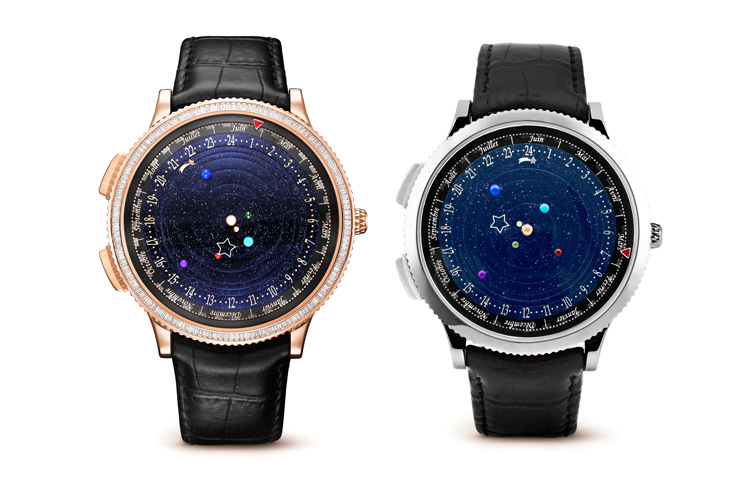
Poetic Complications – Midnight Planetarium – 44mm and Poetic Complications – Midnight Planetarium-44mm
Surfer Sally Fitzgibbons Uses Her Experiences To Empower Women
AUSTRALIAN SURFER SALLY FITZGIBBONS TELLS A&E HOW SHE IS AN EMPOWERED WOMAN IN A MAN’S WORLD BUT STILL MAINTAINS A SOFT AND CREATIVE SIDE.
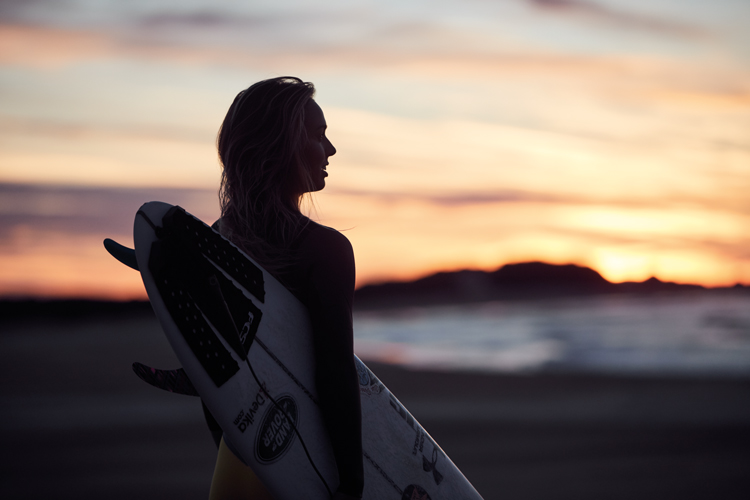
Sally Fitzgibbons is a woman on a mission. As one of the world’s top female surfers she has a dream of winning the World Championship medal and won’t give up until she does. Growing up in a small town in Australia, Fitzgibbons knew she wanted to be in the ocean from a young age. She spent all of her time at the beach, learning to surf and experiencing the thrill of the waves. At just 14 years old Fitzgibbons won the ASP Pro Junior Open, an event that had previously only ever been open to over 21 year old’s. Her successes began at a young age but that didn’t slow her down. Today, Fitzgibbons competes in surfing championships all around the word as part of the World Surf League and has created her own Surf Community encourage fitness and a healthy lifestyle.
Aside from her day job, Fitzgibbons makes up one third of the Breitling Surfer Squad. Alongside Stephanie Gilmore and Kelly Slater, the Surfer Squad represents the brand’s diving watches, including the Superocean Heritage II Chronograph 44 Outerknown watch. Designed in a collaboration between Breitling, world champion surfer Kelly Slater and sustainable clothing brand Outerknown, the watch features a strap crafted from ECONYL yarn. The innovative material is created from nylon waste found in discarded fishing nets around the world. Here we discuss with Sally her passion for what she does and how her core values in life are parallel with the spirit and values of Breitling.
How did you come to know you had a passion for surfing?
Even answering that question brings me so much joy because as a young child I was introduced to the ocean as soon as I could swim. The beach became our playground so I was riding a boogie board (the one where you lay down) from the age of three or four. Then I graduated to go out to the back of the break; my dad would take me out on a long board. The first time I stood up I remember standing there and feeling lightweight but the board was so big and heavy and it was the greatest feeling. You can’t believe you’re riding this piece of foam on this energy that’s created by a something natural. All the thoughts in the world just fade away. I think that’s why I see a lot of people go to the sport of surfing for an escape and a purity and that’s the way I try to live my life. Although it gets fast paced and sometimes it feels like you’re trying hard for results, I just always think back to the purities and that I started riding waves because I loved it.
How does your choice of career add to your character and personality?
I think what it has added to my life is that it’s a really grounding energy so you just feel like you respect everything around you all of a sudden. It’s greater than you are, it has this power that’s insane. You can’t fight it you just have to go with it. You accept a lot of things in life and then you hop back out to the ocean and you feel like everything’s OK. So it gives me a lot of perspective in my life. I’ll be loving it unconditionally well into my older years, I want to be that person that surfs to 100, maybe without a competitive jersey.
There is a new awareness and hype related to female empowerment – what are the challenges that you have had throughout your journey?
This whole movement, it’s a feeling, even when I think of it I can feel it in my feet and my hands, it feels great. I started riding waves not because it was a male sport or a female sport in fact I would often forget that I was the minority out there. Sometimes there would be a hundred men and I would be the only woman. I didn’t think I was any different. I knew that in order to earn your right to a wave you had to be out the back in the most critical part on the break and you had to be determined and courageous and fight for your space in the line-up. No one was going to give you waves, and without being on the waves I don’t think you can become a competitive surfer.
There was something deep inside me that looked around and knew I had to own my space from such a young age and definitely own my big dream. It was hard. I was from a very small town of just two hundred people and I always wanted to be the best surfer in the whole world. Everyone thought it wasn’t possible but I knew I had to stick to it. It was a hard goal and I had to persevere.
With this movement, in 2019 things will change on our surf tour, we now have equal prize money and equal working conditions. All these things have come about because female surfers are not letting anything get in their way and I think the women’s empowerment movement has come through as the aftermath of that and now we’re all running together so it’s pretty amazing to feel empowered.

Sally Fitzgibbons at Breitling Gala Night Beijing
What’s a dream you still aim to achieve?
I want to become World Champion. I’ve had a lot of runner up finishes. I’ve had a very successful career which is something that I’m proud of and I’ve had to overcome a lot of challenges, but I just have this idea of what my best can be and it’s constantly evolving. I think for me that almighty challenge of becoming world champion is what I need. I’m right on the edge and you have to be really brave to jump out into that zone where it’s quite scary and you don’t know what’s going to happen next, but you go anyway! If I can trust myself and use all my core values, for me it’s something that creates a lot of feeling and that’s why I’m so attached to it because it makes me really excited about life.
What are the common codes between you and a brand like Breitling?
I think as a surfing culture and as competitive surfers there is a parallel between Breitling as they have pushed their limits for so many years. They have a rich history but they constantly challenge themselves to make the next timeless piece. They wanted to share not just something that you wear on your wrist but a community and an empowering feeling when you put something on which is a truly unique experience. When you look at our Surfer Squad we have even competed against each other but we have a very respectful rivalry. Kelly Slater is someone who changed absolutely everything in our sport. He can pick and choose which pathway he wants to go on, and by him picking the Breitling Squad opportunity it’s telling us that this is something meaningful that’s bigger than just an individual partnership. For us to come together and have this goal and not only raise awareness but keep challenging ourselves and leave behind the message of what our environment is about and preserving that is really special. And we are educating people to clean our oceans along the way, it feels like we put this watch on and we show people what we can do and hopefully that will influence people to buy that piece and be a part of it.
Which watch is your favourite from the collection?
I love the Superocean watch at the moment because it is part of a culture and a movement and a chance to be a part of something bigger. It shows what we can do with all the trash we find in the oceans. It’s not so much that plastic is such a bad product, it does work well, we’re just not reusing it in the way we should be and that’s creating a problem for all of us. Kelly and Breitling have thought outside the box and said “wow there is all of this pollution that we can turn into a nylon strap”. It shows that you can have such a quality product without compromising its look and value. And you’re giving back to the planet which means you’re part of something bigger so it’s great.
If you were given the chance to co-design a watch with Breitling featuring sustainable components, what would you do?
That’s a great question! I guess in terms of surfers, we break a lot of surf boards, maybe as those surfboards break down we could use the materials within them to create a durable product. That would be super awesome.
When I think of what the current collection has on offer, it’s already got for me the ultimate designs within it. I wear my Superocean when I’m out there competing and pushing my limits, and then I can put on the most elegant piece for the evening. I think for me it’s not so much redesigning the product that’s already amazing, it’s about empowering the communities that are each part of the collection. If I chose a colour it would be blue – I love the ocean so blue is my favourite colour. I would like to see yellow features on it too as that makes me smile.
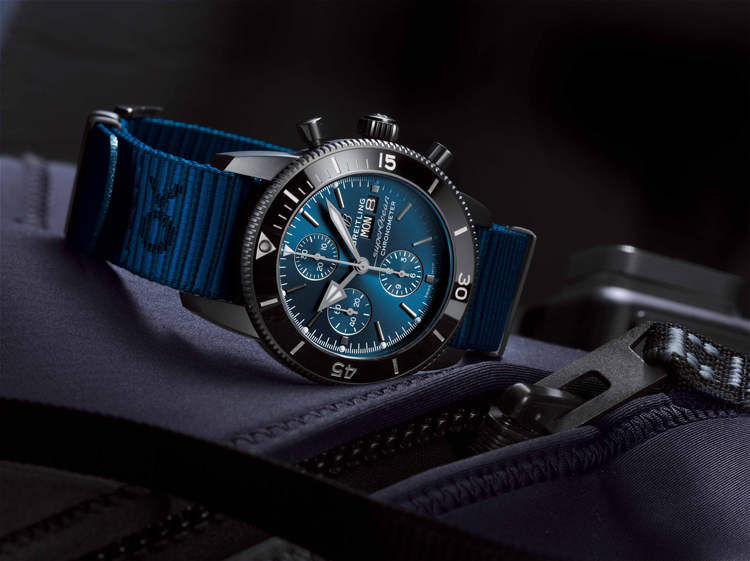
Superocean Heritage II Chronograph 44 Outerknown
If you achieve your dream and win the world championship, to whom would you dedicate it?
Over my career so far so many people have stopped to give their time and energy to me, cheering me on a wave or at training or even when I’m running around town doing my fitness sessions. It could be a grandma or young kids, but I think these are the people that I would dedicate it to. Everyone that’s contributed just a moment of time to me and encouraged me. That to me is priceless. Trophy or no trophy I look at all the moments that I’ve shared with people all around the world and I would want to say thank you.
Surfing is becoming a new hype in Dubai – what do you advise aspiring surfers?
I tell them that it is possible. Surfing is going to new heights with wave technology and it’s debuting in the Olympics in 2020, so it’s going to open doors for so many people to not just have the idea of what surfing could be like, but to try it. I think we could be seeing surfers coming from inland countries that have never even seen the beach and they could be absolutely amazing. Just have an open mind and try it. More importantly hopefully you will get to experience what the surf community is about.
To what do you say no?
Anything that compromises my values.
What scares you?
Dreaming so big – but then I smile.
Are you currently reading a book?
Yes, I would recommend a book by Kelly Clark, the snowboarder, it’s called Inspired.
How would you describe Breitling in one word?
Epic.
Insta-Famous Watch Collector Fred Mandelbaum Shares His View On The Industry
HOW VINTAGE WATCH COLLECTOR FRED MANDELBAUM IS HELPING BREITLING SHAPE ITS FUTURE BY LOOKING BACK AT ITS PAST.
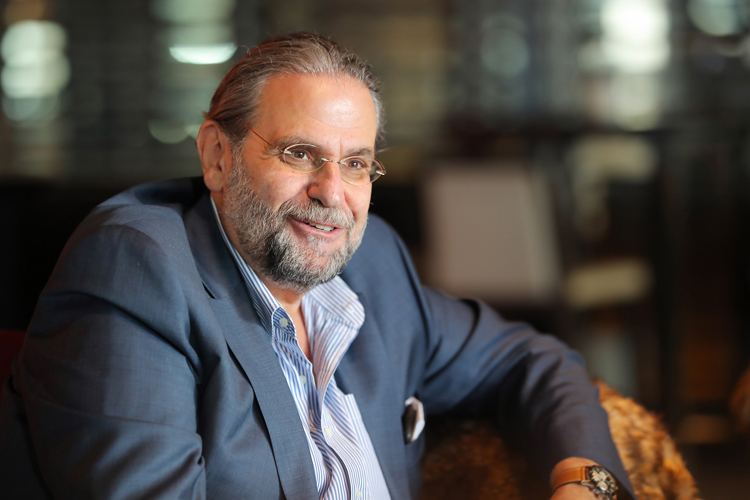
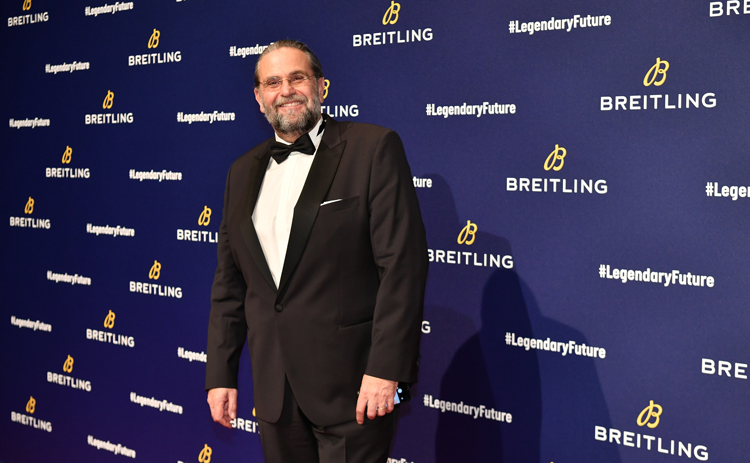
Breitling is on a mission to reconnect with its roots and shine a light on the icons that had an immense influence on the watch industry today. Fred Mandelbaum, an avid vintage watch collector that goes by @watchfred on social media , knows a thing or two about the heritage and the history of the brand and was personally approached by Breitling CEO Georges Kern to help bring the brand back to the forefront of the market.
Below he reveals what makes a good watch collector, reflects on the mistakes that Breitling made in the past and how his experience and creativity will play a role in reinventing the future of the brand.
How do you see Breitling moving forward and how is revisiting the archives is part of that?
Breitling has the richest heritage of any brand and for many years a lot of that was slightly overlooked. Breitling was very successful in one segment of their original market, always an innovator in a grand scheme of watch design and watch manufacturing. During the quartz crisis all the watch companies were affected. The introduction of electronic watches almost killed the mechanical watch, and when Breitling re-emerged they decided to go into a specific niche of aviation and not try to conquer all the market that they had before. So a lot of Breitling heritage was there, but slightly forgotten, so what Georges Kern did when he took over was that he saw that potential of taking the very successful manufacturing of the aviation watch and making it relevant and appealing to a much wider audience. This is what we’ve been working on for the last year, to excavate all those roots and rebuild the brand in a wider field. Very often many of the watch companies today, have to invent history because they don’t have it.
How important are the roots of the brand to succeed in today’s market?
If you’re an artificial brand you have to invent your roots. Breitling is very different, they were the ones expanding the market, innovating in the market, leading the market, and having others follow their lead. In 2050, let’s say, there will be people who collect smartphones, and their core of their collection will be Apple iPhones by Steve Jobs because he was the one who made the smart phone what it is. Very similar in chronographs, Breitling had the role of ‘Steve Jobs the innovator’, innovating in technology and design. If we look at the chronographs, whenever we see a new fashion emerge, we can always follow that fashion and find Breitling to be the first to do that. Disruptor, trendsetter, this is what Breitling was and this is what it’s aiming to be again. We are trying to find those roots and innovate, and bringing them into the 21st Century.
How did you develop your passion for collecting?
I’ve been in electronics since the early days of computer revolution. I was designing computers and everybody around me were wearing Quartz watches. So being surrounded by printed circuit boards, I wanted something different, my personal interest was in mechanical design, but it wasn’t the right time for it. So I started to collect and wear mechanical watches and that was the beginning of a love affair. My first good watch was expensive then for me. It was a Jaeger LeCoultre Memovox. My second Memovox from the 1950’s I found to be a bit more stylish.
Do you follow the roots of watches you collect?
I follow the roots of everything I’m doing! My second brand was Vulcain, it was the called ‘the watch of the president’ as all the American presidents received a Vulcain Cricket watch. Back then I was working in the production planning of circuit boards and assembly of systems so I said to myself “using a stop watch makes little sense” so I bought my first chronograph in 1985/86 because I needed it in my daily routine.
How many watches do you own?
I don’t answer this question because numbers of watches are totally irrelevant. You can have 2,000 watches and not even one good watch.
Let’s rephrase, how many Breitling watches do you have?
I have a large quantity but I’m not proud at all of how many I have because it sometimes shows certain addiction and that’s something we normally tend not to admit. What is relevant about my collection, it’s really not the size but the scope and quality of it. Every watch I collect needs to be A. technically relevant or relevant in watch design. B. it needs to be absolutely original which isn’t easy and C. it needs to be in impeccable condition.
What do you advise aspiring collectors?
Don’t think about investing in watches, only buy watches you fall in love with, the ones that speak to you, that feel right on the wrist and that make you smile. Then as you start to learn about watches you have to develop your own style. I know people who invest in millions of watches but they buy the wrong style and you never know what really makes them interested besides the value of the watch collections. These are poor collectors, I pity them because they invest a lot of money but they don’t develop their own style. Try to find your own style, try to “dress for success” on your wrist.
What is your motto?
Be yourself. I’m specific in who I am and feel comfortable being myself and this should be expressed in everything you do and any watch you put on your wrist, or whatever it is. Be self-assured in your own style and then you’ll buy the right watches.
How important is comfort over style?
The watch industry, including Breitling, forgot that a watch has to fit you like a shoe. You can have the most beautiful shoe, but if you’re uncomfortable in it, then you’ll never love it. The watches that were produced in the last 20 years were shouting very loudly, forgetting that they’re actually built to be worn on the wrist and be comfortable and with the Premier watches that Breitling has now launched we are going back to that. They fit your wrist like the most comfortable elegant shoe you can imagine.
Is there a specific Breitling watch that you’d like to add to your collection?
This is the second time it’s happened to me during the Breitling event. A friend called me yesterday. He’s an American professor who has been living in Tokyo for 30 years, and he called to say that he had seen watch. There are two models from Breitling that I’m still hunting for and one of the two he saw in the shop and sent me a picture so I will have it in my collection in a week.
If you could co-design a watch with Breitling, what watch would you like to see come to light that’s not part of today’s assortment?
We will do two things in the future. We will take roots of design and modernise, then on the other hand we will re-issue iconic watches in the precise form and function that they were originally. They will be limited and hard to get, but they will be sublimely beautiful. One such watch is almost ready and I have part in designing it.
How would you describe Breitling in one phrase?
Impeccable taste.
EXCLUSIVE: a&e Interviews Serge Brunschwig, Chairman At Fendi
SERGE BRUNSCHWIG, CHIEF EXECUTIVE OFFICER AND CHAIRMAN AT FENDI DISCUSSES THE HISTORY AND THE PLANS FOR THE FUTURE OF THE FASHION HOUSE.

Established in 2011, Les Journées Particulières, opens the doors of 56 of LVMH’s iconic Maisons, inviting members of the public to come and experience the savoir-faire and creativity of the artisans within the group. The luxury houses also display the architectural and cultural heritage of the brands in never-seen-before ways and celebrate the beauty of craftmanship and its importance in today’s culture. Inspired by the success and generosity of the houses that make up the group, Les Journées Particulières, allows the public to have an up close and personal experience of some of the world’s biggest fashion houses, giving them an insight into how their beautiful products are made.
At the forefront of the operation is Fendi – a house who has truly unique craftsmanship. Fendi invited members of the public to its home at Palazzo della Civiltà Italiana in Rome to experience a homage to its ready-to-wear, fur, leather goods, shoes, watches and even Fendi Casa home products. This year’s event featured a live craftmanship exhibition that saw Fendi artisans from the Fur Atelier in PDCI, as well as those from the Ateliers in Florence, Porto San Giorgio, Forlì and Neuchâtel come together for a unique experience. These skilled craftsmen were creating unique handmade creations on site, expressing the daring creativity, experimentation and infinite heritage of the Fendi house.

FENDI Les JournÇes Particuliäres 2018-PDCI-Couture-Fur area
One of the highlights of the event was a wall dedicated to graffiti art. Master artisans of the fur atelier created a one-of-a-kind fur graffiti-inspired inlayed tablet using discarded pieces of fur material. The art piece became a map of the world created from various cuts, colours and styles of fur – the first time anything of its kind has been created in this way. Visitors were then given the option to actively participate by drawing their own graffiti on the wall.

FENDI Fur Atelier Artisans on the steps of Palazzo della CiviltÖ Italiana
Serge Brunschwig, who was responsible for bringing the exhibition together, joined Fendi as CEO and Chairman in February this year. No stranger to the LVMH Group, Brunschwig first began his career in luxury at Louis Vuitton in 1995. Since then he has held a number of key positions within the company, including Managing Director of Louis Vuitton, where he was in charge of development of the international retail network, as well as Chief Executive Officer and President at Celine, before becoming CEO at Christian Dior Couture and most recently looking after Dior’s menswear unit. This is a man who has decades of experience in luxury, and now he is putting that into practice with a new chapter at Fendi. In this exclusive interview with A&E, Brunschwig discusses Les Journées Particulières as well as how he intends to look to the future, while still sustaining the strong heritage and legacy of the Italian house.
How are you paying tribute to craftsmanship through this platform?
The house is sharing one of its treasures, which is found in the hands, hearts and eyes of these artisans. We wanted to share all of their education and experience with the public. In my experience we know that it will be of immense value for the people who see it, as well as great value for us. In the Middle East you know how important it is to open your home for guests and that is what we are trying to do here as we open our house to show our customers the best of what we have.
To what extent do you think storytelling and touching emotions is still relevant today?
I think it is more and more relevant. The beauty of our times is that we have improved a lot in storytelling and I think the public is very eager for the stories. People want the real stories, not ones that are invented. My children ask me if stories are true – they want beautiful real stories, and I think that’s what we are doing – showing that it is real and not something that is invented. There is a lot of value and comfort for the customer in understanding these stories and the products.
What do you think is a challenge today for Fendi?
Luxury exists today because it is relevant and I think the challenge is asking “how am I relevant for today and how do I find the words, images and techniques to tell the story that the people of today will find useful?” So the challenge is staying relevant for today and tomorrow. That is why the word ‘millennials’ is so important. I think soon we will need to find another term to speak to the next generation – to make them aware of our existence. Letting them know that this craftsmanship and aesthetic exists today and it has a long history but it is still modern.
Fendi is among the few brands that has managed to appeal to both millennials and existing clientele without pushing either away – what is the recipe to this success and how hard is it to appeal to both?
I think firstly it is product innovation. It’s having great designers and artistic directors. We have two – Karl Lagerfeld who of course is quite famous, and Silvia Fendi who has this strong heritage from her family. Both of them are interested in the future and the new generation. We just did a lovely show, but for them, in a way they don’t want to speak about that anymore because it is in the past. They are really focused on what’s next and how they are going to surprise again. We always use the same authentic craftsmanship, but the question is how we adapt it so that they [the customer] will be interested?
We have just seen on the wall a beautiful piece of artwork using discarded pieces of material – what can you tell us about this concept?
The art of fur at Fendi is in our DNA. Fendi knows how to create these fantastic colours with fur and skins and they know how to assemble them beautifully. So we have this fantastic craft and we have paired it with a graffiti artist to transform a graffiti art piece of the world into a piece of art using fur. We have people in our team who are looking for the next ideas, they are artists, craftsmen, and they are inspired by the light and air of Rome. The map is a fantastic symbol of the world coming together in this place.

FENDI Les JournÇes Particuliäres 2018-PDCI-Couture-Fur area
You joined Fendi just nine months ago – what is your vision and direction for the brand?
I’m here to make sure that talented and passionate people can express their art and invent and design beautiful objects. I also need to ensure that these objects will entertain beautiful people around the world who will be interested in what we produce and ensure we have the right channels of communication. My vision is that we expand this in a natural organic way, and that we have more success because we are doing a good job.
If there is one thing that that you still aspire to achieve that has not been done yet at Fendi, what would it be?
There is a fantastic history so far, so what we need to do now is continue the story. Opening the next chapter, which means talking to a new generation and inventing a new generation of products to go with it. This needs to be done in all sectors. There are some aspects that are more developed than others, so there are some that can be developed more and product lines that can be added. Naturally Fendi can incorporate new savoir-faire.
What is your take on education and what is Fendi doing to share what they do with the new generation?
We are here at an exhibition that is celebrating craftsmanship and we give a strong educative message through this. I asked the teams to invite as many schools and associations as possible so that we can show young people what we do. I want them to see these jobs and the people that are doing them so that they can understand the value and future in it. These roles are something that could have disappeared, but fortunately they are still here in Italy; but it is a very fragile industry. It is our responsibility to make sure that these jobs still exist in twenty years. So I think the LVMH group, and Fendi in particular, have a very important responsibility. That’s why we are investing in craftsmanship. In two years we will open an amazing factory with state of the art equipment and we will internalise craftsmanship with plans for a new generation of people working at Fendi. This is a very important step for us.
What is the recipe to creating an object of desire and how do you maintain desirability?
It’s a mix of things. Of course we have the reputation of the brand – we are now at a size that when we do something we have the power to show it. And of course the quality and the creativity of the object is important.
How do you feel about the digital world?
I use it all the time. Not as much maybe as someone who is twenty years younger than me, but I use it a lot for mail, for social media, for talking to others.
What is your social media of choice?
Instagram and WhatsApp.
What do you say no to?
Bad ideas. I say no when I need to, and also to help people make the right decision.
What book are you reading right now?
A book about the fascism in Italian history.
What is your personal motto that you tell yourself every day?
What can we do best and how can we do it better?

FENDI Les JournÇes Particuliäres 2018 – PDCI KL sketches Corridor
If you were not doing what you’re doing today, what would you be doing?
I wouldn’t like to do something else! I am trained as an engineer but I was fortunate to arrive into this business. This industry didn’t even exist when I was young but then I met a genius; Bernad Arnault. He proposed I join the group (LVMH) and I said yes because I was impressed by him. I remember my first day so clearly. It was January 2, 1995 in Hong Kong at the Louis Vuitton office, I was in charge of Louis Vuitton for Asia Pacific. I had no idea what to expect. I remember very well somebody coming in to ask me about the store and what to do with the windows. We discussed it and there were so many questions that day and I knew I was doing the right thing. When I experienced the passion of the people in my office I knew. I was used to looking at numbers, but I had not been trained on judging the quality of a display for example – so I looked to the part of my brain that I use when I judge what I like and what I don’t like visually, and I trained very fast.
If you were to summarise Fendi in one sentence what would it be?
Nothing is impossible.
Ahead Of The Dubai Launch, Creator Of Bvlgari B.Glam Collection Reveals What To Expect
MIREIA LOPEZ, VICE PRESIDENT HEAD OF ACCESSORIES AT BVLGARI INTRODUCES THE LATEST COLLECTION OF BAGS.
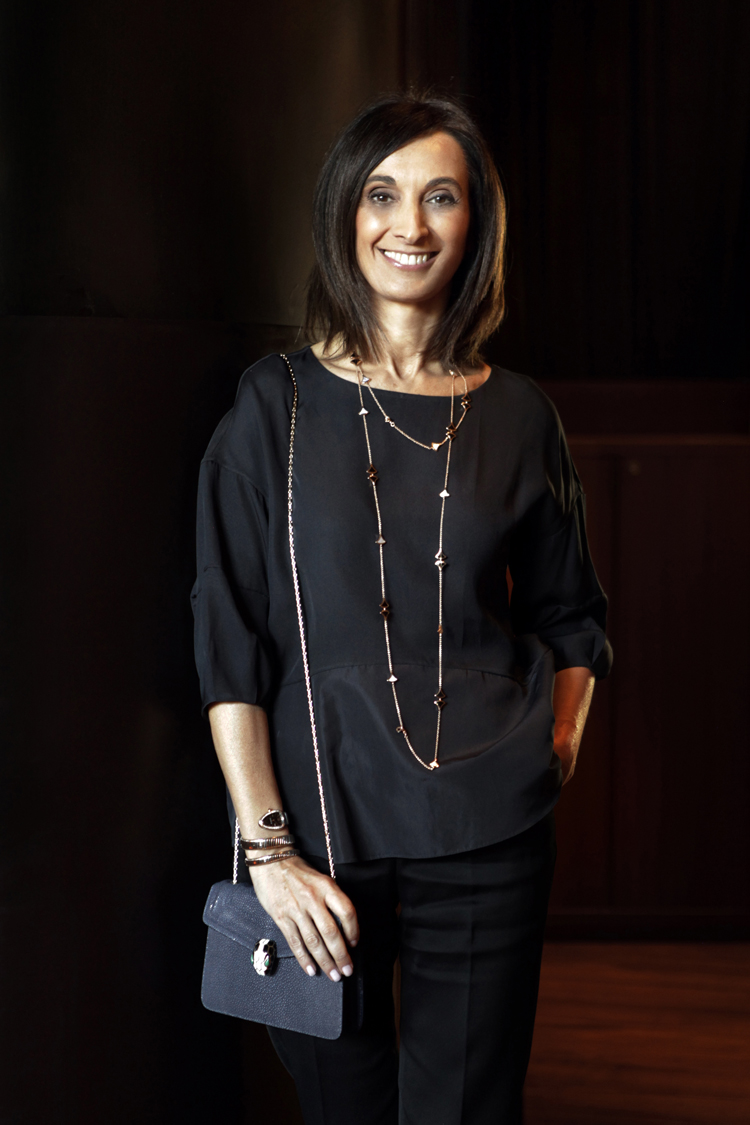
Bvlgari’s accessories are instantly recognisable. Firstly because of their motifs and embellishments (the Serepenti and Monete for example have come to define the brand), but secondly for their bold and bright colour palette. Bvlgari designs statement pieces in colourful hues so the customer can dress according to her mood. So it is perhaps surprising then that the latest collection B.Glam, which will reach stores in spring 2019, is based around a line of black bags. Within the collection you will find new takes the Serpenti bag. Designed as a collection for young women, B.Glam is a new direction for Bvlgari.
To explain all of this, A&E talked to Mireia Lopez, Vice President Head of Accessories who gave an insight into the thought process behind the new direction.
We heard that we are going to see something very different from Bvlgari next season – what can you tell us?
The collection is very different because we are concentrating on the theme B.Glam. B stands for Bvlgari, for black or for just being yourself. It’s a collection through which we are trying to create more of an intimate relationship with our clients and I think it’s going to be really strong for the Middle East in particular.
When you say intimate with the clients, how do you translate this into a bag?
Intimate in the sense that we have unique pieces and we have developed a world around black. Black in the Bvlgari way. It began when we were thinking about the amount of time we spend with a black bag. Black is something that makes us feel comfortable and confident and we have the reassurance that it looks good with everything. Normally, as you know we do colourful bags, and we asked ourselves “how can we get more intimate with our clients?” In the sense that we want our bags to be worn every day or on more occasions, and we wanted to create something that goes with everything. So the collection is centred around black, but we couldn’t just do a black bag, it has to be a Bvlgari bag. Yes the colour is important but what is more important is the craftmanship. It’s about embroideries, chains, metal details and hand painted pythons.
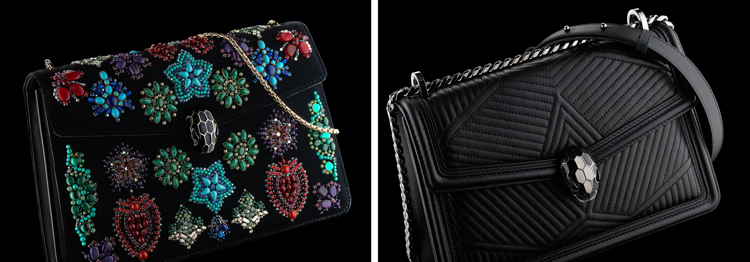
Which categories of bags will we see in this collection?
You will see more across the Serpenti range because we are developing it with new shapes. We used to have our iconic Serpenti Forever bag, and this year we have introduced the Serpenti Diamond Plus, which is bigger and quilted. We are also introducing a bucket bag which has a softer shape. So we are developing Serpenti with more attitudes.
Who is the woman you are designing these bags for?
We are targeting a younger crowd but I think it is really about the attitude. We can think of a young client when we are designing, but it is more how a woman feels and how she wants to look than about her actually being young.
And why young women for this collection in particular?
When a girl grows up the first bag she buys is likely to be a black bag. Her first luxury will be something she can wear a lot. So we want to make the first luxury bag for a young client. The bags are for every day, but still very iconic.
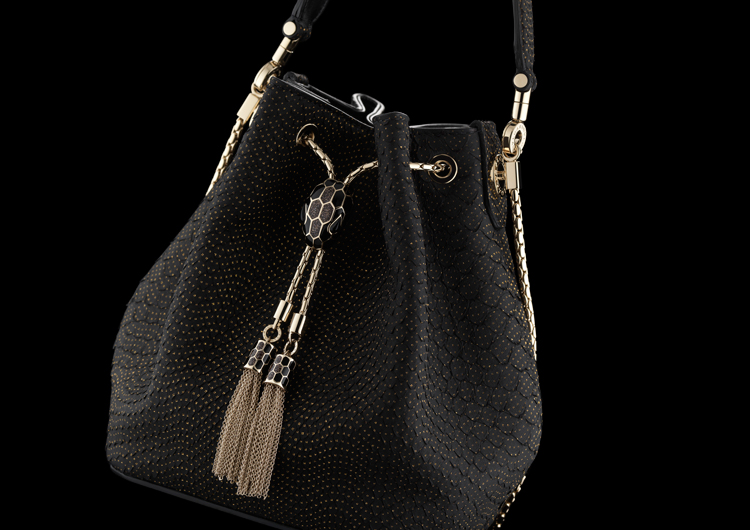
When we talk about black linked to practicality and functionality – how do you feel about the tote?
It is something we are working on and I actually have a prototype. I think what we have is perfect but we are still playing around with the shape. We are working on it and I hope it will be ready by June next year.
What are the challenges that you face to avoid repeating yourselves every season?
We have a team of designers that are working all through the year. We have been doing a lot of capsule collections that include exclusive pieces that you will only find in certain places or at certain moments. So we are trying to follow moments that are meaningful to the client. For the new collection we briefed the designers to work on the iconic shapes but animating them so they look new. Hopefully this will bring variety, whether it’s in the colours, the craftmanship or both. And of course we have new shapes. So Serpenti has a new trendy shape in the form of the bucket and for next season we are making a bigger one. We are also going to be launching a belt bag in the spring.
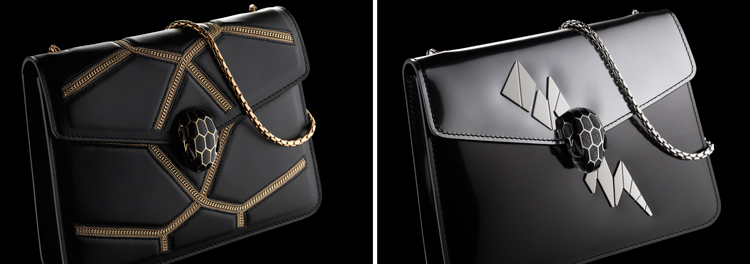
Do you think over communicating and over production on products kills the uniqueness and desire?
Yes I think that we have to manage for longevity. We don’t want to overproduce, we don’t distribute outside our boutiques and we don’t do wholesale, so we are already controlling this. I think that things do change from market to market. Look at something like Chanel – you still see a lot of people wearing Chanel, but it is still very desirable and they seem to manage it well. It’s a tricky thing to find the balance of doing business while managing for longevity and keeping the exclusivity. We are doing a good job to identify how we can build the desire.
a&e Interviews Riccardo Sciutto, CEO Of Sergio Rossi
As Sergio Rossi opens its boutique in the Dubai Mall, a&e talks to CEO Riccardo Sciutto about how he’s using the heritage of the brand to achieve global recognition and the importance of the Middle Eastern market.
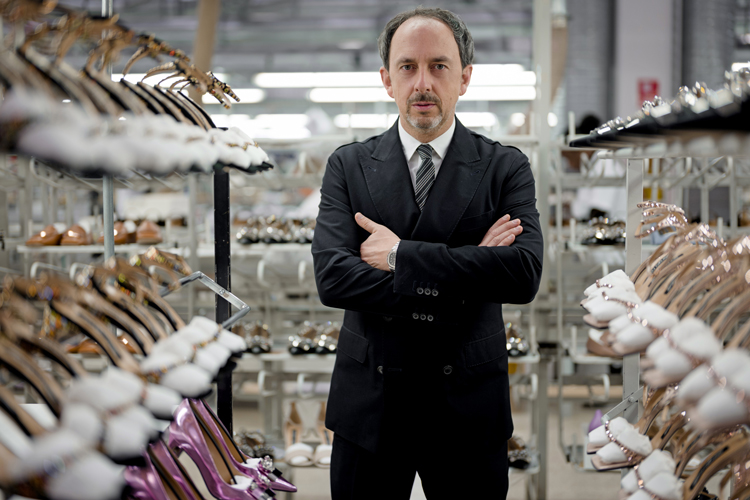
Sergio Rossi has a sixty-year heritage of beautiful Italian made shoes. This is something that as a luxury house they are preserving until today.
Their unique ability to hand-make shoes from start to finish, of the finest quality in the San Mauro Pascoli Factory is something quite unique and at the core of the brand. Riccardo Sciutto was appointed CEO of Sergio Rossi in 2016. With a background in luxury Sciutto most recently held the position of General Manager at Hogan (part of the Tod’s Group). Sciutto’s appointment came just one month after Sergio Rossi was appointed by Investindustrial, with him being brought in to develop a new chapter of the brand in the form of a relaunch and development for the future.
Sciutto worked from day one on rebuilding the credibility of the brand with taste makers and industry insiders. He recovered key pieces from the Sergio Rossi archive, studying its roots and DNA closely and creating a versatile, seasonless collection; SR1, which has become the symbol of the rebirth of the brand. Sciutto reconstructed the management teams, from design to communication, and put the San Mauro Pascoli Factory back at the centre of the story, enhancing the greatness of Italian craftsmanship and shoemaking. With a complete new plan for international store openings and refurbishing – in line with the new direction of the brand – the new era of Sergio Rossi is centred around the idea of ‘thinking heritage and playing digital.’
Part of this new direction incorporated the brand’s first store in the Middle East inside Dubai Mall’s new Fashion Avenue extension. On a recent visit to celebrate this milestone opening, A&E met with Riccardo Sciutto to talk about the new direction and why the Middle East is so important to them at this moment.
You are opening a store in the Middle East for the first time, why now?
As we open here it is very important that we tell the right story of Sergio Rossi. The story is sixty years old, so you have a great story which we have told all over the world, but we have never had the chance to tell it in Dubai as we have never had a store here. So now is the right time to do it because Dubai is one of the key cities in the world. You have people living here from over 100 countries so you are really speaking to a small world within the same city which is amazing. Personally what I love about Dubai is how everything moves so fast and is growing so much. There is a lot to learn, a lot to tell and great opportunities, so it was natural to be here.
What can you tell us about the Dubai Mall exclusive collection?
I believe that women today want to be sexy but they want to be more feminine. So we started with the SR1 archive collection. With a low heel and square shape. With the exclusive collection we took the idea of the SR1 and we gave it a diamond plaque. We have a beautiful silk fabric and we also have an incredible sandal that’s very wearable.
Who are you targeting with this collection?
I think there are no longer different types of women. Today all countries and all types of women are coming very close to each other. What is different is the time they arrive at certain points, but if you are telling one story you need to be consistent. If you look at the new generation you cannot be targeting one country or the other as that is a big mistake.
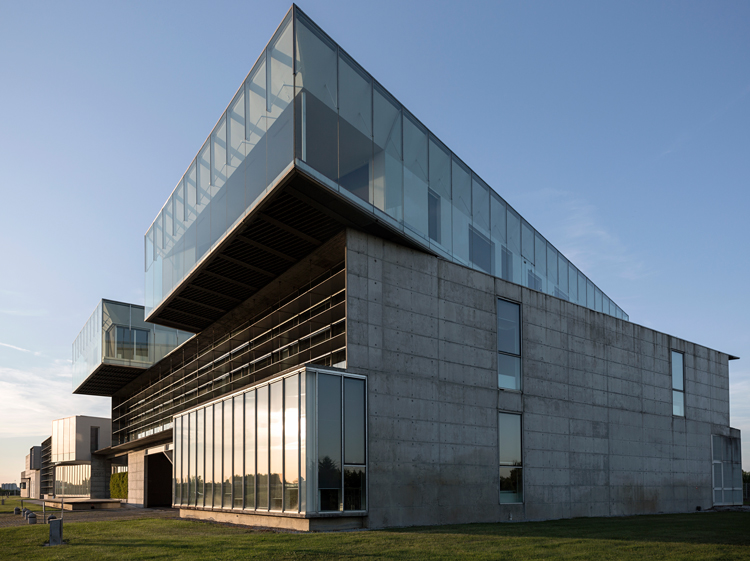
What do you think women in the Middle East are looking for in a shoe?
It’s the same as all around the world. The first question we had when we opened the store was ladies asking for a lower heel. Everyone is wearing lower heels. Today there is no ‘Middle Eastern lady’ or ‘European lady,’ today it is just the lady. We are all travelling like crazy. The world has changed because of aeroplanes and the internet. Everybody can be everywhere in the world. Today’s lady wants to be modern but they want to feel OK. They no longer want to prove themselves to each other, they just want to feel good.
The core of Sergio Rossi is the factory – what can you tell us about it?
The factory is the difference that we have over anyone else. 30,000 square metres with 120 people making 1,000 pairs of shoes per day. It takes up to 14 hours per shoe. Everything is done internally. It is really amazing because we have also revealed the archive at the factory. We are the only factory able to do some of the most difficult techniques in house.
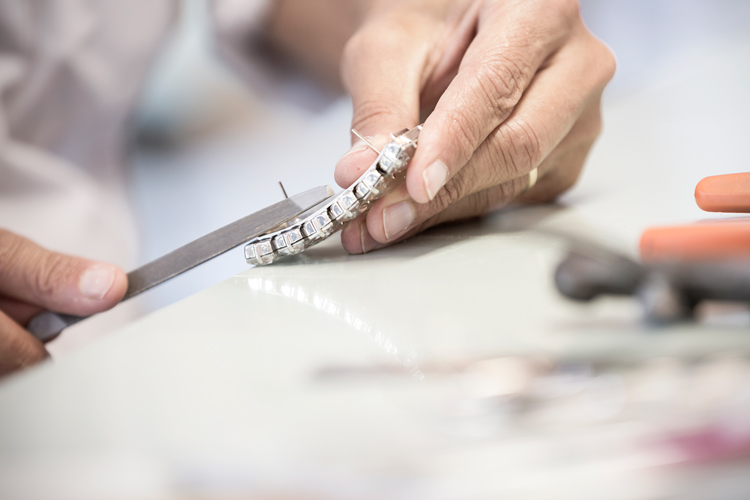
What’s your position on sustainability?
We already produce 20 per cent of our energy from solar power at the factory. We have approved all energy reducing for the next three years. It is something we don’t express in our marketing, but for me it is crucial that every company thinks about this today. For all of the cuts of leather that are not used we have a company that collects it and reproduces leather that is sold and re-used by other companies. We also sell to local schools and they do artisan works with the pieces. This is crucial today and luckily for us this is normal now. There are a lot of brands that are not doing it, but for us it is already under control.
Is there something at Sergio Rossi that you still want to achieve?
Absolutely! We’ve established the factory, the message, and the story of the brand, we have the new shoes of the future and we are established in Milan. Now the next step is that we need to go worldwide.
We have branches in Japan, China, America and Europe, but we need to focus on the Middle East. We are opening a store in London and this will create a close partnership with Dubai. We have stores opening in New York, (close to Tom Ford, who loved Sergio), we also have a pop-up store opening in LA in January which will be fantastic. The point is that now we have an incredible product, what we need to do is to tell the people to come and try the shoes, because when they try the shoes they will love them.
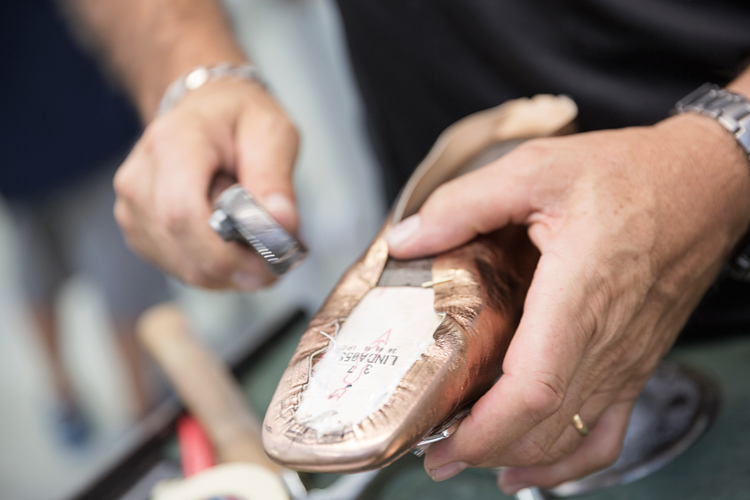
How would you sum up the vision you have for the brand?
We make timeless shoes for the modern lady. They are handmade in Italy so they have incredible capability, but it’s also a modern shoe for a modern lady. I don’t want to be following fashion trends because that is very risky. You have fashion today, tomorrow you’re no longer on trend.
How would you define a timeless shoe?
Timeless is that it can be worn all day long. You can dress from the day to the night and you feel great wearing one shoe for an interview, for work, for dinner. Today there is no time anymore for ladies to dress only for day or for evening.

How important is comfort in shoes?
Comfort is in our DNA. Sergio Rossi was always looking to find comfort in his shoes and today I am following him on this same philosophy.
You are now using social media and digital marketing, what impact has that had on the brand?
For us it was crucial. We started on Instagram and we grew from 60,000 followers to over 800,000 in two years. And this is organic growth. We are the fastest growing luxury brand worldwide in terms of percentage. We also create content internally. I hired a team to create dedicated content. The thing I love about social media is that we can make mistakes, if we don’t like something or it doesn’t work we can change it. It’s very important to have a team internally who understands the DNA.
How do you feel about endorsements of your products?
We believe in real endorsements. Making an organic story using people that really love it and wear it. If they don’t like the product after one year it will fall apart.
How do you balance keeping the exclusivity of a brand when everything is so accessible?
This is the crucial part. We are not a one billion dollar company and we don’t want to be that. If I want to preserve the DNA and the capability to internally produce the parts of the shoes we cannot be that big. But I do think that from being very close as we are today, we can open up our view globally a little bit. We need to spread the story and thanks to media and social media we can speed up the process a little.
How do you think the brand can maintain desirability?
Today it is different from the past. You need to be very fast, and coherent with your DNA, innovative and full of energy. If you can try to mix all of this well, the wheel will turn.
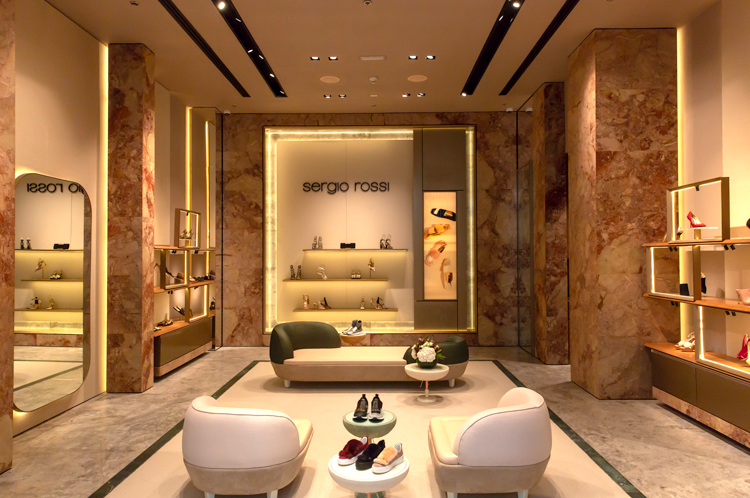
To what extent do you think co-branding is something that a lot of brands are looking into today?
If it is linked to your DNA and it is helping you to spread a voice – I love it.
How important are stores to the luxury experience?
For me the store is more important than before. You cannot have as many as before, but not having a store that gives a good experience is a big mistake. Obviously it’s easy to say “I’ll close the store and open online,” but online you take only a part of the customer and you only give a part of the experience. You cannot skip the possibility to give the customer an experience. It must be a positive experience, well treated, well organised, using people who understand the brand and who will tell you something you don’t already know – that’s what I love about the store. Every few months I want to drop something special only in the store for the customer. That’s the way to make them realise that they need to go there.
How would you describe a woman’s relationship with her shoes?
I have worked with apparel, jewellery and shoes. Shoes and jewellery are very similar because they give you the capability to understand a lady. Shoes have one plus – you live your life in your shoes. You are literally on your shoes all day every day so this changes a lot psychologically. This is why shoes are the centre of the luxury business today, because you have such an intimate relationship with them that is incredible. You can put twenty ladies in the same dress but with twenty different pairs of shoes and you will have twenty completely different ladies.
What is your personal motto?
Happiness is the essence of life. If you are not happy and you don’t enjoy your life you cannot move anything.
What about your professional motto?
Think heritage, play digital. This is very linked to Sergio Rossi today.
What do you say no to?
Injustice.
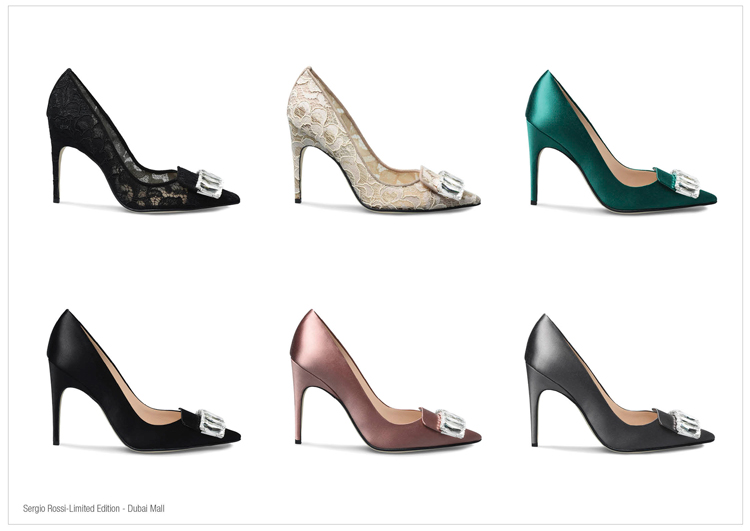
What is something you would never do?
I would never physically hurt someone. This is a way of my culture.
What’s the best piece of advice you have been given?
Always be coherent. In yourself and in the story you are telling.
What book are you reading?
I just read an economics book on the flat tax in Europe. It’s very interesting. Politics is not something that is in my DNA but everybody needs to read this book.
What do you tell yourself every morning?
You will do it. I’m a very positive person.
When you feel that you’re stressed, how do you re-energise yourself?
I look at a photo of my family and I tell myself I’m a lucky man!
What is your biggest challenge at Sergio Rossi for 2019?
To show the world what we made and to gain more visibility.
CEO Of Valextra On Taking The Brand Global
AS CEO OF LEATHER ACCESSORIES BRAND VALEXTRA, SARA FERRERO HAS BIG PLANS. A&E TALKS FUTURE SUCCESS AND HER VISION OF WORLD DOMINATION FOR THE NICHE ITALIAN FASHION HOUSE.
Valextra is an accessories house that has in fact been around for over 80 years. Founded in Milan in 1937, by Italian Giovanni Fontana, it specialises in niche leather products. Valextra became known for creating the first cabin bag. This was in 1954 when flying was a rare luxury so the bag was a truly innovative design. Throughout the years Valextra has strived to continue with the idea of innovative, unique bags, including the first 24-Hour attaché case, the first ever Grip coin purse for men and the first ever hobo bag for women.
Today Valextra has opened a new chapter but still intends to do much the same. With a mission to provide unique luxury bags. Valextra has perfected a clean architectural design that is unusual, yet recognisable at the same time. Since 2013, it has expanded from one flagship store in Milan to boutiques worldwide, as well as the recent launch of its global e-commerce platform. Who better to talk us through Valextra’s plans for the future than CEO Sara Ferrero? Sara joined Valextra in 2015, after working at Furla and Joseph following a career in investment banking and consultancy. She has ambitious plans for Valextra, and aims to take it from a niche brand to a global powerhouse.
What makes Valextra stand out from other brands?
The philosophy of Valextra has been around for 80 years, so it’s quite established. It has always been an architectural design. There’s something very embedded in the bags that is connected to Milanese culture. And that is something that defines the consistency and the way we have always approached our products as well as the way that we treat the store space. Today our brand is about the product, and the experience that you live and also the exclusivity. Our approach is what we call engineered building.
You cannot buy an object if you don’t like it, so fundamentality it has to be beautiful, because a bag especially is a little bit like your home when you go out! You put your most intimate things in your bag, items you wouldn’t leave alone in your home. So there is a relationship with the owner that is very intimate. This means that the inside of the bag is as important as the outside, but it is also something that will tell others about yourself. So we ask “how can we create a beautiful object that is also functional in today’s world?” We always try to come up with some element of innovation. We think about bags where you can pull off the pocket for example, something where you can add a strap and turn a bag into a rucksack, we look at the weight of the bag, all of these elements make us unique.
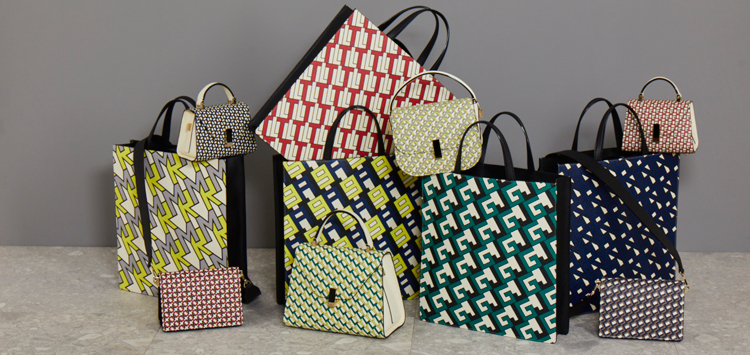
Tell us about the monogramming on the new collection.
Valextra is very graphic and modern. Typography is actually used in an interesting way that creates patterns but doesn’t necessarily scream your name. What is incredible about the monogramming is that we can do a collaboration directly with the customer who can choose their initials, decide their best colour, and the bag they like, and their personality can go into it. The smaller the initials for example, the more feminine, the larger the initials, the bolder the statement. For me this was how we moved from being a self-celebration of the brand to building a relationship and a celebration of the person that is wearing it.
What is an objective that you would still like to achieve at Valextra?
I have a lot to achieve! I think the achieving never ends. I have worked at many companies but the values that I recognise as a person come out in Valextra. It is a small brand so for me to be talking to you today and allowing people to discover the brand, is very important.
What are the challenges that you face today as a niche brand?
The market has changed a lot from when I started my career. People today are looking for beautiful special things that are different. They already possess a lot of beautiful bags and products, so they are looking for something unique, without compromising on quality. This is a lucky moment for Valextra because people are more open to accepting brands that are not necessarily the big mega-brands. Another positive element is that today the culture is of a young, digital mind. There are a lot of young incredible people that like the idea of a company that is smaller because they feel a part of something they can learn from. The last thing is that the customer is becoming more interested in quality.
Quality is becoming the factor that goes beyond the wow moment. What I think is very interesting for me is recently how we have a sudden reaction for our bags in our stores. The customers today know what they want.
What’s your vision and direction for the brand?
I think this is a brand that can go from a niche to a bigger brand. There is a lot to Valextra that goes beyond the product, so I think we have the possibility to bring substance, values and culture. I am seeing that a lot of people are wanting something true. This is an honest brand and that is something that people are looking for. This brand deserves a space in the bigger world.
What is your personal motto?
No is not an answer, you have to want it and you get it. You can have it all. Always be yourself and never give up.
What would be your message to young entrepreneurs?
There are no shortcuts. You have to be a listener. You can be incredibly talented but you have to work hard. Still always maintain a balance between work and life, because at the end of the day, if you don’t have that then you have nothing.
Valextra will be opening a store in Dubai Mall’s Fashion Avenue extension in early 2019.
Breitling Hold Their First Summit And Debut Premier Collection
First Breitling Summit was held in London with the Swiss watchmaker presenting a re-imagined collection of their iconic timepieces.
It was a journey of discovery that revolved around products and novelties inspired by the brand’s four enviroments : Air, Land , Sea and The Professional. I enjoyed learning more about the #sqaudonamission campaign and some great behind scenes moments with the renowned photographer and film director Peter Lindbergh.
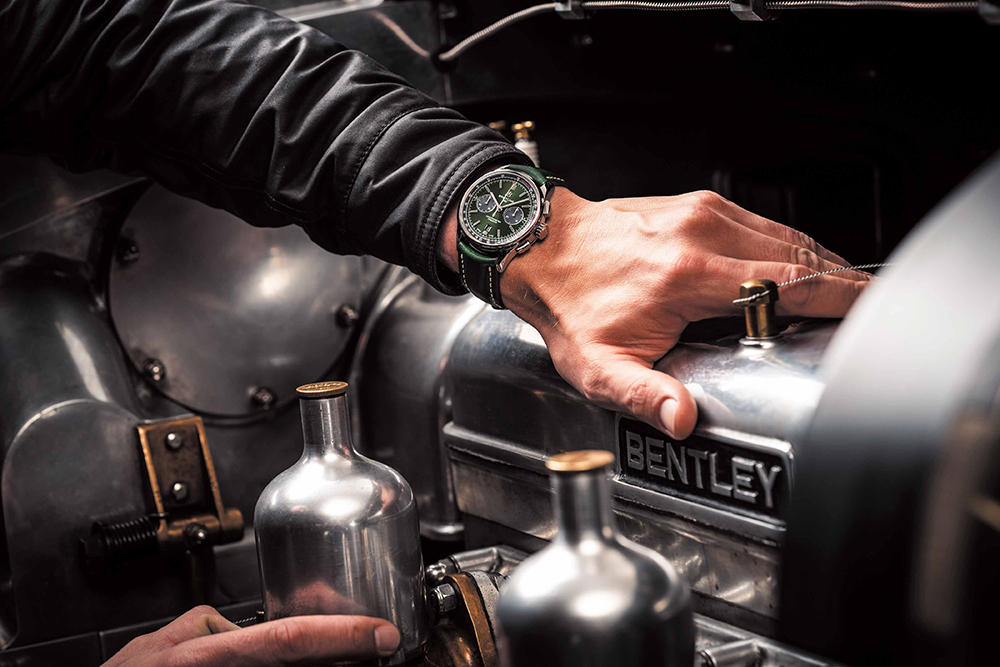
CEO Georges Kern is leading the 134-year-old brand into the future with a look back on the heritage. among the summit highlights was The new Breitling Premier collection that presents five pieces inspired by the Forties and combines purpose with style, delivering quality, performance, and timeless design.
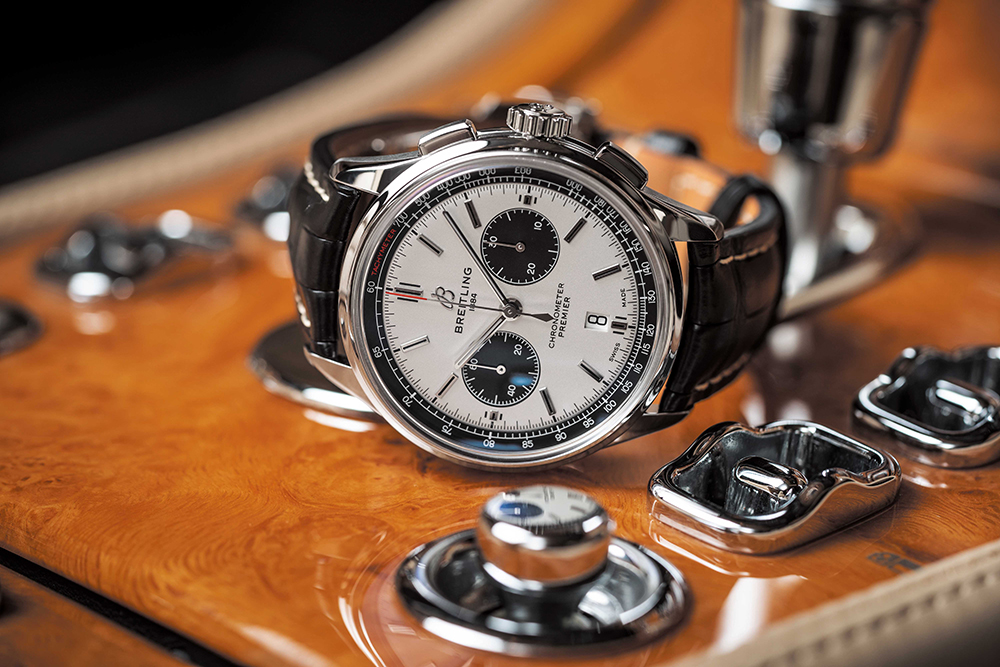
“This is the first modern Breitling collection dedicated to everyday elegance. With outstanding quality and performance, these watches bear our unmistakable brand DNA, but they have been created with a focus on style that beautifully complements their purpose,” said Kern.
While the collection is specifically dedicated to Breitling’s “land” environment, the design team were also influenced by some of the brand’s early models.
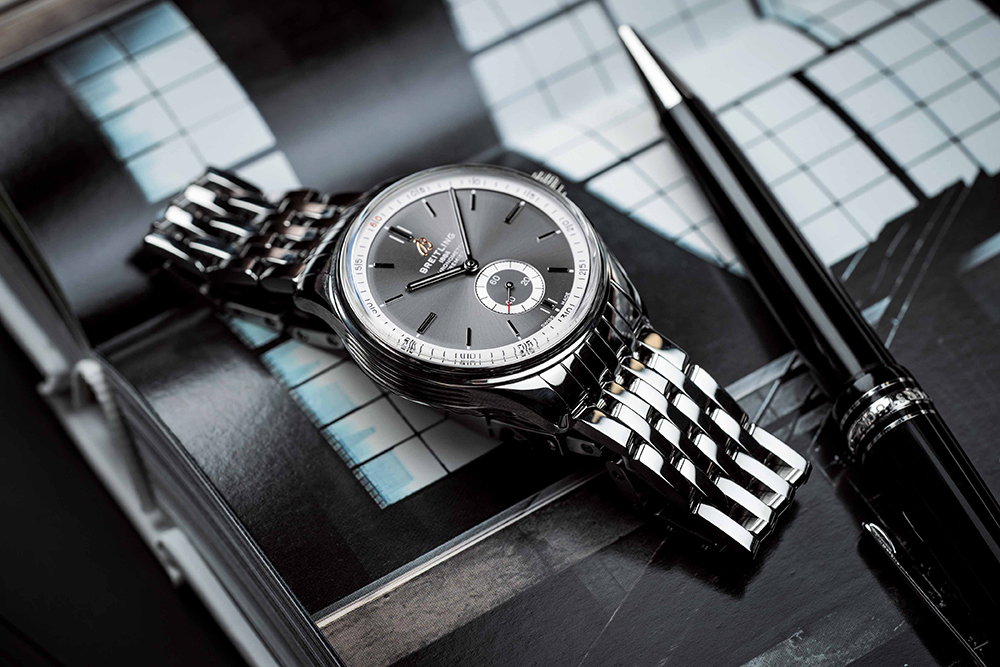
The collection includes chronographs – the cornerstone of the brand’s global reputation –, day and date models, and understated three-hand watches with a discreet, small second subdial.
Kern’s vision for Breitling is stepping into a bold new direction to reach new and style-focused consumers.
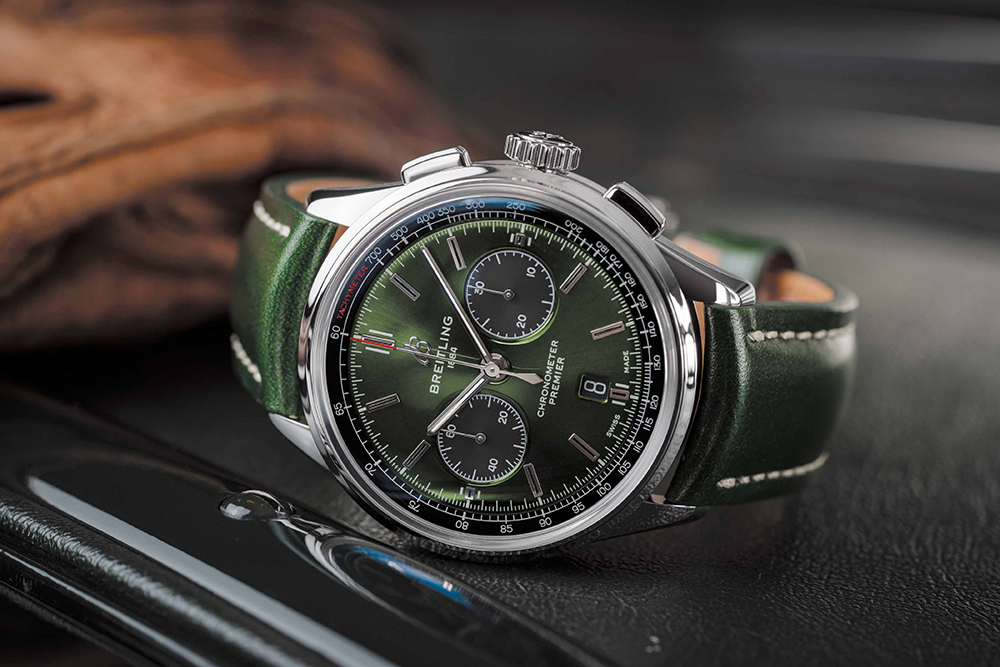
“There Is No Impossible Dream” Says CEO Of Pomellato
Sabina Belli, CEO of the Pomellato group talks to A&E about the history of the brand and why the future is bright.
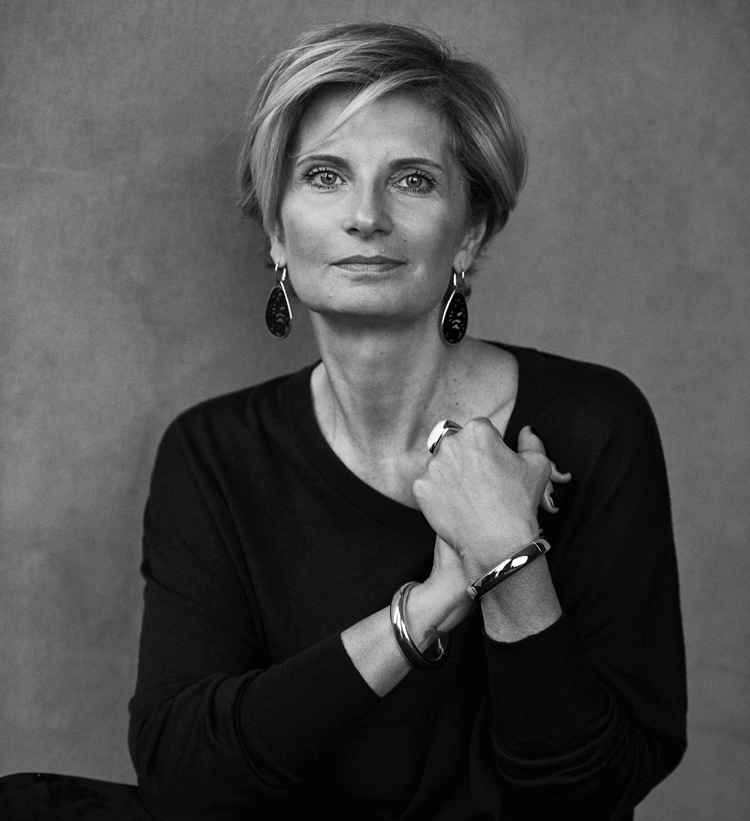
Sabina Belli joined the Pomellto Group as CEO in 2015. With a background in luxury fragrance at Dior and LVMH, she then joined Bvlgari before taking on the role at Pomellato three years ago.
A self-confessed personal client of the brand, Sabina has found a harmonious balance between luxury and jewellery at a House she feels passionate about. Ahead of their new season launches Sabina talks to A&E on her plans for the future of the brand, and why it’s more important than ever to recognise its history.
Tell us about your vision and direction for Pomellato.
First of all I would like to say that I could not define any forward strategy without really diving into the brand and understanding where it comes from, from an inside point of view. I got my first Pomellato in 1989 – it was a vintage ring with an oval aquamarine stone that I still own of course and still wear. When I wear it some of the people from the production team recognise it and they feel very honoured to see it again. The reason I’m telling you this is because I am convinced that as a client and a woman I had a very strong relationship with Pomellato as a brand, and then when I joined I felt that I needed to go and scout a bit more into what Pomellato was in terms of a company and a story of success. And I really realised that there were a few pieces of information that had not been taken into consideration, so far that in my view, totally defined the mission of Pomellato and what it could represent in the world of jewellery for the future.
Such as?
I think that when you do brand development people don’t spend enough time understanding the man or the woman behind the first creative intention of the brand. And then when you start trying to understand better this personality, you have a lot of answers on what the brand stands for. So in that respect I picked out of the history three very major pieces of information. The first one was about Mr Pino Rabolini. He was a Milanese born man from a long dynasty of goldsmiths. The second was that he launched the brand in 1967, and the third is that he did it by observing the Milanese women. When you put together these three threads you can start knitting and you realise a number of things.The year 1967 in Milan and in Europe was a very particular time in our social history because it was a time of rupture and breakthrough between two very conflicting generations. The new generation was born and raised during a shift in history that was very much seeking freedom and a new way of expressing themselves. That led to the first feminist demonstrations and then of course the hippies and The Beatles and all that. And so that is very important because it was a time of breakthrough, and whenever there is a major change in a society’s life it is a moment when creativity is a pinnacle. It was a time when people were seeking more information and becoming more free, and it was also the birth of pret-a-porter. That defined a new way of wearing jewellery – whereby women were not waiting for a special occasion, but rather using jewellery as an accessory for everyday life. He [Pino Rabolini] understood that, and he was the first one to design a much more simple, more organic modern design of jewellery that would compliment the look of this modern woman.
The women understood that and started to buy this jewellery for themselves, without expecting a man to gift it to them. And so it became a community of very strong, powerful, independent women that were choosing jewellery because of their taste and not because of the brand or because it was a gift. This information was so important for us to understand the personality of the woman and the creative intention to be a very fashionable, precious brand. I think the more Mr Rabolini understood that the jewellery line had to go through this fashionable style, the more he had to counter balance the fashionable aspect with extremely high end craftmanship and quality. This is precisely why we still have 100 goldsmiths at the ateliers. This allows us to have very bold and surprising shapes. So in terms of DNA and history, we have the heritage of goldsmith and craftsmanship, we have the heritage of this man that was a visionary for a new style of jewellery and this is what we want to promote to our clients.
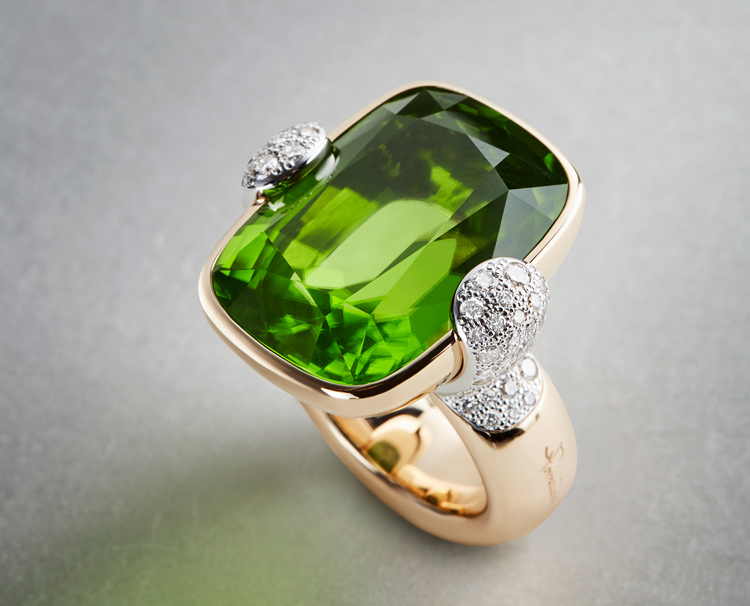
How is the new generation relating to the history?
We are still nurturing and developing these elements and we see that all of this is very much resonating with the modern and contemporary women who buy for themselves. They also understand that the power of their spending can be defined upfront. I think that when you take time to show the consumer how these products are made, there is this amazing element of emotion and a real bond that is created with the brand, because there is a huge amount of respect that all this human savviness is put into our job. I think that people that live in a virtual world will be fascinated by the tradition and the work of the hand of the brand.
What is a challenge you face today as a brand?
Business wise the number one challenge is always to make sure that you have enough visibility and enough power in terms of getting into the arena of choice of the consumer. Of course this is a world where you are fighting against a lot of huge players, but on the other hand we have the chance to create a very strong bond with the consumers. Our consumers are very faithful to us, they become themselves our best ambassadors.
Have you done any research to see if Pomellato customers are returning customers?
Yes we always have returning customers. We have a very strong faithfulness. Particularly because of the stackability. If you get yourself one piece you will come back to get more. That is a situation that is very recurrent and we like that!
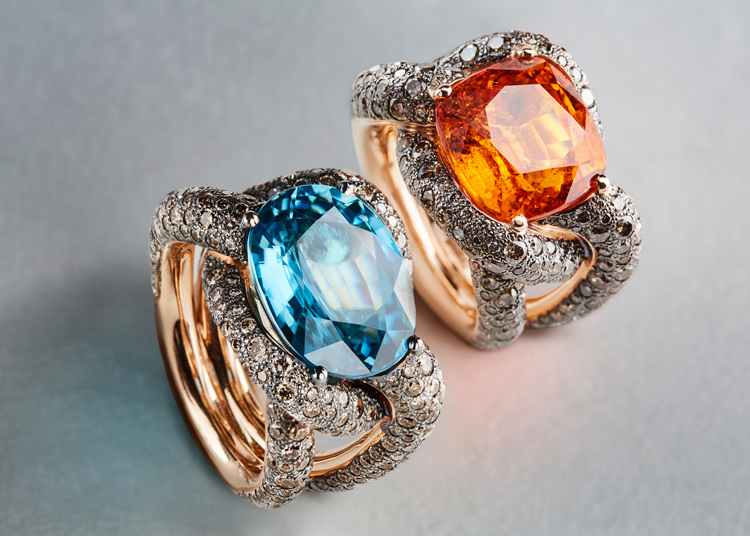
What is one thing that you would still like to create and work on?
There is this absolute need on our side as jewellers to educate the consumers and not to just throw out novelties and products in the hope people will love them for simply what they are visually. I think it’s important to take people into the journey that we go through before getting to a finished product. I really love to educate about the gems – there is so much magic behind that. The mines, mother nature, where they came from. I actually had the honour of visiting a museum in Beirut where they present the natural gemology and that was fantastic. Also the setting of that museum is amazing. You get to see that there is something a bit scary and impressive and mysterious when you look at these gems to imagine and the journey that they have been on. And through the new collection you see the mineral gems. These are all hard stones. The magic of these stones is that when you see them in big sizes, they just look like coloured gems, and then if you spotlight a specific part of the gem, and cut it right there, there is something special that happens. In this way you can reveal to the public the hidden part of the story which is that this is a world of fascination and mystery.
What’s your input on the trend for brands to become ethical and give back to society?
First of all I want to stress that as being part of the Kering Group, this is absolutely essential. This is at the heart of the major strategic axis of Kering. We have been having conversations about sustainability for many years now, and we are very proud to announce today that as a jeweller, we are sourcing 100 per cent of our gold in ethical mines, and so that makes us very proud. And we also have taken a very strong stance on fairmined diamonds. We have launched a collection called Nuvola, which is the merge of these two approaches. We are also going to implement as much as possible this same path on coloured gems. We have already started collaborating with Gemfields, in order to source the most traceable stones, and of course fight against child labour. And on the other hand we also have a very strong implication on whatever is linked to women – giving women chances to get careers. We are also very much active in supporting foundations that fight against domestic violence and we are partnering with support groups that help women that suffer from domestic violence abuse. And finally we have a very new and motivating initiative which is the one to favour and develop the work of goldsmiths among the young generations. We have paired with a school in Milan and we have financed a new academic path that will take the students to a diploma that recognises them as goldsmiths. I also sit on the board of the Kering foundation, which is a foundation that helps to support women all over the world.
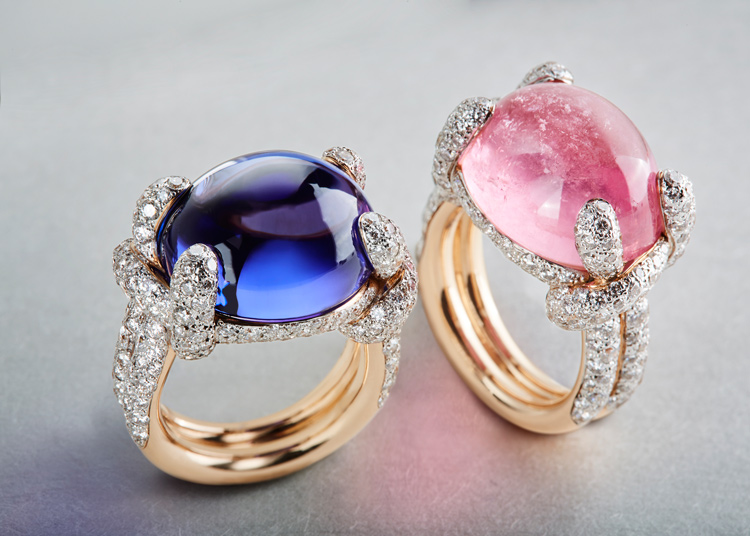
Why brought you to the jewellery industry?
It’s a long career in luxury. I’m a very luxe person, because I have always worked in luxury. I started at L’Oreal working for the licences of Armani. I started really understanding the power of aspiration and dream that is linked to luxury there, and then I developed my career at LVMH for 21 years. And then I was given this amazing opportunity to move to Rome and join Bvlgari which was an incredible, really unique experience. And then by coincidence, my path crossed the one of Pomellato.
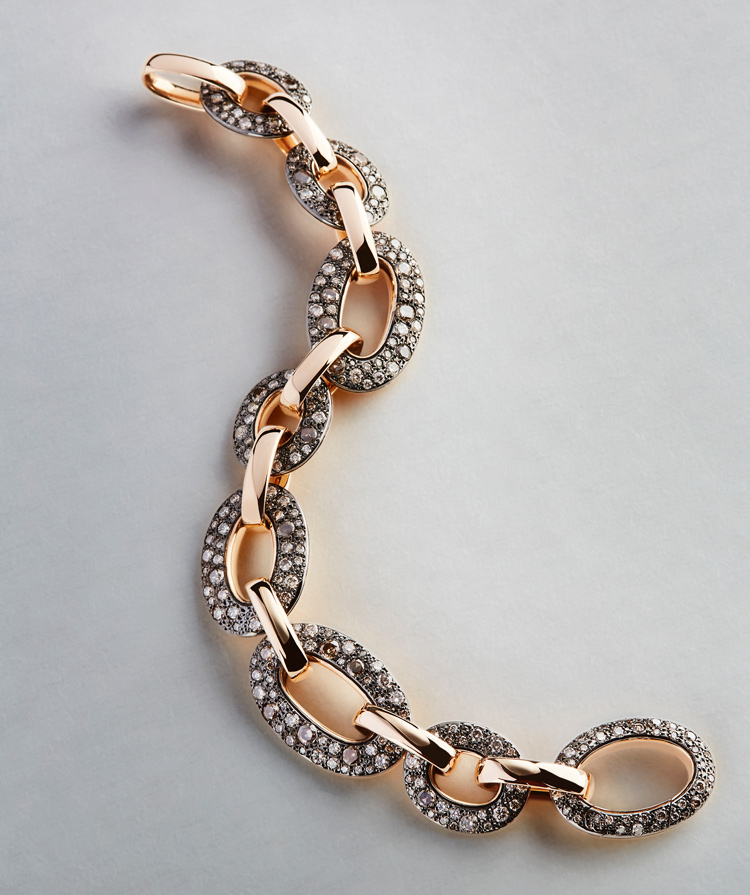
How do you define luxury?
I am one of the people that believes luxury is absolutely not futile or superficial but it is absolutely compulsory. It is at the heart of the mechanism of humanity. Since the dawn of humanity, human beings have always aspired to something better, or to look up to something that was bigger than them, and that is probably how religions have been created. To pay tribute to something that was beyond comprehension. And somehow I still think that was is really beautiful and precious and made with high quality material that creates a strong emotion, is of high aspiration and will always be of high desire, because you want to get as close as possible to the extraordinary. So to me luxury has a philosophical meaning. It’s really part of our civilisation. You see luxury in everything – in the most simple cultures or tribes, where the selection maybe a shell or a fruit as an element of extra ordinary because it’s rare or beautiful. And sometimes this is even given as a gift or reward. So that for me is very important.
If you ever worry about making a decision, where do you go to?
I tend to rely on two elements that are very innate in me but I have also maybe developed over time. One is adaptability – I adapt very quickly to people and situations, and also to strategic analysis. I tend to always observe and then adapt to what the observation is pushing me to do. And then the second thing is the intuition. My intuition has so far not failed me! I think at one point we need to be fast, and we need to have a lot of faith and trust in what we see and what we do. I think the best performers are the ones that decide fast and don’t have too many doubts. And also surround themselves with very strong people who are in a spiral of positive thinking. The moment you install a doubt everybody doubts and the doubts become a big thing. If you are in the mood whereby success call for success people will follow you. And I think that is very important.
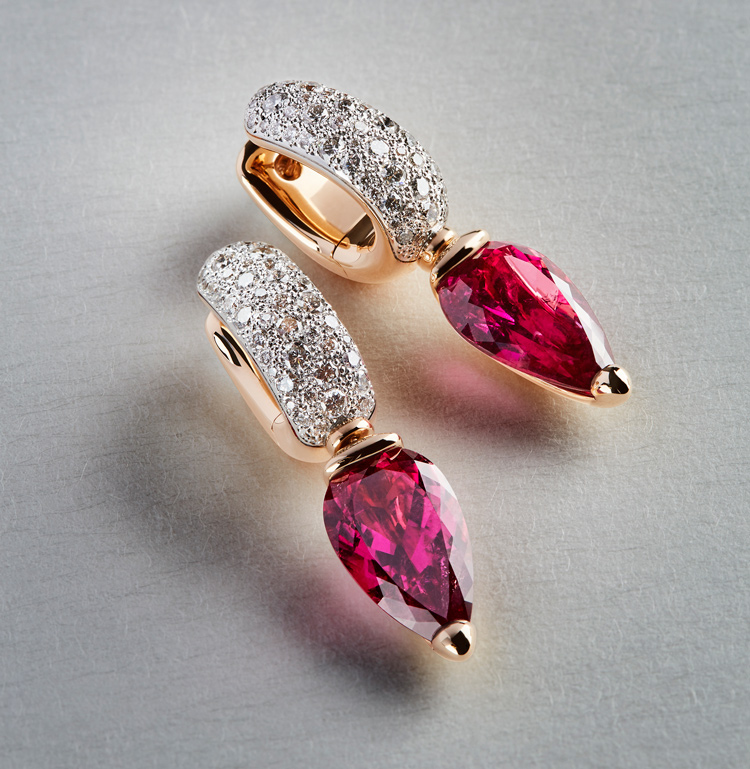
Is there any other message you want to give to women?
There is one other thing that I have probably suffered from, and that is that women are not self-assured and self-confident enough. They always doubt their own potentials and strengths. Because maybe we have been raised for so many years with an obligation of modesty and humbleness. When you see women talking for example, they always say “excuse me if I say this.” Why should you be so careful about your ideas? I always want to communicate this feeling that there is no impossible dream, you just need to believe that it is possible. This applies also to corporate and business life. We should always think big. There is something that maybe culturally for so many centuries maybe prevented women from thinking big, because it was not humble enough, but think big girls! Don’t have anyone make you think that you cannot make it.
What would be your personal motto?
There is always a solution to everything – and the solution is inside of you.
What do you hate?
Injustice.
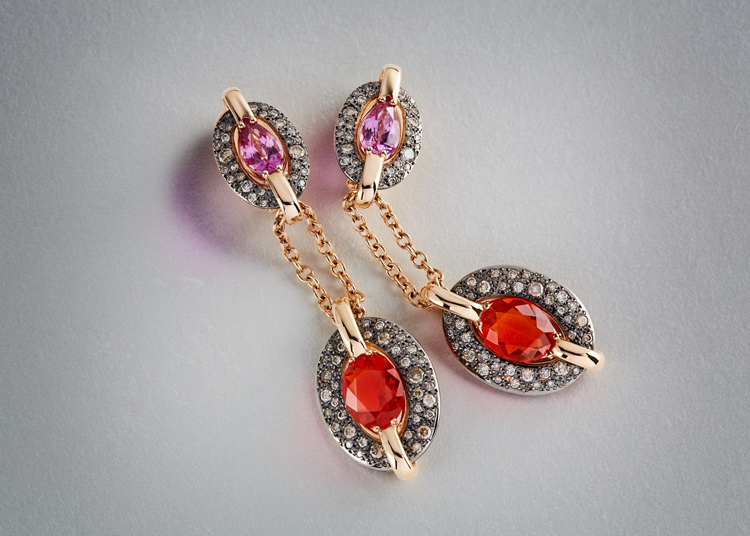
What book are you reading?
A book about Simone Veil.
If you weren’t doing what you are doing today what would you do?
Lasagnes!
What would be your perfect getaway?
A Greek island.
How would you describe Pomellato in one word?
Unconventional.
How Lucia Boscaini Tracked Down Bvlgari’s Iconic Jewellery
As Bvlgari presents a tribute to femininity exhibition in Moscow, we talk to brand and heritage curator Lucia Boscaini who was tasked with bringing all of these iconic jewels together for the first time.
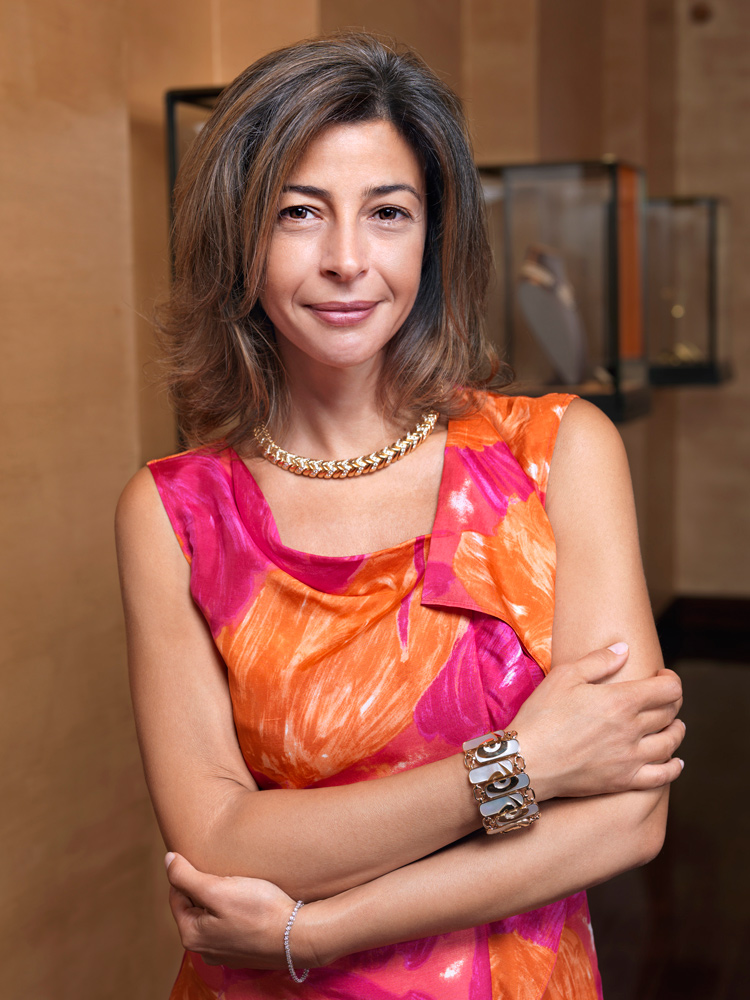
As Bvlgari’s Brand and Heritage Curator Lucia Boscaini has a huge job on her hands. Not only is she responsible for sustaining the image of the Blvgari House she also plays a major role in searching for and buying back iconic pieces of jewellery from the brand’s history.
Many of these pieces are subsequently displayed in exhibitions around the world, helping to showcase and celebrate the legacy of the iconic jewellery House. This fall presents “BVLGARI. Tribute to Femininity” – an exhibition in Russia, presenting some of the House’s most magnificent pieces of jewellery from decades past.
Housed at the Kremlin Museum, the exhibition includes over 500 pieces of jewellery. Lucia Boscaini was the brain behind this beautiful exhibition; bringing together all of these pieces for the first time. Lucia’s job goes further than just organising exhibitions of these pieces – she is also responsible for finding and tracking down these pieces of jewellery from women all over the world, each of whom has a unique story. Here she shares with us her experience, and why this particular project is such an important milestone for the jewellery house.
Can you tell us a little bit about how you put this project together and why you chose this location?
Well the reasons why we wanted to be here is because of the Kremlin Museum has an expertise in jewellery. They have a permanent collection that is really very precious, and in addition to that the directors are experts in jewellery. The last 10-12 years have seen really beautiful jewellery exhibitions here. Also from Bvlgari competitors. The museum has this kind of credibility. So that’s why, when we started planning, and looking for the top museum in the world where Bvlgari would like to be – the Kremlin Museum was really top of the list.
What were the decisions in choosing the pieces that you decided to exhibit?
We have this frame of femininity and a new perspective to go through the archives and the many documents that we have. We sort of re-lived the history of the brand through the women that wore the jewels. This was in a way the easiest way, to start from the movies stars as they are very famous women, but we wanted really to enlarge it much more, and that’s why also in the exhibition you have many pictures of common women, women who are not celebrities or top models, but that are clearly wearing jewels in a way that is very into their time and into the fashion trends of their decades.
In the last few years it came to light the importance of the role of the Heritage Curator – this role has developed to be in the forefront of the Maison – tell us about your role at Bvlgari.
My role is Brand and Heritage Curator, so it’s not only the heritage it is everything. I am part of a larger team that is the marketing and communication team of the company. So I am really into the business side of the company. This is to me my main mission – to protect the identity of the brand in all we do. Then of course to go into detail there are a number of activities: We protect our archive – meaning that we are digitalising it, we keep researching, we keep adding documents; because I’m sure that there are many out there that we do not have yet in our archives, so it is a real research activity. Then we take care of the buy back of the jewels. Jewels are most direct and clear way to tell the identity of the brand.
The collection we have now has a good reach but it is not quite as diverse as we would like. We have a clear strategy in mind, we know the gaps that we have to fill, and so we are working to keep looking for the right jewels for this collection. It’s really quite hard now, because we need exactly a certain type of jewels and it’s not easy, but it is very, very interesting. Meeting people that own the jewels and tracking the stone. There are few records of the past in terms of clients so it is a matter of networking and word of mouth to discover these treasures. For instance, especially in the Middle East, we know that there are many beautiful jewels from historical periods that we are looking for. Jewels from the seventies and eighties but it’s not easy to get in touch with these people. It’s very emotional and it’s a matter of trust as well.

Tell us a story of finding a piece that is part of the collection.
The one that comes to my mind is related to the snake [Serpenti]. We are trying to get connected to owners of jewellery to create trust and then finally convince the to sell or at least to loan us the pieces. And so every now and then we have very small exhibitions of Heritage jewels. One was in Naples during a premiere of a calendar. We had a small exhibition, a few windows with a few jewels. There was also a window with Serpenti on display. A very small old lady came to us and said “they are beautiful jewels, I didn’t know you have these kind of jewels, I had one from my husband a long time ago and I didn’t even know it was Bvlgari.” So we got in touch to visit her and the subject was one of the very first Serpenti from 1954. This was an early design so to us it was extremely interesting to market the evolution of the snake. The proportion and the scales were very differnet in the nineteen fifties. I personally love this piece because the head is very peculiar and the snake has an eyebrow! It is so unusual and to me this is one of the best Serpenti items that we have. The way we got it was so interesting. She was very proud to sell it to us. This is the kind of story that always touches you. There is a lot of human touch in this kind of job – it is quite fun and quite different.
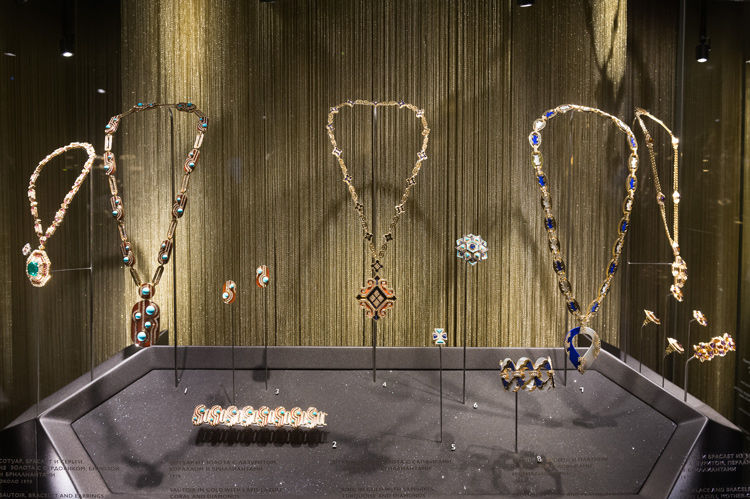
Across history jewellery has always been created to reflect the times – do we still have this these days?
Of course we do – we cannot do it differently. I think in every expression of creativity, be it jewellery, fashion or art – if the creativity is not into the times, it’s not really understandable. It doesn’t work – not in a business perspective but in an emotional perspective. There are of course sometimes designers and artists that are too early for their times. I absolutely believe that each collection is a reflection of time. The jewels that I’m wearing today for instance are completely different from the bold more architectural jewellery because that was a different time. In the seventies it was more recognisable motifs, in the eighties and nineties it was more clean, just a shape that didn’t represent anything it was just a design. So this kind of evolution in style is really going parallel with the evolution of the lifestyle of women.
To what extent is it still crucial that jewellers are revisiting the pillars and archives and reinterpreting – or does it signify a lack of creativity?
To me it’s simply a matter of identity. Each brand has an identity that’s made of different ingredients – the aesthetic codes, the values, the philosophy. To me, to be rooted to the heritage of a brand, it’s really essential in maintaining the identity and making that brand recognisable. If every brand in the luxury world would follow the trends, we would lose our identity. On the contrary, there is an added value of trends but it is about being on time, and in time. The identity that comes from the heritage and the capability to follow and anticipate the trends is what makes brands everlasting.
That’s why for a brand like Bvlgari, heritage is becoming more and more important, because the world today is really fast moving. We have millions of inputs from social media, and if we do not stick to our roots, it’s really a matter of a few months to completely loose the brand equity. And that’s why I absolutely do not believe that going through the heritage is a matter of losing ideas. This is something that looking at the evolution of Bvlgari’s style is so evident. Bvlgari is always trying to combine the roots with the innovation. The tradition is the starting point but it’s always reinterpreted and evolved – that’s really what makes the strength of our brand.
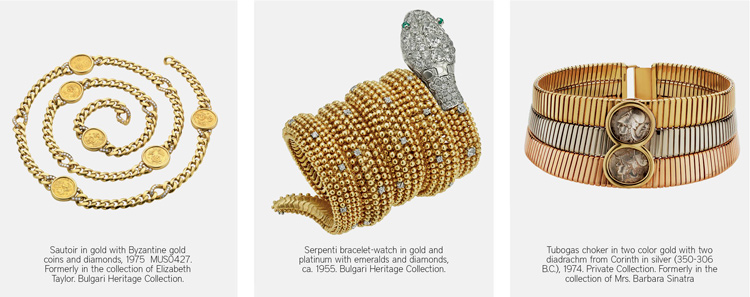
What is it about the Monete emblem and the Serpenti for example that is so timeless and yet still recognisable and desired?
The reason why I believe that still after so many decades those jewels are so appreciated is because they have been there for a long time, but always in new shapes. I think for instance the Monete is extremely interesting because the coins are very rare and are a piece of history but their settings are very modern. When we started with this in the sixties the coins were more classic, and then it became more and more daring. The idea was the same – a contemporary jewel with a piece of history, but it evolved into so many shapes, and that’s why I think it is an exceptional collection. Here in Moscow you can see how the creativity of the jewels with coins is changing and is evolving and can be so different.
BVLGARI. Tribute to Femininity runs until 13th January, 2019 at The Moscow Kremlin Museum.
The Family Of Audemars Piguet
JASMINE AUDEMARS, CHAIRWOMAN OF THE BOARD OF DIRECTORS AND OLIVIER AUDEMARS, VICE CHAIRMAN OF THE BOARD AT AUDEMARS PIGUET SHARE THEIR PASSION FOR INNOVATION AND TRADITIONAL FAMILY VALUES.
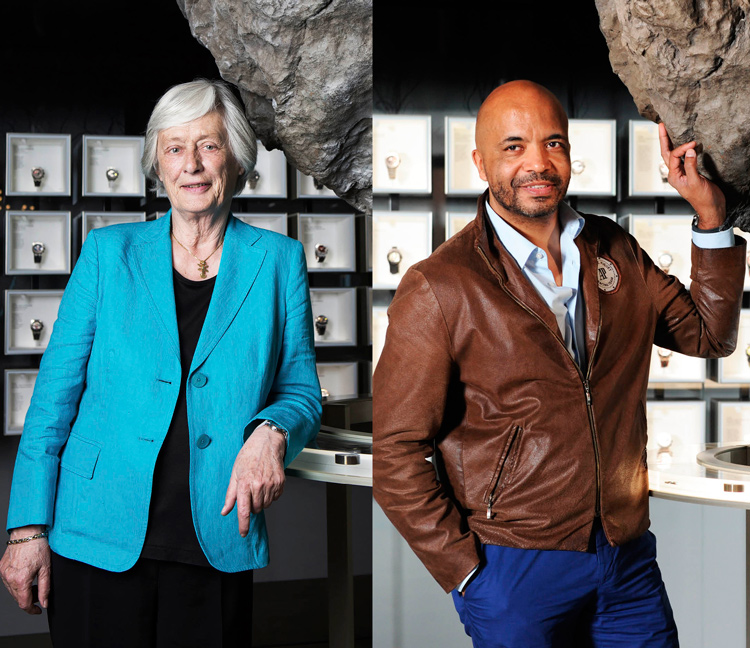
Jasmine and Olivier Audemars were both born into families of watchmaking. Their grandfathers were the founders of Audemars Piguet and today they continue to honour their heritage by being at the forefront of their family’s iconic watchmaking brand.
Jasmine Audemars is the Chairwoman of the Board of Directors of the brand. She grew up in the home of Audemars Piguet, and in fact the home of Swiss watchmaking; the Vallée de Joux. Her grandfather worked at the manufacturer and she spent many days visiting him and being fascinated by all the small parts and components involved in building a watch. Jasmine then went on to become a journalist and eventually held the position of Editor at the Journal de Geneve for 12 years. At the beginning of the 1980s, her father asked her to take over the presidency of Audemars Piguet. For her this was a new life. In 1992 Jasmine succeeded her father as the head of the Board of Audemars Piguet and has been at the helm ever since. Olivier Audemars is Vice Chairman of the Board. A personal watch enthusiast and former engineer, Olvier as a personal interest in the brand as well as a business one. He too is from the Audemars family and grew up very attached to the birth place of the company, something that is very close to his heart.
It is fair to say Audemars Piguet is perhaps the only watchmaker that still keeps it’s family heritage so close and is the only one not have left the property of its founding families. This is one of the running themes as we talk to Jasmine and Olivier, along with their vision on how they will keep innovating while maintaining the strong family values and tradition of the bran.
As we understand it has been a good year for Audemars Piguet?
OLIVIER: Yes we are lucky enough to have good years since 2015.
What would be the challenge for you as one of the very few family businesses still running in the world right now?
JASMINE: We have many challenges. The first one is to remain a very healthy financial company.
OLIVIER: The company was founded as a way to increase the chances of the tradition of making complicated watches worldwide to continue. Making watches in the Vallée de Joux – was also the solution people found to live freely in a place that otherwise would have been hostile. Because in the Vallée de Joux mostly there are just rocks, a forest and long winters so, the people who decided to set up were extremely open-minded. They didn’t want to live by the rules of someone else, and making things like watches was the way they found to survive in this otherwise difficult country. So you could say that all watches represent our independence. It was the way we found to remain independent. So it means that first this notion of independent adjustment that we talk about is extremely important. What we want is to be able to continue to provide good working conditions that allow people to make things that they are proud of and also to make watches that make the people that are buying them, happy when they look at them. So we are trying to do our best to ensure these traditions continue because we think it is important.
JASMINE: Yes, thanks to all that the Vallée de Joux became the cradle of watchmaking and the complicated watches is what we want to continue – that’s our challenge.
Being born in a watch making family, how heavy is the legacy to carry on?
JASMINE: I wouldn’t say it’s heavy, it’s a responsibility of course, but at the same time it’s a very exciting challenge. We are lucky – I consider myself very lucky to have such a challenge and such a responsibility.
OLIVIER: We are also aware of the fact that we are in this situation today not because of the fact that we are exceptional people, but because our fathers made huge sacrifices for the continuation of the company. So in that respect, we don’t consider the company to belong to us but to the people that are involved in working for it. It’s more a notion of stewardship than a notion of ownership.
Jasmine, you are a respected and successful woman in what some might say is a man’s world – can you tell me how challenging was the journey and if you have any advice that you would like to share?
I never found it difficult. You are right to say it’s a man’s world, especially on the technical and production part, but the changes I have seen during the years is that you have more and more women working in the industry. Chabi (Nouri) is the CEO of Piaget, and of course the Swatch family also has a woman at the helm, so I think things are changing very fast. Especially in the communication and marketing and PR as well. Now you are also starting to have female engineers. We are very optimistic!
Jasmine, you were previously a newspaper editor – how did that serve you with what you do now?
A newspaper is a business with people. When you have a newspaper or magazine, what you need is talented, committed people who have a passion. And if you look at the watch industry it’s exactly the same. The same values. It’s a people business and you need people with talent, passion and who are committed to the company and to their job.
To what extent do you think passion is very crucial in the watchmaking business?
JASMINE: I think it’s rule number one because if you don’t have passion it’s the worst.
In certain brands they create the story before the product, and others create the product and then the story – at Audemars Piguet how is it done?
OLIVIER: For us this is our story. So it’s not something that we have to make up. What we are trying to explain is where we are coming from, why the company cannot be separate from the Vallée de Joux, and how this Vallée was the cradle that makes us what we are. If you take the Vallée de Joux – again the resources that we had were forests, rocks and long winters, and people actually discovered on some of those rocks that they had rust. So using the wood from the forest they created fires and transferred this rust into aluminium. They specialised in making small objects from this. Then moving forward to watches, the thing that they had plenty of was time, because of the long winters, and that is why they started making complicated watches. So this story actually was what led to the development of those watches – you cannot separate the two things.
So we don’t have to make up stories – what we are trying to do is explain to the people that you cannot take Audemars Piguet out of the Vallée de Joux. Also one of the reasons why we are trying to bring more people to the Vallée de Joux is because we think that this experience is something that will help people to understand what we are. That’s why we are building a new museum, we are building a new hotel, because we want to bring more and more people into our home. So what we are trying to do is to stay true to what we are. We don’t want to say something that we consider to be untrue, because somehow it will damage the image that we have of ourselves, and at one point things will come out so we would never do that.
JASMINE: We don’t need to invent any stories or history because we have it already. In the museum they can prove what we did. It is true a few brands are inventing their history, but for us it’s not very important because people know about it [our history]. It is even dangerous for a brand to do something like this.
What are the main values that the company live by?
JASMINE: I would say one that is very important for us is that the watch has to be as beautiful inside as it is outside. Even if the customer never sees the movement of his watch, he must know that the movement is beautiful and finished by hand.
OLIVIER: Another one could be the fact that we want our people to do things that make them happy and proud. At the same time that will make the people that are buying the watches happy. We want to build it in a way that it is a virtual cycle, because when the customer is happy it gives a lot of energy to the watch maker, the watch maker is happy as well so we make even better watches. So that’s what we are trying to do.
What’s your vision for the near future of the brand?
JASMINE: As a family company we always have a long term view. So what I personally see is steady but very strong development. We are mountaineers. It’s one step after the other, we don’t want to rush and make fireworks. But I can see Audemars Piguet is going along the same path in a few months, steady and one step after the other. So I would say a development, but no explosion!
OLIVIER: Something that is also important is that we want to continue to combine tradition and innovation. If you don’t innovate you become irrelevant, and if you innovate in the wrong way you also become irrelevant. So the key is to continue to innovate in a creative way that’s a tradition made on relevant innovations.
What is an objective that you would like to see done at Audemars Piguet that has not been done yet?
OLIVIER: It is difficult to say. What I would like us to become is a company that’s making innovations. In the past we have made products that wouldn’t have a place in the museum and I think we need to ask ourselves if this is the case. Some things are easy to sell but are not really something that would help to build the company. I want to do less and less of that and make sure that every watch that we are introducing is worth a place in the museum.
How much are you involved in the final decision of the watch that we see ready for the customer in the market?
OLIVIER: We are not involved in the design. What we are involved in is more the long term vision of the company. I’m also following some of the engineering side as that is my background, but it’s a section that might become products in seven or eight years. It’s actually important for us to differentiate the role of the board and the family and the role of the designers.
The visuals of the communication of Audemars Piguet haven’t changed much – do you think that is because you always want to roll the message of being true to the origins of the brand?
JASMINE: Yes exactly – True to our soul and our roots.
Do you think overcommunication is killing desirability?
OLIVIER: I think so. I think one of the things that is the problem sometimes is that people think that they always have to say something different because if they repeat themselves nobody will listen, but I think that is completely wrong. You need to have consistency in the message that you are delivering. In the past we used to have a communication campaign that we were changing every years, but now we have a strong statement that is true to what we are.
Do you have any mottos that you live your life by?
JASMINE: Break the rules!
OLIVIER: I think this motto comes back to the Royal Oak watch. It was perceived to be going against all the rules of horology. It was the first stainless steel watch that was ten times the price of a Rolex Chrono for example and actually it was a huge success because it was completely current. So it was perceived as going against the rules but it was completely current with what we are. To break the rules it doesn’t mean that you have to do anything that’s crazy, it means that you can do things that are perceived to be completely against the rules but that will succeed if you are true to what you are.
What do you promise for the future?
JASMINE: All the new products you can see. We have some beautiful watches this year. And we have even more launches coming.
How would you describe each other?
OLIVIER on JASMINE: The moral compass of the company, making sure that we always stay on the right track.
JASMINE on OLIVIER: An engineer and a poet.
A. Lange & Söhne Moving Tribute To The Late Walter Lange
A. LANGE & SÖHNE CEO WILHELM SCHMID DISCUSSES THE BRAND’S LATEST NOVELTIES.

The last two years have been a turbulent time for A. Lange & Söhne. The death of their founder Walter Lange in 2017 was a shock to the brand – but they chose not to dwell on the tragedy and instead celebrate his legacy. This year they presented the Homage to Walter Lange collection at SIHH – a carefully curated limited number of watches that encompassed everything their founder loved. Put together in just nine months, the aim of the pieces was to honour the founder with watches he would be proud of.
At the helm of the operation was CEO Wilhelm Schmid, who last year found himself wondering how was the best way to pay tribute to Walter’s legacy and found the perfect solution. Earlier this year, the collection was presented at SIHH – including a one of a kind steel watch that was auctioned for charity. Here Schmid discusses the latest novelties from the brand including the Homage to Walter Lange collection which holds a very special place in his heart.
To what extent today is story telling still relevant, and how important is it in fine watchmaking?
People are clever enough to distinguish between tales and true stories. I believe that is the problem and the challenge. Yes stories are important because stories are what sticks in your mind, technical fact doesn’t stick in your mind unless a story goes with it. That’s how our brain works. If you connect the two things, you have a home run! That’s what people will remember and that is what people enjoy. But these stories have to be authentic and true. If they are just a marketing story, I think in today’s world people will realise that very quickly and that can even backfire on you.
Do you think nowadays over communicating kills desire?
They say that our eye is gathering a lot more information than our brain is actually capable of processing. So there’s a filter on what we see and what we don’t. Gladly because otherwise you couldn’t watch television, for example, because the information you would see is far more than you can compute. With over communication I think it is exactly the same. There is a filter, which will distinguish the relevant from the irrelevant, and I believe that filter is of interest to me. Is it true? Is it something I’d like to look in to? And I think that will be in the future the thing – do you have enough people so that what you offer is of interest for them? And is what you put around it is complimenting your product or is it taking attention away? The best story doesn’t help if the product is nothing. There’s always a trap – the moment of purchase in comparison to the period of time of owning and enjoying is very short. So if you over emphasise on that moment of purchase it’s very easy to disappoint on the pleasure of owning it. I think that’s where we have to find a good balance.
What is the message that you are giving out this year and objectives that you are working on?
We have two watches which are important for very different reasons. We have these technical watches – truly unique masterpieces that have never been done before. In today’s world after 250 years of fine-watchmaking, defining a field that nobody has touched so far is very interesting. It’s the triple-split. Which means it’s a chronograph with a split second, split minutes and now split hours. You can only get this with the triple-split. It’s a large watch. Don’t under estimate creating a big watch – I don’t have massive wrists but I’ve been wearing this for five days now and it’s actually very comfortable. So that’s the technical highlight of the year for watch lovers – you have to be a bit of a nerd to appreciate this!
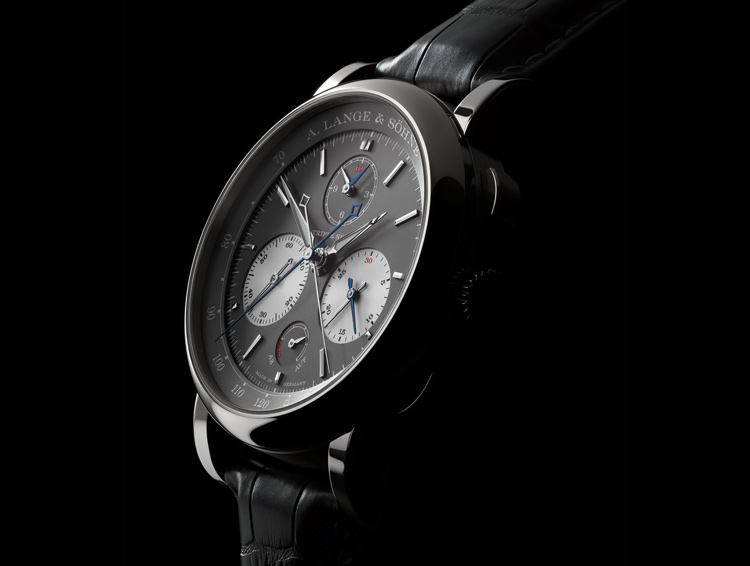
TRIPLE SPLIT
And then we have the emotional highlight. Over a year ago Mr Lange past away. After we came back from SIHH last year we first of all had to do all the funeral activities and there was quite a lot of work to do because you cannot plan for that. So after that we then put our heads together to ask “what do we do for him?” It was clear it had to be a watch – he was always, always pushing us to do the jumping second design – and I always refused because it is quite a complex movement and it is not financially benefiting – you cannot ask for hundreds of thousands of euros for it but the movement is a very complicated thing to build – so I had always said no. But now is the moment to say yes! So we present this watch. When he passed away, our little company was operating for 27 years and yellow gold was his favourite metal – so that’s why there are 27 yellow gold watches. We were founded in 1990 – that’s why there are 90 pink gold watches and that was 145 years after Ferdinand Adolph Lange first founded the company for the first time and that’s why there will be 145 white gold watches. Everything on the watch is connected to him – the calibre is his birthday, there are so many things in it which all refer back to him.
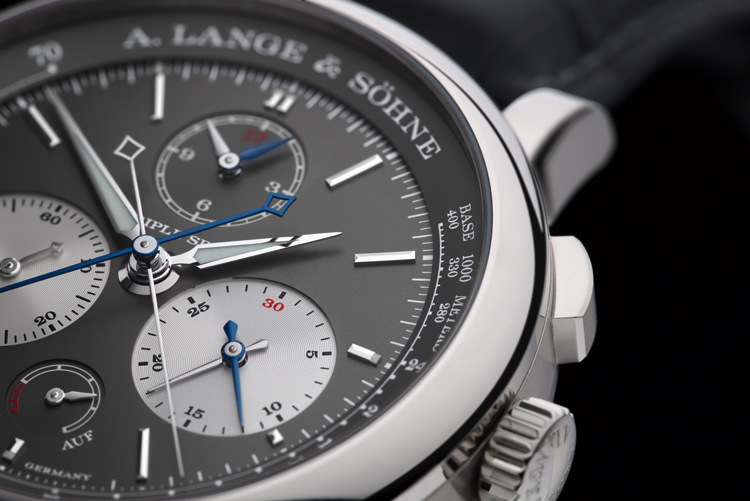
TRIPLE SPLIT
There is one other topic which he was always fond of and that is taking care of children. He was very keen to understand what the next generation is, and he was quite a generous man to support children in need. And that’s why we decided we would have one completely unique watch which is combining what every collector on the planet is asking for. Black enamel dials and stainless steel. So that’s why we have created in a way the weirdest combination of the most expensive dial that we have and the least expensive material but the rarest. All of the proceedings of this watch will go to helping children.
So we have watches that we would never have produced for him [the founder], and one unique watch which we don’t sell. We did all of this in nine months. We can’t do this permanently I assure you but this time we managed it. It’s tells you a lot about motivation that we did it. If I has asked my team to develop a movement in nine months that is not what we can usually do but for this exceptional moment, everybody was prepared to go the extra mile and go over and beyond what they usually do. It was a huge team effort to have everything done in time. I’m very proud of them.
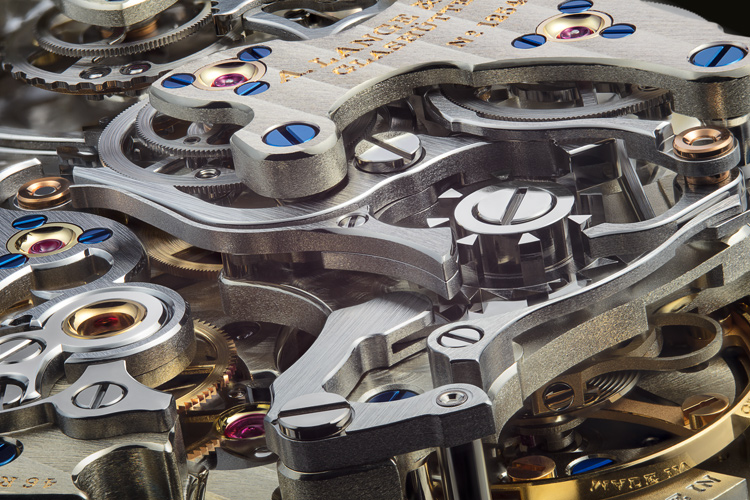
TRIPLE SPLIT
What do you have for women this year?
You may recall last year we launched the Little Lange Moon Phase, this year is the Little Lange One. The movement is exactly the same but all the rest is completely different to our normal watches. Usually we have cases with three pieces, but to make this watch as slim as possible we used a case that only has two pieces. With that you need less screws in it so it is flatter. It is more difficult to work with. The dial is an 18-carat gold dial. The edge is sharp and smooth and brilliantly formed – something that you have to use gold for. If you look to the brilliance of our dials – it is due to the fact that we use the best material for it. These watches have interchangeable straps and are made for ladies and for ladies to buy. They are not made for husbands to buy for their wives. That’s a huge difference from a product point of view for us. The price point is almost the same point as our normal Lange watch.
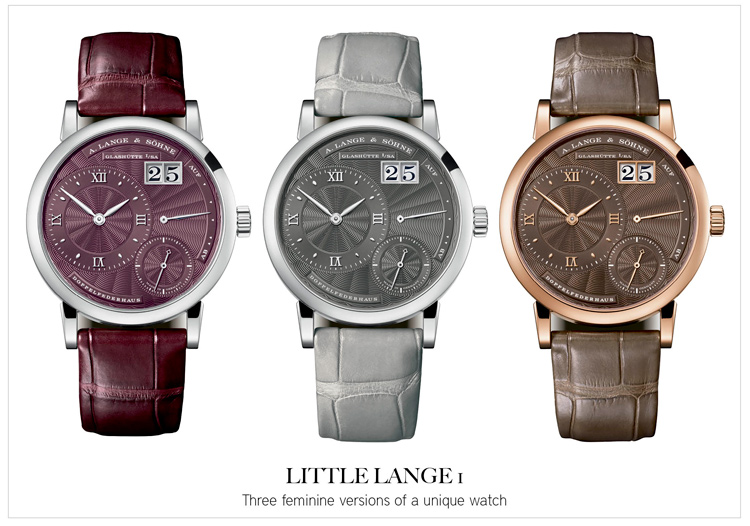
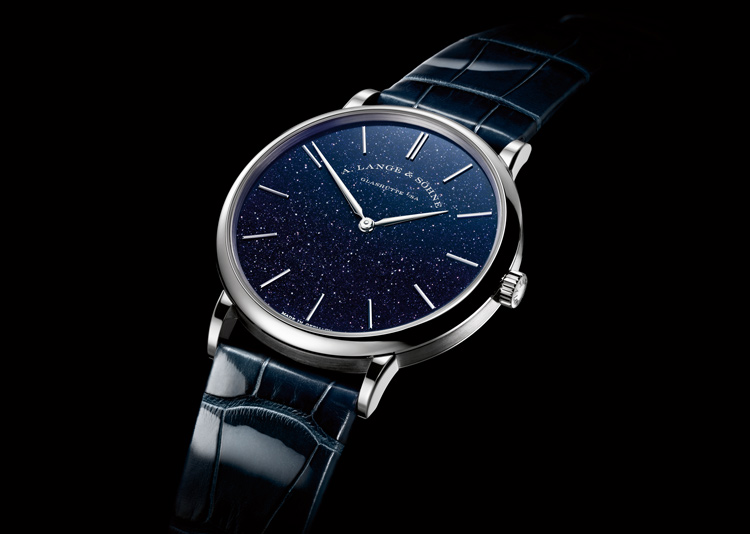
SAXONIA THIN in copper blue
Talking about your alligator straps – how do you source your leather?
We have a complete controlled process and we source it through a supplier.


How complicated is the production of the dial?
It’s quartz elements (that’s where the sparkle comes from). First you melt it, you cast it and then you slice it and then you polish it. It’s very thin glass that you put almost like a layer on top of metal. It is not easy to work with. It is a bit of a challenge but it is actually very beautiful.
The last watch I want to talk about is this one (below) – I felt a touch of freshness and sportiness – tell me about it.
More and more we are getting a demand for people who want that one watch. There are of course the traditional approach of people who buy three watches a year and have a safe full of watches, but there are also people who say they want one nice watch. If you ask these people, they usually say it has to fit jeans and shorts but they also want to look not underdressed if they go to the office. So from this we thought we would work on that and see what we can come up with. So last year we decided to launch something that is a touch more contemporary. And then we also decided to give another price point that was slightly different. This watch actually has a different movement from what we did last year even though it looks similar.
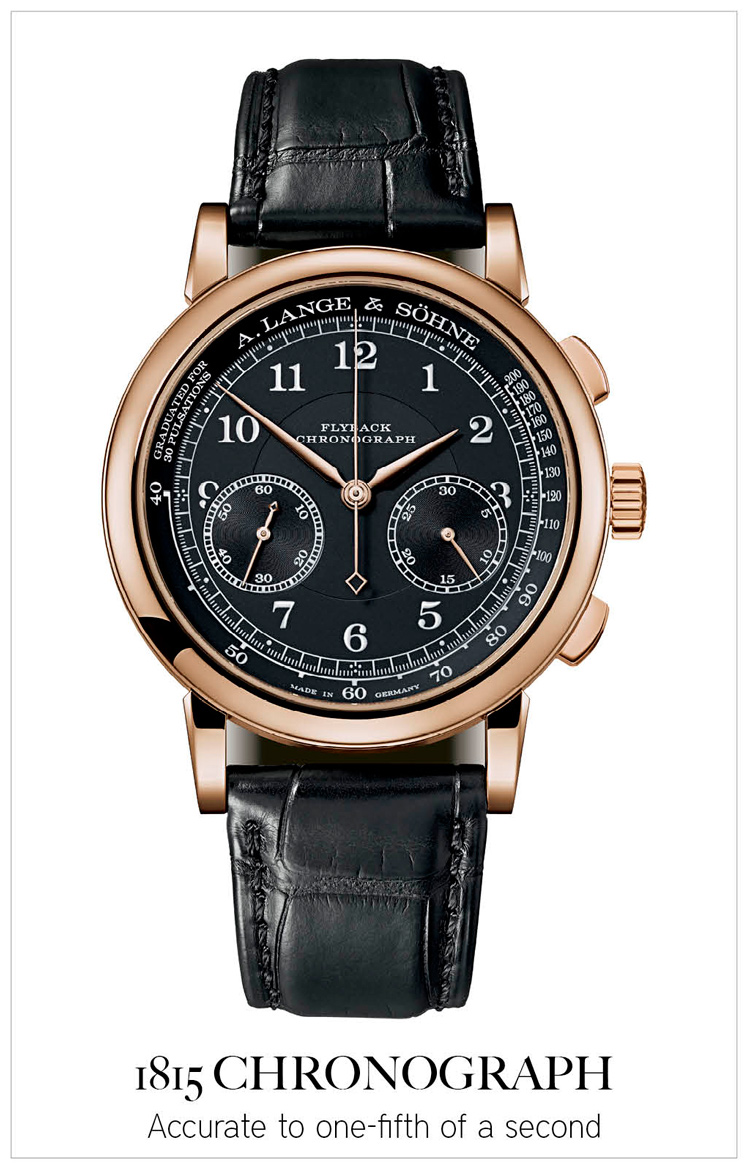
What’s your biggest challenge this year?
Moving marketing and public relations and design from Glashütte to Berlin in our new offices. Our headquarters is in the mountains but we need to be in a different environment. But to maintain my paradise of watchmaking in Glashütte, I need to create a paradise of marketing in Berlin.
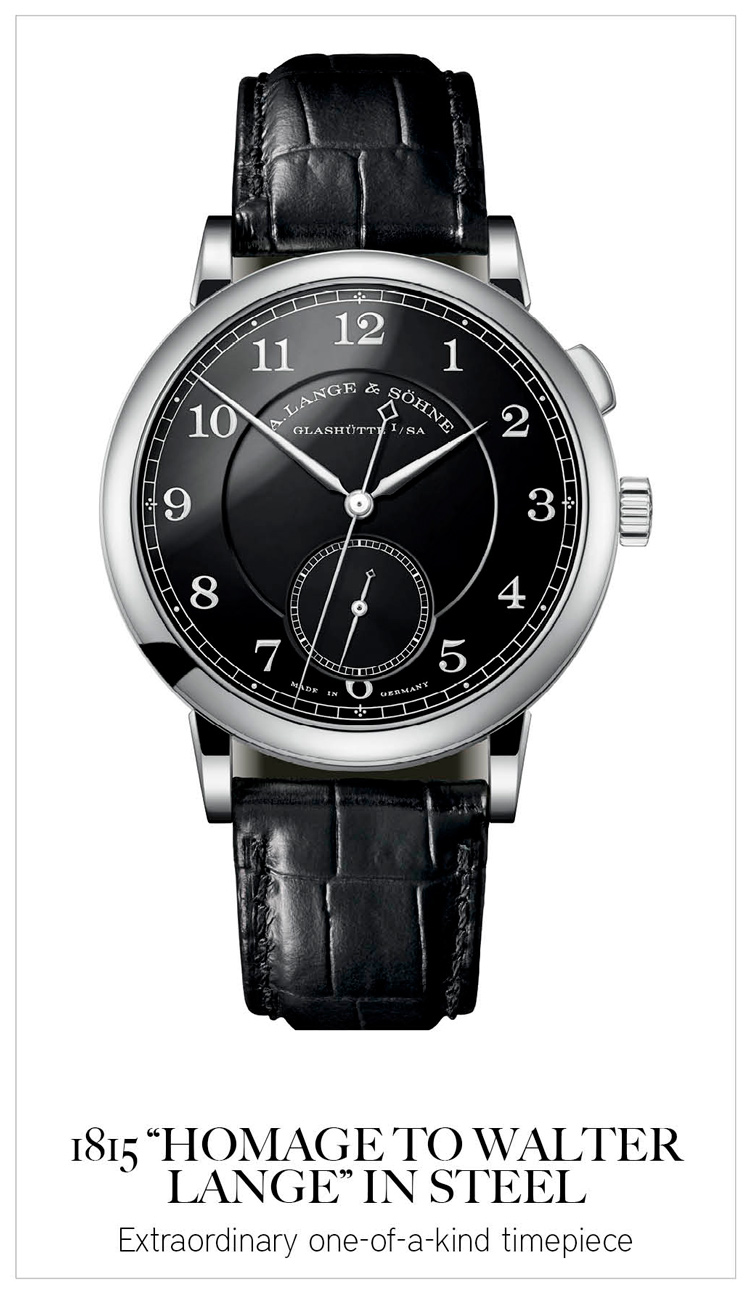
What did you promise yourself personally and professionally this year?
I promised myself to spend more time with the family and travel less weekends. Professionally I didn’t spend enough time in the manufactory last year. I was too busy I was travelling too much and for this year I promised that once a quarter I will be there.
Give me your vision for the brand in one sentence:
Paradise of watch making and paradise of marketing and public relations.
Your Exclusive Invite Into The Dolce & Gabbana Universe Ahead Of Their Much Awaited Dubai Fashion Show
Stefano Gabbana and Domenico Dolce
The Dolce & Gabbana brand as we know it today is over thirty years in the making. The very hands-on and creative designers Domenico Dolce and Stefano Gabbana are at the forefront of one of the world’s most iconic brands and have worked closely together for thirty years to make it what it is.
The Italian duo know their brand inside out, and have built an empire from what was a flicker in their imagination when they first met in 1981. The two are the most recognizable duo in fashion and while we are so used to seeing their images and hearing them share their ideas, it’s hard to imagine what their being in their world is really like. Here we talk to Domenico and Stefano on building the incredible partnership they have today as well as getting some insights into the inspiration their latest collection.
In a market where fashion changes so fast, how would you describe the Dolce&Gabbana DNA and codes?
Domenico Dolce: Our DNA is clearly Italian and our roots run deep in Italy. You can only envisage and build a future if you know who you are and where you come from. Italy is not just a deep source of inspiration, but the starting point for all our projects. It also became a symbol in the world, together with Sicily, in particular. Sicily is a beacon of richness in traditions, colors, village parades, and especially the passion that people nurture within themselves. We will never be tired at rivisiting this magical land – nor physically neither in mind.
Stefano Gabbana: People now seek for history, tradition, family – it is not just about fashion and clothing. People pursue realism, a dream everybody can dream about. This we think is a precious opportunity to tell a story about our background, the pleasure to be Italian. Our style codes include embroidery, the black dress, black suits with a corset, among many others.
What is your design aesthetic?
DD: It’s difficult to discuss our own aesthetics. We fancy different styles and shapes, we’re constantly creating and exploring our own creativity as designers. On one hand, we make corsets, little black dresses and knee-length skirts, all very sensual designs. On the other hand, we create masculine mismatched suits and t-shirts. Dolce&Gabbana has always been the result of many inputs blended together.
SG: Exactly. We’ve always been about a mix of elements, all contributing to shape our DNA, as we just said, our story made of love, passion for Italy, fashion, culture, movies and much more. However, the real breakthrough came in 1987 with our “Sicily” collection, that allowed for our strong Italian identity to fully stand out.
Your womenswear collections have been described as a celebration of femininity, what is it like to be a Dolce&Gabbana woman?
DD & SG: We deeply love all the women in the world! Starting from the first ones and the most important of our lives: our mothers.
In your opinion, what is the most flattering silhouette on a woman?
DD: Nothing in particular, simply a garment that makes you feel beautiful and empowered. It could be a sensual dress of course, or a simple masculine suit just as well.
SG: A woman can be extremely sensual just with a white blouse; it’s her personality that makes all the difference. Sensuality is something you are born with, it is not something you learn.
Tell us about how much your brand has evolved over the years?
DD: Our brand has evolved so much in more than 30 years. Travelling and getting in touch with other cultures, people all over world and clients have been very important for our maturity as a label.
SG: By following this path, we are able to transform something that apparently seems strongly enrooted in a given country into something that speaks a universal and cross-functional language. Today, our world is global, and we cannot but think globally. This is the style of Dolce&Gabbana. It speaks of Italy, but in all the languages of the world.

Dolce & Gabbana FW 18-19
What do you think has been the key to building a strong identity?
DD & SG: To have a story to tell, we suppose. Also, being aware of where we come from: that allows us to keep our values very clear in mind; and these are obviously Italian values. The brand is the representation of the Italian world: this translates into tradition, attention for detail, tailoring, sensuality, but also family and love. Love for the family, for friends and, of course, for beauty.
What’s your secret to longevity in an such an ever-changing industry?
DD & SG: No secrets or magic formulas, we swear! Only a lot of work, and a little luck, as with everything in life.
What do you love most about fashion?
DD: Fashion has always been an important part of my life. My father was a tailor and I grew up in his workshop. Different fabrics, measuring tape and scraps of cloth were my bread and butter. Fashion is my life, my biggest passion.
SG: Fashion defines us, we love fashion as a whole. I think every human being fulfills him or herself by creating something tangible…well, we create clothes and accessories all day long!
When you first met, did you imagine that you would end up creating a successful brand together?
SG: It was 1981 in Milan. I had studied advertisement design but wanted to work in fashion, it was my dream. I had heard that there was a vacancy in Giorgio Correggiari’s design atelier, so I called them.
DD: And I happened to pick up the call, so we arranged a meeting. This is how it all started. And then the big work, the sacrificies, the long summers spent working and working again, and finally the first satisfactions.
What is your creative process like, and what part do you enjoy the most?
DD: First and foremost, it’s important to keep the spark of creativity alive and there are a lot of different ways to do this: by traveling, going to the movies, reading, listening to music, and by being around people. There is no specific recipe for success. It’s not enough to carefully look at the world around you: keeping an open mind is key.
SG: Then, every collection develops as a movie in our imagination; we are the directors of the story, the set, the characters as well as the models and actors. There are days were we happen to work separately, others side by side. Once a week we meet to gather our thoughts on the table. Yes to this, no to that, let’s do it differently…and so on.

Dolce & Gabbana FW 18-19
How do you balance the duties of design when working as a duo?
DD & SG: We are two faces of the same medal. We complete each other.
SG: We discuss everything! We are very different and we both have very strong characters. Today we have learned that if we believe in one idea we must fight for it.
DD: But in the end, we always meet half way.
What makes the combination of you both a great team?
DD: Stefano and I together are fundamental! After so many years, we know each other very well, yet we still pleasantly surprise one another. For example, I prefer a clean and linear look, even if at times I featured flowers and embroideries, while Stefano has more of a Baroque style.
SG: This is the beauty of working side-by-side and switching roles; always finding a way to surprise each other, letting our mind explore new directions, by growing and learning. Even though we often have very different ideas on a given matter, by speaking we meet a solution that will express both standpoints.
What is your favourite thing about each other? What do you respect most about each other?
SG: Domenico is a genius when it comes to handicraft. Give him a piece of rough cloth and he will turn it into a beautiful garment!
DD: I love Stefano’s authenticity. He is straight-forward and extremely resourceful.
Is working as a pair a good motivation for each of you? Do you think working as a team helps you creating a stronger brand as you have more idea input, and your focus can be broader?
DD: Of course! It is our real strength.
How do you think being so personally visible, connecting yourself so closely to the brand, has shaped your business?
DD & SG: We are what we do, the clothes we create. I think this is also true for all human beings in general. Fashion is our life and for us this is normal. We are the Dolce&Gabbana family, together with the many precious collaborators who work day by day to make it real.
Tell us about your recent Fall 2018 collection, and what it embodies for you.
SG: With our womenswear fall 2018 collection, we wanted to celebrate our own approach to fashion! Our identity is a mix of devotion, sheer creativity, religion, style and irony…
DD: The collection has it all, it’s an interesting play of contrasts. It pays tribute to pop culture icons, but also religion and the world of Catholicism.
What was the inspiration behind it?
DD & SG: We wanted to celebrate our passion for fashion, which is our religion in a way. On the other hand, we wanted to celebrate beauty, the ultimate “artifice” of fashion. Beauty is a miracle, so unique it cannot be reproduced. It is like a taste of Heaven on Earth. Let’s say we try to recreate beauty with our own means, or at least we try!
You chose to open the show presenting bags on drones, tell us about your decision behind this and how you came up with the idea?
DD & SG: Drones are the new angels of technology! Our last runway show was meant as an homage to our love for technology. Drones, there you go!

Is this a way of embracing technology?
DD: Yes it is, of course. We observe reality very carefully and are aware of the importance and influence of technology, web and social media. Social media ultimately allows us to communicate, buy and dream. I am by no means a social media enthusiast, but Stefano says he posts a lot of pictures of me working!
SG: That’s absolutely right! I have an Instagram account and I love sharing photos, thoughts, op-eds or photos of our clients wearing DG clothes! It’s a window to the outside world, to the street…it’s very authentic.
What is your view on the power of accessories?
SG & DD: Accessories are as important as clothes. They finish off a look beautifully, by giving that final touch that makes all the difference. Accessories define us as much as clothes, they tell something about our personality. Seeing a woman dressed elegantly and carrying a gorgeous bag is the utmost definition of beauty for us.

Dolce & Gabbana FW 18-19
What is your experience with the way social media and digital is shaping the industry?
DD & SG: Fashion industry has of course been affected by the birth and success of social media, but in a completely positive way. Whenever one of our clients halfway around the world posts an Instagram picture of him/her dressed head to toe in D&G, we gain a lot of visibility. It’s a form of advertisement that simply didn’t exist before. Now picture a client that couldn’t reach one of our stores: thanks to the development of the e-commerce, these hindrances can be successfully overcome.
You are reknown for your millennial catwalk, what do you feel this reflects, and what makes it so important for the brand?
SG: We want to get this message across: elegance and style are ageless. Once again, Millennials, these young digital natives who are so passionate about fashion, prove it very clearly. They love to dress elegantly without necessarily denying themselves the pleasure of wearing embellished sneakers or statement prints.
DD: Our starting point is always tradition, wisdom and the craftsmanship we gained through sacrifice. We build on these core principles as we progress into experimenting with new things. Millennials are extremely versatile and brave, they don’t shy away and mix different styles, creating unique outfits. When it comes to targeting new generations, we definitely try to match trend and tradition.

Pre-Fall ’19 Abaya Collection
How do you feel about fashion and style in the Middle East?
DD & SG: Middle Eastern women are among the most beautiful women in the whole world. They’re not just beautiful, but also elegant, chic and have a unique presence and sense of style. We’ve been creating Abaya collections for the Middle East market for several years now, and we’re delighted with the result.
Will you be creating further capsule collections for the Middle East market, especially in line with the new Dubai Mall store opening?
DD & SG: Of course. As we said earlier, we really love Middle Eastern women, their refined and poised style…it’s so charming. We are extremely proud of our new opening in the Dubai Mall, the boutique is gorgeous.
Do you feel that creating ranges that are tailor-made to different regions and countries is important for your customers?
DD & SG: It’s very important indeed! Our clients come from all over world and they have different demands and needs depending on their jobs, customs, inclinations and religions as well. Then it is very important to offer a large range of supply.
Which markets do you feel will present the biggest opportunities in the coming years?
DD & SG: Of course the Japanese and the Chinese markets. But the Middle Eastern market is going to grow dramatically, too.
Earlier this year we saw the beautiful Alta Moda show that took place in New York, tell us more about it and why you chose NY?
DD: Because to us New York is the city where dreams come true, and it is giving us the chance to show our customers around the world our vision of Alta Moda even outside of Italy.
SG: New York with its skyline and its energy was definitely the inspiration for our Alta Moda and Alta Sartoria shows. We would like people to see New York through our eyes and unveil all the magic that this city hides.

How would you define luxury and what is the biggest luxury in your lives?
SG & DD: There are no black-and-white answers to this question. Luxury is extremely subjective. What I think is luxury, could very well be ordinary for someone else, and vice versa. As we always say, we think real luxury is the time spent with family and the people you love…that is our most cherished thing.
You’ve accomplished so much over the past 30 years, what has been a standout moment in your career, and your greatest achievement?
SG & DD: There are many moments we remember with great pleasure, many dreams we were able to realize. Of course there was our Alta Moda show on Milan’s Teatro alla Scala’s stage, one of the most important theatres all over the world, and one of the places we love most, too.
Do you have any aspirations / dreams that haven’t yet been realised?
DD & SG: We are lucky, we have already fulfilled many of our dreams, but we can’t stop dreaming! Dreams are the driving force of everything.
What do you expect to be the biggest challenge your brand will face in the coming years?
DD&SG: Every challenge is positive, it means growing and delivering something new. Who knows about the future! We will see.
What would you like your legacy to be?
DD & SG: To be thought of like two creatives proud of their own complete freedom.
Can you share with us your future vision for Dolce&Gabbana?
DD&SG: If we disclosed it to you, it wouldn’t be a surpise!
Your perfect free time is spent how?
DD: With my family
SG: Yes, I agree, spending time with people you love.
One thing you can’t stand?
DD: Confusion
SG: Cruelty
One thing you’d like to change in yourself ?
DD: My unlimited rigor
SG: Too many things to count!
Favourite dish?
DD: The pasta alla norma, a typical Mediterranean pasta recipe.
SG: I’m classic, simply pasta!
Favourite season of the year?
SG: Summer, spent at the beach.
DD: Same here.
If you are reading a book, it is?
DD & SG: To this question we feel we must answer together: The Leopard, by Giuseppe Tomasi Da Lampedusa.
Favourite Movie?
DD & SG: Same, The Leopard, by art director Luchino Visconti.
If you weren’t a designer you would have been a?
DD: A Tailor
SG: I think, a graphic advertiser.
Stefano please describe Domenico in one word.
SG: Genious.
Domenico Please describe Stefano in one word.
DD: A tornado of ideas!
READ MORE
Dolce & Gabbana Alta Moda Takes Over New York
See Inside Dolce & Gabbana New Dubai Mall Boutique
Ceo François-Henry Bennahmias Discusses The Evolution Of Audemars Piguet
This year, Audemars Piguet has presented one of its most complete collections ever. With the latest novelties bursting with colour and contrast, vibrant with new ideas, material combinations and design features. To celebrate the 25th anniversary of the Royal Oak Offshore, they issued a re-edition inspired by the 1993 model, incorporating all the knowledge and techniques of 2018 while remaining faithful to the timeless design of the original. The Royal Oak Offshore collection appeared as a larger, more rugged sibling of the Royal Oak in 1993. Since then, it has won a solid global fan base and has become a platform for innovation, constantly evolving into many different versions.
That’s not all, as Audemars Piguet has a superb concept watch, the RD#2, the thinnest perpetual calendar ever made, at a staggering 6.30mm thick, together with of course, many more watches. But the best way to introduce these novelties to you is to let François-Henry share his enthusiasm in our exclusive interview with him.
François-Henry Bennahmias was born in Paris where he began his career in professional sports. Ranked as number 25 on the French golf tour, he developed a keen instinct for the challenge, adventure and bold drive for excellence that marks a true champion and the highest level of perfection in any craft. Realising he needed to pursue a new challenge, he took the decision to refine his experience in the luxury fashion industry, where he worked for brands including Giorgio Armani, Gianfranco Ferré, Les Copains, Reporter, Peter Hadley and Vilebrequin, before starting his career at Audemars Piguet and Haute Horlogerie in 1994, becoming CEO in 2012.
When you took the helm of Audemars Piguet in 2012, what did you find and where is the company today?
I found a lot of things, the good and the bad! I made a few decisions without making too many changes, just important ones, focusing on what we did well. Fast forward six years and the company is in its best shape ever, breaking record after record every year. We are not increasing production from the current 40,000, and don’t plan to for 2018 and 2019, yet look to make an increase in 2020. So overall, I believe the company is in better shape, but we have not changed the DNA, our values, or what we stand for, instead we are just doing it better.
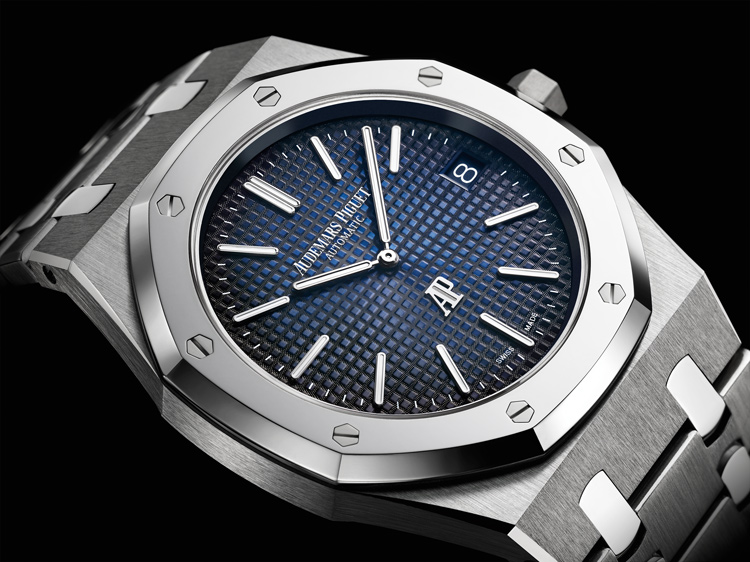
ROYAL OAK OFFSHORE
How are you adapting for today’s customer?
We are learning every day, and more so now as we have more stores and direct points of communication with our customers, allowing plenty of interaction. It is less about adapting, but more about learning how our customers differ worldwide.
As luxury becomes massified, how do you see the direction of luxury watch making?
We take Audemars Piguet in the opposite direction, as true luxury is exclusivity and scarcity. Our production is capped at 40,000 and we could easily sell over and above this, but instead we stand by our word and when we do increase it will be by small increments, taking it slowly to ensure the success we have today stays and remains and we continue our exclusivity.
Can a younger clientele enjoy luxury, and how do you connect with a younger market?
I just recently met a younger consumer wearing an Audemars Piguet watch, and if at that stage they are the fan of the brand it is great for us as they will stay a customer for many years in the future, (if we don’t make any mistakes). The good news is that we know our clients are getting younger. I see more and more younger clients in our stores and at events.
What are your biggest challenges this year?
Keeping momentum going, pushing people far in terms of training. Like sportsman, the key is continual training. You train, you win, and then the following day you go back to training. We need to avoid arrogance, because as good as you are, you need to work even harder to remain at the top.
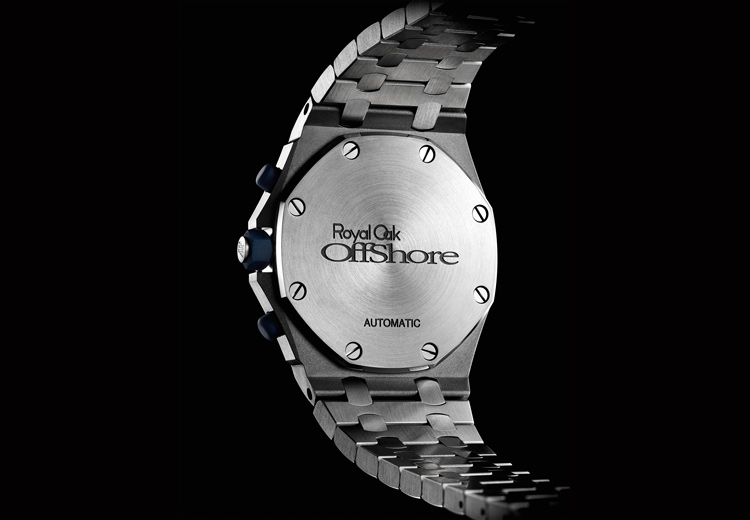 ROYAL OAK “JUMBO” EXTRA-THIN
What is the key to balancing innovation and history in your watches?
Sometimes by using it and sometimes by completely forgetting about it. A good example is the RD#2 where a new technique had to be designed as nothing could be used from history. This technique will now open more doors in high end watchmaking for many years to come, it’s a new era.
Tell us about how you use your sports background in business?
There are a lot of things that apply in both the sports and business world. As good as you are, you have to work, train, and learn every day to become better. When you think about sports alone athletes have changed the way they eat, recover, and train completely, and this evolution will filter into business in the form of food particularly, because it has such an impact on your efficiency. Also, you can look at business like a team sport, it is the addition of the different talents and the way that they are willing to play together. I don’t want just individuals and the best technicians, I look for leaders and team players.
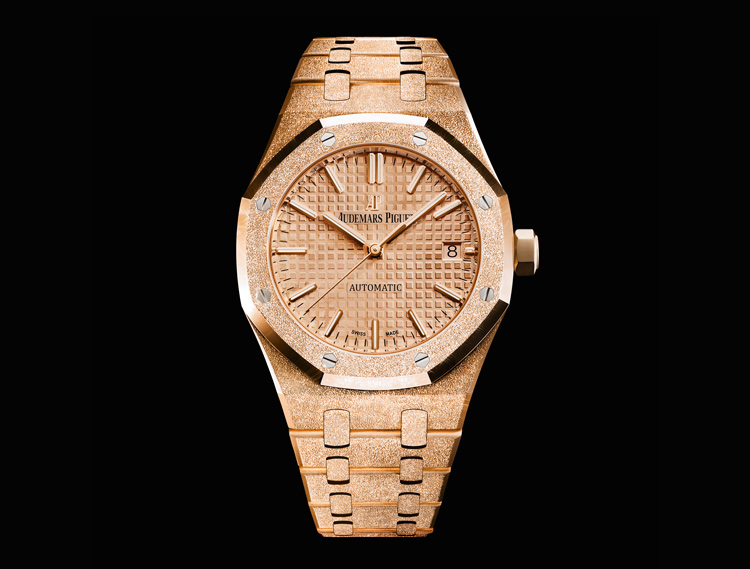
ROYAL OAK FROSTED GOLD SELFWINDING
Why did you choose golf as the sport to support with Audemars Piguet?
Golf is the only sport that you can bring clients to and allow them to be actors instead of just spectators. In golf you can win and beat a champion because of the handicap system, something that isn’t possible on a basketball court or racing track. Golf is also a sport that is played by many people around the planet.
How do you select your team of ambassadors?
I like to meet them, understand what is behind them, and believe that they are good people with a good personality. I want a great character with the right attitude. It is important that our ambassadors behave well with everyone, not just me.
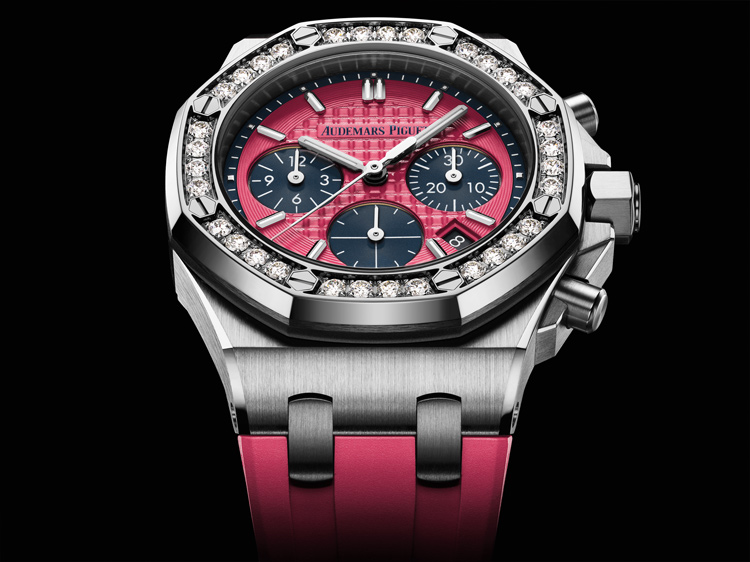
ROYAL OAK OFFSHORE SELFWINDING CHRONOGRAPH
What are your top achieving markets at the moment?
The United States.
How about your performance in the Middle East?
We again had an outstanding year, and in Dubai we sold 180 watches in one month alone.
To what extent do you think it is important for a brand to be disruptive?
You don’t want to actually be everywhere, and maybe we should be careful and make ourselves a little more discreet. So being disruptive could be to stop advertising for a year, which some very important brands do, and it doesn’t stop them being successful.
ROYAL OAK
The Royal Oak is fundamental for Audemars Piguet, and you are marking its 25-year anniversary. Tell us about its evolution?
I can sum this up in one sentence quoting Muhammad Ali, ‘The best is yet to come’.
Laurent Dordet On La Montre Hermès Ambitions In The Watch Industry
CEO OF LA MONTRE HERMÈS LAURENT DORDET DISCUSSES WITH A&E HIS PLANS FOR CEMENTING THE HOUSE’S POSITION IN THE MARKET AS A SOUGHT AFTER WATCHMAKER.

“I WANT A LADY TO WAKE UP IN THE MORNING DREAMING ABOUT A HERMÈS WATCH.”
Like any fashion house that decides to enter the realm of watch making, Hermès faces challenges when it comes to being taken seriously as a watchmaker. While the French Maison does have over forty years’ experience in women’s watch making, the men’s realm is a relatively new one for them. At the beginning of this year, for the first time, Hermès presented at SIHH. With the vision of becoming a powerhouse in watch making as well as fashion, being part of this prestigious event is a step in the right direction for them.
This year Hermès retuned with a new style of its Carré H timepiece. The square has been slightly enlarged and the brand has opted for light effects, playing across the steel case with its polished and microbead-blasted finishes, on the dial with its right-angled guilloché work, and on the facetted hands and numerals. This perfectly balanced use of light harmoniously accentuates the clarity of the design, the softened edges of the square, the curved profile of the case, and the cylindrical crystal. The exclusive font of the numerals – making use of the zero – contributes to the new aesthetic equilibrium of this watch.
The Arceau Casaque is inspired by the brand’s equestrian heritage, the dial represents an arena marked with hoof prints in the sand. Outlined against the background is the Cavale motif. The dial is crafted using champlevé, lacquer and transfer techniques. Hollows are first created in the dial base, then filled with lacquer. A matte tone-on-tone transferred chevron motif lends the final touch to this colourful composition.
The Arceau Pocket Mille ori is a luxury watch for men features a crystal dial the represents the pattern of alligator scales. The black colour, an alchemy of minerals whose composition is a closely-guarded secret, is mixed with incandescent crystal. Once drawn from the mouth of the pots in the furnace, the molten material is transformed into a crystal rod with the glass-maker’s breath. From the rod, a white-hot thread is pulled out, and then cut into sections. The resulting canes are then assembled to form the pattern. This unique creation is limited to just two pieces.
Presenting these watches and the new direction of the brand is CEO of La Montre Hermès Laurent Dordet. Laurent has worked with the Hermès fashion house since 1995, holding a number of roles within the company but most recently in the leather goods department. Dordet knows the Hermès brand better than anyone, but he is relatively new to the watchmaking business, so brings a fresh outlook to this growing sector. His close relationship to the Hermès Maison means he knows the vision and future of the company better than anyone.
Why did you decide to present at SIHH in early 2018?
We had to take a decision at the end of last year, as it was a year when we decided exactly the image and the special voice that Hermès wanted to assert within the industry. Of course it was just words and it has been fifteen years that Hermes has been making a tremendous effort to become a real manufacturer of watches. Last year at Basel World we asked the question – “Where are we now? And who are we now?” Hermès is first a Swiss watch maker after 15 years of investment. Then we are a watchmaker brimming with French creativity – and not only French creativity, Hermes creativity, which is different and shared by all aspects of our Maison. And then what we want to express is a state of mind, a relationship that is a qualitative time to take pleasure with. What we want to convey with our watches is of course quality, precision etc. but more than that, emotion, playfulness and fantasy through the communication and our designs. We think it is the time to close a page and open up a new page. The type of product we are doing now is much closer to the other products and brands we see each year at SIHH. So we feel more exclusive. It was not a negative decision to leave Baselworld, it was a positive move to join a new family. SIHH is a fair that is very open – to the public, to new and small watch makers, very innovative and very open minded to new functions.
CARRE
What is your communication strategy to attract the non- Hermès clients or the watch connoisseurs?
First of all Hermès watches is not a brand, the brand is Hermès. We are part of a bigger brand, we are not a pure player. We have a specific media campaign for this. There is the corporate media campaign which is more fashion and lifestyle for all products, but there is a separate watch campaign that we launched two years ago. Not to promote the products but to talk about Hermès in a different way that is not fashion but more playful and highlighting the relationships we have with time. This campaign and the corporate campaign have one common goal which is to promote the Hermès brand and to drive customers to our stores. Once our customers are in our stores, it is the job of our retailers to sell the right product that fits the needs of the customer.
What are the challenges that you are facing today in the watch industry?
Well there are a lot of changes. I would say our challenge is to really emerge as a watchmaker. We are currently a small department within a large House whose awareness is more about bags and fashion and silk. So for us it’s a huge chance to be behind this big name and very desired brand, but my challenge is to motivate everybody and emerge as a key player in the industry. For this the product is key. As long as you get the right product, everybody is motivated. The product has to convey a story if we want to make people dream.
Do you think people still dream in this industry?
Oh yes. I was taking care of leather bags before. Of course people know Hermès for bags, but each time you convey something authentic related to the life of the product and what meaning and history it has, then the person feels it is not only a luxury product, it is a personalised product which has a mystery and a supplement of soul. So yes it’s very important for us to provide not only a product but a real story – not a marketing story but a real story.
There is a lot of diversity amongst your products – how challenging is it to convey one message which has the perfect equilibrium between maintaining loyal clients yet attracting the younger generation?
For all of our portfolio we have a wide range of products. The common point between all our products is firstly, no compromise on quality, and no compromise on creativity. But as long as we have those two legs, it’s not a problem for us to have products to accompany our customers who might be 20 years old or who might be 40 or 50 years old. We do this in our bag collections with very expensive and very affordable bags, and we do the same with watches. We are mainly focused on women’s watches and have been well known to customers for this for 40 years. Men’s watches is more a start-up for us and is a growing segment. Our goal is to offer a wide range of feminine watches from fashion accessory watches to high end jewellery watches, to accompany our customers from where they want to start to where they want to go.
ARCEAU POCKET MILLEFIORI
What’s your vision and direction for Hermès watches?
I want to be one of the aspirational brands for feminine watches. I want a lady to wake up in the morning dreaming about an Hermès watch. Whether it’s a jewel or a more simple watch. And I want to emerge in the masculine industry. We have already done this as a legitimate player when the experts and our competitors judge us. The next step is to have the same legitimacy from our customers. When men are choosing a watch, even though they hear Hermès is now a watch manufacturer, Hermès for them is too associated with fashion, and that is why our sales are not at the level I wish to be. Which is normal because it’s a relatively recent story, and our challenge is to emerge.
To what extent do you think being made in Switzerland counts today?
One of the key values for Hermès is authenticity. And when we say made in France or made in Switzerland, it is made in France or made in Switzerland. We don’t play the game that a lot of brands are playing which is to be 60 per cent Swiss and say it is Swiss made. Which means that in fact a lot of the components are made in China or somewhere else, and they are then assembled in Switzerland. This is not our philosophy. This is why we are proud to be Swiss made, or sometimes French made. It’s also homemade – because 95 per cent of what we do is done internally. So I like this authenticity. It has proven a real success for Hermès as people know that when we are telling them something we do what we say. For us that is really important. When one of our best assets is the trust our customers have in our brand, we have to honour the trust and be totally authentic.
CAPE COD
In the digital world, to what extent do you think over visibility and over communication kills desire of a product?
One of our difficulties is that our competitors are communicating massively. Whereas Hermès is very discreet. Because our watches are only a small material within the big ensemble we are often even more discreet with our watches. We are part of the global game of Hermès so we have a certain budget to communicate – social media is within this. We digitalise a lot of our communication now. We have a new integrated site for Hermès. So our watches will be much better presented and our communication will benefit from this. Is it creating desire? If we want to target younger people we have to be there. We have to talk to the people where they are and that is where they are.
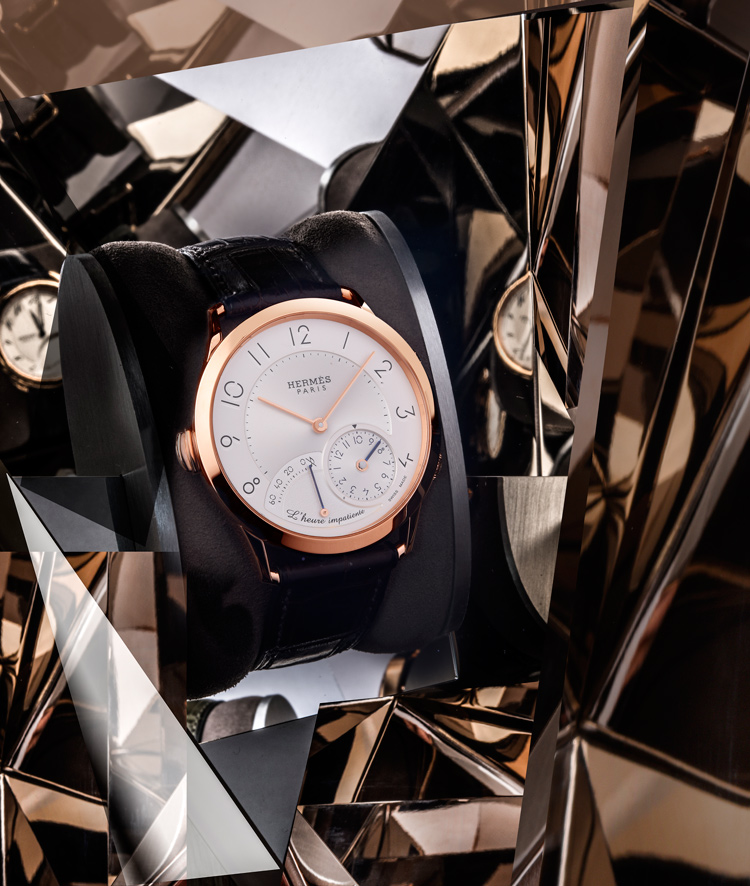
JOYFUL COMPLICATIONS
Which watch are you wearing now and why?
I’m actually wearing the slim d’ Hermès watch that we launched three years ago. Because I like it. First of all because I think it is very classic and very contemporary. Secondly because it means something to me – this is the first watch that was launched when I came to Hermès watches. At the time when we launched it was not following trends. The trends were for more show-off and sparkling watches, and this one was on the contrary very discreet. I think it’s visually very nice. At one point I decided to change the strap and commit to the blue one, and I think when you change the strap you change the watch.
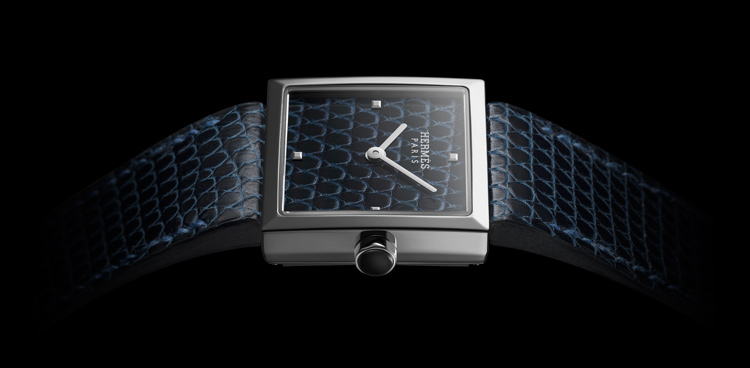
CARRÉ CUIR
If you want to sum up Hermès watches in one sentence what would it be?
A high end qualitative watch that is conveying a lot of fantasy and a lot of emotion to its customers because it has been done to bring pleasure to the people that were creating the watch, so we hope to bring the same pleasure to the customer.
What’s your personal motto?
I don’t have a motto! I think you cannot resume life with one motto so I‘m not addicted to that kind of habit.
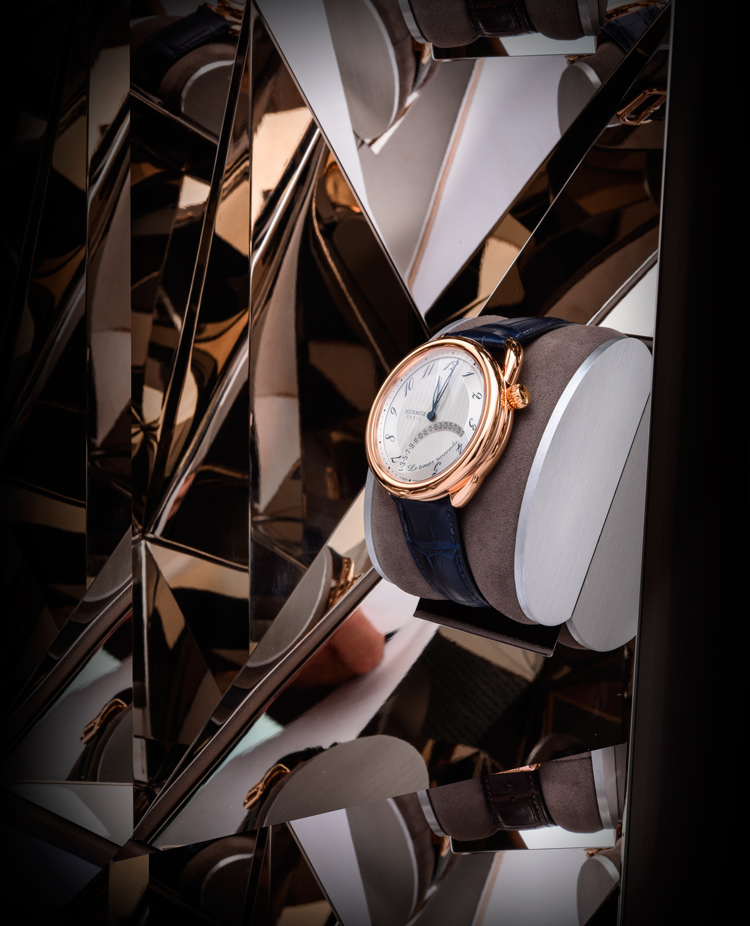
JOYFUL COMPLICATIONS
Are you currently reading a book?
It is a book written by a French advocate explaining how he defends guilty people and why he has been doing the job for fifty years. It goes back to the 1950’s in France when they used to give out the death penalty. It’s a very interesting read.
If you were to invite the readers to come and discover the world of Hermès, what would you tell them?
I would say come and visit us because we have nothing to hide. If you want to understand us please visit us!
Insiders Guide To Richard Mille All-Female Driving Challenge

On a fresh morning in Paris, ninety classic cars lined up at the Vendôme Column ready for an adventure of a lifetime – and we were the only representatives from the Middle East to take on a rally reserved exclusively for women.
A total of 180 elegant female drivers and co-drivers take on the challenge of The Rallye des Princesses in partnership with Richard Mille. A five-day drive across France in classic cars, a journey that test the women’s driving skills, perseverance and the ability to work as a team. The women drive over 1,600 kilometres through the most picturesque of France’s roads.
They had no GPS or map, and relied entirely on a road book to guide them throughout the race and the teams are judged on how they maintain the set average speed, and their ability to navigate with accuracy.
Just days before the event Richard Mille presented the new RM 71-01 Automatic Tourbillon Talisman. The first automatic tourbillon calibre to be entirely developed by the watchmaker. A calibre that combines performance, a precious quality and beauty, just like the founder’s beloved classic racing cars. A timepiece that propels the brand into a new dimension and proclaims its lofty ambitions loud and clear. A perfect partnership then to join together on this race which empowers women and is an experience of a lifetime.
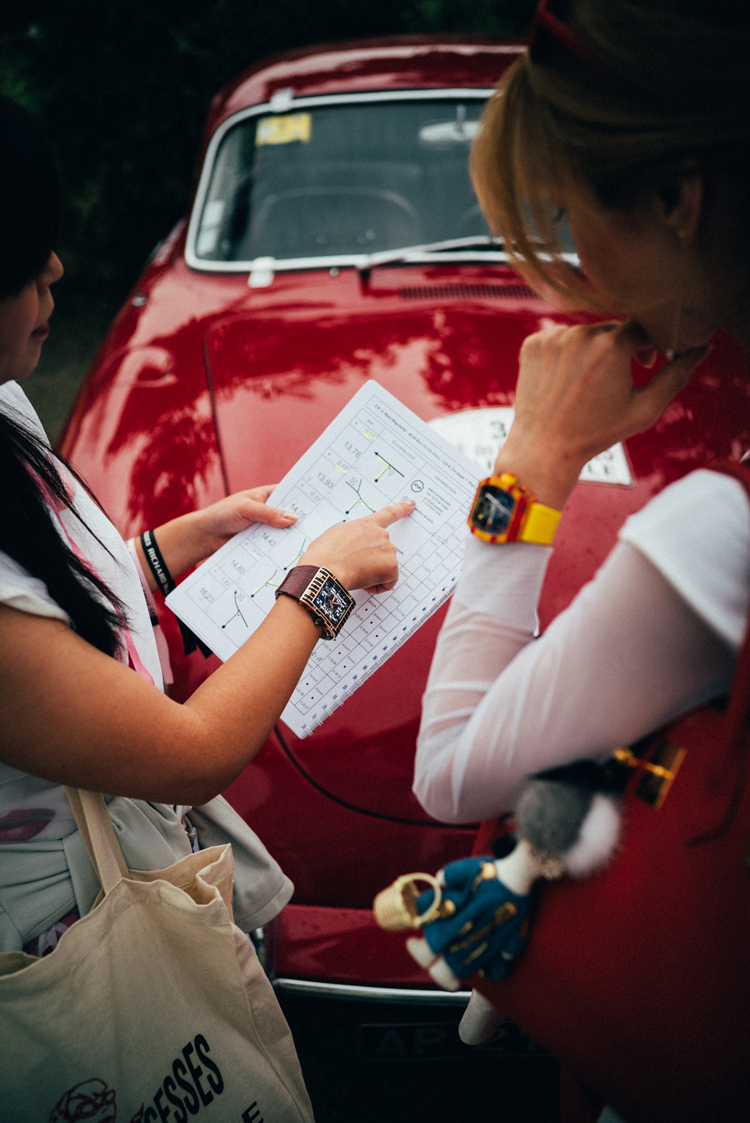
For the first time in 19 years the rally set off in a south-west direction with the aim of Richard Mille to offer a truly immersive experience. The classic cars included, amongst others, four 1963 Porsche 356s, one 1973 Porsche 911 and one 1969 Mercedes Pagode 250sl. Six teams of inspiring women got to experience the rally from inside these rare vintage motors.
While it may sounds like an easy ride, the rally is far from that. Each of the teams of women are equipped with a road book, and determined by a regularity zone, compulsory check points and constant average speeds. The women had to keep pace and the co-drivers were given the responsibility of navigating so the work of one relies hugely on the other. This is teamwork at its best as the teams drove for five days to reach their destination.
As they began their journey the teams discovered the iconic Route N20, a route that was traditionally used by holidaymakers on their way to Spain. The women came face-to-face with the traditions of the rally as they entered the first regularity zone and were challenged to keep as close as possible to the average speed of 50km/h.
This was a challenge for the novice drivers, who had to monitor the speedometer, the time and all the while be looking at the road and following the instructions of their co-driver.
Day two and it was the Navigation and Castles day. This was a challenge that required great concentration from the drivers and the even greater challenge: the rain. Not just any rain, torrential downpours.
Heavy rain is a huge concern for classic cars – the windscreen wipers are not built to handle it and the cars struggle with heavy flooding. Some of them even broke down thanks to the weather. After a little help from the organisers the women were on their way on route to the second leg destination; Vichy.
The next day was a 482km journey towards Toulouse. With treacherous weather conditions again, driving was a struggle with landslides even happening along the route.
Some of the regularity challenges had to be cancelled and the wet weather left some of the teams with flooded cars that were left by the side of the road. While everyone made it to their destination it was not an easy drive for the inexperienced rally drivers with cars flooding and terrible driving conditions this was a huge challenge for the women.

The fourth day thankfully brought sunshine just as the drivers made their journey into Spain. The female drivers ceased the opportunity to unlatch the hoods of the classic cars and make the most of the sunshine.
Climbing the legendary passes of Soulor and Aubisque via the Pourtalet pass was an intense day of driving. The breath-taking scenery made up for the weather conditions and hard work of the past three days and the cars were pushed to the limit as they arrived in Formigal.

After a journey of 1,500km the final stretch reached the outskirts of Biarritz. The princesses crossed the finish line and it was time to check the results. The winners of the race were chosen because of consistency, speed and driving skills as well as the ability to work as a team.
Viviana Zaniroli the race organiser spoke of the event; “This 19th edition was truly exciting and the 90 teams that took part certainly weren’t disappointed. The quantity and quality of this year’s participants was impressive and confirms the increasing popularity of the Rallye des Princesses Richard Mille, with 50% of this year’s entrants taking part for the very first time.”
Editor In Chief Lara Mansour Sawaya
A&E Interviews… Ms Kim Sung-Joo
Ms Kim Sung-Joo is one of the world’s most successful businesswomen. Self-made and inspiring, she discusses with A&E, life as a female entrepreneur and the future of MCM.
Ms Kim Sung-joo is an inspiring self-made business woman. As the founder and Chief Visionary of Sungjoo Group, South Korean-born Ms Kim earned her reputation as Korea’s fashion leader after launching brands including Gucci, YSL and Sonia Rykiel in her home country.
In 2005 Sungjoo group acquired German fashion brand MCM and she has since taken the brand from strength to strength with now over 400 stores worldwide and offices in 15 countries. Ms Kim Sung-joo currently acts as the Chairperson of MCM Holding AG and represents the brand all around the world.
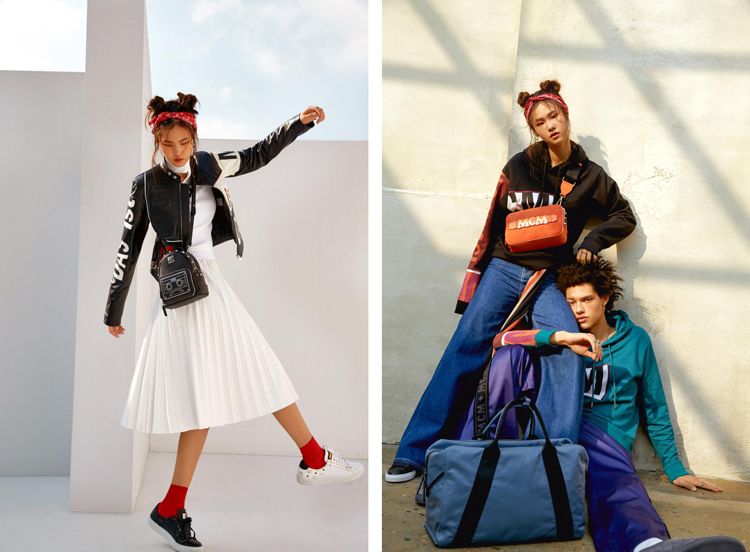
While Ms Kim Sung-joo day job is to manage her brands, she is also a philanthropist, public speaker and a charity worker who has a vision of inspiring women. In 1997 she was selected as a Global Leader of Tomorrow by the World Economic Forum and she has received a host of awards and recognitions throughout her career with perhaps the most memorable being an Honorary Officer of the Order of the British Empire (OBE) by HRH Queen Elizabeth. Ms Kim works with several non-profit organisations to spread her positive and uplifting attitude to life.
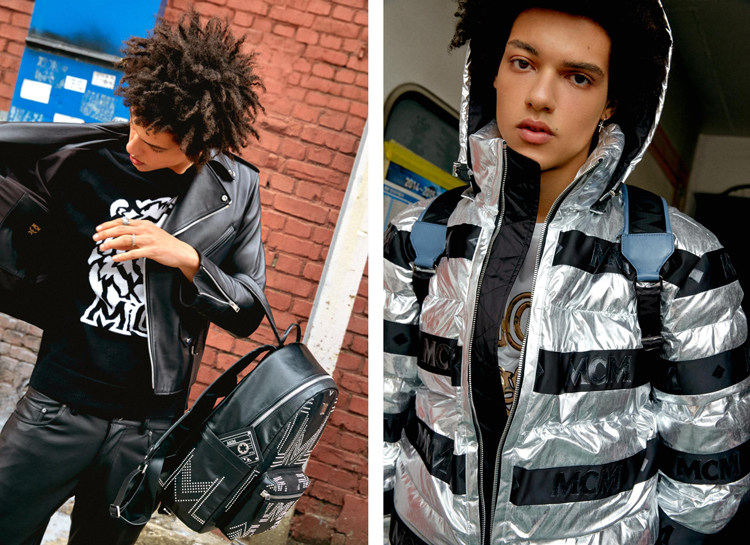
As a brand, MCM is traditionally known for its heavily logoed accessories, but it is so much more than this, striving (and succeeding) to achieve global status the brand is growing year on year. In summer MCM 2019 will launch a ready-to-wear collection that was recently presented at Pitti Uomo in Florence. A&E was there to witness this game-changing show and also to speak to Ms Kim herself.
What can you tell us about the SS19 collection?
First of all the name is “LUFT” – this is the German word for “air.” Air means light and free, so there is a lot of symbolic meaning there. We are a German brand. Germany is actually more known for cars it has never been associated with luxury brands. MCM is now one of the first cases of a global leading luxury brand to be based out of Germany.
When it is a young-minded customer, we need ultimate freedom in what we do. You will really witness an ageless, genderless and seasonless collection. There will be a strong neon orange. Of course bright colours, blue, yellow sunshine and white will be a strong colour. It’s more than colour it is the way it is put together that is truly function driven.
When the Asia and Middle East market is becoming so big, apparently millennials are leading the trend. Why? Because they are so exposed to social media and of course they have deep pocketed parents who can pay for it! So when youngsters are becoming the leaders, the approach to luxury changed. It is not anymore being dictated by just a brand name anymore. This is where the perception of freedom comes from. For MCM we are very millennial driven. All the retailers they need a new young, affluent customer.
Why did you choose Florence as the location for the show?
It’s one of the most beautiful cities in the world as you know. Actually I was first in Florence when I was a student in 1980 and it was one of the most beautiful cities I found. Secondly I worked with Gucci for ten years and came to Florence over forty times and finally we produce a lot of our bags here. This is our first time presenting at Pitto Uomo. Before the Pitto Uomo used to consist of more men’s shows but I have found a new kind of trend emerging that’s not only male, but more unisex. With millennials coming up it’s more casual and sporty and also now fashion is not just only product it’s more lifestyle and the whole package. That’s why we chose Pitti to be our first time to show our ready-to-wear looks.
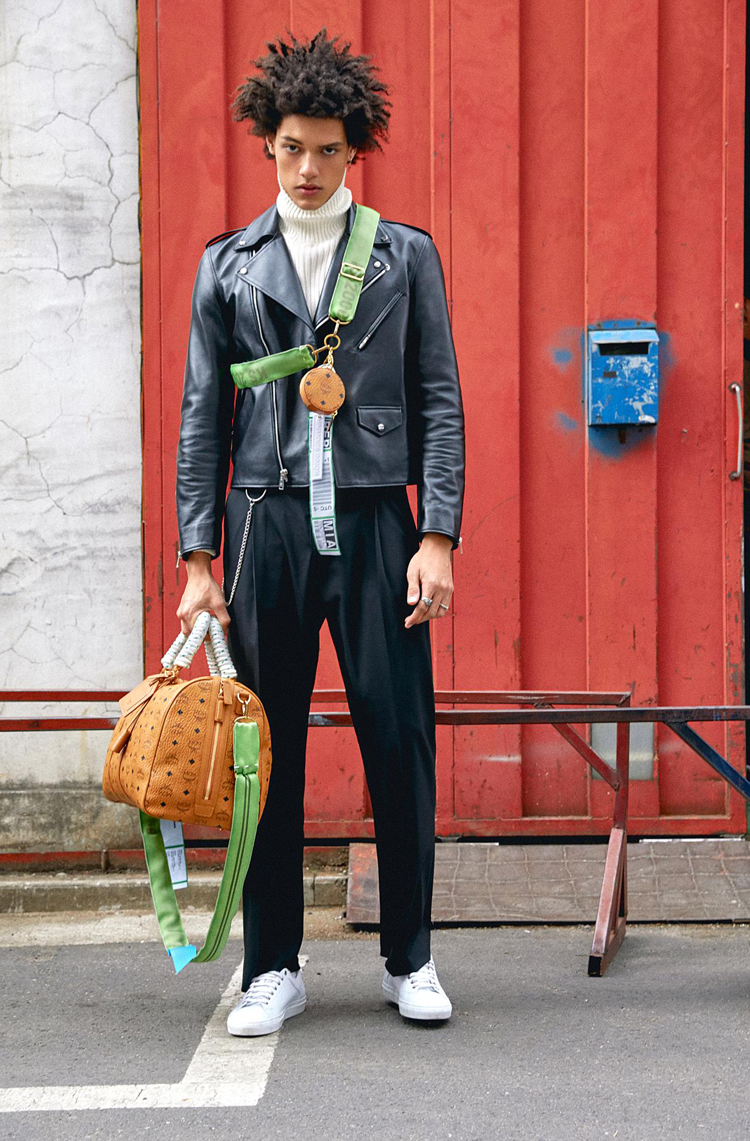
What is an objective in life that you would still love to achieve?
When you live and run a business you have constant challenges. For me, I am a pioneer. On a personal and business level. My case is the first time a woman has run a European global luxury business. I have to deal with more than 300 factories around the world, and nearly 500 stores and 1,500 employees. It’s a crazy house and for some reason I manage it and you know why? Because I want to prove that women can do it. Myself, I am a true global nomad. So being a woman is still challenging for me but I am happy with my business and I am especially focused on helping women’s empowerment.
How are you helping as a company to empower women?
I think I am already inspiring and encouraging so many women by being the first CEO of an international luxury brand. And secondly we also stand up for transparency. As women we have to be smarter, instead of blaming men, just do it smarter. And thirdly we are going through a digital transformation – more Instagram, more digital.
We understand you are repositioning the brand – what can you tell us about that?
All of the luxury brands they used to say we are more affordable luxury – it’s not that. Around 1996 MCM was 10 per cent higher than Louis Vuitton, it has always had a very high positioning. The only reason it decreased was because of the change of license and secondly because a new generation of luxury is emerging we want to appeal to a wider audience so we have a wide price point. We do have crazy $5,000 pieces, but we do have really practical and affordable pieces that are affordable for youngsters. We make all of our pieces in Korea, Italy and Germany that’s it.
MCM has always been known for its logos – but with the recent trend of logomania and so many fashion houses using logos in this way, do you think this has helped or hindered the brand?
MCM was always very logo-driven and we used to be very heavily critisised for this. They said we are too loud – but guess what? Everybody started following us again! And now we are actually less logo-driven. The majority of our sales now come from non-logo items. I see fashion as a social phenomenon – millennials attitude towards luxury can be changed and what they are wearing can express what they are thinking. So I think this is why logos are very popular. I think the even younger generation will be even worse, they will be dictating us as they are so clever.
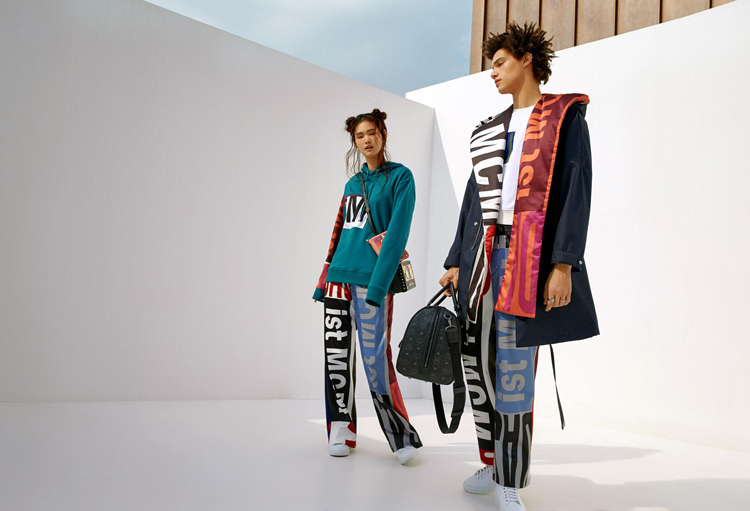
What else is in the future for the brand?
We want to be one of the true leaders of international luxury.
We are prepared for the future.
How would you describe yourself?
I had a chance to look through my bio and I thought “my god do I know this person? She’s absolutely crazy!” I feel like I’ve lived about ten people’s lives at once. I came from the richest family in Korea, I rebelled against a traditional marriage, I was disowned, and married my sweetheart. Then I had to start everything from scratch. I had to deal with discrimination in western society because I was Asian from a fashion background and I went through everything. I don’t want to be rebellious I just want my life to be something meaningful. My mission is that I want women to be encouraged. I want to prove myself and inspire a young generation of women.
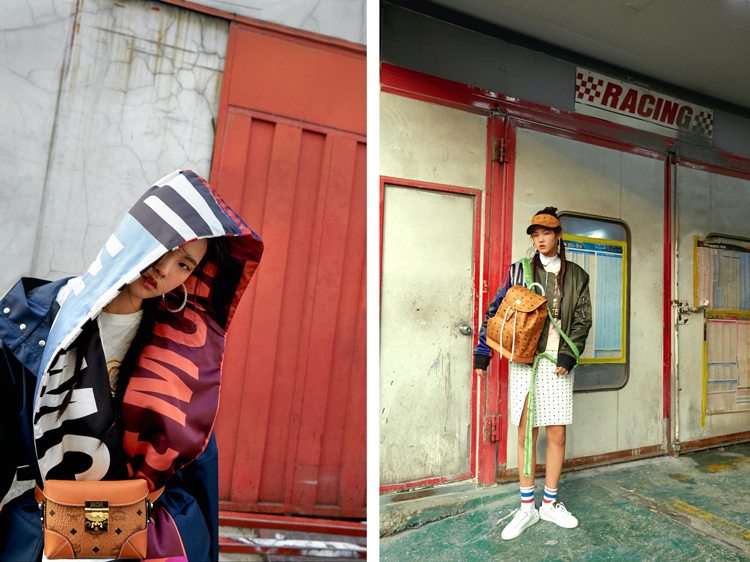
What is luxury to you?
For me, true luxury is freedom.
What is a challenge you faced as a global entrepreneur?
I think the most challenges I face are cultural challenges. When you face these different time zones that is a challenge. When I set up this global team of 1,500 employees across 15 different offices around the world it is truly challenging for me but I think we made it through which is like a miracle to me. The challenges are still there because we are still competing with the giants in the same playground, without as much influence and money as they have, but we are not scared. My personal attitude is that I’m always taking crisis at my breaking point, to my winning point. One thing I can choose is my attitude and I am asking “how can you be smarter and more positive”. I never let failure defeat me.
What is a lesson you give to young entrepreneurs?
Last year I received an honouree doctor degree from London Art School. It’s not that I want to show off how great I am, but the one message I want to give to the young starters is to have a mission in life. Like a figure skater you get knocked down. Business is like this crazy spinning – everlasting challenges but when you’re so focused on your mission nothing will displace you. Money has never been my objective trying to achieve my mission has been.
What scares you?
One thing – if I want to give up because it is too tiring and start to compromise my principles. I am always re-setting myself and think compromising my principals are a big threat to me.
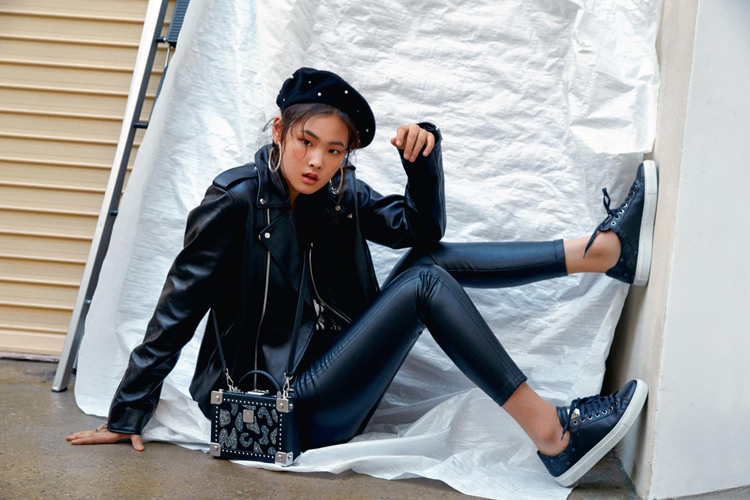
When you look after a brand that is for the whole world, how challenging is it to find a message that is appealing to everyone?
We are truly becoming the leader of new-school luxury because we are pioneering it. People are criticising us but I don’t care because I know we are already there. To consolidate our positioning is challenging.
Do you have any plans to set up a platform to educate the younger generation?
We are already starting to do this. Next year is 100 years of Bauhaus – we are bringing it to Salone des Mobile – we want to initiate a new Bauhaus movement out of this event because it is educational. The new generation means function comes first. So we want to bring the Bauhaus to the world and develop a new movement that will educate the next generation. We are working with the top art schools around Berlin and creating a new Global Creative Centre there and bringing the Bauhaus movement through that. We will do it also around Milan, New York, and Tokyo and maybe Beijing or Shanghai. I would love to do more with women’s education. We would like to as well do something in the Middle East. We are already setting up a big joint venture in the Middle East but I cannot disclose it yet. You will see at the end of this year, we will have a very big show in Dubai – you will see.
READ MORE
A&E Interviews… Gül Hürgel
A&E Chats to Charlotte Tilbury About Her New Store in Dubai and What’s Next
Escape: Cheval Blanc Randheli, Maldives

Just a four-hour flight from the UAE you will find Cheval Blanc Randheli. Opened in 2013 as LVMH Hotel Management’s second Cheval Blanc Maison, the property is situated on the unspoiled Noonu Atoll, just 40-minutes north of Malé, in the serene setting of the Maldivian archipelago
.
With a feeling of peace and happiness, the 46-villa Maison offers the same stylish design and relaxed, friendly atmosphere as the groups sister properties in the Caribbean and in Europe. This property is ideal for self-reflection and a chance to try new experiences and challenges. You will undoubtedly return feeling relaxed, refreshed and fulfilled.
The property includes all the amenities you could ask for, with a the latest in-room technology and a focus on the details; subsequently making every guest feel special. Cheval Blanc adopts the European philosophy of Art de Recevoir, with the aim to give a truly personal approach to looking after its guests. A personal butler is on-hand 24 hours a day to assist with anything you need.

ARCHITECTURE AND DESIGN
Elegant, refined and designed for stylish island barefoot living, Cheval Blanc Randheli was born from a creative collaboration with celebrated architect Jean-Michel Gathy. The Maison was designed in synergy with the island’s natural surroundings, and the striking architecture naturally blends with the atoll’s surrounding landscape. Great attention has been given to the privacy of guests, ensuring a feeling of space throughout the Maison. This is particularly reflected in the elegant design of each villa; lofty cathedral-style ceilings are framed by seven-metre-high handcrafted doors that create a strong sense of openness or when closed, an intimate atmosphere.
The flow of the resort is residential, with an abundance of settings designed for guests to use as they wish – for relaxation, for contemplation, for conversation or simply to enjoy a stunning view. The villas are furnished with materials from the Indian Ocean – teak, rattan, bamboo, thatch and coconut shell. These materials are enhanced by a stylish colour palette of white, taupe and oyster grey with splashes of pop yellow and green. As well as bespoke design elements and artwork throughout, a collection of 46 sculptural colour “spots” by artist Vincent Beaurin make each villa truly individual.

THE VILLAS
Set between lush jungles and the crystal clear ocean, each of the 46 villas, all available with one or two bedrooms, are a private sanctuary offering a unique residential experience and a spectacular sense of place. All have a large living room, spacious bedrooms – which draw the eye out to the stunning scenery – double dressing rooms and light-filled bathrooms with in and outdoor showers, while they all feature a 12.5m private infinity pool and dining pergola or pavilion. There are various types of villas to choose from.
The Island Villas are set within a luxurious garden and ranging from 240 to 300 square metres. Outdoor terraces allow for relaxation on the villa’s own white sand beach surrounded by an exotic garden. The 15 Island Villas are particularly suited for families.
Water Villas are perched on traditional over the water stilts. The 15 villas of 240 square metre offer an unforgettable living experience with endless views over the pristine Indian Ocean.
Garden Water Villas are built partly over the ocean with an overwater deck but also on the island with an exotic private garden, the 15 Garden Water Villas are unique to the Maldives and a true expression of island living.

HEALTH AND WELLBEING
Set sail aboard a traditional dhoni to the Maison’s dedicated Spa Island, where six thatched treatment villas overlook the crystal clear waters of the lagoon, offering guests peace and relaxation. The menu of Guerlain treatments includes 6 treatments created exclusively for the Maison including the Sun Ritual or the After-Diving Experience.
Four single and two prestige couple villas – the Orchidée Villas – offer a sanctuary for guests to discover Guerlain’s exceptional anti-ageing skincare products, a full range of Guerlain’s wellbeing treatments, the brand’s skincare, make-up and fragrance collections. To complete the wellbeing offer, the Hair Spa by Leonor Greyl offers exclusive, tailored natural hair treatments.
The Cheval Blanc Spa also has separate hammams – complemented with a cold plunge pool for a reviving experience. With its deliciously healthy Spa Bar, large swimming pool and serene beach, the Spa Island offers an ideal getaway for those seeking to indulge in a full day of pampering.
The island Yogi invites her guests to indulge in individual or group yoga sessions with various classes of Sunrise or Sunset Yoga, Aerial, Power or Weight Loss yoga for all levels, and Hatha, Ashtanga or Vinyansa yoga for intermediate and advanced yogis. You could also indulge in meditation to set your mind and body into an extreme level of relaxation with a choice of Concentration, Cyclic, Mindfulness or Spiritual meditation.

DIVE CENTRE
The beauty of the ocean in the Maldives is due not only to the colour and transparency of the water, but also its spectacular marine life. You cannot visit Randheli without seeing this wonderful spectacle: explore the reefs of Kuredu, famous for its large population of green turtles, or snorkel in the picturesque waters of the UNESCO protected Hanifaru Bay – a known nursery for mantas, rays and an array of sharks. The 5-Star PADI Dive Centre offers the full range of PADI courses. All of the instructors are multilingual with additional skills such as Underwater Photography/Videography or Marine Biology, and have years of diving experience. A wealth of tailored courses are available.
The qualified captain and enthusiastic crew enjoy sharing the island’s hidden reefs, lagoons and beaches. Any combination of activities on bespoke excursions are possible including fishing, snorkeling, diving. Popular excursions also include a sunset cruise where dolphins are known to swim alongside the boat or a traditional Maldivian fishing trip. The choices are endless.
FITNESS AND SPORTS
Connect with nature and immerse yourself in a wide range of activities and motorized toys for both young and young at heart. Exhilarating experiences await the most adventurous: flyboard, hoverboard, wakeboard, jetski and seabob… or glide with a pedal boat, kayak and boards.
If you want to work out you’ll find the idyllic fitness centre, overlooking the turquoise waters. The workout facility is outfitted with state-of-the-art Technogym equipment and a weekly schedule of complimentary classes. Or if you prefer to keep fit outside, you’ll fine two tennis courts, built according to US Open and Paris Masters standards.
CULINARY
Combining luxury accommodation with incredible food is a rareity. But a Cheval Blanc the aim to provide the culinary experiences of the highest standard and the results are pleasantly surprising. Food is an art, with restaurants that are entertaining, surprising and deliciously varied. The island’s experiences range from fine dining to relaxed alfresco in five restaurants, and three bars which complete the Carte Blanche in-villa menu and tailored offering.

THE WHITE RESTUARANT
This signature concept of Cheval Blanc Randheli offers a casual island chic atmosphere. Its contemporary yet relaxed style blends in with its stunning architecture, white sand beaches and turquoise waters. In this splendid environment, the White Restaurant offers an international menu balanced with Indian Ocean flavours, including Maldivian specialties. Guests can sit outdoor for feet-in-the-sand meals overlooking the lagoon or indoor with an option of private atrium rooms.
LE 1947
Named after Château Cheval Blanc’s most sought-after Grand Cru, here the Chef revisits French culinary know-how with local inspiration with a 9-course tasting menu that evolves on a weekly basis and is a truly unexpected gastronomic experience for the Maldives. The adjoining 1947 Evening Bar with its live piano entertainment has views over the glass enclosed grape cellar, while the nearby Cigar Lounge has a cozy atmosphere completes this fine dining experience for connoisseurs.

THE DIPTYQUE
The Diptyque, inspired by the concept of live cooking and interaction between guests and Chefs, is split into two areas. The areas – East Asian on one, Japanese on the other – invite guests to experience a different culinary journey. Each evening, the inspired team demonstrate their culinary skills before the eyes of delighted guests sitting at the counter right in front of them. For a more alfresco dining experience, guests can choose to sit outdoors on the beachfront, overlooking the ocean. Diners can follow the Chefs recommendations or choose à la carte from a menu which includes the freshest Nigiri, Makimono and Sashimi as well as delicious East Asian specialties such as Gyoza, Tempura, Dim Sum and Miso Black Cod.
TEPPANYAKI
Surrounded by the tropical garden and facing the ocean, the new Teppanyaki experience will delight the guests in search of theatre and culinary mastery. The menu will include beef from Japan, Hamachi, lobster caught in Maldivian waters, and fresh vegetables from the Chef’s garden.

THE DEELANI
This overwater, alfresco restaurant is the centre of the Maison’s Mediterranean cooking. Simple and focused on fresh ingredients, The Deelani invites guests to enjoy Mediterranean dinners inspired by culinary highlights from Spain, France and Italy, with nods to Turkey, Greece and Morocco. Throughout the day, homemade gelato, sorbets and granita can be enjoyed on the sundeck, before the restaurant’s atmosphere begins to build at cocktail hour. The evenings bring delicious tapas and fresh seafood cooked on a Mediterranean style grill. Menu highlights include Mediterranean Mezze, langoustine Prosecco Risotto, Strozzapretti with veal Ossobucco ragout and homemade pizzas.
FINAL SAY FROM THE EDITOR

The Maldives is surely one of the most beautiful destinations in the world and among my personal favourites too, but what really adds to the beauty of any destination is the property you stay at as this defines your experience.
My stay at Cheval Blanc was truly memorable as what this place offers is the true meaning of luxury and what the travel connoisseurs are looking for when planning their getaways. My beach villa was not only stunning, it included the most up-to-date technology, and the attention to detail was incredible. The resort offered exemplary service, friendly staff and one major personal highlight – the food! As you know, the refined culinary experience in many of the resorts in Maldives is not something that’s given much attention to, as the focus is often on the location itself and the activities offered. However at Cheval Blanc providing the highest quality food was among the priorities of the resort. Whether you crave fine French Italian, Asian, or even Maldivian cuisine, all options are available throughout their restaurants. You can even have your morning Lebanese “Manakeesh” baked by Lebanese Chef Saeed, who is also famous for his exquisite pastries. (Forget dieting at this resort!)
I also enjoyed an array of daily activities from snorkeling to diving to island biking and even exploring aerial yoga!
The spa island is also a highlight for me, as it is where you go to enjoy a relaxing day among lush gardens and the blue waters after a signature treatment or massage. (The therapists are excellent).
I totally recommend this place for every person that seeks a beautiful property destination and a refined experience as well as service that is second to none.
READ MORE
Eid Escapes Close To Dubai
Shop Now: Summer Vacation Style
Jewellery Guide: Collecting Coloured Gemstones
WHETHER CITRINE OR SAPPHIRE, BLUE TOPAZ OR ORANGE DIAMOND, THERE HAS BEEN A RAINBOW REVOLUTION
Are diamonds still a girl’s best friend? It may surprise you that right up until the early twentieth century around 50% of engagement rings featured coloured gems and 50% diamonds. This only changed with the intervention of De Beers, who sought to dominate the diamond market by promoting it on a vast scale around the world. They were so successful in achieving this that by the end of the century diamonds accounted for more than 95% of the market. In the twenty-first century we are now seeing this trend reverse and the coloured gem market share expand. Gemfields, often referred to as the ‘De Beers’ of coloured gems, have been an important factor in this shift. Gemfields purchased the 175-year-old Fabergé brand in 2012 for $142 million and they have subsequently launched a bedazzling array of coloured gem engagement rings and jewellery.
The launch ties in with a growing trend for women to veer away from generic white diamond engagement rings, with coloured stones becoming a more common choice among modern brides. Diamonds may be deemed the most valuable gem, but beyond the traditional trio of rubies, emeralds, and sapphires, we are witnessing a rainbow revolution in which previously overlooked stones are now in the limelight.

Although it is true to say the coloured stone market is predominantly centred upon this trio, some more exotic coloured gems are starting to make more of an impact. Beautiful Paraiba tourmalines are becoming increasingly popular since they were discovered in the 1980s in the Brazilian region that gave the stone its name, as are green sapphire, spinel, morganite, amethyst, alexandrite, pink sapphire, golden beryl and many more. The range of hues and colours opened up by this ever-expanding spectrum of gemstones allows designers and craftspeople to create more individual designs. There are also interesting financial incentives for purchasing coloured gemstone engagement rings, as their price point is, in many cases, below that of diamonds. Having said this it is however important to note that some high end Colombian emeralds, such as Burmese rubies and Kashmir sapphires, can fetch many tens of thousands of dollars per carat, often placing them at a substantial premium to many diamonds. Another key advantage that coloured gems possess over diamonds lies in the density of the stones. Diamonds are to be found at 10 on the 1-10 Mohs scale of mineral hardness and are consequently up to 30% denser than emeralds which are at 7.5, resulting in the physical dimensions of an emerald being significantly larger per carat.

Aside from the increased individuality and more accessible price point, there are more practical reasons for coloured stones, such as the vast array of options in terms of cut, colour, and quality, something which Bulgari took advantage of between the 50s and 60s when they were creating extraordinary floral brooches. They started their own style at this stage, using gems for their chromatic effects and daring combinations. This allows for greater flexibility and experimentation, but as with all commodities, increasing demand coupled with diminishing supply will create the most profound price increases. Alongside the increase in demand, there are other factors which are causing these increases, including certification which has had an impact on the gem market in recent years. As buyers of loose stones and jewellery become more savvy in the internet age, they are demanding gems with greater emphasis on the value of the ‘five-C’s’, cut, colour, clarity, carat, and certification. This more discerning consumer buying pattern is driving up the value of certified high-quality stones at a much faster pace, placing greater pressure on supply.
A GUIDE TO COLLECTING COLOURED STONES
Fancy or Vivid, Know Your Terminology
Coloured diamonds come with their own specific colour categories. A blue diamond, for example, could be classified as Faint Blue, Very Light Blue, Fancy Light Blue, Fancy Blue, Fancy Intense Blue, Fancy Dark Blue, Fancy Deep Blue or Fancy Vivid Blue. The same principle of categorisation applies to coloured diamonds of virtually all hues.
Word Order is Important
Coloured diamonds aren’t always a single colour. You may sometimes see a diamond described as Vivid Orange Yellow or Vivid Yellow Orange. The key here is to look at the last word, which will be the principal and dominant colour.
How Valuable are Different Colours
The rarest of the rare is a red diamond, there aren’t many, and they’re generally not very big. It would be exceptionally unusual to find a red diamond above 2 carats.
What Make’s a Perfect Coloured Stone
When it comes to emeralds, the most coveted are a darkish green. However, it’s important the stone isn’t too dark, as the highest-quality emeralds combine good colour with clarity. The same applies to rubies and sapphires, and you should look for stones with an appealing colour, good clarity, and attractive proportions. A small percentage of the top rubies have a colour referred to as ‘pigeon’s blood, a dark red which must not be too dark. Aim for a rich, warm burgundy that makes you joyful when you look at it.
The Relevance of Origin
For coloured gemstones, this is a point to be considered, with the top emeralds mined in Colombia, the finest rubies coming from Burma, and for sapphires Kashmir. However, it is important to remember that attractive gemstones do come from many different localities, and it is all about the beauty of the colour and the budget available.
The Best Care for Coloured Stones
One golden rule is to never carry gemstones in a pouch, as if stored with other stones, a diamond will scratch another diamond, and any stone softer than it. Sapphires will scratch everything that is softer than them, and so on, down the scale.
By Eliza Scarborough
READ MORE
We Found Best…Honeymoon Hideaways
So, what makes the perfect honeymoon? Whether you want a private tropical island to yourselves, an adventure into the unknown, or a secret bolthole in one of Europe’s most enchanting cities, here are our all-time favourite honeymoon destinations in the world, and where to stay when you get there. From romantic hotels to idyllic island havens, these are the perfect start to married life and the most unforgettable, indulgent holiday of your lives.
AMANTAKA, LAOS
For those seeking a more unique and adventurous honeymoon experience, look no further than Amantaka, Luang Prabang. Situated in the north of Laos, this beautiful landlocked country is often overlooked by its more popular South East Asian neighbours. However, step back in time and escape the mainstream tourists, in this romantic, UNESCO listed city. Formerly a hospital, Amantaka exudes old world French colonialism with a modern touch. Featuring high ceilings, four-poster beds, suites with private pools, and a stunning wood panelled library, Amantaka is a luxurious home away from home. For those seeking pure relaxation, lay by the main pool surrounded by mango trees, or take advantage of their onsite wellness plan and luxurious spa. However, if you are looking for some adventure and culture, cycle to nearby temples, using the property’s complimentary bicycles, trek through the neighbouring rainforest and stumble across stunning, natural waterfalls, or book a private sunset tour on the Amantaka riverboat and cruise down the Mekong River in style.


WILD COAST TENTED LODGE, SRI LANKA
On the fringes of Sri Lanka’s Yala National Park, the Wild Coast Tented Lodge completes the trio of Resplendent Ceylon hotels on the island. Animal enthusiasts will love the back to nature excitement of this luxurious safari camp whose tented cocoon suites offer panoramic jungle views. There are four secluded suites that face the white-sand beach, while a further 16 rooms overlook waterholes and act as front row seats to watch the visiting wildlife. In the restaurant a daily-changing menu showcases the best of Sri Lankan cuisine.private sunset tour on the Amantaka riverboat and cruise down the Mekong River in style.


SONEVA KIRI, THAILAND
Just an 80-minute flight from Bangkok in Soneva’s private plane, you are transported to the stunning turquoise waters of Koh Kood. This idyllic paradise is located on one of Thailand’s largest islands, yet it is one of the least developed, making it the perfect honeymoon escape. Soneva Kiri’s laid-back ambience and beautifully designed pool villas, exude Robinson Crusoe luxe. Take advantage of daily yoga and Pilates classes, the heavenly Six Senses Spa, plenty of water sports to keep you entertained and the romantic al fresco cinema. Those looking for something special will love the hotel’s Thai restaurant. This stunning lantern lit restaurant is set on stilts and reached only by speedboat, providing delectable Thai dishes and a truly breath-taking atmosphere.


KENSHO BOUTIQUE HOTEL & SUITES, MYKONOS
Overlooking the beautiful Ornos Bay in the south of the island, Kensho is an equisite new hotel. Dreamy interior design incorporates muted tones to create a soothing oasis, where you can indulge in sublime cuisine that fuses traditional Greek flavours and modern cooking techniques, as well as world-class spa treatments. The 35 bedrooms have Hermès products, a sleek iPad control and most have plunge pools or Jacuzzis, but if you do want to leave and explore, there is an on-demand private transfer to Mykonos Old Town.


BISATE LODGE, RWANDA
The six private villas at Wilderness Safaris’ new Rwandan camp Bisate Lodge may look like alien dwellings from the outside, but inside sophisticated interiors are warmed by a central fireplace beside which you will enjoy your complimentary welcome massage. Situated within the cone of an extinct volcano, the magnificent pods are surrounded by lush forest with sweeping views on the awe-inspiring landscape. You will be given the chance to join morning treks in search of mountain gorillas, golden monkeys and a diverse range of bird-life, and to give back to the environment with tree planting at a nearby nursery.


ANANTARA AL JABAL AL AKHDAR, OMAN
On a promontory of Oman’s Jabal Akhdar reserve, once visited by Prince Charles and Princess Diana, this Anantara outpost brings a new level of luxury to the region. The best rooms are the Cliff Pool Villas, strung along the edge of the canyon, each with views over a private plunge pool out to the rocky, green tinged expanse. The retreat, which is set 2000 metres above sea level, can already lay claim to being the highest five-star hotel in the Middle East, and you can enjoy these heights by abseiling along the via ferrata drilled into the cliff-face.


MILAIDHOO, MALDIVES
Built upon the archetypal white sands and turquoise waters of the Maldives, Milaidhoo offers you the chance to delve deeper into the archipelago’s traditions with cooking classes and dhoni boat-building workshops. Despite the property’s cosy boutique air, the 50 open-sided villas are huge and have their own freshwater infinity pools, guaranteeing total privacy and mesmerising views across the Indian Ocean, including the chance to spot dolphins from the villa deck. Throughout, the design concept is also rooted in indigenous culture, including the characterful main restaurant Ba’theli, which takes its name from a traditional form of wooden boat, where it feels like you are dining at sea.


READ MORE
The Most Iconic Movie Wedding Gowns Of All Time
The princess bride is largely a creation of the cinema, that filmic realm where weddings are designed to have maximum impact. Whether it’s the dramatic Vivienne Westwood gown Carrie Bradshaw wears while getting her heart crushed in the Sex and the City movie or Juliet’s simple, sleek, and delicate number from Romeo & Juliet, a wedding dress is always one of the most unforgettable costumes from a film. Even some of the most classic love stories featured memorable big-day looks, from Julie Andrews’s iconic A-line dress in The Sound of Music, to Audrey Hepburn’s vintage Givenchy number in Funny Face.
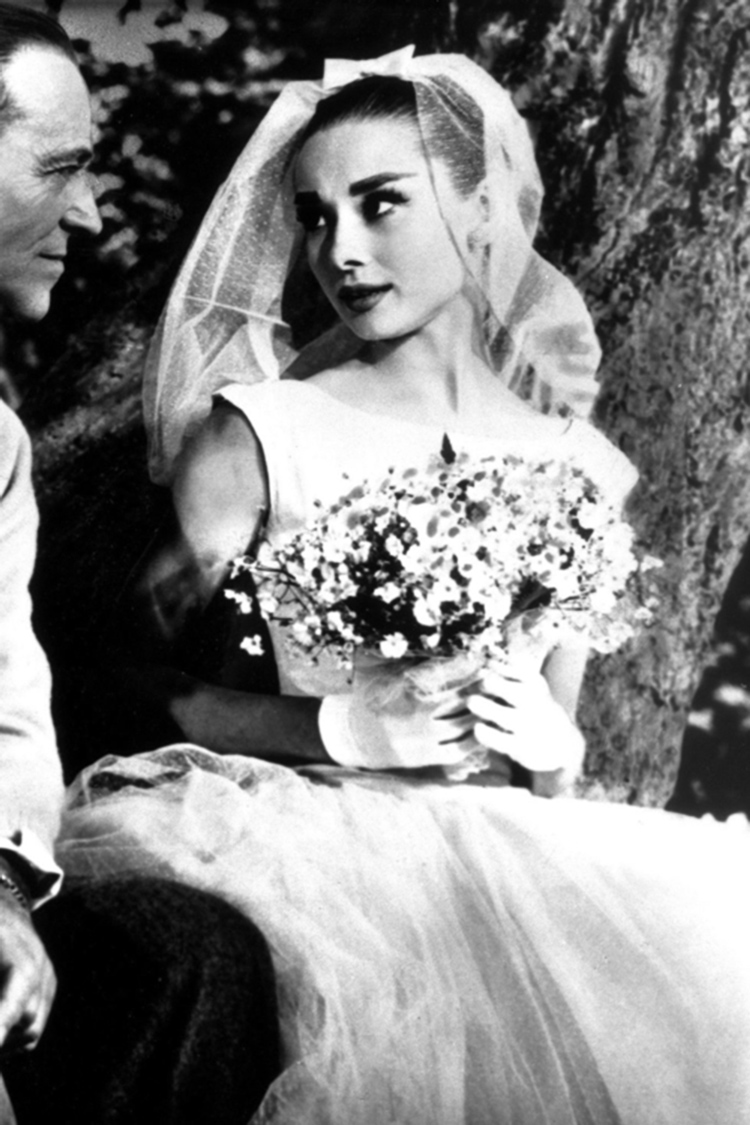
Funny Face
One of the most iconic movie wedding dresses of all time was this white ballerina-length wedding gown that Audrey Hepburn wore as Jo Stockton in the 1957 movie. Featuring a full skirt, tight bodice, sabrina neckline, and of course that now infamous tea-length skirt consisting of layer upon layer of tulle, this classic 1950’s style gown was the creation of Hubert de Givenchy, who worked with Audrey on numerous occasions, and truly was the man behind the style we all know and love Audrey for.

Romeo + Juliet
A spur-of-the-moment secret wedding for Claire Danes as Juliet Capulet in the 1996 retelling of the Shakespearean tragedy called for a simple understated sleeveless silk wedding dress with ever-so-delicate button bodice detailing and feminine white gloves to match. It turns out, costume designer Catherine Martin understands the importance of a good button on screen, as in most scenes they are seen close-up, so she went for covered buttons to complement the dress.
Marie Antoinette
When a historical icon like Marie Antoinette is being portrayed the costuming must be on point, as in real life the royal’s silver gown was a truly decadent design covered in diamonds. The dress worn by Kirsten Dunst in the 2006 Sofia Coppola film was designed by Milena Canonero, the winner of four Academy Awards for Best Costume Design, including one for this film. The opulent three-quarter-sleeve gown featuring large panniers was made from a beautiful silver cloth with a creamy tint and decorated with various ribbons and embellishments.

The Sound of Music
Maria Von Trapp’s wedding dress in The Sound of Music, worn by actress Julie Andrews, is so iconic that it went up for auction at Julien’s Auctions in Beverly Hills. The ivory silk high-collared gown features a modest V-neck and buttons up the bodice and sleeves. Created by costume designer Dorothy Jacobs, it was completed with a long and flowing veil.

Bride Wars
Bride Wars doubled up in every way, with each leading lady wearing Vera Wang. Liv, played by Kate Hudson wore a voluminous ball gown style with a modified sweetheart neckline and a lavender coloured ribbon at the waist. Although Emma’s dress, which was worn by actress Anne Hathaway, was also designed by Vera Wang, her style was completely different and designed to look like it had been handed down from her mother to reflect her timeless romantic personality.

The Father of the Bride
You can’t get much more iconic than Elizabeth Taylor’s wedding dress in the original 1950’s film, when she played Kay Banks, a daughter on her way down the aisle. It was designed by Helen Rose, who was known for her work in films as well as for creating some of the most famous wedding dresses of the era, including Elizabeth Taylor’s own bridal gown for her first marriage to Conrad Hilton, Jr. in 1950 which was inspired by the one in the film, and Grace Kelly’s when she married Prince Rainier of Monaco in 1956.

The Twilight Saga: Breaking Dawn
When it was time for Bella Swan played by Kristen Stewart to wed, series author Stephenie Meyer called upon designer Carolina Herrera. It took Herrera and four seamstresses six months to create the custom crepe satin and French Chantilly gown, which was sleek and simple at the front, yet featured intricate lace and button details on the sleeves and open back.

Love Actually
The long-sleeve, feather-adorned frock worn by Keira Knightley who was playing Juliet in the festive film, could have been very different if director Richard Curtis had his way. Costume designer Joanna Johnston later revealed that he wanted her to be dressed ready for the end of the scene where they are partying so had the idea of a crop top, although in the end a compromise was made by layering sheer fabrics.

Sex and the City
At first, Carrie Bradshaw played by Sarah Jessica Parker, only put on this multi-tiered Vivienne Westwood wedding dress for a photo shoot, but one look at herself in the dress is all the convincing she needed. Other brides loved the design just as much, and following the film’s release, a shorter version of the dress sold out within hours on net-a-porter.com. Of course, Carrie’s look was perfectly accessorised, with a silk tulle veil with feather headpiece and Christian Dior Extreme Dior Gladiator Heels embellished with Swarovski crystals.
The Great Gatsby
Even if we only got a glimpse of the gown worn by Daisy Buchanan who was played by Carey Mulligan in a flashback, its 1920’s style inspired a bridal revolution. Costume designer Catherine Martin topped the fringed, beaded frock with a feathered headdress appropriate for the Art Deco period and was awarded her second Oscar for Best Costume Design for the look.
READ MORE
A&E Interview: Meet Marchesa’s Designer Duo
MARCHESA SPRINKLE FASHION FAIRY-DUST OVER THEIR GOWNS FOR THE MOST EXQUISITE OF CREATIONS

New York-based label Marchesa was established in 2004 by British-born design duo Georgina Chapman and Keren Craig. Named after the Marchesa, meaning Marquise in Italian, Luisa Casati, an eccentric, Belle Époque high priestess, the brand is synonymous with red carpet events and frothy bridalwear, counting Hollywood A-listers Blake Lively and Nicole Kidman as fans.
The two ladies are the definition of power women. They first met as students during a life drawing class at London’s Chelsea College of Art & Design when they were 17, and years later Marchesa was born. The year following their launch they dressed their first-ever celebrity client, Renée Zellweger, who wore a sari-inspired strapless gown for the London premiere of Bridget Jones: The Edge of Reason, and since then their gowns have graced many red carpets before taking to the wedding aisle.
Both Chapman and Craig cite such classic French patternmakers as Madame Grès, the godmother of the Grecian gown, and Madeleine Vionnet as influences, as well as flamboyant fellow Brits Vivienne Westwood and Alexander McQueen. They are experts on the statement gown and their creative process is a collaboration at every level. It’s Chapman who sets the tone for each collection, including ready-to-wear, bridal, and Notte, a diffusion line, and Craig who rules over the sumptuous textiles and embellishments.
Building a fashion empire from the ground up, the duo talk to us about their particular brand of elegant opulence mixes vintage-inspired embroidery with intricate draping, and how their gowns lend an ethereal touch to every red carpet or high-profile wedding they grace.

How did your journey in fashion begin?
GEORGINA CHAPMAN: I was always very interested in fashion. My mother is extremely stylish, so I think a love of fashion was something that I developed early on and has carried through. I studied costume design in art school, I was so fascinated by the idea of escapism in costume and the historical context behind fashion.
KEREN CRAIG: My passion has always been in art, textiles, and fashion. I was always obsessed with party dresses even from a young age. I guess you can say that things haven’t changed much!
Can you tell us about how you started Marchesa?
BOTH: We first met when we were students at Chelsea Art College and instantly clicked. We had so much in common and had similar passions for both design and travel. It was early on when we began talking about having a business together, but it wasn’t until 2003 during a vacation in India that we decided to start Marchesa.
What is your design aesthetic?
BOTH: Marchesa is named after the eccentric Italian heiress, Marchesa Luisa Casati. She had an incredibly dramatic and playful approach to fashion, her outfits were like works of art. We always embody her spirit through our collections but translate them for today’s woman through our silhouettes, textiles, and embroidery.
Tell us about your favourite signature fabrics?
BOTH: We enjoy working with different textiles, however, you will always find varying tulles, laces and silks throughout our collections.
Who is the Marchesa woman?
BOTH: The Marchesa woman is confident and glamorous but doesn’t follow trends. She certainly evolves with time, as have our collections. More recently, we’ve introduced separates into our seasonal Couture and Notte collections, allowing for more versatility in her look, but still possessing the same femininity and elegance that Marchesa is known for.
Tell us about the differences between your mainline Marchesa and the Notte line?
BOTH: There are many parallels between our Marchesa and Marchesa Notte collections. While our Marchesa Couture collection lends itself to black tie affair, Marchesa Notte employs the same aesthetic but applied to effortless silhouettes that work for a casual cocktail event or a gala.

Can you share with us a milestone moment in your career?
BOTH: One of our biggest milestones to date was celebrating our 10-year anniversary and showing our collection in London for the first time in 2014. While we are based in the United States, we are both English and were excited to partner with the British Fashion Council and bring our collection home for this milestone!
What is your creative process like, and what part do you enjoy the most?
BOTH: To start, our collections are always heavily influenced by the sense of adventure and excitement that comes from travel and culture. Once we have decided on our inspiration for the season, we begin conceptualising and bringing that concept to life, starting by preparing mood boards and from there we begin sketching and the creation process.
How do you balance the duties of design when working as a duo? Do you ever disagree on design matters?
GEORGINA: Our skillsets complement each other quite well which is why we work so well together! My role in the process is really conceptualising the collection whether it be through sketching or draping across a form.
KEREN: My focus is on developing the textiles and embroideries for each collection, from creating hand-painted prints for our silks to developing new appliques and different embellishments.

What is your favourite thing about each other? What do you respect most about each other?
GEORGINA: Keren and I have known each other for years, she is one of my best friends and has always been a source of inspiration. We both love what we do and to do it together is a dream!
KEREN: We have known each for so long, so working together is like working with your sister! We both share the same vision and work closely together to execute it.
Tell us about why you decided to expand into bridalwear?
BOTH: Creating a bridal collection was a natural next step for our brand, before we introduced bridal, brides-to-be would frequently request gowns from our collection in white. We love the idea of being part of such a special moment in a woman’s life and are thrilled to offer bridal options for all women through our Marchesa Bridal and Marchesa Notte Bridal collections.
How is the process different when designing either red-carpet gowns or bridalwear?
BOTH: The process of designing our mainline and our bridal lines are incredibly similar from creating mood boards to sketching, draping, and creating the embroideries. For us, creating our bridal collections is such an honour, Marchesa is a quintessentially romantic brand, and with bridal we can embrace that to the fullest extent.
What makes the perfect bridal gown?
BOTH: The perfect wedding gown is different for each woman. The most important part is that she feels beautiful, confident, and comfortable in whatever that dress may be.
Can you share with us the golden rules of wedding dress shopping?
BOTH: One of the most important things to consider when looking for your wedding dress is considering your venue, is your wedding on a beach or is it in a more traditional setting as it should play a part in determining your silhouette and accessories. It is also important that you feel comfortable in your dress, we think a bride’s wedding dress should reflect her personal style and she should decide based on what makes her feel beautiful, rather than adhering to the current trends.
Tell us about your recent Fall 2018 bridal collection?
BOTH: This collection was one of our most versatile and modern bridal collections yet. We really embraced today’s bride by introducing modern silhouettes that still played to Marchesa’s heritage. The collection boasts traditional style gowns with removable overskirts for the bride that wants to change her look from the ceremony to the reception, in addition to cocktail dresses paired with an opera coat. No matter the silhouette, the same craftmanship and Marchesa aesthetic is employed throughout.
Do you have a favourite piece from the collection?
BOTH: We are so close to each piece as so much time and effort goes into bringing the collection to life, it is impossible to pick a favourite!
Should you follow trends when buying a wedding dress or go for timeless styles?
BOTH: We always focus on creating timeless designs when working on a collection rather than adhering to the seasonal trends. A woman’s wedding dress is a memory they hold on to forever, they should be able to look back at photos years later and still love the dress that they wore on their special day.
Can you share your top 3 tips for choosing the perfect wedding dress?
Don’t be afraid to try on a style you didn’t think you’d like or wanted! You might be surprised by how flattering a silhouette or style is that you haven’t tried before.
Pay attention to the smaller details of the dress such as the beadwork and embroideries, these elements can elevate the look and make your dress feel special.
Pick the dress that you feel most comfortable in, you always look and feel your best when you feel confident in what you are wearing, and your wedding dress is no exception.
Can you share with us your recipe for instant glamour?
BOTH: Attitude! You can of course create glamour through what you wear, but ultimately, feeling glamorous is about confidence and poise.
Who are the most memorable brides that you have dressed?
BOTH: We’ve had the pleasure of dressing so many women over the years on their special day including Blake Lively, Emily Blunt, and Julianne Hough, amongst many others. It’s always so thrilling when we see a bride wear a Marchesa creation on her wedding and to be part of such a special moment in their lives.
With online shopping becoming so popular, do you think this will change the way brides shop?
BOTH: We feel that the process of finding your wedding dress is an incredibly intimate and personal experience, whether that means going to a salon with your friends and family to find that perfect dress or purchasing online, that experience should feel natural for the bride.

What do you think of the trend for brides to wear multiple dresses on their wedding day, from the bridal gown, to numerous different party dresses?
BOTH: We think it’s great, a woman should be able to showcase their personality and personal style on her special day however she chooses. There are so many brides who want a more traditional gown for her ceremony but are looking to have something lighter that she can dance the night away in. We embrace this at Marchesa and offer different silhouettes that give brides options.
What are the ultimate wedding accessories to complement a bridal look?
BOTH: Accessories are such an important part of your wedding day look. While there is no formula for finding the perfect accessory, we recommend more subdued accessories when you have a dress with heavy embellishment and for a more minimalistic gown pairing it with a statement earring or necklace. One of the most important accessories on your wedding day is your veil, while this may not be for everyone, it’s such a classic element. When else will you get a chance to wear one?
Can you share with us what is next on the agenda when it comes to product lines for Marchesa?
BOTH: We’ve always envisioned Marchesa as a lifestyle brand, which is reflected through our collections, in addition to our accessories. Looking forward we are excited to continue offering women beautiful gowns and separates for every occasion!
By Eliza Scarborough
READ MORE
Bvlgari Rewrites The ‘RVLES OF DESIGN’ At Milan Design Week 2018
Within the frame of Milan’s Design Week, Bvlgari introduces the “RVLES OF DESIGN” at Fuorisalone and meets the international media during the vernissage in Via delle Erbe in the Brera Design District. With an unexpected catering by the Bvlgari Hotel Milano, the roman Maison brings us through a journey along three different locations with three extraordinary exhibitions: an immersive 1000-metres-square installation in the Brera Design District, a Mirror Cube in il Giardino of the Bvlgari Hotel Milano, and a Gallery in the Montenapoleone Boutique. All the installations celebrate the special relationship of the brand with Design, starting from the evolution of its most iconic ring, the B.zero1.
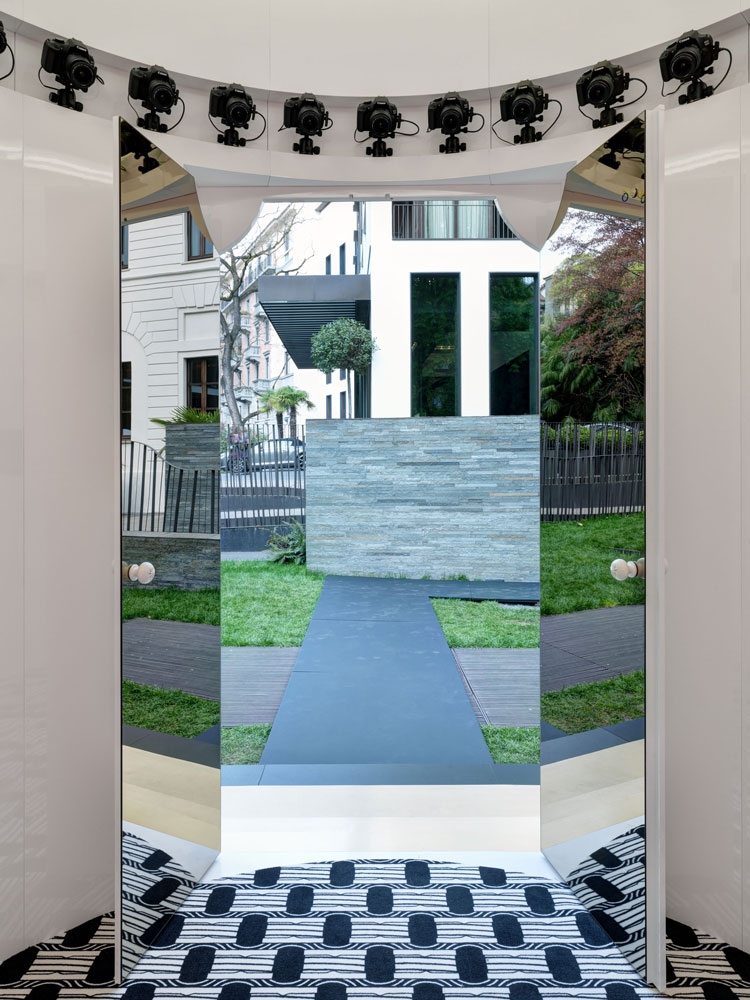
BVLGARI INSTALLATION @ BRERA DESIGN DISTRICT
Envisioned as a labyrinth, the installation welcomes visitors into an abstract universe, where they are forced to abandon everything they know in order to grasp the Bvlgari essence of art and design: deconstruct rules in order to reinvent them.A stunning visual adventure translating three key elements of Bvlgari creativity – materials, modularity and colour – into a three-dimensional space, interpreted by three icons from the world of design and architecture: Iván Navarro & Courtney Smith, MVRDV and Storagemilano.

THE MIRROR CUBE AT BVLGARI HOTEL
Il Giardino of the Bvlgari Hotel Milano is also transformed into a spectacular space for design, and hosts the second part of the Reinventing Design Rules journey: The Mirror Cube. It occupies the Hotel’s garden and makes it shine through its mirroring walls. Once inside the dreamlike structure, the guest is captivated by the hypnotic black and white pattern lining: B.zero1 dominates the scene. Selfie Rules are reinvented inside the Cube: a special camera generates an instant GIF that can be shared by the guests on their social profiles.

THE BVLGARI GALLERY AT MONTENAPOLEONE BOUTIQUE
At the Montenapoleone boutique, a hypnotic Gallery evokes the distinctive patterns of the Brera Design District and Bvlgari Hotel’s installations. An immersive environment allows guests to fully enjoy and celebrate the B.zero1 collection universe through theme windows transformed with geometric patterns.
READ MORE
How To Achieve A Brow Wow Effect On Your Wedding Day
HERE IS HOW YOU CAN ACHIEVE ATTENTION GRABBING BRIDAL BROWS WITH BENEFIT’S PRODUCTS AND EXPERT TIPS FROM MENAT EL ABD.
Today is YOUR day and choosing the right look for your brows is as important as choosing the wedding dress. With Benefit products, having bridal brows has never been easier. The new “Gimme Brow+” and “Precisely, my Brow Pencil” along with “High Brow Glow” are here to help you achieve the perfect bridal brow look for your big day.

For the perfect brows, what is best is to start off the look with applying natural hair strokes by using “Precisely, My Brow” pencil to fill any gaps in and then set the look by topping it off with the new “Gimme Brow+”.

With the new “Gimme Brow+” tinted eyebrow gel, its applicator will definitely allow you to create the bridal brow look you desire in no time. The new product’s updated formula has tiny microfibers that helps volumizing the brows and adheres to the skin as well so you can guarantee a full brow look while looking flawless and natural. What is brow-mazing about this product is the fact that it’s water resistant and long wearing, so you can go ahead and enjoy your wedding with no worries.
Last but not least, to emphasize on the brows and make them pop, use the “High Brow Glow” Brow Pencil to highlight them and add a little of bit of a glamourous glow to your bridal look.
Here are the five steps for your Bridal Brows with a hint of glow. These guarantee a soft natural yet long lasting brow look for you to celebrate the big day. They have never been easier and they will definitely not take much of your time.

With these beautiful bridal brows, one of my favorite tips for all the brides getting ready for their big day is add “Gold Rush” to their look. This golden-nectar blush gives any look a natural-looking warm glow. Simply dust the blush on the apples of your cheeks and blend upward along your cheekbones for a natural flush and you’re done!
READ MORE
Louis Vuitton Expands The Objets Nomades
Louis Vuitton enriches it’s Objets Nomades collection with 10 new items that were presented at The Salone del Mobile in Milan. Les Petits Nomades is a new collection of decorative objects from leading contemporary designers.
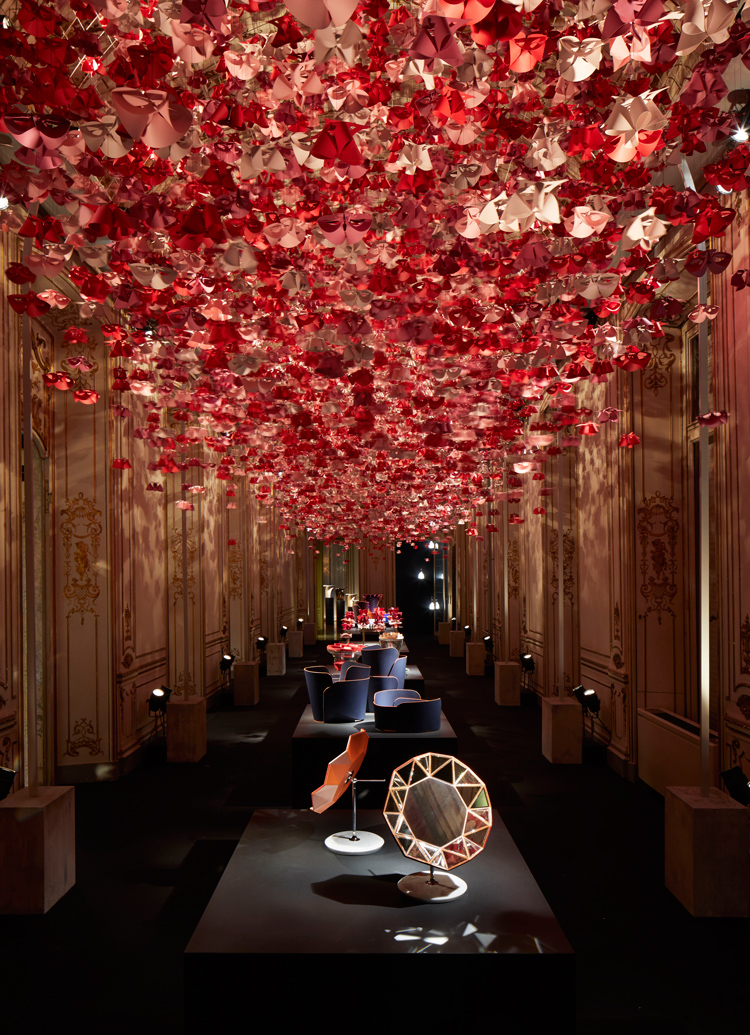
Created in 2012, the Objets Nomades collection keeps alive Louis Vuitton’s long tradition of beautifully crafted travel objects. Some of the world’s most renowned designers have since imagined stunning travel-inspired Objets, which have then been made by Louis Vuitton. This year, two new designers have joined the collection: India Mahdavi and Tokujin Yoshioka.
The limited editions and experimental prototypes that make up the Objets Nomades collection all pay homage to the House’s special orders of the past – such as the iconic Bed Trunk produced in 1874 for French explorer Pierre Savorgnan de Brazza – and add the defiantly contemporary visions of creative designers from around the world: Atelier Oï, Maarten Baas, Barber and Osgerby, the Campana Brothers, Damien Langlois-Meurinne, Nendo, Gwenaël Nicolas, Raw Edges, Patricia Urquiola, Marcel Wanders, and, most recently, India Mahdavi and Tokujin Yoshioka.
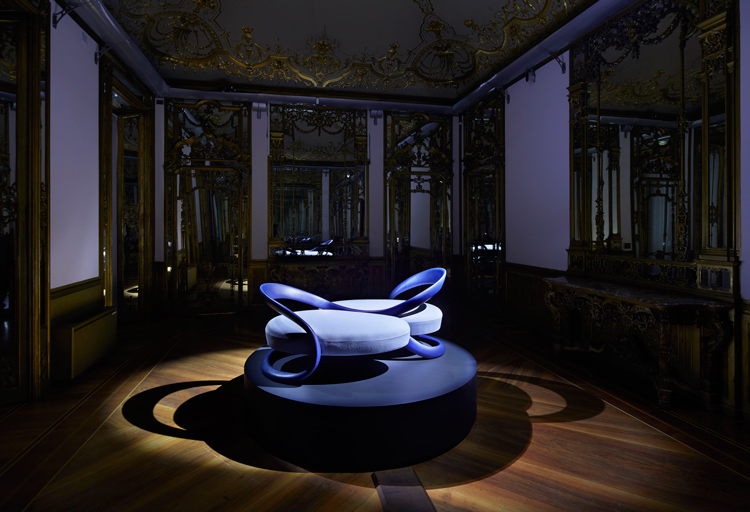
Today, there are 25 Objets Nomades, from a hammock to a deckchair, a swing chair to a foldable stool. Each project has been an opportunity for the designers and Louis Vuitton’s creative artisans to combine their savoir-faire to interpret the idea of travel in their own imaginative ways. Each Objet embodies their shared ideals: a love of the beauty of fine materials, the possibility of forms and carefully balanced proportions, complex and meticulous craftsmanship, and close attention to detail.
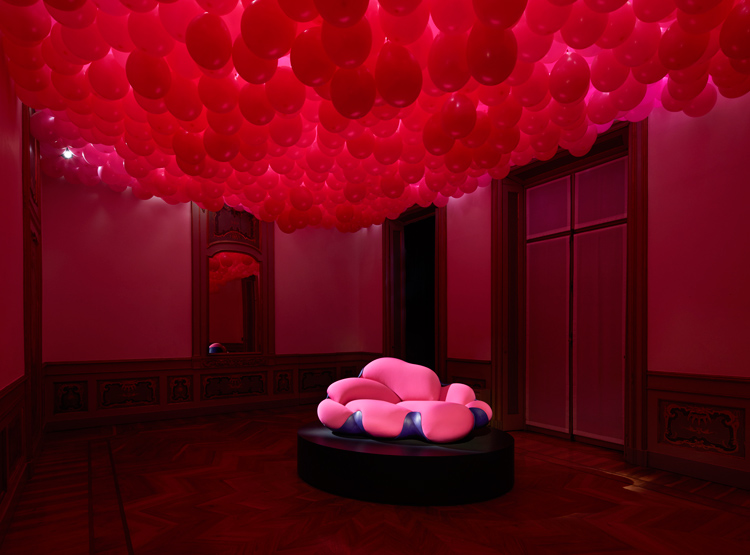
These values are clearly present in the 10 Objets Nomades recently added to the collection, such as the Campana Brothers’ playful sofa, inspired by clouds and the shell Botticelli painted for Venus; Atelier Oï’s stunning chair, with its repurposed straps resembling leather belts; Marcel Wanders’ modern, richly malletage-leather rocking chair; and India Mahdavi’s talisman-inspired nomade side table with its remarkable leather marquetry.
Over 160 years after Louis Vuitton began exploring new territories and ideas of travel, the Objets Nomades collection can be seen as proof that the House has lost none of its sense of adventure.
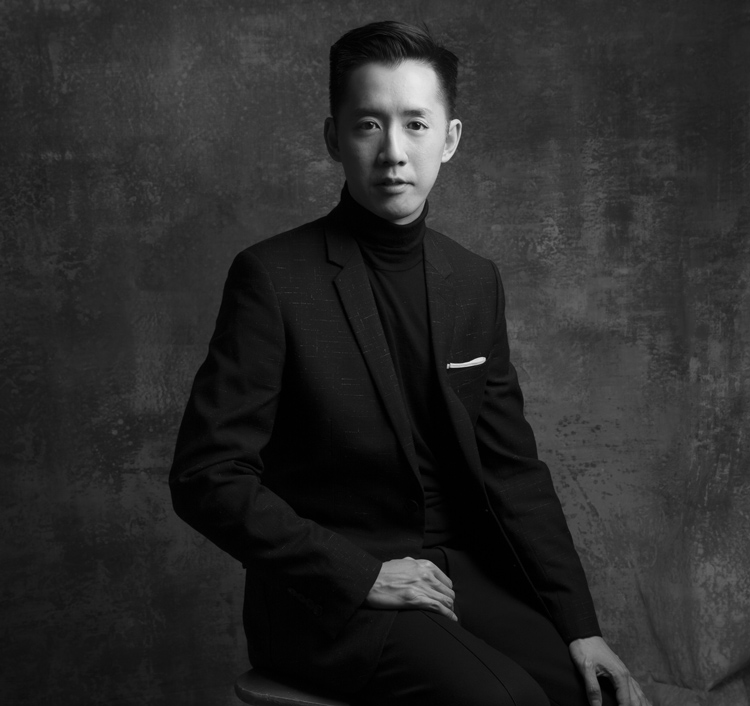
©Louis Vuitton Malletier – Odile Le Moal
ANDRÉ FU
“It is important to me to create forums in which people can gather and interact in person.”
André Fu was born in Hong Kong, educated in the UK from the age of 14, and studied architecture at the University of Cambridge. He credits his 30 years of travelling between Asia and Europe to define his style and unique blend of craft and innovation. He founded his design studio AFSO in Hong Kong in 2000 and since then has worked on hotels, restaurants, galleries, installations and retail spaces worldwide, including the Upper House Hotel in Hong Kong, Singapore’s Andaz Hotel, Villa la Coste in Aix en Provence and the Pavilion Suites at the Berkeley, London. Among his most recent projects was Galerie Perrotin’s new gallery space in Tokyo. Fu has won numerous awards and in 2016, was named Designer of the Year at Maison&Objet Asia, and included in Wallpaper* magazine’s Top 20 Interior Designers.

RIBBON DANCE
André Fu’s two-person “conversation” chair is a graceful echo of the movements of traditional Asian ribbon dances. Its pair of seats sit balanced between the elegant curves of the wooden arms covered in Louis Vuitton leather, their shape evoking ideas of infinity and giving the chair its delightfully fluid profile.
–

©Benjamin Decoin
PATRICIA URQUIOLA
“Nomadism is for me a condition of contemporaneity and lightness.”
Spanish-born Patricia Urquiola has been living and working in Milan, Italy, since the mid-1980s. She graduated from the city’s Politecnico in 1989 and went on to work for a number of renowned architects and design companies, including Alessi, Cappellini and Kartell. In 2001, she founded her own design agency, and two years later was awarded the Best System prize for her Fjord collection. Her body of work, which shows a pronounced taste for colours and a wide variety of materials, now includes an armchair (Smock), a chaise longue (Antibody) and a lamp (Chasen).

SWING CHAIR
Patricia Urquiola’s swing chair invites you to kick back and sway in the breeze in a handbag-inspired design featuring two large, Nomade leather-covered metallic “handles” and a welcoming woven mesh. Held up by gold-plated hooks and beige cord, the chair ensures your comfort with a welcoming Nomade leather seat cushion and woolen back cushion.

OVERLAY BOWL
Each one of Milan-based designer Patricia Urquiola’s Overlay Bowl is made of just four cleverly assembled sheets of smooth but hardwearing Louis Vuitton leather. Featuring harmonious colours and contrasting edge-dying, the baskets – which come in three sizes – are all individually handmade, making each one a one-off sculpture and a beautiful example of the House’s leather work savoir-faire.

©Cyrille George Jerusalmi
MARCEL WANDERS
“We have always seen Louis Vuitton as the benchmark of what it means to love your craft.”
Born in 1963 in Boxtel, the Netherlands, Marcel Wanders founded his design studio in 1995 with the aim of “creating an environment of love, and living with passion to make our most exciting dreams come true”. His design approach often mixes innovative materials and techniques with historical standards, a combination that give his work a poetic and romantic feeling. Alongside his furniture, he has designed a number of stores and hotels, including the Andaz Amsterdam Prinsengracht Hotel in the Netherlands, and works as art director for design label Moooi. His work has been included in design collections and exhibitions across the world at institutions including the Museum of Modern Art, New York; the V&A, London; the Stedelijk Museum, Amsterdam; and the Museum Boijmans Van Beuningean, Rotterdam.

DIAMOND SCREEN
Whether suspended on its metal frame or hanging from the ceiling, the leather screen artfully creates a semi-transparent partition that references both the diamond shape of the House’s classic Monogram pattern and the canework once used in its trunks. As each piece is held to its neighbours with brass clasps similar to those found on Louis Vuitton bags, the screen can be sized to fit any space.

DIAMOND MIRROR
In collaboration with Louis Vuitton, Marcel Wanders is presenting two Diamond Mirrors (2018) as part of the Objets Nomades collection at Fuori Salone this April. The mirrors have been designed in two sizes and are referred to as the large Diamond Mirror and the petit Diamond Mirror. They feature a central octagon that is circled by 25 smaller triangular mirrors and use dazzling geometric design to create poetic reflections. Each mirror’s faceted rigid structure is enveloped in Louis Vuitton’s rich Nomade leather and reveals Louis Vuitton’s emblematic contrasting stitching. The petits Diamond Mirrors are mounted on a heavyweight silvery brass stand with a marble foot.

©Benjamin Decoin
FERNANDO & HUMBERTO CAMPANA
“Above all, travel of fers the unique opportunity to embark on a new exploration.”
Fernando & Humberto Campana Fernando and Humberto Campana have been creating modern classics since 1983. Their creativity is based upon looking beyond the obvious to capture the beauty in the everyday. They use unexpected materials in surprising and inspiring ways, such as in the Vermelha chair, woven in brightly coloured rope they found in a São Paulo market, or the Favela chair, made out of scrap wood picked up on local streets. With a constantly striking use of colour and a heartfelt dedication to craftsmanship, the brothers make the ordinary extraordinary and bring out the beautiful in the simple.
Since 2002, Estudio Campana, their São Paulo-based company, has been producing its own product line, as well as one-of f handmade pieces. Their work can be seen in the permanent collections of cultural institutions around the world, including the Museum of Modern Art, New York; the Centre Pompidou, Paris; the Vitra Design Museum, Weil am Rhein; and the Museu de Arte Moderna, São Paulo. They were also named Designers of the Year at Design Miami in 2008, at Maison & Objet Paris in 2012, and were given a special award at the Musée des Arts Décoratifs, Paris, in September 2012.

COCOON
See it swinging gently from its gilded steel and brass hook and the cocoon becomes an invitation to while away the day. A delicately perforated pod of vacuum-moulded fiberglass – the same material as surfboards – is then covered with calfskin on the exterior and quilted leather on the inside. With its broadcloth-covered cushions that are both warm and comforting, the cocoon is like a protective shell designed to enfold, envelop and reassure. It is of fered in red, yellow, turquoise, purple, caramel, light blue, dark blue, coral, grey or green leather.

TROPICALIST VASE
A carefully crafted construction of 176 two-tone, leather-covered metal “petals”, the Tropicalist Vase is a statement to the different ways that Louis Vuitton’s materials can be crafted. The Campana Brothers were the designers of the first ever Objet Nomade and their Louis Vuitton Les Petits Nomades Tropicalist Vase, inspired by South American quesnalia and bromeliad flowers, is the latest example of their timeless vision of exuberant refinement.

©Géraldine Aresteanu
INDIA MAHDAVI
“Design is about giving function a form.”
After studying architecture, industrial, graphic and furniture design, India Mahdavi spent seven years as creative director for interior designer Christian Liaigre. She founded her own studio in 2000 and, from her base on Rue Las Cases in Paris, has since worked internationally on interior design, scenography, furniture and object design projects. These have included restaurants and hotels, such as The Gallery at sketch in London, Ladurée in Geneva and Los Angeles, and The Monte Carlo Beach Hotel; retail concepts, most recently, Red Valentino in Rome and London; and a line of furniture and home accessories, including her trademark Charlotte armchairs. She describes her style as “polyglot and polychrome”.


TALISMAN TABLE
India Mahdavi’s side table, inspired by Middle Eastern nomadic hospitality, features a portable leather-covered base that unfolds like a book and a removable tabletop whose “benevolent eye” design is created in stunning leather marquetry.

©Benjamin Decoin
ATELIER OÏ
“Encounters and life experience nourish our atelier’s savoir-faire.”
Founded in La Neuveville, Switzerland, in 1991 by Aurel Aebi, Armand Louis and Patrick Raymond, Atelier Oï works to break down barriers between genres and disciplines. The three have worked on projects in architecture, design and set design, nurturing their love of materials and emotion. The studio’s work has been recognised the world over.

TABOURET
Folded it appears like a single sheet of leather; unfolded with one hand however, it magically becomes an intelligent and beautifully designed leather travel stool. Combining the traditional Japanese art of origami with Louis Vuitton’s savoir-faire in traditional trunkmaking techniques, the stool is an extraordinary object: a rigid aluminium membrane wrapped in soft Nomade leather. With its carrying strap and wide range of colours, the stool by Atelier Oï takes portable seating to wherever your desires lead you, from the banks of the Ganges to the dunes of the Sahara or the deck of a yacht. It is off ered in caramel, black, brown, yellow, blue, pink, orange and purple leather.

LEATHER ROSACE VASE
Swiss design studio Atelier Oï has taken the ingenious direction of exploring leather properties, and applied it to Louis Vuitton’s iconic savoir-faire. The results are Origami Flowers,15 differently coloured individually crafted leather blooms; Leather Rosace Vase and Tray, which inspired by the pattern of the House’s Monogram creating a bi-colored relief; and the Flower Field Cushion with its folded leather pattern, a nod to the Hammock that Atelier Oï created for the Objets Nomades collection.
READ MORE
Round The World With Loewe
Fondazione Prada Is Now Complete
The World Of Moynat
PRESIDENT GUILLAUME DAVIN AND CREATIVE DIRECTOR RAMESH NAIR SHARE THEIR VOYAGE TO BRING ONE OF THE OLDEST TRUNK MAKERS IN FRANCE TO WORLDWIDE SUCCESS.

GUILLAUME DAVIN, PRESIDENT
Pauline Moynat, a visionary and the only woman trunk-maker in history, founded Moynat in 1849, and soon made the house the most Parisian among the French leather goods and trunk makers of her time. Founded at the time of the establishment of the French railway system, the house registered innumerable patents, especially for train luggage. Later as a pioneer in the automobile adventure, Moynat specialised in custom-made trunks that fitted the contours and were matched to the colour of the car body. The most famous example is the Limousine trunk patented in 1902, and never copied.
The brand, which is older than Louis Vuitton and Goyard exited the scene in the 1970s, and it wasn’t until 2011 when it was relaunched. Bernard Arnault, the great helmsman of conglomerate Louis Vuitton-Moet Hennessy (LVMH), dreamed of re-awakening the sleeping beauty, and he found in Guillaume Davin and Ramesh Nair a suitable duo to navigate the brand revival.
A graduate of Rouen Business School and Insead, Guillaume Davin started his career in 1998 as International Director of Travel Retailing at Christian Dior Parfums in Paris, going on to work as President of Christian Dior Parfums in Japan in 2001. He joined Louis Vuitton in 2006 as Vice President of Retail in Japan, until he took the helm at Moynat.
Planning to patiently rebuild the brand from the ground up with the aim of capturing a clientele that values understated luxury over logos, Davin has infused a new soul into the storied brand.
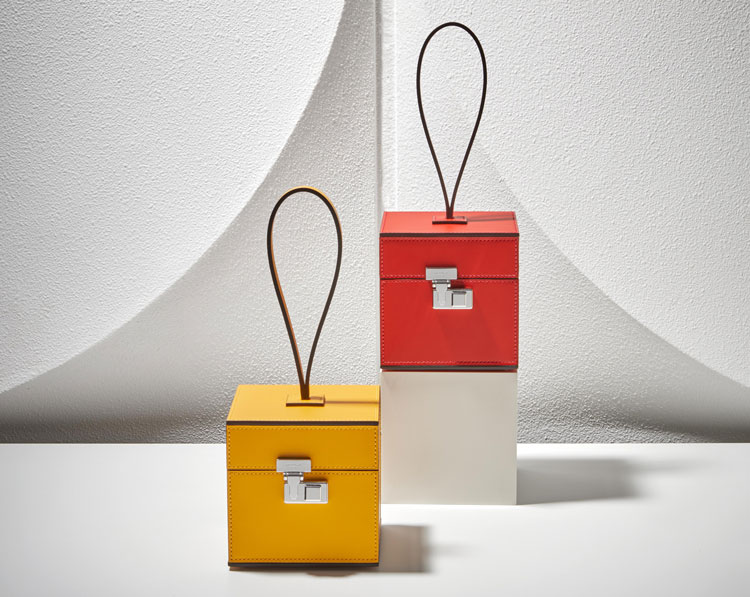
What three words do you feel sum up Moynat?
Exclusivity, Excellence, and Elegance.
To what extent do you still feel storytelling is important in the luxury industry?
It is the link to the past which is a treasure and very important.
How challenging is it to preserve the heritage whilst still being modern?
The challenge is in leveraging the savoir faire and the roots, without becoming a museum of craftsmanship. We have strong roots but are creating for the customer of today’s generation, so we use age-old techniques and apply them to the modern day.
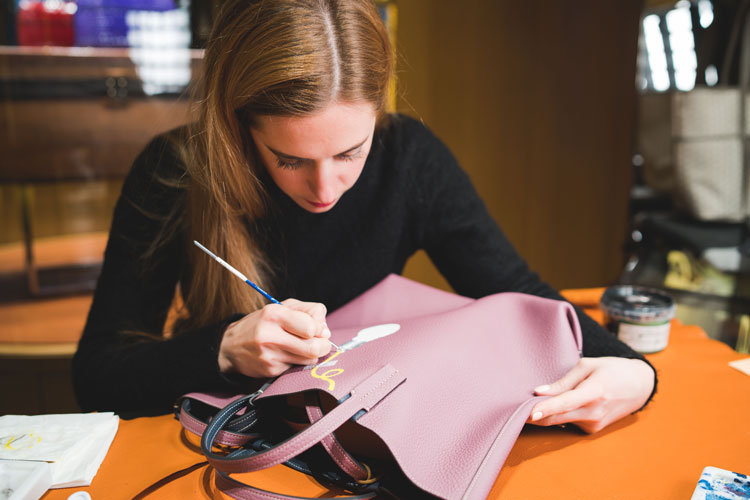
Tell us about your views on how over-communication can kill desire?
At Moynat we are a bit mysterious and we will continue to keep it this way, as we are not about it-bags for the season. We really believe in timelessness, craft, and quality, and are able to repair products. Moynat doesn’t target the mass and remains niche, so what is important is this one to one message and experience, as word of mouth travels.
To what extent is retail still important in the digital age?
It is extremely important in terms of telling the stories, because technology can enhance the experience for customers. It can show beautiful images of our past and stories about our craftmanship, together with changing the way that we can interact with clients. Selling online is something that we are not yet fascinated with, as we want to continue to offer a one to one service, although we may still try and experiment with it from time to time.
What are the difficulties that you face today?
The biggest challenge is the production and the quality, as we make products in an old-fashioned way. Of course, this is not very cost-efficient, and you need to find very skilled craftsman which takes time.
Can you share with us the message from Moynat this year?
We always strive to make our clients happy and proud to carry one of our bags, encouraging customers to become part of the Moynat family.
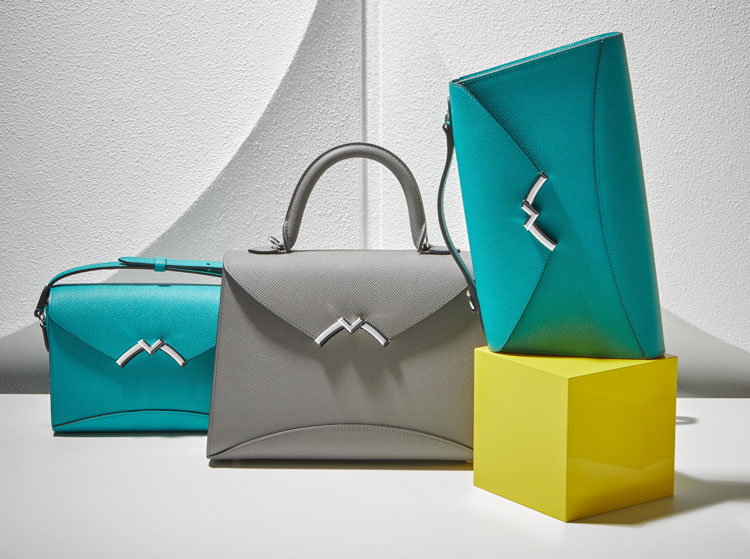
What is a resolution that you made to Moynat for 2018?
There is no miracle for making Moynat more beautiful, so I have to continue working on this through finding more beautiful materials and inspiration. It is also important to ensure that we don’t try to be something that we are not.
What is your vision for the forthcoming years?
Keeping Moynat at the top in terms of craftsmanship.
Can you share with us a motto that you live by?
Hard work is the key criteria for success.
What do you feel is a mistake that many other luxury brands are making?
Going too fast, because luxury was never a rush. With us, when you put a deposit on some bags it can take between two to six months before you receive it. Luxury is about the craft and the exclusivity, and we want to be an emblem in the world of real luxury.
Do you feel that social media can dilute a brand?
No, because technology can be a fantastic tool for making a brand more beautiful.
How about bloggers?
We like when we are being talked about, but we do not seek this aggressively. It is not our style to pay someone to carry the brand, and we cannot compete with the larger more powerful brands on this.
Do you think that word of mouth is one of the strongest marketing tools?
Yes of course, the strongest marketing you can have is the marketing that your clients are doing for you. By creating beautiful products that are made extremely well, we believe that it is only a matter of time.
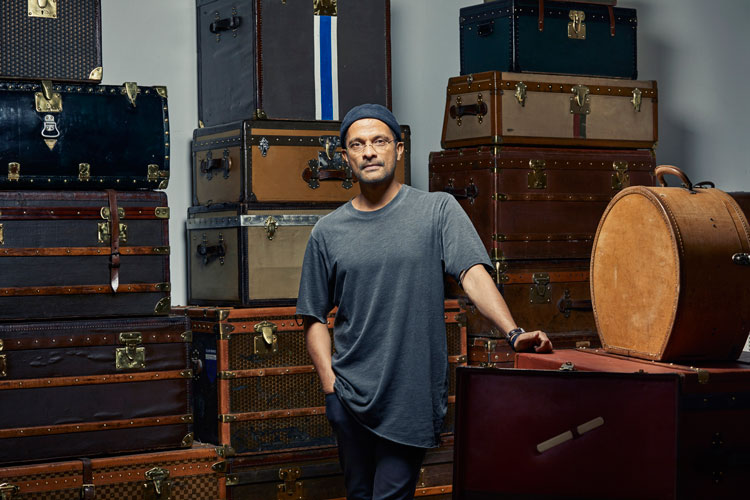
RAMESH NAIR, CREATIVE DIRECTOR
Hailing from Melattur, a small town in Kerala’s Malappuram district, Ramesh Nair began his professional career with Yohji Yamamoto and then founded his own brand, Rain, in India. He went on to work with Christian Lacroix before honing his skills as senior designer for Hermès in the early 1990’s alongside Martin Margiela and Jean-Paul Gaultier.
It was up to Nair to carry forward the vision on which the storied brand was built, which he has achieved through exclusivity, divine craftsmanship, and the finest fabric and leathers. This is not merely a renovation of what existed, instead the result is something brand new with classic yet contemporary designs. Hallowed traditions and century-old knowhow are preserved and revived in creations that bear the modernity that is the hallmark of Moynat.
How did the opportunity to revive Moynat come about?
The Moynat renaissance is an intriguing story, it is a brand that had a huge presence and was very successful, but then disappeared from collective memory, except for a few experts. Years later, Moynat became a part of Mr Arnault’s personal portfolio and in 2O10 he decided to revive it as a heritage brand and I was invited to take creative lead.
What was the appeal of Moynat?
The first thing I did was to dig into the past history of the House like an archaeologist. I believed there was more than just the story of a trunk maker behind the brand and I was right. What struck me from the very start is that this is one of the rare Houses to be founded by a woman, at a time and in an industry dominated by men, making it particularly relevant to our society today. It is not a coincidence that we have so many women artisans in our ateliers. The other aspect of Moynat that holds great appeal is the combination of heritage and innovation. Moynat was born at a time of sweeping changes in France and especially Paris, around travel, around a way of living, so there is a tradition of modernity and open mindedness, of seeking new horizons. Moynat is an old House with deep roots and heritage, but at the same time, it is a brand-new entity because of the rupture in its history from the 1970s to 2011. This combination enables me to continue the Moynat story so that it is anchored in the past but has a fresh, modern future before it. It is very stimulating creatively to know that I can map the way forward, and that behind every door I open there can be yet another door leading to new territories.
Why was it the right time to re-awaken the brand?
There is no right time for a project of this kind, but when things fall into place in a certain way and a certain time, you have to recognise the potential and make it work. In fact, when we started to work on Moynat, it was a more difficult time economically. The real boom-time for launching a luxury brand would have been 5-7 years before that. There are so many Houses from the past that have fallen into obscurity, but we no longer have much information about them. Sometimes I come across vintage pieces that are interesting, but no one is able to tell their story. With Moynat, we had the opportunity to tell the story of this beautiful House once again.
What do you identify as the major signatures of the house?
I built the Moynat style signatures around shapes, structure, and details such as metallic components, as well as the liberal use of colour. What brings it all together is the harmony and balance between the elements. This means that what looks simple and obvious at first glance is actually very complex and multi-layered when you look deeper. My design philosophy is very strong on ‘invisible design’, in the sense that the best design is that which blends seamlessly with the user. It does not overpower the presence of the person carrying it, but subtly boosts it so that others notice you rather than your bag. I have also integrated into the personality of the Maison, the fact that Moynat was founded by a woman. There is grace and lightness in the overall aspect, and yet there is innovation and engineering that comes through. For me, an object must be beautiful not just at the moment of creation, but that beauty must continue to grow and evolve all through its life. Each mark, each scratch, each blow that it gets must add to its character.
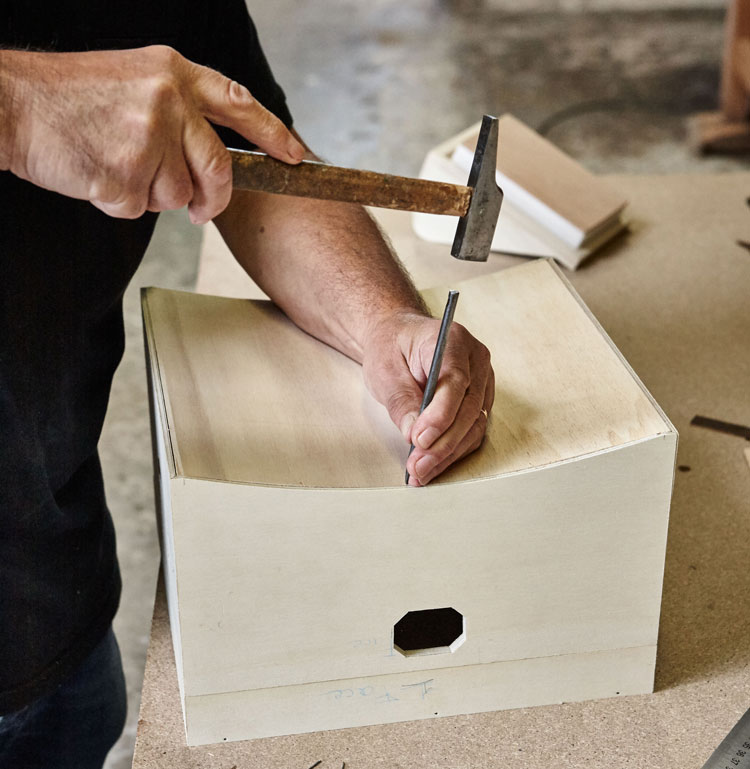
How do you think the DNA of the brand has changed over the years and what has stayed the same?
In the mid-1800s products were designed around utility and novelty. They were meant to perform a function or find a solution to a constraint. For example, the Malle Anglaise, English Trunk, was created as an extra-lightweight trunk to overcome weight restrictions placed on railway travel, especially for those traveling between the UK and Paris. Similarly, monograms and logos were created as a novelty, to distinguish the House from other makers and to protect against counterfeiting. Both types of innovations led ultimately to design-led creation. Today, we no longer travel with wooden trunks the way Moynat customers used to do in the early days of the House, but we have maintained, and in some cases we have revived, the skills and techniques that were practiced in the 19th century and applied them to modern bags and accessories in ways that make sense for our way of living today. Hence, the modern Limousine case that works as a laptop desk. Or the Mini Vanity that uses the angle stitching technique that was previously used in leather trunks. Lifestyle changes mean that our creations today are aesthetically very different from the 19th century, but we still use the same natural materials, leather, wood, and canvas, even while we incorporate 21st century carbon fibre and titanium into some of our modern trunks. We continue to use traditional artisanal methods perfected over the centuries since the birth of Moynat and even earlier. The same master craftsmen trained in 19th century trunk making also work our carbon fibre.
What challenges have you faced with the revival?
Moynat is a unique case, we had no living memory of the brand, which is usually carried by owners, employees, or artisans because in the 30-plus-year rupture this entire generation had passed by. This means that we had to extrapolate from vintage pieces, not only the techniques that were specific to 19th and 20th century trunk making, but also those techniques that were specific to the House of Moynat. We did not have the luxury of relying on older artisans to help us nurture the skills. We did it ourselves by scouring the profession for talented individuals who have the potential for this level of workmanship and sometimes re-training artisans in the ‘Moynat way’. Of course, we are not alone in facing these challenges, some of the best Houses in the business have lost practices and skills because they no longer use them or make trunks the way they used to. This is not confined to the actual trunk making, but also to the makers of metallic parts, nails, closures, cabinetmakers, and other crafts that feed our work.
Can you share with us your greatest achievements at Moynat since you commenced your journey?
One of the things that make me very proud, quite separate from commercial success, is having set up the Moynat atelier and taking it to such a high level of workmanship. This is an achievement because although it was set up just 7 years ago, the work that our atelier produces has helped to establish our reputation and has ranked us among the most revered names for quality and refinement. All without the help of advertisement and product placement.
What do you believe distinguishes Moynat from other luxury leather brands?
I believe it is the special nature of our history, not just our founding in 1849 but also our renaissance. Following the rupture of more than 30 years in our history and our comeback about 7 years ago, Moynat has established itself in the forefront of heritage brands, almost seamlessly. Today, people find it hard to believe that we have not always been present on the luxury landscape. I would attribute this remarkable achievement to the exceptional character and quality of our products from the design, research and development, all the way through to the conception and production.
When we talk Moynat, we think only trunks and travel objects. How challenging was it for you to look beyond them?
Moynat to me is not about trunks or luggage or even bags. Moynat is about movement, mobility, and action. I don’t think in terms of product categories but about what Moynat represents in its character and its purpose. Trunks and travel objects were the foundation of the House of Moynat, but even then Moynat was forward-looking. Pauline Moynat, the founder, was the first to introduce a range of women’s travel handbags in the early days of the railway. The position of Moynat as a pioneer in incorporating lifestyle changes into products became clear to me when I started to collect and study vintage Moynat pieces. So, modernity and innovation were two of my guiding principles when I started to work on Moynat.
Which new materials and techniques have you introduced since reviving the brand?
I constantly work on multiple projects since some ideas take a longer time to mature and realise. This could be a revival or reinvention of ancient techniques and materials or developing entirely new ones from scratch. For example, I have applied trunk-making techniques to modern handbags so that these skills are not lost and remain relevant to modern lifestyles. One of these is the angle-stitching used in our Mini Vanity bags, another is the marquetry technique originally used in wood and which we have perfected in leather. In 2017 we created a magnificent ‘Cuir Imperial’ after a long research and experimental process to recreate the mythical Russia leather. Originally made in a jealously guarded process that took about 18 months and cured with birch tar oil and myrrh among other ingredients, this knowledge was lost following the Russian revolution of 1917. Since then, many attempts have been made to recreate Russia leather with not much degree of success. Moynat Cuir Impérial is finer than the original Russia leather, but it has the same oily, silken suppleness and cross hatch grain and heady aroma. We have even applied the technique to exotic leathers such as crocodile skins, which has never been done before. In terms of inventing new techniques and materials, we have created some unique techniques on crocodile skins, called Croco Ceramique, which we launched recently. I was inspired by ancient glazing techniques of Asian ceramics, from the depth and layering of colours to the crackle effect. Particularly inspiring was Kintsugi, or ‘golden joinery’, the Japanese art of repairing broken ceramic with lacquer and gold dust. Thus, a blend of two rare, traditional techniques from two very different fields, leather and ceramic, experiments what were manually realised at the tannery, which is how I like to work.
Which collections tend to prove most popular for Moynat?
Unlike other brands, at Moynat we do not work on seasonal collections, nor do we rely on one or two bags or models to carry our success. I have yet to see a line or a season that has not received an enthusiastic reception from our clients. It is also interesting that we have a high percentage of success with our range of precious leathers such as crocodile leather, which is typically a smaller part of any brand’s sales.
Can you share with us how a Moynat bag comes to life?
Inspiration for a bag is always a free-wheeling activity with no set path to determine what could trigger the design process, it could happen while I am traveling, and often it happens at the moment when I am about to fall asleep! The idea is a usually latent in the sub-conscious, I have to work to free it from all the other thoughts, and to turn the abstract concept into a concrete object. Frequently, the starting point is a material or a detail, the shape of a metallic component or the grain of certain leather or even the way two pieces of leather are joined together. Once the 1st drawings are ready, I give it a volume in a prototype, for which the choice of leather is very important. The type of leather chosen will determine how the bag behaves, how it holds itself, and how supple it is. After modifications and testing, we make a mini-series, which is subjected to wear tests before actually launching production. It is important to remember that each bag is made from start to finish by a single artisan.
Despite great demand, Moynat has kept prod¬uction small and exclusive, why is that?
I prefer to think of our approach as a quest for excellence rather than exclusivity. For me, luxury is about generosity, it is about pouring out the best of our ideas, skills and materials and not holding anything back. So, I would not define Moynat as exclusive because our aim is not to create scarcity by controlling our output. What is true is that our production, being artisanal, is by definition slower. Our standards for quality mean that our artisans are among the best in the trade, therefore not easy to select and train. Our leathers are among the finest and must meet our stringent requirements, again not easy to procure in unlimited quantities. For all these reasons, the rarity and the price of our products is a natural consequence of our vision and of who we are.
With limited prod¬uction Moynat is considered the epitome of luxury. How would you define luxury?
I am not a fan of the word luxury, I feel it has lost its meaning in an age of commodification of luxury. For me, luxury has to have both physical and metaphysical aspects. In addition, luxury is something that transcends time, never becoming out-dated even if it is attached to a particular period in history. A luxury object or experience is something that will give you the same sensory pleasure and intellectual stimulation time after time whether it is something you use or experience every day or rarely. This is the core of my design philosophy for Moynat as well.
With such a luxury good that is primarily available instore, how do you think it will keep up in the world of digital shopping and media?
With great convenience and speed comes great loss of experience. I do believe that the two models of retail can and should co-exist. In fact, brick and mortar stores are not just a point of sale, but primarily a point of physical contact and communication. It is where you can really connect with the brand beyond product, through the sensory experience that results from architecture, lighting, smells and sounds. The day is not far when brick and mortar stores may be truly experiential, and independent of the compulsion to purchase. At the same time, there is a lot to be done to make the e-retail experience more valuable, and more relational rather than transactional which is the case today.
Luxury brands are moving towards a younger, more energetic look, do you see this direction continuing in the years to come?
The design cycle and the generational change in designers leading brands today mean that we are always looking to the next generation of clients. But we shouldn’t lose sight of the fact that the designers that we consider serious and classic today were yesterday’s young turks. Rei Kawakubo and Martin Margiela ushered in deconstructed and conceptual clothing more than 30 years ago, which today’s generation is only just re-discovering.
Tell us why you choose not to use advertising?
We wanted to let the product speak for itself, to rely on word-of-mouth as a more authentic and organic form of communication. This lets us focus on the brand story, our heritage, and our craftsmanship rather than a slick, glossy presentation where the product is secondary to styling.
When researching new designs, what has been the greatest find in the Moynat archives?
There is no single object or period in the history of Moynat that has inspired me, rather it is the ensemble and the trajectory that the House has had over the years. When I see all the trunks together, I notice certain elements that strike me at different levels, depending on what is already going on in my head. One day, it could be the locks, which could bring me to focus on metallic components, or it could be the variety of curved shapes that may become the stimulus for me to design around.
You have created numerous iconic bags for the Maison, which might be the one bag that you favour?
It is impossible to choose one bag, just as it is impossible for a parent to choose a favourite child. The recent bags that I am fond of include the Loulou for its playful form and unusual closure inspired by the front clasp of our vintage trunks. It is also memorable for its singularly challenging construction where the surfaces are curved as though moulded to achieve a gently rounded face. I also have a soft spot for the Réjane Opera, a sleek evening clutch where the iconic clasp is set like a jewel.
On average, how much time goes into making a Moynat bag?
Depending on the kind of bag involved, it could vary from 3 to 7 days. However, this is just the actual make, once the artisan has all the necessary materials together. On the other hand, if you take into account the fact that our leathers are designed, developed and produced to our specifications, as well as our metallic pieces, right down to the last nail and D-ring, it could take as long as 3 months to have all the ingredients ready.
Tell us about how the craftsmanship sets Moynat apart from other brands?
Firstly, all our production is entirely located in France. Secondly, we have an artisanal approach to all our manufacturing, which means that each bag is made from start to finish by a single craftsman, instead of an industrial or assembly line approach. This means that each product is really a unique piece, and also that each artisan must be trained in many different techniques. Since many of my designs are intended to highlight Moynat savoir-faire, it is very important to maintain this approach. In some cases, we have reinvented or revived techniques that had been forgotten, which enriches not only our Maison, but also the craft itself.
How do you continue to keep the brand covetable and fresh, balancing tradition and innovation?
It is all about innovation, which is a core value of Moynat. When we talk about traditional craftsmanship or noble materials, I do not think of it as just a single technique or a single usage. I think of different ways of using the same metallic elements or using the same traditional gestures but either modifying them or applying them in different ways. It is a kind of cross-pollination between materials, processes, and applications. This is also where design steps in to add a contemporary twist or a humorous touch to lighten what may otherwise be heavy with tradition.
How popular is the made to order service, and can you explain how the process works?
Bespoke is at the very heart of Moynat heritage. The House was renowned for custom-made pieces created for each client since its inception, including automobile trunks that were fitted to the contours of the car and often matched to the colour of the car body. We work closely with our clients on their wishes, always keeping in mind the Moynat codes and expertise. We start by exploring what the client dreams of and then design the object in a truly Moynat way. There is no catalogue of styles, colours, or linings that the client can assemble the custom object from. It is important to understand that all our special orders are custom-made from scratch for each client. Each component is hand made to our specifications, including metal parts and closures specific to each trunk. It is not simply a question of assembling previously prepared components. Depending on the kind of object in question, the time taken to make it varies widely.
What are your thoughts of logomania, and the rise of logos in luxury fashion?
Luxury, like so many things in life, in cyclical. We went through a phase when logos and obvious branding was very trendy, then moved into a more discreet period, and now people are once again drawn towards logos. Being a surface embellishment, a logo is the easiest way to declare an identity. It also depends on the brand’s philosophy, whether to be visible with a logo or to place the focus on other design elements. I took the decision to emphasise our incredible heritage of form and functionality rather than an obvious logo. This does not mean that logos are not important, as when used intelligently a logo can support and strengthen the identity already created by other means.

As Moynat grows, in which geographical markets are you experiencing the strongest growth?
As for most other brands, Asia continues to be a strong market. In the case of Moynat, being such a young brand we have a long way to go in any market and so there is a lot of potential for us everywhere. So, I do not want to focus on just a single market but on nurturing and developing all our markets. I strongly believe that for us, the home territory is a key market, essential to maintain a strong identity and link with our roots, and more so in this age of global travel. I always keep in mind that from its inception until the brand closed down in the 1970s, Moynat had only a single store, which was in Paris.
Tell us your views on the Middle East market?
We have a strong base of clients, friends and followers from the Middle East who look for exquisitely crafted objects, from watch trunks for some to crocodile leather handbags for others. Our Middle East clients have very refined tastes, they don’t look only at the logos and branding but are very discerning about quality and appreciate discreet, subtle and personalised aspects of luxury.
Tell us about the exclusive pieces you made for the region?
We have selected some of our finest and most precious new creations for our first home in the Middle East that are as contemporary in their aesthetics as they are perfect representations of Moynat heritage and savoir-faire. Three rare exotic skins have been developed to showcase our iconic bags and a one-of-a-kind trunk. Crocodile Céramique is inspired by the ancient glazing techniques of Asian ceramics. From light to dark, 3 to 4 colours are applied to crocodile skins, and between layers the skins are hand polished to reveal the underlying coat of colour. The final effect is a complex, delicate, and layered hue unique to each skin, and echoes the layered colours and unique crackling effect of precious Asian porcelains. For the Crocodile Camouflage, I experimented with hand-applied water-based dyes in transparent washes to create military-style camouflage patterns that are unique to each skin, while the Crocodile Natura skin is treated to maintain the natural pigmentation. Finally, the pièce de résistance. It has long been a personal dream of mine to create a special trunk as homage to a piece of art that also has a spiritual significance. After several years of reflection and research, I finally brought together all the ingredients. I had a rare 18th century hand-illustrated Kashmiri Qur’an in its original lacquered binding, which to me symbolises wisdom as well as an object of beauty and a work of art in its own right. The one-of-a-kind trunk I created for it is a perfect cube, realised in an exacting technique where the wooden frame is held together not by nails but by hand stitching the panels, a rare technique that only a master craftsman can achieve. The trunk is covered with a flawless green crocodile skin and lined with supple amber-coloured suede. Classic Moynat langue-de-chat clasps, lever locks and handles were custom-made for this trunk. Inside is an ingenious lectern mechanism that gently lifts the book when the lid is opened. The name ‘Al Noor’ was chosen because every known civilisation in the world has used light as the symbol of knowledge, freedom, and life. We even use the word enlightenment to signify spiritual awakening.

Will you look to make further capsule collections to satisfy the Middle East market?
We do not target markets with particular collections, but I do try to integrate tastes that are specific to different markets. The Middle East market loves rare and refined objects, so we try to ensure that such pieces are part of the mix here, such as exotic leathers and more unusual creations.
What do you expect to be the biggest challenge the brand will face in the coming years?
As the brand grows, we know that we have to expand our production. Keeping in mind our artisanal production model, our stringent standards for our materials and our workmanship, our biggest challenge will be to deliver growth while maintaining our obsession with quality. It is something that takes time and planning, which we have already begun working on.
Can you share with us your future plans for Moynat?
The future has its roots in the past. My aim for Moynat is to continue our trajectory, keeping in mind the philosophy that I have placed at the heart of the House, an emphasis on quality, educating people about our approach to design and artisanal craftsmanship and pushing our boundaries through research and development. This, for me, is the only way to sustain our growth and our success.
