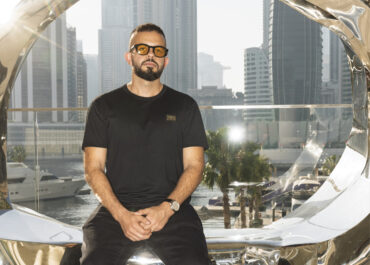
Foad Hamzeh has built his artistic language around the meeting point of Arabic calligraphy and graffiti. Better known professionally as FH.Visual, the Lebanese artist has developed a distinctive practice that brings together Arabic calligraphy, graffiti and contemporary abstraction, allowing familiar letterforms to shift, stretch and take on new dimensions.
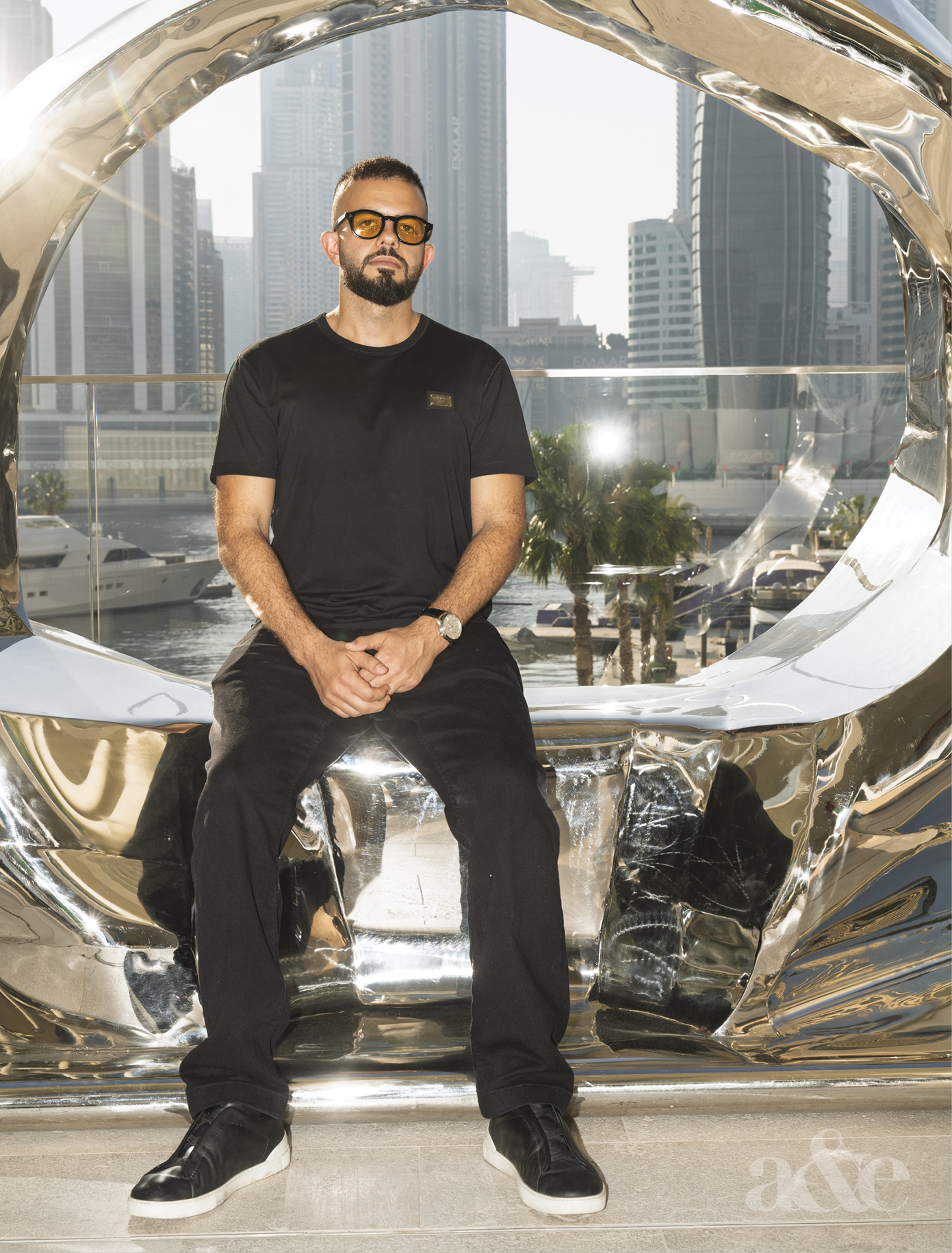
Formally trained in architecture, art and design, Hamzeh has built his creative practice in Dubai, developing a multidisciplinary approach that moves increasingly between painting, sculpture and large-scale work.
Central to his work is FHV, his own Arabic graffiti font, developed after studying classical calligraphy and exploring how its traditions might translate into a more personal visual language. Dripping paint, repeated words and sculptural lettering have become recurring signatures, reinforcing his fascination with movement, change and the idea of Arabic as a living, evolving language.
Now represented by JD Malat Gallery, Hamzeh is looking beyond the canvas towards increasingly ambitious sculptural and architectural possibilities. Here, he discusses growing up in the UAE, finding common ground between graffiti and calligraphy, creating a language of his own and where he hopes to take it next.
What first drew you to art, and when did you realise it could become your career?
I was always drawn to visual expression before I really understood it as “art.” I discovered graffiti when I was quite young and constantly sketched in notebooks, experimenting with letters, shapes, and composition. At the time, it felt more instinctive than anything else. I was fascinated by how a letter could carry meaning but also exist purely as a form.
I started by painting landscapes and learned about the different forms of art. Then, I grew to love art created by letters because I liked how meaning was created by words and visuals. The more I created, the more I realised that this was becoming a language of my own, and eventually something I wanted to build my life around.
How did growing up in the UAE help to shape your creative identity?
I grew up in the UAE, and Dubai has played a huge role in shaping both who I am and how I work. I have Lebanese roots, so Arabic language and culture have always been part of my identity, but I was raised in a city that was constantly evolving around me.
Growing up in Dubai meant witnessing transformation almost in real time: architecture, culture, technology and entire neighbourhoods continuously changing. I think that naturally made me comfortable with evolution. My work carries both sides of that experience. There is a strong connection to heritage and Arabic calligraphy, but I’ve never felt that tradition needs to remain static. For me, preserving a language can also mean allowing it to evolve.
How did you begin combining traditional Arabic calligraphy with the visual language of graffiti?
Graffiti was my entry point, while Arabic calligraphy became something I explored more deeply as my practice developed. What interested me was that they actually share a lot, like rhythm, movement, repetition, gesture and a very strong relationship between the hand and the line.
I never wanted to simply place graffiti and Arabic calligraphy next to each other. I wanted to understand how they could become one visual language. Over time, the letters became less about following an existing style and more about developing my own vocabulary through them.
What inspired you to create your own Arabic graffiti font, FHV, and what makes it persnal to you?
FHV came from wanting a language that felt completely my own. Arabic calligraphy has centuries of history and established rules, while graffiti is more personal; every artist develops a recognisable hand or signature.
I wanted to bring those two ideas together. FHV takes Arabic letterforms and reconstructs them through my own proportions, movement and geometry. What makes it personal is that it developed organically through years of drawing and repetition. It wasn’t created simply as a font. It became a visual system that I could continuously build upon.
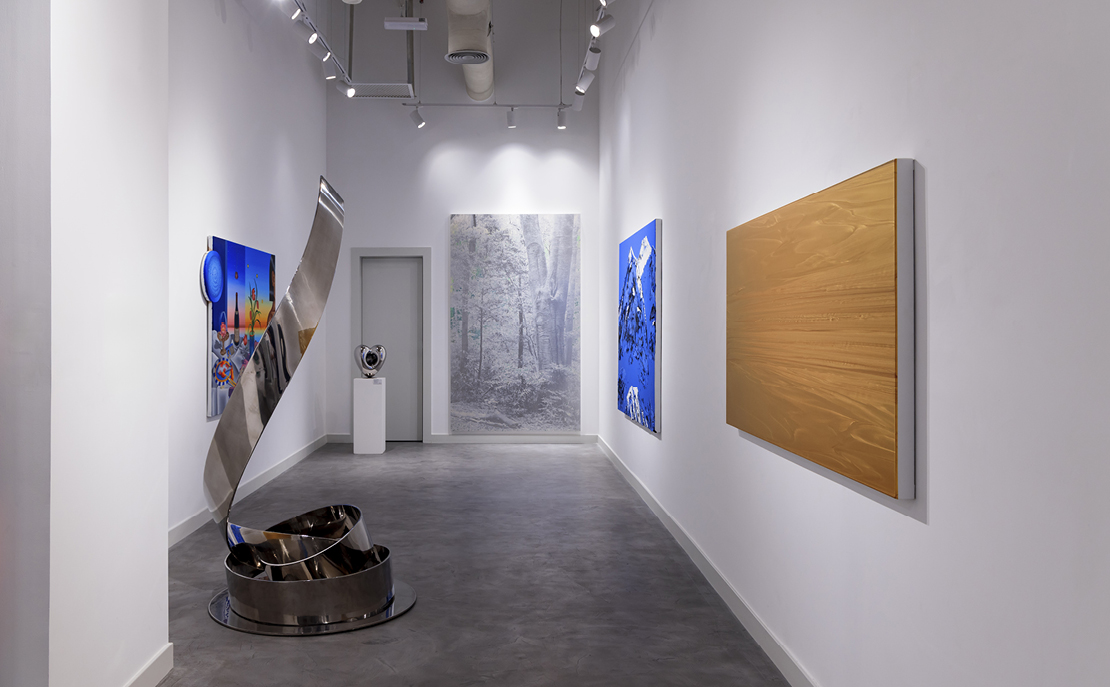
Dripping paint is a recognisable element of your work. What does this sense of movement represent?
Movement has always been important in my work because I don’t see identity, language or even memory as fixed things. The drips introduce an element that can’t be completely controlled. There’s structure in the calligraphy and then there’s this moment where gravity takes over. I like that tension between intention and unpredictability. It reflects the way life works: we can construct, plan, and define things, but something outside our control always changes the final form. For me, the work feels most alive when it carries evidence of that transformation.
How has moving from canvas into sculpture and large-scale installations changed your creative process?
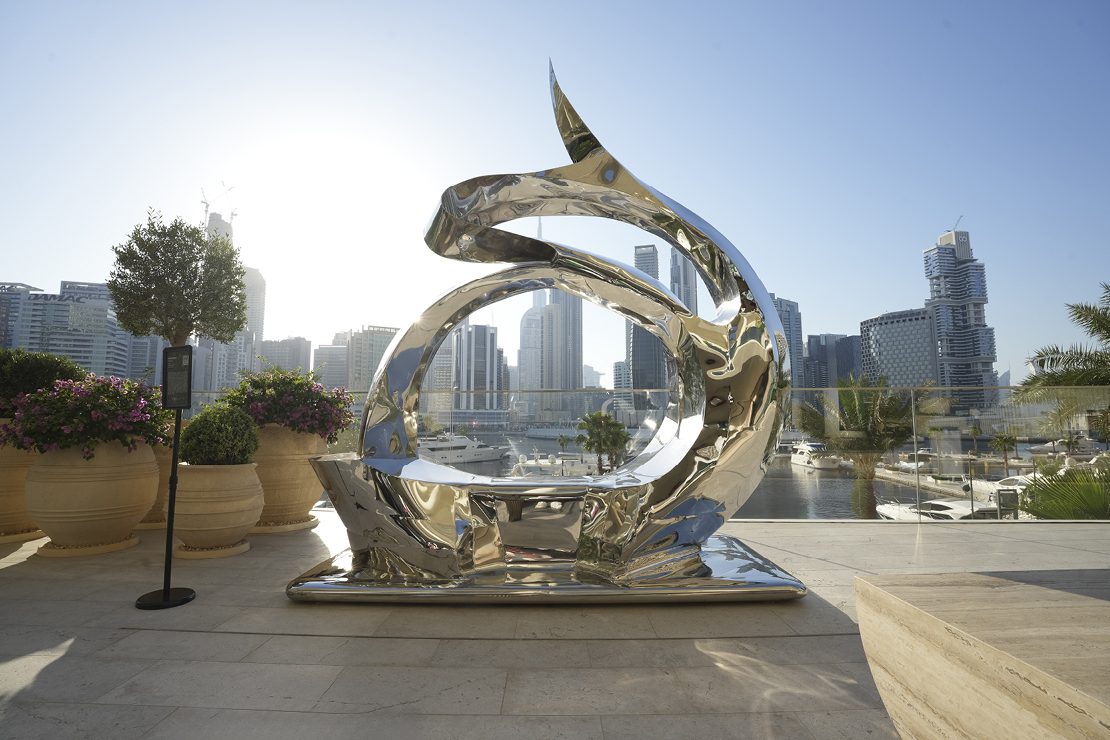
Sculpture completely changed my relationship with the work. On canvas, I was thinking about composition from one perspective. With sculpture, there is no single viewpoint. The work changes as you walk around it, as light moves across it, and as the surrounding environment changes.
That pushed me to think about Arabic letterforms differently. A line was no longer something drawn on a surface; it could become an object, occupy space, cast a shadow or interact with architecture. Working at a larger scale has expanded that even further. I’m now thinking not only about the artwork itself, but about how people move around it and how it belongs to the space it inhabits.
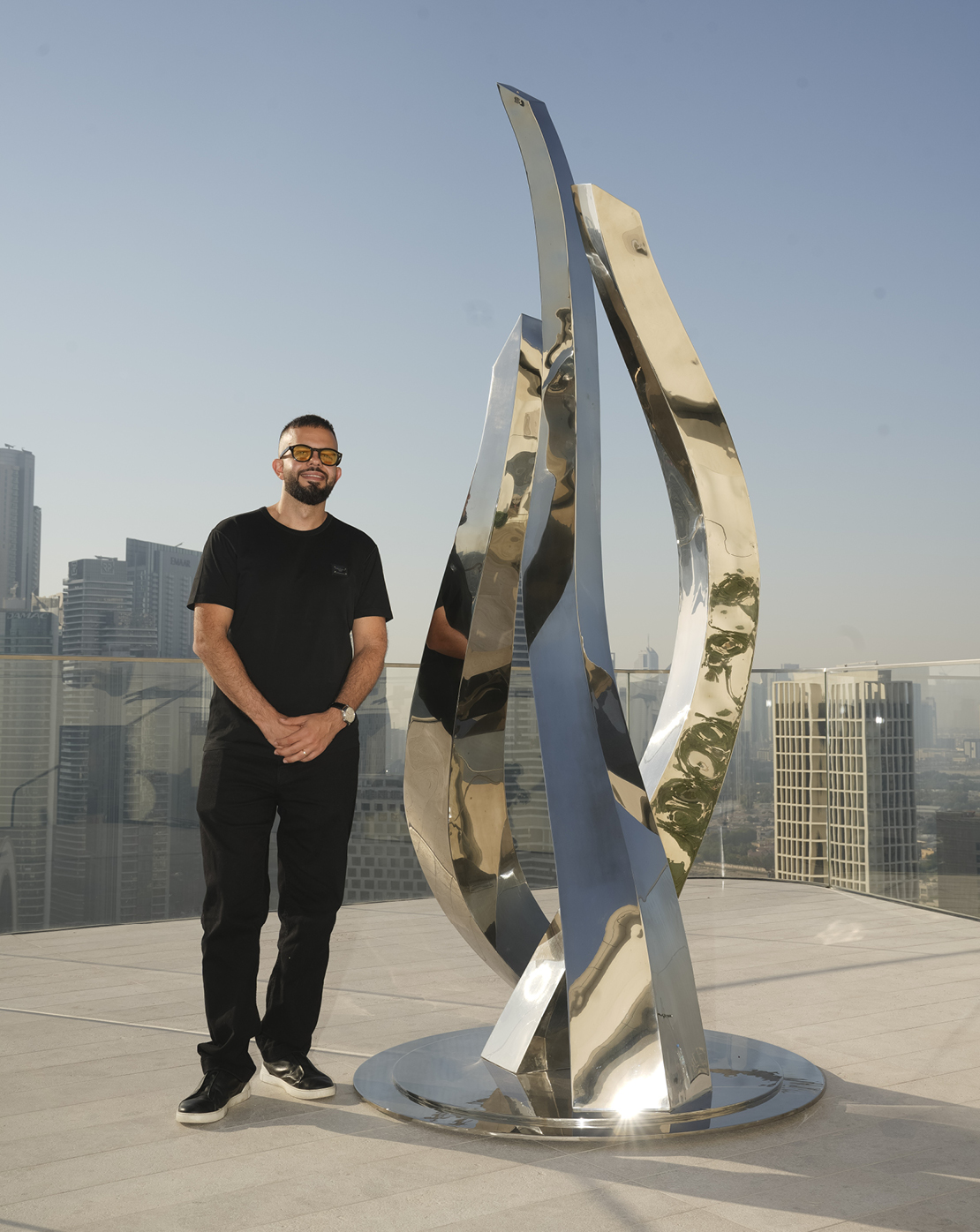
What does being represented by JD Malat Gallery mean for this stage of your career, and what are you currently working towards?
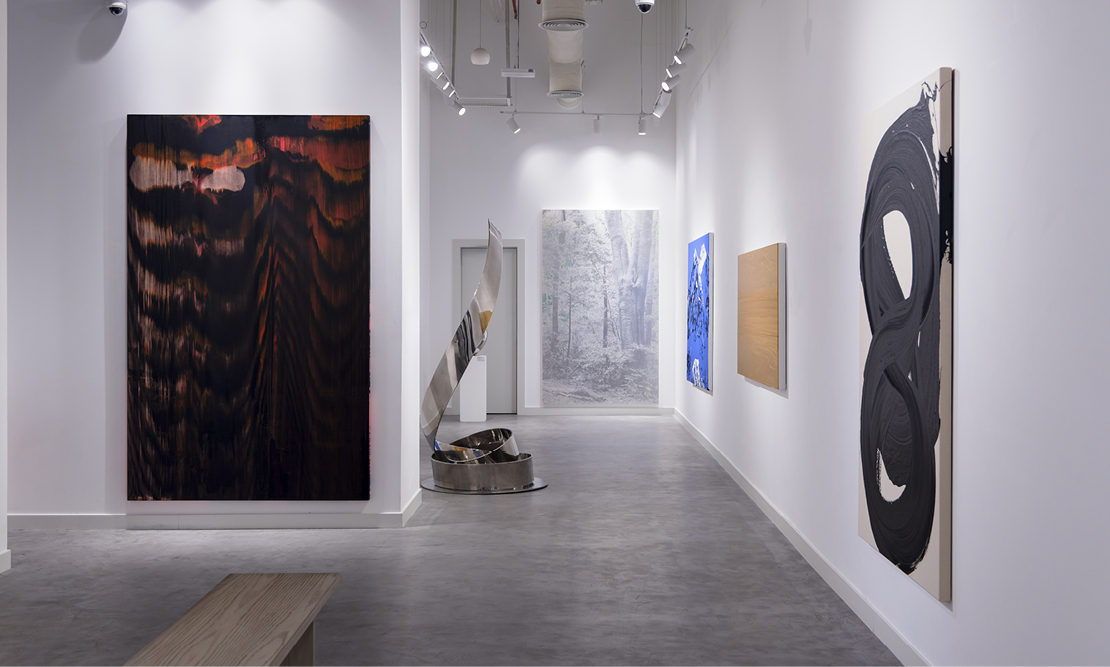
Being represented by JD Malat Gallery comes at an important point in my practice because finding a gallery that aligns visions with you is very core. I’ve moved increasingly into sculpture and large-scale pieces, so having a gallery that understands that evolution and can place the work within an international context is very meaningful.
At the moment, I’m interested in pushing the sculptural language further in terms of scale, material, architecture and the relationship between an artwork and its environment. I want each new project to expand the vocabulary rather than simply repeat something that has already worked.
How do you begin selecting which artworks to focus on for such exhibitions?
I usually start with the space and the story I want the works to tell collectively. I don’t necessarily think of an exhibition as a collection of individual pieces. I think about the conversation between them.
Some works need to carry more visual weight, while others create pauses or quieter moments. Scale, material, movement and placement all become part of that rhythm. Ultimately, I want someone walking through an exhibition to experience a progression rather than simply move from one artwork to another.
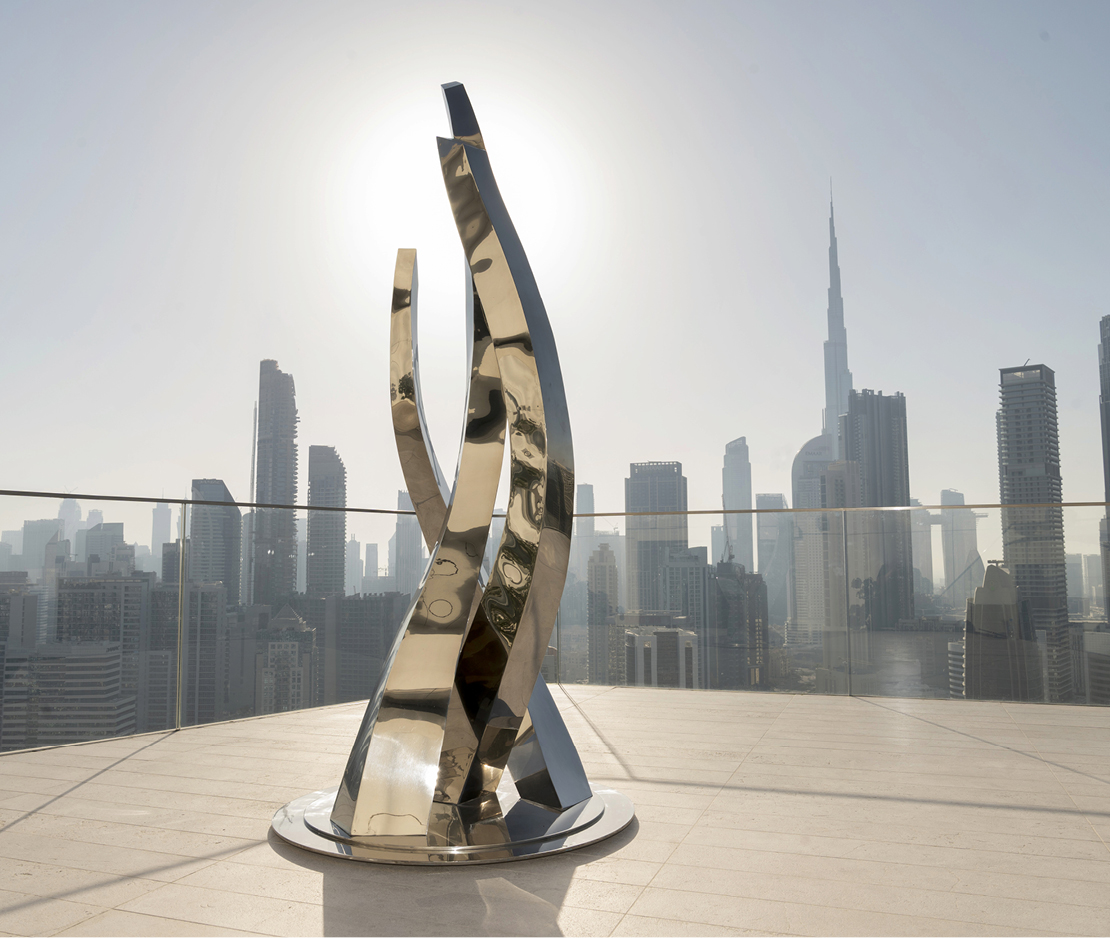
How would you like your artistic language to evolve in the years ahead?
I want it to become increasingly difficult to categorise by medium. The foundation will always be connected to language, movement and Arabic letterforms, but I don’t want those ideas to belong exclusively to painting, sculpture or digital work. I’m interested in what happens when the same visual language can move between all of those worlds. For me, evolution isn’t about leaving the earlier work behind. It’s about continuously finding new dimensions for the same language.
What is a project you haven’t worked on yet but would like to?
I’d like to create something at an architectural scale, where the boundary between artwork and environment almost disappears.
Rather than placing a sculpture within a space, I’m interested in creating a space shaped by the artwork: something people can enter, walk through, and experience from within. I think there is still a lot of potential in translating letterforms beyond something we look at and into something we physically experience.