

Meet The Founder and President of Technogym
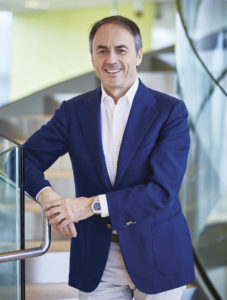
Nerio Alessandri, President and Founder of Technogym on innovation, technology and the importance of looking after our health and wellbeing.
Nerio Alessandri literally built his business from scratch in his garage after realising that fitness gyms in Italy lacked innovation and technology. So in 1983, at the age of just 22, this entrepreneur built his first fitness machine from scratch. The idea was to incorporate technology and innovation into fitness and wellbeing equipment, offering a personalised service for the user. Alessandri’s creation was immediately purchased by a local gym and he was soon commissioned to make the machine on mass, revolutionizing the personal fitness industry.
Alessandri has since seen his business grow on a global scale and has continued to enter new realms of fitness innovation from at- home training to the CPR system a scientific algorithm for constant pulse/heart-rate training, which he patented in 1988. The most recent developments in the company have seen Technogym taking on digital fitness – something that became essential in the times of COVID-19. Thanks to Technogym’s ‘MyWellness Cloud’ platform, and the Mywellness app, fitness centres are now able to provide their services and training programs, remotely, to members, when they’re unable to attend the facility, meaning that users can train wherever however and whenever they want. This next level of fitness allowed Technogym to become a 360 lifestyle that can meet the demands of all of its clients. We find out more about this latest innovation and how Technogym has adapted to these testing times.
This year has been a strange year for all – how has Technogym continued operations through the COVID-19 period?
We never closed, but of course, we diligently followed the prevention guidelines (social distancing, masks, etc) in line with the authorities’ indications in the various countries in which we operate.
What is something you have learnt from this period?
It has been a tough period, but the good news is that with no doubts health has risen within people’s priority lists. And this shows the potential of our industry in the long term.
Have you changed anything within your business moving forward?
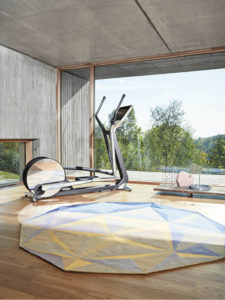
I believe that the crisis we have been going through in the last months has accelerated some trends that were already happening. In terms of digitalisation, in a few months, we witnessed a step forward that would have happened in a few years under normal conditions. At Technogym, we have believed in digital since the beginning. 25 years ago we developed the first software in the fitness industry and today we feature a complete ecosystem made of connected smart equipment and our “Mywellness” cloud platform which allows people to connect with their personal training experience anytime and anywhere: at home, at the gym, at hotels, at work and outdoor.
Starting from our connected Ecosystem, in the last month we launched Technogym Live, a sort of Netflix of fitness, allowing people to choose from our connected consoles a wide variety of training video-based experiences on their personal passions, needs or aspirations: from trainer-led one-to-one sessions, to athletic training oriented routines, to outdoor scenario immersive training.
This issue is about success – how would you define success?
Success is a combination of talent and opportunity. It is important to be talented and to train your skills, but that is not enough… to be successful you also need to create a lot of opportunities.
Take us back to the beginning – what was behind your decision to start Technogym and what was the vision that you had?
I was a young industrial designer who was very passionate about sports. In the 80s I was a member of a local gym in my hometown of Cesena in Italy and I noticed that gyms lacked technology and design and only offered very basic tools. I saw an opportunity for innovation to create something safer and easier to use, so I designed and built my first machine during my free time in the evenings and weekends. I did it with my own hands in my garage because I had the vision to do something that would help people live better. The first machine was a great success and the gym I sold it to ordered a complete line, so from a hobby, Technogym became a full-time business. I was lucky in that way.
As the business has evolved – what is your vision now?
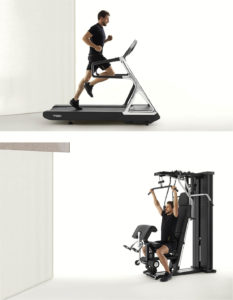
Innovation has always been the engine behind Technogym’s growth. The company has constantly evolved. We started as a biomechanic equipment company, then we introduced software, then digital connectivity and now interactive media content. Initially, our focus was to manufacture the best possible equipment, we still have this clear focus, but today we have added a broader objective: to offer people a personalised training experience made of equipment, digital connectivity, contents and education. Having said that, the vision is always the same: help people to live a better life thanks to regular physical exercise.
You have been known across the world as the Global Champion within the Wellness industry, what do you think is your biggest achievement so far?
The biggest achievement is still yet to come! I don’t like to look back and celebrate, I like to concentrate on the future and on the many things we still have to do.
You have achieved global success with your company – what was the moment when you knew it was going to be so successful?
I believe that masterpieces are made of details. You need to be ambitious and have a dream, but at the same time, success comes from many small day-to-day happenings. That’s why I believe there was not a specific moment in which we realised we were successful. It is the result of the day by day creativity and hard work of our team of more than 2000 people that work for Technogym all over the world.
What would you still like to achieve that you haven’t done yet?
The best is yet to come! I always share the Iceberg business metaphor with my team: it’s more interesting to aim at the big chunk of the iceberg that it’s still underwater than looking at the smaller part that everybody can see, outside the water.
You started your company when you were very young – what advice would you give to anyone afraid to chase their dreams?
On one hand to dare to have big dreams, to believe in them and don’t give up at the first difficulty, neither at the second, neither at the third, but at the same time be very disciplined with your day by day execution and pay attention to all the small details that all together build a big dream.
What is a challenge you have faced throughout your journey and how did you overcome it?
There have been many challenges and I believe the best way to overcome them is to face them as a team and not as an individual. I believe that people are the number one asset for a company and my priority as an entrepreneur is to have the right people at the right place within the organisation.
What is something you would like to see done differently in the fitness and wellness industry?
The fitness industry is going through a strong innovation and evolution process…the key point for all of us working in the industry is to be able to convey to people not only products or training programs but a truly engaging and on-the-go experience. We strongly believe that in the future we will not be talking anymore about a fitness club or home fitness, but about fitness club plus home fitness. Fitness clubs will remain as central hubs in which people will find professional counselling, define their program, socialise and try out fun activities and at the same time they will train in the convenience of their home when they can’t or don’t feel like going out.
As a company how do you keep up with ever-evolving technologies within the fitness industry and what is Technogym doing to be a leader in the digital space?
Digital is central within our strategy to offer people PERSONALIZED WELLNESS – a fully personalized training experience based on their very own personality, passions, needs and goals. Some people are more fitness-oriented and looking to stay in shape or to engage in activities, while some people are more sport-oriented and looking to specific athletic training programs to improve their performance, and others are more health-oriented and looking for prevention or rehab activities. At Technogym, thanks to our connected ecosystem we can offer people their very own training experience anytime and anywhere with our equipment at the gym, at home or even outdoors, thanks to our Mywellness app.
What is your regular fitness or Wellness regime?
I train regularly three or four times a week and I like to alternate at-home training with some training sessions at the Technogym Wellness Center. I like a variety of activities, from more intensity oriented Skillathletic sessions to some functional work with our Kinesis, to stretching with our Flexibility stations. On the weekends I also love to cycle outdoors with Erica, my daughter and Edoardo, my son.
What can you tell us about the Wellness Foundation?
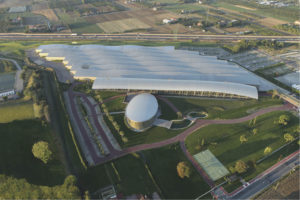
20 years ago, I decided to create the Wellness Foundation, a non- profit body dedicated to promoting wellness as a social opportunity to ensure a sustainable social and economic development thanks to people health. Wellness Foundation is active both internationally (we take part to many research studies) and locally in Romagna, our region in Italy. Here we created the Wellness Valley the first wellness district in the world: an ecosystem which involves all local stakeholders – public administration, schools, hospitals, fitness centres, universities, the hospitality industry – to promote wellness as both an economic and social development driver for the region.
What can still be done to raise awareness of the importance of fitness and a healthy lifestyle?
It’s fundamental to involve young generations and schools to play a fundamental role within this mission. Within the Wellness Valley we have launched “Play Wellness” that involves more than twenty thousand children within local schools in a program that teaches them to regularly exercise though games that have been ideated by our Scientific Team…this is an example that can be replicated in a larger scale.
What’s the best piece of advice you’ve ever been given?
My father who was a very simple but wise man always told me: being always transparent is not only ethical, it’s also convenient in life and business and it’s always rewarding in the long run.
What is the life motto you live by?
If it works it’s obsolete! When something (a product, a process, a service) works very well, it’s time to change to innovate, as if you wait till it declines it will be too late to start the innovation process.
What or who inspires you?
Great brands, like Apple, for example, great culture, like the Italian Renaissance, great events, like The World Economic Forum, but also small things like talks with my team, my kids or my friends. You need to be humble, listen and have to keep your mind open, this way you can learn from every single situation.
Entrepreneur Jumana Al Darwish on Happiness and Success
Jumana Al Darwish, Co-Founder and Chief Happiness Officer of The Happy box on why it’s important to stay positive during testing times.
Jumana Al Darwish took the leap to create her own company in 2014 when she launched The Happy Box and the Happy Studio. Initially started as a mail delivery service bringing boxes of “happiness” to the lives of her customers. As the daughter of a Jordanian UN diplomat, Jumana grew up all over the world, studying at Oxford University, before working at Queen Rania of Jordan’s office in international affairs. When she moved to Dubai Jumana worked at Dubai Cares, a philanthropic organisation founded by HH Sheikh Mohammed Bin Rashid Al Maktoum, Vice President and Prime Minister of the UAE and Ruler of Dubai.
It was in 2014 after the birth of her daughter Ayla that the idea for The Happy Box came to light. After being inspired by her daughter, Jumana decided to create activity packs for kids that would bring them happiness but also education and engagement. The whole ethos of her company was bright, colourful and well, happy and this followed through with the opening of The Happy Studio in Dubai – home to events, kids parties and more. Of course with the global pandemic things have slowed down when it comes to social gatherings, but Jumana was lucky enough to take things back to basics, continuing with the mail-order services that first started the company. We find out more about how this entrepreneur has navigated through these times and what there is to be happy about looking forward into the future.
This year has been a strange year for all – how have you spent these past few months and have you changed any part of your business moving forward?
I am a firm believer that there is great beauty in chaos and in the unknown. When the pandemic hit, I looked for the silver lining. As with uncertainty, great things are bound to happen and they did. For the first time in a long time, I paused and began to reassess every facet of my life. Going “back to basics” was truly liberating. Personally, this retro-perspective enabled me to recognise my priorities from family and friends, to health, safety and security. Everything else was secondary. Additionally, I began to realise the importance of self-care and finding moments of realignment throughout my day. Balance is key.
On a professional basis, I, like many owners of self-funded businesses, wasn’t prepared for a market play overnight. Getting through this pandemic, required me to take a step back and gain a better understanding of what my business’ X-factor was. By doing this, I was able to capitalise on it, re-strategize and make my organisation leaner to ensure further systematic growth and sustainability.
What is a lesson you have learnt from this time?
For someone who strives for excellence and has contingency plans in place for almost everything, the greatest and most difficult lesson of all was learning to let go. There are so many externalities we simply do not have control over. The key is to build inner resilience, be open to change and keep one’s outlook positive. Every day is an opportunity for growth and development.

What can you tell us about the latest news for The Happy Box?
I have always been in awe of our mandate, our values and the incredible team I built. This pandemic made me realize how strong our brand and outreach is, how resilient we are as a company but also as people. The long hours and sleepless nights over the years working hard to build a strong foundation, building partnerships and a loyal client base proved to be in our benefit. We have a story; we weren’t built overnight and hence no matter how strong the external currents may be, we remain firmly rooted.
The pandemic surely proved to be challenging on the operational front of our business given that our portfolio consists of both product development and curated services. As restrictions on interactions have been put into effect and social distancing measures in place for our safety and clients’ safety, I opted to go back to our initial business model of sole product development of educational happy boxes until restrictions ease. If we can’t deliver happiness through our curated services, then we will surely deliver our happy boxes to our clients’ homes.
What can we expect to see from The Happy Box moving into 2021?
The year of 2020, was a year of restructuring and learnings. Next year, will be about implementing these learnings and remaining true to our core mandate of spreading happiness. We will be investing heavily in tech infrastructure and strengthening our e-commerce arm, thus enabling us to have a more prominent global imprint. We have additional plans of expansion but we will be monitoring the pandemic before further investments are made. Delays of this sort do not hinder our growth, but rather enable us to stay focused on the areas that we have the means to control.
Can you tell us a little about the work you are doing with Happy Hearts Global and what you are hoping to achieve with this?
Central to the belief that happiness should be universal to all children, “The Happy Box” under its CSR arm has gifted thousands of happy kits to disadvantaged children in Egypt, India, Jordan, Kenya, Kuwait, Lebanon, Morocco, Nepal and Syrian Refugees at Zaatari Camp. My lifelong dream has always been to establish a private family foundation and hence I proceeded with the registration of “Happy Hearts Global” as a CIO under the UK Charity Commission of which we hope to be completed in 2021. Happy Hearts Global will aim to provide children and in particular girls, with access to primary education and art therapeutic and rehabilitation programs globally. In my opinion, hearts that give are truly the happiest.

This issue is about success – in your own words, how would you define success?
Over the last year, my definition of success changed. Initially, I used to measure it through the attainment of my life goals, which were quite ambitious and long-term requiring energy, commitment, time and patience. In 2020, when plans were delayed due to externalities outside of my control, I found myself feeling frustrated and uneasy. For someone who has always thought big and is driven, I had to find a way to stay motivated. I worked with a business coach when I was restructuring The Happy Box and she gave me an insightful perspective on the measure of success. By dividing my macro-goals into micro-deliverables that could be measurable monthly and even quarterly, I was able to witness progress and thus success became a continuum and not an end factor.
With your line of work it’s important to be perceived as being a happy person – how do you manage this expectation even at times when you’re feeling down?
I am an optimist and tend to see beauty with everything that I am presented with. Every challenge carries a set of opportunities. This outlook has enabled me to be comfortable with my own feelings and has given me the ability to recognise when I need a moment to recharge. My business persona is “happy” but I am human at the end of the day and when I feel that I am not upbeat, I take a moment to ‘just be’. I listen greatly to my mind and body and when they are aligned, I know that I have been kind to myself and I know I am a better version of myself.
What is your secret to success?
Building a dream requires grit and patience. Dreams are not built overnight. There isn’t a single formula, but a combination of key qualities. I have found that if you have maintained an optimistic outlook, shown gratitude for all that comes your way big or small, have a hunger for growth, a strong work ethic, are innovative and solution-centric, whilst embracing challenges that may come your way and learning from them, you are destined to succeed.
We know that your daughter is one of your greatest sources of inspiration – what is something you can tell us about her and what would tell us about her mum?
Ayla, in Turkish, means a ‘halo of light around the moon’ and she is precisely that. She embodies light, love and empathy. We have a beautiful relationship and in her eyes and words she proclaims that her “mama is sweet, smart, she likes to dream and loves unicorns. She always says ‘you live once.’ She is not bossy but knows she is the boss. She is brave and has a voice. She loves to travel.”

You were also very close to your father – how has he inspired you in what you do?
My father has always been my inspiration in life and probably more so now with his passing. He was a visionary, believed in the power of using one’s voice to create change and was a profound philanthropist, impacting the lives of hundreds of thousands of children and mothers globally through his humanitarian efforts.
He valued education greatly and was a feminist. He always believed that being female was is in fact, my greatest weapon in life. When I lost him in June 2019, I felt a massive part of my heart passed with him. Grief took over me and a cloud of sadness filled my world. For someone who runs a happy business, this juxtaposed dynamic was hard to take on. I spent some time away from The Happy Box and took care of myself. I rode the waves of grief as they came and understood throughout the process that grief is in fact love. The massive load of grief I was feeling was actually my profound love for him. I see him in butterflies and white feathers; he remains with me every day. I am his legacy.
What is your biggest achievement so far?
Aside from being blessed with Ayla and embarking on the wonderful journey of motherhood, I would have to say watching my social entrepreneurial dream come true. One night in 2014, I felt I could move mountains and had this incredible courage to embark on change. Plunging into the deep end with no background in entrepreneurship, I worked hard and watched that dream unfold over the years. I am very proud of the organisation I built with my team and social values we stand firmly for.
What would you still like to achieve that you haven’t done yet?
I would like to delve deeper into my poetry. I come from a long line of poets, with many of my family members sharing a passion for this art; including my father and paternal grandmother. I would love to publish my work one day.
What advice would you give to anyone afraid to chase his or her dreams?
What is the worst thing that can happen? Fear is something we impose on ourselves. Eliminating fear gives us the freedom to move to unchartered territories, to try new things and experience all the wonders of life. Why limit yourself when you can experience so much more. Life is meant to be lived and celebrated!
We know you wear many hats – how do you manage your time and have a good work/life balance?
Motherhood taught me that there is no such thing in life as a balance. There will be days where you can progress more professionally than personally and other days where it is the complete opposite. I take each day as it comes and try to fulfil as many of my daily goals as I can and aim to try harder the very next day. I have a sense of daily contentment and gratitude that gives me the balance I need.
What is a challenge you have faced throughout your journey and how did you overcome it?
There isn’t one challenge but a series of daily challenges that an entrepreneur is presented with. It comes with the territory and hence, you address them as they come and you learn as you go. I tend to reach out to my mentors and fellow entrepreneurs for their insight when faced with challenges. Camaraderie of this nature is incredibly beneficial in the business arena.
If you could look back, what is something that you would tell your younger self?
Your voice is your all. I used to shy away from using it. Little did I know how powerful it could be. For years I preferred to be the foot soldier, always in the back. That dynamic changed when I started my own enterprises and was forced to be in the frontline. I had to promote our mandate, our story and portfolio of offerings. To do that and to soar to greater heights, I worked hard to overcome my fear by being true to myself.
What would you say to those at the beginning of their business journey?
Your journey will not be easy and you will be tested on many levels. You will want to quit at times and at other times, you will ask yourself “why am I doing this?” In the end, you will find that your passion, that little spark in your eyes as you speak about your enterprise, transcends all difficult circumstances and the greatest treasure of all will be your learning.
The key is to have faith and believe in your capabilities. Work hard and smart, don’t just think of increasing your financial rewards but also look at the social values that you are creating to better your community and while you are at it – the global community at large. Expand your networks and learn the art of delegating early on. Entrust your team but remain on top of your game no matter what and never lose sight of your end goal.
What’s the best piece of advice you’ve ever been given?
“Keep your eye on the ball” would have to be the best piece of advice I ever received. The moment you lose sight of your end goal is the moment that you get distracted and are thrown off course. You are in this for the long haul, so hold the reigns and keep moving forward.
We love your fashion style – how would you describe it?
I love fashion and have an eye for detail. I believe that simplicity is the essence of elegance and grace, with a dash of sparkle of course. I think I have two fashion personas; one in line with my brand that is more colourful, playful, loud and happy. The other more relevant to my personal life; simple, grand and chic.
What is the life motto you live by?
“Be grateful for this moment, this moment is your life” by Persian philosopher Omar Khayyam. Every moment we have on this earth is a blessing and it is important we take a moment to be present. Presence is bliss for the mind and soul. We’ll never have that moment again.
Discover the Collaboration With Two Luxury Brands Who Are Helping to Save the World’s Elephants
Dr Max Graham, Founder and CEO of Space For Giants discusses the importance of protecting elephants in the wild and the new partnership with Gemfields and Net-A-Porter.
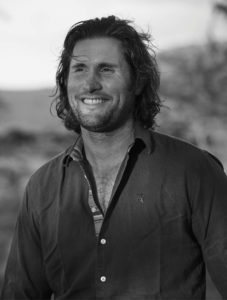
Dr. Max Graham
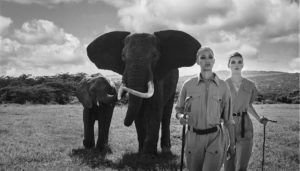
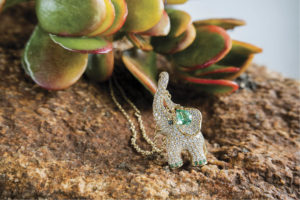
International conservation organisation “Space for Giants” recently partnered with Gemfields and Net-A-Porter on a project that saw the two luxury companies raising awareness of the company’s work for African wildlife conservation. The project, titled “Walk for Giants”, saw the brands create sustainable capsule collections with the proceeds being donated to Space for Giants and its work. The two exclusive capsule collections consisting of a 44-piece jewellery and watches collection and a series of 15 sustainable looks from Net-A-Porter. Proceeds from the collection will bring critical support to protect Africa’s elephants and their natural habitat.
Space for Giants is committed to securing the ecological and economic value that nature conservation offers and through protecting the great wildlife landscapes of Africa, they can help protect the continent’s remaining elephants that need these habitats to survive. Especially in this time of crisis, when travel and tourism are impacted, wildlife and natural habitats are even more vulnerable to exploitation. The company was founded by Dr Max Graham. Graham founded Space for Giants in 2011 in response to poachers killing several of the elephants he was studying during conservation research for Cambridge University. He has since been leading efforts to combat the illegal ivory trade in Kenya.
In 2015, to scale up the conservation tools developed by Space for Giants in Kenya, to the continental level, Max founded the Giants Club, combining political, social and financial muscles with the goal of protecting at least half of Africa’s elephants and the landscapes they depend on. Today the Heads of State of Botswana, Gabon, Kenya and Uganda are the Presidents of the Giants Club and its members are among the most influential philanthropists and business leaders in the world. Space for Giants is working on projects in nine African countries with an increasing focus on attracting conservation and tourism investment to sustain the continent’s remaining natural ecosystems. The Walk for Giants project is the latest in Graham’s journey of raising awareness on a global scale and helping industries such as fashion and jewellery to understand the importance of their actions. We find out more with Dr Max Graham.
What can you tell us about why you decided to start your company Space for Giants?
After University I went to volunteer for an old man who owned a small ranch in Kenya. Shortly after I arrived he showed me around the property that he was entrusting in my (very young and truly incapable) hands while he and his wife went to visit his brother in South Africa. Just before he got into the rusty old plane he yelled at me, “and please do something about these elephants”. Intrigued, I asked around and discovered that a small herd of around 100 elephants passed through the ranch several times a year on their way to Mount Kenya. I completely forgot all about my responsibilities to the ranch and spent the next three months following the elephants, learning about their behaviour and movement patterns. Those three months connected me to elephants in a powerful way that is difficult to describe and through my subsequent PhD research at Cambridge University, I discovered just how vulnerable their lives are and what it could take to ensure they have a future. When some of the individual elephants I got to know during this research were poached I founded Space for Giants – not just to combat the illegal wildlife trade but ultimately, to ensure that these iconic animals have a future in the wild in a world that is increasingly dominated by humans.
Why did you decide to partner with Gemfields and Net-A-Porter for this project and what are you hoping to achieve from it?
In this campaign, two key players in the jewellery and fashion industries have come together to support the conservation of Africa’s wildlife and natural landscapes, with the proceeds from the sale of the capsule collections going towards the frontline conservation work we do. However, it is our objective with this campaign to demonstrate to the fashion industry and to customers, that a unit of consumption can be converted to a unit of conservation. This is not only good for conservation but is critical for business in an increasingly environmentally conscious marketplace. Herein lies the opportunity, which is that big brands will soon, we hope, start investing in the protection of vital natural ecosystems. These ecosystems’ natural services will not only offset their carbon emissions but also make their products more compelling and competitive among increasingly environmentally sensitive consumers. If this were to happen, then perhaps the future of the world’s remaining giants will truly be secure, forever.
How do you think the values of your company align with that of Gemfields?
Gemfields place sustainability and the protection of the environment at the centre of their operations. This is very much aligned with our thinking at Space for Giants. We believe that for the long-term health of the planet, this is the approach that most businesses in any industry should adopt. The Walk for Giants project captures the essence of that commitment from both organisations.
As a company Net-A-Porter is particularly concerned with sustainability – is this something that you find aligns well with your company?
Indeed it is. Times have changed and it is increasingly unacceptable for companies to not invest in social and environmental sustainability. Net-A-Porter is demonstrating that it is indeed possible to be a big and highly successful business, whilst being conscientious enough to implement sustainable practices and provide direct support to the protection of nature and wildlife.
What are some of the issues wildlife in Africa is facing today that we should be aware of?
Africa’s wild places and their wildlife are some of the most bio diverse ecosystems left on Earth. They have great value both ecologically and economically to people, to countries, and to the planet. But they are under threat.
Elephants are threatened mainly by three factors – poaching for their tusks, loss of habitat and conflict with farmers over crops and water. Rhinos face a similar poaching problem for their horns. Lions are threatened by loss of habitat and conflict with livestock farmers, whilst great apes such as gorillas are threatened by poaching and habitat degradation.
There is one underlying threat that all these iconic species face that will determine their survival – loss of habitat in a rapidly modernising continent. Our work at Space for Giants is geared towards securing these natural landscapes that wildlife depend on, creating great value for African nations, their citizens and the planet.
Our work is focused on finding new ways to fund the protection of these landscapes forever so they can continue to bring their benefits for generations to come.
Tell us about your first experience with elephants?
The first time I encountered an elephant I was 17 and the moment was as dramatic as it was fleeting. I was travelling with my girlfriend at the time, and her family, along a dusty game track through Tsavo National Park when quite suddenly an animal so large appeared before us that it seemed as if it had sliced the universe apart with its presence. Shattering any illusions of comprehension that I may have ha it stared penetratingly into our beings and then with a disapproving wag of its huge head, a powerful snap of its sail-scaled ears and a bone-shaking shriek from its trumpet, it disappeared. From that moment elephants held an acute, addictive fascination for me.
What is your biggest achievement so far with Space for Giants?
Space for Giants helped pioneer an approach to combatting illegal wildlife crime that contributed to the virtual elimination of elephant poaching in central Kenya where the organisation was first founded. It helped to increase conviction rates in the entire country from 26% to over 90% in just 4 years. This approach has now been scaled up into nine countries across Africa.
We have also helped to design and deploy new smart electrified fences to combat the major problem for smallholder subsistence farmers of crop-raiding by elephants. We are about to complete a 400km wildlife fence, in partnership with the government that was first conceptualised by experts in 1986 to protect the livelihoods of hundreds of thousands of smallholder farmers in central Kenya. As no one had truly stepped up to the challenge of getting this work done, we took it on in 2010. Now ten years later, we are but a few months away from putting in the final fence post.
But my proudest achievement to date is our work to buy a private land that was a critical elephant refuge and, in partnership with The Nature Conservancy, turn it into a protected area; Loisaba Conservancy which is owned and managed by a not-for-profit trust. This conservancy is now a thriving eco-tourism destination, a hub for community support and secure home for elephants and all the other species that share their range. The process of creating this conservancy spawned a conservation and tourism investment process that is now being deployed in partnership with Heads of State in four African countries. The positive impact this process is having on making wild places valuable to local people and national governments is what I am most proud of as it is this value that will ensure elephants and indeed all wildlife will endure in our world.
What would you still like to achieve that you haven’t been able to do yet?
I would like for Space for Giants to co-manage several iconic protected areas with National Governments with the objective of turning them into world-class conservation assets and hugely valuable engines for driving value to local citizens and national governments.
What is the biggest challenge you face as a company?
Our work is as exciting as it is challenging. We have numerous opportunities to innovate and find solutions to existing conservation threats, but inadequate funding often impedes this. The financial climate right now makes things especially difficult, and as people on the frontline, we still have a responsibility to protect wildlife, despite the drastic decline in available resources.
What is the motto you live by?
There is always a way.
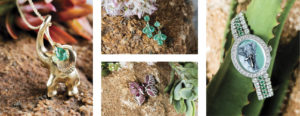
Can you share with us a story or moment that has really inspired you during your travels?
I once sailed on a dhow with a small crew of Swahili sailors to a very remote inlet on the North Kenyan coast near Somalia. The insecurity here meant this beautiful coastline was astonishingly unspoilt, with shallow warm water teeming with life, including large pods of bottlenose dolphins. I found myself in disbelief at the natural beauty here. We anchored off a tiny beach to rest and as we lay there a spearfisherman walked past us with a net of fish. I complimented him on his catch and he stopped in his tracks and insisted that they were a gift for me. He refused any payment and went on with his day. Where nature is unspoilt, people are unspoilt.
This year has been a strange one for all – what is a lesson you‘ve learnt or something that you will take away from this period?
While we scramble to get ourselves out of this mess, it is critical to remember we are in this situation because of the exploitation of nature, where wild animals have been captured to supply a highly lucrative international illegal trade in their parts. My biggest lesson is that we cannot go back to ‘business as usual’ – I do hope this pandemic has made us as humans realise that the protection of nature is not just the responsibility of conservationists. 2020 has taught us that we must all come together to promote a healthy earth; otherwise, the consequences of destroying nature have demonstrably proven to be catastrophic.
How has this year impacted the work that you are doing in Africa?
The wildlife conservation sector in Africa is largely dependent on income from tourism, philanthropy and government funding. With the COVID-19 crisis, tourism income has disappeared and philanthropy and government funding are rapidly declining with the global economic downturn. This is impacting the delivery of essential frontline conservation services in African protected areas and the livelihoods supported by employment in tourism and the related industries. This means there is a greater pressure on natural ecosystems from habitat exploitation and the illegal wildlife trade. As a consequence, we are facing a new and very serious conservation crisis.
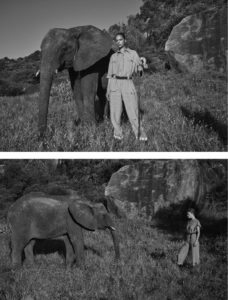
Do you think this time has encouraged the world to reflect on nature?
I do hope so. Clearly, the consequences of not protecting nature have proven to be devastating through the unprecedented loss of lives, a global public health crisis and the collapse of the global economy. The time for action is now.
You have great support from international politicians and heads of state but how can you raise more awareness of these issues globally?
We work with local, national and international partners to drive home the urgency and necessity of immediate action to preserve Africa’s natural landscapes and their wildlife. We have an African Journalist Fellowship programme that allows us to mentor and work with environmental and conservation-focused African journalists, enabling them to better tell conservation stories in their own authentic voices to audiences in their countries and beyond.
We seek and find opportunities that allow us to engage with other conservation organisations, governments, philanthropists, as well as other industries such as fashion to generate interest and support for conservation. One of these campaigns is Walk for Giants. Additionally, we have a longstanding partnership with ESI Media allowing conservation stories to reach 120 million people worldwide every month.
Tell us about your decision to move to Kenya and how your family grew?
Kenya actually created my family. While I was working there, a smart beautiful graduate joined me as a volunteer in 2010 and we subsequently worked together on her PhD research on human-elephant conflict. A few years later we were married and had two small children who have known no other life but one in the bush.
Talk us through your daily routine.
If I’m home I get up around 6 am with the kids, try and do a little exercise on my veranda that looks across to Mount Kenya. We have breakfast together and then I spend most of my day checking up on our conservation projects either in person or over the Internet. In the late afternoon, I often go for a drive with my wife and kids and we look for wildlife and typically find a spot under a tree for a bush dinner. When we get home and after I have wrestled the kids to sleep, I either do some more work or I’m on calls to our strategic partners and supporters in other time zones until late. Because so much of what I do today is about building strong relationships with key individuals who can help us to win this conservation battle, I spend a huge amount of my time on the road.
What do you love most about what you do?
I love visiting remote, wild, wilderness where nature is undisturbed.
Designer Darin Hachem on Overcoming the Beirut Disaster and Promoting a Sustainable Future in Fashion
Darin Hachem founded her eponymous brand as a way to blend together her multicultural heritage.
Bridging her Lebanese and Mexican heritage as well as the traditions of Milan, a place she has called home for many years, the young designer has created a unique label that values savoir-faire, sustainability and the importance of life. Her modern and minimalistic designs are made from materials that are in many cases sustainable and always sourced in ways that respect human and labour rights. Darin is currently based in Beirut and was traumatised by the recent explosion in the city. As she begins to come to terms with what happened, there is no better time to offer positivity by launching her fall/winter 2020 collection.
Inspired by the work of English sculptor Barbara Hepworth, the collection mimics the shapes and forms of nature with carefully cut lines, layering and androgynous style. Materials are full of textures creating a three-dimensional effect on many of the pieces. The colour palette is inspired by the earth, with sandy shades and neutral tones that are easy to wear and flattering. To find out more about this collection and where to go from here after a strange year so far, we talk to Darin Hachem.
The recent events in Beirut were tragic and terrible for all – how did this awful experience affect you?
It takes some time to realise the amount of emotional damage done to the Lebanese people. I was torn between sadness, anger and frustration; but didn’t understand the full extent of it until I had to leave Lebanon for a week. The amount of disorientation, of separation pain, and trauma all hit me as soon as I landed in Milan. It was like I was in another world, in no way linked to my own world, with people living a life I was not able to relate to.

How are you looking to move forward after this?
Very slowly. I believe in slower but more solid steps in accordance with who I’ve become along the painful path Lebanon was put on. I feel my emotions more intensely than ever; which actually will help me be more aligned with myself and the core of my identity.
What can you tell us about your Fall/Winter 2020-21 collection?
The Fall/Winter 2020-21 collection is based on the works of the English sculptor Barbara Hepworth who created modern art pieces in wood, stones and marble in the mid-20th century. Her works are seen as interactions between themselves but also interactions between the human and the object and between the object and its environment. Based on her world, we were actually able to enter and shoot inside the laboratory of Martin Gerull; a sculptor that lives and works in Milan. His pieces that are also made of wood and stone are very close to the world of Darin Hachem with their earthy tones, and art objects elevating upward against gravity.
Both artists actually convey our focus on Mother Earth and nature, in terms of colours, asymmetrical shapes, draping, and of the duality of masculinity and femininity that are essential to the brand’s identity. Sandy tones are seen in the textured wool and silk, while double-sided, thick cotton and burgundy blazers add warmth to the wintery collection.

We recently saw Queen Rania wearing a piece from your collections – how did it feel to have her wearing your designs?
As a designer, it was an honour to see Queen Rania wearing a piece of my collection. She is known for her elegance and sense of style and being Lebanese, having recently experienced trauma, I felt it could be a positive note for my country, maybe an indirect contribution to keeping Lebanon alive on a certain level. It took me some time to realise that Queen Rania was actually wearing one of my dresses! It was such an emotional moment for me.
Who is someone that you would love to dress and why?
Lately, I find myself interested in dressing women that are active in the humanitarian field. This most probably has a link to the events that happened in Beirut. All the work Lebanese women have been doing in the field after the dramatic event impresses me, and it makes me so proud. On the international scene, and to name one, Jane Fonda would be one of the many women I would love to dress!
Who is the woman you design for?
I design for women who look for a twist in the way they dress. They are not afraid to play and to create their lookout with unusual pieces. They like an overall contrast of materials, colours and shapes.

We know that sustainability is very important to you as a brand – what can you tell us about any recent developments in relation to this?
The COVID-19 crisis made it crucial for everyone to focus on the wellbeing of our planet. It forced us to slow down and reflect on what could be done to get even us closer to respecting nature, our surroundings, and presenting a decent working environment and experience for all. We are indeed moving in a slower direction, especially after the Beirut trauma; but it is about re-centring, refocusing on the essentials, and shedding the extras. Key values to me remain getting closer to the raw nature of the product and to its artistic value; while continuing to produce on smaller scales, smaller quantities and being careful that the fabrics chosen have the least impact possible.
Do you believe attitudes towards sustainability are changing in the industry, especially after this past year?
The theme of sustainability is not one we can do without this year or in the coming years. It has become urgent for the survival of the human race and other species. It is about more than just using the word “sustainability” to sell clothes. Even if the work is slow, and not always genuine, there is a greater pressure and every brand is compelled to make an effort at one level or another, be it in the choice of fabrics, in the replacement of leather with vegetal ones, with diminishing and redirecting the use of water in certain fabric creation processes, re-using, re-directing fabrics and hardware; at least some work is being done. And I hope for more in the future.
What would you still like to see happen in the fashion industry?
The industry as a whole needs to slow down, which has already started. It needs to be free of the cycle of consumption, and more on the creative side, shedding light on the work done ahead of the presentation of a collection. I wish for it to be free of imposed timings, of excessive productions, and with less pressure on the designers.
What is something you would still like to do as a brand in relation to sustainability?
I want to be more aware of every step of the creative process and selection of materials. Really be involved in the processes all the steps of the way, at least do my best to have a better understanding and keep on pushing the limits imposed on us.

How as individuals can we help towards creating a more sustainable fashion industry?
We need to educate ourselves, read more, understand more, and ask ourselves more questions about where our products come from. As consumers we need to think about buying only the essentials, pieces we could see ourselves wearing throughout the years, not getting bored of, and maybe passing on to future generations as well.
You had a very multicultural upbringing – how do you think this has influenced your designs?
My multicultural upbringing is a blessing. It enabled me to collect information from different sources; it added the acceptance towards other forms of art and gave me the flexibility of choosing the direction I wish to go. I can easily see my style evolving and not being constrained to a specific category in the coming years.
This issue is all about success – how in your own words would you define success?
Success for me is doing what you are passionate about at your own rhythm and still being able to make a living out of it. It is when you feel and see your message has reached even a single person and that person really understands the depth of your thought and feels the passion you put into each of your creations.
Take us back to the beginning of your brand what were the challenges you faced and how did you overcome them?
The most important part for me was defining the brand, being aware of its identity and the type of product I wanted to create and obviously where to source it all; to make it an entity of its own. I was lucky to have a strong support system and an amazing team as well, in the end, it really is a team effort.
If you could look back, what is something that you would tell your younger self?
Do not be hard on yourself; you are doing your best.
What would you say to those at the beginning of their business journey?
Start small and slow, be focused and take the time to do things one- step at a time. Look for the genuine people around you that will be there when things get less fun.
What is the life motto you live by?
Now more than ever, in Italian we say “piano piano”, it means “step by step”. This is where I am heading.
Maya Ibrahimchah, Founder and President of Beit el Baraka on Helping Those Whose Lives Were Devastated by the Beirut Explosion
At a time when many in the city of Beirut feel helpless, there is a glimmer of hope shining on those who were affected by the tragic explosion in Beirut on 4th August 2020. That hope comes in the form of Maya Ibrahimchah, Founder of the non-profit charity organisation Beit El Baraka. Maya founded Beit El Baraka in 2019 with the mission of helping to offer security to those in Lebanon struggling with the economic crisis and the growing cost of living. After recruiting a team of social workers, creatives, managers and farmers, Maya set about providing food, education, housing and more to those in need throughout the economic crisis.
Then on August 4th 2020, everything changed. When the unthinkable explosion happened in the Beirut port Maya and her company immediately got to work assisting those who were hurt or had lost everything in seconds on the warm summer evening. Through independent funding and donations, Beit El Baraka has been able to help rebuild the homes of over three thousand people, providing food, water, shelter and education to those affected. Maya and her team have worked tirelessly on the ground every day since the explosion to help try to rebuild and create hope amongst the Lebanese people.
But the work is far from done. Without international aid, the people of Beirut will never be able to return to what it once was and hundreds of thousand so of people are still homeless. This paired with an economic crisis and global pandemic and it doesn’t even bear thinking about. Maya Ibrahimchah explains what still needs to be done and how we can all help contribute to her the work Beit El Baraka is doing.
The devastating explosion in Beirut affected us all but you have been there on the ground – what is the feeling amongst the people of the city today?
There are mixed emotions. On one hand, you feel the devastation, but on the other, you feel the love and solidarity of the people. I’m not sure if people actually realise what happened to them, to us. It was the third strongest explosion ever in the world. Did we realise that? I’m not so sure. So you can add denial to the list too.
Talk us through some of the ways you have been able to help those affected so far?
While the atrocities of a humanitarian tragedy add to Lebanon’s extremely critical livelihood and economic situation, Beit el Baraka’s team immediately mobilised to assist some of the devastated families. With countless people left homeless and traumatised, we expanded our team and multiplied our efforts to provide an emergency home rehabilitation programme that aims to repair as many homes as possible in the devastated areas around the Beirut harbour and to provide nutritious food and medicine. We are helping to fix and rebuild 3,011 homes and we are rehabilitating 168 small shops and refilling their shelves with free merchandise for them to sell. We have also set up a psychological support unit, partnering with specialised therapists, that invites adults and children to visit.
What still needs to be done?
International funding is a must. It is impossible to repair an entire city with private donor money. We have severe structural damages, and 300,000 people have been left homeless. We also have a government that failed in responding to the urgency of the situation. We need international financial aid to move forward. There should also be support for students who can no longer to pay their tuition fees and have no homes to study from. And last but not least: there should be justice. A catastrophe of this magnitude cannot be left unaccounted for. Somebody has to pay. People need to heal. And no one can heal without sanctions on those who let this happen.

Who are the people Beit El Baraka is recruiting to help at this time?
We were lucky to recruit some of the best engineers, architects and contractors, and a large team of over 200 volunteers.
What is the biggest challenge you are facing today?
It’s the financial challenge. We are rebuilding three huge sectors with 3,011 apartments, homes and 108 shops, but the funds we are receiving will never cover the actual needs. There should be support from governments or international Institutions who are willing to help in the reconstruction of Beirut.
What inspires you or keeps you motivated during this time?
The youth. I love them, and I believe in their capabilities. If the government doesn’t want to give them a chance, the civil society should.
Lebanon was facing tragic circumstances before the explosion now things are even worse – in your opinion, where do we go from here? We hit rock bottom. So the only way is up. What happened was not just the physical explosion. It’s the explosion of a corrupt system that has been there too long. Nothing will ever be the same after 4 August 2020. The fear is gone, forgiveness has gone too. We, the Lebanese people are rebuilding the country ourselves, the way we want it. We will not repeat the same mistake of 1993 and we no longer tolerate any form of corruption. Regional politics and international allies have nothing to do with our day to day life: the bad infrastructure, the lack of power supplier, the theft, the clientelism, the bribery, the environment…. what do these things have to do with anything?! From now on, we want a dignified life, and we are going to have it.
Since the tragic explosion has there been any moments where you have seen a glimmer of hope of some positivity to come out of this?
I have never been more hopeful.
On a wider scale, what did you hope to achieve when you founded Beit el Baraka?
I hoped to set up a place where people could come and feel safe. It is very destabilising to live in a country where you have no rights, no support, no pension and no security. It infuriates me when a father comes to us asking for help to buy his daughter’s school books, or when a pensioner asks us for medicine or a mother for baby formula. Corruption has seriously taken a toll on our sense of being.
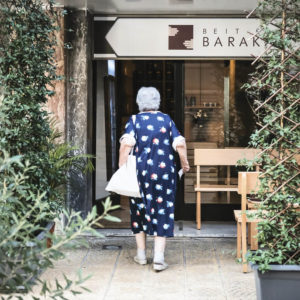
Can you share with us some of your biggest achievements so far?
In 1 year, we have grown from helping 328 beneficiaries to 182,000, we have kept our overheads at less than 2% of our budget, we have created a large community of beneficiaries who feel safe and loved and we have started harvesting organic fruits and vegetables, which enables us to offer nutritious fresh food to hundreds of additional families. We are also producing organic dairy products and eggs, and producing our own bread. This enables us to become more sustainable, to offer a higher quality of food.
During the COVID-19 lockdown, we were able to raise one million dollars to distribute food to 50,000 families in despair all over Lebanon. We have treated close to 1,000 patients. We were able to keep 93 families from getting evicted and we now paying their rent. And now, we are repairing 3,011 homes and 200 small businesses devastated by the blast. We have also launched a new service to help Lebanese families with education.
In this issue we are talking about success – what does success mean to you?
Success is when the people working with you reach their target and achieve their goal, in harmony and happiness.

With all successes comes failures and setbacks – how do you deal with this and stay motivated?
Almost all my setbacks are somehow caused by corruption and by the failing system of governance. But my source of motivation is that we are able to make a change. As small as they may be, the changes we are making are impacting so many people’s lives, especially the youth, and that’s what matters.
What is the biggest lesson you’ve learnt in life?
Justice always prevails, no matter what. We just need to patient.
What is the motto that you live by?
To live a good life and leave something behind. I always tell the young women I work with not to settle for just a good marriage or a small career. Anybody can do that. The important thing is to leave something behind, make a change, have a positive impact on your society. Give your life a large and powerful meaning and most of all; live a vibrant life!
What is a message you would like to share with our readers on how they can get involved and help those suffering during this time?
The first message is that we all need to help; we all need to get involved. The best way to do that is to support local NGOs working on rehabilitating devastated homes and businesses, offering financial, moral and medical support.
For more information on how to help contribute to the working being carried out by Beit El Baraka to help those affected by the Beirut explosion visit: https://www.beitelbaraka.org/
Jaeger-LeCoultre CEO Catherine Rénier on Innovation, Craftsmanship and the Future
Jaeger-LeCoultre has been creating fine watches since 1833. Located in the calm, serene setting of the Vallée de Joux in Switzerland, the Maison has always been focused around expert craftsmanship and innovation, creating pieces that are both timeless and that push the boundaries of watchmaking.
The brand has seen huge success over the years, developing watches that have turned out to be icons, including the instantly recognisable Reverso design.
This year, Jaeger-LeCoultre looked to its archives to create a High Jewellery watch for women that embody pure elegance and sophistication with the Calibre 101 movement. Originally conceived and developed for jewellery watches Calibre 101 revolutionised feminine watchmaking – its minuscule size and baguette shape offered new realms of aesthetic freedom to designers. At 14mm long, less than 5mm wide and weighing barely one gram, the tiny, hand- wound calibre remains the smallest mechanical movement in the world. It is also one of the world’s oldest movements that continue to be in production. Over the years, Calibre 101 has appeared in jewellery watches by Jaeger-LeCoultre under its name, as well as in creations by other great maisons. These rare timepieces have graced the wrists of exceptional women, including Queen Elizabeth II, who wore one – a gift from France’s President– for her coronation in 1953.
This year, two new diamond-set timepieces were unique in the way they were brought to life by Jaeger-LeCoultre’s in-house artistic team. The watches were first designed as bracelets, finally integrating the cases and movements into the designs rather than the usual opposite approach. Both bracelets are composed of pink gold set with diamonds – using only stones classified IF to VVS.
The Snowdrop watch is inspired by the white bell-shaped flowers that can grow through a thin layer of snow in the Vallee de Joux. A circle of pear-shaped diamonds surrounds the dial to form a flower, and waves of diamonds repeat the petal pattern in perfect symmetry. Jaeger-LeCoultre’s designers chose a ‘griffe’ setting for the diamonds, which minimises the metal’s presence and allows light to pass through the stones from all angles. This intensifies the spark of the watch, creating an impression that the diamonds could almost be floating on the surface of the bracelet. With 904 diamonds, of which 204 are pear-shaped and the remainder brilliant-cut (for a total of 20.9 carats), the gem-setting work alone represents 130 hours of work by the jewellery artisans of the Manufacture Jaeger- LeCoultre.
The second timepiece, the Bangle, is a bolder expression of femininity, inspired by the graceful geometry of Art Deco and the strong forms of 20th-Century Modernism. The bracelet is set with 996 diamonds (for a total 19.7 carats), graduated in size to emphasise the sweeping curves of the design. The artisans have combined the griffe (144 diamonds) and grain setting (852 diamonds) techniques to heighten the diamond’s three-dimensional effect and maximise the play of light. Rows of grain-set diamonds highlight the gold bands that run along both sides of the bracelet, supporting its structure. The bracelet needs no clasp as it delicately opens with a simple twist of its two sides.
These two exquisite pieces were shared with clients digitally throughout the lockdown period and as the world starts to open back up again, Jaeger-LeCoultre will be able to share the beauty of the watches physically with clients around the globe.

CEO Catherine Rénier joined the brand just over two years ago and has since been discovering the beauty of some of the pieces in the Maison’s archive. She wants to express the creativity and skills of the Maison’s watchmakers and continue the innovation and high quality of design that Jaeger-Le-Coultre is known for. As a female CEO in what is still today a predominantly man’s world, Rénier has a unique outlook on the world of watchmaking and the way to move forward into the future. We talk to Catherine Rénier about the latest timepieces and continue to innovate for today’s consumer.
What can you tell us about how Jaeger-LeCoultre has been working over these past few months?
Our creativity has actually been rolled out almost as expected. We have had a lot of novelties including the Minute-Repeater with an orbital tourbillion and a Sky Chart piece that started this year in the spring, followed by several Memovox watches which will be launching worldwide from October 1st. Between these, we have also strengthened our message to our clients in regards to “sound- making”. Sound making is something we started doing in the 19th century and since then we have worked on a lot of innovation and patents to constantly improve the sound in terms of its quality, volume and precision. We have a lot of patents of hammers and gongs to manage the best sound for minute-repeaters, but also we have very iconic chimes and this has once again been our focus this year.
From an experience standpoint, we have opened up a specific visit of the manufacture that will be open to the public from November, allowing visitors to have a tour of the manufacture and understand more about sound. There will be specific workshops on sound making that guests can attend and we also have a discovery workshop, which is a three-hour class about sound run by experts from the manufacture. Anyone can join this, no matter his or her knowledge of watches. We discover more about sound in watchmaking from the “tick tock” to the Westminster chime. So these past few months have kept us very busy in terms of products but also in terms of what we have been sharing and our communication.

Currently, we are talking a lot about the 101 high jewellery watch that we recently revealed. The 101 calibre was originally created by the Maison in the 1930 and it is the smallest mechanical calibre that still exists today. At that time it was designed to really give women freedom of expression in their way of wearing watches. In those days, women expressed themselves with their clothes, hair, jewellery but it was less common for them to wear watches and that’s why Jaeger-LeCoultre created this very small calibre to enable the watch to be hidden. It has kept us inspired until today and this summer we revealed two beautiful 20-carat watches. So we have kept busy at all levels of our expertise.
How did the communication strategy of Jaeger-LeCoultre shape up during this era of digital transformation?
The digital transformation era started before COVID-19 and it was already in our plan and something we have always been super-active in. We have been working on this over the last few years. We now have e-commerce around the world and COVID-19 has accelerated the need to be extremely efficient and to be totally valuable. We must ensure that our call centres are extremely efficient and there is, of course, the need to do have more one-on-one and special treatment for our partners and clients to ensure they get the same level of service that they would expect in our boutiques. We have a lot of webinars between the manufacture and some of our clients and we’ve been creating digital tools to reveal some of our novelties. We have been adjusting very quickly and in a way, this was a good time to roll out what was on the road map. It was something that was already needed but became necessary over the last few months. Honestly from that standpoint, it was a welcome accelerator.

101 NOVELTIES
What are some objectives you still aim to achieve at Jaeger- LeCoultre that have not been done yet?
I was very happy this year to talk about sound-making in a very rounded, 360 way. Not just with products but with heritage, education, experience at the manufacture, and showing the consumers who we are and our integrated know-hows. I want to continue sharing our inspiration and innovation so that everyone understands it. There is so much expertise and I want it to be shared in a very innovative, modern and educational way.
Secondly, without revealing too much, next year will be very important for us in regards to the Reverso watch. It is a blessing for us as a Maison to be able to focus on such a historical icon. It is a signature timepiece and I’m very much looking forward to rolling out new chapters of the Reverso story with the world.
To what do you tribute the success of Reverso?
This is a difficult question because I think if there was a clear recipe for the success of icons it would be too easy – you could take the codes and replicate them again and again. There are few icons in jewellery and watches and when you’re lucky to have one within your Maison like Jaeger-LeCoultre does, you cherish it and you make it your core focus for protection and development. My personal opinion is that the very timeless style of the watch and the fact that no matter who is buying it and no matter what their needs, be it a man or woman, the piece has gone through time with its own identity of being very unique with a strong Art Deco-inspired design. It has a special twist with the rotation and the way the watch looks on the dial and this has all made it a piece of its time. Today it remains extremely relevant to new generations and it’s elegance and understated style has really given it its timelessness.

What defines an object of desire?
For us at Jaeger-LeCoultre and I think for luxury in general, it’s about what happens behind the scenes. The craftsmanship, the knowledge and the transmission of this knowledge from generation to generation. I think it creates this sense of value, complexity and tribute to the past that gives the wearer a really unique relationship with the object. I don’t think you would develop the same interest in an Apple watch for example, which has a limited lifespan. It doesn’t offer that same emotion. When you have craftsmanship, heritage, and the meaning or symbol of a luxury item, then the emotion becomes real and it’s all about how you feel and experience that object. But you need all of these ingredients on top of the way it looks to really build a strong object of desire. Timepieces are there as something that you go through life with, building a relationship and there is also this respect of the technicality and complexity of automatic and mechanical watches that you cannot find anywhere else.
What do you think are the challenges that the watchmaking industry is facing today?
Not just for watchmaking but for luxury in general it’s the uncertainty and very quick changes that really make your understanding of what the business will be in six months to a year, extremely complicated. On the other hand, you need to manage long-term views because we are in the business of long-term building. Our work has to be built over months or years because what we do is complex, but at the same time, you need to manage very short-term challenges, constraints and opportunities. Balancing these two speeds of planning for the future but also being agile for the short term is the biggest challenge. We are now in a situation where one plan will never be enough. You need to have two or three solutions for everything you do so you’re always ready for every situation. On the other hand, you must always know your long-term vision; how you get there is the tricky part. This is not just a reaction to COVID-19 – the world has been uncertain and difficult to understand for a long time from a business standpoint. For me, it’s very important to not wait to do anything, because if you stop and wait until things get better, you get too far behind. You have to learn to manage no matter what and be super agile with many different plans. The beauty for us at Jaeger-LeCoultre is really the team spirit that we have and that has been a blessing for me as the head of the Maison.

How do you keep that balance between guarding a legacy but at the same time being modern and appealing to the new consumer of today?
It is difficult but it is an interesting parallel that you draw because in a way the respect of the legacy and the creation and innovation of tomorrow is what we do in research and development every day in our manufacture. We look at the past and we look at what we have as ideas and we keep moving to be modern and create the innovation of the future. This is the way we create our watches and innovate every day. We respect the message of the Maison, talking about our heritage and signature watches which are still very relevant, but that doesn’t prevent us from talking about them with a modern twist and really taking a look at how relevant these creations are in today’s world. There is a thin line and a fine balance of respecting your DNA and heritage but adjusting to the modernity of today’s world.
We have a lot of very nice stories, which I think, give an interesting sense to the Maison’s creativity, for instance, we mentioned sound. One of the angles we took concerning sound is that we commissioned an artist in Switzerland to create a piece of art made of metal that creates a very unique, natural sound. Like our watches, it’s quite precise and very detailed and this art piece will be exhibited around the world as we share our stories about sound. It’s been a fantastic encounter. We had a great time working with him. He worked on his art piece with our blessing, during the lockdown and when I saw the piece in July I was so happy that we had kept going during the period because it was like a breath of fresh air and exciting to know that we will be rolling it out around the world and talking about our expertise and his creativity. I think this sense of artistic engagement also brings a whole new side to the modernity of Jaeger-LeCoultre and the modernity of craftsmanship in our manufacture. There are many ways for us to be relevant and remain open to the world and world people from other industries and inspirations.

What is a message you would like to share with your clients and fans in the Middle East?
In today’s world, creativity and energy prevail. Keep inventing, keep moving and look for the best. This is our motto and what has driven us over the last few months.
Christine D’Ornano, Global Vice President, at Sisley Paris on Success and Innovation
As the youngest daughter of Count Hubert and Countess Isabelle D’Ornano, the Founders of Sisley Paris, Christine D’Ornano has been surrounded by this beautiful brand her whole life. Her parents began Sisley in 1976, around the same time that Christine was born, so her childhood memories are filled with skincare, fragrances and the great innovation that is at the heart of all of Sisley’s products.
Since the beginning, Sisley has been focused around creating products based on active ingredients derived from plants to solve different types of skincare issues. Their unique and luxury approach means they are striving to develop products that really do work and will make a noticeable change to the woman (or man) who uses them. With their headquarters remaining in Paris, Sisley produces all of its products in house, many of which require years of development and innovation. Their dedication to plant-based ingredients also allows their products to be kinder to your skin as well as the environment.
This true success story of a family business is a rare occurrence in the beauty industry. Sisley has always remained true to its values and never tried to be anything other than what it was created to be. As the second and third generations of the D’Ornano family continue the Sisley legacy, we discover more about the future of the brand as well as a look at the latest skincare programme, which promises to restore the vitality of the skin at the source of the cell energy.
This year has been a strange one for all – tell us a little about how Sisley Paris has functioned throughout the lockdown period.
We have adapted very quickly to online meetings and the situation brought new creativity. We have developed new content for social media including a guide to massage techniques with a famous facial therapist in Paris that customers could do at home and also we followed many friends of the brand throughout their confinement. I think the confinement has changed many people’s mentality. We have discovered new priorities and passions. All of this brings new creativity.
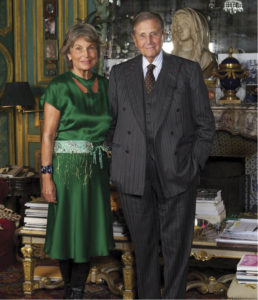
Photo by @David Atlan
Are there any changes you have made within the company during this time and is there anything you believe you will do differently moving forward?
I think it has reinforced Sisley’s existing values. Nature is so important and active ingredients from plants are precious. Investing in skincare
and taking time for oneself is key and as a brand, developing great products. But also Sisley is a family business and looking after our employees is at the heart of our values as a brand. Creating a safe working environment and maintaining jobs is Sisley’s number one priority.
This issue is about success – Sisley Paris has had incredible global success – what do you think has made the brand so successful?
Sisley was a pioneer in phyto-cosmetology – the scientific use of plant extract – that revolutionised the cosmetic industry. Sisley’s innovation was to combine the best quality natural active ingredients from plants with complex, effective formulas that work globally on the skin.
Our philosophy is to enhance the natural mechanisms of defence, repair, regenerate which tend to slow down and deteriorate with age. This is why Sisley’s customers have glowing radiant skin that looks plump and hydrated. And this is why women are very loyal to the brand. We take great pride in the development of our products, some of which have taken over 10 years to create, but also all our products, and especially the fragrances, are developed by the family using our own taste and heritage, which gives them a very personal and original feel.
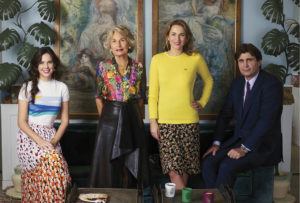
Photo by @Oleg Covian
Your parents founded Sisley and until today it is a family run business – what do you think this family aspect adds to the company and how important to you is the brand?
I think it is a great asset to have three generations working in the business. We have the experience but also a fresh perspective. Being family-owned, we work on the long-term plans, of creating great products that will truly make a difference on the skin. We have many exciting products in the pipeline.
It also gives us great freedom to make the products we want to make. To take our time, to work closely with our scientists and to launch only what we feel is best. My father together with my mother created the brand, my brother now runs it and I work alongside him. We all bring different attributes to the business and it is a wonderful adventure to work together. Now, my niece, Daria Botin has also joined. She is in charge of the Creative Studio. I work a lot alongside her and I enjoy it.
What is your first memory of Sisley products growing up?
I grew up with Sisley as the brand was created when I was born, so I have a lot of childhood memories related to beauty and products. It took up a lot of space and discussions at family meals. For instance, I remember very well when we developed Sisleÿa as it was such a long process. I always remember playing with my mother’s Sisley samples in her bathroom, trying creams, smelling them. Also, I guess I have a lot of memories related to Eau du Soir. I remember when I was a child my mother came to kiss me goodnight on her way out to dinner wearing Eau du Soir. It was her personal fragrance for ten years before my father decided to launch it commercially, and now I wear it too (she now wears Izia).

Sisley Paris is now present in many markets around the world – where is there still room to grow and which markets are you particularly focused on at the moment?
In terms of research, there is so much still to discover. Only a small part of the 800,000 plants that exist on earth have been scientifically analysed and we have not yet explored many of the synergies that could be useful to make efficient skincare products. The natural green chemistry still has many presents to offer to our research teams.
In terms of image and communication, new technologies and new ways of communicating with our customers require new content. Being a family business, we want to keep the same voice through these new outlets. It is a challenge but also a great opportunity.
In terms of focus, we are sold in over 80 countries around the world and all of them are our focus! But the Asian market has grown very rapidly, and we have made certain shades and products specifically for them. In the same way, the Middle East has certain requirements and preferences that we have looked into. We try to adapt to all customers around the world. And also, to men, who love our products too!
What can you tell us about Sisley Paris in the Middle East?
In the Middle East, there is a desire for quality so our Supremÿa and Sisleÿa ranges are very popular. Also, of course, the Middle Eastern market loves fragrances. The Eau du Soir, with its floral Chypre notes, has been a best seller for many years. And so have Izia and Soir de Lune. Finally, our makeup is doing well, especially the lipsticks and eye pencils.
What can you tell us about Sisleÿa L’Intégral Anti-Âge La Cure?
Sisleÿa La Cure is an intensive program, for a very specific use to restore the vitality of the skin at the source of the cell energy. The skin is a living organ that can regenerate itself every month by drawing on the vital energy that runs through and fuels its cells daily. Sisleÿa La Cure was programmed to last the exact same time to restart the skin’s vital mechanisms and ensure a real upsurge in the results obtained. Each one of the four bottles of the energy- saturated treatment unlocks the mechanisms that allow the skin to renew and regenerate itself by acting gradually to restore to its maximum youth potential.
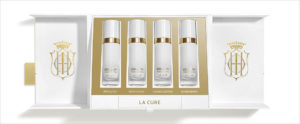
Can you tell us about the research process and planning required when you are developing an anti-ageing product such as this?
Sisleÿa La Cure is the ultimate result of an adventure that started at the end of the eighties.
Our research into skin ageing has always combined our knowledge of the skin, its mechanisms and its environment with unique expertise in the most effective natural key ingredients. With this new generation of treatment products, we were aiming for a global approach to act on the elements that provoke skin ageing.
Therefore, our research teams were very patient and methodical in their work. It took ten years to create the first Sisleÿa global anti-ageing treatment in 1999. From the start, Sisleÿa was a revolution and bestseller worldwide. But for us, it was just the first step. We continued to further improve with the addition of Sisleÿa serums and the launch of Sisleÿa l’Intégral Anti-Âge in 2016. This formula adds the latest epigenetic discoveries: that is to say, behavioural ageing.
Sisleÿa La Cure, the latest step, acts at the very source of the skin’s youth by reviving the cellular energy cycle in four weeks. Our Sisley researchers first focused on the cellular energy and the identification of the key mechanisms involved in its production. Then, we searched for and selected the best key ingredients with natural and complementary properties that would act on the different stages of cell energy production. Nineteen ingredients with remarkable properties were identified, evaluated, and combined and are now concentrated in the Sisleÿa La Cure formula.
Tell us about some of the processes needed to test a product such as this before it arrives on the market?
La Cure benefited from a test protocol of unprecedented scale for Sisley. To demonstrate its effectiveness, our Laboratories have conducted more than 17 evaluation tests:
- Instrumental and consumer tests.
- Tests conducted at all levels of the skin, from the surface to the dermis.
- Tests conducted week after week for 4 weeks, which demonstrate the importance of using La Cure for the recommended period.
Sisleÿa La Cure has been tested on women all presenting marked, tired skin and dull complexion. We have taken into account the main epigenetic factors (linked to behavioural ageing) such as active and urban women, stressed women and smokers or ex-smokers.
Performed under dermatological control by our dedicated laboratories or by independent laboratories, the tests showed visible performance on the quality and youthfulness of the skin from the first week of use and increases week after week. After 4 weeks, the skin regained the characteristics of younger skin. The complexion is radiant, wrinkles are visibly reduced, and the skin is denser, more elastic. It is regenerated in depth.
Why do you believe it was the right time to launch this product?
We always take our time to do the best possible product and launch it when (and only when) it is ready. We do not aim to create luxury but instead try to bring very efficient products to cosmetics. The value in Sisleÿa La Cure is linked to its scientific innovation, formulation and results. We think there is a real demand for a high results product that slows the ageing of the skin while keeping the harmony and personality of each kind of beauty. Once a product is ready, we launch it.
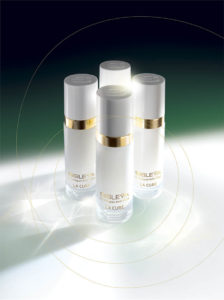
How does this treatment fit in with our regular skincare routine?
Sisleÿa La Cure is an intensive program. It does not replace your daily skincare that you can continue to apply with La Cure or stop and use after La Cure. I use La Cure twice a year when the seasons change. I live in Paris and at the end of winter, for example, I feel that my skin needs a boost. But also, like everyone, I feel and see when my skin needs special attention as soon as it shows signs of fatigue or stress; it is dull and lacks energy. As a result, it’s terrific to take a break from your regular routine and give your skin a real energy boost.
La Cure is also accompanied by a specific tailor-made technique that should be repeated morning and night at home throughout the four weeks to optimize its effects. Its texture is particularly suitable for massage, to provide the skin with special well-being. We have also developed a treatment available at our spas. This will, of course, enhance the effect of La Cure as a deep massage is great to help the mechanisms of the skin.
Where does sustainability fit into the strategy at Sisley Paris?
For many years, we – at Sisley – have been concerned with reducing our energy footprint and seeking to conduct effective and sustainable programs to reduce our environmental impact. This program involves HQE (high environmental quality) certifications for our head office and logistic and research centre. Our CO2 emissions in our factory have decreased by 25% since 2011 while growing the production by over 50%, recycling and clean water programs. We are actively investing and increasing our efforts, as we feel we can still do better.
Why is it important for the company to keep the production of all the products in France?
We are a French company and we believe in working and helping our country of origin. Also, this enables us to keep a close eye on the quality of our products and to make sure that the same level of excellence is maintained at every step of production.

Even a global brand sees setbacks and failures – how do you deal with this and continue to stay motivated moving forward?
To be honest we do not have many setbacks but like all businesses, issues come up and we deal with them as they arise.
If you could look back, what is something that you would tell your younger self?
Have as much fun as you can!
What is something you would love to change within the beauty industry today?
The idea of perfection. I think all types of beauty are wonderful. At Sisley, we believe in being the best version of yourself and to feel good at every age. That is what we strive for.
What do you think women want from beauty products today?
A regime that gives them healthy glowing skin at every age. Also, amazing textures and a real moment of pleasure for themselves.
What is the life motto you live by?
In my opinion, nothing beats “love thy neighbour as yourself”
Meet the Ladies Behind the Success of Benefit Cosmetics
Benefit Cosmetics’ Chief Beauty Ambassadors Maggie and Annie Ford Danielson on global success and providing women with solutions that will really change their lives.
In 2008, Maggie and Annie Ford Danielson, Benefit’s Chief Beauty Ambassadors joined the company that was founded by their mother and aunt; Jean and Jane Ford in the seventies. Born in San Francisco, Benefit was created by the twin sisters to take on a new approach to beauty and that’s how it has continued to function ever since. Today, Maggie and Annie are an integral part of the Benefit team, operates under LVMH.
Benefit Cosmetics is the number one selling brow brand in the world today. The quirky beauty company now has locations in 59 countries across five continents. With more than 3,000 Brow Bars and 85 Boutiques worldwide. Its make-up products have become known as problem-solvers rather than just material products and that’s what enables this brand to have a relationship with customers all over the world. The new generation of sisters in the Ford family, Annie and Maggie joined the company in 2008 and they are now Benefit’s Global Brand Ambassadors and have been working hard to spread the Benefit message to women all around the globe. The two are passionate about beauty, but also about making women’s lives easier and that is ultimately the end goal of the company. As Benefit goes from success to success, we discover more about what makes the brand so unique and the upcoming innovation they have in store.
What does success mean to you?
MAGGIE: To me, success is measured by how you are impacting people’s lives and how much joy and wellbeing you can bring to them. That’s something that the brand tries to do in all the countries that we are present in. We are concerned with how we can better other people’s lives and that makes me feel accomplished. It’s really about being able to pivot and evolve the brand and message no matter what country we’re in. All of the markets and local cultures are different, but I think what makes Benefit so successful after so many years is that we really speak a very basic truth to women. It’s not about trends or the image you might see in a magazine. What it’s really about is making the person who’s wearing the make-up feel good and confident. That surpasses any culture or language, no matter what. So that to me is a mark of success – bringing happiness and joy to women.
Annie: I agree. I think there’s a reason why no matter where we go in the world our top products are the same everywhere. That is one thing that I find to be so unique to Benefit. Mascara, Brows, POREfessional – these key products were always the most popular in every market and everyone was always so confused as to why and I kept thinking – it’s because we are making products that are really solving every woman’s needs. As women, I think we can all agree, we are so multifaceted and at Benefit, we put women first. Of course, we love to make money and have a product that’s a huge success, but if we don’t create something that will truly transform you in five seconds and let you walk out the door looking but more importantly, feeling your best – then we have not done our job. And I think that’s where I consider us a success – when someone takes a product home, feels confident in using it and then goes about her day looking and feeling her absolute best. We are here to fuel her fire and get her going so she can go about her day feeling great.
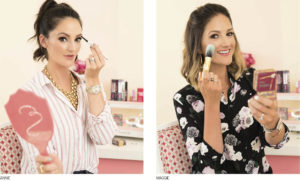
To what do you tribute the success story of Benefit and how have you faced challenges?
Maggie: I think it’s a simple recipe where no matter what, we put the customer first. It’s not about the brand or the founder or what they want – it’s about what the customer wants and that comes first and foremost and that’s how we have always approached everything. Whether it’s a product, a campaign or even the way we think about innovation, all of our products now have an incredible innovation story. We create products that are innovative and make women’s lives easy. It’s not overly complicated or fancy – it’s easy, it’s quick and it helps you get on with your day. I think that is what’s been so successful about the brand. We are actually quite a humble brand. We’re not out there pushing this huge message about being a certain look or way – our message is for women to be themselves, achieve what they want and we’ll be right there next to them, no matter what their day holds and that I think is why we’ve been so successful no matter where we go.
How challenging is it to defy the norms and make women feel confident with who they are?
Annie: I think about the very beginning phases of Benefit and I look at how our mum and aunt faced those challenges. If you think back to 1976 there were only big traditional brands in the beauty industry and then you had Benefit, which was completely different from all of them. So I always wondered what was that secret ingredient that they had to keep the brand alive? And then I realised that it was the fact that they had each other. They were identical twin sisters who could finish each other’s sentences or thoughts. No matter what challenges they faced, they were always a united front and I think as women that was such a powerful front to have. Especially back in the seventies, when it was a very male-dominated work culture. I think that there’s something really special about the fact that there were these two sisters who were so uniquely entwined and were able to push forward and let all of the doubt and fear pass over them because they knew that they were each other’s partners no matter what. I think that kind of sisterhood and that feeling of community is something that we today have woven into every decision we make and that has helped us in challenging times. When we launched Benefit in Korea for example and they told us “you cannot do brows in a department store in public. The Korean woman will not accept this change.” And we said: “Well then you don’t get Benefit because this is who we are.” And we opened up a Brow Bar and the women lined up! I think we are just unapologetically confident in ourselves because we’ve always had to be. But I think it’s something that is especially in this day and age, so respected. We take for granted that we were born that way at Benefit but I think that’s part of our secret recipe because that’s who we have been since day one.
What is a challenge you face as a brand today?
Maggie: There are many challenges, some are more philosophical and some are technical challenges. First of all, there is so much competition out there which is great because it keeps us going, however, a lot of the new brands are much smaller than us, they can launch new products quicker than us because we are such a big global brand with such wide distribution and it takes us a little bit longer to get products to all of our retailers and customers. So when you have customers that constantly want to see new things, it’s hard to keep up and continue with the same level of innovation and customisation and that is one of our challenges that we are trying to figure out.
The other challenge that we have is to stay true to who we are in terms of our message. Because it is enticing to want to jump on a trend or jump on the bandwagon of what is causing sales to happen right now. At the end of the day, trends come and go and at Benefit, we try to not attach ourselves too strongly to those trends so that we will last. We want to be aware of what’s out there, but not get so caught up in it that we lose who we are.
What has been the impact of COVID-19 on the strategies of the brand?
Maggie: Everyone was impacted and continues to be. We can’t say which ones but we did have to take a step back and delay or pause some of our launches to maximise the impact, given the circumstances. We had to think about what would be best for the business and the communities. But at the same time, the resilience has been great and we are all doing what we need to do to stay relevant and stay alive. Great innovation can come from these challenging times.
Annie: Our whole Benefit community haven’t missed a beat. Everyone has constantly been thinking about how we can strategize things and what the plans are moving forward. Everyone in our teams is so creative, they have so much love and passion for the brand and you can see everyone within our community coming together during these times and the brand has always been like that. People who work at Benefit aren’t “Beauty Junkies” they are “Benefit Junkies” and you can see that drive and passion and because of that, we are seeing so many new ways of thinking and marketing throughout this time. To be honest we thank our lucky stars every day that brows and mascara have been our pillars of expertise for decades because when you’re wearing a mask, that’s all anyone is seeing! So we have been running with that and luckily this has been a blessing for us. When we stay true to who we are and don’t get obsessed with trends, when things like this happen, we have that safety zone to run home with which is good.
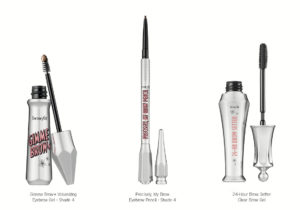
Why did you decide to tap into brows?
Maggie: The funny thing is that we were doing brow services, well before we had a very robust set of brow products. Our service business was very large, we’re the largest employer of aestheticians at any company in the world and we realised that we had very few brow products to support this amazing service business. There also wasn’t any other make-up brand that owned the brow category so we saw a business opportunity that made sense for what we were already doing. So we decided to completely change the brow vision. We wanted to bring the brows to the people and make it easy!
Annie: It was such an intimidating category at the time as women were wary of doing their own brows. So when we added the Benefit spin of: ‘if you have a brow problem we are going to solve it’, women started to listen and were intrigued. It was the perfect combination and then as we launched it, brows became such a hot topic, particularly on YouTube and social media.
What is something that you would like to do that you haven’t done yet at Benefit?
Annie: I think one of the things that we’re always striving for, particularly in today’s era is constantly reinventing ourselves to look and feel fresh. The packaging for example – how do we make sure that today’s women still have that exact experience that people had 10 or 15 years ago when they first discovered Benefit? It’s not necessarily always achieving something new but it’s almost harder to continuously offer that same wow factor. So I think to continuously do that is our biggest challenge, but it’s also our road to success.
Where does your inspiration come from for new products and how do you sustain innovation?
Maggie: When we’re thinking about a new product launch, first of all, we look at what we currently have in our offering. As a global make-up brand, we have a very small assortment of products. If you look at some of our competitors, they have 100 eye shadows alone. We have maybe between 250 and 300 individual products. That is actually quite a small offering. So each product has to be very effective and efficient. The first thing we do is look at what isn’t selling or working and we are ruthless! Then we say ‘what else do we need and what holes are there in our assortment?’ Our newest product; the Brow Microfilling pen was something that we, as a number one brow brand, didn’t have in our assortment and we knew that it was something that we could do best in class, we could innovate, make it easy, our shade range would be the largest. So it’s a case of looking at all these different factors that go into what we’re going to launch next. It does take us a fair amount of time to launch a new product because we have such innovation and everything is so customised. We work with labs all over the world and the way we approach it is that we say to our developers; ‘we want what to solve this problem – what can you do to make this a reality?’ And it can take a couple of years.
Annie: Also I think the reason why the Brow Microfilling pen is such a good example of this is that a few years ago we saw a lot of similar pens come out on the market, and we were already working on our pen but we were not going to fast-forward the innovation or functionality just because we wanted to be first to get it to market. We would rather be fourth or fifth and have the absolute best quality so that the pen never fails our women. So even though it may be something that you’ve already seen, it’s one of our most successful launches, because it actually works. And that’s when we can be super proud of what we do. We have an entire brow innovation team and we work with the best of the best labs in the world. When it comes to our involvement what’s cool is that we actually sell the products in The United States on the home-shopping network, so we’re one of the few people in the corporate environment that has that day-to-day interaction with the customers and actually sell the product to her. So it’s great because we get to experience that side too so and that’s where we can see things coming together.

What can you tell us about Benefit in the Middle East?
Maggie: We are the number one brand in the Prestige Category in Sephora in the Middle East right now, which is incredible. Brows and mascara are key for women in the Middle East and with the situation where everyone is now wearing masks we are seeing this demand double. Sometimes it takes a little time for a brand to make its way into the culture and become an everyday brand in a new part of the world. When Benefit first launched I think people thought it was this wacky American brand but now I think women have settled into it and seen all the things that we do, especially on the marketing side as it’s tailored specifically to Arabic women. We’re obviously an American brand but we’re trying to do it in a way that resonates with Arab women. All of our communication is in Arabic and we’re trying to marry the two worlds in an authentic way and I think that’s been part of the success.
Michael Kors Talks America, Charity and the Middle East
Michael Kors is perhaps one of the most recognisable names in fashion. The American designer has his name to clothing, accessories, watches, leather goods, fragrance and more in over 100 different countries around the world.
His designs have been worn by the likes of Michelle Obama, Blake Lively, Jennifer Lopez and many more. Michael Kors has become a household name thanks to the diversity of his brand, making it accessible to many types of women.
Michael’s love of fashion started at a very young age. When he was just five years old the soon-to-be fashion legend re-designed his mother’s wedding dress for her second marriage. As a teen, Kors began designing clothes and selling them out of his parents’ basement, which he renamed the Iron Butterfly. By the age of 14, he knew he wanted to become a designer. In 1977, he enrolled at the Fashion Institute of Technology in New York City. However, he dropped out after only nine months and took a job at a boutique called Lothar’s in Manhattan. He went on to become both the designer and visual display head for the store before being spotted by Dawn Mello, Fashion Director at Bergdorf Goodman. She asked if he would show his collection to Bergdorf Goodman’s buyers and in 1981 Kors launched his womenswear line at the New York department store.
In 1997 Kors was named the first women’s ready-to-wear designer for French house Celine and while continuing his own label, he turned the Parisian House around at a time when it had been struggling. In 2003 he left to concentrate on his own line. The MICHAEL Michael Kors line was launched in 2004, joining the original Michael Kors Collection label. The MICHAEL Michael Kors line includes women’s handbags and shoes as well as women’s ready-to-wear apparel and is more affordable than the runway line, hence the huge appeal of the brand to women worldwide.
In January 2014, Forbes reported that Kors reached a personal fortune in excess of $1 billion and it seems this is only the beginning. In 2018 Michael Kors Holdings Ltd changed its name to Capri Holdings and has since purchased Versace and Jimmy Choo. The group is on its way to rivalling other luxury giants within the industry.
But while the future is still bright, 2020 has been a difficult year for the fashion industry as a whole. No one truly knows the damage COVID-19 has done but one thing that is clear is that it will come back fighting. Ahead of the launch of his fall/winter 2020 collection, we talk to Michael Kors on American fashion and the future of the brand.
How would you define the universe of Michael Kors today and how has it evolved?
One of the first reviews I ever received stated that I made “chic, glamorous American sportswear” and that still holds true today. I think the key to being a good designer is staying consistent so that your customer trusts you, while always evolving and staying up to date.
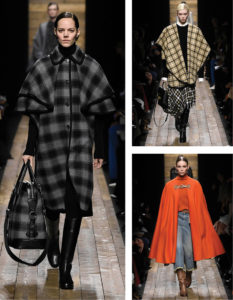
Michael Kors is a true American success story – how do you define, in your opinion, the US market and the American fashion industry?
I think what was once considered uniquely American — sportswear that is still glamorous and luxurious — is now something desired all over the world.
How do you think the values and culture of the United States are reflected through Michael Kors?
Many people don’t realise it, but I’m a very pragmatic person—and at the same time, I love glamour and indulgence. That yin and yang is something that comes through in everything that I do, and I think it’s a concept that’s strongly rooted in American fashion.
How important is it to Michael Kors to localise its collections or give tribute to a specific market?
We’re always looking for ways to connect with our customers around the world and be there for the events and celebrations that are important to them. That’s why we focus on special capsule collections for holidays like Ramadan in the Middle East, Diwali in India and QiXi in China.
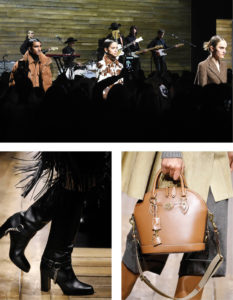
What can you tell us about Michael Kors in the Middle East?
The Middle East continues to be an important market for us. We recently opened a store in Saudi Arabia in the Riyadh Park Mall and we have another one opening in Al Nakheel Mall Riyadh this fall.
What can you tell us about your work related to the World Food Programme and why is this something important to you?
As I travelled the world for my career, I saw the extent to which hunger is a global problem. When I was looking for the right partner to make a difference on a global scale, I was drawn to the United Nations World Food Programme (WFP)—they firmly believe that hunger can be eliminated in our lifetime. Watch Hunger Stop is our philanthropic campaign that focuses on raising funds and awareness for WFP. We’re looking forward to sharing our new campaign this October.
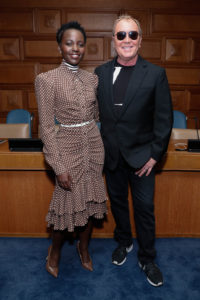
Take us through the Fall 2020 offering of Michael Kors Collection – the inspiration, the fabrics, the colours?
My Fall collection is all about cosy glamour and clothes that are relaxed while still having a sense of polish. I wanted to take the idea of privacy and inject that into the clothes with silhouettes that make you feel protected, like capes and ponchos. It’s a lot of softer shapes that are all about movement and comfort while still being really luxurious. We focused a lot on fabrics that will stand the test of time, like beautiful soft silks and tweeds that give you a sense of texture but still feel very lightweight. And then the colours feel very rich with a lot of camel and grey combined with bright red, cardamom yellow and orange.
Who or what inspires you?
People who can do it all and people who are making a difference—from my friends to the women in my office, to the frontline workers helping to keep us all safe.
What is the professional motto you live by?
Optimism is always in style.
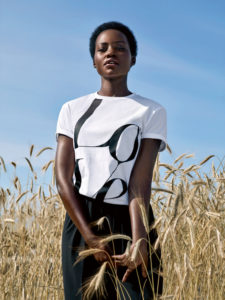
As a designer and a businessman – what is your message to aspiring designers today as well as aspiring entrepreneurs?
Take the time to refine your vision and get to know your customers— and then stick to what you set out to do.
Do you have any plans to visit the Middle East soon and what do you think of the Middle East market and style?
Right now, our travel plans are largely on hold, unfortunately. I think our customers in The Middle East love glamour and appreciate quality and luxury, and that’s something that we always try to deliver.
Vincenzo Castaldo, Creative Director at Pomellato Discusses the Making of the New High Jewellery collection
When Pomellato decided to launch its first high jewellery collection there would be one man responsible for bringing the vision to life.
Alongside his team, Creative Director Vincenzo Castaldo worked on La Gioia to make this vision of joy a reality. Castaldo is the first to credit his team of artisans, but it is also down to his creativity and eye for innovation that allows these unique pieces to become a reality.
In his role as Creative Director, Castaldo is responsible for the overall aesthetic output of Pomellato, continuously updating and evolving the house’s distinctive codes. Working in close tandem with the artisans and the gems master, Vincenzo Castaldo materializes the Pomellato values in tangible objects that break the rules while addressing a clientele of self-confident, independent women who see beauty – and beautiful objects – as tools of self-empowerment, but who also have an easy, spontaneous way of wearing precious things. Spending eight years with this band has allowed him to discover every aspect of its DNA and ensured that now would be the perfect time to delve into the world of high jewellery.
To discuss just that and take a look at the collection in more detail A&E talks to Vincenzo Castaldo.
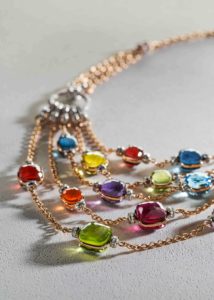
LA GIOIA DI POMELLATO COLLIER PLASTRON NUDO
It seems the high jewellery collection was born at a time when we all need joy in our lives?
When we launched it was perfect timing because we were in an unexpected scenario. As you can imagine we had planned long ago how we would launch the collection but everything changed with what happened around the world. But I do believe it was a perfect moment for us to share this collection with the world.
Tell us more about the collection and the story of how it came to life?
We started to work on the collection more than a year ago. The intention was not to create a traditional high jewellery collection but find our own style or language. We wanted to invent ourselves in a new way. What I love is that the result is perfectly aligned with our philosophy. The new collection is lively, contemporary and it has a playful attitude which is very Pomellato. We wanted to create a new dynamic, high jewellery philosophy. For the first chapter, we want to celebrate our own story. We were born in 1967 and we have had so many inspirations in our history, so this is the perfect occasion and project to celebrate what Pomellato is. It celebrates our passion for sensual volumes – you will never find geometry in our jewels. We love to work with new shapes and designs and then we have the playful and emotional side with the colours. So it has been a fascination with our specific codes and blending these in a new inclusive way. The unconventional style is more of an attitude. When you work on a very high-end collection you can express and create without limits, so for me, it was like being back at kindergarten as I could play with different stones without restrictions and without having to worry about quantity or numbers. So it’s much more artistic and individual.
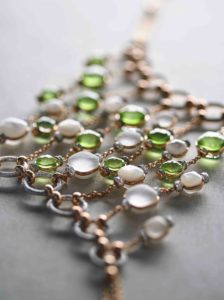
LA GIOIA DI POMELLATO COLLIER CASCADE NUDO WITH TOPAZES AND PERIDOTS
If you look back at Pomellato’s history – what part of the story do you always find yourself attracted to?
I remember I saw Pomellato for the first time when I still worked in fashion so my initial view was as an outsider. I was very intrigued by the use of colours – it was joyful and artistic and I loved the combination of colours that the brand created with its collections. Another important aspect that is interesting for me is the beautiful shapes and how they are always feminine and very natural. There is this kind of spontaneous attitude in the shapes and volume. You can feel the human touch and it’s something very natural, organic and pure. This pureness is very important to me. I would never create something for Pomellato that is rigid because there is always this softness associated with the brand. Every single part of the jewel for me is important down to the last details.
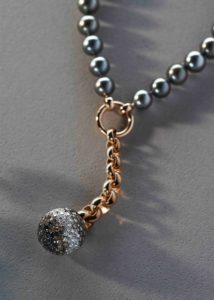
LA GIOIA DI POMELLATO SABBIA NECKLACE WITH TAHITI PEARLS
As a creative person what inspires you and when are you at your most creative state of mind?
Inspiration can be found in very strange places. Art, design, fashion etc. can be very inspiring but it can be more about a colour, attitude or trend. Anything in life can be inspiring. The really important thing is the way you observe what’s around you. Because sometimes an unexpected shape or a combination of elements can inspire you. I like to observe, but observing is different than seeing. It requires a kind of meditation or contemplation. In this kind of exercise, you can understand the different proportion of things together. If you take your time to really see what is going on around you, you will discover different things that can be very inspiring. It’s something very difficult to describe.
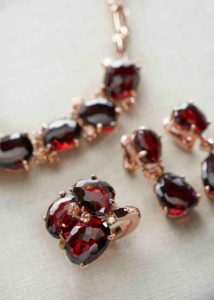
LA GIOIA DI POMELLATO RIVIERE PARURE WITH PIROPO GARNET
What can you tell us about how important it is for a brand to maintain one coherent design DNA?
It’s very important as the DNA of a brand is a kind of calligraphy or style. When you have your own calligraphy, you can write a new chapter, but your story will remain coherent. You never have to betray your own style. You can explore, of course, that’s my job, but with the approach and mindset of the brand. For Pomellato this style is very clear to me after eight years, but every day I discover something new, something that can be Pomellato in a new way. It’s a never-ending exercise that’s very important for the brand. Pomellato has a very strong identity that’s clear to me and our clients. Our clients can recognise every single trait and part of our aesthetic attitude. That makes me very proud.
What was your favourite piece from the High Jewellery collection?
I have a special relationship with the Gourmette Cameleon. It is a work of art and there is an amazing selection of coloured stones in this piece. We looked to find as much colour as possible for the chain. It is composed of 29 links and my dream was to have each link in a different colour – we have 27 colours – two links are in white diamond and the clasp is in gold. It was a challenge for my team to create this piece and find these coloured stones and it turned out to be a journey around the world because every coloured stone came from a different region. We have never done anything like this before and it was a really special experience that embodied the real love and passion in the brand.
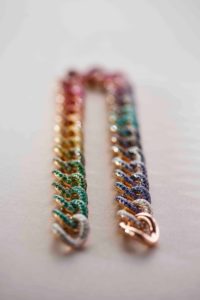
LA GIOIA DI POMELLATO GOURMETTE CAMELEON
The Sabbia Mesh choker is also another one of my favourites. Firstly it’s very comfortable because it is like a precious fabric around your neck. It’s very feminine but at the same time, there is also something very masculine about it because this style of mesh was born in the Medieval era. So there is this nice compromise between something very feminine and sensual but also at the same time very powerful and protective. Every single link was made by hand and we have great artisans who do this kind of work. I find it a very intriguing material to work with.
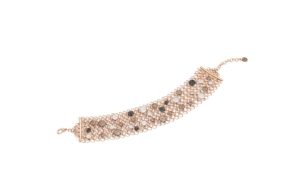
SABBIA MESH CHOKER
What will you take away from this unusual year?
It has been a year to learn many things. Yes, the price was very high but there are some lessons I want to keep in my mind.
Sabina Belli CEO of Pomellato on Life in Lockdown and the First High Jewellery Collection
Earlier this year, during the height of lockdown, Pomellato launched its first High Jewellery collection; “La Gioia” meaning “joy” in Italian.
This landmark launch foresees the Italian House evolving into the world of High Jewellery for the first time and the collection celebrates the true DNA of Pomellato. The 165-piece collection brings the modern spirit and Italian craftsmanship of Pomellato to the High Jewellery sector, with each piece telling a unique story and highlighting masterful savoir- faire.
Launching the collection during the lockdown made it different from any other occasion in the brand’s history. Not being able to meet with clients or travel around the world with the pieces, of course, imposed some challenges but with CEO Sabina Belli behind the rollout of the collection, the jewellery house found new and innovative ways to share these pieces with the world.
While still being in part lockdown over the summer Sabina Belli is starting to reflect on this period and plan for the future. With uncertain times ahead what does seem certain is that some aspects of the business will change for good. Here we talk to Sabina on the latest developments of the company, the upcoming months for Pomellato and the new High Jewellery collection.
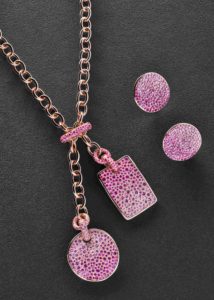
LA GIOIA DI POMELLATO SABBIA FLAMINGO NECKLACE & EARRINGS
What is a lesson you have learnt from the lockdown and what is something you will change moving forward?
There are three axes that are key and we cannot avoid facing them. The first is the value of the human being. All over the world, we are seeing signs that humans need to be at the centre of every debate – whether it’s a question of race, religion or something else – there is no room for discrimination anymore. Inclusivity and taking care of others is very important. I think that maybe the fact that during this lockdown we have entered people’s lives through Zoom and other digital communication windows has made us more authentic. We have seen each other with no make-up, no glamour from the comfort of our homes and we are no longer embarrassed. It’s become normal because everyone is in the same situation. The fact that we can see people as they really are has made a big difference.
I was recently listening to an activist who is based in the United States talking about racial discrimination. She was a black African American woman and she spoke of how she realised that when you go back to the office on a Monday morning we all have to create a narrative that is acceptable in the social area where we interact. Sometimes we might do something during the weekend that we don’t feel comfortable talking about with our colleagues because we feel that we could be discriminated for it. Whether it’s a religious habit, a community belonging, a hobby, etc. But now maybe these masks are dropping. We can be much more open with our employers and they should be more open to listen to people’s real issues and support them. I see that happening at Kering where we have huge support for many of these topics. It’s an absolute must within the company.
The second point is that obviously health is so important and everybody should have access to welfare and be able to take care of themselves. We are now living in a world where sustainability is a must. There is no reason to still be in the mindset where you don’t think about waste. And frankly, concerning me personally, I was ashamed by the number of shoes and bags that I own! I think we will start to shop differently and this will be something very important.
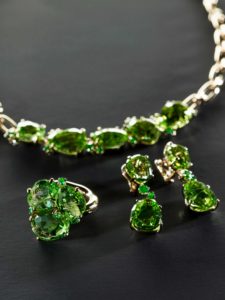
LA GIOIA DI POMELLATO RIVIERE PARURE WITH PERIDOTS
Then the final point is agility. I realised recently that there is a huge difference between remote-working and smart-working. Working but not sitting at the office is remote-working. But smart-working is maybe still being remote, but with something else: empowerment, decision making and risk-taking. We don’t have the time to spend hours sitting in meetings debating things and this is going to be a treasure. I started working in the eighties and from 1983 to 2020 nothing had changed – it was the exact same method of working in the way a company is structured. The only thing that has changed drastically is probably the internet and technology. But everything else is the same. And I’m so excited that I’m witnessing the first major change in the workplace. We are not going to go to the office every day. We are not going to sit at our desks just to complete the hours of 9am to 6pm. Maybe we will do handicrafts at our desks? Because we’re not always busy all day! I’m so excited about this. People will get to live differently but in a truly more balanced way.
In this respect, I’m asking myself what is going to happen for places like Dubai, Hong Kong and New York where people were in the fast momentum of working? I hear so many people feeling that they need an outdoor space in their apartment, or to get out of the city more often. I don’t think there will be this urban environment in the same way. A few years ago I went to visit the new Zaha Hadid complex in New York and they told us how they are now selling properties that have no kitchen. Because there are so many single people that don’t need a kitchen as they never cook. But instead, that space was a gym. That was the new trend. Now however I’m not so sure – what if after three months of lockdown you learn to cook and realise that it’s healthier and you want more space? I think we could be at the beginning of a totally different way of living a daily routine.

LA GIOIA DI POMELLATO GOURMETTE ASSOLUTA WHITE DIAMONDS
What’s next on the agenda for Pomellato when it comes to supporting women and what is something you would still like to do on this topic?
This idea of women allowing women to be empowered is key for us. Empowerment as a whole concept starts from one place: education. You cannot talk about empowerment if you don’t have an education but there are so many women around the world who don’t have access to schooling yet. So we need to think about that. We also need to be teaching the families and parents that an educated girl is a more empowered girl and she’ll have more chances to be happier and freer and also to make more money.
The second point is making sure that there is no discrimination in terms of racial background, colour, religion etc. I’m following what’s happening in the U.S. and so many other parts of the world. The statistics on the chances people have depending on where they come from are unbearable to see. This is something we should fight and it starts from your own personal circle. Start by looking at how your neighbour or your children’s friends, for example, are living and you’ll be surprised how many problems there are. Sometimes people are very much conditioned to not get involved in somebody else’s problems, but it can be a chance to save a life. We need to help so many of these women pass through their struggles. The number one reason why these things happen is because women are scared to talk because of social judgement. I also need to make sure that people in my company consider it as a safe space and ask for help.
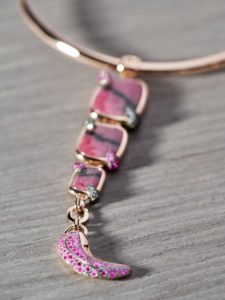
LA GIOIA DI POMELLATO MINERALISMO NECKLACE WITH RHODONITES
What’s in the pipeline for Pomellato for the rest of the year?
As we have been shut down for four months, what we may consider old developments or products in the company are still new for the world as we haven’t shown them yet, and we have some classic pieces that have always been in our stores that could be revamped and presented.
Then what I think is going to be new is the way we interact with our clients and friends of the brand, which will be in more of a virtual way. So we have to make sure that we are open-minded enough to be able to present our novelties and our actions in a digital way. I’m very confident that people have adjusted to that very easily. People are becoming so creative and everyone has invented new ways that are very stimulating. And also as the head of a company, it will be interesting to see how much money we have saved from no travel etc. and we will be happy to reinvest that in other positive ways. So sometimes a bad period can also provide some good.
Why did you choose the name La Giola (meaning “joy”) for the name of the High Jewellery collection?
When I joined Pomellato five years ago I wanted to find this higher purpose for the company. So I went around and asked everyone “Why do you come to the office in the morning?” And they found it difficult to answer. So we exchanged ideas and we realised that when we produce a Pomellato jewel, at the end of the chain, there will be a woman who opens up the box and feels a moment of joy. So I told my team that our job is to provide joy to the world, because that’s what we do – we bring joy to these women. And that is a great responsibility.
THE MAKING OF GOURMETTE CAMELEON
Will this collection always have a special place in your heart?
Of course. It has been done at such a terrible time and it’s incredible because I realised that throughout these weeks and months, we all had something to celebrate. Whether it was a birthday, an anniversary etc. and at these times you want to mark that celebration with something that lasts forever and this is what jewellery is for. So we are so relevant to bring joy to people’s lives.
SABBIA CHOKER AND BRACELET
What is a message you would like to send to your fans and clients in the Middle East?
First of all that I miss them! I miss the pleasure of mingling with amazing women. Middle Eastern women are so unpredictable because you end up discovering these amazingly strong, bold personalities. They are the most free-spirited and sophisticated women and I miss that a lot. I also think that this is time for everyone all over the world to think about life in a different way. Maybe people in the Middle East may find they have the occasion to let their cultural backgrounds be expressed even more and create this multicultural community that is unique in the world. I think there is an amazing opportunity for this and fabulous coming together of many cultures.
Claire Choisne, Creative Director at Boucheron Presents the Latest High Jewellery Collection
Boucheron’s Creative Director Claire Choisne presented the Maison’s latest high jewellery collection via a virtual presentation earlier this year. The collection “Contemplation” was inspired by the beauty of the sky and brought together traditional craftsmanship and new technology to create really special one-of-a-kind pieces.
Claire Choisne said of the seventy-seven piece collection “For years, I have wanted to capture the ephemeral, to convey the poetry of present moments, the purity of the sky, light effects. The jeweller’s art is about stopping time in its tracks, making instants eternal when, by their very essence, they are not”.
This collection is very personal to the Creative Director who has long had a fascination with the sky and the chosen name “Contemplation” suggests a very emotional approach. Choisne worked hard to bring new techniques and materials to the table that have never been seen before in the world of high jewellery. Materials were sculpted to represent the true magic moments of the sky, from the precise second a droplet of raindrops from the sky, to the weightlessness of a cloud, to the lightness of air.
For the collection, the Maison developed new materials and even used a special substance used in space by NASA to gather stardust. This mystery matter – 99.8% composed of air and silica – varying in colour according to the light is enclosed in a shell of rock crystal set with diamonds. It’s unlike anything else in the world and really gives a unique touch to this collection.
Contemplation Necklace
Claire Choisne joined Boucheron in 2011 and was immediately inspired by the Maison’s 160-year archives. She draws her inspiration from the history of the house but reworks it in contemporary ways to create pieces that are truly unique. Her original style combines innovation and originality but doesn’t forget the tradition and values of the brand. Choisne likes to work with unusual combinations of materials and has introduced unexpected mediums such as sand or marble into high jewellery. Her pieces are wearable but also unexpected – perfect for today’s modern woman. Here we find out more about the latest high jewellery collection, as well as discovering what inspires Choisne to create such unconventional, unique pieces.
What was your inspiration for the high jewellery collection?
I visited the Naoshima islands in Japan. It’s a cluster of three islands where you can find art pieces in an open-air museum. I spent three or four days there and took time to contemplate and it was so peaceful. Two installations in particular had openings in the ceiling so you could see the sky; it was so pure and it was great for me to spend some time there. I was also inspired by the Salar de Uyuni in Bolivia; these are the largest salt flats in the world. Of course, salt is white, but when it rains it starts to look like a mirror and it reflects the sky. So again it’s a really pure and calm place. I haven’t had the chance to visit yet, but I would love to go as soon as possible. Then the last inspiration is perhaps more personal, as we are always in a rush, running around and working hard, so I wanted to take time to calm down. So I went to my house in Portugal where i’s surrounded by a pine forest and it’s quite near to the ocean, I go there often to contemplate and observe the nature around me, and this is how I came to choose to work with the theme of contemplation.

What is a lesson that you have learnt from the recent challenging period that we have faced?
I have discovered this idea of really focusing on what is important. During the lockdown we were all scared and it was quite stressful, but at the same time we had time to think and for me, it was a good time to reflect on what was important for me, what I should focus on and what I should forget! I took the time to appreciate everything in life; the simple things and I focused on taking time to be calmer. I work in a creative world but you can spend too much time doing things that aren’t about creation, so I want to start balancing this a bit better.
How are you staying close to your clients this year with the challenges the world is facing?
I haven’t had the chance to see a lot of our clients yet. I don’t know if I’ll be able to travel, but I’m crossing my fingers because spending time with clients and talking about the creation of the collection is important in getting final feedback on the work that we have done. So I hope to meet them very soon.
If you were to design a piece of jewellery inspired by the Middle East what would be the first thing that comes to mind?
It would be inspired by the women from the Middle East that I’ve had the chance to meet. The thing I love about Middle Eastern women is how they truly love jewellery and they love to wear it. They like to wear bold pieces and as a designer that’s great as it doesn’t limit you with your design. I would use that to make something quite spectacular and opulent with femininity.
Contemplation Necklace
What in your opinion sets Boucheron apart from other brands?
I try not to look too much to other Maisons to be sure that I’m not influenced by them. If I had to find something that’s different for us, it would be the freedom that we have as a brand. I have the freedom to create, even if I come up with crazy ideas!
A Maison like Boucheron has a long history and legacy – as a designer and creative, what is a period that inspires you the most from this history?
Without any hesitation, it would be the first pieces of Boucheron made by Frederic Boucheron himself. I love the poetry of those pieces. The Question Mark necklace, the Ivy necklace, the Feather – the way he used nature – it was amazing. These are pieces that I would still love to wear today. I think it’s the goal of every jeweller to create a piece that is still beautiful after all this time. The pieces were very innovative at the time and they became something timeless, so for me, this is the perfect work for a jewellery designer. I am so happy to add some of my creativity to this Maison.
We always see elements of nature present in Boucheron’s design, but what really inspires you and what are the moments when you’re at your most creative state of mind?
We work a lot with nature because it’s in our DNA but also because it’s something that I love personally. I spend a lot of time in Portugal surrounded by nature and I think that is the moment when I’m most creative and inspired. When I’m there, ideas pop into my head easily. These moments when I’m travelling are the times that are the best for my creativity.
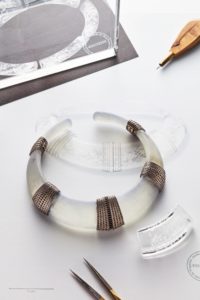
Contemplation Necklace
What is a favourite stone that you like to work with?
I don’t normally have a favourite stone because for me it’s really important to start with the idea or creative concept and then choose the stone that allows me to express this idea. But if I had to choose something that I work with again and again it would be the association between rock crystals and diamonds. Together this is the best combination and it gives modernity to the pieces as well as a visual lightness with its transparency.
What is a stone that you haven’t worked with yet that you’re interested to see in your creations?
It’s not easy for me to answer because I have had the chance to work with a lot of stones! But actually, for the Skydrop necklace in this collection or the necklace we made last year with the magical stone, we created our own stones. So maybe the one I would love to work with is one that I will imagine.

Who would you still love to see wearing one of your creations?
That is super difficult! It would be a woman with a strong character and style but at the same time; elegant.
What is something that you would still like to do at Boucheron that you haven’t done yet?
That’s the pleasure I have working at Boucheron because each year we dream of new ideas with freedom. I can’t say too much, but during the lockdown I worked with my team on the first ideas of the collection for 2022. I can promise it will be something exciting!
The Quatre ring is now an icon – in your opinion how do you achieve creating an object of desire like this?
Being recognisable is one of the key elements, but also matching really well with the philosophy of Boucheron. In the sense that this ring is made with all the iconic codes of the Maison, but putting it all together, creates something that is very modern. So it’s the balance between the past and the present.
And would it be the same for the Serpent Bohème?
I love the Serpent Bohème and I think it’s cool because you can have these two styles that are totally different but you can also wear them together. For me, Serpent Bohème is about femininity. It’s a super line for us and it’s a good balance between power and modernity and femininity and vintage.
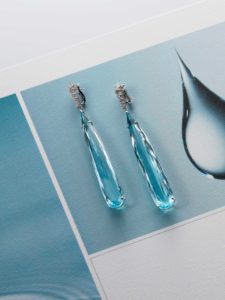
Contemplation Earrings
What does elegance mean to you?
It’s something about the attitude and the confidence that you have in yourself. As well as being a woman who has perfect style.
Is there anything happening in the high jewellery industry that you think is wrong?
I wouldn’t say it’s wrong but something that I think is important that I don’t see everywhere is about the purpose of jewellery. For me and for Boucheron we create jewellery to be worn and not to be stored in a safe. So I want to see jewellery that is wearable. Also sometimes it can become more about the weight or size of the stone than about the poetry or creating something meaningful.
If you had one wish, what would it be?
Never stop dreaming.
Lucia Silvestri Jewellery Creative Director at Bvlgari Presents the Barocko High Jewellery Collection
Lucia Silvestri is bursting with creativity every time we meet with her. And despite the challenging times that we are all facing, this (virtual) meeting is no different. The Creative Director is presenting the new Barocko High Jewellery collection. Inspired by the beauty of Rome, this colourful offering is a bold and brave approach to high jewellery design, sharing a message of joy and positivity.
It’s hard not to smile looking at these jewels and Silvestri is a perfect example of that as she beams, taking us through some of the key pieces of this exquisite collection. Unfortunately, due to the COVID-19 situation, many clients can’t make it to Rome to see the pieces for themselves, however, Bvlgari has been working on ways to share these show-stopping pieces with their customers all around the world even when they can’t physically connect with them.
WATCH THE VIDEO OF LUCIA’S INSPIRATION HERE…
Here Lucia Silvestri, Jewellery Creative Director at Bvlgari talks us through the collection and some of the challenges she faces in her role moving forward during this period.

As work starts to resume how was your time in lockdown and what is a lesson you have learnt throughout this situation?
It’s been a very complicated moment. To begin with, it was very, very hard for me because I was used to travelling a lot, so I felt like a bird trapped in a cage! But I have had a lot of time to think, read, listen to music and spend time focusing on myself. The creativity didn’t stop. I was connected with my team more or less every day and we talked a lot about creativity and new projects, so we were keeping the momentum strong. As the lockdown lifted I started to take long walks around the city of Rome and I was able to appreciate how beautiful it is and how it can inspire me even more. I have realised that the most important thing is quality – the quality of life.
Rome has always been a major element of inspiration to Bvlgari, what can you tell us about Barocko and the beautiful creations that make up the collection?
It’s a shame that I can’t share the emotion that we have when touching the jewellery but I can try to recreate that feeling.

LADY ARABESQUE necklace
Lady Arabesque
This is a necklace that represents the style and art of Barocko. It is a new combination of colours including Paraiba Tourmaline and pink and purple sapphires. This is the first time we have combined these gemstones. I actually started this necklace with completely different stones and I was never convinced that I had the right combination. Then when I found the Paraiba I thought that we could combine the green with pink and I like this combination very much. Barocko for us is about light, colour and wonder, and in this necklace, you can find all these three elements altogether. The back of the necklace is amazing because there are so many curves and the craftsmanship was really challenging. This could be an advantage of the lockdown because I was here in Rome so I was able to follow up on the craftsmanship.

What we can see here is a fine balance between elegance and extravagance – how did you manage to put it together?
When I started with the original stones I explained my suggestion to the designer. I told him that I was thinking about a collection that was very elegant and feminine. So he started to do a few sketches. It was at that point that I started to work with the right gems because we had to balance the harmony between metal and gems and it needed to be extravagant but also very feminine and sensual, as well as representing Bvlgari. For me, Barocko is Bvlgari. It was natural to go deep into this theme and I loved it from the beginning.

Cabochon Exhuberance
Cabochon Exhuberance
In this necklace, you can see that there are huge gems. So the main challenge was to keep the piece light in terms of weight. When I first received these stones, my idea was to create different rings, because each large stone can be a ring or a pendant. But when I learned that the theme was Barocko, I thought that I could use all of these gems together because even though they are different, in a way they work together. The main challenge here was to not have a piece that was too heavy. So we used different cuts around the stones – we have baguettes that are full of life – small mirrors surrounding the stones. It is 600-carats in total.
What is your favourite piece among this collection?
I am in love with this collection as you can imagine, but this time a piece that I loved the most is a ring: The Joyful Colour. I want this ring for myself! This is my favourite piece and something that I would wear. At the beginning, I saw this stone when it was rough. It is a green tourmaline and if you look closely you’ll see that there is a little bit of yellow inside. When I saw the rough stone I told the owner that it was this yellow colour that I wanted; not green with a touch of blue, but green with a touch of yellow. So he found a way to cut the stone to show this yellow and we created the ring. The necklace that goes with it is inspired by a vintage piece but it is much easier to wear than the original.
What were some of the monuments in Rome that inspired these creations?
This is a very personal story. When we decided that the theme would be Barocko I went to Piazza Navona one day at 7am in August and I was there alone. I spent an hour walking around the Piazza and took so many pictures and came back with great inspiration. So this is where it all started.
With the current global situation, what are some of the challenges you are facing in sourcing stones and materials?
From the beginning of lockdown I was in touch with the suppliers every day, talking about the gems. But the challenge now is that we don’t buy gems without seeing them physically. We cannot buy them just from a picture, especially the coloured gems. So they have started to send them on consignment and I can check them here, and then if we like them we buy them and if we don’t like them we send them back. This is the approach we are using at the moment as I start to work on the new collection.

Can you tell us anything about the upcoming collection?
I cannot say a lot, but I love the idea and it’s an idea that we developed together with the marketing department. It’s a natural evolution of Barocko, but I cannot say more.
How are you staying close to your clients during this time?
That is the most difficult part of this situation. We are connecting with video calls and we keep in touch of course, but it’s very different. We send videos to our clients and check in on them but it is not the same as when it is in person.

What is it that you still aim to achieve that you haven’t done yet?
In general, I want to find more time for me. I am looking for quality of life. Of course, I miss my trips around the world because that is something I love to do, but I think at least until the end of this year, we should think about our quality of life and our real values like family and friends and I think this is what I want to continue, but without forgetting the creativity.

If you were granted three wishes what would you wish for?
I would wish that we could be safe, healthy and more sensitive to the problems of people.
What would you like to tell you clients in the Middle East?
I love my clients in the Middle East; we have the same feeling and attitude to life. I miss them a lot and I would really like to come back soon. I send a big hug to everybody.
Van Cleef & Arpels CEO Nicolas Bos talks Challenging Times and Moving Forward Positively
As the world starts to recover from COVID-19 we discuss moving forward and the upcoming year for the jewellery house.
Van Cleef & Arpels prides itself on creating exceptional experiences for its clients. The 124-year old company has been sharing its stories and moments with clients for over a hundred years. So when this period of isolation crippled the world, the company had to rethink its plans and find innovative ways of connecting with its clients when it couldn’t physically be with them. The decision was taken to postpone this year’s High Jewellery collection until 2021 as the brand decided it would be impossible to provide clients with the experience they deserve to accompany the collection. So, over the past few months, Van Cleef & Arpels has been moving forward with other less traditional projects to keep inspiring clients and allowing them to dream.
This September will see the launch of Pierres Precieuses. An exhibition in Paris that will display over 200 pieces of the House’s high jewellery creations. The exhibition will propose a continuous dialogue between minerals, gems and jewels, displaying the ways gemstones can be made into works of art by adding them onto jewellery.
Leading the brand through this turbulent time is CEO Nicolas Bos. Bos has been working with the company for almost 20 years but he took over in his role as CEO in 2013. Bos understands the importance of relationships and experiences when it comes to Van Cleef & Arpels – a challenge he sees himself facing today. We find out how he plans to overcome some of these testing moments, and why he believes the future will bring better days.

Photography: Anuschka Blommers & Niels Schumm Art Direction: Gaspard Yurkievich & Guido Voss
As we start to resume back to normality what is a positive lesson that you have learnt from this time and will it change anything in the way that you communicate and direct the brand?
That is quite a complex question to answer. It’s not a motto as such, but something we have been discussing a lot as a team is that one of our greatest assets for more than a century is that while we have gone through very good periods, we have also gone through a lot of bad periods – economic crisis, wars, disasters. When we look back, these are the references that we can use to work for the future. When we see that the company, like many others, has survived and has innovated through these situations it encourages us to move forward. So this is definitely an asset and strength that we have as a company. We are not immune of course, but we do have the ability to overcome some of the worst periods. I think this is a source of optimism for us. If our company can overcome something like a war, there is no reason why we couldn’t make it after a very bad pandemic. So this was the first thing that I wanted to share with my team – that we are going to bring back that element of our historical perspective.
And then, when you look at the strengths that we have as a brand, a lot of it is to do with the vision of life that the brand is conveying, which is mainly very positive and optimistic. We have a close relationship with nature and love and there is an element of happiness and magic associated with the brand. For centuries, our jewellery has always been treasured by mankind and we feel this is a very important aspect of the house. I think even the representation of time at the House is more about looking at the cycle of time in nature. All cycles have ups and downs and I think this is very important to the brand. It’s very human and it’s all about balance. There are great barriers, but we should try and use these barriers to move forward, to perfect our craftsmanship and to develop initiatives within the brand.

Photography: Anuschka Blommers & Niels Schumm Art Direction: Gaspard Yurkievich & Guido Voss
How is Van Cleef & Arpels staying close to its clients during these difficult times?
It’s true, it’s a challenging period. When I think of all our collections but mostly High Jewellery, which is what we used to present in July, it’s a category where being physically close is key – close to your clients and in physical proximity to the pieces. As these are complicated objects you need to be able to touch, try, understand, see the colours of the stones etc. So there is a physical element that is almost impossible to recreate, even with the best of digital tools.
We are lucky enough to be an international company with stores all around the world so we can work on being close to our clients through our international boutiques on a local basis. This is something that we do anyway, we keep in very close contact with our clients and we have friendships with many of them and make sure that we can keep the conversation going, even if it’s not for commercial purposes, but more to share with them what we are doing and offer them the chance to dream and have some pleasure, which we all need at this time.

Van Cleef & Arpels Craftsmanship
But it is true, especially in the last decade, high jewellery has developed a lot around exceptional moments for our international clients and collectors. And for the past few months and probably for many more to come, this has been almost impossible. So the challenge is to keep that proximity but to offer experiences when we may not have the fireworks of an amazing evening. We need to take more care and to narrow down our selections of jewellery that we show to clients and use all the tools that we can have access to today to build a relationship with them. Then we can bring only the relevant pieces to each client rather than taking all of the collection to a specific destination as we have done in the past. So the relationship is still there, but the magic of the experience is something that’s very difficult to recreate.

Van Cleef & Arpels Craftsmanship
What can you tell us about high jewellery for this year and what will you be presenting for the rest of the year?
Let’s start with what we didn’t do. As you know, every year we have a new High Jewellery collection with a whole new story and a very enjoyable experience to go with it. We looked at all the different scenarios and we decided to keep the High Jewellery collection until next year so that we can bring the whole experience to our clients and friends around the world.
But the company always has a few things cooking at the same time. In September we have an upcoming exhibition organised by the French National Museum of Natural History. They agreed to dedicate a whole exhibition that will last for nine months, to precious gemstones. Based on their incredible collection that goes back to the 17th and 18th centuries, alongside some examples of High Jewellery that show how these exceptional stones become expressions of beauty when they are integrated into jewellery pieces. And they decided to partner with us as we have had a very long relationship with the museum. They will showcase 400 pieces of their own collection of minerals alongside more than 200 pieces selected from Van Cleef & Arpels historical creations. I believe it will be a beautiful exhibition.

Van Cleef & Arpels Craftsmanship
At the same time, the designers have been working to produce a limited number of exceptional pieces that will be a contemporary counterpoint to what’s going to be on show in the exhibition. This is what we presented in July. It’s just a few pieces but they are quite spectacular and they reference in a modern way, some historical milestones of the house. There is one necklace that has emeralds totalling 35-carats which is a reinterpretation of an Art Deco design. It is an echo of a really important piece created by the House in 1929 in terms of the structure and design. It’s a spectacular High Jewellery piece.
We also created a bracelet, that was inspired by a bracelet from 1937. It’s a unique object, with more than 8-carats of rubies. Each of them could be a single stone but we decided to play with the impact of the colour and to group them all together. When you think of the mystique of High jewellery and the high levels of detail, work and exceptional stones, these pieces are a good example of that.
One of Van Cleef & Arpels favourite motifs is the fairy – can you tell us a little more about that?
Fairies have been present in our creations since the 1940s and I think they represent lightness, movement and magic. We love them for that, so we continue to create new presentations including fairies, year after year. We like to associate fairies with elements of nature and this is something that we explore throughout jewellery and watches. It’s an ongoing inspiration. Fairies are quite an important signature of the house and they are around to stay.
What can you tell us about L’Ecole Van Cleef & Arpels and how has it been functioning during this time?
The L’Ecole has been very active, especially during this period as it’s also a platform where we can develop lots of activities where we can educate others. We also partner with organisations that are supporting education and that’s something that is needed at times when things are complicated, so it has been very active. We have been launching a lot of new programmes and stories throughout this time, organising online lectures etc. We are going to resume classes soon. We have also opened a school in Hong Kong and that will be reopening soon and we are developing with the team in Dubai a new programme in the Middle East involving our partnerships in the region, to allow us to introduce a lot of new projects, lectures and exhibitions. We are going to be working a lot with local exhibitions for now and leverage this before we bring back the full programme later in the year.

Van Cleef & Arpels Craftsmanship
What is something that you would still like to see done at Van Cleef & Arpels that hasn’t been done yet?
I love this company and I have been working with it for almost twenty years. There are still so many stories to tell and we are working on collections for two, three, four years from now. L’Ecole VCA is a very important project for me and there is so much we can do around it. The Middle East is probably the region in the world where we had the most positive response to our education programmes and we have had a lot of interest from companies and initiatives in the region that want to partner with us and work together. So it’s a really important project. In the coming year, I have to further develop initiatives coming from the world of ballet and dance. There’s a lot of things to be working on, we are very active!
Helene Poulit-Duquesne CEO of Boucheron Talks High Jewellery and the Middle East
As Boucheron launches its new High Jewellery collection “Contemplation” A&E talks to CEO Helene Poulit-Duquesne.
French Jewellery Maison Boucheron is allowing women to dream with the recent unveiling of its latest High Jewellery collection; Contemplation. This exquisite offering is inspired by the sky and the magic that it brings.
Hélène Poulit-Duquesne joined Boucheron as CEO in 2015. She had the vision to continue to push the boundaries in high jewellery making and bring innovation to the brand, something we have seen in particular with this new collection. She was tasked with pursuing the growth of the jeweller on an international scale and strengthening its position among the most prestigious jewellers in the world.
Poulit-Duquesne spent much of the last months in lockdown at her house in France, but she has learnt to adapt due to the global crisis, allowing the company to move forward with the High Jewellery launch via digital methods.
A&E Editor in Chief Lara Mansour Sawaya spoke with Hélène Poulit-Duquesne from her home to discover more about the high jewellery offering and what Boucheron is doing as a brand to move forward after these testing times.
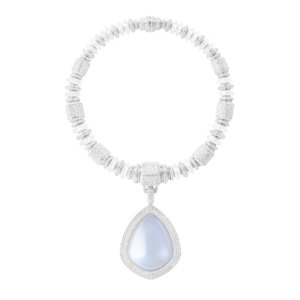
Goutte de Ciel – Contemplation Collection
What is a life lesson you have learnt from this difficult period?
I think the most important thing for me is to take half a day per week to brainstorm on what will change with COVID-19 and think about the future. This is something I have tried to do with my team throughout this time. One thing we have noticed is that the lockdown has pushed us to think about the reality of life and most importantly human feelings. Taking care of our family and friends have become key and we have become much more centred on caring for others. At the beginning of the lockdown, my priority was to take care of my employees. I think this time has put the human touch at the centre of our strategy and for me, this is super positive.
We have discussed a lot about how Boucheron is different from other brands in the market and one thing that we all agreed is that we are genuinely sincere and that we’re very human-centric. We said to ourselves maybe we don’t share this enough. So at the beginning of the lockdown, I got in touch with our closest clients to ensure that they were safe and find out how they were spending their time in lockdown, not for any commercial reason but because we really care and I think this is something that is special for the brand.
What is your vision and direction for Boucheron moving forward after this time?
In terms of business, I think the crisis has accelerated trends that already existed but they have now become top of the agenda. The first thing that has been accelerated is digital. At Boucheron, we have been super agile. We managed to invent a new way of launching the High Jewellery collection and we have changed things from the way we were doing them before and I love that, it’s super exciting. We know how to sell online now and I think in the future it will be about “phygital” – meaning that we will always mix the digital and physical experience. My theory is that the digital world won’t replace the physical experience. I think on the contrary, that it will increase the importance of physical.

Aerogel material
What can you tell us about the inspiration behind the High Jewellery “Contemplation” collection and the pillar pieces of the collection?
We actually decided on the theme of Contemplation three years ago. But now it is launching just after the lockdown it’s really telling a story about what we have all been going through. So it’s super lucky that we are talking about this collection now.
I love innovation and my brief to Creative Director Claire Choisne when I joined the company was that I want Boucheron to push the boundaries in High Jewellery. So I told her to be free in the way she creates and I will support that. When she showed me the first sketches I fell in love with Aerogel and the way it is capturing a piece of sky. It is very poetic. The second piece I loved is Nuage En Apesanteur – a cloud of diamonds around the neck. I was so excited to see the final piece and I truly believe that when it comes to that point, High Jewellery belongs to decorative arts. I think that Claire is mixing decorative arts with contemporary art and this kind of object is even more than a jewel, it is something that should be seen in a museum. I’m very proud of the collection and the team has been working incredibly hard on it.
What challenges do you face today in the High Jewellery industry?
The biggest challenge at the moment in our industry is to sell to the clients when they cannot travel. Even if we are selling digitally when customers are buying very high-end pieces they want to touch and feel the jewellery. One thing we have decided to do is that for the first year, the collection is going to travel. So if the client cannot come to us we need to go to them. The collection is going to Taiwan, China, Japan and so on. We are opening a very big flagship store in Beijing so we really wanted to collection to be there.
Nuage En Apesanteur
How are you keeping close to your clients when most of them cannot travel?
I think it’s even easier because we want to keep in touch with our best clients and to share our news with them. So with the clients that we know well, we are becoming even closer to them. We are calling them every so often to get their news and I have been really worried about clients in the US and the Middle East, because of the situation so we want to keep in touch with them. For the rest that we may not know as well, we can only keep in touch with them through our digital communication.
In your opinion what sets Boucheron apart from other brands and what makes an object of desire?
I think that to make an object of desire for a Maison like us, you must respect the past, but push the boundaries. Boucheron has always been a super innovative brand and I think we must continue to innovate today. If we want to respect the legacy of Frédéric Boucheron, we need to continue to innovate to achieve his dream. Innovate in terms of technique and aesthetic and also have a human approach. I think if we push on these three pillars then we know that we are creating a Boucheron product.
Which part of Boucheron’s legacy is a period that has a sentimental impact on you or has impressed you the most?
There are so many. This coming January we are launching a collection inspired by Art Deco. Boucheron has been manufacturing extraordinary Art Deco pieces for many years but I don’t think it is well known enough. So I want to bring this into the forefront again with this collection. Art Deco at Boucheron is very strong but we have always been more famous for our Art Nouveaux collections – particularly related to nature so it will be good to shed light on this.
Ailes du Vent
What is it that you haven’t achieved at Boucheron that you would still like to achieve?
China is the first priority of our plan. It is super important for the luxury world and if we succeed in China then I would expect that everything will be different. If we succeed in China we will have investment for everywhere else in the world and we will really fly.
What is it that you haven’t achieved at Boucheron that you would still like to achieve?
China is the first priority of our plan. It is super important for the luxury world and if we succeed in China then I would expect that everything will be different. If we succeed in China we will have investment for everywhere else in the world and we will really fly.
If you had to choose between elegance and extravagance when it comes to your own taste in jewellery which direction would be the one you would favour more?
I think on a personal level I’m not extravagant so I would probably go for elegance but I always have a twist of extravagance in the way I wear things. When I was very young I decided I would wear two watches. I don’t know why, but I always used to do it. So in a way, the way I used to wear the watches was extravagant but the watches weren’t extravagant in themselves.
How would you assess Boucheron and the Middle East?
I think the Middle East is probably the region that I am most proud of because I truly believe that we have the right image there. It is exactly the same as the image we have in France and this is not the case for all areas around the world. In other regions, we are still working on our image, but I think Middle Eastern people really understand who we are. A top-end high jewellery brand and an exquisite company. I would love really if the image that we have in the Middle East could be the same in all countries in the world. That’s why when entering China we must have a full offering so they can understand who we really are.
What would be a message you would like to send to your Middle Eastern fans and clients?
I would like to thank them for being themselves and understanding so well who we are and what we want to be.
Broche Caresse de Plume
If you had to highlight something that you think has been done wrong in the industry in the ways that brands are communicating what would it be?
Something that’s not right is that many high jewellery Maisons consider that they have to be distant and I don’t understand why. So when a customer goes to Place Vendome they feel frightened or stressed and I don’t understand why you would need to make your clients afraid to ensure you have the right level of image. This is not the right thing to do. That’s why I always want us to be so close to our clients – we are client-centric and woman-centric, we want our clients to be part of our lives, we are generous, we are close to people, we are open. We want anyone to come into our store for a cup of coffee. You don’t have to be distant or too exclusive to have an attraction.
If you could travel now where is the first place you would go?
Before COVID-19 I used to travel a lot and I miss many countries. Just this morning I was talking with Japanese people saying I miss Japan, I miss China, I miss the Middle East. There are so many countries that I love so I can’t chose one specifically.
If you had three wishes, what would you wish for?
Peace on Earth would be the priority. What I wish for myself is peace for the rest of my life and a lot of fun!
What is the motto that you are living by this year?
Since the lockdown started I have begun every meeting with my team saying “never spoil a good crisis”. You have to stay positive.
What is your favourite piece from the Contemplation High Jewellery collection?
Nuage En Apesanteur. It’s not just a High Jewellery piece it’s an object.
Nuage En Apesanteur made from cotton
Who would you like to see wearing this piece?
A princess or a Queen. I would love that.
Who is the Boucheron woman today?
Someone who likes to be free and a strong woman who knows what she wants. She doesn’t need others to be sure of herself or what she’s doing.
How would you describe Boucheron in one word?
Freedom.
Jean-Christophe Babin CEO of Bvlgari Discusses the New High Jewellery Collection and the Future of the Business
Bvlgari CEO Jean-Christophe Babin talks business in the post-COVID-19 era and the latest High Jewellery collection; “Barocko”.
At a time when many brands have remained quiet, Bvlgari has shifted its focus in recent months to supporting charitable causes, especially those linked to the research and eradication of COVID-19. Its recently announced Virus Free Fund is helping to support the development and research of a vaccine, while scholarship programmes funded by Bvlgari will allow young students to train as doctors.
But Bvlgari hasn’t forgotten its core DNA of incredible jewellery making and it returns with a beautiful high jewellery collection; “Barocko”. This special offering provides joy and colour at a time when the world needs it the most. To discover more on the roll-out of this collection in unusual times as well as a look at the business of Bvlgari moving forward, we talk to CEO Jean Christophe Babin.
WATCH THE VIDEO HERE…
We begin with the recent news of the new Bvlgari hotel in Rome, congratulations on that and can you tell us more about it?
We have been very lucky that the mayor of Rome agreed to be part of the movie to promote this project because obviously, it is an endorsement that makes a difference. She understands how good it is for the city that companies like Bvlgari heavily invest in helping Rome retrieve its former glory. Much like the project Bvlgari did on restoring the Spanish Steps, but also in terms of hospitality. So when the hotel opens we will hopefully attract the clientele that has previously skipped Rome as a destination. It’s a very exciting project in the best possible location we could have dreamt of. It’s a 360-degree journey across 2,000 years of architecture. This will be unique for our clients and it will be by far the most luxurious hotel in Rome.
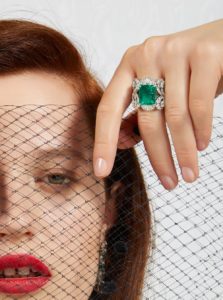
Barocko collection
After the global pandemic is over what is a message that you will take with you and will it affect the way you will do business moving forward?
I think we all thought that pandemics were memories of the early 20th century – the last one being the Spanish flu just after the World War I – and that we have the science so we were protected. Then this virus erupted and somehow two months later it shut down the whole planet. It has brought thousands of people into poverty and killed hundreds of thousands. I think it has been a lesson of humanity, learning that we are fragile and that we can still die from these kinds of things, even in the 20th century. It shows how important our eco-system is and how important it is not only as governments but as companies, to try to improve the system. This is something that Bvlgari has been doing, especially in relation to children. COVID has been an area where Bvlgari has tried to help a lot. We can only create a small drop in the ocean, but a lot of small drops will lead to a river.
We collaborated with The National Institute of Infectious Diseases, then we converted our perfume production facilities to create hand gels, and then eventually we decided to create the Bvlgari Virus Free Fund that is helping towards speeding up the vaccination development with Oxford University. We are trying to contribute to the eradication of the virus threat so we are now financing scholarships to put people through university. Brilliant students should not be prevented from getting a great education due to the lack of money, so these scholarships are meant to support bright students to complete their mission and vision. We are very happy about this, as it is a continuation of our partnership with Save the Children where we start with kids in kindergarten and this is the next step to that. Maybe one day one of our students will discover the vaccination.
Giving back to society is not something new for Bvlgari, with the Save the Children programme you have helped children all around the world.
Exactly. We have consistently tried to help. Even during COVID-19 when as a house we were making no money because our stores were shut down, the only money we were spending was towards fighting against COVID as well as paying our employees. We didn’t have any advertising or promotions.
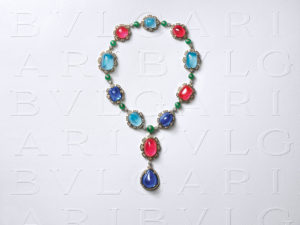
Barocko Collection
Today we are celebrating the launch of the High Jewellery collection Barocko. With a collection such as this launching, how is Bvlgari staying close to the clients when you can’t physically meet them during this time?
It’s more or less as I am doing with you right now; via video call. We can be 5,000km apart but it’s like we are in the same room. We are leveraging digital technology as much as we can. To launch the collection, we have been presenting the pieces with augmented reality. All of our key clients have received a kit including a beautiful art book and an iPad Pro which features a special app so clients can discover the history of Barocko and what it means as a lifestyle.
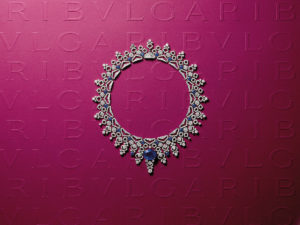
Barocko collection
Through the app, our clients can discover the collection and experience three-dimensional pieces that they can pick up, try on, and take a picture of with different angles as if they were really in the showroom. And eventually, if they are convinced we will fly the piece to them to try on and have a chance to discover and buy it before anyone else. So with that initiative, I think we are breaking the codes of jewellery. We have brought digital concepts into the equation and we have tried to show how beautiful these pieces are in real life. This is something we will broaden and extend also to precious jewellery. We will launch the collection physically in Rome in September. Then according to the situation, we will decide how to show the collection while respecting safety guidelines and ensuring our clients feel totally relaxed.
The feedback we have had so far has been really interesting. In South Korea and China we launched the collection without a big party, but with intimate dinners, private showroom views etc. and the feedback has been great. Yes, our clients enjoy partying but they also like privacy and intimacy and so they didn’t dislike this format at all. It’s a new way of showing high jewellery but it seems to be very much appreciated by our clients.
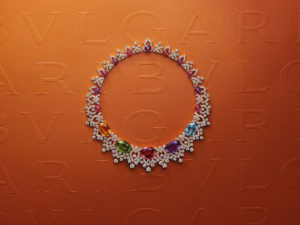
Barocko collection
How do you think COVID-19 has accelerated solutions and ways of working?
COVID-19 has been an accelerator of many things. The technology was always there, but we weren’t using to its full potential because we were victims of our limits. Then a catastrophe like this happens and you have to find solutions and in this case technology has been a 360-degree solution. Our high jewellery is a great example of the ways we have applied augmented reality to the discovery of our pieces for the first time.
The situation has also allowed us to work in many ways without disruption. I have probably met more people than I have ever met in my entire career and I’ve been able to get much closer to others thanks to the flexibility of video calling. Likewise, I have been in direct contact with clients, which in normal times was difficult as it can usually only be done when I am visiting their countries. This time has also sped up a new way of working, with more smart-work at home and less shuttling to the office, offering a better-balanced life and making staff more efficient.
There has also been a very positive impact on the planet. We have seen for ourselves that during lockdown that the planet was clean for the first time in 30 or 40 years. So I think through this tragedy we have changed a lot of things for good that previously were inefficient, costly or time-wasting, as well as leading to a more efficient and sustainable society.
Our clients not only want beautiful craftsmanship and credibility from great craftsmen, but they also want to buy into good companies who are not striving for profits only, but are capable of being close to their communities during hard times and supporting and helping as much as their area of competency will allow them. It has been a moment of union from some of the best and most generous companies in the world who have come together to help the government to control the disease quicker. When I look at Italy, Switzerland and the UK, which are the three main countries where we have been extremely proactive, we have started to take rapid control of the situation that was initially out of control.
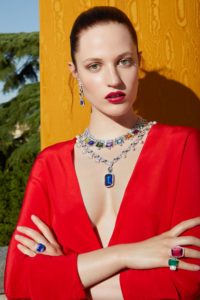
Barocko collection
In your opinion, what is the reason that the Bvlgari designs are so desired and why is it such a successful brand today?
The fact that Bvlgari is from Rome and has always been inspired by the city is a major asset for the brand. In terms of art, culture and architecture, Italy is the richest country in the world and this has created a city with huge diversity. Rome has a history dating back to 27 centuries and the underlying culture and values of the city are magnificent. Everything is larger than life. This is why Rome has not only the highest number of monuments of any city in the world but the largest as well. Everything in Rome, whenever the time of construction, is oversized. Roman life itself is oversized. And it’s authentic.
This has definitely influenced Bvlgari’s jewellery style of being larger than life. It’ bigger, bolder, more contrasted, unexpected, and I think the Barocko collection is a combination of this inspiration. It has the best balance of the aesthetic where you will find all the colours and curves that have made Barocko famous and then at the same time when you look at the construction of the piece you discover the precious metals and gemstones. Barocko for us is probably the most incredible collection we have ever made. It really comes from our heart – Barocko is Roma and Roma is Barocko.
This is one of the key parts of the success of Bvlgari because we had the chance to be born in this city and we have borrowed a lot of the style from Rome. We have something that is totally different and you can’t buy or copy this legitimacy. Our jewellery is joyful because of the colours. I admire diamonds, but it is never as emotional as the coloured high jewellery, which for me screams life. Especially in this post-COVID era – I think this collection will become even more of a success because it is a celebration of life. It offers the kind of harmony that people are looking for after a time of crisis. I think this will probably be the most extraordinary collection that Bvlgari has ever crafted.
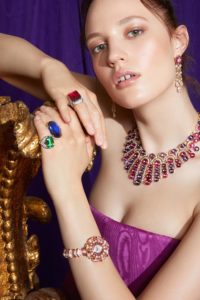
Barocko collection
We remember the Jannah collection that was made in collaboration with Her Highness Sheikha Fatima bint Hazza bin Zayed Al Nahyan and it was a huge success – will we be seeing any more collaborations such as this moving forward?
We will be continuing with the Jannah collection – not only on the very high end but we are also developing more accessible five-petal jewellery pieces which will be available in the Middle East boutiques. What you saw in February in Abu Dhabi was just the beginning of a collaboration that will last for a long time.
Will we also be developing another collection with another royal family somewhere? We should! I think as a company we like to adopt the best talents on the planet, so if we had a chance to meet with someone from the region for example who has ideas, it would be very exciting and I think it makes the brand richer, broader and closer to the local market.

Barocko collection
What is in the pipeline for Bvlgari for the rest of the year?
On the jewellery front, there will be a lot of news on Serpenti. We have something that was planned for 2021 that we have decided to present in 2020 because we are so convinced by the strength of this new collection that we don’t want to miss the opportunity of Christmas and New Year.
We will also have a sequence of Barocko events – starting in Rome then moving to China, The United States and the Middle East.
In fragrance we have a major launch for men, coming out next month, which will be complementing one of our best sellers.
Then for the leather goods, we will have the introduction of the spring/ summer 2021 collection as well as a new capsule as a part of the “Serpenti through the Eyes of” Collection.
Then finally, we will announce the 11th and 12th Bvlgari Hotels as the deals for these are almost signed. This will see Bvlgari setting foot in America, which is very exciting.

Barocko collection
What is a message you would like to send to Bvlgari’s fans in the Middle East?
Firstly, thank you for your incredible support throughout the COVID situation because as long as the stores were open, customers kept coming and buying our products and they allowed us to keep the market share. I’m very thankful that during the peak of the pandemic our clients in the Middle East gave us a lot of time to chat and exchange on a non-commercial base as friends, and that allowed us to strengthen the connection we have with them. And last but not least, as the stores reopen, we are very close to what we used to be in terms of sales. So I really thank all our Middle Eastern clients for their trust and support and it has allowed us to keep very high spirits. We are getting back to work now and I pay tribute to all of our team in the Middle East who are proud to be part of Bvlgari and that is thanks to our clients.
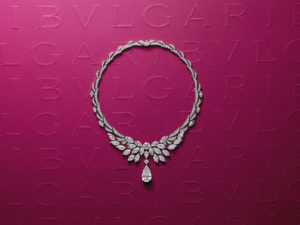
Barocko collection
If you were granted three wishes what would you wish for?
Firstly, I would wish to immediately eradicate COVID-19 forever. I think viruses have killed too many people and this must stop. The second thing would be to provide education to all kids around the world because I believe that education is the lifesaver of the planet. And the last wish would be to establish long-lasting peace across the planet. We need to live in harmony, we need respect, and we need to integrate diversity more than ever. We need to put an end to wars because ultimately we are all striving for the same values centred on friendship, family, authenticity, enjoying life.
Caroline Scheufele Co-President of Chopard on Life in Lockdown and the Red Carpet High Jewellery Novelties
Caroline Scheufele Artistic Director and Co-President of Chopard discusses the latest novelties from the high jewellery collections and why diamonds will always be her favourite stone.
Caroline Scheufele has been immersed in the world of luxury watches and jewellery her whole life. Her parents Karl and Karin Scheufele bought Swiss-based watchmaker Chopard in 1963 when Caroline was just a child. At the time Chopard was purely a watch business, but in the 1980s Caroline expanded the company into high jewellery.
Caroline has since worked as Artistic Director of the jewellery collections at Chopard. A role which has seen her form a close partnership with the Cannes Film Festival, at which every year the Chopard Red Carpet Collection is debuted. Of course this year all international events were cancelled and instead of heading to Cannes, Caroline found herself designing new novelties while in lockdown at her home in Switzerland.

A&E was offered an exclusive chance to discover what to expect from the upcoming high jewellery collections. Editor in Chief Lara Mansour talks to Caroline from her home in Switzerland when she was given a sneak peek at some of the latest novelties.
WATCH THE VIDEO HERE…
The last few months have undoubtedly been a very tough time for everyone – how have you been handling this period and how do you remain positive at a time like this?
I don’t think anybody saw it coming and it really has presented us with unprecedented moments that we have never experienced before. Even though we have seen many wars between countries, the rest of the world somehow continues, but this has been very different.
I live in Switzerland where we are surrounded by nature and I have discovered things that I have never done because I’ve never had the time to do them. I’ve spent a lot of time at home, I’ve seen my parents a lot and done lots of cooking for the whole family. Cooking is something that is somehow creative and I’ve tried out a lot of new recipes from my Grandma and other things that I have never cooked before. This is something I’ve really enjoyed and I really want to continue doing. Maybe soon I’ll have a cookbook with all the recipes from all over the world!
I’ve done a lot of work projects at home. As we speak we are still finishing the Red Carpet collection so even though Cannes did not happen we will still have the collection coming out later on in the year. That’s keeping me very busy. We are starting to go back to the office now. China has opened up and it’s actually doing quite well, most of the markets in the Middle East are opened again, so we are starting to see a little light at the end of the tunnel. But these months passed so fast and you find yourself doing things that are meaningful and doing many things that you wanted to do for a long time and didn’t have the time.
What is something you have learnt from this phase or something you feel more grateful for?
We are a very connected family but I think I have really appreciated spending more time with my family and this is something I will continue to do. I’ve learned a lot about people – in good and bad ways – a lot more about the human aspect. We still don’t know where this enemy came from, however the point is that nature has also taught us a lesson. We did not care about the planet before this and now the planet has survived by itself for the first time – we have clean waters in Venice, air pollution has dropped drastically – I think this is a lesson to be learnt – to be more respectful to our planet and to animals and nature. I think it’s going to have a big impact on the way people travel. Definitely it will have an impact on sustainability which is something I am already very involved in as you know.

Red Carpet Collection Polar Bear Ring
What can you tell us about the Red Carpet collection and the inspiration?
I have been working on it since last year and the theme is about honouring nature and everything to do with it. This year is the 10th anniversary of the animal collection and there is a capsule collection within the Red Carpet collection inspired by animals. And then there are of course flowers. When we started creating the collection we didn’t know what was going to happen, so in a way, it was the right theme at the right moment.

Red Carpet Collection Seal Ring
Chopard is one of the leaders in its field when it comes to sustainability – what can you tell us about the latest developments in the journey to a Sustainable Luxury at Chopard and what are the plans to continue to be a sustainable brand in the future?
It’s a topic that’s very dear to my heart and that’s because I’m living in a beautiful country which has been very sustainability orientated for a long time. They say it’s the cleanest country in the world, which is something that has proven very important at this moment as Switzerland was one of the countries to handle the pandemic in the best way.
I’ve always had the belief that luxury should be transparent. The ultimate luxury is knowing that the piece that you fall in love with, whether that’s a piece of jewellery, a watch or something else, that you know how it’s been produced and that the planet was not spoiled by its production. This is something that I’ve been working on for many years and I think now a lot of others are inspired and going down the same path. This is definitely something that will hopefully remain as a positive outcome of all the suffering that we’ve had this year across the world.
Chopard has always been synonymous with excellence in craftsmanship – what can you tell us about the Artisans of Emotions concept?
When you go to our workshops you see the artisans working with so much passion and emotion, working with their hands for timeless hours. Some pieces can take thousands of hours and they require a lot of skill and talent. So we have created stories about these artisans explaining what they do and how they feel. It’s a big family. Whenever I can I visit the atelier to see this work taking place, it’s always my first stop when I come back from a trip. I think even through the pieces you can feel it when you touch them and see them. It’s something really special.

Red Carpet Collection Gingko Ring
The relationship between Chopard and the Middle East goes back many years – tell us about this and how are you staying close to you clients in the region despite what’s going on in the world now?
The Middle East was one of our very first international markets. I remember when my dad was very young he started working with key figures in the region and I also think Chopard was one of the first luxury brands in the Middle East. The idea of Chopard being a family business relates to the region as there are so many family businesses there. I think that is why we are so connected. But it’s more than just business. It’s about relationships. I personally love to go to the Middle East. It was one of my last trips before the pandemic and I hope one of my first trips when travel resumes.
You grew up in the heart of Chopard – what are some of the fond memories you have from your childhood?
My family had the company before it was even Chopard and I remember the workshop was very close to where we lived and often after school I would go there. There were maybe 50 people working and there was this very long corridor and I would sit on a rolling chair and push it down the corridor! All the employees would know me! Another memory is how my mum was often sorting diamonds and I was allowed to watch, then one time she said I could help and I dropped the whole parcel of diamonds! I have lots of memories.
In 1963 my father bought the name of Chopard and the family slowly moved to Switzerland and there are many stories. My first design was when I was 16 – I used to love the circus and most of all clowns because they make everyone laugh but they are often very sad inside. So I drew a little clown and my father saw it and as a surprise he had it made for me and that was really the start of jewellery at Chopard. So that clown has a lot of importance.

Red Carpet Collection Orchids Earrings
What is something that you would still like to achieve with Chopard that you haven’t done yet?
I have achieved a lot but there are always new projects and new mountains that I want to climb. Something I really want to do is to push sustainability further in different directions. Whether it’s with coloured stones, with other metals, our fragrances – there is a lot to be done.
What is a stone that is close to your heart that you always like to have present in your collections?
Diamonds are a girl’s best friend!

Red Carpet Collection Owl Timepiece
Going back to the red carpet collection do you have any pieces you can show us?
There are a pair of earrings featuring orchids; one of my favourite flowers. They are totally made out of titanium so are super light and representing nature perfectly.
Then going back to the animal world, we have a little seal ring. It’s fully set with diamonds. Then we have a dolphin with a Paraiba and a beautiful watch with emeralds and diamonds in a flower shape.
Last but not least we have a beautiful bracelet with pink and white diamonds inspired by the blossoms of the Japanese cherry tree.
What is a challenge you are facing now that you can share with us?
A challenge of course is keeping the business going because a lot of our boutiques were shut. So slowly they are starting to open again. Another challenge is also the lack of human contact – because I think we all need it and I am seeing clients at their homes but we are not meant to be talking to each other only over screens. Yes a lot of work can be done in this way and I think more will be doing in this way going forward, but I think the general human touch and the warmth of being with people is a challenge and we need to re-establish that because it’s something that everyone is lacking.

Red Carpet Collection
How would you describe Chopard in one word?
There are many words attached to Chopard but I would say happiness.
What is a message you would send to the people in the Middle East?
First of all I would like to send you a very warm “hello” from Switzerland. I miss you all, I miss the Middle East, I’m missing human contact and I’m missing the warmth of your country, the good food! I hope that you’re all healthy, that’s the most important thing and I think that is a lesson learned because without health we have nothing. Then comes love and then comes the rest.
Julien Tornare CEO of Zenith Watches on Achieving Your Dreams
As Zenith gears up for exciting the launches over the coming months, CEO Julien Tornare shares his thoughts on the industry and what’s in the pipeline.
Zenith is a watch brand based around the philosophy of achieving your dreams. Something that many of us have been reflecting on over the recent months. The latest women’s watches highlight this notion of reaching for the stars with their unique design, created for the 21st-century woman. Julien Tornare CEO of Zenith Watches had the vision behind these new timepieces. For someone who enjoys visiting the markets and presenting Zenith novelties in person to the clients, the recent months have seen a huge change for him.
We recently connected with Tornare through a live Instagram conversation from the comfort of his home in Switzerland where we discussed the latest novelties as well as getting in insight into the work that he does in his role as CEO and how he has been working closely with his team during this time of crisis.
What made you attracted to join Zenith after such a long time in your previous company?
It was a mix of different things. When I started at my previous job at Vacheron Constantin I was just 28 and at that time you think you are going to work somewhere for a few years, but I was so lucky to have many roles at the company that shaped up my expertise. It was a fantastic experience but by the end, I felt that I wanted to try and explore something different.
I have always had a lot of admiration for Jean-Claude Biver, the former President of LVMH Watch Division. He called me and told me about the challenge he had with Zenith and what he wanted to do with the brand. The role of CEO was a global position so I was very excited about that, as it was a great evolution that would allow me to see and learn so much. The second point was to work alongside him because he is a living legend and one of the most important names in the watchmaking industry in the last 3 decades. Thirdly was the fact that I knew there was so much leverage with Zenith. It’s such a beautiful brand that could be so much bigger than it currently is and I knew that there was a lot of potential. So I felt that this was the right time to do something different and this was the right role.
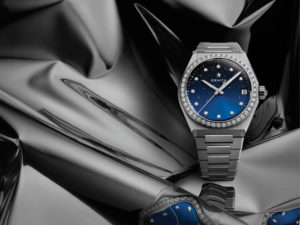
DEFY Midnight
What would you like to see done at Zenith that hasn’t been done before?
I’m pushing my team to be very creative. Creativity and innovation are things that were in the genes of the company from the beginning, but I think for a while it got lost. I ask all of my team to bring new ideas to the table, as we have to be pushing people and challenging them. Even if they make mistakes, that’s is totally OK – I’m asking people to try different things. We were the very first brand to do so many things. I like to push people to do things that are different. Last year I gave my executive committee the objective of bringing me five innovations. This could be a product or a process, but it was a way to try and change the mindset in the company. Sometimes the Swiss watch industry can be very conservative, but for me it’s super important to make sure that tradition doesn’t go against innovation. This was one thing I discovered when I met some of the creators of the El Primero movement from the sixties. They told me not to only repeat the past as at the time when this movement was created they were innovators and that is the DNA of Zenith.
What can you tell us about the latest novelties for women and where are women in the Zenith world today?
When I came on board at Zenith I had a lot of questions but one of the things I heard from all the markets was: ‘why don’t you have a strong women’s collection?’ We had a few watches here and there which women could wear but I knew what they meant. They wanted a watch that was created specifically for women. I often told them that if you make a beautiful watch it could be worn by men or women so there was no reason to create a women’s watch. But then I worked on the DEFY product line which became so important for the brand over the last few years and I decided that we needed a contemporary watch for women of the 21st century. So that’s what we did with the DEFY Midnight. On the dial, we have the starry sky of Zenith. Our logo is a star and the word Zenith means the highest point in the sky – so we have always been connected to this notion. This brings me to the Zenith philosophy of “time to reach your star”. We all have stars that we want to reach in our lives – personal or professional and this is why we have this romantic image with the starry sky on the dial. But I also wanted it to be a watch that is convenient for the 21st-century woman. I wanted to create a watch that could be worn for all the different aspects of a woman’s life, so we worked on an interchangeable bracelet. This in itself is not a new concept, but we decided to sell the watch to the client with the bracelet as well as two options for interchangeable straps. This way we are pushing them to play with the watch and change the look with this easy system. We have had in the past a lot of requests from people asking for different straps and I believe the strap, as well as the dial, can really change the look of your watch more than anything else. So we are looking more into flexibility and interchange-ability within all our watches, but we wanted to do it first for women.
Another thing I want to add on this watch was that we had a lot of questions as to whether we should use a quartz movement and I told everyone; ‘no, why would we?’ First of all, women appreciate mechanical watch movements such as the ones we have at Zenith and women also appreciate having the same level of sophistication of a movement as the men’s watches. There should not be a difference between men and women. I hate the notion of having Quartz watches for women and mechanical for men. So all of the women’s watches have the same movement that we use in our men’s classic watches.
We are going to launch a marketing concept around the watch called “Dream Hers”. We will have women who are leaders in their field and who are achievers and we will be inviting them to share with us how they went about reaching their stars. This is something that means a lot to us at Zenith.
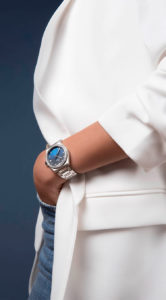
DEFY Midnight
How is Zenith staying close to its clients during these times as well as staying close internally within the company?
When we had to shut down the manufacture on March 17th the first thing I said to my Executive Committee was that we should stay in touch. So we made sure that we talked every day. We had a call at 9am every morning, even if there wasn’t much to discuss we keep in touch and keep the close bond that we have. I asked them to do the same with their teams and of course, we did the same with the markets.
Secondly, we asked ourselves how we could digitalise the company and move faster in the transformation. In terms of marketing, my team has done a very good job at organising online events, gatherings, training, live broadcasts etc. I enjoy giving information to others about the brand so we have done several launches and training sessions around the whole world and it has allowed me to get very close to everyone involved. So this is something I have learnt from the current situation. I’ve received a lot of emails and messages. I have even received drawings of watches that people think we should create. It’s been a tough time and I know there are more tough times ahead, but it has also been a very big learning experience.
Will you be changing any of the strategy of the brand moving forward after COVID-19?
Of course there will be changes. First of all, we have to take a lot of safety measures at the headquarters. It’s very different there now which creates a bit of a strange atmosphere that we need to get used to. We are learning how to work differently. I guess that travel will remain a difficult thing to do for a while and I think we will do more things digitally through screens. These will be the main changes, but I truly believe that we are a people-to-people business. We are in the businesses of selling emotions and stories and sometimes that face- to-face interaction is crucial. At Zenith we have true stories and this is what people buy into when they buy one of our watches so we will at some point, need to get back to the markets and meet the people.
How will you bring Zenith to the next level with its online business?
We have just launched e-commerce in Europe and the rest of the world will follow step-by-step over the next few months. I think when it comes to e-commerce you have to make the experience entertaining. We will start with a regular website but going forward I’m hoping to create a boutique experience online with real interaction. I think that this will be the e-boutique of the future. Also, you have to propose watches that clients cannot find anywhere else. You have to make it very special; otherwise, there are so many other options. So it’s all about creating a great experience.
We recently launched a Manufacture Edition watch. This was initially a watch that would be available only at the manufacture in Switzerland. So customers can only buy the watch if they visit us in Switzerland. At the moment however, I am making a little exception as the manufacture has been closed and we can’t welcome visitors. So we have made this watch available only on the e-commerce platform. But I’m insisting that anyone who buys this watch online has to come and have a tour of the manufacture!
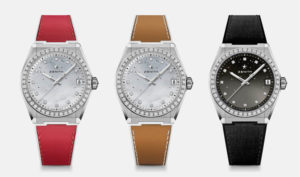
DEFY Midnight
Do you have any Astronomical watches in the pipeline?
Yes we do. Probably at the beginning of next year, we will have a high complication that will be referring to something in the sky. It will be quite amazing and it will come with a very special experience that I don’t think anyone has ever done. It will be a limited edition of 50 pieces.
What in your opinion sets Zenith apart from other brands?
Zenith has a long history. It was founded in 1865. So we have accumulated a lot of knowledge and knowhow. This is very reassuring when you buy an expensive object like a watch. But on the contrary, Zenith is not living in the past. Some watch brands have a long history and they tend to repeat the past because it’s safer to do what’s already been done, but this doesn’t build the future. Zenith is not like that. Of course, we do revival pieces and we pay tribute to some iconic watches, but we continue to create new things and bring innovation to the brand. In fifty years, if we still want to be a strong brand, we need to create now. So our mission is to continue to build the brand for the future. But with all of that said, when you buy a Zenith watch, you buy into a very authentic brand, and to me this is super important. If you want to keep the younger generation interested you have to be authentic through telling real stories and having your own movement in every watch you sell and they need to be sold at the right price. The younger generation wants to understand what they are buying, what is behind the brand and what they are getting for their money. So if you want something very authentic, Zenith is the brand to go for. It’s a fantastic brand with a lot of amazing assets.
Chronomaster Revival “Shadow”, a timepiece inspired by an obscure prototype from 1970. © “The Hodinkee Shop”
What’s in the pipeline for Zenith in the coming months?
A lot of things! We are launching a few different pieces right now. One of these is the Chronomaster Revival “Shadow, which is a very cool interpretation of the A384. We have some animation on DEFY 21 to come. We have a limited edition Land Rover Defender watch coming as well as a new launch with our ambassador Carl Cox. And of course, we have the commercial launch of the ladies DEFY Midnight watch, which will happen in September. So we have quite a few new things arriving step-by-step. Then early next year we will have a very big launch. The closing of the manufacture forced us to postpone some of the launches that were supposed to take place this year but we will have a lot of things going on over the next few months. 2020 was supposed to be the year when Zenith was moving into the next league but I think now 2021 would be an incredible year for us.
As a CEO how do you clear you mind and make decisions and what do you do when in doubt?
It’s a position where sometimes you can feel lonely because ultimately you have to make the decisions by yourself. Yes, you can talk to your colleagues but at some point, you need to make the decision alone. So what I usually try to do is, unless a decision has to be made immediately, I like to sleep on it. A good night’s sleep is sometimes the best way to have clear visibility on what you should or shouldn’t do. Sometimes going for a run or doing an activity for an hour clears your mind. If those tricks don’t work, I have a couple of people who are mentors for me and I like to talk to them. I think professionally and personally, it’s important to talk to people and get a different perspective on things. Sometimes, of course, you have to make a quick decision and in this case, I will listen to my instinct.
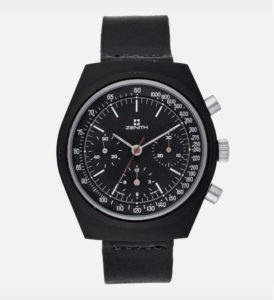
Chronomaster Revival “Shadow”, a timepiece inspired by an obscure prototype from 1970. © “The Hodinkee Shop”
Where will be your first destination when you can travel again?
We are opening a new boutique in Ginza in japan that I really want to visit. I want to go back to China soon as I didn’t visit Asia much in the fall. I have to go to Milan very soon. But at the moment I will take it step by step.
What is an objective you can share for the future of Zenith?
Zenith is a beautiful brand and I think what’s important is doing what we do best and doing it in the right way. Zenith is very strong amongst watch specialists. Our number one market today is Japan, which is quite unique for a watch brand, but Japanese people love complicated watches. My challenge is to not only sell watches to watch specialists and Japan; I need to sell watches to other people as well. So I need to encourage more people to understand what a creative, beautiful and authentic brand this is. I want people to know that when they buy a Zenith watch they buy something true. My job is to ensure that more people know about Zenith and more people discover what is really inside the brand and that’s really where I want to take it. That’s why I’ve been travelling so much and why I’ve been talking to so many people. We are going to have more boutiques and a bigger push on e-commerce. We are going to focus on the best retailers because we want to grow that business. The mind-set at Zenith is very young and I want to reposition that brand in a way that combines a fantastic mix of history and tradition with cool contemporary innovation.
READ MORE:
Chabi Nouri Piaget CEO Discusses the Latest Novelties and The Middle East
Breitling CEO Georges Kern Discusses the Evolution of the Brand
Laurent Perves, Chief Marketing Officer at Vacheron Constantin Presents the Latest Novelties and the Upcoming Year for the Watchmaker
Vacheron Constantin is a Maison built on passion and innovation. These two key values are what’s kept this historical watchmaker at the top of its game for over 260 years.
Despite its age, Vacheron Constantin is timeless. Thanks to its highly-skilled watchmakers and forward-thinking teams, the brand continues to reinvent, innovate and lead in the world of high watchmaking. This year, of course, has been very different when it comes to presenting novelties. But while the format had changed, Vacheron Constantin remained true to itself and presented all of its planned launches through the Watches & Wonders digital platform. With its continued innovation and creativity, the brand has set the bar for 2020.
Passion is something that you can feel deeply within all of those who are part of the Vacheron Constantin family. From the artisans to all the way does to the end client there is a sense of excitement and joy at what comes next. Someone who is particularly passionate for the Maison is Chief Marketing Officer, Laurent Perves. Perves joined Vacheron Constantin in 2016 and was tasked with growing the modern-day message of the brand while embracing its history, something he has been working on over the last four years. As the latest novelties are unveiled we talk to Perves on the newest timepieces and how he continues to convey the message of innovation and passion at this iconic watchmaker.
What is the impact of COVID-19 on the industry in general and as a brand are you changing anything in your strategy moving forward?
Of course, it is impacting everyone, it’s a very sad situation. At Vacheron Constantin, we had to adapt to prioritise the safety of our staff, our partners and our clients. But at the same time, our mission is to keep going. We like to say Vacheron Constantin is like an old tree. Sometimes it will get shaken by the wind or a storm but it will never fall and so very early on, we decided to do our maximum to continue doing what we do best and that is to make watches. The end goal for us is, of course, to maintain the safety and health of our staff, clients and partners, but also ensure that we move forward and I think that the reaction of Watches and Wonders was good because people were excited to see some novelties and to escape and dream.
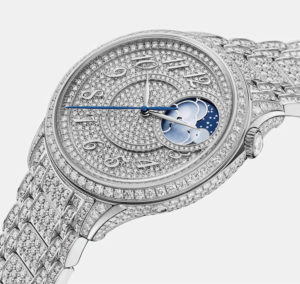
Égérie moon phase jewellery
Let’s talk first about the ladies collection Égérie that was launched earlier this year – what can you tell us?
Indeed, we launched Égérie, our new feminine collection, just before Watches & Wonders. We realised that one in three of the watches we sell from all of our collections is to a woman but many of our clients were asking for something that was dedicated just to women – something that is easy to wear every day and can be worn with different outfits for different occasions. They wanted something that was, of course, original, very Vacheron Constantin, with high watchmaking, an automatic movement that is easy to maintain and versatility with the straps. So Égérie was the response to this. Most of the watches in our boutiques that allow the strap to be changed are bought by women, so it was very important for us to have this aspect. So after all of this research, we looked back at the archive and worked with the design team to create this watch which filled a gap in our portfolio. It’s had a great reaction so far and it’s very encouraging. Moving forward to Watches and Wonders we are very happy to introduce a new version of Égérie with the high jewellery model. This is something that our clients, particularly in the Middle East, really like.
What can you tell us about the tribute to music with the Les Cabinotiers collection?
Every year we have a theme in which we present our Les Cabinotiers novelties. This year La Musique du Temps which means music of time is a tribute to music and sound in general, in the form of a chiming watch. We first presented these timepieces to our clients earlier this year at a VIP event in Singapore. More recently, we added two models to this collection which were revealed at Watches & Wonders. The first one is called Les Cabinotiers Grand Complication Split-seconds chronograph – Tempo. It is a split-seconds chronograph with 24 horological complications – it’s actually the most complicated wristwatch we’ve made in the history of Vacheron Constantin. The construction is perfectly symmetrical so it is completely reversible. It combines the best of terrestrial time complication with the perpetual calendar, split-second chronograph dual time complication, as well as a tourbillion. On the reverse you have the solar time reference complication with the time of sunset, sunrise and the lengths of the day and night respectively positioned at 3 and 9 o’clock, which all allows you to look at time from a different angle.
Les Cabinotiers Astronomical striking grand complication – Ode to Music is the second novelty. Considered as the sister of the Les Cabinotiers Celestia unique model we launched three years ago, this timepiece is based on a double-sided minute repeater model displaying solar, sidereal and civil time, complete with a perpetual calendar.
We finally presented Les Cabinotiers the singing birds, four unique timepieces with the original time display thanks to a dragging-hour system paired with remarkable enamelling technics. We engrave the watch first and then we fill it with enamel which gives very thin, precise lines of gold in between the joints. All of these pieces are unique and they represent the craftsmanship and excellence of Vacheron Constantin.
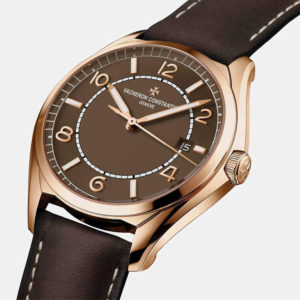
Fiftysix Self-Winding
What can you tell us about this Fiftysix?
The Fiftysix has had a great reaction since its launch in 2018 and it has for sure, become a key pillar of the Maison. In the Middle East, in particular, we have seen a very good reaction to this line. Last year we started to animate the dial of Fiftysix on the steel version with petroleum blue which was a very unique colour used only for that collection. We had a lot of demand for gold, so for this year we tried to find the best tone for the dial to match the gold colour of the case and give a vintage feel to this watch. That is how we found this very special Sepia brown dial colour that we associated with a brown calfskin leather strap. It has been greatly praised so far.
What can you tell us about Overseas this year?
Overseas is doing very well. What is important for Vacheron Constantin is to have an elegant sport watch that embodies very high watchmaking. This year we wanted to go back to open-working; something that is deep in the DNA of Vacheron Constantin. So we created the Overseas Perpetual Calendar Ultra-Thin Skeleton. With the openwork, we are adding even more complication to the watch by removing the maximum possible from each component of the movement. This is the pure expression of high watchmaking, but at the same time, it offers the comfort of an elegant sport watch. It really shows the savoir-faire of Vacheron Constantin.
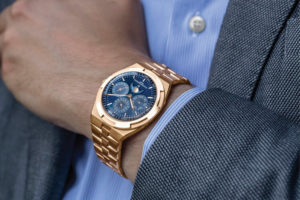
Overseas
How does Vacheron Constantin find a balance between the heritage of the brand but ensure it is appealing to the client of today?
Firstly, this is how the Maison has always been working. A very important aspect is maintaining the savoir-faire and craftsmanship. Vacheron Constantin has been transmitting its savoir-faire and keeping the best watchmakers and Metier-d’art artisans generation after generations. We have our own artisans and we can do everything in-house. We are also working with students on apprenticeship programmes to make sure that these skills are not lost. Innovation and engineering are important as well as the spirit of imagination and the freedom of creativity, which have been part of the Maison’s identity since the very beginning. This creativity is driving Vacheron Constantin and the history of the brand is always an inspiration.
Can you tell us a little about sustainability at Vacheron Constantin?
Sustainability is part of our social responsibility. We believe that we must do everything in a way that is most respectful of the environment and of individuals. We have a variety of programmes, but we don’t use them as a communication tool, but something that we act by. We’re working in the field of education to maintain employment and keep the skills of watchmaking within the house. We are also working on reducing our footprint and looking after the environment.
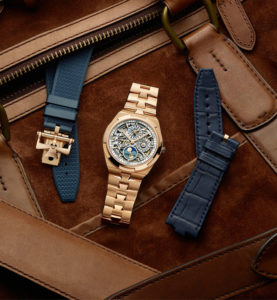
What in your opinion are the prerequisites of creating an object of desire?
This is a question that all luxury companies ask themselves. I don’t think there is one recipe, there are many components. Nowadays, people want to dream and as a brand, we need to touch their emotions. This is the starting point for us. The second thing is the legacy you leave and the history and knowledge you bring to the client. We have seen especially on our digital channels that educational concepts are more in demand, whereas previously we have always concentrated more on visual concepts. And finally, I think people are more than ever looking for real value. People are asking what a product will bring to them and they want to make sure they get value (not necessarily tangible value, but a value of some form) for the price they pay.
What is in the pipeline for Vacheron Constantin for the second half of 2020?
Many things. We have launched a number of novelties at Watches & Wonders, which will take us through to October. We also have a lot of projects coming up with artists. We will soon have some exciting new faces joining our talent pool including Yiqing Yin, the French Haute Couture designer. This will lead us into 2021 where I cannot tell you what’s going to happen just yet! But we have a couple of very important anniversaries that we are looking forward to celebrating.
What is it that you haven’t done yet that at Vacheron Constantin that you would still like to do?
So much! What we want to do right now is to push the relationship with our clients further. It’s very important, especially at a moment like this. We have started to develop a whole hospitality structure with our clients. We welcome a lot of visitors to the manufacturer. The second thing is maintaining our innovation at the top of its game. There is nothing more rewarding for us than seeing the reactions of people when we present our innovative creations.
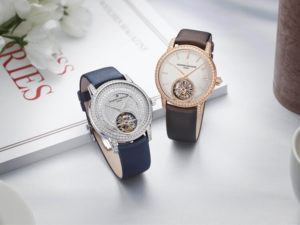
What is a message you would like to send to your clients in the Middle East?
The first thing is saying Thank you! The Middle East is an amazing region for Vacheron Constantin. During Watches & Wonders it was the region we had the most digital contact with. The level of passion in the Middle East is outstanding, so thank you for that. You can count on us to keep bringing beautiful timepieces and always continuing to meet your expectations.
READ MORE:
Chabi Nouri Piaget CEO Discusses the Latest Novelties and The Middle East
Breitling CEO Georges Kern Discusses the Evolution of the Brand
Wilhelm Schmid CEO of A. Lange & Söhne Talks Digitalisation and a Time of Transition
In an innovation-driven world, German watch brand A. Lange & Söhne has always remained true to its values and tradition.
Understated in terms of watchmaking, the 175-year-old brand made waves with its first steps into the realm of an elegant sports watch last year in the form of the “Odysseus”. This year as part of the Watches & Wonders presentation it returns with the second watch in the Odysseus family. Now available in white gold with an integrated rubber or leather strap, the sporty-elegant timepiece has allowed A. Lange & Söhne to build on its values with something that responds to the contemporary market.
Meanwhile a second timepiece, the Zeitwerk Minute Repeater is the world’s only watch that combines a mechanical jumping numerals display with a decimal minute repeater. The complicated timepiece has so far only been available in platinum, but it returns this year in a white gold version, with a deep-blue dial that’s limited to 30 pieces. These two pillars of the brand continue to move the watchmaker forward while remaining true to its values.
Wilhelm Schmid joined A. Lange & Söhne as CEO in 2011 and has since been guiding the brand into a niche that combines tradition and heritage with innovation and technology. Here a&e talks to Schmid on the new timepieces, as well as the outlook for the brand post-COVID-19 and how the digital world is taking over in the current climate.
In your opinion, what do you think the impact of COVID-19 will be on the watch industry and how are you shaping up the strategy of A. Lange & Söhne moving forward?
Firstly, when this is over I think we will find that we are all a little bit more digitally savvy than before. People are getting used to talking to each other through a screen and they are realising that even a digital launch presentation of a watch is better than having no launch at all. But I also believe that the appetite for personal interaction will see a peak after we’re allowed to stop social distancing. Overall at the moment, it’s a very weird situation, a lot of things that we are used to are not happening. When it comes to the industry, I think that people will still want to enjoy the good things life has to offer, and I think that after the crisis they will still want watches, and we’ll be there to offer people beautiful timepieces. So in that way, our strategy hasn’t changed at all.
What can you tell us about the timepieces that are launching for this part of the year?
We purposely wanted to launch only two watches this time. That was a very clear decision and we promise that there will be more watches as we go through the year, as we hopefully go back to a more normal situation. But for now, we decided to launch a watch that is at the very high end of the market in the form of the Zeitwerk Minute Repeater in white gold with a deep-blue dial. And at the other end of the spectrum, we have the latest Odysseus model which was introduced as part of the Odysseus family of watches which initially launched last October. This version comes in white gold with a rubber or leather strap. It took us some time to come up with the concept of this watch and there was a huge controversial discussion in the beginning, which is quite normal because we were planning to do something so different from the current offer. There will always be people who will love it and there will be others that don’t like the concept. But now everything has calmed down a lot. Quite a few people have changed their opinion, so we have seen a huge demand for the watches in that specific family. And this will be our biggest challenge – how do we fulfil the demand? But again, that’s what we’re here for.
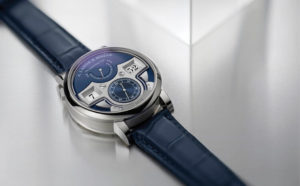
ZEITWERK MINUTE REPEATER
The Lange 1 is the icon that turned 25 last year – what makes this watch so unique and timeless so that it stands out among other watches in the industry?
I would never say that any of our watches are above the others, but what I know for sure is that this is a watch that stays in the mind. When Lange 1 was first launched in 1994 I was a watch collector myself and I remember it. Nobody was expecting that a watch like that to come from Germany. At the time, it was a very large watch from a dimension point of view and that was unusual. The centralised dials coordinated in a way that the symmetry catches your eye and it was unheard of this kind of thing in a wristwatch and had never existed before. So that made the Lange 1 unique and I’m pretty sure that if we had had social media in 1994 we would have also seen a controversial discussion around this watch because this is what happens with strong designs, at least in the beginning. Today the Lange 1 is a whole family of watches. The challenge with very strong designs is that if you want to create a family, you have to think about the implications on that design on later alternations and versions at a very early stage. That goes for all of our timepieces. If you want to maintain the time, look and feel of the product there are a lot of things that you have to work around and it’s not always easy. If you put all of the watches in the Lange 1 family next to each other you will still see that they are all part of the same family, even though individually they are all quite different in their functionality.
Post COVD-19, of course, a lot of things will change – what can you tell us about online and the digitalisation at A. Lange & Söhne?
For sure, the current situation will fuel the digital world. There’s no question on that. It is very early though to determine whether our clients will start to buy online or whether they will continue to get all the information from digital platforms but then still prefer to go to the store to buy their products. I think it’s a little too early for me to see the impact of the current situation on this sort of behaviour but for sure there will be a change. How quickly that change will happen I don’t think I can answer that yet.
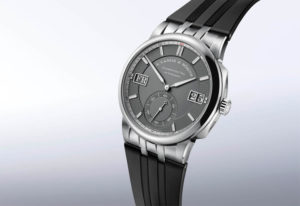
ODYSSEUS
With a Maison with such a rich heritage – how do you keep such a fine balance between the history and the innovation and technology aspect?
We are a traditional company because our values are very traditional. We are an understated brand and quality is always our first priority. Secondly, if we have the chance to build a watch that’s delicate vs a watch that’s robust, we would always opt for the robust option – these values have formed our tradition. But we don’t want to replicate what we did in the last 20 years and continue to do that for the next 20 years and that’s where innovation comes in. I think if you define tradition as a set of values, then whatever you do, you measure against those values. Tradition is an important foundation or anchor but it will not stop you moving forward because it’s something that you can carry with you.
What can you tell us about sustainability at A. Lange & Söhne?
For us, sustainability has always been at the forefront and is utmost important. It starts with having apprenticeship programmes for future watchmakers because we have to build the foundations to have great watchmakers in years to come. So just based on the aspect of what we do, we have to have a sustainable business model. When we launched our new manufacturer we really considered sustainability. We have our own thermal energy source and we only use green energy to operate the water pumps. Even with our packaging etc. if there is a sustainable solution we will always choose it, even if it might be a little more expensive. I believe that you should not produce luxury products today if you don’t have a sustainable model for all stakeholders.
Even before the COVID-19 spread, we have been seeing fewer exhibitions and platforms for watchmaking – how are you staying close to your clients and retailers now and what is the cycle going forward?
At the moment the only way to stay in touch is through the digital world. There is no alternative. We have had to cancel many events and the only way we can talk to our clients is through virtual platforms. We are doing it in a typical “Lange way” in which we are trying to stay authentic. It is a challenge but we have to adapt to the environment. The appetite for personal interaction is rising day by day so I don’t think that the digital world will totally substitute meeting in person. To give you an example; twice a year I put myself on a diet for two weeks and you have no idea how tasty my first treats are after two weeks! I think that is exactly what we are going to experience with watch buying when all of this is over. The first real interactions will be enjoyed a lot more because people won’t be taking it for granted anymore.
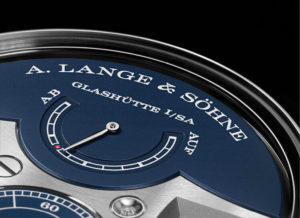
You joined the brand in 2011, what do you think you have achieved over the last decade and what would you still love to do?
Our logo means, “never stand still”. I think if there are no dreams left for me, there’s no vision in what we want to do with the company. And if I don’t have a vision I’d be a very bad CEO! There are still many things that we are working on, the challenge for me is that if I share too much it will take away the element of surprise that people like from us as a brand.
Many people are in a time of uncertainty – as a leader what advice would you give to business owners?
The first piece of advice that I give to everyone is to stay healthy. All of your efforts will not end positively if you aren’t healthy. I think we have to be optimistic but we have to be careful. We have to determine what is important and urgent and quite often we see something that is one and not the other. These are things that have always been necessary but at the moment these things are mandatory or businesses will go under. So stay healthy, make sure you define the things that are really important and urgent, be careful with your resources and always find balance. Now is the time to stay true to yourself and the values you stick to.
What is the first thing you’re going to do after the lockdown ends?
I will invite all of my friends for a proper dinner and celebrate that we can interact again.
What else is in the pipeline for Lange this year?
I can give you a little hint that will probably start some rumours! Fine watchmaking was founded in Glashütte in 1845, which is exactly 175 years ago. I think it’s important to celebrate that moment, and rest assured that there are some exciting things in the pipeline for us on how we will celebrate this 175th anniversary.
READ MORE:
François-Henry Bennahmias CEO of Audemars Piguet On The Exciting Times Ahead
The Buccellati Family on Italian Values and the Heritage of the Jewellery Brand
François-Henry Bennahmias CEO of Audemars Piguet On The Exciting Times Ahead
Over the past few years, Audemars Piguet has gone from success to success. A hugely popular brand in the Middle East it has carefully developed a niche that allows it to be modern and exciting while not forgetting its true values and family history.
CEO François-Henry Bennahmias has been part of the “family” for many years. He started his career at Audemars Piguet in 1994 in his home country of France. In less than three years he was promoted to lead the brand’s operations in Singapore and took on the added responsibility for Audemars Piguet in France, Germany, Italy, Spain, Switzerland, Brunei, Australia and Malaysia. Not long after this, he assumed the role of President and CEO of Audemars Piguet (North America), which was a key market for the company. In 2013 he became CEO of the brand and has been leading it ever since.
Bennahmias has seen the brand go from strength to strength. His close ties to the world of golfing (he was once a pro golfer himself) have seen Audemars Piguet closely linked to the sport, making it a globally recognised brand. In the Middle East, it has had particular success thanks to its appeal to a young, forward-thinking market.
Earlier this year Audemars Piguet launched the [Re]master01, a watch that takes inspiration from a watch of the past but reworks it in a contemporary and modern way – the first time the brand has undertaken such a task. At the same time, Audemars Piguet unveils the long-awaited opening of its Musée Atelier. A museum that will present the past, present, and the future of the Swiss manufacturer’s cultural universe. While the museum opening has been delayed due to COVID-19, the decision was made to go ahead with the launch of the [Re]master01 and the response so far has been extremely promising. To tell us more about the latest launch and the future of Audemars Piguet, a&e talks to CEO François-Henry Bennahmias.
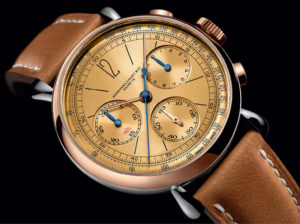
[RE]MASTER01
What is the forecast moving forward at Audemars Piguet and are you changing any of the strategies of the brand?
The first thing is that yes, we are going to take a hit this year like everyone else. We don’t know how big the hit will be and we don’t know what’s going to happen, but there is no miracle. People are talking about the possibility of facing a second wave of the virus, so we have to be very careful and I don’t think our clients will be rushing to stores now. We have to play it one day, week, a month at a time and see where we are at. 2020 is already behind what we expected, but no matter what happens, we will not let any of the staff in the company go. We are protecting the integrity and the employment of our people. The second thing is, even if we sales drop, it’s OK. We are an independent company, so if the numbers go down it doesn’t matter too much and the things we have worked on over the last few years and the success that we’ve had means that we can weather the storm a lot better than some others. Right now, my focus is more on 2021 and 2022 because that’s how we are going to rebuild. I think it’s going to take a few years to go back to the numbers of 2019 and we are going to see changes in the way we address the clients moving forward.
What can you tell us about the brand the novelties for this year?
Right before the lockdown, we had a long list of launches for 2020. The most important one will now be launching in June. We were supposed to launch [Re]master01 Selfwinding Chronograph in line with the opening of the Audemars Piguet museum on April 23rd but this was postponed, so we decided to launch the watch anyway.
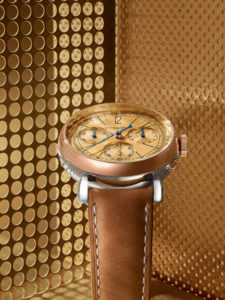
[RE]MASTER01
What can you tell us about this watch?
The idea of the [Re]master01 actually came 20 years ago. So it took us a long time to launch the concept, which gives life back to our exceptional watches from the past. It was when I was in New York looking back at the watches of the 20s, 30s and 40s that were at the time, super small watches. I discussed with my colleagues about how cool it would be to bring some of these watches back in normal sizes and give clients a chance to experience the timepieces their grandfathers or great grandfathers may have worn but with a contemporary update. That was always our goal – it took us 20 years, we moved very slowly! And when we finally did it, we realised that the best way to launch it was in line with the museum. With the museum design, we were bringing something with forward-thinking into the 21st century, it didn’t mean that we were completely replacing the past; it was in fact, the opposite. We used the past to make it relevant for today’s world and that was the same values as the [Re]master01.
How do you manage the balance of respecting DNA and heritage while being relevant for the consumer today?
We have seen many brands creating “Heritage collections” and I don’t think you can base an entire collection on the past. So you have to have a touch of the past and do something else that is modern. This is why we make only 500 watches. We wouldn’t want to make a heritage collection and every six months you see something different. That’s not how we do things. The first time we ever saw a watch made in multiple pieces at Audemars Piguet was in 1951. Before that, every single watch made was unique. So that is our DNA and we like to continue that to a certain point with the way we create watches.
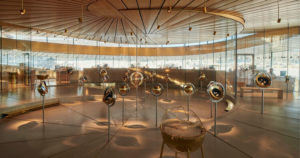
Musee Atelier
What can you tell us about the opening of the museum?
We are now planning to open in June and then we are looking at a special event in November, but we have to see what happens.
What can you tell us about Audemars Piguet in the Middle East and why do you think it is so adored and respected in our region?
First of all our clientele in the Middle East are young. We have seen an arrival of youth in this region, which is unheard of. People as young as 15 or 16 love the brand! I do believe that the values that the brand has are very similar to the values of the people in the Middle East – looking at tomorrow, very forward-thinking and at the same time respecting true traditional craftsmanship. Two years ago I gave a speech at the American University in Dubai and I was stunned to see so many young people enjoying the fact that I was talking about a watch – and not a smartwatch. They enjoyed the idea of craftsmanship, history, exclusivity and I when I left they were asking so many questions. It was a real joy to share with them the passion that we have for watches.
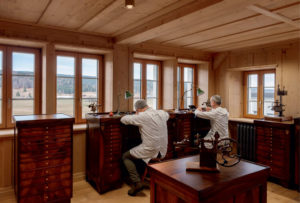
Musee Atelier
What is a challenge that Audemars Piguet is facing today as a brand?
The number one challenge is based around the fact that over the last 10 years the whole luxury world took a huge bet on tourism and people travelling and buying watches. So we expanded our retail network, like many others and what we are finding out today is that we might have forgotten a little bit, the notion of local people. There are ways that you can work a lot more locally with people and I do believe that we have to re-work things a lot in relation to this. We need to analyse the markets more closely and decide what we aren’t doing today that we need to change things to raise the percentage of local people buying in stores like Dubai.
What have you not done yet at Audemars Piguet that you would still like to achieve?
Everything! When you run a business, you never stop and you never reach a place where you say, “it’s done”, because it’s an on-going thing. In January, nobody had any idea what would happen with COVID-19. China spoke about it for the first time in 2019 and then everyone thought it wasn’t something that was going to affect the rest of the world. Most of January was actually much better for Audemars Piguet than it was last year in terms of sales. Then, a month later, suddenly we realised that we are going to sell less, but the good news was that it gave us time to rethink better for tomorrow. When I say tomorrow I don’t mean next week or next month, I’m talking about 2023, 2030 – asking ourselves what we really want to be in the future? And the answer that I’m finding for this question is that we will succeed because there will always be an appreciation for craftsmanship and exclusivity and because of that, it takes time to build and we cannot take shortcuts.
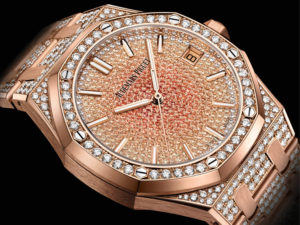
NEW GEM-SET VERSION OF THE ROYAL OAK SELFWINDING
In terms of brand tie-ups do you think the profiles of people that brands should be looking for in the future should be different?
What the world wants right now is for brands to be real, transparent and authentic. So if you get people in the sports world, entertainment world etc. to represent your brand and there is no real connection, the customer will not engage in it. So the choice of the people is very important, but this has always been the case. Our ambassadors have to pass a job interview with us when we start working with them. We don’t sign them, no matter how well known they are, without knowing that they fully understand what’s at stake and what we as a brand want to do. And I think this is something that’s going to be even more important now.
How do you manage the balance between physical stores and digital platforms especially with the current situation?
We always look at it as a new tool. Do I want to sell 40,000 watches online? Absolutely not! But do I want to use all of the tools I can to go after new clients and expose who we are and bring them to our family? Sure. But it’s a tool, it’s not an end and there’s a big difference.
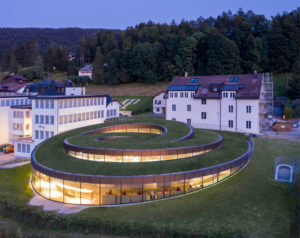
Musee Atelier
What is a project that you would love to do if you had the means and the Ok to do it?
I would go and produce a Broadway show!
What makes the brand unique and what defines your client today?
What makes a brand like this are the fans. When a watchmaker works on his design, he doesn’t know where the watch is going to end up, his mind-set is that he has to make the most beautiful watch he can. Then we promote that product through advertising, interviews, presentations to clients etc. But the ones who are making the brand what it is, are you, the clients! What we’ve seen is so many people commenting on the fact that the brand is real. It’s OK to make mistakes, it’s OK to fail, and we are very human in that respect. The number one thing that people say when they buy our watches is that they never expected something like this. The thing that touches them is the passion of our people and the will to share it in the most familiar way. It’s one big family and our clients make us who we are.
What’s one thing that you would have done differently?
If I could go back, I would go back 20 years to when I became the CEO of the Americas. I used to have this mindset that I could never tell someone when they were doing great, I only used to tell people when they were doing bad or made mistakes. If I was to go back I would completely change the way I managed people because I think I’m a much better boss now than I was 18 years ago because the notion of caring and supporting has evolved for me drastically.
What’s in the pipeline for Audemars Piguet when we go back to “Normality”?
We have the new Automatic 34mm for women with a new movement and a few more launches towards the end of the year, but nothing will be a huge launch this year. We had something that was supposed to be a big worldwide launch, but that has had to be postponed. Which is unfortunate because I couldn’t wait for it! But it will be launched in March 2021 now. There is something that we are working on which is not an evolution at all for Audemars Piguet, it is something very different in the retail world that will go beyond the watch industry, but that’s all I can tell you now.
What message would you give the people in the Middle East?
What I want to share with all my friends in the Middle East is that when I can, I cannot wait to come back, and we are far from being done surprising you. It was during COVID-19 that we came up with an idea that is going to be completely insane. So we will keep surprising you, so keep the love and passion for the brand and I’ll see you soon.
READ MORE:
Chanel’s J12 Watch Celebrates 20 Years With Lily Rose Depp, Claudia Schiffer and Ali MacGraw
Roberto Minotti Co-CEO of Minotti S.P.A. Talks Family Values and the Importance of Being Made in Italy
In 1948 Alberto Minotti started a small scale artisan workshop in his local town, creating handmade contemporary furniture that uniquely brought together modern style with classic Italian design.
Throughout the sixties, the company quickly grew and became known across the country for its high-quality designs that were 100 per cent made in Italy. Alberto Minotti died in 1991 and the company was inherited by his children Roberto and Renato Minotti. The two continue to run the company today, together with their own children.

Minotti Headquarters
This family business has grown hugely over the last three decades after the two brothers decided to take Minotti into international markets. Today Minotti is present in almost 70 countries worldwide. In 1998 the Minotti family partnered with architect and designer Rodolfo Dordoni who was assigned the strategic role of coordinator of all the company collections.

West Seating System, Rodolfo Dordoni Design
Made in Italy has always been at the heart of the Minotti brand. Their factory remains in Meda, in the heart of Brianza and all of their pieces are created by expert Italian craftsman. Today, these artisans embrace new technology, combining it with their skills to create furniture that is seamless and has the highest commitment to excellence. Over the years the company has conceived a specific “Minotti code”, that has become a constant feature of every collection, always following the key principle of “innovation in the spirit of continuity”. To share his vision on the future of the brand and how Minotti is navigating through the current situation, we talk to Roberto Minotti Co-CEO with his brother Renato Minotti, of Minotti S.p.A.
What does Italy mean to you personally?
Italy is firstly home and family. It is, of course, one of the best countries in the world to live and grow up. Italy is a synonym of beauty, creativity and quality expressed in several aspects. These values are truly embodied in our people, our history, our culture and our places. Our beautiful landscapes, our historical sites and all our excellences in food, design, fashion and manufacture are desired all over the world. Italy has an important heritage that we need to preserve and nourish day by day.
Tell us more about the importance of “Made in Italy” and why do you think there is such a fascination with this concept globally?
‘Made in Italy’ is the expression of our heritage and our capability in rereading our traditions and history, combined with our innate attitude towards beauty and creativity. It is linked to craftsmanship, artisanal skills, a high degree of know-how and an everlasting tradition of excellence, which has been handed down from generation to generation. All ‘Made in Italy’ products are truly appreciated and desired worldwide because they are, in some ways, an expression of our unique lifestyle and guarantee of excellent quality. Italy is a brand in itself.
How do you think the values and culture of Italy are reflected through Minotti?
The identity of our company draws from our ability to “innovate in the sign of continuity”, a value deeply rooted in our DNA. Innovating remaining true to our history, our roots and our territory. We believe in Made in Italy and for this reason, we continue to design and produce in Italy, at our headquarters in Meda, in the heart of Brianza. Over the years we have always maintained an “artisan” attitude towards our work, we have focused on attention to detail and quality, values we have never given up on. Our commitment to excellence, quality and research involves our entire company and is more than evident in all our collections. Our sense of beauty and creativity is reflected in our unique lifestyle and our way of manufacturing – always driven by passion and rigour – and in our way of doing business. The decision to share with the Italian Architect and Designer Rodolfo Dordoni the company’s creative vision and its aesthetic key-principles since 1998, it is, of course, a specific and strategic choice in the direction of enhancing Made in Italy. An overall approach that, over time, has translated into a result of excellence recognized throughout the world.

Lawson Seating System, Rodolfo Dordoni Design
Italy has suffered greatly throughout the global pandemic we are currently experiencing – when all of this is over what do you expect to see from the recovery of this crisis?
We’re finally back, we’ve reopened and resumed our production and commercial activities, in full compliance with the protocols for the protection of the health and safety of people and the work environment. A great challenge awaits us to build a new future, with the same passion, courage and creativity as ever. I’m expecting to see more conscious people related to themselves and the earth as well as more attention to all the values that truly count. The whole world has to gradually find its dynamics, market by market continuing to be attentive, as we have always done. We are present in 70 worldwide so we must guarantee each of these the same importance and attention, regardless of the numbers that each of them produces. Every market is precious.
When all of this is over will you be changing any of the strategies of the brand and has it had an impact on how you will move forward?
I can say that Minotti is a “safe” brand: we’ve always worked in the direction of enhancing the timeless design and the highest quality, key-elements that customers will be looking, for now, more than ever. We will continue working with the same passion and attention to details, in terms of products, service and care to our customers.
Do you think it will impact the buying behaviour of customers?
In the beginning, after such a terrible situation, I imagine that consumers will probably reshape their purchasing habits by making more prudent, sober and lasting choices. This approach favours the choice of durable products like ours. As time goes on, people might desire less necessary things again.

Daniels Seating System, Christophe Delcourt Design
Where is sustainability in the world of Minotti?
We, as a family, place the issue of sustainability very close to our heard and have been working for two decades in the direction of optimizing our production process according to the most recent green economy’s standards. Most of our products are now designed and manufactured to allow easy disassembly for recycling purposes. This means that our products – from the materials that make up the product itself, to its packaging and disposal – comply with all the criteria required by the various destination countries. We make use of strictly controlled raw materials such as wood, polyurethane/rubber, leather, glues and paper for printed catalogues. What is important for us is to work in the respect of our values, in terms of ethics and social responsibility towards people and the territory, coherently with that vision of well-living that has always characterized our brand philosophy.
With many Furniture and design exhibitions around the world being cancelled, how are communicating your novelties to your customers?
The numerous furniture and design exhibitions cancelled around the world, starting from Salone del Mobile in Milano this Spring, we’re planning the launch of our brand-new collection with a showcase on our digital platforms. I cannot say more but keep in touch!
Can you tell us more about Minotti and the Middle East?
The Middle East is one of the most dynamic and promising business areas for Minotti. We have been present in the UAE for more than 25 years, so we can say that we are one of the design brands with the longest presence in the area. We are now recording very positive experiences in Lebanon, KSA, Kuwait, Qatar, Bahrain and Iran. The sophisticated aesthetic taste, the attention to details, the long-lasting quality – fundamental values of our brand – are all features very much appreciated by the Middle Eastern consumers.

Lawson Seating System, Rodolfo Dordoni Design
Can you take us through your latest collection?
We have developed our 2019 Collection in close collaboration with our Art Director Rodolfo Dordoni, affirming a new stylistic language and embracing a fresh new approach to décor: a new vision of interior design, mixing different styles and welcoming the voices of architects and designers from different cultural backgrounds including Rodolfo Dordoni, Christophe Delcourt, nendo, Marcio Kogan / studio mk27 and GamFratesi. Three major seating systems – accompanied by a wide-open seating proposal and a huge series of dining, coffee tables and accessories – outline elegant spaces for the home and the hospitality sector and harmoniously flow into our “Minotti project”.
Simultaneously, our Outdoor Collection responds to our desire to create an aesthetic and stylistic continuity between indoors and outdoors as well as a striking dialogue with surrounding nature. We designed impeccable pieces with character and exclusive elegance to create welcoming outdoor environments, also on-board yachts, with a truly international style.
In your opinion, what are the pros and cons of a family business?
Being a family business has a lot of advantages. My brother Renato and I are part of the second generation in the company. We work side by side with our children (my daughter Susanna and my nephews Alessandro and Alessio). Each of us has specific skills in different departments. Working together, guided by the same long-term vision, allows us to be faster in decisions and strategies and this had a positive impact also on our production. On the contrary, we’ve sometimes had to face up to the generational gap among us, but at the end – thanks to a vivid dialogue and an exchange of views – we find a common outcome to proceed in the shared direction.

Shipyard Custom Line 106. Photo courtesy of Custom Line
When this pandemic is over, what is the first thing that you will do?
I would love to enjoy a special dinner on the beach at the seaside.
Growing up, what are some of your first memories of Italy as a child?
My first memories of Italy as a child are truly linked to the sixties. The energy, the enthusiasm, the desire to do, the evolutionary spirit and the understated elegance that animated those years – despite the overall simplicity affecting people and the country – are among my major vivid memories.

Shipyard Custom Line Navetta 42. Photo courtesy of Custom Line
Where in Italy do you like to travel to and what is your favourite city and why?
I would love to explore again the traditions and the stunning landscapes of our Amalfi Coast and islands while enjoying the energy and the real Mediterranean vibe.
Can you share with us any Italian traditions that you have with your family and friends?
During festivities we love staying together at our family home, gathering around a huge fireplace in the centre of the living room. It’s a tradition since I was a child and now, that my family continues. I am always grateful and happy to share such beautiful moments. During the last decades, our fireplace became an important company symbol and we decided to interpret it in the living rooms of our company showroom in Meda, as well as of our exhibition booths and flagship stores around the world.
What is the motto you are living by during this time?
We’ve to stand up again and run faster to face all the new upcoming challenges.
How are you spending your days while staying at home in quarantine mode?
Since my house is very close to our company, I spent most of my quarantine days at the office aiming at strengthening my relationship with our friends and clients.
What’s your favourite Italian phrase?
My favourite Italian quote is “Aiutati che il ciel ti aiuta!”. Its meaning is that if you work hard and you give 100% in everything you do, consequently things will work out positively in your favour and everything will fall into place.

Fireplace at Minotti Booth, Salone Del Mobile, Milano 2018
How would you describe Italy in one word?
Beauty!
What’s the message you would like to tell our Middle Eastern readers?
Stay strong and safe, we’re all together in this. I can’t wait to unveil our brand-new 2020 Collection, it will surprise you!
What is a message to all the Italians that will be reading your interview?
Italiani, siamo forti. We faced unprecedented times, but we will be for sure stronger together again
Minotti is available at Aati in Dubai and Abu Dhabi, Visit us at www.minotti.com
READ MORE:
Alessandro Dell’Acqua on Supporting Upcoming Designers and Moving Forward After the Coronavirus Crisis
Alessandro Dell’acqua discusses his desire to support upcoming designers through this terrible time and how independent brands will move forward after the global pandemic
He has been one of the most loyal names to Italian fashion for decades since he first launched his own label in Milan in 1996. Inspired by Italian cinema, Alessandro Dell’Acqua became known for his unique take on refined evening wear that was given a unique edge. After closing his label Dell’Acqua worked with Brioni as Creative Director of womenswear before launching new contemporary brand N°21. This refreshing, contemporary label has allowed Dell’Acqua to expand his creative horizons and move into a new area of design.
The name N°21, was inspired by Dell’Acqua’s birth date and the brand also reflects himself and his love for creativity. N°21 is devoted to daywear with a freshness and freeness about it. Dell’Acqua’s approach to fashion embraces freedom and the right expression. The spring/summer 2020 collection was the first collection to see both men’s and women’s looks in the same presentation. The silhouettes were exaggerated with soft shapes, flowing, fluid materials with the freedom to move, as well as the freedom of gender – with many pieces designed for both genders and many women’s pieces inspired by men’s styles and vice versa. Here we discuss with Dell’Acqua the latest collection as well as the plans for the future of the brand when this global pandemic is over.
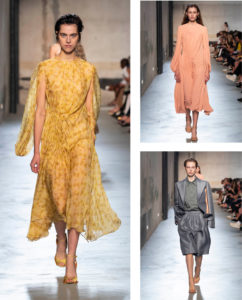
Spring/Summer 2020
What does Italy mean to you personally?
Italy to me means family and tradition.
Tell us more about the importance of the “Made in Italy” and why do you think there is such a fascination with this concept globally?
Made in Italy stands for quality, know-how and heritage with an extreme international flair.
How do you think the values and culture of Italy are reflected through N21?
The extreme attention to details, manufacture and tailoring are the main strengths of N°21 and this reflects the values of Italy.
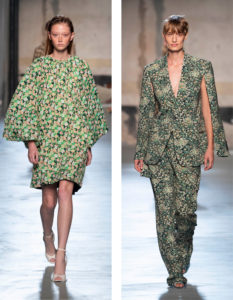
Spring/Summer 2020
How does Italy Inspire you?
Italian creativity inspires me through many forms of arts, especially through cinema. I have a great passion for Italian cinema, especially films from the Golden Age. The women that starred in those movies inspired most of my collections and still do.
Italy has suffered greatly throughout the global pandemic we are currently experiencing – when all of this is over what do you expect to see from the recovery of this crisis?
We will keep the passion and the love for what we do. I think we will have to discard anything that it is not essential, unnecessary and excessive.
In every crisis, there is always an opportunity – what is something positive that will come out of this painful situation?
N°21 actually started in a moment of deep economic crisis. It’s unique price point and quality led to its success. Personally, I think that we will all have to focus on supporting local talents and using local production.
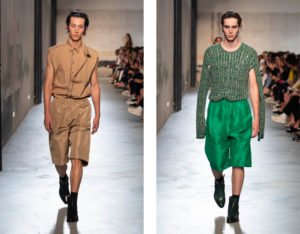
Spring/Summer 2020
When all of this is over will you be changing any of the strategies of the brand and has it had an impact on how you will move forward?
I think we will need to concentrate on fewer collections, smaller collections, more quality and more creativity. Unfortunately, all brands will be affected by this crisis, especially small and independent companies.
Do you think it will impact the buying behaviour of customers?
Yes, I believe that people will buy fewer products, they will focus on more precious and special items.
When this entire situation is over, what is the first thing that you will do?
For the next Milan fashion week, I am planning to make my showroom space available for young designers to showcase their collections both to press and buyers.
What is the motto you are living by during this time?
“Alone but together” and “Through passion to fashion”.
What can you tell us about N°21’s SS20 collection?
For this collection, I wanted to bring together the women’s and men’s collections for the show because I want to give a narrative unity to my idea of fashion. The initial inspiration behind this collection is a sense of romance and a physical and emotional connection with the body. I designed the same clothes for women and men, without falling into the no-gender trap, yet having the two genders — female and male — meet in a continual intersection of references of lines, volumes and fabrics.
Growing up, what are some of your first memories of Italy as a child?
My first memories are from experiences in Naples, where I was born and lived until I was 18 years before moving to Milan. I remember the women of my family cooking Sunday lunch in their nude slip dresses, those that inspired so many collections of both Alessandro Dell’Acqua’s brand and N°21. I also remember how much I loved going to the cinema with my grandfather. My dream was in fact, to become an actor but I was too shy. That’s where my passion for cinema started.

Where in Italy do you like to travel to?
As soon as I am able to I will go back to Ischia and the Amal coast.
Can you share with us any Italian traditions that you have with your family and friends?
Sunday lunch will always be for family and friends.
How are you spending your days during this quarantine period?
I have been dedicating a lot of my time searching for emerging international designers, which – alas – in normal times I have no time to do. I am also going through my personal archive, photography books and old fashion magazines to get inspired.
What’s your favourite Italian phrase?
“Andrà tutto bene” meaning, “everything will be fine.”
How would you describe Italy in one word?
Heart.
READ MORE:
Interview With Paul Andrew Creative Director of womenswear at Salvatore Ferragamo
Fausto Puglisi On Italian Heritage and How it Inspires His Designs
Brunello Cuccinelli on Building a Global Business From His Hometown in Italy
Fausto Puglisi On Italian Heritage and How it Inspires His Designs
Fausto Puglisi’s vibrant, energetic style brings colour and fascination to the fashion world season on season. The designer’s bold creativity has seen him gain a strong cult following of clients looking for clothes that make a statement and bring happiness and colour to their lives.
The Italian designer’s creations reflect his heritage, combined with modern experiences bringing together his Italian heritage and his fascination with American culture. Born in Sicily, Puglisi was inspired by fashion from a young age. He befriended two traditional tailors who had made a suit for his grandfather and he would spend most of his time in the local boutiques, fascinated by the techniques. In 1999 he moved to America, where his fascination with the country was born. It was here he began to design, creating small quantities of designs by hand as he discovered the country.
In 2010, once back in Italy, Puglisi launched his own label; Fausto Puglisi. He was taken under the wing of Domenico Dolce and Stefano Gabbana who invited him to be part of their retail project Spiga 2, which featured a mix of young, unknown international designers. His designs sold out within days. This pushed him to start showing his designs at Milan Fashion Week. By 2013 he was showing his full collection on the runway, as well as having many international celebrity clients that helped to make the designer a household name. Puglisi’s unique creations are inspired by the romance of the past, but with a modern twist. The classicism of ancient Roman sculptures, the opulence of Baroque architecture, the hedonism of Bacchanal or even contemporary Hollywood revelry, and the quiet reserve of 1950s couture, are all continuous fruits of inspiration. Here we discuss with Puglisi his continuous inspiration from his country and how he has interpreted that in his own unique way.
Spring/Summer 2020
What does Italy mean to you personally?
Italy is my DNA, it is in my blood! This country represents culture, excess, opera, theatre, literature, cars and the greatest food. We breathe beauty in every corner here in Italy, and to create beauty becomes a natural approach and reaction. Italy is with me in every breath I take, in every design I do. Prêt-à-Porter was born here in Italy in the early 70s. Italy is a way of life.
Tell us more about the importance of “Made in Italy” and why do you think there is such a fascination with this concept globally?
Here in Italy, you can find the essence of art at its best, from the Roman Empire to the Renaissance, to Renzo Piano’s modern dreams, to ancient Greek sites. Italy is the essence of creativity and there is a great devotion to the arts. There’s no place in the world with such a historical consciousness of beauty and deep knowledge. It’s our tradition and we like to share this sense of beauty with the rest of the world. So many American actors have Italian roots. From Liza Minnelli to Robert De Niro, Frank Sinatra, Madonna and Lady Gaga. They are all part of our big Italian family. Italy is colourful and dark both at the same time, we put our sense of music in every single thing we do. We are unique. There’s no place like Italy.
Italy has suffered greatly throughout the global pandemic we are currently experiencing – when all of this is over what do you expect to see from the recovery of this crisis?
During the lockdown, I’m reflecting a lot and thinking about my future steps. The world needs much more respect. Living in Italy I know I can make a business from what’s beautiful, slow and loyal. The food, the best marble craftsmanship etc. It should be the same with fashion. We don’t need to rush. I like to live my life surrounded by beauty and love, without hysteria, engaging with my artisans and respecting them. The fashion world has seen too many collections and too much marketing. Let’s just think about creating beautiful products at the right time, with the right devotion. This is the only way to win going forward.
Spring/Summer 2020
In every crisis, there is always an opportunity – what is something positive that will come out of this painful situation?
We are trying to understand how so many things that we used to take for granted are not granted at all. Everything can change in a second and this is a beautiful lesson. I’m grateful for being who I am, my passions, my family, my work. I will keep on living my life with loyalty, working hard and believing in high quality. The quality of human relationships, the quality of readings, and the quality of production. I create and sell dreams not illusions. It’s important to take care of the people around the world that are less fortunate than me. I understand now more than ever, that life is like one of my Italian embroideries. It needs care, devotion, love, attention, time and respect. And most of all, a big dose of humanity.
When all of this is over will you be changing any of the strategies of the brand and has it had an impact on how you will move forward?
Since my brand was born I have always focused on quality, beauty and Italian heritage. Honestly, in the last few years, we have seen a triumph of fast fashion sold as luxury. But of course, this isn’t real fashion. I’m proudly not creating this kind of “fashion”. I like to collect art, I love my dogs, my flowers, my friends, I love to visit the museums, to enjoy a coffee in Rome, I don’t believe in trends. I only believe in high quality and beautiful dresses. Values and Loyalty are important in everything we do and that will continue after this crisis.
Do you think it will impact the buying behaviour of customers?
I love my customers and they want to be surprised by me, which I think is beautiful, and in that respect, I think this will continue. I have decided to stay away from stores that mix high end and contemporary fashion. In life, you go left or right, you can’t take both directions at the same time so you can make a sweatshirt using beautiful cotton, voila, it’s modern and it’s high quality and that must be recognised. At the end of the day, all I care about is my clients and my values. People need beautiful clothes for their celebrations of life, or to go to work, and here I am, doing it in my Italian way.
With many major Fashion weeks are cancelled, how do you feel the industry will react moving forward?
The fashion world is old, there are too many clothes, too many collections, too much marketing… The department stores are closing, the buyers of the stores don’t like to explore, but they want to be safe. And you can’t be safe all the time. We need something new. Something that has courage! Fashion needs to come back to its roots. The industry has become too obsessed with the young generations but these young people will get tired soon and change their minds about what they want. This is the beauty of Youth. But a real business can’t worry about this. My clients are of all ages and I respect them all. Fashion lost its natural sense of beauty and that needs to come back.
Tell us about your latest SS20 collection. The inspiration, the aesthetics and fabrics.
My spring/summer collection is very Italian because it’s sexy, colourful and happy! There’s also a tropical approach. When I was in Miami I found a beautiful tie-dyed fabric in my favourite souvenir shop. I fell in love with the print. Then I went to Como, in Italy and I started to design a great black cage of palms leaves which can also look like an animal print. I wanted my best fabric makers from Como to support in developing it and it was magic. From emerald to aquamarine, yellow to deep orange, it is a sunset dream.
I know you love Dubai a lot, how was your experience when you were last here and what is it in your opinion that makes this city unique?
Dubai is magical. It’s beautiful and unique! First of all, I love and respect the culture. There is such a great sense of beauty and high quality. People in Dubai like Italian fashion, Italian cars and Italian food. You have a great cultural heritage, and it’s magical to see the past and the future coming together. The last time I was in Dubai, a year ago, I wanted to understand more about the traditions of the fishermen, the beautiful old boats, the sea, the old villas near the sea. People from the Emirates understand beauty because it’s a part of their DNA. Also, I am obsessed with the traditional fashion of the UAE. It is extremely elegant. Another thing I love is the gates of your villas. Last time I came, I told my driver to stop in front of every gate to enjoy that beauty of the craftsmanship. I posted all of these on my Instagram page because each gate is a jewel. I love the way Dubai has an international approach, but what I like most is the magic of its heritage.
What is the first thing you will do when this situation is over?
I can’t wait to go out, to see my friends, to hug them, I want to go to Piazza Duomo in Milan, I want to breathe the fresh air, to take a train to Rome, eat out in the restaurants. I miss seeing the Colosseum.
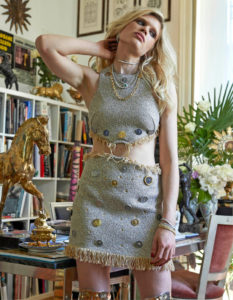
Spring/Summer 2020
Growing up, what are some of your first memories of Italy?
I was born in Sicily, and I have always loved to dress up and I was inspired by Gianni Versace. My childhood was amazing, The Christmas tables, the food, my family, the lights, my family. We used to go on holiday to Calabria. We had the hottest summers at the beach, enjoying Sicilian ice creams. All of this will live in my mind forever. My creativity starts with these memories.
Where in Italy do you like to travel to/your favourite city and why?
I love Rome, Naples, and the south of Italy. Sicily of course, Taormina, Palermo. I also adore visiting the Vatican museums in Rome and the archaeological museum in Naples…and then eating seafood by the sea. It is fantastic and very Italian. I can’t wait to enjoy it again!
Can you share with us any Italian traditions that you have with your family and friends?
Spending all day at the beach, under the sun, during the summertime. Getting a suntan, I live for the sea. Also watching Totò movies or Eduardo De Filippo theatre masterpieces on the television during the Christmas holidays, while eating Sicilian cannoli.
How are you spending your quarantine days and what do you tell yourself every morning?
I’m living my quarantine days with extremely positive vibes. I’m reading a lot, watching my favourite Italian old movies from the 60s and the 70s. I’m listening to my favourite American music and getting inspired. I’m sketching so much, day and night, I don’t look at my watch, I don’t mind what time it is. And finally, I am taking care of my beautiful plants and flowers, playing with my dogs and enjoying the sun. The spring in Milan is beautiful!
What’s your favourite Italian phrase?
My favourite Italian phrase is “la vita e’ bella!” It means “life is beautiful”.
How would you describe Italy in one word?
I prefer to use two words… sexy and beautiful.
READ MORE:
Alberto Camerlengo CEO of Furla on the Uniqueness of the Brand and Its Global Success
Riccardo Sciutto CEO of Sergio Rossi on the History and Heritage of the Italian Shoemaker
Alberto Camerlengo CEO of Furla on the Uniqueness of the Brand and Its Global Success
Alberto Camerlengo CEO of Furla on what makes the accessories brand unique and the importance of spreading the message and values of the brand in achieving global success.
Italian leather goods company Furla, was founded by the Furlanetto family in 1927. This family have devoted their lives to the brand, generation after generation to ensure that the values and methods of the company have remained the same. Until today this family business thrives on being a one-of-a-kind brand in Italy. Its values of Italian craftsmanship combined with accessible luxury, allow men and women all around the world to experience the traditionally made Italian leather goods. Founded in Bologna, Furla’s heart and soul has always remained in Italy and its headquarters today is located in a historic 18th-century villa in Bologna.
The brand’s CEO Alberto Camerlengo is working to sustain the Italian history of the brand while moving with the times and the growing demands of today’s customer. Their targeted consumer base is widespread, with subsidiaries in the USA, France, Japan, China, and Korea as well as a huge presence in stores and department stores around the world. Camerlengo is using this treasure that the brand has of Italian spirit and heritage to spread the message of Furla around the globe. Here we find out more about the importance of Italy to the brand and the plans for life after COVID-19.
What does Italy mean to you personally?
Italy is culture, beauty and strength.
Tell us more about the importance of “Made in Italy” and why do you think there is such a fascination with this concept globally?
Italy has always loved beauty and craftsmanship. We live in a country where beauty is everywhere, we have been the cradle of Renaissance, we have the most beautiful cities in the world, so I would say that as Italians we are used to thinking about beauty and to always look for It. Our history is characterised by a commercial and cultural exchange, this is our DNA and for this reason, we always try to enhance our manufacture not just from a technical point of view. Beauty and passion are always at the centre of what we do. Our savoir-faire is quite unique because it’s rooted in our tradition.

PALAZZO FURLA
How do you think the values and culture of Italy are reflected through Furla?
Furla is the original inclusive luxury brand that de ned the category over 90 years ago. Since 1927 the brand has been dedicated to creating luxury-standard accessories, which are accessible to a broad audience of consumers. As the only Italian brand in its category, Furla stands for quality, creativity and an optimistic yet con dent personality. Furla’s beautiful, high-quality accessories stand out for their uniquely Italian attitude to life. They are designed with the simple purpose of bringing a smile to the customer’s face.
Furla is the only global brand in its category with an Italian heritage. Established in 1927 by Aldo Furlanetto in Bologna, Furla looks to the future with a foot grounded in its solid past of time-honoured craftsmanship, sophisticated elegance and playful originality. The brand never forgets its Italian sensibility and its generous and creative DNA.
Furla has a respected legacy, what is part of its story inspires you most?
What fascinates and inspires me most is the fact that Furla has always been guided by a woman. Mrs Giovanna Furlanetto, our President, has devoted her life to this beautiful brand. Furla has been through a World War and a lot of global crises, but it’s still a strong and independent family business.
Italy has suffered greatly throughout the global pandemic we are currently experiencing – when all of this is over what do you expect to see from the recovery of this crisis?
I think consumers behaviours will change a lot, they will be much more selective. Values and authenticity will be key elements when it comes to buying something. There will be a rebirth, but even when difficulties are over, people will not forget them and there will be a strong need for substance and integrity. We are in good shape: we have a long history and tradition; we have always been true to ourselves and to our core business. At the same time, a lot of brands will change: the fashion industry needs to reorganise itself in many aspects. Technology and digitalisation will be more and more important.
In every crisis, there is always an opportunity – what is something positive that will come out of this situation?
Rediscovering real values: the importance of family, of authentic relationships, to see who is available to share with you not only the beautiful moments, but also sacrifices, and this is also true when talking about business. We have seen in our company that real talents stand out in this difficult moment, It’s all about your attitude and beliefs in times of need. Now is the moment of truth.

PALAZZO FURLA
When all of this is over will you be changing any of the strategies of the brand and has it had an impact on how you will move forward?
We will strengthen and boost our Omnichannel distribution while standing with our core business of inclusive luxury. Implementing and redistributing will be key. In the past two months, we reorganised our company to be ready for post-COVID-19, which is an unexplored land. We are ready in terms of organisation, supply chain, information technology and product.
Do you think it will impact the buying behaviour of customers?
Of course and not only customers, let’s also think about buyers. Technology plays an essential role as we organised ourselves to manage everything online: virtual showroom, digital look books, new interactive and experiential solutions, and e-commerce implementation. The emergency has changed the fashion game and it has accelerated the process of innovation in many different ways: from smart working to virtual technology and interactive approach to customers. On the other side, customer behaviours will also change in terms of preferences. Brands with authentic values and quality products will be preferred.
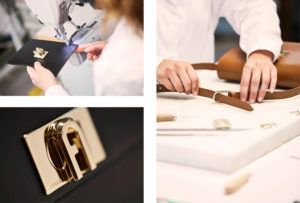
Let’s talk about the SS20 collection. The inspiration and the products.
It’s an elegant and sophisticated collection in its shapes and colours, mixing Italian craftsmanship and contemporary beauty. The new Furla logo, the arch, is the l rouge of the entire collection. Our design team wanted to draw inspiration from a symbolic element with a strong visual impact, which should underline the brand’s values and history. The starting point for the Furla’s arch logo was the arch of the Fondazione Furla building in Bologna and additionally, it symbolises inclusivity, an open door to the new Furla world. The logo assumes, for the first time in the history of Furla, a bold statement. It allows Furla bags to become immediately recognisable. The Furla 1927 bag is the protagonist of the spring/summer collection and it is the first bag that includes the arch as a structural element, underlining the brand’s identity. It stands for heritage, authenticity and craftsmanship.
To what extent do you believe that brands should invest in offering more experiential moments with their customers and how is that applied at Furla?
In my vision, the capability of offering a unique and pleasant experience to customers is, more than ever, a key point in all market segments. People will be more and more attracted to products and brands that are able to offer them something more than simply buying a product. We embraced this vision in Furla at the end of 2019 when we decided that our brand should step up from a competitive scenario, which seemed to be “promotion driven only”. Therefore, we started to work on different touch points to offer our customers a distinctive experience. The first aspect we worked on was the integration of the digital environment with the physical one.
The idea was to create a digital community of Furla lovers who would be able to find in the physical hubs (stores) the values they appreciate in our brand: from design to craftsmanship to exclusive treatments through personalisation programs etc. In our vision customers of all segments will more and more switch from the digital to the physical (and vice versa) environments, expecting a total consistency. That’s why we worked on those two environments in a holistic way. Furthermore, since experience is personal we want to treat each customer as unique. Our goal is being able to have a personal custom-made contact strategy to offer each of them what they really appreciate the most.

Spring/Summer 2020
When this situation is over, what is the first thing that you will do?
Of course, this “quarantine life” Is not the best situation, but I have to say I’ve learned to appreciate also its positive sides, such as spending more time with my family for example. Anyway, as soon as this is over, I will go for a real Italian Espresso. Short and strong!
Growing up, what are some of your first memories of Italy as a child?
It was a very different Italy, or rather life was very different. I grew up in the wonderful Verona. I remember there were very few cars and life was slow-paced. It was more of community life, we were close to our neighbours and we used to go to the little shops we call “botteghe” to buy all that we needed.
Where in Italy do you like to travel to and what’s your favourite city and why?
Italy is my passion and I love every little corner of this beautiful country. I love to go to the seaside, but also to the mountains. I also love to take my children to visit our beautiful art cities. I never go to the same place twice, there’s too much to discover and to see in this country.
Can you share with us any Italian traditions that you have with your family and friends?
Preparing homemade pasta with my family, a tradition that has been handed down to me by my father.
What is the motto you are living by during this time?
Together we are stronger.
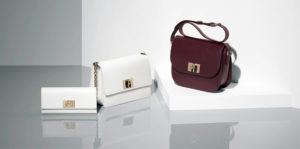
Spring/Summer 2020
How are you spending your days while staying at home in this “quarantine mode”?
Smart working is key in this moment and I have to say it is going very well and it is very productive. I’m spending a lot of time with my family and children, while usually is difficult since I am always travelling for business. I rediscovered the importance of time: time to think, time to spend with your loved ones, time for myself, reading a book, listening to a podcast, calling your friends.
What does Milan mean to you?
I love Milan. I think Milan is the most charismatic, vivid and open city in Italy. It’s booming year after year and not only for its business and financial activities but also for its beauty and the incredible opportunities it has to offer.
How would you describe Italy in one word?
Meravigliosa (wonderful).
READ MORE:
Loro Piana CEO Fabio d’Angelantonio Shares the Joy That His Country Brings and How Its Values Are Intertwined With the Brand
Since the beginning of the 19th century, the Loro Piana family worked as wool merchants in Italy. Sourcing the finest wool fabrics in all of Italy and crafting them into the finest clothing.
Through six generations Loro Piana has continued to produce luxury goods using the world’s nest, raw materials. Today the house can source its raw products from all around the world, ensuring that they have the best quality possible. These treasures are then crafted in Italy to produce clothing that moulds to the body and offers complete comfort for the wearing. Loro Piana is about touch. There is no way to truly describe the sensation of its products through words, which is why they invite all of their customers to their stores to embark on a sensory experience, discovering the world’s nest wool and cashmere.
Leading this unique brand today is Fabio d’Angelantonio. An admitted customer of the brand d’Angelantonio has observed and loved Loro Piana for many years. He understands the legacy of this brand and the importance of preserving its unique treasures. Here, d’Angelantonio shares some of the special traits that make Loro Piana so unique and how he plans to move forward with the brand after this time of crisis.
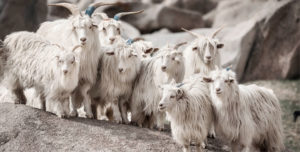
What does Italy mean to you personally?
For me, Italy quintessentially embodies the joy for life, a fantastic mix of beauty (art and country), savoir-vivre (lifestyle and food) and creativity (fashion and design).
Tell us more about the importance of “Made in Italy”.
I believe Italy offers a mix of creativity and savoir-faire, as well as artisanal craftsmanship, which is truly unique.
How do you think the values and culture of Italy are reflected through Loro Piana?
Loro Piana’s DNA is very closely linked to many core Italian values. Excellence, casual elegance, savoir-faire and family traditions: these are deeply rooted in our brand identity. Not to mention our strong link with nature, the carefree joie-de-vivre and of course, not taking ourselves too seriously.
Loro Piana is a brand with a rich legacy that dates back to 1924, what is the part of Loro Piana’s story that inspires you most?
Before becoming the CEO I was first a client. I have been with Loro Piana professionally since 2016, but I’ve been a client for over 20 years. I’ll never forget when I was a student and there still weren’t any Loro Piana owned stores. I was so passionate about the brand and the fabrics that I would go in my car from Rome and head directly to the factory store in Quarona to buy them.
I believe Loro Piana is an extraordinary brand, capable of combining in a completely natural way three, singular dimensions: Firstly, Sensorial immersion, touching unique high-quality natural fibres (our excellences) that are the result of passion, research and know-how that has been handed down for six generations. Beauty and excellence stem from the natural raw materials. Secondly; an effortless and timeless elegance which interprets the product (and its details, see the pockets) as a solution for the needs of a cosmopolitan, sophisticated and discerning clients’ everyday life. Lifestyles evolve and so the products that we propose season after season and generation after generation interpret this evolution, yet remaining faithful to our values. And thirdly, the deep understanding of a sophisticated and discerning cosmopolitan consumer, who appreciates excellent manners and service.
In every crisis, there is always an opportunity – what is something positive that will come out of this situation we are currently facing?
First of all, for years we have heard of globalization but perhaps we have never felt the meaning of “the butterfly effect” as much as we are currently experiencing it. We are all connected in this large global community where geographical distances, cultural and philosophical differences and regional and religious boundaries are dated notions that no longer seem relevant. While we are distant and we cannot meet and shake hands, we have never been closer. If we want to move forward in this hyper-connected and globalised world, we need to increase trust in one another, whether that means individuals, corporations, institutions, or countries. We need to share information and heighten co-operation, institute global agreements and nd common ground for exchanges in business, technology, science, healthcare and education. In some ways, companies have already learned this lesson better than anyone – yet never has this truth been as clear as it is today on so many levels.
Secondly, this crisis quickly changed our relationship with easy to use technology, we adapted quickly and are grateful for these tools that I believe are here to stay. And this is good news. For years we’ve discussed e-learning or working from home, and now in just a few short weeks it’s all become a reality. It’s a giant pilot project, albeit an unexpected acceleration, which otherwise would have never occurred, and which will prove beneficial in the future. When all this will be over we will nd ourselves masters of tools, abilities and habits that we will be more than able to handle.
Spring/Summer 2020
Tell us about the spring/summer 2020 collection.
Feeling, not showing is the essence of the Loro Piana ethos. The way a garment feels to touch and on the body, the perfect balance of noble fibres and easy shapes conveys an idea of comfort that is the ultimate expression of understated nonchalance. Each piece is meant to become one with the wearer, suggesting harmony between the self and the environment, and an “en plein” airway of living style. Spring Summer 2020 is all about the easy side of elegance but more of a quiet form of personal indulgence, with pieces for both city dressing and also more relaxed leisure time. It’s a collection very much focused on sight and touch and comfort: A soft deconstructed summer suit for example, or a delicate supple summer knit in cashmere linen mix. Soft is ultimately the Loro Piana byword for summer.
Why is the Loro Piana Cashmere so unique and special?
Loro Piana sources its Cashmere from Outer and Inner Mongolia, where long winters reach extreme levels of cold, transforming into very hot and dry summers when rain is rare, and water and food are scarce. The Capra hircus goats have adapted to thrive in these extreme conditions developing a special fleece made up of two layers: the outermost layer – formed of protective, coarse hair – and hiding underneath, an exceptionally soft underfleece. The goats shed their insulating underfleece naturally in June when the weather becomes milder: this is what we call Cashmere. The herders gather the fibres from the goats in harmony with the natural cycle of life – and in complete respect of these beautiful, resilient animals that manage to survive in one of the harshest climates on earth.
The uniqueness of Loro Piana Cashmere also depends on human relationships. We think of it as a collaboration in the name of excellence: solid, mutually beneficial and long-term partnerships with a small number of herders who we visit regularly to check the quality of their production. Our herders are keen to keep their exclusive and privileged relationships with Loro Piana as they feel they belong to an exclusive club devoted to producing the nest fibres destined for the very top of the market. They trust us and we trust them because we are continuously working together in the name of absolute quality.
Over six generations of experience in the textile industry have established uncompromising standards in sourcing, quality manufacturing and retailing, combined with the impulse to evolve respectfully in the world. The company is recognised for unrivalled savoir-faire in crafting the nest raw materials into fabrics of rare quality. In the end, the real secret of Cashmere remains the same: the incredible fineness and softness of the raw material.
I also invite you – to better understand what I mean – to see our docu lm ‘Cashmere – The Origin of a Secret’, the first documentary in a trilogy directed at the invitation of Loro Piana by Luc Jacquet, ecologist and Academy Award-winning director for the ‘March of the Penguins’. ‘Cashmere – The Origin of a Secret’ paints a portrait of enduring harmonies, intense harshness and sublime softness – excellences found in extremes. Drawing on a fascination with the delicate symbiosis between humans, animals and the environment, this is the first time Luc Jacquet has filmed a human experience of living in a world, which is constantly challenged by the vicissitudes of nature.
What would you tell us about the “The Gift of Kings”
Once traded by the Phoenicians, the Merino is the very oldest breed of sheep. In the 8th Century, the Moors introduced Merinos to Spain, where the sheep soon attracted the attention of the Spanish sovereigns, aristocracy and clergy. By the 18th Century, the Spanish kings were presenting the animals as royal gifts – Merino wool became known as the ‘gift of kings’. Three centuries later, The Gift of Kings® is the name Loro Piana gives to the elegant clothing crafted from the world’s finest wool.
The Gift of Kings® wool is the outcome of a tireless quest for excellence, and Loro Piana’s enduring passion for the most exquisite natural fibres. Working closely with leading woolgrowers in Australia and New Zealand for many years, Loro Piana encourages and supports the production of this ever-finer fibre. To celebrate the immense effort that goes into producing this unique wool, each year Loro Piana rewards the finest fibre with the Record Bale Award, and occasionally, through hard work and perseverance, this fibre breaks all known world records for wool fineness, becoming the World Record Bale.
The Gift Of Kings® takes wool to an exceptional level of fineness and quality. Measuring approximately 12 microns, this extra-special wool is ner than cashmere, as light as vicuña and available in extremely limited quantities – about 3,000 kilos a year compared to the 500 million kilos of fibre overall auctioned annually in Australia and New Zealand. To turn it into yarn, Loro Piana had to devise new equipment and techniques to preserve the precious qualities and integrity of the fibres.
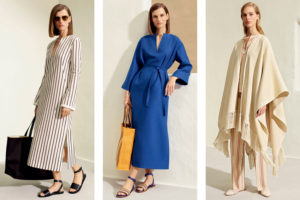
Ramadan Collection
To what extent do you believe that brands should invest in offering more experiential moments with their customers? And how is that applied at Loro Piana?
Experiential moments are very important for customers of luxury brands. One can only appreciate quality if the experience delivers quality itself. In today’s retail world, where each day is increasingly frenetic and transactional, our customers find in our stores an oasis of calm and good manners.
Tell us about Loro Piana and sustainability.
Loro Piana is sustainable by DNA. We deal with gifts from nature of which we appreciate both the privilege and its responsibility. When we buy cashmere in Mongolia we have to think about selecting the best quality this year, but we also have to ensure that there will be the right conditions to have it again in 5 to 10 years.
Sustainability for Loro Piana has a strong foundation in the past before the term “Sustainability” even existed. For decades, sustainability has meant responsibility, first for the environment and for the communities where we operate, from the regions where we source our raw materials to Italy where we spin, weave and transform them into our precious products. This commitment has always gone hand in hand with our obsessive search for quality, as we believe that the excellence of our products needs to reflect the excellence of our environmental practices and our relationship with people and communities. Our in-the- eld presence in Peru and our role in Vicuna conservation in the last twenty years as well as our effort to preserve quality cashmere in Inner Mongolia (China) resulting in better animal welfare and reduced pressure on land, are the shining examples of our commitment to nature
With this heritage as a foundation, today we believe that companies like ours have to take their responsibility through their value chain. For this reason, our sustainability direction includes four priority areas:
- Aiming for carbon neutrality in our operations;
- Improving products in the entire life cycle, from raw materials to end of life;
- Taking responsibility for animals, our main source of raw materials;
- Caring for people and communities, including our suppliers.
We believe that sustainability is not an absolute concept, but rather a journey that allows us to integrate our values, such as integrity, respect and responsibility, into our way of doing business. In the best interest of our brand, of the environment and current and future generations.
Ramadan collection
When this entire situation is over, what is the first thing that you will do?
Hug my friends!
Where in Italy do you like to travel?
To a beautiful small Island in Sicily called Salina, it is heaven on earth.
What is the motto you are living by during this time?
Take one day at the time, the situation is constantly evolving and the excellent decisions made a few weeks ago may need to be changed today.
How are you spending your quarantine days at home?
While in quarantine mode I read, cook, play cards with my family and of course, I work. I try to talk daily with as many colleagues as I can at Loro Piana both in Italy and worldwide.
What’s your favourite Italian phrase?
“La felicità é nelle piccole cose,” which means “happiness lies in small things.”
How would you describe Italy in one word?
Joy for life… I know, it’s not one word!
READ MORE:
Sabina Belli, CEO of Pomellato Talks Overcoming This Crisis and the Importance of Being Made in Italy
Pomellato’s values lie in celebrating understated elegance, something that resonates very closely with Italian women, who are elegant and sophisticated. While Pomellato has been built on being modern and contemporary in terms of its designs, when it comes to the savoir-faire and Italian craftsmanship it very much appreciates the historical skills and treasures that its country has to offer.
Founded in 1967, Pomellato prides itself on being a brand that creates minimalist, elegant jewellery that features have what seems to be a simple design but yet adds style and a touch of beauty to every woman that wears it. Someone who knows understated elegance is CEO Sabina Belli. Belli joined Pomellato in 2015 as the first female CEO of the brand. Her mission was to make Pomellato the first global luxury Italian fashion fine jeweller, with an unconventional and colourful identity. With a background in luxury, Belli brought her business experience to the brand, but more importantly, she brought a female point of view, something that would be in line with the Pomellato’s goal of empowering women. Pomellato is not just unconventional by its design. Its marketing campaigns aim to really connect with women by touching on current and profound issues and often feature real women in their content. To find out more about the values of the brand, the importance of made in Italy and the strategy on moving forward after the coronavirus crisis, we talk to CEO Sabina Belli.
What does Italy mean to you?
Italy to me means creativity and genius. An engineering mind-set merged with creativity.
Tell us more about the importance of the “Made in Italy” and why do you think there is such a fascination with this concept globally?
I think there is a fascination with Made in Italy because of the combination of high quality and excellence with a twist of originality and a style that’s very unique.
Sabbia rings collection
How do you think the values and culture of Italy are reflected through Pomellato?
They are absolutely reflected in Pomellato since the brand embodies the pillars of the Italian culture of design, expert goldsmith and the inner elegance of women – that notion of ‘you don’t need to do much to look cool and elegant when you’re Italian’ and with just one piece of Pomellato jewellery you can add an elegant touch. It’s effortless Italian style.
When all of this is over will you be changing any of the strategies of the brand and has it had an impact on how you will move forward?
Yes, I consider this time being a learning curve. We have learnt a lot about the price of life and the importance of being alive and bringing something to this planet, rather than just taking energy from it. Going forward I think we should give back to the world in terms of safety, healthcare, environment and most importantly, respect.
Pomellato has always given back by putting women in the forefront – we saw this with the recent campaign related to domestic violence – to what extent do you think these sorts of campaigns are the way forward?
It really struck us when people were being told to stay at home because the idea is that home is a safe place to be, but for many women, they were finding themselves in the worst possible situation when being asked to stay home. So we started talking about this publicly to raise awareness and make sure that people understand what is going on. And I think this is something we should do more of. Life will go on but the domestic violence will still be there and I think it’s part of the responsibility of the brands to use their channels of communication to also stress on these kinds of important situations and highlight them for everyone around the world. So we will, of course, continue with these techniques and I think probably one of the next big topics will be how to reintegrate into life, especially or Millennials who will have been affected greatly by this situation and change of lifestyle.
Sabbia Collection
Pomellato has seen great success with its Nudo collection – why do you think this collection, in particular, has been so popular?
I think because this collection highlights how minimalism can be perfect and can offer so much. The pieces are made from a single stone that doesn’t need any decoration to stand out. It’s a minimal style but yet it’s very complicated in terms of its savoir-faire. It’s the idea of the magic of something that is very simple but yet, you know that in order to get there it was a work of complexity and high savoir-faire.
What can you tell us about the recent Earth Day pieces?
At Pomellato we are extremely focused on trying to make sure that there will be regulation in coloured gems so that we have a supply chain that is ethical. This has happened already with diamonds and with some of the iconic gems such as emerald and sapphire. But with coloured gems, it hasn’t really been done yet. There are a lot of different steps that these stones have to go through, so it’s really important that the same consciousness happens with coloured gems. We’ve started to work on this and the first trial is with the Lapis Lazuli and we can trace since we are involved in the entire process, starting from the mining phase. We wanted to test this with one project so that going forward we can try to regulate the market of coloured gemstones, as has been done for other stones.
What is the first thing you’re going to do when the COVID-19 situation is over?
I want to help children in need around the world and that is something that really matters to me.
Nudo Collection
What is your first memory of Italy as a child?
The majestic feeling of Italian monuments. Feeling so small in front of these huge historical creations. Especially in places like Rome. There is something that makes you feel small and humble when you’re in front of such genius and beauty.
Where do you like to travel to in Italy?
Rome is aesthetically the most breath-taking city. But I also love Milan. It is a city that may look ugly and dark from the outside, but if you get to know it better, you discover that there are a lot of very interesting things going on.
What is an Italian tradition you have with your family?
We tend to always listen to music from the sixties and seventies. We love to listen to the iconic Italian pop music. It’s always such a pleasure.
What is the motto you are living by now?
There is a solution to everything.
Fantina Collection
How are you spending your days during quarantine?
I’m trying to keep a routine that’s similar to my regular days. I wake up around 7.30 am and then I work out. I spend a lot of time working and connecting with my team, but I also try to mix up my day – so every two hours I try to do something different. The days are actually flying!
What’s your favourite Italian phrase?
It’s more than a phrase it’s a concept that was developed by Alessandro Manzoni.
It’s the concept of “Provvidenza” which is related to destiny! You can’t control what happens and your path is already designed for you, but you can influence this with your own fate. It also talks about how we always deserve something better than we think.
What message would you like to give to your customers in the Middle East?
We are waiting for you to come back to Italy because we need people of a high level of sophistication in understanding what we are about. We will be opening our doors again soon for all of our friends in the Middle East.
How would you describe Italy in one word?
Creativity.
READ MORE:
Discover Boucheron’s 2020 Timeless High Jewellery Collection, Celebrating the Icons of the House
Bvlgari CEO Jean-Christophe Babin Talks Coronavirus, His Love for Italy and the Upcoming Plans for the Jeweller
When it comes to jewellery houses, Bvlgari is rich in Italian tradition. Founded in Rome in 1884 by silversmith Sotirio Bulgari, the brand quite quickly established a reputation for Italian excellence with exquisite craftsmanship and unique jewellery creations.
Bvlgari has been famed for its statement pieces and its vibrant colour combinations that define the House. The brand has always kept its cultural legacy at the heart of the House, combining this with expert innovation and always looking for contemporary ways to adapt and evolve, while remaining true to its heart. Today, over 130 years later, Bvlgari is still leading in the world of expertly made and finely crafted jewellery. As well as expanding into accessories, watches, fragrance and hotels. Leading the company’s direction today is CEO Jean-Christophe Babin. While originally from France, Jean- Christophe has become an adopted Italian since taking the helm of the brand. He has found himself immersed in the Bvlgari culture and been fascinated with the legacy of the house. Here we discover what Italy means to him, as well as what we can expect to see from Bvlgari for the rest of the year.
What does Italy mean to you personally?
I was born in Paris, but Italy is my second home. I have lived in this wonderful country for many years and it represents more and more everything I love about life. It is a place where creativity, history, architecture and “joie de vivre” converge in a unique way. The Italian mentality always knows how to remain open and flexible to all changes and opportunities.
Tell us more about the importance of “Made in Italy” and why do you think there is such a fascination with this concept globally?
Some time ago, I read in an Ipsos research that “Made in Italy” is the most entrusted and desirable label worldwide for luxury goods, ahead of any other country. It’s not surprising when we know the unique artistic and artisanal DNA of Italy and the country’s excellence in the various fields spanning from luxury sports cars to leather goods, to jewellery and fashion. When I think of Made in Italy I think of the prestige of the Italian industry made by a series of excellent products that are recognised for a high-quality level of the materials used, refined style, innovation, attention to detail, excellent workmanship and the ability to last over time. It is the identity card of this wonderful country. Something that never stops respecting the values of the past, but always reinterpreting them in a contemporary perspective.

We have seen the generous donation you gave Italy in such hard times and this kind of initiatives reflect the values in a person and in a brand. Tell us more about the values that define the Bvlgari culture and the values you live by as a person.
One of the values that characterise Bvlgari’s DNA the most is the generosity that the brand has been able to demonstrate in many different areas and at different times. We can talk about its role as a patron through which important restorations have been started in the city of Rome, its home, from where it continuously draws inspiration through the architecture, the monuments, and the colours of the sunsets. To name just a few, we mention the restoration of the Spanish Steps close to the historical Bvlgari store in Via Condotti or the polychrome mosaic of the Palestra of the Terme of Caracalla to which the brand has dedicated a collection of Jewels named Divas’ Dream. For over ten years, Bvlgari has also been a partner of the “Save the Children” humanitarian aid organization responsible for fundraising what was close to $100 million and aims to intervene in four very specific sectors: emergencies, education, the fight against poverty and Youth Empowerment. A unique partnership in the luxury sector that has allowed us to reach more than 2 million children in around 34 countries around the world. Today Bvlgari wants to do its part also in the war against COVID-19. We have donated to the Spallanzani team of researchers a very high definition 3D microscope to help them speed up the search for the vaccine and we are con dent that those intelligent and excellent hands know how to carry out such an ambitious and important goal for all humanity.
Furthermore, we have reconverted our ICR Fragrances factory in Lodi near Milan into a hand sanitizer gel production facility to distribute to all hospitals in Italy, and to many Swiss cantons including Neuchatel, Basel, Vaud and Geneva, and from the end of the month also in the UK. We wanted to take concrete action with targeted methods that could help those who fight the pandemic every day and put their lives at risk to save thousands of people. We are talking about hundreds of thousands of potentially life-saving 75ml pocket bottles that have been distributed to tens of thousands of front line heroic medical staff fighting COVID-19 day and night in intensive care units.
Bvlgari has a fascinating story of how the brand came to life, what is the part of that legacy that inspires you most?
Definitely the story of our founder, Sotirio Bvlgari. He had a very clear goal and to achieve it he challenged difficulties of all kinds in a period of great wars, at the end of the 1800s. He moved from Greece to Italy and although there was an extreme scarcity of raw material for the creation of jewellery, he was able to create the brand that today is recognised as the largest Italian jeweller in the world, a master in the choice of precious stones and excellent in manufacturing of its products. A visionary who has a lot to teach us in terms of boldness and determination.

Jannah Collection
Italy has suffered greatly throughout the global pandemic we are currently experiencing – when all of this is over what do you expect to see from the recovery of this crisis?
It is not easy to be able to make a certain prediction considering the uniqueness of the crisis we are experiencing, comparable only to the last war. I believe that the wise thing to do now is to work on the strategies that can be put in place when you can start again, knowing that more than at other times, our designs must be flexible and customisable to the situation we are going to face. We must not stop, and we must be aware that sectors such as luxury and fashion will have leading roles similar to what happened in the historical and economic crises of the past. They are part of a business that in addition to numbers can act on people’s mood through beauty, creativity, ingenuity, and lightness.
In every crisis, there is always an opportunity – what is something positive that will come out of this situation?
Albert Einstein said that “The crisis is often a blessing because it brings progress and it is precisely in the crisis that inventiveness, discoveries and great strategies arise. Those who overcome the crisis overcome themselves without being overcome.” I think this unexpected moment has two sides of the same coin. The negative one is related to the loss of people and the incredible physical and mental effort to which doctors, nurses and all the health staff who struggle every day to fight the pandemic are subjected. The positive side is related to the opportunity we have to reflect on and review some aspects of our personal and working life. We have experimented with new ways of working and relating, giving much value to what has been temporarily taken away from us. We have the opportunity to accelerate in our case an increasingly ethical, transparent and engaging approach to the customer by showing our manufactures and telling the product differently.

Bvlgari Serpenti Seduttori Tourbillon
Do you think it will impact the buying behaviour of customers?
Luxury will not disappear. The past has shown us how luxury has been the protagonist of great rebirths such as that of the second post-war period. Jewellery itself dates back to 15,000 years and has gone through terrible wars, pandemics, starvations always gaining in desirability for its unique celebration of the most emotional moments in life as much as the timeless value of its components such as gold, platinum or rare gems and diamonds. We have the evidence with the fast recovery in China where all our stores have been reopened since mid-March and are scoring double-digit growth thus conforming the propensity to resume immediately a “normal life with occasional indulgences” after the crisis. And it is also logical if you think that after having been deprived of many things there is the desire to give yourself a gift and be gratified.
With many major exhibitions that you used to be taking part in being cancelled, how are you staying close to your customers to share your novelties?
Certainly, at this moment the whole world of digital and social communication is protagonist both to tell what we are doing to support the fight against COVID-19 and to continue showing our beautiful products, also through manufacturing details. We are all focused on social media at the moment and this allows us to have greater attention also in the story to be told. We also have a very efficient CRM system and all the teams of our boutiques are directly in contact with customers. At this moment we are prioritizing communication more linked to the personal relationship than to the product and for this reason, we have started a Take Care program that suggests showing our customers how to take care of Bvlgari products while staying at home.

Clockwise from top left: Bvlgari Divas’ Dream, Bvlgari Divas’ Dream Peacock, Bvlgari Octo Finissimo, Bvlgari Octo Finissimo rose gold
Speaking of Novelties, can you share with us the highlights of 2020 in terms of new products? And what is the main focus for this year? (Watches, and Jewellery collections)
Jewellery is our core expertise and business and one of the main events of the year took place in New York earlier in February with the worldwide launch of Bzero1 “Rock”, a new aesthetic expression of Bzero1 created by our Watches Art Director, Fabrizio Buonamassa, and ornate with studs making it more unisex than ever. Then from this summer onwards, we will release major novelties on Serpenti, then ending with Diva and Fiorever in the final quarter. In the meantime, we’ll start introducing our 2020 High Jewelry collection with a first regional event probably in Asia in August then followed every 3 weeks with other regional events in Japan, China, Europe, the Middle East and the USA.
On watches, we introduced earlier in January during the LVMH Watch Week in Dubai, some of the major 2020 novelties including new Serpenti Seduttori Tourbillon diamonds, a jewellery watch setting a new world record in terms of micro-tourbillons size. We have also introduced new Serpenti Seduttori with more daily executions such as the full steel and gold or steel and diamonds. For men, the hero has been Octo with a new gold Minute Repeater and the 100 meters steel on steel, which could become the first icon of the 21st century in daily masculine luxury watches. Then by the end of August in Geneva for the Geneva Watch Days, we will exhibit further news at our Ritz Carlton showroom especially on Bvlgari-Bvlgari with a 9 cities edition, a new Octo world record and a new Men’s collection, without forgetting on the Gerald Genta side, a new Arena following the 50th anniversary Arena Platinum launched in 2019.
What can you tell us about Bvlgari and sustainability?
Sustainability has been dear to Bvlgari for a long time. COVID-19 has certainly accelerated a process that was already underway. Above all, younger customers were the first to desire that greater transparency and ethics that goes beyond the beauty of the product. How the product is created, how the raw materials are supplied and what type of environmental footprint the company leaves. What will surely happen now is that young customers will also drive all the other generations. It will be important for us to test the product in all these phases and allow everyone to be able to enter our factories virtually and see behind the scenes, what happens from the moment a product is designed to the final control phase. It is an extremely stimulating and necessary new process and type of communication.

SERPENTI FOREVER CAPSULE COLLECTION FOR RAMADAN
When this entire situation is over, what can you tell us about Bvlgari and the plans in the Middle East after the mega-success you had with launching the exquisite “Jannah” collection?
First, Jannah will go beyond the February event and become a regional collection available in the UAE Boutiques and on the forthcoming Bulgari.com.uae e-commerce site. Then we’ll move on with some openings that will include Qatar’s Place Vendôme, Dubai’s Meydan and the new boutique relocation at the Avenues Mall in Kuwait to further elevate our Middle Eastern visibility and desirability. The Middle East is for us one of the key strategic world markets.
Many other jewellery brands wonder what is the reason why Bvlgari is so successful and desired in the region especially when it comes to the design aesthetics. Tell us more about the pre-requisites for success?
When I started working for Bvlgari in 2013, I immediately realized the potential of this wonderful brand. It is not just about the product, but also more about an incredible mix of history, audacity, creativity, and typically Italian style.
A Bvlgari product is recognizable because of its character and its clear DNA, from the coloured stones to the particularities of their cut. When it comes to watches, it is about the complicated Swiss mechanisms that perfectly match the typically Italian style and design. The fine leathers of our accessories, in which the iconic Serpenti sign always dominates. The raw materials of the fragrances, precious and at the same time already part of a sophisticated system of sustainability, for example in the cultivation and harvesting of jasmine in India where we have started a project that will help producers to work in safety and quality. All the way through to the welcome of our hotels all over the world and in that unmistakable Italian warmth that is experienced through hospitality, design and cuisine. A wonderful mix of excellence that makes Bvlgari the first Italian jeweller in the world.
What advice would you give based on your expertise for small businesses to recover after this situation?
More than ever to be creative, qualitative and responsible while true to their roots, origins and DNA balancing the beauty of their products or experiences with the beauty and generosity of the soul of their brand.

What is your first memory of Italy?
When I was 16, I went with some college friends to Venezia by train from Paris to spend a few days during the Easter holidays. I just fell in love and ever since that time I have returned there tens of times before eventually settling in Milano in 1991 professionally and proudly becoming Italian in 2007.
Where in Italy do you like to travel to and what is your favourite city and why?
I like everything that tells the story, so Italy is the ideal country for me because any place you visit has something to tell. I am fortunate to live in Rome most of the time, where I love walking and observing the unmistakable and overwhelming architecture and monuments, the sunsets and colours. I love Milan for its dynamism, Florence for its elegance, the south for the warmth of the welcome and the smells of the flowers and fruits that are felt walking through the streets. It is a wonderful country and I am proud to also be Italian.
Can you share with us any Italian traditions that you have with your family and friends?
We like to enjoy life at its best and live the Carpe Diem fully, enjoying any moment for what it brings and celebrate the joy to be healthy, alive and happy with family and friends. One tradition is to eat late, as there’s no good Roman evening without an apperitivo to start so dinner will follow from 9.30 or 10 pm onwards!
What is the motto you are living by during this time?
More than a motto, I am an optimist by nature and I am even more so especially at the moment. I do not like to see only the problem, but to project myself towards the solution and always find a positive side.
How would you describe Italy in one sentence?
I can say THE most blessed place of joy and beauty on planet earth.
READ MORE:
The Buccellati Family on Italian Values and the Heritage of the Jewellery Brand
In a rare and exclusive interview, the Buccellati family come together to discuss Italian values and the importance of Italy.
Goldsmith Mario Buccellati founded Buccellati in 1919, where he opened his first store in Italy and by 1954 he was expanding globally to New York. The world was fascinated by his intricate handmade designs so much that he was commissioned to create pieces for Royals from all around the world. In 1965 when Mario passed away, the company was taken over by four of his five sons who carried on the Buccellati legacy.
The creative direction of the house has been under the family members since and today the business is overseen by the third generation of the family. Andrea Buccellati, holds the role of Honorary President and Creative Director, Luca Buccellati is the Special Sales/ VIP client Director, Lucrezia Buccellati is the Co-creative designer and Maria Cristina Buccellati is the Global Communications and Marketing Director. Together the four oversee all aspects of the jewellery house and its future development. Today the members of the family come together to share their passion for Italy and what this family business means to them.
What does Italy mean to you personally?
Andrea Buccellati: Italy to me, simply means my wonderful home.
Luca Buccellati: Art, culture and food.
Lucrezia Buccellati: Italy is the reflection of all the arts that make the Italian culture unique, and for me the essentials from the cuisine, the craftsmanship, the poetry, the music and so on, that is felt throughout each city in its own way. That’s what makes this country such a special treasure.
Maria Cristina Buccellati: Italy for me is sunshine and a great lifestyle.
Vintage collection
Tell us more about the importance of “Made in Italy” and why do you think there is such a fascination with this concept globally?
All: “Made in Italy” is a matter of prestige, artisanal skills, and the use of top-quality materials and creativity. All the Italian excellences of Made in Italy are based on traditions and they are mainly family companies, which maintain their heritage and skills and pass them over from generation to generation.
How important is it to you to preserve traditional methods and savoir-faire and when it comes to these techniques – what do you think Italy offers that is unique?
All: The House’s DNA is has been the same since it was founded in1919. Based on inspirations from Italian Renaissance, nature and classic architecture, expressed through ancient goldsmithing techniques. Since then, the creative direction has always been in the hands of a family member, and of course, it has evolved with time and taste. Every family member has brought his/her influence, but the core DNA has remained unchanged. It is important to be faithful to the style and the highest quality, and the family‘s aim is still to protect and guard these values.
Vintage collection
How do you think the values and culture of Italy are reflected through Buccellati?
All: Buccellati is anchored to the beauties of Italy, both from an architectural point of view and from a technical point of view. We are deeply rooted in what Italy has to offer culturally and in terms of beauty in general.
What is the motto you are living by during this difficult time?
Andrea Buccellati: These are very difficult times in Italy, and my motto would be “Never give up”.
Luca Buccellati: Everything will be OK.
Lucrezia Buccellati: Keep busy setting weekly goals and stay positive.
Maria Cristina Buccellati: Be patient and think that all you do is for the greater good.
Looking forward, what does the second half of 2020 hold for the brand?
All: Our goal will always be to preserve our traditions, our artisanal style, and at the same time keep our creativity open for future creative inspirations.
Vintage collection
We want to talk about the latest collections – what can you tell us?
All: As you know Buccellati celebrated its 100th-anniversary last year. The Maison chose to celebrate this special occasion by launching the new Buccellati-cut diamond, a special cut stone with an innovative design inspired by the house’s logo. The diamond is certified by GIA as the Buccellati-cut. With this new diamond, we have designed a very special high jewellery collection of one-of- a-kind jewels. For the occasion of our anniversary, we have also worked on a Vintage collection, made up of historical items that are still presented in many of our stores worldwide and that can partly be purchased. Every object is completed with the original packaging, when available, and a certificate of authenticity. To celebrate the centenary of the House, we have also launched a limited-edition collection of Opera pendants set with coloured stones, and it still is a great success.
Who is the woman that wears Buccellati?
All: Buccellati doesn’t have a fixed cliché client in terms of look, but most of them have a special affinity for art and are culturally sensitive, always ready and keen to discover the history behind the Buccellati style. Women who buy Buccellati understand and appreciate the hard work and great skills of the artisans behind each of our jewels, which have a history to be told and this fascinates our clients a lot.
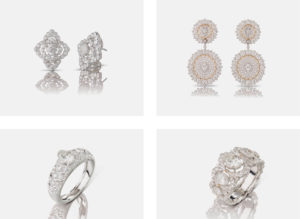
Growing up, what is your first memory of Italy?
Andrea Buccellati: A beautiful summer spent in Santa Margherita and Porto no.
Luca Buccellati: I remember the long mountain walks in Cortina d’Ampezzo
Lucrezia Buccellati: The sound of the bells of the church next to my house, the fresh cooking aromas, and my grandmother singing Italian songs.
Maria Cristina Buccellati: Playing on the beach in Santa Margherita listening to a very famous song “sapore di sale” by Gino Paoli.
Where in Italy do you like to travel to?
Andrea Buccellati: Everywhere! All places in Italy are very peculiar and different from one another. I love the sea, so the places I love the most are Sardinia, Sicily and the Amal coast.
Luca Buccellati: Tuscany a place deep in my heart.
Lucrezia Buccellati: Everywhere but depends on the season.
Maria Cristina Buccellati: Mostly Puglia it is a region with beautiful landscape, great culture, art, architecture and fantastic food.
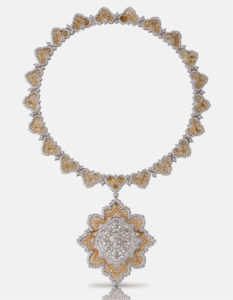
Elettra Necklace
Can you share with us any Italian traditions that you to this day continue with your family and friends?
Andrea Buccellati: There are a lot of traditions in Italy, but in the end, a nice dinner with family and friends is one of my favourite times ever.
Luca Buccellati: Cooking for my friends.
Lucrezia Buccellati: Eating Panettone for Christmas.
Maria Cristina Buccellati: The double kiss when you see each other, and I am afraid we will have to stop these due to the current situation.
What’s your favourite Italian dish to eat?
Andrea Buccellati: I like fish, cooked in any way.
Luca Buccellati: Lasagne.
Lucrezia Buccellati: Pasta al pesto.
Maria Cristina Buccellati: Mozzarella.
What’s your favourite Italian phrase?
Andrea Buccellati: “vivi e lascia vivere” meaning “live and let live.”
Luca Buccellati: “Made in Italy.”
Lucrezia Buccellati: “Chi dorme non piglia pesci” meaning “who sleeps won’t take any fish.”
Maria Cristina Buccellati: “Chi c’è, c’è” meaning “who is not here, is not here.”
How would you describe Italy in one word?
Andrea Buccellati: The cradle of culture, architecture, music, and all the beauty in the world.
Luca Buccellati: Home.
Lucrezia Buccellati: Heritage.
Maria Cristina Buccellati: Home.
READ MORE:
Panerai CEO Jean-Marc Pontroué Explains How the Brand Captures the History, Style and Culture of Italy
Italian watchmaker Panerai combines the culture and style of Italy with the expertise of Swiss watchmaking.
Giovanni Panerai opened his first watch workshop in Florence in 1860 and he quickly developed a close link to the military sector; in particular, the Royal Italian navy, for which he created innovative watches that would stand up to the demands of the men wearing them when out at sea. The Royal Navy’s requirements were very specific: the watches have to remain underwater in extreme conditions for long periods. Therefore, their resistance to extreme tension must also be guaranteed. These specific demands meant that Panerai was a leader in its field when it came to using modern, innovative techniques.
In 1997, Panerai was acquired by the Richemont Group and it debuted within the fine watchmaking market with new distribution channels and growing to a global presence. The original collection comprised of two models: the Luminor and the Luminor Marina in three versions. In 2001 after a meticulous refurbishment, Panerai’s historic boutique in Florence was reopened. A restyling of the original Piazza San Giovanni premises became an artisan’s workshop and a meeting point for brand collectors and enthusiasts, who can find not only pieces from the current collection but also special edition watches and special productions that Panerai reserves exclusively for its boutiques. Then in 2002, Panerai opened its manufacturer in Switzerland, which would allow the brand to benefit from the knowledge of expert Swiss watchmakers who created Panerai’s first in-house movement in 2005.
Panerai has continued to celebrate its relationship with the sea and the Luminor watch remains even today as the key watch of the house and it has been reinvented many times. At the helm of the brand is CEO Jean-Marc Pontroué. He joined Panerai two years ago with a clear idea, not to change the brand, but to change the way it is perceived by customers around the globe. Here we discover how he using the influence of Italian style and culture to shape up the future of the brand.
What does Italy mean to you?
Italy to me and I think to the rest of the world, represents nature, beauty, fashion, taste, and artisan. It is a country that has an intensity of beautiful things. There is this way of living that Italy has been able to share across the globe. It has empathy, positivity and optimism that are extremely unique in the world.
Tell us more about the importance of “Made in Italy” and why do you think there is such a fascination with this concept globally?
It’s in the mind of everyone all around the world that when you have something that has been made in Italy, it captures a certain charm and way of living. It’s the colourful approach, the avant-garde techniques which something that’s pioneering. Whatever product you’re buying, you are getting the flavour that will remind you of trips and vacations to this beautiful country.
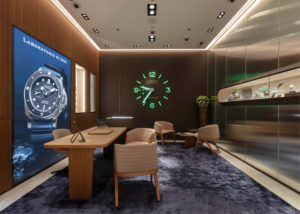
How are the values and culture of Italy translated through Panerai?
It starts when you enter a Panerai store as they welcome you by saying “buongiorno” not hello or welcome, so you are immediately greeted in an Italian way. Even though our watches are made in Switzerland everything else about Panerai– the style, the communication the DNA of the brand – is very Italian. I think it’s very important to keep sharing this message to the world, as this is something that makes Panerai very unique. We have the best of both – Italy for its style and Switzerland for its technique of watchmaking. And the relationship between these two assets has been one of the key reasons for the success of the brand. In the future we will be doing even more things that are associated to Italy, all of the features of our watches will be associated in some way to the country and we will have Italian names for our watches. So we are trying to infuse more and more Italian stories in the brand.
Panerai has a beautiful story and history, what part of the story inspires you the most?
The first is, as you mentioned is that it’s Italian and everything that goes with that is fascinating. The second is that Panerai began with a watch that was not only created for its design but for its technical capabilities as a functional tool and this became the watch that we know now. The fact that we come from the military industry means we do not have the usual watch assortment. When Panerai first began we didn’t have a specific target group or an assortment of sizes or dials – the watch was a very technical military tool, and the beauty of what we did with Richemont was to transform that into a watch that has an appeal that is unique in our industry. I think this Italian military origin is fascinating because we are the only ones who have this aspect and we still maintain it.
Panerai Luminor Marina – 44 mm (PAM01117) and Luminor Marina CarbotechTM – 44 mm (PAM1118)
What do you expect to see happening for Panerai and the industry after this crisis we are currently experiencing?
The first thing is that we don’t know. We are in new territory and so we are preparing for the future in a very cautious way. But we will continue to invest in research and development, new materials and creating emotion. At the end of the day, we are emotion providers and we are here to create stories. I think people will be much more careful about their investments and I think the distribution is going to change with a growing number of people shopping through e-commerce and people wanting to get the right value in what they invest in. But I strongly believe that things will recover. It may take a while but the business will be back and I know this because we are in the business of emotions. It’s not the first crisis we face, although this is a hard one because it is impacting the whole world and it is impacting travellers as well, and that is where a lot of business will be affected. Dubai without tourists, for example, wouldn’t be Dubai and until tourism is back to normal we won’t be back to normal.
When this is over will there be any changes in how you move forward at Panerai?
We have a five-year plan, which we update regularly. So far, we will continue to make watches the way we did and we haven’t changed our plans to create new models. We will probably reduce the number of innovations for this year slightly but otherwise, we don’t see any other reason at this stage, to change anything else related to the brand.
So many of the major exhibitions have been cancelled this year and stores closed, what is Panerai doing to stay close to the consumer during this time to share news and novelties?
We have presented our novelties through a virtual “Watches and Wonders” presentation. Here we introduced the themes for the year and highlighted the key stories. The question we have been asking ourselves is ‘how can we explain to the world that we are continuing to make watches?’ So the creativity of the brand will be expressed through a few events between now and December. Since we cannot travel at this moment, this is the only way we can do this. I want to be able to speak to customers via video or phone and we try as much as we can to stay close to them. We have teams that are working from home to assist customers over the phone, so there are many ways we can stay connected.
Submersible EcoPangaeaTM Tourbillon GMT – 50 mm Mike Horn Edition (PAM01108)
When it comes to novelties what can you tell us about the highlights for 2020?
The key stories of this year will be about Luminor. The Luminor is, of course, the historical product of the brand and the one that people recognise even if they don’t know much about Panerai. It’s been seventy years since Panerai invented this typical case and this year is all about highlighting that. There will be many innovations.
The first one is to continue the focus on Luminor Marina, celebrating its 70th anniversary. With Luminor Marina – 44mm Panerai celebrates the essence of the legendary luminous compound with a new Luminor Marina notable for its particularly high visibility in the dark. The second is the Luminor Marina Carbotech. Panerai pays tribute to the past with a watch that will benefit from seventy years of guarantee. This watch will be limited to an edition of 270 pieces.
The Luminor has never been produced in precious materials, so for our third pillar, we will reveal some precious materials for this iconic model. Finally, we have the Luminor Marina Fibratech. This uses a new material called Fibratech which is 60 per cent lighter than steel, resilient and highly resistant to corrosion. It’s a first in the industry.
We also have the Submersible EcoPangaeaTM Tourbillon GMT – 50 mm Mike Horn Edition (PAM01108) which is a special edition watch limited to just 5 pieces that take us back to watches as tools. This special watch is designed to be a tool for daring pioneers. It will allow the wearer to live a once-in-a-lifetime experience in the Arctic with explorer and brand Ambassador Mike Horn. So we will be playing with all the ingredients of Panerai in different ways.
Luminor Marina FibratechTM – 44 mm (PAM01663)
To what extent do you think offering experiences and sharing moments with the client is key?
I truly believe that the opportunity we have with Panerai is that it’s a brand that has so much storytelling. It has the link to Italy, it’s about the technique, new materials etc. I have discovered through the archives of the company how rich it was, and how passionate our customers are, and these people want to know more about the brand. But you can’t do this just through the store or the website – they want to be part of the story. So that’s why we had some incredible experiences last year – one in Italy and one in Tahiti. They were created to allow our customers to discover the brand and understand it, not just through the product but also through the experience. This is a unique method that we will continue to bring in the future. Having a great product, plus an experience that creates a new concept.
What can you tell us about Panerai and sustainability?
It’s a very important topic for me because Panerai is closely linked to the oceans and we know that one of the major fields of the deterioration of our environment is linked to the oceans. Panerai has launched an initiative called “Panerai Ecological” which is gathering resources to make our world better. This could be through us producing all the energy for our headquarters ourselves or ensuring our staff use public transport or bicycles instead of cars and it is also related to the products. My target is that within the next two years we want to be the first brand creating a product that is 100 per cent recyclable. So far, we already have a tourbillon where around 30 per cent of the watch is made of recycled components. We have a strap that was made from plastic bottles, and a dial made from fishnet, so we are already going in that direction but we want to apply this more and more to some of our watch concepts.
Do you have any plans for the Middle East?
I was supposed to come to the region and I am following all the information to find out when I can be able to start to travel again, and as soon as I can, coming back to Dubai will be one of my priorities.
What is your first memory of Italy?
Venice. I think that was the first place I have visited in Italy, I recall seeing it in books and magazines, but I was even more positively surprised when I saw it with my own eyes.
Where is your favourite city?
There is a spot called Liguria – where you can walk between the beautiful villages and it’s really impressive, I love to visit there. Italy is really about small villages and incredible restaurants and hotels that are not necessarily in the guidebooks. You need time to discover what this country really is and luckily I have had time to do that since joining Panerai. There are three places that I love to visit always and would highly recommend: The Riva Lost Hotel in Firenze, The Hotel Continentale in Firenze (it has an amazing terrace) and La Fontelina restaurant in Capri.
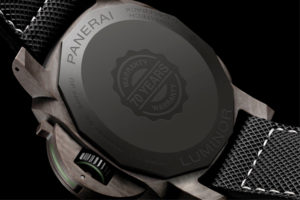
What is the motto you are living by during this time?
Enjoy each and every second that you are alive. I knew it before, but you appreciate it even more during this crisis because you are at home and you have the energy to appreciate each second even more.
What’s your favourite sentence in Italian?
“Laboratorio di idee”, which means “workshop of Ideas” because it expresses what Panerai is about and it describes all regions of Italy.
How would you describe Italy in one word?
It’s not easy in one word! If I have to it would be versatility.
READ MORE:
