

Giambattista Valli Fall Winter 2020-21 Haute Couture
Giambattista Valli unveiled its Fall/Winter 2020-21 Haute Couture collection yesterday via a digital presentation starring Joan Smalls.
The video saw Smalls wear the 18 looks of the collection which were inspired by the nature of Paris. The video shows the model in a studio while a split-screen saw images of a quiet Paris during the lockdown. Creative Director Giamba was inspired by the ways in which nature has still carried on with its beauty this year, despite the rest of the world shut down.
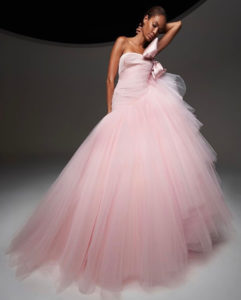
The pieces were created while the design was in lockdown at his apartment in Paris. Inspired by the wild flowers on his balcony the looks are true Giambattista Vallie style with grand volume, layers of silk tulle, taffeta bows, chiffon, voluminous skirts. Fabrics were sculptured in unique ways that create bold show-stopping looks.
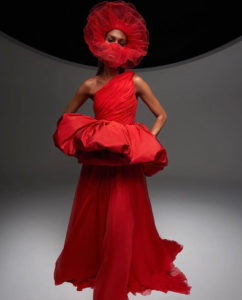
This feminine feel-good collection is exactly we all need to let us dream at the moment.
Georges Hobeika Showcases Fall Winter 2020-21 Haute Couture in Lebanon
Lebanese couturier Georges Hobeika debuted his fall/winter 2020-21 Haute Couture collection in a spectacular show at the Rachid Karami International Fair in Tripoli, Lebanon.
With the current global pandemic making it impossible to travel and continuing economic crisis in Lebanon causing huge worry for all, Hobeika wanted to keep things closer to home and sourced all of his crew, models, production team etc. from Lebanon itself.
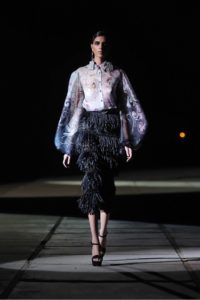
There was no audience at the show, however, the presentation was streamed live on the designer’s Instagram account for all to discover.
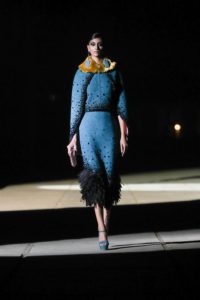
The collection; “Madame President” is a glimpse into a new era of aspirations. Inspired by the strength of the modern Middle Eastern woman Hobeika created looks that represent strength, respect, equality and a better tomorrow.
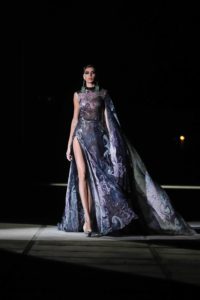
With a dark backdrop the boldness of the looks stood out. Demanding attention as each model walked the runway. A myriad of colour and texture, each look represented power and strength.
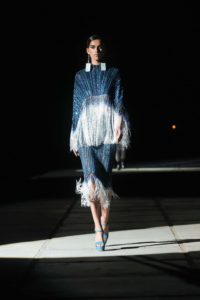
Hand-sewn sequin details, embroidery, tassels and feathers all highlighted the best in savoir-faire.

Fur was a large part of this collection and for the first time, the House announced that it is using a special faux fur that offers a much more sustainable alternative.
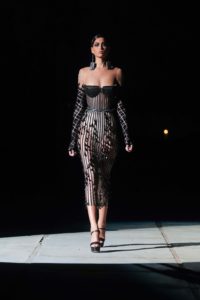
While bold architectural looks offered a modern take on couture that was powerful in its own way.
There were stunning red carpet gowns in bold colours with striking cuts and silhouettes – making us dream of the days when the red carpet will be walked again.

Hobeika partnered with make-up artists Bassam Fattouh who created a glamourous strong beauty look on the models. Accentuating the eyes with thick dark liner and finishing with a bold red lip.
Ralph & Russo Presents its Fall/Winter 2020-21 Haute Couture Collection
As many brands had to explore new ways of presenting their fall/winter 2020 Haute Couture collections this year, Ralph & Russo came up with a unique idea to showcase their latest designs.
Envisioned by Tamara Ralph while at her home in lockdown the Collection was inspired by the seven wonders of the world. These iconic landmarks brought to light the ways in which many of us are appreciating the beauty of nature more than ever. Ralph wanted her audience to look beyond the testing times we have all been facing and allow their minds to dream in a world of fantasy.

Tamara Ralph
The collection itself was bold and colourful – vibrant tones of yellow gold, sky blue, lavender and fuchsia pink – all colours that resonate with better ties. Silhouettes were architectural and bold – reflecting the landmarks that inspired them.

Floral details were key – adding the nature aspect to the creations. From three-dimensional organza blooms to swathes of oral taffeta and tweed – each distorted, blurred like watercolours, and digitally printed – the collection defies singularity, bridging the gap between technology and the elements.

At a time where we cannot physically travel to some of the world’s wonders, Tamara Ralph looked at ways to showcase the collection. The first was a virtual presentation which we saw online as part of the virtual Haute Couture Week. This gave a glimpse into how the collection came to life, from Tamara’ sketches created in lockdown to the finished product.

The second part of sharing the collection came in the form of an avatar and muse named Hauli. This virtual model was Named in traditional Swahili after strength and power, Hauli is at once rooted in African origins and a reflection of womankind; of the beautiful and inspiring women bringing courage and positive change to all four corners of the world.

In a virtual fashion shoot, Hauli travelled to the seven wonders of the world, presenting some of the looks against these stunning backdrops.
Discover the Fairytale of Dior’s Autumn Winter Haute Couture Collection
Dior presented its Autumn/Winter 2020-21 Haute Couture with Le Mythe Dior; a unique whimsical film, broadcast online today (6th July 2020). The collection, designed by Creative Director Maria Grazia Chiuri took the viewers to a fantasy world of magic and beauty that will make the audience dream.
The film was created by one of Italy’s most highly acclaimed film directors Matteo Garrone. Designed to not tell a story, but to evoke emotions and present the inspirations for the collection. It was a fairytale celebration of the Ateliers and their excellence of savoir-faire.
Shot in Garrone’s signature style using powerful plays on shadow and light beautiful Haute Couture creations come to life as if by magic. The film brings to life the journey between the imaginary worlds that inhabit the collection. We see the juxtaposition of a fantasy world, while work continues in the Dior Atelier creating the Haute Couture pieces – representing the coming together of two magical universes.

For the collection, Maria Grazia Chiuri was inspired by surrealist art, a perfect way to interpret the surreal world we are living in currently. Ahead of the release of the film the Creative Director said: “Surrealist images manage to make visible what is in itself invisible. I’m interested in mystery and magic, which are also a way of exorcising uncertainty about the future.”

It was the work of three particular artists that inspired this collection. Lee Miller, Dora Maar and Jacqueline Lamba, who transcended the role of “muses” to which their beauty had initially relegated them in order to champion – in their lives and surrealist works – a different kind of femininity. This is the attitude that forms the basis of the Haute Couture collection, an idea that is connected, attuned to nature and transformation.

In the film, the Haute Couture designs are presented on miniature mannequins, travelling on a journey through a fantastical world. A colour palette inspired by the artists’ works we see gradients of red, like a coral reef swaying in the ocean. Materials are soft and floaty, capturing the moment.

Day looks included suits, created in men’s fabrics featuring exceptional architecture representing a virtuoso feat. A coat reveals pleated layers. Draping evokes antique statues. Luminescence sublimates the grey and golden yellow tones, offering a dazzling brilliance.

The grand finale was a full lace wedding dress, made completely by hand and representing tradition, taking us to another world.

Each of the looks was created in a miniature version, completely by hand by the Dior Ateliers. Highlighting the attention to detail that goes into every Haute Couture piece.

This collection allowed us to dream. Dream of better times another place or dream for the future. Maria Grazia Chiuri truly captured the moment in which we are living.
Trussardi Reinvents Some of Its Classic Styles With an Exclusive Capsule Collection
Italian leather goods and fashion manufacturer Trussardi continues its collaborations by partnering with Giulia and Camilla Venturini, founders of the bag brand Medea and protagonists of Archive+Now°1.
The Italian designer sisters who are known for their bold choices colours, have been selected to interpret two of the Trussardi’s iconic accessories.
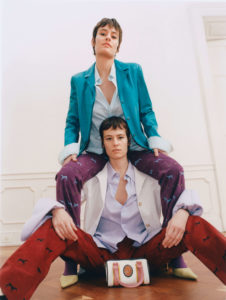
The mini bag and the mini baguette, already part of the brand’s historical archive models from the 80s, were redesigned and updated through the aesthetic vision, and the eclectic language of the creative duo.
The two designers were inspired by cinema, including movies by Federico Fellini, Pier Paolo Pasolini and Luigi Comencini to create the capsule collection of bold coloured accessories.

The Mini Bauletto and Mini Baguette are made of tumbled leather. Each bag features the oval greyhound logo, introduced by Nicola Trussardi in the seventies as an emblem of elegance, sophistication, and dynamism, is the protagonist. A combination of vibrant and pop tones – typical to the Venturinis – such as red and ivory, sky blue, orchid purple and black characterize the colour palette.
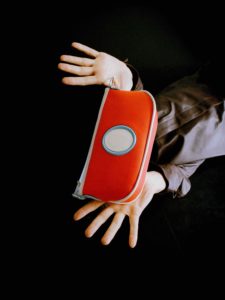
The common fire-red thread is seen through all of the revisited models.
The Giulia and Camilla Venturini x Trussardi capsule collection will be available starting the beginning of July in selected stores, and on Trussardi.com.
A. Lange & Söhne Partners With Virtual Classic Car Charity Competition
Watchmaker A. Lange & Söhne is the Official Timing Partner for the Concours Virtual vintage car contest in aid of UNICEF.
The online contest will feature more than 120 of the world’s most beautiful automobiles curated into 17 special classes. Over the period of a month, the Best in Show cars will be announced and all proceeds will be donated to charity.

Wilhelm Schmid driving his 1954 Frazer Nash Le Mans Coupe
A. Lange & Söhne CEO Wilhelm Schmid said of the partnership: “Sadly, the current situation does not allow us to get together and admire the beauty of classic cars with fellow enthusiasts. Many cars are currently hidden away in garages instead of being showcased. As the official Timing Partner of Concours Virtual, we are happy to make the cars accessible to a much wider audience and to raise money for UNICEF at the same time.”

Classic Days 2019
The German watchmaker has partnered with many vintage car competitions over the years, highlighting the common codes between classic cars and mechanical watches. Both created with a great appreciation of craftsmanship and built to last for a long period of time, with a pursuit of flawlessness.

Passion For Classic Events Key Visual 2020
For Lange CEO Wilhelm Schmid, the commitments reflect the company’s deep-rooted passion for sophisticated mechanics and classic elegance. “It is all about the idea of collecting, preserving and making sure these works of art survive the test of time. That is why we are committed to the world of classic cars. It reflects our passion for sophisticated mechanics and thrilling design, which is deeply embedded in the corporate culture of A. Lange & Söhne.”
The Concours Virtual classic car competition can be view at www.concoursvirtual.com
Salma el-Shurafa, Certified Executive Coach Discusses How Businesses Can Move Forward After COVID-19
As we continue to go through this uncertain time, businesses, no matter how big or small, are having to adapt in order to survive during this time.
There’s no hiding some will fail, but there are ways in which many businesses can change and switch their processes and outputs to ensure they will come out on top. Salma El-Shurafa, Founder of the Pathway Project is coaching businesses through this time. A Certified Executive Coach, El-Shurafa has coached many businesses in the region through transformations and times of change and supported them through growth. Of course, as the world changes, her own business methods have had to change and adapt to be able to support clients virtually and reach out to them in new ways. As many business owners are unsure of how to handle the new challenges they face, El-Shurafa is on hand to coach them through their new path to success.
How have you had to adapt your techniques to work through the current situation?
It was tough in the beginning. Most of my work is face to face and so it wasn’t easy to adapt at first. I had to step out of my comfort zone and ask myself the question “what is needed for me to adapt to this current situation?”. I had to shift my perspective ‘from it can’t be done’ to ‘it can be done’. Everything had to adapt to online processes to meet the current needs of clients at this time. Having my coaching sessions wasn’t an issue because I used to do most of them online. But what I really needed to shift was my workshops. I have now designed online workshops. I started to think of new ways to create content that is still deep and powerful. The current situation is making me re-define my business but what I always keep in the forefront, is not to lose the human component of what I offer. I am still learning. It is trial and error at the moment.
How can businesses adapt and change their strategies during this time? How do you think business owners will need to adapt their strategies moving forward after this crisis?
The pandemic is reminding us now more than ever that we live in a VUCA (volatile, uncertain, complex and ambiguous) world. It is very difficult to predict the impact of this crisis, but we know it’s a dire one. There is a necessity for businesses, big or small, to be agile in the way they operate and how they implement their strategies which means leaders need to be flexible and adapt quickly to the changes. Organisations and businesses need to understand their current context and anticipate changes by forecasting and planning for current and future actions. In these forecasts, they need to anticipate the consequences of decisions and actions for them to be more equipped.
They need to mobilise their resources through communication and cooperation, acting quickly and appropriately and creating conditions for sustainable performance. This is done by being clear on their purpose and vision and leveraging on their talent. This will support them in becoming for fluid and efficient and in building trust. They need to evaluate their current innovation strategies to decide if they need to create and/or improve products, processes and performance. It is key to identify the requirements of the current environment for them to plan ahead and identify actions that may need to be taken to recover and/or improve performance. It is navigating through these changes and understanding our customer needs to find ways that better meet those needs.
The questions businesses need to ask themselves are:
What is our purpose and vision? Does that need to change?
What are the required strategies and organisational structures needed in this current environment?
What are the needs of our customers?
What needs to change in the way we work today?
What is the type of leadership that is needed to lead the way?
How can we be more resilient in the future?
What have we learned so far from this crisis?
I think it is time for the world to start working together and develop ways to generate collective performance. Leaders need to be inclusive. We can’t act alone anymore. We need to go back to the drawing board and start looking at different factors and events that might impact us now and in the future. We have to be more equipped and ready for whatever comes. The question here is how can we build more interdependence?
What are some of the requests you have been seeing from business owners since this crisis starts?
Designing and delivering programmes online with topics around building trust and a growth mindset, developing mindfulness practices, building resilience and how to lead teams virtually. There have also been requests for executive and team coaching to support their talent.

What advice would you give to business owners who are worried about the future of their companies during this time?
Not to overthink and set their priorities to help them focus on what is important for their business at this moment. Do not dwell, in times of uncertainty, we need to think quickly. Breakdown thoughts, plan actions, take small steps and evaluate each step. The more proactive we are, the more we will feel in control and have the ability to navigate through these times. So, take action and move forward.
Look at the cup half full and find opportunities in this crisis. We are all experiencing intense emotions so the need to build a healthy mindset and apply self-care is crucial. Step back and take the time to connect with yourself to rejuvenate to help your business.
While many are working from home, what are some workshops and activities we can do to interact as a team during this time?
This is the time organisations should be investing in their talent. As we have seen, a lot of people have been focusing on learning new skills to develop themselves personally and professionally. And so, businesses should help them do so. Having coaching programs for individuals and teams can build team alignment, productivity and motivation.
Workshops on empathy and mindfulness can help individuals connect better to themselves and those around them. Some activities include having weekly hangout chats to bring teams together and doing 5-minute group check-in before each meeting to bring the “human” aspect to meetings. Having these types of interactions can help people connect and feel part of a community.
What do you think is something positive that will come out of this situation?
Realizing the importance of connecting with ourselves, our family and loved ones. This pandemic brought people together as a community. It showed us how generous we can be as human beings and how quickly we can adapt. We have become more aware and conscious and I think that is the beginning in reevaluating everything we have known to create a better future.
What is the motto you’re living by during this time?
I have many depends on the day! “Have faith and trust everything will turn out ok.” “Everything is figure-out-able” (A motto I adopted from Marie Forleo). I also encourage everyone to recite this serenity prayer: “God grant me the serenity to accept the things I cannot change, courage to change the things I can, and wisdom to know the difference.”
What is the message that you are sending to your clients at this time?
Time to step back and evaluate where you are and where you want to go. Take care of your mental health. Take time to create a balance and shift to a better or healthier lifestyle. Take the opportunity to realign yourself. There are possibilities and opportunities and in every upset, there is a setup for our growth.
How do you approach different business sectors and how does your advice differ from industry to industry?
We are all experiencing similar challenges which is how to keep people motivated and how to build resilience and relationships to allow us to continue to generate value for people and customers. People have become important. The only difference would be the organisational strategy.
How are you supporting business owners during this time of crisis?
Listening to their needs. Realigning them with their vision. Finding new plans. Helping them to build resilience.
Hermès presents its Men’s Collection for Summer 2021
Hermès unveiled the latest offering from menswear artistic director Veronique Nichanian today via a digital experience.
The show which was broadcast online was a collaboration with French filmmaker and theatre director Cyril Teste, who created a “live performance” that gave an insight into the creation of the collection.
In a ‘behind the scenes’ style film, male models got ready for a would-be show wearing the latest designs. The presentation gave credit to all those that work behind the scenes at the French fashion house and explained the “build-up” moment that usually takes place just before the show starts.

Veronique Nichanian said ahead of the presentation: “This collection is smaller than usual because we were cut off from our usual means of production. I also selected eighteen silhouettes where I normally select around forty, partly due to the nature of the performance. I said to Cyril: “Here is my collection, do with it what you will.” I brought him my work, he did his work, and together we created this moment.”

The collection is a carefree expression of lightness and simplicity, demonstrated through light materials, relaxed silhouettes and streamlined styles. Soft, and summer shapes that are light and easy to wear will make the perfect holiday wardrobe. The pieces were brought to life by Cyril Teste in his own unique manner at the Hermes workshop.

“In times such as these, it is necessary to assign more value to the process. We don’t want to create a fashion show or an absolutely finite performance. We want it to be an event: the process of creation experienced; a live sculpture as it were; an object generated at the very moment it appears — something that can only be achieved through precise stage directions, which take time and repetition to master. This collective process opens the door to chance, which is in truth quite a precise thing. Naturally, this is a risky proposition. I hope that our playful approach freed our endeavour from a “making of” vibe that was never our intention. The idea was rather to film what was off-camera.” Explained Cyril Teste.

The colour palette evoked the sense of summer and being swept away to warm blue Mediterranean seas with a colour palette of pastel tones and a hint of bolt colour. Refreshing blues, pure stone tones and almond greens were accented by fluorescent streaks of bold colour. Stripes were key throughout – in soft pastel colours, combined with white.

Adaptability was key throughout this collection. Blousons replaces the traditional shirt and featured removable colours. Suits had secretive pockets, and trousers featured elasticated waists and patch pockets. One pleat trousers have a soft relaxed feel.

The choice of fabrics reflected the mood of the collection, with many technical fabrics in play. Soft cotton poplin, linen and water-repellent Plume canvas led the way would technical canvas was created with stripes.

When it came to accessories they too evoked the sense of vacation. The Haut à courroies Cargo bag in H canvas and Evercalf calfskin, brought elegance while for a more relaxed mood the sports bag in Evercolor calfskin and Togo calfskin was the perfect addition.

The Slim d’Hermès watch came with a case in stainless steel and strap in Barénia calfskin while Mr Farrier scarves were seen in cotton and silk. Shoes came in the form of sandals in calfskin.
While the world is still trying to recover from the global pandemic, Nichanian reflects on how we can move forward after this time; “recent events and their damaging effects on the fashion world have not gotten me down. Quite the opposite in fact; I feel like the current situation is one from which we can all extract new wisdom and a new momentum. I have always believed it takes time to create clothes that last, that age well, that are more than merely functional and for which we feel real affection. My work has always focused on form, material, and colour. The frantic aspect of fashion does not interest me in the slightest. Here at Hermès we use an equestrian phrase that seems particularly apt in this day and age: “Straight ahead, calm, and poised”.
Dolce&Gabbana Presents Its Latest Collections Via An Exclusive Digital Platform
Dolce&Gabbana has presented its Alta Moda, Alta Sartoria, Alta Gioielleria collections with digital shows via and exclusive online platform.
All three collections were debuted from the House’s headquarters in Milan and shown to a select number of VIPs. We discover more…
Alta Moda

Dolce & Gabbana’s Alta Moda collection is the House’s take on Haute Couture. This year’s collection celebrated the best of Dolce Vita with a bold and colourful offering inspired by the beauty of Italian landscapes and travel.

The designer duo looked to old postcards to inspire silk prints, dramatic caftans and kimonos, satin swimsuits and playful colours. Accessories were in abundance – embellished sandals, wraparound headscarves, oversized sunhats and flower crowns made each look a little more special.

The work and craftsmanship can be seen in each of the 47 individual looks, each with its own personality and style. This summery collection would make the perfect holiday wardrobe – making us wish we were spending this summer in the beauty of the Amalfi Coast!
Alta Sartoria

The Alta Sartoria collection for men was title La Bella Italia. Taking inspiration from the style and the original extravagant personalities of the great visionaries and philanthropists who have always loved the Bel Pease.

Much like the women’s offering, this collection was inspired by Italian season resorts – Amalfi, Capri Portofino. With Italian tradition at its core, the collection had a modern twist inspired by many cultures. Embroidered kaftans, tunics and kimono-style jackets were paired with wide shirts, capri pants and soft shorts.

Suits were soft and unstructured – perfect for wearing in the summer months. Hand-embroidered needlepoint pinstripes highlighted the finest in Italian tailoring. Hand-painted and floral prints gave the collection a feminine touch.
Alta Gioielleria
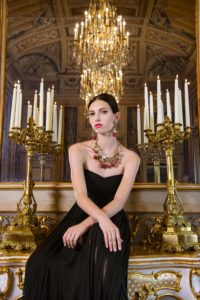
The Alta Gioielleria collection offers precious stones and goldsmith artistry that is unique to Italian tradition. Carrying through the theme of Italian, stones were chosen for the bright and colourful aesthetic – representing the hues of the coastal towns of Italy and capturing the beauty of the country’s nature.

Each of these exclusive pieces is created by hand, guaranteeing uniqueness, each one engraves with its own serial number and logo.
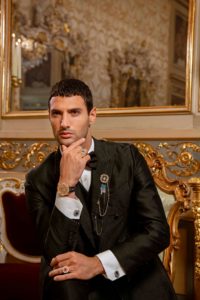
The most perfect crystals are chosen and analysed by the Dolce&Gabbana gemological laboratory. To guarantee their authenticity. All the jewellery is in 18-carat gold.
Read an Expert’s Guide To Video Calling
Cynthia Vincent, Master Virtual Training Instructor at BIZ Group shares the dos and don’ts of video calling and how to adapt to the new business environment.
We are living through a time of change. As the world continues to adapt to the COVID-19 situation, it has become clear that this is not going to be a short-lived crisis. Even as lockdowns and restrictions start to ease, many of us will continue adapting to a smart way of working and living. These changes for many of us have been difficult, but we have come to appreciate some of the luxuries we have today. When it comes to business, video calling platforms such as Zoom, have literally saved companies. Adapting to digital platforms has allowed many businesses around the world to continue many of their day-to-day running’s. Some may think that it has allowed global corporations to become closer, as they move onto virtual meetings that allow for more regular interaction with colleagues.
But the transition to the digital way of working isn’t always an easy one. There are many challenges that have and are being faced by businesses as they continue to navigate the new normal. And when it comes to virtually working many of us are still learning – should I have my camera on? What if my kids come running in? The rules of etiquette in the workplace are essentially being rewritten. Bring in Cynthia Vincent and Biz Group. Biz Group provides business and leadership coaching as well as team-building events to companies in the Middle East bringing together teams and allowing them to feel motivated and move forward positively. Unfortunately, the traditional methods of bringing teams together are obsolete in the current climate so it was crucial to adapt their learning solutions to digital platforms.
As a leadership coach and consultant Cynthia Vincent’s role has changed drastically since the beginning of the coronavirus crisis. Her usual role relied on personal interaction with individuals and businesses in order to train and develop in professional soft skills. When the crisis hit Cynthia was quick to adapt, transforming her skills and applying them to a virtual environment, in order to offer clients a service that was relevant and meaningful in today’s working environment. Here we discover with Cynthia some of the dos and don’ts of video calling and how businesses and individuals can quickly adapt to the new normal.

Cynthia Vincent
What can you tell us about your role as a virtual training instructor?
For more than 15 years I have worked as a classroom-based instructor and facilitator delivering Leadership, Communications and Soft Skills Professional courses. The harsh reality of COVID-19 changed that overnight. My professional survival demanded a quick pivot to delivering all learning virtually. Fortunately, I had attended a Virtual Instructor Training course several years ago on a whim. At the time I thought it would be a ‘nice to have’ feather to add to my cap. Fast forward to March 2020 and that turned out to be a VERY valuable feather! The first priority was to design and deliver a Virtual Train the Trainer course for our team of consultants so that they could make the transition to online delivery. Next, began the lengthy process of converting all of our Face to Face training programs to a virtual format or in the case of our Global IP Products, learning the Virtual content.
Since April I have been delivering training sessions exclusively via Zoom. There has been much to learn along the way but overall it’s been a great experience and we have received excellent feedback from the participants who have attended our virtual courses. Participant engagement is fundamental to the way we deliver the courses. We invest a lot of effort into our virtual delivery skills so that we ensure participants are happy and willing to give us their attention throughout the session.
What can businesses be doing to keep their employees motivated and connected during this time?
Regular check-ins are essential to keep employees motivated and connected. These check-ins on platforms such as Zoom or Teams can be one-to-one, as a whole team or even on an organisation level. Check-ins should be focused on connecting, clarifying goals and progress on KPIs, celebrating success and addressing challenges using collective intelligence.
It’s also important to empower people to tackle challenges to important issues. Giving ownership and then recognising achievements gives employees a sense of purpose knowing that they have made an impactful contribution to the team.
How are some businesses getting it right and what mistakes have you seen?
Jeff Bezos wrote in his April 2017 letter to Amazon shareholders: “Most decisions should probably be made with somewhere around 70% of the information you wish you had. If you wait for 90%, in most cases you’re probably being slow” I think this idea very much applies to our current reality.
- Businesses need to act with urgency coming up with targeted products and services that solve problems for their clients. None of us can be 100% or even 90% sure about the choices and actions we need to take to survive this crisis. But analysis paralysis wastes valuable time. Businesses simply can’t afford to not take action; salaries need to be paid, the bills keep coming and market share will go to the early responders.
- The best organisations create safety for experimentation so that employees are comfortable trying things that have never been done before. A culture of fear squashes innovation. And innovation is exactly what is needed today. But with innovation and experimentation, there will inevitably be mistakes and failed ideas. A culture of safety will mean that people feel comfortable sharing their mistakes so that the entire team can learn from them ensuring that processes can be improved and similar problems can be avoided in the future.
- Finally, we all have to learn, learn, learn. Most people agree that the post-COVID-19 world will be dramatically different from the past. Businesses need to help their employees learn the new skills needed to succeed in the future.

What can you tell us about some of the courses you’re running to assist in effectively communicating and working virtually?
One of our most popular courses is Think on your Feet®, a course that develops and practices the skills needed for spontaneous communication – face to face or virtually – so that you speak with clarity, brevity and impact. We also offer a course through our partnership with The Ken Blanchard Companies® called Leading Virtually that addresses the skills needed to lead virtual teams.
Finally, another course we offer from The Ken Blanchard Companies is Building Trust which unpacks this very important component of leadership – particularly in times like these when we are disconnected and concerned with what the future holds.
What is something positive that will come from this situation?
Speaking for myself, this experience has taught me to not take opportunities to connect with my colleagues for granted. It has made me more empathetic – not everyone is coping well with the dramatic changes in our lives professionally and personally. We have all been there for each other and this has brought us closer. Finally, we have all enhanced our skillset and moving forward will be able to seamlessly switch between in-person or virtual ways of working together.
How do you see the workplace changing for good once all of this is over?
This experience has taught us to work in a leaner more cost-efficient manner. Future efficiencies will be used to invest in making the business stronger and more resilient.
Necessity meant that we all had to be more adaptable and not tie ourselves strictly to our job description. I hope this flexible mindset continues once life gets back to the new normal.

How has Biz Group adapted digitally to the current crisis?
Rapid response agility has been the key to our successful digital transformation and more importantly a team of talented and committed employees who have been living one of our core values – Believe Anything is Possible every day of the week. I won’t lie, we didn’t have the solution to this crisis perfectly mapped out from the start. But we acted quickly, pulled the team together, assessed capability, identified subject matter experts, invested in technology platforms and threw ourselves into a flurry of learning, adapting and project planning.
To begin with, we fast-tracked learning on the digital platforms needed to effectively do our jobs such as Microsoft Teams and Zoom by running multiple short learning sessions on those platforms. The next step was to maximise our engagement with the many team collaboration tools available. Finally, we have taken advantage of the ways these tools can enhance human connection; we have a morning huddle every day on Zoom and have regular Zoom social gatherings on Thursdays either at lunch or after work.
The learning curve over the past two months has been steep but with a huge effort from everyone, we can now confidently say that we are ready and able to respond digitally to the unprecedented circumstances we have found ourselves in.
What can you tell us about the three pillars of Content, Credibility and Connection?
An easy way to get every video call right is to master the 3 pillars of Content, Credibility and Connection.
Content:
- Make sure you are clear about the agenda or purpose of the call and stick to that topic as much as possible.
- Use the tools of the platform to maximise the contribution of all participants, hands up, chat box, ticks and crosses allow everyone to contribute
- When you contribute, make sure your comments are user-friendly (Unique, Succinct, Evidence-Based, Relevant). Most of us have short attention spans in the virtual world. Keep your comments brief, clear and to the point.
- Assign a Scribe to capture follow-up actions and post the document to a common platform or email to the attendees.

Credibility:
- Be prepared to contribute and add value to the discussion.
- . Looking professional and pulled together is part of establishing credibility. It’s not a beauty contest but rather a pleasing and professional look that matters.
- Remain calm in the face of technical disobedience. If things go wrong, do your best to remedy the situation and if needed reschedule the call.
- Laptops are preferable to phones for most situations and do your best to consider the environment around you. The best background is neutral and professional with good lighting.
Connection:
- Enable your camera. Cameras are the next best thing to in-person connection. It’s very difficult to build rapport and read between the lines when all you have to go on is a blank computer screen. And when using your camera, make sure that you are positioned in the middle of the frame and when speaking look directly into the camera (as opposed to staring at your screen)
- Organise a daily huddle. 15-20 minutes for the team to connect is gold dust to keeping everyone engaged and aligned.
- Make small talk when people log in to the meeting, build rapport, break the ice and show interest in their lives outside of work.
- Lighten up and remember to smile. Your body language will influence the mood of the group and a bit of humour from time to time is a great way to connect.
A few things to perhaps consider when working with video calls:
Microphone – unless you are in a noisy environment keep it off mute so that you can seamlessly join in the conversation. Headsets are an asset because not only do they improve your sound quality but they also reduce background noise.
Clothing – I think formal work attire (ties and jackets) looks a bit odd at the moment. Few of us would wear a jacket and tie at home so everyone will know that you just put it on for the call. That said, I think wearing a t-shirt or pyjama top to the office video call is too far in the other extreme. A smart-casual look should be sufficient. Pro-tip: avoid busy patterns, solid colours look best on camera. And make sure they don’t see your pyjama bottoms if you stand up during the call!
Camera – for the average employee, built-in laptop cameras are sufficient. But if you want to look professional you can’t beat the quality of a good external webcam – Logitech has some affordable high-quality cameras and even the simplest models do a great job.
Background – In an ideal world you would have a simple, tidy background but not all of us have the luxury of dedicated office space when working from home. Many of the video call platforms offer virtual backgrounds or at least the option to blur your background. If using a virtual background stick with a neutral, professional background rather than ‘working from the beach’ unless it’s an informal call. Warning: be aware that background bloopers can also involve family members moving from the shower to dressing rooms!
Lighting – The best lighting solution is turning your laptop so that you face a window. If that isn’t possible make sure that you are not sitting with a window behind you and a simple desk light facing you can work wonders.
Make-up – Unless you are the main event, makeup should be optional. My best advice is to turn your camera on before the call and make your own judgement. If you have always worn makeup to work, however, not doing so might signal that you are a little bit ‘too relaxed’ or have rolled out of bed just in time for the call.
What about kids/dogs?
Let me start by saying that I think we have all become more tolerant of these kinds of distractions. In particular, parents with young children are facing incredible challenges in working from home. If possible, schedule your calls at a time when you know kids will be occupied or when you have someone at home to help. If the kids are old enough, set some rules around times when interruptions are allowed and when they aren’t. That may be a post-it note on the door or a hand signal when they approach.
As far as pets are concerned, if you can put them in another room that would be best. On the other hand, if locking them away sends them into a barking frenzy then perhaps allowing them to rest nearby is the best solution.
If all else fails and the interruptions happen don’t take it too seriously. If needed, switch off your camera and microphone, sort it out and return to the call as quickly as possible. And, when it happens to someone else, a little bit of empathy and understanding will go a long way.
Should we arrive on time?
While you are familiarizing yourself with the technology I recommend signing on about ten minutes before the call. Once you are more experienced with the platforms, five minutes early is great … it gives you time to chat and connect with your colleagues. Exactly on time can be risky if you face any tech problems but should be acceptable if you connect seamlessly. Arriving late in person or virtually is never a good idea. The best practice is for the host to start on time out of respect to those who made it a point to be on time. Arriving late means that you will potentially interrupt the flow or at the very least miss the key opening messages. And most importantly, always being the latecomer doesn’t speak well for your personal brand.
How do we know when to speak?
When on a call of up to four people I think it’s fine to have microphones on and to naturally jump in as you see fit. This may mean that you occasionally talk over each other, but with small groups it is manageable. If you are hosting a call, demonstrate a bit of authority making sure that everyone has a voice and politely managing those who are overcontributing. If you are on a call with more than five participants it’s useful to use the tools available on many platforms such as the chat box and the hands up. This does, however, require that the host or a co-host keeps their eyes on those feedback panels to manage the contributions.
What time should we schedule calls for?
It depends on individual preferences and other commitments. Generally speaking, most people have more mental bandwidth for clear thinking in mid to late mornings.
It’s also important to take into consideration cultural holidays and religious rituals (such as Ramadan) as well as time zone considerations when working globally. If you are part of a global team then it’s a good idea to schedule regular meetings on a time rotation so that one group doesn’t always have either the very late or very early time to deal with.
If you’re interested to find out more about how you can tackle the challenges of working from home and leading virtually with confidence, contact Biz Group on 04 146 2400 or visit www.learningwithbiz.com
Discover a Cruelty Free Make-Up Brand Founded in the UAE That Gives Back to Young Women
The Dubai Dolls is a Dubai-based homegrown beauty brand focused on producing cruelty-free, Paraben-free and gluten-free products.
This means that none of the products are tested on animals and all ingredients are chosen after strict testing to ensure they are kinder to your skin. What’s more, all of the Dubai Dolls’ packaging is completely recyclable.

Founders Priya Judge and Gayatri Sagar
Founders Priya Judge and Gayatri Sagar wanted to find a way to give back to the community with their brand so they set about creating an initiative that would give back and help young women. The Dubai Dolls support and improve girls’ access to quality education in developing countries. 2% of every sale goes towards ensuring that girls from underprivileged and undernourished backgrounds receive one year of nutritious lunch meals as well as access to an education in a private institution.

What’s more, for several months this year The Dubai Dolls donated 100% of their sales towards helping labourers receive basic essentials during the COVID-19 pandemic.

The Palm Lipshine
The Dubai Dolls offer four shades of Lipshines that are named after the most popular destinations in Dubai: The Burj, an iconic red; La Mer, a bright coral; The Palm, a naughty nude and Marina, a popping Fuchsia.

Marina Lipshine
The Dubai Dolls products are available at www.thedubaidolls.com. Whatsapp orders on +971 56 500 0283 are also accepted.
Christoph Grainger-Herr, CEO of IWC Schaffhausen Talks the Future of the Watchmaker and the Latest Novelties
IWC Schaffhausen prides itself on engineering solutions and innovating products for the future while never forgetting the heritage of the brand.
Something that has been key to the watchmaker since its beginning in 1868. Founded by American engineer Florentine Ariosto Jones who arrived in Switzerland with a vision, today the brand’s heritage combines American engineering techniques with Swiss craftsmanship to create something very unique.
CEO Christoph Grainger-Herr has been with the company for over 14 years and has seen it develop over the past two decades. Since becoming CEO Grainger-Herr has had a focus on widening the reach of IWC’s watches, particularly in the younger market through developing innovative designs that were authentic and true to the DNA of the watchmaker. Here we discuss the latest novelties that were presented at Watches & Wonders earlier this year, as well as the future for the watchmaker in the Middle East.
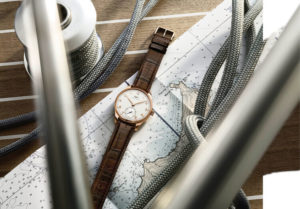
PORTUGIESER AUTOMATIC 40
Can you share a little about the Watches & Wonders platform and how it has allowed you to communicate the message of the brand and new novelties this year?
When the idea for a digital edition of Watches & Wonders came up, we immediately jumped on board. We saw this as an opportunity to underscore our pioneering spirit. IWC has repeatedly created excitement and enthusiasm with its spectacular booth at Watches & Wonders. This year, we spared no effort to turn the presentation of our new Portugieser collection into the exclusive and immersive digital experience that people have come to expect from IWC. Using a series of in-depth conversations with the people behind IWC, we brought our new Portugieser watches directly from our home in Schaffhausen to the homes of journalists, partners and customers across the globe. Visitors even had the opportunity to take a virtual walk around our booth. Another highlight was the innovative Augmented Reality application, which allows you to discover and experience the new models directly on your wrist or anywhere in your environment.
We want to talk a little about the new novelties that were launched through the platform – what can you tell us?
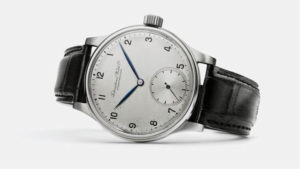
We launched our new Portugieser collection through Watches & Wonders. One thing that I am particularly proud of is that all new models are fitted with IWC-manufactured calibres. This underscores our commitment to technical excellence and is also a testament to the significant investments IWC has made in recent years, in manufacturing capabilities and quality. For the first time, we have equipped the Portugieser Chronograph with an in-house movement from the 69000 calibre family. We are also presenting attractive new models with slightly smaller diameters. One of my favourites is the Portugieser Automatic 40, a compact three-hand model in the iconic design of the original Reference 325 with the small seconds at “6 o’clock”. The Portugieser Perpetual Calendar 42 is an entirely new model with IWC’s iconic perpetual calendar in a very wearable size of 42 millimetres. Another highlight is the third-generation of the Portugieser Yacht Club, which we presented in a 44-millimetre case with reworked proportions and a beautifully finished stainless-steel bracelet. The talking piece is the Portugieser Yacht Club Moon & Tide, the first IWC watch with our newly developed mechanical tide indication. Lastly, we presented a selection of Boutique Editions in an overarching maritime design code in gold and blue, among them two high-watchmaking references with tourbillons.
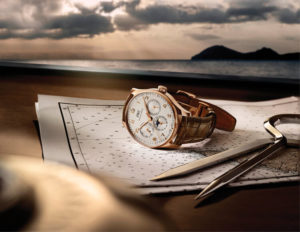
PORTUGIESER PERPETUAL CALENDAR
How important do you think it is to be inspired by the brand’s heritage and historical watches when creating new designs?
The Portugieser has been a part of IWC’s history for over 80 years and is one of our flagship collections. When you face the task of updating such an iconic line, you need to respectfully study its history, while still trying to introduce something new. Our goal was to create a bridge between the past and the future; to surprise our customers with new aspects, while making sure they will instantly recognize the collection as the IWC Portugieser. We achieved this through introducing new models like the Portugieser Automatic 40, the Portugieser Perpetual Calendar 42 or the third generation of the Portugieser Yacht Club while securing an overall look which is true to the nautical heritage of this watch family. By combining the pure and timeless design characteristics of the original with details and colours inspired by modern yachting, the new collection has a consistent and contemporary look.
What can you tell us about the Portugieser and how it’s developed over time but continued to remain relevant and contemporary?
The Portugieser is one of our most prestigious product lines. The first Portugieser, or Reference 325, was created in the late 1930s to the specification of a “marine-chronometer-precision” wristwatch for two merchants Lisbon. Its clean and functional dial was inspired by the deck observation watches of the time, nautical precision instruments used to determine longitude on ships. The amazing thing about the Portugieser is that its design has hardly changed since then, and it looks just as fresh and contemporary today as it did over 80 years ago. The characteristic minute’s scale, Arabic numerals, slender feuille hands and the small seconds at “6 o’clock” have later appeared virtually unmodified in many other Portugieser models. For example, in the Portugieser Anniversary Edition, the Portugieser Minute Repeater or the Portugieser Hand-Wound Eight Days.
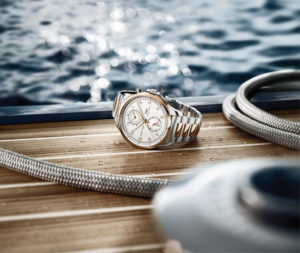
THE NEW PORTUGIESER YACHT CLUB
What can you tell us about e-commerce at IWC and where is its position within the company currently?
We are pursuing an omnichannel distribution strategy which encompasses IWC Boutiques, authorized retail partners, and e-commerce on iwc.com. Online sales have been an essential part of our strategy since 2017. It’s an option that the young generation of technology-savvy customers expect from a luxury brand today. We want to offer our customers a choice and not tell them where and when to buy their watches; this decision is entirely up to them. I think what is critical is the service aspect. Our service needs to be on the same level, regardless of which channel the customer uses. A customer may decide to buy a watch on iwc.com from his smartphone while he waits for his flight. Another customer will maybe buy his watch after a three-hour discussion with one of our sales associates in-store. For both of them, the experience needs to be equally perfect and at the top of the game.
You became CEO at IWC around three years ago – what can you share with us about your strategy since then and what would you still like to achieve going forward?
I joined IWC more than 14 years ago and have since held various positions within the company. In 2017, I became CEO. One of the focal points of my strategy has been the extension of our manufacturing capabilities in the area of in-house movements. In 2018, we opened our new manufacturing centre in Schaffhausen, which I had the pleasure of helping to design as an architect. In this new facility, we are combining the making of movement-parts, case-making and movement assembly under one roof for the first time. The new manufacturing layout is organised in logical and sequential steps, from raw metal to finished movement or case. This approach allowed us to optimise production processes, improve communication, and implement a totally integrated quality management system. As a result of our continuous investments into technical excellence and quality, we introduced our new My IWC program last year. It includes an extension of the International Limited Warranty from two to eight years. When it comes to product development, I focus on functional engineering of complications, timeless design, and emotional storytelling. Another focal point is of case materials. Last year, we created excitement with the Pilot’s Watch Double Chronograph Top Gun Ceratanium with a case made of Ceratanium®. This new material combines the lightness and robustness of titanium with the hardness and scratch-resistance of ceramic.
Moving forward into the second half of 2020 will you be changing the strategy of the brand at all and do you think the buying habits of customers will change once the retail stores are open again?
IWC follows a very long-term oriented strategy. I don’t believe consumer buying habits are going to change fundamentally. Man’s desire to surround himself with handmade, decorative and emotional things has so far survived every distortion in history. Seen in this light, luxury goods are also insignificant either, but even vital for our emotional well-being. Especially in the current situation, many people will reflect again on what brings them joy. I can imagine, however, that it will be less the extravagant products that will be in demand, but rather those of established brands that have a high degree of legitimacy, a history and a radiant design. Many IWC product lines date back for several decades. For example, the Portugieser or the Pilot’s Watches were created over 80 years ago – and their iconic design appears as fresh and contemporary today as it did then. This is what makes our brand authentic and credible, and these are the qualities that consumers will be looking for when choosing a luxury product in the future.
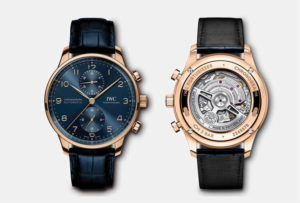
PORTUGIESER CHRONOGRAPH
How important is it to provide experiences for your customers today and how does IWC do this?
In the luxury industry, we are not only manufacturing beautiful products. We are engineering dreams that our clients fall in love with. These dreams range from the history of the brand to the actual product and the stories surrounding it. Experiences are an important part of these dreams. A visit to our new manufacturing centre in Schaffhausen, for example, has turned into an unforgettable experience for many of our most loyal customers. Seeing where our watches are made, allows them to appreciate them in a new way. In today’s environment, we are experimenting with ways to connect people digitally. In Singapore, for example, we hosted a virtual cocktail party, which took place inside a 360-degree digital rendering of our boutique. We sent our customers cocktail kits via mail so that they could prepare their drinks at home. We even provided a matching Spotify playlist so that everybody would feel the same vibe at home. Customers were able to walk around the virtual boutique, discover our new collection, and participate in video chats with each other or with people from IWC.
Where does the Middle East fit into the strategy of IWC and how important is this market to the brand?
The Middle East is an essential market for us. The region is home to many experienced watch collectors, and they do have a very high level of knowledge about mechanical luxury watches. Especially when it comes to high complications, they are an extremely discerning clientele. I am confident that watch lovers in the Middle East will be excited to see our new models with complications. The first one is the Portugieser Tourbillon Rétrograde Chronograph, which combines a tourbillon, a chronograph function and a retrograde date display. The second one is the Portugieser Perpetual Calendar Tourbillon. Both of these exclusive timepieces are available in the overarching design code of our Boutique Editions with cases made of 18 ct Armor Gold®. Thanks to an improved microstructure, this material has significantly higher hardness values than traditional gold alloys. The deep blue dials create a beautiful contrast to the cases. Other versions are also available in platinum, where silver-plated dials and rhodium-plated hands and appliqués harmonise wonderfully with the rare precious metal.
What is the professional motto that you live by?
To be passionate about what we do at IWC, to share that passion with my team, to inspire and encourage them to give the very best they can.
What do you think makes IWC unique as a brand?
IWC is the only Swiss luxury watchmaker that was founded by an American. More than 150 years ago, Florentine Ariosto Jones crossed the Atlantic and established the company by the banks of the river Rhine in Schaffhausen. Combining the advanced manufacturing methods from his homeland with the skilled craftsmanship of Swiss watchmakers, he laid the foundation for IWC’s unique engineering approach. Based on this heritage, we focus on developing technically elegant solutions that solve real engineering challenges and are practical and comfortable for customers to use. A great example would be IWC’s legendary perpetual calendar, which was developed by our former head watchmaker Kurt Klaus during the 1980s. Upset by the imperfections of mechanical calendars for wristwatches, Klaus designed a completely new calendar mechanism which is triggered via a single nightly switching impulse from the base movement. All its displays are perfectly synchronized and can be adjusted via the crown. IWC’s engineering approach has also led to timeless designs. The iconic design of our Pilot’s Watches in the style of an easy-to-read cockpit instrument, for example, is a direct result of functional engineering to the requirements from military aviation. Pilot’s Watches were used for performing celestial navigation in the cockpit, and easy legibility even under challenging visual circumstances was a fundamental requirement.
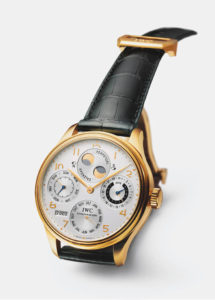
How would you describe IWC in one word or sentence?
IWC is engineered, timeless and emotional.
What watch are you wearing today?
Today, I am wearing the new Portugiser Yacht Club Moon & Tide. This timepiece is an excellent example of how you can respect the history and DNA of a watch family and still come up with something astonishing. If you look at the design of the watch, it has all the elements that have made the Portugieser Yacht Club a success since 2010. Taking the iconic double moon indication of our legendary perpetual calendar as a starting point, we have developed a practical mechanical tide indication which informs you about the approximate time for the next high and low water. The tide indicator can be set to any location on a cost with so-called semidiurnal tides and will then keep running in the 12 hours 24 minutes tide cycle. The mechanism is so precise it will only theoretically deviate by 10 minutes in 100 years. This complication is on the spot with the nautical heritage of the Portugieser, it’s respectful of the DNA of this line, yet it’s something completely new.
Bvlgari Will Open a New Hotel in its Home City of Rome in 2022
Bvlgari will add to its hotel portfolio with the opening of a property in Rome.
The new Roman hotel will be strategically located in the central Piazza Augusto Imperatore, in the very heart of the Campo Marzio neighbourhood, next to the iconic Spanish Steps and the signature Bvlgari flagship boutique in Via Condotti.

When it opens its doors, The Bvlgari Hotel Roma will occupy a current building facing two of the most iconic Roman landmarks: the Ara Pacis and the Mausoleum of Augustus, the first Roman Imperator. The building was built between 1936 and 1938 and has become an iconic piece of architecture within the historical city which emphasises the traditional use of Roman materials and colours including ochre Travertine marble and red brick.

The Bvlgari Hotel Roma Renderings
The architectural project and interior design of the hotel will be handled by Italian architectural firm Antonio Citterio Patricia Viel who have worked on all other Bvlgari hotels around the world.
Bvlgari CEO Jean-Christophe Babin said in a statement:
“We are particularly proud to have secured such an extraordinary location for the new Bvlgari Hotel in Rome. This Hotel, to be opened in 2022, represents a remarkable achievement for Bvlgari that will finally have its own ‘temple’ right in the city where the Company was founded and that still represents nowadays the beating heart of the brand. It will be by far Roma most luxurious hospitality experience ever.”

The Bvlgari Hotel Roma Renderings
The hotel will feature over 100 rooms, most of them suites as well as Il Ristorante the restaurant curated by Michelin-starred chef Niko Romito and the Bvlgari bar, both of which will be located on the top floor with spectacular views across the city. A range of wellness facilities will as well be available, with a high-end spa and its indoor swimming pool, and a state-of-the-art gym offering Bvlgari’s exclusive Workshop training method. As a unique feature, the Bvlgari Hotel Roma will also present a Reading Room containing a collection of precious volumes dedicated to the history of jewellery, which will be open to guests and public by appointment only.

The Bvlgari Ospitalità Italiana Necklace
To mark the occasion of the announcement of the Bvlgari Hotel Roma project, Bvlgari created “The Bvlgari Ospitalità Italiana Necklace” a special jewellery piece, reflecting the legendary house’s outstanding creativity and expertise.
This one of a kind white gold Tubogas chocker is enriched with 10 different precious stones, each of them matching the luxury destinations of the Bvlgari Hotels & Resorts collection.
READ MORE:
How Bvlgari is Contributing Towards Building a Better Planet for Future Generations
Discover Italy’s Must Visit Holiday Destinations
A History of the Fondazione Prada, a Modern Way of Understanding Art and Culture Today
Dubai Based Life Coach On Why Now is the Perfect Time to Make Big Changes
As we live through this time of crisis it will affect people in many different ways. Some will thrive and embrace a time of reflection, while others will struggle in isolation, desperate to be outside or travelling again.
But one certain thing is that have all been given time to slow down. For some it will be through spending more time at home, focusing on the jobs we never had time to do. For others, it’s a chance to share moments with family. And for others, it’s an opportunity to feel at ease with our own company. There will be bad days, but that’s nothing to be afraid of. British life coach Maria Tansey has been working with her clients through this period, many of whose priorities have drastically changed since COVID-19 came into play. Here she shares with us some of the ways to get through the down days and which this time is a moment of opportunity for many of us.
How do you think this period of “lockdown” is something that many of us needed?
There has probably never been a time in our lives where we were all given ‘downtime’ like this, removing many pressures of our daily routine, and for the first time, allowing us to take a step back from routine to review what we were doing and press PAUSE on our lives. Pressures from our daily routine might not even be felt or noticed until we step away and have the opportunity to wind down. Of course, this situation doesn’t represent ‘downtime’ for everyone, and for many, their schedule could have increased, particularly those who might be homeschooling and working from home. But the challenges might be different now.
As we start to adapt to the changes that are happening, what advice would you give to those who are wary of getting back to “normal life”?
‘Normal routine’ might sound attractive right now, although I do think this period will have given many people a chance to reflect on how they were spending their time, who they were spending their time with and a chance to consider whether they want to make changes to their ‘old normal routine’ before they resume ‘normal life’ again. Now is a great time to implement any changes that you want to make.
As a life coach, what is your new normal?
I have been working with my clients on Zoom from home, so my new normal has given me a bigger window for exercise – which I didn’t always manage to do before. On a personal level, I have been focusing even more on my eating habits, because during the downtime between each client I am at home and able to prepare all my meals – with no excuses to order take out or eat chocolate and snacks! I adjusted my working hours to suit many of my clients so I have been working with clients late into the evening meaning my sleeping pattern has been a little crazy!
Out of every crisis, there is always a positive – what are some positive things that can come out of this situation?
There are so many positives that can come out of this situation! Learning to have a greater appreciation for things and people that we normally take for granted is one of the biggest positives. I believe most families and friends that are quarantined together will come out with even stronger bonds and most likely newfound respect for what others are dealing with on a daily basis.
It also gives us necessary reflection time to do reflect on our lives to ensure that whatever we are spending our time and money on and who we are spending our time with, are still in line with our priorities and our values. Time has allowed many of us to complete jobs and tasks which we might have been putting off for a while and has also allowed us to recognise that it wasn’t ‘time’ that was preventing us from finishing those tasks but maybe lack of motivation instead.
What advice would you give to people who are getting cabin fever over the summer?
I’m not sure I can call it ‘advice’ because I don’t know the impact that this situation has had on each different person. I think that everyone needs to get through the situation in the best way they think is possible. Personally, for me, the situation has impacted me financially which has caused me to worry, but on the other hand, I am enjoying the downtime and making my routine work to support the goals that I set for myself before the lockdown. I am a big believer that if you can’t change a situation, then it’s best to see the positives that work for you because it’s wasted energy to focus on the aspects that we have little or no control over.
Particularly in the Middle East many of us won’t have seen our families for a long time – what advice can you give on keeping connected and keeping the positivity with loved ones?
I’m sure this aspect has been particularly tough on many people, and not just because of the lack of contact with families but also the worry for their safety if they are abroad. Our families will all have different worries and we can’t assume that they feel the same as us. I would say, don’t be afraid to reach out as often as you need to, forget about what a normal level of contact is, and do whatever you need to get through this situation. On the other hand, reach out to anyone who hasn’t been in touch in case they need you too but are afraid to reach out.
How do you think values and priorities have changed with this situation?
There is nothing like a ‘once in a lifetime’ situation to force us to question our priorities and values. I would anticipate that lots of people will make BIG life changes following the ending of this situation, maybe not straight away, but perhaps 6 months after returning to ‘normal’. There has been a greater focus on our health due to the nature of the situation and on what we spend most of our time doing every day, so living life to the fullest and taking a ‘now or never’ approach to our goals and dreams might resonate even more at this time.
In your own words how would you describe life after COVID-19 and how do you think things will change?
In the short term, social distancing will become a big part of our lives and that will change things drastically. I think we will continue to have a heightened awareness of personal hygiene, particularly in public places or with strangers where bacteria can easily transfer from surfaces, but honestly, I think that we will resume life as normal with our friends and family. We all need physical contact and frequent hugs are scientifically proven to lower blood pressure, increase oxytocin levels and generally improve cardiovascular health.
What is a lesson we can all learn from this time?
I think that everyone will learn a different lesson from this time, but something I hope that everyone learns is to have even more appreciation for the things they took for granted and gratitude for all the positive aspects of life.
What advice would you give to those who also have children to motivate over the summer?
Take each day as it comes, try not to judge yourself for anything you do or don’t do. The children will survive, whether you do crafts with them every day or give them an iPad to watch. Now is not a time for judgement. If it bothers you, don’t look at what other parents are doing on social media. If your kids are driving you crazy, it doesn’t mean you’re a bad parent….it just means you need a chat or catch up with friends!
What should we do on “dark days” to pick ourselves up again?
I would accept that those days might come, and they might come at the times when you least expect them. I think it’s normal for some days to seem darker than others, even if there isn’t something obvious that is causing it. Some people prefer to be alone at those times and others need to talk with friends and family. Allow feelings to come and then let them go.
What is the motto that you’re living by at the time?
“This too shall pass!”
Giorgio Armani Named Special Ambassador for Responsible Tourism by the World Tourism Organisation
The World Tourism Organisation (UNWTO) announced on 3rd July 2020 that fashion designer Giorgio Armani is the new UNWTO Special Ambassador for Responsible Tourism.
The UNWTO which is based in Madrid, Spain acknowledged the announcement in a statement:
“Giorgio Armani is a global reference for his timeless designs and creativity as well as for his profound commitment to social responsibility and respect for the environment. His fashion brand is inspired by the concept of substance and the conviction that sustainability means creating a system capable of enduring through time, with respect for all the resources and the awareness that the future of generations to come depends on the choices of today.
The designer understands that the change of the fashion industry is necessary and strives to use the platform of his fashion company to contribute directly and indirectly to the transformation of the industry so that it can best serve and support its communities.”
Mr Armani was presented with a special plaque to acknowledge his continued commitment to the environment and the community, demonstrated through a number long-term initiatives. The Secretary-General of the UNWTO Mr. Zurab Pololikashvili thanked the designer for preserving jobs throughout the recent difficult times of the COVID-19 pandemic and for his generosity in supporting front-line workers.
Upon receiving the plaque, Mr Armani said:
‘I am genuinely pleased to have been honoured in this way by an organisation that believes that people should be encouraged to see the beauty of the globe in a respectful and responsible manner. It has been a sense of responsibility for our community that has helped my country through this terrible pandemic, and this too is what has driven me to play my small part in helping those engaged in the fight against the virus, and the fight against the economic challenges it has posed.
A belief in community – the global community – and an appreciation of the humanity we all share are what will help us build a better future for ourselves and the generations to come, through being mindful of the important things in life, like the preciousness of the environment and our duty to protect it. It is therefore an honour to take up the role of Ambassador of Responsible Tourism.’
Giorgio Armani most recently showed support to the local community with his response to the COVID-19 pandemic, offering support to Italian hospitals by pledging a large donation as well as switching all of Armani’s Italian production plants to manufacturing single-use medical overalls. The designer has often spoken of his wish to support the community in Italy and even wrote a public letter to healthcare workers that was published in national newspapers in Italy.
Gilberto Calzolari on His Dedication to Sustainability and What the Fashion Industry Can Do to Change the World
Gilberto Calzolari has had dreams of creating his own fashion line since he was a child. Born in Milan, he worked under some of Italy’s finest designers, learning their craft and finding the right formula to launch his own label.
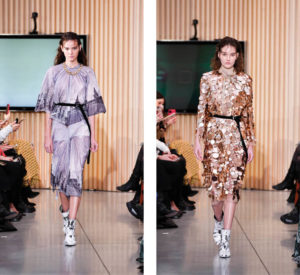
Calzolari soon realised his real passion lies in producing sustainable fashion. He wanted to create designs that are kinder to the planet but still have the same, if not more glamour and quality of regular pieces. The designer first stepped into the spotlight for his sustainable creations when he won the prestigious Franca Sozzani Green Carpet Award for Best Emerging Designer in 2018 for his dress created from used coffee bean bags. He went on to create his first collection made from fully sustainable materials and successfully carved out a niche for himself in the Italian fashion business at a time when few were doing anything of this level in relation to sustainability.
Since then he has continued to create sustainable fashion designs that women really want to wear. His approach to manufacturing is sustainable, but so too are his choice of materials. Calzolari has a unique talent for repurposing unwanted materials and creating something new. This could be anything from coffee bean bags, to broken umbrellas to fruit packaging. His unique eye allows him to be creative and at the same time help to save the planet.
His latest collection can’t be segmented into spring/summer or fall/ winter as it is a year-long collection, designed to meet the needs of consumers all year round and minimise waste from throwaway seasonal garments that are only worn for a few months. The collection was presented on the runway at Milan Fashion Week earlier this year; something that has been a dream of the young designer since he was a child. Here we discuss his continued effort in to lead the way of sustainability in the fashion industry and the experience of achieving his dream to present on-schedule at Milan Fashion week for the first time.
What can you tell us about the One-Year-Long collection that you have been working on for this year?
For my latest collection; “Tilt System”, I decided to get rid of the seasonal approach in favour of a year-long collection. I see it as a coherent step-forward in my path towards sustainability, which is not only expressed through the choice of materials but also in the production cycles with a “slow fashion” fashion approach. This also sees a return to tailored quality and exclusivity and breaks from the traditional seasonal model by offering an eclectic and surprising year-long collection, which touches all seasons.
What was the inspiration for the collection?
I see fashion as the perfect mirror of what is happening around us – a looking glass, at first faithful and distorted, that projects illusions but also reveals the deepest signals of our society, a society that is compelled to a radical change and demands new rules. While social networks flaunt wonderful fake lives, a world full of contrasts highlighted a system on tilt, where nature struggles under a severe climate change, seasons have lost their meaning, and a global crisis forces us to reinvent ourselves. This is the premise of my latest collection, and its title, “Tilt System” in a way anticipated the situation we are all living today. The truth is, the signs of a society on tilt were already there, way before the pandemic. In my new collection, I just decided to put a spotlight on them.
How do you think seasons are changing when it comes to fashion these days?
The current seasonal approach makes no sense, for several reasons. First of all, also from a climatic standpoint, due to climate change, seasons overlap more and more, and there’s a need for a more diverse wardrobe all year long. Moreover, from a sustainable point of view, we need to re-wire the system. It all started when high fashion decided to follow the rhythms of fast fashion, which brought an absurd frenzy of over-production and over-communication. Do we really need, each season, a pre, main and cruise collection? Do we need to create so many items that will inevitably end up on sale, creating so much pollution and waste? I truly believe high-end fashion needs to go back to a more artisanal approach, which is at the core of the Made in Italy greatness. And I believe that presenting a year-long collection responds to the customer’s needs in a better way. This September, I’ll present “Tilt System Volume 2”, which is the same collection with some variations of fabrics, prints and colours.
You recently presented your collection on-schedule at Milan Fashion Week for the first time – how was the experience?
For many years I worked for some of the most important luxury brands in the world, from Marni to Valentino, Miu Miu to Armani, so, in a way, I knew exactly what to expect, but to open the Milano Fashion Week with my own fashion show was a completely different experience. I felt like a professional athlete who, after many years of hard work, is admitted to the Olympics!
What can you tell us about the work Camera della Moda Italiana is doing to support sustainable fashion?
Nowadays, the challenges for an upcoming brand are immense, even more so if it’s a brand committed to sustainability, and I’m immensely grateful to Camera Moda for their unwavering support. Nowhere in the world, will you find attention and commitment to sustainable fashion like the one Camera Moda has proven since the get-go, which translates every year into a myriad of initiatives.
The world has come to a standstill currently – how do you think attitudes to sustainable fashion might change after this time of crisis?
If anything, I believe the situation we are living will make sustainable fashion even more relevant and imperative. It’s the only way. We owe it to ourselves, to our planet, and the future generations.
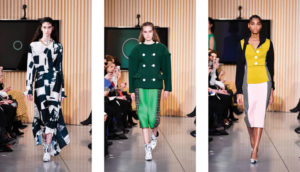
What are some of the methods and techniques you use within Gilberto Calzolari to ensure sustainable production?
My commitment to sustainability comes to life in various ways. In particular, when I create a collection, I follow 3 directions:
- The use of cutting-edge and technologically, advanced and environmentally friendly fabrics of natural origin, compliant with the most reliable certificates in terms of sustainability and traceability.
- The recycling of existing materials, such as beautiful stock fabrics discovered in renowned Italian textile companies.
- The upcycling of unusual materials transformed into couture fabrics: from the dress made with jute coffee bags and embroidered with lead-free Swarovski crystals, that earned me the Green Carpet Award as Best Emerging Designer, to the tulle coming from the nets for citrus packaging; from the clothes created with exploded airbags and discarded safety belts to those made with canvases of broken umbrellas.
Can you tell us about some of the materials you have worked with for your recent collection?
My latest collection features a multifaceted wardrobe where “women’s” cuts are paired with “men’s” fabrics and details, winter and summer clothes together, and styles from different eras collapse into unusual combinations. But there are always glamorous silhouettes, made from a variety of materials including patterned wool from regenerated yarns; organza and crepe de chine in 100% organic and GOTS-certified silk; fake-fur; recovered vinyl and neoprene. Semi-gloss satins of recycled polyester from PET bottles, in a mix of avant-garde, are sustainable fabrics on one hand and on the other, splendid warehouse stock fabrics discovered among reputable textile companies. Then there is the upcycling of unusual and original materials, which is a signature in my collections: in this case, dresses have been created from recovered sheets from broken umbrellas.
You have been an advocate for sustainable fashion for a long time but how have you seen attitudes and approaches to it changing over the years?
It’s been a constant process. I feel that in every collection I learn more about sustainability. Quite honestly, in the past two years, the landscape has improved a lot. This is thanks to new technologies, which mean you can find more and more sustainable fabrics, such as, to name a few, SEQUAL polyester derived from plastic recovered from the sea or EVO nylon extracted from the seeds of the castor plant. Soon we will be able to test fabrics made from grapes and mushrooms… there are no limits to the roads sustainability can take.
What still needs to be done in the fashion industry in relation to sustainability?
There’s still a lot of work to do. Producing sustainable fashion is still very expensive, starting with the costs of fabrics and processes. Only with greater cohesion and collaboration throughout the whole supply chain, from the supplier to the manufacturer, from the distributor to the seller, can we really make a change, so that people can perceive not only the importance but also the beauty – which is both ethical and aesthetical – of sustainable fashion. In this regard, we suffer from a lack of real communication and promotion towards the end consumer. There aren’t many retailers (be it boutiques or department stores) who pay serious attention to sustainable fashion and this is a problem considering that they are the ones who have direct contact and a relationship with the customers. I realise that although there is a lot of talk about sustainability nowadays, many still believe that sustainable fashion is somehow less glamorous.
This perception is completely wrong. The reality is diametrically opposite. Sustainability can and must be beautiful, glamorous and classy. It’s the only way high-end fashion can contrast the damages of fast fashion and prove its superior craftsmanship.
Moving forward what do you expect to see from the behaviour of consumers concerning sustainable fashion?
The paradox is that the end consumer seems more and more interested in sustainable fashion, especially the new generations who are much more aware of what they are wearing. But we have to put them in a position to be able to choose sustainable alternatives and to do this we need an important boost from the distribution, whether they are department stores or multi-brand boutiques because they are the ones who can make sustainability a real option.
Will you be changing any of the strategy of the company after the current global pandemic?
The main change right now is that the current situation forces us to be more digital. I’m working on an e-commerce platform that will offer pieces on a made-to-order basis. People want to have a more dedicated experience, and I believe that they are willing to wait a few weeks to receive an item that is created especially for them to avoid unnecessary waste. We must go back to making fashion an object of desire for which it is worth waiting. If this is what is good for our planet: true luxury does not lie in having everything at once, but in experiencing the exclusivity of craftsmanship sustainably and consciously, knowing that with your purchase you have been impacting less on the environment.
What is the professional motto you live by?
I often use the term “conscious glamour” when I talk about my brand and my vision. My mission has always been to prove that being sustainable means being chic and deeply creative. The woman I dress loves the environment but does not give up on glamour and style. Our job is to create beauty and sustainable fashion that’s twice as beautiful – aesthetically and ethically.
What is something that you would still like to achieve with the brand that you haven’t done yet?
I would one day like to be able to open a flagship store with a sustainable footprint in my city of Milan. Or perhaps in Tokyo, Japan, a country with a culture and an aesthetic very similar to my philosophy of life – a place of deep-rooted elegance and surprising contrasts where tradition and innovation live side by side.
Where would you like to see the fashion industry in terms of sustainable fashion in 10 years?
My dream is that in 10 years sustainable fashion will be the norm, so much so that we’ll no longer have to ask or specify if a garment is made with sustainable fabrics and according to protocols of social responsibility because it would be outrageous to imagine otherwise.
What are the things we as consumers should be doing in order to be more sustainable when it comes to our fashion choices?
Reduce, reuse and recycle. Buy less but buy smart!
What does the rest of 2020 have in store for Gilberto Calzolari?
It’s hard to make long-term plans in the current situation, which is constantly evolving. For example, it’s still not clear if and how the fashion week in September will take place. But the long-term goal is clear. The pandemic has forced everybody to reconsider their priorities, and the one thing I know is that we need to put sustainability at the centre of our industry.
4 Sustainable Fashion Trends to Look Out For
In the last decade, it has dawned on more and more of us that the clothes we wear have a direct impact on our environment.
The fashion industry with its high waste and disposable products is the second biggest contributor to the problem in the world. The interest in sustainability has skyrocketed in recent years and initiatives and technology have followed suit. In 2020 sustainability has become more in the forefront than ever. At a time when we are all starting to appreciate the importance of family and the beauty of nature, protecting the planet for our future generations is crucial. Here we discover some of the sustainable fashion trends that are helping to shape up the future of the industry in 2020.
Upcycling
Whether its re-working an old pair of jeans into a skirt or tie-dying an unwanted T-shirt to give it a new lease of life, make your re-cycling your clothing and finding new ways to wear it is about to become a huge trend. As many of us have more time on our hands and are less concerned with keeping up appearances, what better time than right now to begin upcycling our clothes? Find new ways to wear old pieces, by easily transforming them. An old skirt can become a headband for example or cutting off the sleeves of an unwanted jacket can make it a cardigan – there are so many ways to recycle your old clothing and minimize the waste. The simple process of at-home tie-dye is also on the rise and this is also a strong trend that we saw on the spring/summer runways this year. So why not get creative this summer and upcycle some of your beloved wardrobe items.
Fabric Innovation
On a corporate scale, fashion brands are getting more and more innovative with the materials they use to create their products. From unwanted plastic water bottles to used gloves, the amount of recyclable waste is going to be huge after the coronavirus pandemic and many brands are already looking to ways they can give these materials a new lease of life. One leader in the research of new production models for sustainable development, Italian firm Aquafil created Econyl. It is a nylon substitute, which now often appears in sustainable activewear as well as on watch straps, thanks to a partnership with Breitling. Econyl recycles and regenerates synthetic waste such as fishing nets and spin them into a textile product as robust as nylon. Not only does this bring down the ocean’s pollution budget, but it also mitigates the growing need for nylon.
Many brands have banned fur and are looking for synthetic alternatives that look and feel just like fur but are much kinder to the environment and of course to animals. Leather alternatives are also in the works with fabrics including Piñatex which is made from pineapple leaves, proving a successful alternative. Through a process of “decortication”, Piñatex extracts cellulose fibres of pineapple leaves after they are harvested. They are then “degummed’ and processed to become a non-woven mesh and then given a special finish. The final result is the leather-like appearance.
The Rise of Reuse
Second-hand clothing stores were once considered a fashion faux pas. In 2020, however, the rise of second-hand clothing is back. From swap shops with friends to online apps allowing users to re-sell their unwanted items, to second-hand boutiques, many of which we have in the UAE. In the fight against waste, second-hand shopping makes a huge impact on the problem. Not only do we turn our backs on fast fashion, we simultaneously rescue pieces otherwise destined for landfills. So next time you’re going to throw away your unwanted items, think about someone else who could benefit from your waste.
Rentals
One way to combat the turnover of fashion and also help with the price tag is to rent items. Especially in the UAE when many of us are required to dress up for event after event, there are times when we do want to invest in a new item but the reality is that we may only wear it once. So rather than splurging on new items so regularly, why not rent clothes and accessories that can be used for some time and then returned. There are a number of rental sites cropping up at the moment and the price is far lower than purchasing the item in full. Whether it’s for a job interview, a night out or a special dinner with friends, renting a look will also allow you to experiment with style choices, without breaking the bank.
READ MORE:
Dior to present Its Upcoming Cruise Collection in Italy as a Tribute to Italian Craftsmanship
Hussein Bazaza Launches E-commerce Site With an Exclusive Capsule Collection
Paris, Milan and New York Fashion Weeks Will Return From This Month
Mr Pascal Raffy CEO of BOVET Discusses the True Values of Watchmaking
With a history dating back to 1822, Swiss watchmaking House BOVET has almost 200 years of history.
Known originally for its pocket watches, the house has built a reputation on creativity and attention to detail using unique and artistic techniques to create highly complicated watches that are different to anything else on the market. Highly skilled artisans work meticulously with engraving, miniature painting, enamelling and many more painstaking techniques to ensure every watch reaches the standards of excellence and luxury that this house is about. BOVET produces its watches in small quantities to maintain absolute exclusivity for its collectors.
When Edouard Bovet founded the house in 1822, it was originally for the purpose of manufacturing pocket watches exclusively for the Chinese market. Yet after the great success in China, BOVET looked to the rest of the world and began manufacturing highly skilled timepieces, until 1939 when the house stopped producing for a while. Then in 2001 BOVET had a revival after businessman Pascal Raffy acquired it. Raffy, a fond watch collector himself and a proud owner of an exclusive collection of original BOVET pocket watches, vowed to bring the brand back to life. He purchased the stunning castle of Môtiers where he installed the BOVET assembly workshops and began creating timepieces once again. Today, Mr Raffy has a team of the finest artisans who continuously push the barriers of innovation while respecting the tradition and heritage of the house. Every timepiece is made under his guidance with passion and the most incredible attention to detail, making them exclusive and unique. Here we discuss with Mr Raffy the future of BOVET and the latest novelties.
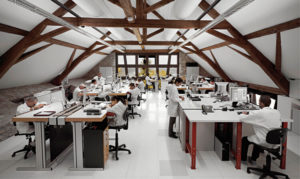
What can you tell us about the strategy of BOVET moving forward after this period of crisis?
I think in every bad moment you have to find optimism. As the captain of the boat, you have to give positivity to people when looking to the future. I think what we did at BOVET during the period of confinement has brought us all together even with the physical distance of being at home. It has tightened the relationships between our team and we have discovered that some people have become even more talented and stronger in their personalities. Some have handled the situation better than others but this can be expected. I see everyone that is a part of BOVET as an extended family and I have discovered a beautiful relationship with all of them. It’s not ideal to be talking through screens, but at least we have all stayed in touch and we have stayed occupied. We have had the time to discover in our statistics from the last five years a lot of joy and we have realised how much we need to thank our artisans and watchmakers for everything they do.
We were supposed to present five big novelties this year and when the crisis hit we decided one month ago not to disclose anything for a while. But now in Switzerland, things are starting to move forward again slowly, so we have made the decision, to start unveiling two of the big novelties in June and this will surely please our artisans, partners and clients. Then we will see how things are for the three other launches and perhaps these will be disclosed around September, all being well with the situation.
Can you tell us anything about the upcoming novelties?
Last year we presented the Dimier Récital 26 Brainstorm Chapter One, this was a watch I first had the idea for in 2015. Then last year I said to myself, I would love to have transparency on a precision Moonphase, that you have to adjust only every 121 years and I wanted an extension of the Brainstorm Chapter One with the Brainstorm Chapter Two in a very sustainable and logical way, so we came up with the bright idea to have a GMT on a beautiful domed presentation with a precision Moonphase, a gorgeous blue/green dial and a hand-engraved movement. All parts of the movement, from all sides, are hand-engraved by our talented engravers and it makes the timepiece balance. It comes with a flying tourbillon with a magnificent display of a beautiful power reserve, which we have inserted at noon and it can be seen through the sapphire case.
We always have the pressure when we are creating a timepiece that until it is ready we don’t know how it’s going to look, but we are very satisfied with this one as it is beautiful. This watch is a logical move for us in the brainstorm chapter.
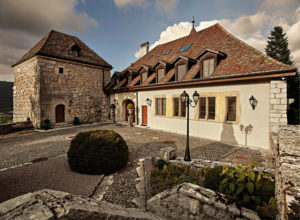
How is BOVET connecting with its clients during the lockdown period and what do you think they will be looking for from a watchmaker when this crisis is over?
I think the quality and loyalty we have first of all with our partners and distributors, including in the Middle East is really important. When you see the reactions of support and close relationships and mutual affection with have with our partners it absolutely helps at a time like this. For the collectors, of course, we don’t have the same ease of being able to travel, but we keep in touch with them and our partners enable us to do this. We have been sharing a lot about the timepieces including collections that we’ve had for a few years as well as answering questions on when they will discover the next step. Of course, we are all waiting for the moment when we can safely travel so we can meet again.
To answer the second part of your question, I have been saying for twenty years that tradition is not old-fashioned, values are important, making watches in small quantities with human manpower, and using artisans and sincerity in the timepieces you present. I hope that after this, all of these true values of life that I’ve been talking about for a long time will be at the forefront of people’s minds. I think we will see people wanting exclusivity and going back to what is real and authentic. They will want things with substance, good taste, and where you feel the human touch, and get more than what you pay for. I hope that we will go back to these true values.
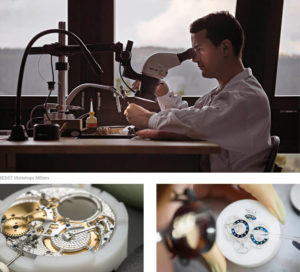
What does BOVET do to offer an experience to its customers?
The first and most important thing is service. I have always said when you go to a luxury store it’s all about service. It is the smile, the welcome, and the transparency. Our collectors have seen a lot and they have the education and knowledge of our watches. So when you compare prices in the market and you take a magnifying glass and look very closely at the details of our watches, I think you’ll smile to know that the extent of finishing that we have at BOVET for the same price range of other offerings that are of course very much respectable, but I think we push things a step further with the detail in our timepieces.
I have always said that I want my collectors to be as pleased as I would be if I was buying a timepiece for myself. So when we talk about ourselves, we want the best and that is why at BOVET we want to give our collectors something that they deserve.
In two years you will celebrate the 200th anniversary of the brand – what does having that much history mean for BOVET and how do you go about celebrating something like that?
For our 200th anniversary in 2022, we would love to have a big celebration. If everything goes well and there are no more catastrophes. When I look to the pocket watch timepieces of BOVET in my collection as I clean them every morning, they are still a huge inspiration for finishing and materials. I say to myself; ‘this house has been logical all through the years on decorative arts, using these skills to decorate a dial, a movement, a case, and it still has the ability to innovate.’ We are proud that we have not betrayed in any way, the soul of the House. We did not change direction because of fashion or trends. That doesn’t mean we can’t innovate; we have created 16 patents over the last ten years, but we still have that backbone of our DNA. If you see a BOVET timepiece of five years ago or one from today, you know immediately it’s a BOVET timepiece. The standard of excellence hasn’t changed. So we are very proud of this and our artisans are of course the first people who should be rewarded for this.
In your opinion what is the secret recipe for balancing heritage vs innovation?
From our point of view, I think the timepieces of BOVET are a continuation of our way of living. I’m sitting here in our fantastic castle and the nature that surrounds us is an absolute inspiration for colours. I am so inspired by trees, leaves and flowers but at the same time, with our materials that we innovate. We have 16 patents that are all about true engineering. If you take the Brainstorm case, for example, it has a very complicated shape, so polishing the sapphire is a very difficult process and also its the same to polish the Convex Bezel so we need to be able to go a step further by innovating but at the same time remain true to the traditions of the house. When you get the right balance between the two, that’s when it becomes poetry and emotion.
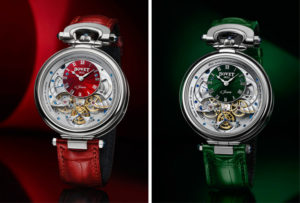
How do you ensure that the techniques used by the artisans at BOVET are passed down onto the younger generations?
Every day we have a new discovery at BOVET and it’s a joy. You have to invest in the youth who will absolutely open their talents within two or three years. We have to give them time, you should never put any pressure on an artisan, and they need the time to excel in their art. It’s very interesting to see these two schools of life – the experienced ones and the new ones – working alongside each other – it’s amazing. We have some young artisans, who are less than 30 years old, but if you see the way they engrave; it is pure talent. And of course, they love what they are doing and I always tell them if they have any new ideas to feel comfortable sharing them. For example, in the Brainstorm Chapter Two, when you see the movement from all the sides through the sapphire case – this was an idea of one of the young ladies who came to me and said ‘Mr Raffy, can I engrave so it looks like snow?’ So we tried it, she took her time and of course when we saw it, it was beautiful. It’s very delicate and so difficult to do. So with the younger generations, it’s all about time and patience.
In your own words, what makes BOVET Unique?
Uniqueness is related to luxury. For me, a luxury house must first of all have a very clear identity and I think that’s what we have, you can identify our watches as BOVET timepieces. Then there is the human aspect – everything is done by hand and must be done in small quantities – otherwise, it’s no longer luxury. Luxury for me means very rare. These are all the qualities BOVET possesses that make us unique.
Where does the Middle East fit into the strategy of BOVET and going forward what can we expect to see from the brand in the region?
I have to tell you I am delighted with our progress in the Middle East and I cannot thank our partners at Ahmed Seddiqi & Sons enough. Without our partners we are nothing, they are the continuation of our brand and they are in tune with the values of the House when it comes to respect and tradition. What I love about the Middle East is the ability for surprise. If you present something valuable and take the time to explain the details I see curiosity and I love that. It’s also about the culture. For me, to be close to the partners and the collectors in the Middle East is a true asset and we are very lucky. I was in Dubai in January with my team and I cannot forget the treatment we received. I have very good memories.
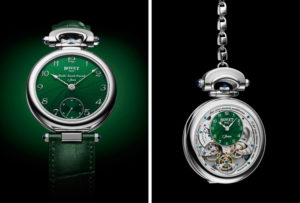
What is there still to achieve with BOVET that you haven’t done yet?
So many things! I think my aim since day one 20 years ago has been to consolidate a true watchmaking house with true values and transmit to my children and my extended family of artisans with the same good spirit, education and talent. It’s always that quest of sustainability in the collections, not compromising on the finishing, quality, service and every morning we find a new idea to enhance what we’re already doing. Every day is a new beautiful challenge. This period, in particular, is so challenging for all of us but I think we know that the way we do things with fine artisans and true watchmaking is the way it should be done. We have to be patient at the moment while so many people are suffering, but step by step we will all recover and get back to normality.
What do you think is the biggest challenge that the watch industry is facing today?
What is happening affects every industry around the globe. Everyone will face the same challenges at different scales of course, but it will be the same challenges for everyone. It is a serious situation that’s all about anticipation; patience and you have to be solid. I wouldn’t like to judge other houses, but you hear that the absolute majority of watch houses are feeling the situation seriously. Humankind has been set back to the real values of life and the economy has stopped for a moment and now it’s about learning step-by-step and hoping that these true values will take over because it’s a good lesson for humanity.

What’s the motto that you’re living by during this time?
It has always been the same; looking after my family. I love to work in nature in the mountains and that’s my balance of life, but my family, my children, my artisans are the most important. It was very natural for me to respect their privacy during this time but I tell everyone that if they need anything or want to talk they know I’m here for them. It’s my duty to do so. I love my balance of life, thanks to the people around me.
How would you describe BOVET in one word?
Uniqueness. Uniqueness in the offering, authenticity, quality and loyalty.
READ MORE:
Nicola Andreatta, CEO of Roger Dubuis Talks Innovation, Adrenaline and the Future
Socially Distant Safe Staycations in the UAE
Many of us have had to cancel our travel plans this summer leading to a much-needed break. Luckily for those of us in the UAE, the options of luxury travel are a little closer to home. We discover the sensible staycations to indulge in this summer, for private, safe and socially distant breaks.
Al Maha, a Luxury Collection Desert Resort and Spa

Al Maha Desert Resort and Spa offers the ultimate in privacy and luxury in the heart of the desert. This secluded resort features iconic vistas and sweeping plains that will allow you to feel a million miles away from home. The resort’s 42 individual Bedouin-style suites allow you to experiences the best of a luxury stay combined with an authentic desert experience. Each room features its own temperature-controlled infinity pool, wooden sundeck and direct access to the rolling desert dunes.

Each room is individually designed and accommodations range from a one-bedroom Bedouin Suite to a three-bedroom presidential suite with room for all the family. Order breakfast to your room and indulge on the terrace while enjoying the beauty of nature. You won’t have to see another soul during your stay!
Rixos Premium Saadiyat Island

Rixos Premium Saadiyat Island has reopened its doors and offers a home-away-from-home escape with its luxurious Superior 4 Bedroom Villas. These Arabian style villas feature a cosy garden and private pool, overlooking the pristine white sands of Saadiyat beach. Each villa has a dedicated Butler who will be on hand throughout your stay to meet any requests or needs.

The resort has implemented enhanced hygiene protocols and stringent safety measures to protect the health and well-being of guests and employees, in accordance with the local government and the World Health Organization (WHO) guidelines.
Bvlgari Resort Dubai

Bvlgari’s luxury resort in Dubai combines Italian excellence with UAE life with its 20 stand-alone villas. Each one looks out on to the white sandy beach and comes complete with its own temperature-controlled swimming pool, private sun deck ad personal butler service. Choose from one, two or three-bedroom properties, all of which come complete with state of the art technology and the finest in home furnishings. The largest of all the villas and the ultimate in privacy and luxury is the 540Sqm Bvlgari Villa.

This villa boasts its own private beach, private security access, oval pool, ocean views and a huge 500sqm garden. The Bvlgari Villa features three bedrooms and is perfect for large families. More Arabian inspired than the other villas, the main living area, complete with floor to ceiling windows, has touches of the traditional Arabic majlis, including its warmer colour palette and textures. The Bvlgari Villa is the only villa offering guests a private indoor Jacuzzi, a personal gym fitted with Technogym equipment and private hammam.
Nikki Beach Dubai Resort & Spa

Nikki Beach Dubai’s luxurious villas offer a Mediterranean experience in the heart of Dubai. All of the resort’s villas have access to private terraces and come complete with minimalist modern interiors. The Nikki Beach Pool Villa features its own private pool and access to the beach. The bedroom and living areas feature floor to ceiling windows, offering panoramic views across the ocean.

There is a private dining area on the terrace, as well as plenty of room for relaxing in the sun. The Nikki Beach Ultimate Villa has three bedrooms and a large dining area. The Ultimate Villa is strategically located between Nikki Beach resort & Spa Dubai and Nikki Beach Beach Club and comes complete with its own entrance. The villa comes complete with private chef and 24-hour in-house host to meet your every need.
Ritz Carlton Rak Al Wadi Desert

This picturesque resort offers extraordinary views across the Arabian desert in a luxury Bedouin-style setting. The peaceful villages come complete with private pools and decks, lounge area, luxurious bathrooms and floor-to-ceiling windows with desert views. While many of the resort’s activities will be limited due to the current situation, you can still experience star-gazing, bird- watching, nature walks and cycles and much more.

Choose from a tented pool villa with direct access to the desert, or an enclosed pool villa for maximum privacy. This resort is perfect for all the family, allow the kids to enjoy themselves in the private pool while you relax and take some well-deserved time out.
The Oberoi Beach Resort, Al Zorah Villas, Ajman
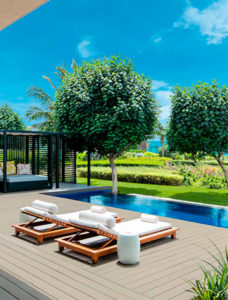
Just a short drive from Dubai The Oberoi Beach Resort, Al Zorah in Ajman offers modern luxury in stunning surroundings of natural mangroves. All rooms at the hotel offer privacy with a private garden in many, while others have a sun terrace. But the most private of all are the villas with private pool.

These modern spaces feature a large pool and private garden so you can relax and unwind with your own company. The villas range from a one-bedroom premium villa to a three-bedroom private villa with pool Each comes with green space and a modern living area, so there’s plenty of room to relax in this home away from home.
Zaya Nurai Island

Just off the coast of Abu Dhabi, you’ll find a peaceful haven. Zaya Nurai Island is the ultimate getaway for those looking for island life but not wanting to travel too far. All of the resort’s accommodation options are private ad secluded so you can choose one that best suits your needs.

The beach villas come complete with a private pool and direct access to the white sandy beach. An outdoor shower gives you a taste of authentic island life. The larger beach house is perfect for families and features a spacious living room, two bedrooms and two private infinity pools. The water villas offer views out across the ocean. With four bedrooms these stunning properties are ideal for large families. The villas have a huge infinity pool as well as rooftop dining and BBQ terrace. The perfect escape.
READ MORE:
Discover Italy’s Must Visit Holiday Destinations
Melia Desert Palm Launches Wellness Retreat Packages
How Bvlgari is Contributing Towards Building a Better Planet for Future Generations
Gucci Beauty Launches Two New Fragrances
Gucci Beauty has launched two new Eau De Parfums as part of its Alchemist’s Garden Collection.
The two luxury fragrances; A Chant for the Nymph (pictured) and A Midnight Stroll each possess key ingredients of Incense and the Frangipani flower. Envisioned by Alessandro Michele and Master Perfumer Alberto Morillas these two perfumes are the ultimate in luxury.
The Alchemit’s Garden Luxury collection is crafted from pure natural plants and flowers layered with modern molecules. Each fragrance in the collection is inspired by the science of alchemy, telling the story of a place, moment or memory. The scents and oils are customisable and transformative when layered, allowing the wearer to curate a distinct identity from their chosen combinations.
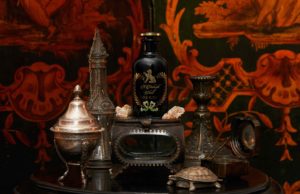
The two new additions to the collection add new accents to the luxury offering. A Midnight Stroll uses the key ingredient of Incense. A homage to the allure of night. Epitomised by a jaguar, imagined to caption the essence of the scent’s mystery. With its combination of aromatic Incense and intense smoky Cade Wood, the jaguar moves under the cloak of darkness, as fresh Cypress channels this expression of vitality.
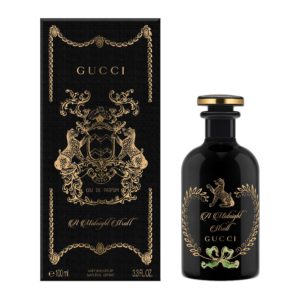
Gucci – The Alchemist’s Garden – A Midnight Stroll
The second; A Chant for the Nymph is an ode to tropical forests filled with sublimating solar flowers. With a key ingredient of the Frangipani flower this scent symbolises immortality thanks to its enduring smell and enchanting beauty. Frangipani is combined with Ylang Ylang and sensual Tiare flower and warmed by soft vanilla.
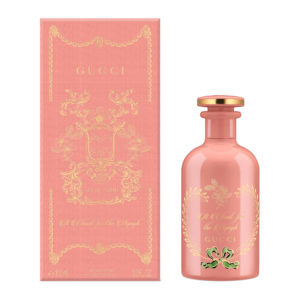
Gucci – The Alchemist’s Garden – A Chant for the Nymph
READ MORE:
Must Have Summer Beauty Essentials
Beauty Giant Shiseido Supports Healthcare Workers on the Frontline in the Fight Against COVID-19
La Maison Valmont is Offering Personalised Beauty Advice Wherever You Are in the World
Must Have Summer Beauty Essentials
The latest skincare, make-up and fragrance solutions that will beat the heat and become your must-have products over the coming months.
Charlotte Tilbury

The queen of beauty magic Charlotte Tilbury is back with some hot new launches this summer. We all know the hot, dry weather can take its toll on our skin, so dedicate this summer to adding some life back into your face with Charlotte’s new skincare launches. The first is the long-awaited Charlotte’s Magic Serum Crystal Elixir. This tried and tested product has been years in the making and is a scientific formula designed to create glowing, hydrated and youthful-looking skin. The product contains the Tilbury Magic 8 complex of ingredients along with new breakthrough ingredients and plant adaptogens to tackle clarity, radiance, texture and skin resilience.
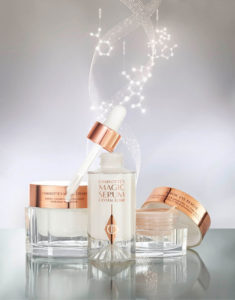
Charlotte’s Magic Cream Light is also a supercharged light texture miracle moisturises that will encourage youthful skin and offer pollution protection. Finally, Charlotte’s Magic Lip Oil Crystal Elixir will add much-needed 24-hour moisture to your pout with its unique serum-oil texture and unique blend of ingredients.
Chanel
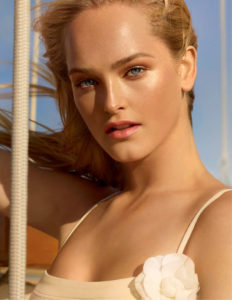
After hitting the beach you’ll want to enhance your summer glow and Chanel’s new Les Beiges Summer of Glow collection will help with just that. Offering the caress of sunlight on your skin with luminous textures and an infusion of beloved summer light. Lightweight, inspired by the aura and free spirit of Mademoiselle Chanel, this new collection has only one goal in mind: a sun-kissed healthy glow that seems revived by the great outdoors.
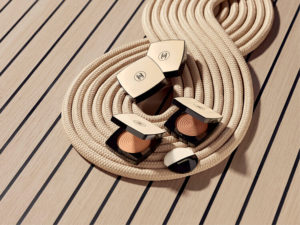
A sheer powder available in two shades will subtly enhance your complexion with a bronzed luminous effect, while a cream bronzer offers a velvety finish for a sun-kissed look. Finally, the liquid highlighter will instantly illuminates skin with a fresh finish, leaving you ready for the after- beach party!
Dolce & Gabbana

Dolce & Gabbana’s Light Blue Summer Gels range will provide a new level of summer freshness. A new solution to smelling and feeling great at the beach the gels for men and women offer a fragrance and a soothing after-sun complex in one. The Summer Gels offer an instant cooling solution that will leave you feeling and smelling great thanks to the Dolce & Gabbana Light Blue scene for men and women. The smooth, light texture will also moisturise dry skin for up to six hours, without leaving any oily residue.
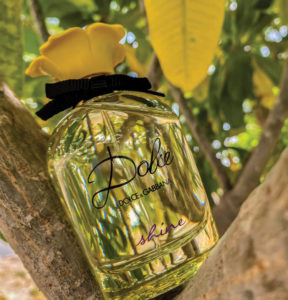
And for post-beach dinners, Dolce & Gabbana’s new fragrance Shine Eau de Parfum embodies the much-needed positivity of summer. An irresistible, fresh, fruity, floral scent that will become your go-to perfume for the coming months. This fragrance embodies the joy of Italian life. Juicy mango and bright jasmine combine with sun-drenched blond woods for a feel-good, scent that warms the heart
Lancôme

If your skin starts to feel tired over the coming months, Lancôme’s Stop & Glow range will offer an instant pick-me-up for refreshed, hydrated and glowing skin. Perfect after a day at the beach or a busy shift at work, the Stop & Glow range is easy to use and provides instant results. Infused with Lancôme’s rose water, renowned for its soothing properties, the Rose Milk Mist and Rose Sorbet Cryo-Mask provide a glow that’s always on call.
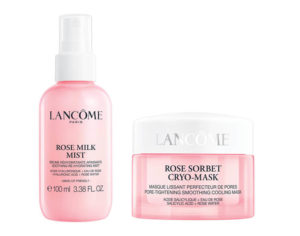
The Rose Milk Mist can be placed easily in your beach or handbag and a quick spray will work wonders on tired, dehydrated skin. This skin perfecter and glow booster is your new ally to get tighter pores, smoother feel and a unique cooling sensation. While the Rose Sorbet Cryo-Mask can be applied before bed to re-boot and restore your skin to its blank canvas. Removing pollution from the day and applying a unique cooling sensation. The cryo-mask also contains salicylic acid to reduce the appearance of pores and smooth the skin’s texture.
Sisley

Sisley’s skincare products are known for their natural qualities that are kinder to your skin and provide real results. If you’re going to be out in the sun this summer the French beauty House has all your skin needs covered. Its suncare range provides protection and skincare within all one through its Super Soin Solaire range. Choose an SPF that is right for your needs and care for your skin at the same time. It’s important to apply suncare products to your face no matter how long you’re planning to be outside as the hot summers can be extra damaging to our skin.
Then when things get a little too hot, cool down with the Floral Spray mist that provides a burst of cool beautiful scented mist that will refresh and hydrate the skin at any time throughout the day.
READ MORE:
Why Rouge Hermès is Your Summer Must-Have Beauty Line
Beauty Giant Shiseido Supports Healthcare Workers on the Frontline in the Fight Against COVID-19
La Maison Valmont is Offering Personalised Beauty Advice Wherever You Are in the World
How Bvlgari is Contributing Towards Building a Better Planet for Future Generations
Bvlgari introduces its Virus Free Fund as well as a look at its continuous development towards creating a better, more sustainable world for future generations.
Bvlgari has long gone far beyond jewellery making as a company to raise awareness and support those in need and contribute to initiatives that will change the world for future generations. The Italian jeweller has raised more than $100 million through its ongoing partnership with Save the Children and its approach to the ethical sourcing of materials and its programmes for sustainability makes it one of the leaders in the market in this field.

When the coronavirus pandemic started to spread across the world, Bvlgari was one of the first to understand how important it was to be proactive in contributing to the fight against the virus and they announced several initiatives including donating to the National Institute of Infectious Diseases that allowed them to unveil a new 3D microscope, a fundamental tool for research in connection of COVID-19, as well as creating hand sanitiser in its manufacture, which has been used by thousands of healthcare professionals.

And now, as the coronavirus continues to impact countries around the world, Bvlgari announces the Bvlgari Virus Free Fund. A non-profit organisation, which will finance high-end institutions pursuing innovative research strategies to achieve remission and cure of different types of virus.
In particular, the Bvlgari Virus Free Fund will support two major institutions: The University of Oxford’s Jenner Institute, which brings together investigators who are designing and developing numerous vaccines, as well as Rome’s Lazzaro Spallanzani National Institute for Infectious Diseases, that Bvlgari already supported previously by financing the purchase of a hi-tech microscope. With the Jenner Institute, the Bvlgari Virus Free Fund will also create two scholarships covering four years of PhD for a generation of new doctors in this essential field.

As the project was announced, Bvlgari hosted an online webinar to highlight the work of the Virus Free Fund, as well as some of the other projects that the brand is continuing to work on related to sustainability and corporate Social responsibility.

Spearheaded by Jean-Christophe Babin, President and CEO of Bvlgari, the Roman jeweller is focusing around three key values that are important to the brand in providing for the future. Jean-Christophe Babin explains:
- Children – “Children are the Gems of nature and the future of humankind as long as they can be educated and understand sustainability. They are our first priority. We try as much as possible to provide kids with the same chances as our own kids.”
- Arts – “Arts are the memory of humankind. It helps to know the roots of something to foresee the future in a positive way and arts are really the memory of all of us.”
- Health – “We need healthy people on a sustainable planet. And that’s why we immediately jumped onto the COVID battle.”
With these three key pillars in mind, Bvlgari has developed its institutional partnerships, aligning with charities and causes that will help to build a better future.

“COVID-19 has reminded us that the pandemics of history are not gone.” Said Babin. “It has also brought poverty to tens of millions of people around the world who have lost their jobs or are struggling financially.
So at Bvlgari we wanted to step up to participate on a global level with the best institutions to found programmes to firstly accelerate the COVID-19 vaccination, but beyond that, to contribute to the total elimination of coronaviruses. So our programme is, on the one hand, to finance directly the Oxford University research of an antivirus, but also to fund students who will be the next generation in this field. We are focusing on those who are the best talents but who also, for various reasons could not finance their PhD so we have been able to offer funds to assist in the providing of scholarships for some of these young people to become part of Oxford University.”

Professor Sarah Gilbert – Professor of Vaccinology at the University of Oxford
Professor Sarah Gilbert has been working on the research at Oxford University to develop a vaccine against COVID-19:
“Currently we are waiting to find out when we will have a vaccine ready to use against COVID-19 but it’s an impossible question at the moment as it requires huge clinical trials which take a lot of time. We have to wait until enough people have gone through a trial process in order to know that the vaccine is safe. It will be some time this year and in order to get the vaccine earlier, we are now partnering with other countries including Brazil to accelerate the process.
In the past, it used to take a long time to make a vaccine against a new disease. However, the processes have now changed. We now use Platform Technologies which means we can proceed much more quickly. To make a vaccine, we use a weakened form of another virus then add in a small amount of the genetic sequence that we want to make the virus against. Because we have done so much research on our process we know that the vaccines we make are safe which allows us to move much more quickly on new trials and new vaccines.

Once the vaccine is ready we will start using it in emergency situations targeted to the most venerable parts of the community. We hope to be there in the autumn but it depends on getting the cases in the vaccine trial and it’s very difficult to know how long it will take, but they hope by working with other countries they will be able to get there faster.
The University is doing many different things and of course, its primary purpose is to teach, so when it comes to situations like this the funds aren’t always there. So contributions from partners like Bvlgari are crucial as they allow us to expand work in this area. We will also be having two new studentships which will help greatly for their lives and the work we’re doing.”

Claudia D’Arpizio – Partner Bain & Company Global Head of the Fashion & Luxury Vertical
“For many years that the consumer base of luxury has been changing. This started with the millennials and it’s true again with Generation Z. These two generations represented 40 per cent of sales in luxury last year. They are asking for brands to be building for the future, so conversations around sustainability are essential in part of building a better future. Consumers are asking brands to stand for something in an authentic and strong way. When we did an analysis last year more than 65 per cent of consumers were stating sustainability as a key driver for them.
We think that there is a millennial mindset. They have a new way of life and other generations are following. COVID is accelerating these trends and the awareness around the need to solve the problems of the planet and also issues around equality and social rights. We have seen in these months that awareness is growing and consumers are stating sustainability among the reasons that they chose a brand. So it’s not just about the products but also about how the brand engages with these projects.
I think the concept of luxury was already changing before COVID-19 in that consumers are looking to luxury products for a broader meaning that has creativity, experience and opinions. They are sharing with brands a concept around life and experiences. I think this concept has been speeded up during the crisis. I think consumers will be more choosy now on what they want from brands. Plus I think luxury is more sustainable than other industries in that you are buying something that will last for generations. Quality over Quantity.”
With these key elements in mind, we come back to the work that Bvlgari can do to support this demand for transparency and informed decisions when it comes to sustainability.

Elenora Rizzuto CSR Director at Bvlgari and LVMH Italian Brands explains how Bvlgari will very shortly be introducing the AURA Blockchain network. This forward-thinking process will allow consumers to trace the history and authenticity of luxury goods, but it will also be applied to fundraising, guaranteeing full traceability of donations and therefore allowing consumers to see how their money is spent positively.
Bvlgari will be the first in the world to apply Blockchain to philanthropy and it means they can justify every euro that they give to research or charities and they can give a practical response. The traceability will cover everything that Bvlgari does. For example – the client will find out information about the product – where the gold was discovered, which country the product came from, as well as how money is spent on charitable causes. It will allow the brand to be fully transparent with its customers.

Plastic Free
Bvlgari’s renewed commitment to CSR doesn’t stop here. The company, inspired by the principles of Circular Economy of Reduce, Reuse, Recycle and Innovate, actually developed a strategy to drastically reduce the environmental footprint of its activities.
In 2019 Bvlgari adopted a Plastic Free Policy which has already seen a reduction of 19 per cent of plastic used a Bvlgari in packaging and around 15 per cent used in the manufacture of the jewellery. This is part of a complete vision that by 2021 By 2021 will see the brand eliminating plastic entirely from all of its products. “We want to reduce as much as possible their environmental impact and contribute to building a better planet.” Said Jean-Christophe Babin.
READ MORE:
Discover Italy’s Must Visit Holiday Destinations
Paris, Milan and New York Fashion Weeks Will Return From This Month
When the coronavirus pandemic hit the fashion world was left wondering what would be the future of traditional fashion weeks?
But now, as brands are trying to get back to some kind of normality many have decided to go ahead with presentations, either in a virtual manner that will be broadcast across social media channels or as a physical show but on a much smaller, safer scale.
It was announced earlier this week that New York Fashion Week will go ahead this September but it will be shortened to just three days. The Council of Fashion Designers America declared that the Spring 2021 shows will take place between 14th and 16th September. While the schedule hasn’t yet been released yet, a number of designers including Marc Jacobs and Michael Kors have already declared that they will not present this season, however, the CDFA is offering digital resources to designers to encourage shows to go ahead.

Marc Jacobs
Dior revealed last month that it would be moving forward with its planned Cruise 2020 show in Italy. The show will now take place later this summer and will be a physical presentation that is also broadcast live digitally. Pietro Beccari CEO of Dior explained some of these reasons for going ahead with the show including how “nothing carries emotion like a real, live fashion show.” And that the House wanted to send “a message of support, hope, optimism and rebirth after this period of difficulty.” The final reason was to give tribute to the local artisans that the brand has collaborated with for this collection.
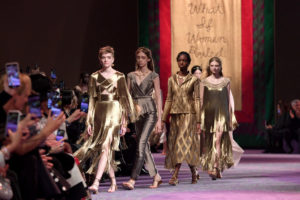
Dior
The scheduled Haute Couture Week in Paris will also go ahead this month but in a very different way, with many brands including Valentino, Dior, Ralph & Russo and Georges Hobeika are choosing to host virtual shows that will be broadcast live to the audience over social media channels.
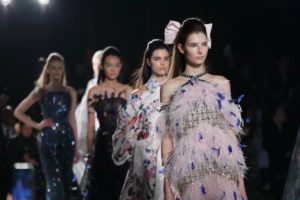
Ralph & Russo
And finally, Milan Fashion Week Men’s kicks off later this month with brands including Etro and Ermenegildo Zegna again choosing to host presentations both physically with a reduced audience, as well as broadcasting live across the world.
This all raises the question of what the future of fashion weeks will be? The physical presence seems to be becoming more exclusive – perhaps going back to the shows of some years ago when only a few selected guests were invited – but at the same time, virtual platforms will open out the shows to all – making them more accessible and instantaneous. As we move forward with the “new normal” it’s likely the concept of the traditional fashion show will change for good but only time will tell.
READ MORE:
Federico Marchetti Joins The Giorgio Armani S.p.A Board of Directors
Discover The New Icons of Cartier
Dolce & Gabbana Celebrates Traditional Italian Craftsmanship With Its Latest Project
Federico Marchetti Joins The Giorgio Armani S.p.A Board of Directors
Luxury Group Giorgio Armani S.p.A announced today that Federico Marchetti, CEO and Chairman of YOOX Net-A-Porter Group will join the company’s Board of Directors as an Independent Non-Executive Director.
The news comes as YOOX Net-A-Porter celebrates its 20-year anniversary. Giorgio Armani was one of the first fashion houses to partner with the group when it began its e-commerce business in 2000. Today, The Armani online flagship store, Armani.com, was designed and is managed by YNAP

Federico Marchetti
Federico Marchetti said in a statement today:
“Over the years Mr Armani has defined and driven quality and craftsmanship in the industry, with an approach that has promoted style over fashion. An exemplar of the excellence of Made in Italy, not only in his products, but also in his business – one of the very few designers that has remained independent and private.
He has built an unrivalled legacy, but he remains a visionary. I experienced this first-hand 20 years ago, when he was among the very first to see the potential for online luxury and trusted me with his beautiful products on YOOX and then on Armani.com and Mr Porter. This year, he has demonstrated this to the world in his profound and generous response to the COVID crisis: moving long before others and delivering a powerful manifesto for the future of the industry in an open letter to WWD with a close that read: “United, we will make it.” I am honoured to unite today with Giorgio Armani S.p.A. and its board and I look forward to what we will achieve together in the future.”
The role comes in addition to Marchetti’s continued capacity as Chairman and CEO of YOOX Net-A-Porter and will begin with immediate effect.
READ MORE:
Giorgio Armani Announces New Dates For Upcoming Fashion Shows
Laurent Dordet, CEO of La Montre Hermès Discusses the House’s Watchmaking Business
Hermès has a watchmaking history that dates back over 100 years when its first watch straps were created.
In 1978 the House opened its watch production facilities in Switzerland. Hermès watches embody the true values of the French Maison; its desire to create beautiful, long-lasting objects. Hermès has truly embraced the world of Horology and carves out a unique niche for itself, producing elegant and stylish watches that require a high level of craftsmanship and embody the exclusiveness of the brand. The Hermès touch and personality can be seen through each of its watch creations, making them instantly recognisable.
Laurent Dordet took over as CEO of La Montre Hermès in 2015. As is often the case with Hermès he had already been part of the family for many years. He first joined the group’s finance department in 1995 and has since held many roles before taking on the position he holds today. So it’s true to say he understand the Hermès universe. But watchmaking is a whole different ball game. Dordet is now challenged with the task of continuing the strengths of Hermès’ watchmaking business and taking it to new heights in challenging times for the industry. We discover more.

Arceau L’heure de la lune
What can you tell us about the watch business of Hermès today and the latest novelties?
In 2019, the watch Hermès business recorded a solid sales performance reflecting the creativity of the collections and the network’s selectivity. The new women’s watch Galop d’Hermès was well received and Hermès watches were rewarded for the fourth time in November at the Grand Prix de L’Horlogerie de Genève. Hermès watches have recorded a 3-year significant growth until 2019, thanks to strong creativity both in feminine and masculine watches and also repositioning of our distribution network. These are still strong assets in 2020, that will enable us to maximise our sales during this crisis and be prepared for next year.
So far, this year, we have presented three new men’s watches: Arceau L’heure de la lune with new dials, Slim d’Hermès GMT in rose gold and Arceau Skeleton. For women, we propose a new bold creation on our iconic Cape Cod and on Nantucket and in the métier d’art, Arceau pays tribute to exceptional craftmanship.
Our highlight, Arceau L’heure de la lune is a very good expression of the singular interpretation running counter to industry trends. We presented it last year in a limited edition and we had the great pleasure of being awarded by the GPHG. We come back this year with new versions on a lunar, Martian or Black Sahara meteorite dial. It’s a useful function with a graphic and mysterious side. This new complication evokes a sense of dreams and emotions. The face of the watch is daily transformed. Its read-off is playful, with counters gravitating around the moons and topsy-turvy moons because Hermès loves to dream with its head upside down. We also present on Arceau a new skeleton version, subtly revealing the mechanism and paying tribute to the equestrian line which was introduced in 1978 when Hermès established watchmaking in Switzerland.

Slim d’Hermès GMT
Another men’s launch is the Slim d’Hermès GMT. Slim d’Hermès was first launched in 2015. It is an elegant Hermès object that appeals to customers looking for a singular timepiece with strong Hermès DNA and high quality in terms of movement and finishing. A first GMT version with a palladium case was presented in 2018 in a limited edition. This traditional complication was interpreted differently, playing with the distinctive numerals on the GMT dial, losing one’s bearings. It was a great success. This year, we present a rose gold version in blue tones highlighting elegance and classicism but also contemporaneity that speaks to the essentials of the brand.

CAPE COD Martelée
This year, we also pay tribute to Cape Cod, an icon born out of a rebellion in 1991 and Nantucket. That of Henri d’Origny, a longstanding creative partner of the Maison, who was asked by Hermès to design a square watch. But this free spirit saw things differently and preferred to respond in an almost irreverent manner with a watch representing a ‘square inside a rectangle’. For almost 30 years, the Cape Cod has been an icon: the anchor chain motif cut in two to insert the square case. Its design reflects rigorous discipline combined with a boldly impertinent attitude. Its natural penchant is to lend itself with great aplomb to the ebb and flow of the times. Its success was further amplified by Martin Margiela’s novel idea for his very first Hermès runway show in 1998: adding a double-wrap strap that would later be known simply as the “Double Tour”. Sales rocketed and the Cape Cod watch became an icon, almost a style in its own right. Everything was possible; both men and women felt an immediate sense of kinship, doubtless driven by a sense of style and liberty. The Hermès singular interpretation of time running counter to industry trends is supported by watch models through their singular functions, but also by models with distinctive and non- formalistic designs, imbued with creativity and boldness, such as Cape Cod, Galop d’Hermès, Kelly and Médor.
This year, Cape Cod introduces again a bold and innovative new creation, with a matt hammered finish borrowed from the world of jewellery, adorning the steel case, as well as the gradient lacquered dial ranging from black to anthracite. On its side, Nantucket is playing with diamonds setting to propose a jewellery watch to Hermès clients.

ARCEAU Cheval Cosmique
Last but not least, Arceau Cheval cosmique is one example of some very interesting and original exceptional timepieces that involve special skills. Over the years, we have had the opportunity to meet talented craftswomen and craftsmen to express the creativity of the house. It is always a big challenge for them to work on a smaller scale but they appreciate this new field of expression. It was through well- known craftsmanship’s such as enamel or engraving or through technics which are for the first time or rarely applied on a small scale such as crystal, leather, straw marquetry and more recently wood marquetry. This year, Arceau Cheval cosmique is a new expression of this creativity with two different versions paying tribute to the art of engraving.
Moving forward, what do you expect from the second half of the year and will you be changing any of the strategies of the brand in light of the current situation?
Our strategy remains overall consistent. We are of course adapting to the situation by ensuring that our launches convey the right messages and are understood in a world which has become mainly digital over the last few months. We are also supporting the retail in markets that have re-opened or are about to re-open. Hermès is a House of creations and we work on presenting new products to our clients. The second semester will be rich, especially for our female customers, highlighting creativity and singularity in our objects.
What is the biggest challenge you face today with Hermès’ watch business?
The main trend today which does not change for us despite the situation is all about this: being singular and bold to offer client authenticity and perfection. Within an R&D-driven approach, the industry is engaged in a perpetual quest for innovation, precision and numerous functions serving to better master time.
Hermès watchmaking offers a different interpretation of time: a time full of fanciful touches and which goes well beyond style; a companionable, lasting, mischievous and recreational time. A time that provides an opportunity to tell a story and to stir emotions. The Maison does not seek to replicate what already exists but to be audacious and follow its intuition by creating objects that do not only indicate the time but tell stories in order to build a relationship with it.
Wearing a Hermès watch is about appreciating a style that is rigorous but free of any formalism. It is about asserting oneself as a man or woman free of temporal constraints, relaxed and occasionally whimsical. It is about making light of time rather than seeking to dominate it. It is an invitation to experience a singular relationship with time, a time with which one plays, yet without ever hoping to control it. This singular interpretation running counter to industry trends is supported by our watch models and their singular functions, distinctive and non-formalistic designs, imbued with creativity and boldness.
Consequently, our biggest challenge is to continue developing our awareness as a unique watchmaker, combining the finest watchmaking skills with unique creations and the ambition to seduce more and more customers that want, not only a qualitative Swiss-made timepiece but also a piece of the Hermès universe.

How do you balance history and tradition with innovation at Hermès?
Innovation is the result of a constantly renewed creative gesture. It accompanies the momentum and spontaneity of creation while remaining true to the past. At Hermès, innovation is the perpetual motion of the house’s spirit. For designers and artisans, materials, craftsmanship and attention to detail are merely the tools required to bring innovation to the forefront. In watches, we have a wide choice of possibilities in terms of materials, shapes and settings that can be used on timepieces. We like exploring the different facets of a model through different metals, stones or finishing as we did this year with the Arceau L’heure de la lune and the Cape Cod martelée.
What can you tell us about e-commerce at Hermès and where is its position within the company currently?
Hermès broke new ground by opening its first e-commerce website in the United States in 2001. It was then rolled out to the saddler’s various other markets. The new hermes.com website was launched in Canada in June 2017, then in the United States in October 2017. The website, available in French, English, Spanish and German, is now live in 18 European countries. Conceived like all Hermès stores, drawing on their ambience, window displays, products, services and narratives, the hermes.com website combines e-commerce and content at a single address. Hermes.com is an attitude that combines creativity, authenticity and singularity with the fluidity of an e-commerce website. As for the watches, I strongly believe the global customer experience mostly starts with a digital one: that’s why we invest a lot into it.

NANTUCKET Jeté de Chaîne d’Ancre
What would you like to achieve with Hermès watches going forward?
In recent years, we have seen growing interest from Hermès customers, and watch collectors, thanks to launches featuring singular designs and unconventional interpretations of traditional watchmaking. In 2015, for example, with Slim d’Hermès; born from a stylistic exercise around the purity of design, and expressing a move towards essentials with a minimalist style; in 2018 with Carré H, a square-shaped watch designed by Marc Berthier featuring a contemporary aesthetic; with Arceau, which suspended time through a unique complication in 2011; began playing with moon phases in 2019 (“Heure de la lune” complication); or which quite simply, with the privilege of its sobriety and elegance, has since 1978 been expressing the audacity of its designer Henri d’Origny.
Hermès Watchmaker conveys a different approach to time, an approach free of any formalism and unmistakably recreational and this is the message we convey in our communication.
Where does the Middle East fit into the strategy of Hermès Horloger and how important is this market to the Maison?
The Hermès watch business in the Middle East has been growing very fast for a few years in response to a demand for high-end watches and beautiful objects. We are very enthusiastic to see a growth in consumers’ interest for our watches which is proof that the expression of the Hermès time pleases them, through objects imbued with Hermès values, whether equipped with exceptional technical watchmaking elements or expressing singular creativity unrestrained by conventions. Hermès is about elegance, creativity, quality and craftsmanship which is something that appeals to our clients in the Middle East.

ARCEAU Squelette
What can you tell us about Hermès Horloger and sustainability?
First and foremost, the values of a craftsmanship’s mindset are deeply rooted in-house and forge our business model as a group, but also as a métier. A sense of responsibility. Never compromising on the quality of know-how and materials. A profound respect for nature, which gives beautiful materials for our products. A profound respect for the skilled men and women who make them. The respect for the time needed to make these beautiful objects.
These values form the platform for the actions of the House in matters of sustainable development by appropriating the notions of individual and group responsibility, authenticity in the search for excellence, or acceptance of the long-term approach as a factor influencing performance.
What is the professional motto that your living by during this time of crisis?
As part of a resilient group, we are extremely lucky in this period: we can focus on preparing ourselves for the rebound days. I think the best players in the watch industry have all reasons (craftsmanship, quality, innovation, authenticity etc.) to believe they will be able to recover quite soon. Hermès is first and foremost a House of design with extraordinary creative wealth. We are guided above all by a concern to do things well while respecting the iconic Hermès design codes.
READ MORE:
Julien Tornare CEO of Zenith Watches on Achieving Your Dreams
Nicola Andreatta, CEO of Roger Dubuis Talks Innovation, Adrenaline and the Future
Dior to present Its Upcoming Cruise Collection in Italy as a Tribute to Italian Craftsmanship
Dior has announced it will present its 2021 Cruise collection in Lecce in Puglia, Italy as planned and it will be a tribute to Italian craftsmanship. The show will take place this summer and will be presented without and audience.
The project was announced during a virtual press conference this afternoon, hosted by President and CEO Pietro Beccari and Artistic Director of Womenswear Maria Grazia Chiuri on 22nd June.
The project which is spearheaded by Maria Grazia Chiuri started before the global crisis as the Artistic Director wanted to highlight the work that is done by these artisans and also to highlight it for future generations. She has worked with many local artisans over the recent months, collaborating with local communities who specialise in traditional techniques.

DIOR CRUISE 2021 LECCE ©Antonio Maria Fantetti
“This project is very close to my heart because my father was born in Puglia. In a way, it is dedicated to him because he taught me to believe in myself even in difficult times and to believe in the future” Said an emotional Chiuri.
While some brands are deciding not to go ahead with traditional fashion shows in the current situation, Dior wants to move forward with this project for a number of reasons. Pietro Beccari explained some of these reasons including how “nothing carries emotion like a real, live fashion show.” And that the House wanted to send “a message of support, hope, optimism and rebirth after this period of difficulty.” The final reason was to give tribute to the local artisans that the brand has collaborated with for this collection.

DIOR CRUISE 2021 LECCE ©Antonio Maria Fantetti
The conference went on to discuss the upcoming fashion weeks and whether Dior will take the decision will move forward with fashion weeks going forward. “We will be following traditional fashion weeks as there are a lot of people who expect us to follow this rhythm. We believe that an injection of novelties is important in our business” Said Beccari. While Chiuri added, “Fashion Week is not only important for the fashion family it is important for the city where the shows are.”
The show will be a live event but without an audience and will be broadcast across the House’s digital platforms on July 22nd.
READ MORE:
Paris, Milan and New York Fashion Weeks Will Return From This Month
Must Have Summer Beauty Essentials
Hussein Bazaza Launches E-commerce Site With an Exclusive Capsule Collection
Nicola Andreatta, CEO of Roger Dubuis Talks Innovation, Adrenaline and the Future
While it has all the qualities of a successful watchmaker – great craftsmanship, the ability to create innovative pieces – Roger Dubuis is far from your average watch brand.
It’s uber-exclusiveness and reputation for innovation and always breaking barriers as well as links to adrenaline-based sports, fast cars and all that is modern, daring and exciting, makes it a coveted brand for the young, cool, rich and famous. But it’s highly sophisticated watches with some of the most complicated movements ever developed in the world mean it’s also hugely popular with watch connoisseurs and collectors that are looking for something unique and exclusive.
Roger Dubuis was founded in 1995 by Swiss watchmaker Roger Dubuis. Within a few years, the company was designing its own in-house movements, certified with a prestigious Poinçon de Genève. Roger Dubuis became known for its highly complex and sophisticated mechanisms, combined with innovation and state of the art materials. In 2018 Roger Dubuis signed a partnership with Lamborghini, which was set to take the brand to a new level in terms of its reputation. Designing a new version of its iconic Excalibur Huracán in collaboration with Lamborghini Squadra Corse, Roger Dubuis perfectly aligned itself with the world of motorsports and adrenalin.
Later that year, CEO Nicola Andreatta joined the brand. Andreatta has spent his whole life in watchmaking and throughout his career has worked on many aspects of the watchmaking businesses. His vision of taking the brand into the future is closely aligned with the values and DNA of Roger Dubuis. As the latest novelties are launched at Watches & Wonders, we discover the plans for the future and the next level of watchmaking at this forward-thinking brand.

Excalibur Diabolus In Machina
You joined Roger Dubuis just under two years ago – tell us about the direction you have for the brand and how you define Roger Dubuis’ DNA?
I’ve been with the brand for less than two years, but I feel like I’ve been here all my life. I always say that whatever I did before trained me to become the CEO of this incredible brand and I feel like there is a good link between who I am and my passions and the world of Roger Dubuis. When I joined the Maison I was in a very healthy position thanks to the work the previous CEO and what the incredible team have achieved. Just before my arrival, the brand signed two important partnerships that complement the work of Roger Dubuis.
Going forward I’m going to perfect what Roger Dubuis stands for. That means that we want to become the most exciting way to experience Haute Horology. We express this in two ways. The first one is the adrenaline factor; and this is where we have connected with motorsports, in particular Lamborghini and Pirelli. Then we have what we call the expressive singularity, and this is a different universe related to the possibility of expressing yourself. We want to push that side a bit more as we have been exploring the adrenaline side and now we want to discover a little more about the second part of the Roger Dubuis universe. This has to do with expressing yourself and extravagance and will allow us to connect with some different partners, related to art, or the way of living in general. All things that are beautiful, incredible and exclusive in life – these are things that most of our clients love and this is where we want to develop further. We must always take into consideration that we come from the pinnacle of Haute Horology. What we do is very exclusive because of the way we manufacture it, but also because of the technical content that we put into our timepieces. This makes them less accessible and more exclusive.
If I had to somehow encapsulate all of our beliefs into one word, I would use the word “excess”. Every meaning of what excess stands for from always going beyond to surpassing expectations. Everything we do has to include, freedom, pleasure and madness. This perfectly defines the world of Roger Dubuis.
With all the constraints that the world is facing today, how are you working to ensure that your clients are still getting the Roger Dubuis experience?
We are convinced that when we come out from this situation it won’t be business as usual. Everyone is reinventing their own selves and we are always projecting forward so we can’t stand still at this time. The digital world is developing faster than ever and we cannot avoid this at Roger Dubuis. The recent presentation of Watches & Wonders highlighted this. It’s a frame of work that we have implemented and the whole Richemont group has accelerated very fast to offer digital and e-commerce. The fact that Richemont acquired YOOX Net-A-Porter a couple of years ago, is an example of the appetite that the group has for the digital world. For us, it’s one of our priorities. There will be more and more coming from Roger Dubuis in terms of e-commerce, but it’s important to do it our way. We should not forget that our DNA is different from all the other brands in the market and we need to keep the exclusivity while being contemporary in everything we do. So the content has to be crafted in a way that resonates with what the brand stands for. Given the fact that we want to be experiential and we think about the power of emotions, we would not be able to survive without the physical part, so we talk a lot about the connection between the physical and the digital world. Providing a journey for our customers so they can connect with the brand in different ways – either through digital means but also through the boutiques. The important thing is to ensure that whatever way the customers are connecting to the brand, they will always feel like they are part of Roger Dubuis.
We want to use our tools to create this incredible journey, which is made of experiences. After this situation is ended it will probably be on a smaller scale, but we will use our boutiques as a place where clients can fully experience the world of Roger Dubuis. Our new store at Dubai Mall is one of the biggest in the world and it is one of the places where you can discover a lot of experiential points. There is a zone that we haven’t used yet at the back of the store where we are going to add even more aspects that will allow people to experience and live the brand in a different way. This allows us to create emotions that are unique and allow us to connect our clients to the future of our world.
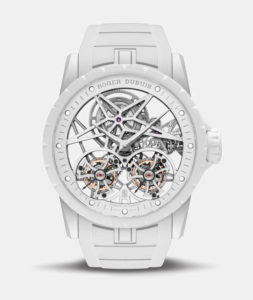
Roger Dubuis Excalibur Twofold
What can you tell us about the novelties presented through the Watches & Wonders digital platform?
We presented at Watches & Wonders the “Twofold” watch. This is a concentration of all the novelties and spirit of the Maison. It features a very well known calibre from the Maison; a double-flight tourbillon, which is one of the most complicated movements to produce but it is very economic. We were the first Maison in the world to produce this. So with this movement, we created a new watch, which encapsulates no less than three world premieres. The first is the use of an incredible new white material. It’s a new compound that we created ourselves together with Lamborghini. It’s very interesting because one of the first challenges I gave my team was to create an all-white watch that wasn’t ceramic. I challenged them to find something better than ceramic and we came up with this incredible material which is 2.5 times lighter than ceramic, much stronger and even lighter than carbon fibre. We came to Mineral Composite Fiber (MCF) by not only finding the right components but also patenting a new process. We wanted the fibres to be so small that they were easy to machine and manoeuvre.
That was the key element for us. Ceramic is easy to break and you cannot reach very thin layers with it, which is what we needed because of the complexity of our timepieces. So the team came up with this incredible compound, which is filled with microelements that make it super-white. We tested it to make sure it didn’t give any allergic reaction and we also made sure the white colour would stay forever. We were so happy when we developed this material that we decided to also put it inside the movement. Which is something unprecedented. We used the same material to cover some of the decorative bridges of the watch. The second world premiere is the way we applied Super Luminova on the bridges and we found a specific process to do this. The third world premiere is the way we developed the strap. As always, we needed to do it in a different way. We created a new rubber material that is luminescent at night and then we created layers of rubber on the strap and cut it with a laser so that the effect of luminosity is embedded in the material. So the luminescence will stay forever. All of this is celebrating one of the best calibres in the world.
What has the impact been so far on the watch?
I knew that customers would like the white colour but we were overwhelmed with the response. We had so many requests and so much good feedback. The number of views across our social networks was one hundred times higher than normal. We immediately understood we were going in the right direction. As we speak I think we only have two pieces left out of eight. Sometimes I think we are not very good at being commercial. Because with all the innovations and all the new things we bring to a timepiece we could easily make 88 pieces, but we need to remain exclusive and it’s a complicated piece to manufacture so we decided to limit it to only eight pieces in the well.
What can you tell us about QLab?
This is something I brought in when I joined the company. Everyone was talking about being innovative but that’s not something that necessarily just comes to us. So I told myself that we need to create a virtual and physical place within the company where we unleash the creativity of our people and allow them to explore, discover, test ideas and share them with each other. A place where we can stage all of our inventions and creations, a place that allows everyone within the company to tell us what they think. I believe anyone in the company can come up with amazing ideas, whatever their role is. There will be instances where we allow people to visit where we stage and present everything that we are doing. We observed in the past few years that sometimes it’s really difficult to move from ideas to reality. So Q-Lab will allow us to explore ideas and break down the processes to bring them to the final product. There are many different advantages to the QLab and it allows us to protect our innovation and everything we are doing. I want to make sure we all go in the same direction and I want each of my colleagues in their departments to do their best. So I am pushing them, but in the end, we are all responsible for what Roger Dubuis stands for.
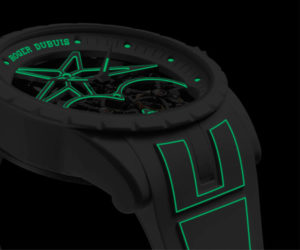
Roger Dubuis Excalibur Twofold
Tell us about Roger Dubuis in the Middle East and what is in the pipeline for the second half of the year?
Well, we just opened our biggest boutique in the world in Dubai, and for us this highlights the importance that the region has to us. At the same time, we can’t hide behind the fact that in the last few years we haven’t dedicated enough resources and attention to the Middle East. I believe that our DNA and concept resonate very well with Middle Eastern customers who are very good connoisseurs of the luxury world and they like to pamper themselves with only the best. Roger Dubuis answers to this because we are the best in terms of technical knowledge but at the same time, we want to be a bit more expressive. I would love for people from the Middle East to get closer to us. We want to make sure that people in the region understand that we make beautiful things and that with us they can have incredible experiences that we offer and because of the adrenaline that infuses every single thing we do. So I think we need to create a better platform for us to connect with our tribe in the Middle East. Every time I come to Dubai I see incredible cars everywhere, I know that people in the region love luxury, so I think we are the best answer for them.
How did you discover your passion for the watch industry and how did your previous experience support your role today as CEO of Roger Dubuis?
I don’t know if I ever really discovered it as in a way, I was born with it in my blood. My father was always into watchmaking and he started taking me to the factory with him from the age of five! The process of manufacturing things amazed me. The way something could go from a piece of metal to a beautiful object. I was always amazed by the concept of time and this crazy idea of controlling or measuring time, which is something we humans believe we can do but in the end, time goes on, even without us. So it is a very difficult thing to conceive and understand in full. My father didn’t want me to have a career in watches because he thought it was a crazy world, so he sent me to study finance. But what I wanted was to work with physical objects. Growing up in a factory and being connected with watches in general (I started going to Baselworld when I was 16), I was very well introduced to that world and I knew I wanted to make it a career.
To answer the second part of your question, definitely whatever I have done in my life previously has been training me for my role today. The fact that I have approached very different aspects of watchmaking from selling watches to manufacturing to marketing to design, allows me to have a much closer connection to my team. When they talk about something happening in the factory, I know what they are talking about. I love this world and I couldn’t do anything else. I’m exactly where I want to be.
Roger Dubuis Manufacture
What is it that you still aim to achieve with Roger Dubuis that hasn’t been done yet and what would you like to see from the future of your career?
For Roger Dubuis, there are plenty of things we are working on. We never stop and for myself, my attitude and character are that of never being satisfied! So we are projecting ourselves into the future and working in many directions that will allow us to develop a completely different stance in the world of Roger Dubuis. I want to evolve the brand, the way we design our stores, the way we welcome our clients. We are offering new experiences and new ways to pamper our tribe of connoisseurs and clients. So there are plenty of things to do! I know where we are going but every day new things are happening and there are new challenges.
Another initiative we started at the end of last year is something we call the Young Advisory Committee (YAC). This is comprised of people from inside the company that are below the age of 30 from every part of the company. It’s a place where we encourage inclusion and diversity and we constantly discuss strategic solutions with them. So we immediately get feedback from the younger generation. We want their opinions and feelings about what we’re doing and if it’s going to appeal to young clients in the future. I think this highlights the attitude the brand has of inclusion and it also highlights the direction that we are moving in.
In terms of my own career, very honestly I would be very happy to continue with Roger Dubuis because I love it. I respect tremendously what the brand was at the beginning and what has been done in the past. We will keep evolving it day by day and we are constantly looking to break the boundaries of watchmaking. We want to express our DNA and ourselves but be relevant in the time we’re in. Which is great because we can bring our own codes and focus on the future and how we build the future of watchmaking.
How would you describe Roger Dubuis in one word?
Excess.
What difficulties do you think the watchmaking industry is facing today?
It’s going to be an interesting time going forward and it’s not going to be business as usual. The world is evolving so the concepts of digital, omni-channel and so on are going to be much talked about. Everyone will have a different interpretation and we don’t know what the retail of the future is going to be. Not everyone will be able to fully embrace this evolution.
I do believe that in the short term when we will have fewer people travelling, brands will have to rediscover local communities and work more with the local clients instead of counting on travel retail and tourism. However I do think that people will come out of this crisis dreaming and wanting to experience even more, so we need to be ready, not only with our watches but with every aspect of the business.
What is the watch you’re wearing today?
This is quite a unique piece. It’s the Excalibur Single Flying Tourbillon. It’s a very rare watch, we are making a limited edition of just eight pieces and I am the only one who can sell this watch to clients personally. So we call it the CEO watch. It’s super exclusive and can be personalised by the clients. I have sold two already to clients and whenever I can travel again I will promote it. It is a watch that I love.
READ MORE:
Chabi Nouri Piaget CEO Discusses the Latest Novelties and The Middle East
Breitling CEO Georges Kern Discusses the Evolution of the Brand
Discover The New Icons of Cartier
Cartier’s 2020 novelties seek inspiration from the legacy of the house and its iconic watch designs.
Cartier’s 2020 watchmaking novelties are united by the global theme of “Unexpected Encounters”. Since it began making watches the House has always combined shapes and ideas that were never expected to be together but somehow work seamlessly. For 2020 we see Cartier’s unusual designs through graphic shapes as it reinvents classic pieces from the history of the Maison.
Pasha de Cartier

The Pasha is an elegant and extroverted watch that has acquired cult status since it was first created in 1985. It celebrates the relationship between a circle and a square. With its distinctive codes and unusual design, the watch is for those who like to make a statement. Faithful to the original the 2020 reinterpretation of this watch has a crown featuring a blue spinel or sapphire, interchangeable strap in steel, gold or leather and multiple possibilities for personalisation through engraving. This modest engraving is only revealed with the famous chained crown of the watch is unscrewed.

This classic is timeless yet contemporary and edgy at the same time. Equipped with a sapphire crystal case back that reveals its movement, the new Pasha de Cartier watch is endowed with the 1847 MC automatic calibre. This in- house movement goes further still in the quest for performance and reassurance thanks to its resistance to both magnetism and water.
Maillon de Cartier
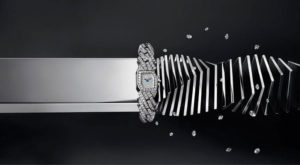
The Maillon watch is inspired by the classic Cartier bracelet. A statement of style this watch plays on the classic codes of the house with a modern touch. This watch is a jewel, designed by the Cartier watchmaking studios. Rectangular links are combined with a hexagonal dial to create an unusual shape that sits perfectly on the wrist. This watch deconstructs the classic Cartier bracelet and allows it to move freely on the arm.
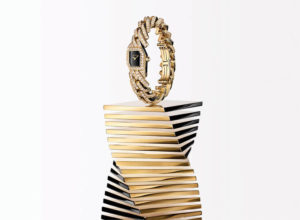
The collection also sees exceptional stones inlaid within the bracelet and set into the links. The choice of stones in the blue lacquer and tsavorite version adds to the kinetic relief of the watch. A graphic effect and contrast that Cartier accentuates with a version in yellow gold and diamonds with black lacquer bevelled links.
Cartier Privé Tank Asymétrique
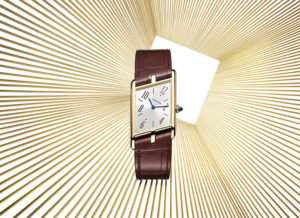
Since 2017 the Cartier Privé collection has highlighted some of the brand’s iconic models. This year the Cartier Tank sees a new incarnation in the form of the Tank Asymétrique. This watch gives new life to the original tank watch by expanding the rectangle and moving the dial’s numeral’s 30 degrees to the right to create an unusual but instantly recognisable appearance. Instead of the signature Roman numerals, it features Arabic numerals separated by baton-style hour markers.
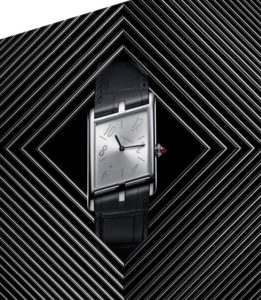
This Art Deco-inspired watch combines a unique design with expert watchmaking. The watch comes in a 47.15mm x 26.2mm case and is available in yellow gold with a champagne dial and brown strap and in platinum with a silver-coloured dial, ruby cabochon and grey strap. Inside is the calibre 1917 MC, a thin and shaped hand-wound movement operating at 21,600 vibrations/hours with 38 hours of power reserve. Each version is produced in a limited edition of 100 watches.
Santos de Cartier
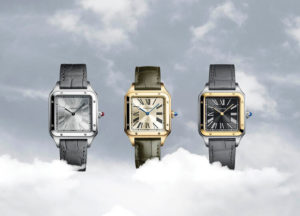
Today Cartier is paying tribute to Santos Dumont a friend of Louis Cartier, for who he first created a watch in 1904. The Santos-Dumont XL watch is a set of three watches available in a limited series. This complete reworked design including new proportions plays tribute to the original by celebrating the purity of its lines and the beauty of its mechanical movement with a manual winding system.
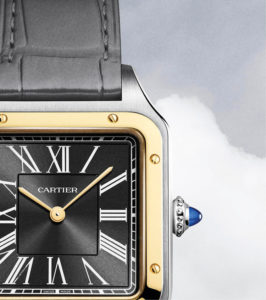
A contoured case and taut lines are some of the features of the watch that are enhanced by this new size. The dial is wide on the wrist and features sword-shaped hands, a sunray finish and a beaded winding crown.
Cartier Métiers d’Art
The Cartier Métiers d’Art watches highlight the excellence and quality produced by the Maison’s artisans. Since 1914 Cartier has been fascinated with the panther, an animal that has been reinterpreted multiple times through the Maison’s jewellery and watches. For the precious Métiers d’Art designs for 2020, the panther is motif is presented again in multiple ways. Straw and gold marquetry are combined with enamel filigree to create these precious pieces, each design requiring the work of craftsmen, jewellers, designers, enamellers, gem-setters and miniature painters.
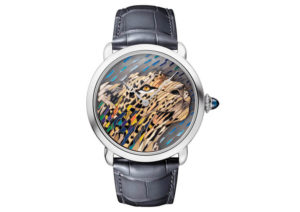
Highly detailed techniques that require hours upon hours of work are used to create these two special designs. The first the Ronde Louis Cartier Straw Marquetry watch was created using the technique of straw and gold marquetry. Seventy-five blades of straw in different sizes and shades, produced in 11 colours make up parts of the dial. The feline’s head is comprised of more than sixty-five elements in white, yellow and pink gold, which are shaped and satin-finished one by one. With an unusual play of meta-exploration, yellow gold wires are embedded in natural straw elements, adding complexity and sophistication that the craftsmen explored for the first time.
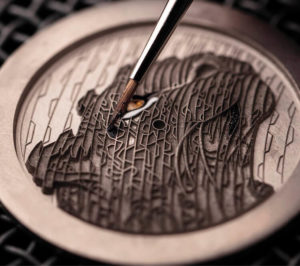
Cartier combines ceramic arts with the art of composition, to which marquetry belongs, by enamelling the spots on the coat and eyes. The rich colour palette contrasts black and white with a large number of shades between opaline and yellow. For the eyes, four different shades come together on a minuscule surface. The gaze comes to life with sparkle, shine and depth, an expression of Cartier’s figurative and realist art. The spots in the background are created with miniature paint.
Brought to life after more than 100 hours, 97 of which are spent on the dial alone, this creation is available in a limited edition of 30 individually numbered timepieces.

The Ronde Louis Cartier Enamel Filigree Watch uses a filigree technique, developed by Cartier’s craftsmen that can be used with enamel. The enamel powder is heated and the glass stretched until it takes on the shape of bamboo, before being set and fixed to the dial by tiny strands of yellow gold. Furthermore, domed champlevé enamel is used for the bamboo in the background and the black spots of the panther’s fur and eyes, as well as miniature painting for the sky. This watch is available in a limited edition of 30 individually numbered pieces.
READ MORE:
Breitling CEO Georges Kern Discusses the Evolution of the Brand
Wilhelm Schmid CEO of A. Lange & Söhne Talks Digitalisation and a Time of Transition
François-Henry Bennahmias CEO of Audemars Piguet On The Exciting Times Ahead
Chabi Nouri Piaget CEO Discusses the Latest Novelties and The Middle East
Piaget has been making watches for more than 145 years, making it one of the oldest watch Maisons in the world.
In 1874, in the small Swiss village of La Côte-aux-Fées Georges-Édouard Piaget set up his first workshop on the family farm at the age of just 19. From that day his motto; “always do better than necessary” has defined the values of the company. The reputation of Piaget watchmaking quickly travelled well beyond its home and Piaget was soon making watch components and movements for some of the most prestigious watch brands in the world. Piaget’s watches have always radiated femininity and excellence, with a desire to dream big, something that has continued through to today.
Fast forward 146 years and Piaget is continuing to celebrate the level of excellence put in place by its founder. By respecting its history but continuing to develop and innovate Piaget has garnered a huge following over the past two centuries. Its business in the Middle East sees it as one of the most beloved jewellery and watch brands in the region. Something that is celebrated by the Maison again and again.
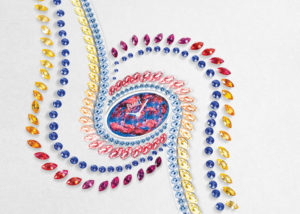
Piaget’s CEO Chabi Nouri understands this market particularly well thanks to her Iranian heritage. A successful woman who worked hard to get where she is today. Nouri joined the Richemont Group in 1998 and after two decades she worked her way up to becoming Piaget’s first female CEO, in fact, the first female CEO in the whole of the group. This huge milestone was not only a personal success but on a global level, it allows Piaget to connect with likeminded women around the world. Here to discuss the heritage of the brand and how it continues to shine through, as well as the new novelties for 2020, we talk to Chabi Nouri.
What can you tell us about the novelties that were launched through the Watches & Wonders Digital platform?
There are many exciting novelties! First of all, this year, we celebrate the Extraordinary with the Limelight Gala novelties. We are launching new models featuring sapphire, diamonds, an aventurine glass dial and Palace Décor bracelet. They perfectly embody Piaget’s craftsmanship. The Palace Décor bracelet takes 8 hours to be hand- engraved and it is done by the same artisan from start to finish to make sure the same pressure is applied and hence the same design can be seen on the full bracelet. In addition, we have created four unique High Jewellery Gala watches. One features an Australian black opal with red hues. It is framed with blue sapphires and a colourful array of yellow and orange sapphires, as well as pink rubies.
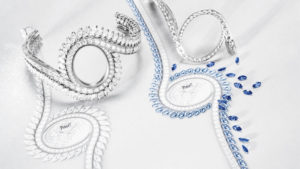
Limelight Gala
And last but definitely not least, we unveiled the Altiplano Ultimate Concept: the thinnest mechanical watch in the world. In 2018, we launched the Altiplano Ultimate Concept, a 2mm watch, the exact same size as the original 9P movement. Except now, it is the whole watch which is 2mm thin. After presenting the concept, we aimed to convert this prototype into a sellable watch. This required us to validate technical solutions and develop new processes. We had to ensure its compatibility to be worn every day in any circumstance. Developing the thinnest mechanical watch in the world truly requires specific knowledge, expertise experience and an innovative spirit. The watch too at least six years of development from the first drawing to the finished pieces as we know it today. We had to completely rethink the construction of the movement, looking for “out of the box” solutions to make the dream come true. Above all, it required an “always do better than necessary” spirit to push the boundaries and never give up. We also wanted to go further by offering to personalize the watch, making it really unique! Thanks to an online app you can visualise our Altiplano Ultimate Concept and chose the colour of the bridges, the screws, the hands and even engrave your initials in a dedicated space on the dial. A real prowess for such a thin watch with components no thicker than a hair.
Of course, the launch was very different this year how do you think this digital platform has been successful in allowing you to connect with your audience?
I am sad we couldn’t meet in Geneva and physically present our novelties but luckily we could digitally unveil all our creations on the Watches & Wonders online platform. Going online actually allowed us to reach to a larger audience and share our passion for watchmaking and creativity with many more people!
What makes a Piaget watch unique?
The craftsmanship and know-how behind it. Piaget has more than 145 years of watchmaking expertise and jewellery know-hows, the combination of both makes Piaget very unique. There is a great fusion between the watch and jewellery worlds at Piaget. The brand has always shared very distinctive creations and celebrated the extraordinary. Piaget shares joy and its creativity enlighten our clients’ personalities.
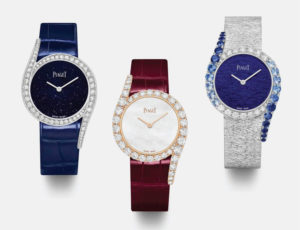
Limelight Gala
What in your opinion are the prerequisites to creating an “Icon” watch today?
An icon should be timeless yet have a strong personality. It should be immediately recognizable. This is why our Limelight Gala watch is iconic. These watches can be passed from generation to generation and still be impactful for every woman. Its strong and sensual design makes the watch very unique.
How important is it to be inspired by Piaget’s heritage in its watchmaking?
It’s very important. Watchmaking is part of our DNA and is at the heart of the Maison. Piaget has been producing watches for 145 years. We have been expressing this art through the development of ultra-thin calibres and other audacious movements. We continue to keep this ultra-thin expertise in mind and continue to push it further. The launch of the Altiplano Ultimate Concept, the thinnest mechanical watch on the market is the perfect example. Every day with our innovations we further build and strengthen our heritage. Heritage is not only the past it is the future.
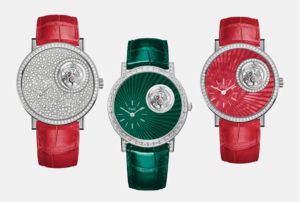
Piaget Altiplano Tourbillon Infinitely Personal
How do Piaget’s watches and jewellery complement each other?
While watchmaking has been our core business since 1874, the Maison started creating jewellery in the sixties, using special techniques and crafts which are still mastered today in our workshops. We are very lucky to have both worlds combined and I believe it gives Piaget creations such a distinctive style, as we are merging the best of both high watchmaking and jewellery crafts. This makes us unique with a strong heritage, giving us the advantage of expertise and experience. We are also expressing the perfect fusion of watches and jewellery through our Jewellery watches. This year we have unveiled the Piaget Polo Emperador skeleton fully paved with diamonds. These are exceptional pieces!
How is Piaget communicating with its customers during this time of when many cannot or are not going to the stores?
We have always been very close to our Piaget family and in these times, we see that distant contacts are very important. We have focused a lot on keeping in contact with our community thanks to the digital world. Our boutiques today are both offline and online and we have always had a strong online presence, so we will continue with that and do everything we can to offer the best digital experience possible.
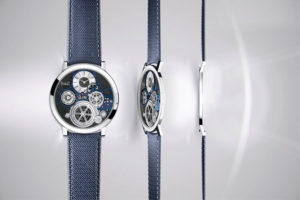
What does the second half of 2020 hold for Piaget?
Even more novelties: watches, jewellery and also our High Jewellery collection, so stay tuned!
Will you be changing any of the strategies of the brand going forward?
We will keep focusing on what Piaget is about: craftsmanship, passion, know-how… we will continue to promote the Maison’s rich heritage: our expertise in ultra-thin watchmaking, our craftsmanship in jewellery and high jewellery continue to push the boundaries of innovation.
What can you tell us about Piaget and sustainability?
In 2019 for the first year ever, we have compensated 100% of carbon emissions. Our global emission has decreased. Our three sites have recycling systems, soft mobility is actively encouraged, thanks to the availability of electric bicycles, electric car parking and participation to public transportation. We continue to reduce, every year our carbon emissions linked to cars. 2019 also marked the beginning of a shift in our plastic consumption. Our principle is to ban single-use plastic whenever possible within the company.
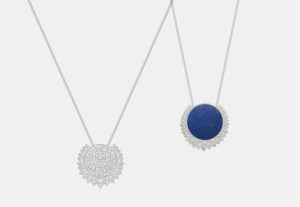
Who is the woman that wears a Piaget watch today?
Women can be whoever they want to be. Characteristics such as inspiring, creative and daring are some of the traits of being a Piaget woman. We celebrate femininity and uniqueness, audacity and self- surpassing. These are some of the values that Piaget embodies.
How important is the Middle East to Piaget and how does the region fit into the brand’s strategy?
Piaget was one of the first Maisons to come to the region. We certainly have a longstanding history within the Middle Each and a very deep-rooted relationship with the people in the region. This makes it a key market and family to us. The Middle East is all about tradition and innovation which is also part of Piaget’s DNA. We have indeed had a very strong emotional connection with the region for 60 years, where Piaget has been part of so many important family moments and celebrations.
What can you tell us about the project that Piaget has recently done at Al Ula?
As we have always had a very strong and deep-rooted relationship with Saudi Arabia, it was very dear to our hearts to be able to connect with our clients in the Kingdom of Saudi Arabia. Although Yves Piaget has been going to Saudi since the sixties, it was my first time, and it was absolutely breathtaking and definitely one of my most memorable trips to date.
We partnered with a spectacular project that links beautifully heritage, culture and creativity, Winter at Tantora in Al Ula. This unique long term partnership celebrates the same values and the spirit of bringing people living the Extraordinary!
We launched exclusive pieces that were seen for the first time at Winter at Tantora, such as the Sunlight Pendant in Lapis Lazuli which was inspired by the breathtaking starry sky of Al Ula during night time, as well as the radiant fully-paved Sunlight pendant. It was my last trip before this crisis and it has kept me dreaming until today, just a spectacular experience. I hope to be back soon.
What is the professional motto that you’re living by at this time?
The Maison’s motto: Always do better than necessary accompany us since the beginning and continues to push our creativity and inspiration. And in these times the family spirit of Piaget is more important than ever.
READ MORE:
Breitling CEO Georges Kern Discusses the Evolution of the Brand
Wilhelm Schmid CEO of A. Lange & Söhne Talks Digitalisation and a Time of Transition
François-Henry Bennahmias CEO of Audemars Piguet On The Exciting Times Ahead
Breitling CEO Georges Kern Discusses the Evolution of the Brand
Breitling recently unveiled its latest novelties during its first-ever Summit Webcast.
Breitling CEO Georges Kern hosted the event and began by addressing the current coronavirus crisis with a clear message of hope and looking forward to better days. He says: “There is a light at the end of the tunnel concerning the coronavirus. Many countries have reopened their stores already and we are expecting more to reopen very soon. I’m confident that the situation will positively evolve, even though it will take a while for the traffic to come back to our stores, as many people have been staying at home, there will be more disposable income and hopefully, customers will spend their money on Breitling!”
Since joining Breitling, Kern has completely transformed the brand. In his words, Breitling has seen a “revolution”, with a whole new product offering, new segmentation, new advertising campaigns, new stores, new sports alignments and a completely new message. Kern’s vision is for Breitling to be a “less formal, more approachable brand that is much younger, cooler and more dynamic.” He has minimised the number of watches on offer to make it clearer and simpler for customers while ensuring that each customer’s needs are met. To do this he introduced the concept of “Air, Land and Sea” brand universes and the Breitling collections are divided among these three categories.

While many stores are still closed globally, the new watches can already be purchased online. “As you know we have introduced e-commerce in the US and in Asia, including China, and we will soon launch in Europe, but in addition, the products are also available on the retailers’ e-commerce sites. I think a lot of businesses have seen a strong digital acceleration during the lockdown,” says Kern. “Before I took over at Breitling, the brand was not digital at all, so this is something we have been pushing a lot. I think this moment is a milestone in terms of the digital transformation of everyone. We have a home office, we have video conferences and digital summits, and we have also seen sales dramatically increase online. But offline will always be the main platform for us. People want the physical 360-degree understanding of the brand, but the share of online sales will most certainly increase. Will it go up to over 10 per cent? We will have to see. But I do think physical retail will remain number one. Humans are social, and they like to see, communicate and experience, and while digital can replace a lot in the decision-making process, in the buying phase, the act of visiting physical stores will remain huge.”
So even during store closures, it was crucial for Breitling to continue to raise awareness of its latest novelties and look to the time in the future when customers return to the stores to buy these products. “I believe that after Covid-19, things will be very different from before Covid-19,” Kern says. “I think that consumer behaviour will change. Luxury is evolving and many things that we have been introducing for the past two years, including our expression of inclusive luxury, being a relaxed brand, being more informal and meaningful, will become even more important in the future. Cool brands of the past might not be cool brands in the future and vice versa. I think we had a very good development before the coronavirus and because of our values and our change of image, this will continue in the future.”
Breitling is looking forward to a successful second half of 2020 and there are many more exciting novelties in the pipeline. “What we’ve been working on for the past two years is simplifying the product lines and making the collection readable,” says Kern.
The Novelties
The Breitling Chronomat

The Chronomat was first introduced into Breitling’s offering in 1984 and now, almost 40 years later it has been redesigned with a modern appeal, inspired by the original. Georges Kern says, “I think that the Chronomat is the perfect product.” The new Breitling Chronomat is an all-purpose sports watch that can be worn from day to night. It recalls the design of the 1980s and features a replica of the eye-catching Rouleaux bracelet from the past. The iconic strap comes with a butterfly clasp that expresses a modern-retro style. This watch introduces a new generation of chronograph timepieces at Breitling thanks to its versatility and stylish appeal meaning it can be worn for every occasion.
Every Chronomat in the collection has a signature rotating bezel highlighted by rider tabs that not only protect the crystal but make the manipulation of the bezel easier. The rider tabs at 3 o’clock and 9 o’clock, true to the original, are interchangeable, so the wearer can use them either for a “count up” or “count down” function.
There are several materials and colour offerings available. The first has a 42-millimetre stainless-steel case with a choice of a silver, copper, or blue dial with black contrasting chronograph counters. It is also available with a black dial with silver contrasting chronograph counters.

The Chronomat Bentley celebrates Breitling’s partnership with the great British luxury car brand. It has a 42-millimetre stainless-steel case with a green dial and black contrasting chronograph counters. This watch features a “BENTLEY” engraving around the transparent sapphire caseback. The Chronomat Frecce Tricolori Limited Edition has a blue dial featuring tone-on-tone subdials and the Frecce Tricolori logo on the dial. This is limited to 250 pieces.
Those looking for something that extra bit special can opt for the Chronomat B01 42 fitted with an 18k red gold crown and pushers and a bezel with 18k red gold rider tabs, numerals, and indexes. This model has a silver dial with silver tone-on-tone subdials and a 42-millimetre stainless-steel case. Another striking two-tone Chronomat features either an elegant blue dial with tone-on-tone chronograph counters or anthracite dial with black contrasting chronograph counters. It is highlighted by an 18k red gold ratcheted unidirectional rotating bezel and an 18k red gold crown and pushers. And last but not least, the Chronomat B01 42 comes with a striking 18k red gold case presented on a black rubber strap with an 18k ed gold folding clasp. It has an anthracite dial with black contrasting chronograph counters.
The watches are powered by the Breitling Manufacture Caliber 01, an in-house mechanical movement that delivers a power reserve of about 70 hours. The hands of every Chronomat B01 42 are coated with Super-LumiNova®, a luminescent material that enhances legibility in all lighting conditions. All of the models except for the Chronomat Frecce Tricolori Limited Edition have a red chronograph second hand, which also contributes to easy readability.
The Breitling Navitimer Automatic 35
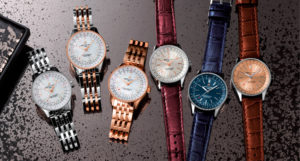
Historically Breitling’s offering of women’s watches has been hugely successful but it has been a while since they introduced a full line dedicated to women, so this is an incredibly exciting launch. The Breitling Navitimer Automatic 35 timepieces are designed for the cosmopolitan woman. This elegant 35-millimetre design is understated and stylish but doesn’t compromise on functionality. George Kern explains: “I think the Navitimer 35 is something special. The dial has a very beautiful, wide opening and it is unique because of the pearl bezel which is inspired by the Navitimer of the 1960s. We have also dramatically simplified the dial while, at the same time, retaining the watch’s identity We decided we needed a characteristically feminine watch, with mother of pearl, diamonds etc. in bicolour.
The collection has a stylish solution to suit any taste. There are four different versions, each powdered by the Breitling Caliber 17, which delivers a power reserve of about 38 hours. The first is offered with a 35-millimetre stainless-steel case with a choice of a blue dial presented with a blue alligator leather strap, a copper dial with a brown alligator leather strap, or a silver dial with a burgundy alligator leather strap. The straps feature a pin or folding buckle, and each version of the watch is also available on a stainless-steel Navitimer bracelet with a folding clasp.
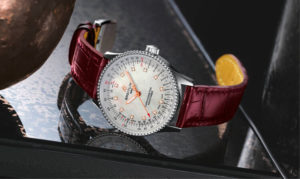
The second version also features a 35-millimetre stainless-steel case with a white mother-of-pearl dial and diamond hour markers. It has a burgundy alligator leather strap with either a pin or folding buckle and is also available with a stainless-steel Navitimer bracelet with a folding clasp. The watch is also available in two-tone with a 35-millimetre stainless-steel case and a luxurious 18k red gold bidirectional rotating bezel. Its white mother-of-pearl dial is highlighted by diamond hour markers, and the watch is presented on a brown alligator leather strap with a pin buckle or folding clasp or a two-tone Navitimer bracelet in stainless steel and 18k red gold with a folding clasp. Lastly is the Navitimer Automatic 35 in 18k red gold with a white mother-of-pearl dial and diamond hour markers. This striking watch is delivered with either a brown alligator leather strap with an 18k red gold pin buckle or folding clasp or an 18k red gold Navitimer bracelet with a butterfly clasp.
But this is just the beginning for a new generation of women’s watches at Breitling says Kern: “What we want to do with our market coverage is to offer outdoor watches with the Superocean; within that line, the white dial is our number one reference. We introduced the Navitimer 35, which is more elegant, and there will be another product launch by the end of the year. Finally, we will have a beautiful setup that we need to attract more women to the brand. Right now, the women’s market does not yet represent a big share for us, because we had no product offering. We are looking forward to increasing that share in the years ahead.”
The Breitling Superocean Heritage 57 Capsule Collection
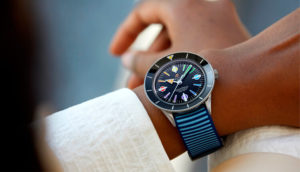
The new Superocean Heritage ‘57 Capsule Collection is for those who like to express a cool, laid-back style. Inspired by the cool mood of the fifties and sixties, this capsule collection is produced in a limited number of pieces for a limited time. Each watch in the collection is a modern retro interpretation of a classic sea watch that embodies the laid-back lifestyle associated with surfers and beachcombers. “In a digital age and in a time when people are feeling insecure, having strong roots in the past but being modern is crucial. The Superocean Heritage ‘57 is super modern, even though it is a product of the fifties,” says Kern.
The collection is available with two dial options. One has a classic black dial and is presented on a black vintage-inspired leather strap with a pin buckle or folding clasp, while the other has a blue dial and is equipped with a brown vintage-inspired leather strap with a pin buckle or folding clasp. Both are also available on a stainless steel bracelet. There is also a two-tone version featuring a bidirectional rotating bezel in 18k red gold with a black ceramic ring. The timepieces in the Superocean Heritage ’57 Capsule Collection are powered by the Breitling Caliber 10, which offers a power reserve of approximately 42 hours.
The Superocean Heritage ’57 Limited Edition

The Superocean Heritage ’57 Limited Edition shares some unmistakable design DNA with its cousins in the Capsule Collection, but it takes its cool credentials a couple of steps further. This watch is all about colour and features a rainbow-style colouring on the dial.
The hour markers and the hour and minute hands are coated with Super-LumiNova® in a rainbow gradient of yellow, green, blue, indigo, violet, red, and orange. This makes the watch particularly easy to read in a range of lighting conditions.
Your Limited Edition can be matched to a vibrant Outerknown ECONYL® yarn NATO strap, which can be purchased separately in one of six colour combinations: blue with dark blue stripes and lining, light blue with dark blue stripes and lining, yellow with orange stripes and lining, grey with black stripes and lining, red with black stripes and lining, and green with black stripes and lining.
READ MORE:
François-Henry Bennahmias CEO of Audemars Piguet On The Exciting Times Ahead
The Buccellati Family on Italian Values and the Heritage of the Jewellery Brand
